




Abstract
This article aims to draw attention to a body of research that is now more than two decades old in Spain: the workings and composition of local government under the dictatorship of General Francisco Franco. Recent research into provincial governments, city halls, and provincial and local Assemblies of Spanish Traditionalist Phalanx of the JONS (Falange Española y Tradicionalista de las JONS, FET-JONS) during the Spanish Civil War and first period of Francoism from 1936 to 1950 can contribute greatly to wider discussions on fascism in Europe and redress how historians of fascism have sidelined Francoism despite its longevity and unique characteristics. This article argues that by defining parafascism in its own right, by what it was rather than what it was not, and by defining fascistization as a dynamic process, studies of Francoism at the local level can fill a gap in debate on generic fascism and help to construct a decentralized transnational history of fascism, parafascism, and conservatism. 1
In 1998, Roger Griffin attempted to distil the precise meaning of fascism in the academic literature on the subject. Griffin merged scattered definitions and argued that fascism was a state ideology that promised a desirable lifestyle. Though his work was criticized, his definition nevertheless gained support throughout the 1990s and revitalized the study of fascism from a comparative perspective. He made it possible to define fascism as ideology, to place it within the history of ideas and to study it from a cultural perspective. A clear definition of fascism as ideology, whether Griffin’s populist palingenetic ultranationalism or later Roger Eatwell’s social rebirth based on a holistic-national radical third way, helped to identify examples of fascism across countries and time and to contrast them. At the same time, to delimit fascism meant to exclude cases that were similar but did not quite meet the precise definition. Vichy France, Francoist Spain, and Metaxasist Greece, for instance, failed to meet the criteria. Strictly speaking, those regimes were cases of parafascism and not fascism. 2
Criticism of the 1990s Griffin consensus focused on the idealism and ahistoricism of research. Robert Paxton argued that it treated fascism in isolation and failed to understand how it changed and evolved in relation to other political movements. In reference to the cultural history of Italian fascism, Richard Bosworth maintained that the consensus centred heavily on the hyperbole of political leaders and isolated mass acts, but said little about how everyday Italians regarded Mussolini’s dictatorship and dealt with fascism. 3
Aristotle Kallis argued that the Griffin consensus and its critics produced two broad, opposing outlooks. The first highlighted the intellectual and cultural history of fascism as a coherent system of ideas across countries and time; the second highlighted the social and political history of fascism as concrete lived experience under dictatorial rule from 1914 to 1945, a period of extended civil war in Europe. The problem with this division was that it assumed that the two outlooks were mutually exclusive, that ideas about fascism that guided one approach could not be useful to the other and vice versa.
Although it is early to speak of a new consensus, a mixed approach has replaced the old dichotomy. Yet while improved, it too has overlooked the role played by parafascism. The work of historians to define fascism in Germany, in Italy, and in select political milieus – to consolidate the Phoenix – has fostered a growth of comparative studies on fascism in Romania, England, Sweden, and elsewhere, but has turned parafascism into a conceptual ragbag, a thousand-headed beast, the Hydra of Lerna.
4
Historians have not defined parafascism by what it was, positively, but by what it was not, negatively. The following is taken from Griffin: [T]o a greater or lesser extent, a number of autocratic conservative régimes deliberately aped some of the superficial aspects of the Fascist and Nazi apparatus and style of power … In these cases, although the façade of national regeneration was maintained, the State, as the representative of the interests of the traditional ruling hierarchy, repressed rather than encouraged those aspects of fascism which it rightly saw as life-threatening, such as the mobilisation of populist nationalism, the emergence of new élites through a genuine social revolution, or the diffusion of a heroic, tendentially pagan world view incompatible with the strictures of Christian orthodoxy.
5
Whether Francoism was fascist, conservative, or authoritarian was a discussion that went back to the 1970s and figured prominently in the new scholarship of the 1990s. Though historians could not agree on a common understanding, many sided with the view that Francoism was a form of fascistized dictatorship. Ismael Saz agreed with Griffin’s analysis but emphasized two aspects that Griffin did not develop in depth. The first was to see fascistization as a roundtrip. Emilio Gentile holds that what Nazi Germany and especially fascist Italy showed was that fascists did not seize power and instantly disseminate fascist ideology, but rather that they introduced it piecemeal through a mythic liturgy of permanent revolution. The speed of the process could be adjusted, stopped or even reversed, as the parafascists or fascistizing dictatorships proved. The second was to argue that fascistization influenced the non-fascist right, which once fascistized won many of the Franco regime’s early internal fights. Through Saz, many historians stressed the fascistization of non-fascist conservatives and distinguished the frequently opposing aims of fascists, conservatives, and those who had been fascistized. They emphasized that a conflictive conservative coalition sustained the dictatorship; Francoism was built upon the defeated fascist party and ‘the success of clearly fascistized sectors of the traditional elite’. 7
In the 1990s, with the advent of scholarship on political repression, the role of gender, popular opinion, and on the effects of autarky on daily life, focus was also given to local institutions and politicians. Local histories sparked debate on how Francoism transformed political elites and whether elites broke from or joined the Franco regime. Broadly speaking, the scholarship of the debate could be divided into two schools of thought: rupturist and continuist. The rupturist school argued that local Francoist institutions created new elites and mimicked fascist countries in how they organized local government. The continuist school argued that traditional elites and their clientelar networks shaped local powers and submerged themselves within a state patronage system that was headed by a unified national party. The former viewed Francoism as fascist and the latter as conservative. 8
Though the debate generated independent empirical data, it was little more than a twist on the larger discussion on the classification of Francoism. The rupturist–continuist debate was counterproductive because, first, it obsessed over Spanish historiography on Francoism and developed ‘a high degree of intellectual autarky in conceptualizing fascism’, as Griffin put it. In other words, the debate fattened out rather than grew up. Second, the debate glutted the field with descriptive studies, whose apparently objective research into local realities aimed to bolster a collective narrative, but instead fragmented it into regional focuses. If previously the hydra had a few heads, it now had as many heads as regions of Spain. Third, the most structuralist studies referenced copious amounts of quantitative data on the Spanish Traditionalist Phalanx of the JONS (Falange Española Tradicionalista de las JONS, FET-JONS) drawn from the archives of city halls, provincial governments, and FET-JONS branch offices. 9 This static statistical approach tended to equate Francoism to German and Italian fascism. It argued that like fascist Germany and Italy, Francoist Spain depended on local coalitions of conservatives and interclass sectors such as the peasantry, whose historic mission was to quash reformists and to oppose revolutionary social movements. 10
Instead, Antonio Costa Pinto argued that fascism and parafascism differed in how they perceived political power, saw government in relation to the single party, and viewed the link between the party and society. Kallis agreed with Pinto, arguing that: the crucial factor is to what extent the fascist component emancipated itself from the initial predominance of its traditional conservative sponsors and to what degree it departed – once in power – from conventional forms/objectives of policy-making towards a more radical direction.
11
In The Nazi Seizure of Power: The Experience of a Single German Town 1922–1945, William Sheridan Allen examined the importance of the local level to the Nazi Party. Allen assessed the party’s strength and the causes for its success by the late 1920s, namely that national leaders permitted provinces to act independently, in effect constituting a movement from below. The strategy was so successful that by 1930–2, half of the Nazi membership in provinces came from towns with populations of less than 10,000 people. Rudy Koshar agreed that ‘small and middle-sized communities were crucial to Nazi success’. Top-down political history dominated Spanish historiography of fascism for decades and microanalyses like Allen’s and Koshar’s were rare. Not until the early 1990s did analyses of Francoism in provinces appear, and then grow exponentially. These offered up valuable data on the Spanish Falange (Falange Española, FE) and the FET-JONS, yet their attitudes about the regime influenced their understanding of the party. In many instances, interpretations were pessimistic and projected features of the dictatorship – its archaism, Catholicism, and race policies – on the FE-JONS. 13
The shift of interest in the 1990s forked into two branches. A branch focusing on cultural and intellectual history demonstrated that a wide variety of illiberal political cultures, including a modern, palingenetic, secular version of fascism, influenced Francoism. From 1936 to 1939, it was still possible to separate fascist ideology and national Catholicism. Zira Box argued that while the former was a political religion, a secular faith in the rebirth of the nation, the latter was politicized religion, a sacred redemption with God as canopy. For national Catholics, nation and God were inseparable; the nation had to be ‘subordinate and absolutely loyal to God’. Both the role of the institutional Church and of Catholics in the regimen highlights the politization of religion, a phenomenon that some authors have called clerical Fascism. However, in the last years there has been a growing acceptance of the idea that Francoism included both aspects – a Fascist political religion and a National-Catholic politicised religion – in which the first became increasingly irrelevant. 14
The other branch focused on a sociological understanding of Falange membership in cities and towns. If the cultural-intellectual branch showed that there was a strong affinity between Spanish and European fascism, studies by José Antonio Parejo and others showed that pre-war recruitment into the Falange occurred similar to elsewhere in Europe. FE-JONS swelled during the Popular Front’s electoral victory in 1936. In Seville between the February 1936 elections and the July 1936 coup d’etat, the number of Falangists doubled. Seville was the severest case, however membership rose throughout Franco-held Spain from the start of the Civil War (see Figure 1). Far from a party of the well-heeled, the FE-JONS comprised many classes, including workers, day labourers, and peasants (see Figure 2). In both rural and urban areas, interclass support grew in 1936, with a slight tilt towards upper-class support in urban centres (see Figure 3). Richard Hamilton claims that the dynamic was similar in Germany.
15
Growth in Falange and FET-JONS membership, rural Majorca, 1934–9. Socio-occupational breakdown of the FE-JONS in rural areas, 1936. Socio-occupational breakdown of FE and FET-JONS in urban areas, 1936 and 1939.
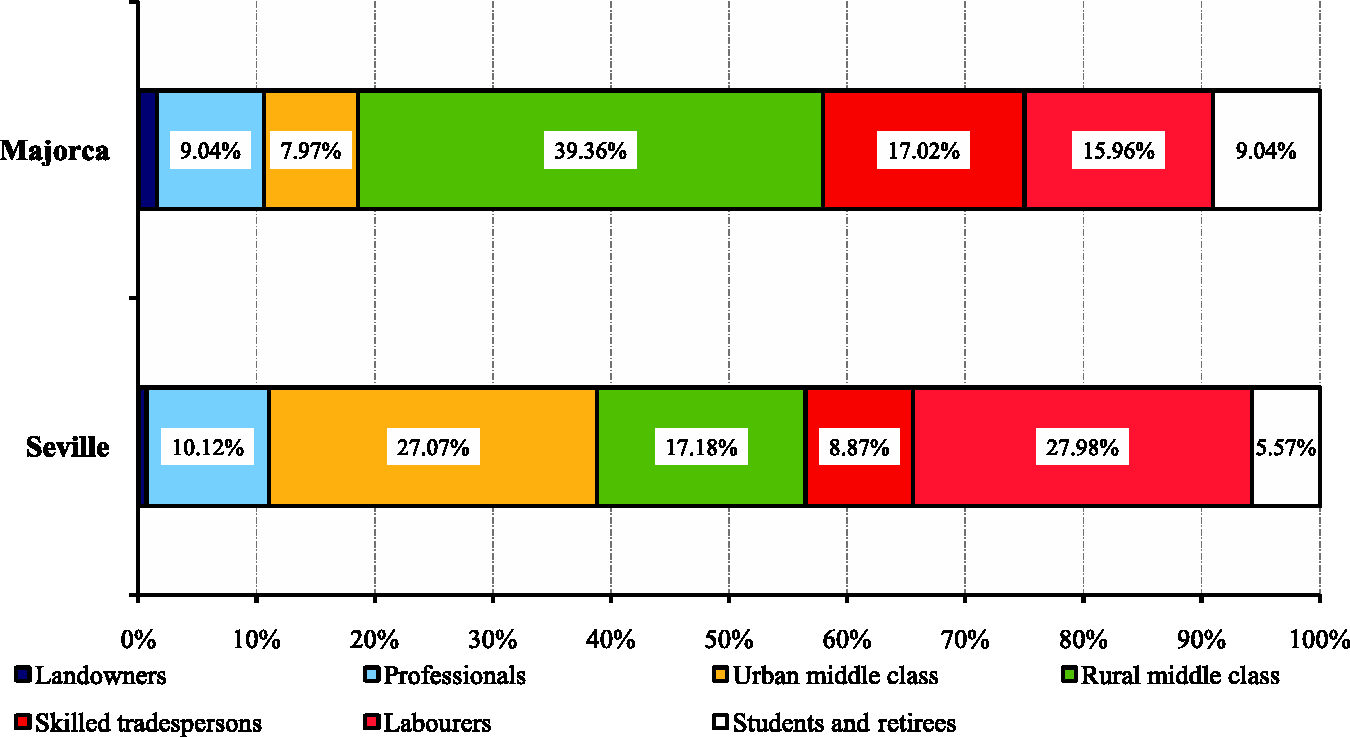
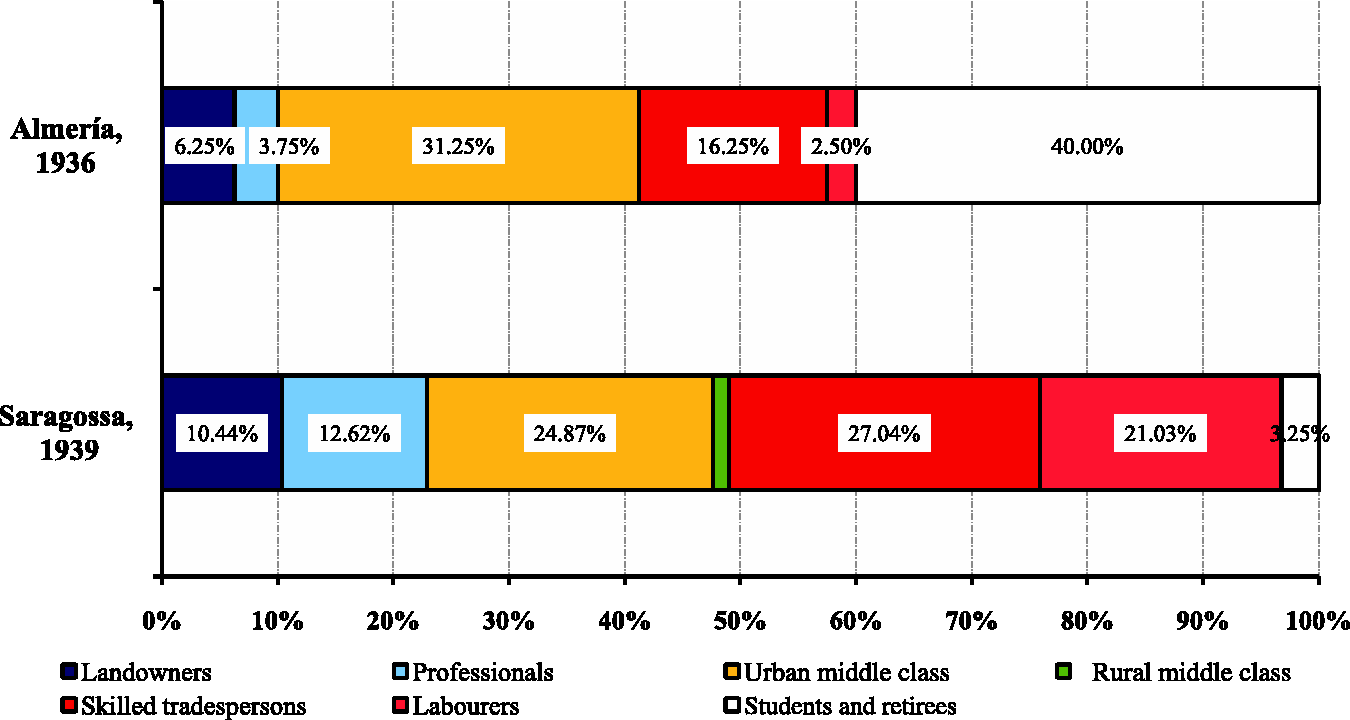
These statistics raise doubts about the apparent peculiarities of Spanish fascism and demonstrate that the FE-JONS was on course to becoming a weighty organization in the Second Spanish Republic. However, a close look at the numbers shows that FE-JONS growth from February to July 1936 was unequal across Spain. When the Popular Front government outlawed the FE-JONS as a party, the party went underground and concealed its records, severely straining quantification of FE-JONS activity in that period. In Palencia, for example, the FE-JONS spread into 40 towns but comprised, officially, only 450 members. The figures for Málaga were similar. In Cantabria where fascism took root in the agricultural sector, the city of Santander had 600 Blue Shirts, or Falangists. The numbers in these provinces were far from the numbers in Seville, while in other provinces, such as in Ciudad Real, the FE-JONS scarcely existed. The statistics also show that despite FE-JONS growth in universities and other middle-class realms, the growth of FE-JONS support in Spain, as in Portugal and Romania, drew on deep patronage networks and clientelism. Carlos Gil Andrés estimated that in La Rioja, just a few hundred Falangists sustained the movement and that their strategy of mobilization and expansion mirrored the traditional war cry of nearby Álava and Navarra. All told, the FE-JONS expanded across Spain, but not enough to constitute a movement from below that could destabilize the political order and force the traditional elite to capitulate. On the contrary, the traditional elites conducted a military coup d’état whose failure resulted in a bloody civil war. 16
The war changed everything. The first few months of it saw horrifying bloodshed in the rearguard of both Republicans and Nationalists and radically altered political values. In Nationalist-held territory, the FE-JONS swelled into a mass organization whose support across the country was highly uneven (see Figure 4 and Table 1). In 1940, most Falange members came from traditional Carlist areas and from where combat was starkest. The civil war fascistized conservatives.
FET-JONS in provinces, 1940–9. Membership as a percentage of the provinces’ total populations. FET-JONS in Provinces (1940–9) Source: AGA (General Archive of the Government), Presidential, DNP 51-20509 and 51-20742 to 51-20752 and INE (National Statistics Institute) census data, 1940 and 1949. Created by author.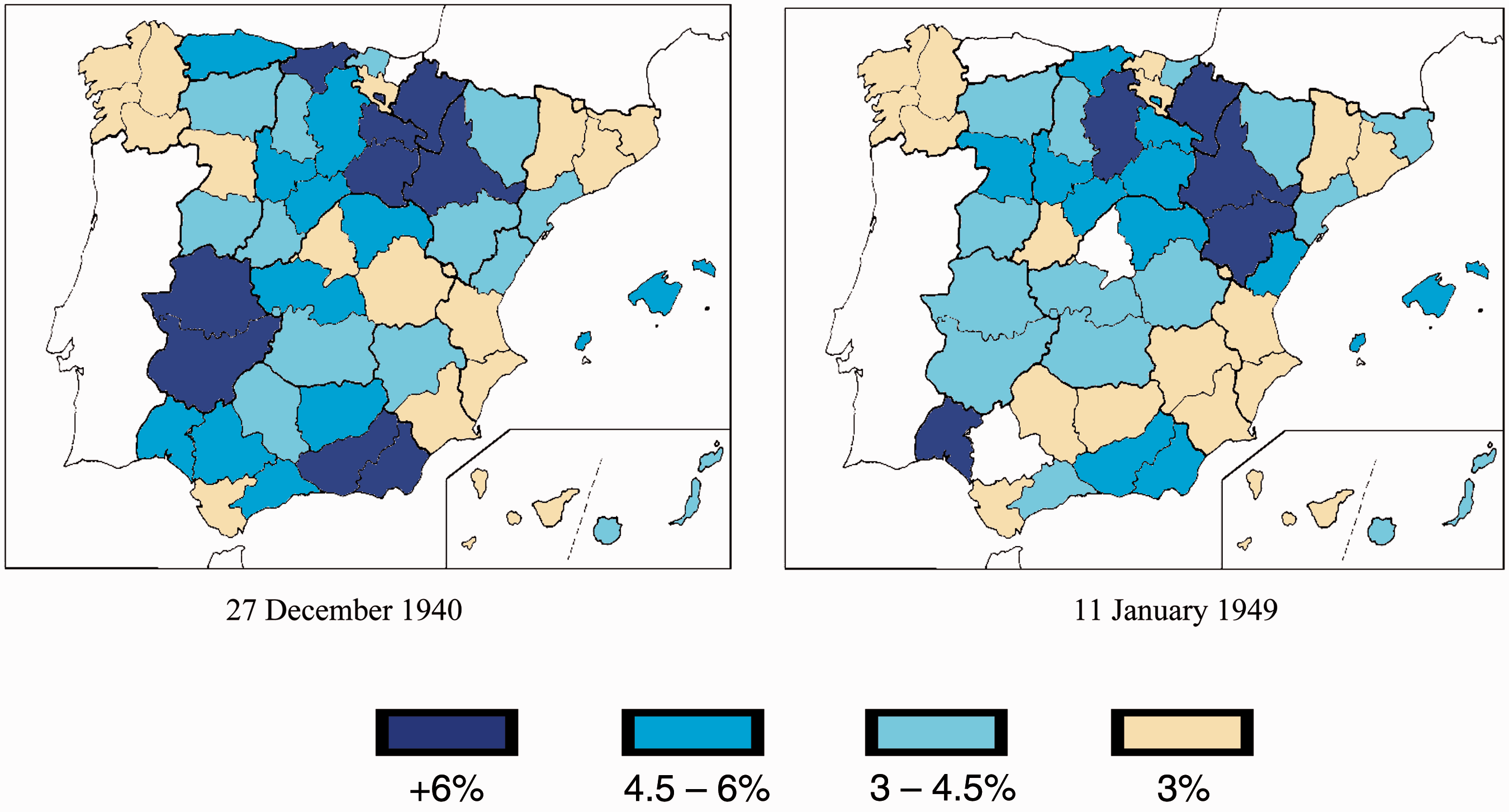

Nationalist concerns centred on the Civil War as a religious crusade and on one leader, Franco, as the Generalissimo and Caudillo of the Nationalist movement. Franco seized control of the military and asserted his political supremacy. In December 1936, he issued a decree to militarize Nationalist militias, and on 19 April 1937 he issued a second decree to rally Falangists and traditionalists under a single organization that he controlled, the FET-JONS. Although the unification of the two groups was a tactical success, in reality they did not always get along. The FET-JONS were more a state party than a fascist movement. In 1941, the provincial leader for Navarra, a mostly traditionalist province, described the local membership as follows: Even though they are loyal to the Organization, they don’t forget their previous ideology, which they believe is integral to our unification. They choose not to follow some of the things we respect … They treat the Party with respect, but without love. They act loyally … but nothing more.
17
Dionisio Ridruejo maintains that the unification of the FET-JONS was a coup d’etat in reverse. With a hint of irony, this view holds that a quick invasion of the state by the single party was how fascists, naturally, seized power. Though the March on Rome and mass rallies in Nuremberg were long in gestation and complicated affairs, perceptions of these events as automatic or inevitable have fuelled the argument. Yet in Germany and Italy, conservatives and fascists first aligned and found ways to coexist before fascists seized power. In Germany the process was quick, and in Italy it was slow. In Portugal, similarly, conservatives and fascists aligned during the military dictatorship of 1926 to 1933, though the Estado Novo repressed and selectively incorporated the fascists. In Spain after April 1937, Falangists pushed to accelerate the state’s fascistization, however it was not until the end of the Civil War that the real struggle took place, especially at the local level and in the areas of culture and propaganda. 19
German and Italian fascism differed in many ways. In Germany state fascistization occurred over months, while in Italy it was built up over years. In Germany the Nazi Party superseded the state, while in Italy it was the other way around. Emilio Gentile has argued that even during Italy’s peak totalitarian acceleration in the 1930s, the state overruled the Italian National Fascist Party (Partito Nazionale Fascista, PNF). Italian fascism can be divided into two rival tendencies that animated the project: a fascisticizing/authoritarian tendency that held sway in the 1920s and a fascist/totalitarian tendency that prevailed in the 1930s. A similar dynamic was evident in other European countries. Julie Thorpe contends that Austria was a fascist dictatorship because it gradually fascistized conservative politicians and policies in education, propaganda and national identity. Portuguese historians maintain that António de Oliveira Salazar mildly fascisticized Portugal in the late 1930s and early 1940s. A number of historians claim that Spain was fascist from 1939 to 1945. Fascistization in Spain was managed by the national government and was noticeable in legislation and in the creation of such organizations as the Youth Front (Frente de Juventudes) and the Welfare Service (Auxilio Social) until 1941, when the government interrupted the process. The Spanish dictatorship hindered political solutions at the local level that aimed at fascistization, and buried corruption and traditional patronage networks within the state and single party. 20
Those who hold that local Francoist power was fascist point out that cities and towns lost electoral representation and were subjected to centralist, interventionist policies in economic and administrative affairs. This undermined the influence of local elites, as it did in Italy as well. Yet centralization and a lack of electoral representation also occur in other forms of political dictatorship and do not equate to fascistization. Phillip Morgan shows that in many instances fascists were not centralists. Authoritarian conservatives and even liberals, as French Prime Minister Édouard Daladier exemplified in 1939, also adopted centralist measures. Indeed, historically centralism has had more to do with administrative traditions and political contingencies than fascism. Depending on how centralism was applied, it could slow or even stop fascistization. 21
Despite the strongly homogenizing tendencies of the Nazis, their administration of the ‘inferior peoples’ to the east contrasted starkly with how local institutions were managed in the Netherlands, France, or Norway. Nazi policy in Western Europe also changed depending on Nazi Party respect of conquered peoples, whether the party viewed the territory as Germanic, how it fit in to the new Nazi order, and how generally the military occupation played out. Alliances with the Nazis and the rifts that they produced created highly differentiated situations. In Luxembourg, the Nazis imposed a system of local administration that mimicked Germany’s as a preliminary step towards annexation. However in Norway, the Nazis remained more aloof and shared executive power with Minister-President Vidkun Quisling, whom they empowered to interpret legislation in accordance with local medieval traditions. 22 Austria and Luxembourg were unique, albeit similar, cases. In Austria as a result of the Anschluss and proximity to Germany, the Nazi Party played a more active role in local life than in Germany. Similarly in Luxembourg, Nazi Party members acted with great freedom at the local level despite difficulties recruiting native Luxembourgers to occupy civil service positions. In Germany, Nazi permissiveness of local autonomy was contingent upon a faithful implementation of Nazi policy at the local level and broke down in 1935. In areas the Nazis considered Germanic and had targeted for Nazification, local Nazi Parties were bolstered by Berlin. 23
In other collaborationist regimes and in the dictatorships of southern Europe, fascist parties were less prominent at the local level. Nico Wouters argues that Belgium was an intermediate and paradoxical case. Though the Flemish National Union (Vlaamsch Nationaal Verbond, VNV) was strong in Flemish Belgium, the Belgian fascist party, the Rex, was weak throughout Belgium. Neither party positioned itself as a catalyst for Nazi change. What the Nazis did instead was fill city halls with new recruits from both parties early on, before 1940. The war then distanced local institutions from the Belgian national government and the Nazis pushed through key policies by negotiating directly with the provincial and municipal levels of government. In Belgium, fragmented, decentralized power played into the hands of the Nazis. The Nazis merely substituted old mayors with Rex and VNV members. Far from homogenizing the occupation, the Nazis increased Belgium’s decentralized structure. Conversely, strict hierarchical rule in France hindered the efforts of Germanophiles in the first few months of Vichy. Thanks to a traditional preference for centralization, regional prefects could obstruct local fascists even if cities’ reduced scope of action limited the effectiveness of prefects. These general (lack of) reforms of local government, led to two distinct specific contradictions in both countries: in Belgium, the policy of centralisation only increased localisation, while in France the policy of trying to reduce municipal government to a purely executive administrative level only served to decrease its efficiency.
24
In northern Italy after the March on Rome, the PNF managed to win the support of strategic organizations and leaders, even if they questioned Benito Mussolini’s dominance on occasion. At first, Mussolini shared power with conservative elites. He used the PNF to destroy Italy’s old liberal class and then empowered the civil service and prefecture to crush resistance from radicals in the party. Though conservatives dominated prefectures in the 1920s, the national party secretary between 1926 and 1930, Augusto Turati, forged an entente between the PNF and state at the provincial level. However, this situation changed gradually in the 1930s. ‘On the ground, the restoration of the authority and prestige of the prefects was only made possible by the massive reshaping of the membership, cadres, organization and methods of the provincial party by Farinacci’s successor, Augusto Turati’. 26
Rather, in Germany the Nazi Party wiped away the old Bismarckian system and foisted in its place a volatile, polycratic regime that tended towards radicalism. Between 1933 and 1935, the party and state were blurred, with the party, if anything, predominating slightly. Anthony McElligott contends that Adolf Hitler used the German civil service and traditional bureaucratic elites to prevent excessive decentralization. Richard Evans points out that Hitler installed a strict hierarchy that did away with Weimar’s organization of local institutions, but preserved a certain level of autonomy inherited from an older tradition of federalism. In any event, the Nazi Party overruled state authorities in the daily lives of towns and neighbourhoods, even if civil servants effectively ran regional institutions. Often struggles were not between Nazis and conservatives, but between different centres of power within the party. 27
In Portugal, meanwhile, the civic body that worked to unify Salazar’s supporters, the National Union (União Nacional), recycled traditional elites and placed them in a party overlooked by the state and the state’s district representatives. The organization of local institutions under Salazar and the National Union resembled more the model of Miguel Primo de Rivera, Franco’s dictatorial predecessor, and his Patriotic Union than Franco’s rule. Unlike Franco, Salazar distanced fascists from power and repressed the most militant groups. Franco bequeathed the Falange positions of influence, powerbases, and operational space in which to manoeuvre. Salazar granted none of these liberties to the Portuguese National Syndicalist Movement (Movimento Nacional-Sindicalista), though he did empower the Portuguese Legion (Legião) and Portuguese Youth (Mocidade). 28
Norway under Nazi occupation mirrored the situations in Spain and Portugal. Hitler made the weak National Unification (Nasjonal Samling, NS) Norway’s dictatorial party and supporters from a variety of other parties quickly swelled its ranks. Though Nazi laws in Norway did not require mayors to be members of the NS, the Ministry of Interior gradually filled keys posts in city halls with NS members beginning in 1941. Though most appointees were not members of the NS prior to the occupation, they were recruited on the basis of administrative skill and experience. When NS radicals conflicted with mayors, as they did frequently, their complaints were routinely ignored by governors and party comrades. 29
Local conflicts spread like wildfire across postwar Spain. Generally, the most pitched battles occurred between FET-JONS provincial leaders and provincial governors over the designations of city hall staff. Provincial governors held the upper hand in this because they alone could appoint staff. As with the NS in Norway, the FET-JONS could only advise. Since the military and old-guard politicians were appointed as governors throughout the Civil War until early 1939, FET-JONS protest surfaced early on. Indeed, provinces overlooked FET-JONS interests to such an extent that during a moment of tension between the two forces, the Ministry of Interior was compelled to issue a circular urging governors to warn FET-JONS leaders of potential sanctions of high-ranking party supporters before the governors took action. The ministry wanted the FET-JONS to discipline internally before it risked doing damage to its public reputation. 30
Historians since then have interpreted the power struggle as a fight of the FET-JONS against the traditional right. The FET-JONS strategy bore a close resemblance to the fascist attack on mayors as moribund, corrupt, and inefficient in Belgium. The FET-JONS provincial head of Alicante reported a number of mayors for obstructing the party’s activities and demanded that irregular appointments to executive bodies (comisiones gestoras) be replaced. When his protest was met with silence, the Falange denounced grave irregularities in the supply chain and generally stepped up criticism. In cacique-dominated Aragon, governors and Falange leaders clashed fiercely in Zaragoza and Teruel over FET-JONS ostracism from government. Similarly in Cuenca, Almería, Lugo, Granada, and Albacete, the Falange spoke out against ancestral cacique rule. The aim of the FET-JONS was not to put an end to irregularities, but to discredit and destroy its political adversaries. When governments replaced local executives with appointees who were not the candidates of choice of the Falange, the Falange redoubled its efforts, pushing to merge the position of governor and FET-JONS provincial leader into one title. 31
From city halls to the provincial level to the Ministry of Interior – from bottom to top – such political wrangling was everyday reality in Spain due to the many power struggles at the local level. The Falange viewed these battles as integral to its interests and identity, and depicted them as fights between fascists and coercive reactionaries. The FET-JONS fought to consolidate positions of authority as a means to power, to designate Falangists as provincial governors who could see to Falange interests at the local level, and to intensify state fascistization along Italian lines. Antonio Cazorla Sánchez argues that the main problem with this strategy and how it has been interpreted was that caciques joined the Falange and used it to continue old struggles in a country whose dominant political culture was factionalism, as was true as well in Italy and Portugal. In Ángela Cenarro’s words: often new Falangists were connected to the old political elite through family ties or affection, even if they were not members of that elite. In many cases, rural vertical solidarities disguised strong dependencies of the weak on the very powerful.
32
How is this mass membership useful? … Because the whole business is a farce. [The membership] doesn’t support us morally. At best, we must see them as mere sympathizers.
33
Voluntary fascistization, based on the appropriation of selective fascist commodities from above and within, ensured a higher degree of continuity and stability with minimal risk of any shift of power away from the traditional centres of power; yet the new veneer could not mask the uninterrupted continuities with the past, flawed political system.
35
The strength of caudilloized parafascism was that it could manage fascistizing and defascistizing governors and mayors at the same time. An important factor in this was the military, which in the 1940s was omnipresent in Spain. Although real political power resided with the governors, it still behoved them not to contravene the desires of top military officials. Governors also had to treat local notables, who were connected to the national government and could call for a governor’s dismissal if they were unsatisfied, with great care. Finally, governors were watchful of the bureaucracies that worked for them, both of the FET-JONS and of the state, as well as the Catholic Church, though to a lesser extent. All told, the model’s flexibility and ability to balance a complex of forces was similar to the structuring of municipal institutions in Norway in 1940. Baard H. Borge explains: We should … ask what happened after the NS’ Führer principle had been implemented in counties and municipalities. If one compares NS-controlled municipalities across counties and regions a diverse picture emerges, i.e., practices varied a great deal, depending on the new mayor’s personality and on his relationship to other Norwegian and German authorities within the county.
38
In addition to deciphering party affiliations in records, it is difficult to determine occupations. In 1940, to distinguish a farmhand from a farmer or a peasant from a landowner was an arduous task. Many town councillors appear in records as lawyers, doctors, or engineers, but may have also been landowners or industrialists. A worker who said he was a miner may have also worked as an agricultural day labourer and a bricklayer’s assistant. Until the 1960s, the Spanish labour market was highly unstable and imprecise.
The database the author created for this article contains data on 1770 town councillors in the province of Almería, 794 for the period 1939–45 and 976 for the period 1946–50. Though the sample is more complete for the latter period, the database as a whole is representative of the kind of data the government collected and is similar to databases that historians have created for other provinces of Spain. 39
Town Councillors by Profession and Town Size, Almería, 1939–49 (%)
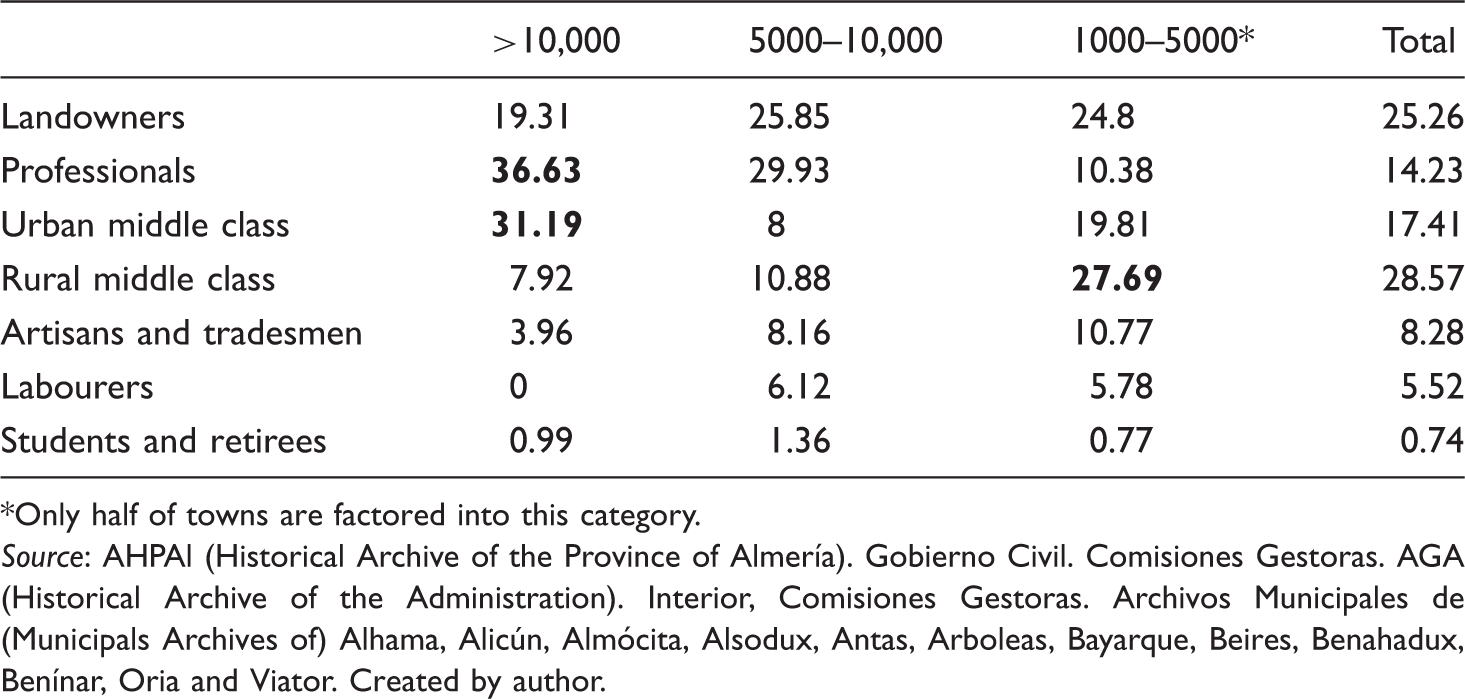
Only half of towns are factored into this category.
Source: AHPAl (Historical Archive of the Province of Almería). Gobierno Civil. Comisiones Gestoras. AGA (Historical Archive of the Administration). Interior, Comisiones Gestoras. Archivos Municipales de (Municipals Archives of) Alhama, Alicún, Almócita, Alsodux, Antas, Arboleas, Bayarque, Beires, Benahadux, Benínar, Oria and Viator. Created by author.
The problem with occupational data is that it is misleading. In reality, farmers and farmhands only became city councillors significantly in towns with populations of less than 5000 (see Table 2). The Franco regime did not favour radicalized farmers or peasants, who represented barely 7.92 per cent of councillors of large cities. The regime favoured professionals, intellectuals, landowners, and industrialists. Cities were dominated by the economically and bureaucratically powerful. The upper and middle classes even dominated the countryside well beyond the numbers they represented there. While Almería in 1940 consisted of 103 towns of which just 14 contained more than 5000 residents, the majority 89 small towns contained comparatively few councillors drawn from the lower classes. This throws into question the degree of interclassism among town and city councillors.
As for mayors, they too were drawn overwhelmingly from the professional classes (see Figure 5). A look at the data shows that jurists and notaries mostly became councillors in cities with populations over 10,000.
41
In towns with populations between 1000 and 5000 mayors were drawn from more diverse backgrounds, though only 12.99 per cent came from the peasantry, against 58.44 per cent from the professions and landowning classes. Even in towns, the regime preferred mayors who were landowners and professionals. In all, scarcely 5 per cent of mayors were from the lower classes. This not only challenges the view that Francoism was as interclassist as some Spanish historians have claimed, but also that the regime conceded significant power to the lower and lower middle classes at the local level.
42
Mayors by profession and population size in Almería, 1939–49.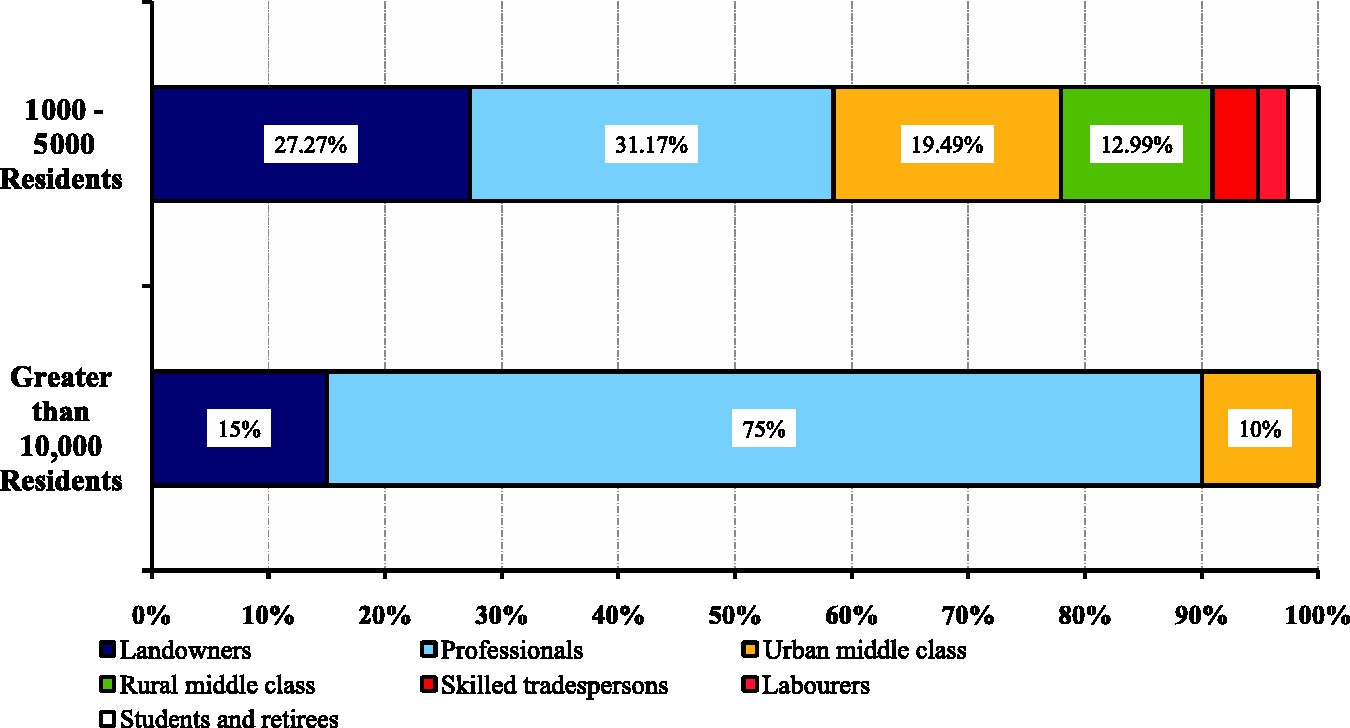
At the same time, the data helps explain why councillors were not politically active in 1936. Judges and notaries were forbidden from joining political parties, and teachers and other professionals were prohibited from becoming mayors or councillors due to an 1877 Municipalities Law that regulated elections and remained in force throughout the Second Republic. Since the Francoists wished to conceal connections to the preceding political order, they sought out persons without obvious political histories, such as professionals and brothers, cousins, brothers-in-law and sons-in-law of traditional elites, as well as sharecroppers who were loyal to their landowners. The outward appearance of these recruits was clean (see Figure 6), yet they were not apolitical and had filtered through the same kinds of family and patronage networks, professional organizations, sports clubs, and lodges that ensured they shared common values and attitudes about politics and religion.
43
Political origin of town councillors, Almería, 1939-49.
The Civil War also significantly replenished those in power. While the war depoliticized broad sectors of the population that only wanted peace and a return to normalcy, it also radicalized such groups as the victims of reprisals or families that had suffered persecutions at the hands of Republicans and had become staunch supporters of Franco. In areas where Republican forces prevailed for most of the war, to have been a resister, a fifth columnist, or a prisoner guaranteed access to city halls in the postwar period. The war generated its own social networks and political identifications, which played important roles after the war. In Franco-held territories, ex-combatants, mostly adolescents and young men, entered the civil service and found employment in city halls in great numbers in 1940–1. Ángel Alcalde, or Jordi Rubio, argues that new faces in the civil service faced a class hierarchy that was more or less rigid depending on their connections to family, class, and traditional elites. These qualitative rather than quantitative considerations help us understand how newcomers and senior politicians learned to share power both formally and informally, and how the dictatorship defeated early infighting and won out over the old order. 44
The data in the graphs show that rather than put an end to caciquism, Francoism perfected it by shrouding and slipping it into the civil service. Provincial governors prioritized the recruitment of public notaries and attorneys, experienced professionals who had intimate family and class ties to landowners, and other traditional authorities and who were well positioned to run government and the legal system. This was true both at the local and national levels, and within the Spanish Trade Union Organization, commonly called the Vertical Syndicate. Cristóbal Gómez Benito’s analysis of agrarian policy and rural society in early Francoism concludes: the great delegation of power to the bureaucratic elite and its total individual and collective ideological identification with the Francoist regime was key to the regime’s success … The bureaucratic elite consisted of highly qualified technocrats who could steer the activities of individual ministries and whose positions, especially in the agricultural sector, involved a conflict of interest … They were also specialists in the law.
45
A common challenge faced by fascism and parafascism was how to transition a liberal political order to a society of the masses. Both adopted aggressive dictatorial formulas that physically wiped out revolutionary and reform-minded citizens, their political movements, and their organizations from public space. Though ideology played a key part, it alone was not what distinguished the two movements. The specific challenges that the societies of each type of rule confronted, and the balance of power in them, were also significant. In fascist and parafascist dictatorships, there were a mix of fascists, conservatives, and even liberals whose evolution one way or the other depended on the balance of forces and how well managing elites assimilated subordinates, manipulated factions, and guided the overall project. In the end, the difference was a matter of degree.
Even within parafascism itself there were opposing tendencies. The gulf was wide between those who cooperated openly with fascism and sought fascistizing solutions and those who, despite some imitation or collaboration, impeded the work of fascists. We understand how parafascism operated the more we analyse its evolution, alliances, and circumstances at the local level. Local Francoism was a version of parafascism that was similar to the structure of power in Portugal and resembled aspects of the regimes in France, Norway, and even fascist Italy. More comparative studies of local parafascism can help us understand the ideology on its own terms, in its full diversity, and distinguish its particular version of dictatorship from those of pure fascism and conservatism.
A look at local Francoist institutions in the context of the wider debate on the nature of fascism shows that there is a need to rethink the dictatorships of the European Civil War, not so much from the point of departure of the German and Italian experiences, but the many meanders – the political dynamics at the local level in Spain, Portugal, Austria, France, Greece, and others – that truly defined fascist-era Europe. Analyses of local dynamics in other European dictatorships could deepen our understanding of how traditional elites and fascists defended common interests and supported the dictatorships of their countries. Furthermore, transnational research centred on microhistory is a way to combine the dominant intellectual-cultural and political-social schools of thought on fascism.
In the Spanish case, as it happens in other Parafascist regimes, it shows a re-adaptation of the traditional elites’ systems of domination based on two elements: Fascist techniques of repression and cooptation, and the use of the state bureaucratic channels by traditional patronage networks. The combination of both repression and nepotism mostly invalidated the timid policies of social cooptation, and eventually generated both political cynicism and popular demobilisation. Combined with the lack of valid political alternatives, the only option left to the majority was accommodation, regardless of the degree of identification with the dictator or the regime. Passive acceptance rather than active support became the norm. There was not, as in Nazi Germany for example, an extensive significant involvement in the regime’s activities or in its political or cultural imaginary. 46
The Spanish dictatorship, like the Portuguese, was based on a system that is not, on the surface, as attractive as the German or Italian ones. But their survival in the midst of democratic Europe shows their remarkable resilience; a factor that should deserve more attention from scholars, and which makes the term Parafascism a rich one rather than a weak, incomplete or even boring version of the more radiant Fascism. In addition, the term Parafascism offers a new venue to make a more comprehensive, transnational and decentralized history of Europe since the early 1930s. It is a term that may help us to hit with a single blow all the many heads of the hydras that populated, with so much grief, our continent.
Footnotes
1
I. Saz, ‘Fascism, fascistization and developmentalism in Franco’s dictatorship’, Social History, 29, 3 (2004), 342–57. A. Cazorla, ‘Dictatorship from Below: Local Politics in the Making of the Francoist State, 1937–1948’, Journal of Modern History, 71 (1999), 882–901 and Á. Cenarro, ‘Elite, Party, Church: Pillars of the Francoist New State in Aragon, 1936–1945’, European History Quarterly, 28, 4 (1998), 461–86.
2
R. Griffin, International Fascism: Theories, Causes and the New Consensus (London 1998); R. Eatwell, ‘On defining the Fascist Minimum: The centrality of ideology’, Journal of Political Ideologies, 1, 3 (1996), 303–19; and ‘Towards a New Model of Generic Fascism’, Journal of Theoretical Politics, 4, 2 (1992), 161–94.
3
On Italian fascism, see R. Bosworth, Mussolini’s Italy: Life under the Dictatorship (London 2005); and Y.W. Kim, ‘From Consensus Studies to History of Subjectivity: Some Considerations on Recent Historiography on Italian Fascism’, Totalitarian Movements & Political Religions, 10, (3/4) (2009), 327–37. For more on the debate on the definition of fascism, see R. Paxton ‘The Five Stages of Fascism’, Journal of Modern History, 70 (1998), 1–23 and R. Griffin, ‘The Primacy of Culture: The Current Growth (or Manufacture) of Consensus within Fascist Studies’, Journal of Contemporary History, 37 (2002), 21–43.
4
A. Kallis, ‘Studying Inter-war Fascism in Epochal and Diachronic Terms: Ideological Production, Political Experience and the Quest for Consensus’, European History Quarterly, 34, 1 (2004), 9–42 and A. Umland, ‘Concepts of Fascism in Contemporary Russia and the West’, Political Studies Review, 3 (2005), 34–49. On comparative fascism, see C. Iordachi (ed.), Comparative Fascist Studies: New Perspectives (London 2010).
5
R. Griffin, ‘Stating the Nation’s Rebirth: the Politics and Aesthetics of Performance in the Context of Fascist Studies’ in G. Berghaus (ed.) Fascism and Theatre: The Politics and Aesthetics of Performance in the Era of Fascism. (Oxford 1994) and R. Griffin, The Nature of Fascism (London 1994), 120–8.
6
D. Blackbourn and G. Eley, The Peculiarities of German History: Bourgeois Society and Politics in Nineteenth-Century Germany (Oxford 1984); G. Eley, ‘What Produces Fascism: Preindustrial Traditions or a Crisis of a Capitalist State’, Politics & Society, 12 (1983), 53–82; A. Shubert, ‘Spanish Historians and English-speaking Scholarship’, Social History, 29, 3 (2004), 358–63; D. Chakrabarty, ‘Postcoloniality and the Artifice of History: Who Speaks for Indian Pasts?’, Representations, 37 (1992), 1–26.
7
I. Saz, ‘El primer franquismo’, Ayer, 36 (1999), 201–21 (cit. 205); R. Paxton, The Anatomy of Fascism (London 2004); E. Gentile, The Sacralization of Politics in Fascist Italy (Cambridge 1996); and M. Pérez Ledesma, ‘Una dictadura por la Gracia de Dios’, Historia Social, 20 (1994), 173–93.
8
M.A. Cabrera, ‘Developments in Contemporary Spanish Historiography: From Social History to the New Cultural History’, Journal of Modern History, 77 (2005), 988–1023 and Ó. Rodríguez Barreira,
9
The FET-JONS was established by a Unification Decree in 1937. It was an amalgamation of the already amalgamated Spanish Falange and the JONS (known as the FE-JONS) and the traditionalist Carlist Party.
10
F. Cobo and T. Ortega, Franquismo y posguerra en Andalucía Oriental (Granada 2005); J. Rodrigo, ‘La naturaleza del franquismo: un acercamiento desde la perspectiva comparada de los fascismos europeos’ in C. Romero and A. Sabio (eds), Universo de Micromundos (Zaragoza 2009) 47–62; and R. Griffin, ‘The Primacy of Culture’, 25.
11
A. Kallis ‘The Regime-Model of Fascism: A Tipology’, European History Quarterly, 30, 1 (2000), 77–104 (cit. 97) and A. Costa Pinto, ‘Elites, Single Parties and Political Decision-making in Fascist-era Dictatorships’, Contemporary European History, 11, 3 (2002) 429–54.
12
A. Kallis ‘Fascism, Parafascism and Fascistization: On the Similarities of Three Conceptual Categories’, European History Quarterly, 33, 2 (2003) 219–49 and I. Saz, ‘Fascism, fascistization’.
13
R. Koshar, ‘From Stammtisch to Party: Nazi Joiners and the Contradictions of Grass Roots Fascism in Weimar Germany’, Journal of Modern History, 59, 1 (1987), 1–24 (cit. 2) and W.S. Allen, The Nazi Seizure of Power (New York, NY 1984). For pioneering work on the FE and FET-JONS, see S. Payne, Falange: A History of Spanish Fascism. (Stanford, CA 1961) and S. Ellwood, Spanish Fascism in the Franco Era: Falange Española de las JONS, 1936–1976 (Basingstoke 1987). On Spanish historiography of fascism, see J.M. Thomàs, ‘Los estudios sobre las Falanges (FE-JONS y FET y de las JONS): revisión historiográfica y perspectivas’, Ayer, 71 (2008), 293–318 and I. Saz ‘Paradojas de la historia, paradojas de la historiografía. Las peripecias del fascismo español’, Hispania, 207 (2001), 143–76.
14
E. Gentile, ‘Fascism as Political Religion’, Journal of Contemporary History, 25 (1990), 229–51; Z. Box and I. Saz, ‘Spanish Fascism as a Political Religion (1931–1941)’, Politics, Religion & Ideology, 12, 4 (2011), 371–89; Z. Box, España, año cero. (Madrid 2010), 60; I. Saz, España contra España (Madrid 2003); C. Boyd (ed.), Religión y política en la España contemporánea (Madrid 2007); R. Moro, ‘Religion and Politics in the Time of Secularisation: The Sacralisation of Politics and Politisation of Religion’, Totalitarian Movements & Political Religions, 6, 1 (2005), 71–86; G. Di Febo, Ritos de guerra y de victoria. (Bilbao 2002) and A. Botti, Cielo y dinero (Madrid 1992).
15
Ó. Rodríguez Barreira, Miserias del Poder (Valencia 2012) J.A. Parejo, Las piezas perdidas de la Falange (Seville 2008), Alfonso Lazo, Retrato de fascismo rural en Sevilla (Seville 1998), R. Morote, La Falange a Mallorca entre la República i el primer franquisme. (Palma de Mallorca 2000). Á. Alcalde, ‘La Zaragoza fascista de 1939’ en VV. AA., L’any de les catastrofes. Actes del Congrés (Barcelona 2009); R. Hamilton, Who voted for Hitler? (Princeton, NJ 1982) M. Mann, Fascists. (New York, NY 2004).
16
J. Casanova, The Spanish Republic and Civil War (Cambridge 2010); C. Gil, ‘La zona gris de la España azul. La violencia de los sublevados en la Guerra Civil’, Ayer, 76 (2009), 115–41; J. Ugarte, La nueva Covadonga insurgente (Madrid 1998); R. Koshar, Social Life, Local Politics, and Nazism: Marburg, 1880–1935 (Chapel Hill, NC 1986); D. García, Instituciones palentinas durante el franquismo (Palencia, 2005); D. González, La Falange manchega (1939–1945) (Ciudad Real 2004); and J. Sanz Hoya, De la resistencia a la reacción (Santander 2004).
17
‘Advice on the Purge’, 12 December 1941, in Presidential AGA, DNP 51-20557. P. Preston, Franco: A Biography (London 1993); L. Zenobi, La construcción del mito de Franco (Madrid 2011); M. Vincent, ‘The Civil War as a War of Religion’ in M. Baumeister and S. Schüler-Springorum (eds), If you tolerate this… The Spanish Civil War in the Age of Total War (Chicago, IL 2008), 74–89; R. Cruz, En el nombre del pueblo (Madrid 2006) and I. Saz, ‘Política en zona nacionalista. La configuración de un régimen’, Ayer, 50 (2003), 55–83 Boletín Oficial del Estado No. 66, 22-12-1936, 438 and Boletín Oficial del Estado No. 182, 20-4-1937, 1033–4.
18
R. Paxton, French Peasant Fascism (New York, NY 1997) and F. Cobo and T. Ortega, ‘No sólo Franco. La heterogeneidad de los apoyos sociales al régimen franquista y la composición de los poderes locales. Andalucía, 1936–1948’, Historia Social, 51 (2005), 49–71.
19
J.M Thomàs, Lo que fue la Falange (Barcelona 1999) and La Falange de Franco (Barcelona 2001) and I. Saz, Fascismo y franquismo (Valencia 2004).
20
E. Gentile, La via italiana al totalitarismo (Rome 1995); P. Baxa, ‘Capturing the Fascist Moment: Hitler’s Visit to Italy in 1938 and the Radicalization of Fascist Italy’, Journal of Contemporary History, 42, 2 (2007), 227–42; A. de Grand, ‘Mussolini’s Follies: Fascism in Its Imperial and Racist Phase, 1935–1940’, Contemporary European History, 13, 2 (2004), 127–42; J. Thorpe, ‘Austrofascism: Revisiting the Authoritarian State 40 Years on’, Journal of Contemporary History, 45, 2 (2010), 315–43; M. Loff, Salazarismo e Franquismo na Época de Hitler (1936–1942) (Porto 1996); S. Rodríguez, El Patio de la Cárcel (Seville 2010); Á. Cenarro, La sonrisa de Falange (Barcelona 2006) and F. Bernal, El sindicalismo vertical (Madrid 2010).
21
M. Marín, Els ajuntaments franquistas a Catalunya (Lleida 2000) and P. Morgan, Fascism in Europe, 1919–1945 (London 2003).
22
B. de Wever et al. (eds), Local Government in Occupied Europe (1939–1945) (Gent 2006) and M. Mazower, Hitler’s Empire (New York, NY 2008).
23
E. Bukey, ‘Hitler’s Hometown under Nazi Rule: Linz, Austria, 1938–45’, Central European History, 16, 2 (1983), 171–86 and P. Dostert, ‘Local Government in Luxembourg 1940–1944: Preparing the Annexation’ in B. de Wever et al. (eds), Local Government, 109–14.
24
N. Wouters, ‘Localisation in the Age of Centralisation: Local Government in Belgium and Nord-Pas-de-Calais (1940–1944)’ in B. de Wever et al. (eds), Local Government, 93. Wouters claims that the mixed system of civil service imposed on the Netherlands helped collaborationists seize local power faster than in France but slower than in Belgium. See N. Wouters, ‘Municipal Government during the Occupation (1940–5): A Comparative Model of Belgium, the Netherlands and France’, European History Quarterly, 36, 2 (2006), 221–46.
25
J. Rodrigo, ‘El Principio del Movimiento’, Historia del Presente, 15 (2010), 5–8 and Á. Cenarro, ‘Fascismo, franquismo y poder local (1936–1949): un ejercicio comparativo’, International Journal of Iberian Studies, 10, 3, (1998) 147–59.
26
In Portugal, Salazar used fascism to push conservative republicans away from power, but once in power he was hostile to the National Syndicalist Movement. P. Morgan, ‘The Prefects and Party-state Relations in Italian Fascism’, Journal of Modern Italian Studies, 3 (1998) 241–72 (cit. 248), D. González, ‘Le relazioni tra il partito e lo stato: il prefetto e il gobernador civil’, in G. Di Febo and R. Moro (eds), Fascismo e franchismo. Relazioni immagini, rappresentazioni (Soveria Mannelli 2005) 469–81 and J Sanz Hoya, ‘El partido fascista y la conformación del personal político local al servicio de las dictaduras de Mussolini y Franco’, Historia Social, 72 (2011) 107–24.
27
J. Noakes and G. Pridham (eds), Nazism, 1919–1945: State, Economy and Society 1933–1939. (Exeter 1984) 39–64; A. McElligott, Contested City (Ann Arbor, MI 1998) 199–235; R.J. Evans, The Third Reich in Power 1933–1939 (New York, NY 2005) 60–7 and D. Lanero, ‘Sobre el encuadramiento de los campesinos y la agricultura en el tiempo de los fascismos: una comparación entre nazismo y franquismo’, Ayer, 83 (2011), 53–76.
28
A. Costa Pinto, Os Camisas Azuis. Ideologia, Elites e Movimentos Fascistas em Portugal (1914–1945). (Lisbon 1994); M. Baioa (ed.), Elites e poder. A crise do Sistema Liberal em Portugal e Espanha (1918–1931) (Lisbon 2004); P. Martínez, La dictadura de Primo de Rivera en Almería (1923–1930). (Almería 2007).
29
B.H. Borge, ‘Quisling’s Mayors: The Führer principle in Norwegian municipalities during World War II’, in B. de Wever et al. (eds.), Local Government, 115–46.
30
AHPAl, Circulars of Provincial Government, GCB-274, Circular del Ministerio de la Gobernación. 10-7-1939.
31
N. Wouters, ‘New Order and Good Government: Municipal Administration in Belgium’, Contemporary European History, 13, 4 (2004), 389–407; D. Sanz, La implantación del franquismo en Alicante (Alicante 1999); D. González, Los hombres de la dictadura (Ciudad Real 2007); Á. Cenarro, Cruzados y camisas azules (Zaragoza 1997); and A. Cazorla, Desarrollo sin reformistas (Almería 1999).
32
A. Cenarro, ‘Instituciones y poder local en el Nuevo Estado’, in S. Juliá (coord.), República y Guerra en España (1931–1939) (Madrid 2006) 335; A. Weingrod, ‘Patrons, Patronage, and Political Parties’, Comparative Studies in Society and History, 10 (1968) 377–400; R. Ramos, ‘O Estado Novo perante os poderes periféricos: o governo de Assis Gonçalves em Vila Real (1934–39)’, Análise Social, 90 (1986), 109–35; and A. Cazorla-Sánchez, Las Políticas de la Victoria. (Madrid 2000).
33
Autor, ‘Report of the Provincial Governor’, June 7, 1943, in Presidential AGA, DNP 51-20614. J. Ponce (coord.), Guerra, Franquismo y Transición. Los gobernadores civiles en Andalucía (Seville 2008); J. Palomares, El primer franquismo en Valladolid (Valladolid 2002); J. Tusell, Franco en la Guerra Civil (Barcelona 1992), 240; J. Sanz Hoya, La construcción de la dictadura franquista en Cantabria (Santander 2008) and ‘FET-JONS en Cantabria y el papel del partido único en la dictadura franquista’, Ayer 54 (2004), 281–303;
34
D. Lanero, Historia dun ermo asociativo (La Coruña 2011) F. Bernal, El sindicalismo vertical. (Madrid 2010), D. González, ‘Coaliciones de sangre en el poder político local. Castilla-La Mancha, 1939–1945’, Ayer 73 (2009) 215–44, A. Robles (ed.), Política en penumbra (Madrid 1996) and W. Opello, ‘Local Government and Political Culture in a Portuguese Rural County’, Comparative Politics, 13, 2 (1981), 271–89.
35
A. Kallis, ‘Fascism, Parafascism and Fascistization’, 241–2 and ‘The Regime-Model of Fascism, 86. The desire to corporatize local productive sectors was also characteristic of Estado Novo or Vichy, as the Corporation Paysanne demonstrates, even if old local politicians and notables could only be brought in through winding channels, for example, through conseils généraux. See R. Gildea, ‘Mediators or Time-servers? Local officials and notables in the Loire Valley, 1940–1945’ in B. de Wever et al. (eds), Local Government; R. Paxton, French Peasant Fascism, 179–203; M. Atrux and M. Baptiste, ‘Por una historia social de la Corporation Paysanne (Francia 1930–1970)’, Ayer, 83 (2011), 27–52; D. Freire, ‘Estado Corporativo em acção: sociedade rural e construção da rede de Casas do Povo’ in F. Rosas and Á. Garrido (eds), Corporativismo, fascismos e Estado Novo. (Lisbon 2011).
36
The term Caudillo originated in the Latin word Capitellus or man who commands an armed unit. In Spanish tradition, this is a term normally associated with military command, but also with political leadership. There is no record of a strict, precise use of the term Caudillo, neither in specialized literature or in common language in Spanish, until the Franco regime. In fact, the term was widely used by the Spanish press during the first decades of the twentieth century, and it was frequently applied, for example, to officers fighting in the Moroccan wars or to European political leaders. In general, the term was used to represent charisma, and its ability to generate both a following and public admiration. Francoism re-cycled the concept to include a divine component and a sense of national revival. This new use of the term can be observed in contemporary examples such as Portugal’s Salazar or Petain’s France. I. Saz ‘Caudillo’ in J. Fernández and J. Fuentes, Diccionario político y social del siglo XX español (Madrid 2008), 185–92; General M. Astray, Franco El Caudillo. (Salamanca 1939), 55–8; A. Costa Pinto, R. Eatwell and S. U. Larsen (eds) Charisma and Fascism in Interwar Europe. (London 2007). On the flexibility of local Francoist power, see A. Canales, ‘Las lógicas de la victoria. Modelos de funcionamiento político local bajo el primer franquismo’, Historia Social, 56 (2006) 111–30 and D. González, Los hombres de la dictadura.
37
Presidential AGA, DNP 51-20509 and 51-20742 to 51-20752. The degree of centralization of local fascist power drew the attention of contemporary observers and is discussed widely in A. McElligott, Contested City, 237–42;
38
B.H. Borge, ‘Quisling’s Mayors’, 134–5.
39
J. Sanz Hoya, ‘Jerarcas, caciques y otros camaradas. El estudio de los poderes locales en el primer franquismo’, Historia del Presente, 15 (2010), 9–26; G. Sánchez, Sobre todos Franco (Barcelona 2008); D González, Los hombres de la dictadura; and R. Moreno and F. Sevillano, ‘Los orígenes sociales del franquismo’, Hispania, 205 (2000) 703–24.
40
F. Cobo and T. Ortega, ‘No sólo Franco…’ and M.Á. del Arco, Hambre de siglos (Granada 2007) and ‘Hombres nuevos. El personal político del primer franquismo en el mundo rural del sureste español (1936–1951)’, Ayer, 65 (2007) 237–67.
41
In Almería, for example, seven public notaries, three attorneys, three landowners, two mining engineers, a pharmacist, a veterinary surgeon, a Francoist public-school teacher, a civil servant and a businessman controlled the main cities.
42
Similar figures can be found in D. González, ‘Coaliciones de sangre’.
43
Gaceta de Madrid, 4-10-1877; Ó. Rodríguez Barreira and A. Cazorla, ‘Hoy Azaña, mañana… Franco. Una microhistoria de caciquismo en democracia y dictadura. Berja (Almería) 1931–1945’, Hispania, 229 (2008), 471–502 and Ó. Rodríguez Barreira ‘El pueblo contra los pueblos. Intervención gubernativa y clientelismo en las instituciones locales durante la II República’, Ayer, 83 (2011) 175–212.
44
A. Cazorla, ‘Beyond They Shall Not Pass: How the Experience of Violence re-Shaped Political Values in Early Franco’s Spain’, Journal of Contemporary History, 40, 3 (2005), 503–20. Ó. Rodríguez Barreira, Miserias del Poder. J.E. Rubio, ‘Continuidades y discontinuidades en las elites locales del primer franquismo. Del éxodo de 1936 a la consolidación de 1948’, Ayer, 82 (2011), 211–37. Á. Alcalde, ‘Excombatientes en los poderes locales del primer franquismo (Zaragoza, 1939–1945)’, in VV. AA., X Congreso de la Asociación de Historia Contemporánea (Santander 2010).
45
C. Gómez Benito, Políticos, burócratas y expertos (Madrid 1995), 322; M. Jerez, Elites políticas y centros de extracción en España, 1938–1957 (Madrid 1982); C. Viver, El personal político de Franco (Barcelona 1978); F. Bernal, El sindicalismo vertical; and D. Lanero, Historia dun ermo asociativo. Studies of nineteenth-century Spanish caciquism tend to demonstrate that caciques were professionals. See, for instance, J. Paniagua and J.A. Piqueras (eds), Poder económico y poder político (Valencia 1998).
46
G. Adinolfi, Propaganda e consenso nel Portogallo salazarista (1932–1944) (Milán 2007); D. Melo, Salazarismo e cultura popular (1933–1958) (Lisbon 2001); A Cazorla, ‘Surviving Franco’s peace: Spanish opinion during the Second World War’, European History Quarterly, 32, 3 (2002), 391–411; A. Cabana, Xente de Orde (Santa Comba 2009); I. Saz and J. Gómez (eds), El franquismo en Valencia (Valencia 1999) and Ó. Rodríguez Barreira, ‘Auxilio Social y las actitudes cotidianas en los Años del Hambre, 1937–1943’, Historia del Presente, 17 (2011), 127–47.