



Abstract
This article considers the nexus between Christian religious practices and the emerging commercial institution of the department store in interwar Australia. It argues that interwar sales managers used religious ritual and language as transitional behavioural forms and as bastions of ‘authentic feeling’ in the face of mechanization, bureaucratization and rationalization. Drawing on the newly opened Coles Myer archive, it traces the attempts of managers and industrial welfare experts to mould salespeople to make them as effective as possible and to deal with the unintended consequences that arose from a perceived lack of authenticity and sincerity in the interactions between salespeople and their customers. It also examines how colonial ideology was woven into salesmanship training in interwar Australian department stores through the performance of store pageants and the writing of store histories.
It is now well established that the twentieth century saw the standardization of many service jobs and the subsequent deskilling of many service professions. As Arlie Hochschild famously argued in The Managed Heart, this shift has seen companies ‘stake out a series of company claims on the private territory of the self' in the form of ‘emotional labour'. 1 This article examines this process in Australian department stores in the 1920s and 1930s. It was in the period that department stores segmented the job of selling and shop work began to seem increasingly like factory work. While department stores have received ample attention from scholars of European or American history, Australian historians have tended to neglect the subject. This is surprising given institutions such as department stores employed more Australians than any other workplace in the first half of the twentieth century. 2
This article investigates how commercial institutions trained Australians to be salespeople while simultaneously diminishing the value placed on salesmanship as a skill and a vocation. It traces the attempts of managers and industrial welfare experts to mould salespeople to make them as effective as possible and to deal with the unintended consequences that arose from a perceived lack of authenticity and sincerity in the interactions between ‘apathetic’ salespeople and their customers. Drawing on literature such as staff training manuals, store parades, training pageant scripts and creative writing by sales staff, I argue that salesmanship training in interwar Australian department stores can tell us something new about the concerns and paradoxes of mass culture.
By far the largest retail archive in Australia is the Coles Myer collection acquired by the State Library of Victoria in 2006. Between 1980 and 1990 Myer gradually took over flagging companies such as Grace Brothers, Fosseys and Farmers, as well as regional chains such as Penneys, Dalton Brothers and The Western Stores. Along with their premises, Myer also acquired their archives, amassing 5000 boxes of uncatalogued material. Documents in this collection reveal that department stores wanted their staff to communicate sincerely on a mass scale, yet by the 1920s following a speed up in the retail industry after the First World War, their customers began complaining that talking to salespeople felt robotic, commercialized and fake. The belief that sales staff had to learn to appear sincere while serving thousands of customers each day generated a large body of prescriptive literature on personal salesmanship. This literature tried to link salesmanship to Christian religious practices, to missionary work, the project of empire, citizenship, settler nation-building and the pioneer mythology of white Australia. A history of salesmanship training in Australian department stores, therefore, tells us much about both working in modern commercial bureaucracies between the wars, and the ways in which modern forms of selfhood were conceived, taught and struggled with in the first half of the twentieth century.
An apprentice saleswoman at Penneys Chain Store in Queensland in the 1930s started her first day of work at ‘register drill’, where she was taught to use the cash register. During her lunch break she was encouraged to send a postcard of the store’s façade home to her family. Gladys Adamson wrote on her postcard that Penneys was: ‘Better than factory’.
3
By afternoon, the training regime intensified. Penneys’ staff manual advised: At 3:15 the register drill should cease. It is time to make your new pupil aware of the glamour of her new job. She is to be schooled in the art of smiling and smiling sincerely. This is quite a difficult assignment and you cannot trust it to any of your staff. We would be happier to know that this vital part of the instruction was in your hands.
4
How were department stores and chain stores to gain as many sales as possible, while keeping ‘authentic feeling’ between sales assistant and customer? How to manufacture the ‘art of smiling and smiling sincerely’ when the very act of replicating such a smile might imply a certain insincerity or fakeness?
6
Salespeople, according to one David Jones manager, were becoming ‘pleasant robots’ and ‘cogs in vast machines … without thought, without character’.
7
Customer complaints contributed to managers' concerns.
8
By the early twentieth century salesmanship training courses were well established in Australia and the manuals that survive from these chart a growing obsession among managers with ‘sincerity’ in their salespeople. Myer’s staff training manual summarized these concerns in 1935: This bewildering Age has been labelled with many tags – the ‘Age of Distribution’, the ‘Machine Age’, the ‘Age of Organization’, all hard and unpleasant sounding names, with a tang of super-efficiency, keen competition and big business … what we want at Myer is an ‘Age of Love’.
9
One solution to the problem of sincerity in salespeople was ‘personal selling’, a salesmanship philosophy based on personal qualities rather than manual skill. 11 Peaking in popularity in Australia in the 1920s and 1930s, personal selling drew on religious education for its moral underpinnings. 12 Doctrines of honesty, loyalty, service, duty, compassion and sincerity ‘passed down by the Christian pioneers of colonial days’ and applied in commerce would be a bulwark against the commodification of human relations. 13 Using these vaguely defined religious ‘commandments', store managers attempted to harness skill in social interaction, a most unmanageable quality and one far less susceptible to control than manual skill. Grace Brothers went so far as to have their new employees swear allegiance to a ‘Gospel of Enthusiasm’ on a King James Bible, a number of which survive in a somewhat tattered shape in the archive. 14 But personal selling did not solve retailers’ social and commercial problems. Customer surveys conducted from the 1940s onwards registered public distaste for personal selling. 15 Failing to manage this slippery psychological territory, managers in the late 1940s stripped staff training back to basics – register drills, stock management, giving the correct change – deskilling the profession in the process. 16 By the 1950s, personal selling had all but disappeared from training courses. As retailers tried to control personal encounters in their stores they confronted the chaos and indeterminacy of social relationships and the limitations of their own bureaucratic control over these relationships.
Scholarly studies of department-store salesmanship in Australian history have been largely limited to labour history. 17 While Gail Reekie’s 1993 book on Sydney’s interwar department stores provided a groundbreaking feminist analysis of mass marketing, it focused more on the production of binary gender difference in department stores than on the making and moulding of salespeople. 18 Recent revisionist work from cultural historians in China and America has widened the scope of department store selling as a historical source. Lien Ling Ling’s latest research into sales clerks and department stores in China has shown how new sales philosophies in the 1920s and 1930s not only brought about changes to retailing but also reshaped city life and urban culture. 19 Walter Friedman’s work on the birth of salesmanship in America portrays ‘personal selling’ as a continuation of nineteenth-century theatrical salesmanship traditions, where the ‘consumption based economy of the early twentieth century originated in the face-to-face selling strategies of peddlers and book canvassers of previous generations’. 20 It takes salesmanship as a path into everyday modernity as experienced by salespeople and customers in moments of commercial encounter – the sphere Susan Porter Benson termed ‘counter cultures’. 21 While Porter Benson chose to focus on the internal work cultures of department stores and the implications of these cultures for women’s agency and solidarity, I wish to bring the connection between salesmanship and modern selfhood more firmly into focus. Although historians of Australian modernity have long since established that new technology (film, radio, photography) were vital tools in the ‘modern penchant for playing with identity’, 22 none have looked to salesmanship as a site where questions of ‘fake’ and ‘real’ personhood, of the sincere and the inauthentic, were agonized over and constantly played out. 23
In his study of corporations in early twentieth-century America, Roland Marchand identified what he termed ‘The Lament’. An oft-repeated criticism of big businesses after the 1890s, ‘The Lament’ was both a nostalgic rumination on the ‘old days’ of social relationships at work as well as an expression of fear for the future: ‘the fear that we are so separated by the mechanical and working condition which divide us'. 24 According to Marchand, ‘The Lament’ arose in response to the ‘soullessness’ of modern commercial life: ‘Soullessness often referred to the coldness and aloofness of the giant corporation'. 25 The personal relationships that had depended on face-to-face contact were no longer possible in corporations that operated multiple plants or offices, with tens of thousands of employees. Familiar images of massive factories and crowds of office workers contributed to popular perceptions of corporations’ soullessness. 26 Workers seemed stuck ‘in immense machines, oblivious to any connections between their narrow, repetitive tasks and the company's larger operations'. 27
Marchand’s ‘lament’ echoes the sociological theory of ‘disenchantment’ postulated by Max Weber. Weber articulated this conceptual framework in his discussion of the ‘disenchantment of the world’, in which he reflected on the decline of spiritual beliefs under the forces of the bureaucratic state. 28 Influenced by Weber, historians have overwhelmingly subscribed to the transformative effect of an increasingly secularized, rationalized and bureaucratized way of life that progressively ‘disenchanted’ modern existence. Marchand argues that American business responded to ‘disenchantment’ by modelling working life on family life, especially on family values, in ‘their search for a new mode of communications with their mass of workers that would convey the imagined humanness and benevolence of an earlier relationship’. 29 Michael Miller found a similar paternalist ideology at work in Paris’s Bon Marché department store in the 1900s. Family values in the department store served as the ‘arena for the accommodation of bourgeoisie culture to the coming of a mass bureaucratized age’. 30
I argue that Australian department stores attempted to balance the ‘disenchantment’ of bureaucratization by drawing on an older ethics of religious uplift and by linking salesmanship to ideas of Empire loyalty through paternalistic welfare capitalism. Here I am using the recent work of Frank Trentmann who has drawn the attention of scholars of consumer culture to the colonial periphery arguing, ‘Colonies were more than passive by-standers responding to a globalizing dynamic pouring forth from an advanced imperial core.' 31 Trentmann has concurrently critiqued histories of consumer culture that ‘cast consumption and religion as competing self-defining universes.' 32
This article will examine shifts in Australian department store work cultures following a perceived crisis in customer satisfaction in the 1920s, the subsequent introduction of new training techniques and welfare provisions. It then traces the application and development of these new modes of staff training in the late 1920s and 1930s, and staff responses.
Despite the best efforts of governments to populate Australia’s rural frontier after Federation in 1901, it was the city that conquered the imaginations of many rural settlers in the early twentieth century. The populations of Sydney and Melbourne roughly trebled between 1880 and 1914, partly as a result of migration from regional areas. 33 Workers were needed in the mushrooming service industry: in shops, restaurants, news agencies, sports grounds, trams, trains, theatres and, by the 1920s, cinemas. 34 In 1876, Anthony Hordern & Sons department store in Sydney was a small drapery shop with a staff of 11. By the 1890s, the store employed 500 and grew to 9000 staff in total by the 1920s. 35 According to census data the total number of wage earners, other than manufacturing workers, employed in Australian department stores grew between 1891 and 1921 from 3250 to 23,968, with the greatest increase occurring between 1901 and 1911. 36 An estimated 7000 shop assistants were employed in Sydney’s big stores alone in 1907. By 1910, the largest – Myer, Grace Brothers, David Jones and Anthony Hordern & Sons – each employed between 1000 and 4000 workers. Together they employed over 10,000 staff, making the city department stores among the largest employers in Australia in this period. 37
The majority of those employed after 1900 were women, who constituted only 17 per cent of Australian drapery employees in 1891, but over 50 per cent in 1911. 38 White female labour was in high demand in Australian cities at the turn of the century. As Kay Whitehead has shown, the archetypal occupation for young women with some post-primary education in the early twentieth century was that of the ‘shop girl’ and ‘girl clerk’. 39 The proportion of women in the commercial, sales and clerical workforce in Australia increased from 10.6 per cent in 1891 to 22.4 per cent in 1921. 40 For most salespeople in the early twentieth century working in sales meant working for department or chain stores. 41 As Kate Murphy and others have shown for Australian history, these gender dynamics in industrializing Australian cities regularly generated moral panics which saw middle class social commentators bemoan the spectre of the young, single, modern women populating the Australian city scape, freely earning and spending her own money. 42
Australian department stores were originally drapery shops with one or two live-in apprentices.
43
In the period between 1880 and 1900 these shops grew from small businesses selling staple drapery lines to ‘palatial giants’ and ‘universal providers’ with buying officers in Europe, China and India.
44
Department stores like Myer and Anthony Hordern physically dwarfed the early twentieth-century city centre, looming so large over the skyline that they could be picked out by train arrivals, pulling into central stations (see Figure 1). To control prices, drapers had also become manufacturers, buying their own factories, marble works, iron foundries and tin smitheries.
45
As they expanded, these draper stores benefited from the nineteenth-century innovation of ‘departmentalization’ – David Jones had 19 departments in 1876 and 117 by 1910.
46
Those involved in the retail industry began to call the big drapery houses ‘department stores’ after 1900 but the term was not widely used until the 1920s.
47
Anthony Hordern and Sons c1935.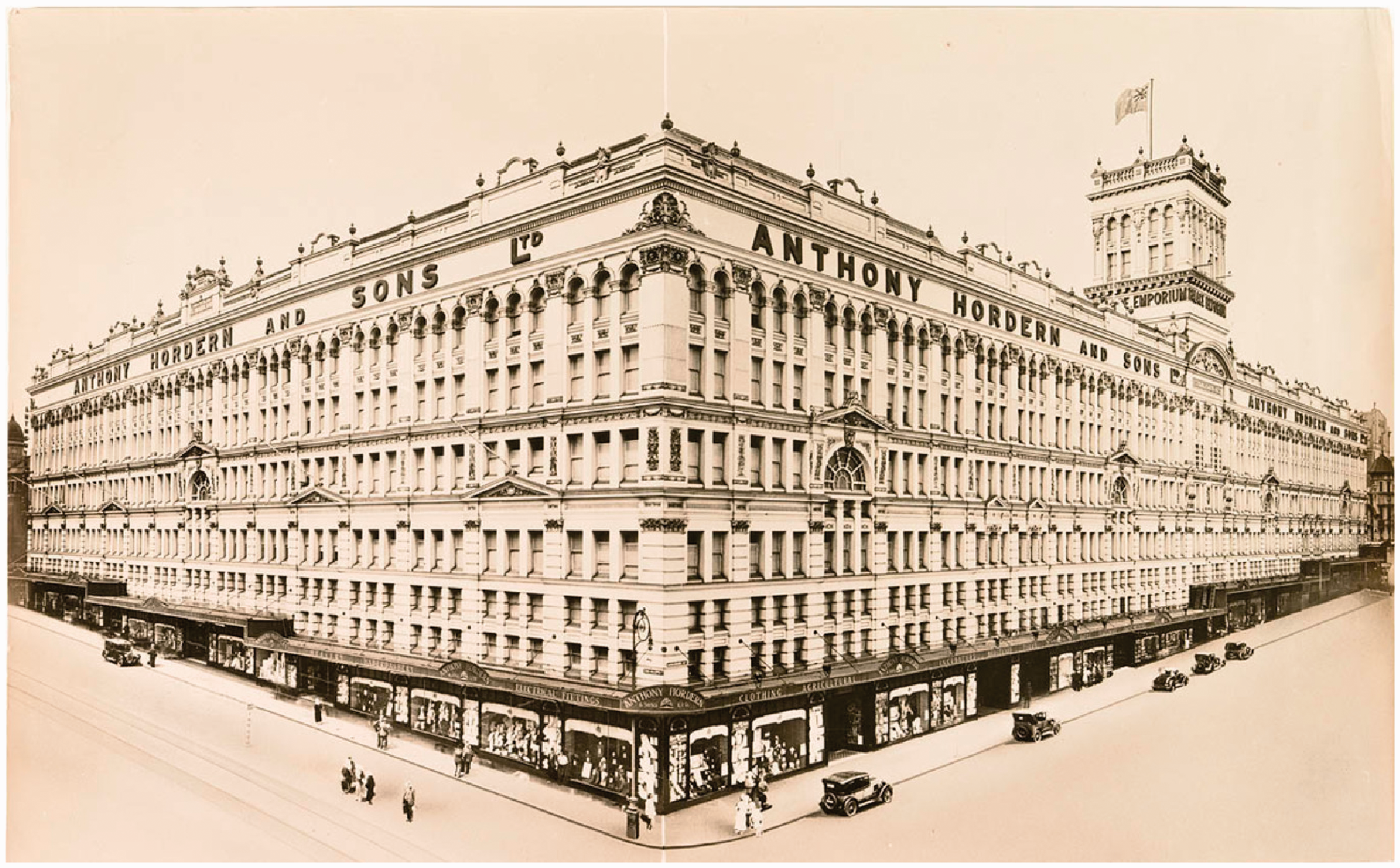
Department Stores have not figured prominently in early twentieth century Australian history. While American scholarship has emphasized the role of corporate culture in the ‘massification’ of twentieth-century Western societies, historians of the Australian city have, in contrast, looked more to machines and technology for their explanations of antipodean modernity. New machines ‘mimicked human action’, enhancing speed and efficiency, ‘literally changing the material world and making it modern’. 48 The rapid diffusion of inventions such as the factory time clock, telephone, typewriter, hydraulic lift, gramophone, wireless, cinematograph and brick press created a space ‘straddling magic and science’. 49 The achievements of the machines raised the bar for what human beings could themselves achieve. Mathews shows how these new technologies of work caused widespread anxiety about the mechanization of human relations, a sense that individuals were beginning to interact in ways that mirrored the machines they were operating. 50 As we shall see, interwar Australian retail managers and industrial welfare experts articulated these anxieties in their observations of ‘apathetic’ salespeople. They subsequently invented forms of training to ameliorate this apathy and their solution was to link selling to Australian nation-building and pioneer history, empire patriotism and religious ritual.
After the First World War, the size of Australian department stores, once a selling point, had become a liability. The following section concerns the late 1910s and early 1920s, a period which saw a perceived ‘crisis’ in customer satisfaction in department stores due to ‘impersonal service’. This customer dissatisfaction prompted managers to introduce ideas of industrial psychology and welfare paternalism into staff training programs. By 1915, Anthony Horderns was serving up to 30,000 customers a day and stores continued to take on staff in large numbers. 51 At the same time the duties of sales staff were diminished by the introduction of cashiers after 1917. Originally assistants entered sales in ledgers and gave change; women, proving to be reliable and accurate, were favoured for the task. But they were replaced by cash registers; little ability was needed to operate them and they were faster – one girl was able to serve 264 customers in a day. 52 The Hordernian Monthly, Anthony Hordern’s staff publication, described in its November 1923 edition the introduction of the shop tube room where 40 girls were responsible solely for giving change. 53 When department stores entered into competition with the newer chain stores, such as Woolworths (established in Sydney in 1924) they introduced a further ‘speeding up’ process whereby the number of people entering the store were counted and the total compared to the day’s takings; each girl’s sales were to reach a pre-determined minimum amount. 54
Customers began complaining to managers about ‘dismissive' service from salespeople. Running parallel to complaints over staff calibre was the deskilling of salesmanship as a profession.
55
Sales work acquired a semblance of glamour in the interwar years, but this happened while the job was also becoming increasingly menial, with diminishing responsibilities and opportunities for promotion (see Figure 2). More than any other type of shop, department stores were: ‘responsible for rigidly preserving the myth of status and privilege surrounding the shop girl while at the same time most surely denying any access to expertise'.
56
Anthony Hordern and Sons Store Guides 1932.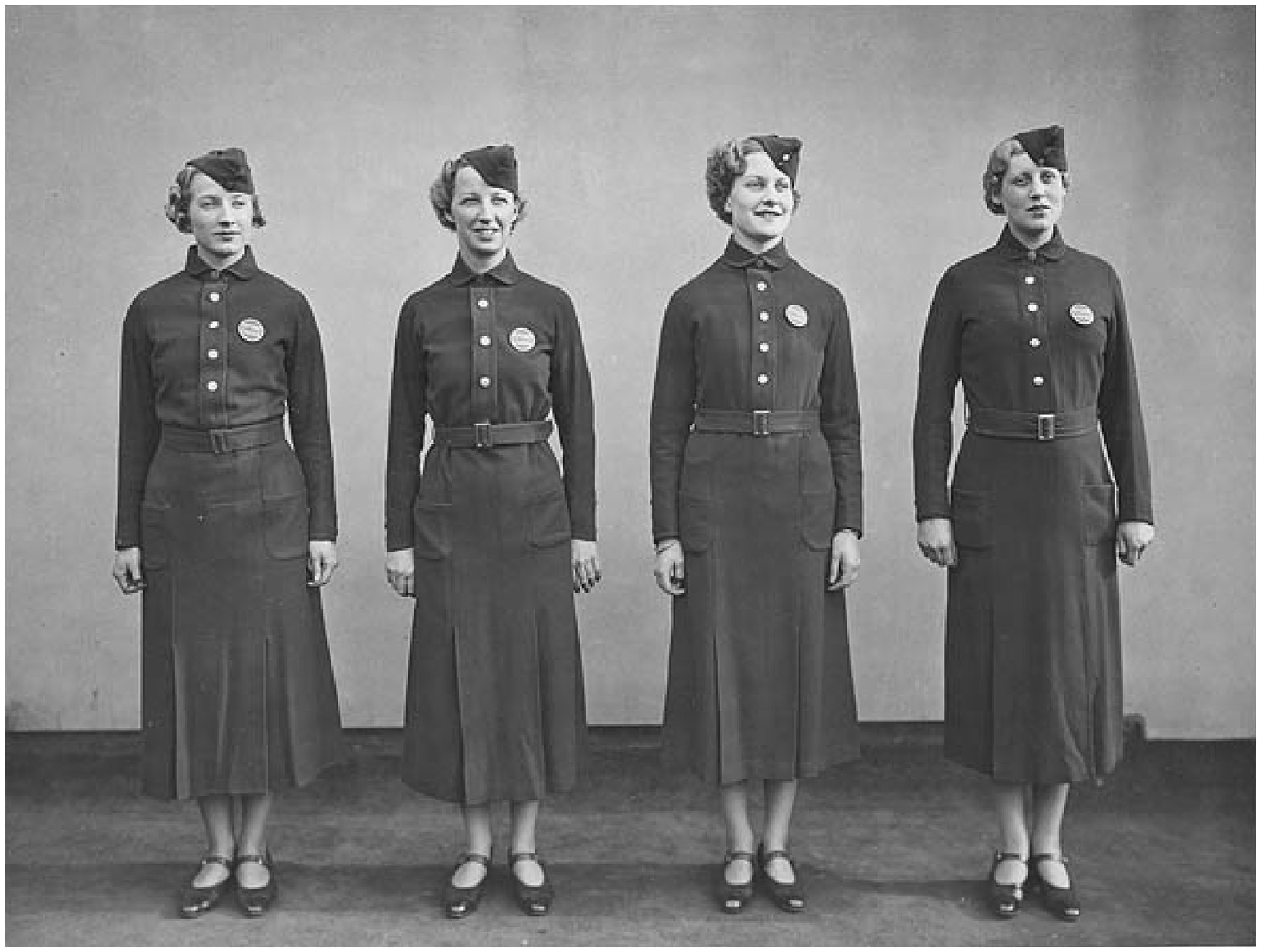
Such technological and social shifts in department store work culture were accompanied by the increasing influence of ‘the new scientific psychology of the interwar years’ on some Australian department store managers (see Figure 3).
57
By the 1920s American industrial psychologists were promoting a ‘behaviourist outlook’ arguing that ‘the social environment had a powerful impact upon a relatively plastic human nature'. The outlook, which soon permeated general psychology, was popularized by John B Watson as ‘behaviourism'.
58
While there is some evidence that American Behaviourism influenced retail managers in Australia (especially at Myer) the most widely-read theories on industrial psychology influencing Australian retail managers in the 1920s and 1930s were those published by Dorothea Proud. After growing up in Adelaide and working in a factory in New Zealand, Proud spent six years (1910–16) observing factory workers in Australia and Britain before releasing her studies in a book called Welfare Work.
59
An instant classic, Welfare Work became required reading for senior staff at Myer while David Jones manager Charles Lloyd Jones authored the foreword for the Australian edition. Proud argued that the scale of the modern workplace had ‘shattered’ the basis of relations between ‘master and man’, leading to a lack of mental and spiritual vitality in employees. The duties of the old employer had ‘been delegated to separate individuals; different departments have been created – a buying department, a selling department, a manufacturing department’.
60
She advocated the use of employee welfare offices to recognize the individuality of workers for ‘after all no one personality can act and react effectively upon twenty five hundred personalities’.
61
Anthony Hordern and Sons Senior Assistants in Class Room, 1933.
Welfare Work cloaked arguments for dramatic adjustments to industrial work routines within assurances of increased profits for owners and managers. But Proud also warned that welfare programs would not improve productivity unless they were in harmony with the social aspirations of workers: ‘It is only individual ambition and self confidence that carry a worker into a superior grade’.
62
Worker apathy was to be attacked ‘through industry which was seeking step by step to evolve a higher idea of itself’. Workers were to be moulded as ‘personalities’ through the teaching of ‘ethical or moral or Grace Brothers staff from Toy Department, 1939.
In 1919 a young female sales assistant threw herself over the railing of a well-known Sydney department store and, having fallen 50 feet, died on the way to hospital. She had been dismissed during an argument with her manager.
65
The incident caused widespread introspection among retailers leading some stores to apply Dorothea Proud’s suggestions. ‘To cope with the complexities of today’, wrote Charles Lloyd Jones, ‘we need new traditions in place of old discarded ones’.
66
Edwin Lee Neil, a Myer senior executive, blamed a lack of religious law and commercial morality in modern day business: It is a soul-destroying life – in that so very few men with whom one must associate daily have the slightest idea of Christian life and requirements. They are so selfish, so often unscrupulous, so nearly inhumane, that their standards and ideals outrage one’s sense of honour and fairness and even common decency’.
67
By 1921 most Australian department stores had included staff welfare facilities in their plans for extensions or rebuilding. Anthony Hordern, typical of the larger program, provided a medical officer and nurse, a library, a musical society, dancing, sports, a provident fund, and classes in commerce and salesmanship, physical culture, cooking, drama, psychology, literature, hygiene, home nursing and millinery. Welfare funds were established by Marcus Clarke in 1917, Nock & Kirby in 1920 and Anthony Hordern in 1923. 69 Farmers invited Dame Nellie Melba to launch its welfare scheme in 1919, reportedly the first of its kind in Australia, and hired Young Women’s Christian Association (YWCA) secretary Eleanor Hinder as its first social welfare superintendent. 70 The YWCA was already on good terms with several Australian department stores that had contributed to its 1919 fundraising campaign. Charles Lloyd Jones was chairman of the YWCA Publicity Committee and Farmers loaned its offices for bible study meetings. 71
Welfare programmes allowed retail managements to formalize gendered expectations of staff. The David Jones magazine Between Ourselves urged male employees to ‘stick with the firm’ by pursuing long term career goals, while women were subjected to numerous, if chatty and often humorous, injunctions relating to their physical appearance, deference to male authority and the adoption of middle class values of respectability. A dominant theme was the necessity for a saleswoman to be ‘charming’ to her customers, and in 1921 David Jones ran a competition to find the store's ‘most charming girl’. A charming, feminine and deferential sales assistant would not only secure more custom for the store but was also less likely to challenge her employer over wages and working conditions.
The introduction of new forms of welfare paternalism were accompanied by a related shift in attitudes to staff training. Managers would place less value on practical skills and more focus on ‘personality’ and personal qualities. This shift was evidenced in staff manuals. By the 1920s staff manuals taught sales techniques based on personal qualities rather than manual skills. ‘A retail career has not the “slur” that being a draper used to have', Myer’s 1925 staff manual assured new employees, ‘intelligence is key. The salesman who is not intelligent enough to sum up the types of customer and make an effort to please them will never make good. They must have the right personality.' 72 The Western Stores chain in rural New South Wales and Queensland introduced their staff manual in the late 1920s by declaring: ‘We do not offer you just a “job” but a permanent career in retail merchandising. In this business there is a need for men and women who can think.' 73 For such people, the manual promised, ‘opportunities for advancement are almost unlimited'. A version of the same manual produced for senior management qualified this claim: ‘Of course, the majority of sales assistants will be unsuitable for promotion and such [sic] should not be encouraged to entertain hopes'. 74
Staff manuals changed in form as well as content after the 1920s, acquiring colourful binding, illustrated store histories and photographs of appropriate ‘facial emotion’ and physical bearing. New sections on ‘Service, Honesty and Loyalty’ appeared, interspersed with scripts for sales training ‘playlets’ and morality tales: ‘Shops in Jesus’ Time’ and ‘The Prodigal Salesgirl’. The first few pages of Coles’ handbook were covered in awkward biblical references loosely applicable to store life: ‘The Lord Says Thou Shalt not Steal … Thy Employer’s Time’, and ‘When Cain Killed Abel: Putting Aside Petty Grievances’. 75 The introduction to the Farmers’ manual encouraged staff to reach new heights of self-awareness through salesmanship training while at the same time mining Shakespeare for store mottos: ‘Welcome to Farmer’s Staff Manual: To Thine Own Self be True’. 76
Staff manuals were incorporated into store ceremonies. New staff at Grace Brothers’ Broadway store in the 1920s and 1930s went through initiation ceremonies. Staff marched into store auditoriums to swear an ‘oath of loyalty’ to Grace Brothers on blue leather-bound Bibles. Senior staff chanted slogans – ‘Grace Brothers, The Store that keeps Faith’ and ‘Grace Brothers, The Model Store’ – while new initiates received their manuals and uniforms.
77
Coles presented employees with Ten Commandments of Service which were to be repeated aloud in front of managers: ‘Be relaxed, proud and confident’, ‘Greet customers with a smile’, ‘Be efficient, be friendly, be accurate, be helpful’ and ‘Remember customers’ names’ (a tall order considering some staff served over 250 customers a day).
78
Myer’s business training handbook sported a drawing of Rodin’s The Thinker with the accompanying gloomy speech bubble: ‘Whoever is satisfied with what he does, has reached his culminating point – he will progress no more. Man’s destiny is to be not satisfied, but forever unsatisfied’.
79
Coles’ 1927 salesmanship handbook began with five Essentials of Success: The judgement of Solomon The business acumen of Henry Ford The smile of a film star The dignity of an Archbishop The facility of an adding machine.
80
Coles required successful applicants to complete an oral arithmetic test in front of their colleagues upon arrival.
83
Shop girls were told to expect leg cramps and exhaustion in their first few weeks.
84
Myer acknowledged, ‘Starting out on a new job is not all fun. There are many bewildering moments, especially in the first few days'.
85
Novices had to quickly insert themselves into the store’s ‘splendid inner routine'.
86
‘But we are sure', Myer concluded: that you will soon feel caught up in the friendly spirit of our store and that the feeling of being a small part of a big machine will be replaced by the knowledge that you are a person in whom we are interested, because you are one of us.
87
At her first day at Hillier’s Café in Farmers department store Catherine Edmonds was struck by its pace and intensity. ‘The shop seemed a fairyland to me: glittering lights, glass counters, waitresses in attractive uniforms, and a ceaseless flow of customers who seemed to me the embodiment of all the people I’d read of in fashion magazines'. (See Figure 5)
89
New girls were to observe official and unofficial hierarchies and humbly place themselves on the bottom rung of the pecking order. Shelia Whitelaw entered David Jones sales floor from the Arts Department in 1932 as an extra for the Christmas rush. To her disappointment she was put in the stock room and not on the front counter. ‘Being a junior it was my duty to go to the stores supply and collect the needed string, paper etc for the day. This interfered with my sales, for being ambitious, I always endeavoured to have a large number of sales in my docket book.'
90
The Perfumery Department, Grace Bros, Broadway.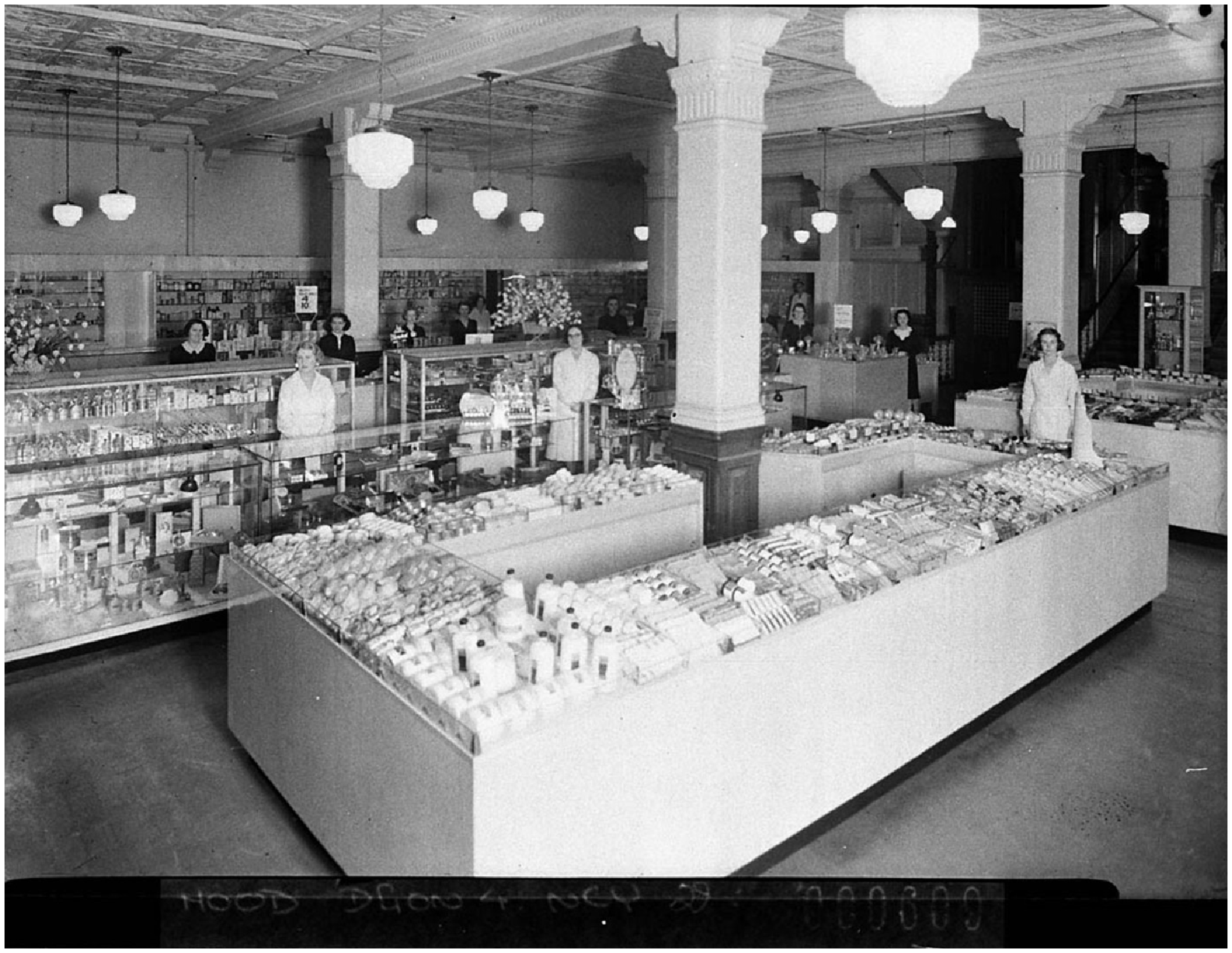
Encounters between salesperson and customer were ritualized in 1920s and 1930’s sales literature. This moment was referred to as ‘The Approach’. 91 Mark Foys’ sales staff rehearsed ‘the approach’ in a training playlet performed at store competitions while Myer used a series of posters: ‘Mya Belle, the perfect salesgirl … and her foil Haisy Maisey will appear fortnightly in posters around the store illustrating good and bad approach manners’. 92 Central to ‘the approach’ was the salesperson’s ability to reproduce an appearance of happiness and enthusiasm while seeming natural and unaffected at the same time. ‘It is imperative that the right atmosphere be created’, Penneys emphasized, ‘Busy, happy, respectful and anxious to please is the right answer, but one jarring discord can ruin it’. 93 Staff training warned that tiny variances in physical movement meant the difference between failure and success. Myer told employees: ‘Look the customer in the eye. No matter how pleasantly you smile and greet the customer the effect will be lost unless you look her in the eye. Not staringly. Not boldly. But in a pleasant, direct way’. 94 Penneys provided diagrams of correct and incorrect eyebrow and mouth positions. Lopsided, ironic smiles or smiles showing bottom teeth or tongue were identified as wrong. After dedicated practice, salespeople were expected to produce a ‘sincere smile’. On the path to successful salesmanship, Penneys told staff ‘the sincere smile is half your battle’. 95
Conjuring up a sincere facial expression was only one part of the ‘the approach’. A salesperson needed to seem authentic during each step of the sale. Eleanor Hinder told Farmers and Coles’ employees to: ‘Appear interested no matter who the customer is. This is done by raising the eyes as the customer approaches, even though busily engaged, or by walking towards her’. 96 If an emotional connection was to be made with the customer, it had to happen quickly: ‘Many customers come into our stores because they expect faster service than elsewhere’. 97 Myer insisted that smiling should last the duration of a sale, telling staff to imagine they were hosting a party: ‘Smile, the Customer is your guest. More than that, she is a source of profit’. 98 Problems arose when salesgirls had to mass sell while also giving individualized attention to each customer, a contradiction store manuals struggled to reconcile. Mark Foys’ sales book attempted a solution: ‘Approach promptly and at busy times, when customers are waiting, scatter your smiles’. 99 Whether or not the scattered smile was enough to ease the impatience of queuing customers was not made clear. Regardless, throughout the interwar years retailers maintained their belief that staff could ‘ … [m]ake each customer feel in turn that he or she is the only person you are interested in at that moment’. 100 Fosseys’ 1920 store manual advised salesgirls to serve multiple customers at once while making each feel specially attended to. At Myer the conclusion of a sale was as practised as ‘the approach’: ‘Whether the customer buys or not say “Thank you” – not in a sing song, mechanical way, but in a genuinely sincere manner’. 101 This final step could not be performative or forced, ‘You cannot make it sound real unless you actually mean it’. 102
When customers inexorably failed to buy despite a salesperson’s judicious performance of ‘the approach’, managers were left grasping for an explanation. A staff memo circulating at Grace Brothers in 1927 found fault with the type of questions salespeople addressed to customers: Perhaps the most common drawback to increased sales is negative speech and negative suggestion; indeed far more sales are lost because of this than we may know! Among the more growing examples of incorrect speech is ‘you don’t want anything else do you?’ In the face of such a remark only a miracle can prevent the inevitable 'NO'.
103
There is a type of question which brings the customer into conversation and at the same time prepares the way for successful sales. It is the type of question which implies a compliment, but lacks none of the
One common form of salesmanship training in the 1920s and 1930s was the pageant. Favoured both as a group motivational activity and a publicity tool, commercial pageantry came into its own in the 1930s. Some stores held weekly pageants between 1933 and 1936.
109
Pageants were also performed in Australia in church social groups
110
for religious holidays like Christmas and Easter, while Sunday School children and adolescents practised pageant tableaux as part of their theological curriculum, often wearing elaborate costumes and carrying homemade props (see Figure 7).
111
Welfare officers in Australian department stores began directing pageants in the early 1920s, borrowing scripts and costumes from Church affiliated groups such as the YWCA.
112
Storylines were rewritten to include salesmanship training philosophies, melding store mottos with biblical morality tales. Players recited their parts chiefly in monotone ‘and their actions were subdued to correspond’.
113
A pageant written by Eleanor Hinder and performed by Farmers’ female employees in 1922 suggests that the labour managers of the 1920s were consciously promoting new values based on commercial efficiency through an older language of religious discipline and moral elevation.
114
Hinder’s The Spirit of Modern Industry opened with saleswomen dressed as Grecian goddesses demonstrating the advance of Modern Industry to an ‘Ancient Shopkeeper, 1860’, who intoned: I worked from Dawn till Dark, in dingy shop Nor knew what leisure was wherein to grow The stature of full manhood – Whereby none May make their fullest Service to their Christian fellows This world of commerce moves too fast That I am dazed by sight and sound. Methinks the world has giddier grown with time I give you greetings! Pray enlighten me!
115
Spirit of Health, I’m called; I strive to work, Allied to modern Industry: see how we work, Through Service, Play, and Self Promotion, To reach the highest standard.
116
We’re all employed in enterprise to do work Mark well what I say And ne’re of it one scrap to shirk Ho! We’ll prepare for life’s big work by training well To make this land of sun a great, glad land … In the name of our Holy Father Glory be to God in the highest spirit, and on earth peace, goodwill toward men.
117
Grace Brothers New Store, 1930.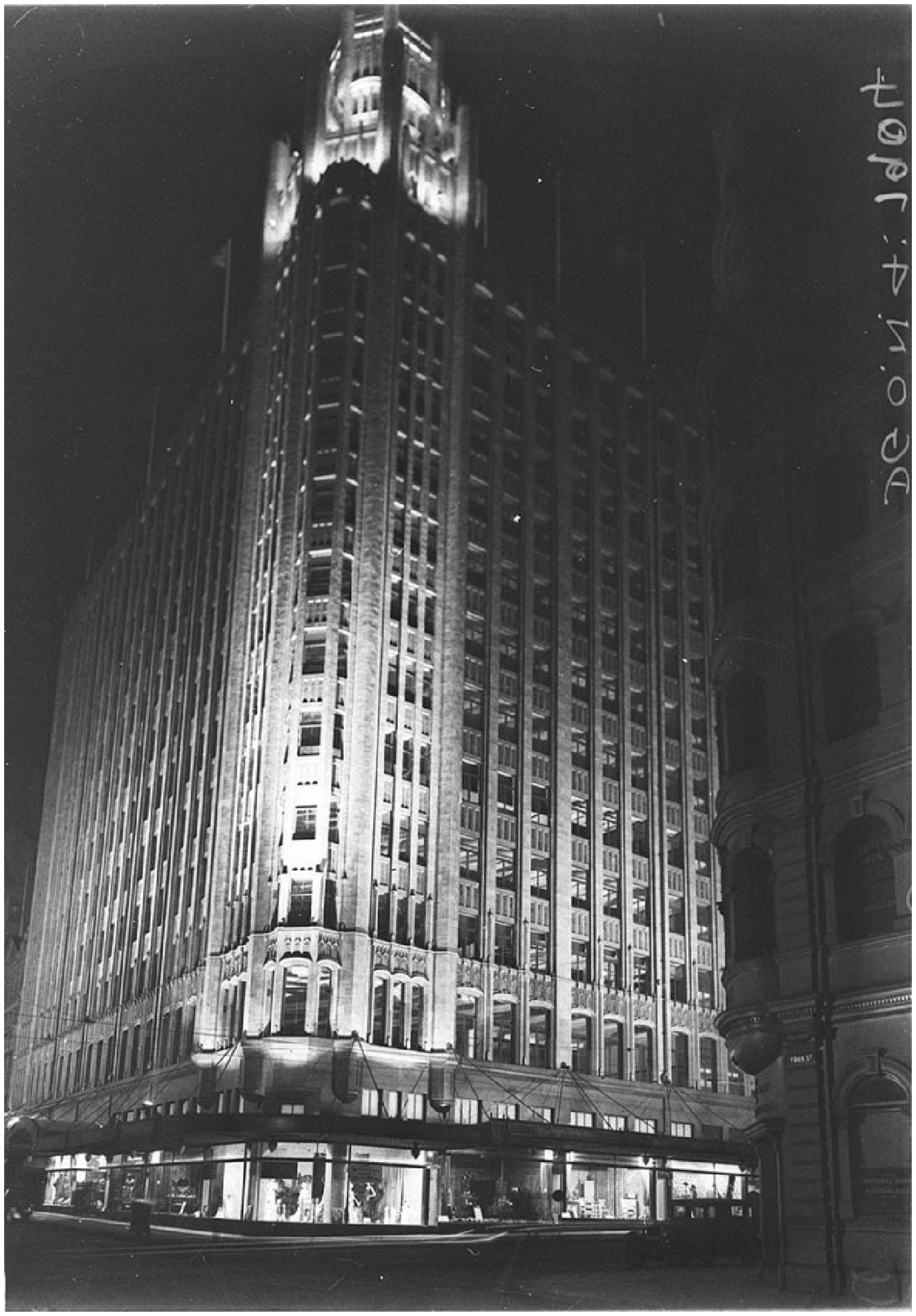
Pageants allowed store managers to encourage sales competition through theatrical display. David Jones, Anthony Hordern and Grace Brothers all held ‘Mistress of the Pageant’ elections or, by the 1940s, ‘Most popular girl competition’, reminiscent of beauty pageants.
124
Departments nominated their ‘most beautiful or popular girls’ while all staff voted to decide the winner.
125
Winners were also chosen on the basis of sales records and those with sales below a specified standard were not eligible to compete. Mistress of the Pageant rituals were borrowed from Church formats, most of which included climactic tableaux featuring (for Catholic stores) the Virgin Mary, usually a young, female parishioner, whose crown was carried by children in the congregation, dressed as angels or heralds (see Figure 8).
126
Virgin Queen Pageant – Barham, NSW 1916–1920. ‘The Crowing of Miss Hordernia’ Anthony Hordern and Sons 1933.

Store pageants replaced the Virgin Mary or the ‘spirit of St Mary’ with their most popular girl – ‘Miss Hordernia’ or ‘Miss Grace’. 127 Grace Brothers held a ‘Dream of Fair Women’ tableau to officiate its Mistress of the Pageant crowning ceremony. At Sydney’s Catholic department store Anthony Hordern’s, Miss Hordernia 1930 was crowned in a ceremony officiated over by a local church bishop. 128 Although the use of Christian iconography in department store pageants was more rhetorical than literal, store managers maintained that religious teachings, used judiciously in training courses, made for happier, ‘more fulfilled and therefore more sincere’ salespeople. 129
Between 1901 and 1933, 95 to 98 per cent of Australians declared affiliation with some denomination of Christian faith. That figure fell to 85 per cent in 1933 but remained high until the mid-1970s. 130 While Catholics were discriminated against, big companies like Myer and Grace Brothers hired staff from a mixture of Anglican, Protestant, Catholic and Methodist backgrounds. Certain stores were more ‘Catholic’ than others. Anthony Hordern preferred Catholic salespeople and some of its senior staff wrote for Catholic newspapers. 131 Regardless of sectarian difference, department heads could assume many of their employees were churchgoers, even if their affiliation was more institutional than based on conviction. Church social events plugged the lives of salespeople into their local communities, with Church fetes, dances, prayer meetings and dramatic societies providing opportunities to cement friendships and family relationships.
In some ways, a theological approach to salesmanship training spliced personal and professional life together, encouraging salespeople to link their Christian and commercial selves in mutually sustaining ways. A number of Church leaders were already preaching along these lines. Reverend Thomas Talt of Scots Church Melbourne told his parishioners in 1921: ‘It is reassuring to note in the world of business many indications of a growing demand for Christian character’. 132 H.N. Barker of Sir Thomas Rectory in North Sydney argued in 1936 that companies needed Christian principles in order to modernize successfully. 133 Some department stores used the teachings of American Pastor Horace Bushnell to justify their ‘appearance and smartness requirements' for salesgirls. 134 In his bestselling Christian Nurture, published in London in 1888 and reprinted in 1916, Bushnell wrote that attention to dress was a spiritual matter, ‘we find the apostles … giving serious lectures to the disciples upon their dress’. 135 Bushnell’s writings conflated dress and deportment with an internal emotional self, capable of reproducing on the inside what was being trained and fine-tuned on the outside. Such an overlap between authentic personhood, self-presentation and Christianity had a receptive audience among store managers, increasingly concerned over ‘apathetic and artificial’ sales staff or ‘pleasant robots’, as one Myer manager complained in 1929. 136
After 1926 a number of churches were using department store facilities for Sunday school groups or Bible study and in 1927 city churches asked department stores to find cast members for its Christmas pageants. 137 But this blending of church and store could happen in more subtle and manipulative ways as well. By the late 1920s, retailers were using Christian doctrines to train staff in internal forms of self-discipline and control, so as to better manage the restricted existence and prescribed passivity of day-to-day life in sales work.
Boredom was often immediately beneath the surface of a salesperson’s dutiful daily routines. From time to time an employee would come forward to make a complaint. A salesman, for example, once wrote to Mark Foys’ in-house newsletter to say he found his work mechanical and his life boring.
138
He had no prospect either for promotion or transfer and he felt trapped. One anonymous poem published by a Grace Brothers employee in 1939 described sales work as ‘unmerciful’: When the doors are closed and the locks fastened tight; and the cares of the morning are hidden from sight When the last parcel is packed and the customers served And you go on your way for a rest well deserved Do visions of hectic unmerciful days, Crowd into your mind in discomforting ways? Does the squeak of a doll still blare in your ears; or the sight of brown paper remind you of fears?
139
Humour. Just laugh when your nerves have grown tight. Many a burden, with laughter, seems light. Interest. Don’t let your job bore you. Dullness just means that such work is not for you Sprightliness coupled with self-possessed ease Helps win success in the struggle to please.
143
There is only one way to live happy, successful lives, and that is to live to the fullest capacity. One of the advantages of early biblical training is that some of the wisest and simplest sayings ever written stick in ones memory, and one of them comes to me now – ‘Whatever thy hand findeth to do, do it with all thy might’. And the curious thing is that in doing that, we find that happiness and fulfilment has, as it were, stolen on us unawares.
144
In the imagination you can reconstruct the entire universe, rebuild it to your heart's desire. You can build castles in Spain and in heaven … You can wear a crown without carrying a cross in imagination, you can be millionaire and enjoy it more than the poor man who actually is one.
147
One way to inject purpose and meaning into sales work was through the writing of store histories. Close scrutiny of this history-making reveals the role of Empire loyalty in this history-making, so that shop workers and salespeople felt themselves to be key figures in the move from a ‘black/backward’ colonial past to a ‘white/civilized’ urban present. In the 1920s and 1930s retailers began scripting narratives welding Australia’s success as a colony to the commercial expansion of its big stores. Farmers required novices to recite historical factoids: ‘In 1854 the 24 feet frontage was increased to 46 feet and soon after adjoining premises were leased with a frontage of 52 feet to Pitt St’.
148
The Western Store chain, established in 1915 and spanning townships from Molong to Gilgandra, gave employees a map tracing the chain’s ‘progress across the New South Wales and Queensland’.
149
Dalton Brothers began their staff manual with an image of white salesmen shaking hands with Aboriginal men. Store history became pioneer history: The founder of the firm of Dalton Brothers, Mr James Dalton, arrived in Orange in the year of 1849 and built a store of slabs with a bark roof on the present site, helped to clear the surrounding land of stumps [and] cut sewer drains from the site of the present store to the main channel then called Blackman’s Swamp Creek.
150
When Grace Brothers held their ‘Gold Jubilee Parade’ in 1935
153
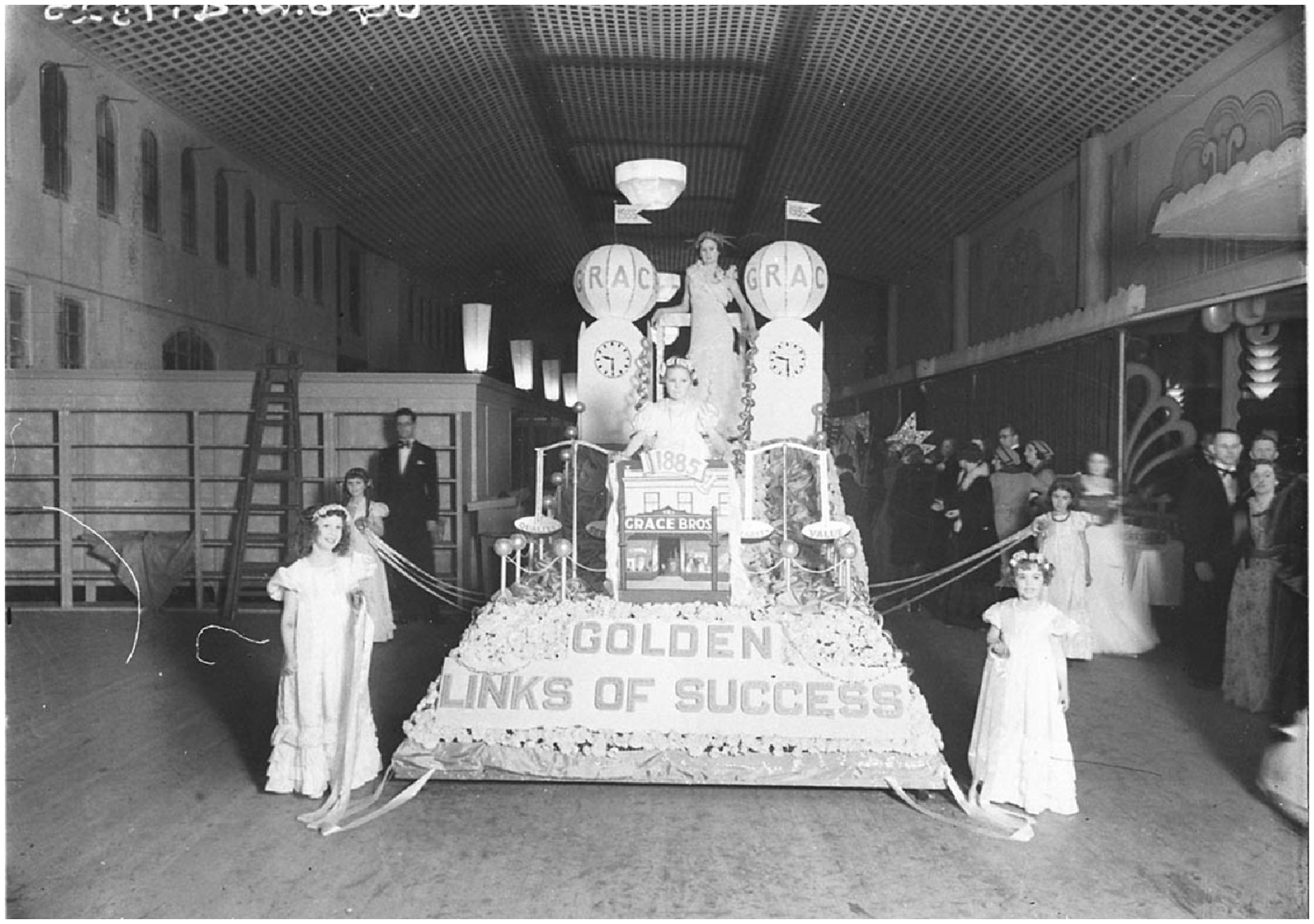
Salespeople worked painstakingly for months beforehand on intricate, themed floats as part of a storewide competition between departments with no financial assistance from management and in their own time (see Figures 9 and 10). The first float, ‘The Steps of Time’, showed a white marbled stairway ascending from the small sun of 1788 through the various periods of Australian history to the ‘resplendent sun’ of 1938. Upon the steps were men and women attired in the fashions of 1788, 1888 and 1938, the latter symbolizing ‘Australia enthroned’, attended by girls representing Sydney and New South Wales.
154
The stairway was supported by a series of zinnia-covered arches, in each of which was a letter of the firm’s name. Preceding the float along the route of the procession were 25 bandsmen of the Glebe District Silver Band riding in a silver chariot. A marching party of 200 sun-tanned girls from the Grace Brothers Gymnasium followed. Nine floats were in the parade and the first prize was awarded to the Model Story – an elaborate and cleverly designed float entirely carried out in blue and gold, the jubilee colours. One of the figures on the float was seen to be turning the pages of a store ‘Bible’ – ‘The Model Story’ – on each page of which was inscribed the words – Service, Honour, Integrity.
155
Rehearsal for Grace Brother Gold Jubilee Parade c1935, Grace Bros. 50th anniversary celebrations. Float ‘Golden Links of Success’ in Grace Brother Gold Jubilee Parade c1935, Grace Bros. 50th anniversary celebrations.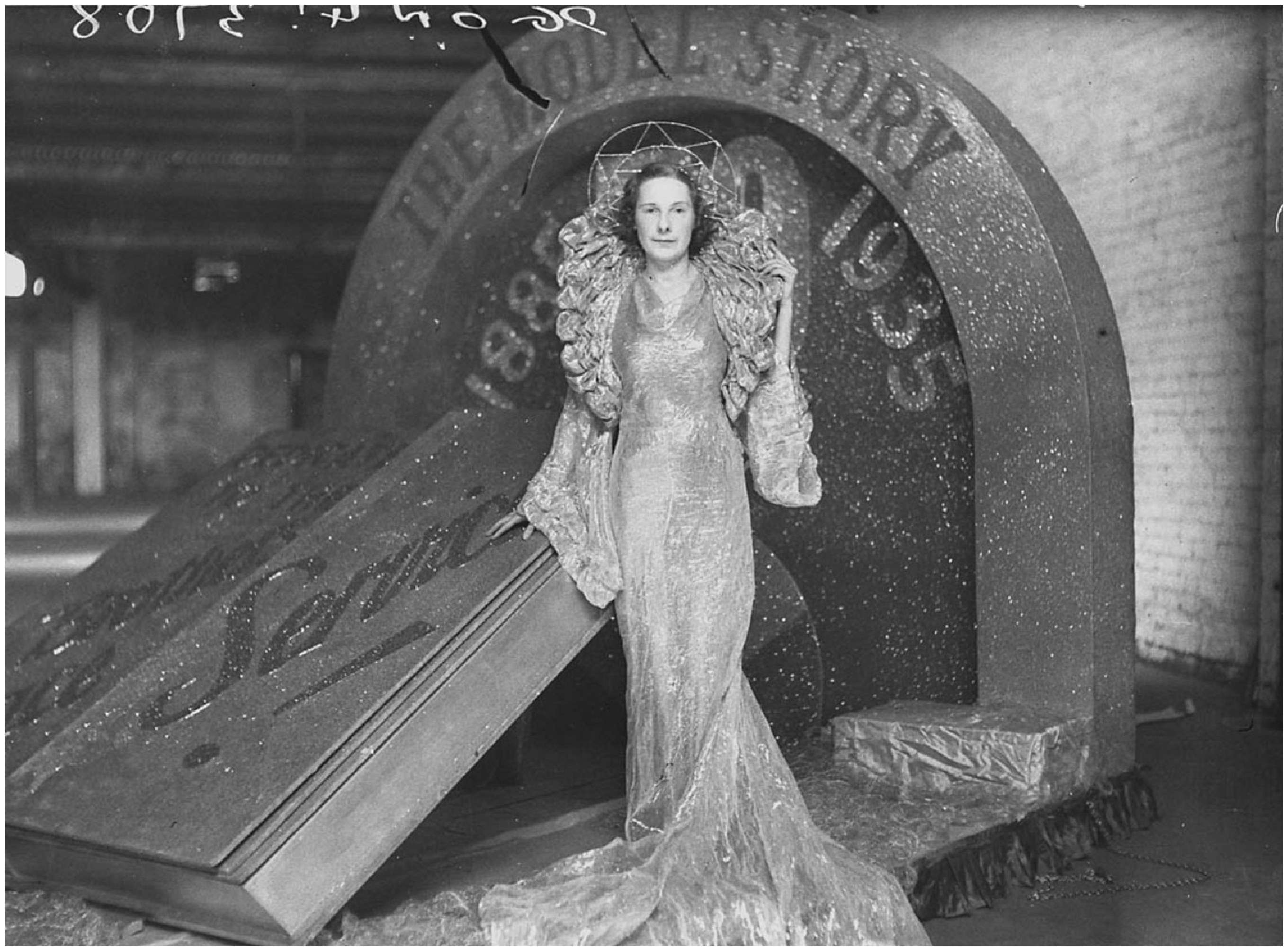
Coles had celebrated their anniversary in 1934 with a pageant in Melbourne. Those who attended were told not to applaud and only one of the 200 people taking part in the tableaux spoke, ‘Yet the shades of expression and emotion were conveyed more delicately with gesture than could have been done with words’. 156 Double tableaux were used ‘for the first time in Melbourne. Scenes from the old world and scenes from the new were acted side by side’. On one side Joseph of Aramethea landed with black cowled monks to convert the bearded Celts in skins and hessian, while on the other the first Church service in Victoria in 1803 was shown in a blare of red, silver and blue with sweeping crinoline, silks, satin cherry coats and cravats. In another scene St Aidan was shown blessing the Saxons while the conversion of Aboriginal Australians in Anglican missions was shown on the other side. The pageant ended with the formation of the ‘living Church formed by pyramids by 70 boys’. All of the organizations taking part in the pageant moved through the open doors and 800 people in ‘dresses of all ages’ were seen on the stage.
Christian storylines and values had a complex role to play in the promotion of commercial institutions like department stores. These kinds of commercial displays were about narrating and translating modern demarcations of time, progress and historical epoch so as to link the work of department stores to the project of empire and of nation building. 157 ‘When one looks at the floats in our parades’ wrote one Grace Brothers’ manager, ‘the sequence of stages of civilization through which our race has passed are immediately apparent’. 158 If modernity is primarily the condition of expecting change or simply the sense of the idea that the present is discontinuous with the past then this kind of pageantry could construct such a break. Aboriginal Australians and other ‘natives of Empire’ portrayed in the parades were instantly transformed into fossils, exhibits of a primitive era. The work of sales staff, on the other hand, became emblematic of a higher stage on the evolutionary ladder.
Frank Bongiorno has talked about a ‘reluctance on the part of Australian … historians to recognize the role played by esoteric belief and unorthodox religion in the making of Australian modernity’. 159 As Melissa Bellanta has pointed out, there is a growing body of work on the relationship of turn-of-the-century occultism and Theosophy to modernity in both Australian and international scholarship. Jill Roe has written of Australian Theosophists’ desire to discover ‘a common ground between science and religion’. 160 This work is evidence that connections between esoteric belief and modernity have been made in Australia, but of the links between department stores, salespeople and religious practice, we know very little. Connections between religion and Australian consumer cultures have not yet been addressed in any major scholarly work. Historians of the Australian city ‘are inclined to represent Australia as a secular country without a significant religious culture’. 161
In department store archives we see how interwar sales managers used religious language and ritual as transitional behavioural forms and as bastions of ‘authentic feeling’ in the face of mechanization, bureaucratization and rationalization. Salespeople were at the coal-face of a certain kind of institutionalized modernity. Of course, selling did not begin in the interwar period, but a certain type of selling did. The actions of salespeople became strenuously managed so that interpersonal engagement became not organic but something to be learned and practised. The ways in which department stores trained their staff intersected with a prevailing colonial ideology, which sought to claim an imperial tradition for the emerging Australian nation by narrating the nation’s past through pageants, parades and store histories. By propagating a history of Australia that valorized white settlement and the civilizing of Indigenous Australians through mission work, consumer culture contributed to the manufacture of categories of difference in the interwar period and was a conduit for ways of thinking about belonging and community. Focusing on salesmanship in department stores can, therefore, make visible a connection between the economic imperatives of urban institutions in the 1920s and 1930s and the narratives of cultural colonialism at the heart of Australian colonial modernity.
Footnotes
1
A. Hochschild, The Managed Heart: Commercialization of Human Feeling (Oakland, CA 1983).
2
G. Haigh, Asbestos House: The Secret History of James Hardie Industries (Sydney 2007).
3
Coles Myer Archive, State Library of Victoria (hereafter SLV) MS, 13468 Box 1505.
4
My emphasis. Penney’s Stores were a Queensland-based chain taken over by Coles in the 1950s. Penney’s Limited Staff Initial Training Booklet, No. 39, property of N. Wall, Penney’s Chain Store papers, Coles Myer Archive, SLV, MS 13468 Box 1511, 1–7.
5
Penney’s Limited Staff Initial Training Booklet, 7.
6
Martin Jay, drawing on Eva Geulen, has written ‘Authenticity is a belated effect. In the beginning it was not the original but rather the reproduction, which makes the concept of authenticity possible in the first place. Authenticity becomes authentic only against the backdrop of reproducibility’. M. Jay, ‘Taking on the Stigma of Authenticity: Adorno’s Critique of Genuineness’, New German Critique 33, 1 (Winter 2005), 19. See also E. Geulen, ‘Walter Benjamin’s “The Work of Art in the Age of Mechanical Reproduction,”’ in G. Richter (ed), Benjamin’s Ghosts: Interventions in Contemporary Literary and Cultural Theory (Stanford, CA 2002).
7
B.J. Pragnell, ‘“Selling Consent”: From Authoritarianism to Welfarism at David Jones, 1838–1958’, unpublished PhD thesis, University of New South Wales (2001), 267. See also: M.B. Miller, The Bon Marché: Bourgeoisie Culture and the Department Store 1869–1920 (Princeton, NJ 1981), 191.
8
E.L. Neil, Letter Collection, Coles Myer Archive, SLV, MS 13469.
9
Excerpt from H. Gibson, The Art of Draping (London 1936), Myer Staff Library, used in Myer training courses, Coles Myer Archive, SLV, MS 13468 Box 314, 1361.
10
E.L. Neil, Letter Collection, Coles Myer Archive, SLV, MS 13468.
11
G. Reekie, ‘Sydney’s Big Stores 1880–1930: Gender and Mass Marketing’, unpublished PhD Thesis, University of Sydney (1987), 148. Salesmanship was first included in the Sydney Technical College as part of the Department of Commerce’s Business Principles syllabus in 1927: Sydney Technical College Handbooks, 1927, 1929/30, 1934 and 1935.
12
Susan Porter Benson’s work has documented the rise of ‘personal selling’ in America. See: S. Porter Benson, ‘The Cinderella of Occupations: Managing the Work of Department Store Saleswomen 1900–1940’, Business History Review, 55, (Spring 1981), 319; Counter Cultures: Saleswomen, Managers and Customers in American Department Stores 1890–1940 (Champaign, IL 1986); B.L. Brisco and J.W. Wingate, Retailing Receiving Practice (New York, NY 1925).
13
‘To the Building of a lasting business must be brought many sterling qualities, the chief among them being honesty, sincerity, prudence’: N. Brash, Grace Brothers: The Model Store 1885–1985 (Adelaide 1985), 17.
14
Coles Myer Archive, SLV, MS 13468 Box 306.
15
Ibid. Susan Porter Benson noted a similar reaction from American customers. See: S. Porter Benson, ‘The Cinderella of Occupations', 18.
16
Collection of Myer and David Jones Training Manuals 1940-1970, National Library of Australia, NLp 658.386 MYE; Regulations for the Staff of David Jones Limited, National Library of Australia, N 381.1410683 D246.
17
Susan Porter Benson’s Counter Cultures remains the most influential work in this field. While social histories of the department store have provided an important counterpoint to business histories, they have not focused on philosophies of salesmanship. See B. Lancaster, The Department Store: A Social History (London 1995).
18
‘The department store, then, is most usefully analyzed as a site of sexual culture in which men and women shaped and contested historically-specific formulations of masculinity and femininity and relations between the sexes.’ G. Reekie, Temptations: Sex, Selling and the Department Store (Sydney 1993), xviii. This book was based on Reekie’s 1987 PhD Thesis: Reekie, ‘Sydney’s Big Stores 1880–1930’, 1–390.
19
L. Ling Ling, ‘From the Retailing Revolution to the Consumer Revolution: Department Stores in Modern Shanghai’, Frontier History China 4, 3 (2009), 358–9. Translated by Y. Kai-Chien in Lishi Yanjiu (Historical Research), 5 (2008), 76–93. See also: ‘“Seeking Independence” or “Coveting Modernity”? The Emergence of Women Clerks and the Formation of Their Images in Modern Shanghai’, Research on Women in Modern Chinese History, 14 (December 2006), 1–50; ‘Everyday Life as an Arena of Power Relations: Department Store Clerks in Republican Shanghai’, Bulletin of the Institute of Modern History Academia Sinica, 55 (March 2007), 137–92.
20
W. Friedman, Birth of a Salesman: The Transformation of Selling in America (Cambridge, MA 2004), 13.
21
Porter Benson, Counter Cultures, 1.
22
A. Woollacott, To Try Her Fortune in London: Australian Women, Colonialism and Modernity (Oxford and New York, NY 2001), 194.
23
See: R. Waterhouse, Private Pleasures, Public Leisure: A History of Australian Popular Culture Since 1788 (Melbourne 1995); J. Damousi, ‘Freud in the Antipodes: A Cultural History’, in C. Bridge and S. Pfisterer (eds), The Trevor Reese Memorial Lecture Monograph Series (London 2001), 1–38.
24
R. Marchand, Creating the Corporate Soul: The Rise of Public Relations and Corporate Imagery in American Big Business (Berkeley, CA 1998), 101.
25
Marchand, Creating the Corporate Soul, 8.
26
Ibid. See also: S. Kracauer, The Salaried Masses: Duty and Distraction in Weimar Germany (London 1998).
27
Marchand, Creating the Corporate Soul, 8.
28
See N. Gane, Max Weber and Post-Modern Theory: Rationalization versus Re-enchantment (New York, NY 2002).
29
Gane, Max Weber and Post-Modern Theory, 104–8.
30
Miller, The Bon Marché, 5–11.
31
F. Trentmann, ‘Crossing Divides: Consumption and Globalization in History,’ Journal of Consumer Culture, 9, 187 (2009), 202.
32
F. Trentmann, ‘Beyond Consumerism: New Historical Perspectives on Consumption,’ Journal of Contemporary History, 39, 373 (2004), 379–0.
33
S. Macintyre, Oxford History of Australia: The Succeeding Age 1901–1942 (Melbourne 1993), 36; Reekie, ‘Sydney’s Big Stores 1880–1930’, 28.
34
K. Murphy, “‘The emotional, the weak, the wayward, the innocent, the unsophisticated and the misplaced girl”: the Travellers’ Aid Society of Victoria and the Country Girl in the 1920s’, Journal of Australian Studies, 34, 4 (December 2010), 449; W.A. Sinclair, ‘Women and Economic Change in Melbourne 1871–1921’, Historical Studies, 20, 79 (1982), 278–91; P. Spearritt, Sydney’s Century: A History (Sydney 2000), 52–4; M. Cannon, The Roaring Days (Mornington 1988); G. Davison, The Rise and Fall of Marvellous Melbourne (Carlton 1988), especially chapter six ‘The Social Dynamics of a Metropolis’, 130–7.
35
L. Hordern, Children of One Family: The Story of Anthony and Ann Hordern and their Descendants in Australia, 1825–1925 (Sydney 1985), 231.
36
Tables 18 and 19, Commonwealth Census of 1911; Tables 25 and 26, Commonwealth Census of 1921. Individual store records underline this expansion. For example, the number of employees at David Jones increased from 224 in 1897 to 2260 in 1919; and Lassetters from 120 in the 1890s to 1000 in 1910.
37
Compare with factory workforce statistics in G.P. Walsh, ‘Factories and Factory Workers in New South Wales 1788–1900, Labour History, 21 (November 1971), 11; Employment figures for individual firms are located in the following sources: Hordern Family papers 1909–1914, Mitchell Library MLMSS 6732; Retail Traders Association of New South Wales Journal, February 1924, August 1923, December 1923 and July 1933; Lassetters: Sixty Years an Employer (Written at the request of staff and employees at F. Lassetters & Co., Sydney, 1910); M. Foy, The Romance of the House of Foy (Published in Connection with the Golden Jubilee of Mark Foy’s Ltd in David Jones Archives, Sydney 1935), 33; The Draper of Australasia, Vol 8 (January 1916), 10.
38
One government official estimated in 1924 that female department store employees outnumbered men four to one. The Draper of Australasia, Vol 12 (August 1924), 475. As was observed by the 1920–1 Select Committee on Agriculture in New South Wales, the drift to the city was spearheaded by the sons and daughters of small selectors and the struggling migratory farming class (share, wage and tenant farmers) who had become discouraged by prospects at home. The many young rural women who moved to the city in these years did so not only to be ‘respectable’ teachers and nurses, but also to work in factories and shops. See: K. Murphy, ‘“The emotional, the weak, the wayward”', 451.
39
K. Whitehead, ‘Careers Advice for Women and the Shaping of Identities’, Australian Labour History, 92 (May 2007), 27.
40
J. Julius Mathews, Good and Mad Women: The Historical Constructions of Femininity in Twentieth-Century Australia (Sydney 1984), 54.
41
P. Spearritt, ‘An Urban History of Sydney, 1920–1950’, unpublished PhD Thesis, Australian National University, (1976), 271–2.
42
K. Murphy, ‘“The emotional, the weak, the wayward”', 451.
43
Reekie, ‘Sydney’s Big Stores 1880–1930’, Table 1.1; Foy, The Romance of the House of Foy, 22.
44
Reekie, ‘Sydney’s Big Stores 1880–1930’, 19.
45
M. Lech, ‘Australia’s Department Stores’, unpublished paper, presented at the Sydney Mechanics Institute, 6 April 2010.
46
Plan of Elizabeth Street store departments 1927, David Jones Archives BRG 1/574; Store histories in Retail Traders Association of New South Wales Journal, May-December 1924, March and June 1932, July 1933, October 1935; I. Jeacle, ‘Emporium of Glamour and Sanctum of Scientific Management: The Early Twentieth Century Department Store’, Journal of Management History, 42, 9 (2004), 1167.
47
Reekie, ‘Sydney’s Big Stores 1880–1930’, 20–1.
48
J. Julius Mathews, Dance Hall & Picture Palace: Sydney’s Romance with Modernity (Sydney 2005), 103.
49
Ibid.; Davison, The Rise and Fall of Marvellous Melbourne, 131.
50
Mathews, Dance Hall & Picture Palace, 103–110.
51
‘It isn’t a Shop, it's an Institution’, Anthony Hordens & Sons, New Palace Emporium, c. 1905. Quoted in Reekie, Big Stores, 21. Newspaper and shop inspection reports from the 1890s and 1900s depict a grim life for the average shop worker. Shifts went for six days, twelve hours a day and conditions were primitive: gas lighting and poor ventilation created a noxious atmosphere; lunchrooms and lavatories were not provided; chairs and sitting were banned; there were no concessions for sickness or ill health; and no time allowed for lunch or dinner breaks, even on night shifts. See: ‘The Shop Girl’, The Bulletin, newspaper cutting in John Anderson’s Letter Book 1879–1880, SLV, MS 9560.
52
Draper of Australasia, 15, 5 (17 May 1915), 140.
53
The Hordernian Monthly, November 1923, Coles Myer SLV 13468 Box 91.
54
Sunday Times (10 December 1922); Shop work was poorly unionized. Explanations for the weakness of retail employees’ unions have often emphasized that a high proportion of salespeople were women with low attachment to the labour force and unions. See: E. Roberts, ‘Gender in Store: Salespeople’s Working Hours and Union Organisation in New Zealand and the United States', Labour History, 83 (Nov 2002), 107–30.
55
J. Macculloch, ‘“This Store is Our World”: Female Shop Assistants in Sydney to 1930' in J. Roe (ed.), Twentieth Century Sydney: Studies in Urban & Social History (Marrickville 1980), 168.
56
B. Kingston, My Wife, My Daughter and Poor Mary Ann (Melbourne 1975), 97.
57
H. Cravens and J.C. Burnham, ‘Psychology and Evolutionary Naturalism in American Thought, 1890–1940', American Quarterly, 23 (December 1971), 646.
58
J.B. Watson, Behaviourism (Chicago, IL 1930).
59
H. Bourke, ‘Emily Dorothea Pavy (1885–1967)’, Australian Dictionary of Biography, Volume 11, (Melbourne 1988), 168–9. See also: A. Woollacott, ‘Maternalism, Professionalism and Industrial Welfare Supervisors in World War I Britain’, Women’s History Review, 3, 1 (March 1994), 29–56.
60
D. Proud, Welfare Work: Employers’ Experiments for Improving Working Conditions in Factories (London 1916), 59.
61
Ibid., 252–3.
62
Ibid., 56, 89.
63
Ibid., 57.
64
Ibid., 60.
65
B. Jameson, ‘Reconstruction: A Reform Practicable to Today’, The Draper of Australasia (27 October 1920), 335.
66
Letter from E. Lee Neil to Alan Neil, Coles Myer Archives SLV, MS 13468 L4/13/3.
67
A prominent and dedicated Anglican, Neil devoted considerable time to the Church Missionary Society and the Melbourne Bible Institute and was also a lay canon at St Paul’s Cathedral, a member of synod and organist at St Hilary’s, East Kew. In the early 1920s he banned the sale of liquor at Myer, and refused Sidney Myer’s request to introduce bridge classes (‘a curse to the community, a gambling source’) in his own store. S. Barber, Sydney Myer: A Life, A Legacy (Melbourne 2005), 135.
68
B. Jameson ‘Reconstruction: A Reform Practicable to Today’, The Draper of Australasia (27 October 1920), 335.
69
Papers relating to Marcus Clarke & Co. Ltd Employee Assurance, Superannuation and Welfare Fund in Marcus Clarke papers, Australian National University Archives of Business and Labour 74/32-33; J. Rawlings, ‘Welfare Work at Anthony Horden & Sons Ltd’, Health, 3, 3 (May 1925), 69–75; The Draper of Australasia (September 1920), 284.
70
Eleanor Hinder papers, MLMSS 770, Box 3; N. Balnave, ‘Company-Sponsored Recreation in Australia: 1890–1965’, Labour History, 85 (November 2003), 133.
71
National Council of Women of New South Wales Biennial Report 1923–1924; YWCA Sydney, Annual Report 1916–1917, 1919–1920, 1921–1922. Meredith Foley has shown in her study of women’s organizations between the wars that the YWCA took the initiative in promoting welfare schemes for women workers after 1919, and in the training of and support for women welfare workers after 1922. The Association organized a conference in 1923 on the Human Factor in Industry to explain to Sydney employers the principles underlying welfare work.
72
K. Roberts Personal Notebook, ‘Advanced Merchandising Course, Lecture IV, The Service We Give,’ Coles Myer Archive SLV MS 13468 Box 91.
73
The Western Stores Limited Staff Handbook (owned by F. Sanderson) ‘Selling Guide’, Coles Myer Archive SLV MS 13468 Box 1505, 11.
74
‘Buyer’s Guide’ Coles Myer Archive SLV MS 13468 Box 1505, 2.
75
‘Fosseys 1920s Staff Guide Book’, Coles Myer Archive, SLV, MS 13468 Box 91; ‘The Retailer of Plato’s Time: Grace Brothers Staff Guide Book 1925’, Coles Myer Archive, SLV, MS 13468 Box 91; ‘Essentials for Success’, Coles & Co Staff Training Manual 1931, Coles Myer Archive, SLV, MS 13468 Box 1511; ‘“Selling Yourself”: The Use of Confident Bearing to Control Others’, Myer Staff Training Manual, 1930, Coles Myer Archive, SLV, MS 13468 Box 1511.
76
Farmers Staff Training Manual 1920, Coles Myer Archive, SLV, MS 13468 Box 962.
77
Grace Brothers collection in Coles Myer Archive, SLV, MS 13468 Box 1361; Box 904; Box 879. A bible used in these ceremonies is preserved in Box 879 along with the following note: ‘The Bible was used by employees to swear allegiance to Grace Bros on Employment.’
78
‘Coles & Co The Ten Commandments of Service,’ Better Business, Manual 5, Coles Myer Archive, SLV MS 13468 Box 386.
79
‘Myer Training Manual 1929’, Coles Myer Archive, SLV, MS 13468 Box 386.
80
Coles Myer Archive, SLV, MS 13468 Box 1511.
81
‘Working in a Department Store, Careers for Boys and Girls’, 1938, Myer Pamphlet Collection, National Library of Australia NLA MS N968.8710994 L778, 1.
82
Ibid.
83
‘Coles & Co, Your Store,’ Coles Myer Archive SLV MS 13468 Box 386.
84
K. Roberts Personal Notebook, ‘Advanced Merchandising Course, Lecture IV, The Service We Give,’ Coles Myer Archive SLV MS 13468 Box 91.
85
‘Working in a Department Store, Careers for Boys and Girls’ 1938, Myer Pamphlet Collection, National Library of Australia NLA MS N968.8710994 L778, 1.
86
Ibid, 2.
87
Ibid, 2.
88
Penney’s Limited Staff Initial Training Booklet, No. 39, property of N. Wall, Penny’s Chain Store papers, Coles Myer Archive, SLV, MS 13468 Box 1511, 1–7.
89
D. Cusack, Caddie, a Sydney Barmaid: an Autobiography written by herself (Melbourne: 1953), 28.
90
‘A Salesgirl’s first Week,’ Sun & Guardian (21 May 1934), 2.
91
For example see: ‘The Approach’, Fosseys Staff Guidebook, 1932, Coles Myer Archive, SLV, MS 13468 Box 91.
92
‘Working in a Department Store, Careers for Boys and Girls’, 1938, Myer Pamphlet Collection, National Library of Australia NLA MS N968.8710994 L778, 1.
93
Penney’s Limited Staff Initial Training Booklet, No. 39, property of N. Wall, Penney’s Chain Store papers, Coles Myer Archive, SLV, MS 13468 Box 1511, 1–7.
94
K. Roberts Personal Notebook, ‘Advanced Merchandising Course, Lecture IV, The Service We Give’, Coles Myer Archive SLV, MS 13468 Box 91. See also: ‘Staff Manual’, Coles Myer Archive SLV MS 13468 Box 1501.
95
Penney’s Limited Staff Initial Training Booklet, No. 39, property of N. Wall, Penney’s Chain Store papers, Coles Myer Archive, SLV, MS 13468 Box 1511, 1–7.
96
‘The Coles Girl’, Eleanor Hinder Papers, ML MSS 770 Box 7, 5.
97
‘The Coles Girl’, Eleanor Hinder Papers, ML MSS 770 Box 7, 6.
98
‘Points of Good Salesmanship 1933’, Coles Myer Archive, SLV, MS 13486 Box 306.
99
‘The Approach’, Mark Foys Manual 1926, Coles Myer Archive, SLV, MS 13486 Box 391, 8.
100
Ibid.
101
‘Service’, Coles Myer Archive, SLV, MS 13468 Box 94, 32.
102
Ibid.
103
‘Increase your Average Sale, Help Others do Likewise’, Grace Brothers Store News (1 August 1939), Coles Myer Archive ,SLV, MS 13468 Box 879, 1.
104
Ibid.
105
Mark Foys Staff Book, Coles Myer Archive, SLV, MS 13468 Box 879 10.
106
‘Grace Brothers Management Notes,’ Coles Myer Archive, SLV, MS 13468 Box 91, 1.
107
‘Psychology of Selling’, New Classes at R.T.T.I. ‘The Psychology of Selling’ on Monday nights from 6 pm to 7 pm at The Retail Traders Training Institute, 114 Castlereagh St. The fee for the course is £1. If there were official and professional links between retailing and professional psychology and research these were indirect, if not obscure.
108
‘Better Business’ Manual 5, Coles Myer Archive, SLV, MS 13468 Box 161.
109
Coles Myer Archive, SLV, MS 13468 Box 1901, 1501.
110
Balnave, ‘Company-Sponsored Recreation in Australia: 1890–1965’, Labour History, 85 (November 2003), 135. E. O. James, Christian Myth and Ritual: A Historical Study (London 1933), 212, 246, 277.
111
I. Breward, ‘Historical Perspectives on Theological Education in Australasia’, in G. Troloar, The Furtherance of Religious Beliefs: Essays on the History of Theological Education in Australia (Sydney 1997), 8–24; R.C. White and C. Howard Hopkins, The Social Gospel: Religion and Reform in Changing America (Philadelphia, PA1976).
112
Eleanor Hinder Papers, ML MSS 770 Box 7.
113
‘How to Sell Pageant’, The Brisbane Courier (31 October 1928), 14; ‘Salesmanship’, ‘Y.M.C.A. Class Inaugurated: Lecture by Mr C O’Connor', The Mercury (9 August 1930), 8; ‘New Wonders of Efficiency Pageant’, Brisbane Courier (23 January 1931), 7; ‘Shop Girls Acclaim’, Australian Women’s Weekly (30 December 1939), 35.
114
E. Hinder, ‘The Spirit of Modern Industry’, Script loose in Item 1-2 ‘Farmers and Company, Sydney, NSW 1919–1926,’ Eleanor Hinder Papers, MLMSS 770 Box 7.
115
E. Hinder, ‘The Spirit of Modern Industry’, Script loose in Item 1–2 ‘Farmers and Company, Sydney, NSW 1919–1926,’ Eleanor Hinder Papers, MLMSS 770 Box 7, 2–3.
116
E. Hinder, ‘The Spirit of Modern Industry’, Script loose in Item 1–2 ‘Farmers and Company, Sydney, NSW 1919–1926,’ Eleanor Hinder Papers, MLMSS 770 Box 7, 3–4.
117
E. Hinder, ‘The Spirit of Modern Industry’, Script loose in Item 1–2 ‘Farmers and Company, Sydney, NSW 1919–1926,’ Eleanor Hinder Papers, MLMSS 770 Box 7,. 5. Biblical quotation from Luke 2: 14.
118
E. Hinder, ‘The Spirit of Modern Industry’, Script loose in Item 1–2 ‘Farmers and Company, Sydney, NSW 1919–1926,’ Eleanor Hinder Papers, MLMSS 770 Box 7, 8.
119
N. Collison, ‘Magnificent Pageant: The Church through the Ages’, The Register (22 October 1928), 28; Script of Nora Collison pageant in Coles Myer Archive, SLV, MS 13468 Box 1501. See also: N. Collison, ‘Pageant Celebrating the Tenth Anniversary of the Establishment of the League of Nations’, Souvenir programme of League of Nations pageant, Theatre Royal, Adelaide, December 7–14, 1929. State Archives of South Australia, A822.2.
120
N. Collison, ‘Magnificent Pageant: The Church through the Ages’, The Register (22 October 1928), 28.
121
J. Smart, ‘Cultivating Class Consciousness in a New Generation: The Labor Guild of Youth in Melbourne 1926–28’, Labour History, 82 (May 2002), 53–4.
122
Ibid.
123
Labour Call (25 November 1926), 8.
124
‘Personal’, Coles and Co Staff Journal, Coles Myer Archive, SLV, MS 13468 Box 957; The Myer Store News (1934), Coles Myer Archive, SLV, MS 13468 Box 962; ‘Manufacture, Service, Distribution: The Voice of the House of Foy & Gibson’, August 1930, Coles Myer Archive, SLV, MS 13468 Box 904; ‘Service, Here’s to Ye!’ Christmas Edition, Grace Brothers Staff Journal, Coles Myer Archive, SLV, MS 13468 Box 904.
125
‘Service, Here’s to Ye!’ Christmas Edition 1939, Grace Brothers Staff Journal, Coles Myer Archive, SLV, MS 13468 Box 904, 1; The Myer Bulletin: Better Selling Number, 39 (July 25 1933), Coles Myer Archive, SLV, MS 13469 Box 3352, 3.
126
N. Collison, ‘Magnificent Pageant, 28.
127
The Hordernian Monthly (4 April 1929), Coles Myer Archive, SLV, MS 13468 Box 904, 3. See also: Collection of Myer and David Jones Training Manuals 1940–1970, National Library of Australia, NLp 658.386 MYE; Regulations for the Staff of David Jones Limited, National Library of Australia, N 381.1410683 D246.
128
The Hordernian Monthly (4 April 1929), Coles Myer Archive, SLV, MS 13468 Box 904, 3; ‘The Crowning of Miss Hordernia 1932’, Sam Hood Collection, State Library of NSW, Pic.Acc.1272 (v.2).
129
‘Service, Here’s to Ye!’ Christmas Edition, Grace Brothers Staff Journal, Coles Myer Archive, SLV, MS 13468 Box 904. See also: ‘Manufacture, Service, Distribution: The Voice of the House of Foy & Gibson’ (August 1930), Coles Myer Archive, SLV, MS 13468 Box 904.
130
M. Eliade, Australian Religions: An Introduction (London 1973), 91.
131
Hordern Family papers 1909–1914, Mitchell Library MLMSS 6732.
132
‘Rev Thomas Talt, Scots Church, Melbourne,’ Sydney Morning Herald (9 August 1921).
133
Rev H.N. Barker, Sir Thomas Rectory, North Sydney, The Sydney Morning Herald (2 July 1936).
134
E. Hinder, ‘Farmers and Company, Sydney, NSW 1919–1926,’ Eleanor Hinder Papers, MLMSS 770 Box 7.
135
‘Uniforms and Appearances’, in H. Bushnell, Christian Nurture (London 1916), 116.
136
E. Lee Neil Letter Collection, Coles Myer Archive, SLV, MS 13468.
137
E. Hinder, ‘Farmers and Company, Sydney, NSW 1919–1926’, Eleanor Hinder Papers, MLMSS 770 Box 7.
138
Reekie, ‘Sydney’s Big Stores 1880–1930’, 217.
139
‘12:30 pm 23/12/1939,’ by ‘H. L .B’, in Grace Brothers Store News (23 December 1939), Coles Myer Archive, SLV, MS 13468 Box 1505.
140
D. Stubbs, ‘I’d Love to Be’, Coles Myer Archive, SLV, MS 13468 Box 3352.
141
R. Niethammer, ‘If’ in Service: All for One and One for All, Coles Myer Archive, SLV, MS 13468 Box 3352.
142
‘Enthusiasm and Boredom’, Between Ourselves, Coles Myer Archive, SLV, MS 13468 Box 904.
143
‘ABC for Sales Staff’, Grace Brothers News (1 June 1940), 4.
144
‘Selling Yourself: The Use of Confident Bearing to Control Others’, in The Retailer of Plato’s Time, Coles Myer Archive, SLV, MS 13468 Box 91.
145
Managers’ Guides, Coles Myer Archive, SLV MS 13468 Box 1505.
146
Reverend T.E. Ruth, ‘The Smile in the Soul’, Sun and Guardian (18 Feb 1934), 9.
147
Ibid.
148
Staff Manual, Farmer & Co 1921, Coles Myer Archive, SLV, MS 13468 Box 386.
149
‘Staff Handbook, The Western Stores Limited: A Division of the Myer Emporium’, property of E. Saunders 1939, Coles Myer Archive, SLV, MS 13468 Box 1505.
150
‘Dalton Brothers: Orange and District Illustrated’, Coles Myer Archive, SLV, MS 13468 Box 1505.
151
‘The J.B. Young Story’, Coles Myer Archive, SLV, MS 13468 Box 1505. See also Grace Brothers Store News (8 August 1947), Coles Myer Archive, SLV, MS 13468 Box 1505.
152
The Myer Store News (1934), Coles Myer Archive, SLV, MS 13468 Box 962; For a personal account of one of these celebrations see E. Phillips correspondence, Coles Myer Archive, SLV, MS 13468 Box 1505. E. Phillips worked for The Western Stores in Molong in the 1920s and 1930s. Her correspondence was solicited by a Myer archivist in the 1980s who planned an exhibition of The Western Stores that never took place.
153
Brash, Grace Brothers, 42–5.
154
Grace Brothers Store News (28 July 1951), Coles Myer Archive, SLV, MS 13468 Box 1505 (page numbers too faded to read).
155
Brash, Grace Brothers, 42–5.
156
‘Souvenir’, Coles Myer Archive, SLV, MS 13468 Box 1511.
157
Floats in Grace Brothers Golden Jubilee Parade carried salespeople dressed as Sikhs accompanied by missionaries, as well as a ‘harem’ of women on a float representing Abyssinia or, ‘A’ Be Seein ‘Y’, Coles Myer Archive, SLV, MS 13468 Box 1511.
158
Coles Myer Archive, SLV, MS 13468 Box 1511.
159
Frank Bongiorno quoted in M. Bellanta, ‘Engineering the Kingdom of God: Irrigation, Science and the Social Christian Millennium, 1880–1914’, Journal of Religious History 32, 1 (March 2008), 70.
160
J. Roe, Beyond Belief: Theosophy in Australia, 1879–1939 (Sydney 1986), 98.
161
B. Griffen-Foley, ‘Radio Ministries: Religion on Australian Commercial Radio 1920s to 1960s’, Journal of Religious History, 32, 1 (March 2008), 31.