



Abstract
Scholarship on Romani (Gypsy) migration has typically focused either on longue durée patterns of persecution and marginalization or on Roma migrants within Europe since the fall of communism. This article shows how the westward migration of Roma after the Second World War and during the early years of the Cold War breaks with several common assumptions about the history of displaced persons, refugees, and Roma alike. Contrary to claims about unbroken continuities in the persecution of European Roma, in the immediate postwar years officers of the International Refugee Organization used ‘Gypsy' as a privileged category that improved an applicant’s changes of getting support from the organization. Internationalization thus offered a brief respite from discrimination for one of the only ethnic refugee groups without its own lobby. This situation changed by the 1950s, when national refugee administrations replaced the earlier international refugee regimes established in the wake of the war. Roma became an exception at a time when West European governments were accepting asylum-seekers from Eastern Europe as part of their ongoing Cold War propaganda efforts. In this period government officials concerned with protecting national interests reverted to earlier classifications of ‘Gypsies' as nomads who were, by definition, not refugees.
Keywords
On 11 May 1949, leading officers of the International Refugee Organization (IRO) in Germany met in the Bavarian spa town of Bad Kissingen. The convened men and women were responsible for deciding who among the millions of displaced persons who found themselves in Western Europe after the war would receive the organization’s services, ranging from resettlement aid to distribution of food rations. During the meeting Dr. Kazimierz Niec, a Polish lawyer and IRO officer for the area of Bavaria that received the majority of new intakes, broached the topic of ‘Gypsies,’ whose notable presence among the applicants posed a variety of conceptual challenges to the IRO. In Niec’s view ‘Gypsies’ were ‘professional wanderers’ who traveled ‘for purely economic reasons’ and thus did not qualify as displaced persons (DPs). A nomad could not be a refugee. 1 The fact that several of these applicants had requested permission to pursue itinerant trades in their new country of reception served as additional fodder for Niec’s attempts to prove that their displacement differed from that of true refugees. Despite his insistence on this point, however, he conceded that ‘Gypsies’ should be considered victims of Nazism, noting that ‘many of them were persecutees, having been in concentration camps.’ 2
Niec’s statements reflected refugee administrators’ concern with separating economic migrants from refugees, since only the latter fell within the IRO’s mandate. The distinction was reinforced by an annex to the IRO’s constitution, which included elaborate definitions of eligibility based on criteria of historical suffering and the threat of particular forms of persecution in the present. 3 Eligibility hinged on proving that one was either a refugee or a displaced person, categories that applied to individuals who were stateless or found themselves outside of the country where they held citizenship due to recent political events. Individuals in both categories were obliged to prove that they had ‘valid objections’ to returning to their erstwhile homes – objections that were defined primarily as legitimate fears of persecution based on race, religion, nationality, or political opinions. 4 Only two groups were statutorily presumed to be unable to return to their former country of habitual residence without having to substantiate their claims: Jews and Spanish Republicans. 5 Neither the IRO’s constitution nor the published decisions of its review board offered any special provisions for ‘Gypsies’ 6 – or individuals who would be identified today by the ethnicized categories of Roma, Roma, and Sinti, or Romanies. 7 As members of a group that had faced systematic racial persecution under Nazism, Romani applicants were, at times, treated like Jews and thus judged to have ‘compelling family reasons arising out of previous persecution’ to be taken into Western Europe as refugees. At other times they were required to demonstrate either their fear of ongoing persecution or political objections to repatriation so as to receive IRO support. In the period of mass migration from postwar Czechoslovakia – which accelerated after the Communist coup d’état in that country in late February 1948 – the latter scenario became increasingly common. It was precisely his adherence to political definitions of refugee status that convinced Niec that ‘Gypsies’ did not qualify as refugees. To his mind, as nomads they could not be political subjects with ideological reasons for fleeing a country.
Not everyone agreed. During the same meeting at Bad Kissingen, the IRO chief of the Care and Eligibility Division, E.C. Grigg, took a different view. He refused all blanket judgments about Roma, requesting instead that each case be adjudicated according to its own merits. Grigg thus offered an individualist interpretation of the law that had formally characterized the new regime of international refugee administration. As many observers have since reminded us, this postwar concern with refugees, represented in the 1948 Universal Declaration of Human Rights and in more lasting form in the 1951 UN Refugee Convention, replaced the interwar preoccupation with minority rights. 8 This new focus on individual rights stood to benefit Roma, who were not mentioned in the minority protection treaties and clauses imposed on fledgling European states since the nineteenth century. 9
Despite this individualist turn, broader classificatory impulses continued to determine the fate of refugees on all levels, as people of particular nationalities found that selection committees were more receptive to their claims of persecution than to others. In response, many refugees learned to articulate their demands in ethnic and national terms. 10 The debate between Niec and Grigg in Bad Kissingen reflected the fact that the IRO’s decision-making process both depended on purportedly stable national categories and denied their relevance at the same time. The organization’s difficulties in classifying ‘Gypsies’ – a group that failed to appear in any version of the IRO’s Manual for Eligibility Officers – thus had important consequences for European Roma who came to be designated by that label. Yet precisely what those consequences were remains surprising in light of the general conclusions of scholarship on twentieth-century Romani history.
Spurred in large part by a rising interest in marginality as well as the growth of Romani activism in recent decades, the field of modern Romani Studies has tended to emphasize long continuities in the stereotyping and persecution of Roma. In particular, works written in the wake of the rise of the Romani Civil Rights movement in the 1970s emphasize the regular impediments and legal frameworks that structured Romanies’ marginalization before, during, and after the Second World War. Among the best-known examples of such continuities are the employment of Robert Ritter (1901–51), the psychiatrist responsible for the racial classification of German Sinti and Roma under Nazism, by the city of Frankfurt am Main in the years after 1945, as well as the postwar careers of his students Eva Justin and Sophie Erhardt. 11 More tangible in the everyday experiences of German Romanies were the actions of law enforcement agencies. Gilad Margalit’s comprehensive study of Romani life in the two Germanies after 1945, as well as local studies such as Panayi Panikos’ everyday history of Osnabrück, show how the police continued to target and harass Roma, including those who had just returned from concentration camps. 12 Unlike the complex apparatus they had put in place for tracing Jews only to dismantle it after 1945, Germany and other European countries retained their police experts and files on Roma well into the 1950s. In light of these ongoing challenges, how could Roma have expected help from an organization that regularly tasked its lowest-ranking administrators with deciding whether those they stigmatized as lazy and rootless merited support to resettle in the Cold War West? 13
There is no doubt that those Roma the IRO classified as ‘Gypsies’ faced a number of unsympathetic authorities who monitored and even targeted them throughout the postwar years. Yet their story is also more complicated than such interpretations would lead us to believe. The IRO’s efforts to assess the eligibility of its applicants produced hundreds of case files on Romani refugees whose encounter with the international organization does not fit the familiar story of unstinting persecution. In this sense, the files generated by IRO administrators, which now form part of the archive of the International Tracing Service (ITS), offer an unprecedented window into a case of Romani migration history that today remains almost entirely forgotten, in spite of the growing political interest in the subject since 1989. 14 Based on an analysis of the case files of 573 individuals who applied for IRO assistance and were identified as ‘Gypsies,’ this article argues – contrary to the interpretations that dominate the field – that there was a brief moment of approximately half a decade following the Second World War when the designation ‘Gypsy’ came to function as a privileged rather than prejudicial category. During these years, being identified as a ‘Gypsy’ offered more advantages than disadvantages for those seeking the support of one of the most influential international agencies of the period.
As unusual as this episode may at first appear in Romani history, it dovetails with recent findings about Romani attempts to work creatively with new political structures and languages throughout the modern era. The historian Jennifer Illuzzi, for example, demonstrates how Roma in Germany and Italy in the late nineteenth and early twentieth century sometimes used contradictory citizenship laws to their advantage, in part by relying on a sympathetic judiciary to challenge their persecution at the hands of the police. 15 Examining Romani communities that were able to actively tap into new political idioms, Brigid O’Keeffe shows how Roma in the early Soviet Union created new opportunities for collective expression by learning to ‘speak Bolshevik.’ 16 Although none of these studies challenges our understanding of Roma as victims of systematic state discrimination, they do offer a richer view of both Romani life and sovereign power than we have previously had. In the hands of these historians, Roma emerge as people who faced prejudice but also opportunities to shape their image as ‘Gypsies,’ while, at the same time, states emerge as a complex web of competing institutions and administrators rather than homogenous bodies. 17
The IRO files analyzed here speak precisely to such an approach: over thousands of pages they offer traces of the interactions between international officers, Eastern European refugees who regularly served as IRO interviewers and translators, and Romani refugee applicants. Constituting the only major collection of postwar Romani migration case files to be declassified and fully available to historians, these records give us access to a history from below that reflects the negotiations between migrants and low-ranking refugee administrators. In so doing, they illuminate not only individual Romanies’ ability to circumvent discriminatory practices but also the various opportunities that the new policies and political languages of the immediate postwar era afforded them. Because the ITS collections for Germany and Italy have recently been made electronically searchable by nationality and ethnicity, they also allow for broad quantitative as well as qualitative analyses of Romani refugees’ lives. 18 Unlike most files housed in topical collections (such as ‘Gypsy’ files in various state ministries), which consist of cases deemed unusual enough to require special attention, these records reveal the broader aspirations and expectations of Romani DPs as well as those involved in managing migration streams between 1945–52.
Finally, this article contrasts the IRO’s relatively flexible approach with the rise of a new ‘Gypsy panic’ in West Germany during the 1950s. In this period, ‘Gypsies’ once again came to constitute a separate category of immigration debates. 19 New fears of the threat they posed to various nations now eclipsed the more sympathetic approach of international administrators, many of whom had come to categorize and treat them as individuals deserving of institutional support. By 1959, fears of an invasion of ‘Gypsies’ into West Germany led to the first postwar attempts to deport large numbers of refugee Roma back to their Eastern European countries of origin. Juxtaposing international refugee policies of the late 1940s and those implemented during the 1950s demonstrates how quickly the category of ‘Gypsy’ shifted from one that had the potential to open doors to Romani migrants to one that served to shut them out. As the main entry point for refugees fleeing into the Cold War West, postwar Germany offers a particularly useful window into understanding these developments at the very moment – and on the soil in which – they were negotiated.
The case files of the IRO – which also include many records produced by the United Nations Relief and Rehabilitation Administration (UNRRA) from 1944–7 – were the work of a project of modern population management that scholars and activists have identified as the principal culprit in the marginalization of Romani communities. While this makes these collections an excellent source for the history of policing, they are nonetheless fundamentally different from the administrative records created by nation-states interested in surveilling their itinerant populations. 20 Unlike collections created to identify Roma according to biometric features – such as the carnets anthropométriques devised by the French state after 1912 or the records that Robert Ritter assembled on German Roma and Sinti for the Third Reich – IRO and UNRRA files contain elaborate narratives, which refugee officers drafted in collaboration with their Romani applicants. Although they were produced under situations of duress, these documents offer many openings for reading Romani testimonies against the grain. 21 As such they constitute a new phenomenon in Romani history, providing us with an international archive that represents the stories of a transnational cast of Romani (and non-Romani) individuals created long before Romani survivors left testimonies of their wartime and postwar fate in other collections.
There is, of course, little question that such files have their limitations: any profile based on these records needs to take into account several caveats to avoid the ‘seductive precision of incorrect data,’ as Lutz Niethammer has warned in the case of the collections of other refugee administrations. 22 First among these is the fact that only a small number of Europe’s Romanies sought the IRO’s support. Yet, while the organization’s case records may detail little about the Romani populations of Europe as a whole, they reveal a great deal about the three major groups of Romani immigrants who applied to the IRO for support: Sinti and Roma from Germany, those from Czech territory, and those from the Italian–Yugoslav borderlands. Each of these groups offers a test case for understanding the negotiations that emerged in the postwar international order not only over the question of how to deal with ‘Gypsies’ but also over broader policies for managing refugee flows in the Cold War West. A second if equally important caveat is the fact that individuals and families who fit ‘Gypsy’ stereotypes were more likely to be given that label than those who did not. There is thus something circular about the definition of Gypsies in the IRO’s administrative sources. The fact that most applicants identified in IRO files as Gypsies listed an ambulant trade such as kettle maker or peddler, for example, need not be an indication that this was the reality of most Romani migrants or aspiring migrants. Those Roma who pursued ambulant trades were more likely to claim to be Gypsies or have others claim this about them than those who did not.
Despite these limitations, the IRO files are not simply the source of an abstract or arbitrary category created by administrators. Many Romani applicants appear to have willingly identified themselves as Gypsies, such as when they listed Romani as one of their languages – often confusing their interviewers, who described it in a wide variety of ways, including: Gypsy, Zigeunerisch, Windisch-Zigeunerisch, and Windisch-Zigeuner-Jargon. One interviewer even described the language of the three members of the German–Polish Brzezinski family as Indian, likely due to theories about the north Indian origin of Roma and their language. 23 Seeking aid as part of a stream of refugees defined by either Italian or Slavic ethnic affiliation, Romani applicants from the Italian–Yugoslav borderlands were the most reluctant to tell IRO officials that they spoke Romani: Only 10 per cent of them did so. Czech Romani refugees were similarly hesitant to list Romani as one of their languages, although 19 per cent of them mentioned having knowledge of the language on their applications. By contrast, as many as 54 per cent of German-born Romanies indicated that they spoke Romani. The figures are even higher among Romani applicants from other countries, including Poland, Lithuania, Yugoslavia, and Romania, where 62 per cent of Romani applicants claimed Romani as one of their spoken languages. In each of these cases, though to varying degrees, we can presume that the term ‘Gypsy' functioned at least in part as a form of self-identification. 24
Further evidence suggests that most of the individuals the IRO classified as ‘Gypsies' also identified themselves as such not simply to interviewers but within the more intimate contexts of social and familial relations. There were certainly applicants who traveled alone for whom evidence is too scant to speculate. The vast majority of applicants, however, traveled with family members – and often as part of extended family networks – whose stories present a new picture when read together. Indeed, cases in which individuals with the same last name all hailed from the same town or listed the same municipal trailer park as their address as well as the existence of concurrent petitions of related families, make it easier to assess how different individuals identified. Their files expose broader Romani kinship networks, only some of whose members appeared in UNRRA and IRO files as ‘Gypsies.' 25
Given the fluid state of different citizenship categories as well as the advantages of claiming statelessness during the immediate postwar era, the best measure of an applicant’s regional background is his or her place of birth. In the Italian Zone, 68 per cent of all Romani applicants and 81 per cent of all Romani applicants alive during the war were born in the Italian–Yugoslav borderlands known as Venezia Giulia, or the Julian March. Of all the applicants that the IRO registered as Gypsies in postwar Germany, 38 per cent were born in Germany and 30 per cent in Czechoslovakia, of whom two-thirds came from Bohemia and Moravia. Although the approximately 70 Czech Roma who ended up on IRO rolls represented a small fraction of the refugee movement across the Czechoslovak–Bavarian border during this period they constituted between 10 per cent and 20 per cent of the Czech Roma who had survived the near-complete destruction of their communities by the Nazis. 26
A more precise profile of those Roma who sought international support appears if we examine the three main applicant groups separately: German Sinti, Bohemian and Moravian Roma, and Roma from the Italian–Yugoslav borderlands. Each of these groups illustrates different aspects of Romani experiences during and after the Second World War.
Romani refugees in Italy were perhaps the most hesitant to openly identify as Gypsies – a pattern that appears to be reinforced by the small number (10 per cent) who mentioned speaking Romani in their applications. Instead, they favored various forms of national affiliation – ranging from Italian to Croatian and Slovenian – while also offering broader political explanations for their flight from the contested areas of Venezia Giulia. 27 Given their need to qualify as ‘refugees’ in order to receive IRO (and UNRRA) support, applicants tended to emphasize their fear of returning home as well as their persecution at the hands of communists or other groups that West European officials perceived as suspect. 28 Indeed, according to most of the Roma interviewed, they had found themselves trapped between communist partisans and German forces, both of whom pressured them to collaborate. 29 The resulting stories thus contrast decidedly with the image of Romani partisan resistance that has spurred the imagination of various commentators since the war. 30 Whatever their experiences of victimization or resistance with forces other than partisans or Italian fascist groups may have been, they did not disclose them. What is more, few of those who fled German-controlled Venezia Giulia in 1943 for Northern Italy mentioned the concentration camps that Italy had established for travelers and Slavs during the war. In the process, these Romani newcomers to Italy participated in an Italian memorial culture that repressed the memory of Italian fascist camps – especially those aimed against Slavic populations – well into the 1990s. 31
While such individuals may have been motivated to adopt the kinds of broader national and political narratives they believed would facilitate their acceptance as refugees in Italy, it is equally possible that they were hesitant to openly avoid identifying as Gypsies due to the particular historical precariousness of their position in the region. As it turns out, the majority of Romani applicants in Italy hailed from the three extended families Hudorovich, Braidich, and Levak, who were often connected through marriage and sometimes also traveled together. Families with the same last names had been expelled from Italy in the early twentieth century when the Italian state had decided that there was, by definition, no such thing as an ‘Italian Gypsy.’ 32 In this context, anybody not officially categorized as an itinerant Italian had automatically been deemed a foreigner and subjected to deportations to areas outside of Italy, including Habsburg territories and Brazil. 33 In all likelihood the Romani migrants who applied for IRO support in postwar Italy were returning to regions that had been their families’ home long before their recent displacement. The fact that many of them listed relatives in Brazil on their emigration forms seems to be further indication of this pattern.
Whereas the Romani populations who fled Venezia Giulia were in many respects refugees in their home country, others crossed long-standing political and linguistic boundaries as they applied for IRO assistance after the war. The majority of these refugees came into Germany and Austria from Czechoslovakia, while smaller numbers arrived from other countries of the emerging Eastern Bloc such as Poland or Romania. In the immediate postwar era, many Czechoslovak Romani refugees lived in the Bohemian city of Aš (German: Asch), whose German population had been expelled in 1945–6. They worked in traditional itinerant occupations but also as woodworkers or in a textile factory before crossing the border by foot. 34 Like Romani refugees in Italy, Roma applicants from Czechoslovakia sometimes cited political causes for their flight, emphasizing, for example, their resistance to joining the communist party as a reason for their emigration. 35 Others cited reasons that could – with some good will – be interpreted as political such as refusal to be drafted into the Czech army. 36 In some cases, interviewers made a point to note that this meant refusal to join the ‘communist C.S.R. army,’ thus blurring the distinction between political and personal reasons for migration. 37
The case of German Romanies is distinct from that of Italian and Czech Roma in a number of respects, not least of which was their struggle to retain the citizenship of their country of birth. 38 The vast majority of German Romani applicants spoke only Romani and German and had lived in Germany all of their lives, excepting periods of deportation or deployment in the army. Many nonetheless faced the threat of statelessness after the war. It was this status above all else that defined their relationship to the international organization.
The case of Bruno Dambrowski, a Rom born close to Tilsit in East Prussia, demonstrates many of the difficulties as well as the opportunities afforded by the IRO’s peculiar approach. Following a trajectory he shared with other Roma and Sinti from his birth region, Dambrowski had been deported during the war to the ghetto Białystok, a camp in Brest-Litovsk, Auschwitz-Birkenau, and eventually Flossenbürg – where he was liberated by the Americans. 39 After the war’s end he remained in the US Zone of Germany, living in the Bavarian town of Neunburg vorm Walde, which also housed a Jewish DP camp. Having twice taken over the former barbershops of Nazi party members who were subsequently cleared of having engaged in ‘Nazi activities’ (unbelastet), Dambrowski lost both businesses. He then briefly worked for a Jewish hairdresser until his new employer closed his shop. During much of this time Dambrowski was supported by UNRRA, which treated him as a German national as well as a victim of racial persecution. Yet once the IRO took over the administration of DPs in 1947, it declared the now unemployed Dambrowski ineligible for support precisely because he was German. Although Dambrowski subsequently attempted to argue for his eligibility as a Pole by noting that he had Polish citizenship through his father, officials working for the IRO rejected his claim due to a lack of documentation. Dambrowski’s story did not end there, however: He was ultimately granted IRO assistance after the officer who made the final determination about his case argued that all German ‘Gypsies’ qualified as stateless because the Germans had stripped them of their citizenship under Nazism. 40 It was Dambrowski’s status as a ‘Gypsy’ – not as a German or Polish national – that afforded him support. In a peculiar twist, it was also precisely the existential threat of denationalization – something Hannah Arendt identified as the ultimate symbol of the menacing power of the nation-state – that opened up the possibility of support by international organizations. 41
For refugee administrators accustomed to working with national categories, the ‘Gypsies’ made little sense. Whether they came from Czechoslovakia, Venezia Giulia, or Germany, in each case they broke with expectations about migrants originating from these regions. Those coming from Czechoslovakia were neither Czech, nor Slovak, nor German; those who fled from the disputed borderlands between Italy and Yugoslavia appeared to belong to none of the major ethnic groups of the area, despite some of their claims to the contrary; others were German-speakers born in Germany of parents born in Germany, yet they were stateless. In a world seeking to reconstruct a stable national order – one in which displacement implied being outside one’s national territory – the ‘Gypsy’ existed beyond the matrix defining national belonging and uprootedness.
The attempts of top refugee administrators to make Roma categorically invisible coupled with the frequent use of the category of ‘Gypsy’ by those working for international refugee bodies on the ground is symptomatic of this confusion. Take the case of UNRRA, the first organization to label postwar DPs. UNRRA’s main task was to offer legal and material support to individuals displaced during the war and to facilitate their repatriation. Nationality structured the organization’s activities. Instructions distributed to UNRRA eligibility teams demanded that classifications be made according to national designations, which would in turn influence later reviews and decisions. Not all categories were equal, however. According to an administrative order of 11 March 1946, ‘Such categories as ‘Arabs,’ ‘Mongolians,’ ‘Gypsies,’ ‘Kalmycks,’ ‘South Americans’ and ‘White Ruthenians’ were not permissible.’ 42 Yet despite their orders, UNRRA officers regularly entered ‘Gypsy’ or its equivalent in other languages – such as the Polish ‘cygan’ – on the organization’s main personal status form, the DP-2. Although the order to suppress the category of ‘Gypsy’ later became part of UNRRA’s Guide to the Review of Displaced Persons for Eligibility, officers of the various international organizations dealing with DPs in the postwar era sometimes treated ‘Gypsies’ in a fashion similar to Jews for registration purposes. 43 The US military personnel who did much of the initial screening also appear to have found the category compelling. They regularly crossed out the preprinted nationality determination on the forms – ‘German’ on the German-language form and ‘Polish’ on the Polish-language form – only to replace it with ‘Gypsy.’ 44
When the IRO succeeded UNRRA as the international body charged with managing Europe’s displaced populations in 1947 it inherited UNRRA’s archive. Since the records of these postwar refugee organizations are today filed in the collections of the International Tracing Service according to the categories that the IRO created, it is impossible to know how many survivors originally classified as ‘Gypsies’ by UNRRA officers were recategorized later. The reverse scenario is easier to trace: Each of the applicants whom the IRO designated as ‘Gypsies’ after inheriting their files from UNRRA had already been classified as such by UNRRA. Approximately one tenth of all applicants in Germany, for example, were classified as Gypsies months or even years before they had met their first IRO officials. 45
From the vantage of the present it seems difficult to imagine that this term – today considered broadly offensive – would not have impeded applicants labeled thus. There is evidence that members of Romani families in the immediate postwar era may have feared precisely this. Some sought to avoid using the designation of ‘Gypsy’ entirely. Certain interviewers found this approach suspicious, however, despite the fact that the category was officially banned. In one instance, a Polish DP who was hired as an IRO interviewer rejected five of the seven Romani applicants he interviewed, presumably due to a general disinclination toward ‘Gypsy’ claims. Dismissing a Czech Rom who claimed that communists had nationalized his shop, the presiding officer scribbled into the case file: ‘My opinion, he is a gypsy. Not solid objections.’ 46
Italian files were more explicit when rejections were based on Romani applicants’ ethnic origins. One reviewer in Italy noted, for example: ‘Applicant is really a Gipsy.’ 47 This led him to the conclusion that ‘This family, being gypsy, cannot be accepted by any selection mission.’ 48 In such cases, Niec’s logic was clearly at work. Stereotypes about the nomadic lifestyle of ‘Gypsies’ combined with the personal aversions of national selection committee members threatened to thwart Romani applicants’ emigration plans. 49 Resettlement countries were known to have racial criteria for immigration. 50 The IRO, for its part, created lists of ‘resettlement handicaps’ that included racialized, religious, and ethnic categories: Next to health, age, and occupational handicaps, IRO noted that ‘Asiatics’ and ‘Moslems (non-Turkish speaking)’ would be unlikely to be accepted for immigration. 51 What is more, it was no secret that an investment in creating a cheap labor force drove IRO efforts to organize resettlement. 52 The first schemes for the mass relocation of DPs after the Second World War – including ‘Operation Black Diamond’ to Belgium, ‘Westward Ho!’ to Great Britain, and the ‘French Metropolitan Scheme’ – were all aimed at tapping into DPs as a labor pool. Even though administrators had suspicions about the ‘passivity’ of DPs in general, many were particularly concerned that ‘Gypsies’ would be unable to fit into a productive economic order. 53 The discrimination that existed in such cases was primarily the result of the international organization’s dependence on sovereign state action.
More surprising perhaps is how often refugee officers’ explicit disadvantaging of Roma was overruled by conscientious administrators. 54 To cite but one example: In November 1949 the IRO provided one Romani family from Venezia Giulia with political and legal protection within Italy but rejected the family’s request for emigration assistance to Brazil. After the family reapplied for an exit visa in 1951, the presiding IRO eligibility officer made clear that they had been denied because they were Roma, adding in large letters onto their case file: ‘Rejected: Policy not to grant Resettlement Services to Gipsy.’ 55 Before the case was decided, however, the head eligibility officer for Italy came to the applicants’ aid, declaring them eligible for emigration assistance. In this and numerous other instances, when low-ranking administrators rejected refugees whom they had identified as ‘Gypsies,’ top officials in the organization overrode these decisions in support of Romani applicants’ emigration. 56
In other cases, administrators purposefully invoked the category of ‘Gypsy’ in favor of the applicant. One Czech Rom who was interviewed alone listed himself as a citizen of Czechoslovakia of Czech ethnic origin. His interviewer, Anton Zaplitnyj, a Ukrainian lawyer from Krakow who came to Germany in 1944, noted in idiosyncratic English: ‘He suspected to be a Gypsy.’ 57 Zaplitnyj followed his comment with the recommendation to accept the man as a refugee within the IRO mandate and to support him in his plans for resettlement. The head eligibility officer of his station in Würzburg, Finn Jarøy, concurred: ‘Gipsy no doubt. Within the mandate.’ 58 The man’s Romani background highlighted his status as a potential victim of further persecution in the eyes of these IRO personnel who thus judged him to be more, not less, worthy of their organization’s support on account of being a ‘Gypsy.’ Another Czech Rom who appeared at the same assembly center in Würzburg that day was categorized as Czech by another interviewer, who rejected the applicant’s claims that he lost his license to pursue his itinerant textile trade under the communists. The eligibility officer who subsequently reviewed his case initially agreed that the man was not within the IRO’s mandate but soon changed his mind, adding the words ‘Gipsy came with own horse’ and crossing out his old assessment in order to grant the man refugee status. 59 Given the long history of prejudice and persecution that Romani groups had faced in Europe, it would have been hard for these applicants to predict what the ‘discovery’ of their ethnic origin would mean for their chances of receiving support. Yet for a brief moment of approximately half a decade after the Second World War, being a ‘Gypsy’ appears to have been a category that benefited applicants’ cases more often than it undermined them.
Identifying someone as a Gypsy could also be the basis for a larger plea for aid issued either by the applicant or the interviewer. Particularly in the Italian files, which include long biographical narratives, interviewers frequently elaborated on Romani DPs’ fears of racial persecution. Romani refugees from the formerly Italian areas around Trieste and Fiume/Rijeka spoke of a broad threat of deportations by Nazis or fascists rather than their personal internment. In the absence of any physical documentation of time spent in a concentration camp the burden of proof rested on the refugee and the interviewer to make a convincing case that the applicants had faced persecution. Many interviewers appear to have been aware of the general fate of Romanies in Hitler’s Europe and put this knowledge to good use. One sympathetic IRO employee explained the decisions of an applicant who had fled from German-occupied areas in today’s Slovenia in the following terms: ‘At arrival of German forces he had to escape from there and come to Italy because Germans were persecuting and shooting gypsys as well as jews.’ 60 The same interviewer implored the responsible officer to consider their persecution under Nazism: ‘PLEASE, consider his origin with respect to the objections.’ 61
In a few other cases, Romani applicants or the interviewers who interpreted and transcribed their statements also sought to explain Romani suffering in parallel to the persecution of Jews. This was particularly the case in Italy, where files include statements such as: ‘when the nazi[s] invaded Yugoslavia, … the Gipsies, as much as the Jews and the Orthodox were persecuted,’ 62 and ‘they wanted to send me to Croatia, with the family, but I refused to go, as for us, GYPSEY, was very dangerous to go there, same as to Jews.’ 63 The category ‘Gypsy’ thus allowed various Romani applicants to explain their biographies in a way that associated them with another group of victims whom international organizations had accepted as statutory racial persecutees.
In certain instances, sympathetic administrators highlighted a person’s ‘Gypsy’ background in order to explain his or her persecution. On other occasions, they made sure to put such individuals into other categories in an effort to have them accepted for support. The IRO office in Gorizia on the border between Italy and Yugoslavia, for example, tended to list the ethnic group of Romani refugees as Italian, Croat, or Slovene. Yet its eligibility officer in the late 1940s, J.F. Schoenacker, proved willing to accept all Romani applicants with full support for emigration. We cannot conclude, as a result, that the successful Romani applicants who were categorized as Italian, Croat, or Slovene in this context were accepted for refugee support because they were seen as non-Romani. The questionnaires created by the Gorizia office make clear that there was no such confusion: their reports identified such individuals primarily as ‘Gypsies’ with either Italian or Croatian as dominant languages.
Overall acceptance rates for individuals categorized as ‘Gypsies.’ Place of birth for families follows the head of household.

Acceptance rates for ‘Gypsies’ in German IRO Assembly Centers. Place of birth for families follows the head of household.

Acceptance rates for ‘Gypsies’ in Italian IRO Assembly Centers. Place of birth for Families follows the head of household. All applicants born in Italy were listed under heads of household born in Venezia Giulia.
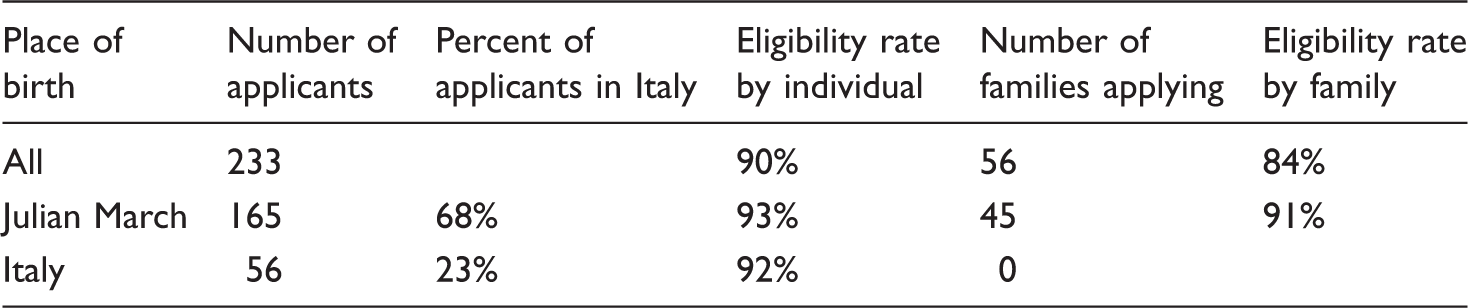
This achievement was not simply the result of Western or Anglo–American attitudes toward due process. Roma had better chances of receiving support among international refugee administrations than they did in various national contexts in large part because of the efforts of the Eastern European refugees hired to assess their cases. This was especially true of interviewers, who rarely figure in scholarship on refugee history: it was this group that often decided more about a refugee’s fate than anyone. 64 Although interviewers were technically only locally-hired aides who served under an international eligibility officer, in Germany, for example, they often offered detailed assessments and made recommendations in complicated cases. While in Italy interviewers issued recommendations more rarely, they had more leeway in creating the biographical narratives of applicants. The IRO, for its part, was concerned mostly with its own permanent, international personnel, which constituted only a small fraction of the work force set to interviewing applicants and processing their claims. Scholarship on postwar refugees has replicated this prejudice, often ignoring the single largest group of people directly involved in admitting refugees into Western and Central Europe in the aftermath of the war. The numbers involved are well illustrated in IRO planning outlines dating from 1947, listing 34 employees in total for a model assembly center. Of these 34 employees, only 3 were to be officers (that is, permanent, international personnel). The remaining 31 individuals were to consist of 10 typists, receptionists, and secretaries, nine individuals assigned to filing, and 10 interviewers. 65 It was the sum total of these individuals, not just the officers, who created the case files that ultimately determined an applicant’s fate. Receptionists and interviewers in particular were in a position to communicate to applicants what they were expected to say long before such individuals had a chance to interact with the IRO’s permanent, international staff of officers.
Temporary personnel were supposed to be recruited to the extent possible from the DP population, both in order to save money and to give work to the otherwise idle charges of the organization. The IRO only offered loose guidance to the representatives who recruited these local aides. Such individuals were to be ‘graduates in philosophy, psychology, sociology or law’ and ‘be able to speak English, German, or Russian, besides their native language.’ 66 The Eastern European interviewers of Romani applicants fit this profile. They were generally well-educated elites who spoke Czech, Slovak, Croatian, and other Central and Eastern European languages, and often had some form of legal training. (Among the interviewers of Romani applicants were, for example, the Czechoslovak military attaché in Vienna who had defected in 1949 or the former owner of a paper factory in Lodz. 67 ) Once hired they found themselves interviewing people who often had only a rudimentary education and who tended to live their lives on the brink of poverty. The interviewers’ generally positive attitudes toward Romani refugees were not spurred, in other words, by professional or social proximity with the applicants they recognized as ‘Gypsies.’
Only in rare cases can we see a personal connection between interviewer and interviewee, as in the case of Peter Barcza, the son of György Barcza Nagyalásonyi, who served as the Hungarian Ambassador to London from 1938–41 and sought to negotiate a separate peace between Hungary and the Western Allies during secret negotiations in Switzerland in 1943. While living in Rome after the war and before his subsequent emigration to Australia, Peter Barcza interviewed Bela Berkes who was, as Barcza explained to the IRO officers, ‘the most famous Gypsy violinist in the World.’ 68 Berkes had indeed led an illustrious career as the leader of the Royal Hungarian Gypsy Orchestra, which had successfully toured the USA several times. For most of the war he was a band leader at the Bristol and the Moulin Rouge in Budapest. Barcza reported in full detail about the applicant’s credentials, offering descriptions of how Berkes’ father had played at the Habsburg royal court and how Berkes himself had performed at a charity event in front of Mrs. Hurst and President Roosevelt. 69 In his long brief, Barcza did not merely record the applicant’s story, he testified on his behalf, vouching for Berkes’s monarchist leanings and his intimate friendship with the Hungarian aristocracy. Berkes’s experience remained exceptional, however. For the most part, these interviews entailed a dialogue across a wide social and economic chasm. Even though Barcza’s role was unusual, his case illustrates the influence of other displaced individuals in the acceptance of displaced Roma. Together officers, interviewers, translators, and other supporting personnel from across Europe and the United States of America participated in an international refugee regime in which being declared a ‘Gypsy’ tended to offer applicants more advantages than current scholarship has allowed.
The situation of Romani migrants during the immediate postwar years – shaped as it was by international organizations run by international personnel – differs notably from the experience of European Roma in both earlier and later periods. The expansion of passport and border controls during the interwar era had made the movement across borders increasingly difficult in Western and Central Europe – a development that had strongly curtailed Roma mobility in the period before the Second World War. 70 The international migration regime that reigned between 1945 and 1951 broke with these precedents, even as it was inextricably linked to different states’ efforts at regulating immigration pursuant to their national interests and using national immigration selection committees.
Once the IRO closed its doors in 1951, migration policies for Roma and others once again fell exclusively in the hands of national administrators, however. This development marks a return to the exceptionalism of Romani migration history, as Roma – or ‘Gypsies’ – re-emerged as a category distinct from that applied to other refugees originating from Cold War Eastern Europe. Unlike those individuals who were treated by Western officials as ‘escapees’ from totalitarianism after fleeing the Hungarian revolution in 1956, Roma migrants now increasingly came to be portrayed a social menace. Indeed, various national authorities began to suggest that they were facing a distinct ‘Gypsy’ problem. 71 What is more, in the case of Roma there was no countervailing tendency among administrators or legislators with ties to industry, many of whom treated other immigrants as potential cheap laborers. 72
Whereas the internationalization of migration regimes in the immediate postwar years has been overlooked as a process that offered new opportunities to Romani migrants, the similarities between contemporary debates on migrating ‘Gypsies’ and those that emerged in 1950s-Europe have similarly gone unremarked. Yet the fears that Romani migrants have evoked within the European Union today have their clearest precedent in the first intensive phase of the Cold War, during the Adenauer era (1949–63) in Germany. During this period German policy-makers and administrators cared little that Roma were fleeing Eastern bloc countries since they were not considered political refugees. When in 1958 a band of Roma musicians performing under the name Cierhan defected to Germany with their families, German authorities immediately rejected their claims. By this time the group had already sought refuge in Austria only to have been denied asylum. Their leader then forged a Danish visa to get to East Berlin via Prague. From there they fled to West Berlin and were flown to Bavaria by US forces. Yet, even before they were rejected by the proper authorities, Bavarian officials denied them any support, declaring that the Valka camp, which had housed many Romani DPs in the late 1940s, was at full capacity. 73 The Bavarian government also sought to deport the Romani musicians while they were in the process of appealing their asylum case. The unequal treatment of Roma compared to other Eastern European refugees in this regard was so egregious that an officer of the Bavarian aliens’ police refused the deportation order and informed the representative of the United Nations High Commissioner for Refugees (UNHCR) of these developments. 74
Although the UNHCR tried to intervene on behalf of the refugees, the decision was ultimately a German one. 75 Among the reasons that the Bavarian court cited for its decision was the group leader’s forgery of documents that had allowed him and his fellow musicians to escape. The presiding judge declared this to be a serious non-political crime and thus treated the case as beyond the purview of the Geneva Convention. 76 A similar decision allowed German authorities to deny asylum to members of the Kwiek family who arrived in Germany from Poland in the same year (1958). 77 Such rulings puzzled the UNHCR, which nonetheless refrained from expressing its dissenting interpretation of the Geneva Convention publicly. 78 Those Romani refugees who were ultimately allowed to remain in Germany were often saved only by the fact that the East European states from which they had fled refused to take them back.
German authorities soon faced a much larger group of Romani migrants, whose arrival spurred an outright Gypsy immigration panic in the country. In the last months of 1958 several Romani families came to Germany as part of repatriation transports of ethnic Germans, the Aussiedlertransporte, from Poland. By early January 1959, over 85 Polish Roma without ‘claims to German ethnicity’ had arrived in Hamburg. 79 Because the German authorities had not yet developed any particular policy toward these newcomers, they were initially treated in a manner similar to those the state recognized as ethnic Germans and received ‘welcome’ payments of 400 DM at the transit camp Friedland. 80
Soon the Ministry of the Interior began to receive complaints from a number of different German states, which were responsible for dealing with the foreigners within their borders. The ministry responded by issuing new orders to immigration and border control agencies. The next 11 Roma who arrived on an Aussiedler train on 6 January 1959 were immediately sent back to the Soviet Zone. This did not take care of the ‘problem,’ however. The East Germans deported the group to West Berlin, where the displaced Roma then requested asylum. Once again German courts rejected their claims of political persecution. 81 In some respects, the interior ministry’s restrictive approach was symptomatic of the widespread skepticism toward foreigners that shaped European and German policy debates in the period. 82 In an era when most asylum seekers in Europe were considered ‘white’ and found that ‘their flight could be used for political purposes,’ however, Roma remained the exception. 83 Their racial belonging and their ability to be political subjects were both fundamentally in doubt. 84
German administrators’ attitudes towards Roma migrants found their most dramatic expression in a series of events that took place on 17 February 1959. On that day, newspaper reporters and TV crews stood on the interzonal train station at Büchen to await the last mass resettlement of ethnic Germans from Poland. The train briefly stopped, uncoupled three wagons, and then entered the station, where the orchestra began to play and church officials started welcoming the newcomers. Meanwhile the locomotive attempted to pull the separate wagons to another location. Within seconds all hell broke loose: having realized that the three last wagons contained only Romani passengers, the German authorities had sought to isolate them from the other returnees in order to send them back them to the Soviet Zone. Once the 321 Polish Romani passengers on these wagons understood that they had been separated from the other migrants, a panic broke out. Men jumped out of the train as women handed their babies to the men. Others broke the wagon doors and sought to escape. Large German police forces, called in as a backup, caught the fleeing refugees and herded them to collection points. Eventually they were all moved to rooms in the small station and to Red Cross emergency shelters. 85 Given the media presence at the scene none of this could be hidden. German and international newspapers ran photos of tall German men in uniforms guarding people in rags next to a train. 86 Even observers unfamiliar with the full repertoire of Holocaust iconography could not miss the uncomfortable parallels to Nazi deportations of, among others, Romani detainees.
While the Ministry of the Interior and local government officials sought to contact the Polish Military Mission in Berlin, the state of Schleswig-Holstein had to deal with the situation on the ground. Facing a mounting public-relations disaster as well as the realization that the refugees could not be cared for properly in the train station, the minister of justice and deputy prime minister of Schleswig-Holstein, Bernhardt Leverenz of the liberal FDP, decided to release the refugees. Rejecting all requests of the Ministry of the Interior that he keep the Roma in the same location for over two nights, Leverenz argued that the police had no right to confine anyone who had not committed a crime. He added that those Roma who had come on the latest transports could hardly be accused of crossing the border illegally since they had come on a sealed train. 87 By the time the Polish authorities agreed to allow all of the 321 Polish Romani refugees to return to Poland, two days after their arrival in Germany, the German police had already released them. In the weeks that followed federal and state authorities sought to round them up once again in order to deport them but all efforts at coordination failed. They were eventually permitted to remain in Germany.
This episode ended the mass migration of Eastern European Roma to Germany for the foreseeable future, but not the mounting preoccupation of German authorities with a ‘Gypsy invasion.’ 88 Police officials regularly reported on new rumors about an impending mass immigration they heard foretold by Romani informants. 89 The German Ministry of the Interior took seriously reports about secret trains full of ‘Gypsies’ lying in wait in East Germany, seemingly confirming an earlier suspicion that the communist regimes were actively sending these people west in an attempt to undermine the free world. German authorities found that their hands were tied in such cases, however. The trains carrying refugees were under the supervision of the Polish Red Cross. The Germans did not get a full manifesto until the trains appeared at the border. Things were further complicated by the fact that the Germans did not then have official diplomatic relations with Poland, which meant any intervention they hoped to pursue had to be arranged through the US embassy. 90 The fact that the German authorities could deal with the new arrivals only after they crossed into West German territory resulted in an outright Gypsy-panic among administrators. For weeks a special platoon of the border police (Bundesgrenzschutz) was deployed at Büchen train station with the sole aim of stopping the rumored Gypsy trains. 91
The lasting result of this episode was a discriminatory travel policy developed by West German authorities. The German Permit Office in Warsaw received instructions not to issue visa stamps for ‘Gypsies’ after this point. In an effort to thwart any ‘abuse’ by aspiring Roma migrants, the Ministry of the Interior also agreed with the German states that their police offices would deny all requests for visits from ‘Gypsies’ coming from Poland. 92 German police even rejected older existing permits once they determined that the permit holders in question were ‘Gypsies.’ 93 When, after a year, a member of Hamburg police inquired as to whether such measures went against the German constitution, the Ministry of the Interior replied that no such conflict existed, since the Roma who faced unequal treatment were foreigners without the protection of German law. 94
Under the renationalized border regimes of the 1950s, the category of ‘Gypsy’ acquired a fundamentally different meaning from the one it had during the IRO era. The difference was less in the final outcome – for in both cases most Roma migrants to Germany ended up remaining in the country, eventually gaining the necessary permits within a matter of years. Nor was it in the awareness of the suffering Roma had endured during the Nazi period. The majority of IRO administrators knew of the persecution and murder of Romanies during the war, at least in broad terms, as did many commentators in the late 1950s. Indeed, during the 1959 incident, German authorities received scores of letters highlighting Germany’s responsibility towards the Romani victims of Nazism, including one sent by members of the Department of History at the Universität Tübingen. 95 Even the hardliners in the Ministry of the Interior felt compelled to agree that four of the 321 Roma from the 1959 transport who had papers proving they had been in Nazi camps deserved immediate release.
Many German administrators and legislators also evinced a similar commitment to due process and the maintenance of basic rights as had the IRO’s permanent staff. The central actor in the 1959 affair, Ministerialrat (Head of Division) Breull, who directed the relevant section of the Ministry of the Interior, as well as the German courts, espoused certain narrow interpretations of national and international protections for refugees. There were always counterforces, however, including the minister of justice of Schleswig-Holstein, whose actions ensured that deportation orders could not be executed. The members of the German parliament’s committee on domestic affairs also challenged Breull’s interpretations of the law. In a closed meeting, members of the SPD questioned whether ‘Gypsies’ were actually receiving proper legal advice regarding their right to asylum as well as whether the ministry’s policies did not contravene rights guaranteed in the United Nations Declaration of Human Rights. 96
The difference between the IRO’s management of the migration of Eastern European Roma and the approach of the German authorities during the 1950s was, to a large degree, semantic. Ultimately the IRO had followed the advice of neither Niec nor Grigg – the two eligibility officers mentioned at the beginning of this article in the context of their disagreement over the proper categorization, and treatment, of ‘Gypsies.’ Even while the IRO refused to create a blanket policy on ‘Gypsies,’ IRO officers were aware that the category continued to emerge both from the rank and file of the organization and from applicants. The organization discriminated not on the level of eligibility but rather when it came to certain resettlement services principally because its officers expected national committees to reject ‘Gypsies.’ Being a ‘Gypsy’ during the era of the IRO’s administration offered individuals high chances of being granted refugee status. Czech Roma had a solid record of acceptance, for example. There is no evidence that this category gave them a disadvantage in comparison to non-Romani Czechs, who were often rejected during the late 1940s as mere economic refugees. 97 In fact, being recognized as a ‘Gypsy’ nearly always guaranteed some level of support, precisely because superior officers in the organization saw to it that most individuals’ Romani identity was either used in favor of the applicant or not at all.
In the West Germany of the late 1950s, by contrast, officials used the term ‘Gypsy’ as it had been employed by West European police agencies since the Enlightenment. In this context, it was a category that came to override all others. ‘Zigeuner’ were neither ‘German’ nor ‘Polish,’ rubrics that administrators and commentators understood in ethno-national terms. Nor were they refugees, escapees, or defectors – even when those in question insisted that they had reasonable fears of persecution. The German authorities followed Niec (whose position did not ultimately prevail in the IRO) in viewing ‘Gypsies’ as defined by a form of mobility detaching them from any political commitments. In the process, the German authorities turned ‘Gypsies’ from the displaced persons they had been under the IRO regime into a separate category of opportunistic migrants without claim to rights or refuge.
This was not just a German development. While the broader history of anti-Romani policing in the Cold War West remains to be written, scholars, journalists, and activists have demonstrated the continuities in European states’ use of the category ‘Gypsy’ both before and after the Second World War. In France, the state tracked ‘nomades’ from 1912 to 1969. 98 For many individuals in that category the internment they faced under the Germans and the Vichy regime did not end with liberation. Some remained detained in the camps Saint-Maurice and Jargeau until the end of 1945, while others were kept in the camp Alliers through July 1946. 99 The German attempts to deport the Polish Roma were thus not part of a Sonderweg but characteristic of a European approach to Roma. 100 It was, in fact, symptomatic of the strengthened role of the nation-state across the continent as a result of post-1945 reconstruction, a development other scholars have also highlighted recently. 101
Germany stands out not due to its policies but because it became the principal destination for Eastern European Romani refugees during the Cold War, as it did once again in the 1990s for refugees fleeing the war-torn areas of the former-Yugoslavia. 102 It was also the site of a brief experiment in postwar internationalization. Whereas in most of Europe immigration remained a purely national matter even when the IRO secured permission to fast-track the resettlement of individuals it deemed worthy of refuge. In West Germany, by contrast – and to a lesser degree also in Italy and the western zones of Austria – UNRRA, the IRO, and occupation forces together created extraterritorial spaces in which they autonomously determined the refugee status of individuals in the territories under their supervision.
Since the 1950s, shifts in public debates have at times afforded Roma new opportunities. Two separate developments were crucial in this regard. First was the migration of Roma as guest workers in the course of contractual labor migration in the 1960s and early 1970s. In this case, the category of ‘guest worker’ seems to have at least partially protected Romanies from discriminatory treatment by migration authorities, largely because Romani migrants managed to be subsumed into the larger category of guest workers. Such developments did not signal a major shift in popular or official ideas about ‘Gypsy’ migrants, however: in this context they were simply not singled out as Romani by authorities. 103 A second if equally important development that mitigated the marginalization of Romanies was the Europeanization of discussions about their status, which led to a greater focus on the fight against anti-Romani discrimination, starting with initiatives by the Council of Europe in 1969. 104 Regulations on Romani migration were nonetheless purposefully excluded from these European initiatives both within the Council of Europe and the European Community. 105
Even in light of the contemporary expansion of legal guarantees and humanitarian debates, the brief era of postwar internationalization in Europe was singular in its reinterpretation of the category of ‘Gypsy.’ The decisive factor was not the mental outlook of administrators, for there is little to suggest that the largely Eastern European refugee interviewers or the international officers working for UNRRA and the IRO did not share the prejudices of other Europeans against Roma. The difference was instead structural: Only during the half decade after the Second World War were refugee streams regulated by individuals charged with creating a stable global order in the face of an international refugee problem. Both before and after, the administrators responsible for dealing with migrants and refugees worked within nationalist paradigms that tended to portray ‘Gypsies’ as disruptive. The persistence of the surveillance efforts of modern territorial states within the European Union illustrates the continuing role of the latter type of administrative logic. Despite increasing sensitivity to questions of historical guilt and discrimination, police agencies charged with defending national borders never returned to the benevolent attitude of the IRO. For the single ethnicized group of former Nazi victims not to have benefited from organized lobbying and welfare efforts in the postwar years, only the temporary internationalization of refugee policies brought about a brief respite.
Footnotes
Acknowledgements
This article was made possible thanks to the author’s tenure as a Diane and Howard Wohl Fellow at the Jack, Joseph and Morton Mandel Center for Advanced Holocaust Studies, United States Holocaust Memorial Museum. The author is also grateful to Ethel Brooks, Julia Phillips Cohen, Anna Holian, Lisa Leff, and two anonymous reviewers for their feedback on this article.
1
On the continuation of this trope 50 years after Niec’s statements, see N. Sigona, ‘“How Can a ‘Nomad’ Be a ‘Refugee’?” Kosovo Roma and Labelling Policy in Italy,’ Sociology, 37, 1 (2003), 69–79. On the ‘broad sedentary bias’ of refugee policies, see T. Polzer and L. Hammond, ‘Invisible Displacement,’ Journal of Refugee Studies, 21, 4 (2008), 421. In some cases, the notion of ‘Gypsies’ as inherent nomads motivated officers to exclude Romani applicants with the explanation that they were ‘just travelling.’ CM1 of 8 June 1949, ITS Digital Collection, 3.2.1.1, 79710149, USHMM. On these concepts in current European debates, see K. Simhandl, Der Diskurs der EU-Institutionen über die Kategorien ‘Zigeuner’ und ‘Roma’: die Erschliessung eines politischen Raumes über die Konzepte von ‘Antidiskriminierung’ und ‘sozialem Einschluss’ (Baden-Baden 2007). For the trope of nomadism as a literary expression of crisis, especially in the interwar period, see U. Gerhard, Nomadische Bewegungen und die Symbolik der Krise: Flucht und Wanderung in der Weimarer Republik (Opladen 1998).
2
Minutes of the Care and Eligibility Officers’ Conference, 11 May 1949, Archives nationales de France (AN), AJ/43/809.
3
The constitution is reprinted in L.W. Holborn, The International Refugee Organization: A Specialized Agency of the United Nations: Its History and Work, 1946–1952 (London 1956), 575–91.
4
On the role of collective categories in the international definition of refugees, starting with agreements in the League of Nations, see I.C. Jackson, The Refugee Concept in Group Situations (Boston, MA 1999).
5
Annex to the Constitution of the International Refugee Organization, Section C para 1.
6
See, IRO, Manual for Eligibility Officers. The organization updated the manual on several occasions. References here are to one of the final versions, completed in 1949, published in two identical copies numbered 241 and 242.
7
Various observers continue to debate the exchangeability of the terms Gypsy and Roma, in large part because ‘Gypsy’ was historically an unsystematic, if not arbitrary, police term and often included a variety of service nomads traveling in family units who would not necessarily have defined themselves as Romani in an ethnic sense. Such objections have been raised primarily in the case of Western Europe. See L. Lucassen, Zigeuner: die Geschichte eines polizeilichen Ordnungsbegriffes im Deutschland, 1700–1945 (Weimar 1996).
8
See, for example; P. Lauren, The Evolution of International Human Rights (Philadelphia, PA 1996); M. Mazower, ‘The Strange Triumph of Human Rights, 1933–1950,’ Historical Journal, 47, 2 (2004): 386–88; G.D. Cohen, In War's Wake: Europe's Displaced Persons in the Postwar Order (New York, NY 2012), 79–99.
9
C. Fink, Defending the Rights of Others: The Great Powers, the Jews, and International Minority Protection, 1878–1938 (New York, NY 2004). For an exception to this rule, see the case of Czechoslovakia, where Roma were accepted as a national minority in 1921: W. Guy, ‘Ways of Looking at Roma: The Case of Czechoslovakia,’ in Gypsies: An Interdisciplinary Reader, ed. Diane Tong (New York, NY 1998), 24.
10
H. Arendt, The Origins of Totalitarianism (Berlin 1951); T. Zahra, The Lost Children: Reconstructing Europe's Families after World War II (Cambridge, MA 2011); M. Wyman, DP: Europe’s Displaced Persons, 1945–1951 (Philadelphia, PA 1989), 106–30; and A. Holian, Between National Socialism and Soviet Communism: Displaced Persons in Postwar Germany (Ann Arbor, MI 2011), the latter on the role of international solidarity among refugees.
11
J.S. Hohmann, Robert Ritter und die Erben der Kriminalbiologie: “Zigeunerforschung” im Nationalsozialismus und in Westdeutschland im Zeichen des Rassismus (Frankfurt am Main 1991); T. Schmidt-Degenhard, Vermessen und Vernichten: der NS-“Zigeunerforscher” Robert Ritter (Stuttgart 2012).
12
P. Panayi, Life and Death in a German Town: Osnabrück from the Weimar Republic to World War II and beyond (London 2007), 215–19.
13
D. Kenrick and G. Puxon, The Destiny of Europe’s Gypsies (London 1972), 187–209; J.S. Hohmann, Geschichte der Zigeunerverfolgung in Deutschland (Frankfurt am Main 1981), 179–215; M. Gharaati, Zigeunerverfolgung in Deutschland: mit besonderer Berücksichtigung der Zeit zwischen 1918–1945 (Marburg 1996), 145–53. For a more recent example, see P. Widmann, ‘The Campaign Against the Restless: Criminal Biology and the Stigmatization of the Gypsies, 1890–1960,’ in R. Stauber and R. Vago (eds) The Roma: A Minority in Europe: Historical, Political and Social Perspectives, (Budapest 2007), 19–30. On the Romani Civil Rights movement see Y. Matras, ‘The Development of the Romani Civil Rights Movement in Germany 1945–1996,’ in S. Tebbutt (ed.) Sinti and Roma: Gypsies in German-Speaking Society and Literature (New York, NY 1998), 49–63.
14
On Romani migration since the end of the Cold War, see E. Sobotka, ‘Romani Migration in the 1990s: Perspectives on Dynamic, Interpretation and Policy,’ Romani Studies, 13, 2 (2003), 79–121; E. Marušiakova and V. Popov, ‘Les migrations des Roms balkaniques en Europe occidentale: mobilités passées et présentes,’ trans. Nadège Ragaru, Balkanologie: Revue d’études pluridisciplinaires, 11, 1–2 (2008), available at:  (accessed 11 May 2015). For an attempt to bring together migration studies and scholarship on the construction of ‘Gypsies’ in public debates and administrative practice, see W. Willems, In Search of the True Gypsy: From Enlightenment to Final Solution (London 1997). See also Roma and Forced Migration: An Annotated Bibliography, Forced Migration Projects and Open Society Institute (New York 1998); A. Fraser, ‘The Rom Migrations,’ Journal of the Gypsy Lore Society, ser. 5, vol. 2, no. 2 (1992), 131–43. On pre-Second World War migrations, see I. About, ‘From Free Movement to Permanent Control: French Authorities and Gypsy Border Mobility, 1860–1930,’ Cultures & Conflicts, 76, 4 (17 May 2010), 15–38; F. Nézer, La Sûreté publique belge face aux Tsiganes étrangers (1858–1914) (Louvain-La-Neuve 2011).
15
J. Illuzzi, Gypsies in Germany and Italy, 1861–1914 (Basingstoke 2014).
16
B. O’Keeffe, New Soviet Gypsies: Nationality, Performance, and Selfhood in the Early Soviet Union (Toronto 2013). The term ‘speaking Bolshevik’ comes from S. Kotkin, Magnetic Mountain: Stalinism as a Civilization (Berkeley, CA 1995).
17
For this approach, see also C. Silverman, Romani Routes: Cultural Politics and Balkan Music in Diaspora (New York, NY 2012); J. von dem Knesebeck, The Roma Struggle for Compensation in Post-War Germany (Hatfield 2011); A. Lemon, Between Two Fires: Gypsy Performance and Romani Memory from Pushkin to Post-Socialism (Durham, NC 2000); W. Willems, In Search of the True Gypsy: From Enlightenment to Final Solution (London 1997).
18
The analysis presented here is based on the so-called CM1 forms of IRO, which have been available, together with selected UNRRA files, in digitized form to researchers through ITS since 2008. While this article references only Italian and German files in its quantitative analysis due to the comprehensive view that search functions for both countries provide, it also draws on individual Austrian case files for the purposes of qualitative analysis. On the ITS archives, see B.J. Zimmer, International Tracing Service Arolsen: von der Vermisstensuche zur Haftbescheinigung: die Organisationsgeschichte eines ‘ungewollten Kindes’ während der Besatzungszeit (Bad Arolsen 2011); P.A. Shapiro, ‘Vapniarka: The Archive of the International Tracing Service and the Holocaust in the East,’ Holocaust and Genocide Studies, 27, 1 (2013), 114–37.
19
On earlier debates, see I. About, ‘“Unwanted ‘Gypsies” The Restriction of Cross-Border Mobility and the Stigmatisation of Romani Families in Interwar Western Europe,’ Quaderni Storici, 49, 2 (2014), 499–532; R. Hehemann, Die “Bekämpfung des Zigeunerunwesens” im Wilhelminischen Deutschland und in der Weimarer Republik, 1871–1933 (Frankfurt am Main 1987).
20
On the use of similar administrative files for an analysis of migration regimes and policing practices, see C.D. Rosenberg, Policing Paris: The Origins of Modern Immigration Control between the Wars (Ithaca, NY 2006).
21
This is also true of the photos included in the files. Even though they were produced for documentation purposes they follow bourgeois conventions of family photography. On the politics of Romani images, see S. Peritore and F. Reuter (eds), Inszenierung des Fremden: fotografische Darstellung von Sinti und Roma im Kontext der historischen Bildforschung (Heidelberg 2011).
22
L. Niethammer, ‘Flucht ins Konventionelle? Einige Randglossen zu Forschungsproblemen der deutschen Nachkriegsmigration,’ in R. Grebing Schulze, D. von der Brelie-Lewien and H. Grebing (eds) Flüchtlinge und Vertriebene in der westdeutschen Nachkriegsgeschichte: Bilanzierung der Forschung und Perspektiven für die künftige Forschungsarbeit (Hildesheim 1987), 316–23.
23
CM1 of Julius Brzezinski, 19 April 1948, ITS Digital Collection, 3.2.1.1, 78970672, USHMM. The other language shared by all members of the family was German.
24
For some, Romani was also evidently the principal language of familial communication. In certain cases, it was the only language all members of a family had in common. CM1 of Rudolf Lora, 20 June 1948, ITS Digital Collection, 3.2.1.1, 79419822, USHMM.
25
10 per cent of all German files and 33 per cent of all Italian files used here do not have ‘Gypsy’ as an index term but nonetheless deal with people identified as ‘Gypsies’ by IRO officials.
26
On the Romani Holocaust in the Protectorate, see C.P. Necas, The Holocaust of Czech Roma (Prague 1999). Figures for the Czech Roma who survived persecution by the Nazis are difficult to ascertain. Necas speaks of 583 Romani survivors who returned from the camps. These Romani refugees migrated to the Cold War West just as rural Slovak Roma who had survived in greater numbers arrived in the industrial towns of the ethnically cleansed Sudetenland. On this, see W. Guy, ‘Ways of Looking at Roma: The Case of Czechoslovakia,’ in D. Tong (ed.) Gypsies: An Interdisciplinary Reader (New York, NY 1998), 26. On Roma in postwar Czechoslovakia, see also J.S. Hohmann, ‘Roma auf dem Gebiet der einstigen CSSR,’ in Bartolomej Daniel, Geschichte der Roma in Böhmen, Mähren und der Slowakei (Frankfurt am Main 1998), 187–92; D. Crowe, A History of the Gypsies of Eastern Europe and Russia (New York, NY 1995), 53–5. Crowe notes that by 1947, a census listed 16,752 Roma in the Czech lands. The later census numbers include many Slovak Roma who moved there after 1945. See Z.D. Barany, The East European Gypsies: Regime Change, Marginality, and Ethnopolitics (Cambridge 2002), 127.
27
In fact we still know relatively little about the various factors that caused Roma to flee Venezia Giulia during and immediately following the Second World War. Due to the particular pressures applicants faced in their eligibility interviews, the evidence we can glean from the IRO testimonies of Romani migrants in Italy offers only a partial view of their reasons for leaving. Relatively more is known about Jews’ flight from this region. On this, see C. Villani, ‘The Persecution of Jews in Two Regions of German-Occupied Northern Italy, 1943–1945: Operationszone Alpenvorland and Operationszone Adriatisches Küstenland,’ in J.D. Zimmerman (ed.) Jews in Italy under Fascist and Nazi Rule, 1922–1945 (Cambridge 2005), 243–61; M. Wedekind, Nationalsozialistische Besatzungs- und Annexionspolitik in Norditalien 1943 bis 1945: die Operationszonen ‘Alpenvorland' und ‘Adriatisches Küstenland' (Oldenbourg 2003), 351–75. On the narratives of forced migrants from Venezia Giulia, in particular those from Istria, see P. Ballinger, History in Exile: Memory and Identity at the Borders of the Balkans (Princeton, NJ 2003). On the exodus from these regions, see G. Corni, ‘The Exodus of Italians from Istria and Dalmatia, 1945–56,’ in J. Reinisch and E. White (eds) The Disentanglement of Populations: Migration, Expulsion and Displacement in Post-War Europe, 1944–9 (Basingstoke 2011), 71–90.
28
Questionnaire, 24 September 1951, ITS Digital Collection, 3.2.1.2, 80415513. USHMM; Questionnaire of 17 November 1949, ITS Digital Collection, 3.2.1.2, 80390272, USHMM. Some spoke also of being pressured by both Ustaše and Chetniks. Questionnaires of 2 December 1949, ITS Digital Collection, 3.2.1.2, 80390217, USHMM. The history of Roma in the German-administered Küstenland (which included the Julian March region) differed from that of the Roma who were persecuted and murdered by the Croatian Ustaše regime. See A.M. Korb, Im Schatten des Weltkriegs: Massengewalt der Ustasa gegen Serben, Juden und Roma in Kroatien 1941–1945 (Hamburg 2013).
29
See, for example, Questionnaire, 24 September 1951, ITS Digital Collection, 3.2.1.2, 80415513, USHMM.
30
The greatest proponent of the image of Romani resistance is the writer Yan Yoors, who started to speak about his involvement in ‘Gypsy’ resistance efforts in the early 1950s. See ‘Gypsianna,’ New Yorker (27 October 1951); J. Yoors, Crossing (New York 1971). On Romani resistance in Germany, see U. König, Sinti und Roma unter dem Nationalsozialismus: Verfolgung und Widerstand (Bochum 1989).
31
J. Walston, ‘History and Memory of the Italian Concentration Camps,’ Historical Journal 40, 1 (1997) 169–83.
32
See Illuzzi, Gypsies in Germany and Italy, 62–88.
33
On the deportation of members of the Levakovich family, together with Sicilian peasants, to Brazil, see ibid, 134–6.
34
CM1 of Franz Krause, 6 December 1949, ITS Digital Collection, 3.2.1.1, 79341789, USHMM; CM1 of František Lursky, 28 April 1949, ITS Digital Collection, 3.2.1.1, 7426962, USHMM; CM1 of Adolf Ruzicka, 28 April 1949, ITS Digital Collection, 3.2.1.1, 79675402, USHMM; CM1 of Jan Schneberger, 8 June 1949, ITS Digital Collection, 3.2.1.1. 79710149, USHMM.
35
CM1 of Vojtek Drapak, 12 July 1949, ITS Digital Collection, 3.2.1.1, 79043206, USHMM.
36
See, for example, CM1 of František Lursky, 28 April 1949, ITS Digital Collection, 3.2.1.1, 7426962, USHMM; CM1 of Michal Veinrich, 29 April 1948, ITS Digital Collection, 3.2.1.1, 79881239, USHMM; Handwritten addition to CM1 of Pavel Kirš, 7 April 1949, ITS Digital Collection, 79283170, USHMM; CM1 of Josef Klimt, 22 September 1949, ITS Digital Collection, 79294590, USHMM. A few also hinted at limitations on itinerant trades as reason for their flight, although official forced settlement policies started only in 1958 in Czechoslovakia. See Barany, The East European Gypsies, 117; Y. Matras, The Romani Gypsies (Cambridge, MA 2015), 234; E. Davidová, ‘The Gypsies in Czechoslovakia: Part II: Post-War Developments,’ Journal of the Gypsy Lore Society, 3rd series, 1, 1–2 (January–April 1971), 39–54.
37
See, CM1 of Stanislav Weinrich, 28 April 1949, ITS Digital Collection, 3.2.1.1, 79908228, USHMM; CM1 of Josef Bamberger, 29 April 1949, ITS Digital Collection, 78902660, USHMM; CM1 of Jan Schneberger 8 June 1949, ITS Digital Collection, 3.2.1.1, 79710149, USHMM.
38
On the denaturalization of German Romanies, see G. Margalit, Germany and its Gypsies: A Post-Auschwitz Ordeal (Madison, WI 2002), 78–80; Y. Matras, I Met Lucky People: The Story of the Romani Gypsies (London 2014), 185–6.
39
On these deportations, see Zimmermann, Rassenutopie und Genozid, 229; Kenrick and Puxon, Gypsies under the Swastika, 49; R.J. Evans, The Third Reich at War, 1939–1945 (London 2008), 530.
40
File for Bruno Dambrowski, ITS Digital Collection, 3.2.1.1., 79018207-79018132, USHMM, including DP-1 of 24 August 1946 and CM1 of 26 September 1949. Dambrowski was also associated with Polish refugees right after the war. See the certificate identifying him as a prisoner liberated from Flossenbürg, Polski Komitet, Neunburg vorm Wald, 12 May 1945.
41
See, for example, CM1 of 31 July 1951, ITS Digital Collection, 3.2.1.1, 79342154, USHMM.
42
UNRRA, US Zone, Administrative Order No. 23, 11 March 1946.
43
Preparatory Commission for the International Refugee Organization (PCIRO), Central Tracing Bureau, Revised Procedure for Registration and Processing of Records, 13 October 1947, Appendix IV, ITS Digital Collection, 6.1.1, 82504655-82504657, USHMM, shows that only Jews and Roma were included in deportation lists if the destination camp was not known. For other similar uses, see PCIRO, Procedure for Completing Inventory Cards, 15 November 1946, ITS Digital Collection, 6.1.1, 82510878-82510881, USHMM. The child registration branch rejected the term ‘Gypsies’ except in the case of Germans, for whom the categories of Jew, Gypsy, and political persecutee existed. Child Search Branch Inter-Zonal Conference, 21 July 1949, ITS Digital Collection, 6.1.2, 82488822-82488827, USHMM; Arthur T. Cooper, US Zone Child Search Officer to Principal Child Search Officer IRO Area 4, 21 July 1949, ITS Digital Collection, 6.1.2, 82490625, USHMM.
44
See, for example, the DP files of the family Lora, ITS Digital Collection, 3.2.1.1, 79425584-79425588, USHMM. Based on this determination the family received 26 months of support from UNRRA. See CM1 of 20 May 1948, 79425591, USHMM.
45
38 out of 102 families processed in Germany had an UNRRA DP-1 or DP-2 form attached to their IRO CM1 form.
46
CM1 of Joesf Rozicka, 28 April 1949, ITS Digital Collection, 3.2.1.2, 79667731, USHMM. Fortunately enough for his interviewees, six out of the seven Romani applicants screened by this particular interviewer were eventually admitted by the IRO, which regularly overruled his judgments.
47
Biography, ITS Digital Collection, 3.2.1.2, 80327761, USHMM.
48
Record of Interview for Bruno Braidich, 18 September 1951, ITS Digital Collection, 3.2.1.2, 80327761, USHMM.
49
International and national refugee regimes coexisted even during the IRO’s most active period in its principal countries of operation. On the interaction of national and international regimes in Italy, see S. Salvatici, ‘Between National and International Mandates: Displaced Persons and Refugees in Postwar Italy,’ Journal of Contemporary History, 49, 3 (2014), 514–36.
50
S. Salvatici, ‘From Displaced Persons to Labourers: Allied Employment Policies in Post-War West Germany,’ in Reinisch and White (eds) The Disentanglement of Populations, 210–28.
51
International Refugee Organization, Report of the Director-General to the General Council, 1 July 1948 – 30 June 1949 (Geneva 1949), 24.
52
See Cohen, In War’s Wake, 100–25.
53
On these general suspicions, see S. Salvatici, ‘“Help the People to Help Themselves”: UNRRA Relief Workers and European Displaced Persons,’ Journal of Refugee Studies, 25, 3 (2012), 428–51.
54
Between 1949 and 1951 the Italian branch of the IRO also appears to have changed its policy regarding Roma. In 1950 Romani files were forwarded from the local offices to headquarters for review, apparently to homogenize the decision-making process. Informal Routing Slip, 26 July 1950, ITS Digital Collection, 3.2.1.2, 80449559, USHMM. By the summer of 1951, many of the families that had previously received no or limited support were granted discretionary emigration assistance.
55
Application for discretionary resettlement, 2 February 1951, ITS Digital Collection, 3.2.1.2, 80390146, USHMM.
56
Record of Interview with Maria Hudorovich, 30 August 1951, ITS Digital Collection, 3.2.1.2, 80390267, USHMM; Record of Interview with Giuseppe Hudorovich, 30 August 1951, ITS Digital Collection, 3.2.1.2, 80390262. High-ranking IRO officials seem to have been particularly inclined to favor Romani applicants whom lower-ranking officials had rejected when the applicants’ cases for emigration were otherwise strong.
57
On Zaplitnyj, see his 1944 file with the Deutsche Arbeitsfront. ITS Digital Collection, 2.2.2.1, Wartime Card File, 76640761, USHMM. He was registered as a German-speaker of Greek-Catholic (Uniate) religion and had worked as a lawyer specialized in cooperatives until 1944.
58
CM1 of Stanislav Weinrich, 28 April 1949, ITS Digital Collection, 3.2.1.1, 79908228, USHMM.
59
CM1 of Antonin Veinrich, 28 April 1949, ITS Digital Collection, 3.2.1.1, 79881233. On communist assimilation and proletarization policies and their later consequences, see M. Stewart, The Time of the Gypsies (Boulder, CO 1997).
60
Questionnaire, 21 November. 1949, ITS Digital Collection, 3.2.1.2, 80390252, USHMM. For an emphasis on Nazi persecution from IRO personnel, see also Bianco Hudorovich, Biographical Page, 2 February 1951, ITS Digital Collection, 3.2.1.2, 80390160, USHMM; Peppino Braidich, Biographical Page, 20 April 1951, ITS Digital Collection, 3.2.1.2, 80327821; Carlo Braidich, Biographical Page, 20 April 1951, ITS Digital Collection, 3.2.1.1, 80327808, USHMM; ITS Digital Collection, 3.2.1.2, 80327761, USHMM.
61
Questionnaire, 17 November 1949, ITS Digital Collection, 3.2.1.1, 80390248, USHMM; Nino Hudorovich, Biographical Page, 19 April 1951, ITS Digital Collection, 3.2.1.1, 80390340, USHMM.
62
Questionnaire of Josko Hudorovich, 31 May 1951, ITS Digital Collection, 3.2.1.2, 80390290, USHMM.
63
PCIRO Petition for Review, 17 June 1948, ITS Digital Collection, 3.2.1.2, 80327719, USHMM; similarly: Questionnaire of 17 November 1949, ITS Digital Collection, 3.2.1.2, 80390272, USHMM.
64
For scholarship that focuses on this level, see Salvatici, ‘“Help the People to Help Themselves”’; S. Gemie, F. Reid and Humbert, Outcast Europe: Refugees and Relief Workers in an Era of Total War, 1936–48 (London 2012).
65
Procedure for the operation and administration of a control center, 6 August 1947, AN AJ/43/809.
66
Ibid., 2–3.
67
On the former see CM1 file of Jiří Janousek, ITS Digital Collection, 3.2.1.3, 80671060, USHMM; on the latter, see CM1 file of Tadeusz Kabarowski, ITS Digital Collection, 3.2.1.1, 79245238, USHMM.
68
Questionnaire, Bela Berkes, 23 September 1949, ITS Digital Collection, 3.2.1.2, 80319902, USHMM.
69
Berkes inflated his reputation in the United States of America somewhat. In fact in 1936, he and his son were denied a permanent residence by US immigration authorities who were skeptical of any musicians who did not play classical music. See K.R. Moon, ‘On a Temporary Basis: Immigration, Labor Unions, and the American Entertainment Industry, 1880s–1930s,’ Journal of American History, 99, 3 (1 December 2012), 787.
70
J. Torpey, The Invention of the Passport: Surveillance, Citizenship, and the State (Cambridge 2000); C. Robertson, The Passport in America: The History of a Document (New York, NY 2010); About, ‘Unwanted “Gypsies”.’
71
On refugee policies during the Cold War, see E. Haddad, The Refugee in International Society: Between Sovereigns (Cambridge 2008), 158–61.
72
See, for example, M. Frank and J. Reinisch, ‘Refugees and the Nation-State in Europe, 1919–59,’ Journal of Contemporary History, 49, 3 (July 2014), 483; K. Schönwalder, ‘“Ist nur Liberalisierung Fortschritt?” Zur Entstehung des ersten Ausländergesetzes der Bundesrepublik,' in J. Motte, R. Ohliger and A. von Oswald (eds) 50 Jahre Bundesrepublik – 50 Jahre Einwanderung: Nachkriegsgeschichte als Migrationsgeschichte (Frankfurt am Main 1999), 127–44.
73
UNHCR Head of Nürnberg Sub Branch Office, Interoffice Memorandum to UNHCR Representative in Germany, 11 January 1958, 6.3.3.3, 82541322, USHMM.
74
UNHCR Nürnberg Sub Branch Office to UNHCR Representative in Germany, Interoffice Memorandum, 12 February 1958, 6.3.3.3, 82541314, USHMM.
75
Dr. E. Jahn, Deputy Representative, UNHCR to Bundesministerium des Innern, 19 March 1958, 6.3.3.3, 82541309, USHMM.
76
Urteil, Bayer. Verwaltungsgericht Ansbach, 21 March 1960, Anfechtungsklage Rudolf Karway, 6.3.3.3, 82541295, USHMM.
77
Beschluss der Bundesdienststelle für die Anerkennung ausländischer Flüchtlinge, 15 June 1959, 3.2.1.1, 79373058, USHMM.
78
K. Newes, UNHCR, Legal Adviser to UNHCR Representative in Germany, 11 November 1959, 3.2.1.1, 79373050, USHMM; UNHCR, Head of the Nuremberg Sub Branch Office to UNHCR Representative in Germany, 2 October 1959, 3.2.1.1, 79373057, USHMM.
79
Kriminalamt Hamburg to Bundesministerium des Inneren, Ministerialrat Breull, 14 January 1959; Kriminalamt Hamburg to Bundesstelle für Verwaltungsangelegenheiten [Köln], 6 Jan. 1959, BArch B106/47404. On Aussiedler, see D.B. Klusmeyer, Immigration Policy in the Federal Republic of Germany: Negotiating Membership and Remaking the Nation (New York, NY 2009), 53–85.
80
Bescheinigung, Lagerleitung, Grenzdurchgangslager, Friedland bei Göttingen, 5 September 1958, BArch B106/47404.
81
Bundesdienststelle für die Anerkennung ausländischer Flüchtlinge, Nürnburg, Vorprüfungsgruppe Berlin to Ausländerpolizei Hamburg, Berlin-Marienfeld, 12 February 1959; Bundesdienststelle für die Anerkennung ausländischer Flüchtlinge to Bundesministerium des Innern, 3 August 1959; BArch B106/47404.
82
Schönwalder, ‘Ist nur Liberalisierung Fortschritt?’
83
B. Marshall, The New Germany and Migration in Europe (Manchester 2000), 15. On the generous asylum practices in Germany between 1949 and 1973, see also C. Prat-Erkert, Les demandeurs d’asile politique en Allemagne, 1945–2005: aspects démographiques, politiques, juridiques et sociologiques (Paris 2006), 129–46.
84
The comments by German local administrators in the files of the Ministry of the Interior on the Romani immigration debates in 1959 – BArch B106/47404 – are full of racialized descriptions of their skin color, including comments about those the authorities considered ethnically non-Gypsy strictly due to their appearance. This being said, even the more general benevolence towards refugees from the east (which clearly appears to have excluded Roma) was not regularized until the Federal Republic standardized its asylum procedures in 1965. See S. Wolken, Das Grundrecht auf Asyl als Gegenstand der Innen- und Rechtspolitik in der Bundesrepublik Deutschland (Frankfurt am Main 1988), 32–8.
85
On these events, see the report of commander of the local forces until the state of Schleswig-Holstein took over: Passkontrollamt Hamburg to Paßkontrolldirektion Koblenz, 25 February 1959, BArch B106/47404.
86
With photos of German police, trains, and Romani refugees: ‘Zigeuner-Alarm in Büchen,’ Bild (18 February 1959); ‘Zigeuner in Panik: Zwischenfall auf dem Zonengrenzbahnhof Büchen,’ Hamburger Abendblatt (18 February 1959); ‘Sigøjnerne faar lov at blive i Vesttyskland,’ Politiken (Copenhagen) (20 February 1959. Politiken was particularly critical. With a more friendly photo of German police and Romani children: ‘Sonderauftrag für den Bundesgrenzschutz: Kleiner Zigeuner mußte mal raus…’ Bild am Sonntag (22 February 1959).
87
Fernschreiben, Ministerpräsident des Landes Schleswig-Holstein to Bundesminister des Innern, 20 February 1959; Ritter von Lex, BMI to Stv. Ministerpräsident und Justizminister des Landes Schleswig-Holstein, 20 February 1959; Innemminister des Landes Schleswig-Holstein to BMI, 26 February 1959; Innenminister des Landes Schleswig-Holstein to BMI, 6 March 1959, BArch B106/47404.
88
The term Zigeunerinvasion was used in the Lübecker Nachrichten, 2 July 1959, see Passkontrolldirektion to Bundesminister des Innern, Referat I B 3, 3 July 1959, BArch B106/47404.
89
Vermerk, BMI Referat I B 3, 26-30 July 1959; Fernschreiben, Passkontrolldirektion Koblenz to Bundesminister des Innern, Referat I B 3, 7 July 1959; Passkontrolldirektion Koblenz to Bundesminister des Innern, 2 October 1959, BArch B106/47404.
90
The slow progress in Germany’s Eastern Europe policies was itself partly the result of the power of the German expellees who had come to Germany at the same time as the Romani refugees. See P. Ahonen, After the Expulsion: West Germany and Eastern Europe, 1945–1990 (Oxford 2003), 119–54.
91
Fernschreiben, Bundesminister des Innern to Innenminister des Landes Schleswig-Holstein, Bonn, 12 August 1959, BArch B106/47404.
92
Bundesminister des Innern, Referat I B 3 to Auswärtiegs Amt, Bonn, 7 July 1959; On the continuing application of the policy see Bundesminister des Innern, Referat I B 3 to Senatskanzlei der Freien und Hansestadt Hamburg, 1 July 1960, BArch B106/47404.
93
Polizeibehörde Hamburg to Präsidenten der Bundesstelle für Verwaltungsangelegenheiten des Bundesministers des Innern, 8 October 1959, BArch B106/47404.
94
Kriminalinspektion IC, Polizeibehörde Hamburg to Bundesminister des Innern, 10 March 1960,BArch B106/47404.
95
Historisches Seminar, Abteilung für neuere Geschichte, Universität Tübingen to Bundesinnenministerium, 18 February 1959, BArch B106/47404.
96
Kurzprotokoll, 33. Sitzung des Ausschusses für Inneres, 19 February 1959. On the general emphasis in German debates on raison d’état as opposed to individual rights, however, see K. Schönwälder, Einwanderung und ethnische Pluralität: politische Entscheidungen und öffentliche Debatten in Großbritannien und der Bundesrepublik von den 1950er bis zu den 1970er Jahren (Essen 2001).
97
AN AJ43/457/56: Review Board Cases – ‘Economic’ Czech Refugees.
98
E. Filhol, Le contrôle des Tsiganes en France, 1912–1969 (Paris 2013); S.L. Fogg, The Politics of Everyday Life in Vichy France: Foreigners, Undesirables, and Strangers (Cambridge 2009), 85–101. On the long continuities, see also I. About, ‘Underclass Gypsies: Historical Approach on Categorisation and Exclusion in France, 19th–20th Century,’ in M. Stewart (ed.) The Gypsy ‘Menace’ Populism and the New Anti-Gypsy Politics (London 2012), 95–114.
99
D. Peschanski, La France des Camps: L’internement, 1938–1946 (Paris 2002); E. Filhol (ed.), La Mémoire et l’oubli: L’internement des Tsiganes en France, 1940–1946 (Paris 2004).
100
On continuities, for example, between policies under Nazism and the 1968 laws on trailers (woonwagenwet) in the Netherlands, see B.A. Sijes, Vervolging van zigeuners in Nederland 1940–1945 (The Hague 1979), 139–40.
101
M. Mazower, Dark Continent: Europe’s Twentieth Century (New York, NY 2000); Zahra, The Lost Children.
102
Barany, The East European Gypsies, 244.
103
On passing among Romani migrants in the 1970s, see I.-M. Kaminski, The State of Ambiguity: Studies of Gypsy Refugees (Gothenburg 1980).
104
J.-P. Liégeois, Council of Europe and Roma: 40 Years of Action (Strasbourg 2012). Until 1995, these protections were on the basis of anti-discrimination not the protection of minorities. See G. Gilbert, ‘The Council of Europe and Minority Rights,’ Human Rights Quarterly 18, 1 (1996), 160–89.
105
On the former, see F. Simon, Ministère du Travail, Affaires européennes to Ministère de l’Intérieur, 25 October 1974, AN 19990426/38; on the latter see, for example, Question écrite No. 95/72 de M. Vredeling à la Commission des Communautés Européennes (4 May 1972), Journal officiel des Communautés européennes no. C 90, 25 August 1972, 5–6.