



Abstract
During the 1950s and 1960s, television arrived in the West German countryside. All across Westphalia, elderly villagers recorded how their lives changed because of it. Their reports, solicited by ethnographers at a Münster folklore archive, allow unprecedented insight into TV’s impact on daily schedules, family routines, living rooms, neighbourly networks, local associations and church activities. This rare body of sources allows us to test the claims of media researchers about television’s early phase. It confirms that television accelerated the ongoing modernization, nationalization and politicization of rural society, rapidly reshaping village life. Only the patriarchal family – the decline of which contemporary ethnographers were most worried about – emerged unscathed.
In 1965, retired farmer’s wife Sybille Tenberg recalled the times before television. The winter evening for the peasant families used to be very lonely and dreary. While back in those earlier years, one still used to go about feeding the cows very late in the day, now one is rather hurried … because everyone wants to be sitting in front of the TV set in good time. It seems that even the cattle have gotten used to the early feeding, as they look just as healthy as in earlier years.
1
In the West German hamlet of Aulendorf, where Frau Tenberg lived, television brought in its wake – besides enthusiastic viewers – some unexpected developments. Early cattle feedings were one of them, eager ethnographers another. Frau Tenberg’s recollections, gathered by a folklore studies archive in Münster (Westphalia), are part of a rare body of unpublished sources telling us in vivid detail how TV changed people’s lives in its early decades. These reports from rural West Germany allow unique insights into the experiences of viewers with the new medium. Written by the users themselves, and backed up by academic surveys of the time, they allow a detailed reconstruction of how TV contributed to the reshaping of village life in postwar Germany.
It is exciting to find such sources precisely because of the general dearth of empirical material about television’s reception and social impact. Particularly the time span from the 1950s to the 1970s – often called the ‘era of scarcity’ or the ‘classical’ period of TV 2 – is well-researched in terms of the programming and its production, but much less so in regard to ordinary people’s responses to the medium. 3 In the early years, when the immediate effects of television’s introduction were most plain to see, few scholars devoted their energies to the phenomenon. Later, when academic work began to focus on viewing experiences, it concentrated on urban and middle-class suburban viewers. Ethnographic fieldwork and statistical surveys about audience behaviour exist, but almost exclusively about US and British cities and from the late 1970s onwards. 4 Rural society was bypassed almost entirely.
Nevertheless, large-scale claims about early television’s role in changing lifestyles, political cultures and societies abound. Already the ethnographers of the 1960s and 1970s saw the medium with jaundiced eyes, considering the rise of TV a danger to family and village life. Today’s historians and media scholars have put forward equally bold assumptions about the social impact of early television on society. Commonly, TV is seen as a motor of modernization, pushing ‘the standardization of everyday life.’ 5 Telecasting is assumed to have accelerated the levelling of social hierarchies, the disintegration of religious and social milieus, and the flattening of differences between rural and urban spaces. 6 The rise of television was part of a ‘drive towards homogeneity’ in society 7 which was often bound up with the suburbanization and urbanization of rurally and regionally defined spaces. 8 The medium is also billed ‘a key component’ in ‘the development of postwar consumer society’, encouraging the purchase of domestic appliances and standardized mass market goods through conspicuous displays of consumption. 9 In the West German context, with its public service broadcasting system, TV is lauded for an increase in mass politicization and democratic participation, pulling in apolitical and uneducated citizens. 10 Moreover, for European as well as US societies, television allegedly fostered national coherence and culture across local and regional borders. TV was ‘the crucial national arena’ of debates, the ‘keeper of the national calendar’ and the medium which ‘gave each nation its own private life’, a ‘shared culture of stories and opinions, updated every night'. 11 Despite the transnational trade in programming and global origin of much imported programming, scholars insist on television’s predominantly nationalizing role. 12 TV, more than any other medium, embodies ‘the modernist intent of engineering a national identity'. 13
Furthermore, TV is alleged to have changed not only the public but also the private realm: daily routines and schedules, gender and generational roles, and the spatial organization of private homes. It impacted the layout of sitting rooms, redefined the duties of housewives and fed anxious debates about the ideals of family and homeliness, according to US and British studies. 14 It is suggested that television bred new generations of child and teenage viewers who became more open to progressive cultural values. 15 TV also figures as a catalyst accelerating the ‘sixties cultural revolution’ by confronting socially remote groups – the rural, the elderly, children, teenagers and housewives – with the demands of cultural change with unprecedented speed. 16
Therefore current research argues forcefully that in different ways, television broke down rural and small town milieus and reconfigured family and domesticity. It served to make rural viewers into modern, urbanized mass consumers and members of a distinctly national political culture, eroding traditional village life in the process. The present article will test these claims for evidence, arguing that while TV accelerated the reshaping of rural society, it did not decisively impact the patriarchal family.
The newly discovered Münster sources will serve as a basis for our test. The reports by mostly elderly village dwellers were elicited by ethnographic scholars at a Westphalian folklore archive attached to the University of Münster. From 1951 onwards, the archivists recruited hundreds of respondents across all of rural Westphalia. For more than three decades, they regularly wrote to these villagers, asking them, over time, to react to 46 different, highly detailed questionnaires. 17 The residents were not to tick boxes, but to write up ‘a contextual report’ from their own local life experience, detailing when, where and in which social milieu they had observed the phenomena in question. They were encouraged to write in the local dialect and to append drawings and photos. 18 A small honorarium was paid per page, postal charges were reimbursed, and paper supplied. To keep respondents motivated, the archivists engaged in personal correspondence. They sent greetings and gifts on birthdays, anniversaries and at Christmas, visited homes and invited them to stop by the Münster offices. 19 Twice, in 1954 and 1971, all reporters were invited to get-togethers in Münster, where they were lectured on the aims of the archive and socialized over ‘Kraftbrühe Royal’ and roast pork in cream sauce. 20 Each report received detailed written acknowledgement, and many led to further correspondence between archivist and author. Eventually, 3719 papers were indexed and filed away in metal cabinets. And there they sat – forgotten, for the most part, until today. 21
Almost all these reports – on topics such as baking bread, Sunday pastimes, or farmhouse furniture – dealt with the reconstruction of peasant life and folklore around the turn of the century.
22
The aim was to piece together, from the personal memories of villagers, a picture of rural culture across Westphalia between 1880 and 1910.
23
Only one of the 46 questionnaires deviated from this pattern: number 38 on television experiences. For once, it asked respondents to record ‘current phenomena’ and ‘changing forms of life’ which were due to ‘today’s innovations'.
24
This survey was sent out for the first time on 29 September 1965; by then, just short of 70 per cent of West German households had a TV set.
25
The questionnaire elicited 57 responses from 50 different authors, ranging between two and 33 pages in length. Twenty-eight accounts originated in 1965–6, 22 between 1967 and 1974, and the few remaining between 1974 and 1992. Geographically, the reports cover more than 50 villages and small towns across Westphalia, some of which were on the doorstep of large industrial centres (Figure 1).
Map of reporting localities from the Archive for Westphalian Folklore, 1951–84. Drawing by B.W. Linnemeier.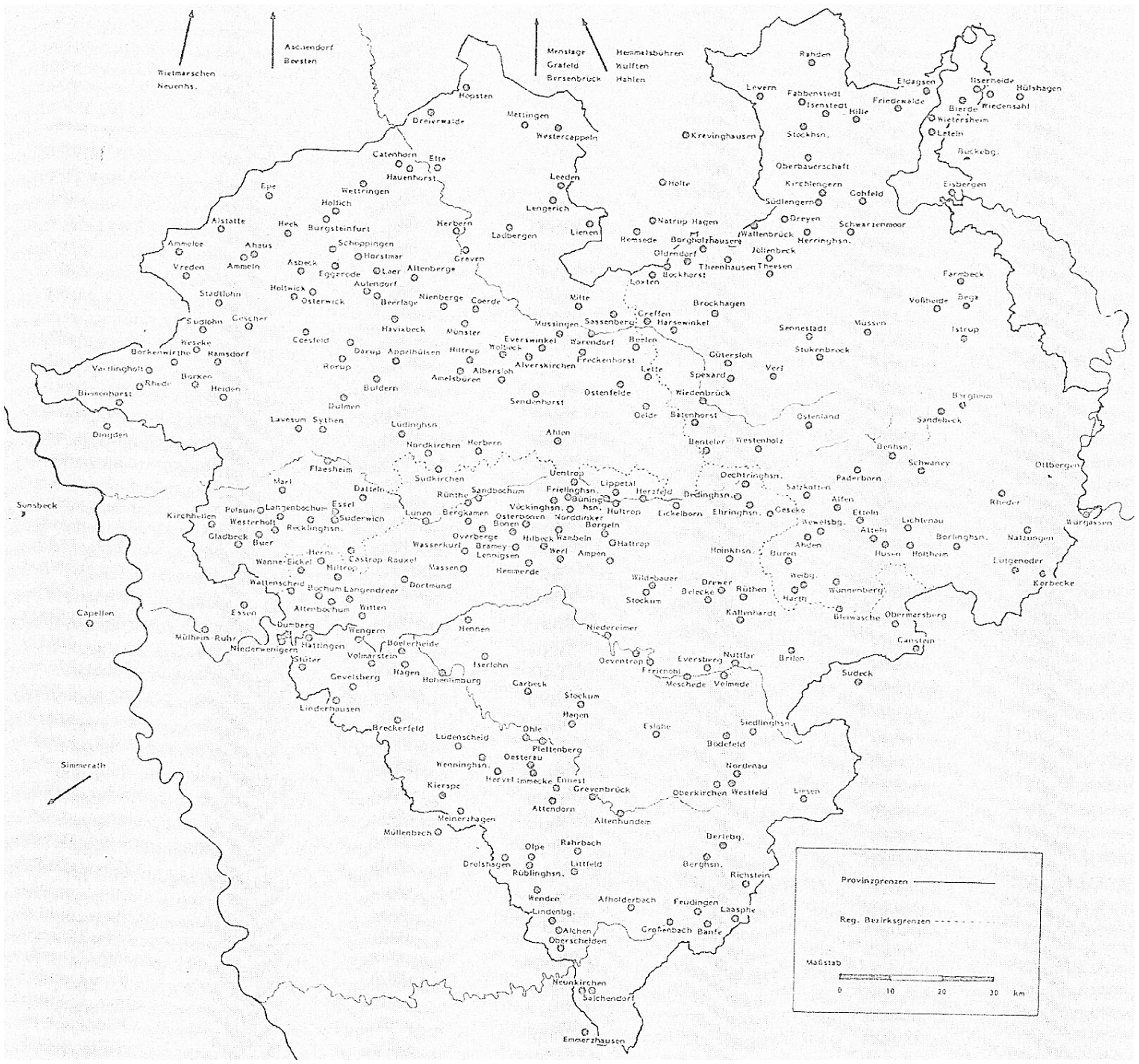
The Westphalian reports hold extraordinary advantages for the historian. They mainly come from the rural elderly, a group typically underrepresented in audience research. Additionally, we know much about each author’s biography and life situation. The lengthy narration of personal experiences is often mixed with observations about other households, or statistics for the entire village. Many authors solicited details from friends and acquaintances. Two teachers even presented entire secondary school classes with the questionnaire. Social and cultural details hardly touched upon by other contemporary polls receive lengthy consideration: for example, who paid for the television set, what the priest said or how the neighbours reacted.
But the reports are also challenging to interpret. First, the respondents had been preselected according to their willingness to reminisce (sympathetically) about traditional peasant folklore. This is not a statistically representative sample. There is a distinct overrepresentation of men over women (42:8), and of retired teachers (16) and clerks (8) over those more typical of rural communities – workers (5) and farmers and farmhands (18). 26 About half of the texts stem from a select group of village dignitaries. Many of them felt it their calling to document the local culture and were active in Heimat (home region) associations. 27 Therefore, the sources should be expected to display an atypically pronounced scepticism to all things modern.
Second, to a certain extent the respondents were influenced by the expectations of the ethnographers. Questionnaire No. 38 ran over five pages in length, listing the areas to be touched upon: the purchase of a set, early attitudes towards TV, its place in the home, watching in the evening, children and television, consequences on village life, programming choices and TV sets in pubs. Some of the questions were rather leading: ‘How was your attitude to television about ten years ago? … Were there worries about family life [or] … that TV detracts from work? That it spoils leisure time? That a set is an inappropriate luxury item? That watching TV is unhealthy?’ 28
The ethnographers running the Münster archive had copied their questionnaire approach from Lund University in Sweden in the early 1950s. But the Münster methods were also influenced by regional ‘tribalism’ and remnants of Nazi-era völkisch thought. 29 While the older staff at the folklore archive longed for the reconstruction of a lost folk paradise (a romanticism they shared with Heimat enthusiasts), they were increasingly challenged by younger colleagues who sought to reorient research away from Heimat and nostalgia. Around 1970, this conflict rocked the field of West German ethnography as a whole. 30
In Münster, the work of long-serving archivists was challenged by a young colleague named Dietmar Sauermann. A lecturer at Münster University’s Volkskundliches Seminar, Sauermann joined the archive on a full-time post in 1970.
31
Five years before, he had already initiated the archive’s television-themed survey.
32
Sauermann decried the ‘cultural pessimism’ and ‘lack of critical historical thought’ guiding the previous work of the Münster ethnographers. In particular, he criticized the underlying assumption of an essentialist, down-to-earth Westphalian folk culture and the idealization of preindustrial rural society.
33
His approach was to explore ‘the impact of industrialization on folk culture’ and the plight of the lower classes in the agrarian world.
34
He warmly responded to villagers whose reports displayed a ‘critical approach'.
35
By his own account, Sauermann: pushed ideas which many of my colleagues most strenuously reject, because for decades they saw only the culture of the wealthy peasant as genuine folk culture – they disregarded the ‘ordinary man’ … I need to prove that the past world was by no means ideal, and that it is insane to take it as a model for the future of society.
36
But only a handful of respondents were looked after by Sauermann, and most by Dr Renate Brockpähler. In her correspondence with Westphalian villagers, Brockpähler made no secret of her opposition to the small screen. She was proud ‘not to be a television person’ and that her family still did not own a set in 1973 (in contrast to 95 per cent of households). 37 She applauded incoming reports by sceptics: ‘You are surely right that TV is mostly to blame for the decline of neighbourly contact’ – ‘the homely conversation [gemütliches Klöhnen] has fully ceased to exist’ – ‘many people are unable to turn it off’. 38 Brockpähler harboured a distaste for modernity in general. She longed for ‘a return to the simple lifestyle’ of yesterday and maintained that ‘rising affluence has failed to make people happier'. 39 Unsurprisingly, she considered the archive’s poll on television experiences ‘out of our usual remit’ and ‘not particularly well received'. 40 In the end, a frustrated Sauermann considered his TV poll ‘a failure’, probably because most answers did not live up to his idea of a ‘critical approach'. 41
The ethnographer’s flop becomes the historian’s asset once we supplement the Münster sources with available control groups and other contemporary empirical studies. Because the Münster survey was handed down to entire school classes, we can compare the responses of the elderly authors to those of 33 sixteen-year-olds (from 1967) and 62 ten- to twelve-year-olds (from 1965). 42 We can also cross-link the Westphalian sources with statistically representative polls on television’s effects which were conducted by Elisabeth Noelle-Neumann’s Allensbach Institute for Demoscopy. 43 Additionally, there are three little-known contemporary investigations of the rise of television in rural and small-town West Germany. In 1959, sociologist Barbara Fülgraff examined television use in two districts of Freiburg im Breisgau. In 1964, mass communications scholars compared TV habits in the rural district Tecklenburg with the mid-sized town Iserlohn and the industrialized hub Oberhausen. Lastly, in 1970, the two Hessian villages Mardorf and Nieder-Erlenbach were surveyed by ethnographer Harald Schäfer. 44 As these studies neither privileged male respondents nor Heimat enthusiasts, their findings will be drawn upon to compensate for the shortcomings of the Münster reports.
Taken together, these sources will enable us to chart television’s arrival in rural West Germany, and to weigh its impact on society. First, who bought receivers and who watched them during the early years? Second, how did TV impact on daily rhythms, village life and family togetherness? Third, to what extent did it politicize and nationalize rural audiences, and make them into culturally homogeneous mass consumers?
I
Round about the year 1960 the first TV set came to Aulendorf … the news spread like wildfire. Many people … wanted to have none of it. But when some … visited to watch a few programmes … they eagerly began saving up for buying just such a box at Christmas.
Frau Tenberg’s recollections were fairly typical, even if television came to her village a few years later than elsewhere. 45 Almost all Westphalian reporters stressed how quickly the new medium established itself. All agreed that radio had been much slower in conquering the rural population back in the 1920s and 1930s. 46
What were the misgivings of the rural population, and how were they wiped out so swiftly? In the beginning, farmers often criticized TV as a luxury item, and they warned of it ‘beaming naked women into the home'. 47 In 1960, ‘one saw it as too big an indulgence. A set cost 1500–1700 Marks back then … today the modest sets are cheaper, 400–600 Marks', reported farmer August Kroes. 48 Up to the late 1950s, money was tight for all but the wealthiest farmers and even the publicans. 49 In addition, many doctors warned of the radiation emanating from the cathode ray tubes in early TVs. It could harm people’s eyes and nerves, maintained a GP in Feudingen. For cataract patients, tinted glass panes were installed in front of the screen. The rays were said to be particularly dangerous for small children. Village rumour had it that once the TV set arrived, the rats abandoned the house ‘because of ultra rays and ultra sound waves'. 50
Both health and money worries did not last long. Country dwellers swiftly embraced the new technology. But compared to the rise of the phonograph and radio, they found nothing ‘miraculous’ or awe-inspiring about television. The same people who typically recalled their first radio or recorded sound experiences as ‘mindblowing', ‘unforgettable', ‘mysterious and wonderful’ and ‘immeasurably astonishing’ were now prepared to take the arrival of TV in their stride. While they had admired radio as ‘magnificent accomplishment’ and ‘wonder of the world', 51 television was just the latest rung on the stepladder of technical progress. 52
Initially, during the 1950s, TV conquered the industrialized and urbanized regions first. Urban areas, such as the Rhineland and Ruhr valley, registered about three to four times as many receivers per person as rural communities. Federal statistics show that farmers were consistently less likely to have a set than workers, clerks and civil servants. By 1960, one-quarter of West German households owned a set; by the late 1960s, it was three-quarters. A 1967 snapshot shows only 66 per cent of villagers lived in a home with a set, compared with between 74 and 79 per cent of town and city dwellers. This was hardly due to technical transmission problems, as already by the end of the 1950s nine-tenths of the population had a good signal. 53 The main reason for the late take up of TV in rural areas was the difference in material wealth between city and countryside.
The reports from Westphalia confirm that during the early years of the medium (1952–4), sets were most likely to be found in pubs or in the homes of the wealthier villagers. 54 Fifteen authors wrote that the local pub was the first to offer the experience of television watching, and that taverns were overcrowded when football games were screened. Sometimes two or three pubs or hotels installed TV sets at the same time, so they would not be outdone by their competitors. 55 On the heels of the innkeepers came the factory owners and the wealthy farmers. 56 Those who had the means to buy a set were either ‘the doctor, industrialist, businessmen’ 57 or well-off farmers. The latter ‘acquired these early TV sets in order to bind the female and male farmhands to their house'. Agricultural labourers were increasingly hard to come by, and in the 1950s often insisted on writing television viewing into their contracts. 58 Another group that bought receivers already during the mid-1950s were well-paid skilled rural workers, such as milkers. 59 As the 1950s progressed, the families of workers who commuted to the nearby factories were generally quicker to purchase a set than smallholders and less well-off farmers. 60 Even though many traders allowed for the receivers to be paid in 20 or 24 instalments, they remained costly for ordinary costumers until the late 1950s. 61 As a luxury item, TV could even stand in as dowry. At a country wedding in 1955, ‘the young woman brought with her a television set instead of the usual cow'. 62
When affluence spread to the villages, during the 1960s, receivers were high on the list of priorities. In 1970, an ethnographer who took an inventory of the Hessian hamlet Mardorf – a remote, rather traditional community – found that of the 265 households, 230 owned a TV set, but only 30 a phone and just about half a washing machine. 63 The new medium appealed to all generations in the rural household. Where, as often, the older generation lived next to a young family, a TV was considered a suitable present for a 70th birthday, name day or Christmas. As 71-year-old farmer Clemens Stücken joked, ‘the retired couple would present the young couple with a television set’ at Christmas, only to be given a TV recliner in return. 64 Some families introduced a piggy bank to which ‘old and young contributed their savings'. 65 ‘If the old people initially had misgivings, that changed over time; they now are watching, too, they even purchase a set', farmer’s wife Ariane Lütke reported. 66 Once the TV arrived, the older family members watched even more than the young, as they had more free time and preferred staying at home to going out. 67 Particularly those who were bedridden, had difficulty walking or whose eyes were too poor to read the paper were ‘very taken’ by telecasts. All nursing homes installed sets in their common rooms; they were unfailingly popular. 68 This fits with the findings of the 1964 survey of Tecklenburg, Oberhausen and Iserlohn, where those above 45 years of age enjoyed TV more than the young adults. 69 ‘It is delightful how precisely the aged love to participate in watching … in their faces you see rapt attention', even ‘tears of joy’, testified Sybille Tenberg. Fellow farmer’s wife Emilie Worting related at 77 years of age how she had bought her own set: ‘although I am old, I do not want to miss out on television entirely'. 70
Like Frau Worting, most villagers waited or saved for several years before they purchased. Between 1954 and about 1961, viewing was a communal experience. During this transition period, neighbourly contact was intensified – in ways not uniformly appreciated. Almost every evening, the television pioneers of the early and mid-1950s had to cope with crowds of friends, family, colleagues and neighbours. One example was ‘Klausi', a smallholder in Laer (a suburb of the coal-mining city Bochum) who held cattle and went around the villages with horse and cart selling fruit, vegetables and meat. Klausi’s passion was breeding carrier pigeons and entering them in races. In 1954, as his neighbour recalled, one of his pigeons: flew so fast that she brought him home a TV receiver … Klausi was besieged with congratulations … Even television heard of it and went to see him at his vegetable cart. A few days later, then, he could watch himself on his new TV set. Of course the neighbours … had to see the new device – preferably when it was switched on … the living room where the box stood in a back corner was too small for the crowds of visitors, and they had to stand in the hallway and watch through the open door … the family could never watch anything on their own … During the winter, those viewers who worked in the mines and received a coal allowance brought with them a bucket full of coal so that the room could be heated … It went like that for a long while, until about half a year later the next person in the neighbourhood bought a TV.
71
The practice of communal viewing was fraught with tensions. Sometimes traditional social hierarchies were turned upside down, for example when landlords went to watch at their lodgers’, or farmers at their milkers’.
79
But more often, people felt unease at ‘running the risk of bothering the neighbours and being an unwelcome guest'. ‘When private TV visits become too frequent, one is certain to be a nuisance to the hosts.’
80
Dorothee Schulte in Rhede remembered how they: went to my brother’s to watch particular programmes, Ohnsorg theatre first of all, then circus and crime stories. But it wasn’t a good feeling for us all of the time to be knocking the others’ door down once again … I do like watching TV, but if my place were so crowded as my brother’s was, I would have been sick of it in no time.
81
we had to adjust to the hosts … the housewife was still busy in the kitchen while we were sitting in the living room with the husband … she incessantly interrupted from the kitchen … if you did not pay attention and respond to her words she would feel offended … sometimes we saw the visuals of a programme but did not hear half of the audio … After a while we found excuses … and went instead to a well-known pub to watch the Saturday evening lineup.
85
Eventually, most households decided to purchase a set. People were tired of putting up with talkative hosts at the neighbours’ and garrulous youths at the pub, 88 and of being outvoted by others opting for another channel. 89 ‘At home one can view and hear properly … nobody interrupts … everyone has his beer, his cigar and biscuits', village teacher Heinrich Kotter summed up. 90 Another factor also weighed heavily: the pressure exerted by children and teenagers. All too often, they proved to be ‘the driving forces’ behind the purchase. 91 ‘In many cases the parents were pushed by their children to buy a set. If they resisted, the kids would work on the grandparents until they relented.’ 92 Schoolchildren argued that ‘everyone’ in their class had a set at home. Once they spent long spells at friends’ homes and even brought home teachers’ recommendations for certain programmes, the parents were likely to give in. 93 Children became the most faithful users of the box during day-time. In Hessian villages in 1970, between a fourth and a third of parents attested that their offspring liked to play Bonanza (after the American Western series). 94 A teacher of biology now found his pupils ‘rather disinterested’ in the slides with which he had been able to ‘maximally enthrall classes’ in earlier years. He also observed that most parents placed no or very few restrictions on the youngsters’ daily viewing. 95
II
With the end of communal viewing, a new era began during which TV imposed new rhythms, rules and schedules on farm work and leisure activities, on neighbourly relations and village associations. Television was not the only factor contributing to the unravelling of the fabric of traditional rural society. Rather, it was a catalyst accelerating the breakdown of the boundaries of rural communities that had begun much earlier. The 1950s had seen massive changes to agricultural practices, in addition to the beginnings of suburbanization and mass motorization. Commuters moved to the villages, tourists and campers discovered the countryside, and the first malls were erected outside cities. 96 But the ‘decisive transformation of everyday life’ happened during the 1960s – within 10 to 15 years of the start of regular broadcasts. 97
One of the biggest changes introduced by TV in everyday life was that people stayed up longer and got less sleep than before. Sleep deprivation was recorded by many, either as observed in others 98 or as their own experience. ‘We often sat in the evenings in front of the set … it got late and you could not get away from it and go to bed.’ 99 ‘The man who fetches the milk in the mornings from the farmers and delivers it to the creamery said: ever since farmers X and Y had a TV, the milk hasn’t been put out at the road at the right time.’ 100 Representative ‘before and after’ polls indeed prove that television shortened the nights, and therefore (on average) slightly lowered the mood of those who had recently acquired a set. 101 This effect was particularly pronounced in the countryside, where people traditionally went to bed earlier than their urban peers, and programming schedules conflicted more with the daily rhythm. 102 Still, on average, rural viewers watched longer than urban viewers 103 and had slightly more positive attitudes to broadcasting as well. 104
The Westphalian respondents agreed that the purchase of a set led to a temporary addiction to television. 105 People became ‘Fernatiker’ (a pun combining ‘Fernseher’/TV and ‘Fanatiker’/fanatic) displaying ‘a certain insatiability'. 106 But after a few months, ‘the novelty wore off’ and the lure of daytime programming waned. 107 Particularly in winter, the afternoon broadcasts were attractive draws for country people. Early darkness meant the set was switched on earlier. The summer, in contrast, saw more urgent tasks to be tended to. ‘When the gardening work starts in the villages, and the days get longer, the television set will not be switched on that often anymore.’ 108
Even the organization of the farmers’ working day was changed by TV’s arrival. The evening’s leisure was moved forward to fit in with the programming schedule, and the late feeding of cattle ended, as Sybille Tenberg described in 1965. In many families, ‘there was a rush to get finished with the tasks by eight p.m.’.
109
To tune into the main news show Tagesschau, the evening meal had to be brought forward. As a rule, the mother has prepared the supper by then, or one has already eaten it … Eating habits have changed, because now for supper there is always only open sandwiches – rarely a warm dish such as fried potatoes, milk soup or leftovers from the midday cooked meal. Earlier, it was pretty much the other way around.
110
Television dominated the evening to such an extent, the village veterinarian reported, that cattle farmers would typically call in for help right after popular broadcasts. ‘They don’t like going to the stables when a suspenseful programme is on … but after it ends, the cases will be all the more urgent.’ 111
The new medium impacted not only on when leisure time started, but also where and who it was spent with. Earlier, on warm summer evenings, the family members sat in front of their houses on a bench and talked to their neighbours across the street, with the men smoking their pipe or a cigar, and the women knitting socks or darning. Now, instead, they sit in front of the screen … On the long winter evenings, the men would play Skat or Doppelkopp [card games] while the women did needlework. That, too, is now rare.
112
This account by retired teacher Bernhard Sonderen from Hagen is remarkably similar to those by Otto Schulz-Wessel from Petzen and Paul Burgmann from Laer. The latter two added that before TV, the men used to read the paper or listen to the radio, and neighbours would stop by for a chat or, occasionally, meet in the pub. 113
Television ended these routines. As 78-year-old farmer Gerd Hüser from Hemmerde noticed, ‘the village streets are absolutely quiet in the evening … it seems a miracle if one encounters a pedestrian, or rarely a car. All the villagers are sitting in front of their screens', having become ‘reclusive’ and ‘encapsulated’. Burgmann concurred: ‘You can bet on the streets … being almost deserted, even on lovely summer evenings, if a popular programme is on.’ 114 Farmer Josef Langenholl from Körbecke argued that ‘the decrease of neighbourly get-togethers at home and in front of the doors’ resulted in people talking less to each other. 115 Television was also blamed for ‘a deplorable decline in contact with the neighbours’ on Sunday afternoons. 116 The traditional card game, where the neighbours rotated to host the men’s Sunday evening Skat, became less popular. 117 Elderly farmers like Karl Venneklos no longer dropped in on the neighbours, as he was afraid ‘of coming at an inconvenient time’ during the schedules. 118 Farmer’s wife Erna Unsehl from Havixbeck resented that, while visiting acquaintances, she had twice ended up joining the family in front of the screen. 119 Farm manager Wilhelm Holtrup agreed: ‘I have to confess that I myself don’t like it if visitors show up just when the news is on'. 120 The spread of television brought with it new unwritten rules about when it was better not to knock on the door.
If TV led to a weakening of neighbourly networks, what was its impact on village rituals and communal leisure activities? Villagers often blamed television’s ascent for the ‘ebbing away’ of social life. 121 ‘Club life [Vereinsleben] suffers, particularly when big sporting events are on. First the TV, then the Verein duties.’ 122 Local clubs commonly began to reschedule meetings to avoid clashes with attractive programmes. 123 Male choirs in Lüdenscheid and Hagen struggled with attendance at evening rehearsals. 124 Likewise, attendance fell at meetings of the Laer pigeon breeder association and the gun club [Schützenverein]. Once in Laer, a popular broadcast almost led to the cancellation of the village fair. ‘The longingly awaited visitors’ only came ‘once the programme had ended'. 125 Nearby in Leeden, fewer and fewer people turned up to lectures, church fairs and other events. That was not least because ‘people have become more critical and demanding by watching TV, and apply television standards to talks and carnival events'. 126 A circus that toured the Westphalian villages in 1966 attracted a teenage audience in the afternoons but had to cancel evening performances. The circus director feared extinction ‘because the big hits of the major circuses are shown on TV and spoil the audiences, who no longer want to see a more modest performance'. 127 The rural cinemas closed down almost everywhere during the late 1950s, 128 and publicans universally complained about fewer guests as people took to consuming bottled beer at home. 129 Only dance venues continued to thrive, with their Saturday and Sunday events drawing in young people who were evidently less keen on TV than their parents. 130
The churches, too, were affected. Secularization was already well under way in Westphalia. Since 1945, secular leisure opportunities had lured away both boys and girls from Catholic activities. 131 During the 1950s, Catholic youth organizations had faced increasingly vocal criticisms from within and an exodus of female members. 132 Television now accelerated this process. Bernhard Sonderen reported from Hagen how the traditional biweekly screenings in the church hall – combining a newsreel with a diocese-approved film – petered out when fewer and fewer of the former 40 to 80 viewers showed up. The weekly church youth evenings lost in popularity, 133 as did the meetings of the Catholic Rural Youth (Katholische Landjugend) in Schöppingen. 134 In some cases, even worship now had to fit around TV. In 1965, the vicar of a Catholic church in Rhede announced to the parishioners’ astonishment that ‘today’s service will be delayed because of a TV broadcast that our children want to see'. 135
Although some pastors initially advised villagers against television, their warnings fell on deaf ears. The religious argument against broadcasting focused almost exclusively on its impact on children 136 and was delivered by the teachers in (denominational) schools. ‘The protestant church and the teachers always warned against children watching excessively', but ‘the masses’ were unwilling to heed such counsel, retired teacher Otto Schulz-Wessel recalled. In his memory, people’s general attitude was that clergy and teachers ‘should keep to themselves and their own stuff; our life is none of their business'. 137 Likewise ‘to no avail', clergy in Lüdenscheid and Witten sought to ‘enlighten and admonish’ parents at parent-teacher evenings about the damaging effects of the new medium. 138
Our Westphalian sources rarely mention the pastors’ warnings in detail 139 – presumably because clergymen, who already faced the tide of secularization, refrained from admonishing laypeople outright against TV. Parishioners might also have chosen to disregard any such advice when taking personal decisions about buying and watching. Instead, our reporters prefer to tell stories about progressive clerics who embraced television for their purposes. Thus, in June 1957 the new pastor in Hagen, a hamlet with particularly bad signal, installed two very tall antennas on the roof of the vicarage and the church hall. He held separate weekly evening screenings for the teenage boys and girls, and invited all villagers to watch selected movies and the yearly Cologne carnival procession. The idea was to ‘offer sound entertainment to the young in order to lure them away from the distractions of the street and pubs'. 140 Other priests bought a set to keep abreast of the Second Vatican Council (1962–5) and regularly invited parishioners ‘to watch broadcasts from the Vatican'. 141 Or they took to announcing recommended programmes during the service. 142
Did people watch the regular religious features on West German channels? 143 The teachers’ impressions were that they did not; younger families tended to tune into news regularly, but not to religious programmes. 144 Only the elderly sought out religious fare. 145 Typically, though, both Catholics and Protestants followed the broadcasts targeted at their own as well as the others’ creed. In the denominationally strongly divided Westphalian countryside, this was new and ‘introduced a conciliatory outlook'. ‘For many, it was interesting to see how worship is practised in the other church’ and viewers ‘liked to draw comparisons’ with their own experience. 146 Here, television served to open horizons beyond the parish and one’s own church, therefore contributing to the decline of the local pastor’s influence.
The critics of television’s rise feared not only the weakening of church ties but also the decline of family values. The Münster questionnaire aimed at ‘gauging the ways in which television impacts the family community’ and enquired ‘whether family conversation had suffered because of it'. 147 Here, the Münster archivists joined a chorus of modernity-sceptic voices in the early Federal Republic. Conservatives had responded to wartime changes to gender roles with the political project of reconstructing the family. The idealized, bourgeois, nuclear family was praised as a storehouse of German values, a basis of postwar recovery and a pillar of stability in times of social crisis. 148 During the 1950s and 1960s, the educated middle and upper classes in particular invoked a ‘crisis’ of the family. To them, the bulwark of the family needed to be fortified against the rising tide of modern forces such as individualism, feminism, consumerism, communism or secularization. This discourse attempted to reinscribe a set of gender norms that were already under pressure. 149 Now, scholars identified television as the newest threat to the family ideal.
The pollsters and sociologists of the time highlighted the danger presented by TV to family life, although they were unable to gather the necessary evidence. 150 A nationwide poll in 1966–7 confirmed that levels of family conversation had not changed by the introduction of TV. 151 Respondents to other surveys, too, overwhelmingly attested that family life had not suffered from television, that they regularly watched together, and that TV made them spend more time at home and have fewer arguments than before. Nevertheless, scholars believed that the rural family was damaged by the ‘pseudo-togetherness’ and ‘superficial sociability’ of consuming TV. 152 For sure, there were differences in the ways rural and urban families watched the tube. The Tecklenburg survey showed that ‘country people much more often practise wordless television reception’ (59 per cent) than town and city dwellers (41 and 47 per cent). The more rural and the older viewers were, the more they tended to devote their undivided attention to the screen. But the study also evidenced that about half of all viewers, regardless of whether they were rural or urban, ‘often’ or ‘regularly’ talked about broadcasts after having watched them. Moreover, village families tended to be larger and have more children than city families, and were thus more likely to enforce silence when the set was on. 153 These data hardly imply a decline of family cohesion. Instead, they suggest that contemporary scholars harboured an idealized middle-class concept of family conversation. They misread the findings to confirm their fears of traditional families being endangered by modern technology.
The Münster ethnographers fell into the same trap. While their questionnaire implied that rural family life had suffered from television, the respondents did not take the bait. They flatly declared that ‘TV has not changed family life’ 154 and that the family chat was but a romanticized ideal. Was not the discussion incited by TV programmes ‘more interesting and fruitful than … the recent village gossip’? 155 Were there not still ‘more than enough possibilities during mealtimes and work’ to talk? 156 A retired teacher conceded that from among the peasants in Schöppingen, he had ‘not once heard family members complain’ about the issue. 157 Work had always trumped the leisurely family chat, the villagers cautioned. Even in the pre-radio days, there had not been much serious conversation. ‘The women and girls did needlework, we children did homework, and our father studied the newspaper. Few words were exchanged, the trivial events of the village were quickly dispensed with, then it was quiet under the petroleum lamp.’ 158 It was felt that television had enriched, rather than undermined, a family life which had never been the idyll imagined by ethnographers.
Television’s impact on gender roles, too, did not conform to the ethnographers’ expectations. One of the main changes induced by TV was that the men now took a night out at the pub or with mates significantly less often.
159
But domesticated fathers, even if they edged closer to the new ideal of softer, emotional fatherhood,
160
were by no means giving up patriarchal privileges. In the everyday practices of rural families, patriarchal structures were mirrored in the ways that air time was consumed. Frequently, after supper, the housewife was still working in the kitchen, while the other family members watched in the living room.
161
Each member took a designated seat, with the father often laying claim to the most comfortable recliner.
162
A teacher who surveyed a class of 33 sixteen-year-olds in Laasphe reported that: often, the father has a privileged place, namely the sofa or armchair. The children come second, and the mother only third! Maybe that is because the family already sits down to watch while the mother is still busy in the kitchen.
163
Thus, the spread of television sets affected rural society in different ways. While it altered daily rhythms and contributed to the erosion of the churches’ authority, it reinforced domesticity and reinscribed patriarchal routines in families. And whereas TV crowded out neighbourly and club meetings, this was less a decline than a reshaping of social life in the village. The leisure activities of the pre-television decades had been limited in scope, constrained by geographical proximity (as in the case of neighbourly networks) and regimented by the village notables and pastors (as in the case of club and church activities). About a fifth of people complained of boredom on Sundays and holidays, 166 and many more rural than urban viewers admitted they tuned in ‘to overcome the feeling of loneliness'. 167 Television simply offered an alternative: a choice of whether to engage with the local culture or with the national or regional programming. Given the choice, most people chose to broaden their horizon beyond the village.
III
To what extent, then, did television act as a ‘window to the world’ 168 and manage to de-localize and politicize rural viewers? Was the village vet right that TV had led to ‘a higher level of general knowledge and to a stronger participation in cultural and political life’? 169 Was the medium a motor of politicization, nationalization and mass consumerism?
In the Westphalian countryside, the most popular genres by far were light entertainment – the comic folk theatre of Millowitsch and Ohnsorg, crime series and sports shows. 170 In this, the villagers differed little from urban viewers. 171 But the rural audience also sought out documentaries on nature, wildlife and animal shows. 172 National as well as international media events – ‘the Olympics, the World Cup, coronations of royals’ – were keenly received. 173 Football games were a huge draw to the men. The World Cups in 1954, 1958, 1962 and 1966 prompted quite a few to purchase a receiver, 174 with almost everyone in the village cheering on the national team. 175
The two West German networks beamed national and international perspectives into rural homes. 176 Willi Buhren, a 65-year-old farmhand, found his fellow countrymen even ‘on the most remote farms … addicted’ to the new concepts TV brought, and always ‘willing to take in the new'. He quoted a retired shoemaker as saying, ‘TV is great, now we get to see things from this world that we not even knew existed'. 177 A 77-year-old farmer from Hemmerde related how ‘particularly exciting’ it was ‘to see, on screen, leading people from the economy and cultural life’ about whom he had only read before. 178 An 82-year-old farmer welcomed broadcasts ‘about national issues, regional particularities, landscapes, buildings and churches’ 179 and an 85-year-old farmer’s wife loved ‘foreign landscapes … Scottish sheep … Nordic reindeer … Oriental towns, far-away continents'. 180
The early evening news had a privileged place in the daily rhythm. For a large majority of viewers, supper was followed by the national news. 181 The families of the polled sixteen-year-olds in Laasphe tuned in at 8 p.m. for Tagesschau (11 out of 27) or at 7 p.m. (nine out of 27) for Heute, the second channel’s news. 182 Thus rural people followed the national news much more extensively than before TV, 183 a strong effect that included those uninterested in politics. 184 By the mid-1960s, villagers were just as well informed about current political affairs as their urban counterparts. They trusted television more than any other media when it came to coverage of political events. 185 Moreover, they attested to tuning in ‘because I can learn something from it’ to a greater extent than town and city dwellers. 186 Willi Buhren was impressed by acquaintances who ‘eagerly followed the Bundestag [parliamentary] debates on screen’ and ‘could recite all the details’ from particular sessions. 187 Many older men enjoyed watching such debates; Wilhelm Holtrup, for example, ‘always’ saw ‘broadcasts from the Bundestag from beginning to end'. He also liked ‘the Sunday Frühschoppen with Werner Höfer', a weekly political talk show with journalists from several countries. 188 ‘Drawn-out discussions’ at home and at work about ‘the politically coloured themes’ on TV were typical of the older male villagers. 189
The extent to which television accelerated the politicization of the rural population was highly gendered. Men were significantly more interested in political programmes, while rural women were the social group least keen on them, most likely to trust them and ‘particularly insecure’ when asked to judge TV’s political party bias. But overall, both rural women and men were now better informed than before TV. 190 This sea change is mirrored in the complaints of non-viewers who felt left behind. Buhren, who did not own a set, was surprised how the regulars ‘knew the ministers and the parliamentary rules of procedure; it was completely foreign to me'. 191 Mr and Mrs Strohschneider, a middle-aged couple from Werl, were embarrassed when ‘frequently asked by other people about all kinds of things which had been seen on television … also political and social topics … we could not join in the conversation. Sometimes we were not really very well informed.’ 192 In the mid-1960s, it became impossible to keep up with colleagues at work, with friends and at school if one did not have a television. 193 This was true for the children, too. All the teachers and classes surveyed testified that recent programmes were a regular, major topic of schoolyard conversation. 194
Television therefore widened the outlook of rural audiences. But was it also a motor of cultural homogenization and mass consumerism? We only have scattered evidence about the ways people reacted to lifestyles and consumer products presented on air. Few villagers remarked on their fascination with televised advertisements or luxury items. 195 Sybille Tenberg was advised by the men in her family that she should have her hair done like a female presenter. 196 Beyond these isolated findings, our sources offer only one way of probing the hypothesis: a glance at living room furnishings. The survey asked whether the purchase of a set led to spatial rearrangements in the home – and brought to light some interesting developments.
Traditionally, in Westphalian farmhouses as well as rural workers’ dwellings, family life revolved around a large eat-in kitchen (Wohnküche). The more expensively furnished living room was called gute Stube (parlour); it was ‘a cold pomp, only used on holidays, at most once on Sundays'. The decline of the showcase rural parlour began with the post-1945 construction wave, as new flats often had small kitchens. 197 Television accelerated this process of modernization. The ratio of boxes in living rooms to boxes in kitchens is a good indicator of how modernized the village was, as our Hessian examples show. Mardorf, where the city was far away and most families were still involved with farming, counted 56 TV sets in kitchens and 118 in living rooms. Nieder-Erlenbach, in commuting distance to Frankfurt and morphing into a dormitory town, recorded a ratio of three to 261. 198
Once the set had arrived in the gute Stube, the pricey sofas and armchairs began to be used every day, with the children lying on the rug while the family was watching. 199 Often, the room lacked heating, so an oil heater or stove was brought in. 200 Seating had to be rearranged so that the screen could be seen by all. Of the 27 Laasphe families with a receiver surveyed in 1967, 22 had placed it in the living room. 201 In 10 households, the furniture was repositioned, and 12 acquired additional furnishings or lighting. 202 Ceiling lights were often replaced by small sconces or a special ‘TV light'. 203 A teacher who questioned 62 ten- to thirteen-year-olds in Papenburg in 1965 found that 44 families had placed the set in the living room, and only 12 in the kitchen. In 26 cases, new furniture had been bought, mostly tables or cupboards to put the set on. 204 Overall, TV prompted at least 40 per cent of households to make additional purchases. Given that most householders had already invested in new suites during the 1950s ‘furniture wave’, television now served to continue the consumerist trend. 205
Figure 2 shows drawings by the Westphalian respondents of their updated rural parlours. The set typically stood in a corner, on a low cupboard or table, with chairs and sofas about three to four metres away. As extended families could be large, there was plenty of seating provided. Heaters or armoires were placed in the other corners. The TV dominated the setting. Only rarely, objects such as the sewing machine, radio or audio equipment hinted at the room being used for other purposes. Television had taken over village parlours, and rural homes now resembled their urban counterparts more closely. 206
Judging from the transformation of village living rooms, TV indeed contributed to the cultural homogenization of the population. It possibly promoted mass consumerism as well, although our sources provide little evidence beyond furniture purchases. Television’s fostering of politicization and nationalization is more clearly established, with national news and political coverage keenly watched among elderly, rural audiences. To them, TV was both a forum of national politics and a window to the wider world.
IV
By the late 1960s, television had become the unquestionable leading medium in both urban and rural West Germany. 207 Initially, the villages had been slow to acquire receivers because they were less affluent. But they caught up quickly once the sets became more affordable. The rural mentality was by no means set against TV. On the contrary: many villagers valued a receiver more than a washer, and found communal viewing an unpleasant experience that had to be overcome as quickly as possible.
Indeed, TV acted as an agent of modernization in rural society. Wherever it spread, it rapidly changed people’s everyday habits. Daily schedules were not only reinforced but radically altered by television. Mealtimes and bedtimes were moved and the feeding rhythms of cattle adapted. Within only weeks or months, living rooms and leisure activities were transformed. New unwritten rules developed about when (not) to visit the neighbours and when (not) to schedule club meetings and church activities. Villagers now stayed at home in the evenings more often, and local institutions such as Vereine, neighbourly card game rotas, lecture series and youth clubs struggled to attract participants. Circuses, cinemas and fairs felt the impact of television (and motorization), too. Village life was redefined by the rise of TV. The old neighbourly networks and village associations were weakened, like the local clerics’ influence.
Clearly, television accelerated the levelling of religious milieus in the village. Catholics and Protestants alike now knew more about the other denomination and could compare their local parish to what happened in the national church. The pastors and teachers of denominational schools understood that they could not win a battle against TV and confined themselves to warning about its dangers to children. But parents overwhelmingly turned a deaf ear to clerical admonitions. After all, most parishioners welcomed television’s advantages. They wanted to escape the grip of local elites such as pastors, teachers and village notables, as the drop in the popularity of Verein and church activities, and the abandonment of church-organized communal viewing events shows. To quite a few villagers, the old forms of socializing were apparently less a cherished tradition than a combination of gossip, social control and boredom. To them, communal viewing was unpleasant, and rural communities were a far cry from the pastoral idyll that Heimat enthusiasts and conservative ethnographers cherished.
Such an attitude was inconceivable to the scholars investigating television’s effects. As the educated middle classes were the stratum most ambivalent towards the new medium, they were the most intent on highlighting the dangers television posed to an idealized, traditional, rural family. Therefore, contemporary social researchers argued unanimously that village families as well as children – both considered more vulnerable than the educated spokesmen – needed protection from broadcasting’s unfettered effects. The patronizing argument was the same, whether it came from conservatives sceptical of modernity or the 1970s neo-Marxists engaged in critique of ideology (who saw TV as a hegemonic instrument of the capitalist bourgeoisie). 208 Such arguments cut no ice with rural people. Our Westphalian reporters stubbornly declared that family togetherness had not suffered, and in any case had not been all that exciting before TV either. Despite the warnings by clergymen and teachers, village children were allowed to indulge daily in a rich television diet.
The openness with which the set was welcomed in the countryside was remarkable. The rural correspondents of the Münster archive, at least half of whom could reasonably be expected to long for the good old times of peasant Heimat, resisted the nostalgic bias of the ethnographers. Elderly men and women proved particularly keen on TV, even more so than young adults. The old villagers watched just as avidly as children and teenagers. This pattern lends additional force to the ‘transitional majority’ hypothesis: that television accelerated the value change of the 1960s as it reached rural, elderly, apolitical and under-age audiences faster and more effectively than earlier mass media. 209 There is evidence, too, that the rise of TV drove ‘cultural homogenization’ and a ‘decline of regional particularities'. 210 In several ways, it flattened the differences between village and city. Living rooms now looked more alike, just as evening schedules became more similar. Rural peculiarities such as warm suppers, late cattle feedings, regular outdoor chats with the neighbours in the early evenings and very early bedtimes began to fade away. Villagers were now just as well informed about current affairs as their urban counterparts, and just as unlikely to heed the churches’ counsel.
As villagers were such regular viewers of the national news, and often keen on parliamentary coverage and political magazines, it is fair to label TV both a nationalizing force and a motor of ongoing politicization. Rural hamlets became part of national politics more than ever before. And even if men enjoyed political programmes more than women, and almost all preferred light entertainment over political information, the lack of alternatives on offer and the enforced situation of family viewing meant that apolitical viewers consumed a fair amount of television’s coverage of national politics. Regional contexts lost their dominance, as rural people witnessed both national and international media events.
The modernizing impact of television on rural society was limited, however. Patriarchal structures persisted, albeit in changed forms, and were reinforced by how the box was positioned and used in rural households. Where receivers were more of a priority than washers, where father and children occupied privileged seats and the mother joined once the dishes were done, and only female viewers combined watching with chores and needlework, gender inequality prevailed. The advent of television did have a dramatic impact on rural society, accelerating its modernization, secularization, nationalization and politicization. But precisely the element that contemporary elites were most worried about, the patriarchal family, emerged unscathed from these changes.
Footnotes
1
Manuscript MS02589, Volkskundearchiv der Volkskundlichen Kommission für Westfalen, Landschaftsverband Westfalen-Lippe, Münster, 2. See also MS02689, 4.
2
J. Ellis, Seeing Things: Television in the Age of Uncertainty (London 2000), 39. L. Spigel and M. Curtin, ‘Introduction’, in L. Spigel and M. Curtin (eds), The Revolution Wasn’t Televised: Sixties Television and Social Conflict (New York, NY 1997), 2.
3
See F. Bösch, Mediengeschichte: Vom asiatischen Buchdruck zum Fernsehen (Frankfurt 2011), 212.
4
An overview in H. Wood, Talking With Television: Women, Talk Shows and Modern Self-Reflexivity (Urbana and Chicago, IL 2009), 102–4; see D. Morley and C. Brunsdon, The Nationwide Television Studies (London 2005).
5
Ellis, Seeing Things, 42–5.
6
Ibid., 45–6. K. Hickethier, ‘Zwischen Einschalten und Ausschalten: Fernsehgeschichte als Geschichte des Zuschauens’, in W. Faulstich (ed.), Geschichte des Fernsehens in der Bundesrepublik Deutschland, vol. V: Vom ‘Autor’ zum Nutzer (Munich 1994), 237–306, 269, 277. See also C. von Hodenberg, Konsens und Krise: Eine Geschichte der westdeutschen Medienöffentlichkeit, 1945–1973 (Göttingen 2006), 98–9.
7
J. Thumim, ‘Introduction’, in J. Thumim (ed.), Small Screens, Big Ideas: Television in the 1950s (London 2002), 7.
8
This perspective on TV’s rise was shaped by the North American experience, but has also been applied to Britain. R. Turnock, Television and Consumer Culture: Britain and the Transformation of Modernity (London 2007), 117, 194, 4.
9
Ibid., 6, 200–2. Ellis, Seeing Things, 2 [quotation], 40, 42–3.
10
Hodenberg, Konsens und Krise, 96; N. Grube, ‘Seines Glückes Schmied?’, in B. Dietz et al. (eds), Gab es den Wertewandel? Neue Forschungen zum gesellschaftlich-kulturellen Wandel seit den 1960er Jahren (Munich 2014), 106–7. Bösch, Mediengeschichte, 204.
11
J. Thumim, ‘Introduction’, 7, 10; Ellis, Seeing Things, 44, 47. See Hickethier, ‘Einschalten’, 271.
12
A. Fickers and C. Johnson, ‘Transnational Television History: A Comparative Approach’, Media History, 16 (2010), 1.
13
J.K. Chalaby, ‘Towards an Understanding of Media Transnationalism’, in J.K. Chalaby (ed.), Transnational Television Worldwide: Towards a New Media Order (London 2005), 1.
14
L. Spigel, Make Room for TV: Television and the Family Ideal in Postwar America (Chicago, IL 1992); M. Andrews, Domesticating the Airwaves (London 2012).
15
D. Siegfried, Time is on my side: Konsum und Politik in der westdeutschen Jugendkultur der 60er Jahre (Göttingen 2006); A. Bodrogkhozy, Groove Tube: Sixties Television and the Youth Rebellion (Durham, NC 2001).
16
C. von Hodenberg, Television’s Moment: Sitcom Audiences and the Sixties Cultural Revolution (Oxford 2015).
17

18
‘Anleitung für die Bearbeitung von Fragelisten des Archivs’, undated (1970), signed Martha Bringemeier. See also her 1951 letter ‘An unsere Mitarbeiter’. File ‘Schreiben an die Mitarbeiter 1951–1970’.
19
MA correspondence files, passim.
20
Files ‘Mitarbeitertreffen 1954’ and ‘Mitarbeitertagung 1971’ (Ratskeller menu for 3 June 1971, letter of 21 May 1971). See Mitteilungsblatt des Archivs für westfälische Volkskunde 20 (August 1971), 10–12.
21
The television reports were used once for a popular illustrated volume: J. Nunes-Matias, Quasselstrippe, Volksempfänger, Flimmerkiste: Über den Umgang mit Medien (Münster 2005).
22
D. Sauermann, Volkskundliche Forschung in Westfalen 1770 – 1970 (Münster 1986), vol. II, 305–6.
23
Ibid., vol. I, 116–18.
24
Ibid., vol. II, 204.
25
Institut für Demoskopie Allensbach, Archive, IfD Bericht No. 1489, 4–5. Sauermann, Volkskundliche Forschung II, 306, and I, 160, date the survey wrongly to 1964 and 1967.
26
To add is one veterinarian, one tailor and one housewife whose husband’s profession is unknown.
27
Sauermann, Volkskundliche Forschung I, 119. See also C. Applegate, A Nation of Provincials: The German Idea of Heimat (Berkeley, CA 1990).
28
Sauermann, Volkskundliche Forschung I, 204–8.
29
E. Timm, ‘Bruno Schier, Münster 1952’, in J. Moser et al. (eds), Zur Situation der Volkskunde 1945–1970: Orientierungen einer Wissenschaft in Zeiten des Kalten Krieges (Münster: Waxmann 2015), forthcoming.
30
F. Schmoll, Die Vermessung der Kultur: Der ‘Atlas der Deutschen Volkskunde’ und die deutsche Forschungsgemeinschaft 1928–1980 (Stuttgart 2009), 41, 286–7.
31
Mitteilungsblatt des Archivs für westfälische Volkskunde 19 (November 1970), 1.
32
Letter by Sauermann, MA136 (11 February 1972).
33
Sauermann, Volkskundliche Forschung I, 155.
34
Ibid., 164, 160.
35
Letter of 23 May 1972, MA700.
36
MA676 (28 May 1973).
37
Letters in correspondence folders MA464 (9 March 1979), MA74 (16 May 1973). See also MA712 (22 January 1979). Hickethier, ‘Einschalten’, 278.
38
Letters in MA554 (31 August 1977), MA464 (9 March 1979), MA316 (16 January 1974), MA384 (12 May 1975).
39
MA464 (22 January 1979); MA316 (2 July 1973).
40
MA464 (18 December 1978); MA90 (4 September 1973).
41
‘The ongoing documentation work … was to such an extent tailored to rural farmers’ way of living that it could not easily be reassigned to a changed research agenda.’ Sauermann, Volkskundliche Forschung I, 160.
42
MS02857; MS02638.
43
Allensbach Archive, IfD-Bericht No. 1489 (comparing people with and without TV set in 1966–7). E. Noelle-Neumann, Auswirkungen des Kabelfernsehens: Bericht über Ergebnisse der Begleitforschung zum Kabel-Pilot-Projekt Ludwigshafen (Berlin 1985).
44
B. Fülgraff, Fernsehen und Familie (Freiburg 1965). G. Maletzke et al., Fernsehen im Leben der Erwachsenen: Bericht über eine Untersuchung im Auftrage des Deutschen Volkshochschul-Verbandes (Hamburg 1968). H. Schäfer, Struktur-Untersuchungen zur Situation der Familie vor und auf dem Bildschirm (Marburg 1973).
45
MS02589, 1.
46
MS02689, 8; MS02857, 9; MS02777, 6. Cf. the 133 radio reports from 1983 used by C. Lenk, Die Erscheinung des Rundfunks (Opladen 1997).
47
MS03418, 2.
48
MS04974, 1. The prices cited are more typical of the years 1953–5: A. Schildt, Moderne Zeiten: Freizeit, Massenmedien und ‘Zeitgeist’ in der Bundesrepublik der 50er Jahre (Hamburg 1995), 272.
49
MS04744, 2.
50
Ibid. and MS05712, 1–2; MS02588, 3; MS04728, 3 (quotation).
51
MS02593, 1–2; MS02610, 1–2; MS02645, 8. Similar: MS02657, 2; MS02777, 7; MS04689, 1; MS04720, 4; MS04728, 1; MS05476, 4; MS04754, 4; MS04760, 3–4; MS06183, 2; MS04912, 1; MS05032, 5; MS02620, 1; MS04313, 2.
52
Only two of our 57 reports call TV miraculous in any way: MS05109, 1; MS02619, 1.
53
Schildt, Moderne Zeiten, 274–5, 270–2. IfD Bericht No. 1489, 6–7.
54
This fits with broadcasters’ statistics from 1953 which show the domination of pub owners (25 per cent), radio and TV traders (22 percent) and other professionals (31 per cent): Schildt, Moderne Zeiten, 274.
55
MS06183, 1; MS05712, 1; MS05032, 1. See also MS02590, 6; MS06624, 6; MS04974, 1; MS02592; MS02598, 1; MS02639, 3; MS02645, 1,3; MS02674, 5–6; MS02685, 4; MS02689, 1; MS04720, 1; MS05988, 1; MS02776, 4–5.
56
MS05032, 1; MS03418, 1; MS04689, 2; MS04912, 2.
57
MS02738, 1; see also MS04893, 1; MS02639, 1; MS02717, 1.
58
Observed by a teacher from Ladbergen, MS02723, 1. The same was reported from Bochum-Laer: MS02776, 14.
59
MS04719, 1,3; see MS06624, 1; MS02685, 1.
60
MS02717, 2; MS06183, 1.
61
MS06183, 1; for prices see Schildt, Moderne Zeiten, 272–3.
62
MS05988, 1.
63
Schäfer, Struktur-Untersuchungen, 32–3, 44.
64
MS05883, 2; see also farmer Fritz Breitmann, MS04719, 3–4; MS03418, 2. Of 62 families surveyed in Papenburg in 1965, eight got the set at Christmas, four as a birthday present: MS02638.
65
MS02589, 1; see MS02685, 1.
66
MS02770, 1. In the hamlet of Wernscheid, two pensioners were the first to acquire a set. MS02587, 1.
67
MS04719, 5–6.
68
MS02590, 2–3; MS02598, 7; MS02657, 1.
69
This was partly because they felt alone more often. Maletzke et al., Fernsehen im Leben, 47–8, 74, 78, 81.
70
MS02589, 4. MS05988, 1.
71
MS02776, 5–6.
72
MS04744, 2.
73
See MS02598, 3; MS02600, 1; MS02619, 1.
74
MS02639, 2; MS02689, 3–4; MS04720, 1; MS02717, 2.
75
MS02770, 1.
76
MS02776, 14; MS02857, 4.
77
MS03418, 2–3.
78
MS02776, 15; MS02717, 2.
79
MS02619, 1; MS04719, 1, 3.
80
MS04852, 1; MS02776, 15.
81
MS02588, 1; similar: MS02717, 2.
82
MS02645, 3.
83
MS02770, 2.
84
MS02619, 1.
85
MS02776, 15.
86
MS02755, 2; MS02717, 7; MS02776, 31–3; MS03418, 6–7; MS05712, 3–4.
87
MS04912, 3, 5.
88
MS02776, 15; MS02598, 5.
89
MS02770, 2.
90
MS04744, 5.
91
MS04728, 2; see also MS02776, 8–9. See also Schäfer, Struktur-Untersuchungen, 62–3; Turnock, Television, 116.
92
MS04744, 2.
93
MS05476, 2; see MS02619, 2.
94
Schäfer, Struktur-Untersuchungen, 80–1. See also MS2657, 1.
95
MS02857, 6–7; see Fülgraff, Fernsehen, 115.
96
Schildt, Moderne Zeiten, 441–2. A. Schildt and D. Siegfried, Deutsche Kulturgeschichte: Die Bundesrepublik 1945 bis zur Gegenwart (Bonn 2009), 186–97.
97
Ibid., 203.
98
MS02770, 2; see MS04754, 3.
99
Farmer Karl Venneklos, MS06114, 1. Similar: MS02776, 8, 18, 27–8.
100
MS02639I, 2.
101
IfD Bericht No. 1489, 46–7; Noelle-Neumann, Auswirkungen, 113.
102
Maletzke et al., Fernsehen im Leben, 86.
103
Fülgraff, Fernsehen, 76.
104
Maletzke et al., Fernsehen im Leben, 49–50.
105
MS05883, 1; MS02776, 9; Fülgraff, Fernsehen, 78.
106
MS02588, 3. MS04719, 4.
107
MS02645, 2; see MS06103, 3; MS02723, 2–3; MS02598, 3.
108
MS04720, 2. See also MS06624, 4–5; MS04912, 4; MS02689, 4. Of the Laasphe pupils polled in 1967, about half said their families tuned in more often during winter: MS02857, 5.
109
See note 1, and MS02738, 1; similar: MS02770, 2. Also Schäfer, Struktur-Untersuchungen, 68; Fülgraff, Fernsehen, 111.
110
MS02776, 16–7.
111
MS05712, 3.
112
MS02717, 4–5.
113
MS02685, 2; MS02776, 18–19. Similar: MS06114, 2.
114
MS02598, 2. MS02776, 18.
115
MS05032, 3. Similar: MS05109, 2.
116
MS05086, 1; see MS03196, 10.
117
MS02644, 8; MS03418, 3–4; MS05032, 3.
118
MS06114, 2; see MS02598, 4.
119
MS02600, 2.
120
MS04689, 5.
121
MS05032, 4.
122
MS06624, 6.
123
MS04744, 4; see MS02685, 3; MS02588, 2; MS02689, 6. Maletzke et al., Fernsehen im Leben, 208.
124
MS02590, 2; MS02717, 6.
125
Before 1966: MS02776, 28.
126
MS02645, 3.
127
MS02717, 6.
128
MS02685, 3; MS02774, 24–5; MS04689, 4.
129
MS05032, 3; MS02723, 2; MS02776, 23–4.
130
Ibid., 23. See also MS02685, 3.
131
See M.E. Ruff, The Wayward Flock: Catholic Youth in Postwar West Germany, 1945–65 (Chapel Hill, NC 2005); W. Damberg, Abschied vom Milieu? Katholizismus im Bistum Münster und in den Niederlanden, 1945–80 (Paderborn 1997).
132
T. Grossbölting, ‘Von der “heiligen Familie” zur Lebensgemeinschaft mit Kind(ern)’, in B. Dietz, C. Neumaier, A. Rödder (eds), Gab es den Wertewandel? Neue Forschungen zum gesellschaftlch-kulturellen Wandel seit den 1960er Jahren (Munich 2014), 227–43, here 238–9.
133
MS02717, 5–6.
134
MS03418, 5.
135
MS02588, 2.
136
It was a common pattern to displace general concerns about TV onto a discourse about vulnerable minors. See Noelle-Neumann, Auswirkungen, 40; Maletzke et al., Fernsehen im Leben, 84.
137
MS02685, 2. Similar: teacher Dietrich Gohfeld, Schöppingen, MS03418, 4. See MS04754, 2.
138
MS02590, 2; see also MS06103, 2.
139
In passing: MS05109, 1; MS05032, 2; MS04974, 1; MS04689, 2.
140
MS02717, 2.
141
MS06183, 1; MS04744, 2.
142
MS04728, 3; see MS04912, 2.
143
For these programmes, see Schildt, Moderne Zeiten, 283–5.
144
MS02738, 2 (1966); also MS02776, 30. A survey in Laasphe (MS02857, 5) asked which programmes were seen regularly. Religious programmes were not mentioned once in the 33 responses. Questioned directly about church broadcasts, 4 out of 26 said they watched these often.
145
MS02755, 2.
146
MS04760, 4; MS02598, 4; MS02589, 7. See MS02587, 2; MS02685, 4; MS02723, 3; MS06114, 3; MS05109, 3; MS03418, 6; MS04722, 3.
147
Reproduced in Sauermann, Volkskundliche Forschung II, 204, 206.
148
R. Moeller, Protecting Motherhood: Women and the Family in the Politics of Postwar West Germany (Berkeley, CA 1993), 2–3, 6, 212–13.
149
See Grossbölting, ‘Von der “heiligen Familie”’; E. Heineman, What Difference Does a Husband Make? Women and Marital Status in Nazi and Postwar Germany (Berkeley, CA 1999), ch. 6; Spigel, Make Room.
150
Maletzke et al., Fernsehen im Leben, 114–16, 123, cf. 118–19, 204. The Allensbach Institute similarly stressed the dangers in spite of contradicting data: IfD Bericht No. 1489, 45; Noelle-Neumann, Auswirkungen, 119. Fülgraff, Fernsehen, 86–7, 110–12.
151
IfD Bericht No. 1489, table A25.
152
Schäfer, Struktur-Untersuchungen, 60–1, 74–5, 78. Maletzke et al., Fernsehen im Leben, 118–19, 204.
153
Ibid., 119–20, 125.
154
MS05883, 1.
155
MS02689, 6, also 2.
156
MS05032, 3; see MS02598, 3; MS04689, 4.
157
MS03418, 5.
158
MS02598, 3; see also MS05883, 1.
159
A national poll found that before buying a set, 12 per cent of men went out ‘often', 23 per cent ‘sometimes’ and 65 per cent ‘never'. This changed to 5, 26 and 69 per cent. IfD Bericht No. 1489, table A22.
160
T. van Rahden, ‘Wie Vati die Demokratie lernte: Religion, Familie und die Frage der Autorität in der frühen Bundesrepublik’, in D. Fulda et al., Demokratie im Schatten der Gewalt: Geschichten des Privaten im deutschen Nachkrieg (Göttingen 2010), 122–51.
161
See, for instance, MS02589, 4–6; MS02598, 3; MS02638, #9, #29, #32; MS02776, 13.
162
MS02674, 2; MS02776, 12. In the 62 Papenburg families, 22 had designated seats, usually for the father (MS02638).
163
MS02857, 3.
164
MS04760, 4. MS02770, 2. See also MS02638; MS02589, 4–5.
165
Maletzke et al., Fernsehen im Leben, 123–5. See also Schäfer, Struktur-Untersuchungen, 76.
166
Nationwide numbers from 1966–7, ibid., table A20. See Noelle-Neumann, Auswirkungen, 111.
167
Maletzke et al., Fernsehen im Leben, 204.
168
A. Fickers, ‘The Emergence of Television as a Conservative Media Revolution’, Journal of Modern European History, 10 (2012), 63–5.
169
MS05712, 3. Similar MS04719, 4–5; MS04689, 4.
170
MS02770, 1; MS02589, 4–5; MS05712, 3.
171
IfD Bericht No. 1489, table A3.
172
Particularly shows with Sielmann, Grzimek and Cousteau. Typical: MS05109, 2.
173
MS04719, 4.
174
MS02645, 1; MS02638 (three of 62 families bought their set on these occasions); MS02857 (two of 27 families), 2.
175
MS02723, 3. See also Ellis, Seeing Things, 44; Turnock, Television, 206–7.
176
The regional third channels of West German television were only introduced from 1964 onwards; local programming came only in the 1980s.
177
MS02619, 2.
178
MS05109, 2.
179
MS04754, 1.
180
MS02593, 4.
181
MS02685, 2; see MS02717, 4; MS02598, 3.
182
MS02857, 4; see MS05883, 1.
183
MS02589, 7; MS03418, 5.
184
The effect was nationwide. Following the news on TV also led to an increased interest in the national political press. IfD Bericht No. 1489, 31–2, 49–58.
185
As shown in Teckenburg, Iserlohn and Oberhausen: Maletzke et al., Fernsehen im Leben, 195, 198, 191.
186
Ibid., 70, also 104.
187
MS02619, 2.
188
MS04689, 5. Similar MS04744, 5; MS04719, 5. About a third of younger families watched Frühschoppen: MS02638, 9.
189
A 74-year-old retired civil servant: MS04912, 5. MS04719, 1. Similar MS05883, 1–2; MS02776, 31.
190
Maletzke et al., Fernsehen im Leben, 169, 179, 185, 191, 198, 206–7. See Schäfer, Struktur-Untersuchungen, 100.
191
MS02619, 2.
192
MS05476, 1.
193
MS02857, 10; MS06624, 7; see also MS02588, 4; MS06103, 1. In the district Tecklenburg in 1964, 52 per cent of men said they watched TV ‘to be able to join the conversation’, as opposed to 35 per cent in the midsized town Iserlohn. Maletzke et al., Fernsehen im Leben, 72.
194
MS02857, 6. See MS03418, 4; MS02776, 20; MS06624, 5; MS02589, 6; MS04744, 3.
195
A 71-year-old farmer recited the slogans of TV ads: MS05883, 2; see MS04744, 6.
196
MS02589, 7.
197
MS02857, 2; also MS02776, 11.
198
In 1970: Schäfer, Struktur-Untersuchungen, 72–3, 174–5.
199
MS05883, 2.
200
MS02589, 3; see MS02776, 12; MS02738, 1; also MS02638, #32, 35.
201
And three in the kitchen: MS02857, 2. See also MS02645, 2; MS04912, 3; MS04744, 3.
202
MS02857, 3.
203
MS02589, 3; MS02645, 2; see MS04912, 3.
204
MS02638. For new furniture, see also MS04912, 3; MS04719, 4; MS04744, 3; MS06624, 3.
205
See Schildt and Siegfried, Kulturgeschichte, 190.
206
Hickethier, ‘Einschalten’, 256–7. Westphalian parlours as drawn by respondents. Drawings (c, d, g) are from 1965–6, (a) from 1978, (b) from 1973 and (e, f) from 1975 but showing settings from 1960 and 1964. Letters in (d) and numbers in (f) refer to the family member whose designated seat this was. Translations: Fernsehen (TV), Küche (kitchen), Tisch (table), Sessel or Stühle (chairs), Ofen (heater), Tür (door), Bank (bench), Flur (hallway), Schrank or Eckschrank (cupboard), Uhr (clock), Fenster (window), Rauchtisch (smokers’ table), Tonband (audiotape), Nähtisch (sewing table). The (d) caption reads: ‘1. television, 2. cupboard, 3. round table with Christmas tree, 4. table with chairs, 5. armchairs, 6. music chest, 7. couch, 8. heater, 9. window, 10. double doors'. Sources: (a) MS06103, 2; (b) MS04974, 2; (c) MS02717, 4; (d) MS02689, 3; (e,f) MS05712, 2; (g) MS02591, 2.
207
Ibid., 277; see also Maletzke et al., Fernsehen im Leben, 206–7.
208
Such as Schäfer (Struktur-Untersuchungen). For parallel discourses elsewhere, see Turnock, Television, 46; D. Buckingham, ‘Electronic Child Abuse? Rethinking the Media’s Effects on Children’, in M. Barker and J. Petley (eds), Ill Effects: The Media/Violence Debate (London 2001), 28; D. Gauntlett, Moving Experiences: Media Effects and Beyond (Eastleigh, 2nd edn. 2005).
209
Hodenberg, Television’s Moment, 287, 292–3.
210
Hickethier, ‘Einschalten’, 269; see also Ellis, Seeing Things, 50.