



Abstract
This article explores Weimar Germany's strategic use of German child distress to win US popular support for a revision of the Versailles treaty. Through the early 1920s German officials deliberately publicized the innocent suffering of German children to project German poverty and victimization and to communicate the unjust and untenable nature of the peace terms to the world, especially the powerful United States. At a time when the United States of America withdrew politically from Europe, its unprecedented humanitarian engagement overseas, including a German child-feeding program, seemed to offer a unique opportunity to mobilize empathy and support for the recent enemy among an otherwise hostile and uninterested US public. Though concerns over German international prestige were always prevalent, Germany’s restricted room of political manoeuvre repeatedly forced such strategic appeals to pity as the only option to garner US interest, sympathy and, ultimately, involvement in a revision of the peace terms, especially the reparations question. By focusing on this ‘diplomacy of pity’ the article sheds light on Weimar Germany's hopes and frustrations in engaging so important, and so elusive, a power as the United States of America in the early 1920s. The article’s focus on German ambitions with regard to US humanitarian aid also challenges the common notion of aid recipients as passive objects of foreign magnanimity. The way recipient nations construct and use their humanitarian narrative, the agency they assert, deserves much wider attention.
Keywords
On 15 November 1918, just four days after the armistice, the National Council of German Women appealed to US first lady Edith Wilson to help lift the Allied sea blockade of Germany, which had been left intact even after the fighting had ended: The German women and children have been starving for years. They will die from hunger by the millions if the terms of the armistice are not changed.… The women and children all the world over have been the innocent sufferers of this terrible war, but nowhere more than in Germany. Let it be through you, Madame, to implore our sisters in the United States of America, who are mothers like ourselves, to ask their Government and the Allied Governments to change the terms of the armistice so that the long suffering of the women and children of Germany may not end in unspeakable disaster.
1
Yet concerns over German prestige and national dignity always complicated the ‘diplomacy of pity’ on the German side, while displays of German wealth and political intransigence continued to feed US disbelief and hostility. Though Germany’s restricted room of political manoeuvre repeatedly forced humanitarian appeals as the only option to garner US interest, sympathy and, ultimately, engagement in the reparations question, it was abandoned as soon as alternatives became available in 1924.
Focusing on the origins, implementation and fate of this ‘diplomacy of pity’ allows us to gain a fuller picture of the ways and means by which Weimar Germany sought to achieve one of its principal foreign policy goals: American engagement in the revision of the Versailles peace treaty. As the leading economic power and Allied creditor, US involvement was seen as pivotal to a viable settlement of the reparations question and Germany's financial reconstruction. 2 But German governments considerably underestimated the time it would take for the USA’s primarily economic concerns in a stable Europe to translate into political action. 3 Not until late in 1923 did the Coolidge administration push for a reparations settlement through the Dawes expert committee, which finally allowed for the inflow of US capital, or – as contemporaries put it – a ‘dollar sunrise’ over Germany. In the meantime, from 1919 to 1924, the question of how the United States of America, or more accurately, a reluctant US public, could be won for the German cause pre-occupied Weimar's diplomats, politicians and publicists alike. 4
Despite the contemporary centrality of the question, we still know surprisingly little about how Germany sought to garner US sympathies. True, the formal part of Germany’s reparations diplomacy has been minutely traced. In conference after conference, Weimar governments sought to downplay their capacity to pay, while pleas of impoverishment and appeals to economic self-interest were to secure US mediation. 5 But in terms of winning over the wider US public, the informal part of reparations diplomacy, we are still left relatively in the dark. Especially in the first postwar years, the hostile US climate, this much seems clear, stifled most German attempts at propaganda. 6 As a consequence, historians have focused almost exclusively on the most visible, most abrasive German campaign of the early 1920s, which publicized the ‘black horror’, that is the alleged outrages of French colonial troops in the occupied Rhineland, in order to widen the breach between the Allies and secure US support in the reparations negotiations. 7 But the focus on this exceptionally sensational campaign has obscured more subtle themes used to purvey a politically desirable German image across the Atlantic. By exploring one of them, the communication of German childhood suffering, the paper paints a more comprehensive picture of Germany’s revisionist public diplomacy in the early 1920s and helps us understand how Germany sought to engage so elusive a power as the postwar USA.
This focus on German appeals also helps de-centre the rapidly growing historiography on US humanitarianism in the era of the First World War. 8 In the last few years, innovative studies have underlined humanitarian aid as a central field of American foreign engagement. The extent of suffering caused by the war spurred the growth of increasingly transnational, secular and professional humanitarian structures, which became fundamental to modern international humanitarianism. After the war, non-state humanitarian groups not only administered unprecedented amounts of relief, but advocated the recognition and codification of humanitarian rights for distinct groups of victims, especially children. 9 In this respect their pioneering use of sophisticated publicity and fundraising techniques has drawn increasing attention. The effective language and imagery of suffering they developed to mobilize empathy for war victims played a crucial role in garnering interest and support for otherwise ‘distant others’. 10 In this way, humanitarian campaigns meaningfully involved a large number of Americans overseas long before and long after their military and political engagement.
But in other respects studies have remained wedded to more traditional perspectives. Above all, historians of foreign relations continue to understand US humanitarianism almost exclusively in the light of US strategic interests. The postwar humanitarian commitment of both the USA's private and semi-official organizations, they hold, was to spur reform along US lines and project an image of an economically potent, culturally progressive and efficient American nation, both to smooth US economic expansion and impede the spread of Bolshevism. 11 In contrast to the richness of studies on US objectives, scarce attention has been paid to recipient attitudes and ambitions. 12 Those few scholars that have studied aid recipients have tended to emphasize the point that their suffering is frequently appropriated and at times misrepresented by foreign fundraisers, that foreign aid creates patterns of dependency and obligation, that it even deprives recipients of their agency. 13 Ironically, by exposing this colonial and paternalistic character of humanitarian ‘empires’ such studies have arguably reinforced common readings of aid recipients as passive beneficiaries of foreign magnanimity. Whereas ‘Americanization’ more generally has long since been rethought as a two-way process of adaption, rejection and appropriation, the USA’s humanitarian expansion is hardly ever critically explored from the ‘receiving end’.
In contrast, this article illustrates how a recipient nation pursued its very own interests in the context of the USA's emerging global humanitarian enterprise. 14 It shows how German official and private groups approached US aid almost exclusively in light of their own ambitions and attempted to turn Germany's relative economic weakness into a foreign policy asset. This said, it might be argued that Germany as a major industrial nation is not representative of our common (contemporary) expectations of an aid recipient. But at least in the context of the early 1920s, its case appears hardly exceptional. After the war, the children of many a European (great) power became beneficiaries of US charity. What distinguished the German case was not its industrial development, but its recent enemy status, its dramatic loss of international influence and the central role it accorded the US in its economic reconstruction. It was exactly this unique situation, which brought the potential political promises (and the drawbacks) of US aid into sharp relief. For scholars of humanitarianism and foreign relations alike, the German case might thus prove particularly instructive. Going back to the armistice, the article traces the driving forces behind German humanitarian appeals and American reactions. It explains how and why child distress remained relevant to Weimar's attempts to revise the peace treaty, explores its promises and limitations in the ongoing Franco-German battle over reparations and interprets the strategy's ultimate demise after 1923.
German attempts to bring civilian suffering to US attention go back to the early hours of the armistice. Confronted with the unexpected reality that the naval blockade had been left in place at Compiegne, it was still on 11 November that German foreign secretary Wilhelm Solf publicly implored President Wilson to alleviate the armistice terms and loosen the blockade to avoid ‘the starvation of millions of men, women and children’. 15 In the coming weeks and months his comparatively sober official appeal was backed and elaborated on by German women, churchmen, social reformers and doctors, which called on US civil society to help lift the blockade. In open letters, scientific treatises, reports and articles, a host of non-governmental groups sought to alert an international audience to the severe deprivation the German people had long suffered – and was still suffering – due to the Allied ‘hunger blockade’. 760 000 Germans, mostly children, women and elderly, they claimed, had already succumbed to the consequences of malnourishment. No country had suffered more during the war than Germany. 16
From the very first, these humanitarian appeals had a strong political dimension. While they were to appear a spontaneous outcry of the German people they received the systematic support of German officials. The Foreign Ministry's propaganda division, in particular, carefully collected, translated and distributed these private appeals, commissioned appropriate illustrations and prompted medical reports on the blockade's civilian death toll. 17 These official efforts clearly aimed to improve the precarious food situation in Germany for both social and (shortly after the revolution) political reasons. But historians have long recognized that they also served distinct foreign policy objectives. By raising the spectre of Bolshevism and starvation the German government hoped to divide the Allies on their German policy and remove a naval blockade, which had primarily been left intact to force Germany to accept the coming peace terms. 18
But German humanitarian appeals clearly aimed beyond these immediate, blockade-related objectives. In fact, they have to be understood as part of a much longer-standing propaganda war, which Germany had been fighting – and losing – against Allied atrocity propaganda since August of 1914. Had German propagandists so far found few effective means to counter the extremely negative international impact of the ‘rape of Belgium’, German defeat, ironically, inspired optimism among them. 19 The Allied victory, the Foreign Ministry's propaganda division reported on 2 December, had for the first time created ‘a sort of compassion and sympathy’ for Germany, which could be used to improve its battered image. It was especially ‘the great suffering of the [German] people and its tragic fate’ that promised, ‘when presented in the right kind of way… to lead to a sea change of world opinion.’ 20 By emphasizing German suffering and Allied ‘frightfulness’ – an exact inversion of wartime presentations – German propagandists thus hoped to soften international judgments on Germany in the lead up to the peace conference.
But even if this sort of agitation followed the established patterns of atrocity propaganda, we have to acknowledge that it was a radical departure from Germany's own wartime strategies. Although scarcity had been a dominating feature of the German home front experience, the military censors had all through the war suppressed any mention of civilian suffering, which they feared would undermine public morale, serve to strengthen British commitment to the blockade and considered altogether incompatible with their own notions of an assertive national representation. Instead, they had kept civilian mortality figures secret and boldly – even in the hunger winter of 1916–17 – asserted the well-being of the German people to the outside world. 21 But once the military censors had left their posts in late 1918, the wisdom of their ‘propaganda of strength’ came under strong attack. A number of prominent politicians and diplomats, including Matthias Erzberger, a Centre Party politician and early leader of wartime propaganda operations, began to emphasize the lack of appeals to pity as the central shortcoming of German wartime propaganda. Military censorship, Erzberger believed, had forced German propagandists to forfeit, ‘one of the mightiest [propaganda] factors: the warming pity with a starving, heavily suffering people’ while the Entente’s more skilful propagandists had successfully dehumanized the German enemy by exactly those means. 22 It was in response to wartime failures, that German propagandists now began to discover and adopt the persuasive power of pity.
While the agitation against the ‘hunger blockade’ is still comparatively well-known, historians have so far ignored that the major notion behind this incipient ‘diplomacy of pity’, the idea that the German civilian plight was a topic especially suited to win foreign sympathies, remained valid even, and especially, after Versailles. The harsh conditions of the peace and their moral justification roused German indignation. As soon as the treaty had been signed, the question of how to revise its terms assumed centre stage in German official and public discussion. In this context, policy makers and publicists alike recognized the importance of international sentiments and urged the adoption of more effective propaganda techniques as a substitute for the loss of traditional means of power and influence. 23 Whereas other countries quickly dismantled their wartime communication structures, the German propaganda landscape remained largely intact, and was soon invigorated by a wide array of private and semi-official groups committed to convincing the world of the unjust and untenable nature of the peace treaty. 24
In this drive to bring the perceived injustice of Versailles to the attention of the world, representations of childhood suffering continued to be accorded a prominent place. Indeed, German publicity materials, authored by churchmen, social reformers and doctors, shifted their focus from the effects of the blockade to those of the peace treaty. While the blockade continued to be cited as the root cause of German child distress, the loss of arable land in the East, the occupation costs and the burden of reparations were charged with prolonging the plight of German children (see Figure 1). Few of the publicity materials were as blunt as the one brochure titled Wie wir verhungern. Deutsches Familienelend unter dem Versailler Vertrag [How we are Starving. German Family Distress under the Versailles Treaty] but all of them strongly underlined that an improvement of child health was contingent on a revision of the peace terms. 25 In medical reports, statistics, images and personal interest stories the malnourished bodies of German children were presented as irrefutable evidence of the untenable nature of the peace. In part to sustain their revisionist conclusions these materials not only exaggerated German suffering vis-a-vis other European countries but reduced German problems entirely to external causes. 26 Within about a year of Versailles, Germany’s humanitarian narrative had moved from an indictment of the ‘hunger blockade’ to an indictment of the ‘hunger peace’. 27
It was not wartime lessons alone that drove Germans to emphasize the theme of childhood suffering in their revisionist politics. The problem was that few of the symbols and categories used domestically to express the injustice of the peace moved foreign audiences. Clearly, the occupation of the Rhineland, the ‘bleeding borders’ in the East, even the ‘war guilt’ question held very limited emotive appeal to the outside world. In contrast, children as the ‘innocent victims par excellence’ (Cabanes) matched not only German self-interpretations as a victimized nation, but seemed to resonate with audiences worldwide. 28 Indeed, though German armistice appeals had had no apparent effect on the peace terms, German officials had during the spring of 1919 registered (and sought to further) an increasing activism of humanitarian groups in neutral and even belligerent countries on behalf of ‘enemy children’. 29 At a time when the assumption of German responsibility for the war was near universal, the innocent suffering of German children alone appeared able to evoke recognition and concern for the precarious German situation. 30 Given the absence of other potent symbols of German victimization, the visible plight of the children seemed especially suited to communicate German demands for a revision of Versailles. 31
Even after the peace, the Foreign Ministry thus showed a strong interest in the topic of child distress and continued to subsidize, translate and distribute brochures, to fund lecture trips abroad and even to provide instructions on what, or what not, foreign visitors were to be made to see. 32 But to imagine the campaign – either before or after the peace – predominantly as a governmentally planned and executed propaganda scheme is to miss the complexity of motivations that informed it. For the most part, the role of the government was limited to supporting a grassroots campaign driven by charitable, medical and reform circles, whose primary concern was not foreign policy, but child health. 33
Indeed, to stress that representations of child suffering were assigned a primarily political function by the German Foreign Ministry is not to doubt its reality. German distress was never a mere propaganda fabrication as many outside of Germany believed. 34 Based on anthropometric data, recent scholarship has confirmed the marked impact of the blockade on German public health, particularly on poor, urban children, whose families tended to receive only basic rations and had little access to black market goods or farm supplies. 35 After the war, German children were on average three to five centimetres shorter than their pre-war peers and postwar economic dislocation, inflation and overtaxed social budgets impeded their fast recovery. 36 There is no indication that the international appeals by German welfare workers, churchmen and doctors were not primarily made to remedy the suffering they witnessed all around them and which seemed all the more dramatic after decades of hard-won improvements in child health.
And yet, when the reality of suffering is accounted for, it remains true that these bourgeois men and women shared in the widespread revisionist consensus of their time. Believing that the international reluctance to revise the treaty or aid in German reconstruction stemmed in part from an honest misperception of German conditions abroad, they did everything in their power to paint the German situation in bleak, often overly bleak, colours. 37 Even if their priorities differed from those of German foreign policy makers, they did share in the hope that increased international awareness of German distress could ‘bring the Allies to their senses’. 38 Humanitarian appeals conveyed actual suffering just as they were harnessed for Weimar's revisionist politics.
This ‘diplomacy of pity’ seemed nowhere more promising than in the powerful and prosperous United States of America. As the Allied creditor, its engagement was considered crucial to any meaningful adjustment of the peace terms, especially the yet to be settled reparations payments. With their interest in a stable and prosperous Europe, US diplomats and financiers, it was hoped, would not only check the substantial demands made on Germany by the USA's debtors, particularly France, but also advance the loans necessary for Germany's economic recovery. It was with US support that Germany hoped to restore its great power status.
Almost from the beginning US public opinion was identified as a major stumbling block to US engagement. Though attitudes towards Germany had diversified since the armistice, wartime dislike and distrust remained strong among a considerable part of the US public. German armistice appeals, for example, had only given rise to a bitter discussion over ‘feeding the enemy’. Although foodstuffs were eventually sold to Germany, depictions of German suffering were routinely dismissed as yet another shameless propaganda fabrication in order to ‘play for [US] sympathy’ and win an easy peace (see Figure 2). 39 With Germany seen as a cause, not a victim of European conditions, most Americans were not, and would never become, inclined to pity Germany. Even after the peace, a considerable part of the American public either maintained their wartime loyalties to the Allies or, disillusioned with European power politics, retreated from foreign affairs altogether. 40 The German fate, it seemed, hinged on convincing an apathetic and hostile US public that the peace was both unjust and untenable and, even more difficult, that the USA ought to involve itself in its revision.
To understand the particular promise held by humanitarian appeals, in spite of the USA’s discouraging armistice response, we have to consider the extremely limited German opportunities to influence the US public on these questions. For years after the war German statements were almost invariably dismissed as ‘German propaganda’ and even the most harmless cultural efforts to reach out to German-Americans were sure to unleash anti-German diatribes and nativist attacks on an already browbeaten ethnic group. 41 That the state of war between the two countries was not officially terminated until late 1921, three years after the armistice, also deferred the re-establishment of normal diplomatic, trade, cultural and personal relations, which would have provided Germany with a measure of physical and emotional access to the US public.
Against the backdrop of these constraints, US humanitarian concerns seemed a distinct window of opportunity. With the end of the war, Americans entered a period of unprecedented humanitarian engagement and once the peace treaty had been signed in Paris, a diverse set of ethnic, pacifist and liberal American groups began to advocate aid also to the former enemy. The large number of Americans of German birth or descent clearly led the way. Driven by the desire to help friends and family overseas and express continued concern for the defeated fatherland, relief work became the central ethnic occupation of the post-war period. 42 But interest and concern for German children soon widened to pacifist and liberal circles. By August 1919, the American Friends Service Committee (AFSC), a Quaker relief organization, had already set up a small German child-feeding program, which grew – with financial support of Herbert Hoover – into one of the largest child aid programs in postwar Europe. 43 Compared to the personal attachments driving German–American relief work, the AFSC and like-minded progressive and pacifist circles approached the German situation from a humanitarian and peace-building perspective. Like similar groups in Sweden or Great Britain, they promoted an ‘image of the universal child’, which deserved US sympathy and support irrespective of its race, creed, nationality or contemporary politics. 44 They saw in German relief a promising peace-building project and an important opportunity for post-war reconciliation. By nurturing the ‘enemy children’ and by communicating the German situation to a larger US public they hoped to pave the way for renewed international understanding. 45 American ‘relief czar’ Herbert Hoover, for his part, coupled such humanitarian sentiments with a pragmatic counterrevolutionary agenda. Convinced that ‘hunger breads Bolshevism’, he had already during the armistice advocated food sales to Germany and now used US aid to stabilize and pacify Central Europe while cultivating European regard for a benevolent and efficient USA. 46 Driven by such different (at times conflicting) motivations, the US child-feeding program in Germany was by the summer of 1921 feeding more than one million German children. Years before diplomatic relations between the two countries were ever re-established, child relief had meaningfully involved a significant number of Americans with postwar Germany.
German officials and private groups strongly welcomed this unprecedented US humanitarian engagement for both its anticipated social and political impact. Apart from its amelioration of prevalent conditions, they saw in ensuing transatlantic relief structures a promising way to revive pre-war ethnic and progressive networks and to communicate the German situation to the US public without being dismissed as ‘German propaganda’. As far as German revisionist ambitions were concerned, the distinct value of US humanitarian relief lay in the fact that Americans deemed it a ‘non-political’ activity. This seemed especially important with regard to German-Americans, whose at least emotional connection to the ‘fatherland’ German policy makers and semi-official groups aimed to maintain even in a nativist climate. Whereas political agitation among German-Americans was sure to arouse the suspicions of 100 per cent Americans, humanitarian activities were usually considered a permissible ethnic concern. 47 Even German diplomats in the United States of America, ever cautious about ethnic mobilization in the 1920s, regarded the publicity of child suffering an especially inconspicuous and effective theme to keep alive German-American indignation against Versailles without appearing to meddle in US affairs. 48 The fact that the German Red Cross had by 1921 established contacts with, and forwarded its publications to, over 300 German-American relief committees speaks clearly to the success of the strategy.
At the same time America’s humanitarian concern afforded a chance to activate the sympathies of politically more influential ‘Anglo-Americans’, who were believed to be particularly susceptible to sentimental appeals, especially when pertaining to children. 49 In this context, it was the substantial engagement of non-ethnic charitable groups, especially the AFSC that made US relief work appear so promising to German officials. With their high credibility, first-hand experience of the German situation, knowledge of American psychology and recourse to a rapidly professionalizing fundraising and publicity apparatus they alone seemed able to organize broad support among US public otherwise doubtful as to the veracity of German suffering. From a political standpoint, concluded thus one German diplomat in 1920, the ‘primary value’ of relief work lay in its ‘great propagandistic usefulness’, in the fact that it ‘enlightens [wide circles] about the true distress in Germany through neutral countries themselves’. 50 While it is clear that US charitable groups acted according to their own interests, Germans rightly identified (and cultivated) them as the one segment of US society both willing and able to raise awareness and sympathy for Germany’s post-war problem. Given their strongly pacifist and ethnic motivations these significant mulitiplier groups could also be expected to continue their work even once German conditions had (from a detached scientific standpoint) significantly improved. 51 Profoundly isolated and convinced that the USA's hostile opinion constrained US engagement, German officials saw in US relief work a promising way to relay the politically desirable image of a destitute, victimized Germany across the Atlantic. US humanitarianism, it turned out, could be of strategic value to both US and German foreign policy interests.
In the United States of America, German revisionist politics played out primarily against competing French interests. Whereas Berlin sought to convince Americans of the untenable nature of the peace treaty and pry them loose from wartime moral alliances, Paris aimed to maintain these very bonds, secure American commitment to the treaty's financial and security arrangements and avoid collection of its $3 billion war debt. 52 After early 1920, the Franco-German conflict crystallized in the struggle over reparations, whose bitterness derived from its far-reaching social and political implications. For France, which had borne the brunt of wartime devastation, German reparations payments were first and foremost a question of how to cover its staggering budget deficits, service its wartime debt, pay pensions and rebuild its destroyed provinces. But reparations were, too, about power and influence in Europe. Only if France succeeded in slowing Germany's economic recovery by extracting considerable payments, could it hope to maintain its hard-won European predominance and, not the least, its security against a revengeful and demographically advantaged neighbour. 53 Given the high stakes on both sides, and the central role accorded to the United States of America, the early 1920s witnessed a fierce Franco–German competition for US sentiments and support.
As the reparations question became acute after the spring of 1920, both pro-French and pro-German groups used the matter of economic devastation to back their claims to US capital and goodwill. Because the question was whether, as the French claimed, Germany was simply unwilling to meet her justly accrued responsibilities to a deserving French nation or whether, as Germans claimed, she was simply unable to in the face of her own postwar economic problems, the issue of public health and hardship was imbued with an immediate political importance. In this context, France relied strongly on the visible signs of destruction in its Northern provinces and pointed to the intactness of German lands to jockey for a more lenient treatment of its war debt and a determined response to German recalcitrance in the reparations question. German supporters, in turn, increasingly countered with an emphasis on German child distress. Though Germany's industry and lands were left unscarred by the war, they argued, Germany had suffered the violation of a much more vital part of its national life, its children. While throngs of US visitors to France were systematically taken to see destroyed villages presented as evidence of German ruthlessness, the growing number of US visitors to German cities were equally strategically taken to see undernourished children at ‘places of misery’ (proletarian apartments, orphanages and tuberculosis wards) presented as evidence of the untenable nature of the peace treaty and the impoverished state of the nation. 54 As one German Red Cross pamphlet summed up German arguments: ‘The bodies and minds of our children are our destroyed provinces’. 55
Especially in the hand of German-Americans, depictions of German distress soon advanced from a competition of victimhood towards a moral indictment of France. German-American editors routinely presented the unaccommodating French reparations policy as a concerted hunger war against women and children bent on the extermination of one third of the German population. 56 Given such abrasive attacks, it is not surprising that the publicity of the German plight increasingly coalesced with the incipient Black Horror agitation in the summer of 1920. Ray Beveridge, for example, an American actress-turned-propagandist and one of the most notorious ‘Black Horror’ activists, launched her postwar career speaking on behalf of suffering German children. One of the most successful props used in her public speeches was an image of a motherly Beveridge with a well-fed interracial toddler of normal weight (allegedly the product of the ‘black horror’) and a malnourished, 6-year old white German child of stunted growth, who, shockingly, seemed to be of roughly the same height (see Figure 3). Distributed as a picture postcard in the United States of America with an ‘appeal to humanity’, this striking juxtaposition combined the emotive factors of both campaigns and offered a master narrative of German victimhood and French aggression. 57 The argumentative shift from the blockade to the peace treaty thus dovetailed with a determined propaganda move, which promoted anti-French rather than anti-British sentiments in the USA.
French and Francophile groups soon responded in kind. One French cartoon, reprinted in the Literary Digest, held that Germany’s ‘whines and wails’ were but a lie to evade its just responsibilities (see Figure 4), that there was no distress in Germany and outside help would be unnecessary if its rich just contributed their fair share. French observers were quoted as saying that ‘German children… have not suffered nearly so much as have the French children in the devastated regions’. 58 Just as German relief committees used their work to make larger political points, heiress Anne Morgan’s American Committee for Devastated France used its wide-ranging fundraising operations to remind Americans of French sacrifices for the common cause and sustain indignation against an unrepentant Germany out to cheat France of its well-deserved fruits of victory. 59 In this way, both sides used their humanitarian narratives to keep the war's social cost and sacrifices before US eyes and to reduce the opaque, highly complex reparations negotiations to their most basic, emotional arguments: that France's long suffering entitled it to reparations, which a relatively prosperous Germany was simply unwilling to pay; and that Germany's own dire economic situation kept it from paying reparations, which France insisted on to ruin it. After mid-1920, championed by a range of US sympathizers, the distress of German and French children had clearly emerged as one theatre of the Franco–German ‘struggle for the affections of America’ (Young). 60
In this ongoing ‘struggle’, Germany seemed to be gaining ground on the French. By late 1920, German-American relief drives were underway across the USA, and the AFSC credibly and sympathetically testified to German distress in a wide variety of US media outlets. In late 1920 it even persuaded Herbert Hoover to include German children in the largest postwar fundraising drive, the European Relief Council (Hoover-Drive) thus providing their plight with official recognition and publicity alongside other European children, including those of Northern France. 61 While scholars have identified these developments as a distinct step towards the normalization of US sentiments, there is little evidence that they reflected widespread sympathy for Germany. 62 Hostility and suspicion towards Germany, even German children, remained manifest throughout the fundraising drive. 63 Rather, the inclusion of German children indicates the extent to which France had by early 1921 lost its privileged wartime position in US affections. To be sure, this transatlantic estrangement owed not to abrasive German attacks, but to profound differences of interest that came to the fore in the unpleasant debates over the repayment of France's staggering war debt, its military sanctioning policies and the matter of disarmament. As the one country interested in a strict enforcement of the peace treaty, the wartime image of ‘poor little France’ slowly gave way to that of a European troublemaker. 64 It was this loosening of wartime emotional alliances that provided wider acceptance for the ideas of those humanitarian groups that had long advocated a universal obligation to the welfare of children, including those of the recent enemy. As such, US aid to Germany in 1921 reflected a wider transnational development towards a recognition and definition of children's humanitarian rights, not pro-German sympathies. 65
Quite on the contrary, while the drive was satisfactory from a child-feeding perspective, Germany’s ‘diplomacy of pity’ had by 1921 clearly failed to achieve its strategic, revisionist goals. Even after years of publicity on German conditions most Americans had neither accepted the conclusion of German victimhood nor the need for revision, let alone French responsibility for German problems. 66 Even among those that did, namely German-Americans, the mobilization for German distress had not borne tangible political results. While their relief work was indeed crucial to the modest reconstitution of their defunct institutional life, German-Americans ultimately remained too marginalized, too cautious and too divided to use this – or any other issue – for united action at the ballot box. 67 Instead, the crudely revisionist, exaggerated claims of some German-American relief bodies were increasingly perceived as detrimental to winning Anglo-American support. Worst of all, the United States of America seemed to have moved no closer to involvement in European problems. Just on the heels of the Hoover-Drive, the incoming Harding administration rejected a desperate German plea for mediation in the reparations questions and in signing a separate peace with Germany a few months later, it characteristically frustrated both French and German hopes by securing for itself all the rights of the Versailles Treaty, while rejecting its international obligations. 68 For all their humanitarian concern, Americans appeared politically more withdrawn from Europe than ever before. By mid-1921, the limitations of the ‘diplomacy of pity’ had become apparent.
But it was not only the strategy's limited political success (or the improvement of German child health) that would lead German officials in particular to de-emphasize child distress after 1921. At least since late 1920 German diplomats had also begun to notice the disconcerting side effects of international benevolence. In particular, they witnessed an alarming rise in individual German collectors grazing foreign lands for donations to inflation-ridden institutions. Apparently attracted by the wide publicity given to foreign benevolence, their open ‘begging’ not only impaired desirable indigenous relief efforts but appeared to violate even the most basic demands of national dignity. There was, as German diplomats realized, a very thin line between aid and alms. As a humiliated, defeated nation, Germany was keen to win the sympathy of the world, but it certainly did not want to appear to beg for the charity of its erstwhile enemies. 69 As ‘begging’ became an ever more prominent, essentially uncontrollable problem, the propaganda value of German misery began to pale against the need to re-establish German prestige overseas.
As a consequence, the German Foreign Ministry began to turn its attention to propaganda ventures more suited to rouse Americans to action. By mid-1921, the agitation against the ‘Black Horror’ and against German war guilt already eclipsed that of the German plight, because they offered, respectively, a more sensational indictment of French practices and a more fundamental critique of the peace treaty. The establishment of official relations at the same time also provided greater regular access to US elites. With the appointment of the businessman Otto Wiedfeldt as first postwar ambassador to Washington in April 1922, German policy shifted markedly from cultivating the US public towards getting in touch with US businessmen and financiers. For a while, appeals to emotions declined noticeably in favour of appeals to economic self-interest. 70
It was only the dual crisis of 1923 – the Ruhr occupation and the meltdown of German currency – that would revive the ‘diplomacy of pity’ once more. Just days after the French occupied the Ruhr on 11 January in response to German reparations payment defaults, the German embassy in Washington mobilized German-Americans for special Ruhr collections 71 and by late summer it had successfully organized what was easily the most comprehensive German propaganda campaign in the postwar era: a large-scale, US-wide fundraising drive on behalf of German children.
From the beginning, the renewed publicity on German child distress was part of the intense propaganda war that accompanied German passive resistance in the Ruhr. With the economic odds stacked against it, Berlin was determined to make the very most of this act of ‘French aggression’ and to score a major moral victory in the court of world opinion. 72 In the United States of America, an emphasis on French brutality and the detrimental economic impact of French policy was hoped to bring about a decisive change in public sentiment, which would finally permit the US administration to get involved in the reparations question. 73 In this context, the importance of emotional appeals was once more recognized. Already in late October 1922, mounting tensions over reparations had led the German embassy in Washington to advise Berlin to once more highlight German distress under the peace treaty in order to make a strong emotional appeal to the American people. ‘Solely in this way’, the embassy concluded, ‘will public opinion retain a mood, which feels pity for the suffering of Germany and will not resist an American involvement in European reconstruction. And on the mood of public opinion over here everything depends’. 74
Yet, no matter how politically expedient such emotional appeals seemed, apprehensions about the strategy's implications for German prestige remained pronounced. German officials, in particular, remained cautious about publicizing German suffering beyond German-friendly circles as long as other means of influencing the US public were still available. 75 It was primarily the weight of Germany’s increasingly desperate political and social conditions that overrode their concerns by July of 1923. With a concrete plan for European reconstruction still wanting, German inflation skyrocketing, passive resistance on the brink of collapse, and the US public – despite months of German agitation – mostly apathetic to the German fate, a large-scale relief campaign emerged as the only viable option to create some measure of sympathy and support for the German situation. 76 In line with a German cabinet meeting on 15 August, which highlighted the imminent breakdown of passive resistance, the Wilhelmstrasse directly instructed the German ambassador to organize a US relief campaign. 77 It was only at this moment of dramatically restricted room of manoeuvre that after years of informal, if state aided agitation, the ‘diplomacy of pity’ emerged as a governmentally driven strategy.
But in organizing a large-scale US relief campaign for Germany, German officials could avail themselves of the informal, transnational infrastructures grown through years of US relief work. German-American networks were easily activated, but it was the participation of US Quakers, as an impartial, trustworthy US group, that Germans deemed crucial to secure a larger public impact of the campaign. In several meetings in Philadelphia, the German ambassador appealed directly to the Quakers to lend their support to the campaign. Though they were clearly aware of the more political designs pursued by the German government they proved at this point, after years of German relief work, too emotionally invested in the German fate – and too enthusiastic about the pacifist project of passive resistance – to turn down the ambassador's plea for help. 78 Their positive response, in marked contrast to the American Red Cross, illustrates the extent to which humanitarian interventions depend not solely on an assessment of objective need, but sympathies and emotional investments. 79 It was with the backing of the AFSC that General Henry T. Allen, the late commander of the US troops in the Rhineland, was persuaded to lead the large fundraising drive on behalf of German children. As an ‘Anglo-American’ with extensive European experience, unassailable reputation and proven patriotism, Allen's leadership would make the drive less susceptible to accusations of pro-German agitation and was, as Germans well realized, its single greatest asset.
Though German interests, funds and publicity materials (see Figure 5) would play a determining role in the inauguration of the fundraising campaign, German influence was systematically obscured and the drive passed off as an entirely American endeavour. 80 Supporters of the campaign would frequently note that they had not ‘one drop of German blood in [their] veins’ and German names were purposefully absent from the national committee in order to deflect accusations of pro-German agitation and secure the disinterested appearance that humanitarian giving (and successful propaganda) depends on. That this strategy proved wise can be seen from the considerable opposition General Allen faced during the fall of 1923 in raising a representative national board among Americans still doubtful as to the sincerity of Germany’s hardship and her moral entitlement to US help. In the context of the Ruhr struggle many potential participants also considered a campaign for German children ‘just at this moment’ not a disinterested humanitarian act but a public declaration of sympathy for the German side, which they were not prepared to take. 81
It was for this reason, too, that American officials hesitated to lend even nominal support. In the Ruhr crisis of 1923 Washington had taken a decidedly neutral position and indulged in a policy of ‘calculated aloofness’. 82 Until a promising and concrete plan for European stabilization had been proposed the Harding and (from August 1923) the Coolidge administration cultivated an appearance of impartiality and remained officially inactive. It was only in early October, with passive resistance abandoned and Germany's political and economic breakdown ever more apparent, that the Coolidge administration began to pursue the set-up of an expert committee with US participation to settle the reparations question. Just as the relief campaign began in October and November, Washington strove to compel France to accept this solution by both concessions and (financial) pressures, leading to an agreement on 30 November. 83 In this critical period any official support of a pro-German endeavour, which could have been interpreted as a derision of French occupation policy, must have appeared unwise. 84 President Coolidge and members of his administration privately expressed their sympathies with the cause but felt that any official support could be misjudged interference in Franco-German affairs. 85
And yet, the impressive range of names eventually assembled on the American Committee for the Relief of German Children (Allen-Drive) signalled a clear change in US sentiment towards the European crisis. By November 1923, the national committee featured more than one hundred leading men of business, finance, science and politics, including the later architects of the Dawes-Plan: Owen D. Young and Charles G. Dawes. Most of these men routinely served on relief boards and the political significance of their participation ought not to be overstated. But as much of General Allen’s correspondence indicates, joining or endorsing the German fundraising campaign in 1923 was indeed considered a political statement. This said, many of them participated not out of any special sympathy for Germany, but an increasingly widespread concern over the European impasse, its implications for world prosperity and a recognition of American stakes in European reconstruction. 86 US businessmen, like German officials, probably understood a large fundraising campaign as a particularly apt way to generate public interest in German conditions and moral momentum for the USA's financial intervention. This at least was how General Allen himself understood his involvement in the campaign. As he explained to the US Secretary of State in August of 1923, he wanted to support the government in ending ‘the present great European Struggle. First, by giving publicity… to the present menace to Western civilization and then to insist that American prestige and ingenuity backed up by world obligation and world welfare should and could successfully act.’ 87 Clearly, a campaign for German children offered salient opportunities to invoke both US ability and its moral responsibility to mitigate the European crisis. As the campaign unfolded across the United States of America from November 1923 to May 1924 – raising more than three million dollars – US churches, clubs and businessmen did not tire of casting Germany as a stage for US ingenuity, efficiency and common sense in the field of relief and beyond. 88
As far as Germany was concerned, the US campaign came not a moment too soon. By late autumn, conditions had indeed become precarious. To be sure, it was not the Ruhr occupation itself, the overburdening with reparations or even the ‘sadistic French lust for destruction’, as Germans claimed, but a longer-standing inflation worsened by financing passive resistance that led to Germany’s fiscal and economic meltdown. 89 Because farmers were no longer willing to sell for worthless currency, the food distribution was breaking down at a time of increasing un- and underemployment. In this state of affairs foreign aid became, for the first time since the armistice, truly pivotal. By late October, the Ministry of the Interior admitted that inadequate funds for welfare expenditures gave foreign charitable aid a ‘determining importance’ in warding off a ‘starvation catastrophe’. 90 Shortly thereafter Germany issued an official appeal to the charitable organizations of the world. For all its foreign policy potential, German destitution remained a strong reason, not a mere pretence for German appeals.
But even in these months of severe financial exasperation and political disintegration, foreign affairs were never just secondary. In a circular to all German ministers, foreign minister Stresemann illustrated the political function still assigned to foreign aid. Reminding his colleagues that international support was only useful if everything possible was being done to alleviate the distress in Germany itself and if these German measures were publicized abroad, he urged their cooperation and made it clear that: this aid program – even if its aim is primarily material help and certainly every deliberate political semblance will have to be avoided – will inevitably also have a strong political side effect, insofar as it will again draw the attention of the entire world to the untenable situation brought upon Germany by the reparations burden and the French course of action. A failure of the relief program would thus also mean a foreign policy failure.
91
Ambassador Wiedfeldt’s disenchantment surely owed much to his insight that the campaign had not won public sympathies as expected. Though it was remarkably successful in generating publicity on Germany and winning the support of respectable, mainstream US groups, there was once again little indication that the US public had come to favour the German position by way of humanitarian appeals, even if observers noted that decidedly anti-French sentiments unfolded throughout. 94 Indeed, for all the experts, statistics and credible advocates the campaign eventually mustered, US suspicions about a ‘feigned tragedy’, the idea that German destitution was only an act of misery to win the sympathies of the world, never subsided. 95 Quite on the contrary, in the light of the US relief campaign, the deliberate nature of German inflation, the flight of capital abroad, German militarism, nationalism and antisemitism (of which there was ample evidence in the months of the Hitler Putsch), its numerous diplomatic blunders and above all else, the lavish spending of wealthy Germans all received heightened critical attention in the US press. 96 Though the German government took strong measures to sustain its carefully constructed image of destitution, obvious displays of German wealth and political intransigence continued to feed US distrust and dislike. Being the object of widespread charity, German diplomats soon learned, placed them in a position of obligation, where the otherwise common behaviour of the German government and people was invariably judged in light of the poverty and humble gratitude expected of an aid recipient.
Indeed, Wiedfeldt’s frustration stemmed in large part from the more fundamental dilemma of humanitarian aid based on unequal donor-recipient relations. For all their couching in terms of peace and reconciliation these relations reflect a pronounced power asymmetry, which constant appeals to charity may cement and perpetuate. Some scholars have even contended that foreign aid in general is a form of ‘symbolic domination’ by which unequal power structures are affirmed. 97 Hence German diplomats’ pronounced concern over ‘begging’ Germans and their slow but certain consternation at the very idea of foreign relief. 98 By early 1924 the attempt to gain short-term charity and sympathy had begun to conflict with the long-term goal of establishing a renewed cooperation on an equal footing.
Moreover, while German distress served to highlight her inability to pay reparations and might have secured some international pity, it also had the detrimental effect of downplaying German assets needed to attract foreign loans. On a fact-finding mission to Berlin for the Allen-Drive, an American professor had in December of 1923 already noticed the conflicting agendas of his informants with regard to charity and loans. While the representatives of the German Ministry of Nutrition and Agriculture portrayed the situation as entirely hopeless, the German currency commissioner – more interested in loans than charity – portrayed Germany’s problems as fleeting and belaboured its promising prospects. 99 As a businessman, ambassador Wiedfeldt was highly sceptical of overemphasizing German despair because it devalued Germany's still existing economic assets and undermined the possibility of an international loan. 100 As he summed up the inherent problem of charity in both its political and economic dimensions: ‘an American who now gives 20 dollars to a begging German, will not sit down at the negotiation table an hour later with another German to do business as equals’. 101
The official appointment of the Dawes Reparations Committee in December 1923 only hastened this retreat from the ‘diplomacy of pity’. As US engagement had finally been secured the child-feeding campaign began to be perceived as superfluous, even harmful to German interests. With the progression of the committee’s work, German efforts to disassociate from the US fundraising drive became ever more evident. When the US Secretary of State visited Germany in the context of the London reparations conference in the summer of 1924, ambassador Wiedfeldt only suggested some official words of praise for General Allen. Other than that, the German government was to strongly emphasize its own embarrassment about the fundraising efforts in the United States of America and express its hope in Germany's economic recovery so that all charity could cease once and for all. 102 Herewith, Germany quietly abandoned its ‘diplomacy of pity’ and awaited the ‘dollar sunrise’.
Germans deliberately, if at times reluctantly, publicized the plight of the civilian population to garner US sympathies, to emotionally bolster their revisionist arguments and ultimately to win US engagement in the reparations question. The campaign, pursued from 1918 to 1921 and again in 1923, was neither as long-lived as the ensuing war guilt agitation nor as abrasive as the Black Horror propaganda. But it did constitute a very first attempt to learn from Germany’s botched wartime agitation by adopting the language and imagery of suffering that had previously been successfully used against it. Throughout the early 1920s, US humanitarian concerns provided one of the few available openings to depict German poverty and victimhood in the hope of re-shaping how the US public thought and felt about Germany. This said, there always remained a distinct uneasiness about the implications of this strategy as it bore the danger of further eroding Germany’s already ailing international prestige and restricting its already narrow room for manoeuvre.
Born of the political and economic pressures of the postwar period, the ‘diplomacy of pity’ was dismissed as soon as alternatives became available. While it made German problems re-enter US discussions in a respectable fashion, most Americans never accepted the fate of German children as a legitimate symbol of the German situation. To most of them, Germany simply was no injured innocent, but the potentially strongest continental nation, seen to have begun a devastating war and to have conducted it with unparalleled severity. There is no indication, too, that the campaign ever affected the course of official US action in the reparations question. Indeed, the die for US engagement had been cast prior to the commencement of the relief campaign in late 1923 and was motivated by economic and political, not humanitarian concerns. 103
If Germany's propaganda of pity had only a marginal impact on US actions, and if the German case is in some ways exceptional, then the very existence of this strategy still suggests that the history of humanitarian aid needs to be critically re-examined from the receiving end. We need to know much more about the ambitions of those typically cast as passive beneficiaries of US (or western) magnanimity, about the agency recipient countries (or individual recipients) assert and the ways they construct, manipulate and use their humanitarian narrative. The era of the First World War – a ‘transformative moment’ for both international humanitarianism and transatlantic relations – appears particularly promising for a systematic study of the actions and ambitions of different recipient nations. Because the USA’s (official) withdrawal from Europe in the early 1920s coincided with its unprecedented humanitarian engagement, humanitarian aid became a primary means of US involvement in Europe. Under these circumstances, it would be surprising had US aid not become a foreign policy matter in other European countries.
While the German case is in some regards unique – in its postwar isolation and lack of influence, in its recent enmity and in the crucial role the United States of America played in the reparations question – this seems a difference of degree, not of kind. After the war, a large number of European nations were anxious to acquire or retain the interest and sympathy of the world's leading economic power. Certainly, the United States of America could not be ignored by its many European debtors, nor the many more in search of US capital. European diplomatic archives and the records of US humanitarian groups might reveal a wide range of European attitudes towards US aid: distinct ambitions, honest gratitude, caution, resentment or concern about its implications. Whatever they might be, they will tell us much about how Europe sought to come to terms with the onset of the ‘American century’.
Footnotes
Acknowledgements
I would like to thank Jørgen Jensehaugen, Heather Jones, Gary Love, Györgyi Peteri, Tore Petersen and Jonas Scherner for commenting on earlier versions of this article.
1
‘German Women Ask Food Help’, New York Times (15 November 1918), 1.
2
See W. Link, Die amerikanische Stabilisierungspolitik in Deutschland 1921–32 (Düsseldorf 1970); K. Schwabe, Deutsche Revolution und Wilson-Frieden. Die amerikanische und deutsche Friedensstrategie zwischen Ideologie und Machtpolitik, 1918/1919. (Düsseldorf 1971); M. Berg, Gustav Stresemann und die Vereinigten Staaten von Amerika. Weltwirtschaftliche Verflechtung und Revisionspolitik (Baden-Baden 1990).
3
Link, Amerikanische Stabilisierungspolitik, 53.
4
C. Müller, Weimar im Blick der USA. Amerikanische Auslandskorrespondenten und Öffentliche Meinung zwischen Perzeption und Realität. (Münster 1997), 99; P. Krüger, Die Außenpolitik der Republik von Weimar (Darmstadt 1993), 31–44.
5
Recently in S. Marks, ‘Mistakes and Myths: The Allies, Germany, and the Versailles Treaty, 1918–1921’, The Journal of Modern History, 85, 3 (Sep 2013), 632–59.
6
The special difficulties Germans encountered in gaining access to US news correspondents are mentioned in Müller, Weimar im Blick, 73–94; This includes also the agitation against German ‘war guilt’ which did not truly take off in the United States of America until the mid-1920s, see H. Wittgens, The German Foreign Office Campaign Against the Versailles Treaty: An Examination of the Activities of the Kriegsschuldreferat in the United States, unpublished Phd thesis, University of Washington (1970), 211; a particularly valuable contribution to the discussion on Germany’s informal reparations policy has recently been made by S. Schuker, ‘John Maynard Keynes and the Personal Politics of Reparations’ Parts 1 & 2, Diplomacy & Statecraft, 25, 3–4 (2014), 453–71, 579–9.
7
The seminal essay on this topic is K. Nelson, ‘The Black Horror on the Rhine: Race as a Factor in Post-World War I Diplomacy’, Journal of Modern History, 42, 4 (1970), 606–27. For newer literature on the campaign see J. Roos, ‘Nationalism, Racism and Propaganda in Early Weimar Germany: Contradictions in the Campaign against the “Black Horror on the Rhine”’, German History, 30, 1 (2012), 45–75, 45.
8
See especially the range of articles in the special issue of First World War Studies, 5, 1 (2014); J. Irwin, Making the World Safe. The American Red Cross and A Nation’s Humanitarian Awakening (New York, NY 2013); B. Cabanes. The Great War and the Origins of Humanitarianism 1918–1924 (Cambridge 2014); B. Little, ‘Humanitarian Relief in Europe and the Analogue of War, 1914–1918’ in J. Keene and M. Neiberg (eds), Finding Common Ground: New Directions in First World War Studies (Leiden 2010), 139–158; B. Little, Band of Crusaders: American Humanitarians, the Great War, and the Remaking of the World, unpublished Phd thesis, University of California, Berkeley (2009); M. Barnett, Empire of Humanity: A History of Humanitarianism (Ithaca, NY 2011); M. Peterson, ‘‘‘Starving Armenians’ America and the Armenian Genocide, 1915 – 1930 and After’ (Charlottesville, VA 2014).
9
The period 1918–24 has recently been characterized as a ‘transformative moment’ in the history of humanitarianism and a distinct step towards the development of more universal notions of human rights, see Cabanes, The Great War and the Origins of Humanitarianism; The Great War led to the founding of a large number of humanitarian groups including the Jewish Joint Distribution Committee (1914), the Commission for Relief in Belgium (1914), the American Friends Service Committee (1917), the Near East Relief (1919), the American Relief Administration (1919) as well as the British Save the Children (1919) to name but a few of the most prominent or enduring. The work of existing organizations like the American Red Cross or the YMCA also underwent a phenomenal expansion.
10
T. Laqueur, ‘Bodies, Details, and the Humanitarian Narrative’ in L. Hunt (ed.), The New Cultural History. (Los Angeles, CA 1989) 176–205; especially useful in this regard is I. Wilkinson, Suffering. A Sociological Introduction (Cambridge 2005) and his article on the ‘Social Politics of Pity’ in M. Ure and M. Frost (eds), The Politics of Compassion (New York, NY 2014), 121–35. Here he pays special attention to how ‘symbolic representations of social suffering might be crafted to provoke our pity’ and how suffering may arouse not only social conscience, but ‘bonds of social attachment and moral responsibility’; very instructive is R. Wilson and R. Brown (eds), Humanitarianism and Suffering. The Mobilization of Empathy (New York, NY 2009); on the importance of the visual communication of suffering see the articles in H. Fehrenbach and D. Rodogno (eds), Humanitarian Photography. A History (New York, NY 2015). As the articles in this edited volume show, ‘humanitarian narratives and imagery gave form and meaning to human suffering, rendering it comprehensible, urgent and actionable for European and American audiences’, 4.
11
See F. Costigliola, Awkward Dominion. American Political, Economic, and Cultural Relations with Europe, 1919–33 (Ithaca, NY 1984); for a more recent work on postwar aid and America’s diplomatic goals, J. Irwin, Making the World Safe and her excellent essay ‘Sauvons les Bebes: Child Health and U.S. Humanitarian Aid in the First World War Era’, Bulletin of the History of Medicine, 86, 1 (Spring 2012), 37–65; on American philanthropy and foreign policy more generally V. Berghahn, ‘Philanthropy and Diplomacy in the ‘‘American Century’’’, Diplomatic History, 23, 3 (1999), 393–419.
12
A lack of attention to recipients is noted in B. Little. ‘An explosion of new endeavors: global humanitarian responses to industrialized warfare in the First World War era’, First World War Studies, 5, 1 (2014): 1–16, 12; S. Gemie and L. Humbert, ‘Writing History in the Aftermath of ‘Relief’: Some Comments on ‘Relief in the Aftermath of War’ Journal of Contemporary History, 44, 2 (2009), 309–18, 317; M. Barnett and T. Weiss, Humanitarianism in Question. Politics, Power, Ethics (Ithaca, NY 2008), 40.
13
Examples of ‘imperial humanitarianism’ in Little, ‘An explosion’, 7; Barnett, Empire of Humanity, 34.
14
There are increasing efforts to address this imbalance; Emily Rosenberg has referred to the ‘reciprocal agency that recipients could exercise upon the plans and strategies of donors.’ See E. Rosenberg. ‘Missions to the World: Philanthropy Abroad’ in L. Friedman and M. McGarvie (eds), Charity, Philanthropy and Civility in American History (Cambridge 2003), 241–57, 242; see A. Fraser, ‘Aid-Recipient Sovereignty in Historical Perspective’ in L. Whitfield (ed.), The Politics of Aid: African Strategies for Dealing with Donors (Oxford 2008), 45–73; some studies on the post-Second World War period have been especially illuminating in this regard: A. Weinreb ‘“For the Hungry have no Past nor Do They Belong to a Political Party”: Debates over German Hunger after World War II’, Central European History, 45, 1 (2012), 50–78; A. Grossmann, ‘Grams, Calories, and Food: Languages of Victimization, Entitlement, and Human Rights in Occupied Germany, 1945–1949’ Central European History, 44, 1 (2011), 118–48; in line with such efforts US philanthropy more generally is being rethought as a target of foreign ambitions, see K. Rietzler, ‘Philanthropy, Peace Research, and Revisionist Politics: Rockefeller and Carnegie Support for the Study of International Relations in Weimar Germany’, GHI Bulletin Supplement, 5 (2008), 61–79; In particular, it has been long realized that ethnic groups in the United States of America used relief committees as forms of political advocacy; for example: F. Carroll, ‘The American Committee for Relief in Ireland, 1920–22’, Irish Historical Studies, 23, 89 (1982), 30–49; On the subject of US aid to Germany from a (German-) American perspective see, C. Strickland, ‘American Aid to Germany, 1919–1921’, The Wisconsin Magazine of History, 45, 4 (1962), 256–70 and C. Strickland, ‘American Aid for the Relief of Germany 1919–1921’, unpublished Master’s thesis, University of Wisconsin (1959).
15
‘Dr. Solf Sends Appeal. Asks Wilson’s Help in Preventing German Starvation’, New York Times (12 November 1918); Solf to Lansing, 11 November 1918, in Akten zur Deutschen Auswärtigen Politik (ADAP) A, I, No. 5.
16
Examples are Schädigung der deutschen Volkskraft durch die feindliche Blockade. Denkschrift des Reichsgesundsheitsamtes (Berlin 1918); M. Rubmann (ed.), Hunger! Effects of Modern War Methods (Berlin 1919) F. Siegmund-Schultze, The Effect of the Hunger Blockade on Germany’s Children (Berlin 1919); Rubner, The Starving of Germany. Papers read at extraordinary meeting of united medical societies held at headquarters of Berlin medical society, (Berlin 1919); All of these publications belong to the materials officially ‘authenticated’ by the German delegation at Versailles. See A Catalogue of Paris Peace Conference Delegation Propaganda in the Hoover War Library (Palo Alto, CA 1926) These brochures stressed the unprecedented and unparalleled quality of German suffering. The well-known reformer and peace activist Sigmund Schultze asserted that ‘the slaughter of the innocents of Bethlehem was but child’s play compared to the awful havoc wrought among German children by starvation due to a three years’ blockade. All the deeds of violence said to have been practiced upon the children of Belgium, France, East Prussia and Poland, Serbia and Macedonia during the war, are not comparable either in number or cruelty to this most awful slaughter of children in the history of the world.’
17
An extraordinary meeting of German physicians was held in December 1918 to calculate the civilian death toll of the blockade (760,000) and provide German claims with scientific legitimation. The proceedings of the meeting were published and distributed by the German Foreign Ministry as M. Rubner, The Starving of Germany. For the best recent introduction to the blockade see A. Kramer, ‘Blockade and economic warfare’ in J. Winter (ed.), The Cambridge History of the First World War Vol II (Cambridge 2014), 460–89; from the perspective of international law; I.V. Hull, A Scrap of Paper. Breaking and Making International Law during the Great War (Ithaca, NY 2014) 141–82.
18
On the blockade as a weapon in the peace negotiations see C.P. Vincent, The Politics of Hunger: The Allied Blockade of Germany, 1915–1919 (Athens, OH 1985), 101; on German attempts to play on US fears of Bolshevism, P. Grupp, Deutsche Aussenpolitik im Schatten von Versailles, 1918–20 (Paderborn 1988), 165–7 and K. Schwabe, Woodrow Wilson, Revolutionary Germany and Peacemaking, 1918–1919 (Chapel Hill, NC 1985), 138–55.
19
Nicoletta Gullace calls the ‘rape of Belgium’ the ‘defining act of the war’ that structured international responses to the conflict. See N. Gullace, ‘Sexual Violence and Family Honor: British Propaganda and International Law during the First World War’, American Historical Review, 102, 3 (June 1997), 714–47, 717; also J. Horne and A. Kramer. German Atrocities, 1914. A History of Denial (New Haven, CT 2001), 4; At the same time the impact of Allied atrocity propaganda tended to be overemphasized by German propagandists, not the least to rationalize their own failures.
20
Memorandum, 2 December 1918, BArch R 901/71002, 42; the hunger blockade propaganda was believed to have an especially strong effect on the American public, see German Legation, the Hague to AA, 18 January 1919, BArch R901/71760.
21
M. Erzberger, Erlebnisse im Weltkrieg (Stuttgart 1920), 8; for Germany’s wartime rhetoric in the midst of the ‘turnip winter’ of 1916–17 see ‘(…) Batocki Denies Germans Starving. ‘We Have Enough Food, Only Luxuries are Lacking’, Declares the Government Controller… Children in Good Health, Batocki Says No Signs of Poverty or Starvation Are to be Found Anywhere’, New York Times (28 January 1917), 1.
22
Erzberger. Erlebnisse im Weltkrieg, 8; it was partly on Erzberger’s initiative that the Zentralstelle für Auslandsdienst, Germany's central print propaganda office, was founded in September 1914; very similar criticism was voiced by theologian Adolf Deissmann and by Germany’s former ambassador to Washington, Johann Heinrich von Bernstorff. Like Erzberger, Bernstorff considered the denial of hunger in Germany to be the most fateful single sin of omission in Germany's wartime propaganda campaign in the United States, see J.H. Bernstorff, My Three Years in America (New York, NY 1920), 45–6; these discussions were a prominent part of a wider discussion on German wartime propaganda, which blamed its failure on a lack of appeals to emotions and lack of knowledge of foreign psychology.
23
On German thoughts about the necessity of propaganda after the war see J. Verhey, ‘Some Lessons of the War: The Discourse on the Propaganda and Public Opinion in Germany in the 1920s’ in B. Hüppauf (ed.), War, Violence and the Modern Condition, (Berlin 1997), 99–118; C. Ross, ‘Mass Politics and the Techniques of Leadership: The Promise and Perils of Propaganda in Weimar Germany’, German History, 24, 2 (2006), 184–210.
24
In 1920, future foreign minister Gustav Stresemann gave voice to a broad public consensus when he demanded ‘that the revision of the Versailles peace is made the centre of a government propaganda, which hammers the injustice perpetrated on Germany home into the awareness of our people, into the awareness of the entire world.’ Cited in C. Freitag, Die Entwicklung der Amerikastudien in Berlin bis 1945 unter Berücksichtigung der Amerikaarbeit staatlicher und privater Organisationen (Berlin 1977), 80; this revisionist campaign encompassed a wide range of issues, including the loss of Eastern territories, the burden of reparations, the accusation of German war guilt and the loss of German colonies. In early 1921 the Foreign Ministry collected a larger number of revisionist groups in the Arbeitssauschuss deutscher Verbände (Working Committee of German Associations). By 1930 it had more than 2000 member organizations.
25
For a particularly illustrative example see A. Stegerwald, Kinder in Not (Berlin 1920), 25–6. K. Arnold, ‘Um einen Besatzungssoldaten gut zu ernähren, müssen vier deutsche Kinder hungern’ [‘To feed one occupation soldier well, four German children have to go hungry!’] (1920) © VG Bild-Kunst, Bonn 2016; originally appeared in Simplicissimus 25, 18 (July 1920), 255 in protest of the Spa reparations agreement; reprinted as a large-scale propaganda poster, Library of Congress, see
http://www.loc.gov/pictures/item/2004666108
. The image shows the revisionist uses – in this case against the Allied occupation of the Rhineland – of German child distress. Characteristic, too, is the fusion of elements of the ‘black horror’ propaganda with the suffering of German children.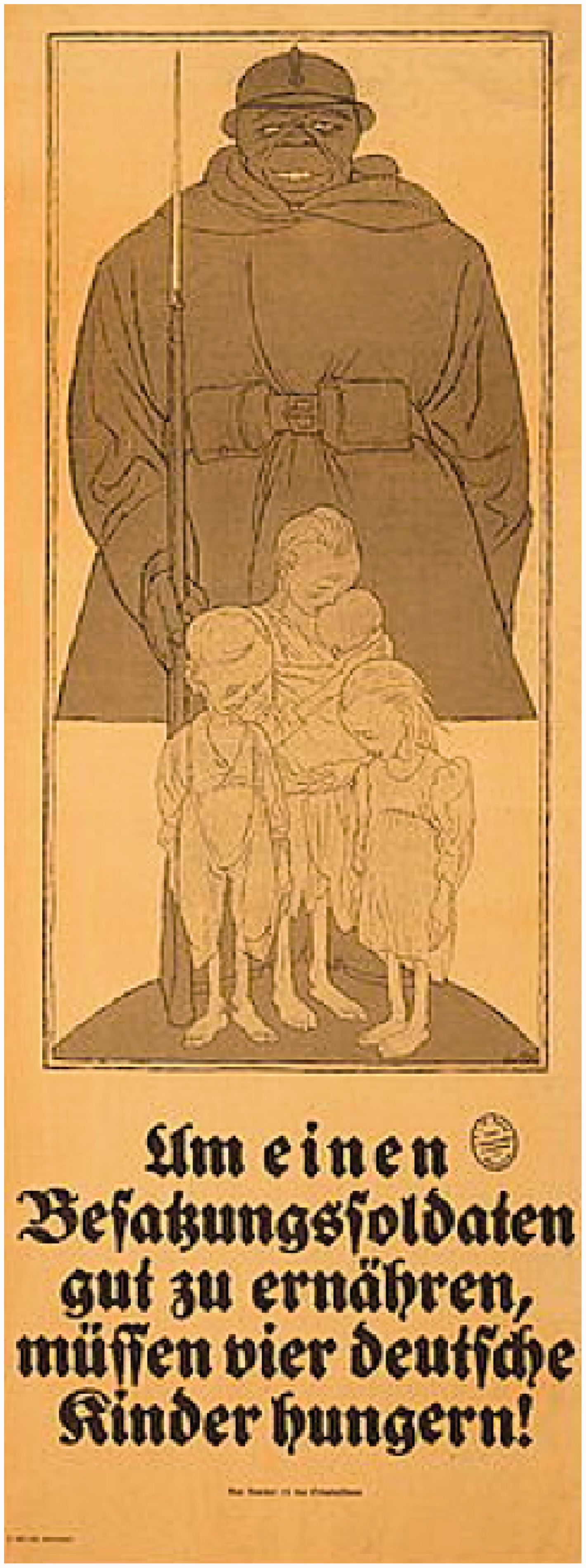
26
This tendency to exaggerate German suffering is already noticeable during the armistice. The German figure of 763,000 deaths due to the blockade is generally believed to be exaggerated. Several scholars suggest an excess mortality of about 424,000; a good overview in J. Winter, ‘Surviving the War: Life Expectation, Illness and Mortality Rates in Paris, London and Berlin, 1914–1919’ in J. Winter and J. Robert (eds), Capital Cities at War. Paris, London, Berlin 1914–1919 (Cambridge 1999), 487–523, 518. German presentation of suffering also neglected the influence of Germany’s flawed distribution and rationing policies during the war or the lack of effective taxation thereafter. Their reductionist analysis (often, it seems, deliberately) kept social peace by directing German frustrations abroad and enabled a favourable moral positioning after the war.
27
The term ‘hunger peace’ is used in Das Münchner Kind nach dem Kriege (Munich 1921), 60.
28
The suffering child had been an iconic motif in humanitarian campaigns ever since the late 1800s, but the war amplified Progressive era concerns for children's physical and mental health. As the most innocent and helpless of all the war's victims, humanitarian publicity began to build strongly on an ‘iconography of childhood to evoke international support. See especially the recent essay by H. Fehrenbach, ‘Children and Other Civilians. Photography and the Politics of Humanitarian Image-Making’, in H. Fehrenbach and D. Rodogno (eds), Humanitarian Photography, 165–99.
29
Such concern for German children was especially noticeable in Sweden, Switzerland, Spain, Holland, Latin America (where many ethnic Germans lived) and especially Great Britain, where liberal reformers founded the Fight the Famine Council/Save the Children after the armistice and campaigned for an end of the blockade. The German Foreign Ministry was very aware of these international developments and prioritized such humanitarian groups in their distribution of publicity materials. On the early work of Save the Children and its strong campaign for a universal responsibility towards them see for example C. Mulley, The Woman Who Saved the Children. A Biography of Eglantyne Jebb (London 2009), 227–330.
30
The German mission in Stockholm, for example, reported that depictions of malnourished children had set off ‘a storm of indignation’ against the Allies; German Legation Stockholm to Auswärtiges Amt (German Foreign Ministry, hereafter: AA), 18 Jul 1919, BArch, R 901/71620.
31
A report in the Foreign Ministry files of July 1919 reflected these limited options stating that ‘the crime of the hunger blockade and its consequences belong to the few effective propaganda means remaining to us, with which we can hope to influence public opinion among friend and foe.’ Draft, Jul 3 1919, BArch, R901/72199, 137–38.
32
On instructions of what US visitors were to see: draft, c. February 1921, PA, R122282; Stegerwald's booklet, for example, was distributed by the Foreign Ministry around the world (circular to all German Missions Abroad, 8 Dec 1920, PA, R65269) as was E. Lilienthal's. Wie wir verhungern. Deutsches Familienelend unter dem Versailler Vertrag. (How we are Starving. German Family Distress under the Versailles Treaty) which the Foreign Ministry deemed particularly suitable to serve as ‘propaganda for the rank and file’ of German-Americans (PA, R65241).
33
This group included such prominent German social reformers as A. Salomon, F. Sigmund-Schultze, theologians like A. Deissmann, doctors like M. Rubner or A. Czerny and, of course, the German Red Cross and German charitable organizations. In October 1919 all of these groups were organized into a German Central Office for Foreign Aid (Deutscher Zentralausschuss für die Auslandshilfe), which assumed a key position in the distribution of foreign aid and fundraising among international audiences. For the profound German concern about child health by a sympathetic observer see K. Kollwitz, Die Tagebücher 1908–1943 (ed.) J. Bohnke-Kollwitz (Munich 2012), 435, 453, 462, 545, 563.
34
‘Germany's Food Conditions’, Literary Digest (21 June 1919), 19–20.
35
Two recent explorations of this matter are M. Blum, ‘War, Food Rationing, and Socioeconomic Inequality in Germany during the First World War’, Economic History Review, 66, 4 (2013), 1063–83 and E. Cox, ‘Hunger games: or how the Allied Blockade in the First World War deprived German children of nutrition, and Allied food aid subsequently saved them.’ Economic History Review, 68, 2 (2015), 600–31. On the blockade’s effect on the German home front, A. Roerkohl, Hungerblockade und Heimatfront. Die kommunale Lebensmittelversorgung in Westfalen während des Ersten Weltkrieges (Stuttgart 1991) and on the disastrous conditions in German psychiatric institutions during the war, H. Faulstich, Hungersterben in der Psychiatrie, 1914–1949 (Freiburg 1998).
36
Cox holds that it was primarily foreign aid that led to a noticeable recovery of German children by 1921. See E. Cox, ‘Hunger games’, 628.
37
This, for example, was the intention of social reformer Adele Schreiber, who was appointed to head the German Red Cross department ‘mother and child’, one of the key offices to transmit depictions of the German plight abroad; for Schreiber's idea of her work see A. Schreiber, ‘Abteilung “Mutter und Kind”’ (1 January 1920) German Red Cross Archives Berlin, RK 210; for her international activities see A. Braune, ‘Konsequent den unbequemen Weg gegangen. Adele Schreiber. Politikerin, Frauenrechtlerin, Journalistin (1872–1957)’, unpublished PhD thesis, Freie Universität Berlin (2003), 324–36; for the very similar ideas held by Alice Salomon see A. Schüler, Frauenbewegung und Soziale Reform. Jane Addams und Alice Salomon im transatlantischen Dialog (Stuttgart 2004), 313.
38
Foreign Minister Simons to Harry Graf Kessler, 13 November, 1920, PA, R28574, 20.
39
For early reactions see ‘Dr. Solf’s Food Appeals. Vigorous American Criticism’, Morning Post (20 November 1918) and ‘Shall we go without to feed Germany?’, Literary Digest (30 Nov 1918). In allocating funds for European relief, the US Congress was careful to exclude Germany and when Herbert Hoover announced to sell provisions to Germany in late March of 1919 the ensuing public outrage forced him to defend his undertaking; see ‘Hoover Tells Why We Feed German People’, Chicago Daily Tribune (23 March 1919); Jane Addams made a similar experience as late as August 1919, when her call to support German children resulted in an ‘outbreak of abusive letters’ see A. Schueler, Frauenbewegung und Soziale Reform, 153. Jay Norwood Darling, ‘He’ll have to take his place in the line’, New York Tribune, 1918, reprinted from The Literary Digest (30 November 1918), 8 – illustrates American perceptions of most European countries, besides Germany, as deserving war victims. The illustration expresses this widespread sentiment in gendered terms. All the countries – with the exception of the United States of America and Germany – are portrayed as women and children, that is, innocent and dependent. While Uncle Sam is taking the role of male provider, Germany alone – depicted as an overweight man – appears an undeserving imposter out to deceive the USA and cheat the huddled, effeminate masses of postwar Europe.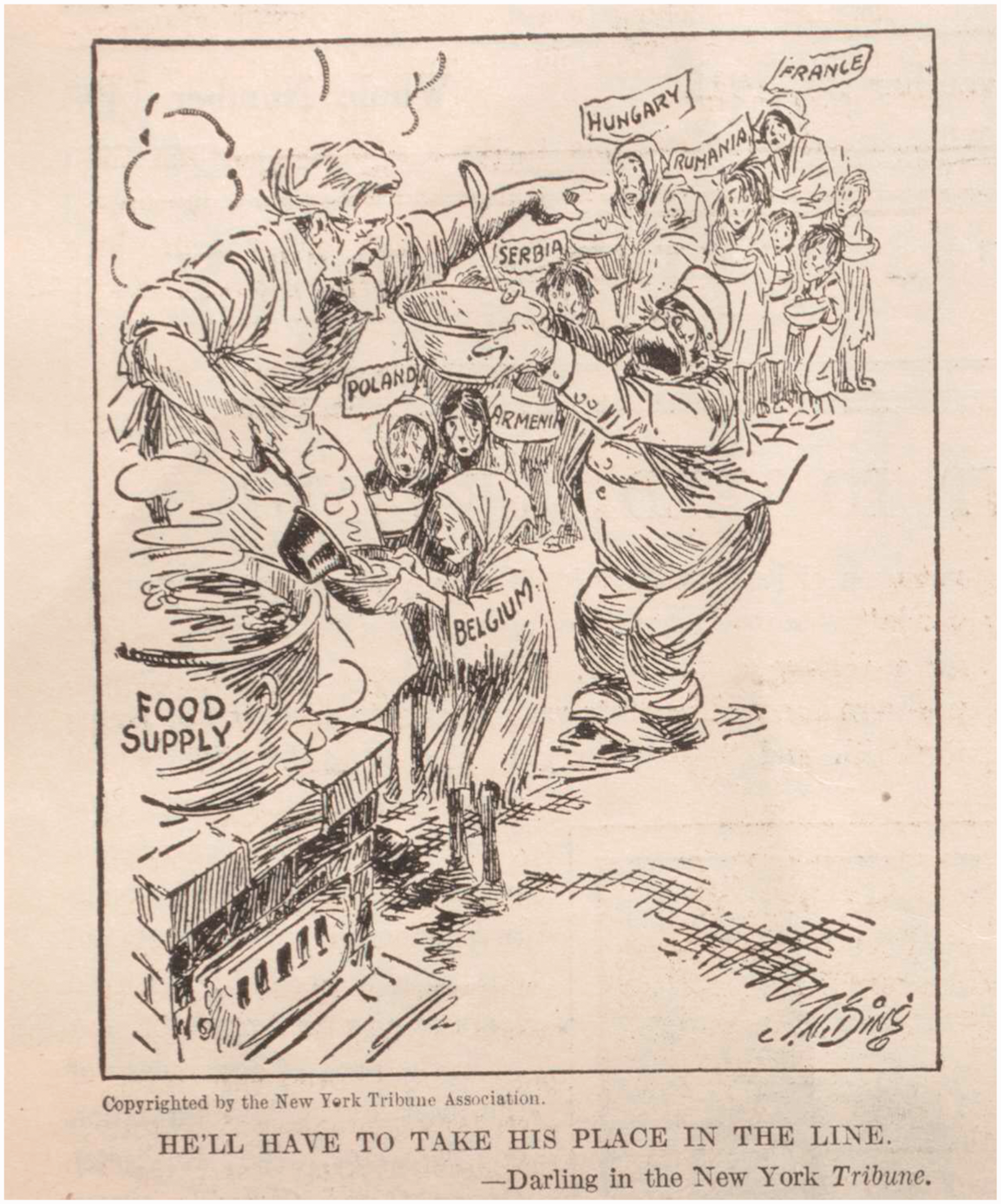
40
On the landscape of postwar US opinions on Germany see Schoenthal, American Attitudes Toward Germany, 23–65.
41
For example, L. Rippley, ‘Ameliorated Americanization. The Effect of World War I on German-Americans in the 1920s’, in F. Trommler and J. McVeigh (eds), America and the Germans: An Assessment of a Three-Hundred-Year History, Vol. II, (Philadelphia, PA 1985), 217–31; for the German Foreign Ministry’s observations on US nativism see for example: Aufz zu VI A.V. 877; 3 Nov 1920 PA R 80287.
42
L. Rippley, ‘Gift Cows for Germany’, North Dakota History, 40, 3 (1973), 4–15; on German-Americans see also C. Strickland, ‘American Aid to Germany, 1919-1921’, The Wisconsin Magazine of History, 45, 4 (1962), 256–70; For a late 1930s overview of the importance of relief work for the reconstitution of German-American ethnic life by someone heavily involved in this work see M. Heinrici, ‘Die Ereignisreichen zwanzig Jahre 1915–1935’ [The Eventful Twenty Years, 1915–35], Horner Memorial Library, German Society of Pennsylvania, Ms. Coll. 46, Box 2.
43
For a contemporary description of the scope of the US child-feeding work see C. Henriques, Das amerikanisch-deutsche Kinderhilfswerk (Berlin 1923); also, H. Stöhr, So half Amerika. (Stettin 1936) and C. Strickland, American Aid for the Relief of Germany 1919–1921; for a concise recent overview of the US child-feeding work in Germany see Cox, ‘Hunger Games’, 622–9.
44
‘Germany’s Need, An Appeal’, American Friends Service Committee Bulletin, 22 (1919); I take this phrase from Cabanes, 273.
45
‘There is a wonderful opening for us here’ one Quaker relief worker summed up her enthusiasm, ‘the philosophy of force has crumpled in our hands.’ Carolena Wood cited in R. Jones, A Service of Love in Wartime (New York, NY 1920), 260.
46
For a list of Hoover’s public arguments in favour of food aid to Germany see ‘Hoover Tells Why We Feed German People’ Chicago Daily Tribune (23 March 1919); on Hoover's counterrevolutionary agenda see Costigliola, Awkward Dominion, 39; Given progressive notions of the interrelation of child health, education and peace Hoover also believed that a German child-feeding program could help pacify a future German generation, which might otherwise ‘grow up to be a menace to… all mankind.’ H. Hoover, An American Epic, Vol II (Chicago, IL 1960), 377.
47
‘Präsident Harding an die naturalisierten Bürger’ Volk und Heimat, 2, 21 (November 1921), 204; only in some rare instances, such as the shipment of a herd of milk cows to Germany, was there substantial nativist opposition to German-American relief work. On these instances see L.V. Rippley, ‘Gift Cows’, 12.
48
Consulate Chicago to AA, 21 March 1922, PA, R121325 The generally cautious line adopted by Weimar governments is reflected in Memorandum, 3 Nov 1920, PA, R 80287 and AA to Office of Reich President, 10 June 1921, PA, R 80293.
49
Statements about the special sentimentality of Americans abound. As the wartime German ambassador to Washington explained to the readers of his wartime memoirs in mid-1919: ‘the outstanding characteristic of the average American is rather a great… sentimentality. There is no news for which a way cannot be guaranteed through the whole country, if clothed in a sentimental form.’ trans. in J.H. Bernstorff, My Three Years in America (New York, NY 1920), 45–6.
50
German Legation, the Hague to AA, 6 Mar 1920, BArch, R901/80966, the topic was an incipient Dutch relief campaign, but the logic applied also to the US case. In the spring of 1920 several ministerial meetings highlighted the distinct political usefulness of the Quaker relief work. As one high-ranking official summed up, the Quakers ‘were able to study the German situation first-hand’ and did not paint ‘too rosy’ a picture of German conditions. The German ‘political leadership’ therefore deemed the US relief program of ‘extraordinary’ political significance because Quaker accounts of the German situation constituted ‘much better and much cheaper propaganda than we could ever undertake ourselves’. Minutes of Interministerial Meeting, 6 May 1920, BArch R43-I/1268, 4–9. A few months later State Secretary Albert again referred to the aid program as of ‘very great’ value for ‘popular nutrition and propaganda purposes’. Albert to Reich Ministry of Finance, 25 October 1920, BArch, R43-I/1268, 169–70.
51
This was clearly the case by the spring of 1921. That both the AFSC and German-Americans continued their relief work beyond that point (the AFSC to mid-1922) owed to their distinct priorities, not an objective assessment of German conditions. This was clearly recognized by the ARA-related nutrition expert Alonzo E. Taylor, who accused the AFSC of turning an emergency humanitarian project into a reconciliation project. He believed that Germany was in no more need than a country like Holland and that she could have easily fed her own children. Alonzo E. Taylor to Alfred Scattergood, 9 March 1921, Hoover Institution Archives, American Relief Administration. European Operations Records, (hereafter: ARA/EOR) Box 636/2.
52
W. Keylor, ‘How they advertised France. The French propaganda campaign in the United States during the break up of the Franco-American Entente, 1918–1923’, Diplomatic History, 17, 3 (1993), 351–73; R. Young, Marketing Marianne. French Propaganda in America, 1900–1940 (New Brunswick, NJ 2004).
53
Z. Steiner, The Lights That Failed. European International History (New York, NY 2007), 183.
54
DZA, Auslandshilfe in den Notjahren 1922 und 1923 (Berlin 1924), 6.
55
A. Schreiber, ‘Wiederaufbauarbeit an Kindern’, Blätter des Deutschen Roten Kreuzes (January 1922), copies in Horner Memorial Library, Ms Coll. 38 Hilfsfond Records, Box 9, Folder 80.
56
G.S. Viereck. ‘America’s Moral Duty’, The American Monthly (May 1920); ‘Die Herzen Auf!’ Das Hilfswerk, 1, 2 (March 1921); Such charges were repeated whenever a new delivery of coal or cows’ milk to France was due. See for example the letter of women members of the Reichstag to Union Française pour le Suffrage des Femmes, 17 December 1920, copy in Archives of the German Red Cross, Berlin, RK 210.
57
For Beveridge’s agitation on behalf of German children, especially among German-Americans, see R. Beverdige, ‘I beg for my dear Germans’, Chicago Abendpost (20 November 1919); that the image was circulated as a postcard is mentioned in S. Marks, ‘The Black Watch on the Rhine: A Study in Propaganda, Prejudice and Prurience’, European Studies Review, 13, 3 (1983), 297–334, 312. (c. 1920), reprinted in: R. Beveridge, Mein Leben für Euch! Erinnerungen an Glanzvolle und Bewegte Jahre (Berlin 1937), 257.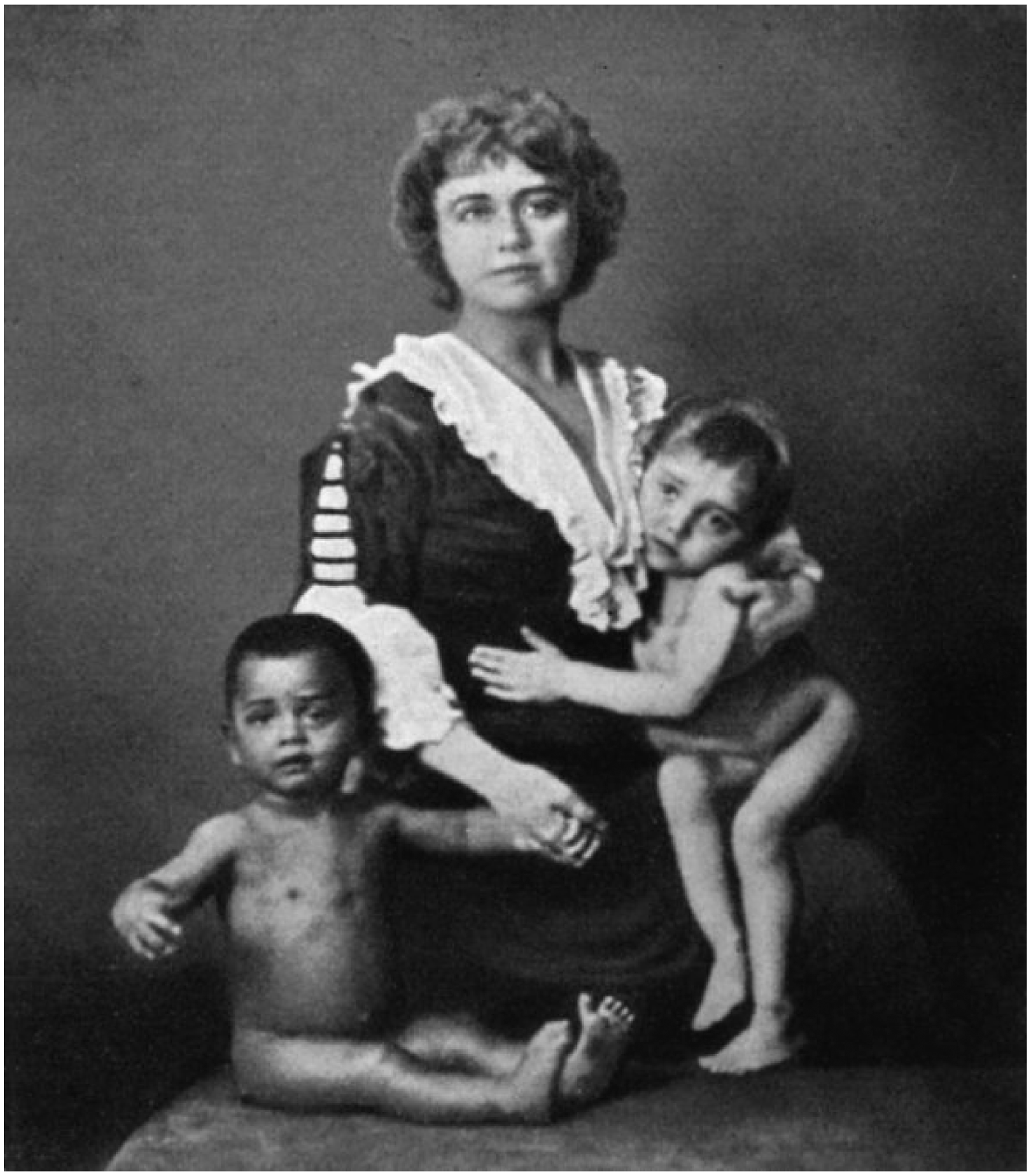
58
‘French View of German Poverty’, Literary Digest (30 April 1921), 16. Henri Zislin, ‘Mme Germania s’habille pour causer aux alliés’ (1921) © Musée Historique de Mulhouse; reprinted from ‘French View of German Poverty’, Literary Digest (30 Apr 1921), 16; The image illustrates the central French argument that German poverty was but a strategic act to win sympathies and evade its just responsibilities. Behind this act of misery, it implies, stood Germany’s unrepentant Junkers up to their old game of deception.
59
See Annual Report of the American Committee for Devastated France, Inc. Year ending, March 31, 1921, 37 and the Annual Report for the year ending March 31, 1922, 31; on official German attitudes towards Anne Morgan see German Consulate General New York to AA, 12 April 1923, PA, R80295 in the context of the Ruhr crisis Morgan’s agitation appeared so dangerous that German officials contemplated initiating a smear campaign against her, see Embassy Washington to AA, 28 July 1923, PA, Botschaft Paris, 500 a.
60
R. Young, Marketing Marianne, xviii.
61
Both the Quakers and their German-American supporters aimed not only to raise funds, which Hoover had already promised, but, as James Speyer wrote, ‘what we want of him, is that he comes out publicly for the German children and that he depicts their plight’. A copy of Speyer's letter in Minister of Finance to AA, Jan 1921, PA R 121325, on the Hoover drive see Strickland, American Aid, 61–106. Examples of AFSC publicity include, ‘Inside Germany’, New York Times (12 December 1920), XX8; ‘Millions fed by Quakers’, Los Angeles Times (27 May 1922), ‘Advertisement: Quaker Appeal for German Children’, Los Angeles Times (26 March 1920) II 5; ‘Facing Impossible Future’, Boston Daily Globe (18 April 1920), E 16; ‘“Americanized Germany” Through Quaker Eyes’, New York Times (17 October 1920), BRM22; ‘Germany Starving, Observers Assert’, New York Times (7 December 1920), 15.
62
On US relief work as a step towards normalization, see Schoenthal, American Attitudes, 84–90.
63
Hoover himself held that the inclusion of German children had slowed US charity. See Herbert Hoover to Unknown, 6 January 1921, Hoover Institution Archives, ARA/EOR Box 739/9; some of the bitter letters opposed to feeding the ‘enemy's children’ or doubtful as to German need in Hoover Institution Archives, ARA/EOR, Box 739/9 and 13.
64
See Keylor, ‘How they advertised France’, 371; also M. McGuire ‘“A highly successful experiment in international partnership?” The limited resonance of the American Committee for Devastated France’, First World War Studies, 5, 1 (2014), 101–15, 110; McGuire holds that because American relief work for France in the early 1920s contradicted the politically deteriorating Franco–US relations it failed to create lasting bonds between France and the United States of America.
65
The advocacy of such groups as Save the Children led to formulation of universal children’s rights in 1922 and their adoption by the League of Nations in September of 1924. D. Marshall, ‘The construction of children as an object of international relations: The Declaration of Children’s and the Child Welfare Committee of League of Nations, 1900–1924’, The International Journal of Children's Rights, 7 (1999), 103–47; also Cabanes, The Great War, 289–95; The humanitarian arguments employed in the Hoover-Drive not only failed to reinforce German claims about its distinct suffering under an unjust treaty, but turned them upside down: German children deserved American compassion and support not because they were German, but despite it.
66
As one German diplomat reported in March 1922, Americans still showed no inclination to get involved in the European quagmire, remained convinced of Germany’s sole responsibility for the war, and regarded ‘our sorry state’ as deserved punishment. German Embassy Washington to AA, 31 March 1922, National Archives and Records Administration (NARA), T-120, Reel 1489, K 618577 – 78.
67
Report Gramm, BArch, R32/158, 159–68; on the problems marring German-American leadership see F. Luebke, ‘German-American Leadership Strategies Between the World Wars’, in Germans in the New Worlds: Essays in the History of Immigration (Urbana and Chicago, IL 1990), 51–78.
68
See the German note of 20 April 1921, which asked the US President to mediate a reparations agreement and set a total amount to which Germany declared ‘ready and willing to agree without qualification or reservation’ The Commissioner at Berlin to the Secretary of State, Foreign Relations of the United States (FRUS) 1921 (2), 41.
69
In fact, no matter how strongly German groups had so far advertised the German plight, they had always maintained that foreign aid was ‘in no way ever asked or begged for’. Minutes of the Annual Meeting of the DZA, 15 April 1921, BArch, R3901/9107; Official responses to begging abroad abound; an introduction to these issues in the key circular in AA to Reich Ministry of Labour, 9 December 1920, BArch, R3901/9059 and AA to various missions abroad, 15 March 1921, BArch, R3901/9060; to avert such detrimental developments there was put in place an ever more restrictive licensing system by which only the most worthy national causes – which could be trusted not to violate standards of dignity – were allowed to raise funds abroad. Still, the wide-ranging measures adopted to control and disable individual collections proved largely ineffective, making ‘begging’ a constant concern.
70
See foreign minister Walther Rathenau's speech in the Reichstag in March 1922: ‘The downfall of Germany is the downfall of Europe. Germany does not demand pity from anyone in the world, but Germany demands the insight of nations into the unity and entanglement of world interests.’ Walther Rathenau in Reichstag Proceedings, 29 March 1922, Vol. 354, 6656 D; On Otto Wiedfeldt, Krupp Director and German Ambassador to Washington, 1922–5, see E. Schröder, Otto Wiedfeldt als Politiker und Botschafter der Weimarer Republik. (Essen 1971) 159–238; One example of the more direct lines of communication and interaction after the separate peace treaty was the German-American Mixed Claims Commission appointed in 1922, which was to settle claims arising from the war, see B. Jähnicke. Washington und Berlin zwischen den Kriegen. Die Mixed Claims Commission in den transatlantischen Beziehungen (Baden-Baden 2003).
71
On the mobilization of German-Americans see Embassy Washington to Consulate General, New York, 25 January 1923, PA, Botschaft Washington, 1407; for new publicity and the prevalent arguments see, for example, the special issue of the Süddeutsche Monatshefte devoted entirely to the topic of German distress and the peace treaty: ‘Ein krankes Volk’, Süddeutsche Monatshefte (May 1923); the brochure published by the mayor of Berlin: Böß, Die Not in Berlin. Tatsachen und Zahlen (Berlin 1923) or the interview given to the international press by an expert in the Prussian Ministry of Welfare on the eve of the Ruhr occupation, Obermedizinalrat Dr. Krohne ‘Die gesundheitliche Not des deutschen Volkes’ 4 January 1923, Hoover Institution Archives, ARA/EOR Box 595/9.
72
Aufzeichnung (Note) 15 January 1923, PA, R 75333.
73
Cuno to Head of United Press Department of the German Government, 23 February 1923, PA, R 75333; As the German ambassador explained in his seminal report of 7 January written in anticipation of the French advance into the Ruhr, all social and economic disturbances that developed during the occupation would have to be immediately advertised and France presented as an aggressive and militaristic power which sought not reparations but the territorial dismemberment and long-term economic prostration of Germany. Such propaganda, he hoped, would help isolate France, place pressure on its currency, force it back into negotiations and finally settle the reparations question. Embassy Washington to AA, 7 January 1923 in ADAP, Serie A, Vol. 7, Nr. 14, 29–42, 41.
74
German Embassy Washington to AA, 18 October 1922, PA, R80134.
75
Throughout the first half of 1923 and even thereafter, Ambassador Wiedfeldt would have preferred a ‘commercial solution’ (a food loan) to alleviate anticipated German food shortages and he pursued other propaganda ventures with considerably more vigour. Apprehensions about German dignity were compounded by the concern that a too aggressive focus on child distress might only underline the weakness of German passive resistance and play into the hands of French propagandists, who aimed to show this policy’s detrimental effect on the German civilian population. In effect, the question was whether an international audience would come to attribute German distress to French or to German actions. This was clearly understood by Lincoln Hutchinson of the American Relief Administration, who visited the Ruhr area in July 1923. For his illuminating report see Lincoln Hutchinson, ‘Sketch Outline of Observations in the Ruhr District’, July 1923, Hoover Institution Archives, ARA/EOR, Box 595/16.
76
By late July, despair had befallen those closest to the US situation. In his disillusioned report on the state of US public opinion, ambassador Wiedfeldt freely admitted the almost complete failure of German opinion-shaping attempts, see German Embassy to AA, 20 July 1923, ADAP, Serie A, Vol.7, Nr. 76, 183–96. Shortly thereafter Counselor of Embassy Hans-Heinrich Dieckhoff revealed the prevalent mood to a friend in the Wilhelmstrasse: ‘The superficiality, complacency and ignorance towards Europe, which characterizes especially Washington… was [before the war] perhaps already as bad as today; just one hardly experienced these things as so aggravating, because back then one did not need the interest of the Americans. Today this has changed completely. Our entire assignment lies exactly in interesting the decisive elements in this country in Europe and this is an almost hopeless endeavour. We can but report back to Germany again and again: Please, expect nothing from America’, see Dieckhoff to v. Bülow, 1 August 1923 in ADAP, A, 8, Nr. 94, 243–44.
77
AA to Embassy Washington, 14 August 1923, PA, R 28344k; on the cabinet meeting on 15 August 1923 see K.D. Erdmann and M. Vogt (eds), Akten der Reichskanzlei. Die Kabinette Stresemann I/II. (Boppard am Rhein 1978).
78
As the German ambassador’s report on the meeting shows, the Quakers strongly distrusted German official intentions, but could hardly refuse after years of German relief work. See German Embassy Washington to AA, 17 Aug 1923, BArch R43-I/1270, 211 – 213; The papers of Quaker aid workers reveal how strongly they had come to identify with the German situation, especially in the light of the non-violent German response to the French occupation. In their private correspondence Quaker relief workers hailed passive resistance as ‘wonderful’, ‘marvellous’, ‘fantastic’ and ‘a great experiment in the world’s history… that all anti-militarists everywhere should pray may succeed’. See J. Henry Scattergood to American Friends Service Committee, 30 March 30 1923, Archives of the American Friends Service Committee, Philadelphia, Box: General files 1923 Foreign Service (Country: Germany to Country: Russia); folder: AFSC Foreign Service Germany (General).
79
Responses of less emotionally invested humanitarian organizations, such as the American Red Cross, were far more negative. See ‘The German Situation’ (c. December 1923), NARA, RG 200, Box 875, Folder 951; the Red Cross based its negative response on the lack of sufficient funds, the absence of a widely favourable US sentiment and predictable international complications.
80
Allen Diary, 14 Nov 1923, Library of Congress (LoC), Allen Papers, Box 4, most of the publicity material came directly from German sources and was then prepared for the US market by a US publicity company. In order to facilitate the flow of publicity materials the head of the German Central Committee for Foreign Aid, Dr. Rau, spent half a year in the United States of America attached to the Allen-Drive. For one of the most illuminating meetings on the Berlin-based propaganda campaign see minutes of inter-ministerial meeting, 29 October 1923, BArch, R3901/9110. German Red Cross, Want. Pictures of German Misery (Berlin 1924); This English-language pamphlet was subsidized by the German Foreign Ministry to provide arguments, images and statistics for the Allen-Drive in 1924. The cover art stems from German artist Käthe Kollwitz, who had already provided the Foreign Ministry’s propaganda division with images of the German plight on earlier occasions.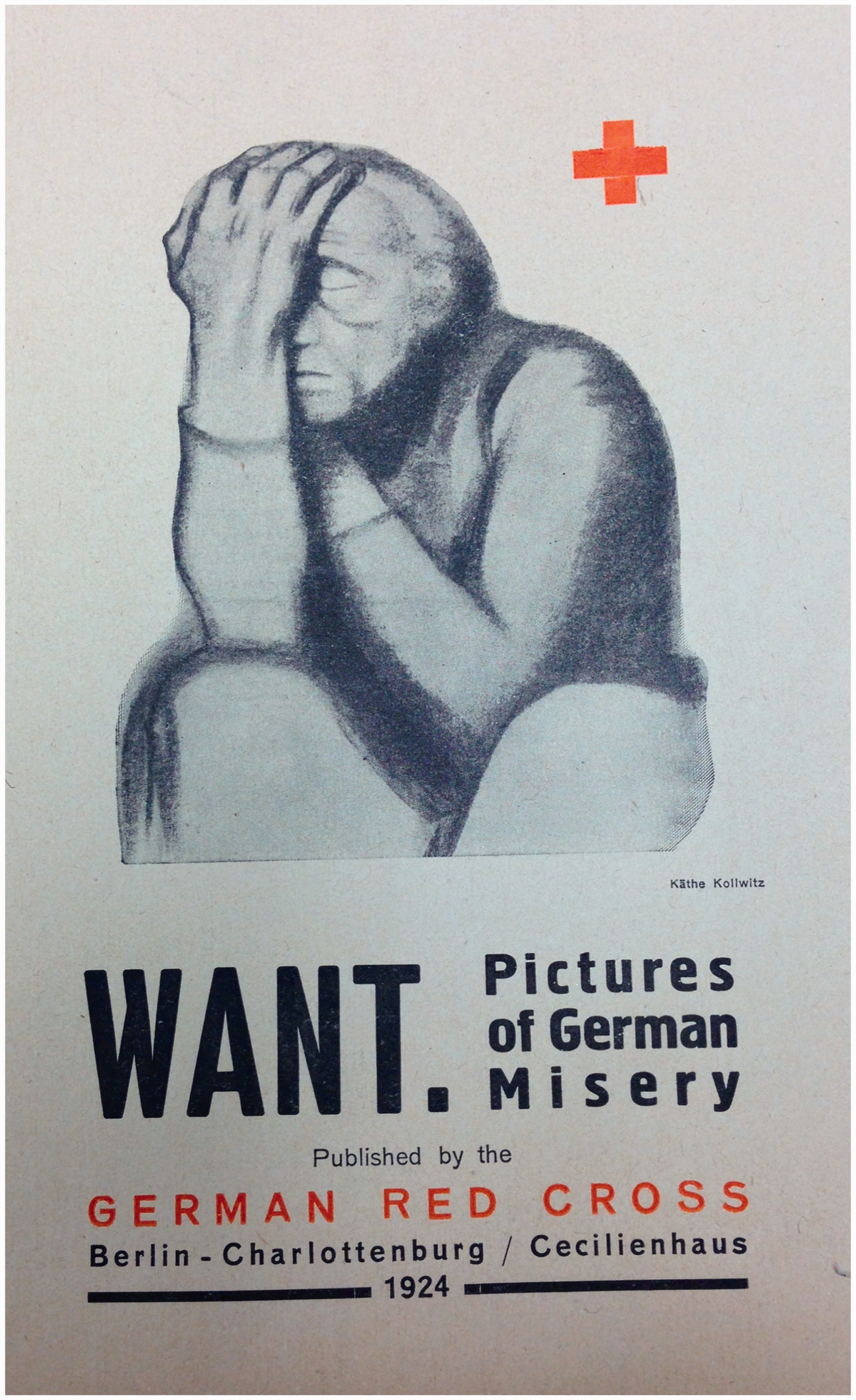
81
J.M. Forbes & Co to Henry T. Allen, 17 October 1923; (unknown) to Allen, 21 November 1923; (unknown) to Allen, 24 October 1923; William Butler to Allen, 22 November 1923; Henry J. Allen to Allen, 3 January 1924, all in LoC, Henry T. Allen Papers, Box 29.
82
Berg, Gustav Stresemann, 134; Link, Amerikanische Stabilisierungspolitik, 183; W. Link, ‘Die Vereinigten Staaten und der Ruhrkonflikt’ in K. Schwabe (ed.), Die Ruhrkrise 1923.Wendepunkt der internationalen Beziehungen nach dem 1. Weltkrieg, 39–51.
83
Link, Amerikanische Stabilisierungspolitik, 203–10.
84
The official endorsement of an Irish relief campaign in 1920, for example, had already led to bitter British complaints and the German cause was considerably less popular with Americans than that of the Irish; Carroll, ‘The American Committee for Relief in Ireland’, 41.
85
Allen Diary, 11 Oct 1923, LoC, Allen Papers, Box 4.
86
Charles G. Dawes, for example, who took the chair of the Chicago committee, was widely known as a Francophile. Such larger motivations behind the campaign are also suggested by Owen D. Young's biographers, who note that ‘on this occasion humane and economic considerations clearly pointed the same way’. J. Case and E. Case, Owen D. Young and American Enterprise (Boston, MA 1982), 273; US opinions towards the Ruhr crisis changed after the end of passive resistance in September. Long split with regard to the Ruhr crisis, they grew increasingly worried about German and European stability. On US opinions during the Ruhr crisis see R. Lang, ‘Die Meinung in den USA über Deutschland im Jahr des Ruhrkampfes und des Hitlerputsches’, Saeculum, 17 (1966), 402–16; K. Schoenthal, American Attitudes, 137–45.
87
Allen to Charles E. Hughes, 18 August 1923, LoC, Allen Papers, Box 23.
88
The influential Federal Council of Churches, for example, announced that US charity to Germany was an immediate imperative but that large-scale economic restoration could be adequately undertaken only by governments. Therefore, it stated, ‘we desire to reinforce in every possible way any plans which the Government of the United States may indorse looking toward a vital solution’. Statement of Rev. Samuel McCrea Cavert, General Secretary, Federal Council of the Churches of Christ in America, Congressional Hearings H.J.Res 180, 129; also ‘Churches Appeals for Suffering Germany’, Bulletin of the Federal Council of Churches (Jan/Feb 1924), 7.
89
Prussian Minister of People's Welfare to various ministries, 20 October 1923, PA, R118050; Minutes Inter-Ministerial Conference, 3 November 1923, BArch, R43-I/1263, 272.
90
Reich Ministry of Interior to various ministries, 22 October 1923, BArch, R3901/9110.
91
German Foreign Minister to all Ministries, 4 December 1923, BArch R3901/9110; a longer and particularly illuminating version: AA to German Missions Abroad, 30 November 1923, PA, R118058.
92
Allen Diary, 23 November 1923, LoC, Allen Papers, Box 4.
93
Allen Diary, 8 October 1923, LoC, Allen Papers, Box 4.
94
Lasting from December 1923 through to May 1924, the Allen-Drive raised not only a very significant 3.66 million dollars for German children but was the largest publicity campaign on German conditions in the 1920s. Entrusted to a New York-based public relations firm, it drew on the full advertising repertoire developed in the previous decade of the USA’s humanitarian crusade. Billboards, articles, bazaars, beauty pageants, boxing matches, dinners, a poster campaign in the New York metro and extensive use of the new medium of radio, constitute but a fraction of the campaign’s publicity. It also won the endorsement of the Federal Council of Churches and even parts of the hitherto strongly anti-German American Legion.
95
‘Germany’s Feigned Tragedy’ (Letter to the Editor), New York Times (22 July 1923), xx8; C. Hart, ‘Mendicant Germany. A Subtle Propaganda’, London Daily Mail (early 1924) clipping in LoC, Allen Papers, Box 29. Even the publicity manager of the Allen-Drive, Cyrus P. Keen, began to discern the contours of a ‘diplomacy of pity’. Showered with attention by the German government, Keen still – or because of it – came to believe that German suffering was grossly exaggerated and used ‘as capital in Germany’s political cause’. See C. Keen, ‘Report of trip to Berlin; Report of Visit to Germany in the Interest of Publicity and Investigation’, American Friends Service Committee Archives, Philadelphia, General Files 1924 Foreign Service – American Com For the Relief of German Children.
96
German Embassy Washington to AA, 18 May 1924, BArch, R3901/9111; most damaging was the lavish spending of Germany’s rich in Berlin and across European luxury hotels. Articles on the millions of dollars’ worth of champagne Germans had consumed during Berlin’s luxurious New Year’s Eve parties, while the USA was raising funds for German children, set of a storm of indignation in Prohibition-era America. For one example of hundreds see, ‘Orgies in Berlin Check US Charity. New Year Display of Money Produces Painful Impression in America’, The Evening Star (2 January 1924).
97
T. Hattori, ‘Reconceptualizing Foreign Aid’, Review of International Political Economy, 8 (2001), 633–60; a brief discussion of the power imbalance between recipients and donors in Barnett, Empire of Humanity, 34–5.
98
German Embassy Washington to AA, 26 February 1924, PA, R 80297.
99
Transcript of telephone conversation between Richter and Berger, 5 January 1924, BArch, R3901/9110.
100
German Embassy Washington to AA, 23 August 1922, reprinted in Schröder, Otto Wiedfeldt, 127.
101
German Embassy Washington to AA, 26 February 1924, PA, R64708.
102
German Embassy Washington to AA, 8 July 1924 in Schröder, Otto Wiedfeldt, 176.
103
Berg, Gustav Stresemann und die Vereinigten Staaten, 142–58.