



Abstract
Research on the circulation of artworks between Europe and the Americas superficially examined the role played by Portugal-based individuals in the trade of looted art in the immediate postwar period. Since then, however, cultural studies have ignored the interactions between Portuguese museums and collectors, and refugees and expatriates involved in the trade, as well as the role played by Portugal in the transatlantic circulation of artworks. This article has two goals: first, to examine the lack of academic engagement in the study of the transactions and provenance of artworks in Portugal between 1933 and 1945; second, to ascertain the existence and demonstrate the utility of Portuguese sources in conducting this study, by focusing on what they reveal about art dealer Karl Buchholz. Through an outline of the main areas of research, this article discusses Portuguese academic practice and museum practice. It identifies and contextualizes biases and opens the door for academic attention to Nazi-era provenance research. Portuguese sources illustrating the activity of Karl Buchholz in Portugal between 1943–5 enable a reconstruction of the chronology of his exhibitions in Lisbon and a partial identification of the artworks exhibited.
RENAULTThe plane to Lisbon. You would like to be on it? RICKWhy? What's in Lisbon? RENAULTThe clipper to America. [Casablanca, 1942]
The itineraries of art objects that entered the country, the circumstances surrounding these movements, and the identities of those involved have also been ignored in the studies of Portugal during the Second World War. Intelligence accounts on the circulation of artworks between Europe and the Americas during the conflict superficially examined the actions of Portugal-based individuals in the trade of artworks looted or confiscated by the Third Reich. 5 Cultural studies on the Estado Novo, the New State, as the Portuguese dictatorship led by António de Oliveira Salazar is known, have rarely ventured beyond the activities and policies of the Secretariat for National Propaganda, and of its mentor, António Ferro. 6 An emerging area of study pertains to the cultural interactions between Portugal and the Third Reich. 7 Yet none of these studies has focused on the interactions involving Portuguese museums and collectors, and belligerent countries, refugees, and expatriates; or on the possible role played by Portugal as a hub for the transfer of artworks, and spoliated or confiscated artworks in particular, from Europe to the Americas.
In the aftermath of Monuments Men 8 and of the Gurlitt affair, the issue of Nazi art looting has received attention from the mainstream media and the blogosphere. 9 However, the revelation that Karl Buchholz, who in 1943 founded the Livraria Buchholz in Lisbon, was among the restricted number of German dealers allowed by the Third Reich to trade in ‘degenerate art’ was met with deafening silence by Portuguese historians and museum professionals.
Perhaps a reflection of this lack of academic interest in the subject, Portuguese museums have not conducted Nazi-era provenance research in their collections. This situation is surprising given that Portugal subscribed to the Washington Principles on Nazi-Confiscated Art. 10 In September 2014, the World Jewish Restitution Organisation stated that Portugal had not made ‘significant progress towards implementing the Washington Conference principles on Nazi-confiscated art’. 11
The inaction of the Portuguese government stands alone when compared to the actions of other neutral countries, and contrasts with the investigations by the Swedish and, more recently, the Swiss governments. 12 While timid, these signal an official engagement with Nazi-era provenance research. Within the Iberian context, Spanish academia has displayed moderate interest in the subject. 13 The online project El Museo Reimaginado sought to identify Spanish paintings looted throughout the war in Europe, examining the relationship between Spain and Nazi-art looted from a different framework. 14 Within the field of museum collections, at least two Spanish institutions, the Reina Sofia Museum and the Thyssen Bornemisza Collection, own Nazi-looted art acquired after the Second World War. 15
It could be argued that this lack of concern reflects the absence of anything of substance to research; that, just as the flow of refugees that passed through the country did not impact permanently upon Portuguese society, neither did the circulation of art works through the country affect the art trade in Lisbon. Granted, Portuguese institutions are not known, to this day, to have received a Nazi-looted art restitution claim. However, setting aside the fact that quantitative and qualitative research must be undertaken before such assertions can be confidently put forward, there are important reasons why the art trade in Portugal during the Second World War, and its interaction with the trade in artworks spoliated or confiscated by the Third Reich, are worthy areas of research, as can be seen below.
Artists, dealers, and collectors, some of whom chose to settle in Portugal, featured among the tens of thousands of refugees and foreign nationals that entered the country between 1940 and 1945. 16 Naoum Aronson, Lenora Carrington, Marc Chagall and Max Ernst, 17 Fernand Léger, Jacques Lipchitz, Arpad Szènes and his wife Maria Helena Vieira da Silva stayed in Portugal for short periods of time. Other artists, such as Gretchen Wohlwill and Max Braumann, settled and pursued their artistic career in the country. Among the art dealers, Paul Graupe, Leopold Blumka and Pierre Rosenberg chose to make their way across the ocean after a short stay in Lisbon. Jacques Kugel, Jean Ostins and Karl Buchholz opted to settle, and work, in Lisbon, as did other, less known, foreign art sellers who settled in Portugal from 1933 onwards – Adolph Weiss and Erich Popper. Finally, while collectors such as Peggy Guggenheim or Marianne de Goldschmidt Rothschild would leave Portugal shortly after their arrival, the oil magnate Calouste Sarkis Gulbenkian settled in Lisbon permanently.
There is also evidence that Portuguese ports played a role in transferring artworks between continents. In October 1940, British authorities in Bermuda seized a shipment of artworks intended for the United States market aboard the S.S. Excalibur. 18 The navicert for the c. five hundred Impressionist and post-Impressionist artworks had been obtained in Lisbon by Martin Fabiani. The executor of the will of art dealer Ambroise Vollard, who owned the seized artworks, Fabiani would be found guilty, after the war, of collaborating with the Einsatzstab Reichsleiter Rosenberg in Paris by recycling artworks from the looted collections of, among others, Paul Rosenberg. 19
These occurrences, which put Portugal on the path of international art transactions, coincided with an acquisitive drive on behalf of Portuguese public museums and palaces, as part of the cultural policy of the Estado Novo. Private collectors such as Ricardo Espírito Santo, António Anastácio Gonçalves and António Medeiros e Almeida were active during the period – the first two as early as 1933, while the latter began his purchases towards the end of the conflict. 20
The aims of this article are therefore twofold. The first goal is to examine the lack of engagement by the Portuguese academic and museum communities in studying the transaction and provenance of artworks between 1933 and 1945. The second goal is to ascertain the existence, and demonstrate the utility, of Portuguese sources in furthering the study of these transactions, by examining what they reveal about the activities of Karl Buchholz, who traded in so-called degenerate art, at times as an intermediary for the Third Reich. To achieve this, this article will initially focus on issues of location and access to Portuguese primary sources; historians’ and art historians’ biases; and on the ethical standards and dilemmas of museum professionals. It will then identify a number of existing sources that can inform on the activities of buyers and sellers of artworks in Portugal, and of Buchholz in particular. To conclude, it will establish the extent to which researching the art trade in the Portuguese territory during the Second World War informs transnational narratives of art dealer networks, and of the role played by neutral countries as ‘grey zones’ 21 in the establishment of these networks.
The difficulties in locating and accessing Portuguese primary sources in the decades following the Second World War should not be underestimated. In fact, the study of the role of Portugal during the Second World War has largely benefitted from the release and organization of source materials in the 1980s and the 1990s, following the democratic revolution of 25 April 1974. These include the public and private papers of Salazar, ministerial archives, which in the cultural area include the Ministry of Education and the Ministry of Finance, archives of the political police, with information pertaining to refugees and foreign residents, and the archives of the Secretariat for National Propaganda. The location and retrieval of primary sources present a challenge when researching object acquisitions, especially in public museum archives. This is due in part to the complex web of the different organisations that operated within the cultural and educational sectors of the bureaucracy of the regime, which resulted in the undocumented break-up of institutional archives within different locations. For example, it has so far been impossible to locate within the archives of the Ministry of Finance or of the national museums, the sales receipts that identify the sellers of artworks to these institutions. 22 Thus, in cases where the seller is not identified elsewhere, the identity of sellers to national museums remains unknown. The adoption of digital repositories failed in its intention to create flexible, interactive work tools, and instead resulted in monolithic databases, where searching for, and obtaining, reliable and comprehensive information is a slow, arduous process.
Given these circumstances, it is not surprising that studying the history of the Estado Novo as a monolithic period ranging over 40 years took precedence over specialist studies in the economic, social and cultural areas. 23 Specialised economic, social and cultural studies did contextualise the interactions between Portugal and belligerent states and those between the Portuguese and the refugees. They did not, however, quantitatively and qualitatively analyse the networks and cultural interactions between each group, much less any art transactions that may have occurred.
From the 1980s onwards, historians provided narratives of Portugal’s actions during the conflict, and deconstructed the discourses with which these narratives had taken place.
24
The scarcity of available primary sources explains the lack of visibility of issues that were to rise in popularity as academic topics, such as the refugee flow, the wolfram trade, or the ‘Nazi gold’. Each of these issues emerged as a research sub-theme, and underwent important academic paradigm shifts. Regarding the refugee issue, early publications presented the temporary hosting of thousands of refugees in the country under a positive light, with a narrative of open arms. Later works focused on the restrictive legislative framework regarding the admission of refugees into the country; or the plight of Jewish communities of Portuguese origin in Greece and in the Netherlands, whose demise is partly attributed to the unwillingness of the Portuguese government to bestow Portuguese nationality on them.
25
The wolfram trade, given the financial values involved, and its use in arms-making, has been the object of detailed academic attention within the study of commercial transactions between Portugal and the various belligerents.
26
Researchers have either emphasized the proximity of Portugal to the Axis when examining the length of the trading period, or its closeness to the Allies when examining the quantities exported to the British, and the beneficial financial conditions of this trade. Douglas Wheeler sees this active trade as an example of Portugal’s creative neutrality, with mysterious foundations, participat[ing] in a war without bullets … by proxy, as it were, in the case of the thousands of Portuguese who made their livings assisting belligerent nationals and their agents acquire or deny wolfram during a war effort.
27
However, it would be inaccurate to presume that Louçã’s assessment related to issues of restitution and reparations of Nazi-spoliated assets. Like many historians involved in the study of the Estado Novo, his research appears to be driven first and foremost by the need to determine whether the personal characteristics attributed to Salazar – which themselves vary in accordance with the observer – are borne out by the facts. His findings regarding Nazi-spoliated assets appear to matter insofar as they make ‘a mockery of another myth enveloping the figure of Salazar, a representation repeatedly emphasized in Portugal since the 1980s, and encouraged there by a flurry of historical revisionism: namely, Salazar the financial genius’. 31
Each of these research themes – the refugees, the wolfram trade, and the ‘Nazi gold’ – appear thus to have been studied not as an end in themselves, but as a means to evaluate the figure of Salazar, and the historiography regarding his tenure. Accordingly, the importance of researching so-called Nazi gold lies in confirming, or debunking, the myth of Salazar as a financial wizard. The value of citing the wolfram trade rests on the possibility of ascertaining Portugal’s, and Salazar’s, friendliness towards either the Allies, or the Axis. Investigating the refugee policy of Salazar, who had final say on visa requests, and proposing a narrative of ‘failed rescue potential’, 32 as opposed to a narrative of saved lives, allows for a stricter evaluation of the dictator’s policies. To put it more succinctly, the centrality of the figure of Salazar in researching the Estado Novo has influenced, and limited, academic research.
The conflation of Salazar, the man, and the Estado Novo, the system, also impacted research in cultural and art history, which have been dominated by the analysis of cultural policy as a tool for state propaganda and for the construction of narratives of national identity; and by the biographical discussion of artists and noteworthy individuals as acting either in active support of or in active resistance to the dictatorship. The actions of museums are mostly discussed as the setting for the cultural creations devised by the Secretariat. Sérgio Lira, who has paid detailed attention to the role played by museums during the New State, focuses on museums as hosts of festivals and large exhibitions within the context of state propaganda. 33 Hence, Portuguese modernists, and their collaborations with the Secretariat in national and international initiatives, are researched in parallel with the emergence of the neo-realist and surrealist movements who actively opposed the regime – and would, after the Second World War, oppose each other. However, while artistic movements were analysed within the framework of the regime, studies have not ventured beyond this binomium of ‘active support vs. active undermining’ of the regime, thereby replicating the regime’s own construction of artistic creation as either supporting ‘the creation of the necessary [national] mystique’ 34 or ‘clearly anti-national works or of manifestly biased struggle against the ethics of the regime’. 35
The prevailing assumption appears to be that, as Salazar appeared manifestly uninterested in culture, and the visual arts in particular, other than to support the work of the Secretariat for National Propaganda, the areas in the cultural sector towards which Salazar attached little personal importance were of equally uninteresting value. Hence, the actions of art museums and, by extension, their acquisitions policies, have yet to be studied in depth. 36 The art market and the State’s involvement in it, whether as regulator or as active purchaser, have not been examined quantitatively or qualitatively. Likewise, the actions of those mainly involved in the art trade – and not in artistic creation or collecting – have been excluded from research, which has progressed from a chronological outline of aesthetic movements, and individual artist studies, to a wider analysis of artistic circles and their articulation within, or in opposition to, the New State and its leader. Granted, the status of Salazar as the neurological centre of the regime, his commitment to micromanagement, and his mind-boggling productivity, cannot be underestimated. 37 Yet this does not imply that areas of State intervention in which Salazar was uninvolved, or cultural issues that did not exist in active opposition to the regime, are automatically irrelevant for an understanding of the cultural history of the period.
The approaches to issues discussed here, which involve an element of polarization between two extremes, and not enough grey areas, are endlessly mirrored in historical debates surrounding the regime. These can be explained in part by the circumstances in which Portuguese historians operate. Senior Portuguese academics have, for the most part, a personal history informing their relationship with the dictatorship. 38 Some were active opponents of the regime during the 1960s and 1970s and participated in the construction of the current democratic system, or espoused their beliefs. Others, whether due to their ties to the Estado Novo, as a reaction against the earlier generation, or because of their own set of beliefs, opted to focus on a strictly political account of the choices made by the dictator – giving rise, in the words of Ribeiro de Meneses, to ‘an engaged right-wing historiography that presents, in a seemingly professional, historical manner, an alternative portrayal of the dictatorship, its actions, and what most others regard as its crimes’. 39 This political tension between different schools informs the polarization according to which findings on the economic, social and cultural histories of the regime are presented. 40 Unlike academic researchers, Portuguese museums know that provenance research, including Nazi-era provenance research, is a specific ethical obligation in their professional practice. 41 Thus the disinterest of Portuguese museum professionals in engaging in the field is particularly surprising. The understanding of the meaning of the word provenance – proveniência, in Portuguese – is mostly interpreted as meaning the immediate previous owner and not ownership history and chain of custody. A new term, procedência, recently introduced by the Portuguese and Brazilian Portuguese translation of the ICOM Code of Ethics, may become resonant within the museum community in the future but has yet to make inroads into professional practice and debates. The difficult financial situation in which Portuguese museums, the large majority of which are taxpayer-funded, have always operated, can also account for the delay or avoidance of the implementation of research systems and priorities that Northern European and American museums may take for granted. In a sector still struggling with basic inventory needs, museum professionals might not consider Nazi-era provenance research to be a priority.
The history of Portuguese public museums and their collections also informs the provenance research priorities in the field. Indeed, at the origins of the major Portuguese public art museums lie the acquisitions of private collections, namely those held by the crown, and by the Catholic church and religious orders, whose property was confiscated by the Portuguese State on two occasions: in 1834, upon the conclusion of the Liberal Wars, and following the implementation of the Republic in 1910. Hence, given that a high percentage of artworks held by Portuguese public museums has either royal or church provenance, the reconstitution of these original holdings has been a greater priority. 42
Factors lying outside professional museum practice, in particular Portuguese colonial history, may also explain this silence around provenance research and restitution debates. The circulation of hybrid fine and decorative arts (for example Indo-Portuguese art) and ethnographic collections between the territories that comprise the former Portuguese empire, may have influenced the choice to avoid engaging in provenance research, deeming all acquisitions by the State as occurring in good faith. In fact, Portugal may be called upon to address the legitimate ownership of the artworks in its collections. As its former colonies enter periods of growth and, in some cases, become global economic players, they are developing the cultural infrastructures to affirm their national identity and legitimacy. It is therefore to be expected that within the near future, former African colonies of Angola, Mozambique, Cape Verde, Guinéa-Bissau and S. Tomé and Príncipe; East Timor; and the Indian regions of Goa, Dammam and Diu may come forward requesting the transfer of objects found in Portuguese collections, claiming cultural ownership and/or unethical or unlawful acquisition. If and when that happens, Portuguese museums, and their staff, will find themselves in the position of having to examine issues of legal vs. ethical ownership, as well as the prevailing narrative of Portuguese museums exhibiting the deeds of the Portuguese during the Great Discoveries, and their role in the politics of constructing and enforcing a particular type of national identity which has been unchallenged since the Estado Novo.
The unpreparedness and unease of Portuguese museum professionals to engage in these debates became evident in 2014, on the occasion of the exhibition Splendours of the Orient, at the National Art Museum (Museu Nacional de Arte Antiga), in Lisbon. 43 The exhibition featured, for the first time, Goan gold jewellery, which had been held in the vaults of the Banco Nacional Ultramarino (BNU) in Goa until a few weeks before the city became part of the Indian Union, in 1961, when it was shipped to Portugal by the bank manager. The exhibition and its catalogue traced a brief outline of the chain of custody of these objects, from the BNU to the Caixa Geral de Depósitos (CGD), a State-owned Portuguese bank, until their incorporation in the national collections. It did not, however, provide documental evidence to support the CGD’s assertions that only unclaimed and State-owned jewellery were included in the museum’s holdings, while the remaining jewellery had been returned to their rightful owners, via the Indian government, in 1991. The issue of provenance research, raised with the exhibition curator in a closed-access online forum, was met with assertions of the good faith and professionalism of the Portuguese government and civil service, and with the stated belief that provenance research was unnecessary given the legal manner in which the objects were acquired. 44
Historians’ bias, accessibility to sources, ideological presuppositions, and contemporary politics account for the lack of engagement by the Portuguese academic and museum world with Nazi-era provenance research. However, the resources do exist to begin tackling the issue, at least within the realm of collections currently held by public, and some private museums. These resources are not limited to national archives. They include museum archives, personal papers, photographic records and media accounts. When studied and cross-referenced they provide a tentative narrative of the main agents involved in the art trade in Portugal during the Second World War – state activity, collector activity, and art dealer activity.
Primary sources for public collections include MatrizNet, the online inventory for the collections of national museums, museum correspondence files, as well as the files of supervisory authorities. In the case of national art museums, these were the Direcção Geral do Ensino Superior e Belas Artes (General Directorate of Higher Education and Fine Arts, henceforth DGESBA) and its advisory panel, Junta Nacional de Educação. The information gathered from cross-referencing these documents allows us to conclude that, overall, the museums in Lisbon, Porto and Coimbra took to the letter the word national. 45 Their autonomy from the Secretariat for National Propaganda notwithstanding, 46 their acquisitions policy promoted Portuguese national identity values as defined by the Estado Novo, a process termed by José Carneiro of ‘cultural re-Portuguesation’. 47 Hence object acquisitions tended to fall along three main categories – medieval (Christian) art; arts of the Portuguese empire, namely Indo-Portuguese art and Chinese export porcelain; and contemporary Portuguese art, usually purchased from the artist.
On occasion, the National Museum of Contemporary Art interacted with refugee artists, purchasing single artworks from Max Braumann (View of Palmela, purchased in 1945), Moïse Kisling (Boy from Nazaré, purchased in 1941) and, after the war, Gretchen Wohlwill (Returning from the Shipyard, purchased in 1948). In 1947, Wohlwill would receive the last Francisco de Holanda Prize, created in 1940 by the Secretariat for National Propaganda to honour non-Portuguese painters residing in Portugal. In Figueira da Foz, a resort town that served as an area of mandatory residence for refugees, the Santos Rocha Municipal Museum, in the refugees mandatory residence in Figueira da Foz, received as gifts works created by refugee artists, namely Naoum Aronson 48 (Bust of Figueira notable Alberto Henrique Bastos, gifted by the sitter) and Ivan Sors (three watercolours gifted by the Friends of the Museum: Buarcos fisherman, Buarcos woman, Buarcos seawolf) as well as by Lisbon-based Arpad Szènes (print gifted by the author) and Wanda Ostrowska (Fragment of the Sintra Royal Palace, gifted by the Polish Committee in Lisbon ‘in remembrance of the hospitality given to the Poles by Figueira da Foz’). 49 It is interesting to note that each of these purchases and gifts were created while these artists were living in Portugal, and were not brought into the country.
As far as private collectors are concerned, only two collections possess primary sources capable of providing sustained information – those of Calouste Gulbenkian, an Armenian businessman who settled in Portugal in 1942, who continued to purchase within the international market throughout the conflict; 50 and those of António Anastácio Gonçalves, who purchased almost exclusively in Portugal. 51 The meticulous record-keeping by the latter has revealed that he did purchase from foreign art dealers based in Portugal, including Jacques Kugel and Jean Ostins, Red Flag Name listees.
Tracking dealer activity is more complex, since there are no extant Portugal-based dealer archives from which significant information can be drawn. However, museum correspondence files and the requests for import and export permits, a sub-set held within the DGESBA archives at the Ministry of Education, provide a reliable source of information on the origins and typologies of non-contemporary artworks that were being brought into the country during the period. 52 This information also contributes to a significant widening of the network of dealers whose activities during the Second World War require further study. The death certificates and asset inventories, held at the Contemporary Archives of the Ministry of Finance, are a source of biographical and business information regarding them. Hence, in addition to the names indicated in the Red Flag Name list, other personalities such as Adolph Weiss and Erich Popper emerge as active refugee art dealers. 53
One notable art dealer whose activities can be tracked through Portuguese sources is Karl Buchholz. His Berlin business, opened in 1934, exhibited and sold works by artists who were soon deemed degenerate, and whose output would after the war integrate the list of both purged and looted property. Buchholz integrated the small group of dealers authorized by the Nazi government to mediate the sale and disposal of modernist art, in Germany and abroad, in exchange for funds, or for other artworks acceptable to the regime, receiving a commission in return. 54 From 1940 onwards, he set out to establish a number of galleries throughout Europe, opening Buchholz bookshops/exhibition rooms in Bucharest (1940), Lisbon (1943) and Madrid (1945), settling in Colombia after the war. The Lisbon establishment, located at 50, Avenida da Liberdade, commonly known as Livraria Buchholz, Exposições, was founded with two partners, Henrique Lehrfeld (a Portuguese national) and Wilhelm Gesseman. 55 In the 1960s, the bookshop moved to another setting, where it remains to this day. At the time of Buchholz’s death, in 1992, he and his protégée Katharina Braun were the sole owners of the bookshop. 56 In 2010, it was taken over by LeYa, a large editorial group, after the bookshop declared bankruptcy.
The details regarding Buchholz’s partners in his Lisbon venture are scarce, and it is yet to determine how he made their acquaintance. Lehrfeld was known in the Portuguese car-racing world, and may well have had his businesses tied to the automobile industry. This perhaps explains why the bookshop was founded formally as Livraria Buchholz-Auto-Mecânica, Lda. Gesseman’s activities as a spy and double-agent have received some attention, although his association with Buchholz is still to be explained. 57
Buchholz’s activities in Berlin, as well as his interactions with his former employee, Curt Valentin – who moved to New York in 1937, where he established the Buchholz gallery –, and their role in the transfer of so-called degenerate art, including spoliated works, from Europe to the USA up until the early 1940s have been researched in depth. 58 However, little is known regarding the details of his Portuguese operations. Godula Buchholz’s monograph on the life of her father, while providing some factual material regarding dates and events, presents few primary sources other than the letters exchanged between Buchholz, his wife and the manager of the Berlin Buchholz gallery. 59 This correspondence reveals that, while Buchholz prepared the opening of his Lisbon shop, the Berlin branch prepared the opening of an exhibition of Portuguese artist Carlos Carneiro, in collaboration with the Ibero-Amerikanische Institut. The priority for the Berlin gallery was to please ‘the Portuguese’ and to keep them in the dark regarding the gallery’s mounting troubles with the Propaganda Ministry due to the so-called degenerate nature of its exhibitions. 60 The Carneiro exhibition suggests a public relations operation by Buchholz to smooth his operations in Lisbon. 61 The correspondence also reveals that, between 1943 and 1945, Buchholz travelled regularly between Berlin, Bucharest, Zurich, Madrid and Lisbon. This intense traveling schedule tempers the perception that Buchholz was prosecuted by the Nazi authorities, and corroborates the possibility that Buchholz operated an international circuit through which his art stock may have circulated. Finally, Godula Buchholz indicates that the work of so-called degenerate artists – Karl Hofer, Renée Sintenis and Gerhard Marcks – was exhibited for the first time in Portugal at the Buchholz gallery. She does not, however, provide a comprehensive list of the artists – and works – exhibited. Regarding the manner in which the artworks were imported, she quotes from a letter written by her father, suggesting that sculptures were shipped to Portugal from Germany through diplomatic channels. 62
Hence, to complete the narrative regarding Buchholz’s activities in Lisbon, other sources need to be consulted. The information emanating from Portuguese contemporary media, import tax exemption requests, and photographic records enables the reconstruction of a chronology of the gallery’s activity, the identification of artworks, and the understanding of import methods.
Contemporary media accounts and the existing exhibition brochures provide a detailed chronology of the exhibitions held between 1943 and 1945. Buchholz numbered each exhibition sequentially, until the 6th exhibition, and alternated between established Portuguese second-generation modernists (1st, 3rd, 5th exhibition) and foreign artists, mostly German, half of whom were considered degenerate by the Third Reich (2nd, 4th, 6th exhibition). According to ‘Notas de Arte’, a column in the cultural monthly magazine Ocidente written by Diogo de Macedo, a sculptor, art critic and future director of the National Museum for Contemporary Art, the gallery’s inaugural exhibition was dedicated to Portuguese painter Carlos Botelho. 63 Botelho was an established artist, who combined his activity with his work for the Secretariat for National Propaganda.
The second exhibition, ‘of prints and drawings by the German sculptors René [sic] Sintenis and Gerhard Marcks, as well as by painter Karl Hoffer [sic]’ took place in November 1943. 64 These three artists were considered degenerate by the Third Reich, seeing their works expunged from State collections, and, in the case of Hofer and Marcks, featuring in the Entartete Kunst exhibition. Karl Hofer (1878–1955) was dismissed from his teaching post in 1934, and expelled from the Prussian Academy of Arts in 1937. Over 300 paintings, watercolours and prints by him were purged from German public collections, of which Buchholz purchased six oil paintings. 65 Buchholz also purchased 18 purged works by Marcks, which he sold to the New York-based Buchholz gallery in December 1940. 66 As for Renée Sintenis (1888–1965), who was expelled from the Academy in 1934 due to her Jewish ancestry, eight of her works were purged from public collections, none of which was purchased by Buchholz.
Adriano de Gusmão, art critic for Seara Nova, was interested by two elements pertaining to the artworks on display – being modern, and, in the case of Sintenis and Marcks, being made by sculptors. 67 He was particularly appreciative of the fact that the exhibition enabled the viewing of drawings by ‘modern artists, even though they are not vanguard [artists] – who, as we know, do not currently reside in Germany’, thereby demonstrating that the treatment of modern artists at the hands of the Nazis was known in Portuguese artistic circles. Gusmão described one of Sintenis’s sculptures in detail, and named some of the drawings presented by Hofer – Woman with a parrot; Woman at a window and Die Freundinnen. Regarding Gerhard Marcks, Gusmão singled out Standing woman, as a particularly beautiful drawing.
The third exhibition, held between 22 March and 20 April 1944, featured sculptures and photographs of public sculptures authored by Salvador Barata Feyo, whose work was heavily patronized by the New State. 68 The exhibition brochure signals the first dated collaboration between the gallery and the aforementioned Diogo de Macedo, who wrote a short text, and Estúdio Mário Novais, a photographic studio specialized in photographing architecture and works of art, and which recorded the great cultural projects of the New State. 69
The fourth exhibition, held between 3 and 30 June 1944, featured again drawings by Gerhard Marcks, as well as sculptures by Swiss artist Hermann Haller’.
70
The four-page exhibition booklet, with an unsigned text, includes three images of the works displayed.
71
Heller’s illustrated works were a free-standing sculpture, and a female bust that can be identified as either Portrait of Yella or Thinker – head of a woman. Other works by Haller were titled Female torso – stucco; Bather; and Woman standing with raised arms. Marcks’s drawings were described as ‘Studies for works in sculpture’, and one drawing was reproduced [Figure 1]. It has been impossible to ascertain thus far if these drawings were those featured in the gallery’s second exhibition, or if they constituted a second group of artworks altogether.
Catalogue of the fourth Livraria Buchholz exhibition, with a drawing by Gerhard Marcks. Source: Author’s image.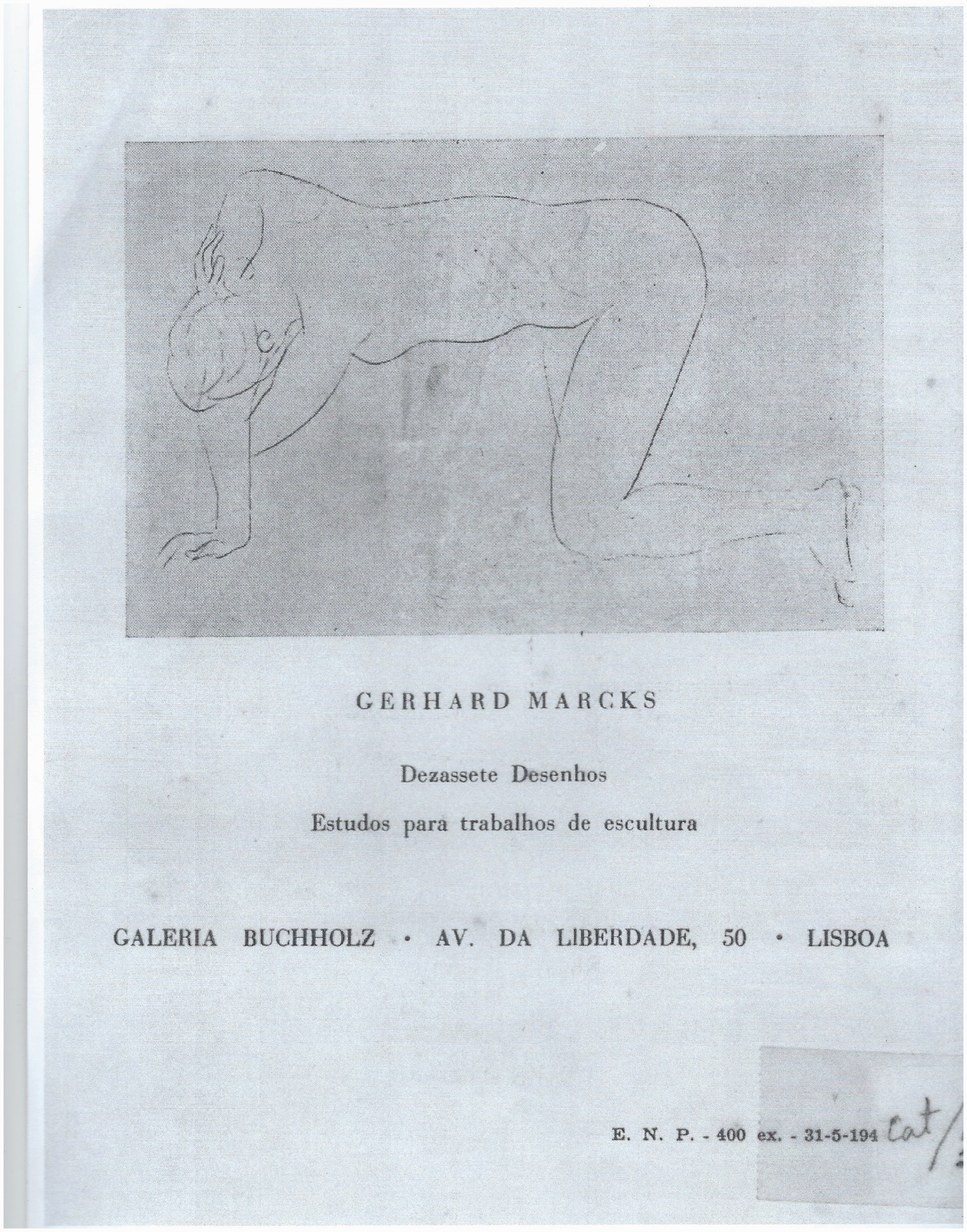
The drawings of Portuguese painter Júlio were the object of the fifth exhibition, which opened in October 1944. 72 The exhibition brochure text was written by the artist’s brother, José Régio, a major figure among Portuguese realist writers. Both brothers combined their artistic activities with a civil service career.
Finally, the sixth exhibition, and the last to be described in this article, opened in February 1945 and featured 17 drawings by Richard Scheibe (1879–1964), and photographs of sculptures by Georg Kolbe (1877–1947). 73 The exhibition brochure included two reproductions of Scheibe’s drawings – both female nudes, one standing, one sitting – and a translation of a section of Bruno A. Werner’s Die deutsche Plastik der Gegenwart, which expanded on the biography and artistic interaction between both artists. 74 Both Scheibe and Kolbe, while having faced difficulties during the first years of the Third Reich, eventually found some sort of cohabitation with the regime, integrating the group of sculptors ‘with modernist roots who conformed to Nazi aesthetics.’ 75 Both artists had their work exhibited at the Grosse Deutsche Kunst Ausstellung, the exhibition of officially sanctioned German art held concurrently with the Entartete Kunst exhibition in Munich, in 1937. 76
Regarding the provenance of these artworks, while it has not been possible to determine it with exactitude, the consultation of the lists of purged artworks excludes an origin from a public German museum. As for their import process, it is likely that they were brought into the country by Buchholz himself, at least in part through diplomatic pouch, as put forward in the Buchholz correspondence. The possibility of commercial imports by Buchholz cannot be confirmed as the Portuguese Customs archives have not been able to locate its archives for the period. While it would be unlikely that Buchholz would have requested an import tax exemption, given the contemporary nature of his works, one such file – among the 11,000 DGESBA files produced between 1933 and 1946 – exists. Dating from early January 1944, it stands as the only official document that dates the dealer’s imports into the country. 77 Submitted by Livraria Buchholz, not by the owner as an individual, it pertains to a temporary import tax waiver request for the Hermann Haller sculptures. It did not encompass the Marcks drawings featured in the same exhibition – giving support to the possibility that these were the same works featured in the second Buchholz Lisbon exhibition. Arguing that his was a non-commercial purpose, Buchholz requested that the two crates should be tax exempt. The original request was not included in this file, but was paraphrased by the Customs Office, who required an opinion from the Ministry of Education regarding Buchholz’s affirmations of cultural merit. 78
The expert opinion, drawn by none other than Diogo Macedo, is noteworthy inasmuch as it provides a contemporary evaluation of the dealer’s activities by the Portuguese art establishment. 79 In Macedo’s opinion, the cultural usefulness of the exhibitions of foreign art by the Livraria Buchholz was ‘recognized and praised’ in the ‘artistic and intellectual milieus of Lisbon’. For Macedo, the public benefit of these exhibitions found their only parallel in those organized by the Secretariat for National Propaganda. As such, he recommended that the gallery’s exhibitions should receive ‘enabling and support’ from Portuguese Customs whenever the Livraria Buchholz sought to bring into the country works by foreign artists ‘of undisputed merit’. While the outcome of the tax exemption request is unknown, the exhibition opening on 3 June 1944, points towards it being granted.
Another primary source, the photographic archive of Estúdio Mário Novais – whose first dated collaboration with Buchholz was also for the Barata Feyo catalogue, sometime before April 1944 – contains a valuable collection of undated images of the bookshop. In this article, we will examine a single Novais image, a vertical display case in the bookshop area [Figure 2]. 80
On the top shelf stands Haller’s female bust that illustrated the exhibition brochure cover. On the middle shelf stand two sculptures against a drawing. The sculpture on the right appears to be a torso or a seated figure. The sculpture on the left appears to be a standing female figure with a particular headdress or hairstyle. These are very likely two sculptures by Hermann Haller, Standing Nude 81 and Sitting Female Nude. 82 The drawing behind them represents a female figure. On the bottom shelf stand various sculptures – on the left, what appears to be a version of Renée Sintenis’s Kleine Daphne 83 and on the right, an undetermined number of small objects, which given their material and their shapes, are most likely casts of Sintenis’s small sculptures of Shetland ponies. 84 The other images in the Novais archive reveal more sculptures and paintings imported by Buchholz and exhibited at his gallery. Their identification will be the object of a separate publication, as the goal of this article is to demonstrate the usefulness of Portuguese sources when engaging in Nazi-era provenance research.
For the first time, it has been possible to identify the non-Portuguese artists exhibited by the Buchholz gallery in Lisbon during the war period; to name some of the artworks displayed there; and, in one case, to establish how these works were brought into the country. However, it has not yet been possible to determine the provenance of these items. Likewise, it has been impossible to determine the destination, and present-day whereabouts, of these artworks. The national inventory database and museum correspondence files confirm that, if they were sold in Portugal, they did not enter a public collection. In other words, the State, befitting its agenda of promoting national identity through its museum acquisitions, did not see the artworks exhibited by Buchholz as valuable acquisitions for its collections. Regarding private collections, and given the lack of document support, the same conclusion cannot be reached with the same level of certainty. The artworks may have left the country, headed to the Buchholz gallery in New York, as had happened in the past; or perhaps headed to another of the Buchholz outposts, in Bucharest, Madrid or Berlin. If so, the documental evidence for these exports is yet to be located.
Given the advances made by German and US institutions in researching the minutiae of the trade in so-called degenerate art between 1933 and 1945, the information revealed by Portuguese sources thus far lacks in detail. However, it constitutes a starting point to reveal what occurred in Portugal during the period, and a new link in the chain of the international movement of artworks during the Second World War.
Reprising the two goals outlined earlier, this article has demonstrated that publicly available sources allow for the research of Nazi-era provenance in Portugal. However, this research has been hindered by academic self-imposed limitations, which relate to the conflation of the figure of Salazar with the bureaucratic workings of the Estado Novo; the analysis of the cultural matters during the Estado Novo under the binomium of promotion or undermining the foundations of the dictatorship; the reluctance of museum professionals to engage in provenance beyond researching vanished national collections. Thus, rather than identifying concrete, visible contents, and focusing on micro-studies, or eliciting large-scale transnational narratives, it delineated the boundaries of what is still an unknown framework of information.
In the particular case of Karl Buchholz, the sources examined here confirm that he did operate as a one-dealer international network, who moved part of his stock of so-called degenerate art through different countries, in the case of Portugal at least once with the help of the German diplomatic service. The existence of one import request suggests that these artworks entered the country openly and legally.
This legality leads us to another element of transnational narratives, that of the roles played by neutral countries in the circulation and trade of artworks, and of so-called degenerate art in particular. In the case of Buchholz at least, Lisbon appears to serve as an intermediate stop along a journey, rather than as the final destination of the Buchholz stock. Yet within the Lisbon arts circuit of the period – artists, critics, academics – the opening and the exhibitions of the Buchholz gallery were publicly praised for its modern and contemporary content. Thus, many questions remain to be answered, for which the location and consultation of hitherto untraceable sources is essential.
What’s in Lisbon? Information, waiting to be found.
Footnotes
Acknowledgements
The research for this paper was financially supported by the Fundação para a Ciência e Tecnologia, grant SFRH/BD/75808/2011. In developing the ideas presented here, I have received critical input from Prof. Filipe Ribeiro de Meneses, Dr. Elizabeth Williams, Dr. Jörn Weingärtner, Mr. Marc Masurovsky and Dr. Nuno Senos. To them, and to the anonymous reviewers, I am obrigadíssima. I also thank the audiences of the ‘Art in the Periphery Seminar’ at New University of Lisbon; and the editors of this issue in particular for their careful reading and unending patience. Para os meus pais.
1
E.M. Remarque, The Night in Lisbon (London 1962).
2
P. Guggenheim, Out of this Century: Confessions of an Art Addict (London 1987), 236–45.
3
See the refugee narratives preserved at the Institute for Jewish Research (YIVO) in New York, and at the United States Holocaust Memorial Museum, in Washington DC.
4
F. du Plessix Gray, Them: A Memoir of Parents (New York, NY 2005), 224.
6
A. Portela, Salazarismo e Artes Plásticas (Lisbon 1987); J. Ramos do Ó, Os Anos de Ferro. O dispositivo cultural durante a política do espírito. 1933–1949 (Lisbon 1999); J.P. Zúquete, ‘In search of a new society: an intellectual between modernism and Salazar’ in Portugese Journal of Social Sciences, iv, 1 (2005), 39–59; M. Acciaiuoli, António Ferro. A Vertigem da Palavra. (Lisbon 2013).
7
A. Menhert Pascoal, ‘Circulação teórico-prática entre III Reich e Estado Novo: Hermann Distel e a Arquitectura Hospitalar’ in C. Ninhos and F. Clara (eds) A Angústia da Influência: Política, Cultura e Ciência nas relações da Alemanha com a Europa do Sul, 1933–1945 (Frankfurt am Main 2014); C. Ninhos, ‘Com Luvas de Veludo’: estratégia cultural alemã em Portugal (1933–1945)’, R:I, 35 (2012), 103–18; C. Ninhos, ‘O Poder da História. Escrever a história das relações luso-alemãs na “época do Fascismo”’ in F. Clara, M. Ribeiro Sanches and M. Matos (eds), Várias Viagens. Estudos oferecidos a Alfred Opitz (Vila Nova de Famalicão 2011), 389–405.
8
This refers to the film Monuments Men (2014) inspired from the same-named book authored by Robert Edsel, published in 2009.
9
Carlos Guerreiro’s blog, Aterrem em Portugal!, which initially focused on aviation in Portugal during the Second World War, has expanded into other areas, disseminating information gathered from primary sources by the author. Available at
http://aterrememportugal.blogspot.pt
(accessed 8 September 2014). F. Calope, ‘Lisboa na rota da arte roubada pelos Nazis’, Visão (14–20 November 2013). J. Palminha, ‘O misterioso destino da arte que caiu em mãos nazis’, Observador (30 May 2015). Available at:  ">
http://observador.pt/2015/06/06/o-misterioso-destino-da-arte-que-caiu-em-maos-nazis/
(accessed 9 June 2015).
">
http://observador.pt/2015/06/06/o-misterioso-destino-da-arte-que-caiu-em-maos-nazis/
(accessed 9 June 2015).
10
11
12
Commission on Jewish Assets in Sweden at the Time of the Second World War, Sweden and Jewish Assets: Final Report from the Commission on Jewish Assets in Sweden at the Time of the Second World War (Stockholm 1999). [Swiss Confederation] Federal Department of Home Affairs and Federal Department of Foreign Affairs, Report on the State of Work on looted Art during the National Socialist era, in particular, on the subject of provenance research (Bern 2010).
13
M. Martorell Linares, ‘España y el expolio nazi de obras de arte’, Ayer, 55, 3 (2004), 151–73; M. Martorell Linares (1998) España y el expolio de las colecciones artísticas europeas durante la Segunda Guerra Mundial. Available at: (accessed 2 February 2015). B. Dermasin, ‘The Third Time Is Not Always a Charm: The Troublesome Legacy of a Dutch Art Dealer – The Limitation and Act of State Defenses in Looted Art Cases’, Cardozo Arts and Entertainment Law Journal 28, 255 (2010); G. Schnabel and M. Tatzkow, Nazi Looted Art – Handbuch Kunstrestitution weltweit (Berlin 2007).
14
15
M. Martorell Linares, ‘España y el expolio nazi de obras de arte’, Ayer, 55, 3 (2004), 173.
16
I. Pimentel, Judeus em Portugal durante a Segunda Guerra mundial (Lisbon 2006) was the first monograph by a Portuguese academic on the subject. See also P. von Zur Muhlen, Flughtweg Spanien-Portugal. Die deutsche emigration und der Exodus aus Europa 1933–1945 (Bonn 1992), the first recorded monograph on the subject of refugees in Portugal between the rise of the Nazi regime and the end of the Second World War.
17
Chagall and Ernst were aided in their escape by Varian Fry’s Centre Américain de Secours. V. Fry, Surrender on Demand (London 1999).
18
United Press, ‘British Seize Art as German Export’, New York Times (10 October 1940).
19
20
Each of these collectors would, upon his death, bequeath his collection, or part thereof, for the purpose of opening a museum. Nowadays the Ricardo Espírito Santo Foundation focuses mostly on Decorative Arts; the Dr. Anastácio Gonçalves House-Museum exhibits an eclectic collection focusing on Portuguese nineteenth century painting, Chinese porcelain, and European furniture; and the Medeiros e Almeida House-Museum displays European painting and furniture, Chinese porcelain, English silverware, jewelry and watches.
21
For an application of the concept of ‘grey zone, originally devised by Primo Levi in The Drowned and the Saved (New York, NY 1989), in wider fields that relate to Holocaust studies, see J. Petropoulos and J.K. Roth (eds), Gray Zones. Ambiguity in compromise in the Holocaust and its aftermath (New York, NY and Oxford 2005).
22
These correspond to the payment records of the tenth delegation of the General Directorate of Public Accounting, Ministry of Finance.
23
A. Costa Pinto (ed.), Modern Portugal (Palo Alto, CA, 1998); T. Gallagher, Portugal. A Twentieth Century Interpretation (Manchester 1983).
24
F. Rosas, O Estado Novo nos anos trinta (1928–1938) (Lisbon 1986); F. Rosas, O salazarismo e a Aliança Luso-Britânica (Lisbon 1988); F. Rosas, Portugal entre a paz e a guerra (1939–1945). Estudo do impacte da II Guerra Mundial na economia e na sociedade portuguesas (Lisbon 1990); A.J. Telo, Portugal na Segunda Guerra (Lisbon 1987); A.J. Telo, Propaganda e guerra secreta em Portugal (1939–1945) (Lisbon 1990); A.J. Telo, Portugal na Segunda Guerra (1941–1945) (Lisbon 1991).
25
P. von Zur Muhlen, Flughtweg Spanien-Portugal; I. Pimentel, Judeus em Portugal; S. Chalente, ‘O discurso do estado salazarista perante o “indesejável” (1933–1939)’, Análise Social, XLVI, 198 (2011), 41–63; K. Ruggiero (ed.), The Jewish Diaspora in Latin America and the Caribbean: Fragments of Memory (Brighton 2005); F. Caestecker and B. Moore (eds), Refugees from Nazi Germany and the liberal European States (New York, NY 2010); M. Franco, ‘Diversão Balcânica: os israelitas portugueses de Salónica (parte I)’, Análise Social, XXXIX, 170 (2004), 119–147; A. Milgram, Portugal, Salazar and the Jews (Jerusalem 2011).
26
D. Wheeler, ‘The price of neutrality: Portugal, the wolfram question, and World War II (part II)’ Luso-Brazilian Review, 23, 2 (1986), 97–111. See also Part I in vol. 23 no.1 (1986), 107–27. J.P. Avelãs Nunes, O Estado Novo e o volfrâmio (1933–1947) (Coimbra 2010); A. de Almeida Sousa Vilar, O volfrâmio de Arouca no contexto da Segunda Guerra Mundial, 1939–1945 (Arouca 1998).
27
D. Wheeler, ‘The price of neutrality: Portugal, the Wolfram question, and World War II (part II)’ Luso-Brazilian Review, 23, 2 (1986), 97–111.
28
Relatório da Comissão de Investigação sobre as transacções de ouro efectuadas entre as autoridades portuguesas e alemãs durante o período compreendido entre 1936 e 1945 Janeiro (Lisbon 1999). See also A.J. Telo, A neutralidade portuguesa e o ouro nazi (Lisbon 2000).
29
A. Louçã, Negócios com os Nazis. Ouro e outras pilhagens. 1933–1945 (Lisbon 1997).
30
A. Louçã and A. Schäfer, ‘Portugal and the Nazi Gold: The “Lisbon Connection” in the Sales of Looted Gold by the Third Reich’, Yad Vashem Studies, 27 (1999), 122.
31
Ibid.
32
M. Kaplan, ‘Review. Portugal, Salazar and the Jews’, Shofar, 23, 1 (2004).
33
S. Lira, ‘Politics and Propaganda in Portuguese Museums and Temporary Exhibitions during the Estado Novo’, Museological Review, 7 (2001), 42–55; see also P. Polanah, ‘“The zenith of our national history!”: national identity, colonial empire, and the promotion of the Portuguese Discoveries: Portugal 1930s’, E-journal of Portuguese History, IX, 1 (2011), 39–62.
34
J. Ramos do Ó, Os Anos de Ferro. O dispositivo cultural durante a política do espírito. 1933–1949, 119.
35
A. Ferro, quoted in ibid., 143.
36
One exception is the six-page study by José Carneiro of the acquisitions of the national palaces through which he identifies the State’s aesthetic and artistic priorities. J. Carneiro, ‘Os critérios estético-artísticos no poder aquisitivo do Estado Novo. O enriquecimento das colecções nacionais’ in J.A. Ribeiro (ed.), Museus, Palácios e Mercados de Arte (Lisbon 2014), 62–9.
37
F. Ribeiro de Meneses. Salazar: A Political Biography (New York, NY 2009).
38
39
F. Ribeiro de Meneses, ‘Jaime Nogueira Pinto’s Portrait of Salazar: a new departure’, A. Ribeiro de Marneses and C. O’Leary (eds), Legacies of war and dictatorship in contemporary Portugal and Spain. Iberian and Latin Studies: The Arts, Literature and Identity, 1 (Oxford 2011) 67–77, 73.
40
41
42
J.C. Pires Brigola, Colecções, gabinetes e museus em Portugal no séc. XVIII (Évora 2000); F. Lowndes Vicente, ‘Travelling Objects: the story of two natural history collections in the 19th century’, Portuguese Studies, 19 (2003), 19–37; H. Xavier, Galeria de pintura no Real Paço da Ajuda (Lisbon 2013).
43
Museu Nacional de Arte Antiga, Esplendores do Oriente (Lisbon 2014).
44
45
In Lisbon, the National Museum of Art focused on artworks from the medieval period to the mid-nineteenth century; the National Museum of Contemporary Art collected art made between the mid to end nineteenth-century to modernity. In Porto, the Soares dos Reis National Museum brought together disparate art collections and the holdings of the Porto Fine Arts School; in Coimbra, the Machado de Castro National Museum had greater focus on religious sculpture.
46
The acquisitions committee of the National Museum of Contemporary Art was the only one to include António Ferro among its members, although the minutes of its meetings do not show him to be particularly vocal in the acquisitions under consideration.
47
J. Carneiro, ‘Os critérios estético-artísticos no poder aquisitivo do Estado Novo’, 67.
48
See ‘A Figueira da Foz e o primoroso escultor Naoum Aronson’, Jornal-Reclamo (16 March 1941).
49
Correspondência recebida/1941 e 1942/Letter from the Polish Committee in Lisbon to the Museum, received 5 October 1942, Santos Rocha Museum Archives, Figueira da Foz.
50
The best known Gulbenkian acquisitions during this period are the paintings purchased from Baron Henri de Rothschild, in 1943. The items were at the National Gallery in London, both men were in Lisbon at the time of the transaction.
51
I. Fialho Brandão, ‘Uma viagem última’ in Coleccionar para a Res Publica (Lisbon 2010), 34–69.
52
By law, contemporary artworks were considered commercial merchandise and thus did not fall under the import tax exemptions for works of high artistic value offered by the State, and whose expert evaluation requests were forwarded to the Ministry of Education. Law Decree [without number, Diário do Governo (41) 22 November 1910, 510.
53
For Weiss, see ‘Tríptico do pintor Gerard David’, DGFP/MOVMB/434 and ‘Tapeçarias dos Gobelins’ DGFP1/LIS/BARTS/001; for Popper see ‘Proposta de aquisição de dois tapetes de Arraiolos e um caneco de faiança portuguesa, para o Palácio Nacional de Queluz’, DGFP1/LIS/SIN/BARTS/003, Contemporary Archives of the Ministry of Finance, Lisbon.
54
J. Petropoulos, The Faustian Bargain: The Art World in Nazi Germany (New York, NY 2000), 63-110.
56
‘Karl Moritz Buchholz Roeper’, Death duty file, DGCI/LIS/LIS9A/IS/03373, Ministry of Finance Contemporary Archive, Lisbon.
57
Anja Tiedemann has found no evidence of Buchholz’s involvement in espionage activities. She hypothesises, however, that Buchholz may have provided Gessman with a false employment at the gallery as a cover. A. Tiedemann, ‘“Insel im braunen Meer”. Die Galerie Buchholz in Berlin’ in M. Steinkamp and U. Haug (eds), Schriften der Forschungsstelle “Entartete Kunst”, 5. (2010), 97. For more details regarding Wilhelm Gesseman, also known as Jean Charles Alexandre or Wilhelm Alendorf, while in Portugal see: I. Pimentel, Espiões em Portugal durante a Segunda Guerra Mundial (Lisbon 2012), 243.
58
A. Tiedemann, ‘“Insel im braunen Meer”. Die Galerie Buchholz in Berlin’ in M. Steinkamp and U. Haug (eds), Schriften der Forschungsstelle “Entartete Kunst”, 5 (2010), 83–102; A. Tiedemann, Die ‘entartete’ Moderne und ihr amerikanischer Markt: Karl Buchholz und Curt Valentin als Händler verfemter Kunst (Berlin 2013); J. Petropoulos ‘Bridges from the Reich. The Importance of Emigré Art Dealers as Reflected in the Case Studies of Curt Valentin and Otto Kallir-Nirenstein’, Kunstgeschichte. Open Peer Reviewed Journal, 2011. Available at: (accessed 31 May 2015).
59
G. Buchholz, Karl Buchholz: Buch- und Kunsthändler im 20. Jahrhundert: sein Leben und seine Buchhandlungen und Galerien; Berlin, New York, Bukarest, Lissabon, Madrid, Bogotá (Cologne 2005).
60
G. Buchholz, Karl Buchholz, 124. The Propaganda Ministry would eventually allow the Berlin Buchholz gallery to trade in degenerate art, but forbid it to hold further exhibitions.
61
In spite of the tensions between the Buchholz Gallery and the Reich Propaganda Ministry, the latter featured the exhibition in the Portuguese version of Signal, its propaganda publication: ‘Um pintor português em Berlim’, Sinal (Unknown month, 1943).
62
Letter from Karl Buchholz, addressed to his wife, dated 6 October 1943, ‘Gestern konnte ich noch 23 Kisten voll gutter Bücher und auch einige Bronzen über das Auswärtige Amt nach Lissabon aufgeben und 5 mit kunstbuchern nach Bukarest’, quoted in G. Buchholz, Karl Buchholz, 133.
63
R. Henriques da Silva and M. Botelho, Carlos Botelho (Lisbon 1995), 355. See also ‘Nova Livraria’, Diário de Lisboa (23 July 1943).
64
D. Macedo ‘Noticiário’, in Ocidente, XXI, 67, 306.
65
66
These figures result from the consultation of the two volumes of the Entartete Kunst inventory made available online by the Victoria and Albert Museum. The accuracy of the number of purged works by Marcks is compromised by the appearance of the spelling ‘Marks’ in some entries – which may or may not refer to the author. For the transfer of artworks between Buchholz and Valentin see A. Tiedemann, Die ‘entartete’ Moderne und ihr amerikanischer Markt: Karl Buchholz und Curt Valentin als Händler verfemter Kunst (Berlin 2013), 378–80.
67
A. de Gusmão, ‘Artes Plásticas -Desenhos na Galeria Buchholz’ in Seara Nova (1943), 143–4
68
D. Macedo, ‘Noticiário’ in Ocidente, XXII, 72, 446.
69
3a Exposição. De 22 de Março a 20 de Abril de 1944. Barata Feyo. (Lisbon 1944). Manuel Mendes private papers, Mário Soares Foundation, Lisbon.
70
D. Macedo, ‘Noticiário’, in Ocidente, XXIII, 75, 329.
71
4a Exposição. De 3 a 30 de Junho de 1944. Hermann Haller. Escultura. Gerhard Marcks. Desenho. (Lisbon 1944). Selles Paes Collection, Art Library, Calouste Gulbekian Foundation, Lisbon.
72
Júlio. 5a Exposição. De 24 de Outubro a 24 de Novembro (Lisbon 1944). Art Library, Calouste Gulbenkian Foundation, Lisbon.
73
D. Macedo, ‘Noticiário’, in Ocidente, XXV, 83, 218.
74
Richard Scheibe. Desenhos. 6a Exposição. De 12 de Fevereiro a 12 de Março. (Lisbon 1945). Mário and Alice Chicó papers, Mário Soares Foundation, Lisbon.
75
J. Petropoulos, Artists Under Hitler: Collaboration and Survival in Nazi Germany (New Haven, CT 2014), 312.
76
I. Schlenker, ‘Defining National Socialist Art’ in O. Peters (ed.), Degenerate Art: The Attack on Modern Art in Nazi Germany, 1937 (Munich, London and New York, NY 2014), 96.
77
File 3086, Box 3112, Archive of the Direcção Geral do Ensino Superior de Belas Artes, Ministry of Education.
78
Memo from Portuguese Customs to the Ministry of Education, dated [?] January 1944, received on 17 January 1944, ibid., fl. 1.
79
Memo handwritten by Diogo de Macedo dated 20 January 1944, ibid., fl. 2.
80
CFT003.40658, Estúdio Mário Novais Photographic Archives, Art Library, Calouste Gulbenkian Foundation. The identification of the artworks presented here is explained in detail in Chapter Six of the author’s forthcoming doctoral dissertation. Livraria Buchholz Display case with works by Hermann Haller and Renée Sintenis. Estúdio Mário Novais, unknown date. Source: Courtesy of the Calouste Gulbenkian Foundation/ Estúdio Mário Novais Photographic Archive.
81
82
83
84
Close-up observation of this image and visual comparison with Sintenis’s works suggests that these are casts of Shetland pony in the wind, and Lying Shetland pony. The third sculpture is not identifiable.