



Abstract
Besides teaching academic knowledge and skills, imparting cultural values and behavioral standard is also an important function of formal education. The present work examines stories sampled from American and Japanese school textbooks (Ns = 72 and 71, respectively) for their cultural values and characteristics. The study found that the stories in American textbooks highlighted themes of individualism such as self-direction and achievement, whereas the Japanese counterparts highlighted themes of collectivism such as conformity and group harmony. The study also found cultural differences in story characteristics (e.g., the narrator, attribution of the outcome, picture content) that are also related to individualism and collectivism. Implications and future directions are discussed.
Formal education’s most obvious function is to teach academic knowledge and skills. However, its other important function is to educate children to be proper members of the society with distinct cultural values. For example, schools in a socialist society stress values of socialism, while schools in a capitalist society teach values that support capitalism (Henslin, 2001). Indeed, many scholars emphasize the close relationship between education and culture, particularly the role of education in cultural transmission (e.g., Martin, 2006; Rogoff, 2003; Savoie, Bruter, & Frijhoff, 2004). Oftentimes, cultural norms, values, and beliefs are transmitted rather implicitly, known as the “hidden curriculum” (Jackson, 1968; Martin, 1983). Hoffman (1983) suggests that children internalize initially external values more effectively when they are introduced with “low saliency” because children forget how they learned these values and thus experience them as their own.
Although the “hidden curriculum” often refers to the socialization aspects of school environment, it could be embedded in the formal educational content as well (Giroux & Penna, 1983). For example, the primary purpose of language arts and reading textbooks is to improve children’s language skills, but stories in these textbooks might convey cultural messages with various examples of how one should feel, think, or act in certain situations. Also, because stories in textbooks are destined to be read by a large population of children in the society, they are likely to exert pervasive influence. The present study therefore explored the possible role textbook stories might play in cultural transmission by comparing stories that appear in textbooks of two different countries, namely the United States and Japan.
This examination is important not only from an educational perspective but also from the perspective of cultural psychology. Most cultural psychological theories specify that cultural context and psyche are two inseparable aspects of cultural dynamics (e.g., Shweder, 1991). Indeed, the amount of work cultural psychologists accomplished in the last few decades should be praised, particularly for revealing various psychological differences among people of different cultures (see, e.g., Fiske, Kitayama, Markus, & Nisbett, 1998, for a review). However, while finding such cultural differences, researchers have often assumed that cultural contexts are responsible for fostering people’s psychological tendencies, but little research was devoted to examine cultural contexts.
Nevertheless, this trend is gradually changing. Increasingly, cultural psychologists have been moving beyond the psyche and starting to examine things “out in the field.” For example, some researchers have analyzed advertisements in popular magazines (Han & Shavitt, 1994; Kim & Markus, 1999), TV commercials (Cheng & Schweitzer, 1996; Cho, Kwon, Gentry, Jun, & Kropp, 1999), and newspaper articles (Morris & Peng, 1994) from different cultures. Morling and Lamoreaux (2008) identified over 50 such studies for a meta-analysis, which found that cultural products from the West (mostly the United States) were significantly more individualistic than those from East Asia (including Japan, Korea, and China), whereas cultural products from East Asia were significantly more collectivistic than those from the West.
As Morling and Lamoreaux (2008) state, “cultural products studies are one important complement to the field’s original focus on private, inside-the-head manifestations of cultural differences” (p. 201). Thus, although there are various developmental studies that cross-culturally compared children’s cognitive tendencies (“inside-the-head manifestations”) in varieties of domains, such as autobiographical memory (Q. Wang, 2004), executive control (Sabbagh, Xu, Carlson, Moses, & Lee, 2006), categorization (Chiu, 1972), or motivation (Iyengar & Lepper, 1999), the examination of textbook stories—a cultural product to which children are exposed in their daily life—would be an important complement to this field.
Present Study
Despite the increasing attention toward cultural products and important role formal education might play in cultural transmission, very few studies have examined school textbooks. The present work therefore examined cultural values embedded in the themes of stories sampled from language arts and reading textbooks used in the United States and Japan.
Among various cultural dimensions that distinguish Japanese and U.S. cultures, such asmasculinity-femininity, high-low uncertainty avoidance, and long-short term orientation (Hofstede, 2001), the present study focused on individualism-collectivism because it has been the most widely used dimension to distinguish the beliefs, values, and practices in different societies (e.g., Morling & Lamoreaux, 2008; Oyserman, Coon, & Kemmelmeier, 2002; Schimmack, Oishi, & Diener, 2005; Triandis, 1995). While it is important to recognize that individualism and collectivism are not always the opposite, and both may coexist within a given culture (Triandis, 1995), it is widely believed that people in North American cultures are relatively more individualistic whereas East Asian cultures are relatively more collectivistic (e.g., Markus & Kitayama, 1991; Triandis, 1995). Thus, the present study predicted that stories from American textbooks would emphasize individualistic values and stories from Japanese textbooks would emphasize collectivistic values.
The cultural messages may be embedded not only in the overall themes of stories but also in various features of stories. For example, Morling and Lamoreaux (2008) expanded the conceptions of individualism and collectivism by including studies that examined cultural products for their manifestations of culturally specific cognitive tendencies, such as causal attribution (dispositional vs. situational) and cognitive sensitivity (attention to central object vs. background). Because these cognitive tendencies are considered to be strongly related to individualism and collectivism, the researchers claimed them to be theoretical parts of this dimension. The present study further extended their proposition and examined textbook stories for additional cognitive tendencies that are also considered as parts of individualism and collectivism—namely, perspective taking (first-person vs. third-person), emotion valance (positive vs. negative), and outcome focus (success vs. failure).
The present work therefore consists of two parts—(a) examining story themes for embedded cultural values of individualism and collectivism and (b) examining story characteristics for the manifestation of individualistic and collectivistic cognitive tendencies. Although the same stories were used in these two parts, they are reported separately for readers’ convenience because each involved a separate set of literature review and coding scheme.
Materials
In Japan, all school textbooks must be approved by the Ministry of Science and Education, and five companies currently publish language arts textbooks for elementary schools. The three textbooks chosen for this study were the ones used in elementary schools in Kanagawa prefecture, published by three different companies: Tokyo-Syoseki, Mitsumura-Tosyo, and Gakkou-Tosyo. From 82 stories identified in these textbooks, 71 stories (86.59%) were randomly sampled. 1
Unlike in Japan, there are no governmental inspections or regulations imposed on textbook production in the United States. The three American textbooks used in this study were Harcourt Language, Houghton Mifflin English, and Signatures. These textbooks were recommended to school districts nationally as conforming to the educational program of the state of Texas, which dominates the United States textbook market and sets educational trends in the country due to its large number of school districts and their size (Athans, 1998). Moreover, these textbooks were ranked at the top for the best selling textbooks in the United States (“Harcourt Tops,” 1999). From 163 stories identified in these textbooks, 72 stories (44.17%) were randomly sampled. For both countries, we identified fiction only and then randomly sampled eight stories from each grade level (an exception was in Japanese sixth-grade books, which contained only seven fiction pieces).
Part 1: Cultural Values in Story Themes
If textbook stories transmit cultural values, individualistic values should be more prominently featured in American textbook stories than in Japanese textbook stories, whereas collectivistic values should be highlighted more in Japanese textbook stories than in American textbook stories. Although few, studies that compared children’s stories in different cultures offer sporadic pieces of evidence that are consistent with the prediction. In one of the earliest studies, Zimet (1972) reported that American children’s stories had especially low scores in putatively collectivistic value categories such as traditionalism, conformity, and compromise relative to children’s stories in other countries, including Japan. Also, Lanham (1979) examined textbooks of ethics in Japan and the United States and observed that the American educational system strived for self-confidence, while the Japanese educational system strived for self-discipline and perseverance. In a similar vein, S. Wang (1993) compared Taiwanese and American children’s stories and observed that “society-centered or interpersonal qualities and behaviors” (e.g., appreciation of others, serving others, traditional Chinese virtues, honesty, and modesty) are more frequently emphasized in Taiwanese stories, but “self-centered or personal qualities and behaviors” (e.g., personal feelings, individual accomplishments, independence, courage, determination, talent, confidence, imagination/creation, and humor) were more frequently highlighted in American children’s stories.
Unfortunately, in neither of the studies was any statistical analysis performed, so it is not clear how reliable these findings might be (perhaps for this reason, these studies were not included in Morling & Lamoreaux, 2008, meta-analysis study). Another problem is that each coding scheme was highly idiosyncratic and none was designed with the distinction between individualism and collectivism in mind. Although consistent with the present hypothesis, the evidence to date is far from conclusive, and none of the previous studies investigated stories of language arts and reading textbooks. Thus, Part 1 sought more definitive evidence for our prediction by systematically content-coding stories sampled from American and Japanese language arts and reading textbooks for the values reflecting both individualism and collectivism.
Coding Scheme
From Schwartz’s (1992) Value Survey and Kilby’s (1993) Omnibus Values Questionnaire, we identified 26 values that were associated with individual goals, individual uniqueness, and personal benefits and well-being (individualistic values) and 19 values that were associated with group goals, group unity, and interpersonal well-being (collectivistic values). However, the Schwartz’s and Kilby’s lists had fewer collectivistic values than individualistic values, and many of their collectivistic values (e.g., obedience, respectfulness, self-discipline, loyalty, politeness, and respect for tradition) were associated with “vertical collectivism,” wherein hierarchy is emphasized and people submit to authorities or a larger group to the point of self-sacrifice (Triandis, 2001). Thus, we added four collectivistic values (sympathy, pleasure in making others happy, harmonious relationship, and sharing) that were associated with “horizontal collectivism,” wherein equality and harmony is emphasized and people engage in mutual sharing and caring (Triandis, 2001). Also, we included self-sacrifice to the collectivistic values because it had been suggested as one of the characteristics of vertical collectivism (Triandis, 2001).
Each story was rated for the 50 values (see Table 1) on a scale from 0 (not present) to 3 (strongly present). 2 This rating method had been used by Han and Shavitt (1994) in their content analysis of Korean and U.S. advertisements and was considered to be suitable for the present study because it would capture the intensity of values conveyed in the stories in comparison to just coding for the presence or absence of the values. In some cases in which the values had negative connotations (e.g., curiosity resulted in a bad outcome, a person was punished for being different), the same values (e.g., curiosity, uniqueness) were coded with negative scores (–1 = a little negative, –2 = moderately negative, –3 = strongly negative). 3 Based on the Schwartz’s value types, the 50 values were grouped into nine larger categories (see Table 1). Of these, five categories consisted of individualistic values (self-definition, stimulation, hedonism, achievement, and power), and four categories consisted of collectivistic values (conformity, tradition, benevolence, and group harmony). 4 The purpose of analyzing these values on two levels was (a) to test the present hypothesis by observing the general tendencies of individualism and collectivism emphasis on the larger category level and (b) to find out which values American and Japanese stories would specifically emphasize on the small value level.
Value Rating Scores and Statistical Results for Japanese and American Stories

p < .05. **p < .01. ***p < .001.
All the sample stories were coded by a bilingual researcher, who was Japanese and had lived in the United States more than 10 years. A Japanese American bilingual research assistant, who was blind to the hypothesis of the study, also coded 16 randomly selected stories (eight from each country). Because translation between the two languages might result in the loss of subtle nuances and the changes in meanings, the coders read the stories in their original languages and coded them for the values in English (as shown in Table 1). Intercoder reliability was computed by Cronbach’s alpha for each of the 50 discrete values. The alpha for the sense of humor was only .63; thus, this item was dropped from the analysis. The average alpha 5 for the rest of the 49 values was .89. The average correlation between the two coders’ rating scores (r = .83) was as high as in Han and Savitt (1994, Study 1) study and within the acceptable ranges suggested by Kassarjian (1977). The discrepancies between the two coders were resolved by discussion.
Results
Table 1 shows the mean value scores computed across all the stories from each country and independent t test results. The value scores subsumed under each category were averaged and compared across the two cultures. In four of the five independent categories (i.e., self-direction, stimulation, achievement, and power), the overall means were significantly greater for American stories than for Japanese stories. Only the category of hedonism did not reach statistical significance. In all of the four collectivism value categories, the overall means were significantly greater for Japanese stories than for American stories. The total rating scores per story did not differ cross-culturally (see the bottom row of Table 1).
To find out what values were particularly emphasized in Japanese and American stories, the cultural differences were examined more closely for the 49 discrete values. Significant cultural differences were found in 41 values, all in the predicted direction (see Table 1). The largest cultural difference was found in sympathy (Japan > U.S.), followed by success (U.S. > Japan), acceptance of one’s portion in life (Japan > U.S.), and self-respect (U.S. > Japan). American stories particularly emphasized ambition, a varied life, being influential, choosing goals, and enjoyment. Japanese stories particularly emphasized sympathy, friendship and affection, helpfulness, pleasure in making others happy, and a sense of belonging.
Another intriguing question might be whether the degree of cultural differences would vary among the different grade levels. Thus, the rating scores for the individualistic and collectivistic value categories were cross-culturally compared separately for three grade groups—lower grades (i.e., first and second grades), middle grades (third and fourth grades), and upper grades (fifth and sixth grades). As shown in Table 2, while the middle and upper grade levels found eight value categories to be significantly different between the two countries, the lower grade level found five value categories to be significantly different. Thus, the cultural differences seem to be more prominent in the middle and upper grade levels than in the lower grade level.
Value Category Scores and t Test Results for Three Grade Groups
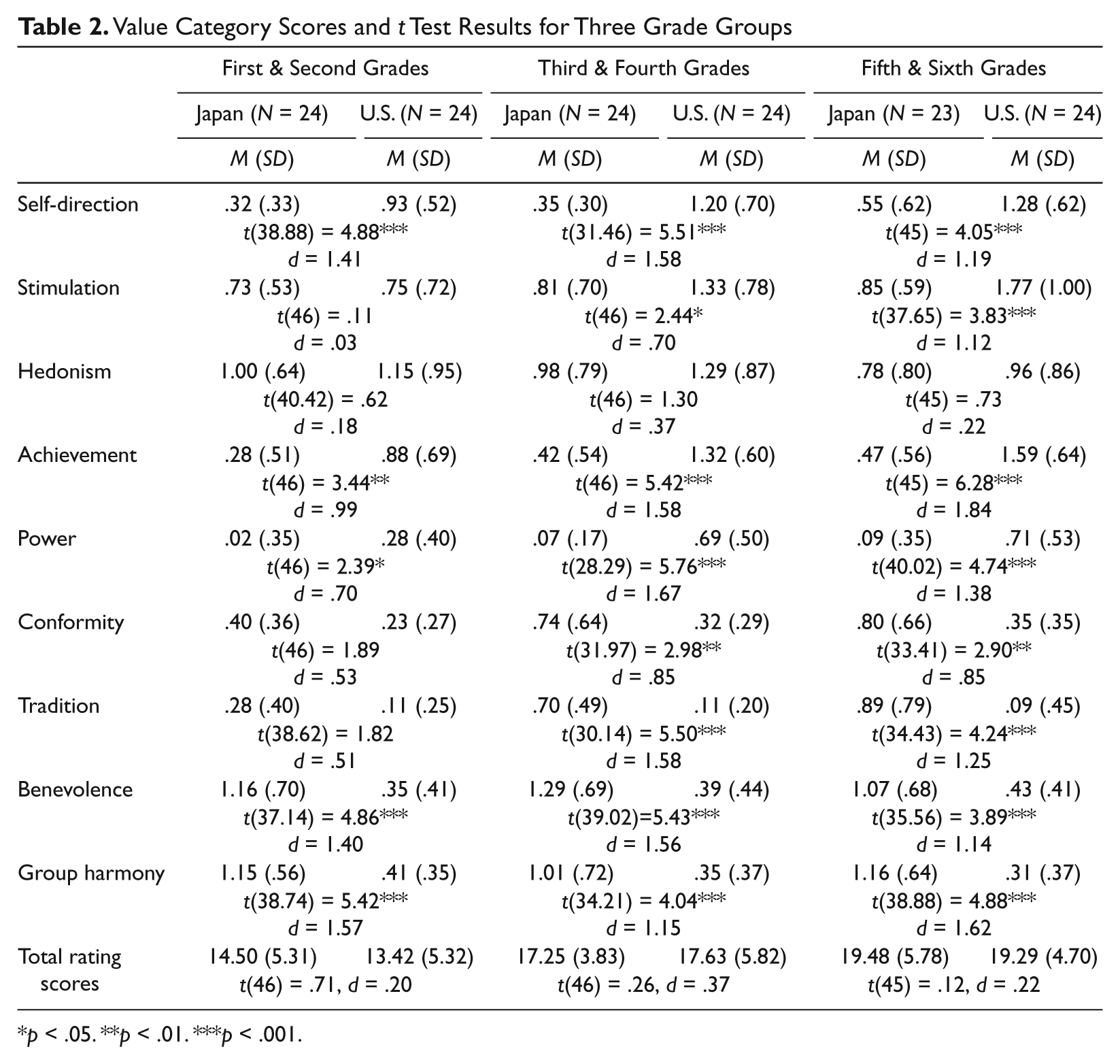
p < .05. **p < .01. ***p < .001.
Part 2: Individualistic and Collectivistic Cognitive Tendencies in Stories
Part 2 examined the manifestation of culturally specific cognitive tendencies that are considered to be theoretical parts of individualism and collectivism. Listed below are the domains in which previous research found significant cultural differences between individuals of individualistic contexts (i.e., North Americans) and those of collectivistic contexts (i.e., East Asians). It was predicted that such cognitive differences would be reflected in various characteristics of the stories.
Perspective Taking
Cohen and Gunz (2002) found that North Americans tended to see the self in social context from their own, first person point of view, whereas East Asians tended to see the self in social context from other people’s point of view. Then, it might be predicted that more American stories would take a first-person narrative form than Japanese stories and more Japanese stories would take a third-person narrative form than American stories.
Success Versus Failure Outcome
Kitayama, Markus, Matsumoto, and Norasakkunit (1997) found that North Americans recalled more events in which their self-esteem increased than decreased, whereas East Asians recalled more events in which their self-esteem decreased than increased. Also, Oishi and Diener (2003) found that North Americans exerted more effort toward the tasks they did well than those they did not do well, whereas East Asians continued to work hard on the tasks they did not do well (see also Heine et al., 2001, for similar findings). These findings suggest that North American and East Asian motivation is success-based or failure-based, respectively. Then, American stories might contain more successful events than failures, but the opposite pattern might be true for Japanese stories.
Causal Attribution
The fundamental attribution error (Ross, 1977) is known to be a pervasive psychological bias among North Americans (e.g., Gilbert & Jones, 1986; Jones, 1990; Ross, Anabile, & Steinmetz, 1977). However, cross-cultural research revealed that East Asians additionally considered situational factors and were therefore less likely to demonstrate this type of error (Choi, Nisbett, & Norenzayan, 1999; Morris & Peng, 1994). Also, Endo and Meijer (2004) found that North Americans tended to make more external attributions for their failures whereas East Asians often made more external attribution for their success. Thus, more self-serving attribution might be found in American stories, but more self-critical attribution might be found in Japanese stories.
Visual Attention
Besides story content, illustrations that accompany stories might also differ in culturally specific ways. To promote individualism, pictures in American stories might show a single person more often, whereas to promote collectivism, pictures in Japanese stories might show more than one person more often. If found, such a pattern would also be consistent with the attention tendencies observed among North Americans and East Asians—that is, North Americans tend to focus on a central object, whereas East Asians tend to pay more holistic attention to both a main object and its relation to background (e.g., Chua, Boland, & Nisbett, 2005; Kitayama, Duffy, Kawamura, & Larsen, 2003; Masuda & Nisbett, 2001).
Emotion
Previous studies suggest that maximizing positive emotions and minimizing negative emotions is key for increasing North Americans’ well-being, but balancing between positive and negative emotions is rather ideal for East Asians (Bagozzi, Wong, & Yi, 1999; Scollon, Diener, Oishi, & Biswas-Diener, 2005). If so, there may be more happy stories than sad stories in the American sample but a more equivalent balance between happy and sad stories in the Japanese sample. Also, American stories might contain more words or phrases to depict positive emotional states than negative ones, whereas Japanese stories might contain a more equivalent number of positive and negative emotional words or phrases.
Coding Scheme
The stories were coded for the following six items: (1) the narrator of the story (main character, another character of the story, or a third person); (2) whether the story is about success, failure, neither, or both; (3) to whom the outcome (success and/or failure) is attributed (internal factors, external factors, both, or neither); (4) the number of people in each picture (none, one person, two people, or three or more people); (5) whether the story is happy, sad, neutral/neither, or includes both happy and sad elements; and (6) the numbers of positive (e.g., happy, smiled), negative (e.g., sad, felt like crying), and neutral (e.g., surprised) emotional words/phrases. For the sixth item, words/phrases that described a person’s general personality traits (e.g., he was a “courageous” man, she was a “cheerful” girl) were not counted unless they described a person’s temporary feelings (e.g., he started to feel “courageous,” it made her feel “cheerful”).
The same coders as in Part 1 coded the stories. The main coder coded all the sample stories, and another coder coded 16 randomly selected stories. Intercoder reliability coefficients for Items 1 to 5 exceeded Kappa = .85. Cronbach’s alpha computed for the sixth item was .90.
Results
The frequency data for the first through fifth items were first analyzed using chi-square tests of independence. Then, more detailed cultural differences were analyzed by multinomial logistic regressions. The data for the sixth item (i.e., mean number of emotion words/phrases) were analyzed by independent t tests and a 2 (Country) × 3 (Emotion Type) factorial ANOVA. Significant cultural differences were found in the first through fifth items (see Table 3).
Frequencies (Items 1 to 5) and Mean Numbers (Item 6) of American and Japanese Stories
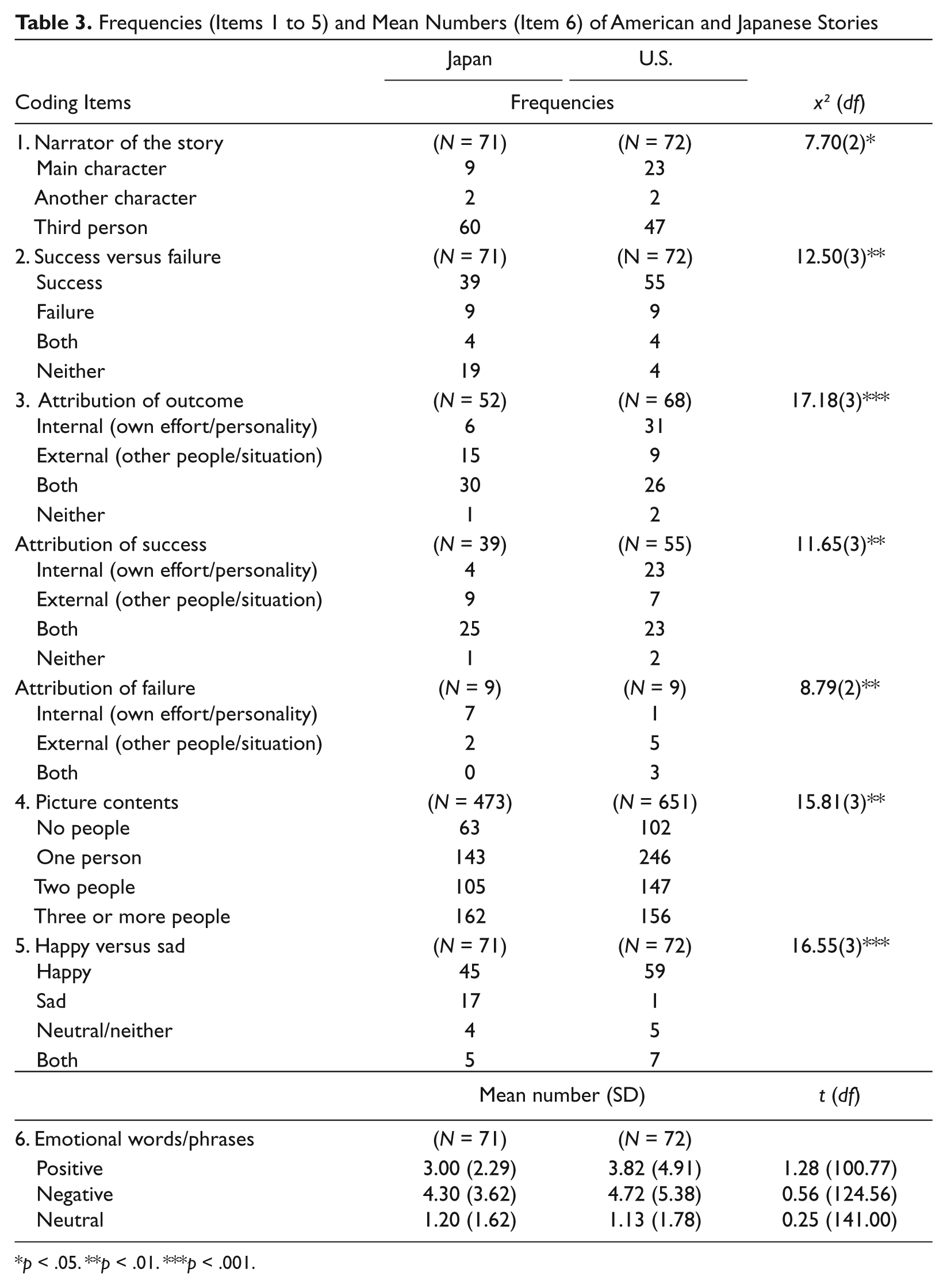
p < .05. **p < .01. ***p < .001.
1. Narrator of the stories
The majority of both American and Japanese stories had a third-person narrator. However, consistent with the prediction, more American stories had a main-character narrator than Japanese stories (23/72 = 32% vs. 9/71 = 13%), and more Japanese stories had a third-person narrator than American stories (60/71 = 85% vs. 47/72 = 65%). Supporting this observation, a multinomial logistic regression found the Country × Narrator (main character vs. third person) interaction to be significant (B = 1.18, Wald = 7.26, p < .01).
2. Success versus failure outcome
Both American and Japanese stories were most frequently about success. However, more success stories were found in the American sample than in the Japanese sample (55/72 = 76% vs. 39/71 = 55%). The Japanese sample, on the other hand, had more stories that fell under the “neither success nor failure” category than the American sample (19/71 = 27% vs. 4/72 = 6%). A multinomial logistic regression found the Country × Outcome (success vs. neither success nor failure) interaction to be significant (B = 1.92, Wald = 10.44,p = .001). Thus, as predicted, success was found to be a more common feature of the American stories than of the Japanese stories.
3. Causal attribution
The stories that had no clear outcomes (i.e., “neither success nor failure” of Item 2) were eliminated from this analysis. More American stories made internal attribution (i.e., the actor’s own action/personality was responsible for the outcome) than Japanese stories (31/68 = 46% vs. 6/52 = 12%), and more Japanese stories made external attribution (i.e., other people or situations were responsible for the outcome) than the American stories (15/52 = 29% vs. 9/68 = 13%). A multinomial logistic regression found this Country × Attribution (internal vs. external) interaction to be significant (B = 2.15, Wald = 12.31, p < .001). This is consistent with the prediction that internal attribution bias would be evident in the American stories, but such a bias would be absent in the Japanese stories.
When the success and failure stories were analyzed separately, the American stories made internal attribution for success more often than did the Japanese stories (23/55 = 42% vs. 4/39 = 10 %), and a multinomial logistic regression found the Country × Attribution of Success (internal vs. external) interaction to be significant (B = 2.00, Wald = 7.31, p < .01). In contrast, the Japanese stories made internal attribution for failure more often than did the American stories (7/9 = 78% vs. 1/9 = 11%), and a multinomial logistic regression found the Country × Attribution of Failure (internal vs. external) interaction to be significant (B = 2.86, Wald = 4.45, p < .05). These findings are also consistent with American self-serving and Japanese self-critical attribution tendencies.
4. Picture contents
There were significantly more pictures in American stories (651 total) than in Japanese stories (473 total), t(141) = 2.47, p < .05, d = .42 (U.S. M = 9.04, SD = 7.73; Japan M = 6.66, SD = 2.55). 6 Consistent with the current prediction, the American stories had more pictures with one person than did the Japanese stories (246/651 = 38% vs. 143/473 = 30%), whereas the Japanese stories had more pictures with three or more people than did the American stories (162/473 = 34% vs. 156/651 = 24%). Supporting this observation, a multinomial logistic regression found the Country × Picture (one person vs. three or more people) interaction to be significant (B = .58, Wald = 14.24, p < .001).
5. Happy versus sad stories
While the majority of both the American and Japanese stories conveyed happy themes, the American sample had more happy stories than did the Japanese sample (59/72 = 82% vs. 45/71 = 63%). Contrastingly, 17 sad stories (24%) were found in the Japanese sample, but only one sad story (1.4%) was found in the American sample. A multinomial logistic regression found the Country × Valence (happy vs. sad) interaction to be significant (B = 3.10, Wald = 8.78, p < .01). Thus, consistent with the prediction, a happy theme was a more common feature of the American stories than of the Japanese stories.
6. Emotional words/phrases
Contrary to our prediction, no cultural differences were found in the numbers of positive, negative, or neutral emotional words/phrases (see Table 2). A 2 (Country) × 3 (Emotion Type) factorial ANOVA found a significant main effect for emotion type; F(2, 282) = 47.46, p < .001,
Discussion
The significant contribution of the present study is its demonstration of cultural differences in the material to which many school children are exposed in their daily life—namely textbook stories. While the stories examined in the present study were diverse and each was unique in a variety of ways, it was also easy to recognize overarching thematic homogeneity for the stories within each country; American stories provide a role model who is a strong, distinctive individual, capable of achieving what he or she really wants, whereas Japanese stories teach children to be kind, considerate, an altruistic member of the group, and to recognize the importance of friendships. These general observations were clearly borne out in the systematic value coding (Part 1). Consistent with the prediction, American stories had significantly higher ratings for most of the individualistic values than did Japanese stories, whereas Japanese stories had significantly higher ratings for most of the collectivistic values than did American stories.
Such cultural differences were found in the stories of all grade levels but were particularly apparent in the middle and upper grade stories. This may be partly due to the story complexity. Naturally, children’s reading comprehension skills improve with age, and stories they read become more complex as they grow. Complex stories can convey more messages than simple stories. As indicated by the total rating scores of the stories (see the bottom row of Table 2), the lower grade stories were in fact lower in overall value weight in comparison to the middle and upper grade stories.
The present study also demonstrated that cultural messages were embedded in various features of stories (Part 2). That is, American stories contained more features that reflect individualistic cognitive styles, such as taking a first-person perspective, focusing on success, making dispositional and self-serving attributions, and emphasizing happiness, than did Japanese stories. In contrast, Japanese stories contained more features that reflect collectivistic cognitive styles, such as taking a third-person perspective, focusing on failure, making situational and self-critical attribution, and balancing happiness and sadness, than did American stories.
The only item that failed to find cultural differences in Part 2 was the number of positive/negative emotion words. Considering that a happy theme was more common in the American stories than in the Japanese stories, this null finding is somewhat puzzling. However, Kuppens, Realo, and Diener (2008) found that when making a life satisfaction judgment, people in individualist nations placed more importance on negative emotions than people in collectivist nations. They suggested this was because individualist culture emphasizes minimization of negative feelings more for attaining higher life satisfaction as compared with collectivist cultures. Then, it is possible that American stories, despite their happy themes, contained many negative emotion words, which might have erased the cultural difference.
Together, the present findings provide convincing evidence that stories in textbooks are full of critical features that carry cultural messages. These findings also imply that the textbook stories play an important function to foster children’s development of culturally appropriate values and cognitive tendencies. However, the limitation of the present research is that it did not directly investigate the causal link between reading individualistic/collectivistic stories and children’s values and cognitive tendencies. Empirically testing the effect of textbook stories on children’s minds might be extremely difficult because it may take many stories read or heard over many years for such an effect to occur. However, Trafimow, Triandis, and Goto (1991) found that reading a short story that focused on either personal benefits or group benefits temporarily changed adults’ self-construal toward the private or collective, respectively. Then, future research might test whether children’s values and cognitive tendencies temporarily shift in the corresponding directions after reading several stories with individualistic or collectivistic emphases.
While the present study focused on textbook stories, investigating educators’ selection of teaching materials is also an important future direction. As mentioned earlier in the Materials section, American textbooks are free from governmental regulations and thus vary in their contents much more than do Japanese textbooks. Also, whereas Japanese textbooks contain just enough materials that should be covered within an academic year, American textbooks often contain much more materials, perhaps more than can be covered within a year. 8 These cultural differences suggest that in comparison to Japanese teachers, American teachers may exercise much more freedom in selecting the teaching materials they want to use in their classes. As teachers’ personal beliefs and ideologies strongly affect their classroom practices (Fang, 1996; Shkedi & Nisan, 2006), what stories teachers select for their teaching may also play an important role in cultural transmission.
Footnotes
The author(s) declared no potential conflicts of interest with respect to the research, authorship, and/or publication of this article.
The author(s) received no financial support for the research, authorship, and/or publication of this article.