




Abstract
In previous research, the authors showed that Japanese and Americans would rather be asked to perform a favor than to have their friend solve the problem by asking someone else or getting it done professionally. In the current research, the authors further explore the similarities and differences in Japanese and American reactions to requests for favors by examining whether (a) increasing the size of the request can increase positive feelings, (b) the perceived closeness of the relationship and appraisals of control mediate the effect of request size on feelings, and (c) the increase in positive feelings only occurs in close friendship. In Japan and to some extent the United States, being asked a larger favor made people happier than being asked a smaller favor—up to a point. However, as in the authors’ previous study, cultural differences emerged in the basic pattern and in the associated appraisals. Results are discussed in relation to the Japanese phenomenon of Amae.
Being asked for a favor can be a nuisance. The helper usually has to go out of his or her way to spend time, effort, and sometimes even money to provide the help requested. Even a small request can be an imposition—people sometimes feel compelled to help because it would be embarrassing to refuse. They may also wonder why the person is asking them for the favor, whether the requester is taking advantage of them because they look like an easy mark. People from individualistic cultures like America might feel irritated by the requester’s dependence. In a study by Graf, Freer, and Plaizier (1979), Americans judged help-seeking requests more harshly than Dutch citizens, purportedly because of the norm of self-reliance prevalent in the United States. However, in Japan, being asked for a favor can have a different meaning. The Japanese may interpret the request as Amae—a sign of a close relationship—and may feel needed and happy. The research reported here extends our previous research (Niiya, Ellsworth, & Yamaguchi, 2006) by examining cultural similarities and differences in people’s reaction to requests for favors.
Amae as a Positive Experience in Japan and the United States
Niiya et al. (2006) showed that the Japanese feel happy about a friend’s request when they perceive the request as an indication of a close relationship. In that research, Japanese reported more positive affect and perceived the relationship as closer when they read a scenario in which a close friend asked them for a favor (e.g., to water the garden for a few days) than when they read a scenario in which the friend did not ask for the favor or asked someone else.
We argued that the Japanese feel happy when a friend asks them a favor because they can experience it as Amae. Doi (1992) defined Amae as the “ability to depend and presume upon another’s benevolence or bask in another’s indulgence” (p. 8). Yamaguchi (1999) defined Amae in terms of behavior and showed that Japanese recognize Amae when they see that a person engages in an inappropriate behavior with the expectation that others will accept or tolerate it (Niiya, Yamaguchi, Murakami, & Harihara, 2000; see Niiya et al., 2006, for a more detailed explanation of Amae). Yamaguchi (1999) proposed two motivations in Amae: the desire for unconditional love and the desire to achieve one’s goals through others. Although Amae involves inappropriate behavior, it can be a pleasant experience for the Japanese depending on the relative salience of these two motives (Masamura, 1998). For example, Joe might resent Mary’s request for a ride if he sees her request as manipulative (e.g., she wants to get home quickly without paying for public transportation). However, if Mary successfully conveys the message that she is seeking affection Joe may feel needed, trusted, and happy to help.
Because the English language does not have an equivalent word for Amae, it has been assumed that Amae is a uniquely Japanese phenomenon (e.g., Johnson, 1993; Morsbach & Tyler, 1986). However, our previous research (Niiya et al., 2006) showed that it can also exist in American close relationships. American college students reported more positive and less negative affect and perceived the relationship with a friend to be closer when they read that the friend requested a favor from them than when they read that the friend asked someone else or hired a professional. However, our study also showed some interesting cultural differences in why people felt happy about the favor request. In Japan, people felt happy because the request implied a close relationship. In the United States, perceptions of control also contributed to participants’ satisfaction—Americans thought that they were more in control and the friend less in control of the situation when the friend asked them for a favor than when she did not.
Current Research
This research further explores the similarities and differences in Japanese and American reactions to requests for favors by extending our previous research (Niiya et al., 2006) in three ways. First, we examined whether increasing the size of the request can increase positive feelings. In Japan, the more burdensome the request, the more inappropriate it is and, therefore, the more likely the potential helper would perceive it as Amae. We expected that up to a certain limit the potential helper would interpret the request as a sign of a close relationship and would feel trusted and needed. Therefore, we hypothesized that up to a certain limit, Americans and Japanese experience an increase in positive feelings as the size of request from a friend increases but that the increase would be more pronounced among Japanese, who are familiar with Amae, than among Americans (Hypothesis 1). However, when the request becomes too large, the potential helper might begin to doubt that the requester is purely seeking affection. Therefore, we hypothesized that when the size of request exceeds a certain limit, both Americans and Japanese experience a decrease in positive feelings but that the decrease would be less pronounced among Japanese than among Americans (Hypothesis 2).
Second, we examined cultural differences in the mediators. We tested whether in Japan perceived closeness of the relationship mediates the effect of request size on positive feelings, whereas in the United States, both perceived closeness and control appraisals mediate the effect of request size (Hypothesis 3).
Finally, we varied the type of relationship to see whether request size increases positive feelings when the requester is a friend but not when the requester is a mere acquaintance (Hypothesis 4). If the perceived closeness of the relationship explains the increase in positive feelings, then request size should increase positive feelings when the requester is a close friend (i.e., when the potential helper can interpret the request as a desire to affirm the close relationship) but less so when the requester is a mere acquaintance.
Method
To manipulate the size of request, we created a vignette with five levels of request size: to water a garden for 3 days, 1 week, 2 weeks, 1 month, or 3 months. Each participant responded to only one level but did so for both a friend and an acquaintance. Although the use of vignettes has been criticized for lack of impact and for the possible discrepancy between imagined and spontaneous reactions, we chose to use vignettes because it is an appropriate first step in distinguishing among five levels of an independent variable while maintaining equivalence between relationships (friend vs. acquaintance) and culture (United States vs. Japan).
Participants
In the United States, 204 American undergraduates (103 males, 99 females, 2 unknown gender) attending the University of Michigan filled out an online questionnaire through the subject pool web system and received partial credit toward their introductory psychology class. In the United States, 77% identified themselves as European Americans and 11% as Asian Americans. All participants were born and raised in the United States and all except one spoke English as their first language. In Japan, a total of 244 undergraduates (177 males, 65 females, 2 unknown gender) completed a questionnaire in class. Data from four international students were excluded from the analyses. Approximately half of the Japanese (n = 114) were from Yamanashi Gakuin University in Yamanashi prefecture (adjacent to Tokyo) and the remainder (n = 126) from Sapporo University in Hokkaido. Participants from the two Japanese universities did not statistically differ on any of the dependent or mediating variables. Because of time constraints, participants from Yamanashi Gakuin University did not complete the acquaintance portion of the questionnaire. Consequently, the analysis for the friend condition had a greater sample size than that for the acquaintance condition.
Questionnaire
Participants read two vignettes that were adapted from our previous study (Niiya et al., 2006):
L is a close friend of yours (an acquaintance) who lives in your neighborhood. L has a beautiful garden with a collection of rare plants that need to be watered every day. L has to go out of town for an important seminar for 3 days (1 week / 2 weeks / 1 month / 3 months). L does not want the plants to die, so must find someone to come to the garden every day to water them. Hiring a gardener would be very expensive. L has several friends, including you, who would be able to water the garden. L could ask any one of them but L asks you to do it.
We varied the length of the request (3 days, 1 week, 2 weeks, 1 month, and 3 months) to manipulate the size of the request between groups. The length of the request was held constant within participants (e.g., if they read that their friend asked them to water the garden for 3 days, they also read that the acquaintance asked them to water the garden for 3 days). The order of the vignettes was the same for all participants: They all read the friend vignette first and the acquaintance vignette second. We did not counterbalance the order of the vignettes because our major interest was people’s reaction to a request from a friend. Although the friend vignette may have influenced the responses to the acquaintance vignette, we wanted to make sure that the reverse did not happen.
Our previous study (Niiya et al., 2006) also used a vignette in which a friend asks to stay at participant’s apartment for several nights. The results for the two vignettes were similar. Because we had five levels of the independent variable in the current study, using more than one scenario would have required more participants than we could obtain. Also, it would be quite implausible for a mere acquaintance to ask to stay in someone’s apartment for the longer time periods, especially in Japan where few people have guest rooms.
After each vignette, participants rated how they felt about being asked the favor on a scale ranging from 1 = no emotion to 7 = very much. Items included seven positive emotions (proud, happy, respected, empowered, loving, relieved, and empathic) and five negative emotions (angry, irritated, sad, disappointed, and guilty). Factor analyses confirmed that all the positive items belonged to the positive affect factor and all the negative items to the negative affect factor. The two factors were correlated at –.23 in the friend vignette and at –.17 in the acquaintance vignette. We took the mean of the seven positive affect items to create a positive affect scale and the mean of the five negative affect items to create a negative affect scale, separately for the friend and acquaintance vignettes. The resulting scales had adequate reliabilities: Cronbach alphas of the positive and negative affect scales exceeded .76 in both vignettes and in both cultures.
To examine whether the perceived closeness of the relationship and appraisals of control mediate the effect of request size on affect, we measured the perceived closeness of the relationship with the following four items: “How close would you feel toward L [the requester]?” “How close does L feel toward you?” “Would you feel closer to L after he/she made the request?” “How much trust does L feel toward you?” The responses were on 7-point scales with higher values indicating a closer relationship. Cronbach alphas were .82 and .81 in the Japanese friend and the acquaintance conditions and .76 and .77 in the American friend and acquaintance conditions. We averaged the four items and used the composite perceived closeness scores in our analyses. The questionnaire also measured participants’ own feeling of control (“Would you feel you are in control of what is happening?”) and participants’ perception of the requester’s control (“Would you feel L is in control of what is happening?”). Responses were made on 7-point scales ranging from 1 = not at all to 7 = extremely. We kept these two items separate in our analyses because they were differently correlated in the two cultures, rUS(203) = −.28, p < .001, versus rJapan(237) = −.04, ns, for the friend vignette, and rUS(201) = −.41, p < .001, versus rJapan(119) = −.02, ns, for the acquaintance vignette.
Two items (“How much effort would the request require of you?” and “Would it be easy for you to help?” reversed) served as a manipulation check to assess whether participants thought that the requests for help that involved longer time periods were more difficult.
We first developed the questionnaire in English and then created the Japanese questionnaire using the back-translation method.
Results
Gender Effect
Gender had no main effect on any of the dependent variables and did not interact with any of the predictors. Because including gender did not affect the results relevant to our hypotheses, we dropped gender from the analyses.
Manipulation Check
As intended, participants indicated that complying with the request would become more difficult as the length of the request increased. In both the friend and the acquaintance vignettes, the perceived difficulty of helping correlated positively with the length of request (rs = .33 and .29, respectively, ps < .001).
The Effect of Request Length on Positive Feelings
To test whether emotional responses to a request depended on the length of request, the requester, and culture, we first conducted a repeated-measure ANOVA with the length of request and culture as between-subject factors and the requester (i.e., friend vs. acquaintance) and affect (i.e., positive vs. negative) as within-subject factors. As expected, the Requester × Request Length × Culture interaction was significant, F(4, 316) = 3.80, p < .01. This three-way interaction did not differ for positive and negative affect, F(4, 316) = 1.05, ns. Therefore, for the sake of simplicity, we created an index of positive feelings by subtracting the mean negative affect from the mean positive affect. A positive value indicates that participants experienced more positive affect than negative affect. Figure 1 shows Japanese and Americans’ positive feelings in response to a request from a friend and an acquaintance as a function of request length. To better understand the three-way interaction, we conducted separate regression analyses for the friend’s and acquaintance’s requests.

Positive Feelings Following a Request from a Friend and an Acquaintance in Japan and the United States as a Function of Request Length
Friend’s request
Figure 1 shows that both Japanese (from Hokkaido and Yamanashi) and Americans felt happier when a friend requested help for 1 week than for 3 days. Positive feelings then decreased, especially among the Americans. When we regressed positive feelings on culture (0 = United States; 1 = Japan) and request length (treated as a continuous variable), we found a main effect of culture, B = .59, t(440) = 3.79, p < .001, a main effect of request length B = −.32, t(440) = −2.71, p < .01, and a Request Length × Culture interaction effect B = .31, t(439) = 2.90, p < .01. Separate analyses by culture indicated that the trend was linear in the United States B = −.32, t(201) = −4.29, p < .001, but quadratic in Japan B = −.16, t(236) = −2.50, p < .05.
To better account for the quadratic trend, we first focused on the 3-day to 1-week period and tested whether Japanese and Americans were happier about a 1-week than a 3-day request. When we entered both culture and request length (0 = 3 days; 1 = 1 week) simultaneously in the regression, request length predicted positive feelings B = .61, t(174) = 2.64, p < .01, but culture did not B = .07, t(174) = .28, ns. Consistent with Hypothesis 1, participants felt happier after a 1-week than a 3-day request. The Request Length × Culture interaction was not significant B = .52, t(173) = 1.13, ns. However, separate analyses by culture indicated that the Japanese felt significantly better when asked to help for 1 week than for 3 days B = .85, t(94) = 2.38, p < .05, a tendency that was less pronounced for the Americans B = .33, t(79) = 1.19, ns.
In the 1-week to 3-month period (1 = 1 week, 2 = 2 weeks, 3 = 1 month, 4 = 3 months), we found a main effect of culture B = .79, t(351) = 4.65, p < .001, with the Japanese showing more positive feelings than the Americans, and a main effect of request length B = −.33, t(351) = −4.32, p < .001. Consistent with Hypothesis 2, after a certain limit—in this case, 1 week—positive feelings decreased with the length of request. The Request Length × Culture interaction was not significant B = .22, t(349) = 1.45, ns. Separate analyses by culture showed that longer requests reduced positive feelings in both the United States B = −.45, t(162) = −4.07, p < .001, and Japan B = −.23, t(187) = −2.14, p < .05.
Acquaintance’s request
In support of Hypothesis 4, a request made by an acquaintance did not increase positive feelings from 3 days to 1 week. A regression with the entire dataset showed that the Americans felt happier than the Japanese B = −.63, t(325) = −3.23, p = .001, and that longer requests reduced positive feelings B = −.23, t(325) = −3.39, p = .001. Although the Request Length × Culture interaction was not significant B = .21, t(323) = 1.54, ns, separate analyses by culture showed that the decrease in positive feelings was significant in the United States B = −.32, t(200) = −3.77, p < .001, but not in Japan B = −.10, t(123) = −.84, ns.
In sum, (a) Japanese (and Americans to a lesser extent) felt happier when the request was for 1 week than for 3 days, but only when a friend made the request; (b) beyond 1 week, both Americans and Japanese felt less happy with a friend’s increasing request; and (c) when the requester was an acquaintance, positive feelings decreased from 3 days to 3 months, especially for Americans.
Mediation With Perceived Closeness of Relationship
Figure 2 shows American and Japanese perceptions of the closeness of their relationship with the requester as a function of request length (see Table 1 for descriptive statistics and intercorrelations of main variables). Consistent with Hypothesis 3, perceived closeness partly mediated the effect of request length on positive feelings in Japan (see Figure 3a). Increasing the friend’s request from 3 days to 1 week predicted greater perceived closeness B = .41, t(95) = 1.99, p < .05, which, in turn, predicted more positive feelings B = .98, t(94) = 6.63, p < .001. When the request length and perceived closeness were entered simultaneously, the effect of perceived closeness on positive feelings remained significant B = .93, t(93) = 6.22, p < .001, but the effect of request length dropped from B = .85, t(94) = 1.99, p = .02 to B = .46, t(93) = 1.48, p = .14; Sobel’s z = 1.90, p = .058. In Japan, perceived closeness also mediated the effect of request length on positive feelings for the 1-week to 3-month period (see Figure 3b). Request length predicted reduced perceived closeness B = −.16, t(188) = −2.42, p < .05, which was a determinant of positive feelings B = .94, t(187) = 9.76, p < .001. When both variables were entered simultaneously, the effect of perceived closeness remained significant B = .92, t(186) = 9.45, p < .001, whereas the effect of request length dropped from B = −.23, t(187) = −2.14, p = .03, to B = −.08, t(186) = −.87, p = .38; Sobel’s z = 2.35, p < .05. In line with Hypothesis 3, in Japan, perceptions of closeness of the relationship with the friend explained why larger requests from a friend led to an increase in positive feelings up to 1 week and a decrease for longer time commitments. In the United States, perceived closeness could not be a mediator for the 3-day to 1-week period because request length did not affect perceived closeness B = .03, t(79) = .15, ns. For the 1-week to 3-month period, perceived closeness explained the link between request length and positive feelings, as in the Japanese data (see Figure 3c). Request length predicted reduced perceived closeness B = −.16, t(162) = −2.17, p < .05, which was a determinant of positive feelings B = .57, t(162) = 4.86, p < .001. When both variables were entered simultaneously, the effect of perceived closeness remained significant B = .50, t(161) = 4.37, p < .001, whereas the effect of request length dropped from B = −.45, t(162) = −4.07, p < .001, to B = −.37, t(161) = −3.50, p =.001; Sobel’s z = 2.35, p = .05.
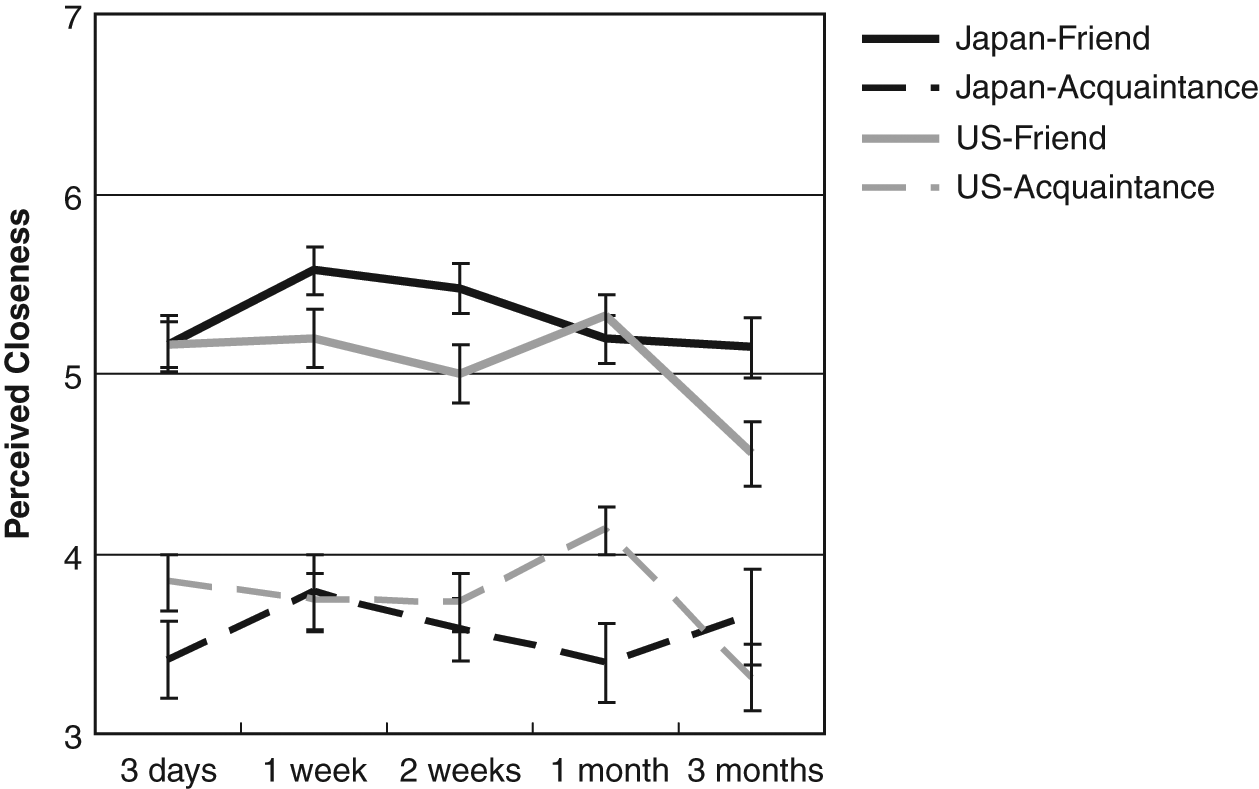
Perceived Closeness of Relationship With a Friend and an Acquaintance in Japan and the United States as a Function of Request Length
Means, Standard Deviations, and Intercorrelations for Positive Feelings and Predictor Variables for 3-Day to 1-Week Request and 1-Week to 3-Month Request in the Friend Condition
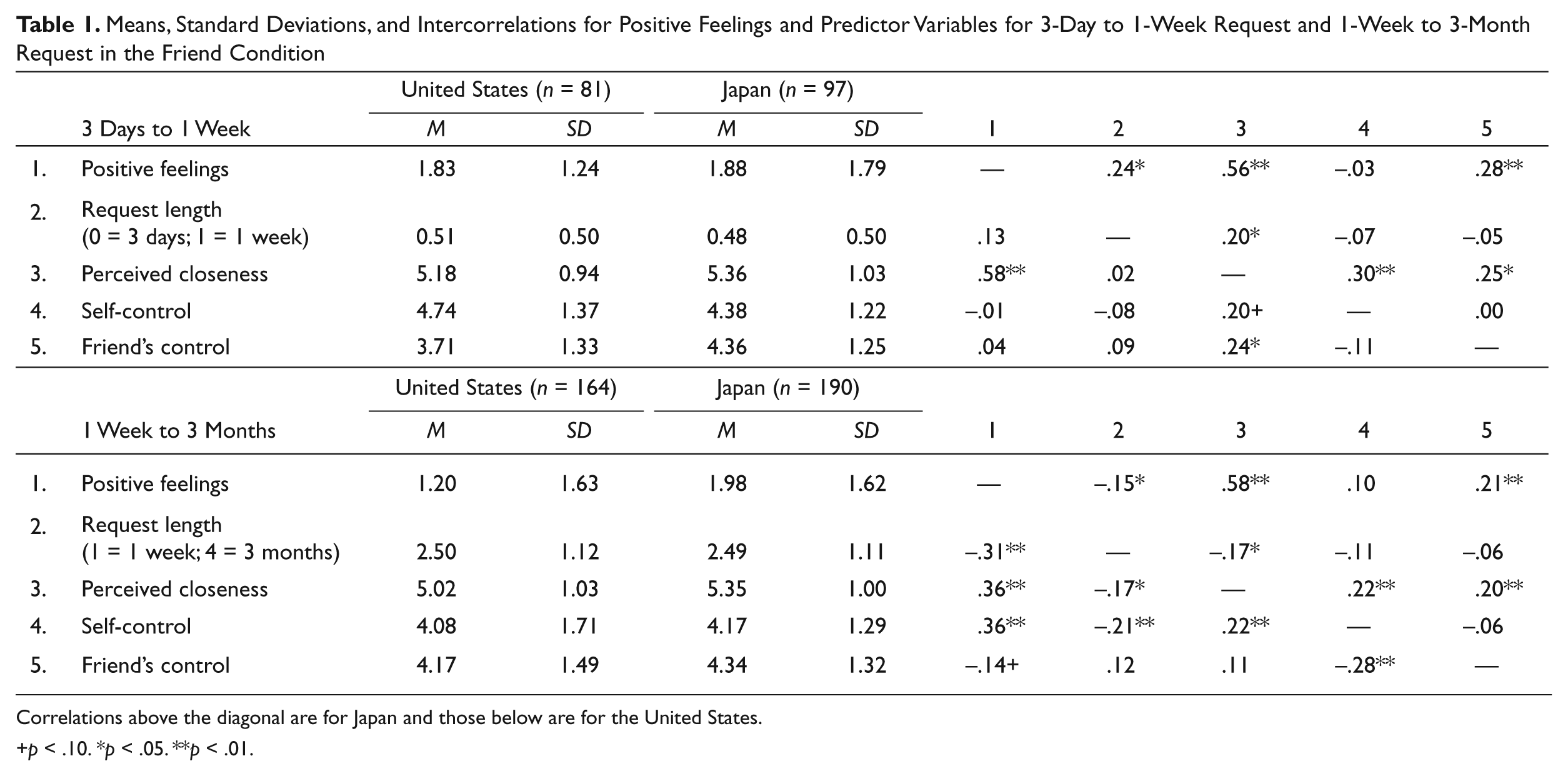
Correlations above the diagonal are for Japan and those below are for the United States.
p < .10. *p < .05. **p < .01.
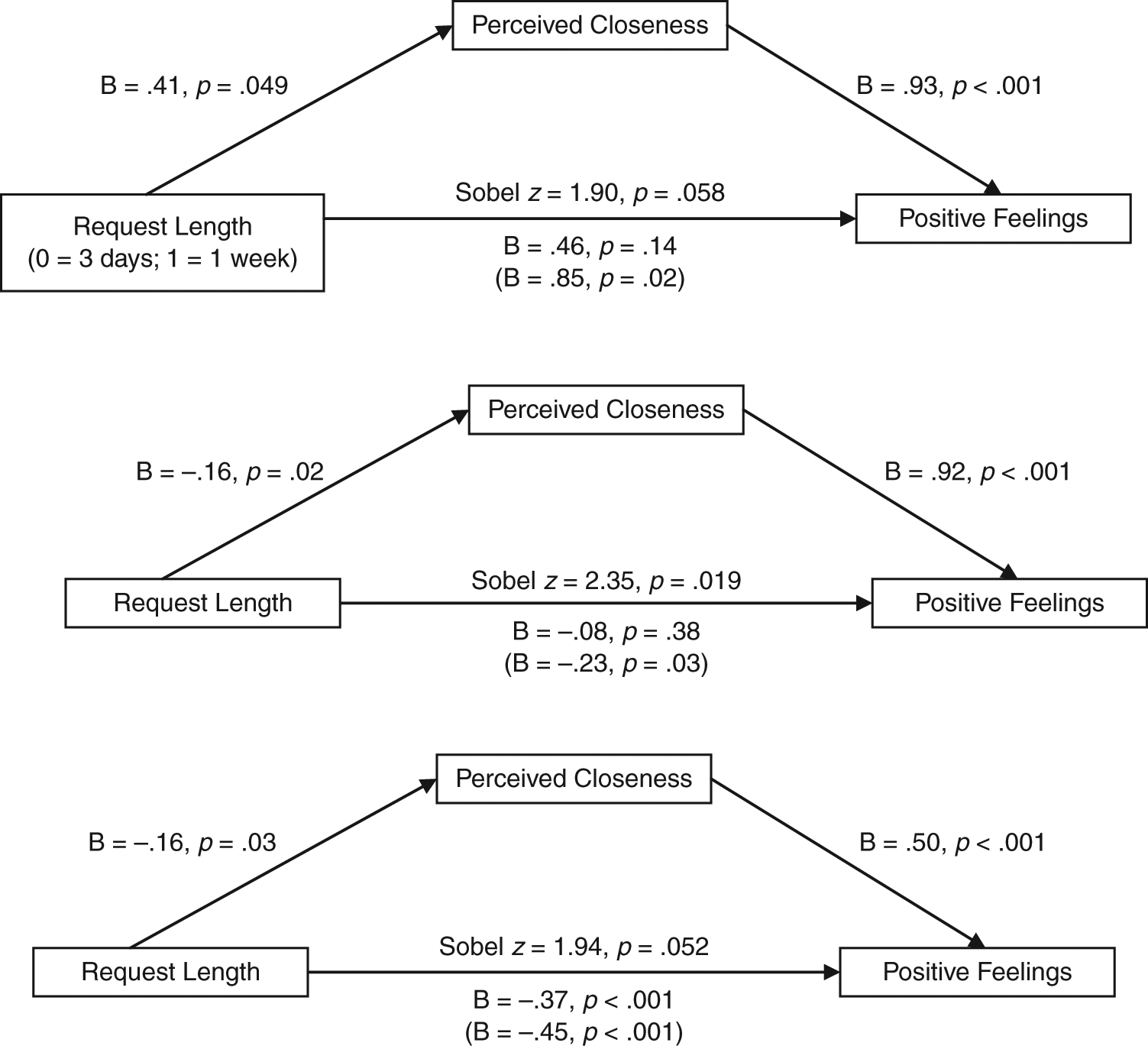
Perceived Closeness Mediating the Effect of Request Length on Positive Feelings in Japan from 3 Days to 1 Week
Mediation With Appraisals of Control
Figure 4 displays American and Japanese appraisals of their own and their friend’s control over the situation when the friend made requests of various lengths. As Figure 5 shows, Americans’ feeling of control partly mediated the effect of request length on positive feelings in the 3-day to 3-month period (Hypothesis 3). As the request length increased, Americans felt less in control of the situation B = −.32, t(202) = −4.02, p < .001, which, in turn, determined their positive feelings B = .32, t(202) = 5.10, p < .001. When the request length and control appraisal were entered simultaneously, control appraisal still predicted positive feelings B = .26, t(201) = 4.16, p < .001, but the effect of request length dropped from B = −.32, t(202) = −4.29, p < .001, to B = −.23, t(201) = −3.16, p = .002; Sobel’s z = 2.89, p < .01. The mediation did not hold for the perception of friend’s control. Although request length increased perceptions of friend’s control B = .20, t(201) = 2.66, p < .01, an increase in friend’s control only marginally reduced positive feelings B = −.13, t(201) = −1.82, p = .07. When both predictors were entered simultaneously, perceptions of the friend’s control no longer predicted positive feelings B = −.08, t(200) = −1.12, ns, suggesting that friend’s control is not a mediator. In Japan, request length reduced participants’ sense of control B = −.12, t(236) = −2.08, p < .05, but feeling in control did not predict positive feelings B = .07, t(235) = .86, ns. Moreover, request length did not predict perceptions of friend’s control B = −.05, t(235) = −.80, ns. Therefore, in Japan, neither participants’ sense of control nor their perception of friend’s control mediated the effect of request length on positive feelings.
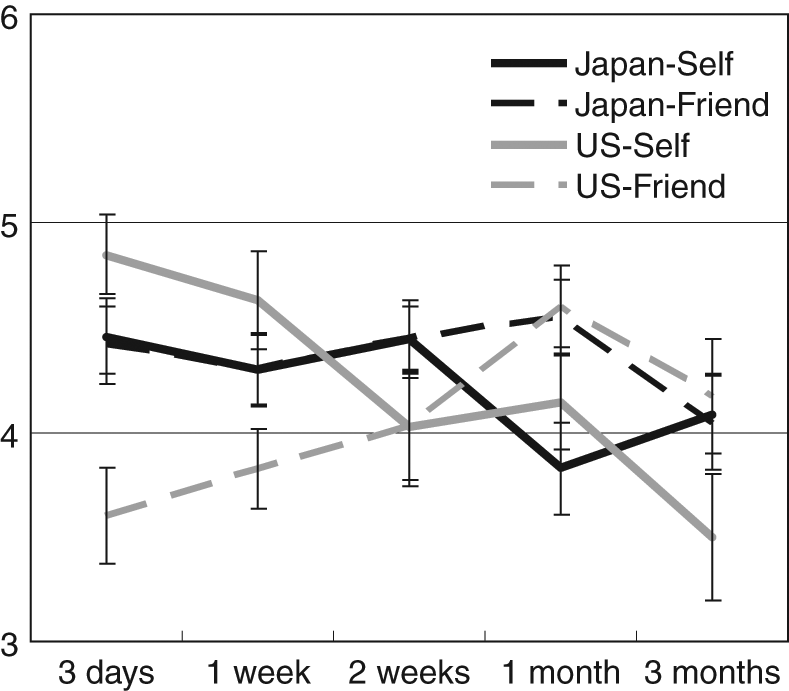
Self and Friend’s Control Appraisals of a Friend’s Request in Japan and the United States as a Function of Request Length

Control Appraisal Mediating the Effect of Request Length on Positive Feelings in the United States
In sum, consistent with Hypothesis 3, in Japan, the perceived closeness of the relationship explained both the increase in positive feelings from 3 days to 1 week and the decrease from 1 week to 3 months. In the United States, both perceived closeness and one’s sense of control contributed to the decrease in positive feelings from 3 days to 3 months.
Discussion
Our earlier study (Niiya et al., 2006) showed that Japanese and Americans would rather be asked to perform a favor than to have the friend solve the problem by asking someone else or getting it done professionally. The research reported here further shows that in Japan and to some extent the United States, being asked a larger favor makes people happier than being asked a smaller favor—up to a point. However, as in our previous study, there were also cultural differences in the basic pattern and in the associated appraisals.
Larger Favor Requests Increase Positive Feelings
Our study shows that increasing the size of a request can make people happier—up to a certain limit. We argued that this was because Japanese can interpret the favor request as Amae, which is often a manifestation of the requester’s desire for affection (Doi, 1973; Yamaguchi, 1999). The Japanese may have inferred from the request that their friend wanted a close affectionate relationship, and they felt good about confirming this friendship. That Americans also showed a slight increase suggests that Amae may not be entirely absent in the United States. Together with our past research (Niiya et al., 2006), the present results suggest that Amae might also exist in the United States, even though people have no name for the phenomenon. We believe that the findings apply to situations involving other requests as well, such as filling in for a friend on a job during the friend’s vacation or lending lecture notes for missed classes. However, the optimal point should vary depending on the burden of the task. Future research should examine the generalizability of the finding by using different vignettes and manipulations of request size.
The increase in positive feelings is consistent with the research by Williamson and Clark (1989), which found that in communal relationships, such as among friends, helping increases positive affect. Williamson and Clark (1989) argued that people feel happy helping a friend because they care about the well-being of close others and want to meet their needs. However, we believe that the good feeling produced by Amae is different from the feeling produced by helping in a communal relationship. In Amae, people derive positive feelings from the close relationship that the request implies, not from the fulfillment of others’ needs. Therefore, in Amae, positive feelings should arise even before people provide the help. In contrast, in communal relationships, people should be happy only after they provide the help. Although our study asked participants to rate how they would feel about being asked the favor, we cannot eliminate the possibility that they imagined what they would feel after helping the friend. Future research should distinguish these two sources of positive affect by measuring how people feel right after they are asked to do a favor and after they provide the requested help.
The existence of a tipping point in the acceptability of favor requests corroborates the idea that Amae can be either a positive or a negative experience for the Japanese depending on the underlying motives the situation evokes (Masamura, 1998; Niiya et al., 2000; Yamaguchi, 1999). When the request becomes too burdensome, Japanese may infer that the friend is more interested in taking advantage of them than in seeking affection.
Our finding may appear to contradict past findings that Asians and Asian Americans are less likely than European Americans to seek social support because they are worried about jeopardizing the relationship (Kim, Sherman, Ko, & Taylor, 2006; Kim, Sherman, & Taylor, 2008; Taylor, Sherman, Kim, & Jarcho, 2004). If Amae requests are pleasant, why do Japanese not seek help more often? Our study showed that Japanese can, under some special circumstances, feel happy being asked for a favor. However, as Kim and colleagues pointed out, asking favors may be stressful in Japan because of the risk that the potential helper will feel annoyed by the request. Therefore, Japanese may seek help only when they are fairly certain that the provider of help will not mind or when they believe that seeking help will strengthen the relationship.
Cultural Differences in the Reaction to Favor Request
Our study showed that although both Japanese and Americans can feel happy about an increasing request (up to a certain limit), Amae might not be as salient and functional in the United States as in Japan. Because Amae is common in Japanese daily interactions (Doi, 1973; Johnson, 1993), Japanese may have easily recognized the request from a friend as Amae and may have guessed the friend’s desire for close relationship. In contrast, in the United States, the lack of a word or concept for Amae may have made it more difficult for Americans to interpret the request as a desire for closeness.
In addition, our study found that although Japanese are sensitive to the closeness of relationships, Americans are concerned both with the closeness of relationships and the amount of control. Control is important in American emotional experience but less so in Japan (Mauro, Sato, & Tucker, 1992; Morling, Kitayama, & Miyamoto, 2002; Yamaguchi, 2001). Consistent with Niiya et al. (2006), Americans may have interpreted the requests for a favor as raising issues of control and balance of power. Future research should explore whether a request for a favor that emphasizes the autonomy and power of the potential helper would have a better chance of being accepted in the United States than a request for a favor based only on the closeness of the relationship.
Our finding that Americans were less happy about a friend’s request than the Japanese is consistent with Graf et al.’s (1979) finding that Americans are less tolerant than Dutch to a request for help. However, when an acquaintance made the request, Americans felt happier than Japanese, indicating that neither the American norm of self-reliance and autonomy nor the Japanese norm of interdependence and mutual help can fully explain the cultural difference. This cultural difference raises the possibility that decisions to help close and more distant others may involve different psychological processes.
Limitations and Future Research
The major limitation of this research was the use of a single scenario and self-report measures. We chose this method because we wanted to examine people’s reaction to several different requests that varied in size. Although not impossible, it would have been difficult to have pairs of friends make spontaneous requests in laboratory settings. Moreover, it would have been extremely difficult to manipulate five distinct levels of the independent variable with live behavior while maintaining cultural equivalence. One problem with vignette studies is the lack of experimental impact. However, our study yielded significant results that supported our prediction, suggesting that the manipulation was powerful enough to influence participants’ responses. Another problem is that people are not always accurate in predicting their feelings (Nisbett & Wilson, 1977). Participants in our study may have been particularly lenient about a request because they knew that they were not required to actually provide the requested help. We do not think that response bias fully accounts for our major results because even though the bias can affect the overall mean acceptance, its influence should not differ by condition. In particular, it is very unlikely that response bias only affected the 1-week condition where the peak acceptance occurred. Nonetheless, it is important to conduct laboratory experiments to complement the current findings and examine behavioral responses to favor requests.
One question that future research should address concerns the reasons for the cultural differences. Future studies should directly examine why increasing the burden leads Japanese to perceive a closer relationship. It would be also important for future research to include data from other interdependent cultures such as Korea or China that do not have a word for Amae. Although we believe that interdependent cultural norms cultivate Amae, having a word to name the phenomenon might be an important factor in making a larger request acceptable.
Conclusion
Being asked for a larger favor can make people happier in some situations. Depending on others for help may not be a sign of individual weakness but a cornerstone in building stronger relationships. A 50-year-old son may ask his 70-year-old mother to prepare his favorite soup for the holiday, not necessarily because he wants the soup but because he wants his mother to feel needed. The mutual benefits involved in seeking favors may play an important role in sustaining close relationships.
Footnotes
Acknowledgements
We thank Susumu Yamaguchi, Hiroaki Morio, and Eri Shigemasu for their assistance with data collection in Japan.
The authors declared that they had no conflicts of interests with respect to their authorship or the publication of this article.
The authors declared that they received no financial support for their research and/or authorship of this article.