



Abstract
A “spontaneous approach” was used to define self-schemas within and across cultures. Specifically, self-schemas were extracted from open-ended personality descriptions from Americans (n = 560) and Mexicans (n = 496) using the Meaning Extraction Method (MEM). The MEM relies on text analytic tools and factor analyses to learn about the most salient and chronically activated dimensions of personality that influence individuals’ self-defining process. The results showed that there were seven relevant self-schemas for Americans and six dimensions for Mexicans. Using qualitative and quantitative analyses, it was possible to observe which self-schemas were cross-cultural and which were culture-specific: Self-schemas common across cultures were Sociability, Values, Hobbies/Daily Activities, and Emotionality. Self-schemas unique to Americans were Fun, Existentialism, and College Experience. Self-schemas unique to Mexicans were Relationships and Simpatía. We discuss cross-cultural differences in self-schemas, along with the advantages and limitations of using the MEM in cross-cultural research.
Consider the essay that Jane has written about her personality:
… I am more open and outgoing than I ever was a few years ago. My friends have opened me up a lot because they don’t care how stupid I look or how embarrassing I am. That makes me less afraid to be outgoing and have fun. My friends at work have also opened me up a lot. Working at the store, you can’t be shy. I learned that the hard way I guess. When I first started working there I was timid and quiet. Then I learned to open up and talk to customers. For one, they feel comfortable because you are so friendly and give them advice on the product selections. And also, I really enjoy it too. It makes work more enjoyable when you can laugh and chat with the customers.
In this essay, Jane talks about behaviors that exemplify a change in her personality (i.e., being more open and outgoing). She has selected memories of events that best describe who she is now, and she expresses the feelings that emerge from changing her personality along a particular dimension. According to Markus (1977), self-schemas are what guided Jane to talk about situations, behaviors, attitudes, and feelings along a specific dimension of her personality. Markus writes that “attempts to organize, summarize, or explain one’s own behavior in a particular domain will result in the formation of cognitive structures about the self or what might be called self-schemata” (p. 64). Self-schemas 1 are chronically accessible constructs that direct an individual to focus on certain aspects of their life. Self-schemas influence how an individual perceives, remembers, and feels about life experiences (Cantor, 1990; Markus, 1977).
How do researchers identify the self-schemas that individuals hold? Traditionally, studies have used a “reactive approach.” For example, participants are asked to rate themselves along a dimension of self-descriptive adjectives and to indicate how relevant each trait is to them. We propose that a “spontaneous approach” can provide more information about salient and highly accessible self-schemas than “reactive approaches.” In this study, we ask the following question: What are the underlying self-schemas that guide people to use words that express personal qualities? People can talk about feelings, behaviors, preferences, values, and physical characteristics. The challenge is in defining the major self-schemas that influence how people selectively attend to certain features of their personality.
In a recent study, Chung and Pennebaker (2008) proposed a method to extract self-schemas from open-ended self-descriptions. The Meaning Extraction Method (MEM) is a new text analytic procedure based on how groups of words cluster together. Each cluster can be thought as an underlying self-schema that guides word choice when describing one’s personality. For example, a shy-schema might guide attention to words that tap memories of relevant events (e.g., talking, group, people) and situations (e.g., party), along with feelings that tend to emerge in those situations (e.g., insecure, nervous).
The current investigation uses Chung and Pennebaker’s MEM to define the underlying self-schemas that Americans and Mexicans use when they describe themselves. Cross-cultural comparisons can uncover those self-schemas that are cross-cultural, that is, self-schemas that people acquire in similar ways across cultures. Cross-cultural comparisons can also uncover those self-schemas that are culture-specific. Culture-specific schemas are the basis for differences across cultures; they reflect how individuals from different cultures organize their behaviors, preferences, feelings, and personalities in different ways (Markus, Hamill, & Sentis, 1987).
Expected Findings
Although we expected that self-schemas might be similar across cultures, the way these self-schemas are expressed might be influenced by the cultural context. For example, for both Americans and Mexicans, sociability might be a relevant dimension. However, in each culture, this trait could be expressed differently. Indeed, it has been found that Americans are more sociable in private environments, whereas Mexicans are more sociable in public environments (Ramírez-Esparza, Mehl, Alvarez-Bermudez, & Pennebaker, 2009).
Established differences in the cultural dimension of individualism-collectivism may also influence self-descriptions across cultures (Hofstede 1980; Triandis, 1995). In individualist cultures—where an independent self is promoted—individuals are more emotionally independent from groups, families, and organizations (Hofstede, 1980; Markus & Kitayama, 1991). In collectivist cultures—where an interdependent self is promoted—individuals show more concern for others and feel more integrated with others (Markus & Kitayama, 1991; Triandis, 1995).
The idea that the United States promotes an independent self and that the Mexican culture promotes an interdependent self has been supported by cross-cultural psychologists and cultural scientists (see Díaz-Loving & Draguns, 1999; Hofstede, 1980; Shkodriani & Gibbons, 1995). Accordingly, Americans may be more likely to use words related to personal qualities (e.g., competitive, ambitious), beliefs and attitudes (e.g., education, God), and other abstract personal attributes (Markus & Kitayama, 1998). In addition, Mexicans may use more words related to family (e.g., parents, sister), relationships (e.g., love, boyfriend), and roles (e.g., student, daughter).
Although constructs such as independence and interdependence are known to exist simultaneously within a culture, researchers have noted the existence of culture-specific schemas. Specifically, Simpatía is a cultural script that has been used to describe a pattern of social interaction meant to characterize Mexicans and Latinos (Triandis, Marín, Lisansky, & Betancourt, 1984). Simpatía is associated with striving to promote harmony in relationships, by showing respect toward others, avoiding conflict, emphasizing positive behaviors, and deemphasizing negative behaviors (Díaz-Loving & Draguns, 1999; Triandis et al., 1984). Indeed, in a recent study Latino Americans used more Simpatía-related words (e.g., likable, sympathetic, polite, gracious) in open-ended self-descriptions than did White Americans (Holloway, Waldrip, & Ickes, 2009).
Another construct that may appear to be culture-specific is achievement orientation in Americans, relative to Mexicans. Madsen and Kagan (1973) found that American mothers chose significantly more difficult achievement goals for their children than did Mexican mothers. In addition, Levine and Norenzayan (1999) found that from 31 cultures, Americans ranked 18th on the pace of life index (i.e., an index derived from walking speed, postal speed, and clock accuracy), and Mexicans ranked 31st. One might infer that Americans may describe their self as being ambitious, hardworking, and with envisaged goals, more so than Mexicans.
Method
Participants
American participants
Students enrolled in Introductory Psychology classes at the University of Texas at Austin completed a brief demographics questionnaire and provided open-ended personality descriptions in exchange for class credit. A total of 606 participants completed the study. Of these, 46 were excluded from the final sample: 3 did not indicate their sex, 5 were not students, 16 indicated that they identified themselves with a culture other than American and that they had recently moved to the United States, and 24 of the self-descriptive essays did not have a total word count of at least 75 words, suggesting that they had not taken the 15-minute self-description writing task seriously.
The final sample consisted of 560 American participants (232 men and 328 women) with a mean age of 18.85 years (SD = 2.12). Their socioeconomic status was 16.7% working to lower-middle class, 31.6% middle-class, and 51.7% upper-middle to upper class. Their ethnic background was 59.9% non-Hispanic White, 17.2% Hispanic, 15.4% Asian, 5.1% African American, 2.0% Native Hawaiian or Pacific Islander, and 0.4% American Indian or Alaskan Native.
Mexican participants
Participants were recruited by professors in Mexico City and Puebla who announced the study in their classes. Interested participants wrote their email addresses on a sign-up sheet and later received an email with a link to the study’s Web page. Other students were recruited by means of flyers passed out at the universities. 2 A total of 618 participants completed the study. Of these, 68 were not students, and 67 of the self-descriptive essays did not have a total word count of at least 75 words and so were excluded from the sample.
The final sample included 496 Mexican participants (123 men and 373 women). Their mean age was 20.93 years (SD = 3.17). Students were from the National Autonomous University of Mexico (n = 174), University Autonomous of Puebla (n = 84), University of the Americas at Puebla (n = 119), and other smaller schools/universities (n = 117). Their education was 90.3% currently in college, 7.1% finishing high school, and 2.6% pursuing graduate school. Their socioeconomic status was 15.7% working- to lower-middle class, 50.5% middle-class, and 33.8% upper-middle to upper class. Their ethnic background was 92.9% Hispanic, 5.0% non-Hispanic White, 0.9% Native Hawaiian or Pacific Islander, 0.9% American Indian or Alaskan Native, and 0.4% Asian.
General Procedure
Prospective participants were directed to one of two parallel websites that were created in either English or Spanish. Both Web pages had the same physical appearance and the same instructions and questions; the only difference was the language. In order to motivate participants to take part in the study, they were told that they would receive feedback about their personality based on their responses at the end of the study.
After reading a description of the study and agreeing to the items on a consent form, participants clicked an “accept” button. Participants first provided answers to the background questionnaire. Then they described their personality for 15 minutes. Finally, they read the automated feedback based on their responses to the study.
Procedure for the self-description essay
The instructions for the English personality description were as follows:
Personality has been defined as an individual’s characteristic traits, behaviors, and attitudes. For the next 15 minutes, describe your personality. At the end of the questionnaires, you will receive feedback about your writing. For it to be of any value to you, please take the assignment seriously.
The instructions in the Spanish personality description were as follows:
La personalidad se define como las características, rasgos, comportamientos y actitudes de una persona. Durante los siguientes 15 minutos, describe tu personalidad. Al final de los cuestionarios recibirás retroalimentación acerca de lo que escribiste. Ya que esta retroalimentación será de gran valor para ti, por favor toma la actividad con seriedad.
When they were ready, participants clicked the screen. A 15-minute timer was presented on the writing Web page, which included a large blank text field for typing. Individuals were told that they must write for the full 15 minutes and that they should write during the entire time. An automated message flashed onto the screen if they stopped writing to remind them to keep writing. Also, an automated message flashed when the 15 minutes had passed, telling the participants that they could finish typing or continue if they wanted to.
Procedure after collection of data
Participants’ scores were recorded and saved to a database. Each of the self-descriptions was formatted as a single plain text file. A spell-check was performed for each text file. The mean word count was 230.07 (SD = 79.81) for the English text files and 295.06 (SD = 157.13) for the Spanish text files.
Text Analytic Strategy: The MEM
To determine self-schemas in the United States and in Mexico, the MEM was conducted on the text files in three steps.
Step 1: Identifying the most frequently used content words
Frequency counts were taken of all words in the self-descriptions, excluding closed-class words (e.g., articles, auxiliary verbs, prepositions, pronouns), using a computerized word counter, WordSmith (Scott, 1996). The most frequently used content words used in at least 5% of all text files were selected. A total of 134 and 132 content words from English and Spanish text files, respectively, were kept for further analyses.
Step 2: Assessing the occurrence of content words in text files
Each of the most frequently used content words was counted separately within each personality essay using Linguistic Inquiry Word Count (LIWC; Pennebaker, Francis, & Booth, 2001). LIWC is a software program that assesses the percentage of particular words or word categories used within text files. A user-defined dictionary directs LIWC as to which words or categories of words to search for. In this study, a dictionary containing the root words of each selected content word was compiled for LIWC. For example, the dictionary included a selected word (e.g., angry) and all forms of its root word that could be produced using an alternate suffix (e.g., angrier, anger, angers), regardless of whether the alternate form appeared in at least 5.0% of all the self-descriptions. By uploading this user-defined dictionary in LIWC, it was possible to assess the percentage of selected words used in each self-description.
Although similar components emerge when using binary numbers or percentages, we chose to report the results based on binary data following previous MEM studies. Specifically, using Chung and Pennebaker’s strategy, the data were coded for the occurrence (coded as 1) or absence (coded as 0) of each root word category. The final data summary, then, can be thought of as an X (Number of Self-Descriptions) × Y (Number of Words) matrix, with each entry referring to the presence or absence of each term within each essay. A total of two matrices were set up to accomplish the main goal of this study: 560 (American Participants’ Self-Descriptions) × 134 (English Content Words) matrix, and a 496 (Mexican Participants’ Self-Descriptions) × 132 (Spanish Content Words) matrix.
Step 3: Factor analyses to extract self-schemas
Although results from a principal component analysis using varimax rotation are reported, virtually identical results were obtained using principal axis analyses and with promax, oblique, and equamax rotations.
Results
The main goals of this study were to define self-schemas in the United States and in Mexico and to explore cross-cultural and culture-specific schemas. This section is divided into four parts: First, the most frequent words used in both languages are provided. Second, self-schemas derived using the MEM are defined for the United States and for Mexico. Next, we observe how these self-schemas are similar or different across cultures.
Word Frequencies in the United States and in Mexico
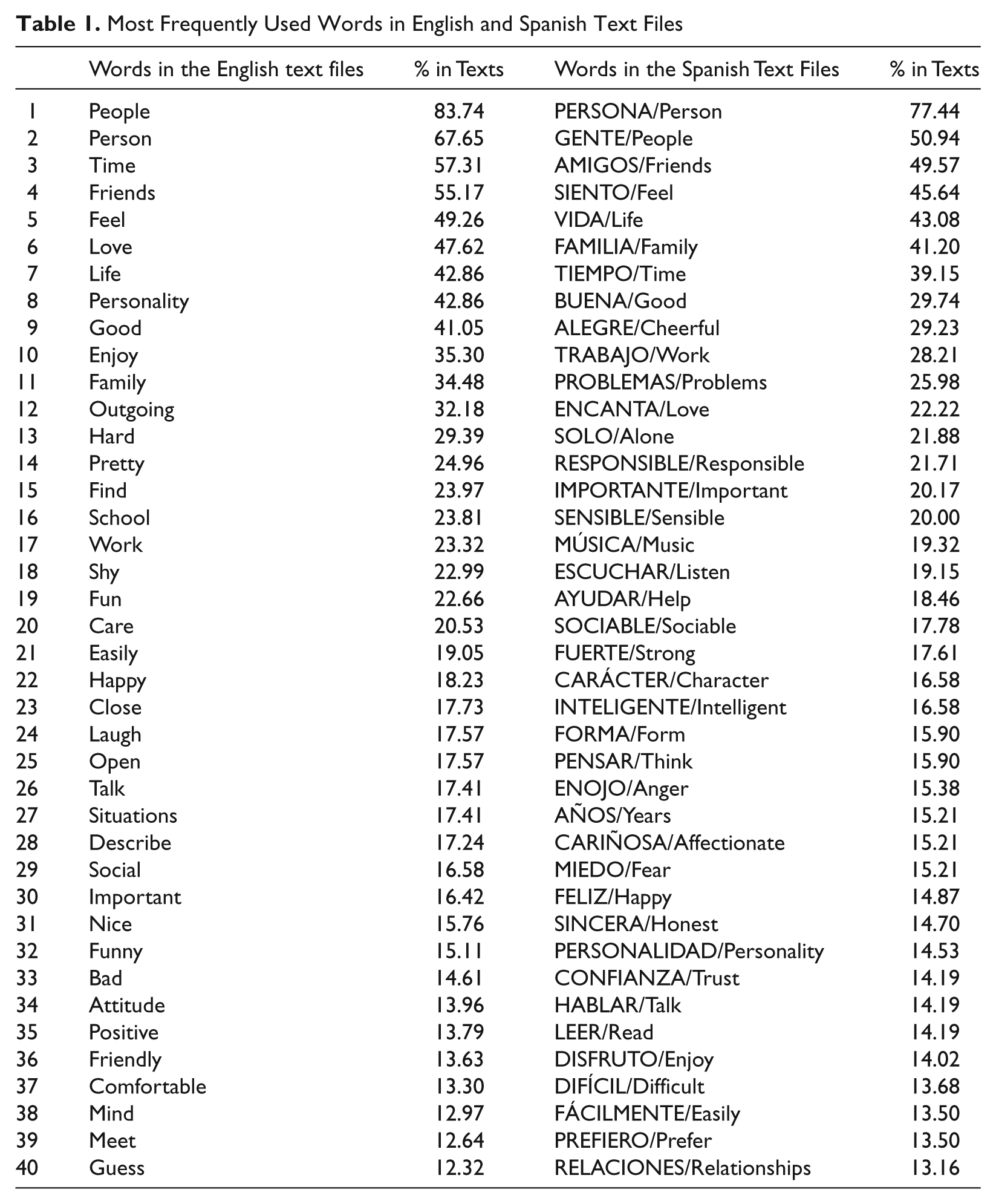
Table 1 shows the Top 40 most frequently used content words by Americans and Mexicans. Note that many of the Top 10 most frequent words in the English text files were also within the Top 10 most frequent words in the Spanish text files (i.e., person, people, time, friends, feel, life, and good). Interestingly, Americans used more words about being outgoing and sociable (e.g., outgoing, shy, meet, open, laugh, friendly), whereas Mexicans used more words related to being nice and agreeable (e.g., affectionate, responsible, help, honest, sensible). In order to quantify the degree of similarity between cultures in the Top 40 list, we correlated the frequencies between the words that had the same translated meaning in both the English and the Spanish list. The results showed that there was high agreement (r = .97).
Most Frequently Used Words in English and Spanish Text Files
Self-Schemas in the United States and in Mexico: The MEM
American self-schemas
A principal components extraction with varimax rotation was first performed on the words from the English self-descriptions. Diagnostic tests indicated that a factor model was appropriate for the data (KMO = .50, Bartlett’s test of sphericity = 12,695.60, p < .001). Factors were extracted, based on a scree of Eigenvalues for the principal components (Cattell, 1966). Specifically, seven factors were selected based on the number of factors at the elbow bend that had Eigenvalues above 2.20 and provided a significant increment to the cumulative percent variance. The first seven factors accounted for 13.98% of the total variance. As in Chung and Pennebaker (2008), factor loadings of .20 or higher were retained. 3
As can be seen in Table 2, six of the seven factors bring together a group of content words that are psychologically meaningful and coherent. Factor 3 included positive and negative loadings, indicating two different factors within this factor: Fun (negative loadings) and Existentialism (positive loadings). 4 From now on, those subfactors will be referred to as Factors 3A and 3B, since each one is coherent. For example, Factor 3A (Fun) includes outgoing, friend, fun, party, and girl. Likewise Factor 3B (Existentialism) includes hope, attitude, thinking, understand, and future. Closer inspection of the factors revealed two factors related to sociability: one refers more to assertiveness, and the other refers to having fun. For example, in contrast with Factor 3A (Fun), Factor 2 (Sociability) includes group, comfortable, enjoy, open, close, social, relationship, problem, prefer, and shy. These two factors were similar to the Sociability factor found by Chung and Pennebaker (2008).
Self-Schemas From Americans’ Self-Descriptions: A Varimax-Rotated Principal Components Analysis
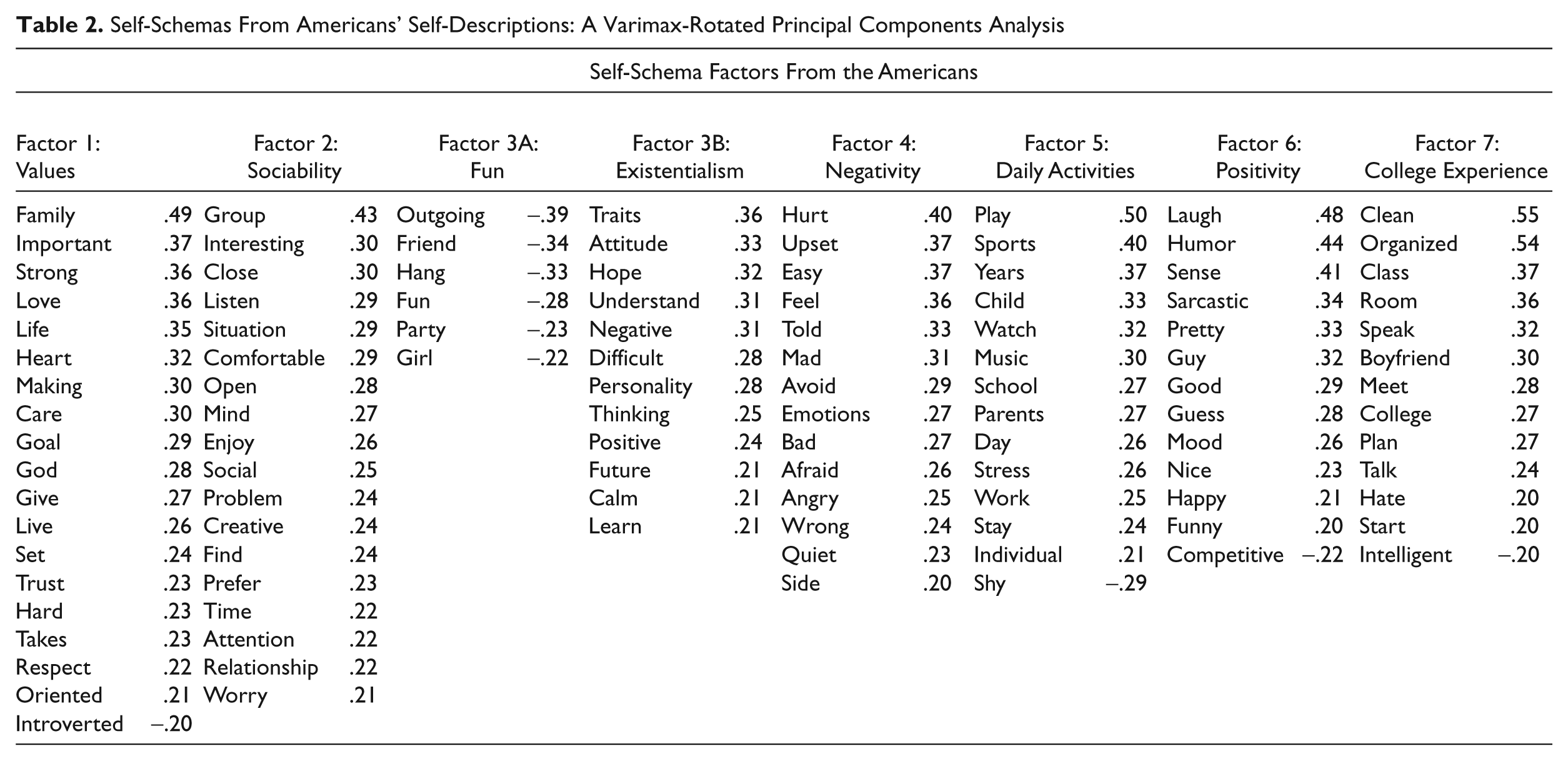
Other factors were concerned with either more mundane or abstract themes such as 5 (Daily Activities), 1 (Values), and 3b (Existentialism). Factor 5 consisted of a group of words describing common activities (e.g., play, watch, work), their associated objects (e.g., school, music, sports), and time markers (e.g., years, day). Factor 1 (Values) lists family, care, God, give, live, love, trust, and respect. These three factors were similar to those found in Chung and Pennebaker (2008), especially the Daily Activities and Existentialism. However, in Chung and Pennebaker’s study, the factor Values was represented in two separate factors, Relationships and Ambition.
There was a factor with positive valence words and a separate factor with negative valence words. Factor 6 (Positivity) included laugh, humor, sarcastic, pretty, good, and happy, whereas Factor 4 (Negativity) included hurt, upset, mad, bad, and angry. Interestingly, Chung and Pennebaker (2008) did not find valenced factors. This might be due to the fact that participants in their study were asked to look at themselves in the mirror while describing their personality. These instructions induced the participants to focus on more superficial and slightly more negative aspects of their self, a possible effect of self-focused attention (Duval & Wicklund, 1972). For example, Chung and Pennebaker reported three factors that were not found in this study: Appearance (e.g., hair, eyes, nose), Evaluation (e.g., weight, lose, pretty), and Reflection/Interests (e.g., mirror, face, look).
Finally, Factor 7 (College Experience) shows that participants included their college experience in their personal schemas as indicated by the use of words such as class, boyfriend, and college. This factor was not found in Chung and Pennebaker’s (2008) study.
Mexican self-schemas
A principal components extraction with varimax rotation was performed on the root word categories from the Spanish self-descriptions. Diagnostic tests indicated that a factor model was appropriate for the data (KMO = .54, Bartlett’s test of sphericity = 12,417.92, p < .001). Factors were extracted, based on a scree of Eigenvalues for the principal components (Cattell, 1966). Specifically, six factors were selected based on the number of factors at the elbow bend that had Eigenvalues above 2.20 and provided a significant increment to the cumulative percent variance. The first six factors accounted for 13.97% of the total variance. As in Chung and Pennebaker (2008), factor loadings of .20 or higher were retained.
As shown in Table 3, the six-factor solution yielded a set of coherent dimensions, some of which resembled those found in the U.S. descriptions. Specifically, Factor 3 (Sociability) and Factor 4 (Values) of the Spanish descriptions were similar to Factor 2 (Sociability) and Factor 1 (Values) of the English descriptions. For example, Sociability included speak, express, alone, timid, and nervous and Values included learn, accomplish, work, money, God, and life.
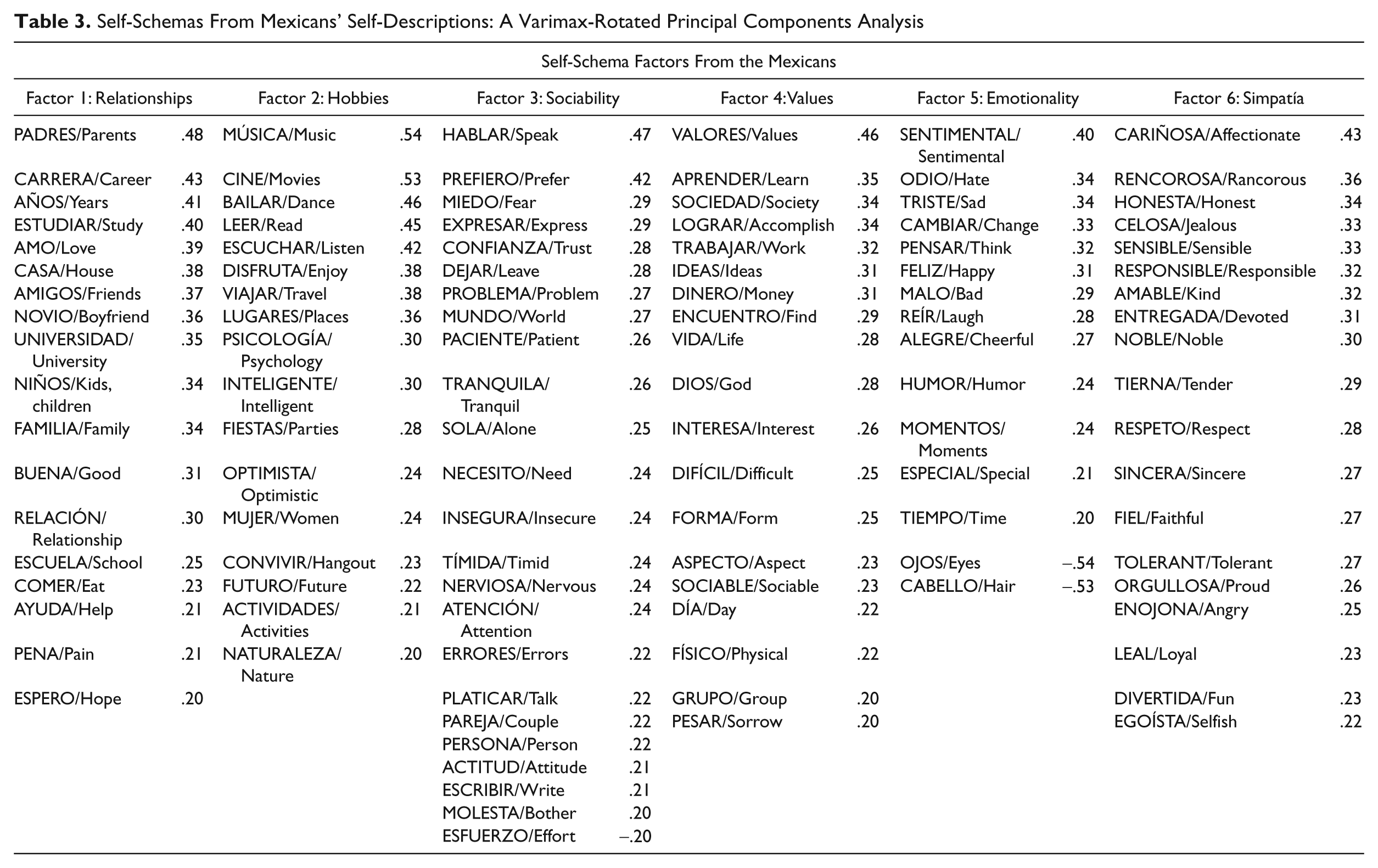
Factor 5 (Emotionality) included both negative and positive valenced words (e.g., sad-happy, hate-love, good-bad). Factor 2 (Hobbies) was similar to the Daily Activities factor from the U.S. descriptions, but it did not include the time component; Factor 2 focused more on mundane activities. Hobbies referred to what participants like to do in their lives (e.g., music, travel, parties).
Two factors were not found in the U.S. participants: Factor 1 (Relationships) and Factor 6 (Agreeableness/Simpatía). The factor Relationships included words related to family activities (e.g., parents, house, eat), friends and romantic relationships (e.g., love, friends, boyfriend), and education (e.g., career, university, school). This factor was similar to the factor Relationships found by Chung and Pennebaker (2008).
Finally, Factor 6 was labeled Simpatía because it is a reflection of the well-established cultural script of Mexicans and Latinos (Holloway et al., 2009; Triandis et al., 1984). Recall that a person high on Simpatía is likeable, easygoing, polite, and fun to be with; is affectionate; and likes to share feelings with others. Indeed, in the Simpatía dimension, Mexicans used words such as affectionate, honest, noble, and tolerant.
Summary
By using the MEM it was possible to define coherent self-schemas in the United States and in Mexico. A qualitative analyses from the results showed that four factors in the United States were similar to those found in Mexico and might be thought of as cross-cultural schemas: Values, Sociability, and Emotionality. Although emotions in the U.S. sample were reflected in two separate factors (i.e., Positivity and Negativity), they appeared together as a single Emotional factor in the Mexican sample. Other factors that were similar across cultures were Activities in the United States and Hobbies in Mexico. However, there were some apparent differences between them: While in the United States Daily Activities reflected mundane activities, in Mexico Hobbies reflected specific interests. In contrast, three factors in the American sample (Fun, Existentialism, and College Experience) and two factors in the Mexican sample (Relationships and Simpatía) can be thought of as culture-specific dimensions.
Quantifying Similarities and Differences of Schemas Across Cultures
In order to quantify if dimensions were comparable across cultures, we used what we called the translated approach. This approach consisted of the following four steps:
A LIWC dictionary was created where each word that belonged to a factor comprised a single LIWC category. For example, the dictionary would include a category called Fun and each word within the category (i.e., outgoing, friend, hang, fun, party, and girl) would become part of this category Fun. This step was done for each of the resultant dimensions in the United States (i.e., an English dictionary containing each of the U.S. dimensions was created) and in Mexico (i.e., a Spanish dictionary containing each of the Mexican dimensions was created).
Using these dictionaries and LIWC, we assessed the percentage of words used in each file that comprised each dimension. Specifically, the English dictionary was run on the English text files and the percentage of words used for each U.S. dimension was assessed for each participant. Likewise, the Spanish dictionary was run on the Spanish text files and the percentage of words used for each Mexican dimension was assessed for each participant.
Dictionaries were translated into the other language (i.e., the English dictionary into Spanish, and the Spanish dictionary into English). Then, the translated English dictionary was run on the Spanish text files, and the translated Spanish dictionary was run on the English text files. The purpose of running the translated English dictionary on the Spanish text files was to obtain the percentage of words used by the Mexicans for each of the U.S. dimensions. Likewise, the purpose of running the translated Spanish dictionary on the English dictionaries was to obtain the percentage of words used by the Americans for each of the Mexican dimensions.
In the American sample, U.S. dimensions (i.e., the percentages obtained from running the English dictionary on the U.S. sample) were correlated with Mexican dimensions (i.e., the percentages obtained from running the translated Spanish dictionary on the U.S. sample). Likewise, in the Mexican sample, the Mexican dimensions (i.e., the percentages obtained from running the Spanish dictionary on the Mexican sample) were correlated with U.S. dimensions (i.e., the percentages obtained from running the translated English dictionary on the Mexican sample). These analyses determined the degree to which dimensions were related across cultures. For example, it was expected that the factor Values from the U.S. sample would correlate highly with the translated factor Values of the Mexican dimensions in the English text files. Similarly, we expected that the Mexican factor Values would correlate highly with the translated U.S. factor Values.
Table 4 shows the correlations between the American dimensions and the Mexican dimensions. Correlations from English text files are shown in the top half of the table; correlations from the Spanish text files are shown in the bottom half of the table. Correlations that are expected to be high in both text files are presented in italics. Only those correlations that were significant (p < .001) and above .20 are bolded.
Correlations Between Self-Schemas and Translated Dimensions for Both the English and Spanish Text Files
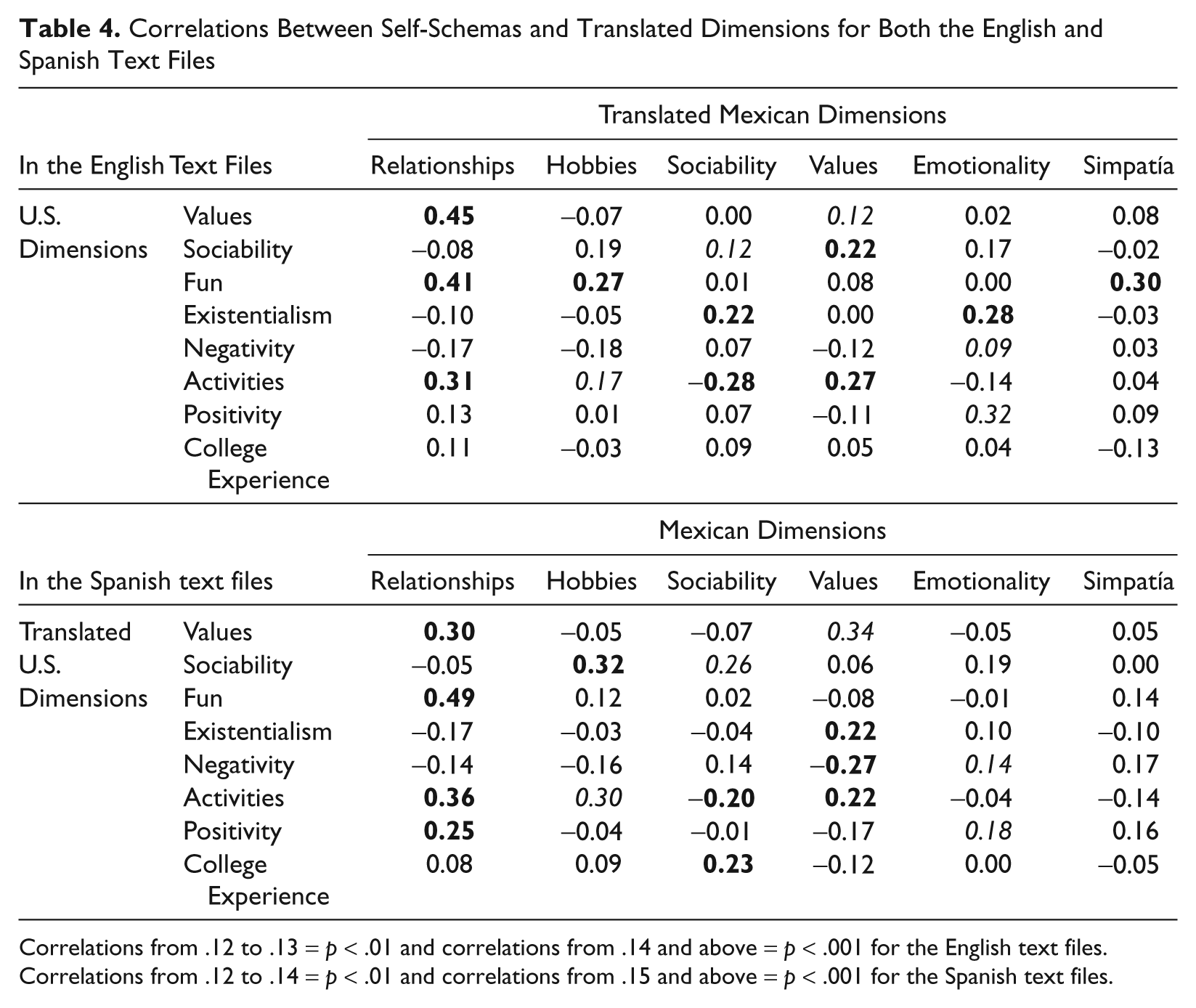
Correlations from .12 to .13 = p < .01 and correlations from .14 and above = p < .001 for the English text files.
Correlations from .12 to .14 = p < .01 and correlations from .15 and above = p < .001 for the Spanish text files.
Cross-cultural self-schemas
The results show that the correlations are not as high as one would expect if the dimensions were equivalent across cultures. However, the correlations provided information about the degree to which dimensions in each culture were related to translated dimensions from the other culture. The expected high correlations were mostly found in the Spanish text files. For example, Mexicans who wrote about their hobbies also used words from the U.S. Daily Activities dimension; Mexicans who used words from the Sociability Mexican dimension also used words from the U.S. Sociability dimension; Mexicans who wrote about their values also used words from the U.S. dimension Values. In the English text files, these correlations were significant, but the Pearson correlations were not as strong as those found in the Spanish text files. For the Mexican Emotionality factor, expected significant correlations were found with the factors Negativity and Positivity in the Spanish text files, but Pearson correlations were small. For the English text files, only one expected significant correlation was found: Mexican Emotionality with U.S. Positivity. These significant correlations demonstrate that similar dimensions across cultures relate to each other; therefore, these dimensions are, for the most part, cross-cultural.
Culture-specific schemas
Culture-specific dimensions for Mexico, such as Simpatía and Relationships, were expected to have low correlations with most of the U.S. dimensions in the English text files. Similarly, culture-specific dimensions for the United States, such as Fun, Existentialism, and College Experience, were expected to have low correlations with most of the Mexican dimensions in the Spanish text files. These predictions were largely true for the factors Simpatía, Fun, Existentialism, and College Experience. Specifically, in the English text files, the factor Simpatía only correlated highly with Fun, which indicates that Americans who use words such as affectionate, jealous, and responsible tend to use words such as outgoing, hang, and party.
In the Spanish text files, Fun correlated highly with Relationships, indicating that Mexicans who use words such as outgoing, fun, and party tend to use words such as parents, study, and family. The factor Existentialism correlated highly with Values, indicating that Mexicans who use words such as attitude, hope, and understand also tend to use words such as work, money, and God. Finally, the factor College Experience correlated highly with Sociability, which indicates that Mexicans who use words such as clean, organized, and room also use words such as speak, timid, and nervous.
The Mexican factor Relationships correlated highly with several U.S. dimensions in the English text files. This finding did not support the idea that the culture-specific dimension Relationships should have low correlations with U.S. dimensions in the English text files. For example, high positive correlations were found with the factors Values, Fun, and Activities. The Mexican factor Relationships reflects family roles and group activities (e.g., parents, house, eat), friends and romantic relationships (e.g., love, friends, boyfriend), and education (e.g., career, university, school). Thus, the use of these themes in Americans is associated with themes about Values (e.g., family, god, respect), Fun (e.g., outgoing, party, fun), and Everyday Activities (e.g., play, sport, watch).
Summary
The findings from the translated dimensions largely supported the qualitative analysis of dimensions, showing that various dimensions are either cross-cultural or culture-specific. In general, one can conclude that the factors Values, Sociability, Emotionality, and Hobbies/Activities are similar across cultures. The factors Fun, Existentialism, and College Experience are culture-specific to Americans, and the factor Simpatía is culture-specific to Mexicans. The factor Relationships seems to be equally relevant for both Americans and Mexicans, however the way this factor is constructed differs across cultures. For the Mexicans, the factor Relationships reflects everyday life with family, going to school, and spending time with friends and romantic partners. For the Americans, these themes were discussed as part of their values, having fun, and everyday activities.
Other interesting and understandable correlations were found. For example, in both the U.S. and Spanish self-descriptions, the U.S. dimension Sociability correlated positively with Hobbies, but the Mexican dimension Sociability correlated negatively with Daily Activities. This means that Americans and Mexicans who write about sociability write more about their hobbies and less about their everyday activities. Another interesting finding is that Relationships correlated negatively with Existentialism and Negativity in both the English and Spanish text files. Americans and Mexicans who talk about relationships tend to use less negatively valenced and existential words. These are among several interesting findings that can be drawn from the correlations using the translated approach.
Discussion
We sought to define self-schemas using a “spontaneous approach.” Specifically, we used the MEM to learn about the most salient and chronically activated self-schemas that influence individuals’ self-defining process. In addition, we sought to define cross-cultural and culture-specific self-schemas from Americans’ and Mexicans’ personality descriptions.
Are Cultural Differences Reflecting Well-Known Cultural Frameworks of Americans and Mexicans?
American participants reflected their independent self in the factors Existentialism, College Experience, and Fun. The Existentialism factor supports the idea that people with independent selves tend to describe themselves in more abstract and global ways (see Markus & Kitayama, 1998). For example, American participants used words such as traits, attitude, hope, understand, and personality. The factor Fun supported the idea that the independent self socializes or relates to others as means of obtaining something (Markus & Kitayama, 1991, 1998). Americans used words such as outgoing, fun, hang, and girls. Going to parties is a means to have fun, hang out with friends, and meet girls.
In contrast, the Mexican participants mirrored their interdependent self in the factor Relationships. This dimension clearly reflects how everyday activities go hand in hand with other human beings: They used words such as study, eat, help, love, university, and career, with words such as parents, friends, boyfriend, family, and relationship.
The Mexican dimension Simpatía mirrored various aspects of the well-established cultural script in Mexicans (Holloway et al., 2009; Ramírez-Esparza, Gosling, & Pennebaker, 2008; Triandis et al., 1984). Indeed, words such as kind, affectionate, respect, sincere, and honest supported the idea that a person who is simpático is kind and polite. Words such as rancorous, jealous, proud, angry, tolerant, and fun supported the notion that being simpático is associated with an easygoing outlook. Finally, the words devoted, faithful, and loyal supported the idea that Simpatía is related to promoting harmony in relationships by avoiding conflict and emphasizing positive behaviors.
There were no culture-specific dimensions that supported the idea that Americans are more achievement oriented. However, it is interesting to note that Americans used time markers in the factor Daily Activities (e.g., years, day). Furthermore, this factor and the factor College Experience mirrored a concern for things that need to be done, like a to-do list or activities that have a set space in time. These word choices support the notion that some cultures, and especially the United States, are future-oriented (Hall, 1983). Americans place an emphasis on planning for the future and are concerned about being punctual and efficient (Levine & Norenzayan, 1999). In contrast, Mexicans are characterized as a present-oriented culture (Hall, 1983; Marín & Marín, 1991), suggesting that Mexicans are not planners, punctual, or efficient (Levine & Norenzayan, 1999). Indeed, Mexicans’ word choice did not indicate a salient concern with timed tasks.
Another interesting cross-cultural difference found in this investigation is the way emotional self-schemas were construed across cultures. In the American sample, two valence factors were found (i.e., one with positive valence words and the other with negative valence words). Instead, in Mexicans, both positive and negative valence words were part of a single dimension. This finding supports the idea that cultures with an independent self tend to view positive and negative affect as opposites, whereas cultures with an interdependent self view affect in a dialectic way (Bagozzi, Wong, & Yi, 1999).
The MEM: Advantages and Limitations
Traditionally, cognitive researchers and trait psychologists have studied self-schemas by using self-report scales on large samples, obviating the need for laborious and sometimes unreliable content analyses by multiple judges. In addition, most traditional content analyses have been used to assess attitudes, intentions, or motives but not personality traits (note that McAdams would have assigned these at Levels 2 and 3 versus at Level 1 ways of describing personality, respectively; McAdams, 1995; McAdams et al., 2004). However, one of the advantages of the MEM is that it allows researchers to define the self-schemas that direct individuals’ thinking processes while describing who they are for large samples. Another unique advantage of the MEM is its suitability to study self-schemas across cultures. Since the method is inductive, it is possible to capture the most relevant self-schemas in people within their culture and language. This method avoids imposing constructs, theories, or lists of adjectives onto individuals. Moreover, translation issues become relevant only at the end of the process. A third advantage from the MEM is that it is less susceptible to self-presentational biases (Heine & Renshaw, 2002; Ramírez-Esparza et al., 2008). People can present themselves as socially desirable or self-enhancing in self-descriptions. However, the MEM is merely concerned with whether or not people used certain words, not their levels of a particular trait.
One of the limitations of the MEM is that it requires more steps to extract dimensions from natural language text, relative to computing scores on Likert-type rating scales (i.e., spell check of texts, frequency word counts, development of dictionaries, and finally factor analyses). Furthermore, selecting the number of factors and labeling them can be somewhat subjective, especially when factor loadings are small, as is the case in this investigation. Although in this study the number of factors was selected according to the scree plot (i.e., number of factors at the elbow bend), there are other criteria to consider in selecting the number of appropriate factors (e.g., Eigenvalues, percent of variance explained, and number of factors before the elbow end). Also, many times, there is little agreement as to how to label the factors. Ultimately, the researcher has to be artistic in coming up with labels that comprise most of the words within a dimension.
The dimensions that are extracted from the MEM may not be relevant to all respondents, whereas established trait rating scales are capable of producing a score on each dimension for each respondent. In using the MEM, one can estimate the main dimensions of salience across a corpus, but it is unlikely that we are extracting dimensions that describe all texts in the corpus.
Future Directions and Limitations of the Study
The goal of this study was to examine the underlying self-schemas that guide people’s thoughts when talking about their personality. That is, we set out to examine the “doing” side of personality. However, future research is needed to link the self-schemas found here with the “having” side of personality (or the structural basis of individual differences; Cantor, 1990). Do introverted Mexicans also talk more about sociability? Do agreeable Mexicans use the self-schema of Simpatía to describe their personality? Not only would it be beneficial to use translated questionnaires (e.g., the Big Five Inventory; Benet-Martínez & John, 1998) but also indigenous questionnaires like the one developed by La Rosa and Díaz-Loving (1991) for Mexicans. In sum, using self-reports would be informative about the ways self-schemas are shaped by personality traits within and across cultures.
It is imperative that future studies seek additional validation of cultural self-schemas extracted using the MEM. Cultural self-concepts have been widely studied using the Twenty Statement Test (TST; Kuhn & McPartland, 1954; for a review, see del Prado et al., 2007), and so an appropriate course of validation for future studies would be to ask people to respond to the statement “I am . . .” 20 times. A factor analysis on the most frequent responses could be performed to see if similar self-schemas result. Also, independent judges could rate the statements according to the self-schemas found in self-descriptions using the MEM.
Could self-schemas been influenced by the context or the language? The answer is yes. For example, it is possible that the physical context (i.e., Austin vs. Mexico City) instead of the cultural self-identification (American vs. Mexican) could have influenced the way participants construct their self (see Rentfrow, Gosling, & Potter, 2008). Another possibility is that differences in cultural self-schemas could have been the result of English-speaking versus Spanish-speaking communities. Future studies where Spanish-English bilinguals describe their personality in English and Spanish would be informative in this regard. Also, by asking monolinguals from Spain or England to describe their personality would be informative to learn how the cultural context influences self-schemas above and beyond the language or vice versa.
In this study, college students served as participants because they presented the most efficient way of comparing cross-cultural phenomena. Students are relatively similar across cultures, which increases the chances that differences across cultures are due to true cultural phenomena and not to population differences or different sampling procedures. However, including only students was also a limitation. Neither students in the United States nor students in Mexico are a representative sampling of a wider American or Mexican population. Furthermore, students are widely influenced by globalization, and cultural similarities could have been the result of similar cultural values due to globalization (Arnett, 2002). A study with a population of individuals from different socioeconomic status, ethnic backgrounds, education level, and ages would provide a more comprehensive evaluation of American and Mexican’s cultural self-schemas.
Conclusions
Using a new method of text analysis, we were able to find self-schemas that were cross-cultural and some that were culture specific in the United States and in Mexico. The word factors reflect how people are structuring their worlds—how they are thinking about themselves and other salient topics of self-relevance. What distinguishes this approach from traditional self-report measures is that it is purely inductive; participants write whatever they think is relevant to themselves and the computer simply calculates the degree to which their words form semantic clusters. Compared to Likert-type rating scales of traits, descriptions of personality are more common in everyday life, across generations, social classes, and cultures. Asking members of different cultures open-ended questions is encouraged for future research in cross-cultural psychology.
Footnotes
Acknowledgements
This article benefited greatly from the feedback provided by Samuel D. Gosling. We are grateful to Juan José Ramírez, Maria Luisa Marván, Dyana Ramírez, Esperanza Esparza, Guadalupe Prieto, and Oscar Díez for their help in recruiting Mexican participants.
The authors declared that they had no conflicts of interests with respect to their authorship or the publication of this article.
Preparation of this manuscript was aided by funding from the Army Research Institute (W91WAW-07-C-0029), CIFA (DOD H9c104-07-C-0014), START (DHS Z934002), NSF (NSCC-090482), and the National Institute of Mental Health grants (MH 52391).