



Abstract
This study investigates the role that culture plays in the effect of intimacy, relationship type, and resources on obligations. Participants (n = 144 U.S. undergraduates and n = 122 Chinese undergraduate and graduate students) were asked about their obligations to another person. Chinese, as compared to Americans, reported greater obligation and greater likelihood to expend money to help another. Americans reported greater intimacy with others and greater likelihood of expending time talking. Chinese are willing to “spare a dime” (i.e., help with money), whereas Americans are willing to “spare some time” (i.e., help with time). Americans exhibited a greater degree of transitivity, as assessed by the extent to which obligations to a person known directly are transferred to the person known indirectly.
Many cross-cultural studies have compared Eastern and Western cultures with regard to constructs such as self-construals (Markus & Kitayama, 1991) and individualism-collectivism (Hofstede, 1980; Triandis, 1995). Although these constructs are based on the idea that relationships are managed differently across cultures, few studies have examined the specific character of these relational differences. The present study compares Americans and Chinese with regard to two kinds of obligations: to spend time with and to give money to another. 1 More specifically, this study investigates the extent to which differences in obligation reflect differences in culture, intimacy, the norms associated with different relationship types, and the resources required to fulfill an obligation.
Social Exchange and Interpersonal Resources
The social exchange perspective treats social interaction as an exchange of material or nonmaterial resources that reflects costs and benefits (Blau, 1964; Emerson, 1981; Gergen, Ellsworth, Maslach, & Seigel, 1975; Lawler & Thye, 1999; Molm, Takahashi, & Peterson, 2003). The underlying assumption is that individuals assess costs and rewards in relationships, seeking to maximize rewards and minimize costs; in other words, people act as if they calculate costs and compare them with benefits that may be directly or indirectly reciprocated both in close relationships as well as in relationships with strangers (see Simpson & Willer, 2008). So when someone asks for assistance, people consider the resources that will be expended based on an expectation that they will obtain benefits in return or whether such benefits have been obtained in the past. This consideration applies to both nonintimate as well as intimate relationships (see, e.g., Byers & MacNeil, 2006; van de Rijt & Macy, 2006).
Foa and Foa (1972) proposed that interpersonal resources comprise six types: love, status, information, money, goods, and services. Some of these types of resources, such as time (i.e., services) and money, decrease when given to others (i.e., they are zero sum at least in the short term), whereas other types, such as information and love, do not decrease when given to others (i.e., they are positive sum at least in the short term).
Resources can be used to meet another’s emotional or nonemotional wants or needs. For example, money can be used to purchase products from another person, or it can be used to assist a friend in need; time can be spent assisting others with their homework, or it can be spent listening to someone who is going through a difficult situation. The distinction between emotional and nonemotional uses of resources may be difficult to operationalize because requests for assistance and responses to these requests often involve multiple motives. In the current study, money and time are used to assess obligations in relationships because these resources are measurable and limited, and they can be used for nonemotional as well as for emotional purposes. Furthermore, although time and money are sometimes considered fungible (“Remember that time is money,” Franklin, 1806/2010; see also Hoorens, Remmers, & van de Riet, 1999), time and money may differ in their appropriateness for meeting obligations in different relationships.
Because obligations require a person to attempt to fulfill the needs and concerns of a relational other, the likelihood of expending a resource provides useful information about the sense of obligation. In addition, exchanges differ based on the amount of a given resource that one is willing to expend. In sum, in addition to the felt obligation to spend resources, two additional indicators of obligation are used in this investigation: the likelihood of expending a particular resource and the amount of the resource that one is willing to expend.
Cultural Differences in Obligations
Culture is expected to affect obligations to expend resources, the likelihood of expending resources, and the amount of resources a person is willing to expend on others. On these measures of obligation, Chinese, for whom relational obligation has a moral dimension (Bond, 1996; Hu, Hsu, & Cheng, 2004; Nisbett, 2003; Nisbett, Peng, Choi, & Norenzayan, 2001) may be expected to exceed Americans, for whom liking, personal choice, and intimacy appear to replace moral demands (Roloff, Janiszewski, McGrath, Burns, & Manrai, 1988). In other words, if obligations are considered within a framework of significant and constraining interpersonal norms, a request framed in terms of obligation should make a person feel obligated, be likely to respond affirmatively to the request, and be willing to expend resources necessary to satisfy the request. On the other hand, if obligations are considered a personal choice, a person should not feel that same sense of obligation, should be less likely to respond to a request framed as an obligation, and should be less concerned with expending resources to satisfy the obligation.
Because there may be baseline differences in the accessibility of resources for Chinese and Americans, the examination of resource obligations requires standardizing on some measure of availability. In its nonemotional context, any implied obligation suggests reciprocity. In its emotional context, obligation may still function according to exchange principles (see Byers & MacNeil, 2006; van de Rijt & Macy, 2006), but such contexts also may involve greater affective concern and allow for greater perceived choice than in nonemotional contexts. Therefore, obligations in emotional contexts are better candidates for examining these seemingly free obligations. This study employs situations that involve both emotional and nonemotional contexts to evaluate the determinants of obligation. The following hypotheses address the role of culture on resource obligations. To eliminate the potential confounding of emotional and nonemotional circumstances that affect obligations, for emotional obligations, the corresponding obligation in a nonemotional context is used as a control variable:
Hypothesis 1: Controlling for the obligation to expend (a) money and (b) time in a nonemotional context, Chinese feel greater obligation than Americans to provide (a) money and (b) time to assist another in an emotional context.
Hypothesis 2: Controlling for the likelihood of expending (a) money and (b) time in a nonemotional context, Chinese are more likely than Americans to expend (a) money and (b) time to assist another in an emotional context.
Because the cost of living differs significantly between the two cultures, making it difficult to create equivalent meanings for the amount of money spent in these situations, one measure of obligation, amount of money one is willing to expend, is not examined for cultural differences. The amount of time a person is willing to spend is compared across the two cultures in the following hypothesis:
Hypothesis 3: Controlling for the amount of time a person is willing to expend to help others in a nonemotional context, Chinese are willing to expend more time than Americans to assist another in an emotional context.
Transitivity of Obligation
Networks consist of nodes (here, individuals) and links. In this study, the links are based on relationships, such as friendships, and it is assumed that such links are infused with and therefore reflect obligation. A relationship structure is transitive if, when A ⇨ B and B ⇨ C, then A ⇨ C, where “⇨” represents a directed predicate of a relationship, such as chooses or likes or admires (Wasserman & Faust, 1994). Transitive obligation structures are characterized by extended relational links that carry responsibility and expectations beyond those of the direct ties between one individual and another; significant ties also exist between an individual and others indirectly tied to that individual. Cultures have been differentiated based on whether relational structures are transitive (Cai, 2001; Cai & Fink, in press; Gelfand & Cai, 2002; Massett, 1999).
Some researchers have provided evidence that Chinese social networks are characterized by transitivity of obligation (Bian, 1997; Bian & Ang, 1997; Hammond & Glenn, 2004). For example, Bian and Ang’s (1997) findings showed that in China many tasks are accomplished because help providers are obligated to the intermediaries who are obligated to the help seekers, making the help providers also obligated to the help seekers. But evidence regarding Americans and transitivity is less clear. Hammond and Glenn (2004) argued that although Americans use indirect relationships to achieve goals, these relationships are mostly for information sharing.
Four types of relationships are compared in this study, varying in closeness (close other vs. acquaintance) and in extension (direct [A ⇨ B] vs. indirect [A ⇨ C]). The four relationship types examined are those of a focal person (the participant) with someone with whom the participant is very close (here labeled a close other), with an acquaintance, with an other known through a close friend, and with an other known through an acquaintance.
Using exploratory data, the two indirect relationship types are used to examine the degree of transitivity for felt obligations. In addition, in this study the type of relationship and the type of resource involved in the obligation are also varied systematically. Thus, the following research question is posed:
Research Question: Does the degree of transitivity of obligation differ by culture?
Relational Others and Intimacy
Relationship type and intimacy are related but distinct constructs (Roloff et al., 1988; Shapiro, 1980). Relationship type is a sociological concept representing individuals’ social connections, whereas intimacy is a psychological construct that may become attached to a relationship. Intimacy can affect the sense of obligation a person has with another (Ifert & Roloff, 1994, 1996; Reznik & Roloff, 2009; Roloff et al., 1988). For example, Williamson, Clark, Pegalis, and Behan (1996) found that in communal relationships, in which intimacy is more likely (as opposed to exchange relationships, in which intimacy is unlikely), refusals to help resulted in reduced positive affect on the part of the help seeker. 2 In this study, intimacy is tested across nonemotional and emotional contexts to examine whether it influences obligations in situations that lend themselves to communal versus exchange orientations.
To distinguish whether obligations are affected by intimacy as compared to relationship type, which is studied in the first three hypotheses, three additional hypotheses are proposed:
Hypothesis 4: The more intimate a relationship type is perceived to be, the more obligation is felt to expend (a) money and (b) time within that relationship.
Hypothesis 5: The more intimate a relationship type is perceived to be, the more likely a person is to expend (a) money and (b) time within that relationship.
Hypothesis 6: The more intimate a relationship type is perceived to be, the more (a) money and (b) time a person is willing to expend within that relationship.
Method
Participants and Procedures
Participants were 144 undergraduate students (35 males, 109 females) at a large east coast university in the United States and 122 undergraduate and graduate students (64 males, 58 females) at a large east coast university in China. As in many cross-cultural studies, the two cultural samples of students are not exactly equivalent in terms of their demographic composition, such as their age and ethnic backgrounds. However, in initial analyses, age and gender were shown not to affect any of the dependent variables. Whereas these student samples may not be the most culturally representative groups, they are reasonable informants for the theoretical investigation of the cultural differences examined here.
The mean age of the participants was 19.9 years (Mdn = 19.0; range = 17 to 52 years) for the Americans and 24.0 years (Mdn = 24.0; range = 19 to 50 years) for the Chinese. We acknowledge that an older population may yield different results: The range of relational experiences—their intimacy, power differential, and duration—that younger people have may differ from the comparable experiences of older people. However, the testing of theoretical ideas across cultures can be accomplished using student samples from both cultures, for what we want to know is whether our hypotheses about obligation are upheld.
Participants in the American sample reported their ethnicity as follows: 69% Caucasian, 15% Asian, 8% African American, 5% Hispanic, 2% central Asian, and 1% unlisted ethnic or racial group or did not respond to this question; 92% of the American participants were U.S. citizens. For the Chinese sample, 100% of the participants indicated their ethnicity and citizenship as Chinese.
Although the U.S. sample is more heterogeneous than the Chinese sample, we included all participants in the United States rather than selecting a subsample. First, removing some members of the U.S. sample may be perceived as “stacking the deck” by conveniently eliminating responses by some participants. Second, the hypotheses predict cultural differences, and the conservative analytic strategy is to include all participants in the U.S. sample regardless of ethnicity. Third, the U.S. sample was diverse, but that diversity reflects and is a hallmark of U.S. culture. In this day and age, it is difficult to suggest that one ethnic group is somehow more representative of American culture than another. Finally, the standard deviations of the key variables of interest are about the same for the Chinese and the U.S. samples in some cases, the Chinese standard deviations are slightly larger. This result suggests that both groups are about equally homogeneous. Thus, we did not split the U.S. sample.
To recruit U.S. participants, students were offered a small amount of extra course credit; the participants’ instructors were not involved in the actual data collection. Alternative class assignments or research projects were offered as options for earning extra course credit for those who did not want to participate in this research project. For the Chinese sample, students were recruited by a student organization as well as by course instructors. Because extra course credit could not be offered, a very small amount of money (equivalent to US$1) was given to the Chinese participants after they completed the questionnaire.
The English versions of the questionnaire were translated into Chinese and back-translated into English. After developing the Chinese versions of the questionnaire, four Chinese native speakers were interviewed regarding the questions to ensure that the meaning of the questions was understood and was equivalent in Chinese and English (see van de Vijver & Leung, 1997, on achieving equivalence in translation).
Americans came to an assigned room to complete the questionnaires, which were in English. Questionnaires were in Chinese for the Chinese students; half of the questionnaires were completed during a class period, and the other half were distributed to students by a student organization and collected after students completed the questionnaires. For both national groups, the questionnaire took approximately 30 minutes to complete.
Questionnaire
Relationship type
Each version of the questionnaire first asked the participant to think of the people with whom he or she has one particular type of relationship: (1) someone with whom the individual is very close but not a boyfriend or girlfriend in the romantic sense (labeled close other), (2) someone known to the individual who is not a close other (acquaintance), (3) someone the individual knows only because of a relationship with a close friend (other known through a close friend), and (4) someone the individual knows only because of a relationship with someone who is not a close other (other known through an acquaintance). It was decided to restrict the close other to a person who was not romantically involved with the focal person. This restriction may have prevented participants from including as close friends those with whom they are closest. However, by restricting the close other to a person who is not romantically involved with the focal person, the possibility of a sexual exchange, which was not a consideration in relationship types 2, 3, and 4, would also not be a possibility in type 1. The four versions of the questionnaire were distributed in random order; each participant received and completed only one version.
Next, participants were asked to think of one particular person from the list of people they had recalled and consider this person when answering all the questions that followed. As an example, for a close other, participants were given the following instructions:
Please take a moment and think of as many people with whom you are very close (but do not include anyone who is your boyfriend or girlfriend in the romantic sense). . . . Please think of one specific person who fits this description. . . . In the following questions, this person will be referred to as Person A. In answering the following questions, consider how you would respond to this specific person.
Interpersonal resources and scenarios
Four interpersonal resources were used in the questionnaire: (a) money spent to assist in a nonemotional context (i.e., to assist by expending money to purchase a cell phone from the person), (b) money spent to assist in an emotional context (i.e., to assist by expending money to help the person get away for the weekend for a needed break), (c) time spent to assist in a nonemotional context (i.e., to assist by taking time to tutor the person), and (d) time spent to assist in an emotional context (i.e., to assist by taking time to talk with the person going through a difficult time). The two scenarios that described an emotional context were those in which the requester’s negative emotions were explicitly mentioned (“under a lot of pressure recently and feels terribly stressed” in scenario b and “feeling down” in scenario d), whereas the other two scenarios had no such information.
Specific features distinguished the scenarios used in this study: the emotional scenarios mentioned negative emotion attributed to the requester, whereas the nonemotional scenarios did not; the money-based scenarios mentioned a money-based transaction (i.e., use of the words sell and money), whereas the time-based transactions did not.
The extent to which participants may have thought that the requests were justified could have differed in some other systematic way. For example, in the cell phone scenario, the participants were told that they already have had experience with the thing requested (i.e., they already have a cell phone), whereas in the other three scenarios, participants may or may not have had experience with the thing requested. Furthermore, no manipulation checks were used to interpret these features. However, the scenarios were presented to colleagues who were unaware of the features being manipulated; they identified these two features (time vs. money; emotional vs. nonemotional context) as being the most salient differentiating features of these messages. In addition, the four scenarios were read by two undergraduate students from China and were considered realistic and believable for Chinese university students.
Each participant read all four hypothetical obligation scenarios with the same specific other in mind for all four. Participants then responded to questions regarding the scenarios. For example, one of the scenarios regarding money read as follows:
Suppose that Person A, the person you identified above, is a salesperson attempting to sell you a new type of cell phone. You already have a similar but older version of this phone. There is a maximum amount of money you may be willing to spend to replace your current phone.
After reading each scenario, participants were asked questions about their likelihood of providing help (i.e., by spending money or time), their perceived level of obligation to provide help, and the maximum amount of money or time that they would be willing to provide.
Demographics
At the end of each questionnaire, participants answered demographic questions regarding their age, sex, ethnicity, citizenship, year in school, and school major.
Scaling
All measures other than the demographic items used magnitude scales. Participants were instructed to use a standard of 100 to represent a moderate amount of the variable that they were rating. For example, zero represented no obligation to help and 100 represented a moderate level of obligation to help. Greater levels of the variable being measured were associated with higher values on this scale. Participants made judgments using this standard such that their responses could be any nonnegative value.
Notes on the Data
Data transformation
To meet statistical assumptions, the items were transformed by a power transformation (see Fink, 2009, and the references therein). When a measure had a few large outliers, the outliers were trimmed by being recoded to a lower value prior to transformation. The skewness of all the items after data transformation is quite reasonable (i.e., between -1 and 1), and in all the univariate analyses of variance and covariance reported below, the null hypothesis of homogeneity of variance was not rejected (at p < .05) based on Levene’s test. The transformed variables were used for descriptive statistics as well as for all the parametric analyses discussed below.
Data description
The data reported in the figures that follow represent estimated marginal means based on the corresponding analyses, whereas statistics reported in the text are basic descriptive statistics, not estimated marginal means.
Statistical controls
In the analyses for which a continuous variable is controlled, the control is achieved by entering the continuous variable as a covariate. In the analyses for which a categorical variable is controlled, the control is achieved by entering the categorical variable as a fixed factor. All predictors in a given analysis are entered simultaneously. These covariates and fixed factors were estimated with the default (Type 3) computation of sums of squares; see Norušis (2008).
Assessing Degree of Link Transitivity
To assess transitivity, the mean felt obligation (transformed) for another known indirectly (Person C in the discussion above) was compared (by creating a ratio) to the mean felt obligation for the corresponding person known directly (Person B in the discussion above); this ratio was computed for each type of resource. Because one group of participants provided the numerator and another group of participants provided the denominator for this ratio (i.e., these participants were in different experimental conditions), no measure of variability or statistical significance is employed regarding these ratios.
If this ratio is 0, there is no felt obligation for the person known indirectly; if the ratio is 1, the obligation to the person known indirectly is equal to the obligation felt for the person known directly. The degree of transitivity of the indirect link is a continuous variable.
Measuring Intimacy
To develop a culturally equivalent measure for intimacy, a pilot study was conducted in China and the United States. Participants (overall N = 75) in the pilot study were given a list of concepts related to intimacy that reflected the scope and intensity of relationships (see Hage & Marwell’s, 1968, taxonomy of role relationships) and also were asked to provide any additional concepts that they could think of that related to intimacy. Participants then were asked to rate all of the terms for their similarity in meaning to the term intimacy. Terms that received similar ratings by members of both cultures were used in the main study to measure intimacy. This pilot study generated nine terms to be used as measures of intimacy in the main study: intimacy, closeness, liking, perceived security (“feel secure to be with”), mutual loyalty, mutual influence, frequent meeting, long duration of meeting, and obligation to maintain a good relationship.
In the main study, each participant was asked to consider a person who fit the relationship type for that questionnaire. Participants were instructed to relate each of the nine intimacy items to that person using a magnitude scale, where 0 indicates the intimacy item and the focal person being so close as to mean the same thing; greater numbers referred to greater differences between intimacy and the focal person. After trimming and transforming the nine items, a principal-components analysis was performed on the nine items for the combined U.S. and Chinese sample. The components analysis resulted in one distinct component with an eigenvalue of 6.29, explaining 69.85% of the variance. The set of items had a Cronbach’s α = .95. Separate components analyses conducted on the U.S. and China samples resulted in one distinct component explaining close to 70% of the variance for each culture (China: explained variance = 67.17%, Cronbach’s α = .94; U.S.: explained variance = 71.31%, Cronbach’s α = .95). Both countries’ component scores correlated highly with the overall component score (China, r = .9997; U.S., r = .9999), suggesting that the measure for intimacy was valid for both cultures. The component score from the analysis based on the entire sample was multiplied by -1 so that high scores represented greater levels of intimacy. This reversed score was used as the measure of intimacy for the analyses below.
Because the intimacy scale includes two time-based items (frequent meeting and long duration of meeting), the scale with and without these two items was compared: The two scales correlated .986; correcting this correlation for attenuation would make the correlation 1.00. Thus, removing the time-based items cannot have any effect on the results.
Results
Multivariate analyses of covariance (MANCOVAs), univariate analyses of covariance (ANCOVAs), and univariate analyses of variance (ANOVAs) were conducted. In preliminary analyses, sex and age (treated as a covariate) were found not to have any main effects, so they were excluded from subsequent analyses.
Examining Potential Cross-Cultural Differences in Relationships
Some initial analyses were conducted to test whether interpersonal relations were understood differently in the United States and China. First, an ANOVA was conducted in which country, sex, relationship type, and their interactions were used to predict the number of persons that participants indicated fit the relationship type to which they were assigned. Manipulated relationship type was the only statistically significant predictor, indicating no cultural difference on this measure.
Second, the list of persons who were used to represent the relationship type to which the participant was assigned (i.e., the participants’ Person A) was analyzed (see Table 1 and Table 2). The responses given by participants were categorized, but the descriptors that participants used for these persons were of limited utility because short words or phrases were unlikely to characterize these persons sufficiently. For example, if one describes another with the descriptor friendly, it is unclear whether this means that Person A is a strong or weak friend, and there may be cultural differences for these labels. Nevertheless, Tables 1 and 2 show that the persons nominated generally seemed to fill the same role for the Chinese and for the Americans. The largest discrepancy is for “other known through an acquaintance”: 17% (6/35) of the others named by Americans were in the Friend, friendly, or adjective + friend category, whereas the corresponding figure for the Chinese was 57% (16/28). As mentioned, this difference could represent a difference in labeling, a difference in the qualifications used with the term friend that was not considered in the classification in these tables (e.g., “ordinary friend,” “superficial friend”), or a difference in the relationship.
Frequency (%) of Relationships Listed by Participants, by Relationship Type Manipulation, for American Participants
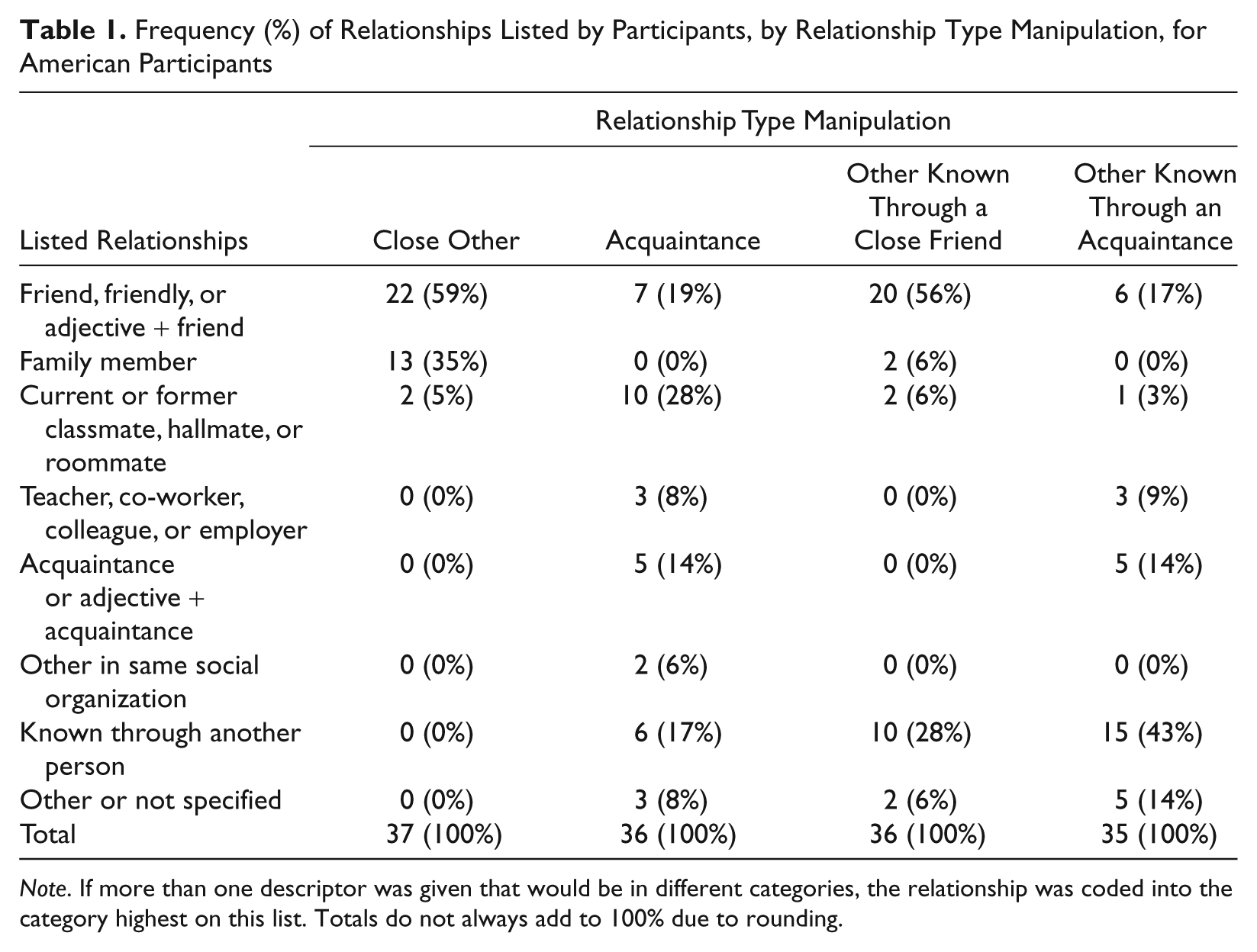
Note. If more than one descriptor was given that would be in different categories, the relationship was coded into the category highest on this list. Totals do not always add to 100% due to rounding.
Frequency (%) of Relationships Listed by Participants, by Relationship Type Manipulation, for Chinese Participants
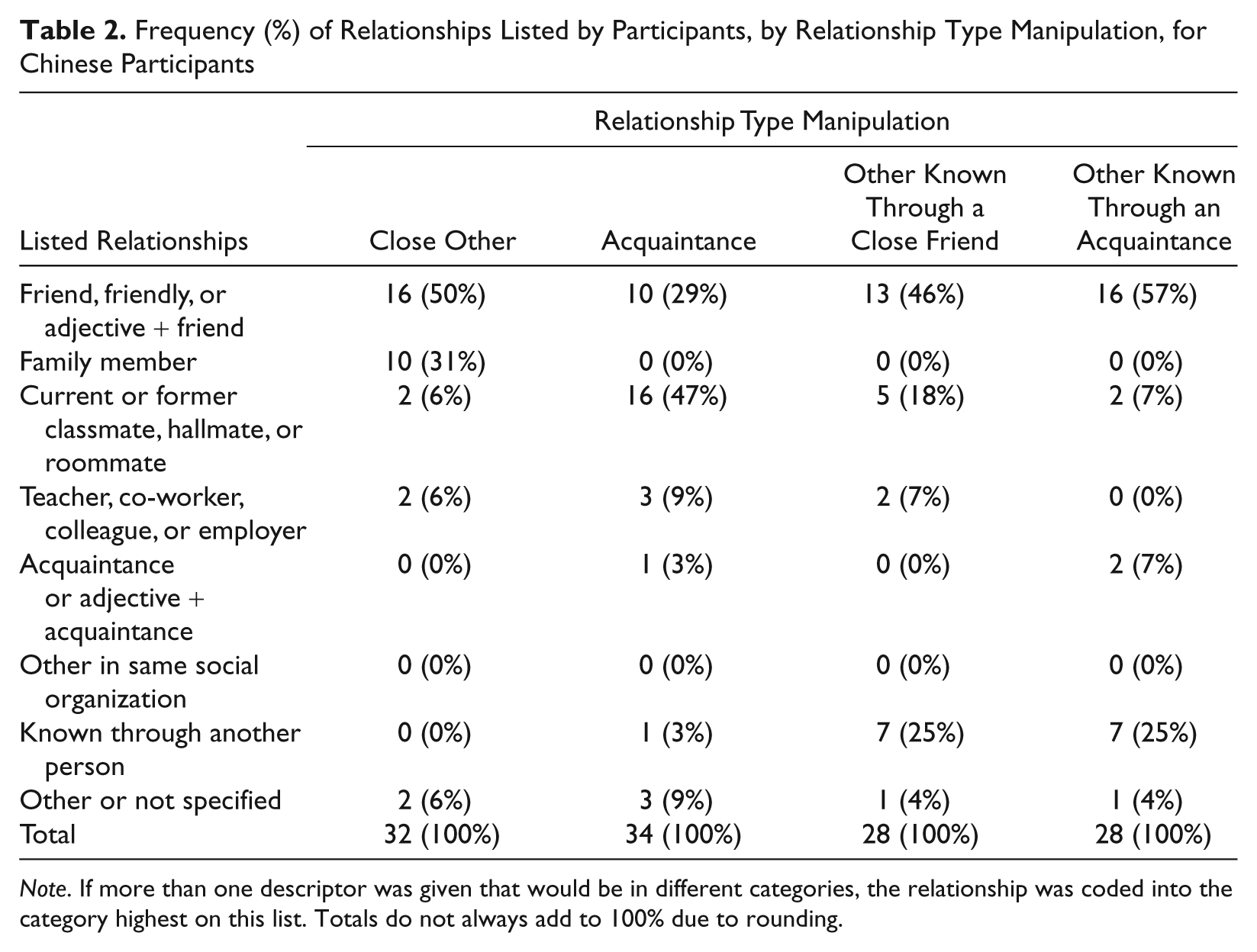
Note. If more than one descriptor was given that would be in different categories, the relationship was coded into the category highest on this list. Totals do not always add to 100% due to rounding.
One approach to eliminate this problem would be to employ a more targeted label for each relationship type. However, if we a priori specified the actual role relationships using a more targeted label, different problems arise. For example, if we asked Americans to answer questions about a “co-worker,” and we wished to ask the same questions for a Chinese sample, the closest Chinese equivalent to “co-worker”—同事 (“tong shi”)—actually means “co-worker or colleague,” which has a slightly different connotation than the English “co-worker.” Furthermore, co-worker entails different sets of obligations in China than in the United States, with co-workers in China often living in the same work compound, so that they are not only co-workers but also neighbors and close friends. Hence, this issue is not easily resolved, and each approach (targeting roles vs. using general categories) may provide significant, although different, information. However, given the finding that no cultural difference was found in the number of others who were described as being in the four relationship types, the differences found in Tables 1 and 2 may not indicate substantial differences.
Cultural and Relationship Type Differences in Obligation
Hypotheses 1 and 2 propose that, controlling for felt obligation (in Hypothesis 1) and likelihood (in Hypothesis 2) to spend money or time in nonemotional contexts, (Hypothesis 1) Chinese feel greater obligation than Americans to provide these resources to assist another in an emotional context, and (Hypothesis 2) Chinese are more likely than Americans to expend these resources to assist another in an emotional context. Hypothesis 3 proposes that, controlling for the amount of time a person is willing to expend to help another in a nonemotional context, Chinese are willing to expend more time than Americans to assist others in an emotional context. 3
For Hypothesis 1 through Hypothesis 3, separate ANCOVAs were conducted for money and time in which country and relationship type and their interaction were the independent variables, obligation to expend money or time in the nonemotional context was a covariate, and the corresponding obligation to expend money or time in the emotional context was the dependent variable.
Felt obligation
To test Hypothesis 1, separate ANCOVAs were conducted for the obligation to expend money or time in an emotional context. For money, there was a significant main effect for country, F(1, 257) = 28.12, p < .001, partial η2 = .10, in that Chinese (M = 3.63, SD = 3.09) felt more obligation to expend money to help the other person than did Americans (M = 2.37, SD = 2.82) (see Figure 1). A significant main effect was also found for relationship type, F(3, 257) = 12.31, p < .001, partial η2 = .13; the greatest obligation to expend money was felt toward a close other (M = 4.63, SD = 3.18), which was greater than for an other known through a close friend (M = 2.91, SD = 2.86) and an acquaintance (M = 2.79, SD = 2.88), which were both greater than for an other known through an acquaintance (M = 1.32, SD = 2.02). No significant interaction was found between country and relationship type. Thus, for obligation to expend money, Hypothesis 1a was supported.

Estimated Marginal Means for Obligation to Spend Money, by Country and Relationship Type
For time, no significant main effect was found for country, F(1, 256) = 1.22. A significant main effect for relationship type was found, F(3, 256) = 4.18, p < .01, partial η2 = .05 (see Figure 2). The greatest obligation to expend time was felt toward a close other (M = 8.35, SD = 4.02), which was significantly greater than for an acquaintance (M = 5.63, SD = 3.62) and an other known through a close friend (M = 5.60, SD = 3.80), which were both greater than for an other known through an acquaintance (M = 3.92, SD = 3.40). No significant interaction was found between country and relationship type. Thus, for obligation to expend time, Hypothesis 1b was not supported.
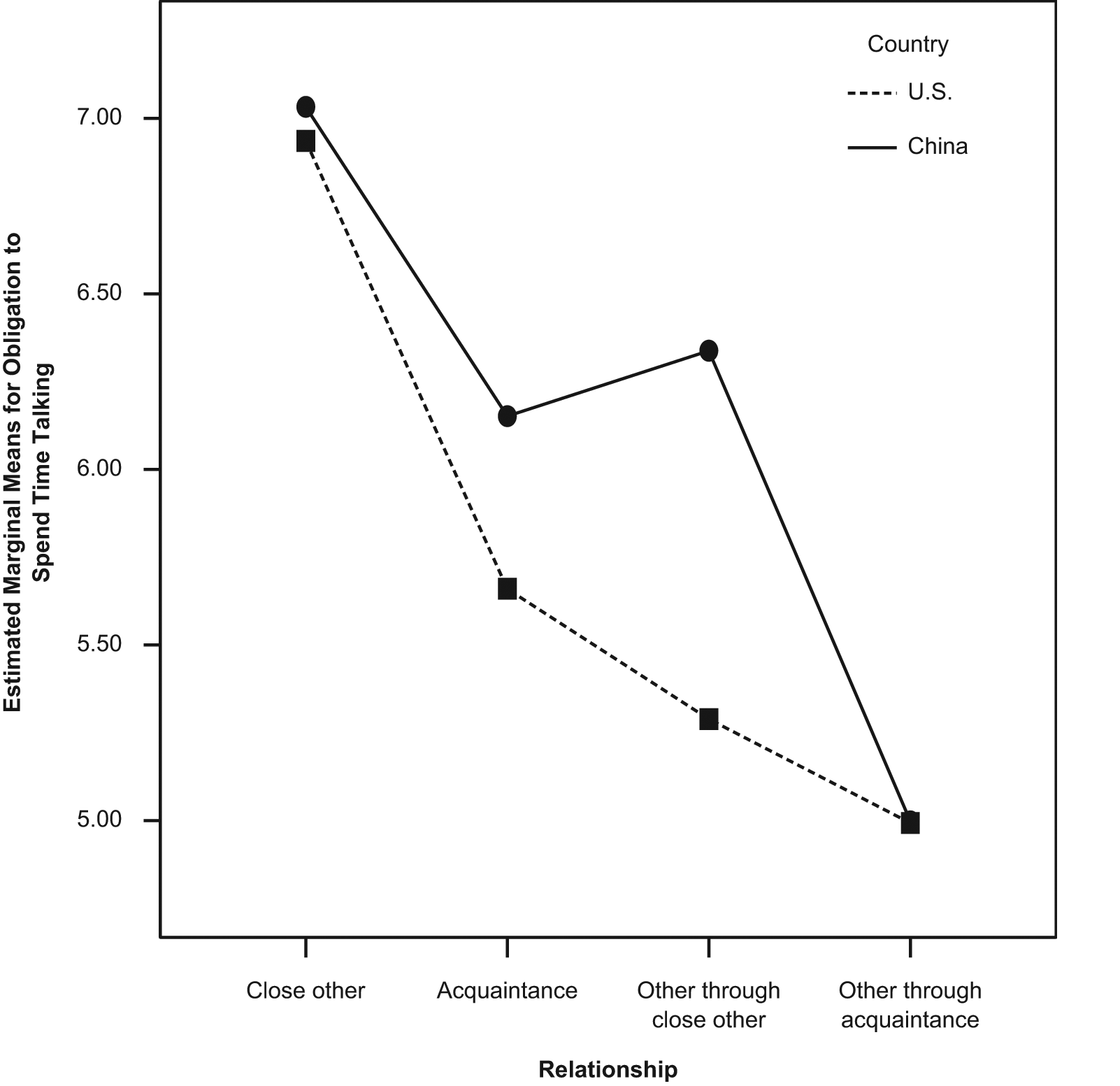
Estimated Marginal Means for Obligation to Spend Time Talking, by Country and Relationship Type
Likelihood of providing resources
To test Hypothesis 2, separate ANCOVAs were conducted for the likelihood of expending money or time in an emotional context. For money, there was a significant main effect for country, F(1, 257) = 22.83, p < .001, partial η2 = .08; a significant main effect for relationship type, F(3, 257) = 16.66, p < .001, partial η2 = .16; and a significant interaction between country and relationship type, F(3, 257) = 2.72, p < .05, partial η2 = .03 (see Figure 3). Most notably, the interaction showed that Chinese reported being significantly more likely than Americans to expend money to assist a close other and an acquaintance (close other: China, M = 7.39, SD = 2.51; United States, M = 5.35, SD = 2.61, p < .01; acquaintance: China, M = 4.95, SD = 2.95; United States, M = 2.71, SD = 2.52, p < .01). Thus, for money, Hypothesis 2a was supported.
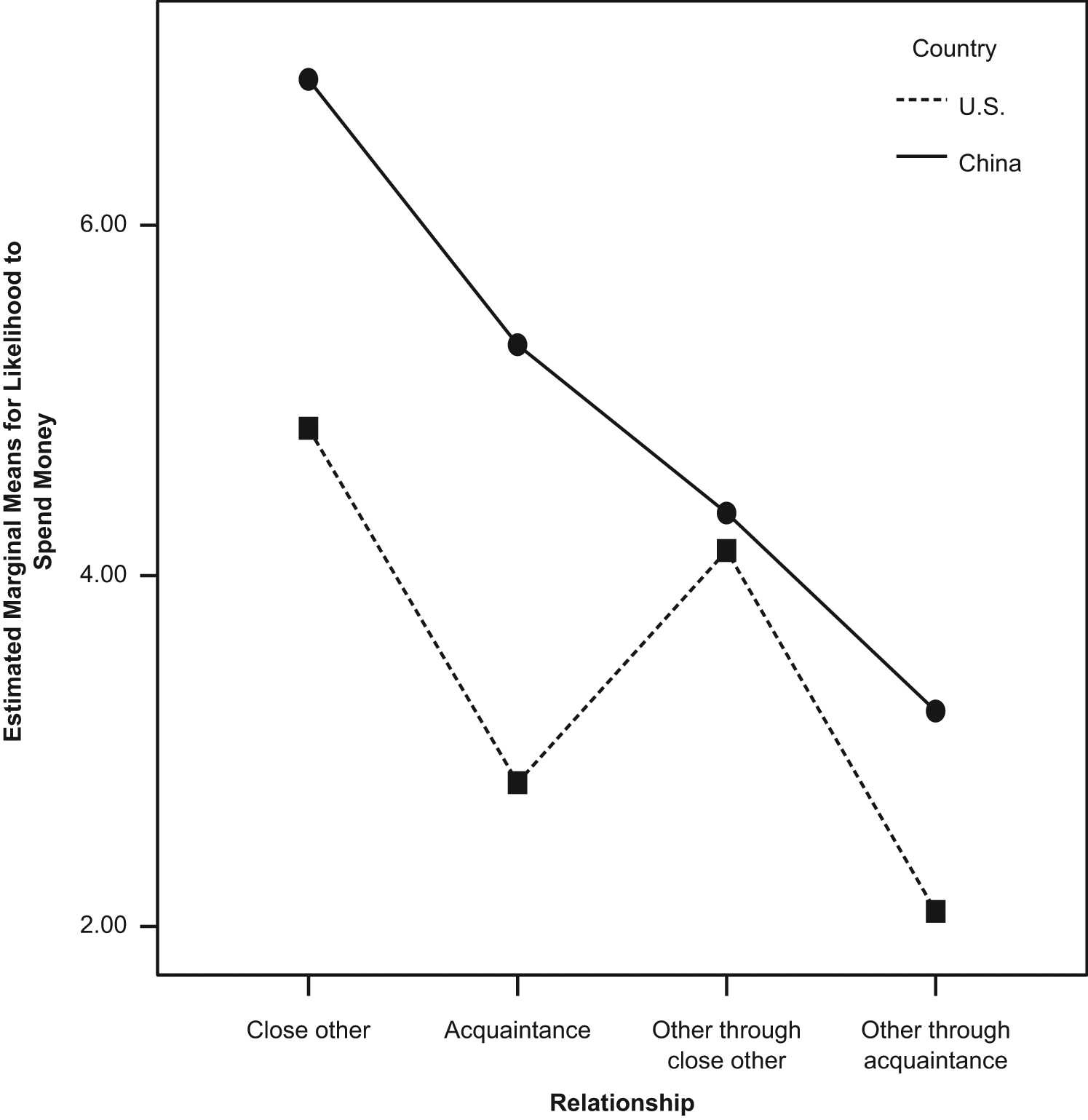
Estimated Marginal Means for Likelihood to Spend Money, by Country and Relationship Type
For time, there was no significant main effect for country, F(1, 256) = 2.21; a significant main effect for relationship type, F(3, 256) = 3.34, p < .02, partial η2 = .04; and a significant interaction between country and relationship type, F(3, 256) = 3.23, p < .03, partial η2 = .04 (see Figure 4). Most notably, the interaction showed that the Americans reported being more likely than the Chinese to expend time talking to an other known through a close friend or an other known through an acquaintance (an other known through a close friend: China, M = 6.96, SD = 3.91; United States, M = 10.08, SD = 3.43, p < .01; an other known through an acquaintance: China, M = 4.49, SD = 4.09; United States, M = 7.76, SD = 3.54, p < .01). For time, Hypothesis 2b was not supported.
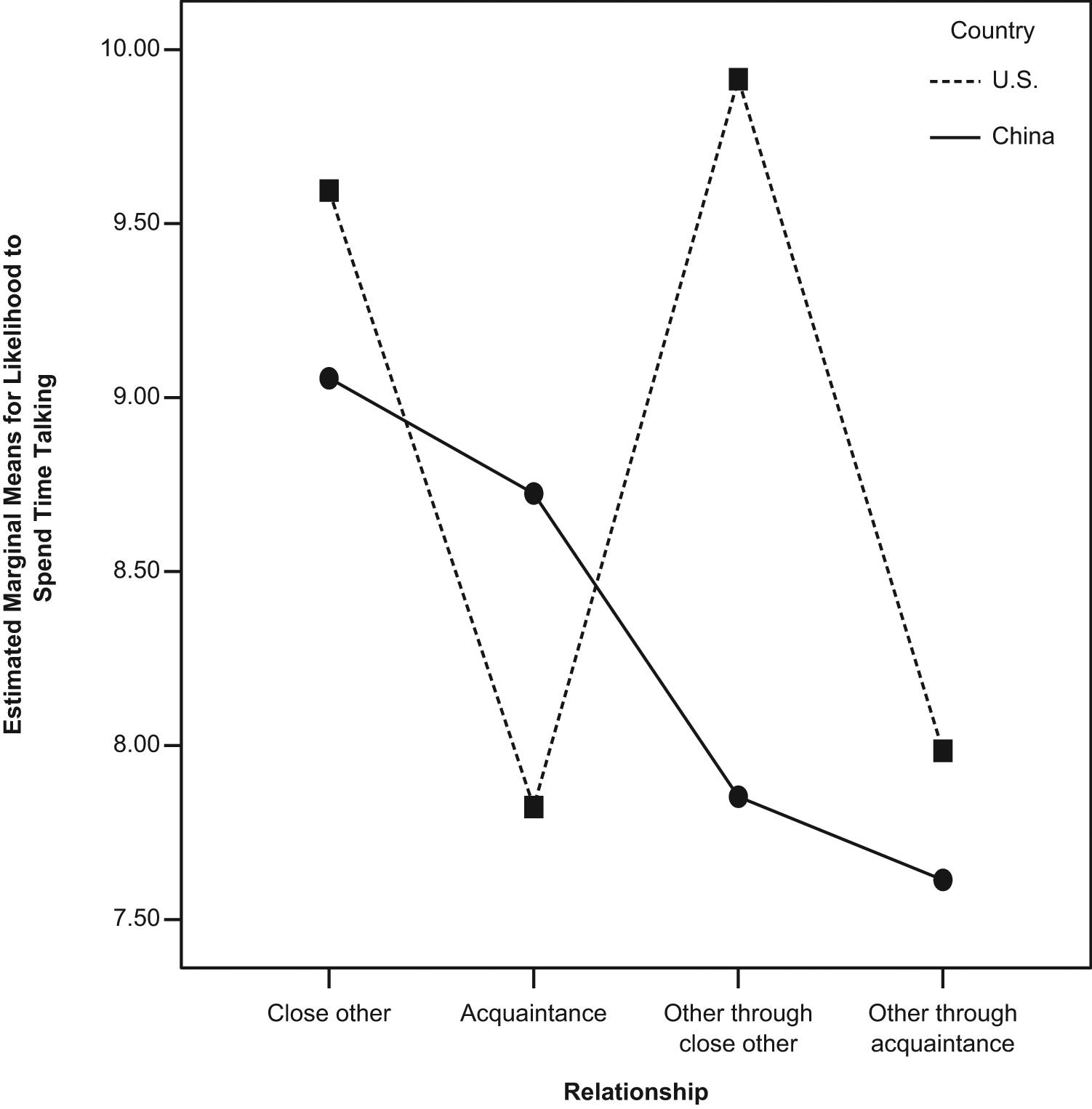
Estimated Marginal Means for Likelihood to Spend Time Talking, by Country and Relationship Type
Amount of time
To test Hypothesis 3, an ANCOVA was conducted for the amount of time one is willing to expend in an emotional context. There was a significant main effect for country, F(1, 255) = 22.23, p < .001, partial η2 = .08: Americans (M = 1.45, SD = 0.51) were willing to expend more time talking to others than were Chinese (M = 1.18, SD = 0.53). A significant main effect also was found for relationship type, F(3, 255) = 5.94, p < .001, partial η2 = .07, such that participants reported being willing to expend the most time talking with a close other (M = 1.55, SD = 0.46), which was greater than an other known through a close friend (M = 1.38, SD = 0.46) and an acquaintance (M = 1.29, SD = 0.54), which were both greater than an other known through an acquaintance (M = 1.05, SD = 0.58). No significant country by relationship type interaction was found (see Figure 5). Thus, because Americans reported willingness to expend more time talking than Chinese, Hypothesis 3 was not supported.

Estimated Marginal Means for Amount of Time Willing to Spend Talking, by Country and Relationship Type
Research Question: Transitivity of Obligation
To evaluate whether Americans and Chinese differ with regard to degree of transitivity in their obligation links, the felt obligation reported for those known indirectly was compared with the felt obligation for the corresponding person known directly (see Table 3). The analysis of the data found in Table 3 should be viewed as exploratory both because this is the first time the proposed measure for degree of transitivity is being employed and because, given the way this measure is constructed, the data are not being analyzed with inferential statistics.
Degree of Transitivity in Obligation, by Type of Indirect Relationship, Culture, and Resource
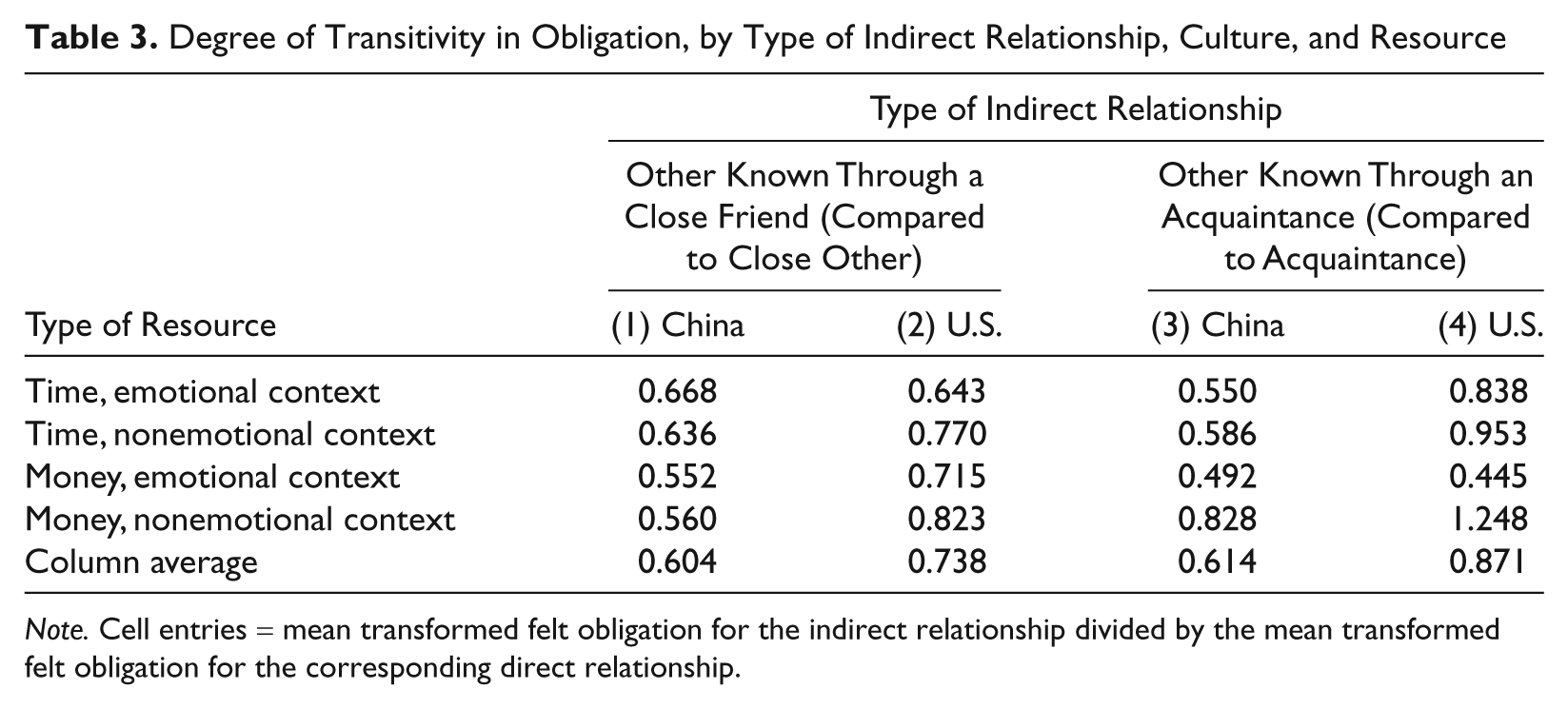
Note. Cell entries = mean transformed felt obligation for the indirect relationship divided by the mean transformed felt obligation for the corresponding direct relationship.
Regarding the magnitude of transitivity, for six of the eight comparisons, the indirect links for Americans are greater than the corresponding links for the Chinese. For Americans, more than for Chinese, the feeling of obligation is diffused across the social network to indirectly associated others. In addition, the feeling of obligation appears to be diffused across the network in nonemotional more than in emotional contexts. No overall difference was found in the diffusion of obligations for money versus time.
In Table 3, only one ratio is greater than 1.00, meaning that the score for the indirect relationship was greater than the score for the direct relationship: For money used in a nonemotional context, Americans reported a greater feeling of obligation to help an other known through an acquaintance than an acquaintance.
Cultural and Relationship Differences in Intimacy
Figure 6 shows the estimated marginal means of the relation of intimacy to country and relationship type based on an ANOVA in which level of intimacy was the dependent variable and country and relationship type were the independent variables. Results showed significant differences in intimacy across relationship types (p < .001) and country (p < .001), with similar trends for both countries (i.e., relationship type and country did not significantly interact). Americans reported greater intimacy in their relationships as compared to Chinese. A test for cultural difference in intimacy for each type of relationship showed that these two cultures differed significantly for an other known through an acquaintance, with Americans reporting greater intimacy than did Chinese, t(45) = 2.82, p < .01, partial η2 = .15, but there were no significant differences for any of the other relationship types.
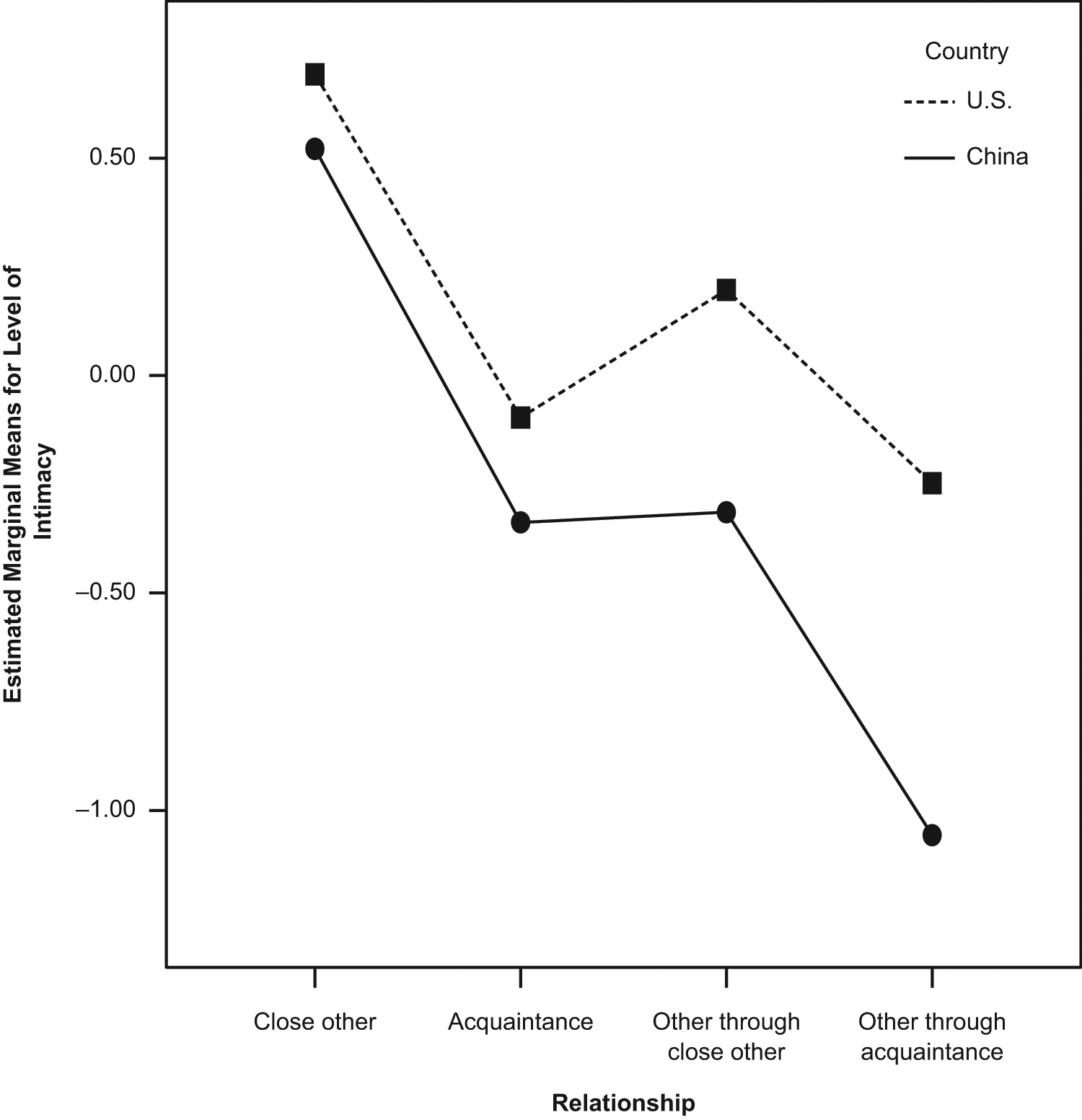
Estimated Marginal Means for Level of Intimacy, by Country and Relationship Type
Intimacy as Predictor of Obligation
The next three hypotheses propose that, for both cultures, the more intimate a relationship type is perceived to be (Hypothesis 4), the more obligation is felt to expend (a) money and (b) time within that relationship type; (Hypothesis 5) the more likely a person is to expend (a) money and (b) time within that relationship type; and (Hypothesis 6) the more (a) money and (b) time a person is willing to expend on that relationship type. For Hypothesis 4 through Hypothesis 6, separate MANCOVAs were conducted with intimacy, country, relationship type, the Country × Relationship Type interaction, and the Country × Intimacy interaction as the independent variables.
Felt obligation
For Hypothesis 4, the dependent variables in the MANCOVA were the obligation to expend money to buy a cell phone (nonemotional support), to expend time tutoring (nonemotional support), to expend money to help the person get away for the weekend (emotional support), and to expend time talking with another person (emotional support). The MANCOVA showed that intimacy did not significantly influence the level of obligation to expend time or money, F(4, 191) = 0.27. Furthermore, the parameter estimates for each dependent variable showed that intimacy did not significantly influence any of the dependent variables. Therefore, Hypothesis 4 was not supported.
Likelihood of expending resources
For Hypothesis 5, the dependent variables in the MANCOVA were the likelihood of expending money and time across the four situations. The MANCOVA showed that intimacy did not significantly influence the likelihood of expending time or money, F(4, 191) = 1.17. However, intimacy had two significant effects on the likelihood of expending resources that were in opposite directions: The greater the intimacy, the less likelihood of expending money to buy a cell phone from an associated other (nonemotional context) and the greater the likelihood of expending time tutoring the associated other (nonemotional context). Overall, Hypothesis 5 was not supported.
Amount of money and time
For Hypothesis 6, the dependent variables in the MANCOVA were the amount of money or time willing to expend on the four situations. The MANCOVA showed that intimacy significantly influenced the amount of money or time people were willing to expend on the other person, F(4, 190) = 2.37, p < .05 (one-tailed), partial η2 = .05. Parameter estimates for the separate situations further showed that greater intimacy resulted in the willingness to expend significantly more time talking with the other person. Therefore, Hypothesis 6 was supported.
Discussion
Different types of relationships have different responsibilities. This study examines the effect of culture and intimacy on the obligation to provide monetary or temporal assistance in different types of relationships. Although not all hypotheses were supported, this study yields some surprising results that provide the basis for future cross-cultural research on obligations.
Culture, Relationship Type, and Resources
In an emotional context, the amount of time to be expended varied across relationship types; greater willingness to expend time was found with a close other than with an other known through a close friend or with an acquaintance, followed by an other known through an acquaintance. Compared to Chinese, Americans reported willingness to expend more time in an emotional context. Chinese reported greater likelihood than Americans to expend money to assist others, especially close others and acquaintances. Americans, on the other hand, reported being more likely than Chinese to expend time talking with an other known through a close friend or an other known through an acquaintance.
The most interesting findings regarding culture involve differences in the use of time and money. Across relationship types, Chinese reported more felt obligation to give money for a person who needed to get away (money, a resource low in particularism, used in an emotional context), whereas Americans were willing to spend a greater amount of time talking with an associated other (time, a resource high in particularism, used in an emotional context). Although the meaning of time and money may be similar across cultures (see Foa et al., 1987), these results suggest a difference in the rules regarding the exchange of resource types (see Törnblom & Foa, 1983) across the two cultures.
These findings raise the following questions: Does the seeking of support follow the same cultural rules as the giving of support? Do different types of support reflect different stages of social or economic development, or are they more stable cultural characteristics?
According to Dunkel-Schetter, Folkman, and Lazarus (1987), providing emotional support is a different process than providing nonemotional aid. This distinction reflects the cultural differences that were found in this study. The Chinese and U.S. cultures may differ in their emphasis on the type of social support people from these cultures are willing to provide: Resources allocated in social relationships, and the obligation and willingness to allocate different resources, seem to function according to different rules (Törnblom & Foa, 1983).
Practically speaking, the social expectations people have within relationships may be affected by such differences. In other words, interactions between people from the United States and China may result in misunderstandings or disappointments when one person has particular needs in the relationship but the other provides a resource that is not expected to fulfill that need. Although an American may be willing to spend time to provide support, a Chinese person may find providing time to be an inappropriate or insufficient type of support, or an American may find the provision of money to be uncomfortable when emotional support is expected.
In general, U.S. culture promotes talking as a way of dealing with life issues (see, e.g., Parks, 1995; for exceptions to this U.S. norm, see Philipsen, 1975). In providing social support, researchers have suggested that Chinese people focus on the pragmatic aspect of a problem, whereas Americans focus on affect (Burleson, Liu, Liu, & Mortenson, 2006; Mortenson, 2005). Therefore, when facing an obligation to help others, Chinese indicated a more pragmatic way to help others (here, expending money), whereas Americans focused more on providing emotional support (here, talking), perhaps because of cultural differences in rules about helping behaviors.
Transitivity of Obligations
The results of this study are intriguing for the light they shed on cross-cultural differences in felt obligation. Although Chinese are willing to “spare a dime,” whereas Americans are willing to “spare some time,” when degree of transitivity is assessed by the extent to which obligations to a person known directly are transferred to the person known indirectly, the Americans exhibited a greater degree of transitivity.
One surprising finding regarding transitivity was that, for money used in a nonemotional context, Americans reported a greater obligation to help an other known through an acquaintance than an acquaintance. This finding may represent American reluctance to engage in exchange relationships with others whom they know moderately. Future research on transitivity may clarify this point.
In social network research, links may be assessed for their strength (Granovetter, 1973, 1982) and networks may be assessed for the extent that triplets of nodes indicate transitivity (Wasserman & Faust, 1994). In the current study, obligational transitivity is inferred by the extent to which indirect obligations are proportional to direct obligations, and the data that were available for the numerator and denominator of this proportion came from different participants. If each participant had been asked about obligations across relationship types, a statistical model could be tested that parallels the network linkages; in other words, coefficients could be generated that represent the normative obligational influence that flows from one link to another. Furthermore, if cultures or groups differ with regard to transitivity, then the whole social web should be affected; transitivity should ultimately determine an entire constellation of social commitments and responsibilities, and therefore, it should be associated with important and pervasive cultural differences (Robins & Kashima, 2008). Future research is needed to compare the transitivity results of the present investigation with other cultural indicators of obligational transitivity and within-participant measures.
Intimacy
The findings regarding the role of intimacy are mixed. Controlling for relationship type and country, intimacy was not found to affect the level of obligation that people reported for expending money or time in either the nonemotional or emotional contexts. Furthermore, obligation did not vary by level of intimacy; instead, obligation to expend both money and time differed by the closeness of the relationship type, with more felt obligation in closer relationship types than in distant ones. This finding suggests that the structural role, not the feeling toward the other party, influences obligation.
On the other hand, intimacy positively predicted the amount of time participants were willing to expend in an emotional context but not in a nonemotional context, which suggests that intimacy may convert felt obligation into resource expenditure when the resource is tied to emotions. Clearly more research is needed, and cross-cultural research would be especially constructive with regard to this issue.
Limitations and Future Research
This study has noted several limitations that should be addressed in future research. First, we acknowledge that testing this study’s hypotheses among an older population would likely yield different results. Future research can investigate the extent to which the results of this study are supported with samples that differ by demographic factors such as age. Second, future research should address differences in the kinds of others who were nominated as Person A by employing a more targeted label for each relationship type. Third, future research can extend this study into relationships that are at the extremes of intimacy: romantic relationships, strangers, and even adversaries (see Halpern, 1997; Mandel, 2006; Shapiro, 1980, for a comparison of exchanges between friends and strangers). And fourth, future research should more closely examine the participants’ interpretations of different scenarios to control for the type of resource and level of emotional involvement to prevent potential confounds across situations.
Conclusion
This study makes several contributions to understanding culture, intimacy, obligation, and relational networks. First, a reliable scale was developed to measure intimacy that was valid for use in both the United States and China. Second, this study suggests that in both cultures obligations apply across relationship types, but with regard to different resources in different contexts. Third, although the literature on Chinese culture has emphasized the significance of extended networks of obligations—an emphasis generally lacking in descriptions of American culture—the links in American obligation networks appeared to have more evidence of transitivity than did the comparable Chinese networks. Our hope is that this study will replace the simplistic notion that East and West are qualitatively different in their interpersonal ties. Nevertheless, social support does appear to be addressed with different resources in the two cultures: Americans can spare some time, whereas Chinese can spare a dime.
Footnotes
The author(s) declared no potential conflicts of interest with respect to the research, authorship, and/or publication of this article.
The author(s) received no financial support for the research, authorship, and/or publication of this article.