



Abstract
The expectancy violation model proposes that people infer deception when the communicator violates social norms without obvious cause. However, social norms are culture specific. Therefore, discrepant norms between a communicator and an observer in a cross-cultural interaction might increase the likelihood of inferring deception and thus result in bias. The present study investigated whether informing people about cultural differences in nonverbal behavior could counteract cross-cultural bias in deception judgments. Sixty-nine Australian students were randomly assigned to receive no information, general information, or specific information about culture-specific behavioral norms prior to making credibility judgments of 10 video clips (5 norm consistent and 5 norm inconsistent). The results suggest that cross-cultural biases in deception judgments can occur but may also be prevented by providing appropriate information. These findings require further investigation but have potentially significant implications in law enforcement, customs, immigration, and broader societal interactions.
Lying and the detection of deception have interested both everyday people and professionals who have a vested interest in catching those who are dishonest. In addition to searching for reliable methods to detect deception, researchers have sought explanations of the process by which people make inferences about deception. Since nonverbal behavior has been argued to reflect dispositional characteristics of an individual and serve as an effective source to identify a person’s true feelings (DePaulo, 1992; Hart & Morry, 1996), much of this research has examined the nonverbal behaviors that laypeople and professional lie catchers (e.g., police officers) focus on when making judgments about honesty.
Extensive research in North American and European countries such as Germany (Fiedler & Walka, 1993), the United Kingdom (Akehurst, Kohnken, Vrij, & Bull, 1996), the Netherlands (Vrij & Semin, 1996), Sweden (Strömwall & Granhag, 2003), the United States (DePaulo et al., 2003; Zuckerman, Koestner, & Driver, 1981), and more recently in more than 75 different countries around the world (Global Deception Research Team, 2006) has suggested that laypeople and professional lie-catchers tend to rely on a consistent and specific set of nonverbal behaviors when attempting to distinguish honest from deceptive messages. In particular, people typically associate deception with cues such as increased vocal pitch, excessive speech disturbances, a slow speech rate, long latency periods before speaking, more pauses, increased gaze aversion, increased smiling, increased eye blinking, and more finger, hand, and body movements (Granhag & Vrij, 2005; Vrij, 2000, 2008). These findings suggest that the beliefs about behavioral cues associated with deception are reasonably consistent across individuals and countries around the world.
Bond et al. (1992) proposed that individuals make judgments about deception based on the violation of expectancies about nonverbal behavior. According to their expectancy violation model, people have preexisting expectancies regarding behavior during communications and tend to accept at face value nonverbal behaviors that are usual and expected within the social context. However, perceivers will seek an explanation for behaviors that are unusual and unexpected. Bond et al. argued that in the absence of a plausible alternative explanation, perceivers will suspect that unexpected nonverbal behaviors may indicate that the communicator is lying. Consistent with this model, they found in a series of three experiments that individuals who performed strange and unexpected behaviors (such as arm raising, head tilting, and staring) were perceived by observers as more dishonest than those who did not perform such behaviors, regardless of whether they were actually telling the truth or lying.
An important and pervasive source of expectancies regarding nonverbal behavior is social norms, which are defined as “situationally based standards that prescribe certain actions and proscribe others” (Bond et al., 1992, p. 969). These social norms, which are often referred to as display rules (Ekman, 1971), dictate the appropriateness of emotional displays depending on social circumstances. According to Ekman and Friesen (1969), each culture has its own norms regarding appropriate social behavior, including the use of nonverbal communication. In other words, people from different cultures may have different rules about when it is appropriate and when it is not appropriate to use a nonverbal behavior in a social interaction and how this nonverbal behavior should be interpreted. For instance, Watson (1970) found that in comparison to Americans, Jordanians make more eye contact, assume a more direct bodily orientation, and are more likely to touch one another. Cultural differences may also exist in display rules regarding the purpose of certain nonverbal behaviors and in which interactions they should be used. For example, Matsumoto and Kudoh (1993) found that Japanese people have a display rule to use smiles for social appropriateness more frequently than Americans and use smiles relatively less frequently to display true feelings of pleasure and joy.
Such differences in normative nonverbal behavior may in turn lead to differences in perceived credibility during cross-cultural interactions. When a communicator and observer are from different cultures, the observer will apply social norms concerning nonverbal behavior that may differ from the communicator’s own norms. As a result of this discrepancy, a communicator who is behaving consistently with his or her own cultural norms might violate the expectancies of the observer, potentially increasing the likelihood that the observer will suspect the communicator of being dishonest. Bond, Atoum, Mahmoud and Bonser (1990) suggested that a culture’s distinctive communication patterns form a baseline for the detection of deception. Therefore, a person who lacks familiarity with this baseline is prone to bias when detecting lies told by people from that culture.
Vrij and Winkel (1991, 1992, 1994) conducted a series of experiments to investigate cross-cultural bias in deception judgments. Their initial study (Vrij & Winkel, 1991) found that Black Surinam participants made more speech errors, spoke more slowly, spoke with higher pitched voice, smiled more, displayed more gaze aversion, and performed more self-manipulations, illustrators, and trunk movements compared to native Dutch people, regardless of whether they were lying. In subsequent studies (Vrij & Winkel, 1992, 1994), Surinam and Dutch actors were videotaped and asked to display typical Dutch or Surinam nonverbal behavior while giving a statement. White Dutch police officers were shown the video clips and indicated the extent to which the person in the video clip made a suspicious impression. In general, it was found that both Surinam and Dutch actors made a more suspicious impression when they showed nonverbal behavior that was consistent with Surinam norms than when they displayed normative Dutch behavior. These findings support the notion that cross-cultural biases can influence deception judgments and highlight that such biases may result from cultural differences in behavior rather than visual appearance (e.g., skin color).
The finding that cross-cultural differences in nonverbal behavior can produce bias in judgments about deception and credibility raises important considerations for areas such as law enforcement, border protection, and immigration. For example, in a police interview, a suspect from another culture might be judged as dishonest if his or her behavior differs from the normative behavior expected by the police officers, thus increasing the risk of a wrongful prosecution. Similarly, customs and immigration officials must make decisions about scrutinizing travelers based on perceptions of suspiciousness. However, the finding that cross-cultural differences in behavior may themselves arouse suspicion suggests that it might be especially difficult to make reliable judgments under such circumstances.
Given the demonstrated potential for cross-cultural bias in deception judgments, it is important to examine whether such bias can be prevented. The expectancy violation model predicts that violation of normative behavior will arouse suspicion of deception if no other plausible explanation for the violation can be found. Based on this model, it is possible that providing individuals with an appropriate explanation for such norm violations may be adequate to prevent cross-cultural bias. Accordingly, this study explored the possibility of preventing cross-cultural bias in deception judgments by providing the observer with information about cross-cultural differences in nonverbal behavior.
Specifically, the present study investigated the effectiveness of two levels of information on cross-cultural bias in deception judgments. First, it is possible that simply informing an individual that the person they are observing comes from a culture that has different norms regarding nonverbal behavior will alert the individual that they should not rely on norm violations to make deception judgments. On the other hand, it may be that individuals require specific information about the social norms regarding nonverbal behavior for the culture from which the communicator comes.
We expected that when participants received no cross-cultural information they would be more likely to judge as deceptive individuals whose nonverbal behavior was inconsistent with their own norms than those whose behavior was consistent with the observer’s norms. On the other hand, we predicted that participants who received general or specific cross-cultural information would not display the same pattern of judgments because this information would provide an explanation for the norm-inconsistent behavior.
Method
Participants
Sixty-nine (17 male and 52 female) psychology students from a regional Australian university participated in the study. The university specializes in providing flexible higher education to mature age students; consequently, the age range of the participants was more diverse than a typical undergraduate sample, with a mean age of 33.64 (SD = 10.58; median = 33). Participants volunteered to take part in the study in response to advertisements asking “Can you spot a liar?” that were posted on psychology department notice boards.
Materials
The stimulus materials consisted of 20 video clips, each lasting for 30 to 40 seconds, in which 10 amateur actors (5 females and 5 males) each produced two versions of a rehearsed statement. The statement was rehearsed from a script and involved the actors ostensibly describing a person who they liked. However, the soundtrack was removed from the video clips in order to prevent interference from verbal content and require participants to rely solely on nonverbal cues.
Each actor produced two video clips (a norm-consistent and a norm-inconsistent clip) in which they were instructed to manipulate the amount of smiling, self-manipulations (i.e., movement of arms and hands), and eye movements they displayed. In the norm-consistent video clips, the actors were instructed to present nonverbal behavior that was consistent with Australian cultural norms. In other words, the actors displayed the typical amount of smiling, self-manipulations, and eye movements they would usually display in an everyday interaction. In the norm-inconsistent video clips, the actors were instructed to display nonverbal behavior that was inconsistent with Australian norms. In particular, the actors were instructed to exhibit more smiling, gaze aversion (looking away), and hand movements than they usually would. These nonverbal behaviors were chosen for experimental manipulation because they have been consistently found to be stereotypical cues of deception (e.g., Global Deception Research Team, 2006; Vrij, 2008).
A pilot study was conducted in order to check the behavioral manipulations displayed in the video clips. Twenty undergraduate psychology students viewed all of the video clips and rated the amount of smiling, gaze aversion, and hand movements in each clip on a 3-point scale (less than usual, neither more nor less than usual, or more than usual) in each clip. For all norm-consistent clips, the modal evaluation by participants in the pilot study was “neither more nor less than usual” for each of the three behaviors, whereas for norm-inconsistent clips, the modal response was “more than usual” for each behavior. Furthermore, the evaluation of norm-inconsistent clips was skewed such that very few participants rated clips as demonstrating “less than usual” of the behaviors, whereas the evaluation of norm-consistent clips tended to be more symmetrically distributed, suggesting that the video clips produced an appropriate distinction between norm-consistent and norm-inconsistent behaviors.
The video clips were recorded in a digital video format and presented using the Inquisit experiment presentation software (“Inquisit 3.0,” 2007). The software randomly selected and presented 10 video clips such that each participant viewed five norm-consistent clips and five norm-inconsistent clips but viewed only one clip featuring each actor.
Procedure
Following informed consent procedures, all participants were instructed that their task would be to watch a number of video clips and judge whether the person in each video clip was lying or telling the truth. However, participants were given additional instructions depending on their random assignment to one of three experimental conditions. Participants in the control condition were not given any further instructions. Participants in the general information condition were told that the video clips displayed people who were from the Netherlands 1 and that research has demonstrated that typical nonverbal behavior can differ across cultures. However, participants in this condition were not given any information about specific behavioral differences across cultures. Participants in the specific information condition were also told the video clips displayed people from the Netherlands. However, participants in this condition were also instructed that previous research has demonstrated several specific behavioral differences between Australian and Dutch people. In particular, participants were told that Dutch people typically display (a) more smiling, (b) more gaze aversion, and (c) more hand and arm movements than Australian people.
Participants then viewed the target video clips. After watching each video clip, participants were asked to record their answers to three questions in an answer booklet. First, participants indicated whether they believed the person was lying (yes or no). Second, participants who indicated that they believed the person was lying wrote the reasons for their deception judgment. Finally, participants rated the percentage likelihood that the person was lying by placing a mark on a scale (0 = definitely not lying, 100 = definitely lying). After viewing and rating each video clip, participants were asked to complete a demographic information sheet. In addition to asking for participants’ age and gender, the sheet asked participants to indicate whether they were born in Australia and, if they were born elsewhere, the number of years they had lived in Australia.
Results
Examination of participants’ cultural backgrounds indicated that 52 (75%) of the participants were born in Australia. Of the 17 (25%) participants who were born outside of Australia, the majority were born in other Western cultures (e.g., the United Kingdom, New Zealand, and the United States). A few participants were born in countries that are perhaps less culturally similar to Australia. In particular, two participants were born in Serbia and individual participants were born in Finland, India, Germany, and South Africa. However, participants who were not born in Australia indicated that they had lived in Australia for a mean period of 21.82 years (SD = 14.86), and the minimum period that any participant had spent living in Australia was 7 years. Consequently, it was assumed that participants would have sufficient experience in and reliance on Australian norms for nonverbal behavior and no participants were excluded from the subsequent analyses.
Deception Judgments and Likelihood Ratings
Participants’ dichotomous deception judgments were used to calculate the proportion of video clips of each type (norm-consistent versus norm-inconsistent) that participants judged as lying. For each participant, the mean rating of the likelihood that the individual in each video clip was lying was calculated for norm-consistent and norm-inconsistent video clips. The proportion of lie judgments and the likelihood ratings were each analyzed using a 3 (Information Condition) × 2 (Clip Type) mixed-model analysis of variance (ANOVA). An alpha level of .05 was used for all statistical tests.
The mean proportions of lie judgments are presented in Table 1. An ANOVA indicated a significant main effect of clip type on lie judgments, F(1, 66) = 55.02, p < .01, with a large effect size, η2 = .46. Also, a significant Clip Type × Information Condition interaction was found, F(2, 66) = 6.59, p < .01, with the interaction explaining 17% of the variance. Analysis of simple effects indicated that there was a significant effect of clip type for participants in the control condition, t(22) = 3.98, p < .001, and a large effect size d = 0.83, and for participants in the general information condition, t(23) = 7.08, p < .001, and a large d = 1.45. However, there was no significant effect of clip type on lie judgments for participants in the specific information condition, t(21) = 1.81, ns, d = 0.38. The main effect of information condition was not statistically significant, F(2, 66) = 0.45, ns, η2 = .01. Thus, although participants judged as “lying” a significantly greater proportion of norm-inconsistent than norm-consistent clips in the control and general information conditions, there was no significant difference between the clip types for participants in the specific information condition.
Mean Proportion of Lie Judgments by Clip Type and Information Condition
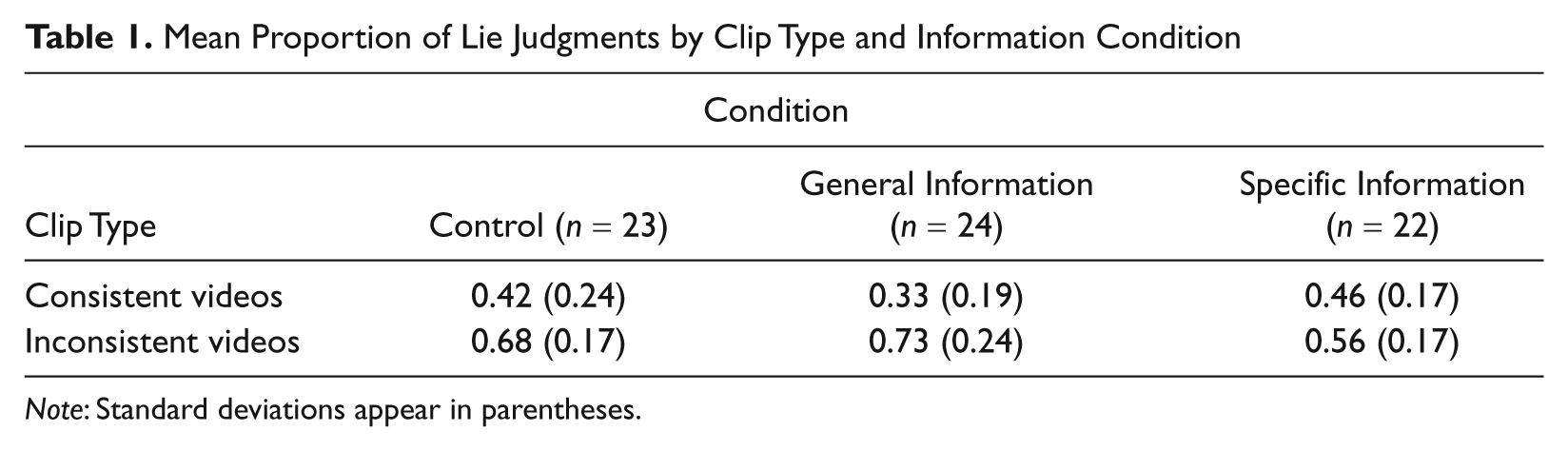
Note: Standard deviations appear in parentheses.
The mean ratings for likelihood of lying are presented in Figure 1. An ANOVA indicated a significant main effect of clip type on likelihood ratings, F(1, 66) = 54.26, p < .01, with a large effect size, η2 = .45. Also, a significant Clip Type × Information Condition interaction was found for likelihood judgments, F(2, 66) = 8.32, p < .01, and explained 20% of the variance. Analysis of simple effects indicated that there was a significant effect of Clip Type on likelihood ratings for participants in the control condition, t(22) = 5.12, p < .001, with a large effect size d = 1.08, and general information condition, t(23) = 6.02, p < .001, d = 1.23. However, there was no significant effect of Clip Type on likelihood ratings for participants in the specific information condition, t(21) = 1.16, ns, d = 0.25. The main effect of information condition was not statistically significant, F(2, 66) = 0.37, ns, η2 = .01. Thus, these findings indicate that participants in the control and general information conditions believed that the people depicted in norm-inconsistent clips were significantly more likely to be lying than the people depicted in norm-consistent clips. On the other hand, there was no difference in the perceived likelihood of lying between norm-consistent and norm-inconsistent clips for participants in the specific information condition.
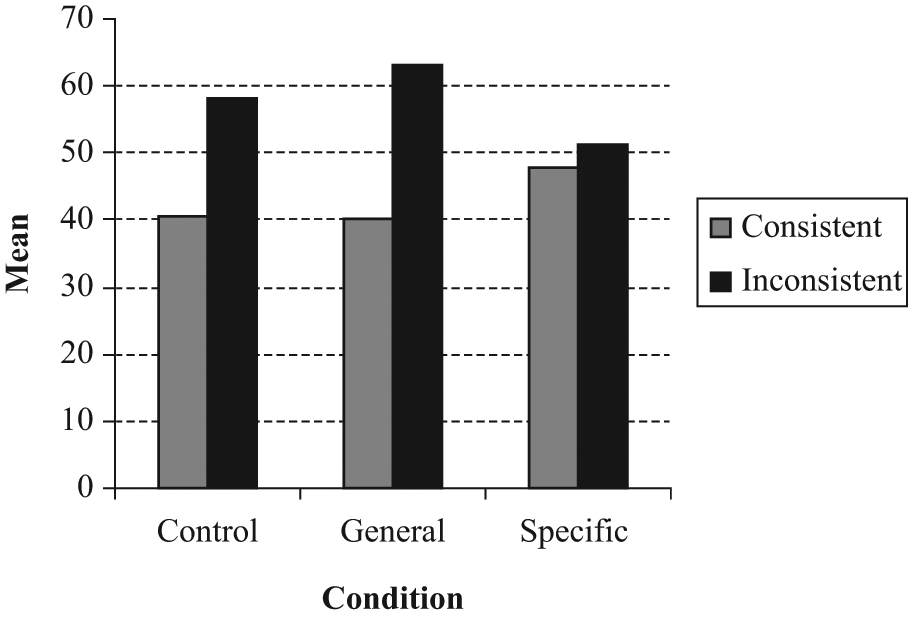
Mean Ratings of Percentage Likelihood of Lying by Clip Type and Information Condition
Perceived Indicators of Deception
For each video clip they judged to be a lie, participants provided open-ended comments on the reasons for their judgment. Participants’ comments were coded based on the inclusion of one or more of the following factors in their response: (a) smiling, (b) eye movements, (c) hand movements, and (d) other factors. Thus, the coding of responses focused on whether participants mentioned the behaviors manipulated in the video clips, while other comments were also considered. The mean proportion of video clips (out of those that were judged as lying) for which participants mentioned each behavioral feature is presented in Table 2. Hand movements and eye movements were both commonly reported indicators of deception, whereas smiling was mentioned relatively infrequently.
A series of mixed-model ANOVAs examined the extent to which different behavioral cues were mentioned across clip types and information conditions. These analyses indicated that the extent to which participants reported using smiling and hand movements as cues to deception was not affected by clip types or information condition. However, a significant main effect of clip type was found for reporting of eye movements as a deception cue, F(1, 58) = 28.11, p < .001, η2 = .33, indicating that participants were more likely to comment that eye movements served as an indicator to deception for norm-inconsistent than norm-consistent video clips. A significant main effect of clip type was also found for participants’ reporting of using “other” cues to deception, F(1, 58) = 4.61, p < .05, η2 = .07. Thus, participants were more likely to report using deception cues other than those that were intentionally manipulated for norm-consistent than norm-inconsistent clips. Common responses that were coded in the “other” category factors included signs of nervousness, uncomfortable appearance, shoulder shrugging, and posture.
Mean Proportion of Deception Cues by Clip Type and Information Condition

Note: Standard deviations appear in parentheses.
Discussion
The findings of the present study supported the hypothesis that participants without information about cultural normative differences would be more suspicious of actors whose nonverbal behavior was inconsistent with Australian norms than those displaying norm-consistent behavior. This finding is consistent with the results of Vrij and Winkel (1992, 1994) and Bond et al. (1992) and provides further evidence of the potential for cross-cultural bias in deception judgments.
Consistent with the expectancy violation model (Bond et al., 1992), the present study also suggests that such a bias in deception judgments could be attenuated by providing a plausible alternative explanation for norm-inconsistent nonverbal behavior. However, the results indicate that the information provided to support this explanation must be specific. When general information about the relevance of cross-cultural differences in nonverbal behavior was provided, participants’ deception judgments were no less susceptible to the influence of expectancy violations than in the control condition. In fact, effect sizes indicated that the consistency or inconsistency of the actors’ behavior with Australian norms had a greater impact on judgments for the general information condition than the control condition. Thus, it appears that participants who are given a general warning that cultural differences should be considered relevant may be more likely to rely on their own social norms for nonverbal behavior than those who received no cross-cultural information at all.
The finding that general information did not reduce the impact of norm-inconsistency can be accommodated within an expectancy violation model. It is possible that the explanatory value of the general information, which failed to specify the target behaviors and direction of differences in normative behavior, was insufficient to prevent participants from considering deception as a potential explanation. Instead, participants might have continued to rely on their own beliefs and expectancies while seeking an explanation for any unusual behavior on the part of the communicator. On the other hand, providing specific information produced markedly different results compared to the general information and control conditions. However, based on the expectancy violation model, the specific information could have produced two possible outcomes. First, participants might have adjusted their expectancies regarding communicators’ nonverbal behavior such that the social norms provided in the experimental instructions were the standard against which communicators’ behavior was judged. If participants adjusted their expectancies in this way, then communicators whose behavior was consistent with participants’ own cultural norms would violate those expectancies and be more likely to be judged as deceptive, resulting in norm-consistent clips (relative to participants’ own culture) being regarded as more suspicious than norm-inconsistent clips. Second, participants might have continued to base their general expectancies on their own social norms but dismissed any norm violations that could be accounted for by the specific information as being the product of cross-cultural differences. If this occurred, we would have expected no difference between norm-consistent and norm-inconsistent videos in deception judgments because the expectancy violations would be attributed to cross-cultural differences.
Our findings were consistent with the latter explanation. Participants who were given specific details about behavioral differences were neither more nor less suspicious of norm-inconsistent video clips than norm-consistent clips. Based on these results, it appears that individuals presented with specific information about cross-cultural differences in nonverbal behavior may have used this information to account for the behavioral differences in norm-inconsistent video clips.
Perceived Cues to Deception
Consistent with the findings of research in many Western cultures about how people believe liars behave (e.g., Fiedler & Walka, 1993; Global Deception Research Team, 2006; Vrij, Edward, & Bull, 2001; Vrij & Semin, 1996), participants’ explanations of their deception judgments indicated that they associated deception with an increase in gaze aversion, self-manipulations, and smiling. However, participants’ reports also suggest they were more likely to use eye movements and self-manipulations and less likely to use smiling as a cue when making deception judgments. Although this is inconsistent with previous work on perceived indicators of deception (e.g., Fiedler & Walka, 1993; Global Deception Research Team, 2006; Vrij, 2008; Vrij et al., 2001), the relatively limited acknowledgement of smiling as a cue to deception might be explained by the methodology of the present study, in which participants were presented with silent video clips. In the absence of information about the verbal content of communicators’ statements, participants had no knowledge about the statements’ emotional valence and would have had difficulty determining a baseline for the normative amount of smiling. Interestingly, participants’ reports of the reasons for their deception judgments did not significantly differ across information conditions for most of the behavioral cues analyzed in the present study. Thus, although the deception judgments of participants in the specific information condition did not differ across clip types, these participants were still more likely to mention some of these behaviors when the communicators’ behavior violated their own social norms. However, participants in the specific information and general information conditions differed significantly in their reports of using eye movements as a cue to deception. This finding might suggest that participants’ strongest social norms concerned eye movements, since participants who reported more frequently using eye movements as a cue also tended to show a greater impact of norm-inconsistency on deception judgments. This finding is also consistent with previous research that indicates increased gaze aversion is the most commonly held indicator of deception in many cultures (Global Deception Research Team, 2006).
It should be noted that the present study focused on evaluating the extent to which norm or expectancy violations might arouse suspicion. Because the primary focus was on the cues that participants used to infer deception, examination of the reasons for participants’ judgments was restricted to clips for which the participant indicated that they thought the person was lying. However, further investigation could usefully examine the reasons participants give for judging that a person appears truthful. Although an expectancy violation model predicts that non-normative behaviors will trigger a process that may result in deception judgments, this does not necessarily imply that people would explain their reasons for truth judgments on the basis of behavior that conforms to expectations.
Theoretical and Practical Implications
The present study has provided additional evidence of the potential bias in deception judgments during cross-cultural interactions. This bias may have significant implications for a range of settings, including law enforcement, customs, and immigration, and could contribute to miscarriages of justice in which immigrants, asylum seekers or foreign visitors are wrongly suspected of deception. However, the findings of the present study also suggest that such risks may be reduced by giving lie detectors specific details about cultural differences in behavioral norms. Importantly, the findings of the current study suggest that a warning against cross-cultural bias without such details would be ineffective at best and could potentially be counterproductive.
However, this does not imply that normative information will make people better cross-cultural lie detectors overall. Although specific information appeared to reduce reliance on the experimentally manipulated behaviors, it is not clear whether these participants then relied on other cues to make credibility judgments or whether they resorted to guessing. The specific information might reduce the likelihood that a truth-teller will be falsely suspected during a cross-cultural interaction but produce a corresponding increase in the likelihood that a liar will not be caught.
An implication of the notion that specific information is required to reduce bias is that accurate data concerning social norms within different cultures are needed. The present study generated fictional cross-cultural differences in nonverbal behavior for experimental manipulation; however, the practical application of these findings to genuine cross-cultural deception judgments would necessarily involve the establishment of norms so that judges could be provided with valid information.
In theoretical terms, although the results are consistent with the expectancy violation model of deception judgments (Bond et al., 1992), other mechanisms could also account for these results. For example, it is possible that rather than inferring deception from the violation of social norms, participants instead searched for behaviors that were consistent with their stereotypes of how liars behave. Participants who received specific information about cross-cultural differences in eye movements, self-manipulations, and smiling might have suppressed their reliance on these stereotypical deception cues. However, previous research suggests that this explanation is insufficient to account for deception judgments. For instance, Bond et al. (1992) found that communicators who performed unusual behaviors that are not stereotypical cues to deception were more likely than others to be suspected of lying. Therefore, it appears that individuals scrutinize any nonverbal behavior that deviates from social norms and may attribute such behavior to deception. It is possible that people’s stereotypical beliefs about lying have developed because they relate to nonverbal behaviors that have strong social norms which are rarely violated.
Limitations of the Present Study
Further studies should build upon these findings by investigating cross-cultural bias under ecologically valid conditions and measuring potential individual differences between participants. As an analogue study that focused on general differences between conditions, the impact of situational and individual difference factors on cross-cultural bias was not explored. In a highly stressful situation such as a law enforcement interview, interviewees’ behavior may be more likely to deviate from norms, which might in turn affect the extent to which the interviewer relies on expectancy violations when making credibility judgments. Furthermore, individual differences in observers’ knowledge and expectancies about culture might affect how a person interprets the communicator’s behavior, which may result in greater or lesser degrees of bias in credibility judgments.
More specific methodological limitations stem from the artificial nature of the video clips. The actors manipulated only three nonverbal behaviors, whereas genuine cultural differences would exist across a broad range of nonverbal behaviors. Furthermore, the removal of the audio track also restricted the range of behaviors that participants could rely upon—for instance, participants were not able to use speech disturbances, speech errors, or vocal pitch—which could have caused a greater focus on eye, hand, and body movements than during a more naturalistic interaction. Another limitation arose from the fact that no preexisting data about normative nonverbal behavior was available for an Australian population. Therefore, actors were instructed to manipulate behaviors based on their own perceptions of the normative amounts of eye movements, self-manipulations, and smiling. Given that this study indicates a potential effect of cultural differences, further research based on empirically identified cross-cultural differences is needed. Finally, the participants in the present study were laypeople, whereas professional lie catchers in occupations that involve regular exposure to cross-cultural differences interactions might be less vulnerable to nonverbal behavior biases. However, the available empirical evidence (Vrij, 2008) suggests that professional lie detectors’ beliefs about cues to deception are relatively similar to laypeople, and they often rely on their own social norms to make judgments of credibility (Vrij & Winkel, 1992, 1994). Therefore, it is possible that cross-cultural bias might also occur among professionals working in law enforcement, customs, and immigration.
In conclusion, the present study has provided an initial demonstration of the potential to prevent cross-cultural bias in deception judgments. The findings emphasize the importance of knowledge and sensitivity in cross-cultural interactions. As cross-cultural interactions become increasingly common, it is essential to understand and inform the community about the risk of misinterpretation and negative evaluations due to natural cross-cultural differences in behavior. Although a substantial amount of further work is required, this line of research could have important implications for a number of areas in which cross-cultural credibility judgments are crucial.
Footnotes
Acknowledgements
Many thanks to Associate Professor Graham Tyson for reviewing drafts of this article. This research was presented as an individual paper at the 40th Australian Psychological Society Conference, September 2005, Melbourne, Australia.
Declaration of Conflicting Interests
The author(s) declared no potential conflicts of interest with respect to the research, authorship, and/or publication of this article.
Funding
The author(s) received no financial support for the research, authorship, and/or publication of this article.