



Abstract
Variability in reasons for sharing narratives with their preschoolers was examined across samples of middle-class American mothers and Polish mothers. Participants responded to an open-ended interview question and completed a 54-item measure, the Parents’ Beliefs About Storytelling Questionnaire. Several significant differences were found across the samples. The American mothers more strongly endorsed the use of narratives to help their child remember important people in their lives and to teach moral or life lessons. They also indicated stronger beliefs that good narratives include contextual information, have chronological order, and tell a truthful story. Polish mothers more strongly indicated that they talk with their child about past events in order to help the child distinguish good from evil. Content analysis of the mothers’ responses to the open-ended question revealed that more Polish than American mothers reported talking with their child about past events to provide explanations to the child, provide emotional support to the child, and connect present events with past events. A greater proportion of American mothers as compared to Polish mothers indicated that they shared narratives with their child to assess the child’s memory. Many of the Polish mothers discussed a specific context in which they shared narratives with their child (i.e., when looking at photographs together).
Within the past three decades, many studies have investigated cross-cultural differences in the content and structure of parent-child narratives (e.g., Christofaro & Tamis-Lemonda, 2008; Fung, Miller, & Lin, 2004; Heath, 1986; Minami & McCabe, 1991; Winskel, 2010). These cross-cultural differences in narratives are thought to reflect underlying cultural ideas regarding the purpose of parent-child narratives related to the appropriate socialization of children (e.g., Han, Leichtman, & Wang, 1998; Melzi, 2000; Miller, Wiley, Fung, & Liang, 1997; Minami & McCabe, 1991). Cultural reasons for sharing narratives include entertaining (Heath, 1986), maintaining the history of the community (Gleason & Melzi, 1997; John-Steiner & Panofsky, 1992) and conveying moral standards (Miller et al., 1997). In many cultures, parent-child narratives are a primary way for the child to gain linguistic skills (Feagans, 1982; Melzi, 2000; Peterson & McCabe, 2004). Expressive language skills, such as those used in narratives, have been found to predict success in reading comprehension in the later school years (Chang, 2006; Griffin, Hemphill, Camp, & Wolf, 2004; Snow, Porche, Tabors, & Harris, 2007; Tabors, Snow, & Dickinson, 2001).
Although many researchers have discussed implied cultural reasons for specific narrative practices in populations under investigation, few studies have examined this issue directly by asking individuals to express their own ideas regarding why they talk about past events. However, as stated by Cho and Miller (2004), “it is not possible to appreciate the full meaning of a cultural or linguistic practice without taking into account the participants’ ‘informal’ theories or commonsense understandings or evaluative stances toward that practice” (p. 82). Miller, Sandel, Liang, and Fung (2001) conducted interviews with mothers of preschoolers in Chicago, Illinois, USA, and Taipei, Taiwan. The mothers were asked to talk about their childhood memories of personal storytelling and current practices of personal storytelling in their families. Within the context of these interviews, some of the mothers articulated their beliefs regarding why they talk with their preschooler about past events. For example, a parent from the Chicago neighborhood said, “I think, ahh, people tell stories about their past in order to share something of themselves with you. Ahh, it creates a bond between two people when you know more about them” (p. 173). The mothers from Taiwan talked about sharing narratives with their children in order to teach them appropriate behavior. Importantly, Fung et al. (2004) showed that this goal was evidenced clearly in adult-preschooler co-constructed narratives in Taiwanese families. Using the same methodology as in Miller et al., Cho and Miller (2004) present comparisons of interviews with mothers of preschoolers in two Chicago neighborhoods. These interviews elucidated purposes of shared narratives including informing children about realities in life and helping children cope with challenges.
Webster (1993) introduces a questionnaire assessing reasons adults may engage in talk about the past, the Reminiscence Functions Scale. This 43-item measure was found to have seven factors, including boredom reduction, death preparation, identity/problem-solving, conversation, intimacy maintenance, bitterness revival, and teach/inform. Some of these concepts, specifically boredom reduction, intimacy maintenance, and teach/inform, may also be important reasons why some parents talk about past events with their young children.
Thus far, reasons for talking with children about past events have not been yet investigated with consideration of possible variability due to child gender or age. However, the literature on parent-child narratives demonstrates child gender-related differences in co-constructed parent-child narratives. For example, Fivush (1998) found that both American mothers and fathers were more elaborative in their shared narratives with their preschool-aged daughters compared to their sons. Parents also utilized more emotion-related words and confirmations in shared narratives with their daughters. Studying Peruvian mothers of preschoolers, Melzi and Fernández (2004) revealed that mothers included more emotion references in their shared narratives with boys than with girls. Similarly, Fernández and Melzi (2008) found that Peruvian mothers of preschoolers referred to internal states (e.g., affective states, expressions of intention, cognitions, sensory perceptions) more frequently in their shared narratives with boys than with girls. Given this evidence of child gender-related differences in parent narrative behaviors, it is possible that mothers’ reasons for talking with their child about past events may also co-vary with child gender, though there is an insufficient empirical basis to make specific hypotheses.
In a study of the thematic content of parental personal narratives told to their infants (aged 1 year or less) and preschoolers (aged 2 to 4), Fiese, Hooker, Kotary, Schwagler, and Rimmer (1995) found that American parents of infants were more likely to share narratives with affiliation themes, and parents of preschoolers were more likely to share narratives with achievement themes. Haden, Haine, and Fivush (1997) showed that both American mothers and fathers included more elements of narrative structure and more evaluative references in their shared narratives with their children as the children developed from 40 to 70 months of age. These studies provide a basis for hypothesizing possible variability in mothers’ reasons for talking with their child about past events depending on the child’s age. Given the nascent state of the literature in this area, however, analyses relating child age to mothers’ reasons for sharing narratives with their preschoolers were exploratory in this study.
The current study sought to determine reasons for sharing narratives with preschool-aged children (aged 3 or 5 years), comparing middle-class mothers from communities surrounding Warsaw, Poland, to middle-class mothers from suburban and rural areas surrounding Buffalo, New York, USA (i.e., participants were recruited from outside the cities). The majority of the cross-cultural research related to parent-child narratives has focused on contrasts between North American, Asian, and Latino families. This investigation was done as part of a larger study on parent-child narratives funded by a United States National Academy of Sciences initiative to develop collaborations between American and Central or Eastern European researchers.
It was considered that the Polish participants as a group likely had personal histories very different from those of American mothers. The Polish mothers grew up in an era of Communist rule (1945-1989), experiencing challenges to personal and political freedoms (including martial law in 1981-1983) as well as economic strain. Since 1989, Poland has experienced some continued political instability and times of economic recession, particularly from 1989 to 1995 (Puchalska, 2005). However, Warsaw, Poland’s capital, has been one of the areas experiencing the greatest economic growth in the country due to interest from foreign investors (Węclawowicz, 1996). At the time of this study (i.e., 2006-2007), the greater Warsaw metropolitan area had a population of approximately 2.7 million (calculation based on data for 2006 provided for nine counties surrounding Warsaw and the city itself, forming together the greater metropolitan area of Warsaw; Główny Urząd Statystyczny, 2011). According to Polish National Census (2002) data, approximately 97% of individuals in the province of Mazowieckie, of which Warsaw is the capital, are citizens of Poland. Approximately 96% of individuals in the province speak only Polish at home, suggesting that nearly all Polish citizens in the Warsaw area are native-born Poles. The mothers in the Polish sample lived in the towns or villages surrounding Warsaw, within a radius of approximately 25 miles / 40 km. This area is considered to be the greater metropolitan area of Warsaw.
In 2004, Poland became a full member of the European Union. As Boski (2006) discusses, shifts toward similarity to other countries in Europe have been balanced by strong patriotism and desire for maintenance of traditional values, such as strong family bonds, memories for the deceased, courtesy for women, and life-long friendships.
Buffalo, New York, is considered to be one of the most economically impoverished large cities in the United States. Loss of jobs in manufacturing has lead to a halving of the Buffalo city population (i.e., from approximately 580,000 to 290,000 people) from the 1950s to the present. The mothers in the American sample lived in cities and towns surrounding Buffalo, within a radius of approximately 100 miles / 161 km. According to 2000 U.S. Census data, the population of Erie County, New York, in which Buffalo is located, was reported as 83% White (European American), 13% African American, 3% Latino/Hispanic, and approximately 1% persons of other racial/ethnic groups (U.S. Census Bureau, 2001). The population of Chautauqua County, New York, a largely rural county directly south of Erie County where approximately half of the American sample lived, was reported in the 2000 U.S. Census data as 95% White (European American), with the largest minority populations being Latino/Hispanic and African American (U.S. Census Bureau, 2001).
Mothers’ reasons for talking with their preschoolers about past events were assessed using two methods, an open-ended interview question and an author-developed 54-item questionnaire. These methods of inquiry were used together in the study because of the study’s exploratory nature; there have been no previously published studies of parental beliefs regarding reasons for talking with children about past events. We thought it was important to first ask the study participants in an open-ended way to discuss their reasons for sharing narratives with their preschooler. Mothers’ responses to this open-ended question were unbiased by previous viewing of the questionnaire items. The work of Miller (1988) and Kusserow (2004) provides evidence that parents’ beliefs do frequently correspond with their behavior, even if the parent has not thought about the issues in any depth before questions regarding the parent’s beliefs are posed. Thus, for this initial study, we considered the use of the open-ended interview question and questionnaire methodologies reasonable, with awareness that more extensive interviews with parents would have elucidated more information regarding underlying parental ethnotheories or cultural beliefs (Bruner, 1990; Harkness & Super, 1992).
In this study, it was expected that the Polish mothers would reveal stronger agreement than American mothers with questionnaire items related to using narratives to share cultural traditions with their children and strengthen family bonds (Boski, 2006; Jerschina, 1992; Wejnert & Djumabaeva, 2005). Jerschina (1992) discusses the importance within Polish families of “creating a community and family at home” particularly due to experiences of economic and political challenges during Communism (p. 287). Jerschina reported that this emphasis on strong family bonds was evident in younger as well as older generations of Poles living in Poland. Similarly, Boski (2006) found in his sample of adult Poles that “strong family bonds” and “memories for deceased” were the values that participants most wished to preserve as Poland was considering integration into the European Union. He suggests that in general these values are some of the most important in forming a fundamental dimension of Polish culture, referred to as humanism, which differentiates Polish culture from other cultures, particularly North American cultures (Boski, 2009). Given the paucity of research comparing the two cultural groups in question, analyses of other questionnaire items were exploratory.
Method
Participants
Study participants were 43 mothers living in communities surrounding Warsaw, Poland, and 42 mothers living in communities surrounding Buffalo, New York, USA. The decision was made to recruit participants outside of the city areas because the Polish authors (both of them being native-born Poles, one of them living in Warsaw and the other living in a village 15 miles / 25 km from Warsaw) identified a potential confound if the samples were to be recruited in the cities: The majority of middle-class highly educated mothers living in Warsaw, Poland, reside in apartments, whereas the majority of middle-class highly educated mothers living in Buffalo, New York, reside in their own homes. Thus, the investigators sought to recruit families living outside of the cities, where most middle-class families with high education live in their own homes in both geographic locations. This decision made the samples more similar in terms of living conditions, which potentially could affect the results of our larger study (in particular the content of mother-child co-narrations about personal past events), but was not crucial for the purposes of the present analysis.
In the American sample, 98% of the sample was European American; one mother in the American sample considered herself biracial. All of the mothers in the American sample were born in the United States and characterized themselves as monolingual English speakers. All of the mothers in the Polish sample were born in Poland, and they were all native Polish speakers. Their second language background was not assessed as it is common in Poland for post-secondary educated adults to know several languages at least to some extent (e.g., Polish, English, French, German). Polish mothers were not asked about their racial identity, as this was considered to be culturally insensitive. The average level of maternal education within both samples was some graduate education, t(83) = 1.49, p > .05. The American mothers were somewhat older (M = 36.74 years, SD = 4.86 years, range = 29 to 51 years) than the Polish mothers (M = 34.37 years, SD = 4.64 years, range = 26 to 44 years), t(83) = 2.21, p < .05. While children’s age in the study was carefully controlled, maternal age was not constrained; the American mothers may have been older because the age of marriage for women is somewhat older in the United States than in Poland (i.e., 26.0 years vs. 23.0 years; United Nations, 2000). Location of residence was matched across the two samples (i.e., suburban or rural areas surrounding Buffalo, New York, and Warsaw, Poland). In the American sample, 52% of the mothers worked full-time; in the Polish sample, 48% worked full-time. A chi-square analysis revealed that this difference was not statistically significant, χ2(1) = .57, p > .05. Typical occupations within the Polish group of mothers included teacher, private business owner, judge, office assistant, journalist, and scientist. Within the American group of mothers, typical occupations were teacher, business office manager, financial officer, and mental health professional.
The racial background of the target children (i.e., those referred to by the mothers in their completion of the interview question and questionnaires) in the American sample was 93% European American, 2% Asian American (i.e., a child adopted in infancy from an Asian country into a European American family), and 5% biracial. The target children in the Polish sample were all born in Poland. We attempted to recruit families to yield a sample with an equal number of 3-year-olds and 5-year-olds and boys and girls in each sample. In the American sample, there were 20 three-year-olds and 22 five-year-olds. In the Polish sample, there were 19 three-year-olds and 24 five-year-olds. Overall, the target children in the American sample had a mean age of 53.96 months (SD = 10.63 months), while the target children in the Polish sample had a mean age of 55.74 months (SD = 12.85 months), a difference which was non-significant, t(83) = .69, p > .05. In the American sample, there were 22 boys and 20 girls; in the Polish sample, there were 20 boys and 23 girls. A chi-square analysis revealed no significant difference in child gender between the two samples, χ2(1) = .29, p > .05.
In both samples, the majority of the children (95% in the American sample, 98% in the Polish sample) came from two-parent families. In one of the American families, both a grandmother and grandfather also lived in the same household as the child and mother. In four of the Polish families, both a grandmother and grandfather lived in the same household as the child and mother; in another two cases, a grandmother lived with the child and mother. In one Polish family, the father’s sister also lived in the household.
Approximately 45% of the target children in both samples were first-borns or only children. A chi-square analysis revealed no significant difference between the groups in the proportion of the sample which were first-borns, only children, or later born children, χ2(2) = 2.76, p > .05. The samples (American M = 1.36, SD = .85; Polish M = 1.26, SD = .93) were also matched on number of siblings of the target child, t(83) = .52, p > .05.
Materials
As part of a larger study on parent-child narratives and conversations, the mothers were asked to complete a 54-item author-developed questionnaire, Parents’ Beliefs About Storytelling (Zevenbergen & Haman, 2005a). The mothers also completed the Storytelling Questionnaire (Zevenbergen & Haman, 2005b), which includes five items related to typical narrative behaviors of the mother and child. The mothers also completed a measure to obtain family demographic information.
The Storytelling Questionnaire was aimed at obtaining a brief overview of the frequency and nature of narrative talk between the mother and child using a multiple-choice format. The questions included: “How often do you talk with your child about past events?” (possible responses varied from “more than once each day” to “less than once each month”); “How often does your child ask you to talk with him/her about past events?” (possible responses varied from “more than once each day” to “less than once each month”); and “Who is usually present when you and your child talk about past events?” (possible responses varied from “usually it is just my child and I” to “usually other family members or friends are present”). For the other two questions on the measure, the respondents were asked to provide information regarding the typical time distribution of parent versus child talk during shared narratives and the typical initiator of narratives. This questionnaire was used to determine the level of similarity across the samples of American and Polish mothers in their reported frequency and general nature of talk about past events with their child at home.
Parents’ Beliefs About Storytelling was developed from the monocultural and cross-cultural literature on narratives (e.g., Fivush, 1994; Melzi, 2000; Miller et al., 2001; Minami & McCabe, 1991; Wang & Leitchman, 2000; Webster, 1993). Thirty-four of the items on the questionnaire refer to possible reasons the parent might talk with his/her child about past events. Examples of these items include: “I talk with my child about past events so that he/she knows what life was like when I was young”; “I talk with my child about past events to transmit cultural values to my child”; and “I talk with my child about past events so that he/she has a chance to express his/her feelings.” The remaining 20 items refer to beliefs regarding the most appropriate content or structure for narratives shared between parents and children. Examples of these items include: “I believe that a good conversation between a parent and child about past events should be long” and “I believe that a good conversation between a parent and child about past events is characterized by chronological order.” For each item, the respondent indicated her level of agreement with the item’s content, on a 7-point Likert-type scale from 1 (fully agree) to 7 (fully disagree). A rating of 4 was used to indicate “I don’t know” or “I don’t have any opinion.” The Cronbach’s alpha for the questionnaire for the American sample was found to be .91. The Cronbach’s alpha for the Polish sample was found to be .89.
All questionnaires were first written in English, then translated to Polish. Questionnaires were then back-translated into English by a bilingual Polish-English speaker not associated with the project. The three authors (one monolingual English and two bilingual Polish-English speakers) discussed and resolved any discrepancies in the back-translation. Both the English and Polish versions were then altered when necessary so that the meaning of all items was as similar as possible across the two language versions of the questionnaires.
Procedure
The data for this study were obtained as part of a larger study regarding mother-preschooler narratives and conversations. Participants in the American sample were recruited through newspaper advertisements and letters sent home to children attending preschool in Erie and Chautauqua Counties, New York (i.e., outside the city of Buffalo). Participants in the Polish sample were also recruited through child care centers located in several suburban districts surrounding Warsaw (e.g., the counties of Grodziski, Pruszkowski, Piaseczyński, and Warszawski Zachodni). Snowball sampling was also used for the Polish sample (Neuman, 1997). Choice of the study location was given to the mothers to render their participation as convenient as possible. Basically data were collected at participants’ homes, since in both samples the majority of mothers chose this location as most convenient to them. If not at the family’s house, the meeting took place in the researchers’ laboratories or in public places such as libraries or child care centers, whatever location was most preferred by the mother (but these places were used for only a few [i.e., <5] participants in each sample). We do not believe that the location of data collection influenced the outcomes obtained, as there was no indication that any family was uncomfortable with its chosen location.
Before participating in the study, the mothers signed an informed consent form and the child completed an assent form. Within the larger study protocol, the mother-child dyads were first asked to “just talk as [they] would at home” for 8 min with the researcher not present in the room. Next, the mother and child were asked to “tell three stories about something that happened to [them] both recently,” with the researcher as the audience. The mother and child were told to “go on to the next story” after they finished telling one story, until three stories in total were told. The conversations and narratives were recorded using a digital audio-recorder. After the narratives were recorded, the mother was asked to respond to the following open-ended question: “When you talk with your child at home about past events, what are your reasons for doing so?” The role of the researcher was to show interest in the mothers’ responses nonverbally (i.e., through facial expressions) but not to inquire further. Mothers’ responses were audio-taped and later transcribed verbatim. Last, the mother completed the set of three questionnaires: Parents’ Beliefs About Storytelling, the Storytelling Questionnaire, and the demographic measure. The mother was asked to consider the target child (i.e., her child aged 3 or 5) when completing these three measures. The researcher occupied the child in another part of the room while the mother completed the questionnaires. For the American sample, all interactions were in English, and for the Polish sample, all interactions were conducted in Polish. The time spent with each family was approximately 60 min.
Due to problems with audio-recording, mothers’ responses to the open-ended question were obtained for only 40 of the 43 Polish mothers in the sample. The responses to the open-ended question were analyzed using a thematic content analysis procedure (Maykut & Morehouse, 1994). The American data were initially categorized by the first and second authors, and the Polish data first analyzed by the second and third authors. Each sample’s data were analyzed in six steps. For illustration, the steps followed for the American sample’s data are presented. First, the first and second authors unitized the American data independently, identifying small units of meaning in the American mothers’ responses. Second, consensus was developed on the unitization of the data from the American mothers. Third, these two researchers created an initial list of categories after cursory examination of common features in the American mothers’ responses. Fourth, the two researchers independently categorized each idea unit, comparing each idea unit to the initially considered group of categories, and all idea units already categorized. When an idea unit did not appear to fit into an existing category, a new category was created. Fifth, reliability in categorization was calculated, after which consensus was developed in cases of discrepancy in categorization judgments. In a few cases, all three of the authors discussed the categorization of particular idea units, to develop a consensus. Sixth, broader categories were created in some cases through discussion of the first, second, and third authors, based on common threads of meaning across smaller categories. Also in this sixth step, category names were refined. The analysis of the Polish mothers’ data was conducted in the same way by the second and third authors, simultaneously with the analysis of the American mothers’ data. It is important to note that the second, third, fifth, and sixth steps occurred in face-to-face meetings between the researchers to ensure as similar understanding of the idea units and categorizes as possible.
Inter-rater reliability in assignment of idea units to categories was 76% for the American mothers’ data (142 idea units) and 85% for the Polish mothers’ data (164 idea units), using percent agreement calculations. We selected this measure of inter-rater reliability given the large number of categories possible in this type of content analysis; that is, 39 categories were considered over the course of the data analysis (McDermott, 1988). We deemed this level of reliability adequate, particularly since some of the category themes were not generated until the time of the independent categorization of idea units.
Results
The idea units from the open-ended question were categorized into 23 main themes, as organized in Table 1. To be considered a theme, the idea had to be mentioned by at least two mothers in the study. The main themes identified in the Polish data, with at least 20% of mothers providing these as reasons for talking with their child about past events, were enjoyment (35%), because the child initiated it (35%), to sustain memories (28%), to reminisce (28%), to explain events or behavior to the child (28%), to get to know the child better (23%), to teach desired behaviors (23%), to learn about the child’s activities (23%), to provide emotional support to the child (23%), to connect present events with past events (23%), for the child to know about family (20%), as a companion activity to looking at photographs (20%), and to maintain communication with the child (20%). The main themes in the American mothers’ responses were to sustain memories (55%), to get to know the child better (33%), enjoyment (31%), for the child to know about family (29%), to help the child prepare for the future (29%), to teach the child (26%), and to assess the child’s memory (24%).
Participants’ Reasons for Talking with Their Child about Past Events
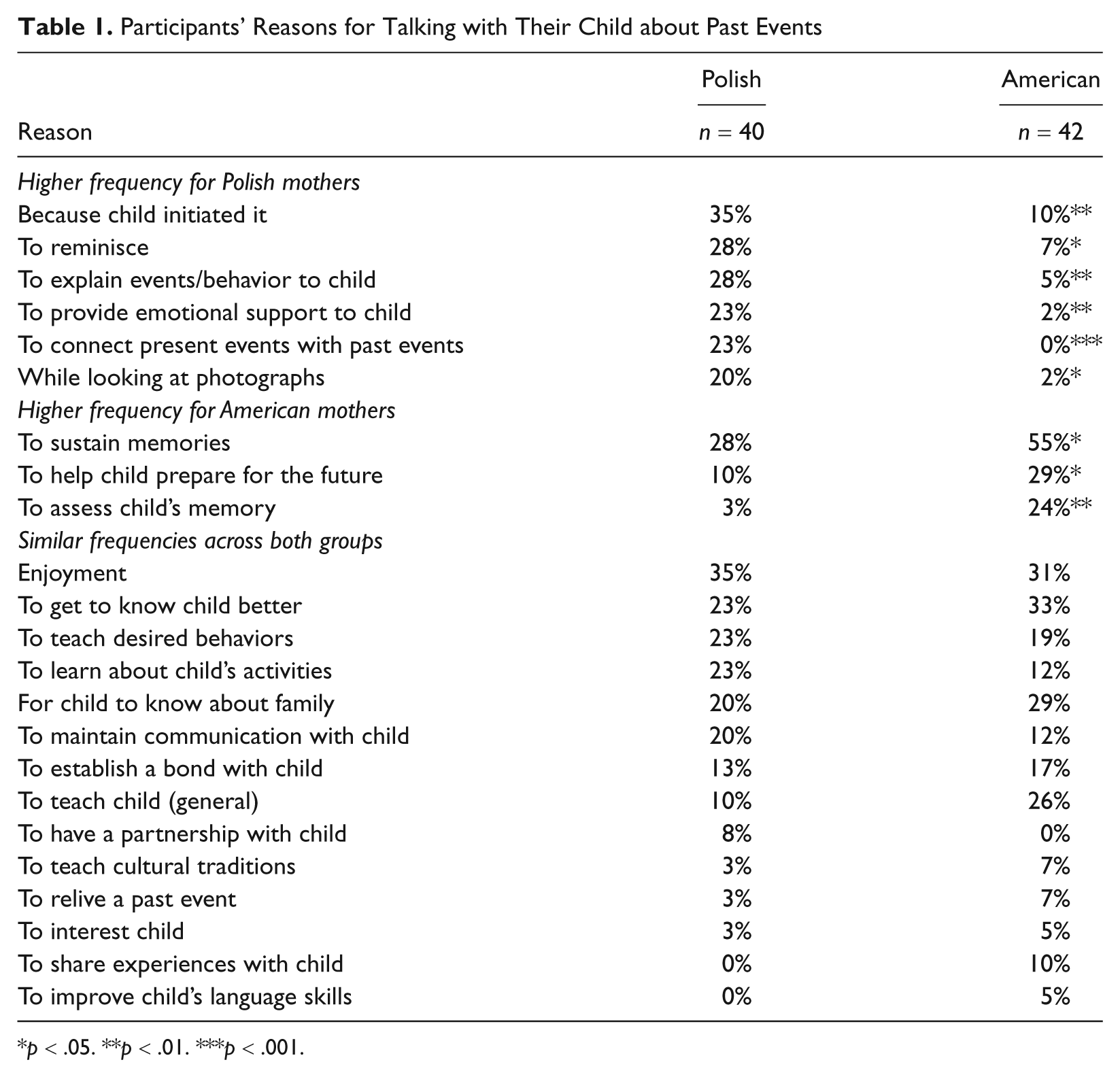
p < .05. **p < .01. ***p < .001.
A series of Fisher exact probability tests was used to determine if there were significant differences between the samples in the proportion of mothers who included particular reasons in their responses to the open-ended question. A significantly higher proportion of Polish mothers than American mothers mentioned talking with their child about past events because the child initiated it (p < .01). to reminisce with the child (p < .05), to explain events or behavior to the child (p < .01), to provide emotional support to the child (p < .01), to connect present events with past events (p < .001), and while looking at photographs (p < .05). A significantly higher proportion of American mothers mentioned talking with their child about past events to sustain memories (p < .05), to help the child prepare for the future (p < .05), and to assess the child’s memory (p < .01).
Analysis of the questionnaire data was conducted through a series of 2 × 2 × 2 analysis of variance (ANOVA) tests. Child age (3 years vs. 5 years), gender, and sample (i.e., American vs. Polish) were the three independent variables in these analyses. Given the large number of ANOVAs conducted, the p level required to reject the null hypothesis was set at p < .01 for each comparison.
The first set of ANOVAs was conducted on the five items from the Storytelling Questionnaire (see Table 2). ANOVA revealed no significant effects of age, gender, or sample on the frequency of talking with the child about past events, the child’s frequency of initiating conversation about past events, the distribution of parent versus child talk during shared narratives, and the typical initiator of narratives. ANOVA revealed a significant interaction of child age, gender, and cultural group on who typically is present when the parent and child talk about past events, F(1, 77) = 8.38, p < .01. Unequal N honest significant difference (HSD) post hoc tests were conducted to analyze this interaction effect; however, no specific contrasts were significant. Table 2 summarizes the results of the Storytelling Questionnaire, focused on the Polish versus American findings.
Mean Scores on Storytelling Questionnaire Items by Sample
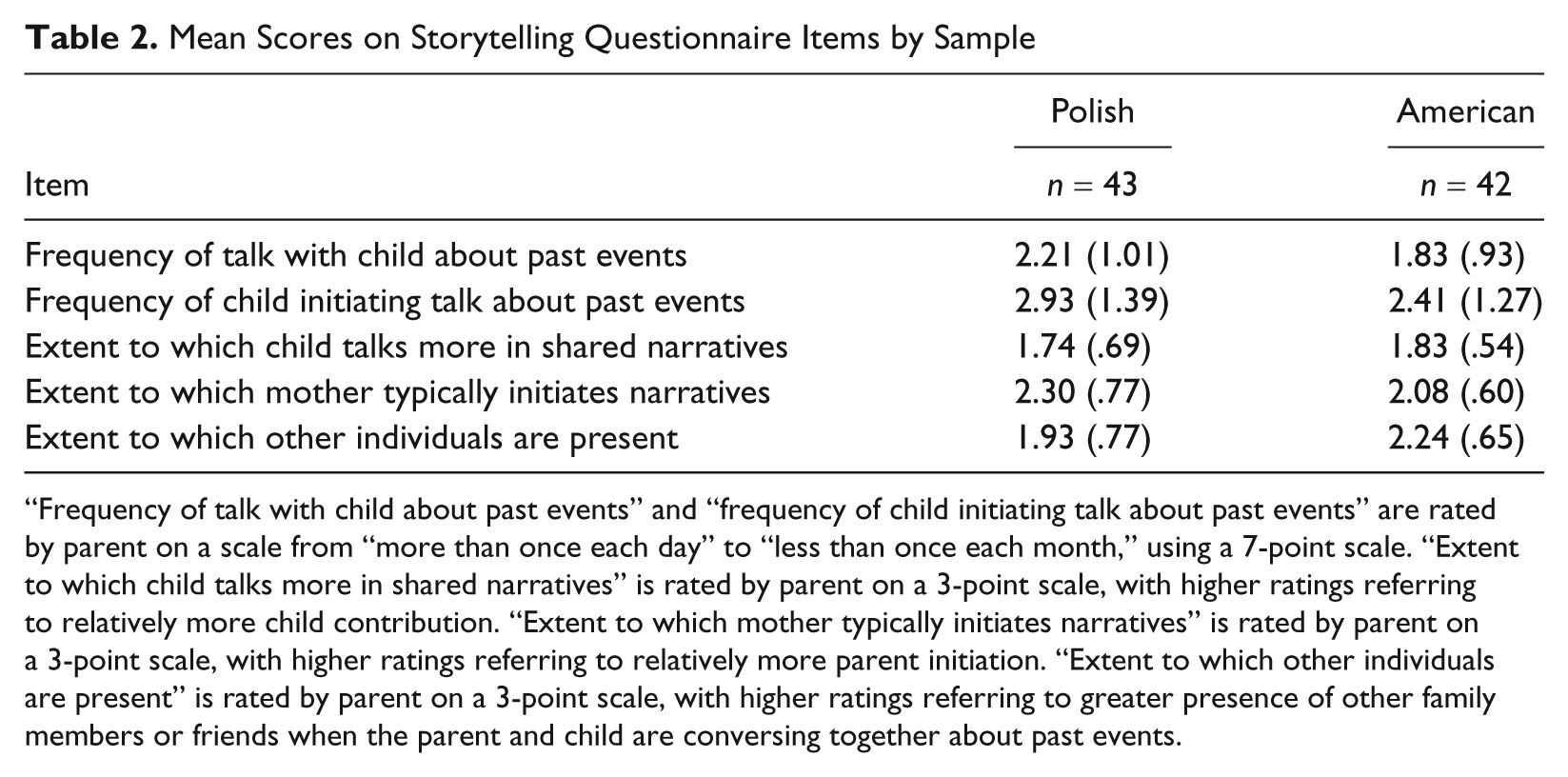
“Frequency of talk with child about past events” and “frequency of child initiating talk about past events” are rated by parent on a scale from “more than once each day” to “less than once each month,” using a 7-point scale. “Extent to which child talks more in shared narratives” is rated by parent on a 3-point scale, with higher ratings referring to relatively more child contribution. “Extent to which mother typically initiates narratives” is rated by parent on a 3-point scale, with higher ratings referring to relatively more parent initiation. “Extent to which other individuals are present” is rated by parent on a 3-point scale, with higher ratings referring to greater presence of other family members or friends when the parent and child are conversing together about past events.
The second set of ANOVAs was conducted on the 54 items from the Parents’ Beliefs About Storytelling questionnaire. For each significant main effect, an effect size, using Cohen’s d, was computed. Effect sizes of .5 to .7 are considered to be medium effects, and those larger than .8 are considered to be large effects (Cohen, 1992). There were no main effects of child age or gender found for any items on the measure or any significant interactions.
Several sample differences were found in mothers’ ideas related to the purpose of narratives. There was a main effect of sample with regard to talking with the child about past events in order to help the child distinguish good from evil, F(1, 77) = 10.75, p < .01, d = .67. Polish mothers (M = 1.61, SD = .85) agreed with this statement more than American mothers (M = 2.36, SD = 1.25. American mothers (M = 2.61, SD = 1.30) agreed more than Polish mothers (M = 3.56, SD = 1.64) with the concept of talking with the child about past events in order to tell the child what the parent’s life is like, F(1, 77) = 8.00, p < .01, d = .61. Compared to the Polish mothers (M = 1.95, SD = 1.17), American mothers (M = 1.31, SD = .68) also more strongly endorsed the idea of talking with the child about past events to help the child remember people who are important in their lives, F(1, 77) = 9.13, p < .01, d = .63.
With regard to beliefs related to appropriate content of parent-child conversations about past events, the American mothers (M = 3.31, SD = 1.33) showed relatively greater agreement than the Polish mothers (M = 4.33, SD = 1.69) with the idea that a good conversation between a parent and child about past events presents adults as protectors of children, F(1, 77) = 10.42, p < .01, d = .64. A sample difference was also found for the statement, “I believe that a good conversation between a parent and child about past events tells a truthful story,” F(1, 77) = 23.27, p < .001. American mothers (M = 2.41, SD = 1.21) agreed with this statement to a stronger degree than Polish mothers (M = 3.93, SD = 1.59; d = .95). The American mothers (M = 3.27, SD = 1.04) also agreed more strongly than the Polish mothers (M = 4.58, SD = 1.65) with the idea that a good conversation between a parent and child about past events includes a moral or life lesson, F(1, 77) = 19.02, p < .001, d = .86.
Sample differences were also found in the mothers’ ideas related to appropriate narrative structure. A main effect of sample was found for the statement, “A good conversation between a parent and child about past events provides information about ‘who,’ ‘when,’ and ‘where’” (i.e., contextual information), F(1, 77) = 22.73, p < .001. The American mothers (M = 2.10, SD = 1.14) agreed with this statement significantly more than the Polish mothers (M = 3.77, SD = 2.01; d = .91). Another sample difference was found with regard to the belief that a good conversation between a parent and child about past events is characterized by chronological order, F(1, 77) = 9.34, p < .01, with the Polish mothers (M = 5.40, SD = 1.51) showing more disagreement with this statement than the American (M = 4.38, SD = 1.31) mothers (d = .68).
Two other sample differences were also found on the questionnaire items. American mothers (M = 3.00, SD = 1.36) were more likely than Polish mothers (M = 4.33, SD = 1.70) to indicate that children should listen closely when their parents are talking to them about past events, F(1, 77) = 15.91, p < .001, d = .80. Last, the Polish mothers (M = 5.51, SD = 1.49) disagreed more than the American mothers (M = 4.07, SD = 1.45) with the statement, “A good conversation between a parent and child about past events uses a dramatic style and tone,” F(1, 77) = 19.01, p < .001, d = .88. Sample means on each item of the Parents’ Beliefs About Storytelling Questionnaire, organized by study results, are presented in Table 3.
Mean Scores on Parents’ Beliefs about Storytelling Questionnaire Items by Sample

Significance levels are based on ANOVA results. Standard deviations are within parentheses. Ratings were made on a scale from 1 to 7, with 1 referring to fully agree and 7 referring to fully disagree. The term conversation is shortened from the longer phrase used throughout the measure: “conversation between a parent and child about past events.” Numbering of items corresponds to the original order of items within the questionnaire.
p < .01. **p < .001.
The last set of statistical analyses sought to determine if there were any significant relationships between mothers’ ratings on the Parents’ Beliefs About Storytelling Questionnaire and their responses to the question, “When you talk with your child at home about past events, what are your reasons for doing so?” There were 10 themes that emerged from the content analysis of mothers’ responses to the open-ended question that corresponded conceptually with items on the Parents’ Beliefs About Storytelling Questionnaire. These themes and their corresponding items on the Parents’ Beliefs About Storytelling Questionnaire were “to establish a bond with the child” (2), “to teach the child (general)” (5), “to teach cultural traditions” (6, 18), “to teach desired behaviors” (8, 51), “to get to know the child better” (9), “to maintain communication with the child” (19), “enjoyment” (22), “to provide emotional support to the child” (23), “to help the child prepare for future” (27, 37), and “for the child to know about family” (40).
The t tests for unequal N were used to determine if there were significant differences in ratings on items on the Parents’ Beliefs About Storytelling Questionnaire between mothers who mentioned a particular theme in their response to the open-ended question and mothers who did not mention that particular theme. Thus, whether the mother mentioned the theme in the response to the open-ended question was the independent variable in these analyses, and ratings on the Parents’ Beliefs About Storytelling Questionnaire was the dependent variable. For these analyses, the data from the Polish and American mothers were combined. The t test for unequal N revealed that mothers (n = 23, M = 1.26, SD = .54) who indicated talking with their child about past events in order “to get to know the child better” agreed more with the Parents’ Beliefs About Storytelling Questionnaire item that they talk with their child about past events to help “understand my child,” compared with mothers (n = 59, M = 2.08, SD = 1.25) who did not include this reason in their response to the open-ended question, t(80) = 3.04, p < .01. A significant difference was found between mothers (n = 20, M = 1.15, SD = .37) who mentioned the theme of “for the child to know about family” in their response to the open-ended question, and those who did not mention this theme (n = 62, M = 1.77, SD = 1.11), with regard to their ratings on the Parents’ Beliefs About Storytelling Questionnaire item, “I talk with my child about past events in order to help him/her remember people who are important in our life,” t(80) = 2.47, p < .05. Last, mothers who indicated talking with their child about past events to provide emotional support to the child (n = 10, M = 1.20, SD = .42) rated the Parents’ Beliefs About Storytelling Questionnaire item on helping the child “cope with difficult emotions” higher than those mothers who did not mention this reason (n = 72, M = 1.79, SD = .84) in their response to the open-ended interview question, t(80) = 2.18, p < .05.
Discussion
The results of this study revealed several interesting differences between Polish and American mothers of preschoolers in their views regarding the purpose of shared parent-child narratives and what constitutes a “good” narrative. The effect sizes for the significant differences found were in the medium to large range (Cohen, 1992). Differences seen across the two cultural samples in their views about the function and optimal style of the narratives with their child may reflect variation in underlying cultural orientations and socialization goals across the two samples (Keller, 2007; Ochs & Capps, 2001).
The hypothesis that Polish mothers would rate sharing cultural traditions and strengthening family bonds as purposes of narratives more highly than would the American mothers was only minimally supported. In their responses to the open-ended query regarding reasons for talking with the child at home about past events, the Polish mothers were significantly more likely to state that they talk with their child about past events in order to provide emotional support to the child. Providing emotional support to the child is likely to facilitate a strong parent-child relationship or bond. Both Polish and American mothers generally agreed with the statement that they talk with their child about past events in order to transmit cultural values (i.e., both cultural groups provided a mean rating of approximately 2 on the 7-point scale, which corresponds to the anchor of agree). Both Polish and American mothers also strongly agreed with the idea of talking with their child about past events in order to help the child remember important people in life; however, the American mothers endorsed this statement at a significantly higher level than the Polish mothers. Using shared narratives to remember important people may have been relatively more important to the American mothers than the Polish mothers as many more Polish (7) than American (1) mother-child dyads in the samples lived with extended family members. Notably, daily contact between Warsaw parents and extended family was reported by Harkness et al. (2001).
It was found that the American mothers more strongly endorsed the belief that parent-child narratives should be organized chronologically. These results concur with those of Melzi (2000), who found that chronological order was evidenced in the shared narratives of American mother-child dyads more than in those of Central American mother-child dyads. Interestingly, the American mothers also more strongly endorsed the beliefs that good conversations between parents and children about past events should include contextual information, use a dramatic style and tone, and tell a truthful story. The American mothers were also more likely to indicate that children should listen closely to parents when they are engaged together in a shared narrative. Taken together, these findings suggest a relative strictness in the American mothers’ beliefs regarding narrative structure and content, at least when sharing narratives with their preschoolers. It would be interesting to study if young American children’s independent narratives are more structured than those of young Polish children, as Peterson and McCabe (1994) showed that parental questioning regarding contextual information (e.g., “when” and “where”) in parent-child co-constructed narratives when children were 2 to 3 years of age was associated with more inclusion of this type of contextual information in children’s independent narratives told to a researcher 6 months later.
One interesting, potentially related, finding from the thematic content analysis of the responses to the interview question was that significantly more of the American mothers (24%) indicated that a reason for sharing narratives with their preschooler was to assess the child’s memory. Only one of the Polish mothers indicated in her answer to the open-ended question that she shared narratives with her child in order to assess the child’s memory for past events. Thus, one may hypothesize that American mothers are more focused on the child’s development of memory abilities as compared to Polish mothers. Other researchers have noted this interest in North American mothers. For example, Peterson and McCabe (1992), studying co-constructed narratives between mothers and their preschoolers in Canada and the United States, discuss how mothers’ yes/no questions increasingly are replaced by memory questions requiring the provision of content information as children move through the preschool years. The American mothers who endorsed this belief may see their role in shared parent-child narratives as modeling a memory-search process for their child to internalize (Hudson, 1990).
Overall, the “testing” approach taken by the American mothers, also seen in research on parent-preschooler shared reading of an alphabet book conducted with families in Chautauqua County, New York (Lachner, Zevenbergen, & Zevenbergen, 2008), is consistent with the emphasis in New York state on preparing children for good performance on school standardized tests (Klein, Zevenbergen, & Brown, 2006). Standardized testing beginning in the early elementary school years, covering a wide variety of disciplines (e.g., mathematics, English language arts, social studies, science) was increasing in frequency and breadth at a rapid rate at the time of this study and was a widely discussed topic in New York schools and homes (Klein et al., 2006; Zevenbergen & Klein, 2004). A pervasive emphasis on assessing children’s attainments in various areas at school might significantly direct parents’ attention to children’s development of memory skills, even at the preschool age.
One set of interesting results relates to the difference between the Polish and American mothers’ ideas with respect to time orientation of shared narratives. In the data from the interview question, it was found that the American mothers were significantly more likely to indicate that they talked about past events with their child in order to help the child prepare for the future. This finding is consistent with the discussion by Markus and Nurius (1986) on the American self as oriented toward possible selves. On the other hand, many of the Polish mothers said that they talked with their child about past events in order to connect present events with past events. Similarly, in her investigation of Polish adults’ narratives elicited from older photographs taken in a Polish border town, Galasińska (2003) reported that her study participants frequently made links between past and present details of the locations depicted in the photographs. Though it is speculative, one might hypothesize that perhaps changes from past to present circumstances are particularly salient to these mothers who have seen many political and economic changes in their country over the course of their lives (Boski, 2006).
Taken together, the American mothers’ inclinations toward memory assessment of their children and using narratives to help prepare their child for the future (which can include a great deal of knowledge assessment) provide evidence of a relative emphasis on children’s development of individual cognitive skills in the American sample. This in turn may reflect a more general desire to transfer to their children a cultural orientation toward independence, which is one of the major characteristics of American culture (Keller, 2007; Kusserow, 2004). On the other hand, using narratives to provide emotional support to the child, as expressed by the Polish mothers, who at the same time link past events to present ones in narratives, may indicate their tendency toward personal relatedness and general cultural orientation toward interdependence (Keller, 2007).
Also of note in the study results is the greater disagreement of the Polish mothers with the idea that discussions of past events should include moral or life lessons (Polish version: “zawiera morał lub lekcję życiową”). This relative level of disagreement may reflect a contemporary movement away from authoritarian (i.e., very strict) parenting in Polish culture. In an account of Polish families in the 1980s and 1990s, Jerschina (1992) reports, “there is much authoritarianism and coolness in these relationships. There is a tendency to dominate others using strong pressure and offering little attention, even in the emotional sense. Parents tend to withdraw from offering time to their children, preferring to remain at a distance” (p. 287). However, Titkow and Duch (2004) observe that during the 1990s in Poland “parenting style was liberalized” and “a partnership approach became popular” (p. 80). This parent-child partnership may be evidenced in the results of our study: Nearly one-quarter of the Polish mothers indicated that they discussed past events with their child in order to provide emotional support to the child. Only one of the American mothers gave this reason for talking with her child about past events in response to the open-ended question. We do not mean to suggest, however, that American mothers are more authoritarian than Polish ones. The specific cultural differences found related to moral lessons and providing the child with emotional support may reflect Polish mothers’ particular focus on relatedness and partnership (i.e., due to the still ongoing cultural changes in parenting style). Overall, we recommend future studies assess the specific intended moral or life lessons of parents in these two cultural groups when sharing narratives with their preschoolers (i.e., through interview, questionnaire, and direct observation of shared narratives), as implicit moral lessons are inherently bound to narratives (Bruner, 1990; Freeman & Brockmeier, 2001; Miller et al., 1997; Ochs & Capps, 2001).
In a seeming contradiction to the above finding, regarding the idea that discussions of past events should include moral or life lessons, the Polish mothers revealed stronger agreement, compared to the American mothers, with the idea of sharing narratives with their preschooler in order to help the child tell good from evil (Polish version: “aby pomóc mu w nauczeniu się odróżniania dobra od zła”). It is likely that both cultural groups interpreted these two questionnaire items as tapping different constructs, as the means for both groups on these items differed substantially across the two items (see Table 3). Although the means for both groups on the “good versus evil” questionnaire item were lower than those for the “moral or life lessons” item (i.e., indicating stronger agreement), it is possible that the Polish mothers believed it is particularly important for children to learn to discern individuals and situations which are benign from those which could cause harm to the child.
This study also revealed a likely cultural difference in the context within which past events are discussed between mothers and their young children. Specifically, 20% of the Polish mothers indicated that they talked with their children about past events at the same time as they looked at photographs regarding these events. Only one of the American mothers mentioned this context. A relatively small literature has discussed the use of photographs to elicit narratives, mostly by adults (e.g., Galasińska, 2003; Harrison, 2002; Pahl, 2004; Pulkkinen & Aaltonen, 1998). It is possible that having photographs present during parent-child conversations about past events may facilitate children’s development of narrative skills more than completely decontextualized conversations about past events. We recommend further study of this potential cultural difference and possible developmental implications of this narrative context.
Although there were several sample differences found in mothers’ views regarding the purpose of shared narratives with their preschoolers and sample differences in preferred narrative content and style, this study did not demonstrate any differences in mothers’ responses to the questionnaires as a function of child age or gender. It appears that highly educated mothers in these two groups (i.e., Polish and predominantly European American individuals living in the United States) do not have differing purposes in sharing narratives with their sons and daughters who are 3-year-olds or 5-year-olds. One possible reason for these findings is that all of the mothers in the study were relatively educated (at least 3 years of university coursework). Highly educated mothers are known to talk more and in more sophisticated ways to toddlers and preschoolers (Hoff, 2003a, 2003b; Torr, 2004), compared to mothers with lower levels of education. Highly educated mothers may be more aware of the consequences of their conversational style with children from the very beginning and more egalitarian in their gender-related attitudes (Leaper & Valin, 1996). This demographic aspect of our samples may be related to the lack of significant findings related to child age and gender.
Due to the lack of significant relationships between child age and gender and mothers’ responses to the questionnaire items, these two independent variables were not investigated with regard to mothers’ responses to the open-ended interview question. However, we recommend that future studies continue to examine the potential role of child age and gender in influencing parents’ beliefs regarding shared narratives with children and facets of parent-child co-constructed narratives, given the results of previous studies in this area (e.g., Fernández & Melzi, 2008; Haden et al., 1997) and possible effects of limited education range within our samples.
The results of this study should be considered in light of the literature which contends that parent-child narratives may have differing purposes, depending on the specific circumstances. For example, Sales and Fivush (2005) found that mothers of 8- to 12-year-olds included more causal explanations, trying to construct a clear understanding of what occurred and communicating this to their child, in co-constructed narratives of chronic stressful events (e.g., parent-child conflict) as compared to co-constructed narratives of acute stressful events (e.g., a life-threatening asthma attack). Sales and Fivush concluded from these results that the mothers might have different goals in mind when discussing chronic versus acute stressful events with their children. Stavans and Goldzweig (2008) note that narratives are likely to have varying functions in various settings, with different speakers. The mothers in this study were not given particular circumstances to consider when framing their answers to the questionnaires and open-ended interview question. However, it is possible that their purposes in sharing narratives with their preschoolers and ideas regarding appropriate conversations about past events do in fact vary across contextual circumstances such as who else is present, the setting, and the topic of conversation. Mothers’ reasons for sharing narratives with their preschooler may vary even within one conversation with the same child, as the child’s intentions in the co-narrative can result in shifts in the parent’s goals as well (Bakhtin, 1986; Ochs & Capps, 2001).
Several limitations of the study must be noted. First, this investigation, which was one facet of a larger study, did not assess why the mothers held particular beliefs about sharing narratives with their children. While we speculated about how mothers’ reasons may be connected with larger cultural ideologies, we were not able to address this issue with means similar to that used by Miller et al. (2001). We recommend that future studies conduct follow-up interviews with parents to illuminate their theories of why they believe particular functions of shared narratives are most relevant for themselves.
Second, this article focuses only on beliefs related to parent-child narratives; it does not discuss whether there are systematic differences in the content and style of mother-preschooler narratives across the two cultural groups in this study. We are beginning work on this topic (Zevenbergen, Haman, Olszańska, & Thielges, 2008).
Third, only highly educated mothers were included in the study, in order to more easily match the samples on this demographic characteristic. A great deal of research has revealed, however, that socioeconomic status significantly influences the developmental niche (Super & Harkness, 1986) within which children develop (e.g., Kağitçibaşi, 2007; Keller, 2007; Kusserow, 2004). Thus, these findings should not be extrapolated to other income and educational-level groups in the United States or Poland. Future monocultural or cross-cultural studies should include study participants from a wider variety of socioeconomic groups, with careful consideration of how study findings may vary across individuals in the sample(s) as a function of socioeconomic status.
A fourth limitation of the study is that the psychometric properties (e.g., test-retest reliability, factor structure) of the questionnaire measures were not assessed. There was some correspondence between mothers’ responses to the two methods of assessing their ideas regarding parent-preschooler shared narratives, but the overlap in results was not extensive. The Parents’ Beliefs About Storytelling Questionnaire, developed for use in this study, could be refined for future studies. There are several important potential reasons parents might share narratives with their preschoolers that we did not assess through our questionnaire measure, including understanding the self better (Bruner, 1990; Nelson & Fivush, 2004; Pratt & Fiese, 2004; Wang, 2004), problem-solving (Ochs & Capps, 2001; Wang, 2004), organizing one’s thoughts (Caspe & Melzi, 2008), gender socialization of the child (Christofaro & Tamis-Lemonda, 2008; King & Gallagher, 2008), and teaching the child which experiences are reportable (Miller, Fung, & Koven, 2007). Interestingly, there were some reasons that the mothers in this study indicated through their response to the open-ended question (e.g., to assess the child’s memory, to sustain memories) that we did not include in our questionnaire. Future versions of the Parents’ Beliefs About Storytelling Questionnaire or related measures could include a wider variety of possible reasons for sharing narratives with children.
The results of this study reveal some differences in the reported purposes of mother-preschooler narratives and ideas about good characteristics of shared mother-preschooler narratives across two samples, mothers who were predominantly European American living in communities surrounding Buffalo, New York, USA, and native-born Polish mothers living in communities surrounding Warsaw, Poland. Sample differences were found, even though the groups were matched for child age and gender, mother education, and type of family residence. Notably, no differences were found between the two groups with regard to reported frequency of parent-child shared narratives and level of participation of the mother versus the child when sharing narratives. Thus, the results of this study exemplify a concept discussed by Kağitçibaşi (2007): “the ‘same’ behavior may assume different meanings in different contexts” (p. 28). The mothers in these two samples saw parent-child narratives as having at least partially differing meanings or purposes in their life and in the life of their child. Implications of these various meanings or purposes for child social, emotional, language, and cognitive development are worthy of future research.
Footnotes
Acknowledgements
An earlier version of this article was presented at the 2007 meeting of the American Psychological Association, San Francisco, California. We would like to thank the families who participated in the study. We would also like to acknowledge Kathryn Anderson, Melissa Andrus, Michelle Blattenberger, Marta Chmielewska, Meredith Faulkner, Stephanie Potkowa, and Ellen Wright for their assistance with data collection, entry, and transcription, and Andrzej Tarłowski for his back-translation of the study questionnaires from Polish to English. We thank Richard Weist and two anonymous reviewers for their helpful insights and comments on previous versions of the article.
Declaration of Conflicting Interests
The author(s) declared no potential conflicts of interest with respect to the research, authorship, and/or publication of this article.
Funding
The author(s) disclosed receipt of the following financial support for the research, authorship, and/or publication of this article: This research was supported by the United States National Academy of Sciences Twinning Program [47.075]; a grant from the Faculty of Psychology, University of Warsaw; and a grant from Media Rodzina Publishing House.