




Abstract
If male dominance in society causes women to be more cynical, women should show higher social cynicism than men in diverse cultural contexts. This conjecture was evaluated in a global study of social axioms, or general beliefs about the world, which involved university students from 40 societies and adults from 17 societies. Results showed that contrary to this expectation, men were generally more cynical than women. Men’s higher concern for competition may be one factor that contributes to their higher cynicism. In line with this argument, compared to women, men generally showed higher reward for application, the belief in the usefulness of effort and application, but lower fate control, which involves the belief that events are preordained but alterable. These findings suggest that the effect of male dominance on women’s social cynicism may be overridden by men’s higher concern for competitiveness. Consistent with the argument that male dominance increases women’s social cynicism, sex differences in social cynicism were smaller in societies where women had lower status. An implication of this finding is that women’s status in society is more reflective of the level of male dominance than women’s tendency to be competitive.
Simone de Beauvoir, the renowned French writer and philosopher, observed that “woman herself recognizes that the world is masculine on the whole” and that “her anxiety is the expression of her distrust of the world as given” (de Beauvoir, 1972, pp. 609-617). Given the traditional subordinate role of women in society, psychological research has generally corroborated her view of women as victims of male dominance. In a male-dominated world, positions of power, decision making, and authority are mostly occupied by men (Johnson, 1997), and men are accorded more prestige, influence, and wealth than women (Johnson, 2001). In the face of male dominance, women experience wide-ranging discrimination, such as reduced wages and barriers to advancement (O’Donohue, Downs, & Yeater, 1998). Women receive less pay than men for similar jobs even when human capital (qualifications) is taken into account (Blau & Kahn, 2000; Joy, 2003), and women are less likely to be promoted than men given a similar level of performance (Eddleston, Baldridge, & Veiga, 2004). One possible explanation for these hurdles is that women’s higher pay and faster promotion would challenge the status quo of a male-dominated world (Oakley, 2000).
An example of a blatant form of male dominance is sexual harassment of women by men, which is common in the workplace (MacKinnon, 1979). This extreme form of male dominance inflicts significant psychological harm on women, such as lower self-esteem (Gruber & Bjorn, 1982), lower self-confidence (Benson & Thomson, 1982), and higher anxiety and depression (Gutek, 1985; Saunders, 1992). This literature suggests that women generally exhibit a less positive psychological profile than men because of male dominance.
The Role of Male Dominance and Competitiveness in Cynicism
Sex differences may reflect different experiences of men and women (Fagley & Miller, 1990). We expect that due to the barriers confronting women in a male-dominated world, women should show higher cynicism than men, which is defined as the tendency to view people and the social world in negative terms (Kanter & Mirvis, 1989). In general, people high on cynicism “mistrust politicians and most authority figures, regard the average person as false-faced and uncaring, and conclude that you should basically look out for yourself” (Kanter & Mirvis, 1989, p. 2). Cynicism has shown a significant negative impact on people’s judgments and behaviors. For instance, cynicism predicted more calloused reactions to others after the September 11th terrorist attacks (Kaplan, Bradley, & Ruscher, 2004). Cynicism is positively related to agism and loneliness (Neto, 2006) and suicidal ideation (Chen, Wu, & Bond, 2009) and negatively related to self-esteem (Neto, 2006), life satisfaction (Lai, Bond, & Hui, 2007), and job satisfaction (Leung, Ip, & Leung, 2010).
Given the negative correlates of cynicism, it is important to confirm if women indeed show higher cynicism than men, because this sex difference has important implications for the well-being of women. The possibility of sex differences in cynicism was tested with an eight-item cynicism scale in a national probability sample in the United States, including items such as “It is pathetic to see an unselfish person in today’s world because so many people take advantage of him or her” and “Most people will tell a lie if they can gain by it” (Kanter & Mirvis, 1989). Surprisingly, men scored higher than women in cynicism, and to explain this sex difference, Kanter and Mirvis speculated that a cynical outlook “permits men to fight back and put their cynicism to work with more gusto and less apology” (p. 156).
Kanter and Mirvis’s (1989) speculation for the sex difference in cynicism resonates with gender role and evolutionary accounts of sex differences in competitiveness, which is concerned with the relative position of an individual against other competitors where his or her success leads to the failure of others (Colarelli, Spranger, & Hechanova, 2006). Gender role theories argue that men are socialized to be more competitive and aggressive than women (Eagly, Beall, & Sternberg, 2004). Men indeed exhibit more competitive behaviors than women, which has received considerable empirical support (e.g., Geary, 1998; Gill, 1993). For instance, in the work setting, male-male competition for status and advancement is more direct and intense than female-female competition (Browne, 2002). Experimental research shows that in competitive situations, there are more competitive behaviors in groups of men than in groups of women (e.g., Schopler et al., 2001). In line with this conclusion, the evolutionary perspective also argues that male-male competition takes on a different nature than female-female competition, resulting in a higher level of aggressiveness and competitiveness for men than for women (Geary, 1998).
It is well-documented that a competitive environment breeds mistrust (Boyle & Bonacich, 1970), and men’s higher cynicism can indeed be a likely consequence of their struggle in a world “red in tooth and claw” as well as an adaptive psychological mechanism for their survival and success. This analysis suggests a different mechanism to account for sex differences in cynicism based on competitiveness. In summary, we argue that male dominance tends to increase women’s cynicism, whereas men’s higher competitiveness is a factor that increases men’s cynicism. Sex differences in cynicism are shaped by the relative influence of male dominance and the higher competitive tendency of men. Based on this reasoning, the pattern of sex difference reported by Kanter and Mirvis (1989) suggests that the effect of men’s higher concern for competiveness on men’s cynicism is stronger than the influence of male dominance on women’s cynicism.
Sex Differences in Cynicism Around the World
The finding that men are more cynical than women in the United States may only reflect the idiosyncrasies of this specific country. A more compelling strategy to ascertain the fundamental nature of this sex difference is to confirm it in diverse cultural contexts with different social-economical-political environments (Schwartz & Rubel, 2005; Terracciano et al., 2005). Independent of the aforementioned study on cynicism in the United States, general social beliefs, or social axioms, have been measured around the world (Leung & Bond, 2004). This project has collected university student data from 40 societies and adult data from 17 societies. A five-dimension structure has been identified with a meta-analytical approach to factor analysis (Leung & Bond, 2004), which was subsequently confirmed by a multi-level factor analysis (Cheung, Leung, & Au, 2006). Diverse studies have provided evidence for the validity of these five axiom dimensions (Leung & Bond, 2004, 2009).
Social cynicism is one of the axiom dimensions identified, tapping a negative view of human nature, a bias against some social groups, a mistrust of social institutions, and a belief that people tend to ignore ethical means in pursuing their goals. It is measured by 11 items, including “Powerful people tend to exploit others,” “The various social institutions are biased towards the rich,” and “Kind-hearted people usually suffer losses.” The validity of this dimension has been established (e.g., Ersoy, Born, Derous, & van der Molen, 2011; Leung & Bond, 2009). The data on social cynicism collected in this extensive cross-cultural project provide a pan-cultural test of whether men indeed show higher cynicism than women, as reported by Kanter and Mirvis (1989).
The social axioms project has identified another dimension, reward for application, which is relevant for the competitiveness argument as a possible explanation for men’s higher social cynicism. It taps how strongly a person believes that challenges and difficulties will succumb to persistent inputs, such as relevant knowledge, exertion of effort, or careful planning. Two sample items include “Competition brings about progress” and “Adversity can be overcome by effort.” Surviving a competitive environment requires intense effort, and given the stronger tendency for men to be competitive and aggressive, men should believe more strongly than women that application can result in rewards. The confirmation that men are higher in reward for application than women across diverse societies provides support for the argument that men indeed show a stronger competitive tendency than women.
The Role of Subordinate Status in Social Cynicism
If male dominance indeed has a lesser influence on women’s cynicism level than the influence of men’s competitiveness on men’s cynicism level, men will generally show higher cynicism than women around the world, as men’s higher competitiveness will overwhelm the effect of male dominance. This argument suggests that sex differences in cynicism are unlikely to reveal the influence of male dominance on women’s cynicism level. Interestingly, the effect of the dominance of a majority group on the social cynicism of a subordinate group may be revealed by ethnic differences in social cynicism. Because there is no compelling reason why there should be differences in competitiveness across majority and minority groups, we expect that an ethnic group with a subordinate status should show higher cynicism than that of a majority group. Consistent with this argument, Kanter and Mirvis (1989) found that minority group members in the United States showed higher cynicism than European Americans. One interpretation is that the subordinate status of minority group members may be one factor contributing to their higher cynicism because of the many hurdles they need to face in a society dominated by the majority group.
The social axioms data provide three separate sources of evidence for the possibility that subordinate status is related to the social cynicism of the subordinate group. First, the data from the United States include both minority and major group members, and the ethnic difference reported by Kanter and Mirvis (1989) can be evaluated. If replicated, it provides support for the argument that the subordinate status of a group is one factor that may increase its social cynicism.
Second, fate control, another axiom dimension, may provide indirect evidence for the male dominance argument. It taps the degree to which important outcomes in life are believed to be fated but are predictable and alterable. Sample items include “There are certain ways to help us improve our luck and avoid unlucky things” and “Fate determines one’s successes and failures.” Consistent with the definition, fate control involves a passive style as well as active and judicious intervention to alter one’s fate (Zhou, Leung, & Bond, 2009). In a male-dominated world, women’s actions and achievements are constrained by male dominance, which would promote among women a weak sense of control over events that happen to them. This reasoning suggests that male dominance is related to higher fate control among women.
Third, societies vary in women’s status, and we argue that women’s status reflects the extent of male dominance in a society. In other words, in societies in which women enjoy a higher status, men are less dominant and provide more opportunities to women. Thus, the male dominance argument suggests that in society where women’s status is higher, women should show lower social cynicism. In other words, sex differences in social cynicism in societies where women’s status is higher should be larger. Note that this expectation assumes that women’s higher status in a society is more reflective of lower male dominance than women’s stronger tendency to be competitive, because competitiveness should elevate rather than lower their cynicism level.
In summary, the findings reported in this article provide an evaluation of whether men show higher social cynicism than women in diverse cultural contexts, whether men’s higher concern for competitiveness than women is related to this sex difference, and whether male dominance is related to women’s higher social cynicism. Given that this is a nascent area, and we lack the guidance of well-established, mature theories, this study is exploratory in orientation.
Method
Participants
The data were obtained from a global study on social axioms (Leung & Bond, 2004). Data were collected from 9,668 university students from 40 societies, who participated in the study either as a course requirement or voluntarily. Data from a convenient sample of 2,954 adults were also collected from 17 societies. Those adults participated in the study on a voluntary basis. In the student samples, 41.4% were male, and 58.6% were female. For age distribution, 44.9% of participants were below 20, 33.1% between 21 and 25, 1.4% between 26 and 40, and 0.8% above 40. In the adult samples, 46% were male, and 54% were female. For age distribution, 7.1% were below 20, 29.7% were between 21 and 30, 20.2% between 31 and 40, 23.7% between 41 and 50, 14.1% between 51 and 60, and 5.0% above 60. With regard to education, which was known for participants from 12 societies, 1.3% had a primary school education or below, 45.2% a secondary school or a community college education, and 43.4% a university education or above.
Instrument
The Social Axioms Survey was used. It was developed in English, and a back translation procedure was followed to translate it into different languages for different societies. It is a 60-item instrument, with a 5-point response format. The end points are labeled as strongly believe and strongly disbelieve. Social cynicism was measured by 11 items, reward for application by 9 items, and fate control by 6 items. Respondents completed it anonymously in small groups in their native language.
Results
We first evaluated the invariance of the factor structure across the two sexes by means of a multigroup confirmatory factor analysis (Vandenberg & Lance, 2000). Because the universality of the social axioms structure is well-established, we merged the samples across all the societies based on a meta-analytic approach to factor analysis (Becker, 1996). For each sex, the entries of the correlation matrix of each cultural group were transformed by the Fisher transformation to z scores, and these matrices were then averaged across societies to generate a combined matrix. This combined matrix was then transformed back to a correlation matrix for factor analysis. Because an item-based factor model is too complex, we randomly grouped the items into parcels (Bentler & Chou, 1987), with each axiom dimension tapped by three parcels.
Configural equivalence, which requires the factors to be defined by similar items for the two sexes, was supported for the student data (χ2= 1,315.42, df = 148, CFI = .91, GFI = .97, RMSEA = .057). The constraints of metric equivalence were then added, which requires the loadings of the items to be similar across the two sexes. Metric equivalence was supported (χ2= 1,335.34, df = 163, CFI = .91, GFI = .97, RMSEA = .054). In fact, this more restricted model was not significantly different from the model for configural equivalence, Δχ2(15) = 19.92, p > .05, ΔCFI < .01 (see Cheung & Rensvold, 2002).
Measurement equivalence across the two sexes was assessed for the adult data with a similar procedure. The model for configural equivalence indicated a good fit (χ2= 775.21, df = 163, CFI = .90, GFI = .95, RMSEA = .058) and so did the model for metric equivalence (χ2= 754.62, df = 148, CFI = .90, GFI = .95, RMSEA = .06). As before, this more restricted model did not differ from the model for configural equivalence significantly, Δχ2(15) = 2.59, p > .05, ΔCFI < .01.
Sex Differences in Social Cynicism, Reward for Application, and Fate Control
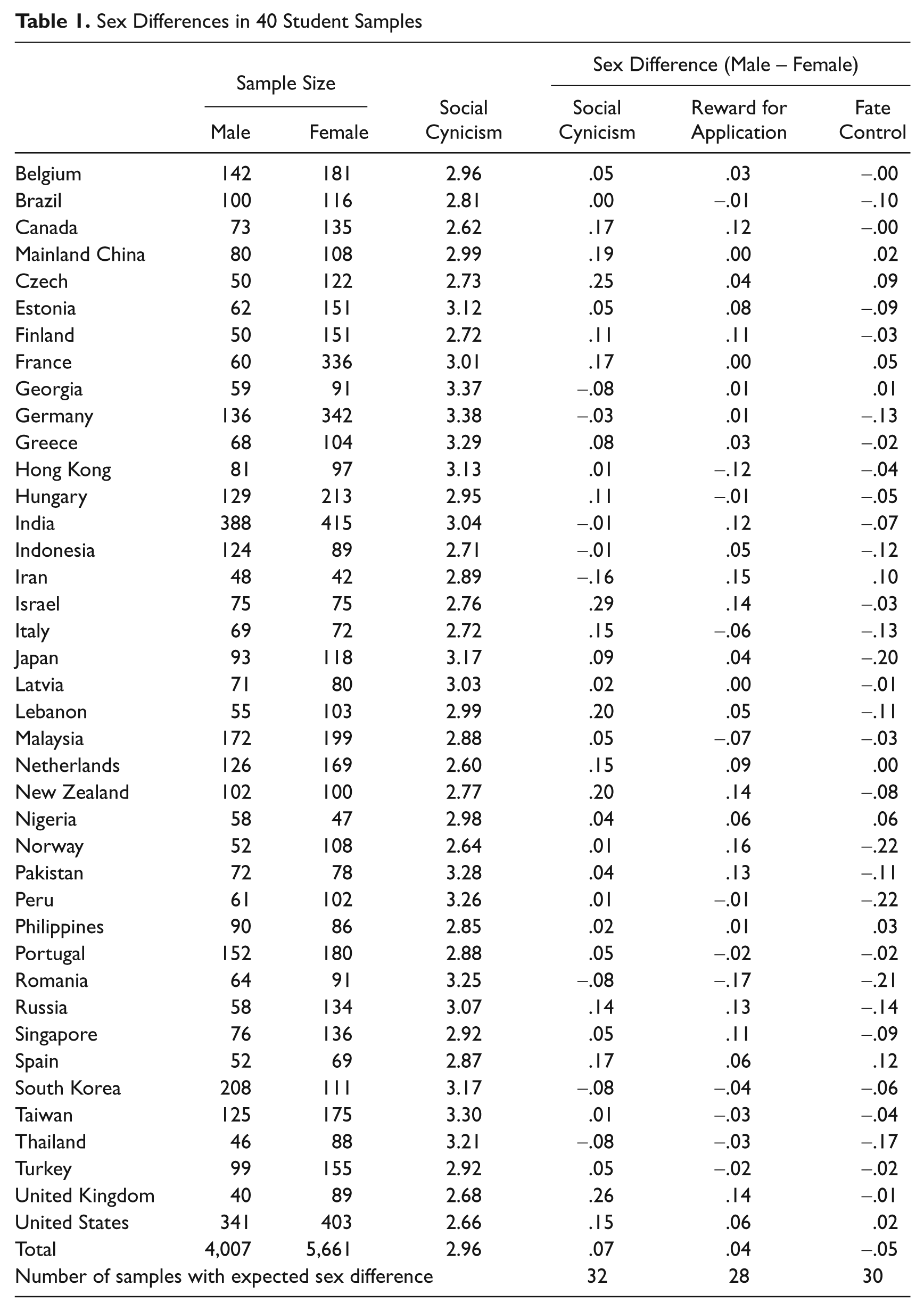
Sample sizes and sex differences based on the student samples are given in Table 1. A t test for the entire sample showed that men reported higher social cynicism than women, t(9,660) = 4.70, p < .001. Among the 40 student samples, men were more cynical than women in 32 samples. A sign test showed that the number of societies with men expressing higher social cynicism was significantly larger than 50% (p < .01).
Sex Differences in 40 Student Samples
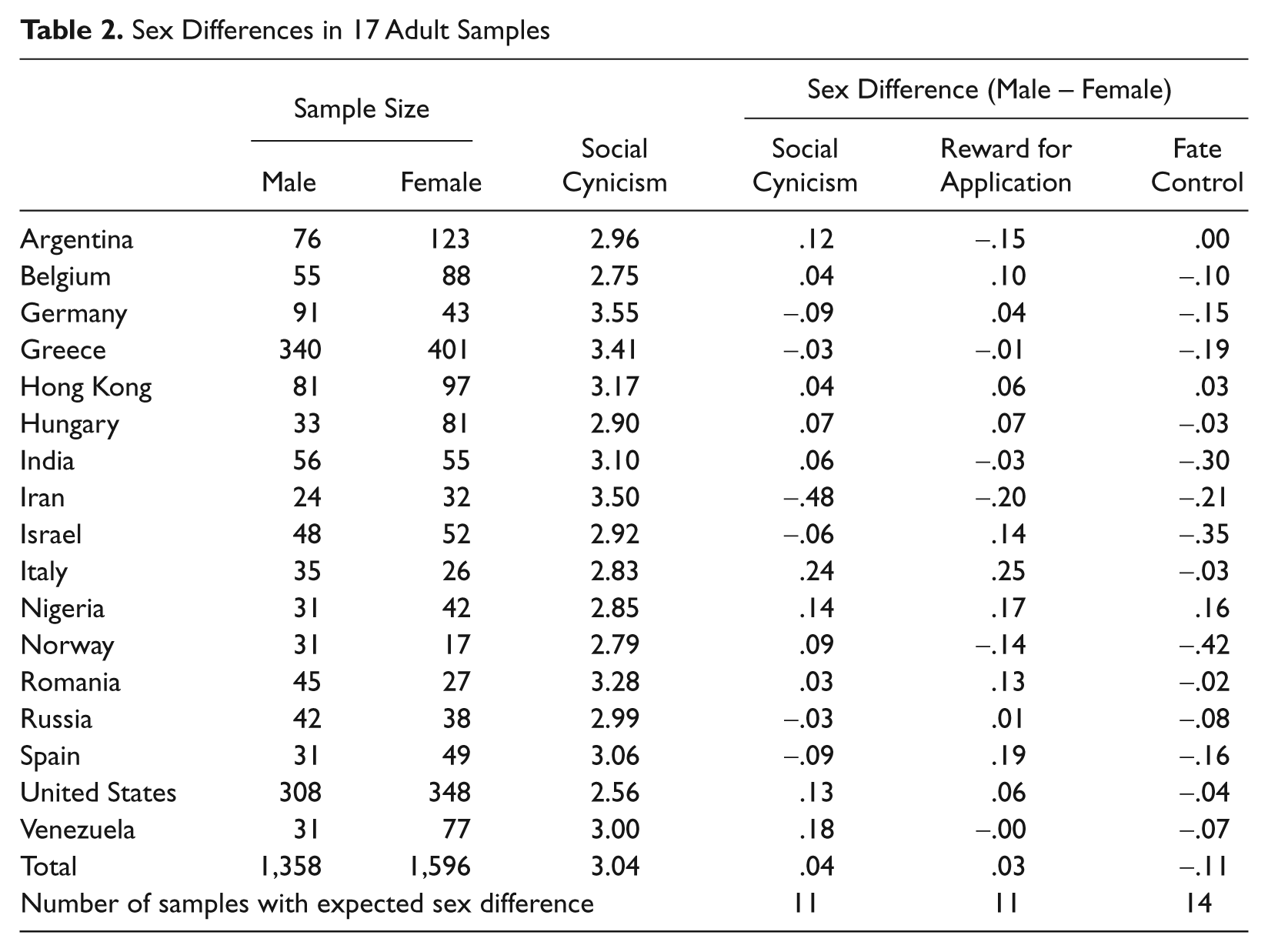
The results based on the adult data are similar (see Table 2). A t test for the entire sample showed that men reported higher social cynicism than women, t(2,951) = 2.74, p < .01. Men showed higher social cynicism than women in the majority of the societies (11 out of the 17 societies), but the sign test was not significant, which may be due to the small sample size.
Sex Differences in 17 Adult Samples
The t tests reported before were at the individual level, whereas the sign tests examined differences across societies. It is possible to examine individual-level and society-level differences simultaneously with Hierarchical Linear Modeling (HLM; Raudenbush & Bryk, 2002). An important advantage of HLM is that it provides accurate estimates of sex effects across societies because it controls for the differential reliability of the within-culture relationships due to differences in sample sizes (Raudenbush & Bryk, 2002; Schwartz & Rubel, 2005).
According to Enders and Tofighi (2007), we analyzed a model with all the individual-level variables group-mean centered because we focused on the effects of the individual-level predictors. The HLM results for the student samples indicated that men reported higher social cynicism than women (see Table 3). Sex accounted for .78% of the variance, whereas culture (societies) accounted for 17.1%, meaning that differences in social cynicism vary a lot more across cultures than across the two sexes. The result also showed that the effect of sex on social cynicism varied significantly across societies. The HLM analyses on the adult data showed similar results (see Table 4). Sex accounted for .65% of the variance, whereas culture accounted for 22.8%. Sex differences in social cynicism also varied significantly across cultures.
Results of Hierarchical Linear Modeling for Student Samples
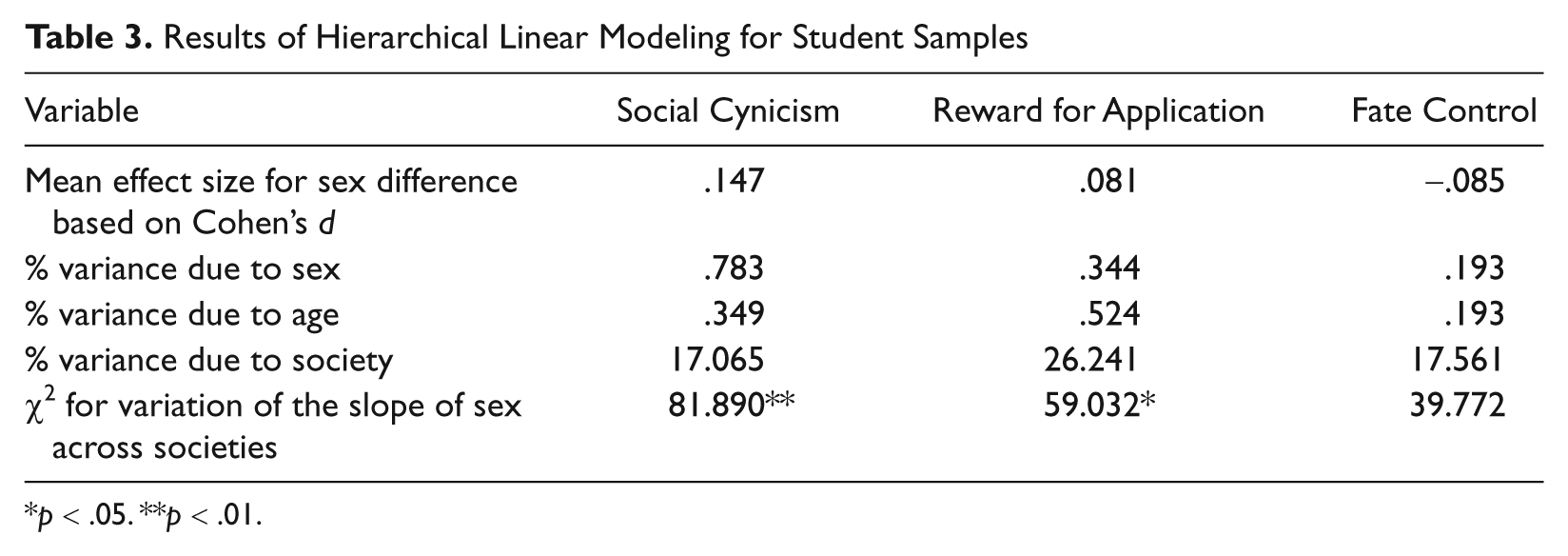
p < .05. **p < .01.
Results of Hierarchical Linear Modeling for Adult Samples
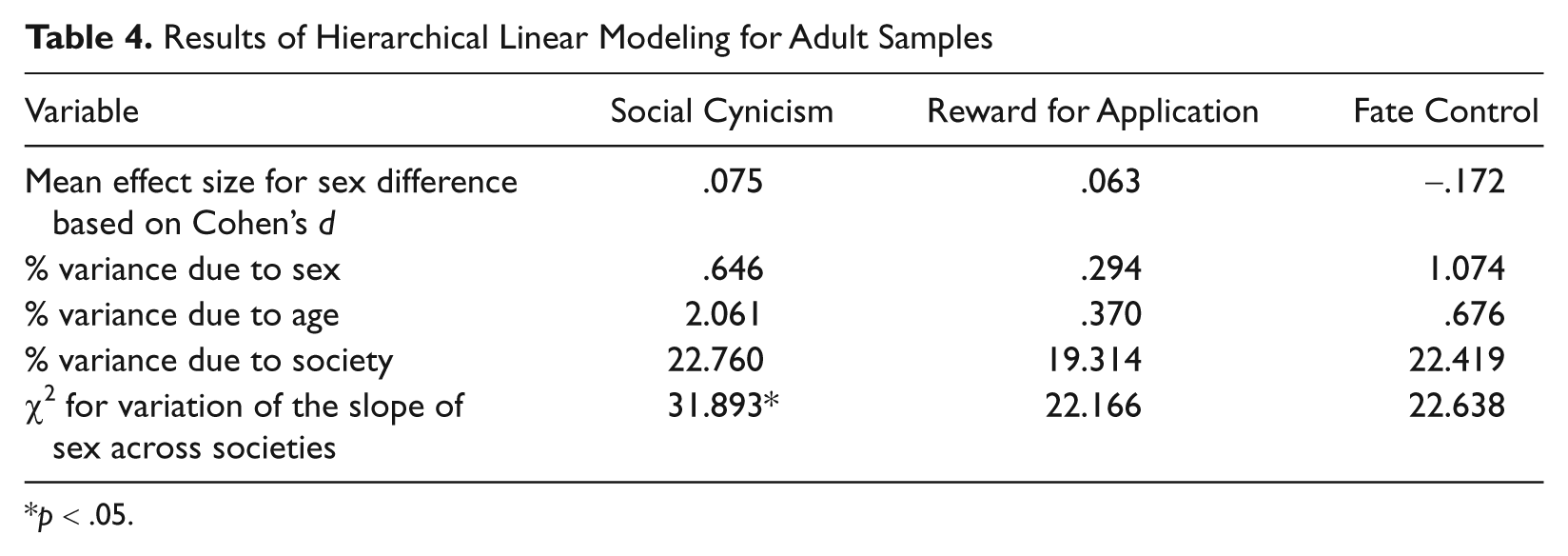
p < .05.
Similar analyses were conducted for reward for application and fate control. For the student samples, the overall t test indicated that men reported higher reward for application, t(9,663) = 6.49, p < .01, and lower fate control, t(9,663) = −2.07, p < .05, than women. In addition, men reported higher reward for application than women in 28 out of the 40 societies (sign test, p < .05) and lower fate control than women in 30 out of the 40 societies (sign test, p < .01).
Similar results were obtained with the adult data. The t tests were significant: Reward for application, t(2,952) = 2.03, p < .05, and fate control, t(2,952) = −3.98, p < .01. In addition, compared to women, men showed higher reward for application (11 out of 17 societies) and lower fate control (14 out of 17 societies) in the majority of the societies. However, the sign test was significant only for fate control (p < .05).
The HLM results indicated that for the student samples, sex accounted for .34% of the variance of reward for application and .19% of the variance of fate control. In contrast, culture accounted for 26.2% of the variance of reward for application and 17.6% of the variance of fate control. Similarly, the HLM results for the adult samples indicated that sex accounted for .29% of the variance of reward for application and 1.07% of the variance of fate control, whereas culture accounted for 19.3% of the variance of reward for application and 22.4% of the variance of fate control.
To sum up, men generally show higher social cynicism than women. In line with the competitiveness argument, men generally show higher reward for application than women. Consistent with the male dominance argument, women generally show higher fate control than men.
Social Cynicism and Subordinate Status
It is possible to evaluate whether a subordinate status is related to higher social cynicism in the data from the United States. For the student data, two groups were formed: European Americans and Americans with Asian, African, Hispanic, or Native backgrounds. We balanced the two sexes in each group by randomly dropping cases in the sex with a larger sample size, and the final sample included 682 European Americans (341 for each sex) and 332 minority group members (166 for each sex). As expected, a t test showed that the minority group members showed higher social cynicism than the European Americans (M = 2.84 vs. 2.67, respectively), t(1,021) = −5.22, p < .01.
For the adult data, the final sex-balanced sample included 616 European Americans (308 for each sex) and 202 Americans with Asian, African, Hispanic, or Native backgrounds (101 for each sex). A t test indicated that the minority group members showed higher social cynicism than the European Americans (M = 2.81 vs. 2.57, respectively), t(816) = −5.81, p < .01. These results support the notion that a subordinate status is related to higher social cynicism.
A more direct test of the idea that male dominance is positively related to women’s social cynicism is possible because there are indexes that reflect the status of women in some societies. HLM provides an effective analytic framework to evaluate whether male dominance as reflected by women’s status in a society may be correlated with women’s higher social cynicism across diverse societies. We analyzed the student data only as the number of societies in the adult data is too small for an HLM analysis.
At the individual level, we set up a regression equation in which the predictor is sex (female = 1 vs. male = 0), and the dependent variable is social cynicism. A negative relationship would suggest that men show higher social cynicism than women. At the societal level, women’s status is reflected by an index compiled by United Nations Statistical Office, the International Labor Organization, and the U.S. Bureau of the Census (Population Crisis Committee, 1988). Data on women’s status are available for 35 out of the 40 societies in the student samples. The key analysis is concerned with a slopes-as-outcomes model, which explores whether women’s status influences the effect of sex on social cynicism across societies. In other words, this analysis explores whether sex differences in social cynicism vary systematically across societies as a linear function of women’s status.
In line with Enders and Tofighi (2007), sex as the individual-level variable was group-mean centered and women’s status as the society-level predictor was grand-mean centered. As expected, women’s status is a significant cross-level moderator (γ = −.0029, p < .01). Based on the formula described in Hofmann, Griffin, and Gavin (2000), women’s status explained 44.9% of the variance in the relationship between sex and social cynicism across societies. Figure 1a provides a graphical representation of the effect, with women’s status based on 1 standard deviation above and below the mean. The graph shows that in societies where women have a lower status, sex differences in social cynicism are smaller, suggesting that women’s social cynicism is relatively higher.
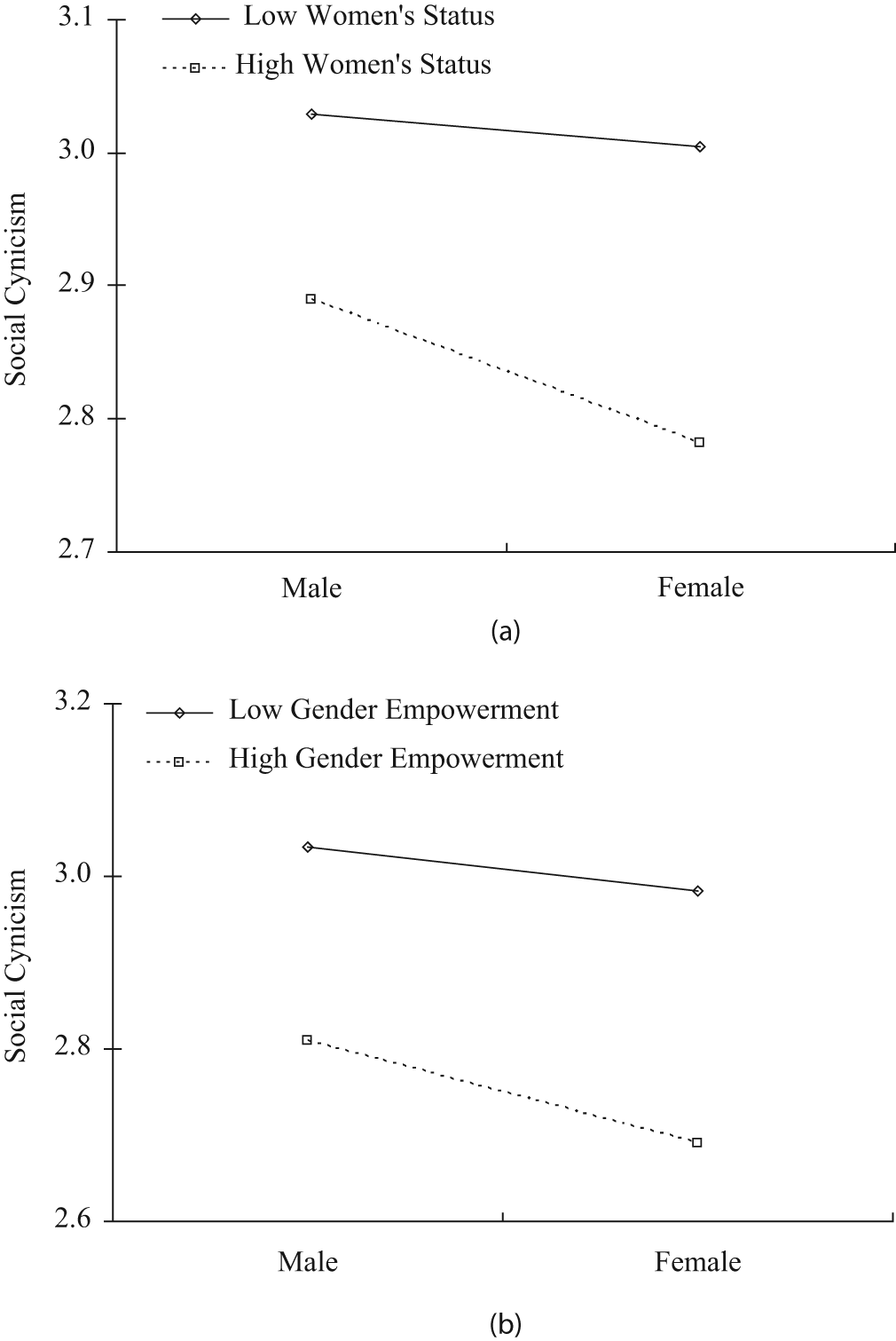
Cross-Level Moderating Effects of Women’s Status in Society
A different, more recent society-level index for the status of women, the Gender Empowerment Index, is provided by United Nations’ 2003 human development report (United Nations Development Program, 2003). This index is highly correlated with the Index of Women’s Status (r = .77, p < .01) and is available for 27 societies in our student samples. In these 27 societies, two societies were not included in the Index of Women’s Status, but 10 societies included in the previous analysis were excluded.
We repeated the HLM analysis with the Gender Empowerment Index replacing the Index of Women’s Status. As expected, gender empowerment was a significant society-level moderator (γ = −.24, p < .05). Gender empowerment explained 18.9% of the variance in the relationship between sex and social cynicism across societies. Figure 1b shows that as in the case of the index of women’s status, sex differences in social cynicism are smaller in societies where there is less gender empowerment, suggesting that women’s social cynicism is relatively higher.
We note that in the student data, eight societies (Georgia, Germany, India, Indonesia, Iran, South Korea, Romania, and Thailand) showed a reversed sex difference: Women showed higher social cynicism than men. Data on women’s status (Population Crisis Committee, 1988) were available for six societies (no data for Georgia and Iran). Among these six societies, five were below average in women’s status, with Germany as the only exception. Perhaps women’s lower status in these societies may have contributed to the reversed sex difference in social cynicism observed.
Discussion
We theorize that men’s higher competitiveness tends to increase their social cynicism. Consistent with this argument, men indeed endorse reward for application more than women, suggesting that men tend to believe in the utility of effort. The association of social cynicism and competitiveness is also supported by other empirical evidence. Across several societies, social cynicism was related to the use of assertive influence tactics in the work setting, such as repeated pleading, demands, threats, and appeal to higher authorities (Fu et al., 2004). Social cynicism showed a positive correlation with the use of a competitive conflict style (Bond, Leung, Au, Tong, & Chemonges-Nielson, 2004). Across several societies, social cynicism was positively related to the value attached to power (Leung, Au, Huang, Kurman, Niit, & Niit, 2007), and the desire for power is characteristic of highly competitive individuals. Nonetheless, while these empirical results corroborate the competitiveness argument, the evidence is indirect. Future research should seek more direct evidence for the association between men’s concern for competition and their higher social cynicism.
It is well-known that the aggressiveness and competitiveness of men are related to their higher occurrence of heart diseases and higher blood pressure (Zheng, Croft, Giles, & Mensah, 2001). Our results suggest that men’s higher aggressiveness and competitiveness may be related to their higher social cynicism, which has diverse negative psychological and behavioral outcomes. For instance, social cynicism was found to correlate negatively with interpersonal trust and cognitive flexibility (Singelis, Hubbard, Her, & An, 2003) but positively with neuroticism of the five-factor model of personality (Chen, Fok, Bond, & Matsumoto, 2006). A negative correlation between social cynicism and life satisfaction has been reported (Safdar, Lewis, & Daneshpour, 2006), which has been replicated even when neuroticism was taken into account (Lai et al., 2007). Compared to women, men seem psychologically disadvantaged because of their higher social cynicism, including lower happiness as well as higher distrust and rigidity.
Our findings support the notion that a subordinate status is related to higher social cynicism. Consistent with Kanter and Mirvis (1989), we found that minority group members in the United States reported higher social cynicism than European Americans. In line with the association of a subordinate status and social cynicism, we found that in societies where the status of women is lower, the sex difference in social cynicism is smaller, suggesting that male dominance in these societies may have increased the social cynicism of women. Note that this argument is based on the assumption that women’s status in society is more reflective of the level of male dominance than the tendency of women to be competitive, a possibility that needs to be evaluated in future research. It is worth mentioning that among the societies with a reversed sex difference (i.e., women are more cynical than men), women’s status is generally low in these societies, which may have contributed to the unexpected reversal.
This pattern of findings supports the theorizing that male dominance tends to increase the social cynicism of women, but it is not as influential as men’s higher aggressiveness and competitiveness in shaping men’s cynicism, which explains why men are generally more cynical around the world. To explain why male dominance is less influential than men’s higher competitiveness, we turn to Glick et al.’s (2000) distinction between hostile sexism and benevolent sexism. Following their reasoning, we argue that hostile attitudes toward women result in more cynical beliefs among women. In addition, Glick et al. reported cross-cultural variation in benevolent sexism, a benign form of sexism characterized by protection and affection toward women. Interestingly, this form of sexism is positively related to hostile sexism, but it is possible that benevolent sexism may counteract the negative effects of hostile sexism. In other words, women’s cynicism may be increased by hostile sexism but weakened by benevolent sexism. This reasoning provides an explanation for the lesser influence of male dominance on women’s cynicism as compared with the influence of men’s higher aggressiveness and competitiveness on men’s cynicism, an idea worthy of exploration in future research.
Finally, we note that the effect size of sex differences in social cynicism is only a small fraction of the effect size due to cultural differences, which is similar to the results reported by Schwartz and Rubel (2005) with regard to values. This finding suggests that contextual variables can easily mask or reverse the expected sex difference in social cynicism, which may explain why several societies show a reversed pattern of that sex difference. In fact, women’s status is able to explain a sizeable portion of the variance in sex differences in social cynicism across societies. Because the influence of culture is obviously social rather than evolutionary in nature, social forces seem to provide a much more powerful explanation for variation in social cynicism than evolutionary forces. Prior research has explored the associations between societal factors and social cynicism. For instance, Leung and Bond (2004) reported some relationships between socioeconomic-political indexes (e.g., per capita GDP) and the mean score of social cynicism across societies. At the individual level, Li and Leung’s (in press) longitudinal study showed that lower evaluation of societal conditions predicted subsequent social cynicism. In the current research, we found that across societies, women’s status correlated negatively with social cynicism (r = −.31, p < .08), women’s social cynicism (r = −.33, p = .05), as well as men’s cynicism (r = −.23, p > .10). This pattern of correlations suggests that women’s status is more related to their social cynicism than with the social cynicism of men. In the absence of prior research, it is difficult to speculate on what these findings mean. Perhaps in societies where women’s status is high, there is a generally benevolent climate, which lowers the cynicism of both sexes. In any event, the exploration of how culture influences sex differences in social cynicism is an important topic for future research.
Although the results are coherent and meaningful, our research has some limitations. First, we theorize that men’s competitiveness accounts for their higher social cynicism, but the evidence we provide is indirect. Future research should seek more direct evidence for this argument. For instance, we argue that women’s higher fate control may reflect the effect of male dominance, and this argument is speculative and requires more direct evidence. Second, we have mainly focused on the main effects of sex and the cross-level interaction effects of society-level variables on the effect of sex, but sex may interact with other individual-level factors. For example, sex differences in social cynicism are larger for students than for adults. It may be possible that younger men are more competitive than older men, which may explain the larger sex difference in social cynicism among university students. Future research needs to explore the interactions between sex and other individual difference variables. Third, our theorizing is causal, but our data are correlational in nature and provide a weak test of the causality implied in our theorizing. Longitudinal and experimental designs are needed in future research to evaluate the causal relationships asserted. Finally, our findings are limited to students and adults in literate cultural groups. A strong test of the universality of our findings will require the collection of data in unindustrialized societies.
In conclusion, this study provides some pan-cultural findings about sex differences in social cynicism and sheds light on the mechanisms involved. Social cynicism has significant implications for psychological well-being, and the present research points to some very interesting and important topics in sex differences for future research.
Footnotes
Acknowledgements
We thank Michael Bond for his insightful comments on an early draft.
Declaration of Conflicting Interests
The author(s) declared no potential conflicts of interest with respect to the research, authorship, and/or publication of this article.
Funding
This research is supported by a grant provided by the Hong Kong Research Grants Council (CityU 1466/05H).