



Abstract
The motive to enhance and protect positive views of the self manifests in a variety of cognitive and behavioral strategies, but its universality versus cultural specificity is debated by scholars. We sought to inform this debate by soliciting self-reports of the four principal types of self-enhancement and self-protection strategy (positivity embracement, favorable construals, self-affirming reflections, defensiveness) from a Chinese sample and comparing their structure, levels, and correlates to a Western sample. The Chinese data fit the same factor structure and were subject to the same individual differences in regulatory focus, self-esteem, and narcissism, as the Western data. Chinese participants reported lower levels of (enhancement-oriented) positivity embracement but higher levels of (protection-oriented) defensiveness than Western participants. Levels of favorable construals were also higher in the Chinese sample, with no differences in self-affirming reflections. These findings support and extend the universalist perspective on the self by demonstrating the cross-cultural structure, yet culturally sensitive manifestation, of self-enhancement motivation.
People are fundamentally motivated to enhance and protect their self-worth. Indeed, the sister motives of self-enhancement (i.e., to maintain or boost positive self-views) and self-protection (i.e., to forestall or minimize negative self-views) influence cognition, shape affect, and drive behavior in ways both subtle and blatant (Alicke & Sedikides, 2011; Brown, 1998; Dunning, Heath, & Suls, 2004; Paulhus & Holden, 2010). Recently, Hepper, Gramzow, and Sedikides (2010) conducted a systematic analysis of the structure of the many (self-reported) strategies that people implement when they self-enhance or self-protect. These authors identified four reliable and discriminable underlying families of strategy.
Three families are pertinent to self-enhancement (Alicke & Sedikides, 2009; Sedikides & Gregg, 2008). Positivity embracement strategies entail obtaining (behaviorally) and making the most of (cognitively) positive feedback from others. For example, people selectively interact with others who are likely to provide positive feedback (Sanitioso & Wlodarski, 2004), carefully self-present their best qualities in interactions (Leary & Kowalski, 1990), and readily take personal credit for positive feedback or success (Mezulis, Abramson, Hyde, & Hankin, 2004). Favorable construals entail forming self-serving cognitions about the world. For example, most people believe they are better than average on personally important traits (Alicke, 1985), expect to have a rosier future than others (Weinstein, 1980), and interpret ambiguous feedback as relatively flattering (Taylor & Crocker, 1981). Self-affirming reflections entail maintaining self-integrity cognitively in the face of current or past self-threat. For example, people bring to mind their values in times of failure (Sherman & Cohen, 2006), construct counterfactuals about possible worse alternatives (Sanna, Chang, & Meier, 2001), and compare favorably to their own past self (Wilson & Ross, 2001). The fourth family is pertinent to self-protection (Sedikides, 2012; Sedikides & Alicke, 2012). Defensiveness strategies entail preparing for (behaviorally) and deflecting (cognitively) negative feedback. For example, people self-handicap before evaluative situations in order to provide a ready-made excuse for failure (Jones & Berglas, 1978), attribute negative feedback to external causes (Campbell & Sedikides, 1999), and engage cognitive effort in order to find ways to discount such feedback (Ditto & Lopez, 1992). The four families of self-enhancement/protection strategies correlate in theoretically coherent ways with individual differences known to predict the motive. For example, persons with higher (vs. lower) self-esteem report more use of the three self-enhancement strategies but less use of defensiveness, whereas those with higher (vs. lower) levels of narcissism report more extensive use of all strategies except for self-affirming reflections (Hepper et al., 2010).
Scholars have been debating whether self-enhancement/protection motivation is equally potent across cultures. The relativist (i.e., cross-cultural specificity) perspective maintains that the motive is virtually absent in East Asian cultures (Heine & Hamamura, 2007; Heine, Lehman, Markus, & Kitayama, 1999; Maddux et al., 2010). That is, because East Asian cultures (e.g., China, Japan, Taiwan) hold collectivistic values, the self-system in such cultures is directed toward maintaining social harmony and not toward attaining positive self-evaluations. This view is supported by evidence that participants in East Asian (vs. Western) cultures report lower levels of self-esteem (Heine et al., 1999) and attenuated at best self-enhancement/protection strategies (Heine & Hamamura, 2007; Maddux et al., 2010). Conversely, the universalist (i.e., cross-cultural generality) perspective holds that self-enhancement/protection is equally strong and relevant across both individualistic and collectivistic cultures, but manifests differently according to cultural norms and values. Recent findings have been consistent with this perspective (Brown, 2010; Cai et al., 2011; Chiu, Wan, Cheng, Kim, & Yang, 2011; Lee, Oyserman, & Bond, 2010; Sedikides, Gaertner, & Toguchi, 2003). Although inspired by this theoretical and empirical background, the current research purports to move beyond this debate and into cross-cultural similarities or differences in the structure of self-enhancement and self-protection.
Evidence supports the notion that self-enhancement motivation has similar structure and correlates across cultures. Across 53 nations, the Rosenberg Self-Esteem Scale obtained consistent factor structure and mean scores above the midpoint (Schmitt & Allik, 2005). Positive self-regard in East Asian cultures has also been demonstrated by self-favoring responses in implicit measures such as name-letter preferences and the Implicit Association Test (Kitayama & Karasawa, 1997; Yamaguchi et al., 2007). Moreover, in East Asia as well as the United States, higher levels of self-esteem are associated with better-than-average self-views (Kobayashi & Brown, 2003), greater self-serving attributions (Brown, Cai, Oakes, & Deng, 2009), and lower depression and anxiety (Cai, Wu, & Brown, 2009; Gaertner, Sedikides, & Chang, 2008) as well as higher satisfaction with life (Cai et al., 2009; Gaertner et al., 2008). Thus, positive self-evaluations (i.e., self-esteem) have similar structure, correlates, and consequences across cultures. However, no research has examined different manifestations of the self-enhancement/protection motive in an East Asian culture using a systematic framework. The first general objective of the present investigation was to assess whether self-reported engagement in self-enhancement and self-protection strategies also has parallel configuration (i.e., factor structure) in an East Asian as well as Western culture.
Of course, cultural context shapes the expression of fundamental motives via culturally bound norms, values, and ideals (Cai et al., 2011; Chiu et al., 2011; Lee et al., 2010). How is the self-enhancement/protection motive expressed differentially across cultures? A key difference is that people may self-enhance or self-protect by means that fit with the predominant goal orientation or regulatory focus of their culture (Higgins, 2005; Kristof, 1996). Whereas individualistic cultures emphasize achievement and positive distinctiveness (and thus foster approach goals or promotion focus), collectivistic cultures emphasize fitting in and not violating social norms and obligations (and thus foster avoidance goals or prevention focus; Elliot, Chirkov, Kim, & Sheldon, 2001; Lee, Aaker, & Gardner, 2000). Hence, self-enhancement strategies may be more prevalent in Western cultures, whereas self-protection strategies may be more prevalent in East Asian cultures (Elliot & Mapes, 2005). For example, Kim, Chiu, Peng, Cai, and Tov (2010, Studies 2-3) found that East Asian students were more likely to report positive self-evaluations by denying possession of negative traits than by claiming possession of positive traits, whereas European American students were not. Moreover, Lalwani, Shrum, and Chiu (2009, Study 1) found that European Americans reported higher levels of self-deceptive enhancement but lower levels of impression management compared to Hong Kong Chinese, and these differences were partially mediated by cultural differences in promotion and prevention focus.
These cultural differences in regulatory focus have implications for the extent to which different persons will rely on different types of self-enhancement/protection strategies. However, past studies on cultural differences have assessed a diverse range of self-enhancement/protection strategies, limiting the ability to compare and interpret them systematically. Therefore, the second general objective of the present investigation was to compare self-reported use of each of the four primary strategies of self-enhancement/protection (Hepper et al., 2010)—focusing in particular on promotion-focused versus prevention-focused strategies—between members of an East Asian and a Western culture. Finally, we also expected meaningful individual differences in the use of different strategies within cultures. Thus, our third general objective was to examine the correlates (i.e., regulatory focus, self-esteem, and narcissism) of self-enhancement/protection strategies in an East Asian culture and compare the associations to those found in Western cultures (Hepper et al., 2010). We detail the scope of our investigation below.
The Present Investigation
We examined self-reported engagement in the primary families of self-enhancement/protection strategy (i.e., positivity embracement, favorable construals, self-affirming reflections, defensiveness; Hepper et al., 2010) among a sample of participants in an East Asian (i.e., Chinese) culture. In order to achieve the cross-cultural comparisons necessary to test our ideas, we utilized data from Study 2 of Hepper et al. (2010). Specifically, we extracted data from participants in that study who indicated that they both originated from, and currently resided in, North America, Australia, or Western Europe.
Our first aim was to examine whether self-reported self-enhancement/protection strategies are underlain by the same factor structure in China as in Western cultures. To do so, we conducted multiple-group Confirmatory Factor Analysis (CFA) to test whether the Chinese and Western samples evidenced measurement and structural invariance. Given the evidence cited above supporting the universal relevance and nature of self-enhancement (Brown, 2010; Lee et al., 2010; Schmitt & Allik, 2005; Sedikides et al., 2003; Yamaguchi et al., 2007), we hypothesized that the model would show invariance across cultures (Hypothesis 1). Evidence of such invariance would attest to the conceptual equivalence of these self-enhancement and self-protection strategies across the two cultures and thus allow for meaningful cross-cultural comparisons (van de Vijver & Leung, 1997).
Our second aim was to compare the relative levels of each self-enhancement/protection strategy across East Asian versus Western cultures. As detailed above, the expression of the underlying motive is shaped by the prevailing culture, and thus East Asians compared to Westerners are likely to rely on different strategies to satisfy the motive (Hypothesis 2). Specifically, East Asians or those with an interdependent self-construal favor prevention-focused goal pursuits (Elliot et al., 2001; Lee et al., 2000), are more comfortable denying negative traits than claiming positive ones (Elliot & Mapes, 2005; Kim et al., 2010), and show lower self-deceptive enhancement but higher impression management than Westerners (Lalwani et al., 2009). Thus, we hypothesized that Chinese individuals’ focus on prevention rather than promotion would be reflected in their lower use of enhancement-oriented strategies (positivity embracement, favorable construals, self-affirming reflections), but greater use of protection-focused strategies (defensiveness), compared to Westerners.
Finally, we were also interested in within-culture variation in self-enhancement/protection strategies. Given the evidence for consistent correlates of better-than-average self-views and self-serving attributions across cultures (Brown et al., 2009; Cai et al., 2009; Gaertner et al., 2008; Kobayashi & Brown, 2003), we hypothesized that the use of different strategies would be subject to the same individual differences in China as in Western samples (cf., Hepper et al., 2010; Hypothesis 3). Specifically, we predicted that Chinese persons with higher promotion focus would report higher positivity embracement, favorable construals, and self-affirming reflections, whereas those with higher prevention focus would report higher defensiveness. Furthermore, we predicted that, whereas self-esteem would relate positively to the three promotion-oriented self-enhancement strategies, narcissism would relate to both promotion- and prevention-oriented self-enhancement strategies. Lastly, we predicted that the strength of the associations between personality and self-enhancement and self-protection strategies would be equivalent across cultures.
Method
Participants
Undergraduate and graduate students (N = 404, 54% female, age 17-28, M AGE = 21.29, SD = 2.32) at Sun Yat-Sen University in Guangzhou, the People’s Republic of China, participated in exchange for 10 Chinese Yuan. Sun Yat-Sen University is one of the top 10 universities in China, located in a large Southern city, and its students are very diverse in terms of their background (e.g., socioeconomic status, originating from urban vs. rural settings).
The Western sample used for comparative analyses comprised participants from Study 2 of Hepper et al. (2010). This was a volunteer Internet sample, and we selected participants who reported that they both originated from, and currently resided in, a Westernized country (N = 392, 76.5% female, age 16-65, MAGE = 24.06, SD = 8.31). Most participants lived in the United States (n = 196) or the United Kingdom (n = 163), with others in Canada (n = 14), Australia (n = 8), and Europe (n = 11).
Materials and Procedure
Chinese participants completed materials anonymously in a classroom in the following order. Western participants (Hepper et al., 2010) completed the same materials (in English) anonymously via the Internet in random order. Anonymous completion, which is typical in cross-cultural research, reduces the role of modesty concerns in influencing responses (Kudo & Numazaki, 2003).
We measured self-enhancement/protection with a 20-item short-form of the Self-Enhancement Strategies scale (Hepper et al., 2010), which consisted of the five highest loading items from each subscale (1 = not at all characteristic of me, 6 = very characteristic of me; see Table 1 for items). Items were translated and back-translated by a “committee” of two bilingual native Mandarin speakers (Brislin, 1980); one member was the third author (Huajian Cai), and the other trained and works in the United States. The four subscales were as follows. Positivity Embracement assessed the tendency to seek positive feedback from other people and to respond in several self-serving ways to positive feedback (αCHINA = .62; αWEST = .69). Favorable Construals assessed the tendency to possess chronic self-serving beliefs about the world (αCHINA = .56; αWEST = .67). Self-Affirming Reflections assessed the tendency to respond to self-threat with self-affirmation or temporal comparison (αCHINA = .57; αWEST = .61). Defensiveness assessed the tendency to self-handicap and to respond in several defensive ways to negative feedback (αCHINA = .66; αWEST = .67). Western participants completed the full 60-item scale, as reported in Hepper et al. (2010), but for the purpose of the present analyses, we utilized their data for the 20 items of the short-form.
Standardized Factor Loadings and Intercepts of Self-Enhancement/Protection Items by Culture
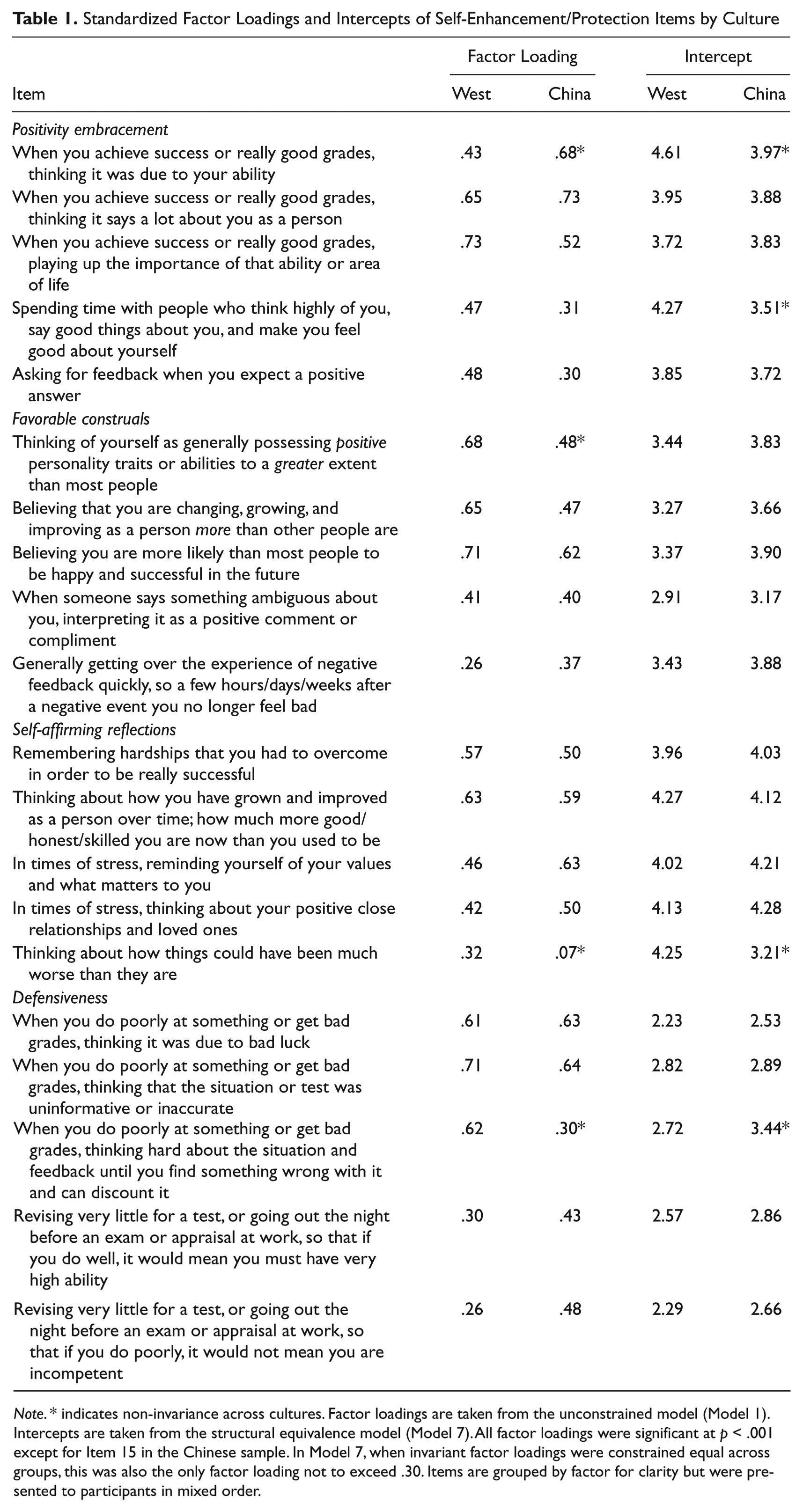
Note. * indicates non-invariance across cultures. Factor loadings are taken from the unconstrained model (Model 1). Intercepts are taken from the structural equivalence model (Model 7). All factor loadings were significant at p < .001 except for Item 15 in the Chinese sample. In Model 7, when invariant factor loadings were constrained equal across groups, this was also the only factor loading not to exceed .30. Items are grouped by factor for clarity but were presented to participants in mixed order.
We measured self-esteem with a validated Chinese version of the 10-item Rosenberg (1965) Self-Esteem Scale (1 = strongly disagree, 4 = strongly agree; αCHINA = .79; αWEST = .90) (Cai et al., 2009). Next, we measured narcissism with 15 items from a validated Chinese version of the Narcissistic Personality Inventory (NPI; see: Cai, Kwan, & Sedikides, in press; He, 2009). The items were selected to conform with the 15-item NPI developed by Schütz, Marcus, and Sellin (2004). Fifteen pairs of phrases are presented, one depicting a narcissistic response and the other a non-narcissistic response; for each pair, participants select the option closest to their beliefs and the number of narcissistic responses is summed (αCHINA = .81; αWEST = .82).
Finally, we measured regulatory focus with the Regulatory Focus Scale short-form (van Kleef, van Trijp, & Luning, 2005). Two six-item subscales assess promotion focus (e.g., “I frequently imagine how I will achieve my hopes and aspirations”; αCHINA = .78; αWEST = .85) and prevention focus (e.g., “In general, I am focused on preventing negative events in my life”; αCHINA = .69; αWEST = .63) (0 = not at all true of me, 7 = very true of me). Again, the bilingual committee back-translated the items, given that no validated Chinese version was available.
Results
Structure of Self-Enhancement in China: Construct Equivalence
In light of Hypothesis 1, we conducted CFA to test the equivalence of the four-factor model across cultures using AMOS 17.0. The first step was to test for configural invariance: whether the same pattern of factor loadings and nonloadings held across cultures. Thus, we tested parallel models in both samples, in which each item loaded only on its corresponding factor. We allowed the four strategy factors to correlate, and following Hepper et al. (2010), we allowed one pair of error variances in the defensiveness factor to correlate (involving two similarly worded items). We evaluated model fit using the indices recommended by Hu and Bentler (1999): the normed χ2statistic (good if 2.0 or less), the comparative fit index (CFI: good if .90 or more), and the root-mean-square error approximation (RMSEA: good if .06 or less). When comparing increasingly constrained models, we evaluated changes in model fit using the difference in CFI (critical value = .01) as recommended by Cheung and Rensvold (2002) based on Monte Carlo simulations. We also report Δχ2 statistics for the interested reader, although it is now generally accepted that this statistic is excessively stringent due to its sensitivity to sample size, and so we did not base decisions on this statistic (Byrne, 2010).
The four-factor model fit the data reasonably well, and comparable to that reported by Hepper et al. (2010), in both the Chinese sample, χ2(163) = 438.64, p < .001, normed χ2 = 2.69, CFI = .80, RMSEA = .065, and the Western sample, χ2(163) = 348.52, p < .001, normed χ2 = 2.14, CFI = .88, RMSEA = .054. Crucially, in the Chinese sample, the model fit better than a single-factor model, Δχ2(7) = 215.84, p < .0001, ΔCFI = .151, or a two-factor model representing self-enhancement (items from positivity embracement, favorable construals, and self-affirming reflections) versus self-protection (defensiveness), Δχ2(6) = 117.21, p < .0001, ΔCFI = .064. The only two notable modification indices in the Chinese model (i.e., greater than 20) implied that one defensiveness item exhibited weak cross-loading onto positivity embracement (estimated loading .42) and self-affirming reflections (estimated loading .43). Given this reasonable evidence of configural invariance, we combined the data from the two samples into one multiple-group CFA model, which again fit reasonably well (Table 2, Model 1). This served as the baseline model against which to compare more constrained models to test for measurement and structural invariance.
Summary of Tests for Invariance of Self-Enhancement/Protection Strategies Scale
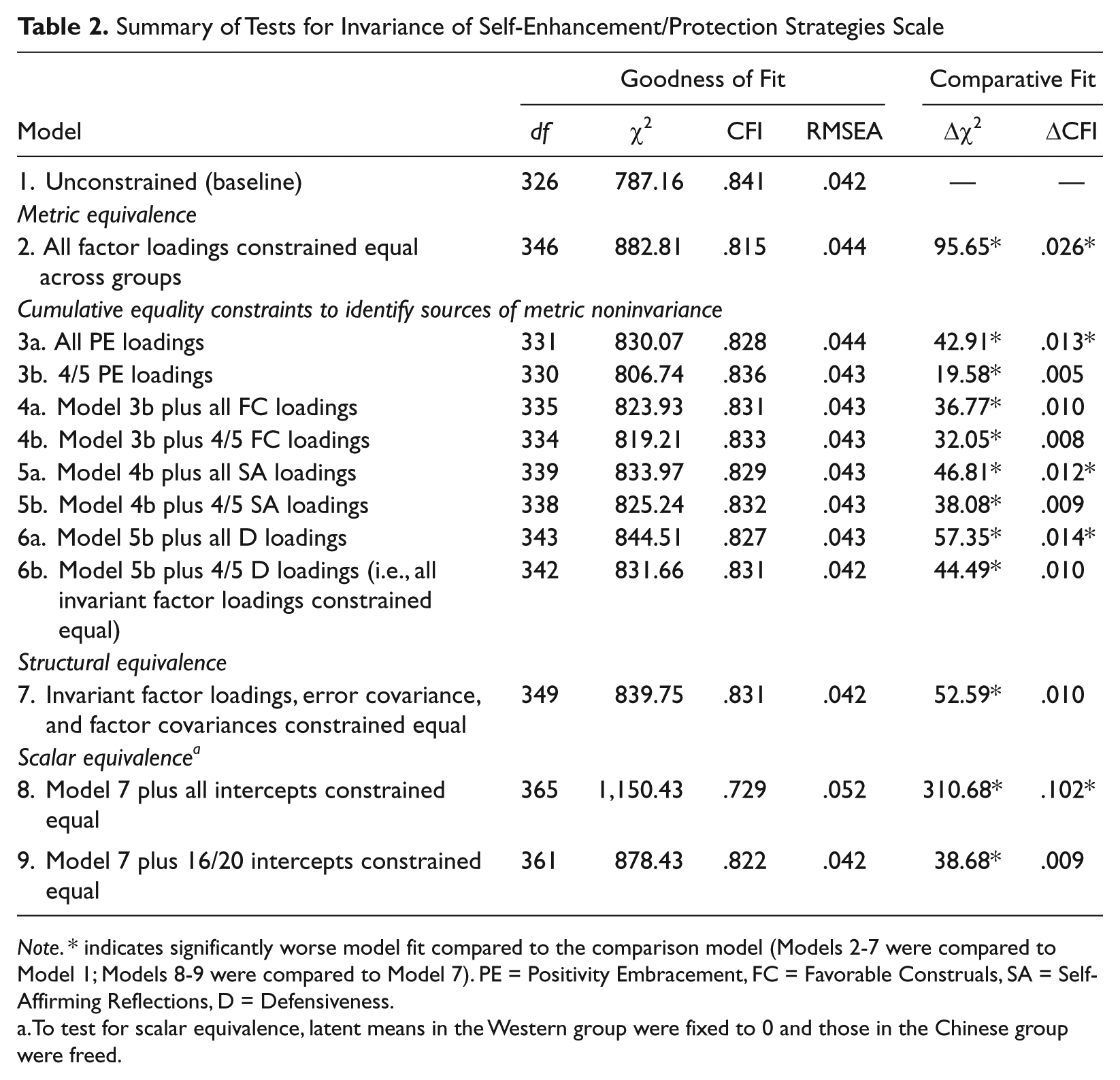
Note. * indicates significantly worse model fit compared to the comparison model (Models 2-7 were compared to Model 1; Models 8-9 were compared to Model 7). PE = Positivity Embracement, FC = Favorable Construals, SA = Self-Affirming Reflections, D = Defensiveness.
To test for scalar equivalence, latent means in the Western group were fixed to 0 and those in the Chinese group were freed.
In accordance with Byrne (2010), we tested between-group invariance in the measurement and structural models following several steps. First, we tested metric invariance: We constrained item loadings to be equal across culture groups. For each factor, if that constraint reduced model fit significantly, we proceeded to identify which item loading(s) in that factor were noninvariant by constraining one parameter at a time. We then held the invariant item loadings equal for that factor when testing subsequent factors. Next, we tested structural invariance, by further constraining the single error covariance and all of the covariances between latent factors to be equal. In each step, we tested whether the equality constraints reduced model fit compared to the unconstrained model (Table 2). This cumulative constraint procedure identified four items whose loadings were noninvariant across cultures (one from each factor; see Table 1 for all item loadings). Allowing these four loadings to vary across cultures, but constraining all other loadings as well as error and structural covariances, the model did not fit significantly worse than the unconstrained model (Table 2).
Table 1 presents the loadings of all 20 items. Of the four that were noninvariant, three nevertheless loaded significantly and above β = .30 on the relevant factor in both samples, suggesting that they are relevant indicators of their self-enhancement/protection strategy across the cultures. Two loaded more strongly in the Western sample (one favorable construals and one defensiveness item), and the other loaded more strongly in the Chinese sample (a positivity embracement item). The remaining item loaded significantly onto self-affirming reflections in the Western sample but not the Chinese sample, suggesting that counterfactual thinking may not be as relevant to self-affirmation in China as in the West.
Finally, we tested scalar invariance (i.e., equivalence of item intercepts), which would indicate that a person with the same underlying level of the latent factor would obtain the same score on each item regardless of their culture group (Cheung & Rensvold, 2002). We fixed the latent means of the Western group to 0 but allowed the means of the Chinese group to vary and followed a cumulative constraint procedure parallel to that described above. As shown in Table 2, four items showed noninvariance of intercepts. Three of these had also exhibited noninvariance of factor loadings, suggesting that these are the least optimal indicators of self-enhancement/protection in China. The fourth item had loaded equally well across cultures but had a lower intercept in the Chinese sample (i.e., a Chinese person would report interacting with flattering others less than a Western person with the same underlying level of positivity embracement motivation). These results suggest that there are other (culturally embedded) influences on these four items as well as the underlying motive. Note, however, that substantive tests (e.g., comparing latent means) can continue even if scalar noninvariance is found, as items are still tapping into the same underlying construct (Byrne, 2010).
The findings were largely consistent with Hypothesis 1. Self-enhancement and self-protection strategies conform to the same four-factor structure in a Chinese sample as in the West, with the exception of four specific items that may be differently relevant in China versus the West. With the caveat of these four items, the results support the proposal that self-enhancement is organized the same way in an Eastern culture as it is in Western cultures.
Levels of Self-Enhancement in China Versus Western Cultures
In light of Hypothesis 2, we compared the latent means for each of the four self-enhancement/protection strategies between the Chinese and Western samples. We did so in Model 8 of the multiple-group CFA (i.e., constraining the invariant factor loadings, all covariances, and all intercepts equal across cultures). We freed the latent means in the Chinese group and compared them to the Western means, which as a reference were fixed to 0. Thus, this approach tests for differences in latent means and does not estimate absolute means themselves. To facilitate interpretation, Table 3 also reports the raw means and SDs obtained when computing average subscale scores for each sample.
Scale Means (SDs) by Culture
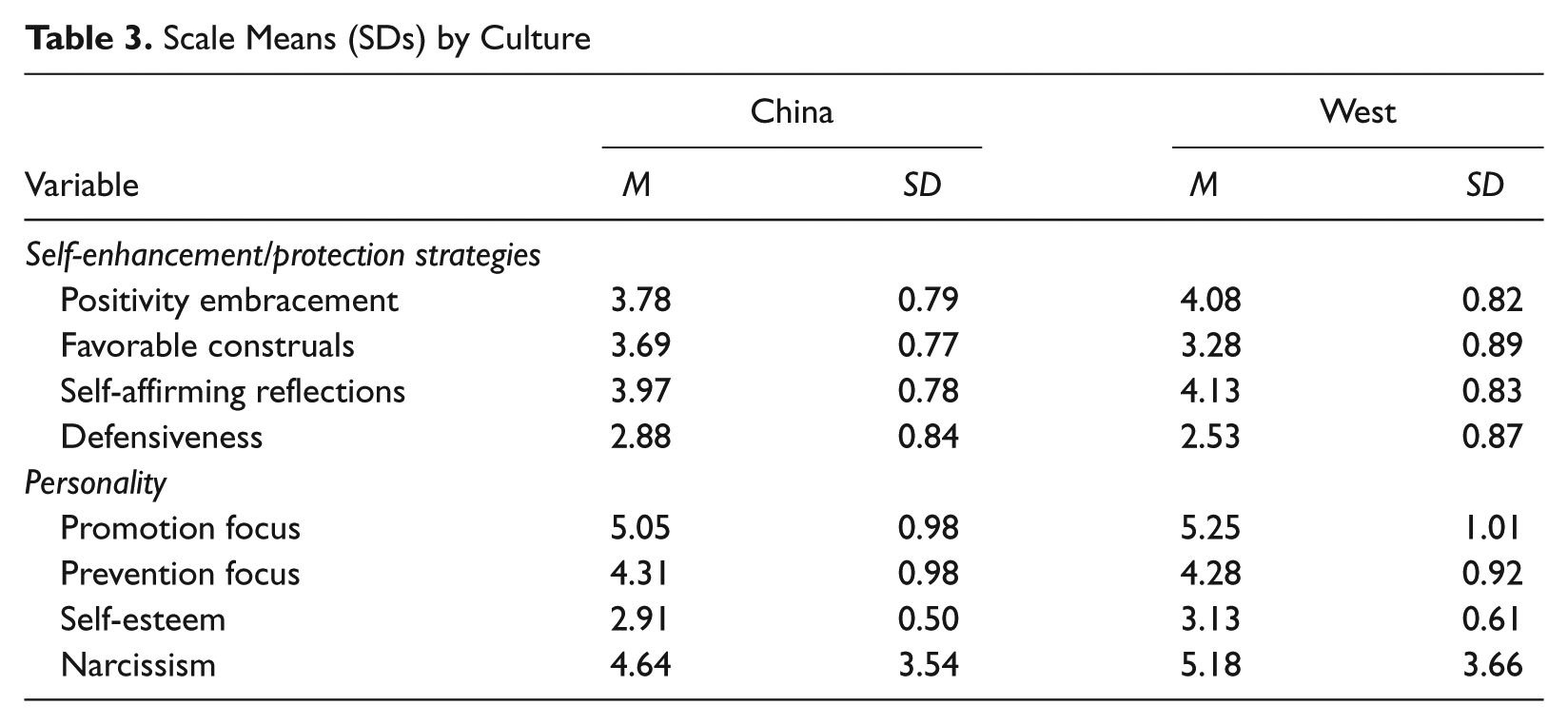
We first examined enhancement-oriented strategies (i.e., positivity embracement, favorable construals, self-affirming reflections), which we expected to be higher among Westerners compared to Chinese. The predicted effect was obtained for positivity embracement (latent mean difference [LMD] = 0.41, Z = 5.28, p < .001). However, self-affirming reflections did not differ significantly across cultures (LMD = 0.13, Z = 1.51, p = .13). And interestingly, favorable construals were significantly higher among Chinese compared to Westerners (LMD = 0.62, Z = 6.81, p < .001). These results suggest that respondents in Western cultures engage in behavioral self-enhancement to a greater extent than those in China, but those in China engage in private cognitive self-enhancement to a relatively greater extent.
We next turned to protection-oriented strategies (i.e., defensiveness). As predicted, levels of defensiveness were significantly higher among Chinese (LMD = 0.40, Z = 4.37, p < .001). This result suggests that respondents in China, far from shunning self-evaluative concerns, protect the self from negative feedback to a greater extent than those in Western cultures.
Overall, these results support and extend Hypothesis 2. They pinpoint that Westerners’ greater emphasis on promotion and self-enhancement is reflected in their greater use of relatively public self-enhancing behaviors (e.g., asking for feedback, choosing flattering interaction partners) but not relatively private self-enhancing cognitions (e.g., perceiving oneself as above-average, bringing values to mind in times of threat). Moreover, these results bear out the idea that Easterners’ greater emphasis on prevention and self-protection is reflected in their greater use of defensive strategies (e.g., self-handicapping, making external attributions for failure).
Individual Differences in Self-Enhancement in China
In light of Hypothesis 3, we examined the associations between the four self-enhancement/protection strategies and regulatory focus, self-esteem, and narcissism. We did so with a path model in which the four personality variables predicted the four strategies, including covariances to account for shared variance among each set of variables (e.g., between self-esteem and narcissism; Gregg & Sedikides, 2010; Sedikides, Rudich, Gregg, Kumashiro, & Rusbult, 2004). We first ran this model in the Chinese sample alone (Table 4).
Unique Associations Between Personality Variables and Self-Enhancement/Protection Strategies Among Chinese Participants
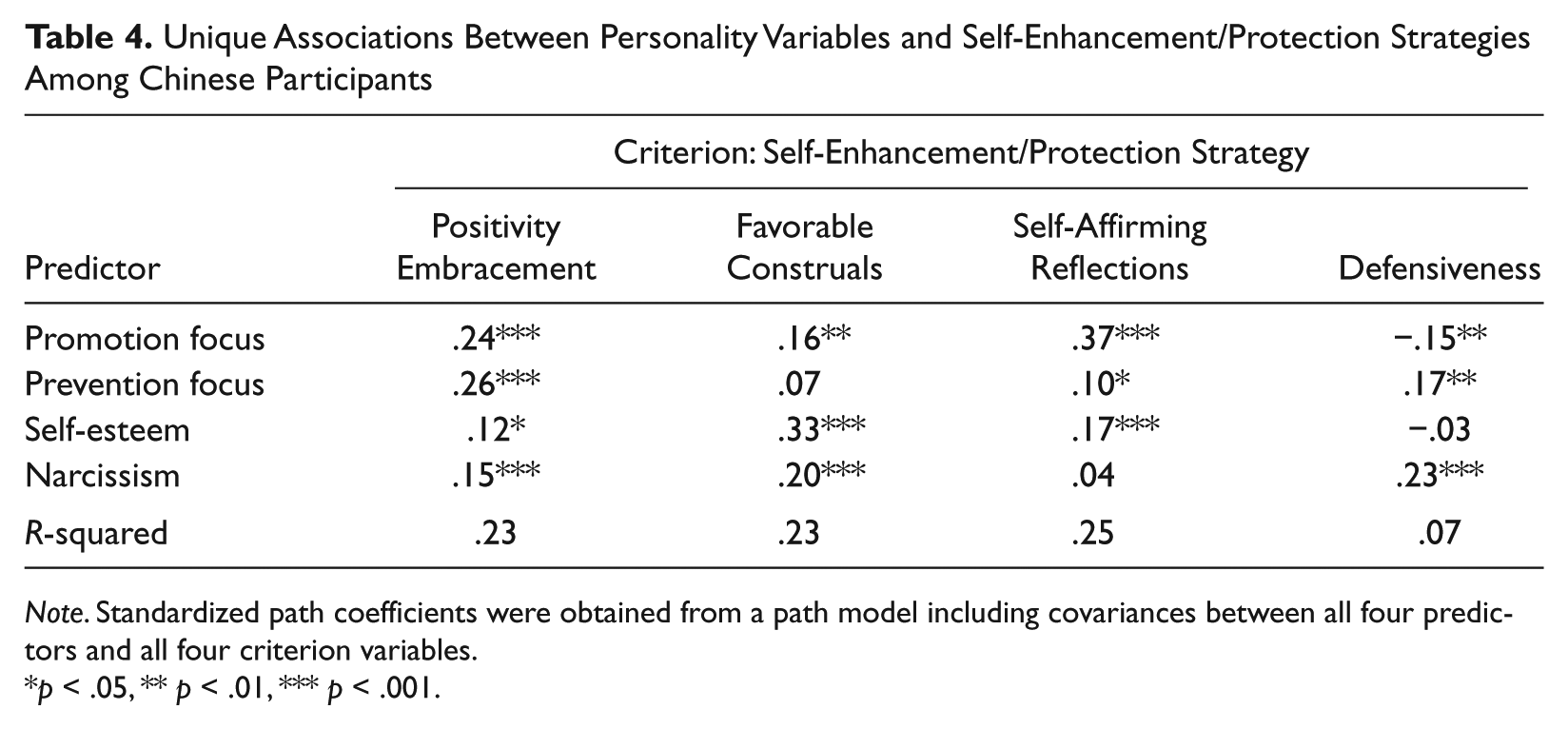
Note. Standardized path coefficients were obtained from a path model including covariances between all four predictors and all four criterion variables.
p < .05, ** p < .01, *** p < .001.
As expected, promotion focus was positively related to the three self-enhancement strategies but negatively related to the self-protection strategy (i.e., defensiveness). Also as expected, prevention focus was positively related to defensiveness but unrelated to one of the self-enhancement strategies (i.e., favorable construals). Prevention focus was positively related to positivity embracement (a link also found by Hepper et al., 2010) and, weakly, self-affirming reflections, which was not expected and could reflect the mention of stress/threat in some of these items. Finally, self-esteem was positively related to the three self-enhancement strategies but not defensiveness, whereas narcissism was positively related to every strategy except for self-affirming reflections. Thus, in a Chinese sample, a person’s regulatory focus—particularly promotion focus—and level of self-esteem and narcissism predict the type of self-enhancement/protection strategies that she or he endorses.
Except for the link between prevention focus and self-affirming reflections, this pattern replicates that reported by Hepper et al. (2010). To test whether the paths were statistically equivalent to those obtained in the Western sample, we examined the path model in a multiple-group analysis. This also provided tests of differences between cultures in mean levels of regulatory focus and self-views (for means and SDs, see Table 3). Consistent with expectations and past research (Foster, Campbell, & Twenge, 2003; Kim, Peng, & Chiu, 2008; Lalwani et al., 2009), Western participants were significantly higher than Chinese on promotion focus (Z = 2.83, p < .01), self-esteem (Z = 5.51, p < .001), and narcissism (Z = 2.12, p < .05). Controlling for the other variables, the two samples did not differ significantly on prevention focus, although the means were in the expected direction (Z = 0.51, p = .70).
Crucially, constraining the covariances among self-enhancement/protection strategies, all error variances (i.e., residuals), and all paths to be equal across groups did not reduce model fit, Δχ2(26) = 27.72, p = .37, ΔCFI = .001. Thus, the relative use of different types of self-enhancement and self-protection strategy are subject to the same individual differences in China as in Western cultures. This result supports Hypothesis 3 and further attests to the cross-cultural relevance of this construct and the scale. 1
Discussion
The motives to enhance and protect positive views of the self are prevalent across persons, groups, nations, and cultures. However, the means by which individuals satisfy those motives are variously cultivated and curtailed depending on the norms, pressures, and expectations of the social and cultural context (Alicke & Sedikides, 2009; Sedikides & Gregg, 2008; Sedikides, Gregg, & Hart, 2007). In this research, we sought to examine both sides of this issue using a systematic framework of self-enhancement/protection strategies that we recently developed (Hepper et al., 2010) and taking an East Asian (i.e., Chinese) culture as the context. We first aimed to provide construct validity for the self-enhancement/protection scale by examining the configural, metric, and structural equivalence of the four factors across the present Chinese sample and the Western participants in a previously reported Internet sample (Hepper et al., 2010). We further aimed to delineate one way in which Chinese culture shapes self-enhancement differently than Western culture: in particular, by cultivating prevention-focused more than promotion-focused strategies. Finally, we examined whether within Chinese culture, individual differences in the use of particular self-enhancement/protection strategies are driven by the same personality variables as in the West. In all, the obtained findings are consistent with the universalist perspective on self-enhancement/protection motivation (Brown, 2010) and support the generalizability of our model of self-enhancement and self-protection to Chinese culture.
Summary and Implications
Our first key finding was that the same factor structure identified in predominantly Western samples also served as an appropriate structure in a Chinese sample. The four-factor model fit adequately and significantly better than a two- or one-factor model, supporting its configural invariance. Moreover, with the exception of four item loadings (only one of which failed to load significantly on its factor) and four intercepts, the model demonstrated metric, structural, and scalar invariance across cultures. This pattern echoes Schmitt and Allik’s (2005) finding that positive self-views (i.e., the Rosenberg Self-Esteem Scale) formed the same factor structure across 53 different countries.
The findings imply that (all but one) manifestations of self-enhancement/protection are conceptually equivalent in China and the West: The scale taps into the same underlying construct (van de Vijver & Leung, 1997). Moreover, they are consistent with the notion that people across these cultures satisfy the self-enhancement/protection motive using the same four primary types of strategy: positivity embracement (i.e., seeking and capitalizing on feedback from others), favorable construals (i.e., holding self-serving cognitions), self-affirming reflections (i.e., cognitively restoring self-integrity to deal with threat), and defensiveness (i.e., preparing for and deflecting negative feedback). The findings do not preclude the possibility that people in China (or other cultures) follow additional self-enhancement/protection strategies as well as these four, or show additional specific cognitive or behavioral manifestations. Indeed, these possibilities present exciting avenues for future research (see below). Nevertheless, it seems appropriate to continue using this scale in Chinese samples.
The second finding supported the hypothesized impact of culture on the way in which self-enhancement/protection is expressed and pursued, reflecting cultural differences in emphasis on promotion versus prevention. Specifically, compared to Western participants, Chinese participants reported lower use of (enhancement-oriented) positivity embracement strategies but higher use of (protection-oriented) defensiveness strategies. These results extend previous findings indicating a prevention-focused orientation to goal pursuit and self-evaluations in East Asian cultures (Kim et al., 2010; Lalwani et al., 2009; Lee et al., 2000). That is, on a dispositional level, Chinese report being more likely than Westerners to use self-protective strategies, such as self-handicapping and discounting negative feedback.
On the surface, this pattern appears to contradict past evidence that East Asians tend to engage in self-criticism (as opposed to self-protection) after failure (e.g., Kitayama, Takagi, & Matsumoto, 1995). One possibility is the comparison being conducted. Assuming that East Asians are generally more sensitive to negative feedback and view it as more self-relevant than Westerners (Kitayama, Markus, Matsumoto, & Norasakkunkit, 1997; but see Gaertner, Sedikides, & Cai, 2011), they may engage more effort toward both self-improving (which we did not assess) and self-protecting. Thus, compared to Western participants, they would show higher levels of both self-criticism and self-protection. A second possibility is the context being examined. Takata (2003) found that Japanese show self-criticism when receiving feedback compared to a partner in a noncompetitive situation (when arguably they felt an affective bond to the partner) but showed self-enhancement when in a competitive situation (when they were distanced from the partner). The present measure of defensiveness made no reference to others and thus may tap into self-protective tendencies in contexts that do not involve interdependent bonds. With regard to the self-handicapping element of defensiveness, the higher level among Chinese is consistent with extant research that perfectionism, a common driver of self-handicapping (Hobden & Pliner, 1995), is often high in East Asian cultures (Chang, 1998). Further research is clearly needed to reconcile these apparent differences in findings.
Unexpectedly, Chinese participants reported higher use of favorable construals, an enhancement-oriented strategy. This is inconsistent with several studies finding that East Asians show lower levels of the better-than-average effect and unrealistic optimism (two of our items) compared to Westerners (Heine & Hamamura, 2007). It is, however, reminiscent of the recurrent concept in Chinese literature of “spiritual victories,” cognitive means of convincing oneself of one’s positivity and superiority. Such strategies are epitomized most famously in Lu Xun’s The Real Story of Ah-Q (trans. Lovell, 2010), which was written to reflect the national character perceived by the author in the early 20th century and is still embedded in Chinese language and culture. A possible reconciliation of the differing empirical findings on cognitive self-enhancement pertains to the generalized dispositional level assessed by our scale, as opposed to the experimental contexts used in past studies. That is, meta-analytic evidence (Sedikides, Gaertner, & Vevea, 2005, 2007a, 2007b) suggests that people (regardless of culture) self-enhance on dimensions that are personally important to them (e.g., individualistic attributes in the West, collectivistic attributes in the East). Given a scale that does not specify the dimensions at hand, it is possible that participants (regardless of culture) will respond with respect to their own personally important dimensions. This suggestion warrants future investigation. A further characteristic of favorable construals is that they are relatively private compared to positivity embracement strategies (of which three could be behavioral and thus visible to others). The relative preference of Chinese (compared to Western) participants toward favorable construals and not positivity embracement is consistent with the prevailing modesty norm in Eastern cultures, which has been linked to low self-enhancement (Kim et al., 2010; Kurman, 2003). That is, dispositionally, Chinese are less likely than Westerners to prefer self-enhancement strategies that are explicit, interpersonal, and thus violate modesty norms (i.e., positivity embracement). Instead, they may prefer self-enhancement strategies that are purely cognitive, intrapersonal, and private in nature (i.e., favorable construals). Finally, there was no difference between Chinese and Westerners on use of self-affirming strategies. This is consistent with evidence that, despite variation in the targets with which people may self-affirm, the overarching process of self-affirmation operates in the same way across cultures (Sherman & Cohen, 2006).
The third finding built on the first by examining within-culture individual differences: Levels of the four primary strategies are predicted by the same combination of personality variables in China as in Western cultures (Hepper et al., 2010). That is, within either type of culture, a person higher in promotion focus or self-esteem is more likely to engage in the three self-enhancement strategies, whereas a person higher in prevention focus or lower in self-esteem is more likely to engage in defensiveness. Regarding regulatory focus, given that Western participants reported higher promotion focus than Chinese participants, this pattern echoes the overall cultural differences observed. These patterns are also consistent with past research showing that self-esteem is positively related to self-enhancing but negatively related to self-protecting (Heimpel, Elliot, & Wood, 2006; Tice, 1991). Also, within either type of culture, a person higher in subclinical narcissism is more likely to engage in all strategies except for self-affirming reflections. Again, this is consistent with past work portraying narcissists as the ultimate self-enhancers (Morf, Horvath, & Torchetti, 2011; Sedikides, Campbell, Reeder, & Elliot, 2002) and as defensive in response to ego threat (Horton & Sedikides, 2009; Sedikides, Cisek, & Hart, 2011).
Further directions for research might include situational or state-level changes in preference for different strategies. As shown by Lee et al. (2010), temporarily activating an individual or collective mindset (by giving instructions to bilingual participants in either English or Chinese language) influences self-enhancement (reported in a relatively public group setting). Our findings suggest that such activation would influence other self-enhancement strategies in a complementary manner; that is, whereas a collective mindset would temporarily reduce positivity embracement, it would increase favorable construals and defensiveness. Such patterns have implications for understanding situational fluctuation in self-enhancement/protection strategies, as well as acculturation of people who move from East to West or vice versa. Another crucial avenue concerns the relevance of different strategies for psychological well-being. Although researchers have shown that global self-esteem relates positively to psychological health in East Asia as well as Western cultures (Brown, 2010; Cai et al., 2009; Gaertner et al., 2008), it would be informative to examine systematically the consequences of promotion-focused versus prevention-focused self-enhancement/protection strategies for well-being across cultures.
Limitations
Of course, the present findings represent the strategies that people report that they utilize. Some behavioral strategies would be better assessed via observation in the laboratory or via informant-report than via self-report. Moreover, participants were required to generalize retrospectively about their behavior, which may leave room for biases of recollection. Thus, for some strategies it would be preferable to collect reports online, for example using an experience-sampling design. Nevertheless, in this preliminary investigation, it was necessary to rely upon retrospective self-report in order to assess many different strategies simultaneously. Furthermore, by ensuring the anonymity of participants’ responses, we minimized the modesty concerns that can influence explicit self-reports. Indeed, the fact that Chinese participants in the present study reported higher use of some self-enhancement strategies than Western participants contradicts the argument that East Asians would not admit to self-enhancing on a self-report measure and allays concerns of response bias.
Chinese participants in this study were recruited from one of the top universities in southern China, located in a highly modernized and Westernized city close to Hong Kong. It is possible that the elite status of the institution, as well as exposure to Western culture, might foster a greater use of more Western self-enhancement strategies among these students compared to the general Chinese population. Moreover, China is becoming increasingly modernized, meaning that the culture driving the studied processes is ever-changing. In fact, there is preliminary evidence of a trend toward increased narcissism in China (Cai et al., in press; Kwan, Kuang, & Hui, 2009). Nevertheless, the present findings are still informative and can serve as the springboard for additional forays into the topic.
A further limitation of our research is that, because the strategies were originally identified in a primarily Western sample (Hepper et al., 2010), it is possible that additional self-enhancement or self-protection strategies exist in other cultures (including China) that are not captured with the present scale. It would be valuable to conduct research explicitly addressing this possibility, which is a wider issue in the vast body of literature on self-enhancement/protection motivation. One issue is that people may be selectively motivated to self-enhance on attributes that are valued by the culture in which they are embedded (Brown & Kobayashi, 2002; Sedikides et al., 2003). Thus, self-enhancement in Eastern cultures might include more strategies that emphasize collectivistic attributes (e.g., saving face, taking opportunities to appear dutiful, talking favorably about one’s group). The current findings do build on other evidence that strategies first identified in Western cultures are also prevalent in Eastern cultures (e.g., better-than-average beliefs; Sedikides et al., 2003; unrealistic optimism; Kim et al., 2010; self-protective memory; Sedikides & Alicke, 2012). In addition, we partially relied in our research on personality scales that had been validated in China, such as a self-esteem scale (Cai et al., 2009) and a narcissism scale (Cai et al., in press). Overall, we believe that the present evidence provides vital initial support for the cultural expression of self-enhancement and self-protection motivation by highlighting the relevance of the four-strategy theoretical framework. Crucially, this evidence points to fruitful directions for future studies. We encourage researchers to build on this preliminary foundation by observing directly the self-enhancing or self-protecting behavior of participants from different cultures regarding each of the four strategy groups. We also recommend obtaining reports from a partner or friend, or experience-sampling self-report data, on the four types of strategy. By conceptually replicating and extending the present findings, such research has implications for understanding the maintenance of positive self-views across cultures.
Conclusion
The present initial findings imply not only that humans from both individual and collectivistic cultures are motivated to enhance and protect positive views of the self but that they satisfy the motives differently in line with cultural norms. In so doing, people are able to maintain positive self-views without thwarting other motives (e.g., for social acceptance). We hope that the present findings stimulate further research to advance understanding of the fundamental and universal nature of self-enhancement motivation and its contextual expression in distinct social and cultural contexts.
Footnotes
Declaration of Conflicting Interests
The author(s) declared no potential conflicts of interest with respect to the research, authorship, and/or publication of this article.
Funding
This research was partly supported by a grant from the Natural Science Foundation of China (Grant No. 31070919) awarded to Huajian Cai.