




Abstract
Previous developmental research has found that children from households with high shared parenting, childrearing agreement, and equitable division of parental labor experience positive developmental and social outcomes; a major limitation of these studies is that shared parenting measures do not assess the amount of total parental effort the child receives, but instead partitioning the amount of effort between parents. Life History (LH) theory predicts that the total amount of parenting the child receives should produce a greater developmental impact on the future LH strategies of children than precisely how that parental effort was apportioned between mothers and fathers. This report presents a cross-cultural study using convenience samples of university students in Mexico, the United States, and Costa Rica, investigating the relationship of total as well as shared parental effort on family emotional climate and the LH strategy of the participants as young adults. The first study was performed exclusively in Mexico; results indicated that higher levels of shared parenting experienced as a child were associated with Family Emotional Climate also during childhood and with participant adult LH. The second study extended these findings; higher total parental effort predicted shared parenting effort, positive emotional climate, and slower offspring adult life history strategy in the three convenience samples of Mexico, the United States, and Costa Rica.
Keywords
According to parental investment theory (Trivers, 1972), the degree of parental investment in offspring should vary systematically between the sexes. Typically, the sex whose reproductive success is more physiologically linked will contribute more toward parenting (Stearns, 1992; Trivers, 1972). In humans, women devote immensely more energy toward reproduction in the form of gestation, lactation, and protecting their altricial children. Parenting among human males is not obligate and as vital to infant survival as female’s investment (Geary, 2000; Hrdy, 1999). However, the male contribution in parental effort is important in the phenotypic quality and social competence of the child. Additionally, cooperative breeding and male assistance to the female aids in ensuring male reproductive success by enhancing offspring survivorship; thus, most male humans should and actually do seek ways to cooperatively assist females (Geary, 2000). From an evolutionary perspective, parental alliance makes sense in perpetuating high-quality offspring. From the child’s perspective, resource acquisition is most important; the identity of the parent investing in the child should not matter if the child is to receive adequate resources (Hrdy, 1999, 2009). This means that neither the configuration of the parent’s arrangement over childrearing tasks nor the individual proportion of effort each parent invests in their children should matter very much at all to child outcomes. What should then matter is the total parental effort the children receive during development.
Life History (LH) Theory
LH theory is a midlevel theory of evolution governing the allocation of bioenergetic and material resources among different components of fitness, such as survival and reproduction (Ellis, Figueredo, Brumbach, & Schlomer, 2009). Research by evolutionary developmentalists has been assisted by the utilization of LH theory in answering questions of ontogeny because LH theory focuses on how and why an organism’s resource allocation decisions throughout development might affect behavior. To illustrate, LH theory has been applied to parenting (Geary & Flinn, 2001), sexual abuse (Vigil, Geary, & Byrd-Craven, 2005), and the effects of paternal harshness upon age of menarche (Tither & Ellis, 2008).
LH theory partitions total effort into Somatic Effort, directed toward the growth and survival of the individual organism over time, and Reproductive Effort, directed toward the production of new individual organisms as vehicles for the genes of its parents. Reproductive Effort is further divided into Mating Effort, directed toward obtaining and retaining sexual partners (in sexually reproducing species), and Parental Effort, directed toward the long-term survival of the individual offspring over time. LH theory assumes that, because the resources available to any individual organism are limited, tradeoffs between these different resource allocations are inevitable. For example, larger amounts of male Parental Effort are a consequence of the corresponding and proportional reduction in the amount of male mating effort, typically required by polygyny. Such a systematic pattern of resource allocation is typically referred to as a Slow LH Strategy and, in humans, also constitutes an entire coordinated suite of personality and behavioral traits present in individuals who are predominately characterized as altruistic, family-oriented, and risk-adverse. The opposite pattern is referred to as a Fast LH Strategy.
Family Systems Perspective
Family systems perspective postulates that conflict regarding the arrangement of parental labor between the mothers and fathers should affect child developmental outcomes. This theory affords a central role to the marital relationship, which can affect the quality of parenting, and family and child outcomes (Minuchin, 1985; Whitchurch & Constantine, 1993). In this view, well-functioning parental arrangements over childrearing, or Shared Parenting, should have a favorable impact on the quality of parental care of offspring and should also favorably impact the Family Emotional Climate, resulting in more positive child outcomes. From the family systems view, total parental effort should not only be predictive, but the degree of shared parenting and the agreement between mothers and fathers on the parental division of labor should influence child outcomes (Gable, Crnic, & Belsky, 1994; McHale et al., 2002).
Shared Parenting is defined as the extent to which husbands and wives, in their roles as mothers and fathers, agree, share, support, and coordinate childrearing tasks with each other (Gable, Belsky, & Crnic, 1992; Gable et al., 1994; McHale, 1995; McHale & Fivaz-Depeursinge, 1999; McHale, Kuersten-Hogan, Lauretti, & Rasmussen, 2000). Previous empirical work has found that poor Shared Parenting is associated with child internalizing behaviors such as anxiety, distress, and anger responses (Grych & Fincham, 1990; Mahoney, Jouriles, & Scavone, 1997; McHale, Freitag, Crouter, & Bartko, 1991) and externalizing behaviors such as aggression, defiant, and oppositional behavior (Lindahl, 1998; Lindahl & Malik, 1999; Schoppe, Mangelsdorf, & Frosch, 2001).
The suspected mechanism for the previous influences has been the diminished quality of the parent-child relationship or family climate disruptions produced by a conflictive parenting (i.e., marital disagreement, undermining, etc.). A negative family climate—the emotional environment that identifies the intimate context of each family—negatively influences child adjustment (Lindahl, 1998; Schoppe et al., 2001). Halberstadt, Parke, Cassidy, Stifter, and Fox (1995) distinguished that Family Emotional Climate consists of positive expressiveness, characterized by openness and sensitivity to family members (e.g., being appreciative, empathic, loving, and concerned), and negative expressiveness marked by anger and contempt. This study has taken such a definition to support our hypothesis that positive Family Emotional Climate is associated with a higher degree of Shared Parenting and to positive child outcomes, as it has been found in previous studies (Garner, 1995; Kolak & Volling, 2007).
The Cultural Context of Parenting
Family climate characterized by low warmth and cohesiveness was associated with higher levels of externalizing behavior in Latino and European samples of children (Lindahl & Malik, 1999). In addition, Loukas and Roalson (2006) found that adolescents’ effortful control was associated with family environment, especially for Latino youth; the study of Shared Parenting has largely missed the role of cultural context on family functioning. Having coined the term (i.e., also called coparenting) to study European American parents, research has not utilized shared parenting to predict family and child outcomes in Latino populations (McHale et al., 2002; McHale, Kuersten-Hogan, & Rao, 2004). Only one study, reporting qualitative findings, has suggested that Shared Parenting is a common practice among Mexican couples (Caldera, Fitzpatrick, & Wampler, 2002); however, no further research has been conducted that could provide a deeper understanding of the role of culture on shared parenting for Mexicans. This scarcity of previous research exploring the role of culture was partially ameliorated by a study (Sotomayor, Figueredo, Christensen, & Taylor, in press), where values such as Familismo/Respeto and Simpatía were found to predict Shared Parenting in a sample of low-income Mexican immigrant couples residing in the United States.
Cultural values, perceptions of what is socially desirable or undesirable, guide much of parental decision making and behavior (Geertz, 1973) and impact how children will be socialized and what values will be instilled in them (Grusec, 2002). Parental endorsement of Mexican traditional values (i.e., familism/respeto and simpatia; Triandis, Marin, Lisansky, & Betancourt, 1984) is associated with parenting practices that emphasize child obedience (Arcia & Johnson, 1998; Halgunseth, Ispa, & Rudy, 2006) and increased levels of paternal involvement in childrearing (Adams, Coltrane, & Parke, 2007). It thus appears that the way Latino partners arrange their childrearing duties might also be influenced by culture. If Familismo invokes solidarity, devotion, and family-centered concern and Simpatía refers to the tendency to seek harmony in interpersonal relations, it seems logical to expect that agreement regarding the division of childrearing duties might be associated with endorsement of these values. Contrary to the stereotype of machismo, in which Latino men are thought to be rigid, aggressive, unexpressive, uninvolved, and tough in their role as spouse and father (Cromwell & Ruiz, 1979), a Latino man’s sense of honor, respect, courage, and responsibility might explain his currently higher involvement in all family and parenting-related issues (Adams et al., 2007). Thus, in this article, we advance a structural model of Shared Parenting by means of two different studies whose relative strengths are detailed in the next section.
Rationale for the Present Studies
The studies reported have several strengths. First, given the gap in the literature showing the predictive power of variables such as parental agreement and co-parenting with Hispanics, in Study 1, we advance a model where Shared Parenting should predict Positive Family Emotional Climate, which in turn should predict Slow Life History within Mexican families.
A second strength comes from the fact that previous studies have utilized measures of parental agreement and co-parenting to estimate the quality of the parental alliance but have failed to address the need to also estimate how total parental effort impacts child outcomes. Thus, in Study 2, we develop a measure to estimate total parental effort to be included in a more sound causal model where both Shared Parenting and Total Parental Effort are estimated to know their relative contribution in predicting Family Emotional Climate and Slow Life Strategy.
Another strength of our article is the inclusion of two Latino societies in Study 2. México and Costa Rica have been characterized as sharing collectivistic values (Harwood, Leyendecker, Carlson, Asencio, & Miller, 2002; Kagitçibasi, 2005; Keller et al., 2006, Shweder, 1995). However, these countries exhibit important variations in structural features that might differentially influence cultural parenting patterns. For instance, reports indicated that gender inequality is generally somewhat higher in Mexico than in Costa Rica (Hausmann, Tyson, & Zahini, 2010; Milosavljevich, 2007; United Nations Development Program [UNDP], 2008). In 2008, Costa Rica showed an overall Gender Inequality Index (GII) of .50 and was placed in 51st among 169 countries. México, on the other hand, had a higher GII of .58 and was placed 68th (UNDP, 2008). Additionally, the literacy rate, participation in the work force, and percentage of women in parliament were higher in Costa Rica than for women in Mexico (Hausmann et al., 2010).
The general picture these sociostructural indicators paint is that the higher degree of gender equity in Costa Rica might contribute to more “progressive” conceptions of gender roles, influencing shared parenting among men and women. Because higher levels of educational attainment, the increasing participation of women in the politics (including a female as head of the State), and the growing incorporation of women into Costa Rican’s labor market might contribute to the development of different social meanings of shared parenting that do not resemble those of the Mexican parents.
Method
Participants
Data for Study 1 were collected exclusively from a single research site, located in México; data for Study 2 were collected from three different research sites, located in the United States, Costa Rica, and México, respectively. The samples were composed of undergraduate university students attending the University of Arizona in Tucson, Arizona; the University of Costa Rica in San José, Costa Rica; and the University of Sonora in Hermosillo, Sonora, México. However, all three universities draw the majority of their undergraduate students more broadly from the entire region in which they are located, so that the samples are not, strictly speaking, specifically representative of the inhabitants of Hermosillo, Tucson, and San José, but are instead more representative of the populations of the Mexican State of Sonora (SO), the USA State of Arizona (AZ), and the Costa Rican Central Valley (CV), and will be presented alphabetically. A total of 473 participants (172 AZ participants, 152 CV participants, and 149 SO participants) participated in the current study (see Table 1 for demographic information). ANOVAS were performed on demographic information to compare the three groups. There were no significant differences between the three groups on mothers and fathers’ education (with all three samples being high school educated), percentage of reported parental divorces, F(2, 486) = 1.51, p = .222, or reported percentage of parents widowed, F(2, 486) = .024, p = .790. In the same vein, percentage of participant’s birth parents’ divorce (SO = 20.9%; CV = 23.9%; AZ = 29.1%) or widowed (SO = 4.93%; CV = 3.87%; AZ = 3.48%) did not differ by sample group. However, the three groups were significantly different on sex ratio, F(2, 470) = 72.19, p < .001, participant’s age, F(2, 470) = 9.00, p < .001, and mother’s age at first birth and father’s age at first birth, F(2, 456) = 7.80, p < .001, and F(2, 429) = 4.65, p < .01, respectively.
Demographics for Study 2
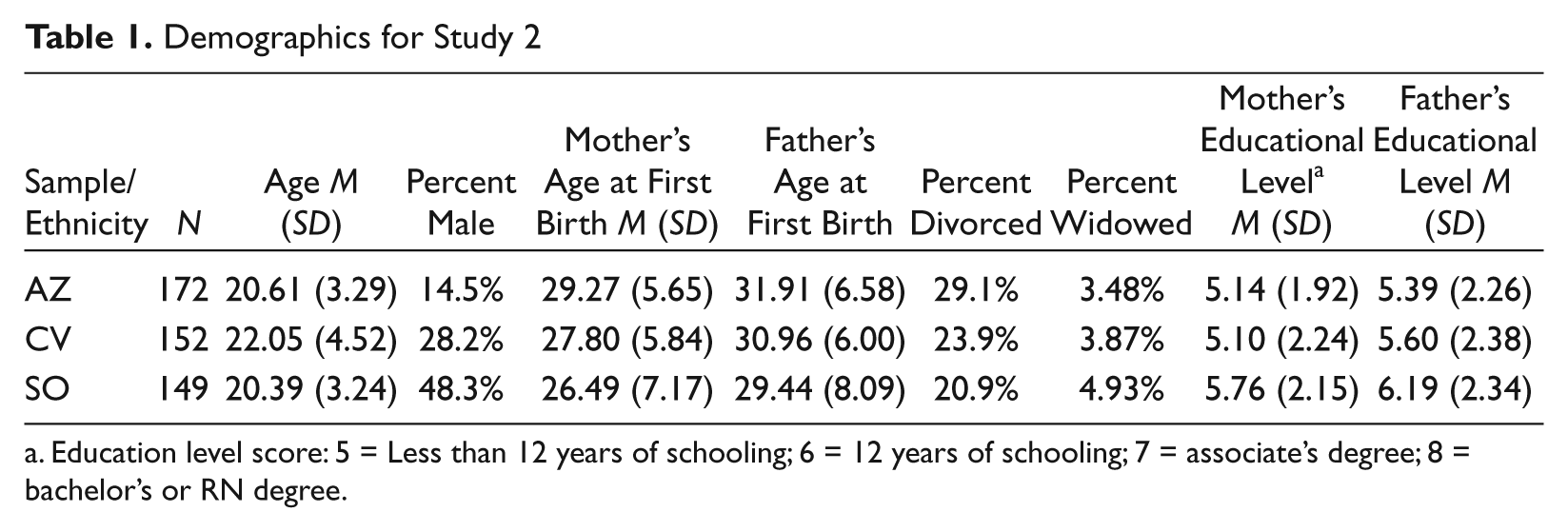
Education level score: 5 = Less than 12 years of schooling; 6 = 12 years of schooling; 7 = associate’s degree; 8 = bachelor’s or RN degree.
To handle these demographic differences across the samples, we proceeded as followed. Based on previous findings suggesting parenting practices differ based on sex of the child (Best, House, Barnard, & Spicker, 1994), we included respondent’s sex in our model of shared parenting. By including respondent sex in our model, we statistically control for its potential contribution.
Regarding “racial” identification (i.e., the AZ sample contained 119 Whites, 18 Hispanics, 4 Blacks, 8 Asians, and 23 participants who self-identified as being from another race; the SO sample contained 28 Whites, 114 Hispanics, 0 Blacks, 0 Asians, and 1 participant from other race, plus 7 missing observation; and the CV sample contained 62 Whites, 79 Hispanics, 1 Blacks, 1 Asian, and 4 Other participants, plus 7 missing observations), we performed a series of independent sample t tests to examine the three major predictors in our model. We test for “race” differences attributable to the different proportions of White and Hispanic participants within them as these two groups constituted the overwhelming majority of participants in all three samples. First, we selected a subsample of exclusively White AZ participants and Hispanic SO participants, eliminating all the “minority” groups in each sample (White being a “minority” in Mexico); then, we compared the restricted AZ subsample directly to the restricted SO subsample. The results were as follows: t(196) = −.317, p = .752, with Shared Parenting, t(196) = .781, p = .436, with Total Parental Effort, and t(196) = .699, p = .485, with Family Emotional Climate. These differences among means were all very close to zero in magnitude and statistically nonsignificant. The fact that there were no significant differences between the two dominant racial classifications in the three major predictors used in our model indicated that the overlap in racial composition between the AZ and SO samples did not likely contribute in any detectable way to the observed similarities in the model parameters between them.
Procedures
Participants in the AZ, CV, and SO samples were recruited via psychology subject pools and/or during university classes in exchange for course extra credit. The AZ participants completed a series of self-report measures in an online format from a secure research website on personal computers, while the SO and CV samples were administered the same measures, translated into Spanish, in paper-and-pencil format to permit classroom-based administration of these questionnaires. Questionnaires administered to the three samples included measures assessing life-history strategies, retrospective recall of shared parenting and family emotional climate among their birth parents, and retrospective recall of their mother and father’s parenting practices during childhood.
Measures
All of the measures used in the two studies were originally written in English, they were translated into Spanish and approved by natives of Mexico and Costa Rica, and they were back translated into English and compared to the original text by English-speaking researchers in the United States. All of the translations into English were done and approved by English-speaking researchers in the United States, were back translated into Spanish, and were compared to the original text by natives of Mexico and Costa Rica. A portion of the Spanish measures have been published (i.e., ALHB; Figueredo, Andrzejczak, Jones, Smith-Castro, & Montero, 2011; Parental and Familial measures; Sotomayor-Peterson, Figueredo, Christensen, & Taylor, in press). In both Study 1 and Study 2, the major variables were factors integrated by their theoretically corresponding indicators. In each measure’s description, we include interitem consistency reliability (Cronbach’s α) as well as part-whole correlations between the indicator and the corresponding factor as a measure of convergent validity.
Study 1
The life history factor was indicated by a mix of cross-culturally valid measures (MSOI, Mini-K, and MVI; Figueredo et al., 2011) and culturally specific measures (familismo/respeto; these variables have been found to be culturally relevant as Sotomayor-Peterson et al., in press, found with Mexican immigrants in the United States).
The Multidimensional Sociosexual Orientation Inventory (MSOI; Jackson & Kirkpatrick, 2007) Long-Term Mating subscale (Cronbach’s α = .76; part-whole r = .82) contains 10 items and measures respondents’ preference for long-term sexual relationships (LTSR). The LTSR scale ranges from −3 (strongly disagree) to +3 (strongly agree) and includes items such “I can see myself settling down romantically with one special person.” The MSOI Short-Term Mating subscale (Cronbach’s α = .88; part-whole r = −.82) also contains 10 items and measures preference for short-term sexual relationships (STSR). An item example is “sex without love is ok.” The two subscales were aggregated directionally to indicate preference for long-term mating over short-term mating by reverse-scoring the subscale for Short-Term Mating preference.
Mini-K
This measure consists of 20 Likert-type scale items (Figueredo et al., 2006), based on the 199-item Arizona Life History Battery (ALHB; Figueredo, Brumbach et al., 2007) assessing cognitive and behavioral indicators of life history strategy (see Figueredo, Cabeza De Baca, & Woodley, in press, for a review of the measurement of life history strategies). This scale obtained an acceptable reliability (Cronbach’s α = .70) as well as part-whole correlation with its respective factor (r = .64). The scale ranges from −3 (disagree strongly) to +3 (agree strongly) and includes items such as “while growing up, I had a close and warm relationship with my biological father” and “I am closely connected to and involved in my community.”
The Mate Value Inventory (MVI; Kirsner, Figueredo, & Jacobs, 2003) was used to assess respondents’ evaluative self-assessment. The MVI (Cronbach’s α = .84; part-whole r = .56) is a 17-item measure of self-perceived qualities that are considered desirable in a romantic or sexual partner. The scale ranges from −3 (extremely low on this characteristic) to +3 (extremely high on this characteristic) and includes items such as “good sense of humor” and “intelligent.”
Familismo/Respeto (adapted from Wozniak, Sung, Crump, Edgar-Smith, & Litzinger, 1996)
We used a modified version of the Family Relational Values Q-sort (Cronbach’s α = .50; part-whole r = .64), which is a 12-item scale that assesses respondents’ values around familismo (8 items) and respeto (4 items). Item examples include “family members should be there in times of need” and “children should never express anger towards their parents.” Respondents indicated their extent of agreement or disagreement with the statement on a 4-point scale that ranged from strongly disagree (0) to strongly agree (3), with higher scores reflective of higher levels of endorsement to those values.
Simpatía (adapted from Griffith, Joe, Chatham, & Simpson, 1998)
Respondents’ values of simpatía were assessed using a modified version of the 10-item Simpatía scale (Cronbach’s α = .69; part-whole r = .66). A sample item is “to be able to openly share your feelings.” Respondents are asked to indicate how important each item is to them on a 5-point scale that ranges from not important (0) to extremely important (4), with higher scores reflective of higher importance as well.
The factor shared parenting included the following indicators:
Parental agreement about childrearing (Snyder, 1981)
Respondents’ perceptions of their parents’ levels of agreement/disagreement was assessed using a 10-item version of the Parental Agreement About Childrearing Questionnaire (Cronbach’s α = .82; part-whole r = .91), which is part of the larger Marital Satisfaction Inventory–Revised. Respondents are asked about the extent to which their parents agreed or disagreed about issues related to parenting. A sample item is “my parents didn’t argue about their children.” Respondents indicated how true or untrue each listed item was about their particular parents on a 5-point scale that ranges from not at all true for us (0) to very true for us (4), with higher scores reflective of higher parental agreement about childrearing (alphas and part-whole correlations for Study 2 are presented later in the article).
Coparenting (Ahrons & Wallisch, 1987)
Respondents’ perceptions of their parents’ coparenting was assessed with a 10-item scale (Cronbach’s α = .93; part-whole r = .91) with questions revolving around how often parents shared their child’s experiences and parenting responsibilities. Respondents were asked to rate on a 5-point scale that ranged from never (0) to always (4) the frequency with which their parents discussed what rules to set for them as children and so on (alphas and part-whole correlations for Study 2 are presented later in the article).
The factor Family Emotional Climate included the following indicators:
Positive family expressiveness (Halberstadt, 1986)
Six items from the original 12-item scale assessed the frequency of the family’s positive expressiveness in home as experienced by the respondent during his childhood. An example item of positive family expressiveness is “praising someone for good work.” It used a 5-point scale that ranged from never (0) to always (4), with higher scores reflective of higher levels of positive emotion expressiveness (Cronbach’s α = .77; part-whole r = .80).
Negative family expressiveness. The remaining six items from the original scale of Halberstadt et al. (1995) were used as the second indicator for this factor. An example item of negative family expressiveness is “putting others down.” It also used a 5-point scale that ranged from never (0) to always (4), with higher scores reflective of higher levels of negative emotion expressiveness (Cronbach’s α = .80; part-whole r = −.80).
Study 2
The factor Life History Strategy was integrated by the following indicators:
The Arizona Life-History Battery (ALHB; Figueredo, Vásquez, Brumbach, & Schneider, 2007) is a battery of self-reported cognitive and behavioral indicators of LH strategy compiled and adapted from various original sources. These self-report psychometric indicators measure individual differences among various complementary facets of a coherent and coordinated LH strategy, as specified by LH theory. Based on previous results indicating a single latent LH factor (Figueredo et al., 2006; Figueredo, Vásquez et al., 2007), we constructed a unit-weighted slow LH scale (Gorsuch, 1983), composed of all the subscales of the ALHB, by taking the unweighted average of the standardized indicators. These were scored and aggregated directionally to indicate a “slow” LH strategy, prior to factor-analytic structural equations modeling. The Inter-Item Consistency Reliability (Cronbach’s α) and Convergent Validity (part-whole r) coefficient for the scales on the ALHB ranged from AZ, α = .78 to .96 and r = .50 to .83; CV, α = .73 to .94 and r = .44 to .80; SO, α = .67 to .92 and r = .26 to .82.
The factor Total Parental Effort was integrated by the following indicators:
Father’s and mother’s parental effort scales (Cabeza de Baca, Figueredo, & Ellis, 2012)
These scales were constructed to assess the relative frequencies of caregiving acts performed by fathers and mothers across several domains during the respondent’s childhood. Items sampled behaviors representing both emotional and instrumental support and sampled parental tasks that are generally performed for children more frequently (ranging from once daily to once weekly) such as preparing food for them, parental tasks that are generally performed somewhat less frequently (ranging from five times a week to once a month) such as attending their events at school, and parental tasks that may be performed only once in a lifetime, like teaching them how to drive a car. The frequencies of all these tasks were aggregated into scores for the total parental effort contributed by each parent toward caring for the child. The Inter-Item Consistency Reliability (Cronbach’s α) and Convergent Validity (part-whole r) coefficient was AZ, Father α = .98 and r = .91, Mother α = .97 and r = .83; CV, Father α = .98 and r = .91, Mother α = .97 and r = .84; SO, Father α = .98 and r = .89, Mother α = .97 and r = .79.
Finally, Study 2 also included the Shared Parenting and Family Emotional Climate integrated in the exact same way as in Study 1.The Inter-Item Consistency Reliability (α) and Convergent Validity (part-whole r) coefficients for the scales ranged from AZ, α = .77 to .95 and r = .83 to .94; CV, α = .75 to .94 and r = .78 to .89; SO, α = .73 to .94 and r = .81 to .90.
Analytical Strategies
The Study 1 cascade model
Intercorrelated outcome variables demand using a multivariate statistical strategy like structural equation modeling (SEM) or confirmatory path analysis in which the hypothesized causal network between outcomes can be fully specified, estimated, and tested (Bentler, 1995). Without considerable previous evidence supporting the causal order hypothesized for Study 1, this can be considered as exploratory; structural equation modeling should be used for theory confirmation, not exploration (Figueredo & Gorsuch, 2007). Thus, an alternative strategy was followed, known as a Cascade Model in cognitive psychology (Demetriou, Christou, Spanoudis, & Platsidou, 2002; Mouyi, 2006). A Cascade Model is a series of hierarchical multiple regression/correlation (MRC) models in which the multiple criterion variables that are expected to causally influence each other are entered sequentially according to the hypothesized causal order, with each hierarchically prior criterion variable entered as the first predictor for the next. This procedure is conceptually equivalent to a sequential canonical analysis (Figueredo & Gorsuch, 2007; Gorsuch & Figueredo, 1991), which controls statistically for any indirect effects of the predictors through the causally prior criterion variables. It is assumed to work as an exploratory form of multivariate analyses.
Study 2: Multigroup structural equation modeling (SEM)
When evaluating the adequacy of an SEM to data from two or more independent samples, one may apply the technique of multisample analysis (Bentler, 1995). The same multisample structural equations model (MSEM) is tested simultaneously on the data from the multiple samples, and cross-sample equality constraints are tentatively imposed that force either all or some specified subset of the model parameters for the independent samples to be equal. The otherwise identical MSEM may be tested with and without these equality constraints imposed and then compared for relative goodness of fit to the data. The constrained MSEM is therefore implicitly nested hierarchically within the unconstrained MSEM because an MSEM with equality constraints imposed is more restricted than one without restrictions. A significant difference between the goodness of fit of the constrained and unconstrained MSEMs would indicate either a statistical or practical rejection of the hypothesized equality constraints, indicating that the model parameters are significantly different between the samples (Widaman, 1985).
Results
All preliminary univariate analyses and descriptive statistics were performed using SAS 9.1.3 (SAS Institute, Inc., 2005), and multisample structural equation modeling was performed using EQS 6.1 (Bentler, 1995), To construct the common factors in both studies, unit-weighted composite scores were estimated by means of computing: (1) the means of the raw scores for all nonmissing items on each scale and (2) the means of the standardized scores for all nonmissing indicator scales on each common factor (Figueredo, McKnight, McKnight, & Sidani, 2000; Gorsuch, 1983). We used unit-weighted factor scores to pre-aggregate the factors, because these are known to be more generalizable across samples, even if the factor-scoring coefficients are sample-specific (Gorsuch, 1983). To determine whether this factor scoring procedure worked equivalently across cultures, we computed separately for each culture (1) the interitem internal consistencies (Cronbach’s alpha reliability coefficients) of each scale used as an indicator and (2) the part-whole correlation of each unit-weighted factor with each of its component indicator scales. We found that for all factors estimated by this method, these interitem internal consistency and part-whole correlation coefficients (corresponding conceptually to the unit-weighted “factor structure”) were extremely similar across the cultures tested. This means that the statistical relation of the individual items to each scale and that of the individual scales to each construct were essentially equivalent across cultures.
Table 2 displays the means and standard deviations of the indicator variables for each of the common factors constructed, prior to standardization, for both studies.
Means and Standard Deviations for the Indicators of the Factors Prior to Standardization
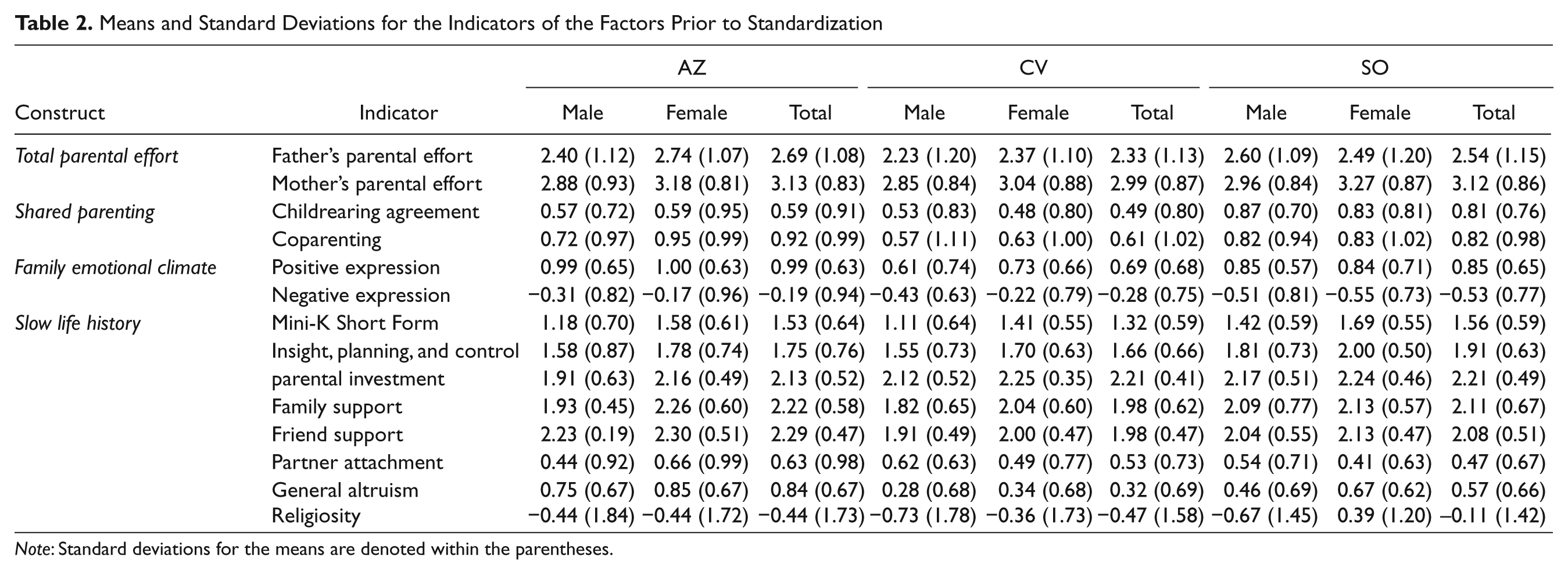
Note: Standard deviations for the means are denoted within the parentheses.
The goal of Study 1 was to estimate the effects of child-reported shared parenting and family emotional climate on child’s slow life history. We specifically hypothesized that higher shared parenting would be associated with a more positive family emotional climate, which would then lead to slower life history strategy. We supported the hierarchical order of the variables within family systems theory that claims the quality of the whole family environment is dictated primarily by the quality of the marital functioning (Minuchin, 1985). Thus, shared parenting antecedes family emotional climate in our model: from shared parenting to family emotional climate to slow life history.
The results of these analyses were as follows: (1) Higher levels of shared parenting predicted higher, more positive levels of family emotional climate, as indicated by a positive and significant standardized regression coefficient of β = 0.52, F(1, 160) = 57.78, p =.0001; (2) higher, more positive levels of family emotional climate predicted higher levels of slow life history, as indicated by a positive and significant standardized regression coefficient of β = 0.33, F(1, 159) = 24.89, p =.0001; and (3) higher levels of shared parenting did not significantly predict higher levels of slow life history, after family emotional climate was entered into the equation, as indicated by a negligibly small and nonsignificant standardized regression coefficient of β = 0.07, F(1, 159) = 0.72, p = .3984.
The squared multiple correlations values for the criterion variables were R 2 = 0.265 for family emotional climate and R 2 = 0.139 for slow life history. A graphical representation of the entire cascade model for Study 1 is displayed in Figure 1.
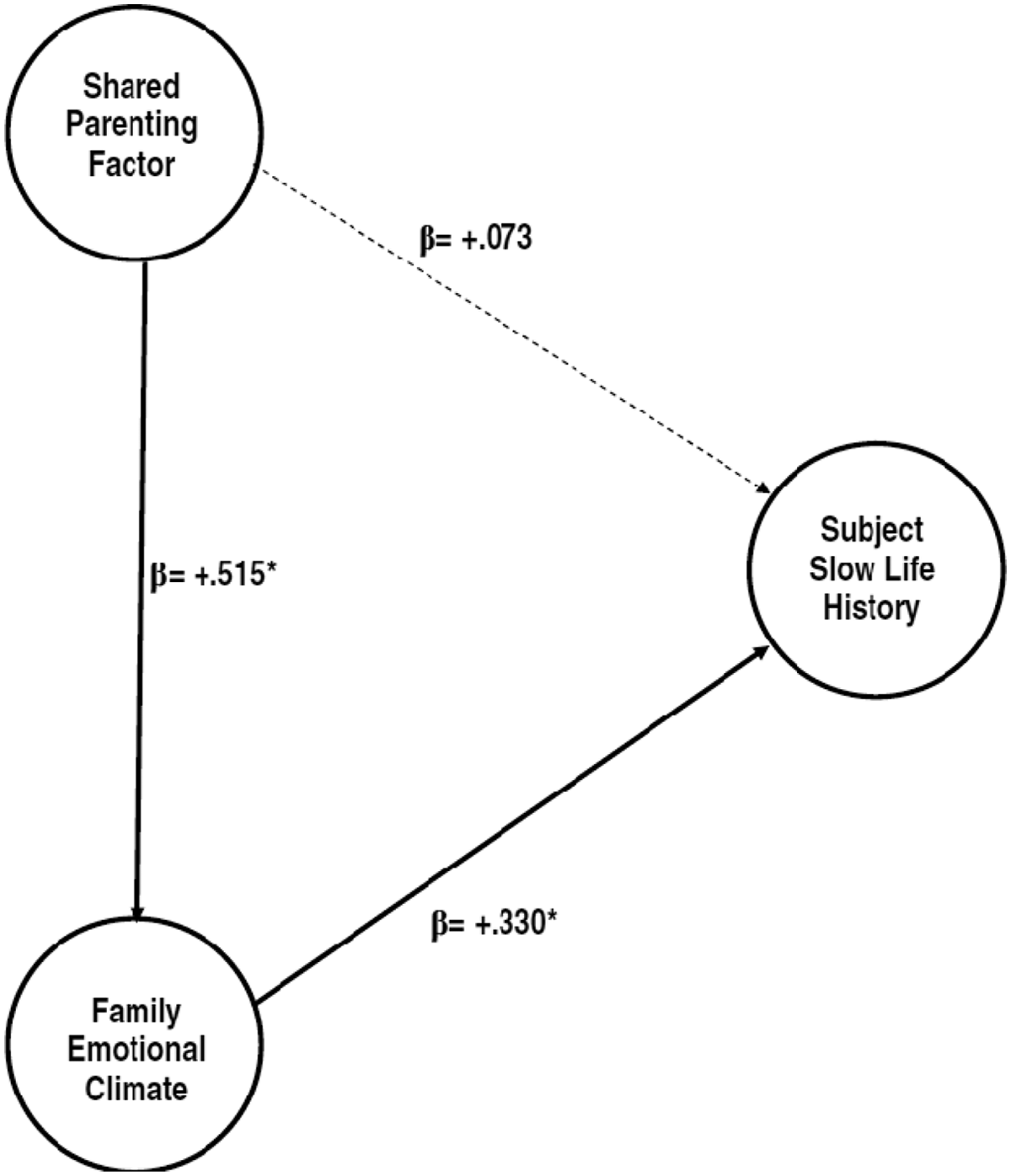
The Cascade Model for Study 1: Shared Parenting, Family Emotional Climate, and Subject Slow
The goal of Study 2 was to extend the network of associations already tested in Study 1. Thus, in addition to testing the contribution of shared parenting and family emotional climate on participant’s life history, this study included total parental effort, which based on life history theory would conceptually antecede the variables mentioned, as an evolutionary perspective would claim that total parental effort, the total investment in the child, would hierarchically impact coordination of childrearing tasks and family environment—eventually impacting child outcomes (Belsky et al., 1991; Ellis et al., 2009). Additionally, given that some studies have proposed that parenting-related outcomes vary based on child’s sex, we include sex of the respondent (Best et al., 1994) to test such a hypothesis within the variables under scrutiny. Consequently, we used nested model comparison to determine whether restricting all possible pathways from sex of respondent to zero would have any deleterious effect upon the fit of the multigroup SEM model. Only the covariance with the other exogenous variable in our model, total parental effort, was estimated and tested for statistical significance, because covariances among exogenous variables are typically estimated as free parameters. Nevertheless, we hypothesized that this covariance would not be found statistically significant either. Thus, the order of the variables was from total parental effort to shared parenting to family emotional climate to slow life history.
Table 3 displays the results of the three multi SEMs tested. MSEM 1 is the fully constrained model, in which all mean-structure parameters (intercepts) and covariance-structure parameters (slopes) are constrained to be equal across all three cross-cultural samples. MSEM 2 is the partially constrained model, in which all mean-structure parameters (intercepts) are free to vary independently across samples, but all covariance-structure parameters (slopes) are constrained to be equal across all three cross-cultural samples. MSEM 1 is the fully unconstrained model, in which all mean-structure parameters (intercepts) and all covariance-structure parameters (slopes) are free to vary independently across samples.
Hierarchically Nested Model Comparisons: MSEM 1–MSEM 3
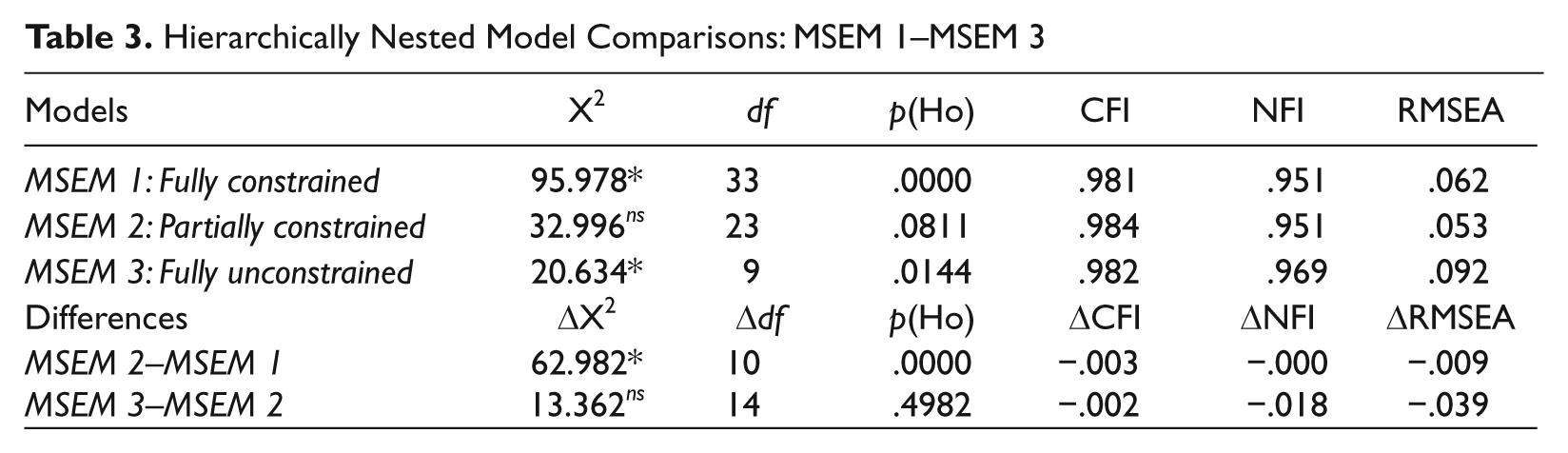
As this table shows, both the fully constrained (MSEM 1) and the fully unconstrained (MSEM 3) models are statistically rejectable by the chi-squared criterion. The partially constrained (MSEM 2) model, however, is not statistically rejectable by the chi-squared criterion. MSEM 2 also has the best overall profile of practical and parsimonious indices of fit. Furthermore, when formal nested model comparison procedures are applied, the constraints associated with comparing MSEM 1 to MSEM 2, representing the equality constraints among the mean-structure parameters (intercepts), the difference tests indicate that these constraints are statistically rejectable. On the other hand, the constraints associated with comparing MSEM 2 to MSEM 3, representing the equality constraints among the covariance-structure parameters (slopes), the difference tests indicate that these constraints are not statistically rejectable.
MSEM 2 is clearly the superior model, and the results are shown in Figure 2. The path coefficients were obtained by maximum likelihood estimation. As per long-standing convention, the unstandardized regression weights representing the intercepts and slopes are shown outside parentheses; the standardized regression weights representing the intercepts and slopes are shown inside parentheses. The triangle with a 1.0 inside it represents the unit vector used in estimating mean-structure parameters from moment matrices, and the arrows emanating from that triangle represent the intercepts of each of the constructs to which they individually point. Also by convention, rectangles represent measured variables, in this case only sex of respondent, and ovals represent latent constructs, in this case all the remaining variables, in spite of having been pre-aggregated, as described above, for the sake of conceptual clarity. Where different across samples, parameters are separated by a slash (/) and are listed in the alphabetical order of the acronyms assigned the cross-cultural samples: AZ, CV, and SO. All unstandardized path coefficients marked with an asterisk (*) were statistically significant (meaning different from zero) at an alpha level of p < .05; where an unstandardized coefficient is marked as significant, the standardized equivalent is always significant as well.
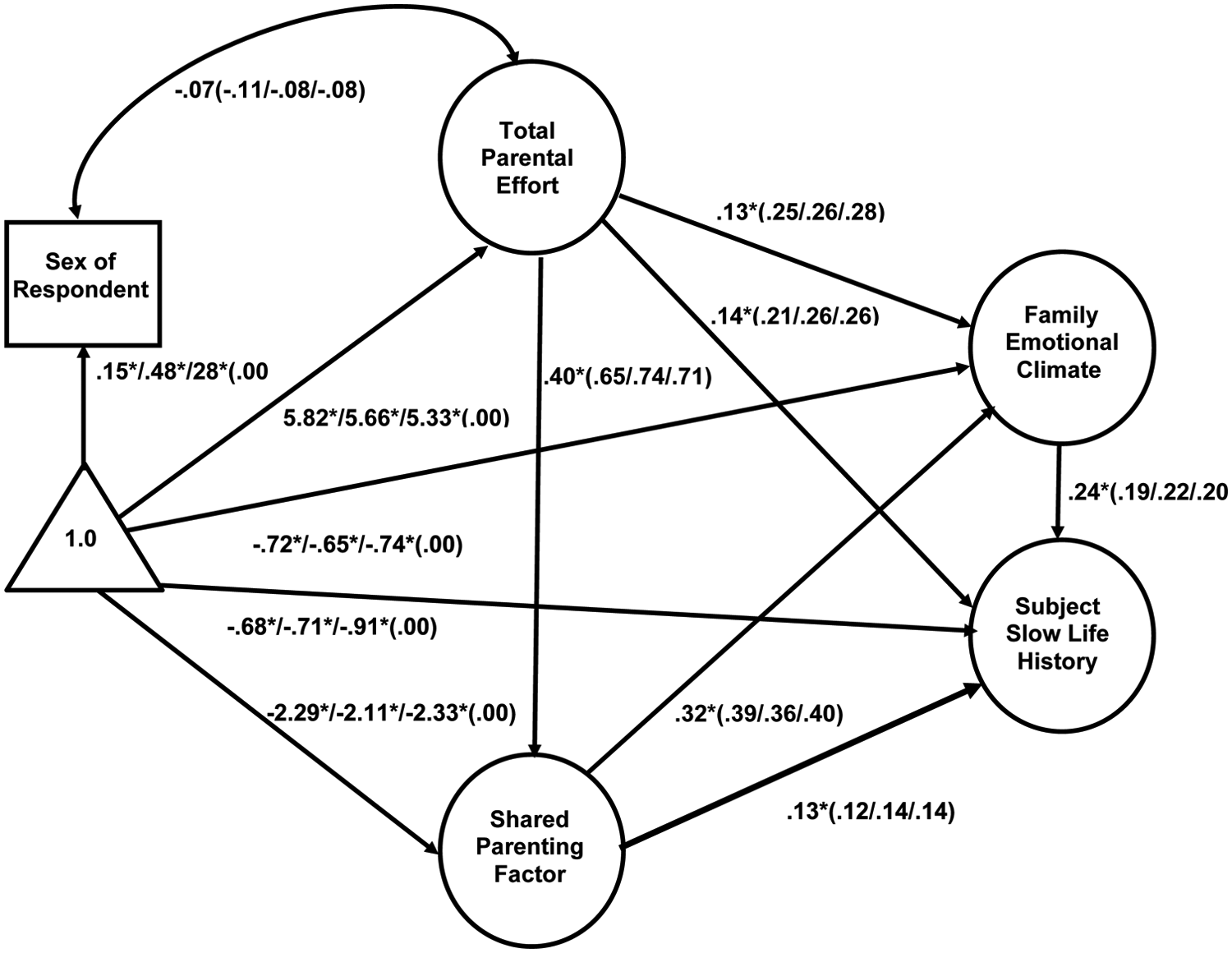
The Multisample Structural Equations Model for Study 2: Total Parental Effort, Shared Parenting Factor, Family Emotional Expression, and Subject Slow Life History
Note that the standardized intercepts of each equation (representing mean-structure parameters) are always equal to zero, by definition. However, as indicated by the results of the nested model comparisons procedure, the unstandardized intercepts are statistically different from each other across the national samples. The standardized estimates for the slopes of each equation (representing the covariance-structure parameters) are also reported because our raw-score measures were expressed as Likert-type scales, which are not directly interpretable. As is typically the practice in SEM, all cross-sample equality constraints were imposed on the unstandardized parameter estimates; however, small differences in sample variances across national samples (which almost always occur for reasons that are rarely known) made the standardized equivalents of these raw path coefficients appear to be somewhat variable in spite of the fact that acceptable equality constraints were imposed. For completeness, the three sample-specific standardized estimates are also reported inside the parentheses for each covariance-structure path coefficient.
The basic results of MSEM 2 were as follows. Higher levels of total parental effort predicted higher levels of shared parenting, as indicated by a positive and statistically significant path coefficient. Higher levels of shared parenting predicted higher, more positive levels of family emotional climate, as indicated by a positive and significant path coefficient. Furthermore, even after shared parenting was entered into the equation, higher levels of total parental effort continued to significantly and directly predict higher, more positive levels of family emotional climate, as indicated by the positive and significant path coefficient. Higher, more positive levels of family emotional climate predicted higher levels of slow life history, as indicated by a positive and significant path coefficient. Furthermore, even after family emotional climate was entered into the equation, higher levels of the shared parenting continued to significantly and directly predict higher levels of slow life history, as indicated by a positive and significant path coefficient. Moreover, even after both family emotional climate and shared parenting were entered into the equation, higher levels of total parental effort continued to significantly predict higher levels of slow life history, as indicated by the positive and significant path coefficient.
The squared multiple correlations values for the criterion variables were R 2 = .422/.546/.500 for shared parenting, R 2 = .334/.326/.394 for family emotional climate, and R 2 = .191/.281/.268 for slow life history. These are, again, presented in the alphabetical order of the acronyms assigned the three cross-cultural samples: AZ, CV, and SO, respectively.
Discussion
Study 1, carried out exclusively at the University of Sonora in Hermosillo, Sonora, México, suggested that the relation between higher levels of shared parenting experienced as a child and respondent adult life history would be at least partially mediated by family emotional climate. Study 2 extended the network of variables implicated in the model of shared parenting in finding that higher total parental effort also predicted shared parenting, positive family emotional climate, and slower adult offspring life history strategy in the AZ, CV, and SO samples. Interestingly, although total parental effort and shared parenting were partially collinear due to the relatively large and positive effect of the former upon the latter, both total parental effort and shared parenting make independent and complementary additive contributions to the slow life history of offspring as young adults.
Additionally, Study 2 provided a more stringent test of the meditational role of family emotional climate, finding the association between this variable and total parental effort and shared parenting having both direct and indirect effects upon life history strategy. These results suggest that, at best, family emotional climate partially mediates the associations between shared parenting and parental effort factors and offspring life history strategy. The fact that these associations were found as invariant across samples offers strong support also to the evolutionary perspective of parenting developed in this research as it provides support for the cross-cultural validity of the theory, at least in the three societies sampled.
From a family systems perspective, these findings provide support for the framework’s assumption that spousal agreement produces favorable family and child outcomes (Minuchin, 1985; Whitchurch & Constantine, 1993). Thus, higher shared parenting—less child-reported conflict between parents over childrearing arrangements during childhood—had a favorable impact on the emotional climate of the family, which in turn had a favorable impact on child outcomes by means of fostering the development of a slow life history. The word favorable is used here to denote what is considered socially desirable in all three of the cultures studied, where slow life history is valued by the dominant cultural groups (but see Ellis, Del Guidice et al., 2012). The fact that nearly all of the parameters of our model were found to be invariant not only across European American and Latino groups, but also within two very different Latino groups strengthened the generalizability of the theory to other than the mainstream North American culture from which the theory originated.
On the other hand, our data show that the CV sample had lower average levels of total parental effort than both the SO and the AZ samples. This result might appear to be quite surprising in light of the fact that both Sonorans and Costa Ricans belong to cultures traditionally characterized as embodying the same general cultural model of socialization goals as well as parenting theories and practices, sometimes described under the more general rubric of collectivism, while Arizonans belong to a culture often described as representing a different cultural model of independence, sometimes described under the more general rubric of individualism, which is peculiar to urban, educated families in industrialized and postindustrial information-based societies (Harkness & Super, 2002; Harwood et al., 2002; Kagitçibasi, 2005; Keller, 2003; Keller et al., 2006; Markus & Kitayama, 1991; Shweder, 1995), sometimes characterized under the acronym WEIRD, for Western, Educated, Industrialized, Rich, and Democratic (Henrich, Heine, & Norenzayan, 2010).
Challenging the traditional division of cultures into collectivistic as opposed to individualistic patterns, our data are rather consistent with previous parenting research involving European American and Mexican samples, showing similarity between parenting practices of Mexican American and European American parents, once important parental factors as SES and educational level were controlled (Fox & Solis-Camara, 1997; Solís-Cámara & Fox, 1995, 1996).
Based on the results, it appears that most of the differences can be attributed to lower reported parental effort of fathers, since maternal parental effort across the three cultures was similar. Compared to the AZ and SO samples, CV students reported less paternal care-giving such as preparing food or attending their events at school. This pattern might reflect characteristics specific to parenting practices in Costa Rican society that might not be fully captured by our measures or that might not be shared by Mexican society. This pattern of parenting could reflect the supposition that Latinos are a heterogeneous group (Sabogal, Marin, Otero-Sabogal, VanOss Marin, & Perez-Stable, 1987) arising from variability in each country’s socioeconomic and political context (Hausmann et al., 2010; Milosavljevich, 2007; UNDP, 2008).
It could be that Costa Ricans have cooperative social networks that include—alongside mothers and fathers—grandmothers, extended family, and social institutions that traditionally protect children (Vega, 2001). This social configuration possibly stems from Costa Rica having higher levels of women’s participation in the labor force than Mexico.
Consistent with evolutionary framework, we could argue that it is possible that lower paternal parental effort in CV is a product of lowered paternity certainty, whereby putative fathers will avoid investing in children if there is a chance the offspring are not his (Gaulin & Schlegel, 1980; Geary, 2000; Wilson & Daly, 1992). Indeed, this pattern of fathering is consistent with research in the Caribbean that shows fathers often have children with multiple women, decreasing the amount of investment a father can devote to his child and his family, leaving all mothers to raise the children (Cabeza De Baca et al., 2011; Flinn, 1992; Roopnarine, 2004). But until there is available data in the present study to evaluate that hypothesis in the case of CV, it remains just a speculation.
Study Limitations
The retrospective self-report design of this study is one of the limitations that must be acknowledged. Because perceptions of childhood experiences, including those of mothers’ and fathers’ parenting, may be shaped by personality type, current mood (McFarland & Buehler, 1998), genetic factors (Hur & Bourchard, 1995), and length of time since the reporter’s childhood (Fergusson, Horwood, & Woodward, 2000), these various biases might influence the retrospective reports of childhood experiences (see Hardt & Rutter, 2004, for a review on retrospective designs).
Another possible limitation of this study is that it is not based on a genetically informative research design. Nevertheless, it is never adequate to view a single study in isolation from other known facts. For example, other quasi-experimental studies using genetically informed designs (Ellis, Schlomer, Tilley, & Butler, 2012; Tither & Ellis, 2008) have documented that the father-absence effect on risky sexual behavior, another fast life history trait, is at least partially environmental in origin, dose-dependent by differential degrees of exposure, and at least partially mediated by paternal psychopathology and the quality of the parental effort expended by fathers. Therefore, it is not unreasonable to presume that both the combined and shared parental efforts of both fathers and mothers might exert a causal influence on the future life history strategies of their offspring as young adults, over and above that exerted by shared genetic influences.
Implications for Social Interventions
Accordingly, the current research has far-reaching implications for social interventions designed to increase the parental effort of fathers. Because cultural norms are often highly ingrained in individuals, interventions seeking to alter the parental behaviors of men should appeal to cultural scripts consistent with the ecology in which they are residing, rather than attempt to override them. Because machismo is a salient aspect of the construction of masculinity in Latin America, social interventions should appeal to the father’s natural interest in meeting the needs of their children, noting that enhanced parental effort may be an important buffer against the elevated hazards of morbidity and mortality that are present in certain environments. An important facet of machismo often neglected by social scientists is providing for the needs of women and children (Mayo, 1997). Therefore, we believe that by emphasizing that investing in children is consistent with these values, rather than attacking them by calling for greater “gender equity” (which lacks widespread cultural appeal), increased paternal effort could be framed in a more culturally acceptable fashion to Latino men and may be used to drive up the parental effort of fathers, thus altering the ontogeny of their children in ways that might perpetuate that practice.
Furthermore, the findings from Study 1 might be able to provide some guidance for practitioners developing evidence-based parenting interventions to be applied with Mexican families living in the United States, as it elucidates how adult children’s endorsement of cultural values such as familismo/respeto and simpatía—included in our criteria variable—are associated with parents’ childrearing negotiation as experienced during childhood. This is relevant to family therapists, as some have called for more research exploring culturally sensitive interventions with minority groups in the United States (Parra et al., 2009).
Footnotes
Declaration of Conflicting Interests
The author(s) declared no potential conflicts of interest with respect to the research, authorship, and/or publication of this article.
Funding
The author(s) received no financial support for the research, authorship, and/or publication of this article.