



Abstract
Bicultural Identity Integration (BII), or biculturals’ perceived compatibility between their two cultural identities, has been found to predict a variety of psychological processes and behavioral outcomes. However, it is not clear why biculturals differ in their levels of BII. We suggest that the valence of bicultural experiences influences BII. Furthermore, we predict that biculturals’ level of BII can be changed momentarily by recalling valenced bicultural experiences. An experimental study manipulating recall of positive or negative bicultural experiences found that recalling positive bicultural experiences increased BII, whereas recalling negative bicultural experiences decreased BII. However, recalling experiences irrelevant to bicultural experiences did not change BII. Theoretical and practical implications of the malleability of BII are discussed.
Keywords
The growing prevalence of biculturals in the United States and globally, has fueled a boost in scholarship on the psychology of biculturalism (Williams, 2012). A key finding in this emerging literature concerns the extent to which individual differences in identity management influence the experience of biculturalism. For example, biculturals have been shown to vary in the degree to which they perceive their cultural identities, or their sense of belonging in the two cultural groups with which they identify, to be compatible or in conflict (Benet-Martínez & Haritatos, 2005). Among other psychological outcomes and process, this individual difference construct, Bicultural Identity Integration (BII), has been found to predict biculturals’ social adjustment (Nguyen & Benet-Martínez, 2007), psychological well-being (Benet-Martínez & Haritatos, 2005) and creativity (Cheng, Sanchez-Burks, & Lee, 2008). BII also moderates how biculturals perceive themselves (Ramirez-Esparza, Gosling, Benet-Martínez, Potter, & Pennebaker, 2006), the type of attributions they make (Benet-Martínez, Leu, Lee, & Morris, 2002), and the nature of their decision-making activities (Mok, Cheng, & Morris, 2010).
Although BII is typically conceptualized as a stable individual difference, this article examines whether BII is malleable and subject to change based on valenced and self-relevant cultural experiences. The experience of being bicultural is usually mixed: Whereas biculturals benefit from their unique cultural competencies such as speaking two languages and having knowledge of and connections with two cultural groups, they sometimes feel misunderstood and discriminated due to their multicultural backgrounds and minority status. While biculturals with high and low BII (i.e., High BIIs and Low BIIs) have positive and negative cultural experiences, the literature suggests that high BIIs have more positive experiences associated with their bicultural status than low BIIs. First, qualitative and quantitative evidence show that, relative to low BIIs, high BIIs report fewer instances of discrimination, have less difficulty dealing with the challenges related to their ethnic backgrounds, feel less stressed by their bicultural identity, and generally adjust better psychologically and socially (Benet-Martínez & Haritatos, 2005; Nguyen & Benet-Martínez, 2007). High BIIs also have more positive feelings toward their bicultural identities and the two cultures related to them (Downie, Koestner, ElGeledi, & Cree, 2004).
Second, Cheng, Lee, and Benet-Martínez (2006) found that, whereas high BIIs assimilate to positive cultural cues in the environment (e.g., they behave more like Asians when being exposed to positive Asian stereotypes and behave more like Americans when being exposed to positive American stereotypes), low BIIs assimilate to negative cultural cues or negative stereotypes associated with Asians and Americans. Extensive research shows that assimilation effects are more likely when cues are congruent with the participant’s own experiences and expectations (e.g., Mussweiler & Strack, 2000). This suggests that positive cultural cues are more congruent with the past experiences of high BIIs, while negative cultural cues are congruent with the past experiences of low BIIs.
Last but not least, a growing literature shows that the quality of the relationship between cultural groups influences biculturals’ acculturation strategies (Schwartz, Unger, Zamboanga, & Szapocznik, 2010). For example, when the mainstream cultural group is friendlier toward the ethnic minority group and more open to different cultural values and experiences, members of the ethnic minority group are more likely to identify with the mainstream and ethnic cultures, and integrate both into their identities. Again, this supports the idea that positive acculturation experiences are associated with the integration of two cultural identities.
Extending this line of research on the relationship between past cultural experiences and BII, we examine whether recall of valenced (positive or negative) past cultural experiences can influence BII. As mentioned, most bicultural individuals have experienced positive and negative cultural experiences in their lives. We suggest that recalling either positive or negative personally relevant experiences makes those experiences salient, which in turn changes individuals’ self- perceptions momentarily (Galinsky, Magee, Inesi, & Gruenfeld, 2006). We experimentally manipulate bicultural individuals’ recall of positive or negative past acculturation experiences, and hypothesize that BII will be higher when biculturals recall positive bicultural experiences than when they recall negative bicultural experiences.
Method
Participants
In all, 174 second-generation Asian American students (98 females; mean age = 19.97, SD = 3.05) were recruited from a U.S. university subject pool or through campus fliers, receiving either course credit or payment, respectively. All participants were born in the United States to parents who migrated from Asia.
Procedure
Participants were randomly assigned to one of three conditions: (a) recalling 10 positive bicultural experiences, (b) recalling 10 negative bicultural experiences, and (c) no recall task. After this task, participants filled out the Bicultural Identity Integration Scale–Version 1 (BIIS-1; Benet-Martínez & Haritatos, 2005), a widely used measure of BII with two subscales—Cultural Distance and Cultural Conflict. Items of the Cultural Distance subscale are: (a) I combine both cultures (i.e., I feel like a mixture of Asian and American), (b) I feel “Asian-American” (i.e., hyphenated, a mixture of the two), (c) I am simply an Asian in North America (i.e., I am an Asian who happens to live in the United States; reverse scored), and (d) I feel part of a combined culture. Items of the Cultural Conflict subscale are: (a) I am conflicted between the American and Asian ways of doing things (reverse scored), (b) I feel like someone moving between two cultures (reverse scored), (c) I feel caught between the Asian and American cultures (reverse scored), and (d) I don’t feel trapped between the Asian and American cultures. Higher scores refer to lower perceptions of cultural distance and cultural conflict or higher BII. Items in each subscale were averaged to give an individual’s overall score of Cultural Distance and Cultural Conflict (Cronbach’s α was .61 and .81, respectively). Participants then rated their Bicultural Pride, a measure of positive feelings about their bicultural status. Items consist of the following: (a) I like being an Asian American, (b) I am proud of being Asian American, (c) There are more advantages than disadvantages of being Asian American, and (d) There are many good things about being Asian American. Cronbach’s α for this scale was .89. All items were measured using a 5-point Likert-type scale.
Results
As a manipulation check, we compared bicultural pride between individuals in the positive and negative recall conditions. As expected, individuals reported higher bicultural pride in the positive recall condition than the negative recall condition, t(112) = 4.86, p < .001 (MPositive = 4.41, SD = .60, and MNegative = 3.72, SD = .89). Although cultural distance and cultural conflict typically do not correlate with each other, they were positively correlated in this study (r = .38, p < .0001). Thus, we first conducted a MANOVA with recall condition (positive, control, negative) on cultural distance and cultural conflict, which revealed a significant main effect of recall, F(4, 338) = 3.61, p = .007, η p 2 = .04 (based on Hotelling’s T2). When examining cultural distance and cultural conflict separately, the main effects of recall were significant for both variables, F(2, 171) = 8.36, p < .001 η p 2 = .089, and F(2, 171) = 3.35, p = .037, η p 2 = .038, respectively. The means and standard deviations, presented in Table 1, show that BII was highest in the positive recall condition, lowest in the negative recall condition, and of an intermediate level in the control condition. A contrast analyses (with weights of positive +1, control 0, and negative −1) was significant for cultural distance and cultural conflict, F(1,112) = 11.84, p = .001, η p 2 = .096, and F (1, 112) = 4.49, p = .036, η p 2 = .039.
Means and Standard Deviations in the Recalling Conditions (N = 235).
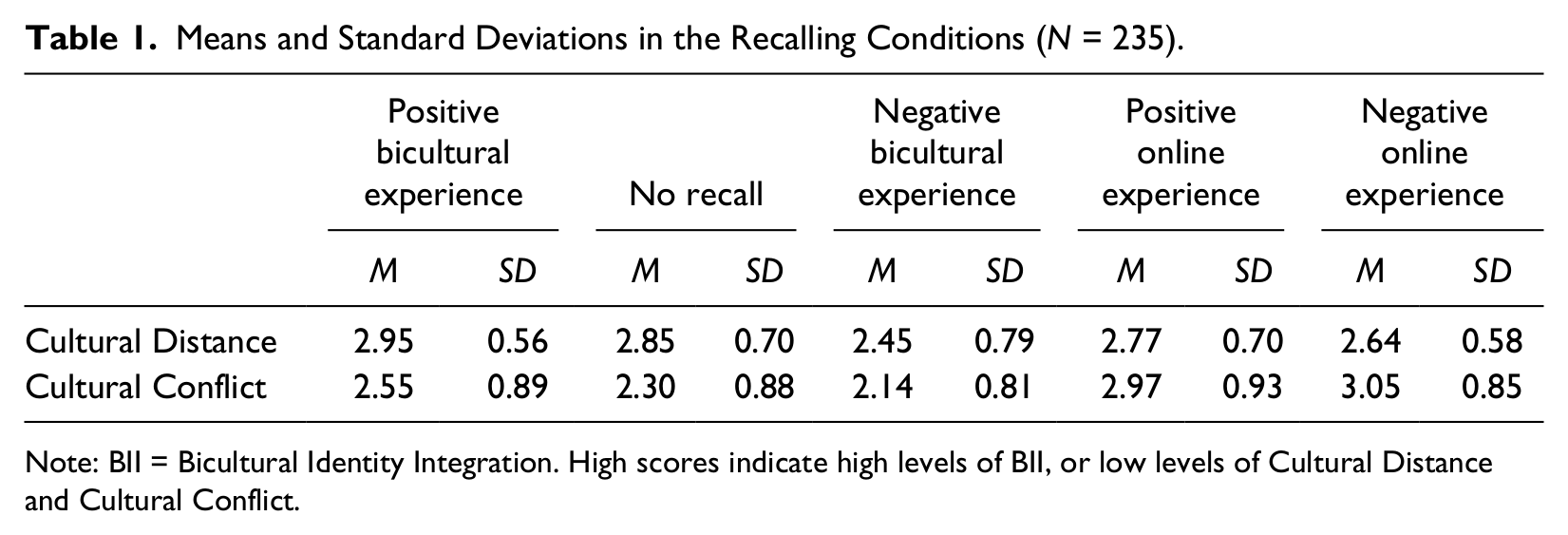
Note: BII = Bicultural Identity Integration. High scores indicate high levels of BII, or low levels of Cultural Distance and Cultural Conflict.
However, this finding could be the result of generalized positive or negative affect prompted by the recall task, rather than the recall of valenced bicultural experiences per se. To rule out this alternative account, we added an additional step in the study with two new experimental conditions that involved recall of positive and negative experiences irrelevant to biculturalism. Sixty-one Asian Americans (29 females; mean age = 26.39, SD = 7.69) in the United States were recruited through “Amazon’s Mechanical Turk,” a website for online research widely used by psychology researchers to reach participants beyond college students (Buhrmester, Kwang, & Gosling, 2011). Participants received payment for their participation. Thirty-six of the participants were first-generation Asian Americans who were born outside United States and have lived for more than 5 years each in an Asian country and in the United States. The remaining participants were second-generation Asian Americans.
Participants were randomly assigned into one of two recall conditions: (a) recalling 10 positive experiences related to being online and (b) recalling 10 negative experiences related to being online. Then, participants filled out the BIIS-1 and Bicultural Pride scales (Cronbach’s α for Cultural Distance, Cultural Conflict, and Bicultural Pride were .62, .72, and .83, respectively). We conducted the analysis of this additional data separately from the data collected in the first step of this study, as participants across the two steps were not recruited simultaneously and were not randomly assigned to the five conditions represented jointly by the two steps. The results are listed in Table 1. The comparison between the positive and negative recall conditions on Bicultural Pride was not significant, t(60) = .06, p = .95 (MPositive = 4.39, SD = .75, and MNegative = 4.38, SD = .73). A MANOVA with recall condition (positive vs. negative) on Cultural Distance and Cultural Conflict also revealed no significant main effects, Fs < 1, ps > .44, η p 2s < .01. In short, BII did not change based on recall of generalized positive or negative experiences irrelevant to biculturalism.
Discussion
According to the dynamic constructivist model of culture, culture is a schema of related information and knowledge, and biculturals can switch between different cultural schemas depending on the situation (Hong, Morris, Chiu, & Benet-Martínez, 2000). Grounded in this view of culture, BII has been shown to play an important role in how biculturals manage, negotiate, or switch between different cultures. In this article, we found that BII is malleable based on biculturals’ recall of past bicultural experiences; BII was higher (or their two cultural identities were viewed as more compatible) when recalling positive bicultural experiences than negative bicultural experiences. However, the recall of positive or negative experiences irrelevant to biculturalism did not change BII.
Although the results support the idea that BII is malleable depending on the valence of one’s cultural experiences, our study also presents limitations that can be addressed by future research. First, the two steps of the study—where the first step involved the experimental manipulation of recall of bicultural experiences, and the second step involved the experimental manipulation of recall of nonbicultural experiences—can be combined in a future study with a single experiment where participants are randomly assigned into the five conditions jointly represented by the two separate steps of the current study. Although we were able to meta-analytically compare the two steps, our current data do not allow combining the two sets of results in a single analysis, in part because participants in the two studies were recruited at different sources and at different times, and in part because participants differed in key demographic characteristics such as generational status.
Specifically, compared with participants in the two conditions who recalled positive or negative nonbicultural experiences, participants in the conditions who recalled positive or negative bicultural experiences were all second-generation rather than first-generation Asian Americans. They also reported higher levels of cultural conflict. This pattern makes sense. According to previous research, second-generation biculturals who are simultaneously born into two cultures tend to experience more internal tension and conflict about their bicultural identity status than first-generation biculturals (Cheng, 2005). It is important to note, however, that although BII has been found to differ among first- and second-generation biculturals, the effects of BII on psychological processes and behavioral outcomes are similar across generational status (Benet-Martínez et al., 2002; Cheng, Lee, Benet-Martínez, & Nguyen, in press).
In addition, although our study only explores momentary shifts in BII through experimental manipulation of recall, future studies should examine whether BII may be influenced by biculturals’ chronic exposure to positive and negative bicultural experiences outside of the context of short-term, experimental studies. Studies can also examine how BII levels change before and after naturally occurring positive and negative cultural experiences. To the extent that BII is malleable, multicultural communities that make positive bicultural experiences salient (or make negative bicultural experiences less salient) can increase (or decrease) levels of BII in bicultural members of those communities. Empirical research is needed to develop and test such interventions.
Footnotes
Declaration of Conflicting Interests
The author(s) declared no potential conflicts of interest with respect to the research, authorship, and/or publication of this article.
Funding
The author(s) received no financial support for the research, authorship, and/or publication of this article.