



Abstract
This study examines how the cultural heterogeneity of work teams moderates the way in which team cultural intelligence (CQ) affects the development of team shared values. Utilizing the four-factor model of CQ, we predict how each facet of CQ will impact the development of shared values in relatively early stages of team development differently for culturally homogeneous versus culturally heterogeneous work teams. We operationalize team shared values as the degree to which a broad set of cultural values are similarly endorsed by team members as guiding principles when working in their team. Results show that behavioral and metacognitive CQ had a positive effect on shared values in culturally heterogeneous teams; however, motivational and metacognitive CQ had a negative effect on shared values in culturally homogeneous teams. All effects were observed in the early stages of team development. Having uncovered positive and negative effects of CQ for shared values in work teams, we discuss implications for theory and practice around this form of cultural competence.
Human values are motivational in nature and define what is important to us (Bardi & Schwartz, 2003; Rokeach, 1973). Decades of research demonstrate that national cultures vary according to the guiding principles that are motivating in life (e.g., Rokeach, 1973; Schwartz, 1992; Triandis, 1989) and at work (e.g., Hofstede, 1980; House, Hanges, Javidan, Dorfman, & Gupta, 2004). Moreover, many of the process conflicts that arise in multicultural teams (MCTs) are thought to be rooted in deep-level diversity, such as team members’ distinct and often conflicting underlying cultural values (Brett, 2007; Earley & Gibson, 2002; van Knippenberg & Schippers, 2007). However, just as norms may shift as a function of team interaction or organizational culture (e.g., Earley & Gibson, 2002; Earley & Mosakowski, 2000), values may also shift, such that team members develop a shared set of motivational values that guide their work as a team. Like “work culture” in a multicultural organization, such team cultures are emergent and situated—they are activated and salient when one is working in one’s team (Brannen & Salk, 2000; Leung, Bhagat, Buchan, Erez, & Gibson, 2005).
Schwartz (2011) noted the many benefits of value consensus, defined by agreement on the importance of values, including increased cooperation, stability, coordination, and goal achievement. Similarly, teams with shared values benefit from less conflict and a stronger group identity (Gibson & Earley, 2002; McGrath, Berdahl, & Arrow, 1995) and improved team performance (Kirkman & Shapiro, 2005; Klein, Knight, Ziegert, Lim, & Saltz, 2011). MCTs face particular challenges in developing shared values because their members are from different national cultural backgrounds, and motivational values tend to vary by national culture, for example, with Eastern nations endorsing more collectivism and Western nations endorsing more individualism (Hofstede, 1980; Schwartz, 1992). Given the importance of developing shared values in today’s MCTs, the current research proposes one set of factors that contributes to a team’s likelihood of developing shared values: cultural intelligence (CQ).
As business and society become increasingly diverse, the MCT has become a reality of everyday work life. MCT members have diverse values and work styles that create challenges in terms of communication, conflict, and identity (see Stahl, Maznevski, Voigt, & Jonsen, 2010, for a meta-analysis). Researchers interested in modeling and improving MCT processes have studied global team norms (e.g., Earley & Mosakowski, 2000), collaboration (e.g., Janssens & Brett, 2006), and effectiveness (e.g., Maznevski & Chudoba, 2000; Tjosvold, Poon, & Yu, 2005), offering significant contributions for managing conflict and maximizing performance. However, this study takes a step back from norms and processes to ask how teams develop shared values. Team values are distinct from team norms in that values are deep-seeded, shared beliefs about a team’s guiding principles, whereas team norms reflect an understanding of procedures and appropriate behaviors (Bettenhausen & Murnighan, 1985).
We propose that team members’ CQ will facilitate the development of shared values in MCTs at early stages of team interaction. CQ is one form of cultural competence, defined as the ability to function effectively in another culture or in a culturally diverse setting, and is essential for members of MCTs as it facilitates understanding, adaptation, communication, and coordination in diverse settings (Johnson, Lenartowicz, & Apud, 2006). CQ is a multifaceted construct that includes behavioral flexibility, cultural knowledge, motivation to adapt in cross-cultural settings, and cultural metacognition (Earley & Ang, 2003). It has been proposed that CQ should positively influence MCT processes and performance (Ang & Inkpen, 2008; Earley & Ang, 2003; Janssens & Brett, 2006; Ng, Van Dyne, & Ang, 2009), but empirical work on CQ in MCTs is scarce.
Most research on CQ has been conducted in the domain of expatriate adjustment and performance (e.g., Ang et al., 2007; Elenkov & Manev, 2009; Kim, Kirkman, & Chen, 2008; Shaffer & Miller, 2008). In the domain of MCTs, CQ has been shown to facilitate team integration (Flaherty, 2008), and leader CQ has been found to positively influence team members’ perceptions of leader and team performance (Groves & Feyerherm, 2011). In this study, we extend CQ theory to the domain of shared cognition in MCTs, offering new insights. Specifically, past theory has predicted that in a culturally diverse context CQ will have beneficial effects on team performance. We extend this logic to team shared values, and we also argue that in a multicultural work environment, CQ can have detrimental effects for culturally homogeneous teams. Our study contributes to the CQ literature, by testing the effect of CQ on team shared values, and to the broader team literature by examining team cultural heterogeneity as a moderator of the proposed relationship.
In the following sections of this article, we first elaborate on the construct of team shared values and its importance for team functioning. We also discuss the temporal factors that suggest teams should develop shared values in relatively early rather than late stages. Then, we present the construct of CQ and discuss how the relation between each of the four facets of CQ (motivational, behavioral, metacognitive, and cognitive) and team shared values is moderated by team cultural heterogeneity. We test hypotheses with a sample of three- or four-person student teams that worked together for 9 weeks. Team composition was either culturally homogeneous (Canadian) or fully heterogeneous with respect to team members’ cultural identity. Our results extend theory on shared values, CQ, and MCTs, and we discuss implications for managerial practice in a multicultural work environment.
Shared Values in MCTs
Defining Shared Values in MCTs
Individual values define what end-states are important to us and motivate us to act in a goal-directed manner (Bardi & Schwartz, 2003; Meglino & Ravlin, 1998; Rokeach, 1973). Cultural values are defined as guiding principles that are shared by a recognizable social group and that define what is desirable and important in life (Kluckhohn & Strodtbeck, 1961; Schwartz, 1992, 1994). There are many cultural value typologies available to categorize individuals and countries (e.g., Hofstede, 1980; House et al., 2004), but one of the most widely used is that of Schwartz (1992, 1994). Schwartz’s (1992, 1994) unique theory, conceptualization, and mapping of motivational values at the individual and national levels shaped the field of cross-cultural psychology in the 1990s and 2000s and continue to influence research on the antecedents and consequences of values in individual-, national-, and cross-level studies (Knafo, Roccas, & Sagiv, 2011). Schwartz’s value dimensions have been used in cross-cultural organizational research to predict creativity, reward allocation, and charismatic leadership (Brown & Treviño, 2009; Fischer et al., 2007; Rice, 2006). Because the Schwartz values reliably predict work behaviors, we use them to measure work team shared values, which we define as the degree to which team members similarly endorse a broad set of guiding values when engaged in teamwork. Extending prior research that has examined antecedents and consequences of shared team norms, as well as implications of team cultural value composition for team processes (Bettenhausen & Murnighan, 1991; Earley & Mosakowski, 2000; Kirkman & Shapiro, 2001a, 2001b; Klein et al., 2011), we investigate the antecedents of shared team values, a novel construct that captures the degree to which team members share a set of core motivational values when working in their team.
“Team cultural values” have been shown to predict such team variables as cooperation, satisfaction, and team effectiveness (e.g., Eby & Dobbins, 1997; Kirkman & Shapiro, 2001a, 2001b), and to moderate the effect of transformational leadership on team performance (Schaubroeck, Lam, & Cha, 2007). These studies, along with research on team cultural value diversity (e.g., Kirkman & Shapiro, 2005), operationalize team cultural values as an aggregate or standard deviation of individual members’ native culture values (i.e., individual members’ guiding principles in life). However, international business research suggests that employees in multicultural organizations will adjust and adapt their guiding principles to develop an emergent, shared organizational culture (Brannen & Salk, 2000; Leung et al., 2005). Similarly, values can become shared within teams when individual schemas adjust and converge, and team members internalize the shared values that guide their team (Bardi & Goodwin, 2011; Fiske & Taylor, 1991; Tajfel & Turner, 1979; Turner, Hogg, Oakes, Reicher, & Wetherell, 1987).
The Emergence of Shared Values in MCTs
We draw on two areas of literature suggesting that individuals can adjust their motivational values in different situations. First, the literature on bicultural identity shows that individuals can shift their cultural mind-set depending on the situation (Hong, Morris, Chiu, & Benet-Martinez, 2000; Hong, Wan, No, & Chiu, 2007; Yagi & Kleinberg, 2011; see also Bardi & Goodwin, 2011, for a review of priming studies resulting in value change). Second, researchers have recently developed models of value change, arguing that situational factors can prompt value change at the conscious or unconscious level (Bardi & Goodwin, 2011). The management literature similarly proposes that when individuals enter work groups or organizations, they may adjust their own values to be more similar to the group’s values as identification increases (Chatman, 1991; Mael & Ashforth, 1992). Thus, team members may develop shared team values while their core individual or cultural values, which tend to be highly ingrained and sticky, do not necessarily change. Instead, individuals develop a core set of motivational values that are activated and guide their work specifically in the team setting.
We propose that teams develop shared values much in the same way they develop a team mental model or shared identity, namely, shared cognition evolves as a function of both the preexisting individual identities that influence group processes and the group processes themselves (Postmes, Haslam, & Swaab, 2005; Postmes, Spears, Lee, & Novak, 2005). Communication and group interaction are essential for these processes to unfold (Cannon-Bowers, Salas, & Converse, 1993; Klimoski & Mohammed, 1994), allowing previously unconnected values to become related and clustered (Latané, 1996). Drawing on these processes of value change and shared mental model development, we argue that team members can adjust their motivational values, developing shared values within the team, and these values then become a part of the individual’s malleable identity that is activated in the team setting. Because shared team values (a) evolve from individual member values and (b) require processes of adaptation and convergence, we argue and propose below that team members’ CQ at team inception will influence the degree to which a team develops shared values.
We build our predictions around the emergence of shared values at the early stages of team interaction. The question of “when” teams will develop shared values is informed by models of temporal group processes that have shown that teams change and evolve over time by moving through stages (Tuckman, 1965; Wheelan, 1994). When teams first form, in relatively early stages, team members typically work through issues of inclusion, organization, and power. It is in these early stages that we expect teams to form shared values, which provide a foundation for building trust and organized processes. Once a common group identity and task understanding are achieved, at relatively later team stages, a task focus takes over. These temporal models suggest that changes in values, goals, and identity are evident in relatively early stages of team interaction, as later stages are marked by more stability and a task focus (Arrow, 1997). Taking this group process perspective into account, we propose that team members should develop shared motivational values, at early stages of interaction. Of course, early versus later stages of team development are relative to the length of time a team exists. In particular, teams that know their existence is short and limited, as is the case with our teams, will set the norms for working together and converge on values relatively quickly because they know they have no time to lose.
It should also be noted that one of the main tenets of our model is that how and when teams develop shared values will depend, in part, on where teams begin. Once a team has formed a social identity, at relatively later team stages, members’ preexisting characteristics should not be as relevant. Therefore, we examine team characteristics at the point of inception as predictors of shared team values.
Team CQ as a Predictor of Shared Team Values and the Moderating Role of Team Cultural Heterogeneity
CQ as Cultural Competence
In recent years, with the globalization of business, cultural competence has emerged as an important determinant of successfully managing cross-cultural encounters. As noted by Johnson et al. (2006), the literature offers many definitions of cultural or cross-cultural competence that generally include “the ability to function effectively in another culture” and “an inventory of cross-cultural competencies” (Johnson et al., 2006; Tan & Chua, 2003). The construct of CQ is a psychological measure of cultural competence that is defined as a person’s capacity to function effectively in settings characterized by cultural diversity (Earley & Ang, 2003) and has been used in research on expatriates, leadership, judgment, and decision making (e.g., Ang et al., 2007; Elenkov & Manev, 2009). It has cognitive, motivational, and behavioral elements and captures awareness and flexibility in intercultural situations (Oolders, Chernyshenko, & Stark, 2008). Similar to other forms of intelligence, CQ has external (motivational and behavioral) and internal (metacognitive and cognitive) components.
What makes CQ distinct from other cultural competencies (e.g., cultural knowledge, cross-cultural experience) is that it is theoretically grounded in the framework of multiple intelligences (Ang et al., 2007; Earley & Ang, 2003; Sternberg, 1985). As a result, CQ is viewed as separable from other competencies in that CQ does not conflate ability with personality (Ang et al., 2007; Paige, 2004). Instead of being a facet of the CQ construct, personality is viewed as an antecedent of CQ (Earley & Ang, 2003; Ng, Van Dyne, & Ang, 2012) with theory proposing that CQ and personality should be distinct, but related, constructs (Earley & Ang, 2003; Ng et al., 2012). Research that has tested this tenet of CQ theory has found consistent evidence that CQ and personality are distinct constructs that are related (e.g., Ang et al., 2007; Ang, Van Dyne, & Koh, 2006; Rockstuhl, Seiler, Ang, Van Dyne, & Annen, 2011).
Although CQ is presented as an intelligence and situated in the theoretical framework of multiple intelligences (Sternberg, 1985), it is argued to be distinct from general cognitive ability, emotional intelligence, and social intelligence. Research on construct validity has found that CQ is distinct from emotional intelligence, social intelligence, and general mental ability (Moon, 2010; Ward, Fischer, Lam, & Hall, 2009). In recent research, CQ has been found to predict outcomes such as leadership effectiveness, decision making, and task performance above and beyond emotional intelligence, and general mental ability (Moon, 2010; Rockstuhl et al., 2011; Ward et al., 2009). Much of the past empirical research has focused on how CQ alters effectiveness and adjustment of expatriates. For example, Elenkov and Manev (2009) found that senior expatriate leaders with high CQ (compared with the ones with low CQ) had a more positive effect on organizational innovation. Furthermore, Lee and Sukoco (2010) found that CQ had a positive effect on expatriate adjustment and cultural effectiveness. In addition to the research with expatriates, Imai and Gelfand (2010) found that CQ predicted sequences of integrative behavior (i.e., more cooperative behavior and information exchange) in intercultural negotiating dyads. Thus, this past research suggests a beneficial impact of CQ on cross-cultural interactions involving expatriates and negotiators.
The Role of CQ in MCTs
CQ in a team context is also important to study because organizations are increasingly using global teams to manage complexity and coordinate tasks across the organization (Janssens & Brett, 2006). In addition, given that many societies and organizations are multicultural (Fukuyama, 1995; Locke, 1995), many “domestic” teams are composed of members with different cultural backgrounds. Thus, MCTs can be a reality for domestic and global organizations. One of the only studies we have found examining CQ at the team level is a field study of six MCTs. The author found that a team’s motivational and cognitive CQ were positively correlated to the team’s reported time for acceptance and integration of new members (Flaherty, 2008). The author concludes that “individuals and teams with a stronger desire to interact with others from different cultures may have higher thresholds of acceptance and integration and may be more cautious and conscientious in their interactions” (Flaherty, 2008, p. 200). We build on Flaherty’s study by testing CQ at the facet level in culturally homogeneous and heterogeneous teams. Our study design responds to recent calls for a closer look at the unique explanatory power of the four CQ dimensions (Groves & Feyerherm, 2011) by examining the unique effects of two external and two internal CQ facets at the team level.
It has been argued that in MCTs, leader and team member CQ should facilitate team learning, knowledge sharing, sense-making, and interpretation (Ang & Inkpen, 2008; Groves & Feyerherm, 2011; Ng et al., 2009). It is the sense-making and interpretation functions that we argue will lead team CQ to positively impact the development of shared values in teams. Prior research reports relationships between CQ and outcomes in culturally diverse, but not culturally homogeneous, settings presumably because the need to bridge cultural boundaries is so obvious in multicultural settings (Rockstuhl et al., 2011). Whereas some researchers have suggested that CQ may be less predictive in culturally homogeneous settings (Groves & Feyerherm, 2011), we develop hypotheses that suggest CQ might even be detrimental to teams in culturally homogeneous settings.
External Facets of CQ
The external facets of CQ, motivational and behavioral, are directly related to how people adapt to their environment, and prior research shows that both predict individuals’ ability to adapt and adjust in a cross-cultural encounter (Ang et al., 2007). Motivational CQ reflects a drive to learn and function effectively in new environments and a desire to adjust and adapt (Earley & Ang, 2003). Individuals who have high motivational CQ should show openness and a willingness to adapt to others. Drawing from expectancy-value theory (Eccles & Wigfield, 2002), Ang et al. (2007) purported that individuals with high motivational CQ direct their attention and energy to cross-cultural situations because they are intrinsically interested in them and are motivated to achieve success in these contexts. Supporting this notion, Ang et al. found that motivational CQ was linked to cultural adaptation in expatriate managers. Imai and Gelfand (2010) found that motivational CQ was the strongest of all CQ facets in predicting the identification of mutually beneficial agreements in negotiations. Because motivational CQ represents openness and flexibility, we expect that it will help MCTs develop shared values.
Although motivational CQ may help MCTs develop shared values, we propose that it may hinder shared mental model development for culturally homogeneous teams. In culturally homogeneous teams, it is common for ingroup–outgroup distinctions (Tajfel & Turner, 1986) and ethnocentrism to emerge (LeVine & Campbell, 1972; Triandis, 1990). Ethnocentrism reflects the belief that one’s culture is superior to other cultures. Particularly when culturally homogeneous teams work alongside culturally heterogeneous teams, homogeneous groups should develop a strong social and cultural identity that distinguishes them from other teams. In such teams, strong motivational CQ, or cultural openness and flexibility among some or all members, may threaten the team’s homogeneous monocultural identity. Similar to the way that minority opinion-holders generate divergent thinking in majority groups (Nemeth, 2002), the presence of culturally open-minded individuals in a culturally homogeneous team may cause all team members to think more broadly and could hinder the development of shared team values. Note that we use this reasoning to predict negative effects of all CQ facets on team shared values in culturally homogeneous groups.
Hypothesis 1 (H1): Motivational CQ will lead to a greater degree of shared values in MCTs but to a lesser degree of shared values in culturally homogeneous teams.
Behavioral CQ reflects flexibility in interacting with others and intercultural communication sensitivity, and it has also been linked to cultural adaptation in samples of expatriates (Ang et al., 2007; Earley & Ang, 2003). Individuals who are high in behavioral CQ show an ability to interpret indirect messages and adjust communication to others that should help them develop a shared understanding in MCTs. Indeed, Imai and Gelfand (2010) found that behavioral CQ predicted sequences of cooperative relationship management behaviors in negotiations. However, as argued above with respect to motivational CQ, the presence of individuals who are culturally open and behaviorally adaptive in a culturally homogeneous team could generate dissent and division, thus preventing the team from developing shared values.
Hypothesis 2 (H2): Behavioral CQ will lead to a greater degree of shared values in MCTs but to a lesser degree of shared values in culturally homogeneous teams.
Internal Facets of CQ
Internal facets of CQ (metacognitive and cognitive CQ) have more to do with knowledge content and innate cognitive abilities than do the external facets. As a result, internal facets of CQ are less clearly related to how one might adjust behaviorally, and they do not predict adaptation and adjustment in cross-cultural settings (Ang et al., 2007). However, because shared team values are a cognitive construct, a shared mental model, team member cultural knowledge and culture-related meta-cognition may very well predict cognitive adjustment leading to shared team values.
Metacognitive CQ represents an awareness of thought and adaptation in the self and others and reflects how one makes sense of a cross-cultural encounter (Earley & Ang, 2003). Metacognitive CQ is the most abstract CQ facet, and it is often described as the ability to think about cultural variability in how people think (Earley & Ang, 2003). Team-level cultural metacognition has been shown to boost creativity and task performance in culturally diverse teams (Ang et al., 2007; Crotty & Brett, 2010). Similarly, teams with high levels of metacognitive CQ should have members skilled in identifying and adjusting members’ distinct values. Thus, metacognitive CQ should help MCTs develop shared values.
As above, we expect that metacognitive CQ may hinder the emergence of shared values in culturally homogeneous teams. As metacognitive CQ captures a higher level awareness and thinking about the influence of culture on the self and others in interaction, then team members with high metacognitive CQ may engage in more broad, divergent thinking while trying to connect team members’ thinking styles. Such divergent thinking might seem threatening to the homogeneous team’s strong monocultural identity, especially in the presence of other teams when ethnocentrism and ingroup bias may be activated.
Hypothesis 3 (H3): Metacognitive CQ will lead to a greater degree of shared values in MCTs but to a lesser degree of shared values in culturally homogeneous teams.
Cognitive CQ refers to an individual’s knowledge of specific norms, practices, and conventions in other cultures (Earley & Ang, 2003). Cultural knowledge should help MCTs develop shared values; however, it will only do so if team members’ knowledge is accurate. At the same time, one might argue that cognitive CQ can interfere with team shared cognition if team members’ knowledge is inaccurate and/or they overestimate their cross-culturally savvy. Thus, it is unclear whether cognitive CQ will help or hinder MCTs develop shared values, and we examine the effect in an exploratory fashion.
Method
Participants
Participants were 203 undergraduate students (63% males) enrolled in an organizational psychology course at a large Canadian university. Participants came from diverse cultural backgrounds: 61% were identified as Caucasian Canadians, and 39% were from a range of other cultures (e.g., China, Japan, Israel, Jamaica, Germany, etc.).
Procedure
This study was conducted as part of an in-class group exercise. Students were informed that they would be assigned to three- or four-person teams in Week 4 of a 12-week term and that they would engage in team activities inside and outside class over the term and complete questionnaires based on their experiences.
Team composition
In Week 3 of the term, we administered a questionnaire assessing students’ cultural background, demographics, CQ, and national cultural values. We measured cultural background with self-reports of birth country, citizenship, national culture most identified with, and ethnicity. Based on this information, we categorized participants into two pools: “Canadian” or “other.” We randomly placed Canadian students into 29 culturally homogeneous teams comprised students who were Caucasians, born and raised in Canada, and who identified only with the Canadian culture. Participants in the “other” pool and remaining Canadian students were randomly placed into 24 culturally heterogeneous teams comprised students who were all born and raised in different countries and who identified with different national cultures, including Canada, Hong Kong, China, Korea, Philippines, Germany, Italy, Bangladesh, India, Sri Lanka, Vietnam, Taiwan, Oman, Jamaica, and Serbia. In culturally heterogeneous groups, there were no two group members with the same cultural background in one group. 1
Team tasks and time
Team assignments were announced in Week 4 of the term, and teams were told that during the remainder of the term, they would complete weekly tasks together that included experiential exercises (e.g., puzzle task, decision-making task), case analyses (e.g., work–life balance in Company X), and thought papers (e.g., analyze your team’s performance on the in-class exercise). The teams’ first meeting took place in Week 4 of the term, when they were instructed to review the course syllabus for information on the types of experiential tasks and case studies they would be working on, and to discuss a team contract and team name. The teams’ second meeting took place in Week 5 of the term, when they conducted a group decision-making exercise and then responded to the first survey measuring their values when working in their team. We also measured participants’ motivational values when working with their team at two later stages (Weeks 7 and 8 of the term). Debriefing occurred at the end of the term.
Predictor Measure: CQ
CQ was assessed before groups had been assigned, using the Cultural Intelligence Scale (Ang et al., 2006). This scale has four facets: motivational CQ (five items), behavioral CQ (five items), cognitive CQ (five items), and metacognitive CQ (four items). Example items are “I enjoy living in cultures that are unfamiliar to me” (motivational CQ), “I vary the rate of my speaking when a cross-cultural situation requires it” (behavioral CQ), “I know the arts and crafts of other cultures” (cognitive CQ), and “I am conscious of the cultural knowledge I use when interacting with people of different cultural backgrounds” (metacognitive CQ). The response scale was a 5-point Likert-type scale ranging from 1 (strongly disagree) to 5 (strongly agree). Cronbach’s alpha was .77 for motivational CQ, .78 for behavioral CQ, .83 for cognitive CQ, and .75 for metacognitive CQ. 2
Outcome Measure: Shared Team Values
To measure shared team values, we administered a modified version of the Schwartz Value Inventory (Schwartz, 1992) that includes 56 items measuring 11 motivational values. We modified the survey content and the instructions. We included 9 of the 11 motivational values: self-direction, stimulation, achievement, power, security, conformity, tradition, benevolence, and universalism. Two values, hedonism and spirituality, were not included in this study because they were not directly relevant to the context of work teams. As noted by Klein and colleagues (2011), when studying values in work teams, we should study values that might be important to colleagues and shape behavior in teams. We modified instructions by asking participants to rate the degree to which each value was a guiding principle at the current time when they interact with their team. We used a 7-point Likert-type scale ranging from −1 (this value is opposed to my values), 0 (not at all important), to 5 (of supreme importance). The score for each value type was computed by taking the mean rating of its associated items for each individual. The average Cronbach’s alphas for all 9 value types over three questionnaires are as follows: .75 for self-direction, .87 for stimulation, .79 for achievement, .85 for power, .82 for security, .66 for conformity, .81 for tradition, .80 for benevolence, and .88 for universalism. 3
Following previous research, we created a score to measure the strength of shared values, using the team’s standard deviation for multiple indicators (see Knight et al., 1999, for an example of a similar approach). We first calculated the standard deviation within each group for each cultural value dimension. A larger standard deviation indicates less agreement among group members regarding the importance of a given cultural value in their team. In the next step, we dummy coded the standard deviation of each value dimension (0 = not shared; 1 = shared) that were above or below a mathematically derived cutoff of 1. 4 We divided the total number of values a team could share by the sum of a team’s dummy variables to calculate a team’s “degree of shared values” as the percentage of a team’s nine values that had a standard deviation below 1 (i.e., high group consensus; see Eby & Dobbins, 1997, for a similar three-step process to determine team collectivism).
Moderator Variable: Team Cultural Heterogeneity
Our moderator was team type, defined and coded using a dummy variable representing a culturally homogeneous or culturally heterogeneous team composition. As noted above, homogeneous teams consisted of members from the same cultural background and heterogeneous teams consisted of members with different cultural backgrounds.
Control Measures
Before teams were formed, the survey administered in Week 3 measured participants’ national culture values with the standard Schwartz value survey, asking participants to what degree each value is a guiding principle in life. Following the same procedures outlined above, we calculated a shared values score at team inception as a control variable. Thus, all our analyses included a control for the degree to which team members had similar values at the point of inception.
Results
Analytical Approach
We tested our hypotheses at the team level of analysis. Consequently, we aggregated our individual level variables of CQ (motivational, behavioral, metacognitive, and cognitive) to the team level. To justify our procedure for treating variables measured at the individual level as team-level variables, we use Chan’s (1998) typology of compositional models. Chan suggested that an additive aggregation (using the mean of the individual level variables) is appropriate when the theoretical interest is in the magnitude of an effect at the group level. Following Chan’s additive compositional model, we assumed that the level of CQ increases the collective pool of CQ. For example, characterizing a team with high cognitive CQ would mean that at least some team members have an above-average cognitive CQ. As suggested by Bliese (2000), we computed intraclass correlations, namely, the ICC(2) coefficient, to determine the reliability of the team-level CQ. In particular, we estimated a two-way random effects model with absolute agreement and average measurement (Shrout & Fleiss, 1979). The ICC(2) coefficient for motivational CQ was .79, for behavioral CQ was .82, for metacognitive CQ was .74, and for cognitive CQ was .83. Given that the ICC(2) values surpassed the cutoff value of .70, reliability of team-level means of CQ are adequate and as such aggregation to the team level was justified (Bliese, 2000; Klein et al., 2000).
Our hypotheses predicted effects in early stages of team development, and thus, we were interested in effects of our predictors on the development of shared values primarily in our first team value survey administered in Week 5. The reason for expecting effects at early stages is that our theoretical development suggests that convergence on values should happen early in team existence, before more stable and task-focused stages. We argued that when teams have a relatively short or limited time frame, they should develop shared values and norms more quickly than teams that expect to work together for the long term or indefinitely. Given that our teams knew that they would exist for a limited time, we reasoned that convergence would happen quickly.
We conducted a set of moderated regression analyses with team shared values at Week 5 as our criterion and team type as our moderator. Following procedures outlined by Aiken and West (1991), we first mean-centered CQ variables. Second, we created interaction terms from the cross product of CQ and team type. Table 1 presents means and standard deviations for all variables for culturally homogeneous and heterogeneous groups and zero-order correlations at the group level. Although intercorrelations among the four dimensions of CQ appear to be mostly marginally significant or nonsignificant at the group level, it should be noted that at the individual level all four dimensions had significant and moderate intercorrelations ranging from .18 to .37, which is in line with the past research on CQ (e.g., Ang et al., 2007; Imai & Gelfand, 2010).
Descriptive Statistics and Zero-Order Correlations at the Group Level.

Note. Given that our outcome variable, shared team values, is a group-level outcome, analyses in this table represent group-level analyses (N = 47). CQ = cultural intelligence.
p < .10. **p < .05.
The Effect of CQ on the Development of Shared Team Values as Moderated by Team Type
H1 predicted that MCTs with high motivational CQ would be more likely to develop shared values and that culturally homogeneous teams with high motivational CQ would be less likely to develop shared values. As presented in Table 2, results showed a significant Motivational CQ × Team Type interaction, b = .11, t(45) = 2.02, p < .05 (f2 = .64). To interpret the interaction, we graphed the results at high and low levels of motivational CQ. Following Aiken and West (1991), high and low levels of motivational CQ were defined by plus and minus one standard deviation from the mean (see Figure 1). Consistent with our prediction, a simple slope analysis revealed that culturally homogeneous teams were less likely to develop shared values when team motivational CQ was high, t(23) = −2.23, p < .05. However, contrary to our predictions, shared values of culturally heterogeneous teams were not influenced by motivational CQ, t(20) = 0.64, ns. Thus, H1 was partially supported.
Regression Analysis Results Predicting Shared Team Values at Week 5.

Note. Team type was coded as 0 for culturally homogeneous teams and 1 for culturally heterogeneous teams. CQ = cultural intelligence.
p < .10. **p < .05.
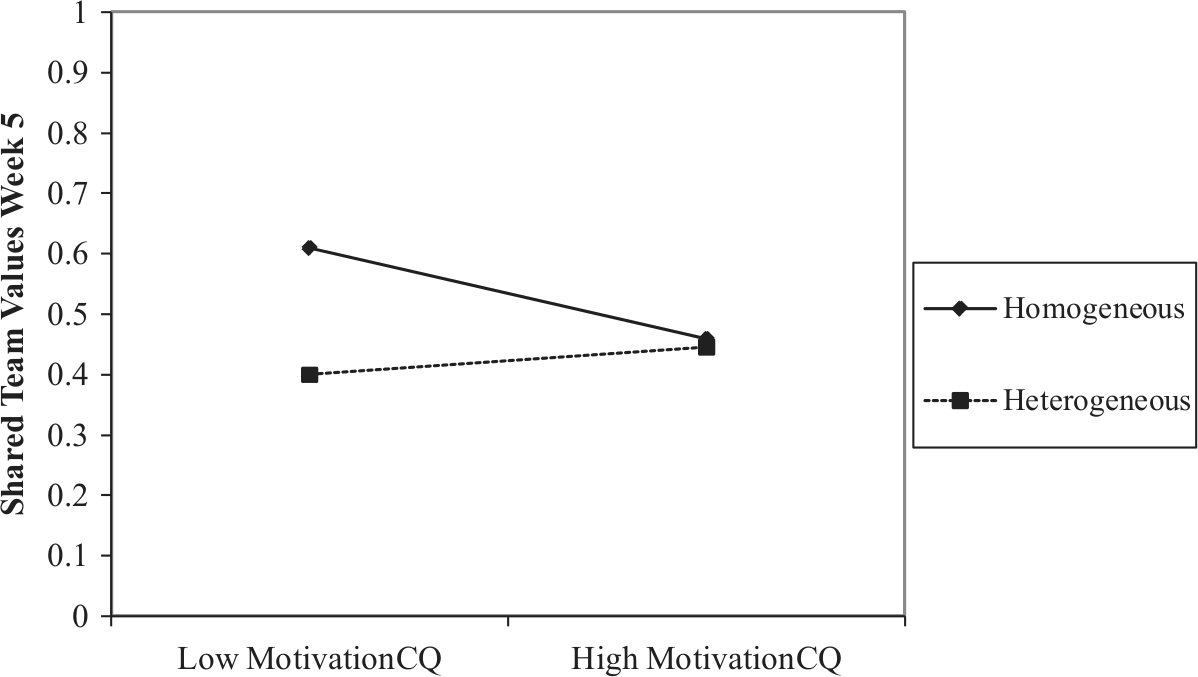
The effect of motivational CQ on shared team values moderated by team type.
H2 predicted that MCTs with high behavioral CQ would be more likely to develop shared values and that culturally homogeneous teams with high behavioral CQ would be less likely to develop shared values. Results showed a significant Behavioral CQ × Team Type interaction, b = .09, t(45) = 2.01, p < .05 (f2 = .64) (Table 2). We graphed the interaction at high and low levels of behavioral CQ (see Figure 2). Consistent with our prediction, a simple slope analysis revealed that culturally heterogeneous teams were more likely to develop shared values when team behavioral CQ was high, t(20) = 2.31, p < .05. However, contrary to our predictions, shared values of culturally homogeneous teams were not influenced by behavioral CQ, t(23) = −.39, ns. Thus, H2 was partially supported.
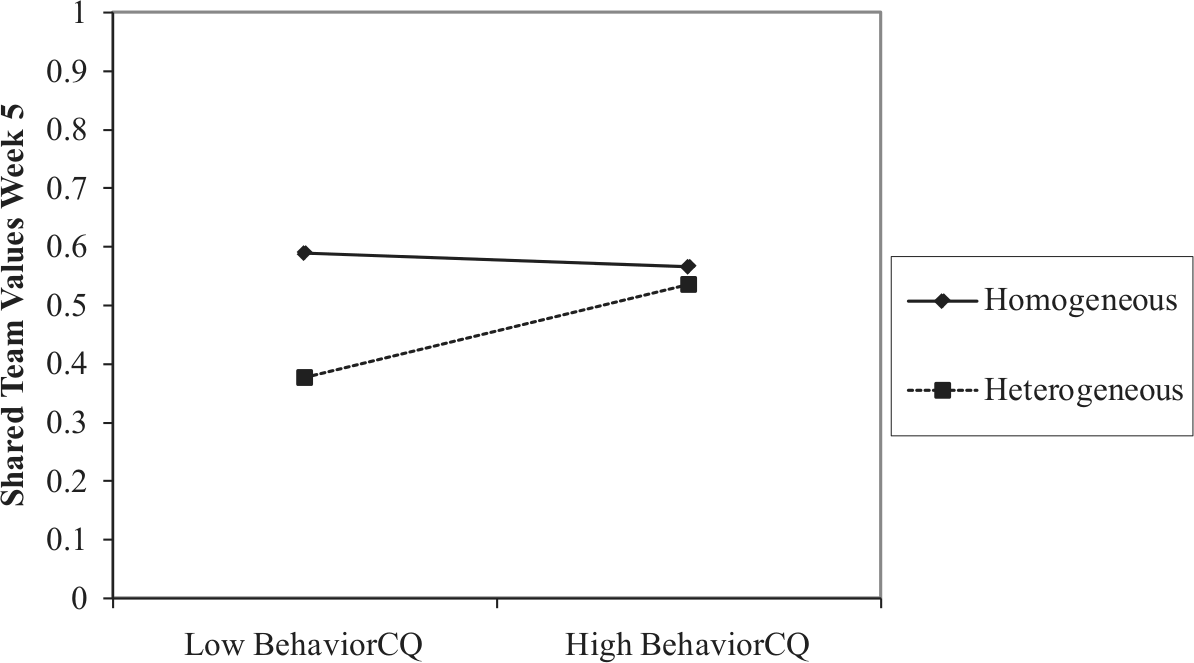
The effect of behavioral CQ on shared team values moderated by team type.
H3 predicted that MCTs with high metacognitive CQ would be more likely to develop shared values and that culturally homogeneous teams with high metacognitive CQ would be less likely to develop shared values. As indicated in Table 2, results showed a significant Metacognitive CQ × Team Type interaction, b = .11, t(45) = 2.17, p < .05 (f2 = .61). To interpret the interaction, we graphed the effect at high and low levels of metacognitive CQ. Figure 3 indicates that the pattern of interactions was as predicted for culturally homogeneous and heterogeneous groups. However, simple slope analyses were only marginally significant. In particular, a simple slope analysis revealed a marginally significant effect for culturally homogeneous groups, such that they were less likely to develop shared values when team metacognitive CQ was high, t(23) = −1.75, p = .08. A simple slope analysis also revealed a marginally significant effect for culturally heterogeneous groups, such that they were more likely to develop shared values when team metacognitive CQ was high, t(20) = 1.37, p = .08. Thus, H3 was partially supported.
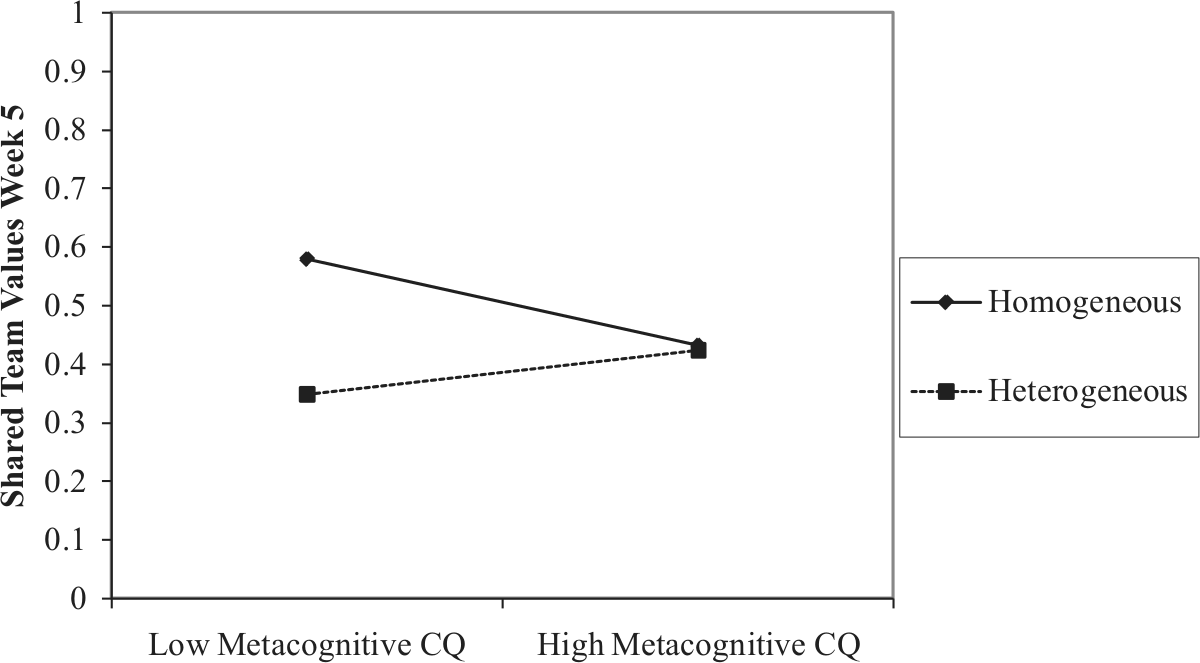
The effect of metacognitive CQ on shared team values moderated by team type.
We also examined in an exploratory fashion the moderating effect of team type on the relation between cognitive CQ and team shared values. As shown in Table 2, we found a nonsignificant Cognitive CQ × Team Type interaction, b = −.08, t(45) = −0.83, ns (f2 = .57).
Other Main Effects and Control Variables
In all analyses, there was a significant positive effect of our control variable, team shared culture at inception (see Table 2). This means that for all teams, greater shared values at team inception led to greater shared values at an early team stage.
In all analyses, we also found a significant negative effect of team type, indicating that culturally homogeneous groups had stronger team shared values than culturally heterogeneous groups, for analyses with motivational CQ, b = −.12, t(45) = −2.41, p < .05; behavioral CQ, b = −.13, t(45) = −2.66, p < .05; cognitive CQ, b = −.13, t(45) = −2.40, p < .05; and metacognitive CQ, b = −.13, t(45) = −2.59, p < .05. These main effects of team type, however, were qualified by significant interactions between team type and CQ, as described above.
Effects at Later Stages of Group Development
In addition to testing all our hypotheses at teams’ early stages, we also tested our hypotheses at two relatively later stages of group development for exploratory purposes. 5 As expected, there were no significant effects for any of our predictors on team shared values at later time periods. Together, these results offer support for our proposition that team CQ affects the emergence of shared values at early stages of team development.
Discussion
In this study, we hypothesized that the effect of a team’s average CQ on the development of shared team values in early stages of group development would be moderated by team type. We predicted that although CQ may have beneficial effects in MCTs, it may have detrimental effects in culturally homogeneous groups. In support of our hypotheses, we found that behavioral CQ and metacognitive CQ were helpful for the development of shared team values in culturally heterogeneous teams. In contrast, motivational CQ and metacognitive CQ hindered the development of shared team values in culturally homogeneous teams. It further should be noted that our moderating results had large effect sizes ranging from f2 = .57 to f2 = .64 (f2 = .35 and above is considered large; Aiken & West, 1991), attesting to the importance and influence of CQ on forming shared culture in MCTs and suggesting that CQ may be one of the key variables influencing shared team values. Below we discuss why these findings improve our understanding of how team member attributes alter the emergence of shared values in teams as well as contributions to theory on CQ, value change, and team cognition. In addition, we offer practical applications with respect to the training and management of culturally homogeneous and heterogeneous teams.
The Benefits of CQ for MCTs
Our results at the team level of analysis generally support prior work on leader CQ, suggesting that high CQ facilitates the understanding of diverse cultural backgrounds and values, and the development of a deep shared understanding (Groves & Feyerherm, 2011). We found that MCTs with a greater average behavioral CQ at inception were more likely to develop shared team values than MCTs with lower average behavioral CQ. This finding complements previous research that found behavioral CQ linked with cultural adaptation in samples of expatriates (Ang et al., 2007). Although behavioral CQ primarily involves listening and indirect communication, it seems to assist team members with cognitive as well as behavioral adjustment. The items used to measure behavioral CQ are similar to high context communication, which involves the ability to sense and intuit feelings and indirect information from those around you (Hall, 1976). Our results suggest that skills in sensing and communicating are some of the most important forms of CQ for MCTs to develop shared values.
We also found that metacognitive CQ had a positive effect on shared values in MCTs. As explained above, metacognitive CQ relates to a meta-awareness of thinking in the self and others in a multicultural setting. When MCT members had a greater awareness of how people think in multicultural settings, they were more likely to adjust their values to develop shared team values when working in their team.
Interestingly, MCTs, but not culturally homogeneous teams, developed more shared team values when the CQ items favoring behavioral flexibility were more strongly endorsed. In culturally homogeneous Canadian teams, strong individual values for self-interest and assertiveness may have impeded the effects of CQ on shared team values. In MCTs, perhaps, the presence of one or more team members with more traditional Eastern values (e.g., conformity, adaptation, interdependence) may have helped legitimize the openness that helped members establish flexibility and shared cognition. Most prior research on multicultural and diverse teams has focused on homogeneous, moderately heterogeneous (e.g., faultline groups), and fully heterogeneous groups (e.g., Earley & Mosakowski, 2000; Lau & Murnighan, 2005). Researchers are yet to examine the degree to which the cultural values of one team member can influence the group. However, research on minority influence in groups suggests that the presence of a few (or even one) vocal minority members is sufficient to spark divergent thinking (Nemeth, Wachter, & Endicott, 2006). Moreover, research in the field of negotiation and social dilemmas suggests that just one consistently cooperative member of a negotiating team or a group competing over scarce resources can influence the rest of the team to endorse a cooperative stance (e.g., Weber & Murnighan, 2008). Thus, the question of one team member influencing a culturally heterogeneous group is an excellent one for future research.
Together, these findings show that two CQ facets are particularly beneficial for the emergence of shared values in MCTs: behavioral and metacognitive CQ. Note that although behavioral CQ is an external facet and metacognitive CQ is an internal facet, both capture an openness and willingness to listen and understand how others think and communicate. MCT shared values are, therefore, a function of openness and listening skills, not simply knowledge or motivation, the other two CQ facets that had no effect in MCTs.
The Risks of CQ for Culturally Homogeneous Teams in a Multicultural Workplace
Although we did not find the predicted positive effect of motivational CQ on MCTs, results did support the predicted negative effect in culturally homogeneous teams. We also found the predicted negative effect of metacognitive CQ in culturally homogeneous teams was marginally significant. We predicted that all CQ facets would impede the emergence of shared values in culturally homogeneous teams because the presence of culturally flexible and open-minded members could (a) lead homogeneous groups to feel threatened and conflicted in the presence of MCTs and (b) generate divergent thinking. However, we did not find the predicted negative effects of behavioral CQ and cognitive CQ in culturally homogeneous teams. Our results suggest that attitudes and behaviors that go along with metacognitive and motivational CQ in particular may trigger cultural identity threat and/or divergent thinking in culturally homogeneous teams. In the present data set, we were not able to test these mechanisms, but future research should aim to model and measure such processes.
While we found evidence of the expected negative effect of metacognitive CQ in culturally homogeneous teams, the effects for metacognitive CQ were only marginally significant. Whereas the motivational CQ facet is a very tight measure of motivation to adapt and perform well in cross-cultural settings, the metacognitive CQ facet may be a form of cognition that is more adaptive in all interpersonal settings. In other words, if someone has a high level of metacognitive CQ, he or she may be able to observe, adapt, and play according to the rules of any group, even a rather homogeneous, inflexible group. Future research is necessary to understand the psychological processes through which all four CQ facets impact individuals in culturally homogeneous and heterogeneous settings.
Theoretical Contributions
There are several important theoretical contributions of this study. Our study tests CQ as a form of cultural competence that impacts group-level processes, namely, the emergence of shared cognition in teams. We extend previous research on CQ by testing (a) its effects in a team setting and (b) its effects on shared cognition. Whereas past theorizing and research on CQ has always featured the beneficial effects of CQ, our research offers a potential dark side of CQ in culturally homogeneous settings. Given that CQ is an individual difference, people bring it into cross-cultural and monocultural interactions. Thus, our research and theorizing departs from past research on CQ by suggesting that CQ may be relevant in monocultural teams, and in these instances, it may be detrimental for interaction outcomes. Our study also contributes to literature on team mental models by examining a unique type of team mental model—shared team values. In contrast to previous research on transactive memory, which focuses on roles and responsibilities, and team mental models, shared team values capture the team’s motivational values (Adair, Tinsley, & Taylor, 2006).
Another contribution of this study is that we measured the development of shared team values from group inception through early and later stages of interaction. Our research design allowed us to identify the stages of group development when shared values are shaped by team CQ. As predicted, we found that team characteristics have an impact primarily at the early stages of group development. This finding is especially important from a practical standpoint as it identifies a critical period for interventions designed to help MCTs develop shared values. The findings also provide evidence of a temporary value shift for values-in-use during teamwork, confirming that individual values are somewhat malleable based on context or situation (Bardi & Goodwin, 2011; Brannen & Salk, 2000; Hong et al., 2000, 2007).
Our research also provides an empirical example of what theorists term the “integration and/or identity model” of MCTs (Janssens & Brett, 2006). According to such identity models, MCT members develop a shared identity (that can be defined by shared values) that is salient and activated whenever they are working in their team (Adair et al., 2006; Earley & Mosakowski, 2000; Maznevski & DiStefano, 2000). If the team identity reflects the dominant or host national culture, then such a model is an assimilationist one (Janssens & Brett, 2006), but when the team identity reflects a merging of the various national cultures present or something entirely new, it is called a third culture (Adair et al., 2006; Casmir, 1992; Hambrick, Davison, Snell, & Snow, 1998). Although we did not measure shared team value content per se (i.e., did the team value tradition more than it valued achievement), selective retention suggests that teams will retain values that best help them to achieve their goals or solve social coordination problems (Chiu & Hong, 2006). Thus, future research should examine the content of shared team values as predictors of goal attainment.
Limitations
As with all research studies, our design involved making trade-offs, and there are several limitations to be acknowledged. The first limitation pertains to the generalizability of findings due to the nature of our student sample. It is possible that results will not generalize to work teams in organizations because of the relative youth and inexperience of a student sample. However, groups examined in this study were not artificial groups created for the purpose of an experiment; they were real student project groups that worked together for 3 months. This type of team does in fact resemble many temporary, project-oriented groups in organizations (S. G. Cohen & Bailey, 1997). Thus, the results of this study should generalize to a degree to project groups in organizations. However, future research is needed to examine development of shared team values in work teams in the field.
Second, the existence of our teams was very short and their interaction was limited (twice a week), and thus, we expected and found that the interactive effects between CQ and group cultural composition on shared team values took place very quickly into the team’s existence. This quick value convergence at the beginning of a team’s existence is in line with the research on timing in negotiations. In particular, this past research found that negotiators who expect to negotiate only for one round (limited time) as opposed more rounds (longer period of time) make judgments more quickly about the other party, and the norms for the negotiation are set much faster (Pruitt, 1981; Sinaceur & Neale, 2005). Thus, it was reasonable to expect that our teams’ values would converge quickly. However, future research should examine how quickly shared values emerge in teams that are in existence for a longer period of time. We expect that team members may take more time to set norms and converge on values if they know that they have more time to do so. At the same time, it is possible that other factors would also influence value convergence as team members have time to observe team interactions and take into account multiple factors.
A third limitation is that team shared values was our dependent measure because we were primarily interested in the effects of CQ on shared cognition as a potential measure of shared culture. Due to our research question and also ethical limitations on collecting grade or performance data from a student sample, we did not have team performance measures. Nevertheless, we hope that future field research will examine the effects of team CQ and team shared values on team outcomes such as performance and longevity.
Practical Implications
Our research has several implications for incorporating the concepts of CQ in cross-cultural training for people who will be working in MCTs. Skills in communicative flexibility can be taught to improve behavioral CQ and help the development of shared team values. Skills in perspective taking and cultural variation in cognitive styles can be taught to improve metacognitive CQ. In addition, this study identifies when such a cross-cultural training intervention may be the most effective: An intervention implemented during the early stages of group development may be the most successful. The importance and need for cross-cultural training that improves CQ is further attested by the large effect sizes of our findings (J. Cohen, 1992). In other words, our findings do not only present scientific significance but also show practical significance and implications.
Our findings also caution against the risks of putting individuals with high CQ in a culturally homogeneous team that is working alongside MCTs. In such cases, employees should be made aware of ethnocentrism and cultural identity threat, and they should develop skills to identify and manage when conflict and discord threaten their team values.
Conclusion
In recent years, CQ has emerged as an important predictor of success in cross-cultural interactions such as expatriate adjustment and effectiveness in host countries. We show that CQ is also an important predictor of the development of shared team values in culturally heterogeneous teams, giving further evidence for the importance of this construct in today’s globalized business world. However, we also show that high levels of CQ in culturally homogeneous teams may be detrimental for the development of shared team values. In essence, this is the first study that hypothesized and uncovered detrimental effects of CQ in teams, and as such, this study offers a balanced view on the power of CQ in our multicultural world.
Footnotes
Acknowledgements
We are grateful for the work of Marianna Soraggi and Zhenhua Wang on earlier versions of this article.
Declaration of Conflicting Interests
The author(s) declared no potential conflicts of interest with respect to the research, authorship, and/or publication of this article
Funding
The author(s) disclosed receipt of the following financial support for the research, authorship, and/or publication of this article: This research was funded by the Social Sciences and Humanities Research Council of Canada (SSHRC) under Grant 410-2007-453. This research was also supported by a doctoral fellowship from the Social Sciences and Humanities Research Council of Canada to Ivona Hideg.