



Abstract
The current study investigated the impact of intercultural contact between domestic and international students on attitudes toward international students, and potential mediators of this relationship. A total of 247 Australian-born domestic undergraduates completed a survey of the quantity and quality of their contact with international students, levels of intergroup anxiety (IA) and intercultural communication emotions (ICE), and their attitudes toward international students. Positive quality of intercultural contact, less IA, and more positive ICE were all related to more positive attitudes toward international students. In addition, ICE mediated the relationship between positive quality of contact and attitudes, and between IA and attitudes. Quality of contact exerted both direct and indirect effects (via IA and intercultural communications emotions) on intergroup attitudes. Results highlight the importance of addressing communication barriers and the emotions associated with these when promoting positive interactions between domestic and international students. Suggestions are made for a theoretical integration of intergroup and communication-based perspectives when considering attitudes toward linguistically diverse outgroups like international students.
There has been a significant increase in the number of international students on university campuses worldwide, with the numbers of foreign tertiary education students enrolled outside their country of origin increasing 7.1% per year from 2000 to 2010, resulting in around 4.1 million such students in 2010 (OECD, 2012). The largest numbers of students studying abroad were from Asian countries, with 17.0% coming from China, 5.9% from India, and 3.7% from the Republic of Korea. The top three destinations were all English-speaking countries, with the United States receiving the most tertiary international students (16.6%), followed by the United Kingdom (13.0%), and Australia (6.6%). Among these three destination countries, Australia had the largest percentage (at over 21%) of international students as a proportion of its total onshore tertiary education enrolments (OECD, 2012).
Cultural and linguistic diversity in the social interactions between domestic and international students has thus become a prominent feature in the major receiving countries of international students. In 2010, students from Asia accounted for close to 80% of all the onshore tertiary international students in Australia (OECD, 2012). The majority of the international students on Australian university campuses are from non-English-speaking backgrounds (Department of Education, Employment and Workplace Relations, 2011). China alone provided 40.8% of the 230,923 onshore international student enrolments in Australian higher education in 2012 (Australian Education International, 2012).
Despite the increase in numbers of international students on Australian university campuses, research has documented generally low levels of interactions or contact between Australian domestic and (primarily Asian-born) international students (Battye & Mak, 2008; Mak, 2009; Mak & Neil, 2006; Summers & Volet, 2008; Volet & Ang, 2012). This reflects worldwide trends with recent research conducted in English-speaking countries indicating friendships between domestic students and culturally and linguistically different international students are relatively rare; this is a recurrent finding in studies conducted in the United States (Williams & Johnson, 2011), in England (Harrison & Peacock, 2010), and in New Zealand (Ward, Masgoret, Newton, & Crabbe, 2005).
When positive contact does occur between domestic and international students, it has been shown to have beneficial effects for the psychological and educational outcomes of international students from culturally diverse backgrounds (Kashima & Loh, 2006; Ward & Masgoret, 2004). It is important to also consider the effects of such contact on domestic students, and how it may impact on their feelings about, and attitudes toward, international students. However, this line of research has received little attention worldwide (Ward et al., 2005). The increased presence of international students on campus can be threatening to domestic students. Low levels of intercultural contact have been linked to increased levels of perceived threats (Dalglish & Chan, 2005; Stephan, Diaz-Loving, & Duran, 2000), and feelings of anxiety and apprehension (Ward et al., 2005). An additional threat faced in the context of relationships between domestic and international students from linguistically different backgrounds is connected to communication (Spencer-Rodgers & McGovern, 2002). Many domestic students are likely to find these interactions challenging and anxiety provoking. Spencer-Rodgers and McGovern (2002) refer to this threat as intercultural communication emotions (ICE), which are the negative affect associated with perceived linguistic and cultural barriers.
Much research has been devoted to the relationship between contact and prejudice (Pettigrew & Tropp, 2006). Our study examines that relationship in the context of contact between international and domestic university students. Specifically, we examined the relationship between intercultural contact on an Australian university campus and domestic students’ attitudes toward international students. We considered both the quantity and quality of intercultural contact as predictors of attitudes, and the importance of affective threats, such as intergroup anxiety (IA), as mediators of the contact–attitude relationship (see Pettigrew & Tropp, 2008). Given that the majority of international students to Australia come from culturally and linguistically different backgrounds, we also examined intercultural communications emotions as an additional mediator of this relationship. Previous research (Spencer-Rodgers & McGovern, 2002) has identified intercultural communications emotions to constitute a particularly important predictor of prejudice of domestic students toward foreign students.
Intercultural Contact and Prejudice: IA as a Mediator
Allport’s (1954) contact hypothesis proposes that contact with individuals from an outgroup should reduce prejudice and improve attitudes toward that group. It is not just the amount of contact that is important (quantity of contact); contact is likely to be more effective if the nature of that contact is positive (quality of contact; Pettigrew & Tropp, 2006). The positive effects of contact have been found to be robust, with prejudice reduction occurring even without the presence of Allport’s optimal conditions, although effects are stronger when these conditions are present (Pettigrew & Tropp, 2006). Studies including measures of both quantity and quality of contact (e.g., Aberson & Haag, 2007; Islam & Hewstone, 1993) have tended to find stronger effects for quality versus quantity of contact.
Recently research has moved in the direction of examining how intergroup contact reduces prejudicial intergroup attitudes. Perceived threats from the outgroup have been found to mediate the relationship between contact and prejudice (Stephan & Stephan, 1985). Based on Integrated Threat Theory (ITT), Stephan and Stephan (1985) identified four threats that influence negative intergroup attitudes. These include realistic threats (threats to the welfare and prosperity of the ingroup), symbolic threats (threats to the norms and values of the ingroup), negative stereotypes (negative expectations about the outgroup) and IA. IA refers to negative emotions experienced when anticipating interactions with outgroup members and can include feelings of uncertainty, awkwardness, embarrassment, and rejection by the outgroup (Corenblum & Stephan, 2001; Curşeu, Stoop, & Schalk, 2007; Riek, Mania, & Gaertner, 2006). Of the threats outlined above, it has been shown to be one of the stronger predictors of negative intergroup attitudes (Riek et al., 2006).
For majority groups, like domestic students, IA about interacting with international students may include feelings of uncertainty about how to interact, doubts about cross-cultural competency and anxiety about acting in a discriminatory or offensive manner. ITT suggests that negative contact between groups is an antecedent of IA and that the outcome of high IA is negative evaluation of the outgroup and prejudice (Stephan, Stephan, & Gudykunst, 1999). There is substantial evidence for IA as a mediator of the contact–prejudice relationship (Aberson & Haag, 2007; Corenblum & Stephan, 2001; Stephan et al., 2000; Tausch, Hewstone, & Roy, 2009; Voci & Hewstone, 2003; Ward & Masgoret, 2006) and some studies have shown the effect to be stronger for majority groups (Binder et al., 2009). Pettigrew and Tropp’s (2008) meta-analysis examined three proposed mediators of the contact-prejudice relationship: knowledge, IA and empathy/perspective taking. They found IA to be the strongest mediator, highlighting the importance of affective mediators in the contact-prejudice relationship.
ICE
The majority of research on intercultural or interethnic contact has looked at groups who, while they may be racially or culturally different, share a common language (e.g., Black and White Americans, Aberson & Haag, 2007; Hindus and Muslims in Bangladesh, Islam & Hewstone, 1993). A unique and often overlooked aspect of intercultural contact is that it frequently involves interactions between groups who do not share the same primary language. This is often the case for domestic and international students, especially those on English-speaking campuses. Williams and Johnson (2011) found that U.S. domestic students who had fewer friendships (or less contact) with international students had higher levels of intercultural communication apprehension. Spencer-Rodgers and McGovern (2002) have suggested that in order to achieve successful relations across cultural groups, individuals must overcome challenges of language barriers, cultural variations, and unfamiliar cultural practices and customs. Cultural and linguistic barriers frequently carry judgmental and affective consequences for individuals in cross-cultural situations and are often correlated with undesirable emotional responses.
ICE are the negative affect associated with perceived linguistic and cultural barriers (Spencer-Rodgers & McGovern, 2002). ICE can produce feelings of uncertainty and frustration when interacting with the culturally different due to communication obstacles (Chen, 2002; Wiseman, Hammer, & Nishida, 1989). Furthermore, negative emotions associated with cultural differences such as norms, values, and customs may contribute to cultural misunderstandings and occasions of communication disruption that are viewed as unpleasant and stressful, in turn producing negative emotions toward the culturally different (Spencer-Rodgers & McGovern, 2002).
In the context of ITT, Spencer-Rodgers and McGovern (2002) propose that ICE represent an additional and unique form of threat and are related to attitudes toward those from linguistically different outgroups. They argue that this type of threat may be especially important in the context of interactions with international students, particularly those who are from linguistically different backgrounds. Recent reviews highlight the stigma of nonnative accents in communication speakers’ accents (Gluszek & Dovidio, 2010) and their powerful effects on interpersonal evaluations (Fuertes, Gottdiener, Martin, Gilbert, & Giles, 2012). Thus, ICE may represent an additional type of intergroup threat that is particularly relevant in contexts where outgroups speak another language.
In a sample of 154 domestic students who identified as U.S. nationals, Spencer-Rodgers and McGovern (2002) found that American college students felt impatient, uncomfortable and frustrated when interacting with foreign students. Their participants were from various ethnic backgrounds, with 54% identifying as European American and 22% as Asian American. Their study also measured threats derived from ITT (realistic threat, symbolic threat, stereotypes and IA) in addition to ICE, and found that ICE were the strongest unique predictor of attitudes toward international students and had a stronger relationship than general affect (IA).
Battye and Mak (2008) obtained similar results with Australian domestic students, with students experiencing negative ICE reporting less favorable attitudes toward international students. They also found evidence that ICE mediated the relationship between both the quality and quantity of intercultural contact and attitudes, with more positive contact related to more positive ICE. More recently, Imamura, Zhang, and Shim (2012), investigated the effects of communication frequency and quality on Americans’ attitudes toward Japanese (as a cultural group, not necessarily as international students). Their measure of communication quality was adapted from Spencer-Rodgers and McGovern’s (2002) measure of ICE and was conceptually similar. They found that communication quality was positively and directly associated with attitudes, as well as having indirect effects via relationship solidarity (connectedness between individuals depending on relational satisfaction and closeness, liking, commonality, and trust: Imamura et al., 2012).
Contact, IA, and Communication Barriers
Like ITT, Anxiety/Uncertainty Management (AUM) theory (Gudykunst, 2005) also argues that intercultural encounters can produce both uncertainty and anxiety. AUM theory states that these need to be managed to allow for successful intercultural communication. The theory proposes a number of potential antecedents to anxiety and uncertainty, including the quality and quantity of contact with outgroup members (Stephan et al., 1999). The outcome of anxiety/uncertainty in this model is communication effectiveness. Studies have found a relationship between anxiety or uncertainty, and communication effectiveness (Duronto, Nishida, & Nakayama, 2005; Gudykunst, Nishida, & Chua, 1986). AUM assumes that the effect of antecedent variables (like contact) on communication effectiveness is mediated via anxiety and uncertainty (Stephan et al., 1999).
Similarly, in ITT, anxiety is argued to play a key role in intergroup relations and prior contact is considered one of the antecedents of anxiety (Stephan & Stephan, 1985). In ITT, anxiety (termed intergroup anxiety) is measured in a way that also incorporates uncertainty (Stephan et al., 1999). However, unlike AUM, in ITT the outcome of anxiety is argued to be prejudice rather than communication effectiveness. As stated above, IA has been found to be a consistent mediator of the contact–prejudice relationship.
The Present Study
More research is needed to clarify the possible mediating role of IA in determining attitudes toward people from linguistically different groups such as international students. To date, few studies have investigated the role of IA as a mediator of the contact–prejudice relationship with respect to international students (see Ward et al., 2005). In addition, research is needed to consider additional affective threats, such as ICE, as mediators of the relationship between intercultural contact and attitudes toward outgroups who are both culturally and linguistically different from the ingroup. We believe that threats and negative emotions associated with communication with others (like international students) who do not share the same culture and primary language has been a neglected area in intergroup contact research to date.
In the current study, we tested a model which proposed quality and quantity of prior intercultural contact with international students as predictor variables, perceived affective threats in the form of IA and ICE as mediating variables, and attitudes toward international students as the outcome variable. Previous research has shown consistent support for IA as a mediator of the contact–prejudice relationship, although rarely in the context of domestic students’ attitudes toward international students. In addition to addressing this gap, our study expanded upon previous research by also considering the mediating role of ICE. There is limited evidence in this area to date, but some studies have found ICE to be a predictor of negative attitudes toward international students (Battye & Mak, 2008; Spencer-Rodgers & McGovern, 2002) and have found a positive relationship between prior intercultural contact with international students and decreased intercultural communication apprehension (Williams & Johnson, 2011). Other research has found that communication quality (a similar concept to ICE) is related to positive attitudes toward a linguistically different outgroup (Imamura et al., 2012). Battye and Mak (2008) demonstrated that ICE mediates the relationship between intercultural contact and negative attitudes toward international students; however, their study did not include quantity and quality of contact within same model and did not consider ICE in a multiple mediation model with IA.
In line with previous research, we expected prior intercultural contact (both quantity and quality of contact) to be related to more positive attitudes toward international students. Consistent with ITT and with previous research, we expected that affective threats (IA and ICE) would mediate the relationship between prior intercultural contact and attitudes. We also examined whether the effect of IA on attitudes is indirect, via its effect on ICE. This prediction is in line with AUM theory, which argues that anxiety mediates the relationship between contact and communication effectiveness. The model we tested is represented in Figure 1.

Hypothesized mediation pathways between intercultural contact and intergroup attitudes via the possible mediating roles of intergroup anxiety and intercultural communication emotions.
Method
Participants and Procedure
A total of 247 Australian-born domestic undergraduate students (65% being female) enrolled at a mid-sized university in Canberra, Australia, participated in the study. In 2011, approximately one in five of the onshore students at this university was an international student; this proportion was comparable with the Australia-wide proportion of just over 21% (OECD, 2012).
Participants’ ages ranged from 17 to 61 years (M = 21.13, SD = 6.01), which reflect the wide age range of students on this campus. The majority of participants (95.5%) spoke English at home. Likewise, the majority of participants (82.6%) stated that their ethnic background was either Anglo-Australian or other European. Participants were recruited from undergraduate classes or via their course websites, and invited to complete a questionnaire at the end of their class or in group sessions. Participants either received course credit for their participation or were offered the opportunity to enter the draw for a music voucher.
Measures
For all measures, responses were averaged across items to form composite scores. Cronbach’s alphas of the resultant scales ranged between .77 and .90 (see Table 1), indicating satisfactory internal consistency.
Descriptive Statistics and Correlations among Predictor Variables, Potential Mediators and Intergroup Attitudes.

Note. Quantity = intercultural contact quantity; Quality = intercultural contact quality; IA = intergroup anxiety; ICE = intercultural communication emotions. Scores on Quantity can range from 1 to 4, scores on Quality can range from 1 to 6, all other scores can range from 1 to 5.
p < .01. **p < .001.
Predictor variables
Intercultural contact quantity was measured by eight items adapted from Ward et al. (2005). Participants indicated how often they took part in a variety of activities in both social and academic contexts with international students (e.g., “interacting during free time outside of class,” “doing group assignments”). Responses were made on a 4-point scale from 1 (never), through 2 (rarely), and 3 (sometimes) to 4 (often). Intercultural contact quality was assessed using six items adapted from Islam and Hewstone (1993). Participants were asked to indicate the nature of their interactions with international students in terms of pairs of bipolar adjectives (e.g., pleasant/unpleasant, cooperative/competitive) on 6-point scales. For both these measures, a higher composite score indicated more or better quality contact, respectively.
Mediator variables
IA was assessed by eight items adapted from Stephan and Stephan (1985). Participants indicated how they would feel when interacting with international students (i.e., confident, awkward, patient, uncertain, anxious, irritated, tense, uneasy) on 5-point scales, from 1 (not at all) to 5 (extremely). Higher composite scores indicated greater IA.
Seven items taken from Spencer-Rodgers and McGovern (2002) assessed the affective components of intercultural communication barriers or ICE. This measure assessed affect associated with communicating with international students, both with respect to language (e.g., “I find it unpleasant to listen to international students who speak with a strong accent”) and other cultural barriers to communication (e.g., “I am comfortable interacting with international students who have different ethnic customs and practices”). Respondents indicated their agreement with each statement on a scale from 1 (strongly disagree) to 5 (strongly agree). After recoding positively worded items, higher scores on this variable represented more negative ICE. Spencer-Rodgers and McGovern (2002) found that all seven items in the scale represented a single factor and in their study the scale demonstrated acceptable internal consistency (Cronbach’s alpha = .76).
Outcome variable
Attitudes to international students were assessed via agreement with 12 statements, adapted from Ward et al. (2005; for example, “I like having international students in my class,” “There should be fewer international students in the country”). Responses were on a 5-point scale (1 = strongly disagree to 5 = strongly agree). After recoding negatively worded items, higher scores on this measure represented more positive attitudes toward international students.
Results
Table 1 presents means, standard deviations, and reliability coefficients for all variables and their intercorrelations. In general, attitudes toward international students in this sample were relatively positive, with a mean score above the midpoint of the scale. Typically, there was a relatively low mean amount of quantity of contact with international students (below midpoint of scale, and slightly above “rarely”) with the quality of contact perceived as positive (above the midpoint of the scale). IA and ICE were also relatively low on average. Scores on all measures were comparable with those obtained by Battye and Mak (2008) with a similar sample of Australian domestic students.
Both types of contact were positively correlated with attitudes, with quality of contact showing a stronger relationship. Both affective threats (IA and ICE) were negatively correlated with both contact and attitudes. Although the correlation between IA and intercultural communications emotions (ICE) represented a large effect size, analyses showed no evidence of multicollinearity.
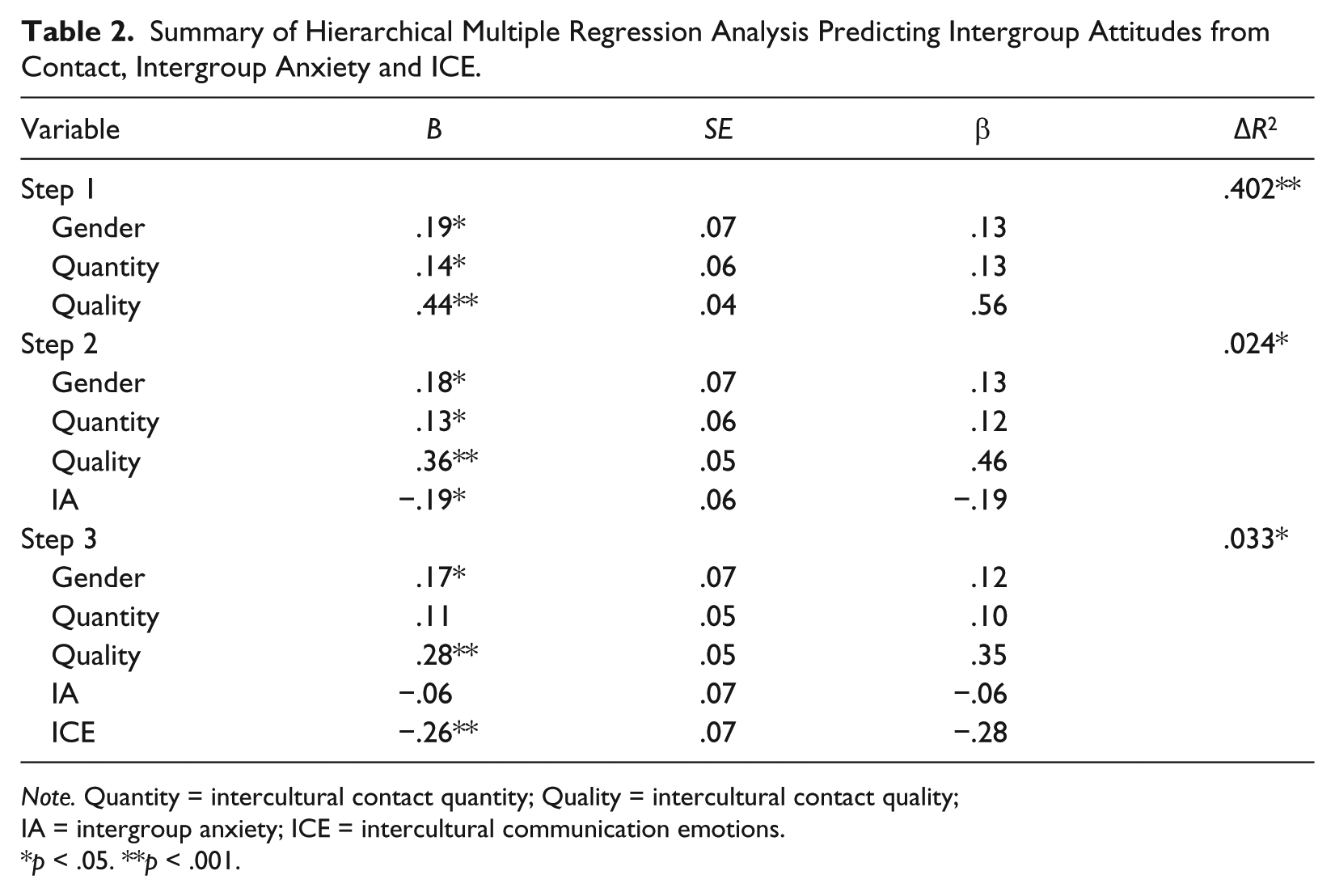
We conducted a hierarchical multiple regression analysis to assess the relative contributions of contact, IA, and ICE to the prediction of intergroup attitudes. In line with the model presented in Figure 1, quantity and quality of contact were entered at Step 1, while controlling for gender. IA was entered at Step 2 and ICE at Step 3. Table 2 presents a summary of the regression analysis. ICE contributed 3.3% of unique variance in attitudes beyond that already explained by quality and quantity of contact and IA. This suggests that ICE is an important predictor of attitudes, having a significant effect even after other key variables have been taken into account. In the final model, intercultural contact quality was the strongest predictor uniquely explaining 6.9% of the variance in attitudes, followed by ICE and gender. Contact quantity was not a significant predictor of attitudes in the final model. Likewise, IA, although significant at Step 2, was not a significant predictor in the final model, which suggests its effect on attitudes may be mediated by ICE. The final model explained 45.9% of the variance in attitudes, adjusted R2 = .447, F(5, 234) = 39.65, p < .001.
Summary of Hierarchical Multiple Regression Analysis Predicting Intergroup Attitudes from Contact, Intergroup Anxiety and ICE.
Note. Quantity = intercultural contact quantity; Quality = intercultural contact quality;
IA = intergroup anxiety; ICE = intercultural communication emotions.
p < .05. **p < .001.
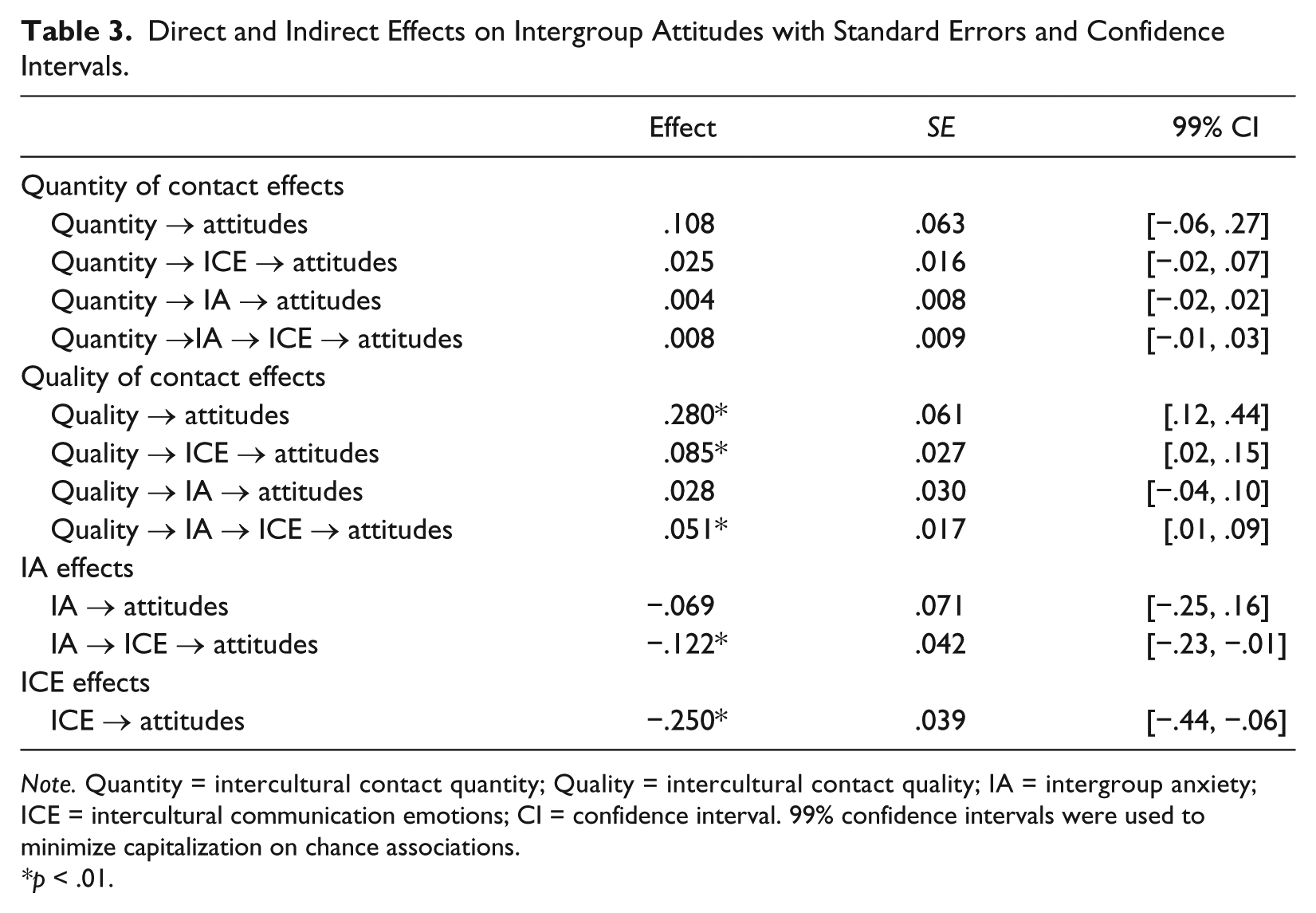
To further test the hypothesized relationships presented in Figure 1, we conducted a path analysis using Mplus version 6 software (Muthén & Muthén, 2010). We used the maximum likelihood estimation method and tested the fully saturated model to provide a more conservative test of proposed indirect pathways. Gender was included as a covariate. Five thousand bootstrap samples and 99% bias-corrected confidence intervals were used to test the significance of the hypothesized indirect paths.
Bootstrap bias-corrected estimates, standard errors and 99% confidence intervals for direct and indirect effects are shown in Table 3 and the model is presented in Figure 2. As can be seen in Table 3 and Figure 2, the indirect effect from intercultural contact quality to attitudes via IA and ICE was significant, as was the indirect effect from intercultural contact quality to attitudes via ICE. This suggests that quality of contact, in addition to having a direct influence on attitudes, also influences attitudes indirectly via its effect on ICE, and via its effect on IA, which in turn influences ICE. Positive quality of contact was related to lower (or more positive) ICE, which in turn were related to more positive attitudes. Positive quality of contact was also related to lower IA which in turn predicted lower (more positive) ICE. Less negative ICE was directly related to more positive attitudes. All indirect effects from intercultural contact quantity to attitudes were nonsignificant.
Direct and Indirect Effects on Intergroup Attitudes with Standard Errors and Confidence Intervals.
Note. Quantity = intercultural contact quantity; Quality = intercultural contact quality; IA = intergroup anxiety; ICE = intercultural communication emotions; CI = confidence interval. 99% confidence intervals were used to minimize capitalization on chance associations.
p < .01.
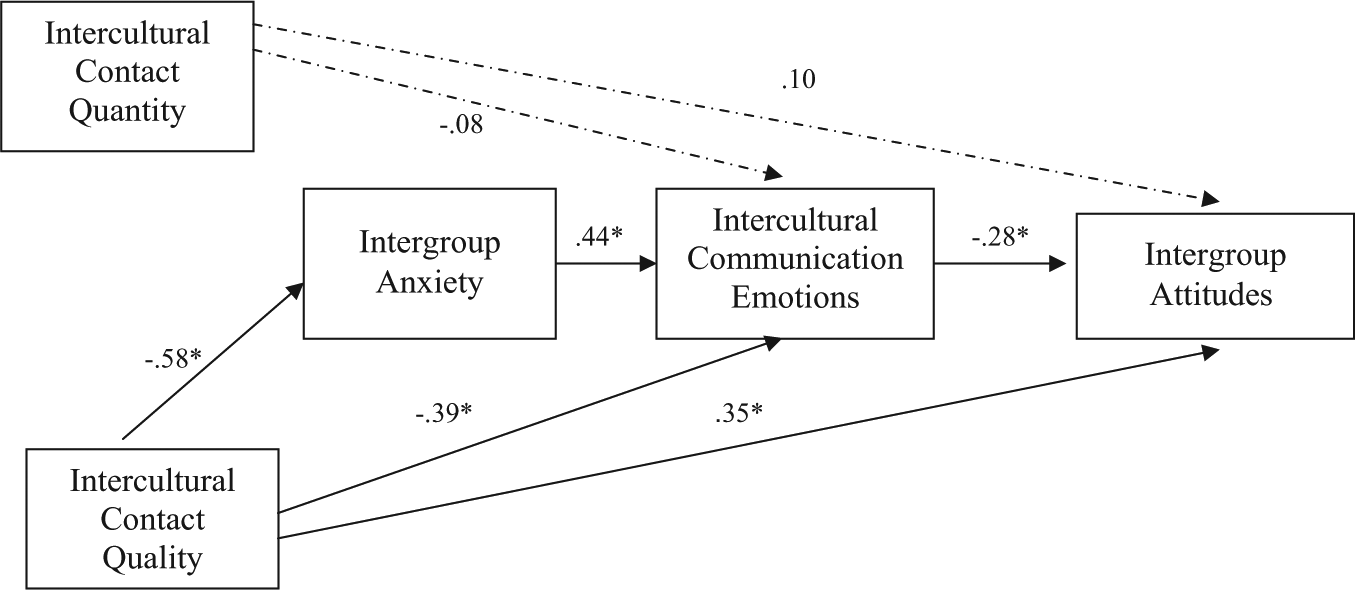
Path model predicting attitudes toward international students.
Discussion
This study examined the effect of prior contact on the attitudes of a sample of Australian domestic students toward international students, and potential mediators of that relationship. The results of this study highlight the importance of considering affective threats associated with communication when considering relations between groups who do not share the same first language. Negative affect and anxiety associated with communication may be particularly relevant in understanding attitudes of domestic students toward international students.
We found that domestic students’ attitudes toward international students in our study were, in general, mildly positive, similar to findings by Battye and Mak (2008), Spencer-Rodgers and McGovern (2002), and Ward et al. (2005). Consistent with Battye and Mak (2008), in the present study, the mean level of contact quantity was somewhat low, while contact quality was somewhat positive. Previous intergroup contact research has similarly found that contact quality tends to be higher than contact quantity (e.g., Aberson & Haag, 2007; Binder et al., 2009; Tausch, Hewstone, & Roy, 2009). We also found that intercultural contact quality was a stronger predictor of attitudes than intercultural contact quantity, suggesting that the nature of intercultural interactions is important. Indeed, in our regression model that included contact quantity and quality, along with the measures of affective threat (IA and ICE), quality of contact was the strongest overall predictor of attitudes. This is consistent with previous research that has shown that contact quality is a stronger predictor of prejudice than the quantity of contact (Aberson & Haag, 2007; Islam & Hewstone, 1993). Our path analysis indicated that contact quality has both a direct effect on attitudes, and indirect effects via ICE, and via both IA and ICE. Direct and indirect effects involving quantity of prior intercultural contact were nonsignificant. Of the proposed mediators, ICE had a direct relationship with attitudes. However, IA exerted its influence on attitudes indirectly via ICE.
Our findings highlight the potential of ICE in explaining attitudes toward international students from culturally and linguistically diverse backgrounds. While previous research has found IA to be a mediator of the contact–prejudice relationship, our study found that when two types of affective threat (IA and ICE) were simultaneously considered, it is the latter that maintained the stronger unique relationship with attitudes. In addition, the effects of IA on attitudes were indirect via their impact on ICE.
Based on these findings, we suggest a model of intergroup attitudes toward international students where positive intercultural contact, as well as having a direct effect on attitudes, may also result in a reduction in IA (consistent with previous research). We further suggest that this reduced anxiety may in turn serve to remove barriers around intercultural communication by reducing negative emotions (ICE) associated with actual and anticipated communication with international students. This is consistent with Gudykunst’s (2005) AUM Theory, which argues that intercultural encounters can produce both uncertainty and anxiety and that these need to be managed to allow for successful intercultural communication. Reducing the negative emotions associated with communication may in turn produce more favorable attitudes toward international students and associated reductions in prejudice and discrimination.
The current study is limited by its cross-sectional nature in making causal inferences like those implied in the above proposed model. Previous research suggests that the contact–prejudice relationship is bidirectional (e.g., Binder et al., 2009). In terms of the above model, it is possible that in addition to producing more positive attitudes, a reduction in ICE is also likely to lead to increased communication and positive contact between host and international students. Future studies could employ longitudinal designs which would clarify the direction of the relationships proposed in our model.
A further limitation of this study is its use of self-report measures, which may be subject to socially desirable responding. Future studies could employ additional measures, such as implicit attitudinal measures, observational measures and qualitative data obtained from interviews or focus groups, which are less subject to these biases. A theory such as communication accommodation theory (Gallois, Ogay, & Giles, 2005), which focuses on the dynamics of communication and which has been widely applied in intercultural contexts, could provide a framework for analyzing data obtained from interviews and direct observations.
This study focused on affective threats as mediators of the contact–prejudice relationship. Other threats (e.g., realistic and symbolic threat as discussed in Stephan et al., 2000) have been found to mediate the effects of contact, and have been found to be predictive of negative attitudes toward refugees in an Australian context (Schweitzer, Perkoulidis, Krome, Ludlow, & Ryan, 2005). These and other potential affective mediators involving positive emotions (e.g., empathy, perspective taking, and relational solidarity: Aberson & Haag, 2007; Imamura, et al., 2012; Pettigrew & Tropp, 2008) and communicative dynamics (e.g., self-disclosure and communication accommodation: Harwood, Hewstone, Paolini, & Voci, 2005) can be explored in future research. Likewise, a number of antecedents to anxiety, in addition to contact, have been proposed by ITT including prior intergroup conflict, relative status of groups, and strength of ingroup identification (Stephan et al., 1999). These are all potentially relevant to relations between international and domestic students and could be included in future investigations.
This study is one of the few to examine the attitudes of domestic students toward international students and to consider the determinants of these attitudes. It is the first study to consider both IA and ICE simultaneously as mediators of the relationship between contact and prejudice with respect to international students. Our findings highlight the usefulness of affective threats, in particular threats associated with communication, in explaining negative attitudes toward outgroups who are linguistically and culturally different, like international students. Consistent with ITT, our findings suggest that different types of threats may become more important in explaining the contact–prejudice link in the context of the relations between the groups being examined (Riek, et al., 2006; Tausch, et al., 2009). When the outgroup is culturally different and speaks another language, threats associated with communication become primary, with the stigma associated with nonnative accents affecting native speakers’ interpersonal evaluations of ethnolinguistic others and the communication process itself (Fuertes et al., 2012; Gluszek & Dovidio, 2010)
These findings have implications for intergroup contact theory (Allport, 1954: Brown & Hewstone, 2005; Pettigrew, 1998). Research suggests that contact is likely to be more effective in contexts where the intergroup context is salient (Hewstone & Brown, 1986). However, this is only the case for positive contact and the opposite effects may hold if contact is perceived as negative or threatening (Paolini, Harwood, & Rubin, 2010). When groups do not share the same primary language, this difference, and the emotion associated with it, may become an important dimension for intergroup comparisons. If cultural and linguistic differences have negative emotions associated with them, this is likely to contribute to negative intergroup contact and negative perceptions of the outgroup. It is important to note that intercultural communication takes place in an intergroup context (Gallois et al., 2005) and that when contact occurs between linguistically diverse groups, communication, and the affect associated with communication, becomes a crucial part of the contact event. To date, contact theory has not focused sufficiently on the role of language and communication in the dynamics of contact and this area holds much promise for further developing contact theory (Harwood, 2012).
A recent meta-analysis (Davies, Tropp, Aron, Pettigrew, & Wright, 2011) found that friendships between ingroup and outgroup members represent a particularly powerful form of high quality contact. Given the generally low levels of friendships between domestic and international students, it is important for higher education institutions to find ways to encourage this form of positive contact. The results of this study suggest that the design and delivery of interventions aimed at promoting contact and friendships between domestic and international students should take into account the potential barriers posed by language and communication, and the emotions associated with those barriers. Individuals with high intercultural communication competence are likely to feel less threatened by intercultural encounters, and intercultural competence training that focuses on reducing communication barriers should produce more favorable intergroup attitudes toward international students from culturally and linguistically diverse backgrounds.
Footnotes
Declaration of Conflicting Interests
The author(s) declared no potential conflicts of interest with respect to the research, authorship, and/or publication of this article.
Funding
The author(s) received no financial support for the research, authorship, and/or publication of this article.