




Abstract
We present two studies on the consequences of threats to family honor. In Study 1, 99 Pakistanis (67 females, 30 males, 2 undisclosed) and 134 European-Americans (65 females, 69 males) reported a recent insult to their family where the offender was either a family or a non-family member. The insults targeted the family as collective or individual family members other than parents. Across targets, insults to one’s family had more negative emotional (e.g., more intense anger, shame) and social (greater relationship strain) consequences for Pakistanis than for European-Americans. Study 2 examined whether these effects extend to insults to parents. Fifty-one Pakistanis (29 females, 22 males) and 58 European-Americans (30 females, 28 males) responded to an insult-to-parents or an insult-to-self scenario. Insults-to-parents and insults-to-self elicited similar emotional responses among Pakistanis. By contrast, European-Americans responded more negatively (e.g., more intense anger) to an insult-to-self than to an insult-to-parents.
In some cultures, an individual’s honor is based on the social image of their family. Honor creates a distinctive type of interdependence within the family, one based on shared social image. If the social image of the family is good, so is the social image of the individual members of the family. If the social image of the family is bad, so is the social image of the individual members of the family. This type of interdependence makes individual family members responsible for protecting the family from potential threats, such as insults impugning their honor. We report two experiments on the effects of insults to one’s family on emotions, self-concept, and social relations. Furthermore, we compared two cultures that differed in the importance of family honor: Pakistani and European-American culture.
The present studies are novel as previous cross-cultural research on the family has not examined interdependence based on shared social image. The Value of Children (VOC) pioneered cross-cultural research on the family by focusing on the value parents place on children (Kağitçibaşi, 2007). The Families across Culture Project followed the VOC studies, thereby becoming the largest and most comprehensive study on the family to date (Georgas, Berry, van de Vijver, Kağıtçıbaşı, & Poortinga, 2006). Although these projects measured some forms of family interdependence (e.g., task-related; financial; emotional bonds among family members), they did not examine interdependence based on shared social image.
Family Honor: The Challenges of Shared Social Image
Social image refers to how others view the self, and is central to many social-psychological processes (Rodriguez Mosquera, Uskul, & Cross, 2011). Social image, however, has not been examined from the perspective of it being shared with other individuals from the same family. 1 This relational aspect of social image, and the interdependence it creates, poses important psychological and social challenges. In particular, group members must avoid disrespecting the group (e.g., family) through their own actions. Second, they must regulate other group members’ behavior to prevent them from disrespecting, or bringing dishonor, to the group. Third, they are charged with protecting the group from insults and other devaluations inflicted by outsiders. Family honor is a particularly appropriate context to study these challenges as shared social image is the basis of family honor (Abu-Lughod, 1999; Peristiany, 1965; Rodriguez Mosquera, Liskow, & DiBona, 2012; Rodriguez Mosquera, Manstead, & Fischer, 2002a, 2002b).
Threats to Shared Social Image: Consequences for Self-Concept and Emotions
The notion of interdependence based on shared social image suggests that fluctuations in the social image of one’s family should be accompanied by fluctuations in individual family members’ self-concepts. In particular, insults to one’s family should affect two aspects of one’s self-concept: self-esteem and perceived individual social image. Thus, those who value family honor highly should respond to insults to their family by feeling bad about themselves (e.g., feeling inferior) and worrying about their own social image.
Furthermore, insults to one’s family should also elicit intense feelings of anger and shame. Insults, and other forms of devaluation and negative treatment, are common elicitors of anger. Feeling angry about negative treatment indicates that an individual appraises the treatment as offensive (e.g., Averill, 1982; Ortony, Clore, & Collins, 1988). Shame is felt in response to moral violations or inferiority (Gausel, Leach, Vignoles, & Brown, 2012; Smith, Webster, Parrott, & Eyre, 2002; Tangney & Dearing, 2002), as well as in response to threatened social image. Indeed, individuals feel shame in response to insults (Rodriguez Mosquera, Fischer, Manstead, & Zaalberg, 2008). In the case of insults, shame reveals an individual’s concern with a negative social image; an idea advanced by Cooley (1902) who argued that we feel shame in situations where others think poorly of us. In this case, shame is reflective of our image in the eyes of others.
To date, research on honor, anger, and shame has examined (1) anger responses to threats to masculine honor (i.e., toughness and strength; e.g., Cohen & Nisbett, 1994; Cohen, Nisbett, Bowdle, & Schwartz, 1996; IJzerman, van Dijk, & Galluci, 2007); (2) anger and shame in response to threats to feminine honor (i.e., social and sexual decorum; Rodriguez Mosquera, 2011; Rodriguez Mosquera et al., 2002b); and (3) anger and shame resulting from insults to one’s competence or place in interpersonal relations (Rodriguez Mosquera et al., 2008). Only one study has examined anger and shame in response to threats to family honor. Rodriguez Mosquera et al. (2002b) compared Spanish and Dutch emotional responses to scenario-based insults that threatened individualism-related (e.g., threat to autonomy) or honor-related concerns. One of the honor-related scenarios presented a threat to family honor, i.e., the participant was accused on bringing shame upon his/her family. The Spanish participants reported greater shame in response to this insult. Although this study provides the first foray into the emotional consequences of family honor, emotions were measured in response to a scenario in which the insult was directed to the self, not to one’s family. In this paper, we report studies focused on insults to the family where the self is not responsible for the insult.
Threats to Shared Social Image: Consequences for Social Relations
Insults to one’s family should be accompanied with more severe relationship strain among individuals who are eager to protect their family’s honor. A previous study suggests that relationship strain should be especially severe when the insult comes from “within the family,” that is, when the offender is a family member. In a comparative study on emotional narratives, Spanish and Dutch children, adolescents, and adults were asked to report a recent situation in which they felt anger at another person. Interestingly, the more honor-oriented Spanish participants reported insults by intimate others (e.g., family members) more often than the less honor-oriented Dutch participants did. Most importantly, the Spanish participants ended the relationship with the intimate other who insulted them more often than their Dutch counterparts did (Rodriguez Mosquera, Manstead, & Fischer, 2000). In a related study, Spanish and Dutch children, adolescents, and adults described situations that lead to the loss of honor (Rodriguez Mosquera et al., 2002a). According to the more honor-oriented Spanish, honor can be easily lost when one fails to live up to family expectations. Taken together, these findings reveal that the protection of family honor demands family members to respect the family. Thus, family members who insult the family should be treated at least as harshly as “outsiders” who do the same.
Overview of Present Studies
We measured the consequences of insults to one’s family on emotions, self-concept, and social relations in two experimental studies. These studies examined the role of two contextual factors in responses to insult: group membership of the offender (Study 1) and target of the devaluation (Study 2). Both studies compared two cultural groups expected to differ in the importance of family honor: Pakistanis and European-Americans. Family honor is a core cultural value in Pakistani culture (Zaman, Stewart, & Zaman, 2006). Although little is known about the value of family honor in European-American culture, a recent study by Uskul, Cross, Sunbay, Gercek-Swing, and Ataca (2012) suggests that family honor may not be an unknown value to European-Americans. In Uskul et al.’s studies (2012), Turkish and European-Americans did not differ in how frequently they mentioned honor-enhancing situations that involved the family. However, European-Americans reported honor-attacking situations that involve the family less frequently than the Turkish participants. Taken together, these findings suggest that European-Americans should be moderately concerned with family honor, but less sensitive to the devaluation of their family than Pakistanis. In Study 1, we test the prediction that Pakistanis value family honor more than European-Americans.
Study 1
Participants were asked to describe an episode in which their family was insulted. We manipulated the group membership of the offender by randomly assigning participants to a family (i.e., the offender was a family member) or a non-family condition (i.e., the offender was a non-family member). We measured the consequences of insults for the participants’ emotions, self-concept, and relationship with the offender. Participants’ emotional experience of the insult was measured by asking them about their appraisals and feelings. We measured three appraisals: appraisal of damage to the family’s social image, appraisal of offense, and appraisal of betrayal. We also measured feelings of anger and shame. Effects on the self-concept were measured by asking participants how much the insult (1) made them feel bad about themselves, and (2) made them worry about their own social image. Finally, we measured the insult’s social consequences by asking participants about their behavioral intentions toward the offender. We measured two behavioral intentions: relationship distancing and relationship maintenance. Importantly, all measures asked participants to report their experience at the time they answered the survey in order to avoid retrospective bias in the participants’ responses.
We expected the Pakistani participants to value family honor more than the European-American participants. In line with this expected cultural value difference, the Pakistani participants should evaluate the insult as more damaging to their family’s social image. Although we also expected the Pakistani participants to perceive the insult as more offensive, and as implying a greater betrayal, the biggest cultural difference should emerge for appraisal of damage to the family’s social image. This is because this appraisal most clearly indicates the participants’ concern with family honor in response to the insult. Furthermore, the Pakistani participants should experience (1) more intense feelings of anger and shame, (2) lowered self-esteem, and (3) increase worry about their own social image. In line with the study by Rodriguez Mosquera et al. (2000), we expected group membership of the offender’s effect to be most pronounced for behavioral intentions. In Rodriguez Mosquera et al.’s (2000) study, honor-oriented Spanish participants distanced themselves from intimate others who insulted them more than the less honor-oriented Dutch participants did. Thus, we expected the Pakistani participants to want to distance themselves from a person who offended their family more than the European-American participants, especially when the offender is a family member.
Finally, we also had expectations for associations between key variables among the Pakistani participants. First, shame should be a stronger emotional marker of threats to the family’s honor compared to anger. Thus, we expected shame to be more strongly associated with the appraisal of damage to the family’s social image compared to anger’s association with the appraisal. Second, the extent to which the Pakistani participants worry about their own social image should be positively associated with the appraisal of damage to the family’s social image. This association would reveal that the Pakistani participants perceive their individual social image as interdependent with their family’s social image.
Method
Participants
Ninety-nine Pakistanis (67 females, 30 males, 2 undisclosed) and 134 European-Americans (65 females, 69 males) participated in the study. Pakistani participants were university students attending university in Karachi and Quetta. European-American participants were university students attending university in the East Coast of the United States. All Pakistani participants, and their parents, were born in Pakistan. All European-American participants, and their parents, were born in the United States and self-identified as European-Americans. Pakistani participants’ average age was 22.23 years old (SD = 2.23). European-American participants’ average age was 18.81 years (SD = .94). 2
Measures
Participants were randomly assigned to a family or a non-family condition. In the family condition, participants were given the following instruction: “Please think of a recent situation in which a member of your family did or said something that devalued your family.” The instruction for the non-family condition read as follows: “Please think of a recent situation in which somebody you know (a person who is not a stranger but also not a member of your family) devalued your family.” 3 We measured appraisal of damage to the family’s social image (two items, e.g., “Do you think that what this person did or said damages your family’s name in the community?”), appraisal of offense (three items, e.g., “Do you think that what this person did or said is offensive?”), and appraisal of betrayal (three items, e.g., “betrayed”). 4 We measured anger (four items, i.e., “angry,” “annoyed,” “irritated,” “hurt pride”) and shame (three items, i.e., “ashamed,” “shamed,” “embarrassed”) about the insult. Furthermore, we measured how much participants experienced self-esteem threat (two items, e.g., “inferior”) and threat to their individual social image (two items, e.g., “damages your social image”) about the insult. Social consequences were measured by asking participants “has your relationship with this person changed after what (s)he did or said to you about your family?” Participants rated a series of statements that measured relationship distancing (three items, e.g., “I do not want to have contact with this person”) and relationship maintenance (two items, e.g., “I still feel close to this person”). Participants recorded their answers to all questions on 7-point scales from (1) not at all to (7) very much/extremely.
Finally, we measured how much participants valued family honor using the family honor scale by Rodriguez Mosquera et al. (2002b). This scale measures individual differences in the importance of shared social image within the family. Participants were asked “how bad would you feel about yourself” if they were to behave as described in a series of statements. The scale included four items (e.g., “you were unable to defend your family’s reputation?”). Participants answered on 7-point scales from (1) not at all bad to (7) extremely bad.
Procedure
Data were collected following identical protocols in each country. Participants completed the measures in small group settings while seated at separate desks. All participants filled in the questionnaire individually and did not receive any financial compensation for their participation in the study. Participants were randomly allocated to each condition by research assistants who were blind to the condition to which each participant was allocated. 5
Results
Content analysis
In all, we collected 233 narratives about insults to one’s family (i.e., one narrative per participant). These narratives were content analyzed by two independent coders with ample experience in content analysis who were blind to the condition. Only a few disagreements between coders emerged (less than 5%), which were resolved through discussion. 6 The content analysis revealed two major types of insult reported by all participants: offensive behavior and verbal insult. The Pakistani and European-American participants reported equivalently offensive behaviors, that is, behaviors that violated important moral or social norms, like stealing, drinking, fighting, or gambling. Verbal insults included derogatory comments toward the participants’ family as a collective (e.g., “your family is not that smart”) or a specific family member, typically a sibling. 7 There were no significant cultural differences in frequency of offensive behaviors or verbal insults for either the family condition (offensive behaviors: Pakistanis = 40 [64.52%], European-Americans = 43 [79.63%]; verbal insults: Pakistanis = 22 [35.48%], European-Americans = 11 [20.37%], χ2 = .55, df = 1, p = .46) or the non-family condition (offensive behaviors: Pakistanis = 6 [17.64%], European-Americans = 7 [16.27%]; verbal insults: Pakistanis = 28 [82.35%], European-Americans = 36 [83.72%] χ2 = 1.05, df = 1, p = .30). Thus, any cultural differences found in the dependent measures cannot be attributed to group differences in the reported events.
Finally, we only found a striking cultural difference with regard to reported frequency of insults to parents. In particular, 37 European-American and 3 Pakistani participants reported insults that targeted their parents. These results may seem inconsistent with Uskul et al. (2012) who found that European-Americans reported less honor-attacking situations that involved the family than Turkish participants. However, Uskul and colleagues asked participants to generate hypothetical situations that would be most effective to attack a person’s honor, whereas we asked participants to report real-life experiences of family devaluation. Given the frequency difference we found in the present study, we could not statistically compare the two sets of cultural narratives on insults to parents. Thus, we removed the 40 narratives on insults to parents from further analyses. We return to a discussion of this cultural difference, and its implications, in the discussion of Study 1. After removing the participants who reported insults to parents, the final sample consisted of 96 Pakistani (65 females, 29 males, 2 undisclosed; average age = 22.26 years, SD = 2.26) and 97 European-American (45 females, 52 males; average age = 18.76 years, SD = 0.86) participants. 8
Measurement equivalence
All measures were examined for measurement equivalence (van de Vijver & Leung, 1997). To test the equivalence of factorial structures, we carried out exploratory factor analyses within each cultural group and separately for each set of measures (e.g., appraisals). These analyses included all measures, including the family honor scale. The analyses yielded equivalent factorial structures for the two samples and all measures (i.e., same number of factors with the same items in each factor, and similar loadings). 9 Cronbach alphas computed separately for each cultural group and each measure were typically higher than .70 or .80, and all 20 alphas were higher than .60.
Cultural differences in the value of family honor
We computed a total score for importance of family honor by averaging the items on the honor scale. We carried out an analysis of variance with culture and gender as the independent factors and the family honor total score as the dependent variable. The main effect of culture was significant, F(1, 187) = 8.57, p = .004,
Emotional responses to insults to one’s family: Mean differences
We report below the results of a series of 2 (culture: Pakistani vs. European-American) × 2 (gender: female vs. male) × 2 (condition: family vs. non-family) MANOVAs for each set of dependent measures (e.g., appraisals). Table 1 presents the adjusted means, standard errors, univariate F values, and
Study 1: Responses to Insults to One’s Family by Culture.
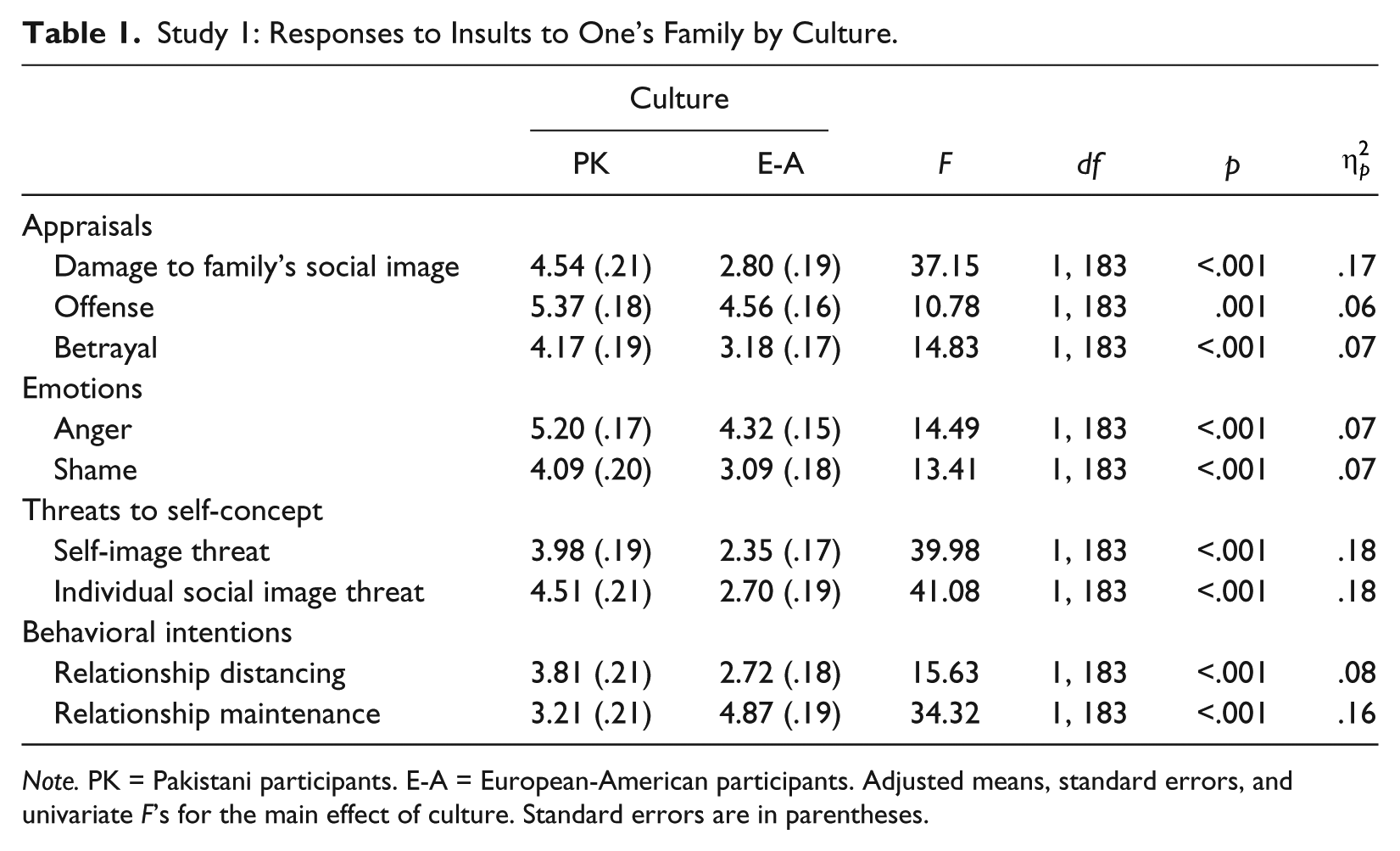
Note. PK = Pakistani participants. E-A = European-American participants. Adjusted means, standard errors, and univariate F’s for the main effect of culture. Standard errors are in parentheses.
Appraisals
The main effect of culture was significant, F(3, 181) = 13.23, p < .001,
Anger and shame
The multivariate main effect of culture was significant, F(2, 182) = 8.94, p < .001,
Threats to self-concept
The multivariate main effect of culture was significant, F(2, 182) = 32.51, p < .001,
Behavioral intentions
The multivariate main effects of condition and culture were significant, F(2, 182) = 11.59, p < .001,
Relationships with appraisal of damage to the family’s social image
Compared to anger, we expected shame to be more strongly related to appraisal of damage to the family’s social image. To test this prediction, we carried out two regression analyses for Pakistani participants, one for anger and one for shame, with the three appraisals as the predictors. The three appraisals were only moderately correlated with each other (range = .33 to .43). As expected, appraisal of damage to the family’s social image was a significant predictor of shame (β = .31, p = .002). The more the Pakistani participants evaluated the insult as damaging their family’s social image, the more ashamed they felt. Although appraisal of offense (β = .22, p = .02) and appraisal of betrayal (β = .22, p = .03) were also significant predictors, appraisal of damage to the family’s social image was the strongest predictor as indicated by its higher β value. The regression model explained 33% of variance in Pakistani participants’ shame. In contrast, appraisal of damage to the family’s social image did not predict anger (β = .11, p = .20.). Appraisals of offense (β = .38, p < .001) and appraisal of betrayal (β = .33, p < .001) predicted anger. The more the Pakistani participants appraised the insult as offensive and as a betrayal, the angrier they felt. The regression model explained 43% of variance in Pakistani participants’ anger.
Furthermore, we also expected Pakistanis’ worry about their own social image to be strongly related to how much they evaluated the insult as damaging their family’s social image. To test this prediction, we carried out a regression analysis with individual social image threat as the outcome and the three appraisals as predictors. As expected, appraisal of damage to the family’s social image was a strong and significant predictor (β = .67, p < .001). Although appraisal of disrespect also emerged as a significant predictor (β = .16, p = .03), the former appraisal was the strongest predictor as indicated by its higher β value. Appraisal of betrayal was not a significant predictor (β = .08, p = .29). The regression model explained 62% of variance in Pakistani participants’ worry about their individual social image. 12
Discussion
Pakistanis valued family honor more than European-Americans did. Consistent with this value difference, an insult to one’s family had more profound consequences on the emotions, self-concept, and social relations of Pakistani participants. They appraised the reported insult as more damaging to their family’s social image than European-Americans did, a finding that supports the idea that the collective social image of a family is more vulnerable to disrespect and social disapproval in cultures where family honor is a core cultural value. Moreover, the Pakistani participants also appraised the insult as more offensive and as a greater betrayal, suggesting that there might be stronger norms against family devaluation in cultures that emphasize the protection of family honor.
Pakistani participants also felt more angry and ashamed about the insult than European-American participants did. Cultural differences for the two emotions were of equal size as indicated by the partial η2 for each effect. This finding is important as it reveals that insults toward one’s family elicit a truly mixed emotional response among those who value family honor highly. Interestingly however, appraisal of damage to the family’s social image was a significant predictor of shame, but not of anger. It is shame, therefore, that emerges as the emotional marker of threats to family honor. This finding expands previous research on shame in response to threats to an important in-group. Shame has been mostly studied in relation to in-groups like one’s ethnic or national group (e.g., Gausel et al., 2012). In this study, we show that shame is an important emotion to study in the context of threats to one’s family, the family being an important in-group across cultures (Georgas et al., 2006).
Together with appraisal of damage to the family’s social image, we found the biggest cultural differences for how much the insult affected the participants’ self-concept. Pakistani participants felt worse about themselves and worried more about how others think of them in response to an insult to their family. Thus, the self-concept had a greater social basis among the participants who valued family honor highly. Moreover, the more the Pakistani participants evaluated the insult as damaging their family’s social image, the more they worried about their own social image. These findings show the interdependence between individual and family’s social image among the participants who valued family honor most.
Of course, European-Americans were not oblivious to how their family was treated. Consistent with their scores on the honor scale, they reported moderately negative appraisals and moderately intense feelings of anger and shame. The European-Americans also cared about how their family was treated. However, they did not care as much as the Pakistani participants did, a conclusion also supported by European-Americans’ behavioral intentions toward the offender: European-Americans wanted to maintain the relationship with the offender more than Pakistani participants did. Interestingly however, this cultural difference was only found for the family condition. Whereas Pakistani participants wanted to distanced themselves more from a family member who insulted the family, the European-American participants wanted to maintain the relationship more with a family member who insulted the family.
These results have important implications for understanding family and other close relationships among individuals and cultures that differ in honor orientation. First, these results suggest the existence of cultural differences in behavioral norms on how to respond to insults and other forms of unfair treatment from intimate others. Among those who value family honor highly, a norm of creating distance with an intimate other who devalues one’s family can serve to protect family honor. This is because distancing can lead to the social isolation of the relative who devalues the family. Such a negative social consequence can be an effective deterrent for future negative behavior toward the family. Second, these results have important implications for research on relational mobility. Research has shown that individuals from collectivistic cultures have low relational mobility, that is, they see their relationships as stable and unchangeable. However, relational mobility research has mostly examined friendships and the formation of new relationships (e.g., Schug, Yuki, & Maddux, 2010). The present study expands research on relational mobility by showing that family relations may operate under different relational principles than other types of relationships.
Furthermore, the offender’s group membership did not influence participants’ appraisals, feelings of anger and shame, or self-concept. Participants from both cultures reported serious insults to their families. Thus, it could be the case that the seriousness of the reported insults overrode any effect of the offender’s group membership on participants’ emotional experience. It could also be the case that we only found an effect of the offender’s group membership on behavioral intentions because there are clear norms for how to respond to an in-group or out-group offender in the two cultures, whereas there may be no distinct norms about how to feel when the insult is delivered by an in-group or an out-group member (i.e., feeling rules; Hochschild, 1979).
In sum, the findings from the present study show that family devaluation is a core emotional event for those who value family honor highly. Core emotional events are situations that threaten key cultural values, thereby eliciting intense appraisals and negative feelings (Mesquita, 2001; Rodriguez Mosquera, Manstead, & Fischer, 2004). The present study shows that core emotional events have significant social-psychological effects, effects that go beyond intense appraisals and feelings. Core emotional events affect how we feel about ourselves, the way we think others view us, and our relationships with close others. Importantly, we asked participants how they experienced the reported family devaluation at the time they answered the survey. Because the intensity of emotional experience is likely to have decreased over time, cultural differences could have been bigger if we had asked participants to report how they felt about the event when it happened. However, our chosen approach reduced the effect of retrospective bias on the reported measures. In addition, participants reported from moderately to very intense emotions about the reported event. This shows that the present study gathered meaningful and important autobiographical experiences of family devaluation.
Finally, there is one cultural difference that remains unexplained: European-Americans reported insults to their parents more frequently than Pakistani participants did. It is possible that this cultural difference is the consequence of insults targeting parents being more emotionally significant for European-Americans. However, parents emerged as key authority figures in Pakistan in the Families across Cultures Project (Georgas et al., 2006). Other studies have also shown that open expressions of negative feelings toward parents and elders is discouraged in Pakistani culture (Zaman et al., 2006). Thus, it could be the case that insults to parents occur less frequently in Pakistani culture, thereby explaining why only three Pakistani participants in the present study reported an insult to their parents. However, when insults to parents do occur, they should elicit intense emotional responses given parents’ status in Pakistani culture. In Study 2, we examine the emotional consequences of insults to one’s parents among Pakistanis and European-Americans with a scenario-based methodology.
Study 2
We presented participants with an insult situation in which we manipulated the target of the insult. In the insult-to-parents condition, participants responded to an insult to their parents’ intelligence. In the insult-to-the-self condition, participants responded to an insult to their own intelligence. We chose intelligence as the insult domain due to the fact that being portrayed as “not that smart” or “dumb” was a frequently reported insult by both Pakistanis and European-Americans in Study 1. We measured appraisals, feelings, and attitude toward the person who delivered the insult.
We chose an insult-to-the-self as the comparison target for two reasons. First, Study 1 has already shown that Pakistani participants respond more strongly than European-Americans do to verbal insults to the family as a collective and to individual relatives, other than parents. Second, we aimed to examine cultural differences as well as within-culture differences in responses to the two targets. The examination of within-culture differences provides important information about the relative importance of the two targets within each culture, thereby allowing a better interpretation of any cultural differences found. For example, if there are no cultural differences in responses to insults-to-parents, could we conclude that parents have equal emotional significance in the two cultures? To answer this question, we need to examine within-culture effects. Because European-Americans reported insults targeting parents more frequently than Pakistanis in Study 1, it is especially important to understand the emotional significance insults-to-parents have for European-Americans. To this end, insults-to-parents need to be compared to insults to another culturally relevant target: the self. Given the emphasis on individuality and the individual self in European-American culture (e.g., Markus & Kitayama, 1991), insults-to-self should elicit intense emotional responses among members of this culture. The comparison of parents versus self is also relevant for the Pakistani participants. If family devaluation is a core emotional event for Pakistanis, the family should be more equal to the self in importance. Thus, we expected to find less within-culture variation in responses to the two targets among Pakistanis than among European-Americans. Uskul and colleagues (2012) also found that honor-oriented Turkish participants evaluated honor-attacking situations as having a similar impact on themselves and on close others, whereas European-American participants evaluated the same situations as having a greater negative impact on themselves than on close others.
Furthermore, we expected European-American participants to appraise an insult to the self in more negative terms, to feel more intense negative emotions about the insult, and to evaluate the person who insulted them more negatively than Pakistani participants. We did not expect to find cultural differences for the insult-to-parents condition. Insults to parents might occur less frequently in Pakistani than in European-American culture. However, less frequent does not mean less significant. Given the importance of the family and of parents as key authority figures in Pakistani culture, Pakistani participants should respond negatively to their parents being insulted. And so should the European-Americans. The higher reporting frequency of insults to parents among European-Americans in Study 1 suggests that European-Americans care about their parents being devalued.
Method
Participants
Fifty-one Pakistani (29 females, 22 males) and 58 European-American (30 females, 28 males) individuals participated in the study. Participants were university students attending different universities in the East Coast of the United States. We chose to collect data among Pakistanis living in the United States to avoid any potential differences in university life between Pakistan and the United States (given that the insult scenarios were contextualized in a university setting). Pakistani participants’ average age was 20.88 years (SD = 2.18). European-American participants’ average age was 18.74 (SD = .85).
Measures
Participants were presented with one of two scenarios. The scenarios were based on real narratives reported by the participants in Study 1 and depicted an insult to one’s own or one’s parents’ intelligence delivered by a fellow student. In both conditions, the scenario started by describing that the participant knows the fellow student because they live in the same dorm and have a class in common. Following the procedure by Rodriguez Mosquera, Parrott, and Hurtado de Mendoza (2010), we increased the vividness and realism of the story by giving the fellow student a name that matched the participants’ sex and cultural background (i.e., we chose the names Michael, Elizabeth, Ali, and Alia). In the insult-to-parents condition, the story described that the participants’ parents were visiting for a homecoming weekend. The fellow student had a chance to meet the participants’ parents and, during an informal conversation with the participant, tells the participant that his/her parents are not that smart. The parents were not present when the insult was delivered. In the insult-to-self condition, the fellow student tells the participant that (s)he is not that smart during an informal conversation about a recent test.
We wanted to make sure that cultural differences in appraisals, emotional feelings, and negative attitude toward the offender were not a consequence of one cultural group perceiving the insults as more unfair. For this reason, we asked the participants to rate the unfairness of the insult on a 7-point scale from (1) not at all to (7) very much. We measured appraisal of offense (three items, e.g., “Do you think what Alia said about you/your family is offensive?”), appraisal of betrayal (three items, “betrayed?”), and appraisal of damage to the family’s social image (three items, e.g., “Do you think what Alia said about you/your family will make other people think negatively about you/your family?”). Furthermore, we measured feelings of anger (two items, e.g., “angry”) and shame (two items, e.g., “ashamed”) about the insult. Finally, we measured participants’ negative attitude toward the offender with two items (e.g., “I would begin to dislike Alia”). Participants answered all items on 7-point scales from (1) not at all to (7) very much.
Procedure
The study was advertised to all participants as a study on perspective taking. Each participant was randomly allocated to one of two conditions. Research assistants responsible for data collection were blind to the condition to which each participant was allocated. All participants filled out the questionnaire individually. European-American participants received a course credit for their participation. Pakistani participants received $7 dollars compensation for their participation.
Results
We report below the results of a series of 2 (culture: Pakistani vs. European-American) × 2 (gender: female vs. male) × 2 (condition: insult-to-self vs. insult-to-parents) MANOVAs for each set of dependent measures (e.g., appraisals). Table 2 shows the adjusted means, standard errors, univariate F values, and
Study 2: Responses to Insult by Condition and Culture.
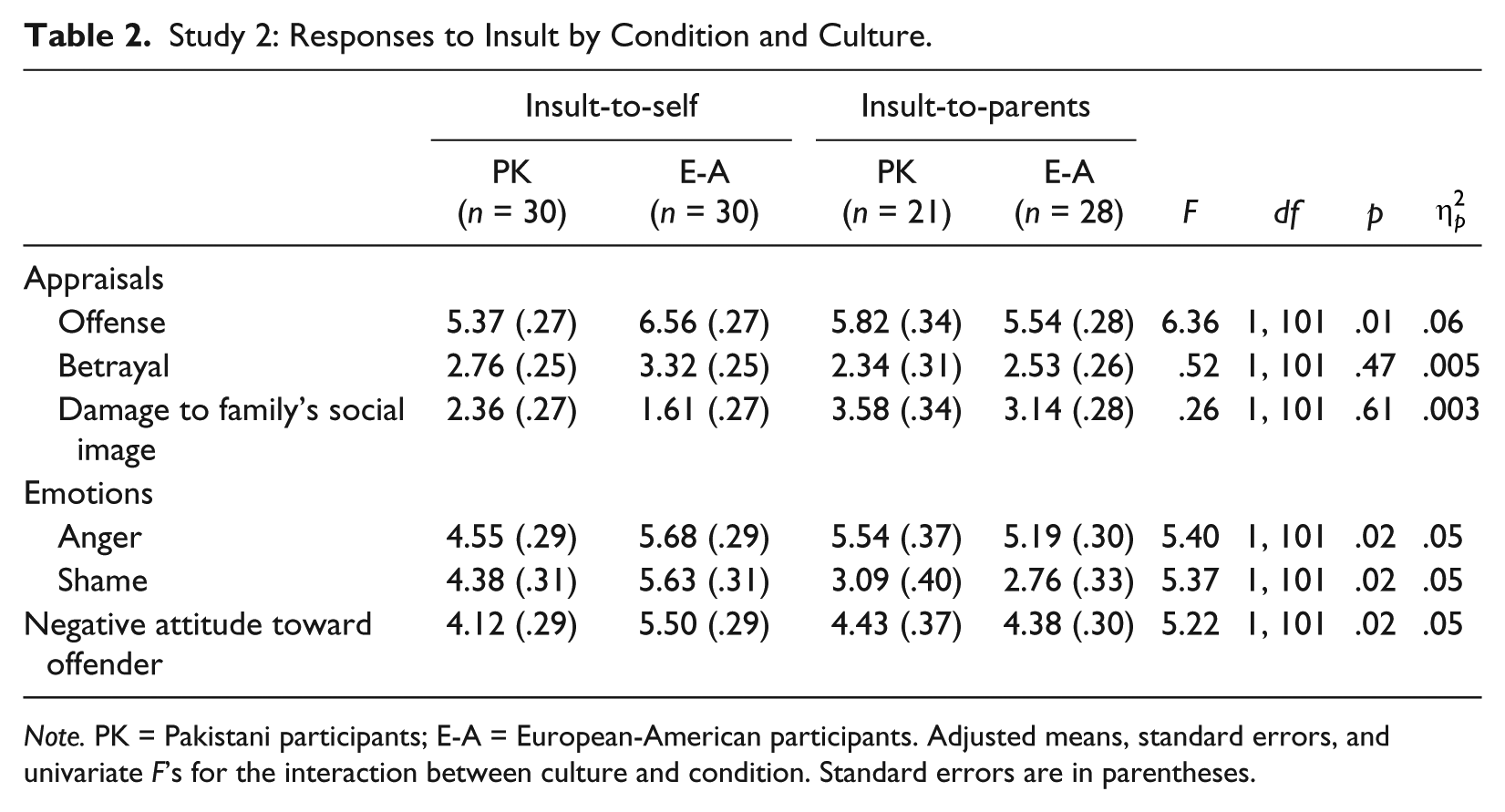
Note. PK = Pakistani participants; E-A = European-American participants. Adjusted means, standard errors, and univariate F’s for the interaction between culture and condition. Standard errors are in parentheses.
Evaluation of insult as unfair
None of the main or interaction effects was significant—multivariate main effect of culture, F(1, 101) = .02, p = .89,
Appraisals
The multivariate main effects of condition and culture were significant, F(3, 99) = 17.34, p < .001,
As expected, the multivariate interaction between culture and condition was significant, F(3, 99) = 2.95, p = .04,
Anger and shame
The multivariate main effects of gender and condition were significant, F(2, 100) = 3.83, p = .02,
Negative attitude toward the offender
The main effect of culture was significant, F(1, 101) = 4.55, p = .03,
Discussion
European-American and Pakistani participants did not differ in their appraisals of, or their angry and shame responses to, an insult to their parents. Moreover, the two cultural groups reported an equally negative attitude toward the person who insulted their parents. Thus, parents are important family figures in both cultures, a conclusion that is consistent with the results from the Families Across Cultures Project (Georgas et al., 2006). In this large cross-cultural study, participants from all 27 countries rated parents as being the most important family members when compared to other members of the family (e.g., grandparents, siblings).
Insults to the self, by contrast, elicited more intense responses among European-American than among Pakistani participants. In line with our predictions, European-Americans evaluated an insult to themselves as more offensive than the Pakistani participants did. European-Americans also felt more angry and ashamed when they were insulted. These cultural differences are all the more remarkable given the nature of the insult to the self. A fellow student insulted the participants’ intelligence, a domain that is significant for all participants, given that they were all university students. Still, the European-American participants responded with more intense negative emotions. In addition, the European-American participants evaluated the person who insulted them more negatively than the Pakistani participants did. These cultural differences cannot be explained by potential differences in how unfair the two cultural groups evaluated the insult as Pakistani and European-American participants evaluated the insult as equally unfair. These cultural differences are likely to be a reflection of the emphasis in seeing oneself in a positive light in European-American culture (Heine & Buchtel, 2009).
We also examined within-culture differences in responses to insults-to-self versus insults-to-parents. As expected, we found more within-culture differences among European-Americans. These participants rated an insult to the self as more offensive than an insult to their parents. Moreover, the fellow student who delivered the insult to the self was rated more negatively than the fellow student who delivered the insult to one’s parents. In contrast, Pakistani participants responded either equally strongly, or more strongly, to insults to their parents compared to insults to themselves. In particular, the insult to one’s parents was appraised as equally offensive as an insult to the self among Pakistani participants. In addition, the fellow student who delivered the insult to one’s parents was rated as negatively as the fellow student who delivered the insult to the self. In the case of anger, the insult to one’s parents elicited more intense anger than the insult to the self.
These findings show that the two targets (i.e., self and parents) had a more equal psychological status for the Pakistani than for the European-American participants, a conclusion that fits with the notion that family devaluation is a core emotional event in Pakistani culture (Study 1). In addition, these findings are also an expression of interdependence based on shared social image. Any word of disrespect toward a family member carries negative implications for all other family members and the family as a collective unit. Consequently, an insult to one’s parents can be as damaging to social image as an insult to the self. In addition, interdependence based on shared social image implies that social situations should be readily interpreted in terms of how they affect the collective social image of the family. Our results show this to be the case. Culture had a main effect on the appraisal of damage to the family’s social image. Pakistani participants appraised both insults as more damaging to their family’s social image than the European-American participants did.
General Discussion
Family honor has personal costs. By creating a type of group interdependence based on shared social image, the social image of the family now reflects on all. Each family member must carry the responsibility of protecting the collective image. In two experimental studies, we examined the effects of family devaluation on emotions, the self-concept, and social relations. Insults to the family are both painful and threatening among those who value family honor highly. Thoughts of damaged social image, betrayal, intense feelings of shame and anger, and relationship strain among intimates are some of the profound consequences of threats to shared social image.
The present studies expand upon research on culture, honor, family, and emotion in several important ways. First, the studies are the first to systematically examine the emotional and social consequences of family honor, a value that is important in many different cultures (Abu-Lughod, 1999; Rodriguez Mosquera et al., 2012). Second, the present studies expand current research on honor by focusing on aspects of honor that have not been examined in previous research. Third, we developed new measures that can be useful to future research on insult, honor, family, or other social groups that exhibit interdependence based on shared social image (e.g., the military). In particular, we developed measures of diverse appraisals, feelings, and behavioral intentions. Moreover, we tested the validity and reliability of these measures in two different cultural contexts. Fourth, the present studies show the importance of examining shame in the context of the family, a group that has been understudied in the literature on shame. Finally, the present studies expand our understanding of social image by showing that social image is not only an attribute of individuals, but also a cherished and shared attribute within important in-groups.
Footnotes
Acknowledgements
We thank A. S. R. Manstead and N. Ramírez-Esparza for their helpful comments.
Declaration of Conflicting Interests
The author(s) declared no potential conflicts of interest with respect to the research, authorship, and/or publication of this article.
Funding
The author(s) received no financial support for the research, authorship, and/or publication of this article.