




Abstract
Children themselves play active roles in shaping their developmental trajectories. The constant interplay of a wide range of biological, familial, social, and cultural factors shapes development. In this study, we examined the links between maternal control and 5- to 7-year-old children’s compliance in a cross-cultural sample (N = 89: 30 Chinese in Taiwan, 30 Chinese immigrants in the United Kingdom, and 29 nonimmigrant White English in the United Kingdom) using observational data. The results showed that the English mothers used less negative control and were more responsive than the Chinese immigrant mothers, and that the English mothers also showed more positive affect than both the Chinese immigrant and Taiwanese mothers. The Taiwanese children showed more situational compliance than the Chinese immigrant children, whereas there were no significant cultural differences in committed compliance and oppositional behaviour. Further regression analyses showed that committed compliance, situational compliance, and oppositional behaviour were associated with different predictors. Converging evidence from both observational tasks showed that committed compliance, moderated by surgency, appeared to increase as children grew older and was negatively influenced by maternal negative control. Different trends emerged for child opposition or noncompliance in the two tasks. In the Etch-a-Sketch task, noncompliance was accounted for by child age and temperament, but not by any maternal behaviour, whereas opposition in the clean-up task was not predicted by child age or temperament but was associated with maternal use of force. Finally, situational compliance could not be predicted by child age and temperament alone, but the addition of cultural group and maternal control significantly increased the prediction of situational compliance. These results suggested different pathways for the development of committed compliance, situational compliance, and opposition.
Children’s innate dispositions, their parents’ behaviour, and the social, economic, cultural, and ecological environment all help shape their development. Parents, as the first and most regular socialising agents, have a profound influence on their children’s development (e.g., DeHart, Pelham, & Tennen, 2006; Pardini, Fite, & Burke, 2008; Sheehan & Watson, 2008). The societies or cultures in which children live also constitute environments in which parents and children develop their beliefs, attitudes, and behaviours.
Among many indices of child development, the present study focused on compliance because the development of children’s compliance is an important indicator of children’s socialisation and the internalisation of social values, social norms, and moral development (Kochanska, 1995, 2002; Kochanska, Murray, & Coy, 1997). Compliance is also a significant predictor of children’s later social adaptation and maladaptation (e.g., X. Chen, H. Chen, Wang, & Liu, 2002; Kochanska, 1997; Kuczynski & Kochanska, 1990), yet there has been little research on cross-cultural variation. Not only does the Chinese culture emphasise compliance more emphatically than do Western cultures (Chao, 1995; Ho, 1986), but Chinese children are also taught to comply with authority from a very young age (e.g., Ho, 1986). However, research on the compliance of Chinese children is still scarce (e.g., X. Chen et al., 2003). In the present study of children’s compliance, we not only took child characteristics (such as age, gender and temperament) into account but also examined parental practices and broader cultural factors in Chinese (Taiwan), immigrant Chinese, and nonimmigrant White English families.
Child Compliance
The development of compliance is an indication of children’s self-control, socialisation, and even moral development. Compliance is initially imposed and maintained by external demands, such as parental request and directives (Kochanska, 1995, 2002; Kuczynski & Kochanska, 1990), but is increasingly mediated by internal factors as children mature (Kochanska, 1995, 2002; Kopp, 1982). The responsibility for regulating children’s behaviour gradually shifts to the children themselves with parents increasingly assuming the role of distant monitors. In this way, children come to internalise social standards and begin to regulate their own behaviour without parental intervention (Kochanska, 2002; Kochanska & Aksan, 1995). The transition from externally prompted control to internalised self-generated regulation is a progressive process, driven by both maturational factors and experience (Kochanska, Coy, & Murray, 2001; Kopp, 1982).
Researchers have consistently shown that, with age, children display increasingly mature forms of self-regulation (Kochanska, 2002; Kochanska et al., 2001; Spinrad et al., 2012), although there are individual differences in the development of children’s self-regulatory abilities (e.g., Block & Block, 1980; Kochanska, 1995; Posner & Rothbart, 2000). These individual differences in self-control during the early years appear to be stable over time and predictive of later social adaptation and maladaptation (e.g., Block & Block, 1980; Kuczynski & Kochanska, 1990; Lengua & Kovacs, 2005). For instance, self-restraint and compliance may serve as the basis for the internalisation of social rules and values and for the development of socially and morally appropriate behaviour (Kochanska & Aksan, 1995), whereas noncompliant and defiant behaviour may be associated with later socioemotional problems of an externalising nature (Mullineaux, Deater-Deckard, Petrill, & Thompson, 2009; Patterson, 1982).
Kochanska and her colleagues (Kochanska, 1995, 1997, 2002; Kochanska & Aksan, 1995; Kochanska et al., 2001) have represented child compliance within the mother–child context as the first marker of internalisation. They distinguished between two motivational systems underlying child compliance: committed compliance and situational compliance. Committed compliance involves the child’s wholehearted, eager compliance when the parent exerts control. It is this internally motivated embrace of parental rules that marks the emergence of self-regulation (Kochanska & Aksan, 2006), consistent with the models of Lytton (1980), Kopp (1982, 1987), and Stayton, Hogan, and Ainsworth (1971). In contrast, situational compliance refers to parent-monitored obedience with little indication of internalisation, with the child seeming to cooperate only in response to the parent’s immediate control, often with neutral affect (Kochanska, 2002), in line with the models of Piaget (1932) and Kohlberg (1969). These two systems follow distinct developmental trajectories, and the self-regulated version defines a stable child orientation that develops into a more mature form of internalisation in the preschool years. Committed compliance appears to increase significantly between 14 and 22 months and between 22 and 33 months, before levelling off at 45 months (Kochanska et al., 2001) whereas situational compliance increases between 14 and 22 months and levels off between 33 and 45 months (Kochanska et al., 2001). By the age of 5 or 6 years, multiple variants and aspects of compliance appear to be coherent, including compliance with requests from the mother (Kochanska, 2002) as well as other adults and peers (Wachs, Gurkas, & Kontos, 2004). It appears that compliance becomes quite stable between toddlerhood and early school age (Kochanska & Murray, 2000). By early school age, children have already entered the broader social environment beyond the family (Kochanska, Koenig, Barry, Kim, & Yoon, 2010; Sameroff & Haith, 1996), encountering a variety of challenges: navigating academic and peer environments that provoke both rule-compatible and prosocial conduct as well as rule breaking and deviance (Deater-Deckard, 2001; Rimm-Kaufman & Pianta, 2000). However, there is little empirical evidence about the development of compliance in children aged 5 or older. Therefore, one of the aims of the present cross-cultural study was to extend our current understanding of how child compliance develops during this period.
Child Temperament and Compliance
A number of developmental and social factors are involved in the development of children’s compliance. For instance, child temperament appears to moderate the relationship between specific parenting practices and specific types of compliance (Himmelfarb, Hock, & Wenar, 1985; Kochanska, 1995; Kochanska & Aksan, 1995). Temperament refers to an individual’s personality profile, marked by individual differences in reactivity and regulation in cognitive, emotional, and behavioural domains (Kagan & Fox, 2006; Rothbart, Ahadi, & Evans, 2000). Three dimensions of temperament—surgency, negative affectivity, and effortful control—are frequently studied in 3- to 5-year-old children (Ahadi, Rothbart, & Ye, 1993; Putnam & Rothbart, 2006; Rothbart, Ahadi, & Hershey, 1994; Rothbart, Ahadi, Hershey, & Fisher, 2001). Highly surgent children tend to be active, impulsive pleasure seekers who are not shy in new situations. Children who are high in negative affectivity tend to experience more negative emotions, such as sadness, fear, anger, and frustration, and they are less easily soothed when distressed. Finally, children who are high in effortful control exhibit more attentional and inhibitory control and are likely to be more vigilant (John, Caspi, Robins, Moffitt, & Stouthamer-Loeber, 1994; Putnam & Rothbart, 2006). Toddlers high in effortful control exhibit high levels of committed compliance, both concurrently and longitudinally (Kochanska et al., 2001; Kochanska et al., 1997; Spinrad et al., 2012). Longitudinal studies show that attention and attention regulation (both components of effortful control) and reactivity in infancy predict committed compliance (Hill & Braungart-Rieker, 2002; Kochanska, Tjebkes, & Forman, 1998) and noncompliance (Stifter, Spinrad, & Braungart-Rieker, 1999) in toddlerhood, respectively.
Parenting and Child Compliance
Another important factor that has been extensively studied in relation to child compliance is parenting. Most of the earlier studies of child compliance focused on the links between child compliance and parenting practices, especially parental responsiveness and control, which are consistently associated with child compliance (e.g., Chamberlain & Patterson, 1995; Kochanska & Aksan, 1995; Wahler, 1997). However, the relations between parenting and compliance vary depending on which aspects of compliance are assessed. Committed compliance is generally positively associated with responsive parenting (Kochanska, 1997; Kochanska & Aksan, 1995), but this association is moderated by child temperament (Kochanska, 1997; Kochanska et al., 2007). Situational compliance is either not associated with parenting or is positively associated with parental negative control, such as criticism, threat, or use of force (Kochanska & Aksan, 1995). Passive noncompliance is either unrelated or is positively associated with negative control and decreased guidance (Braungart-Rieker, Garwood, & Stifter, 1997; Kuczynski, Kochanska, Radke-Yarrow, & Girnius-Brown, 1987). Finally, mutually responsive parent–child interaction is positively associated with negotiation, in which verbal refusals by the child foster self-assertion, whereas this relation does not hold for defiance (Crockenberg & Litman, 1990).
However, the effects of parenting on the development of compliance are unclear (e.g., Feldman, 2007; Kochanska & Aksan 1995; Laible & Thompson 2000; NICHD Early Child Care Research Network, 1998; Van der Mark, Bakermans-Kranenburg, & Van Ijzendoorn, 2002; Volling, Blandon, & Kolak 2006), possibly because of differences in the ways parenting and compliance have been measured (Kim & Kochanska, 2012).
Culture and Child Compliance
Despite the significant role played by culture in social, cognitive, and behavioural development (Hinde, 1987; Lansford et al., 2005), little attention has been paid to the role of culture in the development of compliance. In most societies, the emergence of self-control is considered a significant early achievement, but different cultures may emphasise different values and prescribe varying schedules for its development, depending on the socialisation goals and requirements of the culture in question. Culture may thus affect the developmental pace, timetable, and processes by which compliance develops.
In Western cultures, independence and self-assertion tend to be emphasised. Although child compliance is generally encouraged during early childhood (Chamberlain & Patterson, 1995), parents are advised to be sensitive to their children’s needs and to understand children’s abilities and behaviours from a developmental and “child-centred” perspective (Rubin, Stewart, & Chen, 1995). Consequently, Western parents may expect, evaluate, and respond to their children’s self-control capabilities using different standards at each developmental stage and across different contexts (e.g., Goodnow, 1995). In comparison with Western cultures, Chinese culture values self-control and compliance in a more consistent and absolute manner (Chao, 1995; Ho, 1986), and it emphasises compliance with authority from a very early age (e.g., Ho, 1986; Luo, 1996). Chinese children are encouraged both to restrain their personal desires and impulsive acts and to behave cooperatively and compliantly in social contexts (X. Chen et al., 2003); the terms most commonly used to praise children are guai (乖, being well behaved) and tin hua (聽話, being obedient, listening to adults’ words). Moreover, the traditional Confucian focus on filial piety emphasises children’s obedience and reverence to parents (F. Chen & Luster, 2002; Ho, 1986), which is also in line with the culture’s emphasis on compliance.
Given the emphasis on self-control and self-restraint in Chinese culture, are Chinese children more compliant than their Western counterparts? In an attempt to answer this question, X. Chen and colleagues (2003) examined compliance (assessed using Kochanska’s paradigm) in 2-year-old Chinese and Canadian toddlers (n = 228). The Chinese toddlers showed more committed compliance than their Canadian counterparts, but the Canadian toddlers exhibited more situational compliance and overt protest than the Chinese toddlers. Maternal warmth and induction were positively associated with committed compliance in the Chinese toddlers, while maternal induction was positively associated with situational compliance in the Canadian toddlers. Maternal punishment orientation was negatively associated with committed compliance and positively associated with situational compliance in the Chinese toddlers, but not in the Canadian toddlers. These results may indicate that different forms of child compliance have specific cultural meanings, thereby underscoring the value of studying the development of compliance in different cultural contexts. However, X. Chen and colleagues (2003) only assessed the mothers’ child-rearing attitudes using self-report questionnaires; no observational information about the mothers’ actual parenting practices was available. Moreover, compliance in Chinese immigrant children has yet to be examined. Immigrant parents’ acculturation may influence their parenting beliefs and practices, particularly the degree to which their parenting practices reflect culture-specific constructs (Buki, Ma, Strom, & Strom, 2003; Costigan & Su, 2008; Kelley & Tseng, 1992). Some researchers found that immigrant Chinese parents had parenting values more similar to those of Chinese parents than of Caucasian American parents (Jose, Huntsinger, Huntsinger, & Liaw, 2000; Lin & Fu, 1990) and that immigrant Chinese mothers not only had more authoritarian attitudes but were also more likely to encourage independence and demand maturity from their children than did Anglo American mothers (Wang & Phinney, 1998). Other recent research suggests that the ideologies of Chinese immigrant mothers may be modified in the course of acculturation (Buki et al., 2003; Costigan & Su, 2008). For example, Cheah, Leung, Tahseen, and Schultz (2009) found that Chinese immigrant mothers of preschoolers (in the United States) strongly endorsed the authoritative parenting style, which predicted increases in the children’s behavioural and attention regulatory abilities. However, relatively little is known about the child-rearing styles and practices of Chinese immigrants (J. Chen, Chen, & Zheng, 2012), and most of the research findings were obtained in North America, thus increasing the need for research on Chinese immigrants in the United Kingdom and other European countries.
Given the links between parenting and child compliance (e.g., Kochanska & Aksan, 1995) and Chinese parents’ emphasis on child compliance and obedience (e.g., X. Chen et al., 2003; F. Chen & Luster, 2002), it is reasonable to suspect that, when Chinese immigrant parents’ parenting behaviour changes in the course of acculturation, their children’s compliance might be influenced as a result. It would be valuable to obtain observational data to better assess parenting in a cross-cultural sample including immigrant Chinese families. The present study was thus designed to further our understanding of parenting and child compliance in a cross-cultural sample using observational data.
Current Study
The goals of this study were to examine similarities and differences in parenting and child compliance as well as the associations between parenting and child compliance in three groups of mother–child dyads. Parenting practices and child compliance were studied using observation measures in groups of Taiwanese, Chinese immigrant, and nonimmigrant White English parents and their 5- to 7-year-old children. We examined these three groups because one of our aims was to further our understanding of the behavioural changes that happen during the course of immigration and acculturation. Research has repeatedly shown that, during the course of immigration and acculturation, immigrant parents’ acculturation may influence their parenting beliefs and practices (Buki et al., 2003; Costigan & Su, 2008; Kelley & Tseng, 1992). Many modify their parenting beliefs to more closely match the larger society to prepare their children for success in a new multicultural context (Lin & Fu, 1990; Yee, Huang, & Lew, 1998). Therefore, in the present study, we included a comparison group of nonimmigrant White English families to represent the receiving culture, and another comparison group of Taiwanese families to represent the traditional Chinese culture. “Chinese” people may have origins in the People’s Republic of China, Hong Kong, and Taiwan (Chao & Tseng, 2002; Cheah et al., 2009). Although these societies differ greatly with respect to their current social, political, and economic conditions, they share a long tradition of Chinese culture (Berndt, Cheung, Lau, Hau, & Lew, 1993; Fan, 2000; Li & Lamb, 2013). Based on their shared Chinese cultural traditions, we considered it appropriate to compare the Chinese immigrants with the Taiwanese Chinese.
We aimed to address the following questions: (a) Is observed parenting behaviour different in these three groups? (b) Are patterns of compliance different in these three groups? (c) Are observed parenting practices associated with child compliance? (d) Are parental control and child compliance consistent across the two tasks studied? (e) After controlling for child characteristics (e.g., child age, gender, and temperament), do parenting and cultural group independently account for variance in child compliance?
Based on previous research, we hypothesised that the Taiwanese mothers would employ more negative control strategies than the Chinese immigrant and English mothers, because mothers from Chinese culture were found to endorse more authoritarian parenting and use more physical coercion (Pomerantz, Ng, & Wang, 2008; P. Wu et al., 2002). With respect to child compliance, the Taiwanese children were expected to show more committed and situational compliance than the Chinese immigrant and English children, given the previous findings (e.g., X. Chen et al., 2003) and the positive association between situational compliance and parental negative control (Kochanska & Aksan, 1995). These cultural differences were expected to remain significant even after the effects of temperament were controlled for. Mothers’ observed maternal negative control was expected to correlate positively with noncompliance in the Etch-a-Sketch task, and maternal forceful control was expected to associate positively with situational compliance and opposition, but negatively with committed compliance in the clean-up task. Maternal positive control and responsiveness were expected to correlate positively with child on-task behaviour in the Etch-a-Sketch task, and maternal gentle guidance was expected to associate positively with committed compliance and negatively with situational compliance and opposition. Maternal control and child compliance were expected to show consistency across the two observational tasks. Maternal negative control in the Etch-a-Sketch task was expected to be positively associated with maternal control and forceful control in the clean-up task. Maternal positive control and responsiveness in the Etch-a-Sketch task were expected to be positively associated with gentle guidance and negatively associated with forceful control in the clean-up task. Child on-task in the Etch-a-Sketch task was expected to correlate positively with committed compliance in the clean-up task, whereas noncompliance in this task was expected to correlate negatively with committed compliance but positively with opposition in the clean-up task. It was further expected that children’s effortful control would be positively associated with committed compliance, and that surgency would be positively correlated with child opposition and negatively correlated with committed compliance, regardless of cultural group.
Method
Participants
In the present study, we included 5- to 7-year-old (M = 6.08, SD = 0.82) Taiwanese (M = 5.9, SD = 0.82), Chinese immigrant (M = 6.06, SD = 0.92), and nonimmigrant White English children (M = 6.25, SD = 0.70), and their mothers from two-parent heterosexual families. The 30 children (15 boys and 15 girls) in each group were matched with respect to background characteristics (age, gender, and parental educational level). Unfortunately, the video record of one English family was damaged, so only 29 families were included in the group for analyses of the observational data. All the children in the present study were enrolled in school (mean hours per week = 33.9, SD = 8.29). Twelve (13.3%) of the 90 children were only children, 63 (70%) had one sibling, and 15 (16.7%) had two or more siblings. The children came from well-educated, middle-class backgrounds; all of the parents had finished at least 13 years of formal education. In the Taiwanese sample, 10% of the mothers had only completed high school, 50% had received a vocational school, college, or university education, and 40% had a postgraduate (master’s or doctoral) degree. In the Chinese immigrant sample, 10% of mothers had received high school education, 40% had completed vocational school, college, or university education, and 50% had postgraduate (master’s or doctoral) degrees. In the English sample, 16.7% of the mothers had only completed high school, 33.3% had received a vocational school, college, or university education, and 50% had postgraduate (master’s or doctoral) degrees. It should be noted that much higher percentages of the parents in this study had completed tertiary education than in the Taiwanese general population (36.8% have college degrees or higher), the nonimmigrant English population (29.5%), and the U.K. immigrant population (37.7%; Directorate-General of Budget, Accounting and Statistics, Executive Yuan, 2010; Office of National Statistics, 2013a, 2013b), and thus the findings should be interpreted with caution. At the time of data collection, 73.3% of the English mothers, 70% of the Chinese immigrant mothers, and 80% of the Taiwanese mothers were working outside the home. There were no significant associations between the child and maternal variables and measures of maternal education or employment status.
The English and Chinese immigrant families were recruited mainly in and around Cambridge, while the Taiwanese families were recruited in and around Taichung and Taipei City in Taiwan. The Taiwanese families were recruited from kindergartens (53.3%), from a University research database (20%), and through referrals by other participants (26.7%). Nineteen (63%) English families were recruited through Cambridge primary schools, and they referred 11 (37%) other families to participate in the study. The Chinese immigrant families were recruited from the Cambridge Chinese School (84%), the Chinese Church in Cambridge (6%), and by referral (10%). The Chinese immigrant parents who participated in the present study were all first-generation immigrants who had been living in the United Kingdom for as little as 9 months to as long as 27 years (M = 9.5, SD = 5.38). They came from various provinces in the People’s Republic of China (24, 80%), Hong Kong (2, 6.7%), Taiwan (2, 6.7%), Vietnam (1, 3.3%), and Malaysia (1, 3.3%). The length of residence in the United Kingdom and country of origin were not associated with any of the outcome variables in independent-sample t tests (immigrants from People’s Republic of China vs. from elsewhere) or nonparametric correlations (Spearman’s ρ).
Procedure
The researcher first contacted the kindergarten head teachers for permission to recruit through the kindergarten. After acquiring the head teachers’ approval, recruitment letters were distributed. The researcher then arranged with the head teachers to visit the kindergartens on a school-open day, so that the researcher could meet potential participants and inform them about the research project. Parents who were interested and willing to participate in the project then left their contact information.
After recruitment, the participating families were observed in their homes. During the visit, the researcher explained the study and the observation procedure to both the parent and the child in detail, encouraging them to ask questions. Verbal consent was obtained from the child, and written consent was obtained from the mother both for herself and on behalf of her child. After signing the consent form, the mother was given the questionnaires (to be completed at her convenience) and prepaid envelopes in which they could be returned. The questionnaires included a demographic questionnaire and the Children’s Behaviour Questionnaire–Short Form (CBQ-SF; Putnam & Rothbart, 2006). The observation procedure was then described and the camcorder was set up. The behavioural observations were video recorded for later coding and analyses. The researcher provided a variety of age-appropriate and gender-neutral toys for the play session and an Etch-a-Sketch board for use in the Etch-a-Sketch task. The observation procedure was adapted from the task used in Kochanska’s laboratory studies of child compliance in 56-month-old children (Kochanska, 1999) and from MacKinnon-Lewis and colleagues’ (1994; MacKinnon-Lewis, Rabiner, & Starnes, 1999) research on parent–child cooperation. The toys and observation procedure used in all the groups were identical.
The mother and child were first told to play together in their usual way for 10 min using the toys provided by the researcher. This 10-min free-play session was not coded, but allowed the parent and child some time to get used to the researcher’s presence and the video recording. After the free-play session, the researcher demonstrated to the participants how the Etch-a-Sketch board works, and the researcher instructed the mother and the child to work together, using the Etch-a-Sketch drawing board, copying a fairly complicated figure provided by the researcher. Each participant could only control one knob, and participants were not allowed to touch the other person’s knob, so they needed to work cooperatively to complete the drawing. The cooperative task took the parent–child dyads approximately 10 min to complete. Finally, the researcher instructed the parent to ask the child to help put the toys away in appropriate boxes, which took 10 min on average.
The first author conducted the observation and data collection, and video coding was conducted by the first author as well as by trained graduate students at the University of Cambridge. Each of the participating children received a small snack (preapproved by the mothers) as a token of thanks, and each participating mother received a copy of the observation video as a souvenir.
Measures
Demographic questionnaire
This short questionnaire was designed for the present study to obtain background information about the family, including the child’s age, gender, ethnicity, number and age of siblings, parental educational levels, occupations, and time spent with their children. The family background information was used to match the participants in the three groups.
Children’s Behaviour Questionnaire–Short Form
CBQ-SF (Putnam & Rothbart, 2006) is a 94-item, 15-scale measure adapted from the longer CBQ (195 items, 15 scales; Rothbart et al., 2001), a commonly used parent-report measure of temperament for children aged 3 to 8 years. The short form has satisfactory internal consistency and criterion validity, is recommended for use by researchers who wish to minimise participant time (Putnam & Rothbart, 2006), and is available in both English and Chinese versions. Parents were asked to rate the items, depending on how much the item description matched their children’s behaviour, on a 7-point Likert-type scale (1 = extremely untrue to 7 = extremely true), with an additional “not applicable” option.
The 15 scales defined by Rothbart et al. (2001) were (a) activity level, (b) anger/frustration, (c) approach/positive anticipation, (d) attentional focusing: the tendency to maintain attentional focus on task-related material, (e) discomfort, (f) falling reactivity/soothability, (g) fear, (h) high-intensity pleasure, (i) impulsivity, (j) inhibitory control, (k) low-intensity pleasure, (l) perceptual sensitivity, (m) sadness, (n) shyness, and (o) smiling and laughter. Rothbart et al. (2001) further identified three primary higher order dimensions: extroversion/surgency, negative affectivity, and effortful control. Extroversion/surgency combines subscale scores for activity level, high-intensity pleasure, impulsivity, and shyness (reverse scored). Negative affectivity combines subscale scores for anger, discomfort, fear, sadness, and soothability (reversed score). Effortful control combines subscale scores for inhibitory control, attentional control, low-intensity pleasure, and perceptual sensitivity. As recommended by Rothbart and her colleagues (1994), each subscale was assigned equal weight and a mean composite score was calculated using the subscales that made up the three temperamental dimensions. Because child temperament moderates child compliance (e.g., Kochanska, 1995, 1997, 2001), we used the three higher order dimensions of temperament to control for cross-cultural differences in children’s temperament.
Behavioural coding
Parental and child behaviour in the Etch-a-Sketch task was coded using the Parent–Child Interaction System (PARCHISY; Deater-Deckard, 2000; Deater-Deckard, Pylas, & Petrill, 1997) to assess maternal control, affectivity, and responsiveness, child compliance, and on-task behaviour in the cooperative game session (Etch-a-Sketch task). The PARCHISY is widely used in both community and clinical research, and can be easily modified to accommodate various types of tasks and populations to measure parent–child interaction. The Etch-a-Sketch task, which is commonly coded using the PARCHISY, can be used with children aged 3 years and older. The present study used the following five items to assess maternal behaviour: (a) positive control—use of praise, explanation, and open-ended questions; (b) negative control—use of criticism, physical control of dial, or the child’s body; (c) positive affect—smiling and/or laughing; (d) negative affect—frowning and/or harsh voice; and (e) responsiveness—verbal or behavioural responses to the child’s comment, behaviour, or questions. Child compliance was assessed using the following two items: (a) noncompliance—refuse or do something contrary to what is asked and (b) on-task—persistence and engagement with respect to the task. These items were rated on 7-point global scales at the end of the task (1 means infrequent occurrence and 7 means frequent occurrence).
Maternal discipline and child compliance in the clean-up task were coded using procedures developed by Kochanska (1999) to assess child compliance in children aged 15 to 78 months. The coding adopted a time-interval approach (30-s segments), and the percentages of each targeted behaviour were computed. Three codes were used for maternal discipline: gentle guidance, control, and forceful control. Gentle guidance was coded when mothers directed the children in a gentle, subtle, or playful manner (e.g., using polite suggestions, hints, playful comments or reasons). Control was coded when the mothers directed the children in an assertive, matter-of-fact, and no-nonsense yet nonforceful manner. The mothers had to issue commands or prohibitions during most of the coding segments for this code to be applied. Forceful control was coded when the mothers directed the children in a somewhat forceful, power-assertive manner, such as by raising their voices, using an assertive, decisive tone, and even using threats. Because forceful control was observed very rarely, it was coded whenever there was a well-defined, clearly articulated show of force, anger, or threat on the part of the parent, even if it was brief.
Five codes were used to code child compliance: committed compliance, situational compliance, passive noncompliance, overt resistance, and defiance. Committed compliance was coded when the child showed wholehearted compliance (e.g., focused on doing what the mother told the child to do). Situational compliance was coded when the child was cooperative and receptive to the parental agenda, but responsive only to the immediate parental control, or when the clean-up work was only sustained by parental control. When attention slippages were common or the children performed the task half-heartedly, situational compliance was coded. Passive noncompliance was characterised by passive reluctance to accept the mothers’ instructions. The children could be noncooperative, unreceptive to the instructions, or avoidant (i.e., the child turned a deaf ear to the parents’ requests). Overt resistance was coded when the children overtly rejected the parents’ instruction, shook their heads, protested nonaversively, or overtly resisted, so this code encompassed the refusals and negotiations (in a nonaversive way) described by other researchers. Defiance was coded if the children defied or rejected the mothers’ requests or instructions angrily or while displaying other negative emotions. However, passive noncompliance, overt rejection, and defiance occurred very rarely, so they were combined into one index of opposition. Only three measures of child compliance (committed compliance, situational compliance, and opposition) were thus used in the analyses.
Two trained coders from the University of Cambridge coded the videos; both coders were fluent in Mandarin and English. Interrater reliabilities were computed using Cohen’s kappa for 25% of the data. The kappas for maternal behaviour and child behaviour in the Etch-a-Sketch task were .84 and .89, respectively, and for maternal control and child compliance in the clean-up task were .88 and .89, respectively.
Results
The analyses proceeded in several stages. Associations with child age, gender, and temperament were computed using correlational analyses and t tests so that significant effects could be controlled for in later analyses. Next, to find out whether there were cultural differences in maternal and child behaviour in the Etch-a-Sketch task, multivariate analyses of variance were conducted. Cultural differences in observed maternal control and child compliance in the clean-up task were then explored using parallel analyses of covariance controlling for child age and temperament. Thereafter, correlation analyses were conducted to examine the within-task and across-tasks correlations between maternal behaviour and child compliance. Finally, regression analyses were conducted to determine whether maternal behaviour accounted for child compliance in the same tasks after controlling for children’s characteristics (age, gender, and temperament).
Effects of Child Age, Gender, and Temperament
Correlational analyses were conducted to examine the effects of child age and temperament on maternal control and child compliance. The results indicated that mothers used less negative control, Spearman’s ρ(89) = −.213, p = .045, and were more responsive, ρ(89) = .210, p = .049, to older children than to younger children in the Etch-a-Sketch task. Older children also showed less noncompliance, Spearman’s ρ(89) = −.211, p < .05, and more on-task behaviour, Spearman’s ρ(89) = .278, p < .01, in the Etch-a-Sketch task as well as more committed compliance in the clean-up task, Spearman’s ρ(89) = .250, p = .01, than younger children.
Independent sample t tests revealed that mothers generally did not treat boys and girls differently, but that boys were viewed as higher in surgency than girls, t(90) = 2.311, p < .05, two-tailed. Boys and girls did not differ on most observation-based behavioural indices, except for child committed compliance, t(89) = −1.991, p < .05, two-tailed, and opposition, t(89) = 2.207, p < .05, two-tailed, in the clean-up task. Girls (M = 0.70, SD = 0.25) showed more committed compliance than boys (M = 0.58, SD = 0.30), whereas boys (M = 0.13, SD = 0.18) showed more opposition than girls (M = 0.06, SD = 0.09). Therefore, child gender was only included in subsequent analyses when indices of child compliance were the dependent variables.
As for child temperament, correlations were used to explore associations between mothers’ reports of child temperament and indices of maternal behaviour as well as indices of child compliance, controlling for correlations with child age. The results of both zero-order and partial correlations are summarised in Table 1. The results revealed that, after partialling out the effects of child age, mothers used more positive control, less negative control, and showed less negative affect with children who had a higher level of effortful control. On the other hand, children with higher level of surgency showed less committed compliance, even after partialling out the effect of child age. Because child effortful control was significantly correlated with three indices of maternal behaviour, child effortful control was included as a covariate in subsequent analyses when maternal behaviour indices were dependent variables, and child surgency was included as a covariate in subsequent analyses when child committed compliance was the outcome variable.
Zero-Order and Partial Correlations Between Mothers’ Reports of Child Temperament and Measures of Maternal Child Behaviours in the Etch-a-Sketch and Clean-Up Tasks Controlling for the Effect of Child Age, Surgency, and Effortful Control.
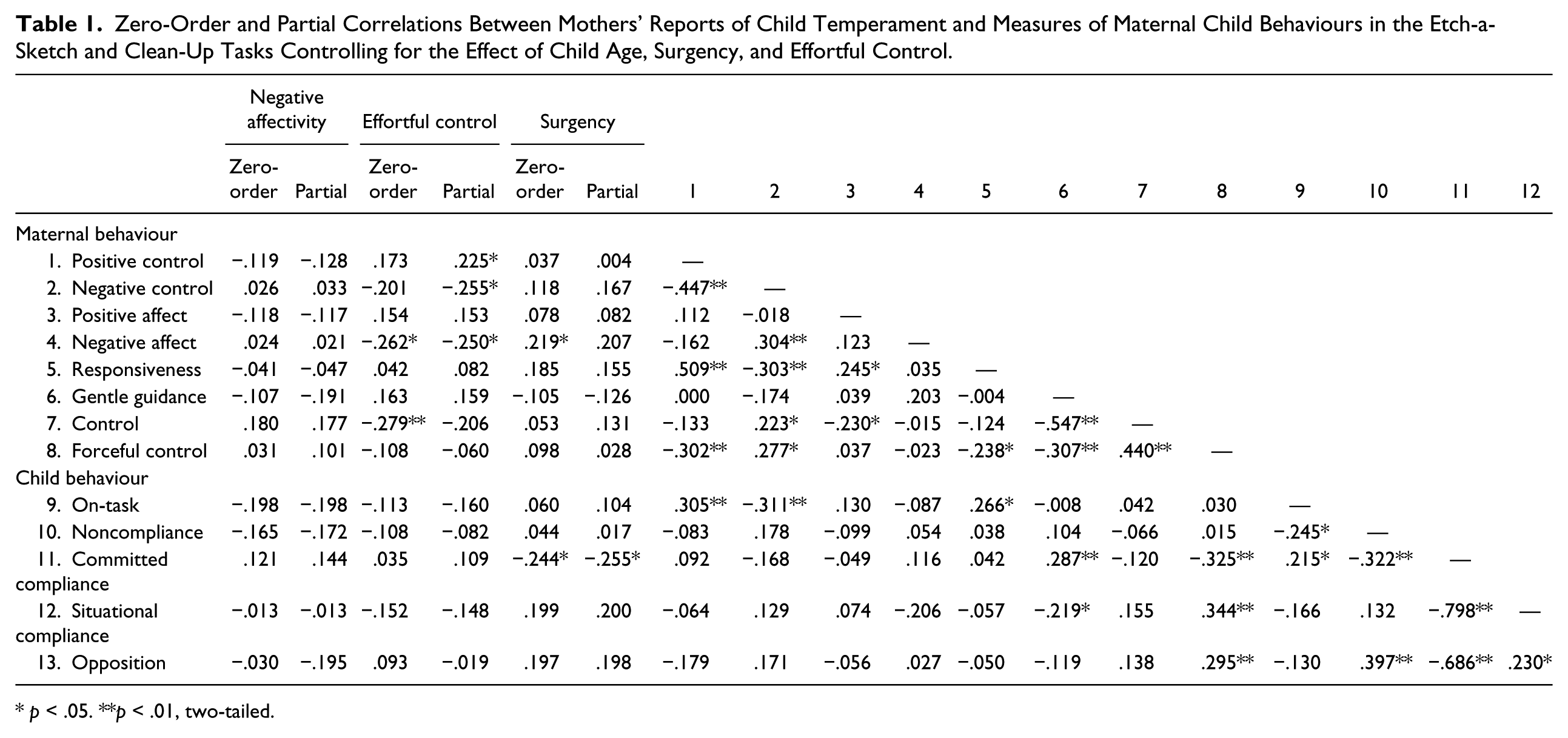
p < .05. **p < .01, two-tailed.
Cultural Difference in Observed Maternal and Child Behaviour in the Etch-a-Sketch Task
A one-way multivariate analysis of covariance (MANCOVA), with child age and effortful control as covariates, was conducted to examine the effects of cultural group on measures of observed maternal and child behaviour in the Etch-a-Sketch task. Child gender was not included as an independent variable because no association was evident in the preliminary analyses. The MANCOVA revealed a significant main effect of cultural group, F(2, 78) = 2.880, Pillai–Bartlett trace = .321, p = .011, η2 = .161. The achieved statistical power of this MANCOVA was .957. Follow-up univariate analyses of covariance (ANCOVAs) with Bonferroni corrections were then conducted to examine the effects of covariates and cultural group on each of the dependent variables. The results revealed significant covariate effects of child age on maternal positive control, F(1, 84) = 4.671, p = .034, maternal negative control, F(1, 84) = 5.429, p = .022, and child noncompliance, F(1, 84) = 4.413, p = .039. The ANCOVA revealed significant effects for child effortful control (covariate) on mothers’ negative affect, F(1, 84) = 5.035, p = .027, and significant univariate effects for cultural group on maternal negative control, F(2, 84) = 6.224, p = .003, positive affect, F(2, 84) = 5.744, p = .005, and responsiveness, F(2, 84) = 4.077, p = .020. Subsequent pairwise comparisons revealed that the English mothers not only engaged in less negative control (MD = −0.693, p = .002) and were more responsive (MD = 0.653, p = .019) than the Chinese immigrant mothers, but also showed more positive affect than both Chinese immigrant mothers (MD = 0.696, p = .027) and Taiwanese mothers (MD = 0.851, p = .006). The mean scores and standard deviations are summarised in Table 2.
Cultural Group Differences in Observed Maternal and Child Behaviour in the Etch-a-Sketch and Clean-Up Tasks.

Cultural Differences in Maternal Control and Child Compliance in the Clean-Up Task
A 3 (Cultural group) × 2 (Child gender) MANCOVA, with child age and child temperament (surgency) as covariates, was conducted to examine the effects of cultural group and child gender on child compliance. The MANCOVA revealed significant effects for cultural group, F(2, 75) = 2.213, Pillai–Bartlett trace = .339, p = .010, η2 = .169, but no significant effects for child surgency, age, child gender, or the Cultural group × Gender interaction. The achieved power of this MANCOVA was .962. Follow-up ANCOVAs with Bonferroni corrections revealed a significant effect for cultural groups on situational compliance, F(2, 81) = 6.732, p = .002, and maternal forceful control, F(2, 81) = 6.426, p = .003, a significant effect of child age on committed compliance, F(1, 81) = 5.032, p = .024, and on maternal forceful control, F(1, 81) = 4.635, p = .034, and a significant effect of surgency on committed compliance, F(1, 81) = 5.314, p = .024, and situational compliance, F(1, 81) = 4.257, p = .042. Subsequent post hoc pairwise comparisons revealed that the Taiwanese children showed more situational compliance than the Chinese immigrant children (MD = 0.171, p = .002), and that the Taiwanese mothers used more forceful control than the English mothers (MD = 0.029, p = .002). The descriptive data on child compliance by cultural group are summarised in Table 2.
Interrelations Between Observed Maternal Behaviours and Child Compliance
Partial correlations among indices of observed maternal behaviour and child compliance controlling for child age, surgency, and effortful control were performed to examine the intercorrelations between observed maternal behaviours and child compliance across the two tasks. The results are presented in Table 1. The results showed that, within the Etch-a-Sketch task, mothers who used more positive control tended to be more responsive, Pearson’s r(89) = .509, p < .01, and to use less negative control, r(89) = −.447, p < .01; furthermore, the more positive affect the mothers showed, the more responsive they were, r(89) = .245, p < .05. On the other hand, mothers who used more negative control tended to show more negative affect, r(89) = .320, p < .01, and were less responsive, r(89) = −.303, p < .01. Children were more engaged in the task when the mothers used more positive control, r(89) = .305, p < .01, less negative control, r(89) = −.311, p < .01, and were more responsive, r(89) = .266, p < .05, whereas children’s noncompliance was not significantly associated with any maternal behavioural indices.
Within the clean-up task, mothers who used more gentle guidance used less control, r(89) = −.547, p < .01, and forceful control, r(89) = −.307, p < .01, and mothers who used more control also used more forceful control, r(89) = .440, p < .01. Children showed more committed compliance, r(89) = .287, p < .01, and less situational compliance, r(89) = −.219, p < .05, in response to mothers’ use of gentle guidance, whereas, with mothers’ use of forceful control, children responded with less committed compliance, r(89) = −.325, p < .01, more situational compliance, r(89) = .344, p < .01, and more opposition, r(89) = .295, p < .05.
As for the associations between maternal behaviour across the two tasks, mothers’ use of control in the clean-up task was associated with more negative control, r(89) = .233, p < .05, and less positive affect, r(89) = −.230, p < .05, in the Etch-a-Sketch task. Mothers’ use of forceful control in the clean-up task was associated with less positive control, r(89) = −.302, p < .01, and lower responsiveness, r(89) = −.238, p < .01, in the Etch-a-Sketch task.
Finally, children’s compliance across these two tasks also showed consistencies: Children who were more engaged in the Etch-a-Sketch task also showed more committed compliance, r(89) = .215, p < .05, in the clean-up task, whereas children who showed more noncompliance in the Etch-a-Sketch task showed less committed compliance, r(89) = −.322, p < .01, and more opposition, r(89) = .397, p < .01.
After the preliminary correlational analyses, we used hierarchical regressions to determine whether child characteristics, cultural group, and observed maternal behaviour predicted child compliance. In the following hierarchical regressions, child characteristics such as age, gender, and temperament were entered first to control for their effect on the outcome variables; cultural group and observed maternal behaviour were entered in the second step. We wanted to examine whether observed maternal behaviour and culture could account for child compliance after the effects of child characteristics were controlled for.
The dependent variables were the children’s observed compliance, including on-task and noncompliance in the Etch-a-Sketch task, committed compliance, situational compliance, and opposition in the clean-up task. For the analyses of on-task and noncompliance, child age, gender, and temperament (including negative affectivity, effortful control, and surgency) were entered in the first step to control for their possible effects. Cultural group was not included because there were no significant cultural group differences for these variables. In the second step, the mothers’ observed positive control, negative control, positive affect, negative affect, and responsiveness in the Etch-a-Sketch task were added.
For the analyses of committed compliance and opposition, child age, gender, and temperament, including negative affectivity, effortful control, and surgency, were entered in the first step to control for their possible effects on committed compliance and opposition. Cultural group was not included in the regressions for committed compliance and opposition because there were no significant cultural group differences for these variables. For the analysis of situational compliance, child age, effortful control, and surgency were entered in the first step; child gender and negative affectivity were not significantly associated with situational compliance in previous analyses, so they were excluded for this analysis. In the second step, the mothers’ observed gentle guidance, control, and forceful control in the clean-up task were added. Cultural group (using two dummy variables) was included in the second step for the analyses involving situational compliance as the outcome variable. The results of the hierarchical regressions are summarised in Tables 3, 4, and 5.
Summary of Regression Analyses Assessing Effects of Child Age, Gender, Temperament, and Mothers’ Observed Behaviour on Child Compliance in the Etch-a-Sketch Task.
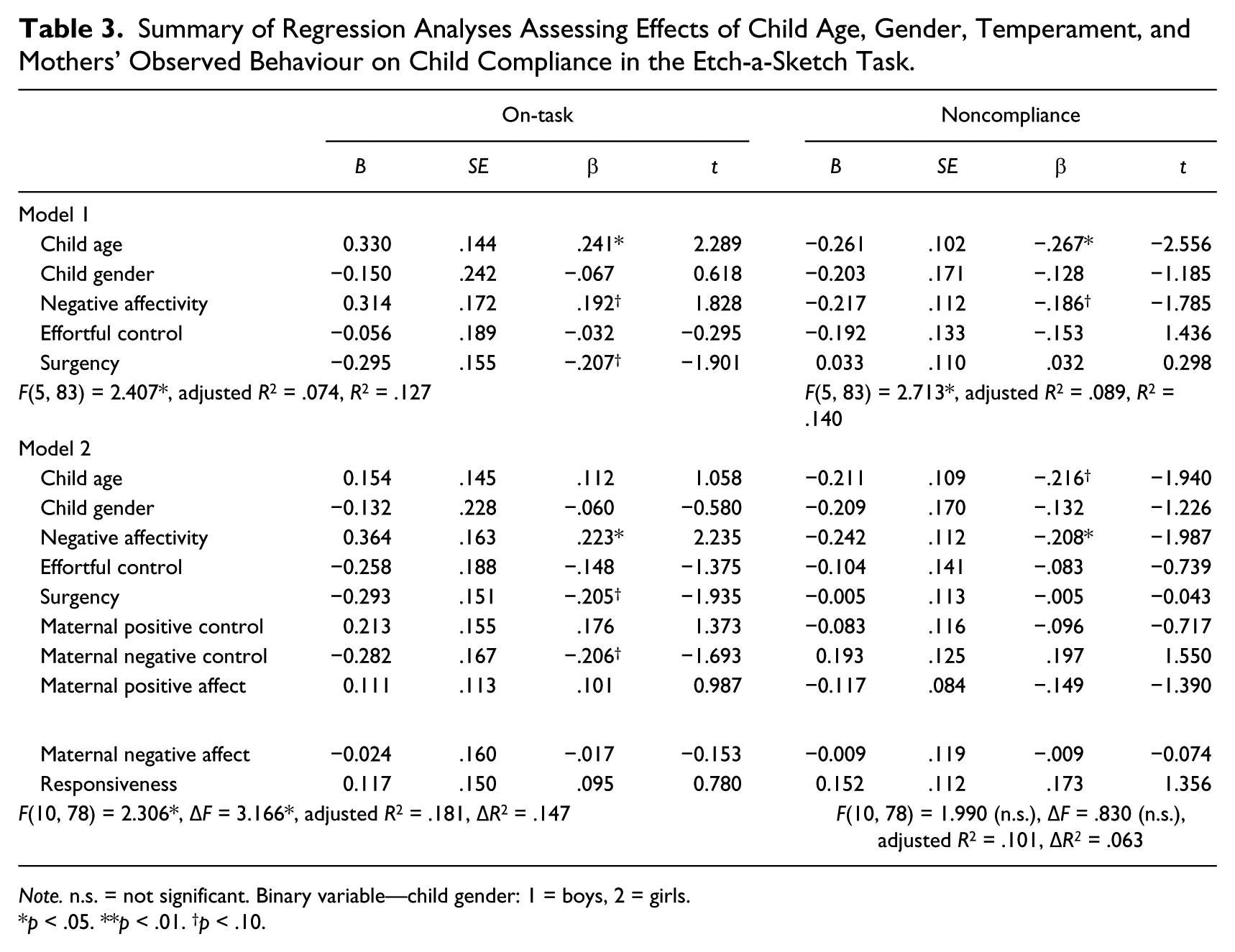
Note. n.s. = not significant. Binary variable—child gender: 1 = boys, 2 = girls.
p < .05. **p < .01. †p < .10.
Summary of Regression Analyses Assessing Effects of Child Age, Gender, Temperament, and Observed Maternal Control on Child Committed Compliance and Opposition in the Clean-Up Task.

Note. n.s. = not significant. Binary variable—child gender: 1 = boys, 2 = girls.
p < .05. **p < .01. †p < .10.
Summary of Regression Analyses Assessing Effects of Child Age, Temperament, Cultural Group, and Observed Maternal Control on Child Situational Compliance in the Clean-Up Task.
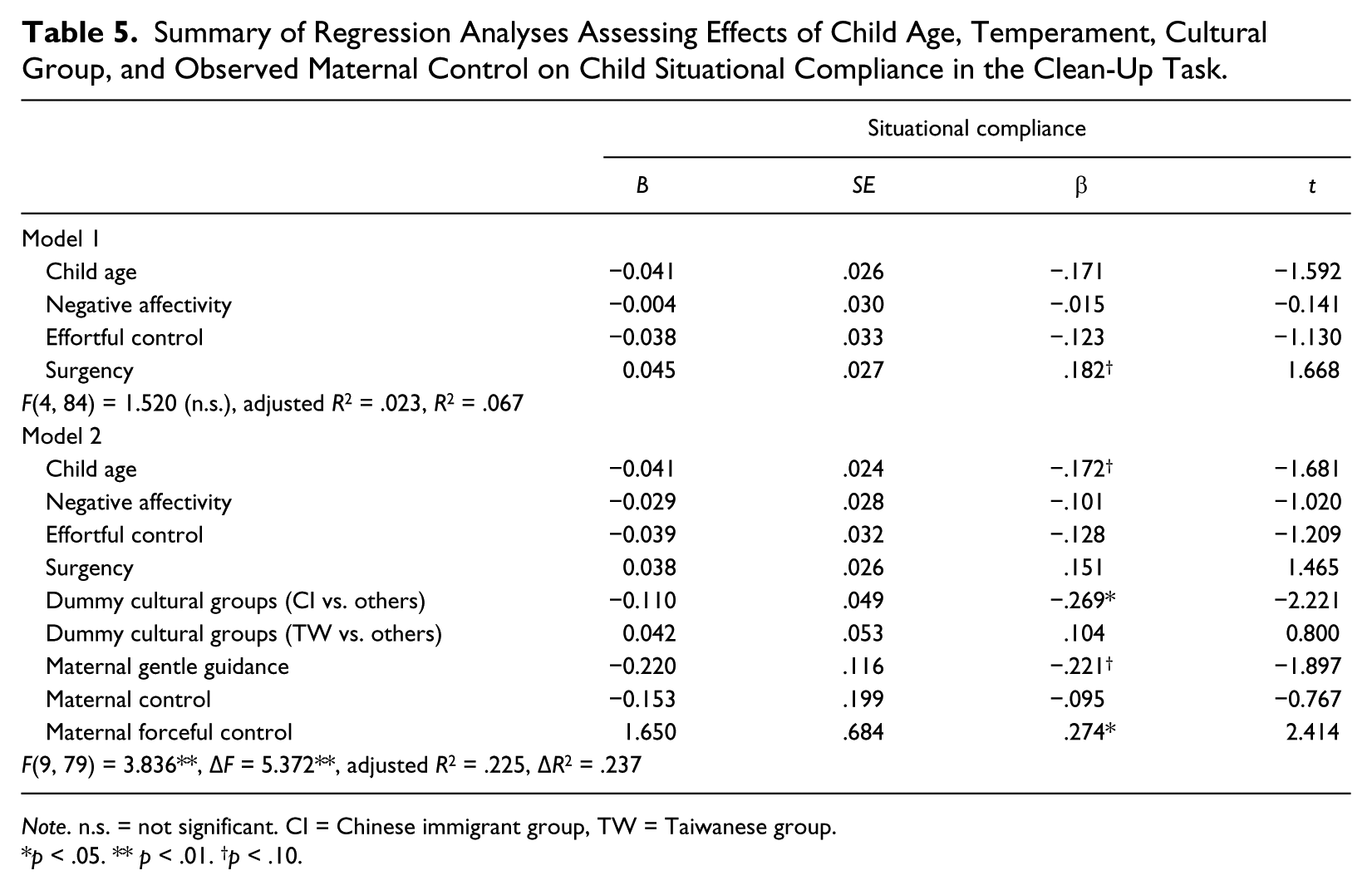
Note. n.s. = not significant. CI = Chinese immigrant group, TW = Taiwanese group.
p < .05. ** p < .01. †p < .10.
When the outcome variable was the child’s on-task behaviour, child age, gender, and temperament jointly explained 12.7% of the variance, R2 = .127, F(5, 83) = 2.407, p < .05. Adding mothers’ observed behaviour significantly increased the proportion of variance explained, ΔF(5, 78) = 3.166, p < .05; ΔR2 = .147, Cohen’s f2 = .175, showing a statistical power of .832. The regression coefficients indicated that child negative affectivity and surgency were most strongly associated with the children’s on-task behaviour in the Etch-a-Sketch task.
When the outcome variable was the child’s noncompliance, child age and temperament jointly explained 14% of the variance, R2 = .140, F(5, 83) = 2.713, p < .05. Adding mothers’ observed behaviour did not significantly increase the proportion of variance explained, ΔF(5, 78) = 1.230, p = .303; ΔR2 = .063, Cohen’s f2 = .079, showing a statistical power of .453. The regression coefficients indicated that child age and negative affectivity were most strongly associated with the children’s noncompliance in the Etch-a-Sketch task.
When the outcome variable was the child’s committed compliance, child age, gender, and temperament jointly explained 14.9% of the variance, R2 = .149, F(5, 83) = 2.908, p < .05. Adding mothers’ observed behaviour also significantly increased the proportion of variance explained, ΔF(3, 80) = 5.592, p < .01; ΔR2 = .147, Cohen’s f2 = .209, showing a statistical power of .945. The regression coefficients indicated that child age and maternal use of gentle guidance were most strongly associated with the children’s committed compliance in the clean-up task. Maternal use of forceful control was also strongly but negatively associated with the children’s committed compliance.
When the outcome variable was child opposition, child age, gender, and temperament jointly explained 10.2 % of the variance, R2 = .102, F(5, 83) = 1.884, p = .106. Adding observed maternal control in the clean-up task did not significantly increase the proportion of variance explained, ΔF(3, 80) = 2.537, p = .063; ΔR2 = .078, Cohen’s f2 = .095, achieved statistical power = .636, but the overall regression became significant, F(8, 80) = 2.194, p < .05. The results suggested that child opposition could not be predicted by child characteristics, and maternal use of forceful control was most strongly associated with child opposition.
When the outcome variable was the child’s situational compliance, child age and temperament jointly explained 6.7% of the variance, R2 = .067, F(4, 84) = 1.520, p = .204, which was not significant. However, adding cultural group and observed maternal control in the clean-up task significantly increased the proportion of the variance explained, ΔF(5, 79) = 5.372, p < .01; ΔR2 = .237, Cohen’s f2 = .341, achieved statistical power = .991. The regression coefficient indicated that observed maternal forceful control was the strongest predictors of child situational compliance in the clean-up task. Besides, being in the Chinese immigrant group significantly decreased the level of situational compliance.
Converging trends across these two contexts for committed compliance revealed that child age and temperament were the most significant predictors of committed compliance in the clean-up task and on-task behaviour in the Etch-a-Sketch task, while negative parenting (negative control in the Etch-a-Sketch task and forceful control in the clean-up task) was negatively associated with it. Different trends emerged for child opposition or noncompliance in these two tasks. In the Etch-a-Sketch task, noncompliance was accounted for by child age and temperament, but not by any maternal behaviour, whereas opposition in the clean-up task was not predicted by child age or temperament but was associated with maternal use of force. Finally, situational compliance could not be predicted by child age and temperament alone, but the addition of cultural group and maternal control significantly increased the prediction of situational compliance. These results suggested different pathways for the development of committed compliance, situational compliance, and opposition.
Discussion
Cultural Differences in Observed Parental Behaviour
Cross-cultural differences in parenting between Chinese and Western parents have been well documented in past research (e.g., Cheah et al., 2009; Su & Hynie, 2011; P. Wu et al., 2002), and we expected to find significant cultural differences in observed parental behaviour in the present study. Indeed, we found that, in the Etch-a-Sketch task, the Chinese immigrant mothers used more negative control than the English mothers, while the Taiwanese parents were rated in between the Chinese immigrant and English mothers in their use of negative control; the English mothers showed the most authoritative (high positive affect and responsiveness, and low negative control) behaviour when observed. In the clean-up task, the Taiwanese mothers used more forceful control than did the English mothers, and the Chinese immigrant mothers were rated in between their Taiwanese and English counterparts.
These findings were generally consistent with previous evidence that Chinese and Chinese American parents are more authoritarian (Kelley & Tseng, 1992; Lin & Fu, 1990; Porter et al., 2005; Wang & Phinney, 1998; P. Wu et al., 2002) and more controlling (for reviews, see Chao & Tseng, 2002; Pomerantz., 2008) than their European American counterparts. These differences could reflect Confucian socialisztion goals that emphasise children’s responsibility to be obedient and attend to the needs of their parents (Ho, 1986), which may promote strict control, intolerance of misbehaviour, and physical discipline in Chinese parents (Ima & Hohm, 1991; Tang, 1998, 2006). Extrapolating from previous research, we expected that the Taiwanese mothers would use more negative control than the other mothers, but the Chinese immigrant mothers, instead of the Taiwanese mothers, used the most negative control (criticism and physical intervention) when observed in the present study. Perhaps this was because the Etch-a-Sketch task was perceived as a cognitive task by the Chinese immigrant mothers, and so elicited more strict control and discipline from mothers who emphasised academic achievement. Notwithstanding this finding, the Chinese immigrant mothers and Taiwanese mothers used more negative control than the English mothers, as expected, although the difference between the Taiwanese and English mothers was not statistically significant. Most previous researchers have relied on parental self-reports, but in the present study, the findings were based on behavioural observation, underscoring the importance of including behavioural measures as well as self-reports when exploring cross-cultural differences.
Our findings echoed those of Jose and colleagues (2000) as well as Lin and Fu (1990) that immigrant Chinese parents reported parenting values more similar to those of Chinese parents than of Caucasian American parents. However, it may be that some parenting changes took place in the course of acculturation (Buki et al., 2003; Costigan & Su, 2008), which explained the difference between the immigrant Chinese and Taiwanese mothers’ parenting. These changes in the immigrant Chinese mothers’ parenting might help to explain the resulting difference in child compliance between the immigrant Chinese and Taiwanese children, because their endorsement of authoritative parenting fostered children’s behaviour regulatory abilities (Cheah et al., 2009; Wang & Phinney, 1998).
Both the Taiwanese and the Chinese immigrant mothers showed less positive affect than the English mothers, perhaps because the Chinese culture emphasises emotional restraint to promote harmony and healthy adjustment (Chao, 1994; Kelley & Tseng, 1992; P. Wu et al., 2002). Interestingly, there were no comparable differences in negative affect, possibly because little negative affect was shown. Research has previously shown that Chinese parents in Mainland China as well as in the United States downplay expressions of warmth (Chao, 1994; Kelley & Tseng, 1992; P. Wu et al., 2002). Therefore, it was not surprising to find less positive affect expressed by Taiwanese and Chinese immigrant mothers than by their English counterparts. The present study also revealed significant cultural differences in observed parenting even after partialling out the effects of child age and temperament, but there were fewer significant differences than expected, and there were unexpected differences as well, possibly because the sample size precluded identification of small differences. Some findings might also reflect the rapid social, political, and economic changes currently taking place in some regions of China (e.g., Chang, Lansford, Schwartz, & Farver, 2004; X. Chen, Bian, Xin, Wang, & Silbereisen, 2010; X. Chen & Chen, 2010; Li & Lamb, 2013).
Cultural Difference in Child Compliance
A variety of social and cognitive factors, including attention, language, memory, social communication, and interaction affect the development of self-control and compliance (e.g., Kochanska & Aksan, 2006). Previous research (e.g., X. Chen et al., 2003) led us to expect that the Taiwanese children would show the most, and the English children the least, committed and situational compliance. However, our findings revealed cultural differences only in situational compliance: The Taiwanese children showed significantly more situational compliance than children in the other two groups. This finding suggests that, when being pressured to comply with maternal requests, the Taiwanese children show the obedience emphasised in Confucian teaching as well as the Chinese culture’s emphasis on self-control and compliance (Chao, 1995; Ho, 1986). Contrary to expectation, the Chinese immigrant children did not show as much situational compliance as the Taiwanese children, although their mothers used high levels of negative control. Perhaps, as immigrants moving from a collective culture to an individualistic culture, immigrant Chinese parents feel that they must encourage their children to be independent and autonomous to fit in. For instance, Lin and Fu (1990) and Wang and Phinney (1998) both found that immigrant Chinese mothers of preschoolers sought to promote their children’s self-reliance and independence more than Anglo American mothers did. This might help to explain why the Chinese immigrant children in the present study showed less situational compliance than their peers.
Unexpectedly, we also observed no cultural differences in children’s committed compliance, whereas X. Chen et al. (2003) reported that Chinese toddlers showed more committed compliance than their Canadian peers. This may be attributable to the different ages of the children in these two studies. X. Chen and colleagues’ (2003) study involved 2-year-old toddlers, whereas we studied children who were 5 to 7 years old. In line with Kopp’s theory (1982), Kochanska et al. (2001) found (in White American families) that committed compliance showed an upward trend from 14 to 33 months of age, levelling off at around 33 months. It is possible that Chinese children start to develop committed compliance and self-control earlier than Western children, thereby accounting for the cultural difference in X. Chen et al.’s (2003) study. However, by the age of 5 to 7 years, levels of committed compliance may already have stabilised, leaving no cultural differences. However, further research is needed to clarify these findings, especially because relevant research on children aged 5 to 7 is still rare.
Associations Between Parenting and Child Compliance
The links between parenting and child compliance have been documented consistently in past research (e.g., Chamberlain & Patterson, 1995; Kochanska & Aksan, 1995, 2006; Wahler, 1997). In the present study, it was anticipated that, in the Etch-a-Sketch task, observed maternal positive control and responsiveness would be positively associated with child on-task behaviour, while negative control would be negatively associated with child on-task but positively associated with child noncompliance. With respect to the clean-up task, maternal gentle guidance was expected to associate positively with children’s committed compliance but negatively with situational compliance and opposition, while maternal forceful control was expected to correlate negatively with committed compliance but positively with situational compliance and opposition.
Our hypotheses were only partially confirmed. We found the expected converging trends regarding child on-task and committed compliance, but not for noncompliance or opposition. Negative and forceful parental control was indeed negatively associated with child on-task and committed compliance, even after child characteristics (age, gender, and temperament) were controlled for (e.g., Kochanska, 1995, 2002; Kochanska & Aksan, 2006; Smith, Calkins, Keane, Anastopoulos, & Shelton, 2004), but associations between sensitive and positive parenting and committed compliance were only significant in the clean-up context (e.g., Belsky, Pasco Fearon, & Bell, 2007; Blandon & Volling, 2008; Li-Grining, 2007; Spinrad et al., 2007). This may be attributable to our smaller sample size or to the fact that most of our participants were of Chinese origin, rather than Caucasian.
Somewhat different correlates of child noncompliance were evident in the two tasks. In the Etch-a-Sketch task, child noncompliance was accounted for by child age and temperament, whereas in the clean-up task, child opposition was not accounted for by age, gender, or temperament but by forceful maternal control. It is possible that because these two tasks were very different in nature, they elicited very different child responses. In the clean-up task, which required children to perform an unpleasant task (tiding up toys) for some time, the children in this study were old enough to have sufficient self-control (e.g., Kochanska, 2002; Kochanska et al., 2001) to perform the task. Therefore, opposition was only evident when mothers used force. In the Etch-a-Sketch task, the children encountered a cognitively challenging task, so maturation and temperament were both important. These finding suggested different developmental pathways in different contexts, and highlighted the importance of examining behaviour development in different cultural and situational contexts.
Interestingly, negative parenting (forceful parental control in the clean-up task) was positively associated with situational compliance, and this association was still significant even when the effects of child characteristics (age, gender, and temperament) were taken into account. It may be that negative and controlling parenting behaviours have a stronger or more immediate impact on children’s regulatory skills than on internalised control (X. Chen et al., 2003). Indeed, Karreman, van Tuijl, van Aken, and Dekovic (2006) found in a meta-analysis that parental control, but not responsiveness, was significantly associated with children’s compliance. We found that children from Chinese (Taiwanese) cultural backgrounds were more likely to comply (even though unwillingly) with high-power parental control than were their peers, which might reflect the Chinese emphasis on obedience. It is also possible that, because the Chinese culture emphasises and values self-control (X. Chen et al., 2003; D. Y. H. Wu, 1996), the Chinese mothers expected their children to show more committed compliance and thus rewarded children who displayed this form of compliance with warm and responsive parenting. In contrast, previous research has shown that children who require external support to ensure compliance may be considered socially and behaviourally incompetent (X. Chen et al., 2003). Accordingly, Chinese mothers might view situational compliance as less acceptable than would English mothers, and their resultant disappointment or frustration might lead them to behave harshly and punitively. It is worth noting that the effects of cultural group and parental control were still significant after child characteristics were taken into account. Thus, the present findings highlight the role of socialisation practices in shaping behaviour in early childhood, when self-regulation is developing (Kochanska, Murray, & Harlan, 2000).
Effects of Child Age, Gender, and Temperament
As expected, child age was associated with many indices of observed child and maternal behaviour. Older children received less negative control and more positive control from their mothers than did younger children. Previous research has shown that parenting changes as children grow older, especially during infancy and early childhood (e.g., Crouter & Booth, 2003; Dunn & Plomin, 1990; O’Connor, 2002), perhaps in response to developmental differences in children’s self-regulatory, cognitive, and communicative abilities. Mothers can use more positive means (e.g., explanation, guidance, and encouragement) to control older children’s behaviour because older children can understand verbal guidance and reasoning better than younger children. Parents of younger children may resort to more negative controls (e.g., direct physical intervention or criticism) because it is more difficult and time consuming to reason with them. Also consistent with previous findings, older children showed more committed compliance in the clean-up task. The maturation of children’s self-regulatory abilities may well explain age differences in committed compliance and engagement in tasks that require self-regulation and the ability to sustain attention. However, contrary to expectation, child age was not positively correlated with maternal reports of effortful control, perhaps because the present study had a cross-sectional design, with effortful control scores of different individuals compared, whereas other researchers have studied children longitudinally (e.g., Eisenberg, Spinrad, & Eggum, 2010; Posner & Rothbart, 1998; Rothbart & Bates, 2006; Rothbart & Putnam, 2002).
As for gender differences, mothers did not treat boys and girls differently, but they did report that boys had higher levels of surgency than girls, which was consistent with previous findings (Else-Quest, Hyde, Goldsmith, & Van Hulle, 2006). The gender differences in observed child compliance were consistent with those obtained in previous researches on compliance (Kochanska & Aksan, 1995; Kochanska et al., 2001). The higher surgency scores of boys also help explain their lower levels of committed compliance, because surgency was negatively associated with committed compliance. Child gender did not predict committed compliance when factors such as child age and temperament were taken into account but there was a near-significant (p < .10) association between surgency and committed compliance.
As expected, the mothers were observed using more positive control and less negative control, and showing less negative affect with children who were characterised by higher levels of effortful control. More self-regulated children may elicit parental guidance and responsiveness, whereas children who are low in effortful control can force parents to be more power assertive (Kochanska & Aksan, 1995). The correlation between effortful control and parenting could also be driven by maternal behaviour: Authoritative parenting—including the use of reasoning and induction—may direct children’s attention to the consequences of their misdemeanours for others, and thereby foster the internalisation of family and social rules about self-regulation (Grusec & Goodnow, 1994; Hoffman, 2000). Besides, authoritative parents encourage their children’s autonomy, which provides opportunities for children to develop self-regulatory abilities, including effortful control (Zhou, Eisenberg, Wang, & Reiser, 2004). In contrast, authoritarian parents rely on direct parental control of their children’s emotions and behaviour, which may interfere with the development of self-regulatory abilities (Hoffman, 2000; Manire & Power, 1992).
However, we did not find the expected associations between effortful control and committed compliance. In the present study, child effortful control was reported by mothers and child compliance was rated by observers, whereas Kochanska and her colleagues (1998, 2001, 2007) assessed both effortful control and child compliance using observations and maternal reports, with good convergence between mother-reported and observed measures of effortful control. Perhaps cross-cultural researchers should consider using both maternal report and observational measures to allow for more accurate and reliable assessments of effortful control.
Also contrary to expectations, surgency was negatively associated with committed compliance. In previous research, shyness (one of the components of surgency) was associated with committed compliance in the “don’t” task (inhibition of temptation) but not the “do” (clean-up) task (e.g., Kochanska et al., 2001), so significant associations between surgency and committed compliance in the “do”/clean-up task were not expected. Perhaps active, impulsive, pleasure-seeking (all components of surgency) children might find the clean-up task difficult because it requires sustained attention to unpleasant and tedious activities.
Strength, Limitations, and Future Directions
The present study provided unique insights into parenting and child compliance in different cultural contexts. It was the first to examine parenting and child compliance in matched groups of Chinese (Taiwanese), immigrant Chinese, and English families who were observed. Measures were taken to reduce the effects of the observer on mother–child interaction (Gardner, 1997, 2000). For instance, the observations took place in the participants’ homes, there was time for the mother–child dyads to habituate to the presence of the observer before the task started, the video recording equipment was very small, and the observer/researcher had met the mothers and children earlier.
However, some limitations need to be acknowledged. First, the present sample was fairly small and the parents tended to be well educated. Future studies involving larger, more demographically diverse samples may provide further insights. Second, this study only investigated mother–child interactions, although fathers, too, affect child development both directly and indirectly (Lamb, 2010). In addition, Chuang and Su (2009) found that Chinese (both Chinese Canadians and those in People’s Republic of China) fathers and mothers had quite discrepant views of the importance of obedience, suggesting that they might socialise children differently. In Chinese culture, the traditional paternal role is associated with authority and strict discipline (Li & Lamb, 2013). The Chinese adage “strict father, warm mother” (嚴父慈母) portrays fathers as more authoritarian, controlling, and strict than mothers, who are portrayed as nurturing and supportive (Wilson, 1974). Therefore, it is important to examine the influence of both mothering and fathering on child compliance. Third, the mother–child dyads were only observed once in the present study, making generalisation to other situations questionable. Although observer reactivity effects did not appear to be very substantial, given appropriate measures to minimise the intrusion (Aspland & Gardner, 2003), it would be better in the future to include multiple observations and to follow the parent–child dyads longitudinally. Fourth, data from the “don’t” task were not included in the analyses because there was so little variability. Perhaps children have already developed self-control by this age (e.g., Kochanska et al., 2001), so future research may consider including stronger temptations in “don’t” tasks or using different tasks to assess children’s compliance. Finally, the present study only assessed children’s temperaments using a maternal report measure, whereas Kochanska and colleagues (1997, 2001) assessed child temperament using both questionnaires and observations. Such multimethod assessments are preferable.
Conclusion
The present study provided unique insights into parenting and child compliance in different cultural contexts in matched cross-cultural groups. Significant cultural differences were found in both observed parenting and child compliance even after child characteristics were taken into account. In particular, child situational compliance varied depending on cultural background, but similar differences were not evident in committed compliance. These findings suggest that the Chinese value of being obedient to parents might not have been fully internalised. In addition, the Taiwanese children may temporarily comply with their mothers’ assertive demands, but they may not internalise their mothers’ agenda when it is forced. Although limited by the moderate sample size and the correlational nature of the design, the present study still provides valuable insights into parenting and child compliance in different cultural contexts. It underscores the importance of looking at human development from a holistic perspective to best understand human development.
Footnotes
Acknowledgements
We are grateful to King’s College, Cambridge, for the generous funding that made the research possible. We would also like to thank all the families who contributed valuable time to participate in this research.
Authors’ Note
This research was conducted by Chin-Yu Huang as part of a PhD research project supervised by Michael Lamb at the University of Cambridge.
Declaration of Conflicting Interests
The author(s) declared no potential conflicts of interest with respect to the research, authorship, and/or publication of this article.
Funding
The author(s) disclosed receipt of the following financial support for the research, authorship, and/or publication of this article: This research was funded by King’s College, University of Cambridge. The first author received the Ferris research fund from King’s College, Cambridge, for the data collection.