



Abstract
In this study, we compared Chinese and American never-married heterosexual adults’ minimum mate selection criteria (N = 1,260) and write-in responses on additional criteria important in mate selection (N = 756). Participants’ mean age was 25.55 years (SD = 4.44), and data were collected in 2013. Having analyzed quantitative and qualitative data both separately and corroboratively, we discuss Chinese and American individuals’ cultural emphases and unique expressions regarding the relative prioritization of mate selection criteria and additional mate selection criteria typically not included in mate selection studies. We also compare our findings with the results of previous mate selection studies, highlighting possible developments in Chinese and American individuals’ mate selection criteria, and suggest potential modifications and extensions of existing survey items to more comprehensively capture individuals’ mate selection criteria, particularly in different cultural contexts.
Introduction
Studies on mate selection criteria commonly fall into three categories by the quantitative/qualitative nature and the cultural context(s) of their designs. First, in most studies on mate selection criteria, researchers examined a set of predetermined mate selection criteria within one (and most frequently, Western) cultural context, noting gender differences (e.g., Kenrick, Groth, Trost, & Sadalla, 1993; Kenrick, Sadalla, Groth, & Trost, 1990; Li, Bailey, Kenrick, & Linsenmeier, 2002; Sprecher, Sullivan, & Hatfield, 1994). Second, in some studies, researchers examined a set of predetermined Western-rooted mate selection criteria in cross-cultural settings, noting both cultural and gender differences (e.g., Buss et al., 1990; Higgins, Zheng, Liu, & Sun, 2002; Shackelford, Schmitt, & Buss, 2005; Toro-Morn & Sprecher, 2003). Third, in a handful of studies, researchers solicited participants’ qualitative responses on mate selection criteria (e.g., Buss & Barnes, 1986, Study 2; Boxer, Noonan, & Whelan, 2013). For example, Buss and Barnes (1986, Study 2) asked participants to “list in order the 10 most desirable characteristics in a potential mate” (p. 567). Many subsequent mate selection studies more or less incorporated the criteria developed in early classic studies as the base of their instruments, contributing to an accumulative body of empirical research and solidifying a set of criteria typically investigated in mate selection studies.
Cultural Differences in Mate Selection Criteria—Individualistic Versus Collectivistic
Perhaps one of the most significant and consistent findings in cross-cultural research on mate selection criteria has been the relative prioritization of different mate selection criteria between individuals from individualistic cultures and those from collectivistic cultures. The individualism-collectivism cultural dimension, proposed by Hofstede (1983), addresses “the relation between an individual and his or her fellow individuals” (p. 79). Applied to the mate selection process, researchers have suggested that individuals from individualistic cultures (like America) emphasize romantic love and hence, traits facilitative of emotional bonding and closeness, whereas individuals from collectivistic cultures (like China) value family continuity and conformity to society and others’ opinions of one’s marriage in the mate selection process (e.g., Dion & Dion, 1993; Higgins et al., 2002; Toro-Morn & Sprecher, 2003; Zhang & Kline, 2009).
However, though the respective cultural emphases are relatively clear, our understanding of the specific cultural expressions of these different emphases has been rather confined within the realm of a predetermined set of mate selection criteria. For example, Toro-Morn and Sprecher examined the importance of 23 mate selection traits to Chinese and American participants, and found that traits such as health and being a good housekeeper were more important to the Chinese than to the Americans, and traits such as sense of humor and attractiveness were more important to the Americans than to the Chinese. Higgins et al. (2002) asked their Chinese and British participants to rate the importance of a list of traits in their mate selection, and found their Chinese participants to assign less value to interests, but more value to morality, health, and chastity than their British participants did. However, we suspect that there might be other important expressions of the emphasis on family continuity and group harmony for individuals of Chinese culture (or other collectivistic cultures), because participants in those studies were only asked to rate a list of Western-rooted criteria and did not have the opportunity to suggest any additional criteria important in their mate selection.
Gender Differences in Mate Selection Criteria—Sexual Strategies Theory
Sexual strategies theory assumes that males and females are valued for gender-specific contributions to the survival of their offspring: males tend to be valued for qualities such as access to resources, social status, and wealth because these qualities are associated with their assumed ability to invest in their offspring; females tend to be valued for their physical capacity to give birth to viable offspring; therefore, signs of good physical condition, such as youth and beauty, are particularly valued (e.g., Buss & Barnes, 1986; Buss & Schmitt, 1993; Kenrick & Trost, 1989; Trivers, 1972). In addition, sexual strategies theory suggests that women tend to hold more stringent mate selection criteria than men do, because they generally invest more time and physical resources in their offspring than men do. Although these gender differences have been validated by many empirical studies (e.g., Buss, Shackelford, Kirkpatrick, & Larsen, 2001; Higgins et al., 2002), we are interested to see if there might be other culturally unique gender differences not typically explored in quantitative mate selection criteria studies.
Need for Updates, Modifications, and Extensions
As described above, most studies of mate selection criteria have relied solely on quantitative designs. One recent exception is the study conducted by Boxer et al. (2013), in which they asked participants (undergraduate students at four universities in America) to write in “their ‘top three characteristics’ preferred in their ideal partner” (p. 13). To our knowledge, there has been no qualitative study of mate selection criteria with participants of different cultural backgrounds. Although existing research has summarized key mate selection criteria and compared them across genders and cultures, new research is needed to monitor the applicability of these established criteria and to update them for newer generations of young adults in different cultural contexts. There are several reasons for this need.
First, the majority of mate selection research participants are college students approximately 20 years old (e.g., Buss et al., 2001). Although college students may represent an ideal group to study mate selection because most of them have never been married (Boxer et al., 2013), there is a growing need to study mate selection using an older, more representative sample, as the median age at first marriage for American men and women has increased to 28.6 and 26.6 years old, respectively, in 2012, a new high (U.S. Census Bureau, 2013). The mean age at first marriage for Chinese men and women has also increased to 24.6 and 22.8 years old, respectively (National Bureau of Statistics of China, 2012), with individuals in metropolitan areas having significant higher first-marriage age (for instance, the average first-marriage age for men and women in Shanghai was 30.0 and 27.3 years old in 2012, respectively; Wang, 2013). The gap between the mean ages of mate selection study participants and the median or mean age at first marriage of the general population suggests possible discrepancies between the mate selection criteria of typical study participants and of those to whom mate choices are considerably more imminent.
Second, some conventional mate selection criteria, albeit well documented in prior studies, might have become obsolete or taken on different meanings. For example, being a college graduate three decades ago might have been a strong indicator of social status, but because of the increase in average education attainment since then (see Barro & Lee, 2013), a more appropriate indicator of social status (via education-related variables) may be post-baccalaureate degree attainment.
Furthermore, it is worthwhile to investigate developments in the cultural differences of mate selection criteria. Although cultural comparisons have long constituted an important aspect of mate selection studies (e.g., Buss, 1989; Higgins et al., 2002; Toro-Morn & Sprecher, 2003), certain well-established cultural differences—especially between Western and Eastern cultures in mate selection—might have evolved or assumed new meanings as the cultures themselves have changed. For example, Geary, Vigil, and Bryd-Craven (2004) noted that women’s preference for men with whom they can form an emotionally satisfying relationship is more of a luxury and a higher priority for individuals from Western cultures compared with non-Western cultures. Although this finding might be valid for comparisons between older, traditional generations of Chinese and Americans, such differences might have become less distinct as the Chinese culture evolves alongside nationwide policies (e.g., Open-Door policy and One-Child policy). To this end, there is a need to periodically identify and evaluate differences in mate selection criteria and priorities between Chinese and American individuals. In addition, of the limited cross-cultural comparative mate selection studies, many have used established Western scales (e.g., Buss et al., 2001; Toro-Morn & Sprecher, 2003). Such designs may miss the complexity of mate selection in non-Western cultures and lead to misunderstandings (Goodwin & Tang, 1996).
Last, many studies have compared mate selection criteria individually. For instance, Buss et al.’s (2001) studies assessed 18 independent criteria. Boxer et al. (2013) specified 27 categories in their qualitative analysis of the “top three characteristics” participants preferred in their ideal partners. Although comparisons by criteria produce rich, detailed information, they may also leave readers mired in parallel comparisons while missing key themes in the mate selection process.
In the present study, we attempted both to update and to extend our understanding of mate selection criteria, by summarizing core themes important to Chinese and American individuals in mate selection, as well as by highlighting participants’ common choices of mate selection criteria typically not included in mate selection surveys. To apply this approach, we used quantitative analysis and directed content analysis, both individually and corroboratively, as appropriate. For the comparisons between Chinese and American adults’ minimum mate selection criteria, we expected Chinese participants to have higher minimum criteria on traits related to family continuity and group harmony than American participants do. We expected, across the two cultures, male participants to have higher minimum criteria on appearance-oriented traits than female participants do, and female participants to have higher minimum criteria on resource-oriented traits than male participants do. We also expected women to have more stringent criteria than men do overall. Because the content analysis part of our study is inductive in nature, we did not have any specific hypotheses, but expected to observe unique cultural emphases and expressions of mate selection criteria.
Method
Sample
The data for this study represent a subset of the data collected in 2013 for a larger mate selection study. The target population for this study was never-married heterosexual adults, 18 to 39 years old, and citizens and residents of People’s Republic of China or America. We first enlisted acquaintances in China and America to forward the recruitment letter and the survey link to their contacts, and offered a lottery incentive (one Amazon gift card worth 50 U.S. dollars, and two Amazon gift cards worth 25 U.S. dollars were offered separately to Chinese and American participants) and a summary of the study’s findings for participation in the survey. This recruitment method yielded 708 qualifying participants across the two countries. We later used the Qualtrics online survey panel (http://www.qualtrics.com; for the recruitment of American participants) and Sojump online survey panel (http://www.sojump.com; for the recruitment of Chinese participants) to recruit an additional 672 qualifying participants. Qualtrics and Sojump were responsible for the compensation of their panelists. For the purpose of this study, we combined the two rounds of data. One hundred and twenty participants did not complete a large portion of the survey analyzed in this study, thus yielding 1,260 qualifying participants. The Chinese sample consisted of 656 participants (359 women, 297 men; M age = 25.79, SD = 3.84). The American sample consisted of 604 participants (366 women, 238 men; M age = 25.30, SD = 5.00).
At the time of the survey, 51.3% of the American participants were single and not involved in a relationship, 10.8% were dating but not serious, 32.1% were in a serious relationship, and 5.8% were engaged. The American participants were 65.7% non-Hispanic White, 15.6% White Hispanic, 12.3% Black or African American, 8.1% Asian, 1.7% American Indian or Alaska Native, and .3% native Hawaiian or other Pacific Islander. In terms of the highest level of education, 1.6% of the American participants did not graduate from high school, 13.1% graduated from high school, 31.3% had some college education, 7.0% had an associate degree, 14.6% had a bachelor’s degree, 16.6% had some graduate education, and 15.9% had a master’s degree or higher.
At the time of the survey, 47.7% of the Chinese participants were single and not involved in a relationship, 9.9% were dating but not serious, 36.6% were in a serious relationship, and 5.8% were engaged. The Chinese participants were 95.3% Han, and 4.7% were from ethnic minorities. In terms of the highest level of education, .7% of the Chinese participants did not graduate from high school, 3.5% graduated from high school, 2.1% had some college education, 20.9% had an associate degree, 47.7% had a bachelor’s degree, 7.6% had some graduate education, and 17.3% had a master’s degree or higher.
Of the 1,260 participants, 756 participants (169 Chinese men, 248 Chinese women, 114 American men, and 225 American women) listed additional criteria important to them in choosing a spouse in response to our qualitative question. Some of the remaining 504 participants stated that there were no additional criteria important to them in choosing a spouse (e.g., “I think your list covered them”), although the majority left this field blank. It is unclear whether they did not have any additional criteria or simply skipped the question.
Data
The survey instrument was originally devised in English. We took the following steps to ensure the conceptual equivalency between the English version and Chinese version of the survey
We recognize that self-reported mate selection criteria do not always translate to actual mate selection choices, which often involve complex tradeoffs and compromises (e.g., Li et al., 2002; Miller & Todd, 1998; Roberts & Little, 2008). To encourage participants to consider the tradeoffs among various mate selection criteria, we solicited participants’ minimum mate selection criteria, as compared with ideal preferences. We first asked male participants the following question: What are your minimum criteria in choosing a spouse? Please rate the following criteria on a scale from 1 to 10. For example, on the criterion “wealthy,” if you would only marry a wealthiest woman, please select 10. If you would marry a least wealthy woman, please select 1.
Female participants answered the same question, except for the word “woman” was replaced with the word “man.” Each participant rated 21 criteria, selected from well-referenced mate selection criteria studies (Buss & Barnes, 1986; Kenrick et al., 1993; Toro-Morn & Sprecher, 2003). We randomized the orders in which the 21 items appeared to avoid any sequence effect. We then asked participants: “Are there any other criteria important to you in choosing a spouse? What are they?”
Analytic Strategy
We first analyzed quantitative data on participants’ minimum mate selection criteria for between-culture differences and between-gender differences within each culture. We then conducted directed content analysis (Hsieh & Shannon, 2005) on participants’ write-in responses. We compared how frequently different criteria were mentioned by Chinese and American participants, and by men and women within each culture. We discussed whether our quantitative and qualitative data supported or complemented each other, and in which ways. We also discussed the differences and similarities between the relative prioritization of mate selection criteria found in the present research and prior mate selection studies.
In developing our coding scheme, we first examined mate selection survey instruments and items used in well-referenced studies (e.g., Buss & Barnes, 1986; Buss et al., 2001; Kenrick et al., 1993; Toro-Morn & Sprecher, 2003) and personality inventories, such as the Big Five Factors (i.e., extraversion, agreeableness, conscientiousness, emotional stability, and intellect) and Big Six Factors (i.e., the Big Five Factors plus a honesty-humility factor; for example, De Raad et al., 2010; Goldberg, 1992; Saucier, 2009). We also immersed ourselves in the data to develop additional codes as needed. To identify and understand the themes as well as the richness of the data, we designated both main categories and subcategories (e.g., personality is a main category, and agreeableness is a subcategory within this main category), and conducted analyses on different levels (i.e., by category totals and by subcategories).
Our open-ended question asked participants to list additional criteria important to them in choosing a spouse, and participants often responded with phrases and adjectives. Thus, we decided that our message units were adjectives, or phrases, often separated by a comma or “and” in participants’ responses. Even if a participant listed one criterion (or more frequently, descriptions of the same criterion) multiple times, we only assigned the corresponding code once, unless the participant’s response addressed different aspects of a same category, in which case we assigned different subcodes. For example, we assigned two subcodes—“compatible interests” and “compatible values”—for the response “similar interests and goals,” but only the second code for the response “similar values and worldviews.”
In addition, though at times it seemed plausible to infer meanings from participants’ responses, we based our coding strictly on participants’ explicit responses. For example, one participant wrote “must love cats,” which might suggest that the participant loved cats and wanted a spouse who shared this specific interest, thus meriting a compatibility code. But because the participant did not actually state any personal interest in cats, we only coded the response with “interests” (not “compatible interests”). In contrast, we coded the response “I want someone who likes to spend time outside. I love outdoor adventures” with “compatible interests.”
After developing the initial coding scheme and coding rules, two coders participated in coder training. Likely because the coding scheme included many subcodes, the reliability between the two coders was unsatisfactory when they were not equally familiar with the coding scheme. We then discussed the coding scheme further, merged overlapping categories as appropriate to reduce the amount of subcategories (e.g., we merged “sexual compatibility” and “sexual chemistry” into the subcategory “sex” under “attraction”), and conducted additional coder training. Following the modifications of the coding scheme and additional coder training, inter-rater reliability between the two coders was improved in our pilot test. Using 10% of the total sample (N = 76; every 10th response was selected), we then recorded an inter-rater reliability of κ = .95 using Cohen’s kappa. Differences of opinions between the two coders were resolved through discussions.
Results
Minimum Mate Selection Criteria—Quantitative Comparisons
Based on our quantitative data, Table 1 presents the cultural differences in minimum mate selection criteria between Chinese and American participants. Because of the large number of comparisons performed, we used a conservative Bonferroni-corrected alpha (α = .05 / 21 = .0024). Chinese participants had higher minimum criteria than American participants did on “high social status,” “powerful,” “wealthy,” “high earning capacity/potential,” “good family background,” “good housekeeper,” “healthy,” “popular,” and “creative.” American participants had higher minimum criteria than Chinese participants did on “honest and trustworthy,” “has a sense of humor,” “intelligent,” “exciting,” “highly educated,” “physically attractive,” and “religious.” Together, these differences suggest that overall, Chinese participants were more demanding on criteria related to status and family orientation, whereas American participants had higher requirements on various personality traits, attractiveness, and religiousness. These findings are congruent with previous findings on the different emphases in mate selection between individuals from collectivistic cultures and those from individualistic cultures.
Means and Standard Deviations of Minimum Mate Selection Criteria (Rank Ordered).
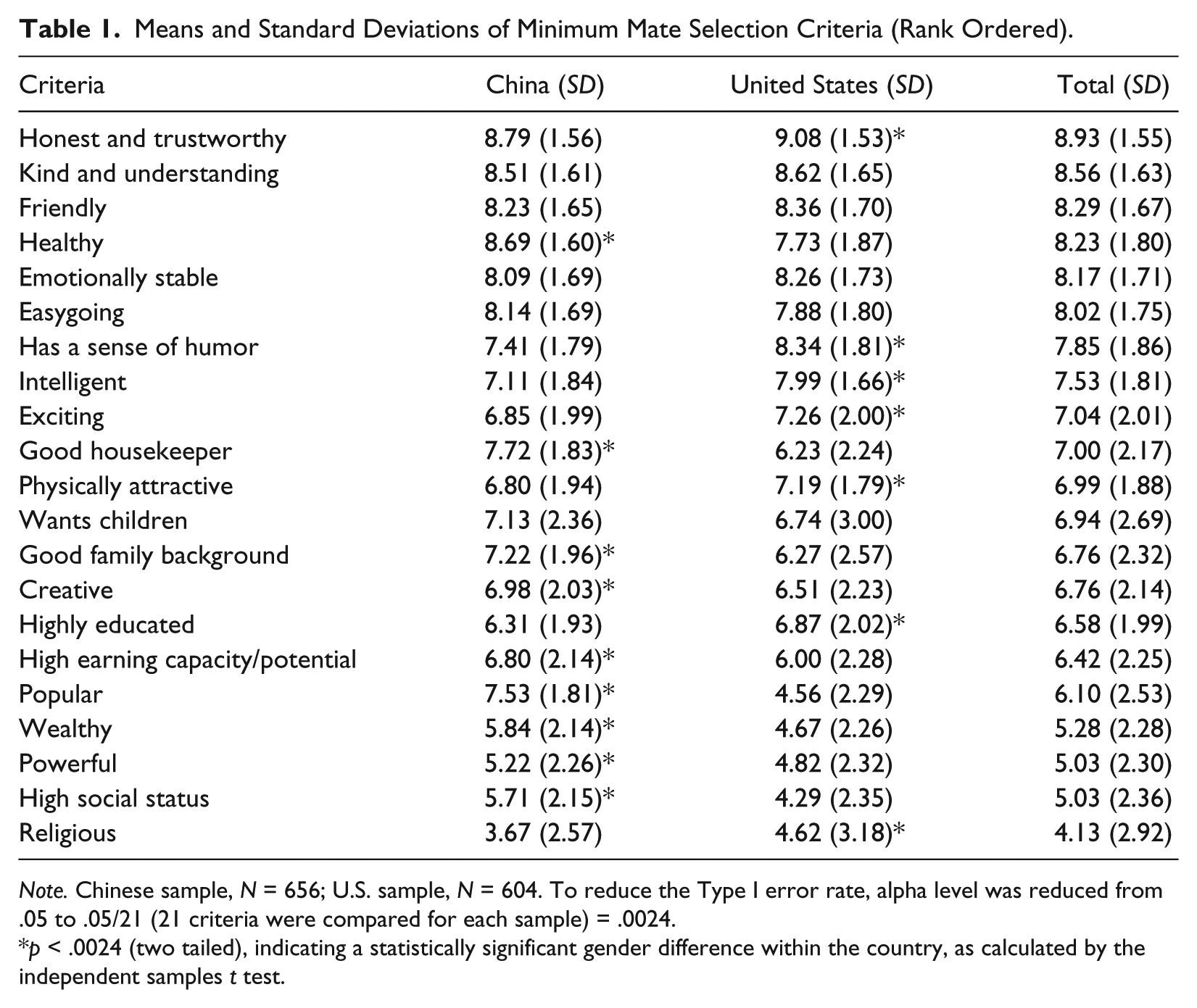
Note. Chinese sample, N = 656; U.S. sample, N = 604. To reduce the Type I error rate, alpha level was reduced from .05 to .05/21 (21 criteria were compared for each sample) = .0024.
p < .0024 (two tailed), indicating a statistically significant gender difference within the country, as calculated by the independent samples t test.
We also examined gender differences in minimum mate selection criteria within Chinese and American participants, respectively. For the Chinese participants, women had higher minimum criteria than men did on “has a sense of humor,” “intelligent,” “high earning capacity/potential,” “wealthy,” “powerful,” and “high social status,” whereas men had higher minimum criteria than women did on “good housekeeper,” “wants children,” “physically attractive,” and “religious.” These results fit well with the sexual strategies theory in mate selection. In addition, our content analysis revealed that more Chinese women than Chinese men listed conscientiousness, how the person treats me, and character, and more Chinese men than Chinese women mentioned values generally (see Table 2). One possibility is that, because men are better positioned to exercise control through hostility in intimate relationships (Lee, Fiske, Glick, & Chen, 2010), women seek an added layer of protection by implementing high minimum criteria on personality traits that may keep such potential hostility in check.
Code Counts of Additional Mate Selection Criteria—The 10 Most Coded Categories.

Note. Chinese male, N = 169; Chinese female, N = 248; U.S. male, N = 114; U.S. female, N = 225.
p < .05. **p < .01. ***p < .001, indicating a statistically significant gender difference within the country, as calculated by the chi-square difference test.
For the American participants, women had higher minimum criteria than men did on “honest and trustworthy,” “kind and understanding,” “friendly,” “emotionally stable,” “has a sense of humor,” “wants children,” “good family background,” “higher earning capacity/potential,” and “wealthy.” On no criterion did men have a higher minimum requirement than women did. This result may suggest that women had higher requirements for their spouses than men did, particularly on traits related to personality and family orientation. American women’s higher requirements on earning capacity/potential and wealth also fit with the sexual strategies theory. In addition, our content analysis revealed that more American women than American men listed honesty-humility, conscientiousness, and compatible values, whereas more American men than American women listed personality (in general), compatible personality, cultural compatibility, compatibility in race/ethnicity, and attractiveness (see Table 2). These results, when considered with findings from the quantitative analysis, suggest American women’s general focus on personality traits and American men’s focus on compatibility.
Additional Mate Selection Criteria—Content Analysis Results
Personality
Personality, as a category, was listed by 35.1% of the participants, the most of all categories. Personality traits’ importance in mate selection was echoed by eight of the top 10 highest minimum mate selection criteria from our quantitative results in the combined sample (see Table 1). This may suggest that, across the two cultures, participants were not willing to negotiate much on their future spouses’ personality traits though they might be willing to accept a lower perceived value of status and wealth, partly because personality traits are less likely to improve than, for example, wealth and education attainment, which can be acquired.
Cultural differences emerged on the honesty-humility and extraversion factors (see Table 3). A total of 8.9% of Chinese participants and 17.1% of American participants listed honesty-humility as an additional criterion, suggesting both a general emphasis on this trait and cultural differences in how much participants contemplated on this trait (χ2 = 11.55, p < .001). The prominence of honesty-humility in mate selection was reinforced by the quantitative analysis, as both Chinese and American participants placed their highest minimum demand on the item “honest and trustworthy.” Americans still demanded a higher minimum criterion on this item than did the Chinese (t = 3.31, p < .001), suggesting that the Americans valued honesty and trustworthiness in their spouse even more than the Chinese did. Although honesty-humility may be merged into the dimension of agreeableness (see De Raad et al., 2010), we assigned honesty-humility a unique subcode under agreeableness, because many participants highlighted distinctive features of this subdimension, such as “honest” and “trustworthy.”
Percentages of Participants Who Received Each Code—The 10 Most Coded Categories.
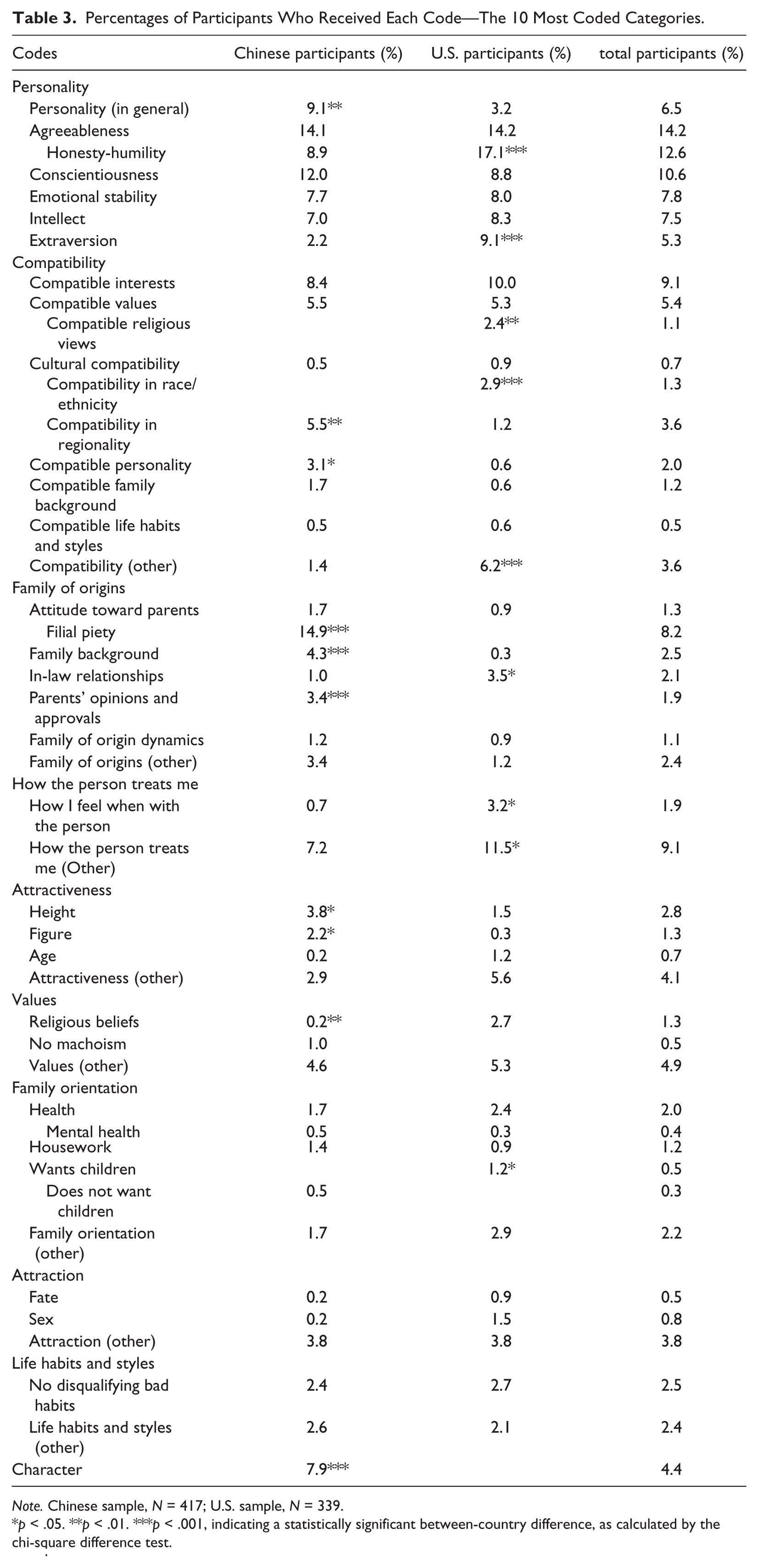
Note. Chinese sample, N = 417; U.S. sample, N = 339.
p < .05. **p < .01. ***p < .001, indicating a statistically significant between-country difference, as calculated by the chi-square difference test.
Only 2.2% of Chinese participants listed extraversion, whereas 9.1% of American participants did so (χ2 = 18.21, p < .001), suggesting that extraversion’s presence via multiple items in many mate selection surveys may be more appropriate for Americans (and maybe those from other Western cultures as well) than for the Chinese. Despite its dense representations in mate selection surveys by items such as “popular,” “exciting,” and “has a sense of humor” (e.g., Kenrick et al., 1993), only 5.3% of all participants listed extraversion, making it the least mentioned among all personality factors.
Although there was no significant difference between the percentages of Chinese and American participants who listed the agreeableness, conscientiousness, emotional stability, and intellect factors, we noted some interesting trends. First, agreeableness was listed by 14.2% of all participants, with no cultural difference between the two groups, suggesting universal emphasis on this personality factor in mate selection. Second, conscientiousness constituted 10.6% of the total codes, thus more represented than emotional stability, intellect, and extraversion. In existing mate selection studies, conscientiousness was often measured by, for example, “neatness,” “dependable character,” “ambition, industriousness” (e.g., Buss et al., 2001), and “conscientious,” “punctual,” and “careful” (e.g., Kenrick et al., 1993). Popular choices of terms by both Chinese and American participants suggest that “responsible” and “reliable” may measure this personality dimension well. Finally, emotional stability commanded high importance in both cultures (M = 8.09, SD = 1.69, for Chinese participants; M = 8.26, SD = 1.73, for Americans). Nonetheless, emotions are experienced differently in different cultures (e.g., Bond, 1993; Markus & Kitayama, 1991), and emotional stability might be a difficult concept to transfer cross-culturally. To this end, Chinese participants frequently used the terms mature and steady, two markers of emotional stability (De Raad et al., 2010), suggesting that these terms might be culturally appropriate candidates to measure emotional stability for Chinese participants.
Compatibility
Our content analysis validated the importance of compatibility in mate selection, as 15.5% of the total codes belonged to this category, second only to the category of personality. In total, 9.1% of all participants listed “compatible interests” and 5.4% of all participants listed “compatible values” as an additional criterion. Meanwhile, only 1.1% of participants, all Americans, listed “compatible religious views.” Although compatibility is an important theory in mate selection, some mate selection studies have omitted this criterion (e.g., Kenrick et al., 1993; Toro-Morn & Sprecher, 2003). Others (e.g., Buss et al., 2001) have included compatibility, but have focused on specific aspects of compatibility (i.e., “similar educational background,” “similar religious background,” and “similar political background”) that might not be as central as other aspects are to young adults today. We find that “compatible interests” and “compatible values” may be well positioned to measure individuals’ requirement for their future spouses’ compatibility with them, particular cross-culturally.
Within the category of compatibility, we observed cultural differences in different subcategories. More Chinese participants listed compatible personality than American participants did (χ2 = 6.14, p < .05). Compared with the Chinese, more Americans mentioned compatibility in a general sense (χ2 = 12.28, p < .001), along with compatible religious views (χ2 = 9.95, p = .002) and compatibility in race/ethnicity (χ2 = 12.47, p < .001), likely due to the different historical, cultural, and societal contexts of the two countries (e.g., about 91.51% of all Chinese are of the Han ethnicity [National Bureau of Statistics of China, 2011], whereas America is more racially and ethnically diverse). At the same time, more Chinese participants listed compatibility in regionality than American participants did (χ2 = 10.21, p = .001). One Chinese participant wrote, “[We need to] work in the same city (I won’t accept long-distance relationships).” Chinese young adults seemed particularly wary of the challenges associated with long-distance romantic relationships (e.g., Guldner, 1996).
Compared with the American college students in Boxer et al.’s (2013) study (M age = 19.89, SD = 2.38), American participants in our study (M age = 25.30, SD = 5.00) received significantly more compatibility codes, χ2 = 225.94, p < .001. Notwithstanding the likely differences in coding rules and consequent coding decisions between the two studies, this striking difference may nevertheless indicate that the priorities of older and younger never-married adults differ in mate selection, thus supporting the need to conduct more mate selection studies with participants who are more representative of the demographics of never-married adults in the general population.
Family of origins
Of the total codes, 10.6% were in the category of family of origins, specifically, 16.0% of the total codes from Chinese participants, and merely 3.8% from American participants (χ2 = 53.69, p < .001). Of all Chinese participants, 14.9% mentioned “filial piety” (or “xiao shun” as in Chinese), whereas no American participants mentioned it. This would appear to suggest that unique cultural concepts should be incorporated to measure individuals’ mate selection criteria for the measurement to be culturally compatible and accurate. For Chinese participants, and maybe individuals from other collectivistic cultures, future spouses’ fit with their family of origins might carry more importance compared with certain conventional mate selection criteria, such as social status (M = 5.71, SD = 2.15) or attractiveness (M = 6.80, SD = 1.94), on both of which Chinese participants had lower minimum criteria than on family background (M = 7.22, SD = 1.96). In addition, 1.0% of Chinese participants and 3.5% of American participants listed in-law relationships as an additional criterion (χ2 = 6.31, p = .01). Chinese people’s concern regarding difficult relationships between in-laws is well documented (e.g., Veronica, 2002; Zheng & Lin, 1994), but interestingly, more Americans than Chinese considered in-law relationships an important mate selection criterion. Perhaps despite their concerns related to this issue, Chinese people were more willing to live with such a predicament than were their American counterparts, and thus did not consider it a priority in their mate selection criteria.
Family orientation
Notably, Chinese and American participants did not differ much on the codes in the category of family orientation they received, despite differences in certain minimum criteria related to family orientation (e.g., good housekeeper). Of particular interest, though “wants children” has traditionally been indicative of family orientation, and thus desirable, it might not necessarily remain so for some participants. For example, two Chinese women listed “does not want children” and “have the same attitude toward not having children,” respectively, as their only additional criterion. This finding suggests that certain value-laden mate selection criteria may indeed be disqualifiers for some participants. In addition, as societal and cultural contexts change, traditionally desirable and even seemingly essential traits in mate selection might lose their appeal and importance. For example, double income no kids (DINK) families in China are no longer as taboo or rare as they once were (Faure & Fang, 2008).
Chinese people have been found to value family continuity highly in the mate selection process (e.g., Toro-Morn & Sprecher, 2003). Yet only 3.1% of all codes from Chinese participants were in the category of family orientation. In contrast, 16.0% of their codes were in the category of family of origins, a category rarely measured in mate selection studies. Although both family orientation—mainly directed toward future generations in the family—and family of origins—mainly concerns older generations in the family—affect family continuity, perhaps conventional mate selection criteria, rooted in the Western culture and focused on future generations, should adopt a different focus for Chinese individuals, who may be more focused on older generations in the family, as prescribed by traditional Chinese cultural values (e.g., filial piety). Meanwhile, the focus on the future generations in mate selection studies seemed more acceptable for American individuals, as only 3.8% of all codes from American participants were in the category of family of origin, compared with 4.3% in family orientation.
How the person treats me
In total, 7.2% of Chinese participants and 11.5% of American participants received the subcode “how the person treats me” (χ2 = 4.19, p < .05). Regardless of how wonderful someone is in general or to others, his or her treatment of the considering individual is most relevant to the individual’s mate choice. One participant stated, “It is important to me that my spouse is supportive and encouraging of my ambitions in life and strives to understand me as a person.” An additional .7% of Chinese participants and 3.2% of American participants received the subcode “how I feel when with the person” (χ2 = 6.56, p < .05). One participant wrote, You should [be] able to be 100% yourself around your spouse, without any holding back. And you shouldn’t EVER think for a second, “I wonder if they still love me, if I ___” like had an anxiety attack or something. You know your spouse will always be by your side.
Because of the importance of having a relatively secure attachment with one’s future spouse (e.g., Hazan & Diamond, 2000), two potential items to add to mate selection surveys may be “good to me” or “treats me well,” and “I feel safe with him or her.”
Wealth
Based on our quantitative data, Chinese participants had a higher demand for “wealthy” than American participants did (t = 9.41, p < .001). The differences between Chinese and American participants’ unique expressions on this common criterion are rather telling of their respective societal environments. For instance, some Chinese participants listed owning a home, whereas one American participant listed not having debt. In recent years, home prices have soared in China, especially in major cities, a situation that renders owning a home an ultimate dream for many individuals. As the Chinese cultural norm advises men to own a home before marriage, it is not surprising that home ownership may be a key consideration in Chinese individuals’ mate selection. In America, however, recent years of economic struggle have led many Americans to downsize their pursuit of owning one’s home to, for instance, renting (e.g., Streitfeld, 2011). Although only articulated by a few participants, these specific expressions of the criterion “wealthy” seemed to reflect participants’ respective societal narratives.
Attractiveness
“Attractiveness” has always been a feature item on mate selection surveys and most mate selection studies conduct some measurement for this criterion. In the current study, American participants had higher minimum criterion on attractiveness than Chinese participants did, and Chinese men, more than Chinese women. In addition, whereas attractiveness can be abstract and subjective, many participants listed concrete measurements of attractiveness or specific element of attractiveness. Specifically, 3.8% and 2.2% of all Chinese participants mentioned height and figure, respectively, as an additional criterion. Because height is closely associated with dominance and assertiveness (e.g., Melamed, 1992) and women’s preference for taller men may be connected to their endorsement of traditional gender roles and internalized social norms (Salska et al., 2008), it seems unclear which constructs underlie participants’ demand for height in their future spouse. With height being given so much emphasis by Chinese participants in particular, we might need to provide more detailed items—such as “overall attractiveness,” “height,” and “figure”—to separate different underlying constructs (e.g., status vs. attractiveness).
Discussion
Findings from the current study replicate well-documented cross-cultural and gender differences in mate selection criteria, and also generate many practical suggestions for future cross-cultural mate selection research and important theoretical implications. We found that Chinese participants tended to identify their criteria generally and abstractly. For example, 38 Chinese participants listed personality in general, without specifying personality traits or dimensions. In contrast, only 11 American participants mentioned personality in a general sense, significantly less than the frequency of Chinese participants (χ2 = 10.62, p = .001). Similarly, 33 Chinese participants listed “character” without specifying descriptions, whereas no American participant did so (χ2 = 28.05, p < .001). This culturally specific difference is intriguing. For example, the relative prioritization of Chinese and Western individuals’ mate selection focuses on family continuity and romantic love, respectively, or at least the degree of such relative prioritization, can be re-examined. Perhaps Chinese participants’ potential demands for romantic love and emotional closeness in mate selection were not measured efficiently. Their ratings on these constructs might indeed be higher if measured with items more compatible with their culturally familiar expressions, for example, if they were given “compatibility in general” instead of “similar religious background,” and “mature and stable” instead of “emotional stability.”
We may also consider offering “good personality” and “good character” as two items in abbreviated versions of mate selection surveys. Although doing so might lose rich information on which dimensions of personality participants value the most, it may assist studies seeking to capture central concepts in mate selection by shortening the time required to complete such surveys, and in turn, improving response and completion rate. It may also help researchers interested in rank ordering mate selection criteria, despite the method’s shortcomings (e.g., Li et al., 2002), by providing significantly fewer items for participants to rank, thus making the task more manageable and meaningful.
Furthermore, the ranking of minimum mate selection criteria presented in Table 1 exhibits a general resemblance to rankings in previous studies (see, for example, Buss et al., 2001; Toro-Morn & Sprecher, 2003). Interestingly, status has been ranked relatively and consistently low in various mate selection studies. For example, in Buss and colleagues’ (2001) multiple studies across a span of six decades of the preferences of 18 mate selection traits, “favorable social status” received an average ranking of 15.7th from men, and 14.2th from women. A similarly low prioritization of status was observed in the present study. Participants’ average minimum criterion on “high social status” ranks 20th out of the 21 criteria rated. Yet status has been frequently cited as an organizing criterion in individuals’ mate choices. For example, Regan (1998) found that both sexes demand long-term mates with a social status at least equal to their own. Sloman and Sloman (1988) suggested that individuals attempt to mate with others at or above their own levels of social status and attractiveness.
This discrepancy merits further investigation. Li et al. (2002) suggested that men and women tended to treat attractiveness and social status, respectively, as necessity traits in choosing a spouse. Another possibility may be that participants rated social status below its actual importance to them, due to social desirability bias (e.g., King & Bruner, 2000). Perhaps participants believed that imputing high importance to social status might make them appear, for instance, superficial, whereas designating high minimum criteria for personality traits such as honest and trustworthy might reflect positively on them. Yet another possibility may be that participants care less about social status than mate selection theories suggest they do (e.g., no participants mentioned status in response to our open-ended question). We contend that a combination of the abovementioned mechanisms may be at work. On the one hand, participants might feel inhibited to list high minimum criteria on social status, wary of the negative connotations associated with such a demand. On the other hand, social status was indirectly measured by more neutral criteria (e.g., high education attainment), on which participants might feel more comfortable reporting their true minimum criteria. For instance, “education, intelligence” was ranked 8.2th on average by men, and 7.5th, by women, in the multiple studies by Buss and colleagues (2001), much higher than the ranking “favorable social status” received. Consequently, they might report their true requirement on social status via these indirect measurements and not so much via the item “social status” itself.
We also might examine whether mate selection surveys in use indeed address the most important criteria in mate selection, especially cross-culturally. As one Chinese participant wrote, “In fact, many criteria you listed are not important.” Although there are many salient mate selection theories, items in most mate selection surveys reflect only a couple of these theories (e.g., sexual strategies theory). Participants’ repeat mentioning of certain mate selection criteria not always included in mainstream mate selection surveys highlighted the same concern. It might be worth broadening the theories tested in mate selection surveys, such as assortative mating, chemistry, and attachment theory, as results from our content analysis might suggest. We may accomplish this task with a few efficient items. For example, we may use “compatible interests” and “compatible values” to measure the importance of compatibility in mate selection, and “I feel safe with him or her” to measure the importance of secure attachment.
Furthermore, some researchers have attempted to extract a few underlying dimensions of various mate selection criteria (e.g., Goodwin & Tang, 1991; Shackelford et al., 2005; Simpson & Gangestad, 1992). As Shackelford et al. (2005) have noted, pan-cultural mate selection dimensions may only represent different cultures to different degrees. One way to improve the accuracy and usefulness of such pan-cultural solutions is to identify the most culturally appropriate items to measure these constructs within different cultures. For example, emotional stability may be best measured by “mature” and “steady” for Chinese participants but by “confident” and “secure” for American participants, as suggested by results from our content analysis.
More qualitative studies are required as societal and cultural environments in which young adults make mate selection choices evolve. More in-depth interviews of individuals’ mate selection experiences might deepen our understanding of unique and meaningful individual values in the mate selection process, and potentially generate new mate selection criteria appropriate and key to newer generations’ mate selection processes. In addition, despite the merit of comparing mate selection preferences and criteria across cultures, there is a need to adapt mate selection surveys to coincide with participants’ unique cultural backgrounds (such as adding items on family of origins for Chinese participants), particularly given that mainstream mate selection surveys have been predominantly rooted in Western cultures.
Although the qualitative question asked for additional criteria important in choosing a spouse, many participants listed criteria already included in the quantitative sections of the survey. Participants were exposed to the 21 criteria three different times (one related to evaluating oneself, another related to interpreting possible mates’ minimum mate selection criteria, and a third related to establishing one’s minimum mate selection criteria) before answering the qualitative question, and consequently, the likelihood of participants not remembering criteria already mentioned is relatively low. Nevertheless, it is possible that some participants mentioned these criteria because they forgot that these criteria were not “additional” to the survey as they were asked. Alternatively and more likely, based on the regular mentioning of criteria included in the list, certain criteria might be of particular importance for participants, whether they were mentioned in the original survey or not. For example, one participant explicitly stated, “Trustworthy is [the] most important and it was on the list.” In addition, our data came from participants who may represent savvy Internet users. Although younger adults are more likely to be Internet users, our study findings might not be very representative of individuals with limited access to the Internet. Moreover, subsequent researchers may consider investigating individuals’ mate selection choices in actual mate selection scenarios (for instance, on date matching websites) to address the limitation of relying solely on self-report measures. They may also adopt longitudinal designs to examine the consistencies and discrepancies between individuals’ self-reported mate selection criteria and their actual mate selection choices.
The current study has a few unique strengths. First, using an open-ended question, we were able to examine mate selection criteria not typically included in mate selection studies. Second, using participants whose demographics (e.g., age, ethnicity, education) were more diverse and representative of the general population of never-married heterosexual adults, our study findings were likely to be more indicative of the mate selection criteria that these individuals actually use. Third, the content analysis part of this study involved analyses and comparisons on the levels of both main categories and subcategories, thus allowing us to capture any themes as well as finer details.
Footnotes
Declaration of Conflicting Interests
The author(s) declared no potential conflicts of interest with respect to the research, authorship, and/or publication of this article.
Funding
The author(s) received no financial support for the research, authorship, and/or publication of this article.