




Abstract
Hofstede measured four dimensions of national differences: Masculinity, Individualism, Uncertainty Avoidance, and Power Distance. The information was obtained from IBM employees in more than 60 nations. Correlations applied to the national scores were close to zero for Masculinity with each of the three other dimensions. Correlations can be misleading because of regional and other variations in a world sample of nations. Undesirable effects of regional variations can be minimized by correlating differences between paired nearby nations in their scores on the two dimensions. Differences between pair members revealed that the nation with a higher score on Masculinity usually had a higher score on Individualism. A wide range of quantitative scores enabled large differences between the pair members and minimized omissions of data because of the same score for both members on either of the correlated dimensions. National Masculinity is highly correlated with national Individualism when regional differences are controlled.
Geert Hofstede (2001) reported quantitative scores on four general dimensions obtained from answers by IBM employees to questionnaires in more than 60 contemporary nations. One dimension, Individualism or Collectivism, has been the topic of much research reviewed by Triandis (2001) and discussed by Allik and Realo (2004). Another dimension, Masculinity or Femininity, was extensively described by Hofstede (1998). The other dimensions are Power Distance and Uncertainty Avoidance.
Hofstede (2001) reported evidence, from the scores of 50 nations, that Individualism and Masculinity were not correlated with each other. Subsequently, Borkenau, McCrae, and Terracciano (2013) briefly reported a correlation of .41, p < .05, between the same two dimensions in 38 or fewer of the sample of more than 60 nations.
Relationships between two variables are customarily measured by correlations applied to the scores for each nation. The correlations can be distorted by the effects of regional differences and other dimensions that are not measured. An alternative technique is to measure differences between pairs of nearby nations. The pair members control for undesired effects of regional differences. A similar technique is to measure differences between matched pairs of individuals.
Barry (2009, 2011) applied scores of individual societies and differences between paired societies in a world sample of 186 diverse societies. An example of different findings from the two applications is a correlation of .51 between amount of food obtained from animal husbandry and bride-price when applied to differences between 20 paired nearby societies but a correlation of −.06 when applied to scores of 186 individual societies (Barry, 2011). Food from animal husbandry and bride-price occurred most often in three of six world regions: circum-Mediterranean, sub-Sahara Africa, and East Eurasia. Differences among world regions negated the relationship between these two customs.
Method
The 32 pairs of nations are listed in Table 1. The principal criterion for selecting pairs was geographical proximity. Examples of extreme proximity, paired nations that share a large proportion of their land border, are Colombia–Venezuela, Canada–United States, France–Germany, Argentina–Chile, Portugal–Spain, and Norway–Sweden.
Scores on Masculinity (Mas) and Individualism (Ind) Are Shown.
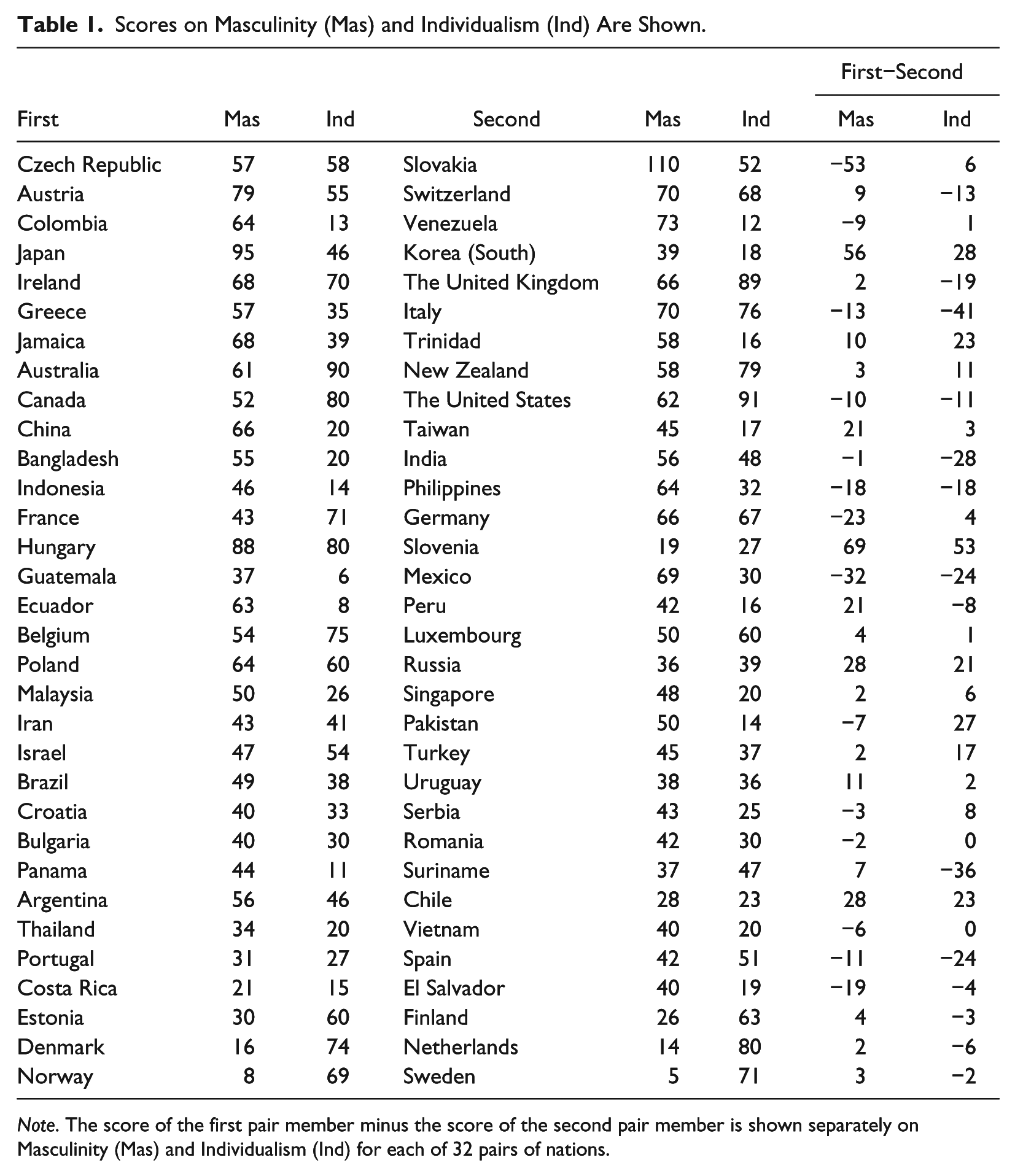
Note. The score of the first pair member minus the score of the second pair member is shown separately on Masculinity (Mas) and Individualism (Ind) for each of 32 pairs of nations.
Other pairs of nations were selected for the smallest available geographical separation. When geographical separation is similar for more than two nations, an additional criterion was similar population size or similarity of an important custom, such as dominant religion.
Five of the nations included by Hofstede (2001) are omitted from the comparison of scores of individual nations with differences between paired nations. Hong Kong became part of China; Yugoslavia was divided into three components, Slovenia, Croatia, Serbia, which are included in Table 1. No nearby nation is available as a pair member for Malta, Morocco, and South Africa.
A pair is omitted from the analysis if the difference score is zero on either dimension because the pair members have the same score. The difference scores of zero in Table 1 are for Bulgaria–Romania and Thailand–Vietnam. The wide range of quantitative scores minimizes the number of zero difference scores.
The dimension of Masculinity measures a preference in society for achievement, heroism, assertiveness, and material reward for success. Society at large is more competitive. Its opposite, Femininity, represents a preference for cooperation, modesty, caring for the weak, and quality of life. Society at large is more consensus oriented.
Individualistic people are expected to look after themselves and their immediate families. Collectivistic people are integrated into strong, cohesive groups, which protect them in exchange for unquestioning loyalty.
Power Distance measures inequality in boss–subordinate relationships. Components are subordinates who are afraid to disagree with superiors, authoritarian decision making by superiors, and subordinates preferring authoritarian decision making by superiors.
Uncertainty Avoidance pertains to employees in the work place. A high score is obtained from strong rule orientation, employment stability, and high stress expressed by the employee.
An additional variable, per capita gross domestic product in U.S. dollars, is listed for each nation in the World Almanac and Book of Facts (2003).
Correlations between two variables are applied to the difference score that is obtained by subtracting the score of the second pair member from the score of the first pair member. The difference score for the two variables is positively correlated if the same variable has a higher score for both paired nations and therefore the other variable has a lower score for both paired nations. The difference score is negatively correlated if the same variable has a higher score for one paired nation and a lower score for the other paired nation. Because the scores are quantitative, with more than two levels, a correlation differs more from zero if it contains larger difference scores for the two variables.
The correlation is the same regardless of which pair member is listed first because the positive or negative correlation depends on the relationship between the correlated variables instead of between the sequence of the pair members. For example, if the first pair of nations were Slovakia–Czech Republic instead of Czech Republic–Slovakia, the difference scores would be 53 instead of −53 and −6 instead of 6. The difference score on the same dimension would continue to be positive for one pair member and negative for the other pair member. The correlation is also the same regardless of which correlated variable is listed first, provided that the same variable is listed first in each pair.
The quantitative scores of each nation were reproduced in an electronic file. The statistical package used is Release 20 of SPSS, a component of the IBM Corporation. Norusis (2009) described some of the programs.
Results
The first row in Table 1 contains the pair of nations that has the highest total score on Masculinity, combining the scores of both paired nations. Successive rows contain decreasing Masculinity scores. The last two numbers in each row are the score of the second nation subtracted from the score of the first nation, separately for Masculinity and for Individualism.
For 18 pairs of nations, the difference score in the last two numbers of the same line was either positive or negative for both dimensions, Masculinity and Individualism, thereby contributing to a positive correlation. For 12 pairs, the difference score was positive for one dimension and negative for the other dimension, thereby contributing to a negative correlation.
The difference score was 10 or higher for both dimensions in 10 pairs. The unanimous contribution to a positive correlation contributed to the high positive correlation of .54 when applied to differences between the paired nations.
The correlation between each pair of variables is shown in Table 2. When the correlations were applied to the differences between scores of paired nearby nations, the highest correlation, .54, was for Masculinity with Individualism. Other statistically significant correlations were for Masculinity with low Uncertainty Avoidance and for high Power Distance with low per capita gross national product. The pairs of nations were fewer than 32 because a pair was omitted if the difference between the pair members was zero on either variable.
Correlation (r) and Number (N) Are Shown Between Pairs of Dimensions.
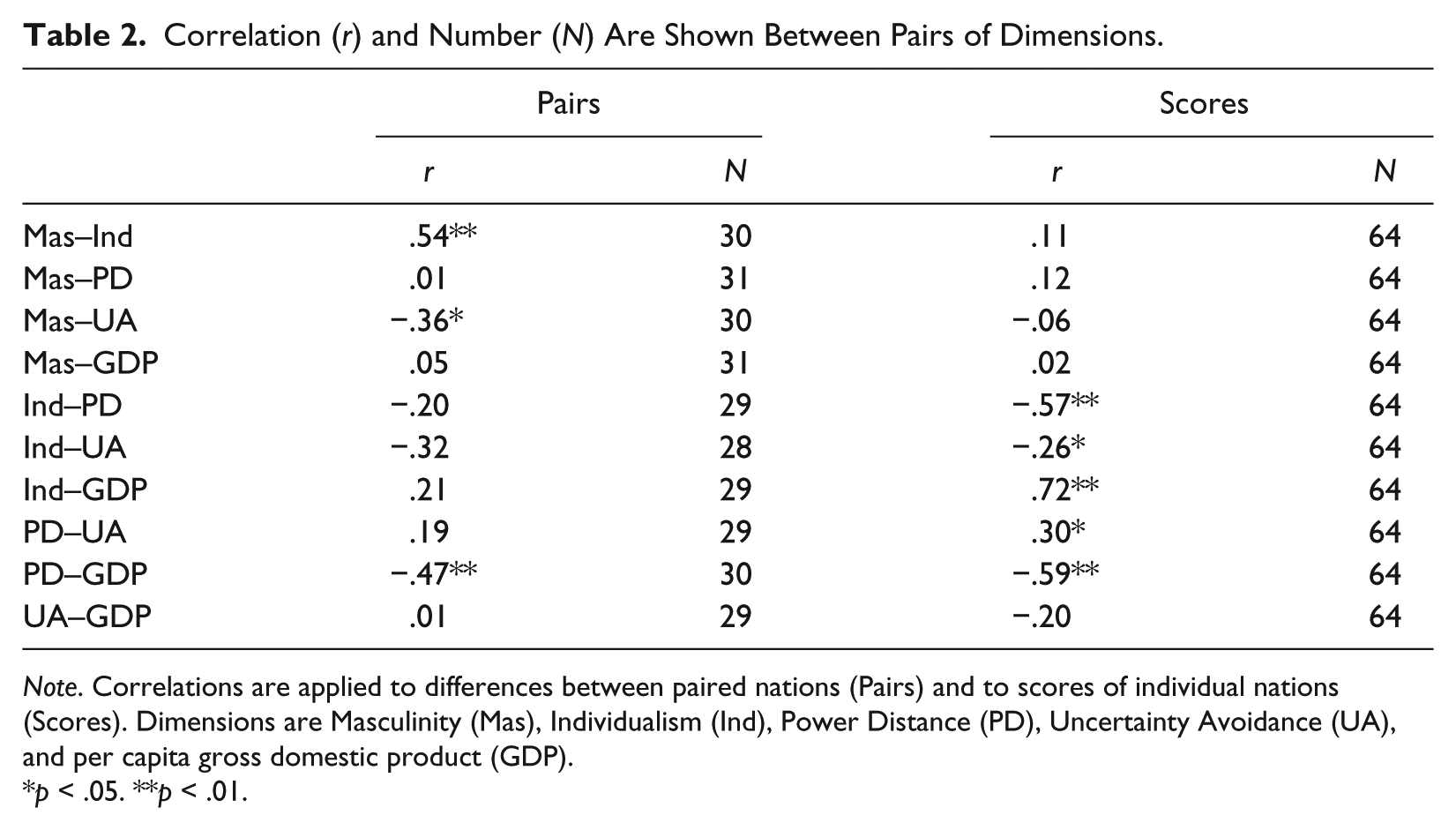
Note. Correlations are applied to differences between paired nations (Pairs) and to scores of individual nations (Scores). Dimensions are Masculinity (Mas), Individualism (Ind), Power Distance (PD), Uncertainty Avoidance (UA), and per capita gross domestic product (GDP).
p < .05. **p < .01.
When correlations were applied to scores of the 64 individual nations, none of the correlations for Masculinity with the four other variables was statistically significant. Five of the six correlations between the other variables were statistically significant.
In some world regions, such as Southeast Asia, North America, and Europe, both pair members had a much higher score on Individualism than on Masculinity. Examples are Australia–New Zealand, Canada–United States, Estonia–Finland, Denmark–Netherlands, and Norway–Sweden. In other world regions, such as South America, Central America, and eastern Asia, both pair members had a much higher score on Masculinity than on Individualism. Examples are Colombia–Venezuela, Japan–South Korea, Indonesia–Philippines, Guatemala–Mexico, Ecuador–Peru, and Malaysia–Singapore. These pairs of nations detracted from the positive correlation between Masculinity and Individualism when applied to scores of individual nations.
Correlations applied to scores of individual nations include the very high level of .72 for Individualism with per capita gross domestic product. Both variables have high scores in some regions, such as Europe, and low scores in other regions, such as South America. When correlations are applied to differences between pair members, the only statistically significant correlation with high per capita gross domestic product was .47 for low Power Distance.
Discussion
Most human families and communities are highly collectivistic. The majority of women are more collectivistic, oriented toward their children, other family members, and social relationships. The majority of men are more individualistic and competitive. Schmitt, Realo, Voracek, and Allik (2008) emphasized that the gender difference increased because of changes in men’s personality when nations developed. Borkenau et al. (2013) emphasized that the gender difference is greater in more individualistic nations.
The relationship of national Masculinity with national Individualism is obscured by regional differences. Hofstede (2001) portrayed large regional differences in both dimensions. The regional differences are controlled by measuring differences between paired nearby nations. The pair member with a higher score on Masculinity or Individualism usually has a higher score also on the other dimension.
The correlation close to zero for Masculinity with Individualism, when applied to scores of individual nations, agrees with a conclusion by Hofstede (2001). The high correlation for Masculinity with Individualism, when applied to differences between paired nations, agrees with the brief report by Borkenau et al. (2013).
The definitions of national Femininity and of national Collectivism imply the similar existence of cooperation and cohesive groups. The definitions of Masculinity and of Individualism imply the similar behaviors of achievement and looking after oneself.
In a world sample of diverse nations or societies, geographical variations can spuriously decrease or increase correlations between two variables. Measurement of differences between nearby nations or societies controls for effects of geographical differences.
Footnotes
Declaration of Conflicting Interests
The author(s) declared no potential conflicts of interest with respect to the research, authorship, and/or publication of this article.
Funding
The author(s) received no financial support for the research, authorship, and/or publication of this article.