



Abstract
The goal of this study was to examine relations between different forms of social withdrawal (shyness, unsociability) and indexes of adjustment in Chinese and Canadian children. Participants were fourth- to eighth-grade students in urban China (n = 787) and Canada (n = 1,033). Data on social withdrawal and adjustment were obtained from multiple sources, including peer nominations, child self-reports, teacher ratings, and school records. Multigroup tests indicated that relations between shyness and adjustment did not differ in Chinese and Canadian children. However, relations between unsociability and adjustment variables were significantly different across the countries, with unsociability more strongly associated with adjustment difficulties in China than in Canada. Results are discussed in terms of historical and cultural backgrounds related to values of group orientation and individuality.
The importance of the peer group in children’s development has been well-documented (Rubin, Bukowski, & Parker, 2006). Interpersonal interactions provide unique opportunities for enhancing children’s social and cognitive competence; children who do not engage socially with peers or are socially withdrawn may “miss out” on these benefits. Social withdrawal refers to the process whereby children remove themselves from opportunities for social interactions and has been described as an umbrella term that encompasses different reasons why children might choose to remain alone in the company of peers (Rubin, Coplan, & Bowker, 2009). Researchers now typically distinguish between shyness (i.e., social fear/anxiety that impedes motivations to socially engage) and unsociability (i.e., a nonfearful preference for solitude; Asendorpf, 1990; Coplan & Armer, 2007). In Canada, the United States, and many Western European countries, whereas shyness is related to indexes of socioemotional difficulties in childhood, unsociability appears to be a relatively benign form of social withdrawal (e.g., Coplan, Prakash, O’Neil, & Armer, 2004; Rubin et al., 2009). The goal of the present study was to explore cultural differences in the implications of shyness and unsociability in Canada and China.
Shyness and Unsociability in North American Children
Shyness is a temperamental trait characterized by wariness and anxiety in the face of social novelty and perceived evaluation (Rubin et al., 2009). From a motivational perspective, Asendorpf (1990) suggested that shy children experience an approach–avoidance conflict, whereby they wish to interact with peers (high social-approach motivation) but also fear social situations (high social-avoidance motivation). Shyness shares conceptual overlap with related terms such as behavioral inhibition (Kagan, 1997) and anxious solitude (Gazelle & Ladd, 2003).
From early childhood to adulthood, there is now considerable empirical evidence concurrently and predicatively linking shyness with indexes of maladjustment in North American and other Western cultures (Rubin et al., 2009). For example, results from research in Canada and the United States indicate that, compared with their more sociable counterparts, shy children display deficits in social and academic competence, lower self-esteem, and greater loneliness and depression, and tend to be rejected by peers (Coplan, Arbeau, & Armer, 2008; Coplan, Closson, & Arbeau, 2007; Gazelle & Ladd, 2003; Hughes & Coplan, 2010; Ladd, Kochenderfer-Ladd, Eggum, Kochel, & McConnell, 2011). Moreover, extreme shyness in early childhood places children at increased risk of the later development of clinical anxiety disorders (Biederman et al., 2001; Hirshfeld-Becker et al., 2007).
Unsociability or social disinterest refers to the nonfearful preference for solitude (Coplan & Weeks, 2010a). In contrast to shy children, unsociable children are characterized as having a combination of both low social-approach and low social-avoidance motivations (Asendorpf, 1990). Thus, unsociable children may have less interest in initiating social interactions, although they are not thought to actively avoid peers. It has been argued that unsociable children may be capable of engaging in competent social actions when they are called on to do so (Asendorpf & Meier, 1993). Although there is limited direct empirical support for this supposition, Ladd et al. (2011) found in the United States that unsociable children did not differ from their more sociable counterparts in terms of the likelihood of having a mutual best friend, the overall number of mutual friendships, and the likelihood of maintaining friendships across a school year.
Less is known about the implications of childhood unsociability. According to Coplan and Weeks (2010a), unsociability may still carry with it some social costs in childhood. Peers may respond negatively to unsociable children because they perceive them as being unfriendly and socially aloof. In support of this notion, researchers found that, compared with descriptions of other hypothetical children, unsociable North American children were not perceived as attractive playmates (e.g., Coplan & Weeks, 2010b; Coplan et al., 2004; Ladd et al., 2011).
However, there is growing evidence to suggest that relative to shyness, unsociability appears to be a relatively benign form of social withdrawal (Rubin et al., 2009). For example, unsociability in Canada and the United States is typically not associated with indexes of internalizing problems (e.g., anxiety, depression, low self-esteem) or sociocommunicative competence (e.g., Coplan & Weeks, 2010b; Coplan et al., 2013; Coplan et al., 2004; Harrist, Zaia, Bates, Dodge, & Pettit, 1997). Results from some recent studies also suggest that unsociability may not be problematic in the realm of peer relations. For example, as described above, unsociable children appear to demonstrate normative friendships (Ladd et al., 2011). As well, in a Canadian sample, Coplan et al. (2013) reported that both shyness and unsociability predicted social withdrawal (observed solitary behaviors in the schoolyard and self-reported solitary activities outside of school), which in turn predicted peer relations difficulties. However, whereas shyness maintained a direct path to peer problems, unsociability was not associated with peer difficulties once its shared association with shyness was accounted for.
Taken together, these findings suggest that despite the risks associated with a “lack of peer interaction” (Rubin et al., 2009), unsociable children in North America do not appear to suffer from substantive socioemotional difficulties. In this vein, Bowker and Raja (2011) have recently argued that because they do not actively avoid opportunities for peer engagement, unsociable children may get just enough social interaction so as to avoid many of the negative outcomes associated with social isolation.
Shyness and Unsociability in Chinese Children
Culture plays a critical role in the development of children’s social functioning. According to Chen and French (2008), peers and adults in different cultural contexts may evaluate and respond to specific social behaviors differently and have different attitudes toward children who display these behaviors during social interaction. These attitudes and responses are thought to then partly determine children’s adjustment within the cultural context. In this regard, different types of social withdrawal can be construed as having different meanings in non-Western cultures.
In Western societies, assertiveness, expressiveness, and competitiveness are strongly encouraged (Oyserman, Coon, & Kemmelmeier, 2002). In contrast, in traditional Chinese society, wariness and behavioral restraint are more positively evaluated and encouraged, and are thought to reflect social maturity, mastery, and understanding (Chen, 2008; Ho, 1986; Tamis-LeMonda et al., 2007). Children who do not inhibit their emotions and constrain their behaviors may be viewed as selfish and impolite (Ho, 1986). In this context, children who are shy, sensitive, and wary may obtain approval and support from parents, peers and teachers, which would help them develop positive social relationships and confidence in displaying their strengths in school performance (Chen, 2008). Thus, childhood shyness has been viewed as a positively valued characteristic in China. In support of this notion, results from a series of studies conducted in the early 1990s by Chen and colleagues indicated that (anxious) shyness was positively associated with peer acceptance, teacher-rated competence, psychological well-being, and academic achievement (Chen, Rubin, & Li, 1995; Chen, Rubin, Li, & Li, 1999). Thus, as opposed to their counterparts in many Western cultures, shy children in China were accepted by peers, teachers, and parents and tended to be socioemotionally well-adjusted (Chen, 2010a).
Over the past two decades, however, China has been experiencing large-scale economic reforms and dramatic societal changes. It has been suggested that certain behavioral characteristics, such as initiative and self-expression, would be more adaptive in the urban competitive environment (Chen, Cen, Li, & He, 2005). Thus, the implications of shyness appear to be changing in urban China, with its adaptive value on a sharp decline. Indeed, results from several recent studies indicate that shyness in 21st-century urban China is associated with adjustment problems, including peer rejection and symptoms of depression (Chen et al., 2005; Chen, Wang, & Wang, 2009; J. Liu, Chen, Li, & French, 2012; J. Liu et al., 2014). Moreover, these studies show that shyness is associated with poor academic performance, which has pervasive implications for social and psychological adjustment because of the extremely high value placed on academic achievement in Asian cultures (Chen, Yang, & Wang, 2013; Ho, 1986; Stevenson et al., 1990).
Children in Western countries are expected and socialized to be assertive and autonomous. Thus, the preference for solitude may be construed as an autonomous expression of personal choice (Coplan & Armer, 2007; Leary, Herbst, & McCrary, 2003). In Chinese societies, however, interdependence and group affiliation are highly emphasized (Chen, 2010b; Greenfield, Suzuki, & Rothstein-Fisch, 2006; Triandis, 1995). Children in China are socialized to develop a sense of belongingness and commitment to the group and to contribute to collectivistic interests (Chen & French, 2008; Sharabany, 2006). Accordingly, preference for solitude in such a context may conflict with group orientation (Ho, 1986), and children who have no interest in group interaction may be viewed as selfish and deviant by others (Chen, 2008). As such, unsociability may be considered maladaptive in Chinese children and thus associated with adjustment problems. Despite the recent increased appreciation of individual assertiveness and personal distinctiveness among urban Chinese in recent years, group orientation, social connectedness, and cooperation continue to be highly valued and exert significant influence on children’s and adolescents’ adjustment (Chen, 2010b). As K. S. Yang (1986) noted, group harmony and affiliation represent the core of the Confucian value system, which has played a crucial role in shaping the attitudes and behaviors of Chinese people for thousands of years and thus is robust during social changes. If this is the case, unsociable children may still be viewed by others as deviant and problematic and have difficulties obtaining support in social and school performance. Thus, even in the face of the substantive societal changes, unsociability in children may still be expected to be associated with adjustment problems.
There have been only a few studies that have specifically examined the construct of unsociability in China. Chen, Wang, and Cao (2011) found that unsociable children in rural areas reported greater social, emotional, and school difficulties. Nelson, Hart, Yang, Wu, and Jin (2012) reported that young children who played quietly alone in the presence of peers (a potential behavioral index of unsociability) were more likely to be perceived as nonconforming and displayed higher internalizing problems. Most recently, J. Liu and colleagues (2014) reported that unsociability in later childhood was associated with both peer problems and internalizing difficulties across a school year.
The Present Study
To date, few studies of shyness and unsociability have been conducted beyond the middle childhood years (Rubin et al., 2009). The transitional period from later childhood to early adolescence is an intriguing developmental stage for the study of the consequences of social withdrawal. For example, although during this time period social norms are heightened with regard to the frequency of peer interactions and their influence in children’s lives, there is an evolving appreciation of the potential benefits of time spent alone (see Bowker, Rubin, & Coplan, 2012 for a recent review). Moreover, there have been no studies directly comparing the implications of shyness and unsociability across cultures. Thus, the primary purpose of the present study was to compare links between different forms of social withdrawal (shyness, unsociability) and adjustment in later childhood in China and Canada.
It should be noted that Xu and colleagues make a distinction between anxious shyness, which is similar to shyness as defined in North America, and regulated shyness, a form of self-controlled social restraint characterized by nonassertive and unassuming behavior (Xu, Farver, Yu, & Zhang, 2009). Children’s regulated shyness appears to be associated with positive outcomes in China (Xu et al., 2009), although this form of shyness has not been studied in Canada. Shyness that we examined in the present study is similar to anxious shyness in Xu’s work. We focused on this form of shyness because it has been studied extensively, using the same or comparable measures, in both China and Canada (e.g., Chen et al., 2005; Chen, Rubin, & Sun, 1992; J. Liu et al., 2012).
Drawing on the extant literature, we expected that shyness would be similarly associated with socioemotional difficulties (i.e., loneliness, negative self-worth, depressive symptoms, peer rejection) and poor school adjustment (i.e., school incompetence, low academic achievement) in both Chinese Canadian children. In contrast, unsociability was expected to be more strongly associated with negative adjustment outcomes in Chinese children than in Canadian children.
Finally, we sought to explore possible gender differences. In Chinese and Western societies, due to gender-stereotypical ideologies, boys are encouraged to be more autonomous and assertive than girls in social interactions, whereas girls are often expected to be more interested in social relationships (Chen & He, 2004; Maccoby, 1998). The gender-related expectations and corresponding socialization practices may affect the exhibition of shyness and unsociability. Although girls may have become more assertive over the past decades in China, perhaps due to the one-child policy (Fong, 2004), gender-specific beliefs and attitudes continue to play a role in shaping social interactions and children’s behaviors (e.g., Chen & He, 2004; Chen et al., 1995). We expected in this study that girls would have higher levels of shyness and lower levels of unsociability than boys. Research has indicated that girls tend to perform better than boys in social and school areas such as overall peer preference and academic achievement (Chen et al., 1995; Dodge, Coie, & Lynam 2006; Eisenberg, Fabes, & Spinrad, 2006; Whiting & Edwards, 1988), although girls tend to report higher emotional distress such as depression than boys with increasing age (e.g., Nolen-Hoeksema & Girgus, 1994; Rudolph & Conley, 2005). We examined these possibilities in the study.
Method
Participants
Participants in this study were 1,820 children in Grades 4 to 8 from Shanghai, P.R. China (n = 787; 444 boys, 343 girls; Mage = 12.55 years, SD = 1.59) and Ontario, Canada (n = 1,033; 444 boys, 589 girls; Mage = 11.81 years, SD = 1.53). Schools (four in China and eight in Canada) were randomly selected and thus the two samples were quite typical of students in each site. The city in China where the schools were located has a substantially larger and denser population than that in Canada. The structure and organization of schools are more similar to each other in China than in Canada. For example, whereas there are more variations across schools and classes in Canada, the core curriculum is stipulated by the Ministry of Education and is identical in the region in China. The schedule of courses and other academic activities is typically the same for students in the same class in Chinese schools. Nevertheless, students in both countries are encouraged to participate in a variety of extracurricular social activities in school, which provides extensive opportunities for children to interact with each other.
The families in the regions were mostly in low to middle socioeconomic class. Of the participants, 96% in China and 87% in Canada were from intact families, and others were living with one parent because of parental divorce, death, or other reasons. Eighty-six percent of the participants in China were the only children in the family; the information was not available for the Canadian sample. Almost all participants belonged to Han nationality which is the dominant nationality in China. In the Canadian sample, about 70% of participants were White, 9% Asian Canadian, 2% African Canadian, with a variety of other ethnicities also represented. The demographic variables had no significant effects on the variables or relations of interest in this study.
Measures
Shyness and unsociability
Shyness and unsociability were measured by peer nominations using an adapted version of the Revised Class Play (RCP; Chen et al., 1992; Masten, Morison, & Pellegrini, 1985). This technique has been found particularly useful in assessing children’s social functioning in different contexts because it taps the insiders’ perspectives (e.g., Casiglia, Lo Coco, & Zappulla, 1998; Chen et al., 1995). Consistent with Masten et al. (1985) procedure, administrators read each behavioral descriptor and children nominated up to three classmates who could best play the role if they were to direct a class play. When all children in the class completed their nominations, they turned to the next item. Subsequently, nominations received from all classmates were used to compute each item score for each child (children who did not receive any nomination received a score of zero). Both same-sex and cross-sex nominations were allowed (Terry & Coie, 1991). No child refused to participate in the RCP. Item scores were standardized within the class to adjust for differences in the number of nominators.
The RCP includes items assessing broad areas of social functioning. Only the subscales assessing shyness and unsociability were of interest in the present study. The Shyness subscale consisted of three items assessing anxious reactivity and social wariness (e.g., “very shy,” “feeling get hurt easily”; α = .74 in the Chinese sample and .64 in the Canadian sample). The Unsociability subscale included three items assessing unsociable motivations and behaviors (e.g., “rather plays alone than with others,” “not interested in participating in activities with others”; α = .81 in the Chinese sample and .76 in the Canadian sample). These items have been previously demonstrated to load on separate factors and to be reliable and valid assessments of shyness and unsociability in Chinese and North American children (e.g., Chen et al., 2011; J. Liu et al., 2014).
Measures of adjustment
Children were asked to nominate up to three classmates with whom they most liked to be (positive nominations) and three classmates with whom the least liked to be with (negative nominations). Nominations received from all classmates (i.e., including cross-gender nominations) were totaled and standardized within each class (Coie, Terry, Lenox, Lochman, & Hyman, 1995). Following Coie, Dodge, and Coppotelli’s (1982) procedure, an index of peer preference (i.e., how well a child is liked by peers in the classroom) was formed by subtracting negative nomination scores from the positive nomination scores. The measure of peer preference has been proved to be a useful and valid index of social competence in North American and Chinese children (e.g., Chen et al., 1995; Coie et al., 1982; J. Liu et al., 2014).
The head teacher of each class rated each child’s school competence using the Teacher Child Rating Scale (Hightower et al., 1986). The items in this scale included various aspects of school-related social competence such as frustration tolerance, task orientation, and social skills. Teachers were asked to rate, on a 5-point scale, how well each of the items described the participant. Consistent with previous studies (e.g., Chen et al., 1995; Chen et al., 2009), a global score of school competence was calculated and standardized within class to control for response biases (α = .90 in the Chinese sample and .90 in the Canadian sample). Moreover, the head teacher rated each student’s current academic achievement on language and math, on a 5-point scale (1 = far below grade; 5 = far above grade). Scores on language and math were summed and then standardized within class and used in the analysis. Teacher rating data were obtained for all participants in China and 922 (89.3%) in Canada.
Children also completed a number of self-report measures. These included assessments of loneliness (Asher, Hymel, & Renshaw, 1984; 16 items, for example, “I feel lonely,” “I have nobody to talk to”; α = .90 in the Chinese sample, α = .83 in the Canadian sample), general self-worth (subscale from the Self-Perception Profile for Children, Harter, 1985; 6 items, for example, “I am proud of myself in many ways,” “I like the kind of person I am”; α = .78 in the Chinese sample and .87 in the Canadian sample), and depression (Childhood Depression Inventory, Kovacs, 1992; 13 items related self-deprecation, reduced interest in activities, anhedonia, self-hate, self-blame, sleep disturbance, fatigue, somatic concerns, and reduced appetite; α = .82 in the Chinese sample and .82 in the Canadian sample). All the measures have been used in previous studies and proved to be reliable, valid, and appropriate in Canadian and Chinese children (e.g., Chen et al., 1992; Chen et al., 2011; Chen, Wang, Li, & Liu, 2014; J. Liu et al., 2014; F. Yang, Chen, & Wang, 2014).
Procedure
Data were collected in 2008-2009. The same procedure was used in both samples. Written consent was obtained from all children and their parents through the school. The participation rate was approximately 95% and 76% in the Chinese and Canadian samples, respectively, which were consistent with those in the previous studies (e.g., Chen et al., 2004; Hoza, Molina, Bukowski, & Sippola, 1995). Each teacher received a compensation of 200 yuan (about $33; in China) or Can$75 (in Canada). Children did not receive compensation. Assessments were conducted by a group of psychology researchers and postgraduate students at Shanghai, China, and Ontario, Canada. Extensive explanations were provided to participants during the collection of data. No evidence was found to suggest that children in either sample had difficulties in understanding the measure items or procedures.
Results
Descriptive Data
As suggested by other researchers (e.g., Graham, 2009), we imputed missing data for each sample using the Markov Chain Monte Carlo (MCMC) algorithm (the missing values was 2.33% for China, and 3.45% for Canada except for teacher data [10.7%]). A MANOVA was conducted to examine the overall effects of Gender, Grade, Country, and their interactions on the variables. The results indicated significant multivariate effects of Gender, F(8, 1805) = 35.13, Wilks’s λ = .87, p < .001, Country, F(8, 1805) = 67.08, Wilks’s λ = .77, p < .001, as well as significant Gender × Grade interaction, F(8, 1805) = 3.34, Wilks’s λ = .99, p < .01.
Follow-up univariate analyses revealed that (a) girls had significantly higher scores than boys on shyness, peer preference, teacher-rated school competence, and academic achievement, and significantly lower scores on unsociability; (b) Chinese children reported significantly higher depression and significantly lower general self-worth than Canadian children. For the Gender × Grade interaction, results from follow-up simple-effect analyses indicated that (a) boys reported lower general self-worth than girls in lower grades, whereas boys reported higher general self-worth than girls in higher grades; and (b) boys reported significantly lower depression than girls in higher grades, whereas there was no significant gender difference in depression in lower grades. Means and standard deviations are presented in Table 1. The skewness of the variables ranged from −1.41 (academic achievement) to 2.76 (unsociability) in the Chinese sample and −1.04 (general self-worth) to 2.07 (unsociability) in the Canadian sample.
Means and Standard Deviations of the Variables.
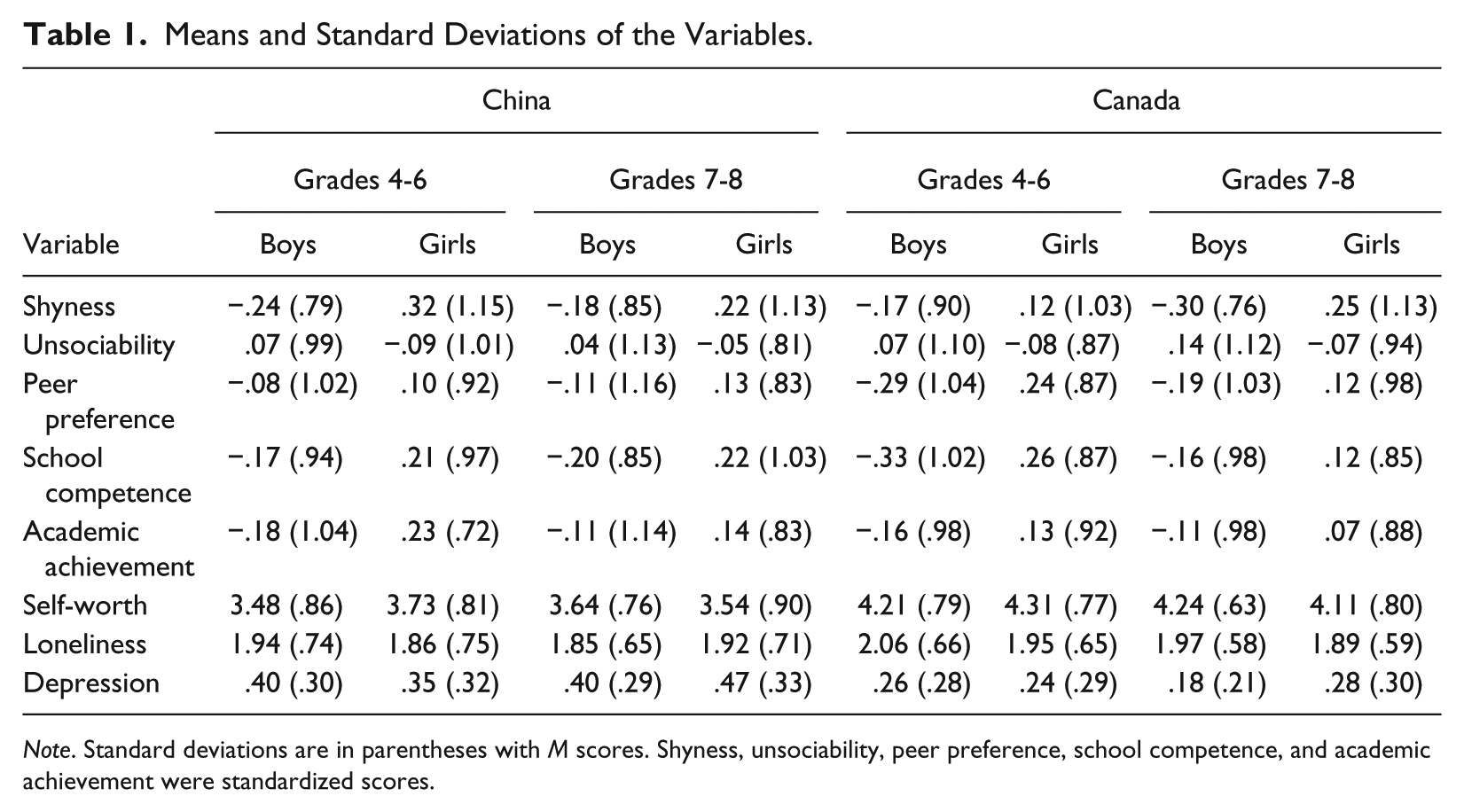
Note. Standard deviations are in parentheses with M scores. Shyness, unsociability, peer preference, school competence, and academic achievement were standardized scores.
Testing Invariance Across Countries
The goal of these analyses was to test whether there were differences between the samples in the relations between shyness and unsociability and adjustment variables. This was done with multigroup invariance tests in LISREL 8.80. This technique allowed for the direct comparison of nested models, with and without the constraint of specific relations (Joreskog, 1971). A significant χ2 value indicates that a relation is different across the two groups.
First, a multigroup invariance test was conducted to assess overall differences between countries for shyness, unsociability, and all adjustment variables. For these analyses, the relations between shyness and adjustment variables and between unsociability and adjustment variables were constrained as equal across countries. The main effect of gender was also controlled for. Results indicated a significant difference between the original unconstrained model and the constrained model with all the relations set equal across the countries, χ2(12) = 45.38, p < .001, indicating that there were overall significant cross-country differences in the relations of shyness and unsociability to adjustment variables.
Next, multigroup invariance tests were conducted separately to test the relations between different forms of social withdrawal (shyness, unsociability) and the entire set of adjustment variables. 1 For shyness, after controlling for the effects of unsociability and gender, there were no significant cross-country differences in the relations between shyness and adjustment variables, χ2(6) = 9.41, p > .05. Thus, the relations between shyness and adjustment variables were invariant across the Chinese and Canadian samples. The results for shyness based on the combined two samples are presented in Table 2. Shyness was negatively associated with peer preference, school competence, academic achievement, and perceived self-worth. Shyness was also positively associated with loneliness and depression.
The Effects of Shyness on Adjustment Variables Based on the Combined Samples.
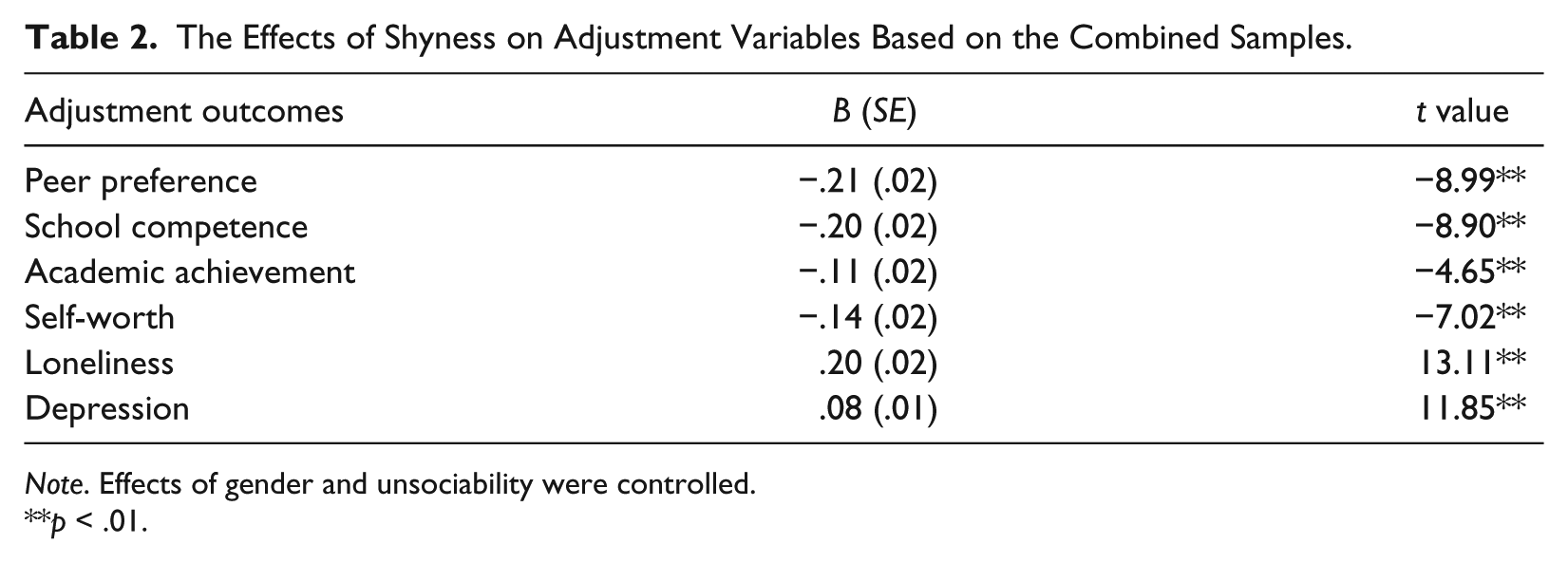
Note. Effects of gender and unsociability were controlled.
p < .01.
In contrast, for unsociability, after controlling for the effects of shyness and gender, results indicated significant cross-country differences in the relations between unsociability and adjustment variables, χ2(6) = 30.06, p < .001. Follow-up analyses were then conducted for each adjustment variable. The results revealed that cross-country differences were significant for the associations between unsociability and peer preference, loneliness, general self-worth, and academic achievement (see Table 3). In all cases, the relation between unsociability and these variables was stronger in the Chinese sample than in the Canadian sample.
Multigroup Invariance Tests Across Countries of the Associations Between Unsociability and Adjustment Variables.
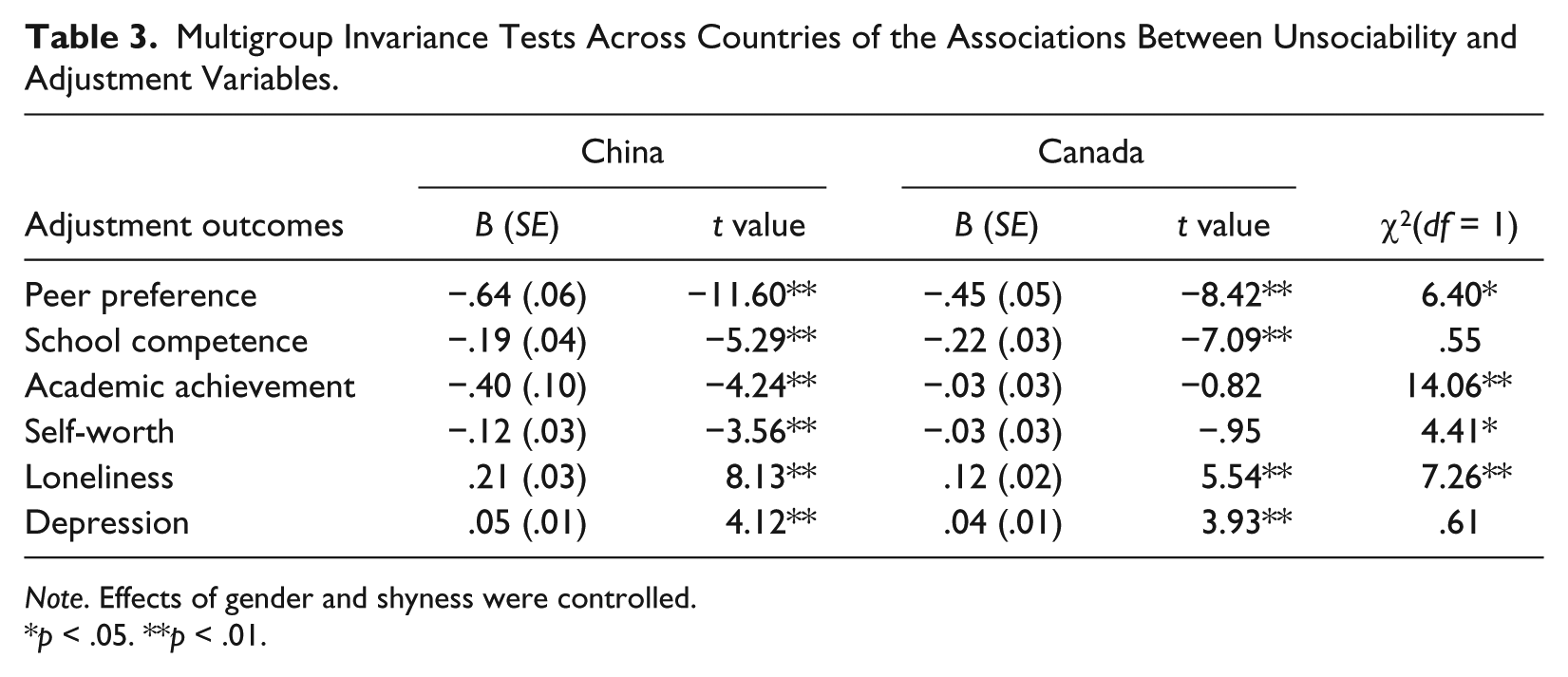
Note. Effects of gender and shyness were controlled.
p < .05. **p < .01.
Discussion
The major goal of this study was to compare the relations between two different forms of social withdrawal and adjustment in Chinese and Canadian children. Accordingly, we tested differences in the associations between shyness and unsociability and indexes of children’s socioemotional functioning and school adjustment in the two samples. Overall, our results indicated that whereas the relations between shyness and adjustment were consistent in China and Canada, relations between unsociability and adjustment variables were stronger among children in China than in Canada. These findings highlight the importance of considering social and cultural contexts when examining the implications of children’s social behaviors.
Shyness and Adjustment in China and Canada
Consistent with hypotheses, our results indicated that shyness was similarly related to indexes of socioemotional difficulties in both urban China and Canada. For example, in both cultures, shyness was negatively associated with peer preference and self-worth, and positively related to loneliness and depressive symptoms. These findings are consistent with previous research results in Western countries indicating associations between shyness and both internalizing problems and peer relation difficulties (e.g., Coplan et al., 2008; Coplan, Zheng, Weeks, & Chen, 2012; Crozier, 1995; Gazelle & Ladd, 2003). Moreover, our findings add to the growing literature suggesting that shyness is no longer positively valued in urban China (Chen et al., 2005).
These results are in clear contrast with earlier research indicating that childhood shyness was more positively valued in Chinese culture (e.g., Chen et al., 1995). As discussed earlier, the rapid social and economic shift occurring in China appears to have impacted the adaptive value of children’s social behaviors. That is, shyness in contemporary urban Chinese settings now demonstrates associations with more negative adjustment outcomes (e.g., Chen et al., 2005; Chen et al., 2009; J. Liu et al., 2012; J. Liu et al., 2014). Interestingly, Chen et al. (2011) recently reported that in rural Chinese settings, shyness seems to have retained its more traditional positive value. Apparently, China’s continued modernization, the ongoing transition to a more market-based economy, and increased contact with the West play a role in changing the functional meaning of shyness (Cai, Park, & Zhao, 2008; Zhang & Song, 2003).
Unsociability and Adjustment in China and Canada
The current study provided the first empirical cross-cultural comparison of the links between unsociability and adjustment in childhood and early adolescence. Significant cross-cultural differences were found between Chinese and Canada children in the relations between unsociability and several indexes of adjustment. Specifically, in comparison with their Canadian counterparts, unsociable children in China were found to have poorer peer acceptance, greater loneliness and feelings of depression, and poorer academic achievement. These findings indicate that childhood unsociability is less adaptive in China than in Western societies, which is consistent with our expectations.
Traditional Chinese society emphasizes interdependence and group affiliation (Chen, 2008; Greenfield et al., 2006; Oyserman et al., 2002). From early childhood, children are encouraged to belong to the group, to be concerned for others, and to display prosocial and cooperative behaviors. For example, Chinese mothers are more prone to encourage social connectedness in their children as compared with Canadian mothers (M. Liu et al., 2005). Because of this greater pressure for Chinese children to initiate interpersonal relationships (Chen & French, 2008), unsociability may be construed as in contrast to traditional group-orientation values, and a preference for solitude may be actively discouraged (Chen & French, 2008; Ho, 1986). Our results suggest that these components of traditional Chinese values have not completely disappeared in urban areas during the rapid process of modernization, although behavioral qualities such as initiative-taking and assertiveness may be more supported and promoted. As the core of the traditional Chinese value system, group orientation and interpersonal connectedness appear to be robust during social changes (K. S. Yang, 1986) and still positively evaluated and encouraged (Fuligni & Zhang, 2004; Ming, 2008). In her model concerning social change and the development of autonomy and social relatedness, Kagitcibasi (2012) argued that, although the lifestyles during urbanization in many contemporary societies may allow for greater individual autonomy and initiative, social change does not necessarily weaken the significance of interdependence and social relatedness in these societies, which may be reflected in the values of autonomous-related qualities.
Of particular note was the stronger negative association between unsociability and academic achievement in Chinese children. It has been argued that because of limited opportunities to access higher education, children in China face increased pressure from their parents, teachers, and peers to achieve academically and spend more time studying and doing homework (e.g., Chang, Schwartz, Dodge, & McBride-Chang, 2003; Ng, Pomerantz, & Lam, 2007). Along with the difficulties in socioemotional functioning, unsociable children may face the increased risk of poor academic performance. It is possible that the negative social evaluations of unsociable behavior make it difficult for these children to receive instrumental assistance from others, which facilitates the development of negative attitudes toward the school milieu and eventually undermine their academic performance.
In the Canadian sample, results from correlational analyses indicated that unsociability was significantly related to some indexes of maladjustment, including lower teacher-rated school competence and higher self-reported loneliness and depression. These results are somehow inconsistent with previous findings indicating a general lack of significant associations between unsociability and indexes of socioemotional functioning (e.g., Coplan et al., 2004). Most previous studies of unsociability in Western samples relied upon parental reports (e.g., Coplan et al., 2004; Coplan & Weeks, 2010b) or self-reports (Bowker & Raja, 2011; Coplan et al., 2013). The peer nomination method used in the current study might be more reliable and effective in assessing children’s behaviors in social context. Therefore, the relatively greater social and cultural endorsement of preference for solitude in North American societies (Coplan & Armer, 2007; Larson, 1997) may not prevent unsociable children from developing school and psychological problems. The results appear to support the view that the lack of social interaction has adverse effects on socioemotional and cognitive development (e.g., Hartup, 1992; Piaget, 1932; Rubin et al., 2006). Nevertheless, it should be noted that the associations between unsociability and adjustment variables mostly became weaker or nonsignificant after the variance shared with shyness is accounted for. Moreover, even with these potentially “strengthened” associations between unsociability and socioemotional difficulties in the Canadian sample, results from cross-cultural comparisons still indicated that these same associations were significantly stronger in the Chinese sample.
Gender, Age Group, and Country Differences in Social Behaviors and Adjustment
We found that girls had higher scores than boys on shyness and lower scores on unsociability. Similar results have been reported in previous studies (e.g., Chen et al., 2005; Chen et al., 2011). The results may be related to gender-stereotypical ideologies that boys are expected to be more autonomous and assertive in social interactions in Chinese and Western societies (Chen & He, 2004; Maccoby, 1998). Girls also had higher scores than boys on peer preference, teacher-rated school competence, and academic achievement, which is largely consistent with what has been found in previous studies in China and other countries (e.g., Chen et al., 1995; Dodge et al., 2006; Eisenberg et al., 2006). The tendencies that boys reported more positive self-perceptions and girls reported higher emotional distress with increasing age have also been documented in the literature (e.g., Nolen-Hoeksema & Girgus, 1994; Rudolph & Conley, 2005). Whether the gender differences are a cross-culturally universal phenomenon and how socialization, dispositional, and developmental factors (e.g., self-control abilities) play a role in the emergence of the gender differences should be investigated further in future research.
Chinese children reported higher levels of depression and lower levels of perceived self-worth than Canadian children. The results are also consistent with what was found in previous studies (e.g., Chen et al., 1995; Crystal et al., 1994; Dong, Yang, & Ollendick, 1994). It is an interesting question whether the traditional emphasis on group harmony, self-improvement, and self-criticism in Chinese society undermines children’s self-confidence and leads to psychological problems, as argued by Crystal et al. (1994) and other researchers (e.g., Heine, Takemoto, Moskalenko, Lasaleta, & Henrich, 2008; Henirch, Blatt, Kuperminc, Zohar, & Leadbeater, 2001).
Limitations and Future Directions
This study provided the first direct assessment of similarities and differences in the implications of shyness and unsociability in later childhood and adolescence. Results may help us understand the role of social and cultural contexts in shaping the significance of different forms of social withdrawal. Notwithstanding, some caveats must be considered with an eye toward future research.
First, the cross-sectional design of the study did not allow for any conclusions to be drawn regarding causality. For example, although we speculated that unsociable children would come to be excluded by peers, it is possible that peer rejection leads to subsequent unsociable behaviors. Longitudinal designs are required to examine the developmental processes involved in relations between social withdrawal and adjustment. Moreover, the current study focused on the purported “outcomes” associated with social withdrawal subtypes. It would be of interest to explore the etiological pathways of shyness and unsociability. For example, biological/temperamental characteristics, parenting (e.g., parental personality, socialization strategies), and environmental/contextual factors (e.g., school experiences) may differentially predict the development of shyness and unsociability in Chinese and Canadian children.
Second, consistent with several previous studies (e.g., Chen et al., 2005; Chen et al., 1995; J. Liu et al., 2014), we assessed shyness and unsociability via peer nominations. Researchers should use other sources of assessment (e.g., parent/teacher ratings, child self-reports, naturalistic observations) in the future to provide more detailed and in-depth assessments of children’s social withdrawal subtypes. For example, the use of observational methods in the context of peer interaction would allow for a more direct examination of unsociable children’s social skills and peer experiences (e.g., Asendorpf & Meier, 1993). In addition, academic achievement was assessed based on teacher reports in this study, which might be confounded with the teachers’ perceptions of students’ performance in other aspects. Future research will benefit from using more objective measures of academic achievement such as standardized tests.
Third, as indicated earlier, researchers have proposed different types of shyness, such as anxious shyness and regulated shyness (Xu et al., 2009). We focused mainly on the form of anxious shyness in this study, in keeping with the cross-cultural work on Chinese and Canadian children (e.g., Chen et al., 2005; Chen et al., 1992). It will be important to investigate other forms of shyness (as well as unsociability) in the future from a cross-cultural perspective.
Finally, there are substantial regional differences within China and Canada. The generalization of the results to other regions, particularly rural regions, needs to be made with much caution. In addition, according to Sharabany (2006), unsociability and lack of interest in social interaction are regarded as more problematic in the collectivistic Arab villages than in urban Jewish groups in Israel, which appears to be consistent with our results in this study. Nevertheless, one should be careful in generalizing our results to other societies. The specific traditions and social and cultural conditions of each nation need to be considered in the study of children’s social functioning in different societies. Despite the limitations, the present study makes a significant contribution to our understanding of social withdrawal in Chinese and Canadian children.
Footnotes
Acknowledgements
We are grateful to the children and teachers for their participation.
Declaration of Conflicting Interests
The author(s) declared no potential conflicts of interest with respect to the research, authorship, and/or publication of this article.
Funding
The author(s) disclosed receipt of the following financial support for the research, authorship, and/or publication of this article: The research and the preparation of the article were supported by grants from the Social Sciences and Humanities Research Council of Canada, the Natural Science Foundation of China (31300855), the “Shu Guang” program of the Shanghai Municipal Education Commission and Shanghai Education Development Foundation (12SG28), and the National Science Foundation (BCS-1225620).