



Abstract
Research on acculturation gaps has traditionally focused on parent–child dyads and the negative implications for youths’ psycho-social adaptation. The current study explored the impact of acculturation gaps in Turkish immigrant couples (N = 121) on each spouse’s acculturation stress. Wives and husbands reported their acculturation across two domains (language and identity) and dimensions (German and Turkish), and two facets of stress (homesickness and upholding traditions). Actor–partner interdependence models were used to estimate effects (Cook & Kenny, 2005). While homesickness was a burden for both partners, upholding traditions was not an immense stressor but was higher among husbands. Host culture adaptation was associated with lower levels of homesickness among wives and higher levels of stress with traditions among husbands. Heritage culture maintenance was associated with lower levels of stress with traditions among husbands. Overall, there were very few partner effects although better Turkish language abilities of wives were related to less homesickness among husbands. Acculturation gaps were either unrelated to spouses’ acculturation stress or associated with lower levels of stress. Results are discussed with respect to an interpersonal perspective on immigrants’ acculturation strategies. We promote the idea that biculturalism can be achieved within the couple.
Keywords
As the second generation of Turkish immigrants continues to grow and continues to marry partners from the home country (Lievens, 1999), immigrant couples with mixed generational status become an inherent part of the European society. Marriage migration unites couples with different socialization experiences as one partner grew up in Turkey, whereas the other experienced Turkish culture as an immigrant in the host country. In general, second-generation immigrants are more oriented toward the host culture and less involved with the heritage culture than first-generation immigrants (Birman & Trickett, 2001; Leyendecker, Schölmerich, & Citlak, 2006; Martinovic & Verkuyten, 2012). Accordingly, there is a heightened probability of acculturation gaps in today’s Turkish immigrant couples. Yet, little is known about the subject. In the past, a considerable amount of studies focused on acculturation gaps between children and parents (Telzer, 2010). In short, these studies highlight that children are more acculturated to the host culture whereas parents are more acculturated to their culture of origin. These acculturation differences between children and parents have the potential to evoke family conflict and higher levels of youth maladjustment (Portes & Rumbaut, 1996; Szapocznik & Kurtines, 1993). Thus, in parent–child dyads, the variation from the acculturation of close relatives can be negatively related to individual well-being. Research on the combined acculturation of other family dyads such as spouses is scarce (Costigan, 2010; Leyendecker et al., 2006). Consequently, we do not know whether acculturation gaps between marriage partners are a resource or a source of distress for the spouse.
In the present study, we examined the acculturation stress of Turkish–German immigrants in relation to their own and their partners’ Turkish and German language abilities and identification with Turkish and German culture. We draw on the widely known bidimensional model of acculturation which assumes that heritage culture maintenance and host culture adaptation are two independent dimensions of acculturation (Berry, 1997). We use actor–partner interdependence models (APIMs; Cook & Kenny, 2005) to estimate how acculturation is related to acculturation stress and to spouses’ acculturation stress and to answer our overall research question of how acculturation gaps within couples relate to the acculturation stress of each spouse. We were particularly interested to explore whether the acculturation gap distress model that has been studied in parent–child dyads (Telzer, 2010) can be extended to other family dyads.
Acculturation Gaps
Acculturation covers all phenomena that result when culturally different groups come into direct and enduring contact (Berry, 1997). For immigrants, these can be structured among two dimensions, the degree of heritage culture maintenance and host culture adoption (Arends-Tóth & van de Vijver, 2006). Bidimensional models of acculturation suggest that both dimensions are relatively independent; thus, immigrants can simultaneously adapt to the host country and maintain their heritage culture (Berry, 1997). Heritage culture maintenance and host culture orientation can be expressed in different life domains such as language and identity. Changes in language use, preference, and proficiency refer to behavioral acculturation and more overt changes in the daily life of immigrants (Matsudaira, 2006). Identities refer to rather subjective internal changes following cultural contact situations and describe a person’s sense of belonging to one or the other culture (Phinney & Ong, 2007).
Acculturation gaps used to refer to differences in the acculturation orientations or outcomes between parents and their children (Telzer, 2010). Immigrant parents are more inclined to retain heritage culture traditions; they are less open toward the values and lifestyle of the host culture, and learning the host society’s language is more of a challenge. Immigrant children, in contrast, may be less involved in the heritage culture, have frequent contact with host society members, and incorporate the host language more easily (Birman, 2006). Such acculturation differences between immigrant parents and their children have been labeled acculturation gaps (Telzer, 2010). However, in our most broad understanding, acculturation gaps can also refer to differences in the acculturation of groups, an individual and a group or between two individuals.
Empirical data on acculturation gaps between marriage partners are scarce. There is some indication of acculturation gaps within a Canadian sample of Turkish immigrant couples (Ataca & Berry, 2002). However, this study applied a group-level perspective (describing average levels of differences between husbands and wives) rather than family-level analyses (describing differences in husband–wife dyads). Another study investigated the acculturation of Chinese immigrant families in Canada (Costigan & Dokis, 2006). Although the authors focused on acculturation gaps in parent–child dyads, they also found unforeseen and considerable differences between marriage partners. Even though both husbands and wives immigrated as adults, husbands were more oriented toward the host culture whereas wives were more oriented toward the culture of origin.
Based on the ongoing trends in marriage migration, there is an increased probability of acculturation gaps between marriage partners. Turkish immigrants in Europe have a strong preference to marry a partner from their home country, and Turkish women are as apt to marry a partner from Turkey as their male counterparts (González-Ferrer, 2006). As a result of this marriage migration, more than half of the Turkish couples in Germany are of mixed generational status with one partner being a second- and the other being a first-generation immigrant. This development is supported by immigration laws as marriage became a major legal way of entry for Turkish adult immigrants in Germany and other European countries. While the term family reunification includes both the influx of children and spouses, today, family reunification is most often realized by spouses (Kofman, 2004). These family forming processes bring together individuals with different acculturation orientations, for example, different degrees of host culture adaptation and heritage culture maintenance. Past research on the acculturation of first- and second-generation immigrants illustrates that the second generation is more proficient in the host country’s language, identifies to a greater extent with the national majority group, and is less involved in the culture of origin than the first generation (Birman & Trickett, 2001; Leyendecker et al., 2006; Martinovic & Verkuyten, 2012).
Another reason to study acculturation gaps between marriage partners is gendered acculturation attitudes of Turkish immigrant men and women in Europe. It is important to note that these studies did not investigate immigrant couples but rather report group-level differences between women and men. The results are inconclusive. While some studies indicate that gender is unrelated to heritage culture orientation (Maliepaard, Lubbers, & Gijsberts, 2010) and host culture adaptation (Martinovic & Verkuyten, 2012), other studies found gender differences but yield mixed findings with respect to the direction. For example, in some studies, Turkish men were more oriented to their culture of origin than women (Güngör, Fleischmann, & Phalet, 2011), whereas in other studies, Turkish men felt less connected to their culture of origin than women but perceived group boundaries between the heritage and the host culture as more permeable (Skrobanek, 2009; Zimmermann, Zimmermann, & Constant, 2007). If gender differences in acculturation attitudes exist, they might be another source of acculturation gaps in immigrant couples.
Acculturation and Acculturation Stress
Immigration is a potentially stressful experience for individuals. Immigrants experience a variety of acculturative stressors such as inadequacy in the majority language, unsatisfying employment situations, and reduced opportunities for social interaction (Thomas, 1995). Homesickness, an intense yearning for home or sense of severe loss (Archer, Ireland, Amos, Broad, & Currid, 1998), is also frequently experienced among immigrants (Jibeen & Khalid, 2010), as are perceived pressures from the in-group to uphold traditions (Vinokurov, Trickett, & Birman, 2002). Women and first-generation immigrants are known to be more vulnerable than their male or second-generation counterparts (Liebkind, 1996; Padilla, Wagatsuma, & Lindholm, 1985). As acculturation stress has been linked to serious mental health issues such as anxiety, depression, and feelings of loss (Berry, Kim, Minde, & Mok, 1987; Hovey, 2000), it is important to identify resources that help immigrants to overcome stressors related to acculturation.
Acculturation orientations have been linked to acculturative stress. Generally, within the individual, host culture adaptation is linked to less acculturative stress whereas heritage culture maintenance is linked to more acculturative stress (Berry et al., 1987; Miranda & Matheny, 2000; Vinokurov et al., 2002). However, a study among Vietnamese refugees in Finland revealed gender differences in the link between acculturation attitudes and stress. While women were more stressed when they separated from the dominant culture, men were more stressed when they adopted a Western lifestyle and rejected traditional family values (Liebkind, 1996). Partners’ acculturation orientations may also directly affect the acculturative stress of the spouse. For example, among Bosnian refugee couples in the United States, husbands’ behavioral acculturation to the host culture was a protective resource for wives’ post-traumatic stress (Spasojević, Heffer, & Snyder, 2000). In sum, acculturation stress is likely to be influenced by a spouse’s own level of acculturation and by his or her partner’s level of acculturation. However, acculturation gaps between spouses may also play a role in the acculturation stress of each spouse.
Acculturation Gaps—Resource or Source of Distress?
The acculturation gap distress model suggests that immigrant youths acculturate at a faster pace to the host culture than their parents, leading to intergenerational differences in values, interests, and language skills. Cultural differences between generations in turn are expected to increase the likelihood of family conflict and youth maladjustment (Portes & Rumbaut, 1996; Szapocznik & Kurtines, 1993). The empirical evidence is not straightforward with respect to the presence of parent–child acculturation gaps and the invariably negative implications on family functioning and youth adjustment (Telzer, 2010). It was our major concern to understand whether acculturation gaps between marriage partners contribute to stress experiences of each spouse.
Acculturation gaps between marriage partners may enhance feelings of incapacity and overload among the partner who is less capable in the host language and more insecure in interactions with members of the host culture. The self-esteem of the partner who is “left behind” may be lowered due to the greater power of the other. For example, in Russian American couples, partners were less satisfied in their marriages when wives were more proficient in the host language than their husbands possibly because husbands took offense as traditional role perceptions got dislocated (Kisselev, Brown, & Brown, 2010). Studies among interethnic marriages further support the idea of acculturation gaps as a source of distress. These studies attest a lowered stability and increased risk of divorce for interethnic marriages when compared with monoethnic ones (Bratter & King, 2008; Kalmijn, de Graaf, & Janssen, 2005). It is assumed that there are more cultural differences in interethnic marriages which increase the risk for marriage breakup. Studies on monoethnic couples with either mixed or same generational status further support the idea of cultural differences as a source of distress. Among Turkish and Moroccan monoethnic couples in Belgium, those with mixed generational status had a higher probability for marriage breakup compared with same generational status couples (Eeckhaut, Lievens, van de Putte, & Lusyne, 2011). The authors assumed that different acculturation levels and a lack of cultural fit accounted for higher divorce rates in mixed generational status couples although actual acculturation differences were not assessed.
Studies that actually assessed acculturation gaps among marriage partners contradicted the acculturation gap distress model as they found either no link between acculturation gaps and adjustment or even a positive one. For example, among Bosnian refugee couples in the United States, differences between husbands’ and wives’ behavioral acculturation to the American culture were not linked to the marital stress of each spouse (Spasojević et al., 2000). Among Mexican American couples, behavioral acculturation gaps even were a protective resource in terms of fights about relatives, verbal and physical aggression, and conflict resolution (Flores, Tschann, Marin, & Pantoja, 2004). Among Russian American couples, both partners reported higher marital satisfaction when husbands were more proficient in American language than their wives (Kisselev et al., 2010).
In sum, the literature on acculturation gaps between marriage partners is scarce and yields mixed results with respect to the question whether gaps are a resource or a source of distress. Instead of assessing one or more dimensions of acculturation, oftentimes, single acculturation measures (e.g., only language) or rather simple indicators of acculturation (e.g., ethnic background or generational status) were used. In addition, although a wide range of outcomes such as marital conflict and divorce has been used, acculturation stress has not been studied.
Research Questions
First, we explored how a spouse’s acculturation relates to his or her own acculturation stress. Studies with other ethnic minority and immigrant groups from different cultures suggest that host culture adaptation is linked to less acculturative stress whereas heritage culture maintenance is associated with higher levels of stress (Berry et al., 1987; Miranda & Matheny, 2000; Vinokurov et al., 2002). However, there might be gender differences in the link between acculturation and stress (Liebkind, 1996). Second, we explored whether a spouse’s acculturation relates to his or her partner’s acculturation stress. Husbands’ host culture orientation is likely to be a resource for wives (Spasojević et al., 2000), but there is hardly any evidence on how wives’ acculturation attitudes relate to husbands’ acculturation stress. The major focus of the present study was the link between acculturation gaps and stress. As prior research on the combined acculturation of marriage partners is limited and inconsistent (Flores et al., 2004; Kisselev et al., 2010; Spasojević et al., 2000), this was also tested in an exploratory manner.
Method
Sample
The study was based on 316 Turkish families who participated in a larger study on resilience and the social integration of immigrant children. Sixteen single mother families were excluded. Additional 156 couples were excluded because husbands did not reply. There were no differences between couples with participating and non-participating husbands with respect to wives’ and husbands’ highest level of education, household net income, or the distribution of first- and second-generation partners. Another 23 couples were excluded due to missing information on the dependent variables. Again, there were no differences between the excluded and included couples. The following information refers to the remaining subsample of 121 Turkish couples. Forty-one percent of the wives and 33% of the husbands were second-generation immigrants, born in Germany or immigrated before the age of 7. There were equal number of second-generation immigrants among husbands and wives, χ2(1,240) = 1.54, p = .214. Wives who were born in Turkey lived in Germany on average 21 years, husbands 23 years; all of the participants lived in Germany at least for 7 years. Half of the couples were mixed generational status couples with one partner being a first- and the other partner being a second-generation immigrant. In particular, there were 45 first-generation couples, 14 second-generation couples, 25 couples with first-generation wives and second-generation husbands, 35 couples with second-generation wives and first-generation husbands, and 2 couples with missing information. A marginal minority of the wives reported that husbands were chosen for them (3%); the majority chose partners on their own terms (67%) or agreed with their parents’ choice (30%). Wives’ average age was 36 years (SD = 6, range = 24-56 years); husbands’ average age was 39 years (SD = 5, range = 27-57 years). Ninety-seven percent of the families had more than one child and up to nine children. These children ranged in age from 1 to 31 years. The study’s target child was either in the last year of kindergarten (n = 34), fourth grade (n = 85), or seventh grade (n = 2). Participants were of rather low socioeconomic status as indicated by their education and income. Fifty-nine percent of the wives and 39% of the husbands had less than 10 years of school in either country compared with 16% of the German population (DeStatis–Statistisches Bundesamt, 2014). Twenty-five percent of the wives and 64% of the husbands were gainfully employed. The average net monthly equivalized household income according to the OECD scale (Hagenaars, de Vos, & Zaidi, 1994) was 922.63 Euros ranging from 264.83 to 2,714.93 Euros. The average household income among Germans is 1.800 Euros per month (DeStatis–Statistisches Bundesamt, 2014).
Procedure
Sampling took place in the Ruhr area, an industrial area in the Northwest of Germany. We asked the school administration for permission to distribute information about the project in schools. To raise the acceptance of the project, we also attended parent–teacher conferences and other formal and informal meetings with parents. In addition, we started a campaign to make the project known and accepted within the Turkish community through posters, information stands, articles in German and Turkish language newspapers, leaflets in the offices of pediatricians, presentations in mosques, and at meetings of associations of Turkish parents; furthermore, we asked community leaders and organizations for their endorsement. Because parents heard of the project through multiple channels repeatedly, it is difficult to identify how exactly families were recruited.
Data were collected in the participants’ homes. In some cases, families preferred to come to the university instead. According to the participants’ preferences, trained bilingual research assistants conducted structured interviews with the wives in German, Turkish, or in rare cases, Kurdish language. Interviews took about 30 min. In addition to the interviews, wives and husbands were asked to fill out a questionnaire. These were available in Turkish and German. The wives’ questionnaires took between 1 and 1½ hr. If the husband was in the apartment during the homevisit, he was asked to fill out the questionnaire. Otherwise, the husband questionnaire and a prepaid envelope were left with the wife. Confidentiality was explained, and one of the marriage partners signed consent forms. Families received 25-Euro compensation for their participation.
Measures
Acculturation was measured in the domains of language and identity. Each aspect was assessed separately with respect to the German and the Turkish culture. Language proficiency was assessed with four items that ask participants to rate their language ability to speak, understand, read, and write. A 4-point Likert-type scale was used ranging from 1 = not at all to 4 = very good with higher values indicating better language proficiency. Parallel items were used to assess participants’ identification with Turks and Germans. Items were adapted from the International Comparative Study of Ethnocultural Adolescents project (ICSEY, Berry et al., 1993). The four items were, “I think of myself as Turkish/German” and “I feel that I am part of Turkish/German culture.” A 5-point Likert-type scale was used ranging from 1 = totally disagree to 5 = totally agree with higher values indicating stronger identification with the group in question. Cronbach’s alpha reliability coefficients are presented in Table 1.
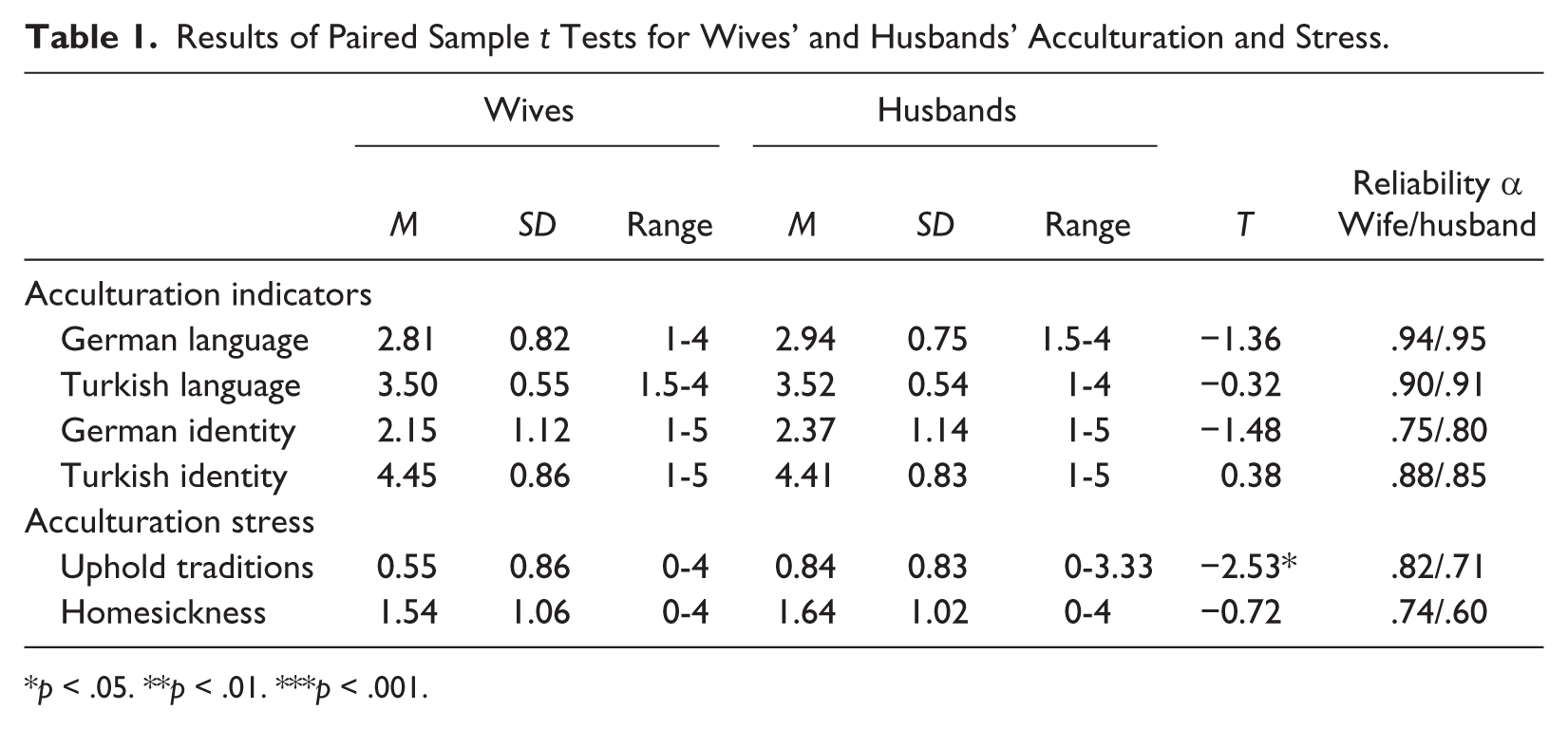
Results of Paired Sample t Tests for Wives’ and Husbands’ Acculturation and Stress.
p < .05. **p < .01. ***p < .001.
Acculturation stress was assessed with items developed by Oppedal (2006), based on the work by Lay and Nguyen (1998) and Vinokurov et al. (2002). Respondents indicated the occurrence of homesickness and stress due to upholding traditions in the past 12 months (did not happen vs. happened) and the intensity of both hassles on a 4-point Likert-type scale ranging from not a burden to very much a burden. Accordingly, the scale ranged from 0 = did not happen to 4 = happened, very much a burden, with higher values indicating higher levels of acculturation stress. Stress with upholding traditions was assessed with the following three items: “People from your country of origin criticize you for not maintaining your values and traditions well enough,” “Your child does not uphold traditions from your country of origin,” and “Your child behaves too much like German children.” When answering, respondents were asked to keep in mind the study’s target child. Homesickness was assessed with two items: “You miss friends and family living in Turkey” and “You are worried about family members in your home country.”
To test whether homesickness and stress with upholding traditions correspond to two separate factors, we conducted two confirmatory factor analyses using maximum likelihood estimation in AMOS 21. A correlated two-factor model without cross-loadings was specified and compared with a one-factor model. For wives, the fit of the two-factor model was good, chi-square goodness of fit (CMIN) = 3.54 (4), p = .473, Tucker–Lewis index (TLI) = 1.006, comparative fit index (CFI) = 1.000, root mean square error of approximation (RMSEA) = .000, p of close fit (PCLOSE) = .614, and significantly better than a one-factor solution, χ2 dif(1) = 50.46, p = .000. For husbands, the fit of the two-factor model was good after freeing one between-factor error correlation, CMIN = 2.27 (3), p = .519, TLI = 1.021, CFI = 1.000, RMSEA = .000, PCLOSE = .635, and significantly better than the one-factor model χ2 dif(1) = 16.73, p = .000. Cronbach’s alpha reliability coefficients are presented in Table 1.
Construct validity was assessed by correlating both acculturation stress measures of wives with other indicators of psychological well-being and adaptation. Wives’ stress with upholding traditions tended to be negatively related to wives’ perception of general family functioning, r = −.17, p = .065 (Epstein, Baldwin, & Bishop, 1983). Wives’ homesickness was related to wives’ daily hassles, r = .31, p = .001 (Kanner, Coyne, Schaffer, & Lazarus, 1981); depression, r = .28, p = .002 (Andresen, Malmgren, Carter, & Patrick, 1994); and satisfaction with life, r = −.21, p = .025 (Diener, Emmons, Larsen, & Griffin, 1985). These correlation patterns are similar to those among other ethnic minorities (Jibeen & Khalid, 2010; Vinokurov et al., 2002). They also suggest that acculturation stress caused by family members, that is, children who do not uphold traditions, linked primarily to the adaptation of the family (convergent validity), but not so much to the psychological well-being of the individual (discriminant validity). Data on husbands’ psychological well-being and adaptation were not available.
Demographics were assessed by asking each wife to indicate her own and her husband’s birth place, age of migration, age, and highest education level, as well as the family’s household net income.
Results
Descriptive Findings
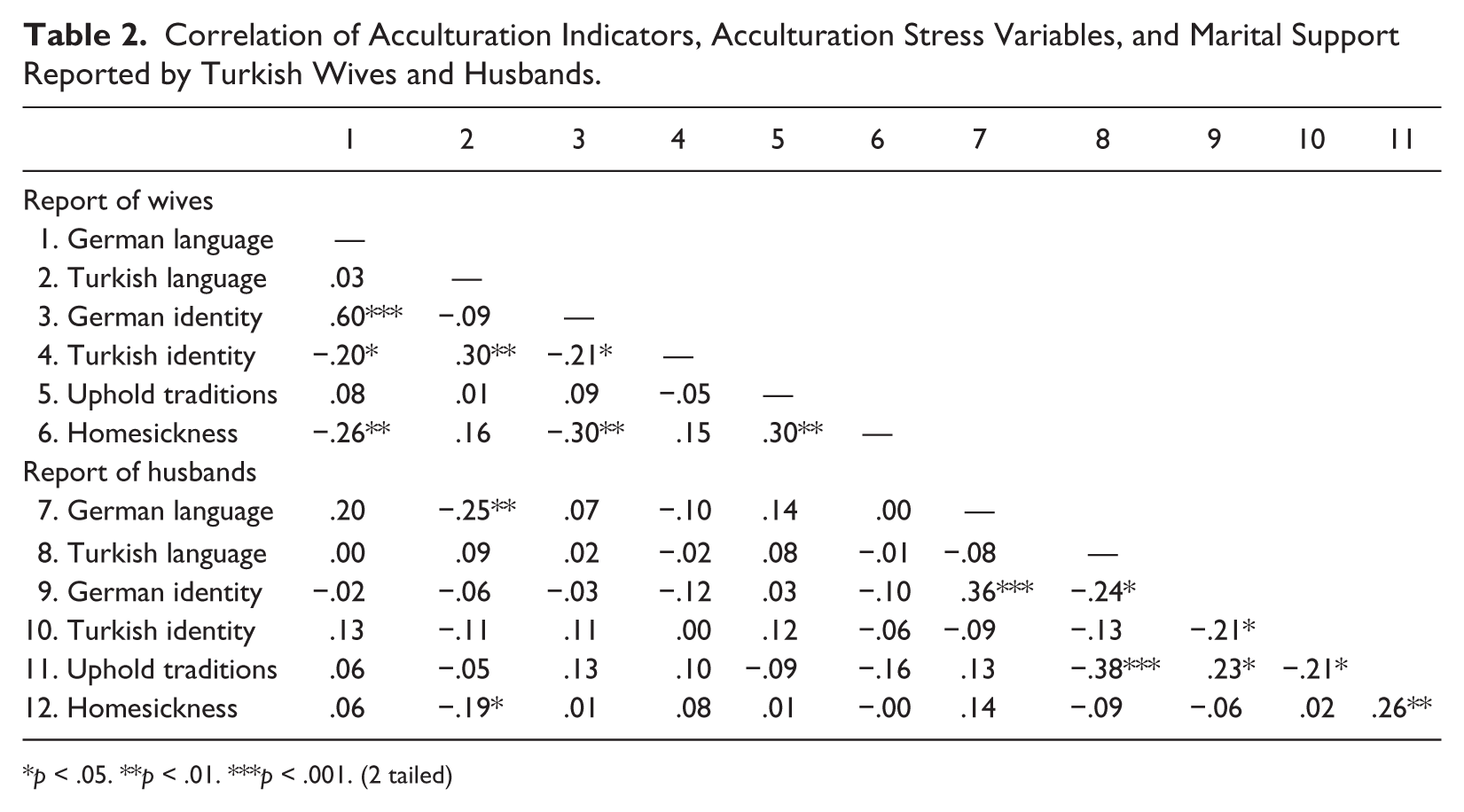
Means and standard deviations of all main variables are presented in Table 1. We conducted a one-sample t test to examine participants’ level of acculturation stress and a paired-sample t test to see whether husbands and wives had different levels of acculturation stress. Husbands’ and wives’ stress with upholding traditions and homesickness was below the midpoint of the scale (all p < .01). We found no differences between husbands’ and wives’ homesickness, but husbands were more stressed to uphold traditions than wives. Using correlation analyses, we examined effects of age on acculturation stress, and univariate analyses of variance were used to estimate effects of child age, education, and generation. Younger women were more stressed to uphold traditions than older women (r = −.21, p = .021). Mothers of preschool children tended to report higher levels of stress with upholding traditions than mothers of fourth- and seventh-grade children, Welch’s F(1, 43) = 3.96, p = .053. Lower educated and first-generation wives reported more homesickness than higher educated and second-generation wives, F(1, 119) = 8.22, p = .005 and F(1, 119) = 10.41, p = .002, respectively. Husbands’ acculturation stress was unrelated to husbands’ age, child’s age, education, and generational status. The correlations among the main variables are presented in Table 2. Wives’ stress with upholding traditions was unrelated to wives’ acculturation, but wives’ homesickness decreased with higher levels of acculturation to the German culture. Husbands’ homesickness was unrelated to husbands’ acculturation, but their stress with the upholding of traditions increased the less husbands maintained their Turkish heritage culture.
Correlation of Acculturation Indicators, Acculturation Stress Variables, and Marital Support Reported by Turkish Wives and Husbands.
p < .05. **p < .01. ***p < .001. (2 tailed)
Prevalence and Size of Acculturation Gaps
To examine the prevalence of acculturation gaps, we computed four difference scores between wives and husbands acculturation indicators, that is, wife minus husband German identity. The difference scores can range from −4 to +4 with negative values indicating lower scores of wives (W < H), a value of 0 for exact equal scores among partners or no gap (W = H), and positive values indicating higher scores of wives (W > H). To inspect the size of the gaps, we reversed the negative scores. Thus, the size of the gap can range from 0 to 4 with higher values indicating greater differences between marriage partners. Results revealed that in the majority of couples, husbands identified more strongly with Germans than wives (43% W < H, 25% W = H, 32% W > H), and it was identification with Germans where we observed the largest differences between partners (M = 1.29, SD = 1.00, range = 0-4). Although a lot of couples reported differences in German language proficiency (45% W < H, 12% W = H, 43% W > H), there were hardly any couples with very large differences (M = .91, SD = 0.63, range = 0-2.5). Many couples reported similar levels of identification with Turks (23% W < H, 50% W = H, 26% W > H), and the average difference was rather small (M = .75, SD = 0.93, range = 0-4). There was a similar number of couples in which either the wives or the husbands were more fluent in Turkish (38% W < H, 25% W = H, 37% W > H), but the differences were small on average (M = .55, SD = 0.50, range = 0-3).
Analytic Strategy for Main Analyses
We used APIMs (Cook & Kenny, 2005) with an interaction term and multivariate outcomes to test our research questions. The APIM can measure interdependence within interpersonal relationships as it treats the dyad rather than the individual as unit of analysis. When there is nonindependence of observations, APIMs yield more accurate test statistics than commonly used statistical procedures such as multiple regression. Furthermore, the multivariate procedure helps to keep Type I errors to a minimum (Thompson, 1991). Central components of the APIM are the actor effects and the partner effects. An actor effect measures how much a spouse’s acculturation stress is influenced by his or her own level of acculturation. A partner effect measures how much a spouse’s acculturation stress is predicted by his or her partners’ level of acculturation. An interaction term was added to examine whether spouses’ acculturation stress depends on a certain combination of husband and wife acculturation. We created four interaction variables: (a) the product of husbands’ and wives’ host language proficiency, (b) the product of husbands’ and wives’ identification with the host culture, (c) the product of husbands’ and wives’ ethnic language proficiency, and (d) the product of husbands’ and wives’ ethnic identity. Each of the variables was standardized prior to the multiplications.
We conducted four separate APIM analyses to test how spouses’ host language proficiency (APIM 1), identification with the host culture (APIM 2), ethnic language proficiency (APIM 3), and ethnic identity (APIM 4) predicted the acculturation stress of marriage partners. An example of an APIM model is depicted in Figure 1. The correlations between the independent variables ensure that actor effects are estimated while controlling for partner effects and vice versa. The correlations between the residuals control for other sources of nonindependence that can occur when individuals come from the same family (for more details, see Cook & Kenny, 2005). As a result of these preliminary analyses, wives’ age was mean centered and added as a predictor for wives’ stress with traditions, and wives’ education was added as a predictor for wives’ homesickness. Both age and education were correlated with wives’ acculturation. The APIMs were tested in AMOS.

Example of an actor–partner interdependence model (APIM).
Missing data were imputed for German and Turkish language proficiency, German and Turkish identity, and acculturation stress. There was missing information on 5 out of 12 variables. The amount of missing data ranged from 0.08% in wives’ Turkish language proficiency to 4.1% in husbands’ stress due to the upholding of traditions. Note that we only imputed dependent variables when at least one of the two was present. Missing data were imputed based on the APIMs. We replaced the unobserved values by regression imputation in AMOS. In this procedure, linear regression is used to predict the missing values for each case as a function of the observed values.
Main Analyses
The model fit for the APIM 1 in which host language proficiency predicted acculturation stress was good: χ2(df) = 11.50 (11), TLI = 0.978, CFI = 0.993, RMSEA = .019, PCLOSE = .643. The model fit for the APIM 2 in which identification with the host culture predicted acculturation stress was good, too: χ2(df) = 7.95 (11), TLI = 1.155, CFI = 1.000, RMSEA = .000, PCLOSE = .872. The model fit for the APIM 3 in which ethnic language proficiency predicted acculturation stress was also good: χ2(df) = 5.95 (11), TLI = 1.258, CFI = 1.000, RMSEA = .000, PCLOSE = .954. The model fit for the APIM 4 in which ethnic identity predicted acculturation stress was not good. Modifications indices suggested correlating wives’ age and husbands’ ethnic identity (r = .20, p = .033). This yielded a satisfactory model fit of χ2(df) = 10.90 (10), TLI = 0.928, CFI = 0.980, RMSEA = .027, PCLOSE = .508.
Acculturation and acculturation stress
Whether a spouse’s acculturation was related with his or her own level of acculturation stress can be seen in the top rows of Table 3. As expected, the APIM analyses revealed that wives’ homesickness was higher among wives who did not identify with Germans. This was qualified by a significant interaction between spouses’ German identities (see below). In line with our assumptions, husbands’ stress to uphold traditions increased the more they identified with Germans, the less they identified with Turks, and the less fluent they spoke Turkish.
Results of Four APIM Analyses.

Note. Estimates are unstandardized regression coefficients. APIM = actor–partner interdependence model.
p < .10. *p < .05. **p < .01. ***p < .001.
Acculturation and partner acculturation stress
Whether spouse’s acculturation stress was related with his or her partner’s level of acculturation can be seen in the mid rows of Table 3. In contrast to our assumptions, APIM analyses did not indicate that husbands’ adaptation to the German culture was a resource for wives. Instead, husbands’ identification with Turks increased wives’ stress to uphold traditions. However, this partner effect was qualified by an interaction (see below) and thus needs to be interpreted with caution. Wives’ heritage culture maintenance appeared to be a resource for husbands because husbands were less homesick when married to a wife who spoke Turkish well.
Acculturation gaps and acculturation stress
Our final research question explored whether acculturation gaps between marriage partners are a resource or a source of distress. Results are presented in the bottom rows of Table 3. As can be seen, acculturation gaps were in large parts unrelated to the acculturation stress of each spouse. However, wives’ homesickness was related to acculturation gaps in spouse’s German language proficiency. Analyses of simple slopes revealed that wives were less likely to be homesick if wives’ German language proficiency was high and their husbands’ was low. In contrast, wives were more likely to be homesick if wives’ German language proficiency was high and their husbands’ was high as well (Figure 2a). Wives’ homesickness was also related to spouses’ German identity. If the German identity of both, husbands and wives, was low, wives were more likely to be homesick. In contrast, wives with a low German identity married to husbands with a high German identity were less likely to feel homesick (Figure 2b). Finally, spouses’ Turkish identity was associated with wives’ stress to uphold traditions. If both marriage partners identified strongly with Turks, wives were more stressed to uphold traditions than when only the wives identified strongly with Turks (Figure 2c).

Interaction effects of spouses’ acculturation on wives’ acculturation stress.
Discussion
Previous research on acculturation gaps has focused on parent–child dyads but widely neglected acculturation gaps among other family members. Therefore, we did not know whether acculturation gaps between marriage partners were a resource or a source of distress for each spouse. Our study shows that acculturation gaps exist between marriage partners, too, and were most prevalent in the host culture dimension. Turkish marriage partners differed more often and most strongly in their German identity and German language proficiency but less often and strongly in their Turkish identity and Turkish language proficiency. Our results indicate that in the majority of cases, these acculturation gaps do not relate to spouses’ homesickness or stress with the preservation of traditions. Therefore, acculturation gaps are neither a resource nor a source of distress. However, in some cases, they did affect wives’ acculturation stress, and in these cases, acculturation gaps seemed to be a strength. For example, when wives did not identify with Germans but their husbands did, this was a resource for wives’ homesickness. In addition, wives were less likely to experience homesickness when only the wives were proficient in German. In parallel fashion, when only women identified strongly with Turks while their husbands’ identification with Turks was less strong, women were less stressed with traditions. It seems that the overrepresentation of one culture can be a source of distress, but a balance of both cultures might be a resource. Previous literature has been more focused on the balance of cultures within a person, for example, bicultural identity (LaFramboise, Coleman, & Gerton, 1993). Our results suggest that within a relationship, this balance might be reached between the two partners.
Biculturalism is most beneficial for immigrants as heritage culture maintenance provides a securing harbor, and host culture orientation enables one to successfully perform in the new environment (Ward & Rana-Deuba, 1999). In contrast, the overrepresentation of one culture as evident in assimilation and separation attitudes, is known to increase social difficulties and psychological stress (Berry et al., 1987). In accordance with previous findings, correlation results showed that biculturalism, the simultaneous orientation to both cultures, was less prevalent among Turkish immigrants in Germany (Vedder, Sam, & Liebkind, 2007). So when one partner was strongly oriented toward the heritage culture, he or she was probably less interested in the adoption of the host culture. Therefore, acculturation gaps may reflect a couple with one partner who was more oriented toward the heritage culture whereas the other one was more oriented toward the host culture. Following this idea, it may be meaningful to extend the study of biculturalism to the family level. In that sense, biculturalism is the ability of marriage partners to maintain cultural components of the heritage culture and simultaneously adapt to the receiving country. This type of biculturalism allows marriage partners to meet the requirements of both cultures as a unit because at least one partner can interact with residents and the other partner can maintain social bonds with ethnic peers. Future studies should investigate the idea that biculturalism can be achieved within the couple. This should be done by considering the acculturation attitudes of both partners and toward both cultures simultaneously. So far, we can only assess the acculturation attitudes of family members in isolation, and it requires thoughtful decisions and transformations to determine the biculturalism of couples (Arends-Tóth & van de Vijver, 2006). An alternative for future studies might be the development of new measurement instruments that directly assess the acculturation attitudes of the couple.
It is important to highlight that most of the time, acculturation gaps were unrelated to Turkish spouses acculturation stress. This absence of effects is meaningful as it implies that acculturation gaps do not necessarily raise trouble to the marital relationship or spouses’ well-being. So our results tie in with previous studies that found no association or a beneficial influence of acculturation gaps on marital stress (Kisselev et al., 2010; Spasojević et al., 2000). Assuming that acculturation gaps are most likely to occur in mixed generational status couples, we have no reason to believe in a poor point of departure for cross-border marriages. In contrast, it may be a resource for first-generation immigrants to be married to a second-generation partner who is more familiar with the language and customs of the receiving country. Cross-border marriages can also help second-generation immigrants to keep alive the heritage culture in a national context that does not value heritage culture maintenance. However, this might not apply to forced-marriages, which were underrepresented in our sample. In addition, there is a need for empirical studies that look at the actual frequency of acculturation gaps in mixed versus same generational status couples.
Taken together, these results do not support the transfer of the acculturation gap distress model to husband–wife dyads. However, future studies need to examine the generalizability of findings among other immigrant groups, among immigrant newcomers, in different local and national contexts, and with different measures. First, the participants in the present study were mainly lower educated immigrants. Higher educated immigrants may have less stress because of prior contact and experience with the host culture and more resources (Berry et al., 1987). Second, in more welcoming national contexts, Turkish immigrants are more likely to prefer biculturalism (Vedder et al., 2007). Acculturation gaps may not be a resource for spouses when cultures are already balanced within a person. Third, in the present sample, marriage partners who were born in Turkey had lived in Germany for about 20 years and at least for 7 years. Therefore, there were no newcomers in the sample, but the link between acculturation and acculturation stress is likely to be stronger right after the migration experience (Miranda & Matheny, 2000). For example, a first-generation wife may benefit most strongly from her husband’s German language proficiency during the first years of her settlement. Fourth, future studies should include a wider range of family outcomes as acculturation gaps between spouses are likely to influence more indicators of psychological and socio-cultural adjustment such as depression and daily hassles. Moreover, it is questionable whether the same type of acculturation gap has positive implications throughout. Researchers may also want to consider other domains of acculturation than language and identity. For example, while spouses benefit from partners’ language abilities, different values and child rearing practices could become a source of distress. Finally, our results are based on cross-sectional data. Longitudinal studies on acculturation gaps would help to clarify the interpretation of results. Until then, the possibility remains that acculturation stress causes differences between partners.
Our study cannot answer the question of whether low levels of homesickness are indeed a desired outcome. Although there is very strong evidence that homesickness is a stressful, problematic, and emotionally demanding experience that is related to lower levels of general health (Archer et al., 1998) and psychological well-being (Jibeen & Khalid, 2010), low levels of homesickness might also indicate a lack of orientation toward the heritage culture which would be unfavorable within an acculturation framework (Liebkind, 1996). It is up to future studies to consider and weigh the benefits of homesickness against its costs.
In sum, this study presents a unique step forward in the study of acculturation gaps as we have moved beyond parent–child dyads and the perception of acculturation gaps as problematic. Our findings highlight that immigrants’ acculturation strategies must be understood with reference to the broader family context. The task of balancing heritage and host culture may be divided among marriage partners. Thus, we should pay more attention to bicultural competencies within the husband–wife dyad. This could have implications for the study of child development in immigrant families. However, more research is needed to appraise the role of acculturation gaps within couples for the adjustment and acculturation of families.
Footnotes
Declaration of Conflicting Interests
The author(s) declared no potential conflicts of interest with respect to the research, authorship, and/or publication of this article.
Funding
The author(s) disclosed receipt of the following financial support for the research, authorship, and/or publication of this article: This research was supported by a NORFACE grant (292) awarded to Birgit Leyendecker, Judi Mesman, and Brit Oppedal.