




Abstract
At the end of the 20th century, a survey of the metatheoretical landscape of culture and psychology noted an emerging consensus—physicalist ontology, gene–culture co-evolutionary phylogeny, gene–culture interactionist ontogeny, and a mutual constitutionist view of culture and mind. Revisiting the terrain now, the then emerging consensus seems well established, but new challenges appear on the horizon, prompting us to expand our metatheoretical scope. Extending beyond phylogeny, we need to consider a geological timescale, and further naturalizing the culture concept, we need to consider culture and human activity within the planetary system. According to some, we have left the Holocene, and entered into the Anthropocene, a geological epoch in which human activities have such a disproportionate impact that it deserves to be prefaced by humanity. Psychology with interests in culture can play a critical role in human efforts to investigate the psychological processes involved in the cultural change and to reconceptualize humans’ place in nature.
Keywords
Culture has emerged as a critical concept in the globalized world. From a restaurant in one’s neighborhood to armed intergroup conflicts, diasporas, and mass migrations, culture has become a de jour concept of the contemporary discourse around the world. As the signs of human cultural diversity penetrate our everyday lived experience, in psychology too the concept of culture is regaining its place. Despite a history of vicissitudes in the past (e.g., Bruner, 1990; Cole, 1996; Jahoda, 1986; Shweder, 1990; see Kashima & Gelfand, 2012), the revival of the culture concept that began in the 1980s has continued into the 21st century, and by now it is a discernible part of psychological discourse. To wit, in the latter half of 1980s, less than 5% of the articles listed in the main data base for psychology, PsycINFO, had a word culture or cultural in their texts. However, in the past decade, the count has doubled to nearly 10% (Figure 1). It is a far cry from the early days of psychological research. Culture is becoming a critical concept for psychology.

Proportion of culture-relevant research in psychology.
With an expansion of the culture-relevant research in psychology and adjacent disciplines, there is a need for a bird’s eye view of the research terrain more than ever before. The central question is the conceptions of culture in this intellectual endeavor. Namely, how do researchers understand the concept of culture? How do their conceptions of culture relate to their research? Nonetheless, for psychology as a discipline whose primary objective is to describe, explain, predict, and understand human mind and behavior, conceptions of culture are inevitably and inexorably enmeshed with conceptions of the person, that is, what it means to be human (Kashima, 2000; M. B. Smith, 1991). This article attempts to update a broad survey of the conceptions of the person and culture as discernible in the research on culture and psychology as a similar survey was attempted at the very end of the last century (Kashima, 2000).
To set the scene, it is necessary to give a broad definition of what is meant by culture in the present article. Here, culture is understood broadly as a domain of shared meaning, which should be distinguished from society—a human grouping of some size and structure. Although culture is often defined as a human-made part of the environment (e.g., Herskovits, 1948; Triandis, 1996), I will distinguish culture from it, but suggest that shared meaning is a critical basis that enables humans to construct the human-made part of the environment. With these caveats in mind, let us begin with a review of the historical backdrop for the story of conceptions of culture and person in the early 21st century.
The Enlightened, the Romantic, and an Emerging Conception of the Person
In 2000, when a broad survey of the culture concept was attempted, a lingering conceptual division was noted between the natural science and cultural science models of psychological research (Kashima, 2000). On the one hand, reflecting the Enlightenment tradition, the natural science model regarded psychology as seeking universal causal explanations of human behavior using hypothetico-deductive experimental research as the method of investigation. On the other hand, drawing on the Romantic, Counter-Enlightenment tradition, the cultural science model saw psychology more as a branch of humanities, which seeks culturally and historically contingent understanding (Verstehen) or interpretation of human action with hermeneutic or semiotic methods of inquiry (Jahoda, 1992). 1
Despite this familiar opposition, both models of psychological inquiry had a common underlying assumption, the presumption of human–nature separation. That is to say, human culture is separate from the rest of the nature, and that human cultural processes are a fundamentally different kind that should be distinguished from natural processes (Kashima, 2000). The natural science model took culture to be a “mere content” grafted on top of the universal and unchanging natural processes governed by the law of nature. Culture then can be safely ignored or it is a methodological nuisance that gets in the way of a “scientific pursuit of the universal truth.” The cultural science model regarded culture as so fundamentally different from the natural process that its method of inquiry too must be fundamentally different, and its theoretical end points, markedly distinctive. Ironically, culture then tends to be treated as if it is a natural kind essentially distinct from the rest of nature.
Against this background, there was an emerging consensus about a conception of the person in psychology (Kashima, 2000). Ontologically, most psychologists came to take a monist and physicalist stance, according to which human mind is physically realized over the brain and body. The phenomenal experience of consciousness is to be scientifically examined, rather than metaphysically debated in terms of mind–body dualism. Phylogenetically, human beings are understood to be a biological species that has emerged as a consequence of Darwinian evolutionary processes. Most psychological theorizing and research assume as common ground the general contour of the Grand Synthesis that integrates the Mendelian genetics with the Darwinian evolutionism. According to this view, a primary mechanism of phylogeny is the process of random variation and selective retention of genetic information. There is a general assumption that culture is enabled by humans’ genetic endowment, and that Homo sapiens is a cultural animal. Ontogenetically, human development necessarily involves the process of enculturation. Human newborns are incomplete at birth, but cultural input is presupposed for their growth and maturation as well as life-span development. Finally, cultural–historical context and human mind/body are regarded as mutually constitutive. Cultural–historical context constitutes human mind/body, but it is itself a result of human mind/body in interaction with other enculturated conspecifics.
Taken together, the emerging conception of the person regards humans as a physically realized, evolutionarily endowed, and cultural–historically complemented animal whose social interactions mutually constitute their mind/body and their culture. In this conception of the person, culture is an integral part of what it means to be human. This general consensus diffused the tensions due to the materialist versus idealist and nature versus culture oppositions stemming from the Enlightenment and Romanticist stances in the modern European intellectual tradition, and enabled psychology to build a new common ground (Kashima, 2000). It necessarily directs one’s attention to cultural dynamics in psychology—formation, maintenance, and transformation of culture and psychology over time, asking the question, how human activities in situ generate human cultures, which in turn shape their minds and bodies? It traverses multiple levels from the micro-level embodied human activities to the macro-level cultural stability and change; it travels through multiple timescales from the milliseconds of reaction time measures to the millennia of human evolution. In so doing, this emerging consensus harbored a potential for undoing the presumption of human–nature separation.
Culture, Time, and Nature
Culture-relevant psychological inquiry since the turn of the century can be understood in terms of this emerging conception of the person. In particular, two conceptual vectors capture the main directions of this movement: a greater extension in timescale and a greater naturalization of culture.
Extending Culture in Time
Initially, a conceptual tension was noted between the perspective that regards culture as signification process and the perspective that regards culture as a meaning system (Kashima, 2000). The process view of culture took its inspiration from Vygotskian approaches to culture and cognition, and examined micro-level processes of culture acquisition in concrete context of social interaction (e.g., Cole, 1996; Greenfield, 1997; Rogoff, 2003). It directed scholarly attention to short-term and situated processes of culture learning (Table 1: time in situ). This perspective became a dominant force in culture and development, pushing the boundary of cultural ontogenesis to life-span development (e.g., Greenfield, Keller, Fuligni, & Maynard, 2003; Rogoff, Paradise, Arauz, Correa-Chávez, & Angelillo, 2003). In contrast, the systems view of culture dominated cross-cultural comparisons, comparing macro-level differences in psychological constructs among groups of people (Berry, Poortinga, Breugekmans, Chasiotis, & Sam, 2002; Markus & Kitayama, 1991; Schwartz, 1992, 1994; Schwartz & Boehnke, 2004; P. B. Smith & Bond, 1993, 1998; Triandis, 1989, 1994). Taking a longer-term perspective, the meaning-system approach treated culture as if it is stable over generations (Table 1: ontogeny).
Timescale in Culture and Psychology.
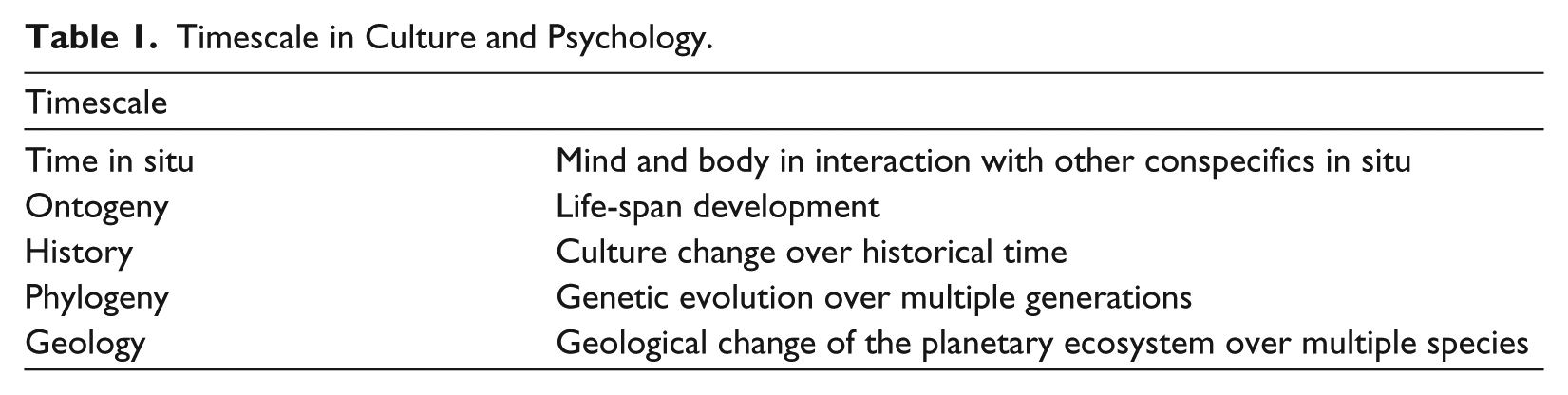
An analogous opposition emerged in the form of cultural priming and cultural comparison studies in culture and psychology (Kashima, 2009). On the one hand, cultural comparative studies continued to examine relatively stable, macro-level cultural differences, initially exploring along the dimensions of individualism and collectivism (e.g., Hofstede, 1980; Markus & Kitayama, 1991; Nisbett, Peng, Choi, & Norenzayan, 2001; Triandis, 1995), but further expanding to more complex dimensionality of cultures (e.g., Brewer & Chen, 2007; Heine, Lehman, Markus, & Kitayama, 1999; Kashima et al., 1995; Leung & Bond, 2004; Schwartz & Boehnke, 2004). They have been presumed to capture relatively stable cultural differences at least over a generation if not longer. On the other hand, cultural priming studies began to examine how cultural representations such as self-concepts (e.g., Brewer & Gardner, 1996; Trafimow, Triandis, & Goto, 1991) and cultural icons (e.g., Hong, Morris, Chiu, & Benet-Martínez, 2000) can be momentarily activated, and influence cognition, emotion, and behavior in the time span of 1-hr experiments. It is fair to say that both of these approaches have generated reliable results, showing that average cultural differences exist across the world in individualism and collectivism despite noticeable variability across studies (e.g., Morling & Lamoreaux, 2008; Oyserman, Coon, & Kemmelmeier, 2002) and that cultural representations can be primed to effect situationally induced changes in people anywhere (e.g., Oyserman & Lee, 2008).
Thus, culture-sensitive psychology began to span micro–macro levels of analysis as well as the timescales of cultural priming in situ and cultural differences over ontogenetic time. A more recent research has, however, taken it to a longer timescale, that is, history. Extending the cross-cultural research on individualism over time, Twenge and her colleagues (e.g., Twenge, 2006) began cross-temporal research tracing cross-generational trends in the United States from the 1960s to 2000s. 2 Using a variety of data including published studies (cross-temporal meta-analysis; for example, Twenge & Campbell, 2001), archival data (e.g., Twenge, Campbell, & Gentile, 2013), and existing surveys of successive cohorts of high school and university students (e.g., Twenge, Campbell, & Freeman, 2012), they have argued that the U.S. culture has become increasingly more individualistic—“more confident, assertive, entitled than before” (Twenge, 2006). A methodological development (Michel et al., 2011) that allows archival research of a large corpus of published books over a century has further prompted an examination of historical trends (e.g., Greenfield, 2013; Kesebir & Kesebir, 2012), generally testing and supporting the hypothesized increase in individualism in the United States.
However, this question is far from settled. When historical trends other than increasing self-enhancement are examined, both American and Japanese trends show increasing individualism in some domains, but increasing collectivism in others (Hamamura, 2012), suggesting that historical changes may not be uniform and unilinear. In addition, a cross-cultural link between economic inequality and self-enhancement (Loughnan et al., 2011) points to the possibility that the trend of greater self-enhancement in the U.S. history may be more due to increasing economic inequality than increasing individualism. With greater sophistication and availability of methodological tools (Kashima, 2014), research on cultural history is set to expand even further (e.g., Oishi, Graham, Kesebir, & Galinha, 2013; Wolff, Medin, & Pankratz, 1999) together with cross-cultural research on perceptions of history (e.g., Liu et al., 2005).
Continuing to further extend in time, cultural research in psychology has developed into the phylogenetic timescale. Although the question about animal culture—whether non-human animals have a “culture”—is long-standing (Galef, 1992), a series of high profile empirical reviews arguing for the existence of animal culture in chimpanzees (Whiten et al., 1999), orangutans (Van Schaik et al., 2003), and bottlenose dolphins (Krutzen et al., 2005) have opened a recent debate. With evidence of social learning even among Norway rats and fruit flies (!) (Galef, 2012), whether animal cultures exist may not be as critical a question as what type of culture exists for which species. That is to say, there may be a set of features that distinguish some species’ cultures from other species’ cultures. In particular, some have argued that cumulative culture—presumably a consequence of what Tomasello (1999) called a “ratchet” effect—is a species-specific characteristic of humans (e.g., Dean, Vale, Laland, Flynn, & Kendal, 2014).
At present, cumulative culture is narrowly understood as technological improvement over time; however, what constitutes improvement is itself a significant question. If understood as improvement in efficiency (i.e., ability to bring about an outcome it is designed to produce), the standard of evaluation is perhaps objectively definable. However, cumulativeness may operate not only in technological efficiency, but also in a domain of cultural beliefs and values (see Kashima et al., 2015; also see the discussion above on individualism). If it is understood more broadly—whether it is better in some moral sense—it will touch on a contentious issue of moral objectivism, namely, whether there is any objective standard of morality (see Goodwin & Darley, 2010).
Naturalizing Culture
The debate on animal culture has obvious implications for cultural research on the interface between phylogeny and ontogeny (e.g., Keller, 2007; Tomasello, 2008; Tracy & Matsumoto, 2008). However, it also points to the second conceptual vector that structures the metatheoretical space in culture and psychology—humans’ understanding about our place in nature. Contrary to the presumption of human–nature separation that the paradigm of the natural versus cultural sciences has both assumed, three lines of research began the trend for naturalization of culture (Table 2).
Human–Nature Relationship in Culture and Psychology—Naturalization of Culture.
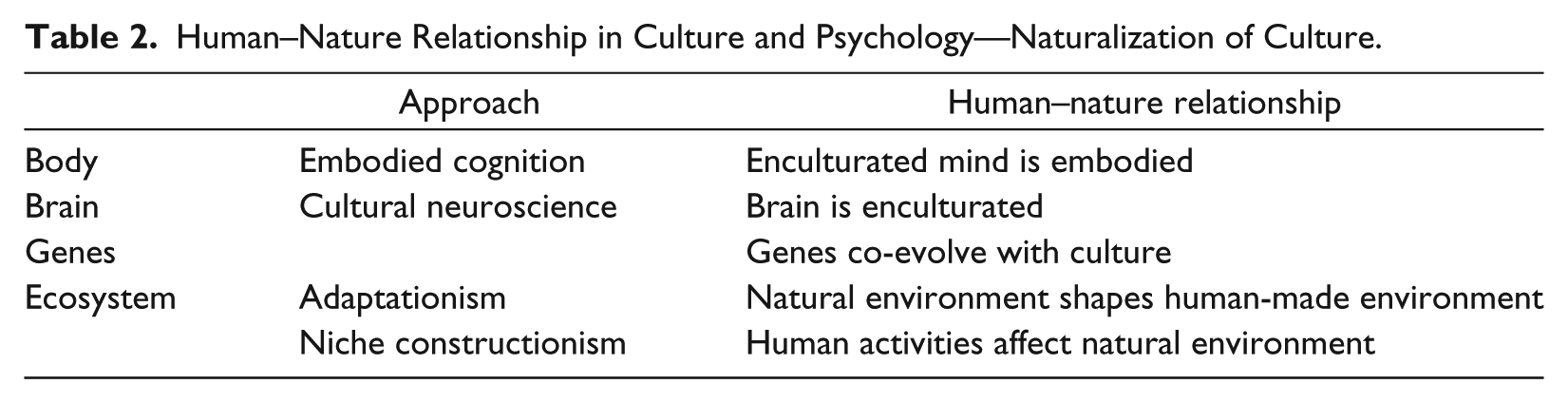
First of all, the gene–culture co-evolutionary approach that emerged in the 70s and 80s (e.g., Boyd & Richerson, 1985; Campbell, 1975; Cavalli-Sforza & Feldman, 1981; Dawkins, 1976; Durham, 1991) began to guide genetic research that has significant implications for culture and psychology (e.g., Chen, Burton, Greenberger, & Dmitrieva, 1999; Chiao & Blizinsky, 2010; Kim, Chiu, Peng, Cai, & Tov, 2010). In addition, dubbed “The Century of the Brain,” the 21st century has seen an upsurge of interest in brain processes. Fuelled by a physicalist stance on culture and mind, a neuroscience of the culture–mind interface emerged as an area called cultural neuroscience (e.g., Han & Northoff, 2008; Kitayama & Uskul, 2011), culminating in the publication of a journal, Culture and Brain, in 2013. Thus, the gene and brain have become the foci of inquiry. Finally, culture is now seen to be embedded not only in the brain, but also in the body—embodiment of culture (e.g., D. Cohen, Hoshino-Browne, & Leung, 2007).
The naturalization of culture continued as cross-cultural research programs began to uncover ecological correlates of culture. To be sure, the ecological environment in which a human population is located obviously sets the requirements for their survival. Indeed, ecological theorizing about culture has a long history (see Jahoda, 1992). More recently, however, research has shown that a variety of ecological threats to human survival have a profound impact on the type of cultural ideas and practices that are likely to help the population to adapt to the environment.
Most broadly, climatic threats on culture were brought to focus (e.g., Van de Vliert, 2008, 2013; Van de Vliert, Schwartz, Huismans, Hofstede, & Daan, 1999), showing that bioclimate—a deviation of temperature from the comfortable temperature for humans—can have a profound impact on psychological well-being as well as ingroup favoritism (Van de Vliert, 2011). Health threats such as a greater prevalence of pathogens in the environment that can cause infectious diseases makes it more likely for a human population to develop cultural practices that tighten group boundaries by strengthening the social ties in one’s ingroup (e.g., Fincher & Thornhill, 2012; Fincher, Thornhill, Murray, & Schaller, 2008; Murray, Trudeau, & Schaller, 2011) and avoiding outgroups (i.e., avoiding, for example, Schaller & Murray, 2008). More generally, natural threats, that is, a greater likelihood of natural disasters, can strengthen a meta-norm (i.e., cultural norm about norms) of cultural tightness (Gelfand et al., 2011). A greater need to coordinate individual activities and to cooperate with each other to cope with natural disasters makes it necessary to have a strong tendency to enforce their norms (i.e., tighter culture).
From Adaptationism to Niche Constructionism
Thus, the consensual conception of the person that takes seriously ontological physicalism, Darwinian phylogenesis, cultural ontogenesis, and culture–mind mutual constitutionism has exerted influences in the past two decades of culture and psychology. It seems fair to say that an adaptationist view of culture—the general hypothesis that human culture is an extra-somatic adaptation device for humans—underlies much of these metatheoretical trends. For instance, what may be called a functionalist school of cross-cultural psychology (e.g., Berry, Poortinga, Segall, & Dasen, 1992; Kağitçibaşi, 1996; Triandis, 1994) has regarded culture as an adaptation to the ecological and socio-political contexts. Most of the gene–culture co-evolution theorists (e.g., Boyd & Richerson, 1985; Campbell, 1975; Cavalli-Sforza & Feldman, 1981; Dawkins, 1976) conceptualized culture as a process of random variation and selective retention of ideas and practices, where the selection pressure comes from the ecological and socio-political environment. Finally, some theorists (e.g., Cole, 1996; Kağitçibaşi, 1996) took a “Lamarckian” stance, suggesting that one generation may pass their cultural ideas and practices to the next generation strategically guided by their perceptions of the future environment to which their cultural offspring needs to adapt.
Despite the subtle and nuanced differences among these orientations, the common theme that binds them is the view that there is the environment to which a human population adapts, and culture emerges, stabilizes, or changes over time through this adaptation process. The caution against a Panglossianism notwithstanding (Kashima, 2000), this perspective highlights the importance of culture as a powerful adaptation device for humanity. Culture helps people to coordinate their activities and cooperate with each other (e.g., Chwe, 2001; Kashima, 1999), providing them with an enhanced capacity to extract resources from the natural environment and convert them into goods and services to satisfy human needs. Culture has enabled humans to construct their own niches—the human-made environment—including the built environment made up of buildings, highways, and airplanes as well as the social institutions of nation states, market economy, and international organizations such as the United Nations. The socio-political environment humans themselves have constructed takes up a very large portion of the environment to which they have to adapt. Indeed, the non-human part of nature and the human-made environment are so intertwined and interpenetrated that it is hard to imagine any aspects of the planet Earth’s ecosystem untouched by human culture in the 21st century.
Perhaps one of the most fundamental aspects of the human-made environment is its economy, broadly construed here as the means by which people obtain resources for their living. Economies that require greater cooperation among people (e.g., farming, fishing vs. hunter-gatherer, herding) encourage them to develop a more holistic cognitive style (tendency to view an object within context; for example, Berry, 1979; Uskul, Kitayama, & Nisbett, 2008). Even among farming communities, those that require more cooperation (rice farming) tend to encourage more holistic cognition than those that require less cooperation (wheat farming; Talhelm et al., 2014). Furthermore, greater engagement with market economy has a significant impact on a human population’s culture. Hofstede’s (1980) well-known finding about the strong correlation between Gross Domestic Product (GDP) per capita and individualism may be understood in this vein. Henrich et al.’s (2005) cross-cultural study of small-scale societies found that the better integrated into the market economy, the more likely people were to equalize their share and their partner’s share in an economic game. As well, mobility—extent to which people move from one place to another or from one relationship to another (e.g., Oishi et al., 2007; Schug, Yuki, & Maddux, 2010)—and other factors of the social environment have been shown to have significant impact on culture (see Oishi, 2014).
Although some aspects of the human-made environment are well-embedded in the ecological environment (e.g., hunter-gatherer, herding, farming), other aspects are so all-encompassing that it has a high degree of autonomy (e.g., D. Cohen, 2001) and a life of its own (well, almost! but not completely, as we will see later). Again, economy provides a compelling example. The Global Financial Crisis of 2009 and its aftermath have shown us how difficult it is for humans to harness the global social institutions that they themselves have created. There are other intriguing examples of the relative autonomy of the human-made environment. For instance, a human population’s intragroup social institution (how effective its government works) affects people’s ingroup favoritism as a cultural adaptation more than the non-human ecosystem (pathogen prevalence; Hruschka & Henrich, 2013). Somewhat more disturbingly, human populations’ intergroup environment (how fiercely groups compete with each other) can co-evolve with the behavioral practices in which people sacrifice themselves for their ingroup to aggress against their outgroups (Choi & Bowles, 2007). Intergroup conflicts and outgroup threats can also make cultures tighter (Gelfand et al., 2011).
These developments in culture and psychology are very much in line with the niche construction view of evolution (e.g., Laland, Odling-Smee, & Feldman, 2000; Odling-Smee, Laland, & Feldman, 2003). In this perspective, all biological organisms, including humans, alter parts of their environment as they go about their business of living, namely, extracting resources from the environment, processing them, and disposing the waste back to it. The life process is, as Lewontin (2000) put it, best construed as a triple helix—intertwining of gene, organism, and environment in their ever-changing dynamics. The environment, then, is not a stable set of affordances to which organisms adapt as gene–culture co-evolution theories once assumed (e.g., Boyd & Richerson, 1985), but rather dynamic affordings that the organisms themselves participate in their construction, which in turn exert selective pressures on the evolution of genes as well as cultures (also see Oishi, 2014; Yamagishi, 2011).
Into the Uncharted Waters: Intergroup Relationships in the Anthropocene?
2001 was a symbolic year. Two events brought to our attention the changing human circumstances. One occurred on September the 11th, when hijacked American Airlines Flight 11 and United Airlines Flight 175 crashed into the World Trade Center (WTC). By now, these attacks are widely regarded as an ominous fanfare for the widespread intergroup conflicts often along religious lines that we witness today. The other event came and went perhaps less noticeably in the form of the third assessment of the Intergovernmental Panel on Climate Change (IPCC). It voiced without a fanfare a concern about the increasing likelihood of global warming and its potential risks for humanity. In combination, they signaled the global intergroup conflicts that humans undoubtedly initiate and the global environmental change that humans have apparently effected.
Without a doubt, origins of these events are numerous, complex, and contentiously enmeshed in the fabric of the past, and their winding causal chains that have led to the contemporary human circumstances can be traced back to many decades if not centuries. Rather than delving into the past, however, my task here is to consider the implications of these circumstances for conceptions of the person and culture for future psychology. And, what implications they are! The picture I present is not rosy, but clearly suggests a direction that research on culture and psychology can take in my view. Let us start this crystal ball gazing by considering the role of culture from psychological perspectives as it relates to intergroup relationships and the planetary system—aspects of the human-made and non-human-made environment.
Culture, Religion, and Intergroup Conflict
Expressly motivated by religion (U.S. Government Efforts to Counter Violent Extremism, 2010), al-Qaeda’s September 11 attacks inevitably drew attention to religion as a form of culture (A. B. Cohen, 2009) and its potential role in intergroup conflict. Although the contemporary risks of conflict along the cultural and religious lines had been noted before then (Huntington, 1997), it was the symbolism of it all—the destruction of a symbol of the global economic system (WTC) with a symbol of the technological advances and global mobility (jet-propelled airplanes) by what was portrayed as an act of God—that seem to have prompted the subsequent research into religion and psychology.
Recent psychological research on religion exemplifies the trend that I called a naturalization of culture. It is probably fair to say that religion is a cultural phenomenon. Although its definition is controversial, at minimum it may be regarded as a system of beliefs, which can be socially transmitted from one person to another. As such, it qualifies as part of culture broadly conceived. However, religion may have genetic evolutionary bases (e.g., Atran & Norenzayan, 2004; Barrett, 2000; Boyer, 2001). Here is a sketch of the contemporary theorizing about religion. Biological evolution has endowed humans with a variety of cognitive, emotional, and motivational capacities. Religious beliefs then “naturally” emerge from these capacities. For instance, humans have an evolved capacity for a “theory of mind”—an ability to attribute beliefs, desires, and intentions as well as emotions to understand others’ actions (e.g., Heyes & Frith, 2014, for a review). This ability to conceptualize a mind presumably enables the formation of mind–body dualism belief, namely, an ontological belief that separates the intangible mind/soul from the tangible body (Bloom, 2004), which in turn enables the development of a belief in afterlife, that is, an ontological belief in the continuing existence of the intangible after death (Bering, 2006).
Once a religion has emerged as a configuration of cultural elements, cultural evolution has taken it further because it tends to encourage intragroup cooperation among believers (e.g., Shariff & Norenzayan, 2007), which can facilitate their adaptation to the natural environment and also help them win over their contest in case of intergroup competition (e.g., Atran & Henrich, 2010; Wilson, 2002). Furthermore, religion tends to sacralize objects, events, and values as sacred and non-negotiable, which cannot be traded off with other secular values (e.g., Tetlock, 2003). Granted, intergroup conflicts often have a “realistic” basis, such as competition for scarce resources, intergroup oppressions, and unfair treatments. Nonetheless, if an intergroup conflict is framed and justified as a conflict between incompatible sacred values, it tends to be prolonged and become intractable (e.g., Atran & Ginges, 2012). Although religion is not necessarily parochial—world religions such as Christianity and Islam can facilitate cooperation and trust among strangers (Henrich et al., 2006)—it seems fair to say that, in the post-9/11 world, religion is ironically playing a significant role in intergroup conflicts.
Nature, Humans, and Climate Change
The planet Earth has experienced an unusually stable period of climate in the past 10,000 years, which geologists call the Holocene. It is the time when human civilizations have arisen and flourished because the planetary system maintained the environment that enabled human evolution, presumably both genetically and culturally. According to Rockström et al. (2009), a number of Earth-system processes—atmospheric carbon concentration, biodiversity, nitrogen and phosphorus cycles, stratospheric ozone concentration, Ocean acidification, freshwater availability, and so on—operate in tandem to sustain the Holocene planetary environment—“a safe operating space for humanity.” However, if many of these processes go beyond certain limits, which they call planetary boundaries, the Earth system may undergo sudden and irreversible changes, resulting in an environment less conducive for human survival.
Nevertheless, the Industrial Revolution and the subsequent human activities have pushed many of the Earth processes that maintain the Holocene environment to their limits and in some cases beyond the planetary boundaries (Rockström et al., 2009; Steffen, Grinevald, Crutzen, & McNeill, 2011). Paul Crutzen (2002), a Nobel laureate in chemistry, opened a debate by suggesting that we have now entered a new geological epoch more appropriately called the Anthropocene in which humans have disproportionate influences on the planetary process. One of the most telling and pressing examples of the Anthropocene is anthropogenic climate change. Since the IPCC’s third assessment in 2001, its warnings have become clearer and stronger as it updated its assessment in 2007 and 2014: An increasing body of observations gives a collective picture of a warming world and other changes in the climate system. (IPCC, 2001, p. 1) Warming of the climate system is unequivocal, as is now evident from observations of increases in global average air and ocean temperatures, widespread melting of snow and ice and rising global average sea level. (IPCC, 2007, p. 30) Human interference with the climate system is occurring, and climate change poses risks for human and natural systems. (IPCC, 2014, p. 3)
Together with Al Gore, the IPCC received a Nobel Peace Prize “for their efforts to build up and disseminate greater knowledge about man-made [sic] climate change, and to lay the foundations for the measures that are needed to counteract such change (Nobelprize.org, 2014).” Despite the lingering skepticism (see Oreskes & Conway, 2010, on the historical account of such skepticism) and fluctuating public opinions (Brulle, Carmichael, & Jenkins, 2012), the scientific consensus about the reality of anthropogenic climate change is overwhelming (Cook et al., 2013).
Does culture have anything to do with climate change? The answer is an emphatic “Yes!” Accumulation of greenhouse gases, particularly, Carbon dioxide (CO2), is a primary cause of the warming world (IPCC, 2001, 2007, 2014). Humans now use fossil fuels, that is, a main source of atmospheric CO2, in every aspect of the contemporary economic system—the global system of production, distribution, consumption, and disposal of goods and services. Given that humans have constructed, maintained, and even expanded the contemporary economic system with the aid of human-made science and technology, human culture has played, and continues to play, an obvious and significant role in the changing climate. It is in a way a niche construction gone awry. We humans have constructed our niche, the global economic system, which has now begun to adversely affect the rest of the planetary environment.
Climate and Intergroup Conflict
The implications of climate change do not stop at its effects on the non-human natural environment. With extreme weather events and the damages that they cause, other forms of efficiency losses in the global economic system, and likely uprooting and displacements of human populations, climate change is likely to have adverse effects on many aspects of contemporary human life (e.g., Helm & Hepburn, 2009). In fact, recent historical research shows that climate variations have a significant impact on the economic system, intergroup relationships, and human well-being (e.g., Zhang, Brecke, Lee, He, & Zhang, 2007; Zhang et al., 2011). In the Northern Hemisphere over the 15th to 19th centuries, there was an average temperature decline known as the Little Ice Age in Europe. This temperature anomaly of approximately −.5 °C over the long-term average in the Holocene appears to have caused a number of human crises including the collapse of agricultural production and food supply, thus causing famines, mass migrations, and social disturbances (Zhang et al., 2011) accompanied by intergroup conflicts and population declines in both China and Europe (Zhang et al., 2007). A recent quantitative synthesis found a substantial linkage between climate and human conflict (Hsiang, Burke, & Miguel, 2013), showing a 14% increase in intergroup conflict with a one standard deviation warming above the long-term average.
More generally, as discussed earlier, threats to human survival and human culture are linked—the greater the threats to a human population from the human-made and non-human-made environment, the tighter is its culture, so that its norms more clearly prescribe and proscribe the social behaviors, and that norm violations are more likely punished to bring the behaviors in line with the norms (Gelfand et al., 2011). Although the amount of economic resources populations have at their disposal can buffer the climate-related societal stress (Van de Vliert, 2013), it makes the prospect for humanity even more problematic. Poorer and less fortunate human populations are more likely to experience the adverse effects of climate change in a nearer future. They are more vulnerable, less equipped to cope with, and more likely to experience a greater difficulty in weathering and adapting to the likely change of the planetary system. If globalization has increased economic inequality around the globe (e.g., Hutton & Giddens, 2000) and economic inequality has a deleterious effect on human well-being (e.g., Wilkinson & Pickett, 2009), what might be the future prospect for humanity?
Concluding Comments: Implications for the Conception of the Person and Culture
The brief sketch of the intergroup relationships in the Anthropocene draws out several implications for the conceptions of the person and culture. First of all, it compels us to consider human culture in the geological timescale. Although there is no official word that geologists are ready to usher in a new epoch, the very idea of the Anthropocene signals that human activities need to be considered in describing the dynamics of the planetary system. Given the obvious role of culture in its making, what humans do with our culture needs to be theorized from a very long-term, potentially geological perspective.
Second, it almost completely naturalizes the concept of culture. Homo sapiens has evolved to be able to develop our cultures to adapt to the challenges of the natural environment (adaptationism); in so doing, we alter some aspects of the environment to construct our niche, the semiautonomous human-made environment (niche constructionism); and the human activities within the niche are now affecting the rest of the natural environment. And yet, the human-made environment is not autonomous. The planetary climate can shape the human-made environment, particularly, the relationships among human individuals and their groupings, which in turn profoundly affect our cultures and well-being. This demands us to theorize about culture and psychology as part of the planetary ecosystem. The presumption of human–nature separation, which was common across the Enlightenment and the Counter-Enlightenment opposition, needs to be abandoned.
Finally, it suggests us to reconsider the role of culture in a human collective self-narrative. In the current story of humanity, the anatomically modern humans emerged in Africa between 200,000 and 140,000 years ago, and spread out of Africa into all habitable continents 28,000 years ago (e.g., Overy, 2007). Humans have been on the move ever since. Throughout this period, culture has been an adaptation device that helped humans to adapt to and prosper in the environment. But now, culture seems to be a cause of at least some of the major human problems—climate change by human technology and intergroup conflict due to religion as a form of culture. These contemporary circumstances are likely to further fuel the human movement around the globe—people displaced from their places of birth, moving elsewhere, settling in, and making their living. Together with globalization, such geographical movements inevitably set the scenes for everyday experiences of cross-cultural differences, and potential causes for cultural clashes.
This raises a question. Is culture a friend or a foe? My answer would be this. Culture is neither a savior nor a nemesis; culture is a tool. Just like any tool, it helps us to do what it is meant to do. Through ratchet effects, humans have constructed more and more sophisticated and effective tools that are human cultures, which have enabled us to pursue our goals increasingly efficiently, those goals including survival, prosperity, and meaningful existence. Yet, just like any other tools, culture can have unintended consequences such as global warming, intergroup conflict, and depletion of minerals and reduction of biodiversity. If the current tool’s side-effects are no longer tolerable, perhaps we need to re-tool ourselves. According to one reading of our history (Pinker, 2011), humanity has managed to reduce human tragedies of intergroup conflicts by developing a new culture that enabled the establishment of states—a social institution of large-scale political entities with stable governance structures. This gives us a hope—humanity may be able to construct new cultures for the future (e.g., Wilson, Hayes, Biglan, & Embry, 2014).
Psychologists with a greater understanding about the person and culture can play a significant role in this endeavor.
Footnotes
Authors’ Note
This article is based on the Presidential Address to the International Congress of the International Association for Cross-Cultural Psychology at Reims, France, in 2014.
Declaration of Conflicting Interests
The author(s) declared no potential conflicts of interest with respect to the research, authorship, and/or publication of this article.
Funding
The author(s) disclosed receipt of the following financial support for the research, authorship, and/or publication of this article: The preparation of the presentation and this article was facilitated by grants from the Australian Research Council to the author (DP130100845 and DP 130102229).