




Abstract
Hypotheses are tested that ways of handling anger and their consequences will differ in student samples drawn from dignity cultures (United Kingdom and Finland), honor cultures (Turkey and Pakistan), and face cultures (Hong Kong and China). In line with our hypotheses, holding anger in and controlling anger correlate positively in face cultures but not in other samples, whereas holding anger in and letting anger out correlate positively in honor cultures but not in other samples. Furthermore, holding anger in and letting anger out are more strongly predictive of high depression and low life satisfaction in honor cultures than in other samples. The results provide support for the cross-cultural validity of Spielberger’s Anger Expression Inventory and for the proposition that differences in ways of handling anger can be understood in terms of contrasting cultural contexts.
Research on emotion has emphasized the importance of distinguishing separate components in the experience, labeling, and expression of different emotions (Lazarus, 1991). This perspective has proved fruitful in the cross-cultural analysis of primary appraisals; the circumstances that lead one to assign specific labels to aroused emotions (Scherer, 1997; Scherer & Brosch, 2008). As well as cultural differences in primary appraisals, there may be cultural differences in how one handles an emotion once it has been identified, known as secondary appraisals. This article contributes to the understanding of secondary appraisals by focusing specifically on cultural variations associated with three ways of coping with the emotion of anger; namely holding it in, controlling it, and letting it out directly. We investigate whether the interrelationship between the use of each of these coping styles is representative of known types of cultural differences. We then test hypotheses associating measures of well-being with these three anger coping styles. While doing so, we move beyond simple contrasts between individualistic and collectivistic cultures by sampling exemplars of differing types of collectivism.
Cross-Cultural Studies of the Experience of Anger
Comparative studies have indicated that the circumstances that elicit different types of emotions may be relatively similar across cultures, although there may be some tendency for the cultural context to predispose one to label emotions in culturally appropriate ways (Scherer, 1997; Scherer & Brosch, 2008). Cultures may vary more in the frequency of the circumstances that elicit specific types of emotions, and in the secondary appraisals involving whether and how they are then expressed and perceived by other members of that cultural group.
In terms of the experience of anger, the preference for harmony in East Asian cultures might lead to an expectation that anger would be more frequently experienced and expressed in individualistic cultures than in collectivistic cultures. However, Scherer, Wallbott, Matsumoto, and Kudoh (1988) found that Japanese students could recall more recent anger experiences than U.S. or European students. In their data, Japanese anger was mostly directed toward strangers, and therefore did not threaten in-group harmony, whereas anger among U.S. and European students was more often concerned with personal relationships. Expressions of anger may also convey meanings that vary between contexts. For instance, Park et al. (2013) contrasted the more generalized expression of anger that is associated with frustration in Western cultures with the “anger privilege” that permits senior figures in East Asian cultures to express their frustrations in a way that signals their dominance and control.
While cross-cultural researchers have thus given most attention to the circumstances eliciting anger, research into anger coping styles has mostly been conducted within single-nation samples. Here, we first consider the few existing cross-cultural studies of coping styles for anger and for emotion more generally, and of how they may interrelate with one another. We then discuss how well-being as exemplified by depression and life satisfaction may relate to anger expression in different cultural contexts.
Cross-Cultural Studies of Anger Coping Styles
Nation-Level Analyses
Matsumoto and his colleagues have made nation-level comparisons of emotional expression that provide the principal basis for the hypotheses to be tested in the present study. Matsumoto, Yoo, and Nakagawa (2008) compared reliance on suppression and reappraisal as coping styles for the regulation of emotion among students in 23 nations. The present article follows the terminology of Spielberger (1999) in referring to suppression as a form of Anger-In and reappraisal as a form of Anger-Control. Reappraisal involves a variety of cognitive adaptations such as changing what one is thinking about and changing the way that one construes the context within which the emotion is occurring. Matsumoto, Yoo, and Nakagawa (2008) found that suppression was more frequent in nations high on Hofstede’s (2001) measures of collectivism and power distance, while reappraisal was more strongly favored in nations that were low on Hofstede’s measure of uncertainty avoidance.
Aside from personal dispositions, individuals’ suppression of emotional expression can be encouraged by relevant cultural norms. As part of the same project, Matsumoto, Yoo, Fontaine, et al. (2008) compared reported norms for the expression of seven emotions, including anger across 33 nations. Emotional expression overall was strongest in individualist nations, but the effect for anger was weak and differed depending upon whether anger was to be expressed in in-group or out-group contexts. Relative to those from collectivistic cultures, members of individualistic cultures reported it to be more appropriate to express anger in in-group settings and less appropriate to do so in out-group settings. Furthermore, members of more collectivistic cultures endorsed the neutralization and masking of anger. Positive correlations were also obtained between norms favoring emotional suppression and Hofstede’s (2001) cultural dimensions of power distance and long-term orientation, as well as Schwartz’s (2004) measures of embeddedness and hierarchy. Conversely, where nation-level values are more individualistic, autonomous, and egalitarian, norms were more in favor of toning down but not eliminating one’s expressions of anger (Matsumoto, Yoo, & Chung, 2010). In a similar way, across 37 nations, self-reported anger expression was found to be greater in nations scoring low on Schwartz’s (2004) measure of mastery values (Wong, Bond, & Rodriguez Mosquera, 2008). These studies provide indications of relations between nation-level means for emotional coping styles and culture, but to understand their basis it is desirable to examine the extent to which these nation-level effects are congruent with the ways in which individuals in differing cultural contexts handle their emotions.
Prototypes of anger coping styles held by students in 25 nations have been compared by Alonso-Arbiol et al. (2011) and Fernandez et al. (2014). Following Spielberger’s (1999) division between Anger-In, Anger-Control, and Anger-Out, these authors distinguished between experienced internal processes, active self-control mechanisms, and overt reactions. Significant individual-level and nation-level variations were reported in the extent to which different anger components were seen as prototypical. Of particular relevance to the present study is their finding that overt anger expression was perceived as more typical in nations high on individualism and the human development index (HDI), whereas Anger-Control was perceived as more typical in nations high on collectivism and low on HDI. However, no measures based on respondents’ own personal experiences of anger were included in these studies.
Individual-Level Analyses
Matsumoto, Yoo, and Nakagawa (2008) reasoned that at the individual level, coping styles are not necessarily independent of one another. For instance, one might suppress emotional expression while thinking about how to control it. They predicted that greater need to restrain emotional expression in nations high on collectivism and power distance would foster use of multiple coping styles. In support of this expectation, they found that the magnitude of the correlation between respondents’ reported reliance on suppression and on reappraisal was positively related with nations’ scores on collectivism. In the present study, we aim to determine more precisely the contexts in which multiple coping styles are used and those in which they remain distinct.
Development of Hypotheses
Within any given culture, some contexts will occur in which anger expression is more permissible, and others in which it is less so. Indeed, Matsumoto, Yoo, Fontaine, et al. (2008) found contrasts of this type between in-group settings and out-group settings. While it is possible that preferred anger coping styles might vary between contexts within a given culture, it is equally plausible that coping with anger in different contexts varies only in terms of the degree to which one employs habitual coping styles. As Gelfand et al. (2011) showed, the variation of social constraint across everyday settings occurs in much the same way in cultures defined as tight and those defined as loose. Consistent with this assumption, the present study uses Spielberger’s (1999) measures of Anger-In, Anger-Control, and Anger-Out to gain a more specific understanding of the ways in which dimensions of culture relate to the experience of anger. We use Spielberger’s original measures, which do not refer to specific contexts.
Persons in all cultures are likely to encounter anger-inducing circumstances. However, we are not concerned here with anger frequency, but with how reliance on Spielberger’s (1999) three coping styles will relate to one another in any given context, and with the association between coping styles and well-being. While there is substantial evidence for restrained anger expression in East Asian cultures, there is less evidence concerning collectivistic cultures from other regions in which more forthright styles of communication prevail. We therefore supplement the contrast between individualist and collectivist cultures by addressing the variability in the handling of anger among individualist cultures and cultures that reflect different types of collectivism.
Leung and Cohen (2011) have distinguished cultures in which prevailing values favor either dignity or honor or face. The contrast between dignity cultures and face cultures parallels the contrast between individualism-collectivism as exemplified by studies sampling North America and East Asia. Dignity cultures construe individuals as relatively equal, with each having a stable and internal sense of worth. Face cultures are more hierarchical with members valuing humility and in-group harmony. Honor cultures represent a different form of collectivism, characterized by the greater salience of threats to the honor of oneself and of one’s group. Until recently, few comparisons have been reported that directly contrast cultures characterized by a predominance of dignity, honor, and face values.
In all cultural contexts, we can expect that those who control their anger will express less anger. However, the relationship between holding one’s anger in and the other two coping styles may differ between cultural contexts. For instance, while some respondents may hold anger in and others may let anger out, it is possible to do both, although the circumstances in which they do each of these things will of course differ (Martin & Watson, 1997). We next consider in turn the three distinctive culture types identified by Leung and Cohen (2011) and hypothesize how they relate to anger coping styles.
Face Cultures
Within face cultures, the concern to preserve harmonious relations will especially constrain the circumstances in which it is appropriate to express anger. Even when direct insults are delivered to Chinese respondents experimentally, no overt anger expression is found (Bond & Venus, 1991). Where anger is experienced, keeping it in and consciously using ways of internally controlling it will be shared priorities, and respondents’ reports of doing both are likely to co-occur, as Matsumoto, Yoo, and Nakagawa (2008) found. A lesser degree of differentiation of coping styles in face cultures than elsewhere is also consistent with the preference for holistic rather than analytic cognition identified by Nisbett, Peng, Choi, and Norenzayan (2000) and others.
Honor Cultures
In honor cultures, the need to defend the honor of oneself and of one’s group raises the potential for a variety of angry responses. Contrasts between understandings of honor have been extensively investigated between dignity and honor cultures (Cross et al., 2014; Rodriguez Mosquera, Manstead, & Fischer, 2000, 2002; Rodriguez Mosquera, Fischer, Manstead, & Zaalberg, 2008; Vandello & Cohen, 2003; Uskul, Cross, Sunbay, Gerҫek-Swing, & Ataca, 2012) and between honor and face cultures (Güngyor, Karasawa, Boiger, Dincer, & Mesquita, 2013). However, few studies have been reported that simultaneously contrast all three types of the cultures that exemplify dignity, honor, and face values (Leung & Cohen, 2011; Severance et al., 2013; Uskul, Oyserman, Schwarz, Lee, & Xu, 2013).
Within honor cultures, expression of anger under certain circumstances is more acceptable. The challenge is to identify correctly the circumstances in which to hold it in rather than express it. Because it is so important to determine when honor is or is not threatened, honor cultures are likely to have especially strong politeness norms (Cohen, Vandello, Puente, & Rantilla, 1999). Where honor is seen to be threatened, retaliation is more likely than in other cultural contexts (Günsoy, Cross, Uskul, Adams, & Gerҫek-Swing, 2015; Uskul et al., 2015). Respondents’ reports of sometimes holding anger in and at other times expressing it are therefore more likely to co-occur.
Dignity Cultures
The cultures referred to by Leung and Cohen (2011) as dignity cultures are more frequently characterized as individualistic. Spielberger’s State-Trait Anger Expression Inventory (STAXI) instrument was first developed and validated within the United States (Spielberger et al., 1985; Spielberger & Reheiser, 2009), thereby providing distinctive evidence that U.S. respondents do differentiate the three coping styles. Within individualist cultures, anger expression may be less regulated by norms and be more dependent upon individual choices and dispositions. There may therefore be circumstances when each of the coping styles is distinctively characteristic of an individual. There is less reason to predict that reliance on any two of the styles will co-occur.
The finding of Matsumoto, Yoo, and Nakagawa (2008) that emotion regulation and suppression are positively associated in collectivist cultures but not elsewhere provides the basis for Hypothesis 1a. The greater threat posed by insults to oneself and one’s group within honor cultures (e.g., Rodriguez Mosquera et al., 2008) and the consequent need to select when and how to respond provides the basis for Hypothesis 1b. There is no basis to expect variation in the inverse relationship between Anger-Control and Anger-Out.
Anger Expression and Well-Being
Depression
Anger and associated emotion regulation have been shown to be related to well-being across several cultures. For example, the 23-nation study by Matsumoto, Yoo, and Nakagawa (2008) found that suppression was significantly related to high depression and low life satisfaction, whereas reappraisal was unrelated to either measure. This suggests that those who hold their anger in—for instance, by suppressing it—may report lower levels of well-being, but that there may be no relationship between controlling one’s anger—for example, through reappraisal—and well-being. However, these results refer to nation-level associations, and Matsumoto et al. point out that there is no reason for them to concur with the results of individual-level analyses.
Kwon, Yoon, Joormann, and Kwon (2013) compared the relationship between anger coping styles and Centre for Epidemiological Studies–Depression (CES-D) among South Korean and U.S. students. Based on an earlier comparison of emotion regulation in Japan and the United States (Matsumoto, 2006), they predicted that Americans would be less likely to suppress anger or ruminate than Koreans. They also expected that anger suppression (measured by Spielberger’s Anger-In scale) and rumination would be more strongly predictive of depression in the more individualistic United States. Having established metric equivalence, they found that reported anger suppression was actually higher in the United States. Anger suppression was indeed a significantly stronger predictor of depression in the United States, whereas a measure of reappraisal was a significantly stronger protective factor against depression in Korea.
We did not find any other studies that examine the individual-level association between anger coping styles and depression across cultures. It could be argued that in contexts such as face cultures, where suppression is supported by norms favoring emotional restraints (Safdar, Friedlmeier, Matsumoto, et al., 2009), and in which anger is predominantly experienced in relation to strangers (Scherer et al., 1988), that Anger-In would be less predictive of depression. However, it is equally possible that, where anger is intensely felt in these circumstances, it could trigger depression precisely because of the norms discouraging anger expression. Therefore, we do not make any predictions regarding the differential association of anger suppression with depression across cultures.
The items defining anger control in the STAXI scale exemplify the practice of self-control (e.g., Baumeister, Vohs, & Tice, 2006). Where anger is successfully controlled, it may be associated with positive well-being and lower depression. A meta-analysis found a positive association between self-control and various indices of positive well-being (De Ridder, Lensvelt-Mulders, Finkenauer, Stok, & Baumeister, 2012). However, the reappraisal involved in controlling anger may be more difficult in some cultural contexts than others, and De Ridder et al. were able to include only U.S. and European samples in their analysis. Where expression of anger is socially acceptable in some contexts but not in others, control becomes a priority and can therefore be a protective factor against depression. As we have noted, the potential for insult and retribution in honor cultures renders acute the need for such control.
Overt anger expression is found to be positively correlated with depression in cultures as diverse as the United States (Goodwin, 2006) and Ethiopia (Terasaki, Gelaye, Berhane, & Williams, 2009). Given the emphasis on harmony in East Asian face cultures, as well as norms that disfavor expression of all types of strong emotions, there is less reason to link anger expression and depression in face cultures. Conversely, the risks of negative outcomes associated with anger expression will be greatest in honor cultures, leading to a greater risk of depression:
Life Satisfaction
Kuppens, Realo, and Diener (2008) compared levels of positive emotions, negative emotions, and life satisfaction across 46 nations. A lower reported frequency of negative emotions during the past week was a stronger predictor of life satisfaction in more individualistic nations than in more collectivistic nations. However, anger was only one of eight emotions included in their measure of negative emotions.
Hu, Zhang, Wang, et al. (2014) compared the results of 51 Chinese and Western studies of the association between emotional regulation and various indicators of positive and negative mental health. The positive indicators included life satisfaction and the negative indicators included depression. Meta-analysis indicated that reappraisal predicted positive outcomes positively and negative outcomes negatively in both Western and Chinese studies. However, suppression was a significant predictor of outcomes only in the Western studies. This result could not be attributable to differing sample sizes, as Western and Chinese studies were equally numerous, but may have been influenced by the inclusion of a larger proportion of unpublished studies from China. This study, as well as the previously discussed norms favoring harmony in face cultures and the riskiness of anger expression in honor cultures, provides the currently available basis for hypotheses relating to life satisfaction. Caution is also exercised, on account of the finding of Matsumoto, Yoo and Nakagawa (2008) that reliance on reappraisal and suppression are positively linked in more collectivist cultures.
Cultural Contexts
The hypotheses have been outlined using the contrast between honor, face, and dignity cultures proposed by Leung and Cohen (2011). However, these authors identify these cultural contexts as ideal types and did not seek to measure their attributes empirically. In the present study, we address this issue by drawing on secondary sources. If the contrast between dignity and face cultures may be equated with Hofstede’s (2001) understanding of individualism versus collectivism, the remaining question is how to identify honor cultures. Minkov (2011) has derived a nation-level dimension of cultural variation named as monumentalism-flexumility from responses to items within the World Values Survey. Nations scoring high on monumentalism are defined by strong endorsement of national pride, preference for children to develop religious faith, and a strong wish to make one’s parents proud. Nations scoring high on monumentalism are predominantly Arab and African nations, while those scoring on flexumility (flexible humility) are East Asian nations. It appears that this dimension may capture the contrast between honor cultures and face cultures. In addition, Minkov defines the poles of his dimension in terms of contrasting types of self-construal. In monumental cultures, the self is said to be consistent, stable, and proud, in contrast to a more flexible and humble self-construal within flexumility cultures. Leung and Cohen (2011) also characterized self-construal in honor cultures: In honor cultures, there is competition within a status group among rough equals, who may appropriate each other’s honor—though some honor cultures may have caste-like structures separating different status groups, while in others a rough equality may pervade society. In honor cultures, self-help justice is the ruling principle; an entity whose honor is violated cannot appeal to any overarching authority to give it justice—though cultures vary in how much claims to honor are vested in, and must be defended by, collective entities (such as clans, extended families, and so on) versus individual persons. (p. 5)
Relevant scores from the data of Minkov (2011) and from the World Values Survey are used to establish the degree to which the nations in the present sample do exemplify honor, face, and dignity cultures.
In summary, by testing the hypotheses we seek to clarify the distinctive ways in which anger expression is (or is not) controlled within three specific cultural contexts, and to show the ways in which anger coping styles interact with context in yielding more positive or negative outcomes.
Method
Sample
Respondents were students majoring in a variety of subjects who were enrolled in universities in the nations sampled, as shown in Table 2. The data for depression and life satisfaction from Hong Kong, China, Pakistan, Turkey, and Finland were also analyzed by Smith et al. (2015), but their study was not concerned with anger expression. The questionnaire was created in English, and then translated into the language of instruction in the sampled universities, using back-translation (van de Vijver & Leung, 1997) to maximize accuracy. Responses from non-nationals and those born outside the country were discarded.
Measures
Cultural clusters
To differentiate honor cultures from dignity and face cultures, country mean scores and percentages for items relevant to Minkov’s (2011) delineation of monumentalism-flexumility were downloaded from the World Values Survey (worldvaluessurvey.org). Within the data of Hofstede (2001), United Kingdom and Finland are contrasting nations with scores in the top third for individualism, while Hong Kong and China have contrasting histories but both score in the top third for collectivism and are considered as exemplars of face cultures. Hofstede’s data show Turkey as moderately collectivistic and Pakistan as strongly collectivistic.
Measurement equivalence
To test the hypotheses validly, metric equivalence is desirable for the measures used to test within-sample relationships, namely depression, life satisfaction, and modes of anger expression. For each scale, model fit was assessed using the comparative fit index (CFI), root mean square error of approximation (RMSEA), and standard root mean square residual (SRMR). Values of SRMR <.08 (or <.10), RMSEA <.06 (or <.08), and CFI >.95 (or >.90) have been proposed as criteria for “good” (or “acceptable”) fit (Hu & Bentler, 1999; Kline, 2005). Following Little (2000), metric or scalar invariance was considered to be supported if a model that assumes that level of invariance showed adequate fit. Analyses were conducted in Mplus Version 6 (Muthén & Muthén, 2010).
Anger expression
Anger expression was measured with Spielberger’s (1999) 24-item STAXI. The scales measuring Anger-In (e.g., “I boil inside, but I don’t show it”), Anger-Control (e.g., “I control my anger”), and Anger-Out (e.g., “I lose my temper”) each contain eight items with none reversed. Responses are recorded on 4-point scales keyed from never to almost always. No previous tests have been reported of the cross-cultural measurement invariance of these scales.
To investigate invariance, we conducted exploratory structural equation modeling (ESEM) with targeted rotation (Marsh et al., 2009; Morin & Maïano, 2011; Scalas, Morin, Marsh, & Nagengast, 2014). This method relaxes the often unrealistic constraint within confirmatory factor analysis (CFA) that the loadings of items on latent factors of which they are not theoretically indicators are fixed to 0. To achieve invariance, one Anger-In item and one Anger-Out item were removed due to low (<.30) standardized loadings on their respective factors across several groups, one covariance was added between two Anger-In items to the Turkish group, and three covariances were added to the China group: two between Anger-Out items and one between Anger-In items. After these adjustments, a multi-group ESEM supported partial metric and scalar invariance of the three subscales: χ2(1289) = 2,166.617, p < .001, CFI = .90, RMSEA = .05 and SRMR = .07. Factor scores were saved from this model, and adjusted sample means were computed for our main analyses.
Depression
Depression was measured with the 20-item version of the CES-D scale (Radloff, 1977). These items have 4-point response scales keyed in terms of frequency of symptom occurrence. Four items describing positive symptoms are reverse keyed. The depression factor was scaled by fixing one item loading to 1. After removing items 20, 17, and 15 and adding three covariances between similarly worded items, a multi-group CFA supported full metric and scalar invariance : χ2(776) = 1,651.912, p < .001, CFI = .90, RMSEA = .07 and SRMR = .08.
Life satisfaction
Satisfaction with life was measured with the five-item scale developed by Diener, Emmons, Larsen, and Griffin (1985). A sample item is “I am satisfied with life.” These items have 7-point response scales keyed from strongly disagree to strongly agree. There are no reversed items. The scale has been shown to have predictive validity when used cross-culturally (Diener, Inglehart, & Tay, 2013), but does not always factor unidimensionally (Slocum-Gori, Zumbo, Michalos, & Diener, 2009). The average of Cronbach’s alphas by nation was α = .81 with the lowest score being .68 for the Pakistani group. CFA indicated removing Item 2 (“The conditions of my life are excellent”) and adding one covariance. After these modifications, a multiple-group CFA supported full metric and scalar invariance, with acceptable fit: χ2(21) = 34.371, p = .033, CFI = .99, RMSEA = .05, SRMR = .04. Factor scores were saved from this model for use in our analyses.
Results
Table 1 provides information drawn from World Values Survey data, profiling the six samples included in the present study. Consistent with expectation, United Kingdom and Finland exemplify individualistic or dignity values, with high emphasis on personal choice, low emphasis on religious belief and on making one’s parents proud as a life goal, with only moderate pride in one’s nation. Conversely, Turkey and Pakistan exemplify the values of monumentalistic or honor cultures, including high emphasis on religious belief, pride in one’s nation, and wish to make one’s parents proud, and low emphasis on personal choice. The two Chinese samples exemplify lower pride in one’s nation, lower religious belief, and lower wish to make one’s parents proud. While these attributes are not directly representative of face cultures, they differ substantially from those defining honor and dignity cultures.
Profiles for Sampled Nations.
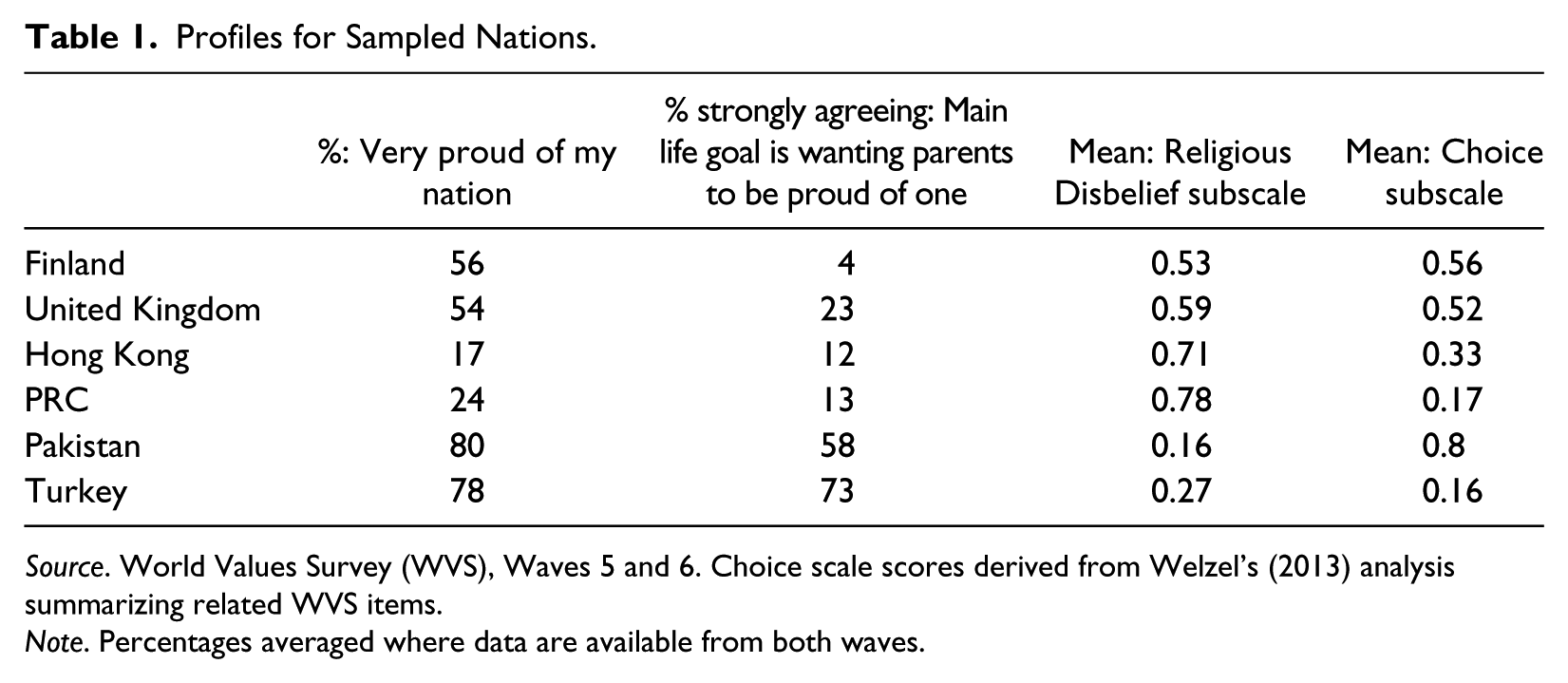
Source. World Values Survey (WVS), Waves 5 and 6. Choice scale scores derived from Welzel’s (2013) analysis summarizing related WVS items.
Note. Percentages averaged where data are available from both waves.
Demographic details as well as factor scores for the STAXI scales, depression, and life satisfaction for the respondents from each nation and for the overall sample are shown in Table 2. To test the hypotheses, it was necessary to pool the data from each pair of nations that, respectively, exemplify face, dignity, and honor cultures. This was accomplished through standardization around each sample’s means for each nation.
Sample Demographics and Factor Scores.
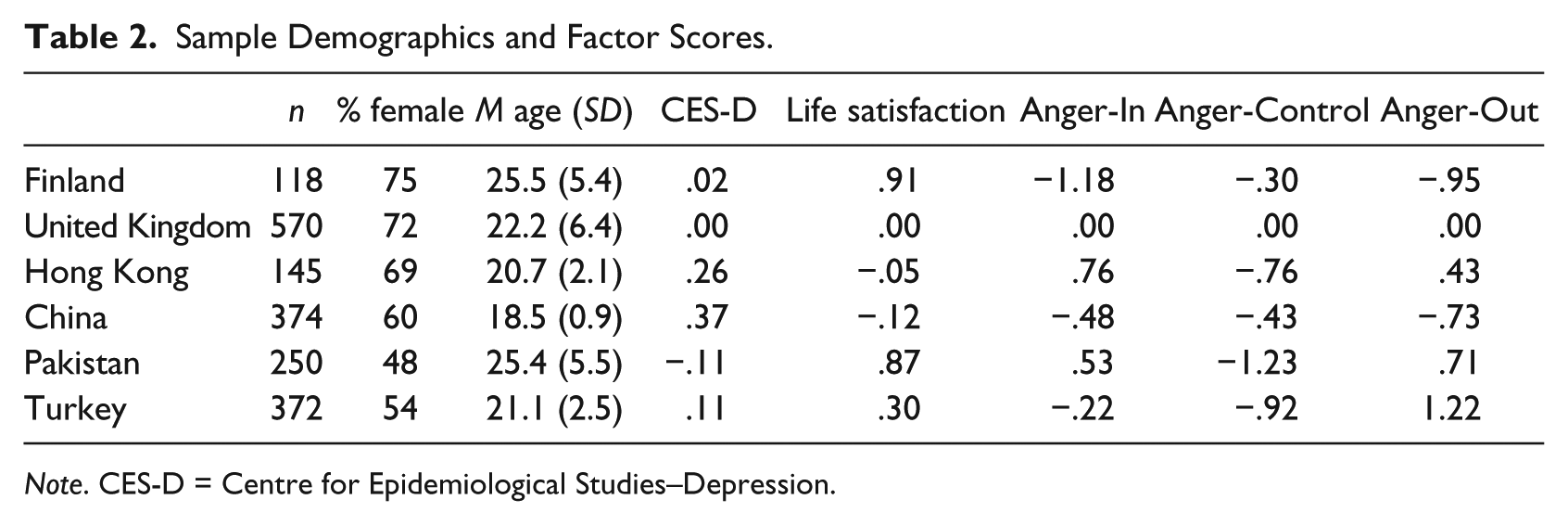
Note. CES-D = Centre for Epidemiological Studies–Depression.
Hypothesis 1 was tested via regression analyses in a series of steps. Each STAXI scale (e.g., Anger-In) was used as the outcome in each of three hierarchical regressions, so that the tables which follow each summarizes results from a total of nine regression models. In Step 1, we included age and gender as control variables. In Step 2, we included one of the remaining two STAXI subscales as a predictor (e.g., Anger-Control). In Step 3, we included two dummy variables representing two of the three cultural groupings (e.g., Dignity, Face; the remaining grouping was a reference group). In Step 4, we included the interactions between the STAXI scale and the two dummy variables as a test of whether the strength of the relationship between the STAXI scales varied significantly by cultural grouping (e.g., Anger-Control × Dignity and Anger-Control × Face). In Step 5, we repeated the first four steps but switching the cultural grouping that was used as the reference group (e.g., including Dignity and Honor, rather than Dignity and Face). Step 6 replicated Step 5 using the remaining cultural group. This ensured that all cultural groups acted in turn as the reference group and provided estimates for all the relevant effects. We next repeated the first six steps but having replaced the STAXI scale used in Step 2 and Step 4 (e.g., Anger-Out). Finally, we repeated all of the above steps but having replaced the STAXI scale designated as the outcome variable (e.g., Anger-Control). Tables 3 to 5 also show the variance explained by differences between the three culture types after demographic differences have been discounted.
Hierarchical Regressions Indicating the Strength and Direction of Association Between the STAXI Scales by Cultural Group, Controlling for Age and Gender.
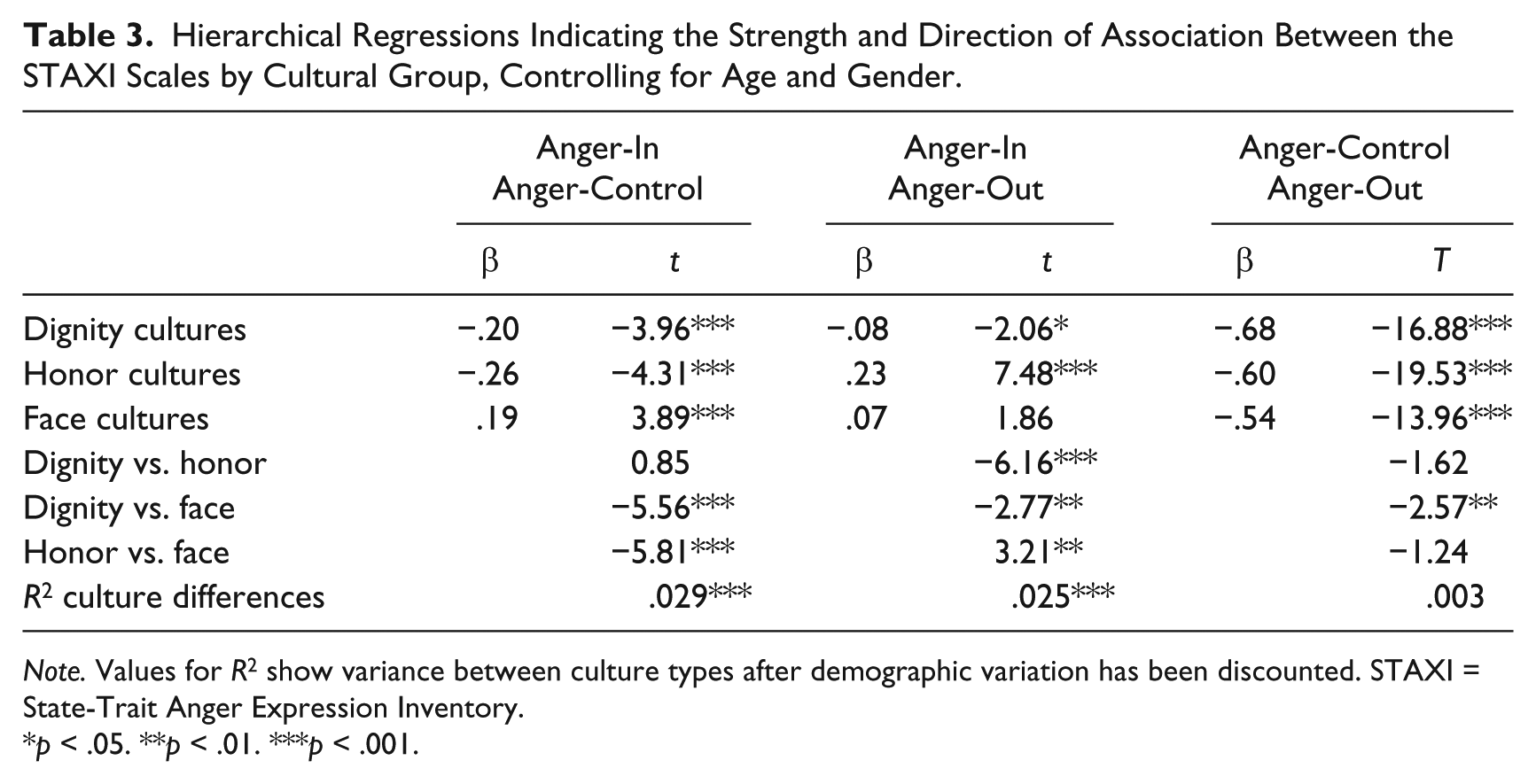
Note. Values for R2 show variance between culture types after demographic variation has been discounted. STAXI = State-Trait Anger Expression Inventory.
p < .05. **p < .01. ***p < .001.
Hierarchical Regressions Indicating the Strength and Direction of Association Between the STAXI Scales and CES-D by Cultural Group, Controlling for Age and Gender.
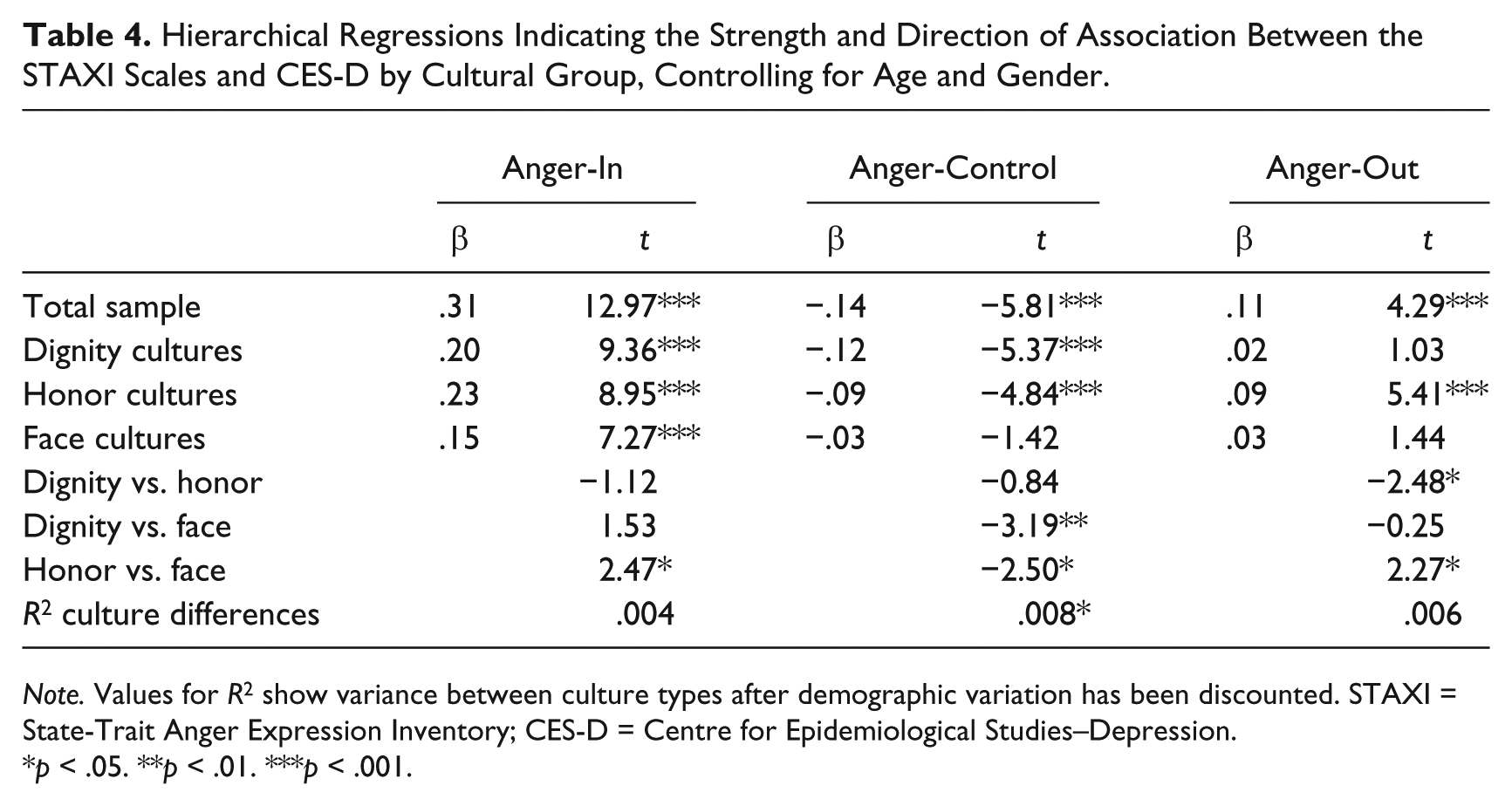
Note. Values for R2 show variance between culture types after demographic variation has been discounted. STAXI = State-Trait Anger Expression Inventory; CES-D = Centre for Epidemiological Studies–Depression.
p < .05. **p < .01. ***p < .001.
Hierarchical Regressions Indicating the Strength and Direction of Association Between the STAXI Scales and Life Satisfaction by Cultural Group, Controlling for Age and Gender.
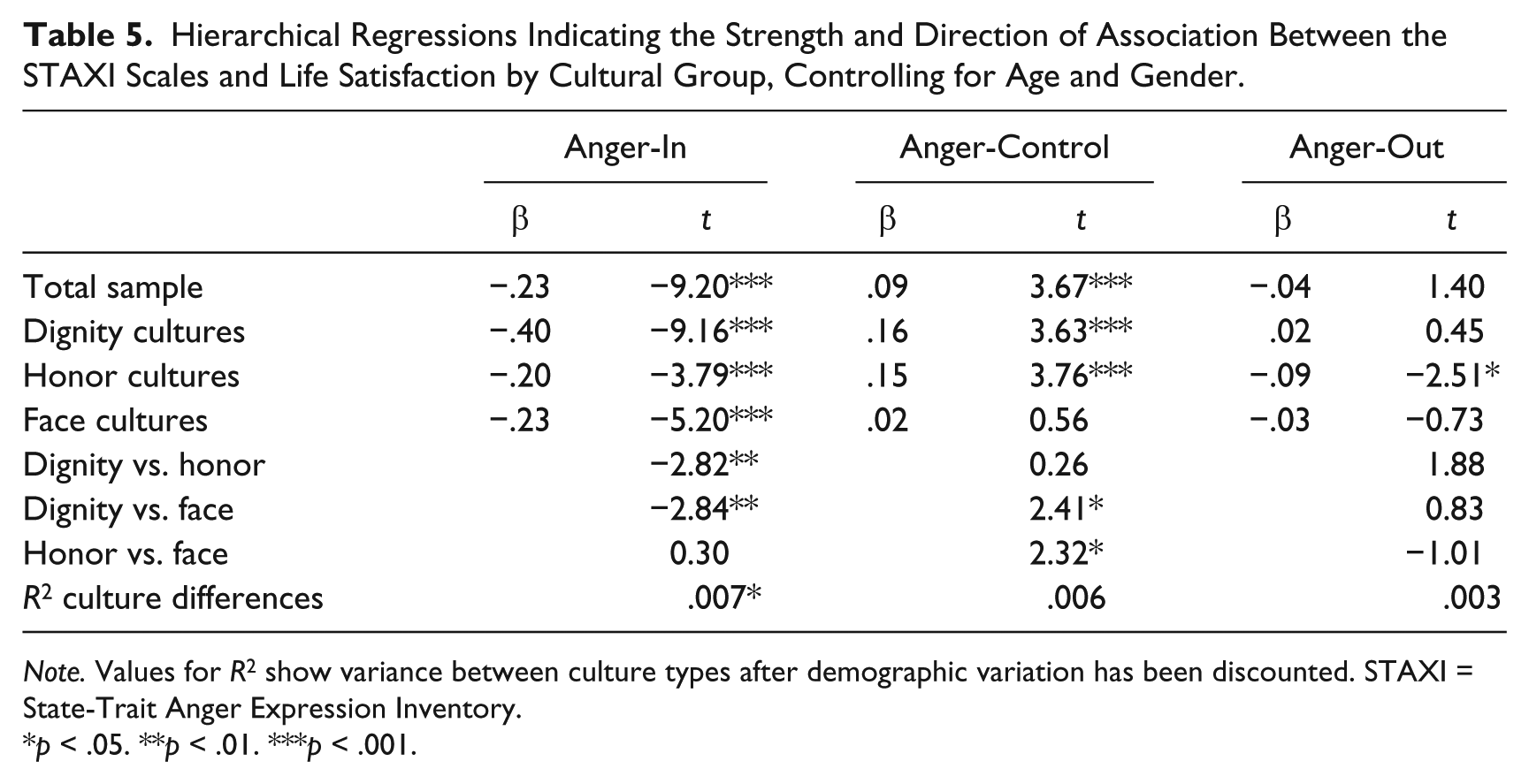
Note. Values for R2 show variance between culture types after demographic variation has been discounted. STAXI = State-Trait Anger Expression Inventory.
p < .05. **p < .01. ***p < .001.
Table 3 shows that, as predicted by Hypothesis 1a, Anger-In and Anger-Control are significantly positively associated in face cultures, and are negatively correlated in dignity or honor cultures. Furthermore, Anger-In and Anger-Out are more strongly positively associated in honor cultures, as predicted in Hypothesis 1b. This relationship was significantly negative in dignity cultures. Finally, Anger-Control and Anger-Out are negatively correlated in all samples, consistent with Hypothesis 1c.
Hypotheses 2 and 3 were tested by regressing the STAXI scales on depression and on life satisfaction, using a similar series of steps detailed in Steps 1 to 6 above. Table 4 first shows results for the overall sample, followed by results for each cultural group separately. Overall, depression is predicted by high Anger-In, high Anger-Out, and low Anger-Control. Anger-In also significantly predicts depression in each of the separate cultural samples, consistent with Hypothesis 2a. Hypothesis 2b is not supported, as the link between Anger-Control and depression is equally strong in both honor and dignity cultures, although the association is significantly weaker in face cultures. As predicted by Hypothesis 2c, depression is more strongly positively associated with Anger-Out in honor cultures, although, against Hypothesis 2d, the association is non-significant in both face and dignity cultures.
Table 5 shows a similar set of results with life satisfaction as dependent measure. Overall, high life satisfaction is predicted by low Anger-In and high Anger-Control but is unrelated to Anger-Out. Across each cultural sample, Anger-In predicts low life satisfaction (H3a), but does so more strongly in dignity cultures. Anger-Control is associated with high life satisfaction (H3b) in honor cultures as predicted, but the effect is again equally strong in dignity cultures. Hypotheses 3c and 3d are also not supported, as there is no difference between samples in the relation between Anger-Out and life satisfaction.
Discussion
This study is innovative in two major ways. First, it has tested the predictive validity of Spielberger’s STAXI scales across a broad range of samples. No previous study has been identified that samples these scales from more than two nations. Second, evidence for the utility of Leung and Cohen’s (2011) distinction between dignity, honor, and face cultures has been extended. While Severance et al. (2013) have identified differing understandings of the nature of aggression in each of the three culture types, this study has found differing associations with anger coping styles.
By using ESEM, we were able to determine that, after deletion of a small number of items, the STAXI scales and the dependent measures that were employed have adequate levels of measurement invariance to permit valid comparisons of their predictive validity in the settings that were sampled. The tests of Hypothesis 1 provide evidence in favor of distinguishing the types of collectivistic cultures here characterized as honor and face cultures. Holding anger in was positively associated with controlling anger within face cultures, whereas in honor cultures these ways of managing anger were distinct and negatively related, just as they were in dignity cultures. Conversely, the co-occurrence of Anger-In and Anger-Out was characteristic of honor cultures but not of face and dignity cultures.
The associations found between the STAXI scales and reported depression and life satisfaction require closer scrutiny. Respondents to the STAXI scales describe their habitual ways of handling anger, whereas the CES-D items request a report of symptoms experienced in the preceding week. Radloff (1977) reported test–retest correlations for her U.S. respondents for periods up to 12 months that varied between .45 and .70, dependent on the occurrence of life events during the intervening period. Hence, it is possible that associations in the present data between habitual anger coping styles could be attenuated by the occurrence of recent life events for some respondents. In contrast, the measure of life satisfaction has no immediate time referent.
Results for the overall sample provide evidence favoring the cross-cultural validity of the Anger-In and Anger-Out scales as positive predictors of depression, and of Anger-Control as a protective factor against depression. However, when the sample was divided into groups characterizing dignity, honor, and face cultures, significant differences were found in the relation between all three STAXI scales and depression. While Hypotheses 2a and 2c were supported, 2b and 2d failed because, although Anger-Control did predict depression more strongly in the honor cultural group compared with the face cultural group, the effect was equally strong in both the honor and dignity cultural groups. The results with life satisfaction as dependent measure were similar to those for depression in relation to all hypotheses. However, the effects were generally weaker.
Cross-cultural researchers have frequently contrasted individualistic and collectivistic cultures. The present study adds to the growing literature indicating the benefits of distinguishing honor cultures from face cultures as differential exemplars of collectivism. Honor cultures were shown to resemble dignity cultures rather than face cultures in their differentiation of Anger-In from Anger-Control, and in their association of Anger-Control with high depression and low life satisfaction. When the analyses reported in Tables 3 to 5 were repeated simply contrasting individualistic cultures from collectivistic cultures (available from the second author on request), less variance was explained in all analyses.
The primary limitation of the present results is that no direct comparative measure was included to determine the extent to which the sampled cultures endorse honor or monumentalism. Secondary data did provide indicative evidence, but direct measurement with existing scales (e.g., Rodriguez Mosquera et al., 2008) is desirable. The study also included only two exemplars of each culture type, and both for dignity cultures and for face cultures one sample was substantially larger than the other. Locally salient issues in the larger samples may therefore have influenced the outcomes obtained to some extent.
A second limitation is that the STAXI scales that we employed did not differentiate between the differing social contexts within which one may experience anger. In doing so, we argued on the basis of studies of tight and loose cultures (Gelfand et al., 2011) that it is equally plausible that differences in anger management between contexts may vary in amount rather than in terms of different types of coping styles. In future studies, it is desirable to test whether our assumption is correct.
The results also underline the importance of identifying aspects of East Asian cultures that are distinctive. The relationships between STAXI scales and outcomes within the face culture sample were significant only for Anger-In. The predominance of norms favoring harmony in East Asian cultures may mean that the items defining the STAXI scales fail to capture adequately the ways of handling anger that are most prevalent there. The present result that Anger-In was less strongly predictive of depression in face cultures is consistent with the finding of Kwon et al. (2013) that Anger-In predicted depression less strongly in Korea than in the United States, and the conclusions of Hu et al. (2014) that anger suppression is only predictive of outcomes in Western samples. Where norms favor harmony, the priority may not be on how to handle anger but on how to prevent its occurrence in the first place (Lee, Aaker, & Gardner, 2000; Wong et al., 2008).
In contrast to the results for face cultures, those for honor cultures showed significant links between all the STAXI scales and both dependent measures. Prior studies of honor cultures have mostly been directly addressed to the immediate circumstances of threats to honor. The present results suggest that while there may be circumstances where it is appropriate or necessary to express anger in honor cultures, the association with high depression is in fact stronger there than elsewhere. It is desirable to study more broadly the causes and consequences of interpersonal relations in settings where honor is a salient component of the cultures that Minkov (2011) has identified as monumentalistic.
In conclusion, it is evident that there is substantial commonality in the ways in which members of different cultural groups handle anger experiences. Nonetheless, there are significant variations, and by more fully understanding these variations we may be able to enhance the ways in which those forms of cross-cultural encounter that are prone to elicit anger may be managed.
Footnotes
Declaration of Conflicting Interests
The author(s) declared no potential conflicts of interest with respect to the research, authorship, and/or publication of this article.
Funding
The author(s) received no financial support for the research, authorship, and/or publication of this article.