




Abstract
Using terror management theory, we examined whether mortality salience (MS; death-related cognitions) increased support for religious and political extremism and/or violent extremism in young Indonesian Muslims. Muslim and non-Muslim Indonesian students studying in Australia were randomized to an MS or control condition. Following completion of a distracter task, participants were asked to rate their agreement/disagreement with another Indonesian Muslim student’s (bogus) statements toward extremist views and violent extremist actions. After controlling for alienation, Muslim students in the MS condition reported significantly higher levels of support for extremist views than did non-Muslims. There was no significant effect of MS on violent extremist action in either Muslims or non-Muslims. The results suggest that reminders of death (MS) may lead young Muslims to be more supportive of politically and religiously extreme views, but not violent action. Our findings lend partial support to previous research in Iranian Muslim students; however, further research is needed to establish factors that can result in increased support for violent extremism.
There is international concern regarding the increasing number of youths from America, Europe, Australia, and Indonesia who have travelled to the Middle East to fight for violent extremist groups such as the Islamic State of Iraq and Syria (ISIS) (Stern & Berger, 2015). Within Indonesia, violent extremism came to the forefront of public attention after the 2002 Bali bombings that resulted in the deaths of 202 civilians, the majority of which were Indonesian and Australian citizens (Solahudin, 2013). Although political parties advocating the adoption of Sharia have consistently been rejected within Indonesia (Barton, 2005), religious minorities such as the Ahmadiyah continue to encounter prosecution by both fringe extremist groups and segments of the Indonesian government (Burhani, 2014). Furthermore, it is currently estimated that more than 200 Indonesians have travelled to Iraq and Syria to join ISIS (Jones, 2015), most of whom are university students studying domestically or abroad and are seemingly alienated from those around them (Sanliurfa, 2015). As noted by previous research, the adjustment period when studying abroad can be especially alienating and challenging for international students as they may initially lack a sense of belonging and identity in their adoptive country (Cemalcilar & Falbo, 2008; Lefdahl-Davis & Perrone-McGovern, 2015; Sawir, Marginson, Deumert, Nyland, & Ramia, 2008). Furthermore, it has been suggested that social alienation (a lack of connectedness with others around them) play an important role in driving recruitment into groups such as ISIS (Horgan, 2008; Sanliurfa, 2015; Schmitt, 2014). There is a particular fear within authorities that Indonesians recruited into terrorist groups overseas will conduct violent attacks when they return home (Jones, 2015).
Thus far there have been few studies within a young Indonesian population examining the antecedents of extremism and violent extremism (Liu, 2013). Experiments utilizing terror management theory (TMT) in Muslim youths in Iran have found that mortality salience (MS) can increase support for martyrdom (i.e., violent extremism; Abdollahi, Henthorn, & Pyszczynski, 2010; Pyszczynski et al., 2006). This work builds on research that examines the effects of MS on support for violent action and aggression within American and Israeli populations (Hirschberger & Ein-Dor, 2006; Hirschberger, Pyszczynski, & Ein-Dor, 2009; Lieberman, Solomon, Greenberg, & McGregor, 1999). According to TMT, reminders of death can create a sense of anxiety within individuals, which can be overcome through a two-pronged buffer system based on one’s cultural worldviews and self-esteem. When humans are reminded of their death, they subconsciously suppress their anxiety by grasping tightly to and bolstering their cultural worldviews (e.g., norms, standards, ideology, identity, and affiliation). By strongly believing and living up to their group’s cultural worldviews, they increase their self-esteem, which reduces anxiety (Rosenblatt, Greenberg, Solomon, Pyszczynski, & Lyon, 1989).
Prior research has shown that cultural context can affect how participants defend their cultural worldview (Kashima, Beatson, Kaufmann, Branchflower, & Marques, 2014). To this end, the present study utilizes statements that touch on salient cultural, political, and religious issues within Indonesia. In addition, we address potential limitations in previous research involving the measurement of support for violent extremism. In earlier work, Pyszczynski et al. (2006) assessed support for violent extremism using statements that contained elements describing both violent actions and non-violent views. This makes it difficult to establish whether participants in the MS condition were more supportive of the use of extremist violence rather than just being more supportive of extremist views, an important distinction highlighted by terrorism researchers (Busher & Macklin, 2015; Moskalenko & McCauley, 2009; Neumann & Kleinmann, 2013). Accordingly, terrorism researchers define extremism (extremist views) as “political ideas that are diametrically opposed to a society’s core values,” while violent extremism (violent extremist action) is the “methods by which actors seek to realize any political aim, namely by ‘show[ing] disregard for the life, liberty, and human rights of others’” (Neumann & Kleinmann, 2013, p. 365).
The present study tests whether reminders of death (MS) increase support for extremist and/or violent extremist statements within young Muslim Indonesians. We hypothesized that evoking MS would result in greater support for extremism and violent extremism in young Indonesian Muslim students, but not non-Muslims students.
Method
Participants
One hundred eighteen young Indonesians studying at Australian universities participated in the experiment. There were 68 females (58%) and 50 males (42%) in the sample. The mean age of the participants was 23.7 (SD = 3.36 years, range = 18-29 years). Sixty-three of the participants identified as Muslim (53%) and 55 identified as non-Muslim (47%). Of those who identified as non-Muslim, 27 were Christian, 17 were Catholic, seven were Buddhist, and four identified as Other.
Measures
Along with demographic details (i.e., religion, gender, age, education level), measures of alienation, death thought accessibility (DTA), and agreement with extremism and violent extremism were taken. Participants were also asked whether they saw themselves as conservative or progressive in terms of their social and political orientation (1 = very conservative, 7 = very progressive) and about the importance of religion in their day-to-day life on 7-point scales (1 = not at all important, 7 = very important).
Alienation
To control for alienation, participants were presented with the Jessor and Jessor (1977) Alienation Scale. This 15-item questionnaire measures general alienation according to the meaningfulness of daily roles and a perception of interpersonal isolation from others around them.
Support for extreme views and violent extremist action
Participants were given seven statements, three of which were unrelated filler items designed to maintain the cover story of the study. The remaining four items were specifically designed to assess participants’ support for extremist views (extremism; two items) and support for violent extremist action (violent extremism; two items) against religious groups and government bodies within Indonesia. We also ensured the items were relevant to Indonesia’s Muslim national identity, with each statement presented to participants as supposedly real samples of a questionnaire completed by a fellow Indonesian Muslim student (see statements below). Participants were asked to rate their agreement with each student statement on a 7-point scale (1 = strongly disagree, 7 = strongly agree).
Statements assessing support for extremist views:
Statements assessing support for violent extremist action:
Experimental manipulation
To evoke MS, participants were given the standard MS manipulation (Rosenblatt et al., 1989): “Please briefly describe the emotions that the thought of your own death arouses in you” and “Jot down, as specifically as you can, what you think will happen to you as you physically die and once you are physically dead.” Participants in the control group answered questions about dental pain. As a distracter and delay, participants were given two tasks: the Positive and Negative Affect Schedule (PANAS) scale (Watson, Clark, & Tellegen, 1988) and a word search task.
Manipulation check
To ensure the manipulation was successful, we conducted a DTA check using an Indonesian word stem completion task. Of the 25 words stems used, the following six can be completed as either a death or non–death related word: _ E W A _ (tewas, killed), T _ _ A N G (tulang, bone), M _ _ A T (mayat, corpse), P E M A _ A _ A N (pemakaman, burial), M E N I N G _ A _ (meninggal, died), _ _ T I (mati, dead).
Procedure
Recruitment was conducted through flyers placed at various university campuses in Melbourne, Australia, along with online advertisement through various Indonesian student organizations throughout Australia. These advertisements incentivized potential participants via the possibility of winning either a AU$100 gift card to a local supermarket chain or an iPad mini and directed them to an online questionnaire hosted by Qualtrics.com. All written instructions and materials were presented in Indonesian (double translated back and forth). Participants were told that the survey was about young Indonesians’ opinions on a variety of social, political, and behavioral issues and that their identity would remain anonymous. No mention was made to religion or Muslim identity. After obtaining consent, participants answered the experimental survey containing the measures outlined above. Demographic questions and Alienation Scale were completed before the experimental manipulation, delay and distracter tasks, and manipulation check. Respondents were then asked to indicate their agreement with the extremist and violent extremism statements.
Statistical Analysis
ANOVAs were used to assess significant mean differences in DTA scores between participants in the MS and control conditions. To assess mean differences between groups (MS: death, control and religious groups: Muslim, non-Muslim), on support for extremism and violent extremism, we conducted ANCOVAs while controlling for alienation. Planned contrasts were conducted to assess the a priori hypothesis that only Muslim participants in the MS condition would report higher levels of support for extremism and violent extremism than participants in other groups.
Results
Confirming the effect of the MS manipulation, ANOVAs showed that there was a significant difference in DTA score, F(1, 117) = 5.10, p < .05, between the MS (M = 2.17, SD = 1.30) and control (M = 1.67, SD = 1.13). The composite scales assessing support for extreme views and support for extremist actions were significantly correlated, r = .57, p < .001. Items assessing support for extreme views and violent extremist actions were strongly associated with their respective composite measures (rs > .85, ps < .001), but less so with the opposing composite measures (rs < .54, ps < .001).
There was a significant positive correlation between alienation and extremist views, r = .23, p < .05, as well as alienation and violent extremist action, r = .27, p < .01, justifying its inclusion as a covariate in ANCOVAs. No other independent variable was significantly associated with the dependent variables.
ANCOVAs revealed a significant main effect of the MS manipulation, F(3, 113) = 4.33, p < .05, on support for extremist views. Those in the MS condition reported higher levels of support for the extremist statements than those in the control condition (Table 1). There was also a significant main effect for religious group, F(3, 113) = 13.37, p < .001, with Muslims reporting higher levels of support for the extremist statements than non-Muslims (Table 1). The interaction between MS and religious group approached traditional levels of significance, F(3, 113) = 2.95, p = .089. Planned contrasts revealed that Muslims in the MS condition reported significantly higher level of support for the extremist statements than Muslims in the control condition, t(114) = 2.69, p < .01, d = 0.61, non-Muslims in the MS condition, t(114) = 3.83, p < .001, d = 1.03, and non-Muslims in the control condition, t(114) = 4.34, p < .001, d = 1.05.
Participant Characteristics and Dependent Variable Scores for Each Experimental Condition, Controlling for Alienation.
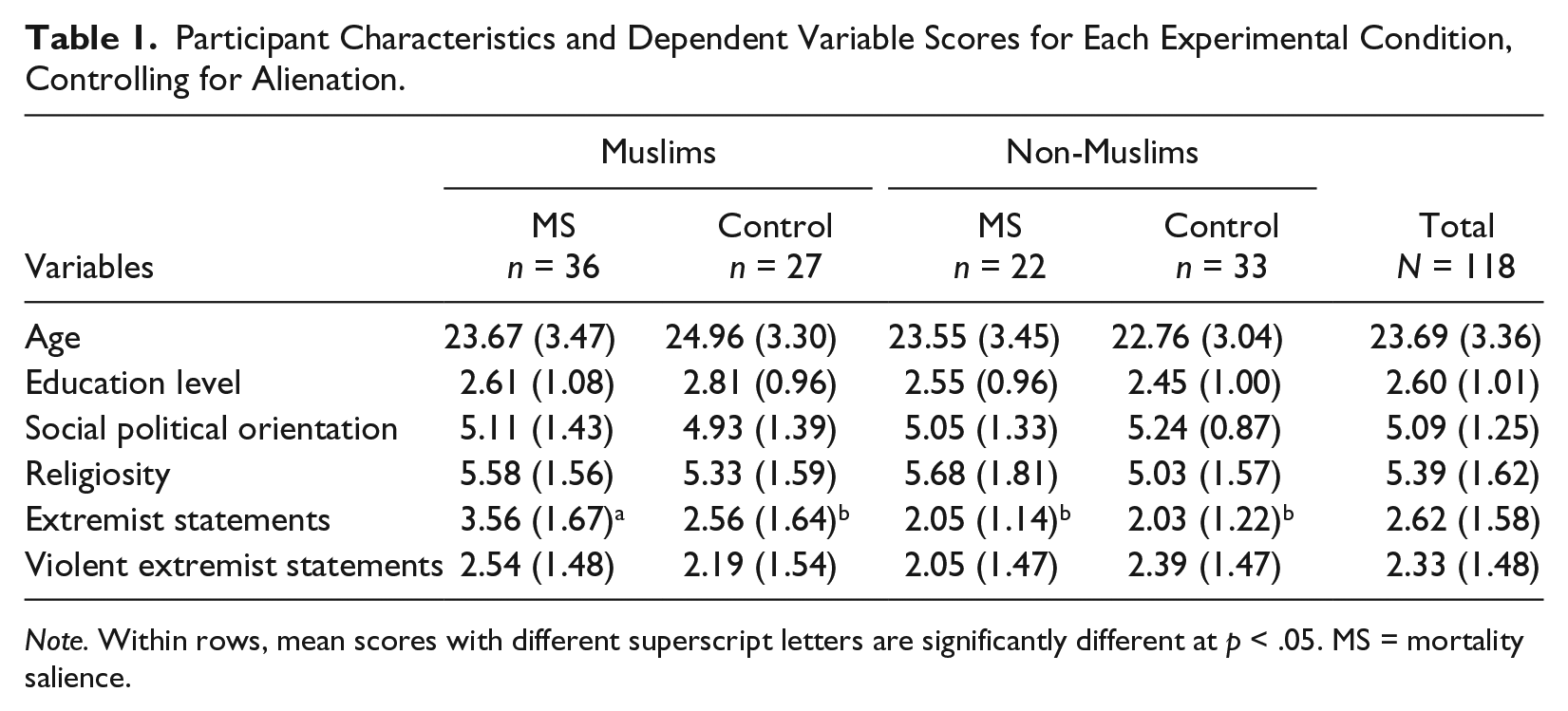
Note. Within rows, mean scores with different superscript letters are significantly different at p < .05. MS = mortality salience.
ANCOVAs revealed no significant main effect for either the MS manipulation, F(3, 113) = 0.05, p = .83, or religious group, F(3, 113) = 0.13, p = .72, on support for the violent extremist statements. The interaction between MS and religious group was also not significant, F(3, 113) = 1.35, p = .25.
Discussion
The present study examined whether reminders of death (MS) can increase support for extremism and violent extremism within young Indonesian Muslims. Consistent with our hypothesis, we found that young Muslim Indonesians in the MS condition displayed greater agreement with extremism. However, while Muslims within the MS condition reported, on average, higher support for violent extremist action, group differences were not statistically significant.
The results lend some support to previous work in young Muslims (Pyszczynski et al., 2006). However, Pyszczynski et al. (2006) did not distinguish between support for extremist views and support for violent extremist actions, an important distinction called for by terrorism researchers (Busher & Macklin, 2015; Moskalenko & McCauley, 2009). Although the results of this study provide support for calls to distinguish between extreme views and violent actions, there are some limitations to the measures used here. Though we only found a significant effect for MS on support for extreme views, the measure of support for extreme views was correlated with support for violent extremist action. While it may be difficult to completely disentangle different facets of extremism, there is a need in the field for measures that distinguish between extreme views and violent actions.
We also found that the effect of MS on support for extremism is only present in Muslim Indonesians. The absence of any effect in non-Muslim participants is interesting. Although not our primary question, one might have expected that there would be significantly less support for extremism and violent extremism following MS within non-Muslim participants. This was not the case.
Overall, the study suggests that although death reminders may influence people’s support for extreme views, they do not appear to lead to greater support for violent action. An important question that arises from this study is whether the expression of support for individuals with extremist views could influence such individuals to take violent action. This has not to our knowledge been examined in Muslim populations. There are also a number of other factors that future research may address, such as whether Indonesian students studying domestically are more prone toward supporting extremism and violent extremism than those studying in “Western” countries. Future research may also analyze the effect of MS on items that utilize provoked forms of violence, which has been found to be more successful in prior research (Hirschberger et al., 2009).
Footnotes
Acknowledgements
We wish to thank Randi Nizar and Lintang Paramita Indrawijaya for their assistance in the translation of survey materials.
Declaration of Conflicting Interests
The author(s) declared no potential conflicts of interest with respect to the research, authorship, and/or publication of this article.
Funding
The author(s) received no financial support for the research, authorship, and/or publication of this article.