



Abstract
Globalization has rendered culture mixing a pervading and overwhelming phenomenon. Culture mixing refers to the coexistence of representative symbols of different cultures in the same space at the same time. It reflects the new paradigm of polyculturalism in the culture and psychology research. The articles in this issue offer nuanced understandings to features of the culture mixing stimuli, personal and situational factors that affect responses to culture mixing, and the sociocultural and psychological consequences of culture mixing. We discuss how these articles provide a new context that extends existing psychological theories and set the stage for the burgeoning psychological inquiry of culture mixing. Future research is needed to uncover how different cultural elements are mixed and how ecological factors affect responses to culture mixing, to investigate the underlying psychological mechanisms of culture mixing, and use multiple methods at various levels of analysis to uncover the dynamic, interactive culturally mixed processes.
Keywords
The acceleration of globalization has brought cultures in close contact and resulted in compression of time and space (Giddens, 1985), making a new phenomenon titled “culture mixing” an inexorable issue for researchers to explore. The term culture mixing refers to the coexistence of representative symbols of different cultures in the same space at the same time (Chiu, Mallorie, Keh, & Law, 2009). Culture is defined as a constellation of loosely organized ideas and practices that are widely shared and transmitted across generations (Chiu & Hong, 2006). According to this definition, each ethnic group (e.g., Jews), religion (e.g., Christianity), region (e.g., urban area, rural area), and discipline (e.g., sociology) has its cultural tradition. Therefore, culture mixing can appear in the encounter of different ethnic cultures, different religious cultures, or different disciplines. Peking duck pizza sold in some Chinese restaurants and an American patriotic song interpreted in Spanish are examples of culture mixing.
Exposure to culture mixing (i.e., bicultural priming) can promote exclusionary or integrative reactions among individuals (Chiu, Gries, Torelli, & Cheng, 2011). Exclusionary reactions are emotional, reflexive responses evoked by perceived fear to cultural erosion and could bring people to defend the integrity of heritage cultures (Chiu et al., 2011). Integrative reactions are reflective mental processes that facilitate individuals’ creativity performance (Leung, Maddux, Galinsky, & Chiu, 2008). The diverse responses toward culture mixing call for the investigation of the dynamic nature of culture mixing and its psychological and sociocultural ramifications.
Culture Mixing: A New Perspective in the Culture and Psychology Research
The research of culture mixing has its root in the paradigm of polyculturalism, which treats cultures as interacting, changing, and evolving systems rather than independent, static entities (Morris, Chiu, & Liu, 2015). Cultural psychology, cross-cultural psychology, and multicultural psychology are the three main paradigms in psychology research. However, these paradigms do not fully capture the intercultural dynamics in rapidly globalized environments.
Cultural psychology focuses on how culture and psychology mutually constitute each other. It illustrates the cultural embeddedness of human behavior by taking an emic approach to studying culture and psychology (Mesquita & Frijda, 1992; Shweder, 1991). Cross-cultural psychology often compares cultures along some universal dimensions (e.g., individualism vs. collectivism, holistic vs. analytical thinking) and apply them to explain cultural differences in basic social cognitive processes (e.g., attention, perception, categorization; see Higgins, 2008; Nisbett, Peng, Choi, & Norenzayan, 2001; Triandis, 1989). An assumption in cultural and cross-cultural psychology is that cultures are independent and static, and people unconsciously accept and internalize the ingroup culture (Morris et al., 2015). Though these two paradigms recognize cultural differences, they also discourage intercultural learning and motivate movements that seek to preserve the purity of heritage cultures. In addition, they speak little about how individuals from different cultures interact with each other.
As the third wave of research in culture and psychology, multicultural psychology complements cultural psychology and cross-cultural psychology by taking a dynamic constructivist approach (Hong, Morris, Chiu, & Benet-Martínez, 2000). It views culture as a knowledge system that could be activated by priming external cues (i.e., cultural icons). Research in this stream shows that after extensive exposure to multiple cultures, individuals can acquire multiple knowledge systems, and dynamically switch between the “cultural frames” (Hong, 2010).
The emergence of research on culture mixing and its psychological consequences motivates a new look at culture and psychology from a polyculturalist perspective (Morris et al., 2015). Polyculturalism posits that the relationship between individuals and cultures is partial and plural, cultural traditions are interacting and continually evolving systems, and individuals engage with and are shaped by more than one culture. Unlike multicultural psychology that focuses on how bicultural individuals switch between different cultural frames (and thus do not experience direct juxtaposition of different cultures at the same time), polycultural psychology recognizes the coexistence of cultural traditions and the possibility to recombine different cultural elements to generate hybrid cultures. This perspective captures the intercultural dynamics in rapidly globalized environments.
As an important phenomenon in polycultural psychology, culture mixing research highlights several noteworthy aspects of the plural, dynamic cultural milieu of globalization. First, unlike some existing research topics on multicultural experience, such as immigration acculturation (Berry, 1974) and bicultural identity integration (BII; Benet-Martínez & Haritatos, 2005), which focus on bicultural individuals who have extensive experiences in two cultures (e.g., immigrants, expatriates), culture mixing research focuses on the meeting of multiple cultures in the environment rather than within a person. This focus allows researchers to examine the multicultural influence on individuals without immersion in foreign cultures. Torelli, Chiu, Tam, Au, and Keh (2011) showed that exposure to culture mixing (vs. moncultural exposure) enlarges the perceived distances between cultures, and this bicultural exposure effect can occur even when individuals are not members of the primed culture(s). This finding suggests that bicultural exposure effect is not identity-dependent and can occur without involving self-categorization.
Second, culture mixing research examines more diverse types of intercultural contacts. Oftentimes, participants in acculturation studies gain foreign knowledge mostly through interactions with foreigners. However, in the era of globalization, intercultural contact could occur not only through direct interpersonal contacts, but also through engagement with foreign food, languages, institutional logics, values, and so forth. (Morris et al., 2015). The research of culture mixing corresponds with this broader intercultural contact perspective by studying individuals’ cultural exposure through various forms of cultural products, in addition to interpersonal contacts.
Finally, whereas most previous culture literature focuses on national cultures, culture mixing research investigates more forms of cultures, such as global culture and local culture, traditional culture and modern culture, materialist culture and religious culture, and so forth. As such, culture mixing has expanded the scope of previous multicultural research.
Major Findings of This Issue
The articles in this issue represent the latest progress in the psychology of culture mixing. The authors investigate various phenomena of culture mixing (e.g., language, food, products, society models) in different disciplines (e.g., marketing, intercultural relations, organizational management) to afford a nuanced understanding of these phenomena in different parts of the world (e.g., America, Australia, China, Europe). Their conceptual and empirical analyses have offered deep insights into the following issues:
What features of the stimuli are more likely to trigger culture mixing effects?
What personal and situational factors moderate the extent to which people exhibit exclusionary or integrative responses to culture mixing?
What are the sociocultural and psychological consequences of culture mixing?
Features of Culture Mixing Stimuli
As an environmental phenomenon, culture mixing takes on a variety of forms and manifestations, which may evoke various responses. The articles in the present special issue studied four major respects of culture mixing stimuli: (a) involvement of ingroup culture, (b) the extent of mixing between cultures, (c) the level of cultural symbolism, and (d) the direction of cultural influence.
First, culture mixing may either involve the ingroup culture element (i.e., mixing the ingroup and outgroup culture) or not (i.e., two outgroup cultures). Mixing of two foreign cultures blurs the boundaries of established cultural categories, thus may seem unnatural to perceivers. However, because one’s own cultural traditions and identities are not involved, this type of mixing does not pose cultural contamination threat as much as the mixing of ingroup and foreign culture does. Indeed, Cheon, Christopoulos, and Hong (2016) found that whereas people show a generalized aversion to the fusion of two foreign cultures, exposure to the fusing of own and foreign cultural representations evokes stronger disgust.
Second, the extent of culture mixing may range from juxtaposition to fusion (see Figure 1). Fusion alters the original cultural symbols and may thus incite stronger reactions than other types of mixing. Yang, Chen, Xu, Preston, and Chiu (2016) demonstrated that people are more likely to exhibit exclusionary reactions in response to the mixing of foreign and local icons when the contrastive symbols overlap in space (i.e., a foreign symbol “intrudes” into a local, sacred space) than when they are placed side by side separately. Cheon et al. (2016) further illustrated that compared with side-by-side presentation of own and foreign cultural icons, blending or fusion of the two stimuli evokes more “disgust” emotions. Similarly, De keersmaecker, Assche, and Roets (2016) showed that culture fusion threatens epistemic security more directly than copresence of cultures.
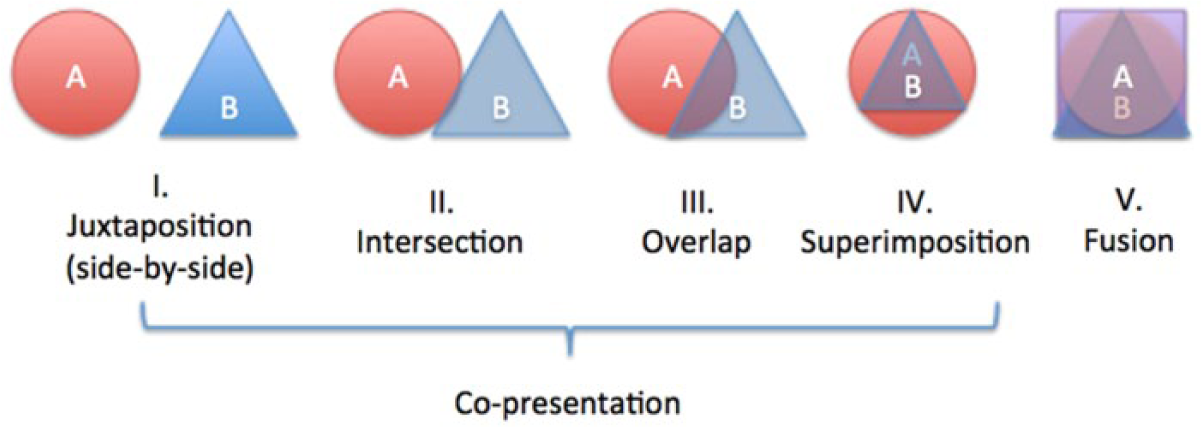
The spectrum of culture mixing manifestation.
Third, culture mixing stimuli involves mixing of stimuli of varying levels of cultural symbolism. As symbols/icons of the culture are carriers of cultural identities, the copresence of symbols/icons of one’s culture with those of a foreign culture may evoke concerns of cultural contamination, which in turn triggers negative responses to culture mixing (Yang et al., 2016).
Finally, as Morris et al. (2015) proposed, the direction of cultural influence in intercultural interaction dynamics affects the emotional responses of individuals. They argued that cultural outflow and cultural inflow could evoke different emotions and responses. In line with this argument, Cui, Xu, Hu, Qualls, and Wang (2016) identified a self-other asymmetry effect in culture mixing evaluation. Specifically, a culturally mixed product framed with “foreign-culture modifies home-culture” strategy is less favorably evaluated than the same product framed with the “home-culture modifies foreign-culture” strategy.
Personal and Situational Factors That Affect Responses to Culture Mixing
Existing literature has shown that simultaneous encounter of multiple cultures promotes categorical perceptions of culture and draws attention to cultural differences (Chiu et al., 2009), which in turn can lead to either exclusionary or integrative reactions (for a review, see Li, Kreuzbauer, & Chiu, 2013). Indeed, a major theme in the extant culture mixing research is to delineate the conditions that facilitate people’s different responses to culture mixing. For example, exclusionary responses to culture mixing are more likely to emerge when people are motivated to defend their cultural worldview (i.e., under mortality salience, Torelli et al., 2011), when competition with outgroups are salient (Cheng et al., 2011), or when individuals are low in need for cognition (Torelli et al., 2011). Along this line, the articles in this issue make great strides in charting out the personal and situational factors that moderate people’s responses to culturally mixed stimuli.
In general, psychological and situational factors that induce individuals to be more open to the novel experiences from intercultural encounters promote integrative responses including creativity and acceptance of foreign entities. For instance, Chen et al. (2016) showed how the trait of openness to experience interacts with a situational cultural threat to affect the creative benefits of culture mixing. Under heightened perceptions of cultural threat, exposing to the mixing of Chinese and American cultures (vs. a nonmixed situation) improves open-minded Chinese participants’ performance in a creative generation task. Shi, Shi, Luo, and Cai (2016) found that people with stronger multicultural orientation (i.e., value the distinctiveness of different cultures) exhibit less implicit prejudice toward an intrusive foreign culture. Similarly, Keh, Torelli, Chiu, and Hao (2016) demonstrated that endorsement of autonomy values (i.e., values of stimulation and self-direction, Schwartz, 1992) positively predicts favorable attitudes toward culturally mixed phonosemantic brand translations.
In contrast, factors that promote close-mindedness hinder the emergence of integrative responses to culture mixing. For instance, Fu and colleagues (2016) demonstrated that, although exposure to culture mixing makes people open to foreign practices, this integrative effect is absent among individuals who are high in need for cognitive closure (NFC), or those who need a firm answer in a psychologically ambiguous situation (Webster & Kruglanski, 1994). In a similar vein, De keersmaecker, Assche, and Roets (2016) showed that people who are high (vs. low) in NFC are less favorable toward culturally mixed stimuli (e.g., a culturally fused society, culturally mixed food).
Past research also suggests that exclusionary responses to culture mixing are more likely to emerge when people want to defend the local culture from foreign contamination (Cheng, 2011). Accordingly, personal or situational factors that heighten the motivation to defend the local culture should incite exclusionary responses to culture mixing. Consistent with this notion, Cheon et al. (2016) showed that disgust toward ingroup–outgroup cultural mixing is particularly pronounced among those who endorse higher levels of patriotism. Similarly, Shi et al. (2016) demonstrated that individuals who highly identify with their heritage culture are more likely to exhibit implicit prejudice toward the foreign culture represented in a culturally mixed stimulus. Furthermore, Kwan and Li (2016) found that heightening the status of one’s culture vis-à-vis a foreign one triggers more unfavorable attitudes toward culturally mixed products.
Besides, individuals’ cognitive mindsets also moderate their perception of culture mixing and the subsequent responses. For instance, Peng and Xie (2016) showed that people’s comparison focus affects their reactions to culture mixing. Compared with a difference focus, a similarity focus reduces positive reactions to a culturally mixed product, and this effect is mediated by reduced creativity perception of the product. Likewise, Cui et al. (2016) demonstrated that when evaluating culturally mixed products, if people are induced to focus on the facts rather than the motivations, the aforementioned self–other asymmetry effect disappears.
Moreover, in a globalized environment, the ways in which individuals negotiate multiple cultural identities may influence their responses to culturally mixed contexts. Harush, Lisak, and Erez (2016) suggested that the relative strength and the balance between people’s global and local identities jointly affect their reactions. They propose that whereas individuals with dominant identity types (global or local) will demonstrate exclusionary responses to culture mixing, individuals with balanced identity types (glocal or marginal) will exhibit positive and inclusive responses to culture mixing.
Finally, the cultural environments in which individuals are raised are also likely to shape their cognitive preferences and identities. Martin and Shao (2016) distinguished two types of multiculturals based on early experiences—innate multiculturals who have experienced early immersive culture mixing and achieved multiculturals who have become multicultural later in life. Their study found that innate multiculturals reported a more integrated cultural identity than did achieved multiculturals.
Sociocultural and Psychological Consequences of Culture Mixing
Culture mixing not only invites strikingly different responses from the perceivers but also brings about important cognitive and motivational consequences. Existing psychological research on culture mixing has documented, among others, the downstream influences of multicultural exposure on individuals’ cultural sensitivity (e.g., Chiu et al., 2009), creativity performance (e.g., Leung et al., 2008), and NFC (e.g., Tadmor, Hong, Chao, Wiruchnipawan, & Wang, 2012), and so forth. Articles in this issue follow and enrich the inquiry in this research stream.
The consequences incurred by culture mixing can be either positive or negative. Chen et al. (2016) suggested that threatening culturally mixed encounters may hamper people’s creative performance, depending on their level of openness to experience. In contrast, Fu et al. (2016) discovered a facilitative effect of culture mixing in the domain of change management. Specifically, priming individuals with culture mixing would promote acceptance of new organizational policies and reduce adherence to the status quo.
Furthermore, whereas past research has mainly investigated the cognitive and behavioral consequences of culture mixing, the articles in this issue extend this stream of research by exploring emotional and implicit attitudinal consequences. Cheon et al. (2016) examined the idea that disgust, an emotion that originates from fear of pathogenic and food-based contamination, may extend to culturally mixed stimuli that involve self and foreign cultural elements. Shi et al. (2016) demonstrated that intrusive culture mixing heightens implicit prejudice toward the intruding foreign cultural group, which in turn mediates intentions to boycott foreign products.
Theoretical Implications, Future Directions, and Conclusion
Due to the rapid increase in immigration, international travel, commercial exchange, and flows of information, culture mixing has become an increasingly common phenomenon in a globalized world. People can respond to culture mixing by rejecting foreign influences or by accepting and integrating the foreign and the local cultures. These two types of responses seem to be at the core of a worldwide political debate about globalization. For instance, recent “Brexit” fight to define the status of the United Kingdom within the European Union (the “leave” and “remain” campaigns) frequently referred to the erosive effects of foreign influence on local culture (exclusionary responses) versus the benefits of having a diverse society to support competition in a global market (integrative responses). Similarly, the debate in the 2016 U.S. presidential campaign between the notion that globalization has weakened the core of U.S. society (traditional White, working-class America) and the view that global trade and immigration strengthen America’s position in the world, also expresses the tension between exclusionary and integrative responses to globalization. These examples highlight the importance, at a macro-level, of deepening our understanding of culture mixing and its psychological effects at various levels in most societies.
Theoretical Implications
The articles in this issue echo the recent appeal to add to psychologists’ contribution to globalization research (Chiu & Kwan, 2015; Gelfand, Lyons, & Lun, 2011). On the one hand, these articles draw upon theoretical insights from existing psychological theories to explain culture mixing phenomena. On the other hand, they also provide opportunities to extend and refine some basic psychological theories.
For example, the evaluation mode theory in behavior decision making suggests that individual preferences reverse between separate and joint evaluation modes (Hsee, Loewenstein, Blount, & Bazerman, 1999). One study illustrated that simultaneously presenting two products (e.g., healthy food vs. unhealthy food) draw perceivers’ attention to the unique attributes (versus the similarities) between the two products (Hsee & Zhang, 2004). Thus, participants perceive healthy food to be more healthy and unhealthy food more unhealthy when the two kinds of food are placed side-by-side than when they are presented separately. In other words, compared with separate evaluation, joint evaluation accentuated the perceived differences between the objects. Researchers in culture mixing have replicated these findings in intercultural contexts. They have uncovered the bicultural exposure effect—Simultaneous exposure to two cultural symbols brings the cultural factor into focus and draws attention to the differences between these cultures (Chiu et al., 2009; Torelli et al., 2011). In this issue, Peng and Xie (2016) also investigated the bicultural exposure effect and explore the boundary conditions of this effect. They found that the perceiver’s similarity comparison focus (vs. difference focus) could eliminate the bicultural exposure effect. Extending this logic, we can generally argue that the joint evaluation effect may not occur if the two copresenting objects/cultures are similar, rather than dissimilar. Hence, indepth investigation into the psychological process of culture mixing can help refine past evaluation mode theory by examining its premises and boundary conditions.
Another example is Cheon and colleagues’ (2016) research in disgust associated with culture mixing. From an evolutionary psychology perspective, the emotion of disgust evolved from a food rejection system in fear of oral contamination (Rozin, Haidt, & Fincher, 2009). The disgust evaluation system was later extended to social and moral level, showing that people at risk of disease tend to feel disgust toward foreign groups (Landau, Meier, & Keefer, 2010), and moral violations of purity and sacredness also trigger a feeling of disgust (Chapman, Kim, Susskind, & Anderson, 2009). Cheon et al. (2016) further extended the disgust evaluation system to the field of culture mixing. Through four experiments, they showed that perceiving the fusion of own and foreign cultural representations evokes a profile of disgust responses that mirror physical contamination. This finding surely complements and extends existing psychological research in the secondary disgust evaluation system.
Besides, the collection of articles in this issue also provides important theoretical insights to the extant cultural theories. For instance, Martin and Shao’s (2016) theorization of early immersive culture mixing shows that innate multiculturals have a hybrid cultural identity and do not switch between different cultural frames, whereas achieved multiculturals are more likely to have acquired separate cultural schemas and switch between cultural frames. These findings not only uncover an important antecedent to individuals’ responses to culture mixing but also link and advance previous multicultural theories such as cultural frame switching and BII. Likewise, Harush et al. (2016) applied and extended the global acculturation model (Erez & Gati, 2004) to explore individuals’ responses to local–global culture mixing. On the one hand, they suggested that the relative strength of the global and local identity, as proposed by the global acculturation model, is an important variable that affects individual responses. On the other hand, they extended this model by also considering a second variable: the balance in identity strength.
In sum, there is a “two-way” street (see Gelfand, Lyons, & Lun, 2011) of culture mixing research and psychology, in that existing psychological theories play a critical role in understanding reactions to culture mixing, while at the same time, research in culture mixing also provides new insights from new contexts that supplement and advance the inquiry of psychology.
Future Research Directions
Building on the current progresses, future research could further unearth the features and consequences of culture mixing, as well as the psychological and contextual factors that moderate responses to culture mixing. Moreover, it is important to identify the underlying mechanisms of responses to culture mixing, and to employ multiple methods at various levels of analysis to uncover the dynamic, interactive cultural processes.
First, how different cultural elements are mixed may be another important feature to explore. We propose that culture mixing could either be “organic” or “nonorganic.” In organic culture mixing, the seemingly unrelated cultural elements from different backgrounds are combined, blended, or integrated in a systematic and meaningful way, and in perfect harmony with each other. On the contrary, nonorganic culture mixing just puts distinct cultural elements together randomly or superficially, without any inherent connection. Perceivers would infer that organic culture mixing shows deep understanding of cultural diversity and appreciate such creative integration. Conversely, nonorganic culture mixing may be perceived as awkward or unnatural.
Second, besides the personal and situational factors reviewed above, ecological factors, which have been underinvestigated, are another important determinant of responses to culture mixing. The literature has shown that cultural values are shaped by a collection of physical/social ecological factors in the environment. For example, Fincher, Thornhill, Murray, and Schaller (2008) suggested that collective values are more endorsed in ecology with high pathogen prevalence, and Gelfand, Raver, et al. (2011) indicated that differences between tight and loose cultures are responses to the environmental threats. Along this line, future studies could investigate how ecological factors such as level of economic development (Inglehart & Abramson, 1994), social structure (Yamagishi & Yamagishi, 1994), residential mobility (Oishi & Talhelm, 2012), and relational mobility (Schug, Yuki, & Maddux, 2010) interact with other personal and situational factors to affect individuals’ responses to culture mixing.
Although extant research has provided insights into the factors that affect individual responses to culture mixing, our understanding of the underlying psychological mechanisms is much less limited. In the literature, cultural contamination anxiety is the most extensively studied mechanism of exclusionary responses to foreign cultures (e.g., Cheng, 2011; Wu, Yang, & Chiu, 2014). Future research is needed to explore other cognitive, behavioral, emotional, motivational, physiological, and neurological mechanisms, and to identify the situations under which these psychological processes operate.
Another need for the scholars in the field of culture mixing is to use more research methods at various levels of analysis. Most studies in culture mixing are at the individual level. Nonetheless, some authors have started to look at culture mixing effects at team, institutional, and country levels. For example, by analyzing multinational databases, Kwan and Chiu (in press) argued that the mere presence of cultural heterogeneity within a country does not guarantee the promotion of intercultural learning; it is the economic complexity that mitigates the negative effect of culture mixing in countries with high levels of ethnolinguistic fractionalization.
Moreover, complexity theory views culture as a self-organizing and self-reproducing system that coevolves with other systems, such as economic and political systems. The social structural settings wherein people negotiate their self-identities and engage in social interactions are also ubiquitous in constraining (although not strictly determining) human action (Salgado & Gilbert, 2012). In addition to laboratory experiments, many alternative approaches from other social sciences could help capture the complex, dynamic, and interactive culture mixing processes. For example, qualitative methods such as field observation and interview can help us gain deep insights into the psychological processes underlying culture mixing, content analysis of books is a useful tool for tracking longitudinal cultural change (Greenfield, 2013), experience sampling can record momentary feelings and temporal actions of the individuals (Brandstätter, 1983), and social media analysis can track how a cultural mixing experience spreads in the population (Anstead & O’Loughlin, 2014). Importantly, agent-based modeling is a newly emerging theory-building tool to understand dynamic cultural processes. By simulating the process that large numbers of autonomous agents interact with each other in a given environment, agent-based modeling enables us to observe the emergent patterns from these interactions. Recently, Gao, Qiu, Chiu, and Yang (2015) illustrated the emergent results of social interaction processes with an agent-based modeling study. They found that in a culturally mixed environment, as long as most agents in the system prefer talking to others with similar opinions, the relative distribution of majority and minority opinions in the system will not change. We believe it would be a promising avenue for future studies to combine these various methods to illuminate the reciprocal interactions of society, culture, and psychology.
Conclusion
As an increasingly prevalent phenomenon in the globalized world, culture mixing reflects the “compression of time and space” (Giddens, 1985) brought about by globalization and echoes the burgeoning research paradigm of polyculturalism. Articles in this issue offer important new insights into various aspects of culture mixing phenomenon: its defining dimensions and features, the moderating factors of its effect, and its sociocultural and psychological consequences. These insights not only deepen our understanding of culture mixing but also provide new contexts to expand and refine existing psychological theories. We believe articles in this issue would collectively pave the way for an emergent interdisciplinary inquiry into the dynamic, interactive cultural processes of globalization.
Footnotes
Authors’ Note
The authors contributed equally to this work. Jia Hao’s second affiliation is Hong Kong Institute of Asia-Pacific Studies at Chinese University of Hong Kong.
Declaration of Conflicting Interests
The author(s) declared no potential conflicts of interest with respect to the research, authorship, and/or publication of this article.
Funding
The author(s) disclosed receipt of the following financial support for the research, authorship, and/or publication of this article: Jia Hao acknowledges the support of the Greater China Research Program and the colleagues from Hong Kong Institute of Asia-Pacific Studies. Dongmei Li acknowledges that the work described in this paper was substantially supported by a grant from the Research Grants Council of the Hong Kong Special Administrative Region, China (UGC/FDS14/B12/14). Luluo Peng acknowledges the support of National Natural Science Foundation of China (No. 71302030). Siqing Peng acknowledges the support of National Natural Science Foundation of China (No.71372025) and Foundation of the Ministry of Education of China for Humanities and Social Sciences Research (No. 13YJA630066).