




Abstract
Previous studies have shown that Easterners generally perceive themselves as having lower subjective well-being compared with Westerners, and several mechanisms causing such differences have been identified. However, few studies have analyzed the causes of such differences from the perspective of the cross-cultural differences in the meanings of important life events such as whether people receive approval from others. Specifically, events regarding others’ approval might have different meanings to and influences on Easterners and Westerners. Thus, the degree of fluctuation of people’s views of self-worth in response to these events (i.e., others’ approval contingencies of self-worth [CSW]) probably differs between Easterners and Westerners. This may be a reason for cross-cultural differences in subjective well-being. We investigated two samples of undergraduate students from Taiwan and the United States to examine the mediating role of others’ approval CSW in forming cross-cultural differences in subjective well-being. The results revealed that Taiwanese participants exhibited lower subjective well-being and higher others’ approval CSW than American participants. In addition, others’ approval CSW partially mediated the cross-cultural differences in subjective well-being. Thus, one reason for lower subjective well-being among Easterners was likely that their self-esteem was more prone to larger fluctuations depending on whether they receive approval from others in everyday life.
Keywords
Subjective well-being (SWB) has received considerable attention from researchers. A branch of the related studies is focused on investigating the differences in SWB between Easterners (e.g., East Asians) and Westerners (e.g., Europeans and European Americans) and determining the reasons leading to the differences. This article discusses the phenomenon and causes of differences in SWB between Easterners and Westerners from a new perspective.
Differences in SWB Between People From Eastern and Western Cultures
Studies have indicated that Easterners tend to perceive themselves as having lower level SWB compared with Westerners, including having lower satisfaction with life, fewer and less intense experiences of positive affect, and more intense experiences involving negative affect (e.g., Kitayama, Markus, & Kurokawa, 2000; Oishi, Diener, Lucas, & Suh, 1999). Subsequent studies have identified several potential mechanisms for such differences. For example, the phenomenon could be related to the differences in the perceived meanings and impacts of positive and negative events for Easterners and Westerners. Because Easterners are more likely to be affected by negative events and negative affect, they would exhibit lower SWB than Westerners (see Heine & Buchtel, 2009; Wirtz, Chiu, Diener, & Oishi, 2009).
The Role of Others’ Approval Contingencies of Self-Worth (CSW) in Cross-Cultural Well-Being
In addition to positive and negative events and affects, some life events such as whether people receive approval from others might also have different meanings to Easterners and Westerners. Few studies have analyzed the causes of the cross-cultural differences in SWB from this perspective. The following sections introduce the related concepts.
Cross-Cultural Differences in Others’ Approval CSW
Studies show that Westerners from individualistic cultures tend to possess an independent view of the self, whereas Easterners from collectivistic cultures tend to own an interdependent view of the self (Markus & Kitayama, 1991). That is, Westerners tend to define themselves according to their internal thoughts, feelings, and actions. Easterners tend to define themselves according to the relationship they have with others. Therefore, compared with Westerners, Easterners place more value on how others evaluate them, causing their self-evaluations more likely to vary because of this (Heine & Buchtel, 2009). This notion can be explained from the perspective of CSW. Specifically, individuals differ in their CSW, which determines how much their views of self-worth would fluctuate around the typical level of self-esteem in response to positive and negative events (Crocker & Wolfe, 2001). For a person whose self-worth is more dependent on a specific domain such as others’ approval (this is one of the five external CSW domains identified by Crocker, Luhtanen, Cooper, & Bouvrette, 2003), positive and negative events in this domain should result in more increases and drops in self-esteem. Thus, because Easterners place greater emphasis on how others evaluate them, their self-esteem should be based more on others’ approval and be more prone to larger fluctuations because of the related events in everyday life.
Others’ Approval CSW May Mediate the Cross-Cultural Differences in Well-Being
As discussed above, events in a specific life domain might have different meanings to people from individualistic and collectivistic cultures. Among the life domains studied, the difference between Eastern and Western culture for the perceived meanings of events related to other’s evaluation may be one of the most prominent and noticeable. Easterners tend to place greater emphasis on others’ approval and their views of self-worth may fluctuate more in response to events in this domain than those of Westerners. In addition, studies have indicated that having self-worth that is highly dependent on an external life domain such as others’ approval, which leads to greater fluctuations in self-esteem, is associated with having less SWB (Cambron, Acitelli, & Steinberg, 2010). Thus, we posited that the lower SWB in Easterners may be the result of their self-esteem being more prone to larger fluctuations in response to others’ approval (i.e., having higher others’ approval CSW).
The Present Study
We considered that other’s approval events were more meaningful to Easterners than to Westerners. Thus, Easterners may have self-worth more dependent on others’ approval, which may in turn lead them to exhibit lower SWB than Westerners. In brief, we examined whether others’ approval CSW was a factor mediating the differences in SWB between Easterners and Westerners.
Method
Participants
A total of 386 Taiwanese students of Asian descent (132 male, 250 female, and four unknown; age = 21.18, SD = 5.72) were recruited from four universities in Taiwan and given a convenience store voucher valued at NT$100 for participating. The sample of American students was recruited online through Amazon’s Mechanical Turk platform. A total of 358 undergraduates (183 male, 175 female; age = 27.20, SD = 7.20) who were citizens of the United States were given US$3 for participating. Stratified by ethnicity, 265 participants (74%) were Euro-American or Caucasian, 43 (12%) were African American, 22 (6%) were Asian American, 19 (5.3%) were Hispanic or Latino-American, and 10 (2.8%) were of other ethnicity.
Measures
In addition to some filler scales, participants completed four major measures. These measures were translated into Chinese before being administered to the Taiwanese participants.
Others’ approval CSW
The participants completed a 35-item Contingencies of Self-Worth Scale (Crocker et al., 2003) on a 7-point scale from 1 (strongly disagree) to 7 (strongly agree). This scale consists of a five-item Others’ Approval subscale (e.g., “My self-esteem depends on the opinions others hold of me”) assessing the participants’ others’ approval CSW and six five-item subscales assessing the other CSW domains (Appearance, Competition, Academic Competence, Family Support, God’s Love, and Virtue). All subscales have high internal consistency for Taiwanese (αs = .85, .79, .86, .75, .78, .84, .92) and American (αs = .86, .86, .93, .87, .86, .92, .98) participants.
SWB
First, the participants completed a five-item Satisfaction With Life Scale (Diener, Emmons, Larsen, & Griffin, 1985) on a 7-point scale to indicate their satisfaction with life as a whole. Next, the participants completed a 20-item Positive and Negative Affect Schedule (PANAS; Watson, Clark, & Tellegen, 1988) on a 5-point scale to indicate their experience of positive (10 items) and negative (10 items) emotions during the past few weeks. As in previous research (e.g., Anderson, Kraus, Galinsky, & Keltner, 2012), we averaged satisfaction with life scores with positive affect scores and negative affect scores after reverse-scoring the latter (αs = .89, .83, .85 for Taiwanese and .91, .88, .93 for American participants) to create an SWB variable.
Self-esteem
Global self-esteem was assessed with the five positively worded items of the Rosenberg Self-Esteem Scale (Rosenberg, 1965) with a 7-point scale (αs = .89 for Taiwanese and .90 for American participants).
Results
Because Asian Americans might have been influenced by Eastern culture as children, their data were excluded from the analyses (American sample = 336; Taiwanese sample = 386).
The Mediating Role of Others’ Approval CSW in Cross-Cultural Differences in Well-Being
Table 1 shows that Taiwanese participants exhibited lower SWB and higher others’ approval CSW (Ms = 3.67, 4.03) than American participants (Ms = 4.12, 3.40), ts(720) = −8.28, 6.5, ps < .001. Next, we conducted mediation analyses using the bootstrapping method (Hayes, 2012) to examine whether others’ approval CSW mediate the effect of East–West culture (American vs. Taiwanese undergraduates) on SWB. Because the other six CSW domains, age, and gender may be associated with SWB, we controlled for the effects of these factors in the analyses. Overall, the results showed that the total effect of East–West culture on SWB (effect = −0.6, t = −8.92, p < .001) decreased when others’ approval CSW was included in the model (effect = −0.48, t = −7.18, p < .001). Taiwanese participants exhibited higher others’ approval CSW than American participants (b = 0.71, t = 6.71, p < .001) and participants with greater others’ approval CSW exhibited lower SWB (b = −0.17, t = −7.28, p < .001; see also supplementary materials, Figure S1). The total indirect effect was significant with a point estimate of −0.12 and a 95% confidence interval of [−0.17, −0.07]. Others’ approval CSW partially mediated the effect of East–West culture on SWB.
Descriptive Statistics, Intercorrelations, and Differences Between American and Taiwanese Undergraduates for All Measures.
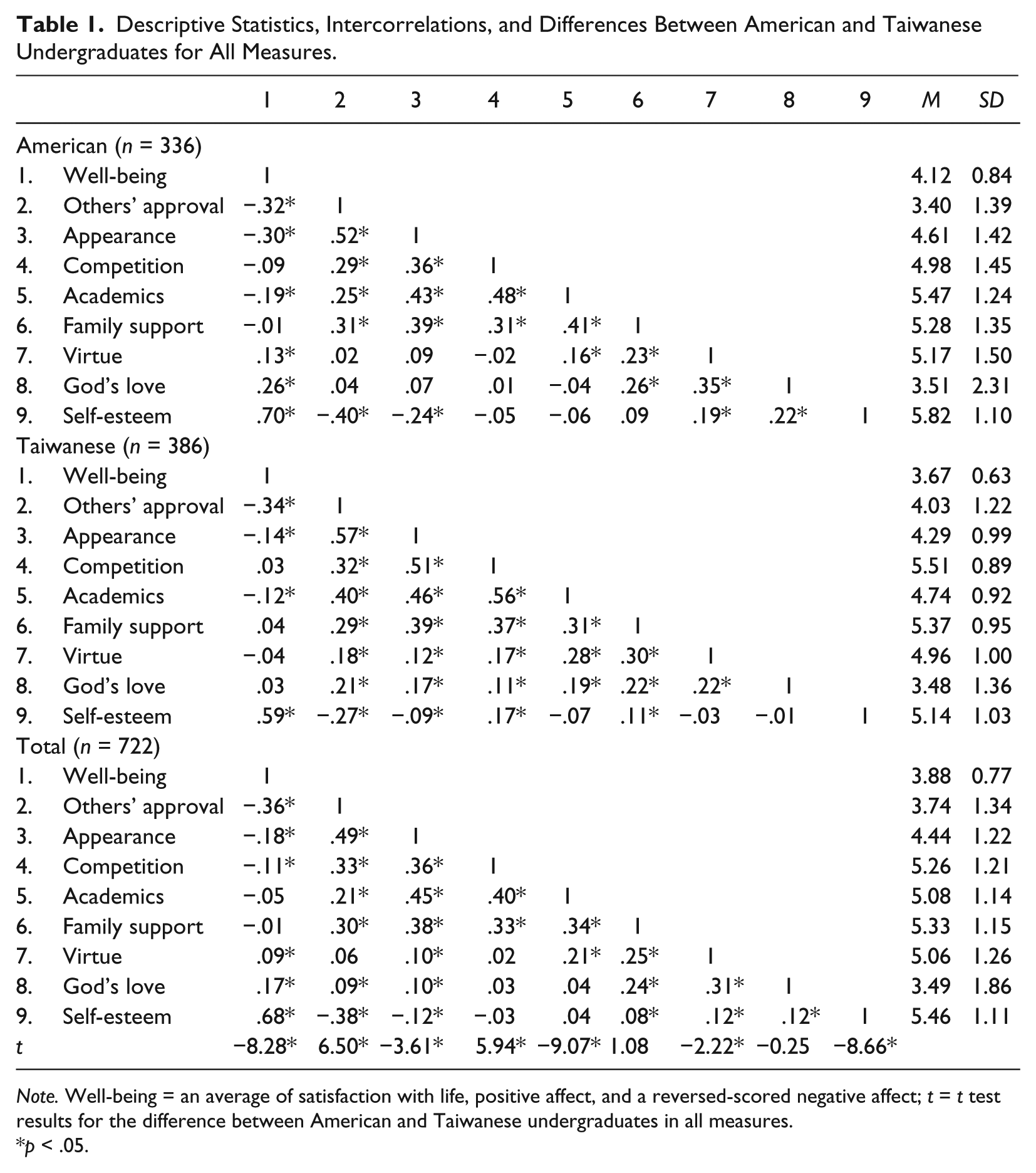
Note. Well-being = an average of satisfaction with life, positive affect, and a reversed-scored negative affect; t = t test results for the difference between American and Taiwanese undergraduates in all measures.
p < .05.
Additional Analyses
Studies have indicated that relative to Westerners, Easterners tend to report lower self-esteem, which is also associated with lower SWB (Heine & Buchtel, 2009) and higher others’ approval CSW (Crocker et al., 2003). This indicates that self-esteem may also be a factor mediating the cross-cultural differences in SWB and that clarifying the role that self-esteem may have in the mediating processes of others’ approval CSW is crucial. Because self-esteem is a general, unspecific construct and others’ approval CSW is a domain-specific construct, as well as because self-esteem may influence how much people worry about others’ evaluation about them (Heatherton & Wyland, 2003), we tested a serial multiple mediator model (see Hayes, 2012), in which self-esteem and others’ approval CSW were two mediators between East–West culture and SWB, and self-esteem had a direct effect on others’ approval CSW (see Figure 1). The results revealed that the direct effect of East–West culture on SWB decreased (effect = −0.13, t = −2.92, p = .004) after considering the two mediators. In addition, there are three indirect effects. The first carried the effect of East–West culture on SWB through self-esteem, bypassing others’ approval CSW, with a point estimate of −0.28 and a 95% confidence interval of [−0.35, −0.22]. The next indirect effect flew from East–West culture directly to others’ approval CSW and then to SWB, bypassing self-esteem with a point estimate of −0.02 and a 95% confidence interval of [−0.04, −0.01]. The last indirect effect of East–West culture passed through both self-esteem and others’ approval CSW, with a point estimate of −0.02 and a 95% confidence interval of [−0.03, −0.01]. Overall, self-esteem was also a mediator between East–West culture and SWB. However, after considering the effect of self-esteem, others’ approval CSW still mediated the effect of East–West culture on SWB.
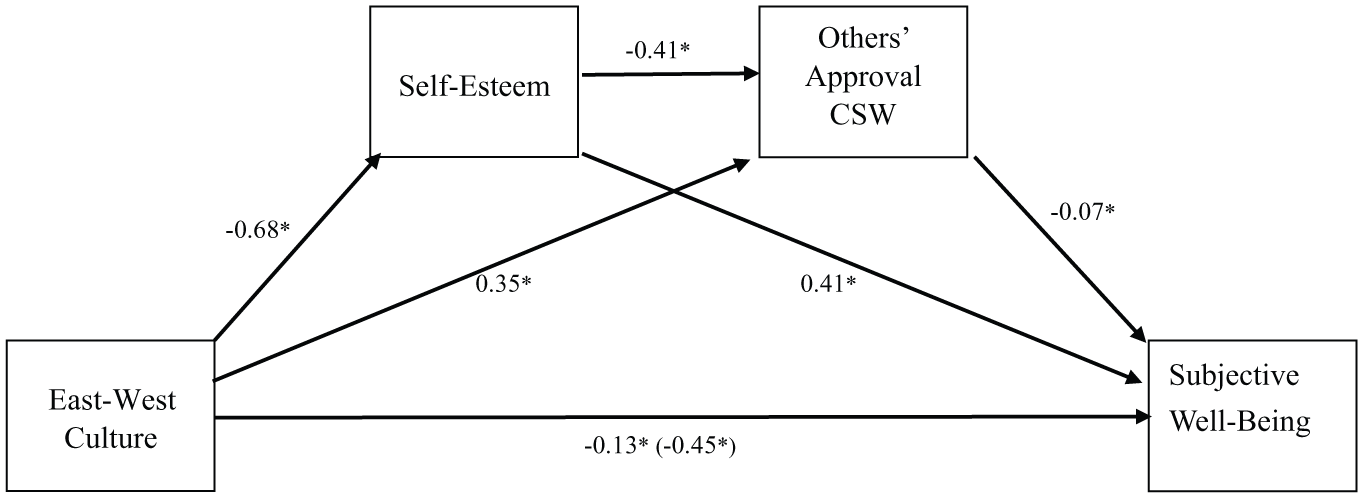
Serial multiple mediation of self-esteem and others’ approval CSW in the relationship between East–West culture and subjective well-being.
In addition, readers may be interested to see whether the other six CSW domains also explain the cross-cultural differences in SWB. Table 1 shows that Taiwanese participants exhibited higher competition and lower appearance, academic competence, and virtue CSW than American participants (ps < .05). Next, participants with higher external CSW (appearance, competition) and lower internal CSW (virtue and God’s love) exhibited lower SWB (ps < .05). According to the directions of the beta weights of the influencing paths, among the six domains, only competition and virtue CSW were possible factors mediating the cross-cultural differences in SWB (i.e., Taiwanese participants reported higher competition and lower virtue CSW, which may have led them to exhibit lower SWB). However, the results revealed that the total effect of East–West culture on SWB did not decrease when competition CSW and virtue CSW were included in the model (see also supplementary materials, Figure S2 and Figure S3). The total indirect effects were insignificant with the point estimates below 0.02 and the 95% confidence intervals contained 0. Overall, these six domains may not be factors mediating the cross-cultural differences in SWB.
Discussion
The results showed that Taiwanese participants exhibited lower SWB than American participants. In addition, Taiwanese participants also attained higher others’ approval CSW than American participants. This is consistent with the hypothesis that events regarding others’ approval would have greater meanings for Easterners. Thus, compared with American participants, Taiwanese participants are more likely to place additional value on what others think about them (Heine & Buchtel, 2009), which can lead to greater fluctuations in their self-esteem depending on whether they receive approval from others. Given the lack of findings in previous studies on Eastern–Western cultural differences in CSW, the present study bridges this research gap.
More importantly, the results showed that after controlling for the effects of the other six CSW domains, age, gender as well as self-esteem, others’ approval CSW still partially mediated the effect of East–West culture on SWB. This indicates that at least part of the lower levels of SWB observed among the Taiwanese undergraduates could be attributed to a higher likelihood of them experiencing greater fluctuations in their self-esteem, depending on whether they receive approval from others. To our knowledge, this is the first attempt to analyze the causes of such differences from this perspective. This analysis facilitates clarifying the source of cross-cultural differences in SWB observed between Easterners and Westerners.
The results may provide a possible direction for enhancing the SWB of people from Eastern cultures. Specifically, future studies should explore whether parents and educators in Eastern cultures, relative to those in Western cultures, tend to apply more education methods that associate their children’s self-esteem with the opinions of others. For instance, Chen (2004) reported that some Eastern parents tend to deal with children’s unfavorable behaviors by teaching them that these behaviors cause others to evaluate them poorly and that they should experience “losing face” and be ashamed of themselves. If so, Eastern parents and educators should decrease the use of such education methods that may make their children’s self-worth more prone to larger fluctuations in response to others’ approval and may reduce their SWB.
Limitations and Future Directions
The current study has several limitations. First, several variables may provide alternative explanations for our results (see Veenhoven, 2012), such as response styles (Easterners are more likely to avoid extreme ratings, leading to lower SWB) and social desirability bias (Easterners may report lower SWB because that is what they perceive others to expect from them). Regarding these explanations, Veenhoven (2012) indicated that the differences of self-reported happiness across nations are unlikely to be much influenced by response styles and desirability bias. Our data also seemed to support this perspective. For example, if our participants’ responses were much influenced by response styles, the measurement values of SWB and others’ approval CSW for Taiwanese participants should concentrate near a median value and show less variability among the observations. This should cause a smaller value of r between others’ approval CSW and SWB for Taiwanese participants than for American participants (Goodwin & Leech, 2006). However, our data did not show that the correlation coefficient obtained for Taiwanese participants (r = −.34) was smaller than that for American participants (r = −.32; see Table 1). In addition, Table 1 also reveals that relative to American participants, Taiwanese participants obtained higher others’ approval and competition CSW scores, indicating that Taiwanese participants did not avoid extreme ratings. Thus, the influence of response styles on our participants’ responses may have been limited. Despite this, we encourage future studies to further examine the role of others’ approval CSW after measuring and controlling for these alternative explanations. Next, the lower SWB in Easterners may be the result of their self-esteem being more prone to larger fluctuations in response to others’ approval events. This notion was supported by the result that Taiwanese participants attained higher others’ approval CSW than American participants. However, we encourage future studies to use other measures and provide more direct evidence for this claim. For example, diary record measures can record when other’s approval event occurs and the momentary self-esteem over a period of time and obtain an estimate of self-esteem stability by calculating each person’s standard deviation of self-esteem (e.g., Cambron et al., 2010). Actions such as this may provide more direct evidence of the mediating processes. Third, this study adopted undergraduates as participants. Future studies are advised to recruit participants from a more extensive range (not restricted to undergraduates). Finally, others’ approval CSW and self-esteem only partially mediated the cross-cultural differences in SWB. Future studies are recommended to identify whether there are other mediators.
Footnotes
Declaration of Conflicting Interests
The author(s) declared no potential conflicts of interest with respect to the research, authorship, and/or publication of this article.
Funding
The author(s) disclosed receipt of the following financial support for the research, authorship, and/or publication of this article: This research is supported by the Ministry of Science and Technology, Taiwan, R.O.C. under Grant No. NSC 102-2410-H-007 -071 -SS2.
