




Abstract
The primary goal of the current study was to examine cultural differences in Chinese and U.S. adolescents’ and parents’ perceptions and evaluations of adolescent misconduct behaviors. A total of 395 U.S. and Chinese adolescents (ages 11-19 years) and 255 parents participated in this study. Each participant generated adolescent misconduct behaviors and rated each misconduct behavior as to the degree of wrongness. The misconduct behaviors were coded into 10 categories across three themes (moral offenses, drugs, and conventions). Results revealed significant cultural differences in a number of adolescent misconduct behaviors. For example, the United States generated more misconduct behaviors in weapon offenses and drug use than did China. These cultural differences were further complicated by an interaction between culture and generation. Chinese adolescents were more likely than U.S. adolescents to use categories of school, home, and social conventional violations, and considered these adolescent misconduct behaviors to be more wrong. However, it was the U.S. parents who considered adolescent misconduct behaviors in these categories to be more wrong than did Chinese parents.
The purpose of this study was to investigate adolescents’ and their parents’ judgments of what represent a misbehavior on the part of adolescents in two different cultures, the United States and China. Adolescent misconduct has been a major concern in almost every society. However, only a few studies have directly compared cross-cultural differences in perceptions and evaluations of adolescent misconduct behaviors. An important cultural distinction is the ideology that defines the United States and China.
Whereas the United States focuses on individualism, or the individual, China’s ideology emphasizes collectivism, or the group (Triandis, McCusker, & Hui, 1990). Within the Chinese culture, Triandis et al. distinguished three subtypes of collectivism, focusing on family, peers, and society. The core Chinese value of filial piety emphasizes family obligations such as respect of authorities (parents and schoolteachers) and not bringing shame to their family. This is a major goal of socialization in Chinese culture (Ho, 1994).
There has been a lot of research examining cross-cultural differences on parents’ expectations of their children. As an example, Chao (1996) found that immigrant Chinese mothers placed greater value on education, had higher investment, and played a more important role in their children’s academic success when compared with European American mothers. European American mothers, on the contrary, were more concerned about building their children’s self-esteem and valued less about academic success and used a less directive approach in their children’s academic learning. Similarly, H. Chen (2001) found that Chinese parents and children placed more value on science education than did Americans. Chinese parents also emphasized more about self-improvement, set higher standards, and more often helped their children with their science learning than did American parents. Related to this, Chinese fifth graders reported that the parents de-emphasized their academic success and emphasized their academic failure, whereas their American counterparts reported the opposites. Probably as a result, Chinese children also responded less positively to success and more negatively to failure when compared with their American counterparts (Ng, Pomerantz, & Lam, 2007).
Some studies conducted with Chinese parents and children indicate some specific cultural expectations on children. For instance, a study conducted in Hong Kong interviewed parents about the characteristics of an ideal child. The generated attributes of an ideal child primarily focus on family-related attributes (63.3%), academic-related attributes (60.5%), and conduct-related attributes (40.7%), followed by other attributes (33.3%) such as interpersonal relationships and health/hobbies (Shek & Chan, 1999). Conduct-related attributes include expectations that their children will have good character, have self-discipline when going out, are obedient to the law, have no acquaintance with undesirable peers, and have no naughtiness (guai). The findings of the studies described above are consistent with Triandis et al. (1990) describing the importance of the family, peers, and society, which are relevant subtypes within collectivism culture.
Examining parents’ expectations of their children is vital in understanding the importance of different socialization practices across cultures. This is critical in understanding children’s development across cultures. Likewise, investigating parents’ and adolescents’ views of misconduct behaviors among adolescents across cultures, such as within Chinese and the United States, is also central in understanding the developing child. There may be a strong relationship between parents’ expectations of their child and what they consider to be misconduct; that is, if the child does not meet the parents’ expectation, parents may perceive their behavior as misconduct.
There has been some research on misconduct behaviors across cultures (e.g., C. Chen, Greenberger, Lester, Dong, & Guo, 1998; Feldman, Rosenthal, Mont-Reynaud, Leung, & Lau, 1991; Greenberger, Chen, Beam, Whang, & Dong, 2000; Juang & Nguyen, 2009; Weisz, Chaiyasit, Weiss, Eastman, & Jackson, 1995). For example, Weisz and colleagues (Weisz et al., 1995; Weisz, Sigman, Weiss, & Mosk, 1993) reported that American parents, in comparison with Asian and African parents, perceived their adolescents to display more undercontrolled problems, such as arguing, disobedience at home, and cruelty to others. However, the findings revealing cross-cultural differences in adolescent misconduct behaviors have not always been consistent. As an illustration, C. Chen et al. (1998) reported no cultural differences among misconduct behaviors among European and Chinese Americans, and Chinese in Taipei, Taiwan, and Beijing, China. There may be several reasons for the inconsistency across studies. One explanation for the discrepancy could be the methodology used to assess misconduct behaviors. Another explanation for the discrepancy could be the differences in cultural values and socialization practices across cultures (C. Chen et al., 1998; Juang & Nguyen, 2009).
As noted above, the values and socialization practices within the United States emphasize the individual, and the processes to enhance the growth of the individual. In contrast, China’s ideology focuses on collectivism or the group. Thus, the socialization practices would encourage behaviors that benefit the group, regardless of whether it is the family, peers, or society (Triandis et al., 1990). For example, Weisz et al. (1995) noted conflicting results in using different measures in comparing Thai and American children. Thai teachers reported higher levels of problem behavior of Thai children than American teachers reported of American children. The opposite pattern was true when direct observation was used in evaluating cross-cultural differences in problem behaviors of the same Thai and American children. American children displayed twice as many problem behaviors as their Thai age-mates. Thus, not only were the measures different (teacher reports vs. observations), but as Weisz et al. (1995) stated, it is critical in conducting cross-cultural research to take into account the cultural relevance of problem behaviors. In other words, Thai and American teachers may differ in their perceptions of what constitutes a misbehavior, which would be based on the values within the culture.
Another methodological difference that may account for the conflicting results of cross-cultural studies on adolescent misconduct behaviors is the participant’s residence. As an illustration, Feldman et al. (1991) reported that Hong Kong adolescents reported a lower level of misconduct than did their American and Australian counterparts. However, C. Chen et al. (1998) found that adolescent students from southern California, Taipei, Taiwan, and Beijing, China, showed similar levels of self-reported misconduct. One important difference in the two studies was residence (e.g., Hong Kong vs. Mainland China). Again, however, the participants’ residence could be related to their diverse cultural values and the socialization practices, which would affect perceptions of misconduct behaviors.
Another limitation of previous research involves the source of information. Some studies used teachers’ and parents’ reports (e.g., Weisz et al., 1995), whereas others used adolescents’ self-report (e.g., Feldman et al., 1991). Very few research compares parents’ and adolescent children’s perspectives on adolescent misconduct behaviors, with one major exception (Stewart et al., 1998). These researchers examined differences between teenagers and their mothers’ reports of values and autonomy expectations in relation to school misconduct in Caucasian and Asian high school students attending an international school in Hong Kong. Stewart et al. (1998) found that differences between teenagers and their mothers’ values significantly predicted disciplinary violations across the two cultures.
When evaluating misconduct behaviors, it is important how the behaviors are categorized, which may influence perceptions of whether the behavior is in fact misconduct. That is, as noted in past theoretical research (Turiel, 1983, 1998), misconduct behaviors (or violations of rules) are conceptualized in different domains of social thinking. For example, one type of rule violation or misconduct behavior is that which has a negative effect on the rights and welfare of others (referred to as moral violations). Misconduct behaviors such as hitting, stealing, and destroying property would be examples within the moral domain. Rules of the social conventional nature are considered arbitrary, and the purpose is to aid in the running of the social group. Examples of social conventional misbehaviors would include not following teachers’ orders to sit while class is being held and not doing chores that parents require.
Past research has been consistent in demonstrating that children and adolescents in the United States (see reviews by Helwig, Tisak, & Turiel, 1990; Smetana, 1995; Tisak, 1995; Turiel, 1998) and in other cultures (Hollos, Leis, & Turiel, 1986; Nucci, Turiel, & Encarnacion-Gawrych, 1983; Song, Smetana, & Kim, 1987) consider violations pertaining to others’ rights and welfare to be wrong (even if there is no rule prohibiting the behavior), nonchangeable, and generalizable from one context to another. In contrast, social conventional violations or misbehaviors are only wrong if there are explicit rules regulating such a behavior. Thus, these rules are not generalizable, and are alterable.
In addition, past research (reviewed in Tisak, 1995) shows that it is important to categorize different types of moral violations. That is, even though violations such as vandalism, physical aggression, verbal aggression, and larceny affect the welfare of others, they may not be evaluated in the same way as previous research suggests (Tisak & Tisak, 2016). Moreover, it may also be important that violations within the social conventional domains be categorized as those involving school versus those involving home misbehaviors (Tisak, Crane-Ross, Tisak, & Maynard, 2000). In other words, school misbehaviors, in comparison with home conventional violations, may be more salient to adolescents and parents in China than in the United States.
Given the concerns and limitations described above, there were several goals of the present study. The first was to use a modified new methodology utilized with younger children (Tisak & Block, 1990; Tisak, Tisak, & Goldstein, 2001), in which adolescents in the current study generated misbehaviors on the part of peers. In prior research (e.g., C. Chen et al., 1998) adolescents were presented with researcher-generated misconduct behaviors to evaluate or there were very few items presented for evaluation (Feldman et al., 1991; Juang & Nguyen, 2009). In contrast, participants in the current study were asked to generate the misbehaviors and to evaluate them on degree of wrongness. A related goal was to compare adolescents’ perspectives across two cultures, in the United States and in China. By doing so, we anticipated that the misbehaviors generated would be culturally relevant.
In addition, another related consideration addressed in the present study was the source of information. Findings reported by Feldman et al. (1991) demonstrated that cultural differences in perceptions and evaluations of adolescent misconduct may be further complicated by which point of view you were taking: parents versus adolescent children. Moreover, given there are disagreements about everyday issues (Dekovic, Noom, & Meeus, 1997; Holmbeck, 1996; Yau & Smetana, 1996), we included not only the adolescents but also their parents. Therefore, in the current study, we examined both cultural and generational differences, by including Chinese and U.S. adolescents (between 11 and 19 years of age) and their parents.
In particular, we asked adolescents and parents in China and in the United States to generate specific misbehaviors on the part of adolescents, and to evaluate how wrong they perceive the misbehavior to be. Based on past research, several predictions were noted. We expect that Chinese adolescents and parents would indicate those acts that did not conform with the collectivist view to be considered misconduct, which would not be the case for the participants from the United States. As an illustration, it was predicted that violations pertaining to family duties would be perceived to be misconduct within China than in the United States. From this, it was expected that parents in China, in comparison with parents in the United States, would note social conventional violations pertaining to both home and to school. Chao (1995, 2001) reported that Chinese mothers consider obeying and respecting parents as well as teachers as one of their top child-rearing goals, suggesting both the school and home behaviors are equally important. Again, we expect the misconduct behaviors to be consistent with the values of collectivism within the Chinese culture and with individualism within the culture of the United States.
Due to previous findings (e.g., Stewart et al., 1998; Yau & Smetana, 1996), it was also predicted that in both perceptions and evaluations of specific misconduct behaviors generated, there would be a generational difference (i.e., parents vs. adolescent children), such that violations of social conventions would be more prevalent for parents than for adolescents. Misconduct behaviors, such as weapon offenses and illegual drug use would be generated more by adolescents and parent in the United States than in China. One explanation for this hypothesis is that Chinese laws prohibit personal ownership of weapons and the use of illegal drugs, and these violations are punishable more severely in China than the United States. Thus, participants in China, in comparison to participants in the United States, would not consider these behaviors as occurring as often in China than in the United States.
Method
Participants
Adolescents
A total of 395 adolescents participated in the study; M = 14.61 years, SD = 2.16, for the adolescents in the United States; M = 14.54 years, SD = 1.09, for the adolescents in China. There were 246 from the United States (110 males and 136 females) and 149 from China (72 males and 77 females). The U.S. participants (92% Caucasian) were recruited from Northwest Ohio, and the Chinese participants (100% Asian) were recruited from a city in East China. We matched American and Chinese adolescent ages and chose schools located in small cities with similar sizes. All U.S. adolescents who agreed to participate and whose parents signed the consent form were included in this study. In China, permission for students’ participation was vested in the school.
Parents
Two hundred fifty-five parents participated. There were 89 parents from the United States (18 males and 71 females; M = 42.96 years, SD = 5.6) and 166 from China (106 males and 60 females; M = 41.97 years, SD = 4.91). In the United States, parents were contacted through letters taken home by their adolescent children. Those parents who participated in the study returned both their consent form and their questionnaire. In China, parental data were collected at a school event involving students’ parents. Only those who signed the consent form and completed the questionnaires were included in the study. Educational level of parents was obtained using a classification of 1 = less than 12 years of school to 5 = postgraduate. The educational level appears a little higher for parents in the United States (M = 2.88 for fathers; M = 3.05 for mothers) than those in China (M = 1.94 for fathers; M = 1.63 for mothers). However, due to the unequivalence of the educational system in the two cultures, we chose to use these data as descriptive only.
Materials and Procedures
Adolescents
Participation took place at the school of the adolescent (for both cultures). A background questionnaire including age, gender, race, and fathers’ and mothers’ education levels was administered first. To protect the anonymity, participants were instructed not to put their names on the background questionnaire. The target questionnaire on adolescent misconduct consisted of a set of instructions, 40 blank double-spaced lines, and a Likert-type rating scale placed adjacent to each blank line.
Adolescents were asked to write down on blank lines misconduct behaviors that a person of their age does. Participants were asked to generate as many misconduct behaviors as they could think of (up to 40). In addition, they were asked to indicate how wrong they felt each behavior was, by circling a number from 1 = a little wrong to 5 = extremely wrong.
Parents
The participation of parents in the United States took place in their homes. After receiving the parents’ reply that they wish to participate in the study, and following the completion of their adolescent’s participation, a demographic sheet and a questionnaire were sent to them at their home address. The parents in China completed the demographic sheet and questionnaire following a school event. As in the United States, parents in China did not participate until their adolescents had completed their participation. The questionnaire for the parents was the same as the adolescents except parents were asked to write down on the blank lines misconduct behaviors of teenagers who are the age of their son/daughter.
Cross-Cultural Equivalency and Coding Procedure
Researchers in both the U.S. and China collaborated on designing the instructions in the questionnaire. Moreover, the items generated as misbehaviors by participants in China were translated into English and were checked by two bilingual researchers (English and Chinese languages). Next, the misconduct behaviors generated by participants were categorized into 10 categories, across three major misconduct themes, as described on Table 1: (a) moral offenses (vandalism, physical aggression, verbal aggression, larceny, and weapons), (b) drug use (illicit and minor), and (c) conventional violations (school, home, and social). It is important to note that, to ensure that the cultural relevance was protected, two independent raters, one whose native language is English and the other whose native language is Chinese, each rated 40% of the protocols (half from each country). A coding system was developed from 25% of the sample of subject protocols from the United States and 25% from China. Interrater reliability was 95% for the U.S. protocols and 90% for the Chinese protocols. Finally, the remaining protocols (list of misbehaviors) were coded by both raters.
Categories for Misconduct Behavior (Examples).

Statistical Procedures
Table 2 describes the percentage use of each of major misconduct themes by culture and generation. We assessed within culture whether there was generational difference for moral offenses and conventions. The results indicated that moral offenses were mentioned more by U.S. adolescents than their parents, χ2(1) = 8.4, p < .01, and by adolescents in China, than their parents, χ2(1) = 4.8, p < .05. Conversely, misconduct concerning conventions were generated more by U.S. parents than U.S. adolescents, χ2(1) = 7.6, p < .01, and more by Chinese parents than their Chinese adolescents, χ2(1) = 7.3, p < .01. Due to the low percentage mention of drugs, we did not assess the differences.
Percentage Use of Response Themes by Culture and Generation.

Note. Moral offenses include vandalism, physical and verbal aggression, larceny, and weapons; drugs include illicit and minor; conventions include school, home, and social.
A series of 2 (culture: the United States vs. Chinese) × 2 (generation: adolescent children vs. parents) ANOVAs was conducted to assess the mean usage and the mean degree of wrongness of each category separately. We are using the term generation because parents in both cultures were born between 1969 and 1979, which classifies them as being in the same generation group (referred to as Generations X). For the adolescents, they were very similar in age across cultures.
It is important to note that, within each theme, we assessed the categories separately. Past findings have shown that physical aggression and verbal aggression are separate constructs (e.g., J. Tisak, Maynard, & Tisak, 2002), in addition to larceny, weapon offenses, and illicit versus minor drug use (e.g., Tisak & Tisak, 2016). Although less research has focused on the differences in school, home, or social violations, there are data suggesting that children from a young age do not evaluate home and school conventions in the same manner (e.g., Tisak et al., 2000). Therefore, for theoretical purposes, we choose to examine each of the conventional types separately, as well. We will first describe significant main effects by culture and by generation when there were no significant interactions between culture and generation.
Results
Main Effects: Culture
Our first hypothesis predicted cultural differences in the number of specific misconduct behaviors generated for each theme. Specifically, we found significant main effects for culture for (a) moral offenses, weapons offenses, F(1, 646) = 6.44, p < .05; and (b) drugs, illicit, F(1, 646) = 168.72, p < .01. In general, U.S. participants were more likely than Chinese participants to generate misconduct behaviors in weapon offenses and illicit drugs (see Table 3).
Means (Standard Deviations) for Usage of Categories by Culture and Generation.

Significant culture by generation interaction.
Main effect of generation.
Main effect for culture.
p < .05. **p < .01.
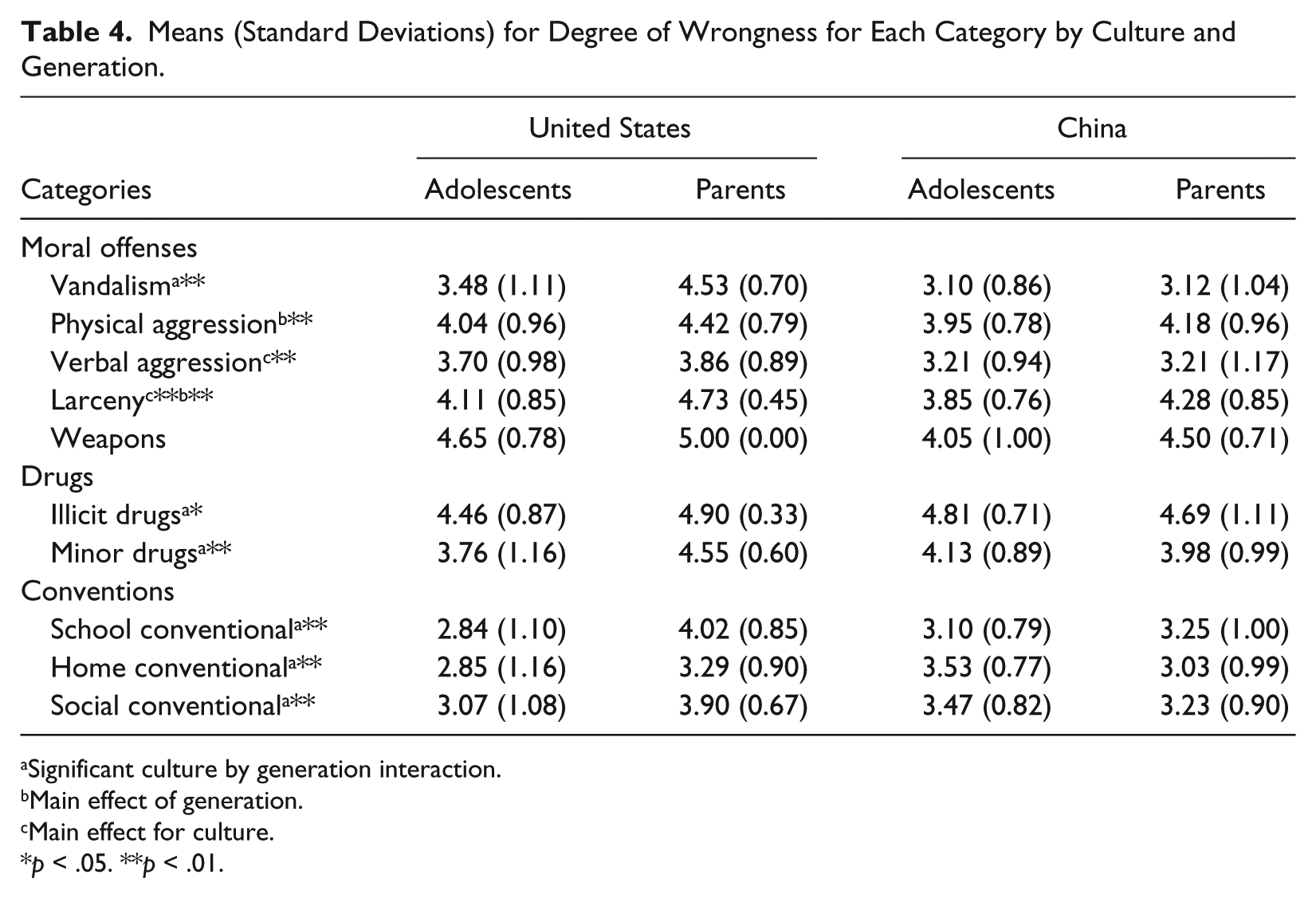
When evaluating specific adolescent misconduct behaviors on degree of wrongness, the results revealed main effects of culture in moral offenses of verbal aggression, F(1, 314) = 19.51, p < .01, and larceny, F(1, 498) = 21.99, p < .01. Specifically, U.S. participants rated verbal aggression and larceny as more wrong than Chinese participants (see Table 4).
Means (Standard Deviations) for Degree of Wrongness for Each Category by Culture and Generation.
Significant culture by generation interaction.
Main effect of generation.
Main effect for culture.
p < .05. **p < .01.
Main Effects: Generation
The second hypothesis predicted differences between parents’ and adolescent children’s perspectives on usage and evaluations of adolescent misconduct behaviors. Supporting this hypothesis, there were only two significant main effects of generation, the categories pertaining to the usage of moral offenses: physical aggression, F(1, 646) = 17.72, p < .01; weapon offenses, F(1, 646) = 35.61, p < .01; and illicit drugs, F(1, 646) = 10.55, p < .01. Adolescents generated more misconduct behaviors in these categories than their parents (see Table 3).
When evaluating specific adolescent misconduct behavior on degree of wrongness, the results revealed main effects for generation, again for moral offenses, involving larceny, F(1, 498) = 48.33, p < .01, and physical aggression, F(1, 459) = 10.56, p < .01. Interestingly, parents rated this misconduct as being more wrong than did adolescents (see Table 4).
Culture by Generation Interaction
Our final hypothesis predicted interaction effects between culture and generation. Supporting this hypothesis, significant interaction effects of culture by generation were found for the usage of the following misconduct behaviors: (a) moral offenses: vandalism, F(1, 646) = 82.97, p < .01, verbal aggression, F(1, 646) = 30.25, p < .01, and larceny, F(1, 646) = 34.27, p < .01; (b) drugs, specifically, minor drug, F(1, 646) = 13.16, p < .01; and (c) for all three conventional violations, school, F(1, 646) = 69.50, p < .01, home, F(1, 646) = 74.62, p < .01, and social, F(1, 646) = 45.29, p < .01.
Post hoc testing revealed that Chinese adolescents were more likely than the U.S. adolescents to use categories of vandalism, t(393) = 12.53, p < .01; school, t(393) = 13.28, p < .01; home, t(393) = 16.26, p < .01; and social conventional violations, t(393) = 8.78, p < .01, whereas Chinese and U.S. parents did not significantly differ on the mean usage of these categories. In addition, Chinese adolescents were more likely than the U.S. adolescents to use categories of verbal aggression, t(393) = 4.23, p < .01, and larceny, t(393) = 4.53, p < .01. In contrast, the U.S. parents were more likely than Chinese parents to use these categories: verbal aggression, t(253) = 4.32, p < .01, and larceny, t(253) = 4.98, p < .01. Finally, the category of minor drugs was more likely used by U.S. adolescents than by Chinese adolescents, t(393) = 3.81, p < .01. The differences were even greater between the U.S. parents and Chinese parents: t(253) = 8.94, p < .01 (see Table 3).
When evaluating specific adolescent misconduct behaviors on degree of wrongness, there were significant interaction effects of culture by generation for vandalism, F(1, 349) = 19.07, p < .01; school, F(1, 506) = 32.50, p < .01; home, F(1, 491) = 27.81, p < .01; social conventional violations, F(1, 527) = 41.55, p < .01; illicit, F(1, 301) = 4.49, p < .05; and minor drugs, F(1, 471) = 23.68, p < .01.
Follow-up testing showed that Chinese adolescents rated school, t(320) = 2.40, p < .05; social conventional violations, t(317) = 3.59, p < .01; as well as minor drugs, t(313) = 3.05, p < .01, as more wrong than did U.S. adolescents. In contrast, it was the U.S. parents who considered school, t(186) = 5.41, p < .01; social conventional violations, t(210) = 5.84, p < .01; as well as minor drug use, t(158) = 4.35, p < .01, to be more wrong than did Chinese parents. In addition, Chinese adolescents rated home conventional violations, t(268) = 5.79, p < .01, and illicit drugs, t(227) = 2.72, p < .01, more wrong than U.S. adolescents. However, there were no differences between Chinese parents and U.S. parents. Finally, U.S. adolescents considered vandalism more wrong than Chinese adolescents, t(258) = 3.06, p < .01. The differences were even greater between U.S. parents and Chinese parents: t(91) = 7.22, p < .01 (see Table 4).
Discussion
The major goal of the current research was to examine cultural and generational differences in perceptions and evaluations of adolescent misconduct behaviors. To achieve this goal, this study used a new methodology to collect the data. Participants were asked to generate adolescent misconduct behaviors and evaluate the degree of wrongness of these self-generated misconduct behaviors. In addition, the current study used a fully crossed design to compare parents versus adolescent children’s perspectives on adolescent misconduct behaviors. Finally, the current study took extra steps to match age range and city size of the U.S. and the Chinese samples.
As expected, the results revealed main effects for cultural and generational differences in generated adolescent misconduct behaviors. For example, participants (adolescents and parents) in the United States generated more adolescent misconduct behaviors in the categories of weapon offenses and illicit drugs than Chinese parents. However, in ratings these misconduct behaviors on degree of wrongness, there were no cultural differences. This finding is not surprising given the rate of juvenile arrests in the United States is a serious concern. The number of juveniles arrested for possessing a weapon (24,700 arrests) and or using illicit drug (140,000 arrests) is high (U.S. Department of Justice, 2014). As discussed previously, Chinese laws also prohibit personal ownership of weapons and the use of illegal drugs is punished more severely in China than the United States. Thus, given the prevalence of arrests in the United States among juveniles, it seems reasonable that both adolescents and parents in the United States would likely generate weapon and illicit drugs as misconduct, but not necessarily rate them as more wrong than their Chinese counterparts.
Other interesting findings were based on the interaction effects between culture and generation. For example, Chinese adolescents were more likely than U.S. adolescents to use categories concerning conventional violations (i.e., school, home, and social), and considered these adolescent misconduct behaviors more wrong than their U.S. peers. Chinese and U.S. parents did not differ in generating these categories. However, it was U.S. parents who considered adolescent misconduct behaviors in these categories more wrong than did Chinese parents. These findings are also consistent with the previous findings that parents and their adolescent children’s expectations may not be the same (Chen, Cui, Wang, & Zhang, 2009).
Moreover, Juang and Nguyen (2009) explained that cultures, such as the United States, that emphasize individualism appear to have more problems with adolescent misconduct behaviors, in comparison with adolescents from a collectivistic society. Due to the collectivistic ideology and socialization, Chinese adolescents are more likely to deter from acting out these behaviors (Greenberger et al., 2000). Thus, because of the parental and societal sanctions, it may not be considered as more serious for parents in China than in the United States.
Moreover, the results may be somewhat surprising for researchers who examine cultural differences alone, but may not be so surprising for those who study parental control (Steinberg, Mounts, Lamborn, & Dornbusch, 1991). Cultural differences in values may be most likely evident in adolescents’ perspectives because of the specific life stage they are in during the socialization process. At this stage, adolescents may be more likely to accept the most salient cultural values without scrutiny and translate these values in their behaviors. Parents, on the contrary, may be more likely to look at their adolescent children’s misconduct behaviors and adjust parental control wherever necessary (Feldman et al., 1991). Moreover, these findings are consistent with Chao’s (1995, 2001) observation that Chinese mothers consider obedience and respect to be one of the most important goals of child rearing. Thus, parents’ perceptions and evaluations of adolescent misconduct behaviors may be more likely to tailor adolescent children’s perspectives.
Second, U.S. adolescents were more likely than Chinese adolescents to generate misconduct behaviors in mentioning minor drugs, but rated these misconduct behaviors less wrong than Chinese adolescents. In contrast, U.S. parents were more likely than Chinese parents to generate misconduct behaviors in minor drugs and rated these misconduct behaviors more wrong than Chinese parents. One explanation is that adolescents in the United States may consider minor drug use as a personal decision, whereas parents may see it as a violation of a law (Tisak, Tisak, & Rogers, 1994).
In addition, our results provide a new perspective in explaining previous conflicting results of cross-cultural differences in adolescent misconduct (e.g., Feldman et al., 1991, vs. C. Chen et al., 1998). The present study suggests that it all depends on what type of adolescent misconduct behavior is under examination. For example, U.S. adolescents, in general, have more access to weapons and drugs than Chinese adolescents. This may explain why the U.S. participants generated more adolescent misconduct behaviors in these categories. Chinese adolescents, on the contrary, generated more adolescent misconduct behaviors in either home or public places (i.e., school and social settings) than U.S. adolescents. This finding supported the notion that Chinese culture is more likely than U.S. culture to emphasize group harmony and interdependency. This is consistent with Shek and Chan’s (1999) findings regarding Chinese parents’ expectations on their children, which reflect the cultural expectations on being self-disciplined and maintaining good relationships with others.
However, it would be misleading if one only focuses on the number of adolescent misconduct behaviors generated without looking at evaluations of these behaviors. Although the U.S. participants generated more adolescent misconduct behaviors in weapon offenses and drug use, they did not evaluate these behaviors to be more wrong than did Chinese. This pattern of results is consistent with previous research of Tisak and her colleagues (1994). American adolescents may realize that certain behaviors (e.g., using minor drugs such as tobacco and alcohol under age) are misconduct, but they do not judge these misconduct behaviors very wrong and hence continue these misconduct behaviors in spite of law regulations.
Likewise, Chinese generated adolescent misconduct behaviors in vandalism and school conventional violations but considered them less wrong than did the U.S. participants. It seems that the number of misconduct behaviors only represents salient problem behaviors in a particular culture or society, whereas the degree of wrongness reflects the true values held by individuals in different cultures. The only category of behaviors that produced consistent cultural differences in the number of misconduct behaviors generated and in the degree of wrongness was home conventional violations. Chinese generated more adolescent misconduct behaviors in this category and rated it more wrong than did the United States. This may suggest that family relationship is more important in Chinese culture than in American culture, given that a family, instead of an individual, is the basic unit in a collective culture (Triandis et al., 1990). This is also consistent with Shek and Chan’s (1999) findings that when Chinese parents were asked to generate expectations on their children, family-related attributes were mentioned the most, which emphasized filial piety and family orientation. The findings of differences between parents’ versus their adolescent children’s perceptions and evaluations of adolescent misconduct behaviors give us another example of why we should examine both the number of misconduct behaviors and the degree of wrongness. Although, in general, parents generated fewer adolescent misconduct behaviors than their adolescent children, they rated these misconduct behaviors more wrong. The number of adolescent misconduct behaviors generated by adolescents themselves may simply reflect a familiarity issue, whereas the degree of wrongness represents the true attitudes parents have about adolescent misconduct behaviors.
There are several limitations of the current study that should be addressed. First, we assessed adolescents and parents about misbehaviors of adolescents in general. We may have obtained different types of behaviors if the target was the adolescent. At the same time, however, if we used this approach, we may have had to worry about social desirable responses as well (e.g., parents may be reluctant to review their adolescent child’s actual misbehaviors, especially if the behavior was illegal). Second, we do not know what sources these perceptions were drawn from (e.g., personal experience or the media). It would be important in future research to assess whether their perceptions of misconduct behaviors are based on actual activities of adolescence or if it is obtained from other sources. Therefore, if participants did not generate other behaviors that they considered misconduct, one may assume that this is similar to having missing data. However, given that we were interested in comparison between groups, this does not appear to be a serious issue. Thus, future research could include a validation study assessing both perceptions of misconduct behaviors, as well as adolescents’ personal self-reports of misconduct.
Nonetheless, the present study made significant contributions to past research on cross-cultural differences in adolescent misconduct behaviors using a self-generated methodology and examining cultural values from both parents’ and adolescent children’s perspectives. This study also lays the groundwork for future research to examine the mechanisms that account for the interactions of culture and generations. Finally, there are many implications for parents and teachers who are concerned about the heightened level of adolescent misconduct behaviors in today’s society. For example, parents need to establish good communication with their adolescent children, by not only understanding their definitions of which behaviors are misconduct behaviors, but also how wrong they consider the specific adolescent misconduct behaviors to be. As previous research found that high parental expectations were related to heightened stress and worsened mental health on their children (Zhang & Huang, 2014), future research may further explore how the discrepancies in parent–child perspectives on what constitutes misconduct behaviors and the level of wrongness of the behaviors affect adolescent development and family relationships.
Footnotes
Acknowledgements
The authors would like to thank Guanfeng Sun and Guangren Chen for collecting data in China. The authors would also like to thank Yanlong Sun for translating English version to Chinese and Fan Zhang for translating Chinese version back to English. Special thanks are also given to the principals, administrators, teachers, parents, and students from the sixth High School of Maanshan, China, Gateway Middle School, Gibsonburg Exempted Village School, Maumee City High School, and Patrick Henry High School in the United States.
Authors’ Note
Erin R. Baker is now at the Department of Educational and Counseling Psychology, University of Albany, The State University of New York.
Declaration of Conflicting Interests
The author(s) declared no potential conflicts of interest with respect to the research, authorship, and/or publication of this article.
Funding
The author(s) received no financial support for the research, authorship, and/or publication of this article.