



Abstract
Cultural stereotypes and considerable psychological research suggest that Russians are less happy and more stoic than Americans and Westerners. However, a second possibility is simply that cultural norms deter Russians from displaying happiness that they actually feel. To test this second possibility, three studies compared the emotional inhibition tendencies in U.S. and Russian student samples. Although Russians and Americans were no different on subjective well-being (SWB), a consistent three-way interaction was found such that Russians (compared with Americans) reported greater inhibition of the expression of happiness (vs. unhappiness), but mainly to strangers (vs. friends/family). Russians also viewed their peers and countrymen as behaving similarly. Furthermore, a consistent interaction was found such that the degree of happiness inhibition with strangers was negatively correlated with SWB in the U.S. samples but was unrelated to SWB in the Russian samples. Given the equivalent levels of SWB observed in these data, we suggest that Russians may not be less happy than Americans, as this would illogically entail that they exaggerate their SWB reports while also claiming to inhibit their expression of happiness. Implications for emotion researchers and international relations are considered.
Westerners who visit Russia often come away with the impression that Russians are stoic or even gloomy. Shopkeepers do not seem pleased to see shoppers, subway-riders endure the ride stony-faced, and public officials are almost invariably bad-tempered. Internet travel guides echo this stereotype of Russian culture. For example, recent travel blogs have asked, “Why Don’t Russians Smile?” (Golubeva, 2014; Sternin, 2015). Furthermore, considerable evidence supports the supposition that Russians are unhappy, consistently ranking at the bottom relative to other countries on well-being measures (e.g., Kööts-Ausmees, Realo, & Allik, 2015; Marks, Abdallah, Simms, & Thompson, 2006). Such differences have been explained as being more than a mere response bias (Veenhoven, 2001), instead reflecting the tumultuous political history of soviet bloc countries (Allik et al., 2011), or the lower wealth, poorer climate, or lower autonomy experienced in Russia (Fischer & Boer, 2015; Fischer & Van de Vliert, 2011).
Still, other studies challenge the idea that Russians are objectively less happy than Americans, or suggest that any such differences are small, or are decreasing (e.g., Inglehart, Foa, Ponarin, & Welzel, 2013). Recent statistics, for example, reveal that the percentage of Russians who feel very happy grew from 5% in 1990 to 29% in 2015, and that university students are the happiest segment of the Russian population (WCIOM, 2016; see also Kiseleva & Strielkovski, 2016). Also, according to the 2016 World Happiness Report, Russia is up to 56th place (out of 150) on an integrated index of happiness, and Russia is also one of the 10 countries with the fast growing happiness level (Helliwell, Layard, & Sachs, 2016).
In sum, the data are somewhat mixed on whether contemporary Russians, especially students (who are sampled in the current studies), are less happy than Westerners or Americans in particular. Regardless, the question is largely moot from our perspective, because our research addressed a different issue—namely, whether Russians are more likely to inhibit the expression of positive emotions, compared with Americans or with Westerners more generally. In other words, one reason Russians may strike foreigners as stoic and unsmiling is that they are simply following a cultural norm against the open expression of warmth to strangers. We attempt to demonstrate that this second possibility may be the correct one.
Our research drew from the “display rules” concept extensively studied by Matsumoto and his colleagues (Matsumoto, 1990, 1991; Matsumoto, Kasri, & Kooken, 1999). According to these researchers, emotion display rules are “culturally prescribed rules learned early in life through socialization” that dictate “how, when, and to whom people should express their emotional experiences.” In our research, we focused primarily on “which” emotions people display (happiness vs. unhappiness), as well as “to whom” they are displayed (friends/family vs. strangers), postulating that Russian culture socializes members to inhibit the expression of positive emotions, especially to strangers, even when they are feeling quite happy or positive.
Feeling Versus Expression Across Cultures
However, consideration of the research literature in cultural psychology reveals the difficulty of distinguishing between “actual feelings” versus “mere expressions” of happiness. A general problem is that researchers typically rely on self-reports to assess the level or intensity of felt emotion—self-reports that are themselves expressions that are likely affected by cultural display rules, as well as by actual feelings. Another general problem is that the feeling and expression of emotion are both entangled with many other processes, including emotion coping, emotion regulation, and emotion sharing, all known to differ across cultures (Chang, 1996; Erber & Erber, 2000). Moreover, different cultures hold widely varying views on what affects are ideal to feel, what expressions should look like, how emotions should be labeled, and how and when emotions should be displayed (Matsumoto, 1990; Mesquita & Frijda, 1992; Tsai, 2007).
Cultural Differences in Actual Feeling
To gain further traction on the slippery distinction between actual feeling versus mere expression, we consider relevant research comparing individualist/Western cultural samples with collectivist/Asian cultural samples (although caution is needed, as Russia is not always clearly a collectivist culture; Chirkov, Ryan, Kim, & Kaplan, 2003; Latova & Latov, 2008; Stetsenko, Little, Oettingen, & Baltes, 1995). For example, Asians (compared with Americans and Europeans) report objectively lower levels of positive emotion while doing tasks designed to elicit such responses (Mauss & Butler, 2010; Soto, Levenson, & Ebling, 2005). This is consistent with other findings indicating that Asian individuals do not seek to feel strong positive experience, instead aspiring to moderation. For example, while Chinese individuals’ view of happiness is quiet, peaceful, and reserved, Americans’ view is energetic and emotional (Lu & Gilmour, 2004; see also Tsai, 2007). Another study found that happiness for Americans, compared with other nationalities, involves a significantly broader array of positive feelings (Oishi, Graham, Kesebir, & Galinha, 2013).
Also relevant to the “Russians really are less happy” possibility is the finding that non-Westerners typically report more mixed emotions (i.e., experience positive and negative emotions at the same time) compared with Westerners (Schimmack, Oishi, & Diener, 2002). This phenomenon reflects non-Westerners’ dialectical view of emotions, in which apparent opposites need not be experienced as antithetical and contradictory (Peng & Nisbett, 1999). For example, Lu and Gilmour (2004) found that Chinese participants see happiness and unhappiness as two states that often go hand in hand; life is bittersweet. Moreover, research shows that in some Asian cultures people deliberately choose to do things that make them feel unhappy or sad, thus avoiding happiness and positive affect (Erber & Erber, 2000). Likewise, non-Westerners are more likely to dampen their positive emotions instead of savoring them (Joshanloo et al., 2014). In the words of Leu, Wang, and Koo (2011), Asians are wont not only to find the “good in the bad,” as many Westerners do, but also to “find the bad in the good.”
Cultural Differences in Mere Expression
However, existing evidence also supports the possibility that any differences between Russians and Westerners primarily reflect the expression (vs. inhibition) of emotion. Previous studies of emotion regulation—especially regulation with respect to outward expression—have revealed that Asian respondents value emotional control and suppression, whereas U.S. respondents value free and open emotional expression (Butler, Lee, & Gross, 2009; Soto et al., 2005). Western European values such as independence and self-assertion encourage open emotional expression in almost all situations, with suppression reserved for social threats (Markus & Kitayama, 1991; Matsumoto, 1990; Oyserman, Coon, & Kemmelmeier, 2002; Tsai & Levenson, 1997; Wierzbicka, 1994). In contrast, Asians may use emotion suppression in service of in-group goals—for example, suppressing anger with a friend to preserve that person’s feelings or status (Wierzbicka, 1994). In general, happiness and positive emotion expression are more valued in individualist cultures (Eid & Diener, 2001; Joshanloo et al., 2014) and less valued in Asian cultures (Matsumoto & Kudoh, 1993; Tsai, Knutson, & Fung, 2006).
It may be difficult, however, to apply findings regarding Asian or strictly collectivist cultures to Russian culture, because Russia is intermediate between East and West, and has historically had relatively greater exposure to Western ideas. In the next section, we consider some distinct aspects of Russian culture, in comparison with U.S. culture.
Emotion Expression in Russia and the United States
In the United States, happiness is primarily conceived as a strongly positive emotional condition (Oishi et al., 2013). In contrast, the Russian word for happiness (счастье) expresses more of an existential ideal than a feeling (Levontina & Zalizniak, 2001) and is thought to reflect luck and good fortune as much as one’s own actions or accomplishments (Diener, Kahneman, & Helliwell, 2010; Oishi et al., 2013). The authenticity or truth of emotional expression is considered to be more important than whether these emotions reflect a happy or an unhappy state (Sternin, 2000). Moreover, similar to other non-Westerners, Russians demonstrate hesitation toward pursuing or demonstrating happiness or success, which is often connected to the belief in the “evil eye”—the idea that visible success can lead to envy and suspicion from others, and to ultimate misfortune and unhappiness (Haber, 2013). This belief usually concerns interactions with unfamiliar people or acquaintances, while genuine expression of emotions is culturally expected toward close friends and family members (Berger, 2012).
Also relevant is the notorious reluctance of Russians to smile in public, or to strangers (Gasparyan, 2011). Sternin (2000) argued that a smile for Russians is meant to be very sincere and should never simply mirror someone else’s smile. Also, when Russians smile, they must have a very concrete and logical reason to do so. Any ambiguity about why someone smiles could lead to confusion and worry in others; thus, it should be avoided. Sternin (2000) cited a famous Russian saying in support of this: “Laughter with no reason is a sign of stupidity.” According to Gasparyan (2011), when the root causes of smiling or laughter are unclear, Russians err on the negative or cynical side when guessing the reasons. Americans, on the other hand, usually assume that a smiling or laughing person is just happy or having a good time.
Interestingly, Stefanenko (2014) claimed that the Russian tendency to withhold or limit smiling is a historically recent phenomenon. Stefanenko’s content analysis of Anna Karenina, written in 1877 by Leo Tolstoy, led her to conclude that a tendency to withhold smiles was not a traditional characteristic of Russian culture, but instead emerged only in the 20th century during the Soviet regime. Similarly, Mondry and Taylor (1998) analyzed the “New Russians” who appeared after the collapse of the Soviet Union, concluding that they view being able to control one’s emotions as cool. Stefanenko also argued that Russia is a “high-context” culture, in which much information is derived from people’s facial expressions and other nonverbal cues. This observation ties back to Sternin’s (2000) proposal that Russians do not want their smiles to be “empty,” conveying the wrong information. Still, neither Sternin nor Stefanenko conducted empirical research on contemporary Russians, and thus, their ideas remain to be corroborated.
These literary and anthropological analyses are consistent with some empirical research. For example, when asked to select which of six emotion display categories people “should” do in various situations and categories (express, de-amplify, amplify, mask, qualify, or control), Russians selected the “emotional control” category more frequently than did Asians or Americans (Matsumoto, Takeuchi, Andayani, Kouznetsova, & Krupp, 1998). Matsumoto, Yoo, Hirayama, and Petrova (2005) found that this pattern extended specifically to the control of happiness expression.
The main goal of the current research was to replicate and extend this latter finding. Using continuous rather than nominal measures to assess inhibition—and including subjective well-being (SWB) as a corroboratory measure—we explore the idea that the “unhappy Russians” stereotype merely reflects different emotion display rules—rather than differing emotional fact—within Russia. Study 1 reports unpublished data collected in the late 1990s (Lyubomirsky, 2000). Studies 2 and 3 report data collected in 2014 and 2015. All three studies tested the following three-way interaction hypothesis: Russians (compared with Americans) will be more likely to inhibit the expression of happiness (compared with unhappiness), especially with regard to strangers (compared with friends and family). In addition to this primary three-way interaction hypothesis, we also expected to observe main effects of emotion type (i.e., people inhibit unhappiness more than happiness; Gross & John, 2003) and social target (people inhibit more to strangers than to friends/family; Matsumoto, Yoo, & Fontaine, 2008). We did not predict a main effect difference of nationality (Russians do not inhibit more, overall), and we ventured no particular two-way interaction hypotheses.
Study 1
Method
Participants and procedure
The sample (N = 155) was comprised of two cultural groups. Russian students (N = 67) were recruited from Moscow State University from introductory psychology classes and participated in exchange for 10 rubles. U.S. students (N = 88) were recruited from the introductory psychology pool at the University of California, Riverside, and participated in exchange for course credit. The gender and age composition of the participants were as follows: 73% female (Mage = 19.8) in the Russian student sample and 65% female (Mage = 18.8) in U.S. student sample. All participants completed measures via paper-and-pencil in 1998, and all measures were translated and back-translated before being administered to Russian students.
Materials
To assess emotional inhibition, we used an indirect approach, employing two incomplete stems: “When happy, I express my happiness to . . .” and “When unhappy, I express my unhappiness to . . .” Each of the two stems was followed by the same six options: Everyone, Acquaintances, Friends, Family, Significant Others, and No One. Participants were asked to select as many options as they desired. We computed the percentage selected for each of the 12 options to facilitate cross-cultural comparisons.
Results
Response percentages are summarized in Table 1, along with chi-square values for the comparison of these percentages across cultures. Concerning the expression of happiness, no cultural mean differences were found for “Family” or for “Significant Others.” However, Russian students were significantly less likely than U.S. students to report expressing happiness to “Acquaintances” (26% vs. 57%). The largest cultural difference was that Russians were much less likely to express happiness to “Everyone” (15% vs. 62%). Finally, Russians were significantly more likely to say they would express their happiness to “No One” (11% vs. 2%). Together these patterns support our hypothesis that Russians especially inhibit the expression of happiness to less well-known others (acquaintances and strangers); no such tendency appears to exist for family and significant others. Turning to the expression of unhappiness, Russian students were less likely than U.S. students to express unhappiness to “Everyone” (3% vs. 17%) and to “Family” (48% vs. 70%). No differences in unhappiness expression were observed for “Acquaintances,” “Friends,” “Significant Others,” or “No One.” Consistent with prior research on the display of positive versus negative emotion (Matsumoto et al., 1998), people inhibited unhappiness more than happiness, likely because of generic social norms that people should try to keep their unhappy thoughts and feelings to themselves.
Study 1: Emotion Expression Selections, Split by Cultural Group.
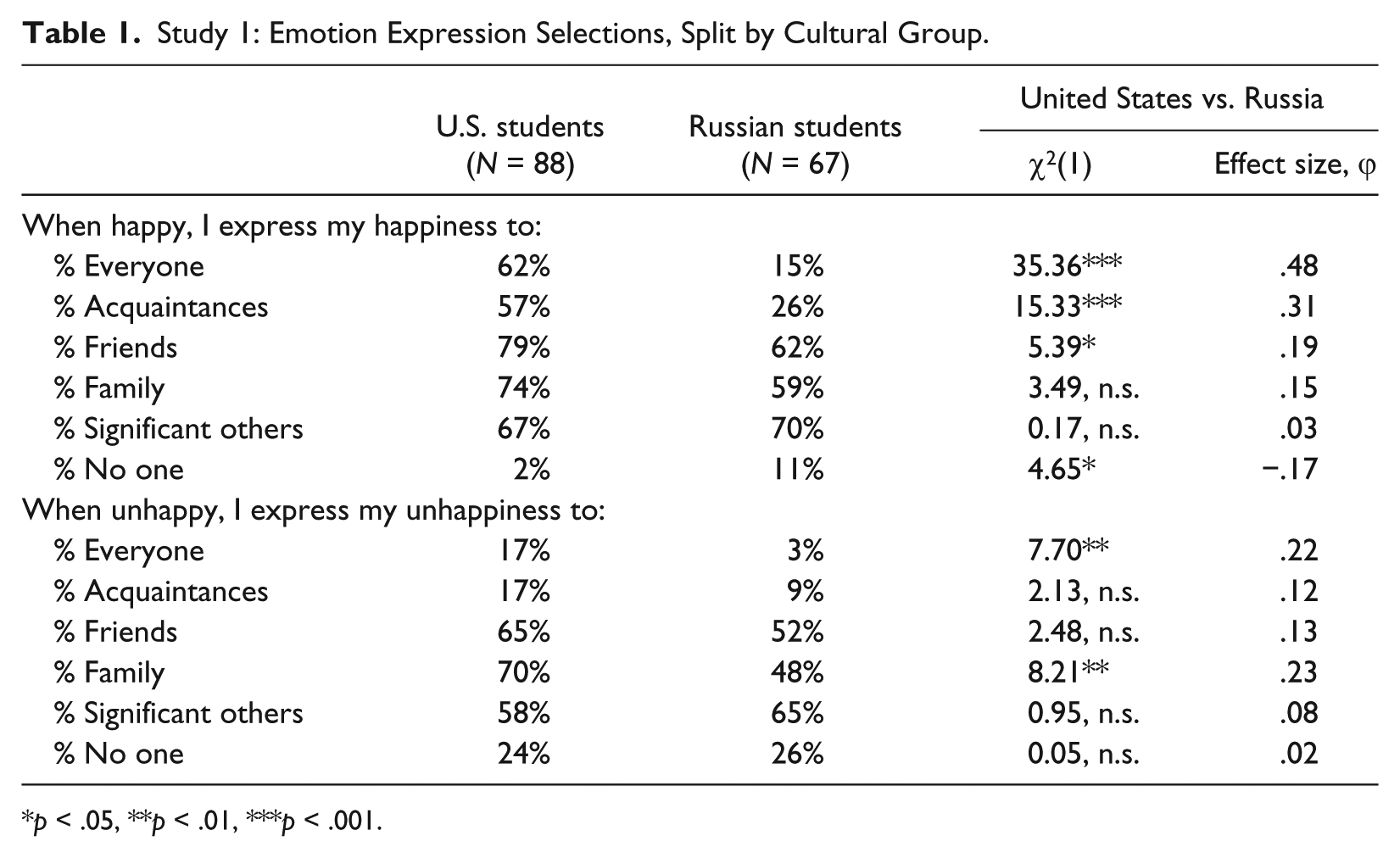
p < .05, **p < .01, ***p < .001.
We were unable to formally test our three-way interaction hypothesis in these data, because the original data were not recoverable from an obsolete data format. To approximate this test, we used criteria proposed by Wild and Seber (1993), to evaluate the significance of the difference in the tendency to express happiness and unhappiness for each setting and country. The resulting Z scores were statistically compared across countries. We found significant interactions between culture (Russian vs. American) and emotion expressed (happiness vs. unhappiness), when analyzed with respect to the Everyone (Z = 2.20, p < .05) and Acquaintances (Z = 2.33, p < .05) categories. No other interaction tests were significant.
Study 1 Discussion
Consistent with our primary hypothesis, Study 1 showed that, compared with a U.S. sample, Russian students are less likely to express happiness to “everyone” and to “acquaintances,” and more likely to express happiness to “no one.” Notably, however, happiness expression did not differ by culture for family and significant others. No such pattern was observed for the expression of unhappiness, suggesting that the phenomenon is restricted to positive emotions in particular. Consistent with this notion, we found a significant Culture (United States vs. Russia) × Emotion (happiness vs. unhappiness) interaction when the targets of emotional expression were “everyone” and “acquaintances.” These findings confirm popular stereotypes and previous findings that Russians tend to inhibit positive emotional expression (Matsumoto et al., 2008), especially in the presence of strangers or outgroup members (Stefanenko, 2014; Sternin, 2000).
This study, however, presents a number of limitations. First, the data were collected in late 1990s, following the recent (1991) collapse of the Soviet Union. Students at that time had been born and raised in the Soviet era, compared with contemporary Russian students who grew up in a transformed cultural environment. Second, Study 1 did not directly assess emotion inhibition toward strangers and distant others; instead, it used the category “Everyone” as a stand-in for the category of distant others. Third and most important, Study 1 did not examine the associations of happiness inhibition with well-being. If the inhibition of happiness to strangers is really standard within Russian culture, then those who do it should suffer no decrements in actual well-being because they are simply following the prescriptive norms. In contrast, Americans who inhibit happiness expression are engaging in counternormative behavior that may indicate psychological problems or reflect problems due to a lack of fit with the dominant milieu.
Study 2
In Study 2, we present 2015 data from current U.S. and Russian university students. Several refinements were added. First, we constructed a 2 × 3 repeated measures experimental design, asking participants to rate the extent they inhibit the expression of both happiness and unhappiness to friends, strangers, and authorities. By asking participants to rate each item, rather than merely indicate “yes” or “no” from among options provided (as in Study 1 and as in the display rule research of Matsumoto and colleagues), we gained greater statistical power and precision. Second, we included a distinction between “Strangers” and “Authorities,” allowing us to examine two different types of distant (or less well-known) social targets. This approach allowed us to investigate the possibility that Russian tendencies to inhibit happiness expression merely reflect unwillingness to take risks with governmental or political authorities, in the aftermath of the political repression that characterized Soviet times. If happiness inhibition to strangers is really a dominant feature of contemporary Russian culture, then it should be evident in people’s responses to social strangers, not just in response to powerful authorities. Third, the Study 2 methodology asked about emotion inhibition, rather than about emotion expression, as in Study 1. Thus, the method more directly addressed the question of emotion inhibition.
In addition, we included an SWB assessment, so that participants could be compared on their actual measured happiness levels, not just on their reports of inhibition. This addition provided a second source of information on participants’ emotional status, to distinguish whether Russians are actually less happy or just less expressive of happiness. If a mean difference between Russians and Americans is observed in reported inhibition—but not in reported SWB—then the findings will support our “inhibited expression” interpretation (i.e., Russians are equally happy but less expressive of it). To believe otherwise would be to believe that Russians really are lower in SWB, but that this difference cannot be detected because Russians exaggerate their SWB reports upward, while at the same time claiming not to reveal happiness to strangers (which includes the researchers, presumably). We ventured no predictions concerning cross-national differences in SWB, because of the mixed findings discussed above and because this question was not central to our investigation.
The addition of the SWB measure allowed us to add a new primary hypothesis—namely, that the tendency to inhibit happiness expression would be negatively associated with actual SWB in the U.S. sample and unrelated to SWB in the Russian sample. If happiness inhibition is merely a cultural norm in Russia, then adhering to the norm should not affect well-being. In contrast, if expressing happiness is a norm in the United States, then not doing so may predict (or be symptomatic of) reduced SWB. This two-way interaction hypothesis was tested via regression.
Method
Participants and procedure
Participants were 598 undergraduates from Russia (N = 311) and the United States (N = 287). The U.S. sample was collected at the University of Missouri–Columbia, and the Russian sample combined students from Omsk State Technical University (N = 160) and Tomsk State University (N = 151). All three are large public universities located in the interior of their respective countries, with students of average-to-good quality. The median age was 19 across the samples with no significant sample age difference. There were more women in Russian samples (70% in Omsk and 69% in Tomsk) compared with the American sample (44%), but because preliminary analyses did not find significant interaction effects by gender, gender is not considered further.
All English-language scales were first translated into Russian by a native Russian-speaking psychologist, then reviewed and reformulated by a group of four additional Russian psychologists. Next, a U.S. psychologist fluent in Russian did a back-translation. Finally, the first author compared the original and back-translated versions, making small refinements in wording. The resulting survey was administered online. Measurement equivalence analyses on the Study 2 and Study 3 data established full metric invariance, which was essential for the regression analyses planned. Scalar invariance was not always established, meaning that any observed mean differences should be interpreted cautiously. More information regarding our measurement equivalence analyses is available online.
Measures
Emotion inhibition
To assess differential tendencies to inhibit or restrict emotional expression to others, we created a 2 (Emotion: Happiness vs. Unhappiness) × 3 (Target: Friends, Strangers, or Authorities) repeated measures design in which participants rated their level of agreement with six statements, using a 5-point scale (1 = strongly disagree, 2 = disagree, 3 = neutral, 4 = agree, 5 = strongly agree). The items took the form “When I am (happy/unhappy), I try not to show it to (friends/strangers/authorities).” We intended to analyze these six items using repeated measures MANOVAs, and we also averaged the three happiness inhibition items to derive an aggregate measure of inhibited happiness (α = .76). This measure was used in correlational and regression analyses.
Subjective well-being (SWB)
To measure the actual well-being of participants, we used the five-item Satisfaction With Life Scale (SWLS; Diener, Emmons, Larsen, & Griffin, 1985; for example, “I am satisfied with my life”). We also used the Positive Affect Negative Affect Schedule (PANAS; Watson, Clark, & Tellegen, 1988), which consists of 20 items (10 for negative affect [e.g., nervous, distressed] and 10 for positive affect [e.g., proud, inspired]). To calculate an aggregate SWB score, we summed the SWLS and PA scores and subtracted the NA score, following a procedure widely used in well-being research (Busseri & Sadava, 2011; Diener & Lucas, 1999).
Results
Table 2 presents means for our six inhibition variables, split by country (12 means in all). In every case, we found a significant mean cultural difference; however, the direction of this difference varied across the six variables. We conducted a 2 (country: Russia vs. U.S.) by 2 (emotion: happiness vs. unhappiness) by 3 (social target: friends vs. strangers vs. authorities) mixed ANOVA, with repeated measures on the latter two factors. First, we found a significant main effect for country: Russians inhibited their emotional expression to a greater extent overall, F(1, 596) = 9.05, p < .01. A main effect also emerged for social target, F(2, 1194) = 117.1, p < .001; participants in general inhibited most to authority figures, less to strangers, and least to friends. There was also a main effect of emotion: Participants inhibited unhappiness expression more than happiness expression, F(1, 597) = 689.9, p < .01.
Study 2: Emotion Inhibition Means, Split by Cultural Group.
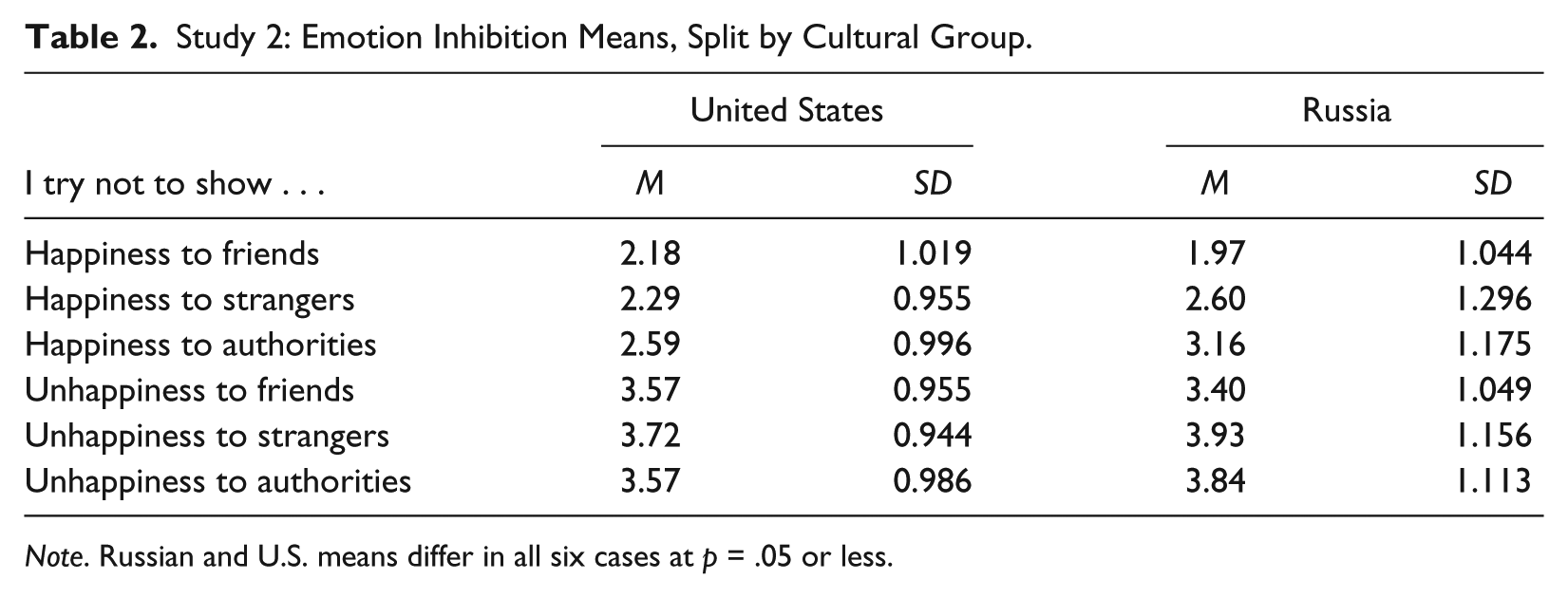
Note. Russian and U.S. means differ in all six cases at p = .05 or less.
Although we made no predictions concerning two-way interactions, two of the three possible interactions were significant. First, the Emotion × Social Target interaction was significant, F(2, 1192) = 61.0, p < .01; although participants inhibited the expression of happiness most to authorities, less to strangers, and least to friends, in the case of unhappiness inhibition, there was no difference between strangers and authorities. It may be that one function of authorities is to receive complaints. Second, the Country × Social Target interaction was significant, F(2, 1192) = 44.09, p < .01; Russian students were more likely to inhibit emotional expression to strangers and authorities, compared with U.S. students.
Our primary hypothesis, however, concerned the three-way interaction. This interaction was indeed significant, F(2, 595) = 3.68, p < .05, such that Russian participants most inhibited the expression of happiness to strangers and authorities, and much less to friends; this difference was much smaller for U.S. participants. Stated differently, in the Russian sample, the social target main effect was much larger than it was in the U.S. sample. Americans did not distinguish between friends and strangers vis-à-vis the inhibition of happiness, while inhibiting slightly more to authorities. In contrast, Russians inhibited the expression of happiness much more to strangers than to friends, and inhibited even further to authorities. Figure 1 graphs the patterns observed.
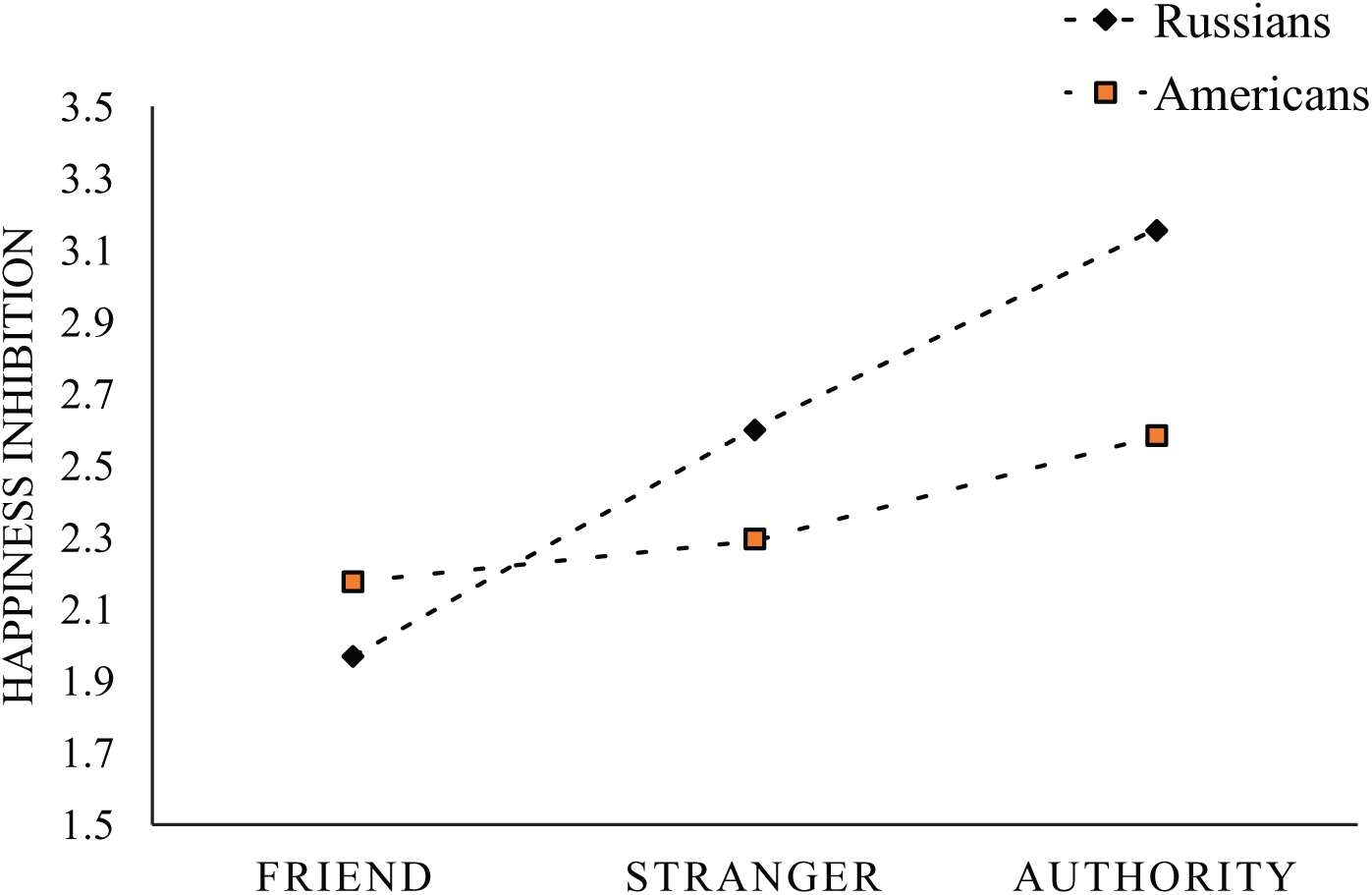
Study 2: Interaction between cultural group and interaction target predicting happiness inhibition.
Next, we turned to the SWB and the aggregate happiness inhibition variables. A t test revealed no SWB cultural difference (M = 4.63 for Russia; M = 4.65 for the United States), t(596) = .12, p > .50. However, we found a significant happiness inhibition difference (M = 2.58 for Russia; M = 2.36 for the United States), t(596) = 2.99, p < .01. Notably, for U.S. students, the correlation between happiness inhibition and SWB was r = −.31, p < .001, yet no relation between these two variables was found for Russian students, r = −.07, n.s. This difference was confirmed by a regression of SWB upon a country dummy variable, happiness inhibition (centered), and a product term; the product interaction term was significant, β = .195, p = .002. This analysis indicates that inhibiting happiness has a negative relationship with overall well-being for Americans but not for Russians. Supplementary analyses confirmed that the pattern held for both the PA and NA components of SWB, analyzed separately. We also tested the interaction coefficient when only the two “stranger” inhibition items were used (“I don’t show happiness to strangers/authorities”). The size of the coefficient increased from .195 to .331, suggesting that concealing happiness specifically from strangers is most problematic in the United States (but not in Russia). Inhibiting happiness expression to friends was not associated with SWB in either culture.
Study 2 Discussion
In Study 2, we were able to replicate the basic pattern found in Study 1, in which Russians were especially liable to inhibit the expression of happiness to distant others, compared with U.S. participants. That this basic effect was found in data collected almost 20 years apart suggests that this phenomenon may be a stable aspect of Russian culture. Furthermore, the fact that the strongest happiness inhibition effect was found with authorities supports the conjecture that the effect may be in part a holdover from Soviet times, as suggested by Stefanenko (2014).
We also found support for our new secondary hypothesis. A significant negative relationship between happiness inhibition and SWB emerged in the U.S. sample but not in the Russian sample. Taken in conjunction with the finding that happiness inhibition was stronger overall in the Russian sample, this finding suggests that happiness inhibition is culturally normative in Russia, where it is considered to be socially inappropriate to smile and appear jolly for no reason. Thus, those who inhibit a lot in Russia do not appear to suffer as a result. In contrast, happiness inhibition is less normative in the United States, where people are enjoined to “smile!” and “put on a happy face.” In this cultural context, those who inhibit happiness expression the most, especially with regard to strangers, may suffer adverse consequences.
Study 3
In our final study, we explicitly addressed the issue of cultural norms by asking participants not only “to what extent do you inhibit” emotional expression, but also “to what extent do your peers” and “your countrymen” do so. This methodology allowed us to compare participants’ self-reports with their lay beliefs about others’ behavior; finding the same basic patterns across these two additional types of variables would bolster the social norm hypothesis. Accordingly, we did not predict cultural differences in the perceived emotional inhibition of peers and countrymen, with respect to self-reported self-inhibition. We also expected to replicate the finding from our primary hypothesis—namely, the three-way interaction in which Russians report that they themselves are more likely to inhibit expressing happiness to more distant others. We also expected to replicate the finding from our secondary hypothesis—that is, the two-way interaction between country and happiness inhibition with respect to the prediction of SWB.
Method
Participants and procedure
The study took place in late 2014. Participants were 1,184 undergraduates drawn from the University of Missouri in the United States (N = 196; 71% female, Mage = 20.53; SD = 4.74) and from eight different universities in Russia (N = 988; 74% female, Mage = 19.05; SD = 2.61). Before research commenced, translation and back-translation were accomplished via the same method and research team used in Study 2. The resulting survey was administered online in the United States and mostly online in Russia. Other items included in the survey can be examined upon request.
Measures
Emotion inhibition
We used the same item stem format as before, but the “authorities” option was dropped. We also repeated the four items twice more, replacing “I” in the sentence above with either “my peers” (four items) or “my countrymen” (four items). This design resulted in 12 items total. We also created an aggregate “happiness inhibition” measure by averaging the “I don’t show happiness to friends” and “I don’t show happiness to strangers” items (α = .66).
Subjective well-being
SWB was measured in the same way as in Study 2.
Results
Table 3 presents the means for the 12 inhibition variables, split by country (24 means in all). In every case but one (self hiding unhappiness from strangers), a significant mean cultural difference emerged, but the direction of this difference again varied across the 12 variables. To replicate our previous findings supporting the primary hypothesis, we first focused only on the ratings of self, conducting a 2 (country: Russia vs. U.S.) by 2 (emotion: happiness vs. unhappiness) by 2 (social target: friends vs. strangers) MANOVA, with repeated measures on the latter two factors. Again, we found a main effect of country: Russians inhibited their emotional expression to a greater extent overall, F(1, 1182) = 11.26, p < .01. Also, again a main effect emerged for social target, F(1, 1182) = 142.83, p < .001, and for emotion, F(1, 1182) = 1,247.08, p < .01. Participants in general inhibited more to strangers and less to friends and were more likely to inhibit the expression of unhappiness than happiness.
Study 3: Emotion Inhibition Means, Split by Cultural Group.

Turning to two-way interactions, the Country × Social Target interaction was again significant, F(1, 1182) = 27.93, p < .01: Russians were more likely than Americans to inhibit emotional expression to strangers. Also, we found a significant Country × Emotion interaction, F(1, 1182) = 48.59, p < .01: Russians were more likely than Americans to inhibit happiness. The Emotion × Social Target interaction found in Study 2 did not replicate in Study 3.
Next, we again tested our primary hypothesis—the three-way interaction—which was again significant, F(1, 1182) = 4.11, p < .05. That is, Russian participants inhibited happiness expression more to strangers and less to friends (a gap of .66), a difference that was much smaller for U.S. participants (.17). For unhappiness inhibition, the stranger–friend gaps was .53 in Russia and .29 in the United States—not a significant difference.
Analyses revealed that the same basic patterns occurred with the “peer” and the “countrymen” data (see Table 3). Compared with U.S. students, Russian students believed that both their peers and their countrymen inhibit the expression of happiness more to strangers than to friends. The stranger/friend gaps became progressively smaller moving from self to peers to countrymen, but analyses revealed no significant four-way interaction involving the person doing the inhibiting (self, peers, or countrymen), indicating that the effects were equivalent across this factor. The primary difference between the three sets of ratings was that all participants (Americans and Russians) believed that they personally inhibit the expression of unhappiness more, to both friends and strangers, than their peers and countrymen do. This likely reflects a self-serving bias on the part of participants (e.g., “I am not a complainer!”).
Next we turned to the SWB and aggregate happiness inhibition variables. A t test again revealed no cultural SWB difference (M = 4.87 for Russia; M = 4.73 for the United States), t(1182) = −1.04, p > .30. However, we again found a significant happiness inhibition difference (M = 2.31 for Russia; M = 1.56 for the United States), t(1182) = 7.09, p < .01. The correlation between happiness inhibition and SWB was significant for U.S. students (r = −.16, p < .05), but not for Russian students (r = −.03, n.s.). However, unlike in Study 2, in a regression analysis, the product interaction term reflecting this cultural difference was not significant, β = .05, p = .113. When the two items that comprise the measure were examined separately, inhibiting the expression of happiness to friends was unrelated to SWB in both samples (rs = −.098 and −.03, n.s.). However, inhibiting the expression of happiness to strangers was correlated with SWB in the United States (r = −.18, p < .01) but not in Russia (r = −.026, n.s.). The coefficient for this interaction was significant in a regression, β = .08, p = .03. The interaction was again equivalent in size for PA and NA analyzed separately (βs = .05 and −.05, respectively). Thus, once again, it was the tendency not to show happiness to strangers that was most predictive of lower SWB in the United States.
Study 3 Discussion
Study 3 replicated several findings from Studies 1 and 2, and also provided support for our new secondary hypothesis. First, we again showed that the biggest cultural difference occurs for happiness inhibition with respect to strangers—that is, Americans express their happiness just as much to strangers as they do to friends, while Russians do not. We were again able to demonstrate that happiness inhibition with regard to strangers is unrelated to SWB in Russians, but predicts lower SWB for Americans. Finally, in our final study, we were able to assess the cultural norms of the two countries. Our results supported the hypothesis that the cultural differences in emotion inhibition, which we found in all three studies, are not just a reflection of the personal behavior or self-concepts of our participants; rather, our participants believed that their peers, and other people in their own country, behave similarly. Thus, happiness inhibition to strangers may really be a cultural norm in Russia.
General Discussion
We set out in this research to distinguish between two possibilities. Are Russian people literally unhappy, as some cultural stereotypes and research findings suggest? Or, do Russian people merely inhibit their expression of happiness, especially to distant others? Our three studies clearly support the second, “cultural display rule” possibility (Matsumoto et al., 1998). First, in Studies 2 and 3, Russian student samples were no different from U.S. student samples in their self-reported levels of SWB, despite some earlier research suggesting that Russians are less happy and satisfied than most Westerners. Second, in all three studies, Russians (compared with Americans) reported inhibiting their happiness (but not their unhappiness) expression, to strangers but not to friends or families. This consistent three-way interaction directly supports the second possibility. Indeed, for the display rules interpretation to be incorrect, the Russian samples would have had to exaggerate their SWB reports (to make themselves look just as happy as the Americans), at the same time they reported being reluctant to show happiness to strangers (such as the researchers). This alternative account seems unlikely.
Three additional findings support the display rules interpretation. First, Study 3 found the same basic patterns when participants were rating what their peers do, and also when they were rating what their countrymen do. Thus, our studies are apparently not simply demonstrating a self-report bias; instead, they offer evidence of a general difference in cultural norms—a difference on which participant’s reports regarding themselves, as well as their reports regarding others, converge. Second, Studies 2 and 3 showed that the tendency to inhibit happiness expression was unrelated to SWB in the Russian samples. In other words, even the Russian participants who reported doing this the most showed no apparent adverse effects. In contrast, U.S. participants who reported inhibiting happiness expression, especially to strangers, tended to be lower in SWB compared with their peers. Third, the patterns were found in data collected almost 20 years apart (Study 1 vs. Studies 2 and 3), suggesting that the documented cultural pattern is a persistent one, as would be expected from a display rules perspective.
Why might happiness inhibition to strangers be problematic in the United States? Although our data are only correlational, we speculate that American culture has a reverse display rule—namely, “show a happy face to the world.” In line with the “can do” and “power of positive thinking” ethos of American society, expressions of positive emotion are encouraged and expected, perhaps especially to strangers (Butler et al., 2009; Soto et al., 2005). In such a context, positive affective states might even be wielded as tools, for forming relationships, achieving social influence, and obtaining desired goals. Within the United States, those who especially inhibit happiness expression to strangers may be feeling a stressful mismatch between themselves and their cultural milieu, or may be evidencing a sense of isolation or estrangement from others, reducing their SWB.
In contrast, in Russia, inhibiting the expression of happiness may not breed or reflect such isolation or alienation. Instead, inhibiting positive expression in communication with strangers appears to be actively encouraged, as unexpected or unexplained positive expressions are viewed with suspicion. The current studies provide the first extended empirical test of prior observations (cf. Stefanenko, 2014; Sternin, 2000), as well as the display rule hypothesis more generally (but see Matsumoto et al., 2005 and Tsai et al., 2006, for relevant earlier data). Also notable is that our data comport with recent findings that Russians are more self-distancing than Americans when it comes to reflecting on their own emotions, and that such emotional self-distancing does not have negative correlates in Russia, as it does in the United States (Grossmann & Kross, 2010). We found the same basic pattern with respect to inhibited happiness expression.
Limitations and Future Directions
Our study has important limitations, which point the way to future research. First, our data were based on self-report. This is especially problematic in a study of cultural display rules, where the accuracy of people’s self-reports may be confounded by display rules in ways that are difficult to predict. It will be essential to follow up with observational data—perhaps via field studies in which shifts in SWB are tracked along with shifts in objective emotional displays as measured by facial muscle coding, or via laboratory studies in which participants are observed describing happy versus unhappy experiences to friends versus strangers. We note, however, that our combined collection of SWB and inhibition data somewhat mitigates the concern with self-reports. Our two-pronged approach enabled us to test the accuracy of the “unhappy Russian” stereotype, finding no support, while testing the alternative display rules hypothesis, finding considerable support. Thus, it is may not be that Russians are actually unhappy or lack joy; rather, they may simply be undemonstrative, as befits a dominant cultural norm or display rule of their culture (but see Veenhoven, 2001).
Another limitation of these studies is their reliance on student samples. Although common in cross-cultural research, future researchers will find it desirable to generalize such results to working adults. One possibility is that our use of student samples reduced error and enhanced our ability to detect the predicted patterns, as college students tend to have similar circumstances and concerns and around the world, and are increasingly exposed to similar messages via media, Internet, apps, and entertainment. Using more diverse samples within each country might provide a more conservative test of the display rule hypothesis. However, the fact that the predicted cultural difference has (so far) survived the international homogenizing influences that are acting upon contemporary college students might be viewed as evidence of robust persistence of the cultural norm.
Conclusion
Our work could have important implications for cross-cultural communication. American businesspeople, instead of being put off by the apparent stoniness of their Russian colleagues, should remain mindful of norms around emotional expression and inhibition. U.S. executives should recognize that grinning and nodding their heads during a negotiation may be customary in the United States but considered inappropriate by Russians. Similarly, tourists would do well not to infer that a dour expression is necessarily a sign of hostility or unfriendliness; although Russians may seem unapproachable, they may be a lot more welcoming and comradely than they appear.
Footnotes
Declaration of Conflicting Interests
The author(s) declared no potential conflicts of interest with respect to the research, authorship, and/or publication of this article.
Funding
The author(s) disclosed receipt of the following financial support for the research, authorship, and/or publication of this article: The study has been funded by the Russian Academic Excellence Project ‘5-100’.