



Abstract
Ostracism is pervasive across a wide range of cultures. However, little is currently known about how it may be experienced emotionally across cultures. In the current work, we drew on prior cross-cultural evidence and predicted that Westerners would construe social rejection as unfair and unjustifiable (an appraisal consistent with independent self-construal and linked to the emotion of anger) while Easterners would construe the same event not only as unfair but also as situationally constrained and, thus, also “inevitable” (an appraisal consistent with interdependent self-construal and linked to sadness). As predicted, after social rejection within the Cyberball paradigm, European Americans reported experiencing more anger than sadness while East Asians/East Asian Americans (Study 1) and Japanese (Study 2) showed no difference in their levels of these two emotions. In addition, we also found that, compared with European Americans, East Asians/East Asian Americans showed similar levels of overall negative reactions to social rejection (Study 1) while Japanese had a stronger negative response (Study 2). Our findings underscore the central role of culture in shaping the experience of social rejection and suggest possible ways in which people with different cultural backgrounds may cope with it.
Ostracism—the experience of social rejection or receiving the “cold shoulder”—is a frequent and worldwide phenomenon. Indeed, at least once a week, one in four Japanese elementary school students report experiencing this via bullying or ijime (Morita, Soeda, Soeda, & Taki, 1999). Meanwhile, Dalits in India (formally known as “untouchables”) face continual social spurning in the form of blocked access to public drinking water, temples, and shops (Bob, 2007) and, in the United States, nearly 75% of people report facing the “silent treatment” from others (Faulkner, Williams, Sherman, & Williams, 1997). In addition to it being common across cultures, research also suggests that, because the need for social connection is universal (Baumeister & Leary, 1995), the experience of social rejection feels hurtful for everyone (Williams, 2009). Yet, might cultures vary in the specific way in which they respond emotionally to the experience of being socially rejected?
Previous work provides ample evidence that emotional experience is highly dependent on how situations are construed and how aspects of them are appraised (Frijda, Kuipers, & Ter Schure, 1989; Smith & Ellsworth, 1985; Smith & Lazarus, 1993). Hence, it stands to reason that, depending on how social rejection is interpreted, the specific emotions that result from this experience should vary systematically. This consideration may be applicable to the predictions for how social rejection is emotionally experienced across cultures.
It has been repeatedly demonstrated that cultures vary systematically in the degree to which either independence of the self from others, or interdependence of the self with others, is normatively sanctioned (Markus & Kitayama, 1991). Specifically, in Western cultural contexts, achieving independence is strongly approved and fulfilling one’s own needs and expressing oneself is highly encouraged (Cousins, 1989). Given this cultural imperative, people in this context are strongly motivated to pursue positivity of the self while doing their best to avoid negative events. Accordingly, when negative events happen, they predominantly view them as unfair and blame others for them (see Heine, Lehman, Markus, & Kitayama, 1999, for a review; Kitayama, Takagi, & Matsumoto, 1995). Therefore, Westerners are likely to view the negative event of social rejection as being the fault of the ostracizer and this appraisal, in turn, may lead to the emotion of anger (Frijda et al., 1989; Smith & Ellsworth, 1985; Smith & Lazarus, 1993).
In contrast, in Eastern cultural contexts, achieving interdependence with others is more strongly encouraged and normatively sanctioned and, thus, maintaining social connection and fitting in is more valued (Markus & Kitayama, 1991). For people in this context, there arises a greater tendency to see outcomes as embedded in a web of various underlying causes (Ji, 2005; Norenzayan & Lee, 2010). One important consequence of this more holistic worldview is that people often construe outcomes as more inevitable after the fact (Choi & Nisbett, 1998), and thus, they tend to be more fatalistic as well (Norenzayan & Lee, 2010). Therefore, Asians may construe social rejection as not only being unfairly caused by the ostracizer but also as inevitable. While the former appraisal is strongly linked to the emotion of anger, the latter is strongly linked to sadness (see Smith & Ellsworth, 1985). Thus, we predicted that while Westerns will show higher levels of anger than sadness, Easterners would show similar levels of these two emotions.
Our primary aim was to test this prediction and to examine, for the first time, potential cultural variations in the discrete emotional response to social rejection. Using different measures and cultural groups (e.g., European Americans, East Asians/East Asian Americans, and Japanese people), in two studies, we manipulated social rejection (vs. inclusion) via the standard Cyberball paradigm and then examined how it differentially impacted anger and sadness responses across cultures. As general negative emotions and general psychological need fullfilment (i.e., current satisfaction levels in terms of belonging, self-esteem, meaningful existence, and control) are common consequences of social rejection, we also examined cultural difference in the impact of social rejection on measures of both of these general responses. Because previous cross-cultural research has found mixed results (Gardner, Knowles, & Jefferis, 2017; Garris, Ohbuchi, Oikawa, & Harris, 2011; Over & Uskul, 2016; Pfundmair, Aydin, et al., 2015; Pfundmair, Graupmann, Frey, & Aydin, 2015; Yamaguchi, Kuhlman, & Sugimori, 1995), we did not make predictions on the direction of these effects on these general measures.
Study 1
Method
Participants
Sixty-three European Americans (42 females; Mage = 18.83, SDage = 0.94) and 52 East Asians/East Asian Americans (27 females, Mage = 19.55, SDage = 1.96) were recruited for a lab study in exchange for course credit at the University of Michigan, Ann Arbor. Of the East Asians/East Asian Americans, approximately 53% were born in the United States/Canada. The rest were born in Korea (24%), Mainland China (18%), Taiwan (4%), and Hong Kong (2%) and spent an average of 9 years in the United States. Two participants were discarded because they accidentally found out that we had staged the social rejection manipulation. 1 Thus, the final sample consisted of 62 European Americans and 51 East Asians/East Asian Americans. Following ethical review board stipulations, participants could decline responding to any measure, which slightly reduced sample size in some of the analyses.
Procedure
We used the standard Cyberball social rejection manipulation (Williams & Jarvis, 2006) in which participants were led to believe that they were tossing a virtual ball with two actual players over the computer as part of a study on mental visualization. These players were alleged to be in another part of the building, to be students, to have the same gender as the participant, and to have first names that were identified to be relatively frequent for U.S. students of both European American and East Asian backgrounds (e.g., Kim, Jason). To ensure that participants believed these players were real, before beginning the game, we walked down the hall to allegedly check to make sure that the other players were ready to begin.
Participants were also told, In this task, you will be playing a ball tossing game with two other students over the internet who are in different lab rooms in this building. We would like you to visualize yourself and the other students throwing and catching a ball. What is important is not your ball tossing performance, but that you mentally visualize the entire experience.
In line with standard Cyberball procedures, the game lasted approximately 6 min and involved 40 throws. In the inclusion condition, participants received the virtual ball roughly one third of the total throws. In the social rejection condition, participants only received the “ball” twice at the beginning of the game and then never again.
To ensure that participants felt free to respond naturally, we ran them individually in a private room. Moreover, the experimenter stayed in an adjoining room with the door closed for the entirety of the Cyberball procedure while participants completed the measures described below. If participants asked any questions during these procedures, the experimenter answered it through the closed door.
Measures
Other than the manipulation check, the following measures were disguised as “personality” questions. To obscure the meaning of these measures further, we embedded them within various filler items.
Manipulation check
We used two items developed specifically for testing Cyberball’s effectiveness (Zadro, Williams, & Richardson, 2004): (a) percent of throws received and (b) the extent the participant felt included during the game; 1 (not at all) to 9 (very much).
Anger and sadness
Current levels of anger (e.g., irritation, hate, outrage; α = .90) and sadness (e.g., hurt, depressed, loneliness; α = .86) were assessed directly after Cyberball with 10 items each that were selected a priori from Shaver, Schwartz, Kirson, and O’Connor (1987). Specifically, participants were asked, “Indicate to what extent you feel the below emotions right now (i.e., at the present moment),” from 1 (not at all) to 5 (extremely).
General negative affect
Randomly interspersed in the 20-item anger and sadness measure above were 20 additional items from the Positive and Negative Affect Schedule (PANAS; Watson, Clark, & Tellegen, 1988), current positive (α = .90) and negative affect (α = .78). Positive items were reverse scored to form an aggregated measure of general negative affect (α = .82). Therefore, the entire measure of “current affect” included 40 items in total (i.e., 20 general negative affect items plus 20 anger and sadness items).
General Need fulfillment
Perceived fulfillment of fundamental needs (i.e., belongingness, self-esteem, control, and meaningful existence) was assessed with 20-standard items (Zadro et al., 2004) rated on 7-point scale: 1 (not at all) to 7 (very much). All items were aggregated (α = .96).
Results
Manipulation check
Confirming the manipulation’s effectiveness, included (vs. rejected) participants felt more socially included during the game (M = 5.45, SE = 0.13 vs. M = 1.64, SE = 0.13), F(1, 111) = 441.35, p < .001,
Anger and sadness
Next, we tested whether social rejection relative to inclusion led to more anger than sadness among European Americans (vs. East Asians/East Asian Americans). Because these measures were nested within participants, we used linear mixed modeling via the MIXED command in SPSS (Peugh & Enders, 2005). We modeled the residual covariance structure of our data, imposing a heterogeneous compound symmetry covariance structure, to allow for residual error variances to vary across anger and sadness measures and to model error covariance between these measures. We calculated partial correlations as a measure of effect size (Rosnow & Rosenthal, 1996). To examine cultural variations in the expression of sadness and anger in response to social rejection, we tested the 2 (condition) × 2 (culture) × 2 (affect type: anger, sadness) interaction, with emotion type as a within-subjects factor. In addition, we included all two-way interactions, as well as all main effects, into the statistical model.
As predicted, the Condition × Culture × Affect type three-way interaction was significant, t(107) = −2.01, p = .048, pr = –.19 (see Figure 1). Among European Americans, social rejection relative to inclusion increased anger (M = 1.64, SE = 0.10 vs. M = 1.23, SE = 0.10) and sadness (M = 1.34, SE = 0.08 vs. M = 1.16, SE = 0.07), t(109) = 2.46, p = .016, pr = .23. However, this main effect was qualified by a Condition × Affect type interaction, t(107) = −2.92, p = .004, pr = –.27. Whereas sadness and anger were equally low in the inclusion condition, t(107) = −1.28, p = .204, pr = –.12, in the social rejection condition, anger was experienced more strongly than sadness, t(107) = −4.93, p < .001, pr = –.43. Among East Asians/East Asian Americans, social rejection relative to inclusion marginally increased anger (M = 1.41, SE = 0.10 vs. M = 1.21, SE = 0.11) and sadness (M = 1.43, SE = 0.08 vs. M = 1.22, SE = 0.09), t(109) = 1.71, p = .090, pr = .16. Anger and sadness reports did not differ, t(107) = –.073, p = .942, pr = –.01. 2
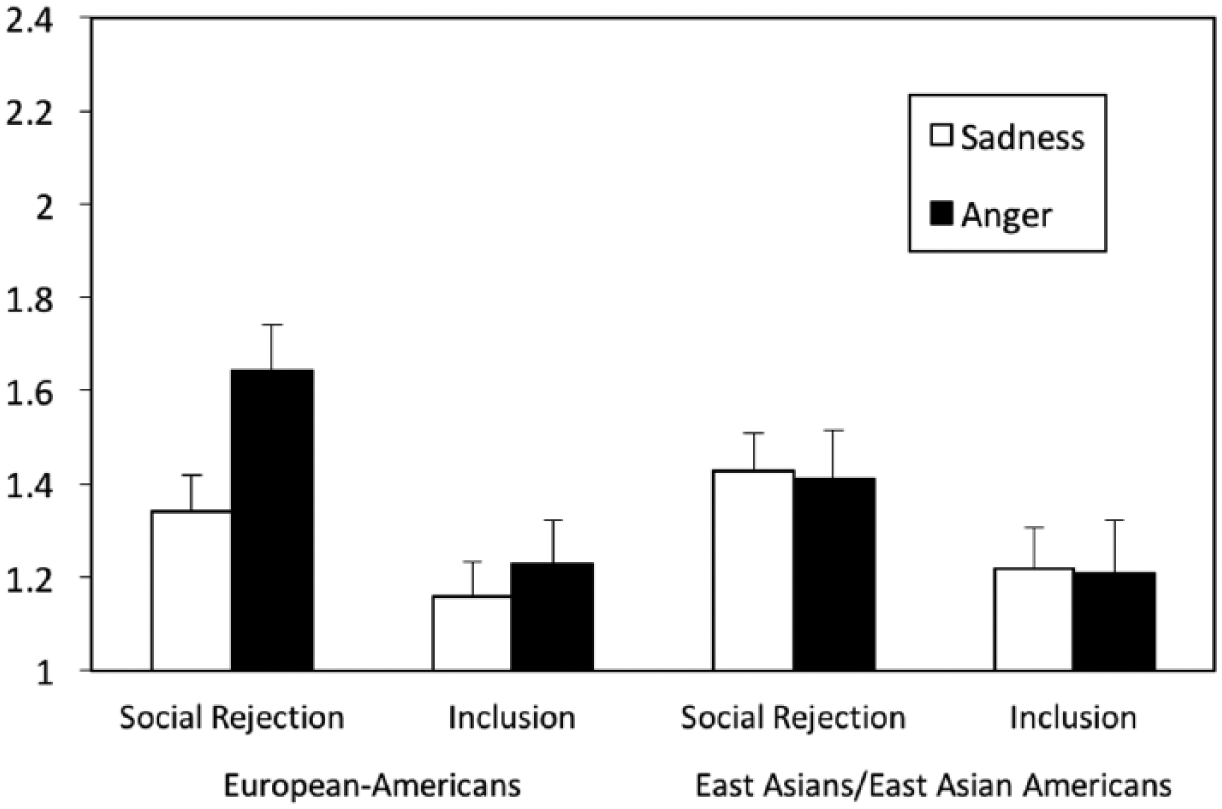
Anger and sadness across cultures and social rejection conditions (Study 1).
Males and females did not differ in their overall anger (M = 1.40, SE = 0.09 vs. M = 1.36, SE = 0.07) or sadness (M = 1.30, SE = 0.07 vs. M = 1.28, SE = 0.05) responses, |ts| ≤0.91, ps ≥ .366, |prs| ≤.09. Gender did also not affect cross-cultural differences in the extent to which participants responded to social rejection with anger compared with sadness, as gender did not moderate the Condition × Culture × Affect type interaction, t(102) = 0.98, p = .330, pr = .10.
General Need fulfillment
A 2 (social rejection vs. inclusion) × 2 (European American vs. East Asians/East Asian Americans) ANOVA indicated higher need fulfillment among included (vs. rejected) participants (M = 4.98, SE = 0.12 vs. M = 2.64, SE = 0.11), F(1, 107) = 218.72, p < .001,
General negative affect
A 2 (condition) × 2 (culture) ANOVA indicated more negative affect among rejected (vs. included) participants (M = 2.83, SE = 0.05 vs. M = 2.55, SE = 0.05), F(1, 104) = 14.17, p < .001,
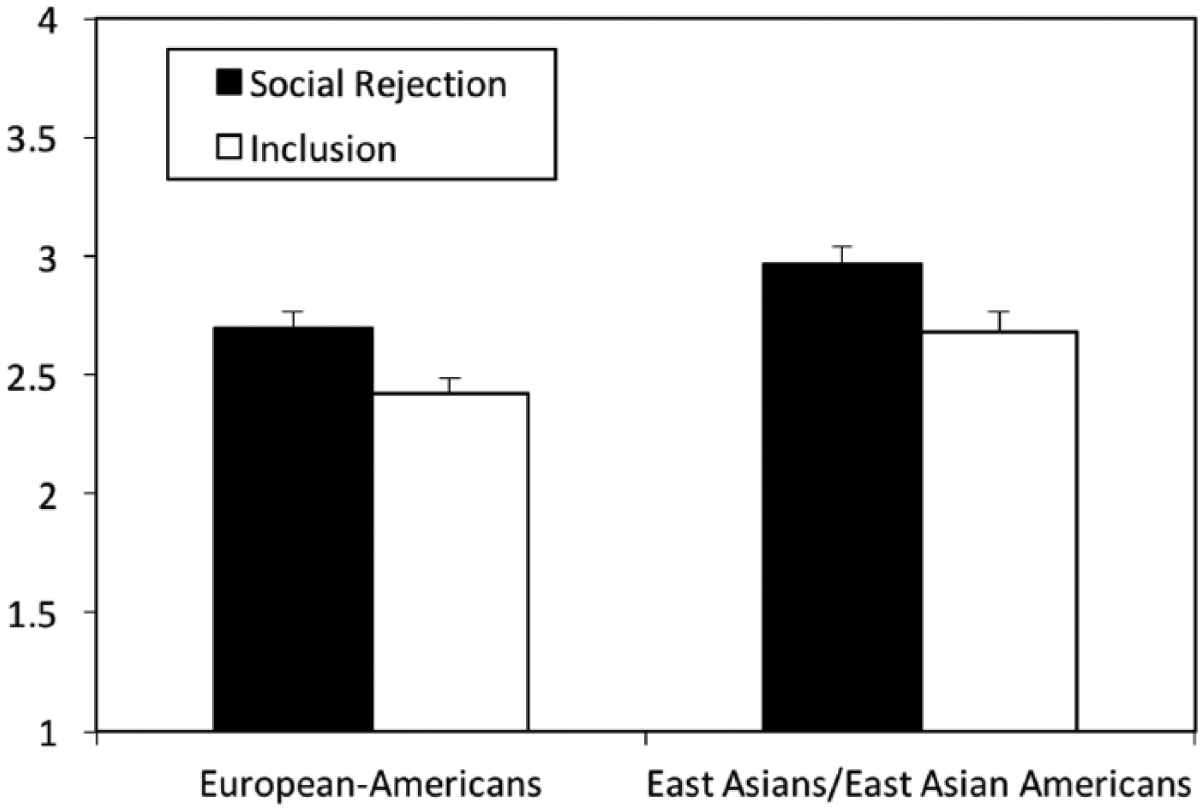
General negative affect across cultures and social rejection conditions (Study 1).
Study 2
Study 1 provided initial evidence that social rejection leads primarily to anger (vs. sadness) among European Americans and that, for East Asians, it leads to no difference in the levels of these two emotions. These two cultural groups were also no different in their levels of both general perceived fullfilment of psychological needs and general negative affect. In Study 2, we attempted to conceptually replicate these findings in a cross-cultural comparison in the United States and Japan using European Americans and Japanese people, respectively. We also explored a different measure of affect. While Study 1 asked participants to report their current feelings (i.e., a present tense measure) after the social rejection or inclusion experience, Study 2 asked them to retrospectively report their feelings during this event (i.e., a past tense measure). Previous research has found this latter measure to be more responsive to ostracism (Garczynski & Brown, 2014).
Method
Participants
Ninety-five European Americans from the University of Michigan, Ann Arbor (44 females, Mage = 18.65, SDage = 0.92) and 60 Japanese undergraduates from Kyoto University (25 females, Mage = 19.28, SDage = 1.08) were recruited for a lab study in exchange for course credit or 1,500 yen (about US$15), respectively. Three participants were discarded because they accidentally found out that we had staged the social rejection manipulation (see Note 1).
Procedure
The procedure closely matched the first study. The only difference was that, in Japan, we used popular Japanese names for the alleged players (e.g., Mariko, Daisuke) and all materials were forward-and-back translated into Japanese. To make sure that the procedures were as identical as possible between the locations, the first author traveled from the United States to Japan to both set up the lab space and train the experimenters as equivalently as possible.
Measures
The manipulation check and need fulfillment (α = .95) measures were the same as in Study 1, while the following measures were altered.
Anger and sadness
Retrospective levels of sadness (i.e., sad, depressed, lonely; α = .84) and anger (i.e., angry, frustrated; α = .80) were assessed by asking participants the following: “Please rate the extent to which you felt the feelings listed below during the ball tossing task”; 1 (not at all) to 7 (very much). These were assessed with three items and two items, respectively, all from the measure of sadness and anger in Study 1. 3
General negative affect
Embedded in the anger and sadness measure described above were 20 items general positive (α = .91) and negative affect (α = .90) items (Williams et al., 2002). As in Study 1, positive affect items were reverse coded and combined with negative affect to form a general negative affect measure (α = .90).
Results
Manipulation checks
Again, those in the inclusion (vs. social rejection) condition felt more included during the game (M = 5.48, SE = 0.12 vs. M = 1.70, SE = 0.10), F(1, 147) = 600.60, p < .001,
Anger and sadness
Using the same linear mixed modeling procedures from Study 1 (Peugh & Enders, 2005), we provided evidence for the prediction that whereas European Americans would feel anger more than sadness after social rejection, Japanese would feel these emotions to an equal degree. Overall, both anger (M = 3.80, SE = 0.16 vs. M = 2.02, SE = 0.18) and sadness (M = 3.32, SE = 0.12 vs. M = 1.91, SE = 0.14) were elevated in the rejection condition relative to the inclusion condition, ts(148) ≥ 6.78, ps < .001, prs ≥ .49. As shown in Figure 3, furthermore, the 2 (condition) × 2 (culture) × 2 (affect type: anger vs. sadness) interaction was significant, t(148) = −3.85, p < .001, pr = –.30. European Americans reported anger (M = 3.52, SE = 0.20 vs. M = 1.86, SE = 0.22) more than sadness (M = 2.22, SE = 0.15 vs. M = 1.68, SE = 0.17) in the social rejection (vs. inclusion) condition as indicated by a significant Condition × Affect Type interaction, t(148) = −4.75, p < .001, pr = –.36. European Americans reported more anger than sadness in the rejection condition, t(148) = −7.17, p < .001, pr = –.41; this difference, however, was absent in the inclusion condition, t(148) = −1.40, p = .164, pr = –.11. In contrast, among Japanese, exclusion did not affect anger or sadness differently. Both anger (M = 4.08, SE = 0.25 vs. M = 2.19, SE = 0.27) and sadness (M = 4.41, SE = 0.19 vs. M = 2.15, SE = 0.21) were higher in the social rejection condition than in the inclusion condition, ts(148) ≥ 5.70, ps < .001, prs ≥ –.42. However, the increase in anger in the rejection condition relative to the inclusion condition did not differ from the respective increase in sadness, as a nonsignificant Social Rejection Condition × Affect Type interaction among Japanese indicated, t(148) = 0.70, p = .482, pr = .06.

Anger and sadness across cultures and social rejection conditions (Study 2).
Males and females did not differ in their overall anger (M = 3.01, SE = 0.16 vs. M = 2.77, SE = 0.18) or sadness (M = 2.77, SE = 0.12 vs. M = 2.40, SE = 0.14) response, |ts|(145) ≤ 1.63, ps ≥ .105, |prs| ≤ .13. Gender did also not affect cross-cultural differences in the extent to which participants responded to social rejection with anger compared with sadness, as gender did not moderate the Condition × Culture × Affect type interaction, t(144) = 1.12, p = .267, pr = .09.
General Need fulfillment
A 2 (condition) × 2 (culture) ANOVA indicated higher fulfillment of needs in the inclusion (vs. social rejection) condition (M = 4.69, SE = 0.09 vs. M = 2.66, SE = 0.08), F(1, 148) = 265.44, p < .001,
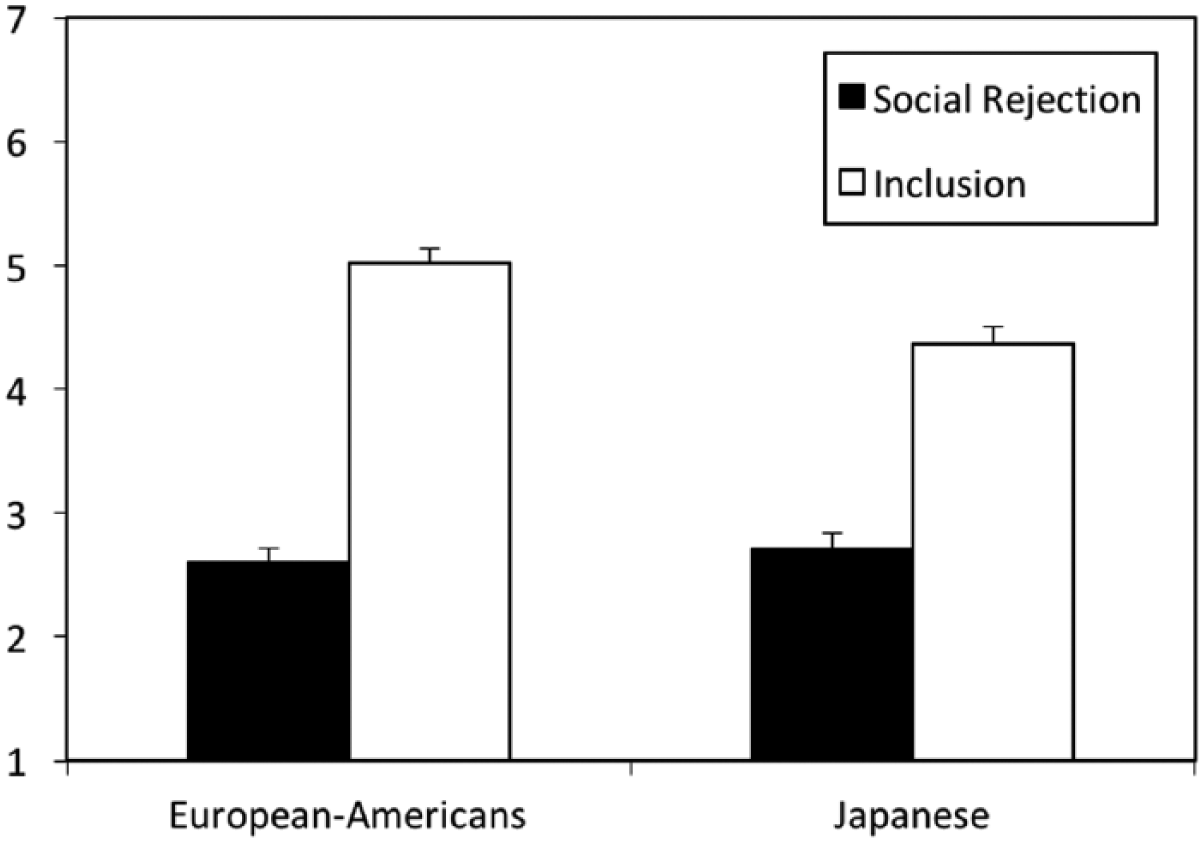
General needs fulfillment across cultures and social rejection conditions (Study 2).
General negative affect
A 2 (condition) × 2 (culture) ANOVA indicated more general negative general affect among rejected (vs. included) participants (M = 4.38, SE = 0.08 vs. M = 3.17, SE = 0.09), F(1, 148) = 100.33, p < .001,
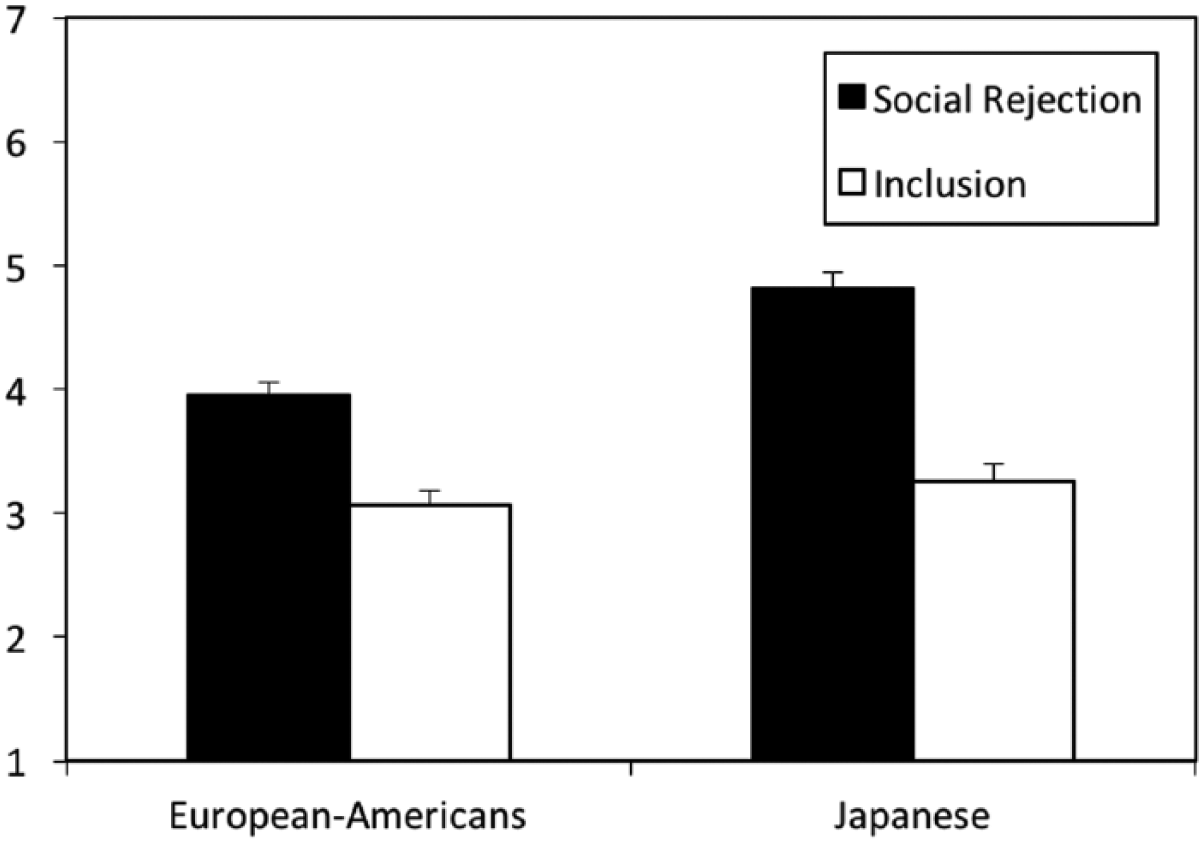
General affect across cultures and social rejection conditions (Study 2).
Discussion
Our research’s primary contribution is showing that emotional experience linked to social rejection varies systematically across cultures. Whereas European Americans experienced anger more strongly than sadness, Asians (both East Asians/East Asian Americans in Study 1 and Japanese in Study 2) showed no such difference. This pattern is consistent with the hypothesis that whereas those engaged in independent cultures regard social rejection as unfair and unjustifiable (Heine et al., 1999; Smith & Ellsworth, 1985), those in interdependent cultures tend to regard it not only as unfair and unjustifiable but also as situationally constrained and, thus, to some extent inevitable (Choi & Nisbett, 1998; Ji, 2005; Smith & Ellsworth, 1985).
These findings shed some light on how culture may shape ways of coping with social rejection. First, they indicate that Westerner’s anger response may be a double-edged sword. On one hand, this group’s anger in response to social rejection may be an effective coping strategy (Uchida & Kitayama, 2009) since, unlike the powerlessness of sadness (Matsumoto, Takeuchi, Andayani, Kouznetsova, & Krupp, 1998; Timmers, Fischer, & Manstead, 1998), it can protect rights and freedoms (Eid & Diener, 2001; Stearns & Stearns, 1989). Yet, anger can also increase Westerner’s biological health risks (Kitayama et al., 2015) and antisocial behaviors (Chow, Tiedens, & Govan, 2008; Leary, Twenge, & Quinlivan, 2006). Indeed, consistent with these implications and our findings, Pfundmair, Aydin, et al. (2015) found strong aggressive behavioral intentions among social rejected independent individuals. Second, our research indicates that Easterner’s response to social rejection may be double-edged as well. While their sadness response may be an effective strategy since it can help preserve connections with others after social loss (Gray, Ishii, & Ambady, 2011), anger—if expressed publicly—can threaten relationship harmony in interdependent cultural contexts (Miyake & Yamazaki, 1995). Importantly, however, in our study, we provided a high degree of privacy for our participants to express their emotions without social concerns. Therefore, for Easterners, and especially Japanese who tend to display less negative emotion in public versus private settings (Ekman, 1972), this may have allowed more freedom to express culturally unacceptable emotions such as anger and to report them in a way that more accurately reflected one’s true emotional experience.
Our research’s secondary contribution is providing another look at general negative response to social rejection. It is not surprising that the overall negative response increased for everyone who was socially rejected (vs. included). Yet, the degree of the negative response in the rejection (vs. inclusion) condition varied by culture. In Study 1, similar to Garris et al. (2011) and Yaakobi and Williams (2016), we found no cultural differences on these general response measures. However, in Study 2, we found a stronger overall negative reaction among Japanese versus European Americans. While this finding is consistent with research that found a relationship between interdependence and higher rejection sensitivity (Garris et al., 2011; Yamaguchi et al., 1995), ours is the first to directly manipulate social rejection and find a stronger negative response among interdependent (vs. independent) cultural groups. This suggests that Japanese people may be particularly vulnerable to social rejection, particularly under certain specific conditions. For instance, while the Cyberball studies that found less negative response to social rejection among interdependently oriented individuals used anonymous ostracizers (Pfundmair, Aydin, et al., 2015; Pfundmair, Graupmann, et al., 2015; Ren, Wesselmann, & Williams, 2013), the ostracizers we used shared numerous identities with the participants (e.g., gender, student-status, university membership, race/ethnicity, nationality) and this was particularly the case in our Japanese study where race/ethnicity and nationality were even more explicitly shared.
Finally, previous research and theorizing has suggested that social connection is a fundamental human need and that social rejection likely feels hurtful for everyone (Baumeister & Leary, 1995). Yet, although this may be universal to some extent, our research adds to the growing body of work suggesting that culture meaningfully affects the experience of social rejection. Specifically, along with previous research (see Over & Uskul, 2016; Pfundmair, Aydin, et al., 2015; Pfundmair, Graupmann, et al., 2015), we found that social rejection affects the extent of one’s general negative response to social rejection. Moreover, we provide new evidence that social rejection also affects the specific negative emotions with which one responds to this painful experience.
Limitations and Future Directions
Future research should examine whether the shared identities of the other players was indeed sufficient to elicit the perception of in-group membership and, moreover, whether the group membership of the ostracizers is indeed an important moderator of the relationship between culture and social rejection. It is also unknown how anger and sadness may mediate the various health and behavioral consequences of social rejection across cultures. Research in the Western context suggests that perceived social disconnection can lead to depression (Cacioppo, Hawkley, & Thisted, 2010) and impaired immune system functioning (Jaremka et al., 2013). It is possible that different emotional response dispositions, influenced by cultural background, may account for different physical or mental health impairments in response to perceived social disconnection. Research on how cultures may vary in the discrete emotions that can lead to social rejection’s behavioral consequences, such as aggression or prosocial behavior (Chow et al., 2008), is also needed.
Future research should also examine the role of cognitive appraisals in explaining cross-cultural differences in the response to social rejection. For instance, for both Westerns and Easterners, social rejection may be appraised as someone else’s responsibility and as unfair which may be the default appraisal across cultures since social rejection, particularly via the standard Cyberball paradigm, often occurs without any obvious reason. Moreover, for Easterners, the appraisal may be mixed with social rejection be construed as not only as unfair but also as inevitable which would be consistent with work suggesting that interdependent individuals tend to show greater causal complexity in response to the same event (Ji, 2005).
Cross-cultural research distinguishing a lack of emotional responsiveness from emotional numbing is also needed. While previous researchers have argued that reduced emotional reactivity to social rejection is indicative of the protective effect of interdependence, such a pattern of findings is not necessarily evidence for better coping. In fact, a lack of emotional responsiveness may be evidence of emotional numbing which can occur when social rejection is perceived as particularly severe (Bernstein & Claypool, 2012a, 2012b; Blackhart, Nelson, Knowles, & Baumeister, 2009; Gerber & Wheeler, 2009). As a consequence, interpreting cross-cultural differences in reported emotional reactivity to rejection and a lack of emotional reactivity, in particular, is not necessarily straightforward. Indeed, there is some evidence that the relationship between perceived rejection and emotional reactivity is curvilinear, with low and high levels of perceived rejection both leading to low levels of reported emotional distress (Bernstein & Claypool, 2012a, 2012b). To distinguish emotional reactivity from emotional numbing, it is necessary to vary levels of social rejection and study the curvilinear relation between perceived rejection and emotional reactivity across cultures.
Taken together, our research highlights the critical role of culture in shaping the experience of social rejection. It also suggests possible ways in which culture may impact how people cope with this painful experience.
Footnotes
Declaration of Conflicting Interests
The author(s) declared no potential conflicts of interest with respect to the research, authorship, and/or publication of this article.
Funding
The author(s) disclosed receipt of the following financial support for the research, authorship, and/or publication of this article: This material is based on the work supported by the National Science Foundation under Grant No. OISE-0812925 that was awarded to the first author.
Supplementary Material
Supplementary material is available for this article online.
Notes
References
Supplementary Material
Please find the following supplemental material available below.
For Open Access articles published under a Creative Commons License, all supplemental material carries the same license as the article it is associated with.
For non-Open Access articles published, all supplemental material carries a non-exclusive license, and permission requests for re-use of supplemental material or any part of supplemental material shall be sent directly to the copyright owner as specified in the copyright notice associated with the article.
