




Abstract
Previous research suggests that the benefits of different types of social support depend on cultural background. However, cultural variations in the underlying motivations for seeking social support and the emotional implications of receiving support have not yet been clearly explored. We hypothesized and found that European Americans emphasized the motivation for self-esteem as a factor in deciding to seek explicit social support (e.g., advice, emotional comfort), whereas Japanese emphasized relational concerns as a factor in deciding to seek implicit social support (e.g., the emotional comfort experienced without disclosing one’s problems). Furthermore, European Americans anticipated experiencing strong feelings of self-esteem and pride regarding receiving support, whereas Japanese anticipated experiencing strong feelings of shame and guilt. Additionally, influence goals mediated cultural differences in the motivation for self-esteem and the experience of self-esteem and pride, whereas adjustment goals mediated cultural differences in relational concerns and the experience of shame and guilt.
Social support is believed to help people cope effectively with stressful events and contribute to their psychological well-being and physical health (e.g., Cohen & Wills, 1985; House, Landis, & Umberson, 1988). Although the benefits of social support are ubiquitous, previous research has suggested that appropriate forms of social support differ across cultures. Asians and Asian Americans are less likely than European Americans to seek explicit social support, such as advice or emotional comfort, from close others, and they are also less likely to perceive social support to be effective in resolving stressors (Kim, Sherman, Ko, & Taylor, 2006; Kim, Sherman, & Taylor, 2008; Taylor et al., 2004). Moreover, the factors motivating social support transactions vary across cultures. For example, among European Americans, providing social support is associated with the motivation of maintaining the self-esteem of the recipient, whereas this association is not found among Japanese (Chen, Kim, Mojaverian, & Morling, 2012).
Although these culture-specific underlying motivations for social support provision have been demonstrated, it is still unclear whether the motivational underpinnings of social support seeking vary across cultures, whether cultures influence individuals’ emotional responses associated with receiving support, and what factors account for these cultural differences. Following previous research on cultural differences in influence and adjustment motivations (Morling, Kitayama, & Miyamoto, 2002), the present research explores the idea that cultural differences in the motivational underpinnings of seeking social support and the emotional consequences of receiving support are associated with the goals of influence (e.g., exerting personal control and changing the surrounding people and events) and adjustment (e.g., adapting to and accepting the surrounding situations).
Culture, Self-Esteem, and Social Support
Social support has been defined as information in an interpersonal transaction that leads the recipient to believe that he or she is cared for, loved, esteemed, and a member of a network of communication and mutual obligation (Cobb, 1976). As social support is a multidimensional concept, researchers have argued that the amount of support, the type of support, and the source of support are important dimensions (Thoits, 1982). Moreover, different aspects of support, which are grouped into perceived support (i.e., one’s potential access to social support) and received support (i.e., the reported exchange of social support), have been conceptually distinguished, and the latter, in particular, has been examined in terms of the effectiveness of support (e.g., Uchino, 2009). For instance, tangible support, such as giving practical advice, is helpful for resolving concrete problems (e.g., debt-related stress). However, it would be less effective for other sorts of problems (e.g., grieving the death of a parent) than emotional support. Also, depending on how support is received, enacted support may be ineffective. For example, when a support transaction is visible to the recipient, it may be ineffective in alleviating stress as it could damage the recipient’s self-esteem and sense of independence. Instead, invisible support, a support transaction achieved without the awareness of the recipient, is more likely to be beneficial for decreasing depression (Bolger & Amarel, 2007; Bolger, Zuckerman, & Kessler, 2000).
Although self-esteem is important pan-culturally as a buffer against stress (Corning, 2002), its relative importance varies across cultures. Previous research has found that people are more motivated to maintain and enhance self-esteem by focusing on the uniqueness of their own positive attributes in Western cultures than in Eastern cultures (e.g., Heine, Lehman, Markus, & Kitayama, 1999). Moreover, compared with Western cultures, which place greater value on individual freedom and the sense of personal control conveyed through one’s personal actions, Eastern cultures place greater emphasis on social adjustment and accommodation to others (e.g., Markus & Schwartz, 2010; Savani, Markus, & Conner, 2008).
Cultural differences in the importance of personal control versus social accommodation suggest that choosing to disclose problems and sharing personal matters with others to cope with one’s stress is viewed as less appropriate in Eastern cultures than in Western cultures. Such disclosure implies a demand for help from others, which may disrupt a harmonious relationship. Taylor et al. (2004) sought to understand reasons for not seeking support, and showed that Asians and Asian Americans were less likely than European Americans to seek social support (e.g., getting comfort, advice, or help from other people) to cope with stressful events and that cultural differences in seeking social support were mediated by relational concerns (e.g., disrupting group harmony). That is, Asians and Asian Americans reported greater relational concerns surrounding social support seeking than European Americans did. Another study (Mojaverian & Kim, 2013) showed that, when experiencing unsolicited social support situations (i.e., situations where social support is given without being asked for), Asian Americans felt less stressed and reported higher self-esteem than they did when experiencing solicited social support situations (i.e., situations where support is given only after explicit seeking). By comparison, European Americans were not differentially affected by these types of social support. This research suggests that actively seeking social support has more negative consequences and is less strongly associated with maintaining self-esteem for Asian Americans than for European Americans.
Research suggests that support experienced without disclosing one’s stressors and problems is more effective among Asian Americans. Taylor, Welch, Kim, and Sherman (2007) examined the effects of explicit social support (defined as the advice, instrumental aid, or emotional comfort given by social networks) and implicit social support (defined as the emotional comfort experienced without disclosing one’s problems and stressful experiences) in Asian Americans and European Americans. This study found that implicit social support is more psychologically and physiologically beneficial for Asian Americans than explicit social support whereas the pattern is reversed in European Americans.
These findings show that appropriate and effective types of social support depend on culture. Beyond cultural differences in the forms of social support that people prefer to use, there may be cultural differences in why people choose to seek social support. Although studies have shown that relational concerns explain why people would choose not to seek explicit social support, to date, there has been no examination of cultural differences in why people would seek social support. Thus, the possibility that relational concerns might encourage Asians to seek implicit social support more so than European Americans has not been tested. In addition, we suggest the desire to maintain self-esteem as a differing potential motivator, given previous findings showing that European Americans are more likely than Asian Americans to maintain their self-esteem when they decide to seek explicit social support (Mojaverian & Kim, 2013), and that social support provision is associated with motivation for maintaining the self-esteem of the support recipient among European Americans but not among Japanese (Chen et al., 2012). Despite these reported cultural differences in the association between support seeking and self-esteem, it is still unclear to what extent self-esteem is an important goal in deciding to seek social support and whether culture influences social support seeking as an intentional action to enhance self-esteem. In this research, we take a step towards examining cultural differences in the extent to which social support seeking is intended for decreasing relational concerns and maintaining self-esteem.
In addition, the emotional consequences of receiving social support have not yet been clearly explored. Given the association between explicit social support use and self-esteem in European Americans, they may experience positive emotions, particularly self-esteem and self-pride, more strongly than Asians would when receiving explicit social support. In contrast, compared with European Americans, Asians may experience negative emotions, particularly guilt and shame related to a failure to maintain group harmony, more strongly when receiving explicit social support. The present research aims to fill the gap in the literature by investigating the underlying motivational mechanisms of seeking explicit and implicit social support and the emotional consequences of receiving such support.
The Role of Influence and Adjustment Goals in Social Support Seeking
The present research also explores the role of influence and adjustment goals as mediators of cultural differences in motivation for seeking social support and the emotional consequences of receiving social support. At a basic level, people everywhere seek social support in an attempt to resolve their personal issues, and they believe that their close others are able to help them achieve the goal. Thus, they are satisfied when social support provision matches their goal (Horowitz et al., 2001). Previous research shows that people from different cultures vary in broader approaches to how they deal with challenges that they face. In North American contexts, daily practices of influencing one’s environment are more emphasized whereas in East Asian contexts, daily practices of adjusting oneself to the surrounding environment are more emphasized (Morling et al., 2002). Given the well-established differences in culture-specific goals, it is anticipated that differences in the relative emphasis placed on influence versus adjustment would lead to cross-cultural differences in why and how people seek support as well as the association of different emotional experiences with receiving support.
Influencing behaviors cause people to experience enhanced self-esteem (Morling et al., 2002), and social support, as a way to proactively influence one’s social environment, bolsters self-esteem (e.g., Pearlin, Menaghan, Lieberman, & Mullan, 1981). In social support seeking, the motivation to exert influence may thus lead to the act of seeking social support by disclosing problems and asking explicitly for help. Consequently, support seeking may restore and enhance self-esteem. The psychological tendency of maintaining self-esteem through seeking and receiving explicit social support is widespread in North American cultural contexts, and influencing goals may underlie this relationship. In contrast, adjustment goals may make people hesitate to actively mobilize their social network. Rather, people may become more considerate of others’ needs and sensitive of the potential risk of burdening close others to maintain their self-esteem. This is consistent with existing findings showing that adjusting behaviors bring a feeling of closeness to others (Morling et al., 2002). In social support seeking, adjustment may lower a person’s willingness to seek social support given its potential for troubling and burdening others. Adjustment goals may facilitate seeking implicit social support, which carries minimal social risks. Thus, in this study, we explored whether cultural goals mediate cultural differences in the processes of social support use.
Overview
Figure 1 outlines the theoretical model of how cultural goals of influence and adjustment shape individuals’ self-esteem, the relational motivations that underlie social support seeking and receipt, and the emotional responses associated with social support use. Comparing European American and Japanese participants, the present research examined willingness to seek emotional and instrumental support (categorized together as explicit social support) and implicit social support along with the emotional experiences anticipated when receiving these types of support. We hypothesized that European Americans would be more likely than Japanese to emphasize self-esteem as a motivating factor in deciding to seek explicit social support. We also hypothesized that Japanese would be more likely than European Americans to emphasize relational concerns as a motivating factor in deciding to seek implicit social support. We predicted that, after seeking and receiving explicit social support, European Americans would be more likely than Japanese to experience positive feelings, particularly self-esteem and pride, whereas Japanese would be more likely than European Americans to experience negative feelings, particularly shame and guilt. Furthermore, we predicted that endorsement of influence goals would mediate cultural differences in the process of explicit support use whereas endorsement of adjustment goals would mediate cultural differences in the process of implicit social support use.

The theoretical framework on the association between culturally divergent influence and adjustment goals and the underlying motivation and emotional outcomes of seeking and receiving social support.
Method
Participants
Eighty-eight Japanese students (53 women and 35 men, Mage = 18.60, SD = 2.07) at Kobe University and 70 European American students (52 women and 17 men, one unidentified, Mage = 19.28, SD = 1.42) at the University of California, Santa Barbara, participated in the study for partial course credit or monetary compensation. 1
The proportion of female participants was higher in the European American group than in the Japanese group; χ2(1, N = 157) = 4.00, p = .046. Because our initial analysis showed that gender did not influence the cultural differences reported below, we excluded gender in the following analyses. 2
Materials and Procedure
Following the methods used in previous research (e.g., Kim et al., 2006; Taylor et al., 2004), participants were initially asked to identify the biggest stressor they had faced within the last three months, describe it briefly, and choose the most relevant type of stressor from nine options (family relationship, friend relationship, romantic relationship, academic, health, financial, job, future, or other). 3 By asking participants to recall these stressors, we could assess their salient responses to concrete stress situations.
The participants were then asked to examine their motivations for seeking support in response to stressors like the ones they had described. Specifically, they were asked to imagine seeking three different types of social support and to report what factors would motivate them to seek each type of social support. The three types of social support were (a) emotional support (e.g., encouraging words from a close other), (b) instrumental support (e.g., advice from others), and (c) implicit support (e.g., simply spending more time with close others without talking about a given problem). For each type of support, participants were presented with a list of potential support seeking motivations, and they rated on a 7-point rating scale (1 = not at all, 7 = very important) how important each factor would be for them in deciding to seek support. Motivation for self-esteem was measured with four items (“I want to feel like I am doing better regarding the problem,” “I want to make myself feel better,” “I want to feel more confident,” and “I want to feel good about myself”). We developed the items by adapting those used in Chen et al. (2012) regarding motivations for providing support to the context of seeking support. The reliabilities were reasonably high (Japanese: α = .68, .72, and .67; European Americans: α = .81, .92, and .94. for emotional, instrumental, and implicit support, respectively). Regarding seeking implicit social support, relational concerns were measured with four items (“If I discuss my problems with the people I am close to, it makes it a bigger problem than if I keep it to myself”; “I wouldn’t want to make the people I am close to feel stressed about my problems”; “I can save face by not talking about my stressor”; and “I would rather keep my problems to myself than risk criticism from the people I am close to”; Taylor et al., 2004). Cronbach’s alpha was .66 for Japanese and .91 for European Americans. 4
For each type of support, after completing the questions regarding motivations for seeking support, participants reported on a 6-point rating scale (1 = not at all, 6 = very strongly) the extent to which they would experience a series of emotions if they received that type of support. The emotions used were adopted from previous studies by Kitayama and colleagues (Ishii, Kitayama, & Uchida, 2014; Kitayama & Park, 2007; Kitayama, Park, Sevincer, Karasawa, & Uskul, 2009). Emotions were sampled from six theoretically derived categories. Some emotions were general in the sense that they could be associated with either independence or interdependence, both positive (happy, elated, and calm) and negative (unhappy). Others were socially disengaging, resulting from either success (proud and self-esteem) or failure regarding independence (angry and frustration). Another set of emotion terms were socially engaging, stemming from either success (friendly feelings and close feelings) or failure regarding interdependence (ashamed and guilty). 5 Cronbach’s alpha for general positive emotions, disengaging positive emotions, disengaging negative emotions, engaging positive emotions, and engaging negative emotions was between .78 and .90 among the European Americans and between .74 and .88 among the Japanese.
Finally, influence and adjustment were assessed by using the Circumplex Scale of Interpersonal Values (Locke, 2000). The participants were presented with items describing how they would act, appear, or be treated in interpersonal situations and rated the importance of each item on a 5-point rating scale (1 = not important, 5 = extremely important). Following Tsai, Miao, Seppala, Fung, and Yeung (2007), influence was measured with four items (e.g., “I have an impact on them”; Cronbach’s α was .58 for Japanese and .68 for European Americans) while adjustment was measured with five items (e.g., “I go along with what they want to do”; Cronbach’s α was .46 for Japanese and .57 for European Americans). 6
All materials were initially developed in English and then translated and back-translated between Japanese and English by two Japanese English bilinguals to ensure cross-cultural equivalence.
Results
Characteristics of Stressful Events
Regarding how participants categorized their own stressors, Japanese (36.4%) were more likely than European Americans (7.1%) to mention stressful events related to friend relationships, χ2(1, N = 158) = 18.56, p < .001. In contrast, European Americans (57.1%) were more likely than Japanese (15.9%) to mention stressful events related to academic issues, χ2(1, N = 158) = 20.47, p < .001. Although the characteristics of the stressful events described differed across cultures, we asked the participants to rate the extent to which they perceived the events as stressful and negative by using two separate items with a 7-point rating scale (1 = not at all, 7 = very much) and found that there was no cultural difference in the average of the two items (Japanese: M = 5.04, SD = 1.24, European Americans: M = 5.24, SD = 1.28), F(1, 156) = 0.95, p = .33. Cultural differences in the characteristics of stressful events did not influence the ratings for motivations for seeking support and emotional experiences except for the rating of relational concerns regarding implicit social support seeking (see Note 7 for more details).
Motivation for Self-Esteem in Seeking Support
A 2 (culture) × 3 (type of support) ANOVA conducted on the mean average rating of items measuring self-esteem motivation revealed a significant main effect of type of support, F(2, 302) = 70.37, p < .001,

The mean ratings of self-esteem motivation by culture and type of social support.
Relational Concerns in Seeking Implicit Support
An ANOVA conducted on the mean average rating of items measuring relational concerns regarding implicit social support seeking revealed a main effect of culture, F(1, 151) = 38.29, p < .001,
Expected Emotional Experiences in Receiving Support
The average intensity for each participant was computed for the six categories of emotions for each type of support in each culture. An ANOVA with a between-subjects variable (culture) and three within-subjects variables (valence [positive and negative], social orientation [general, disengaging, and engaging], and type of support [emotional, instrumental, and implicit]) was then performed on the average intensity.
The interaction between culture and social orientation was significant, F(2, 302) = 13.47, p < .001,
Influence and Adjustment as Cultural Mediators
As expected, influence was significantly higher in European Americans (M = 3.48, SD = 0.69) than in Japanese (M = 3.04, SD = 0.71), F(1, 156) = 15.69, p < .001,
Correlations among the measurements reported above in each culture are presented in Table 1. In both cultures, influence was positively associated with self-esteem motivation for emotional and instrument support seeking (Japan: rs = .25 and .28; United States: rs = .20 and .22) and expected experiences of disengaging positive emotions (Japan: r = .43; United States: r = .26), and adjustment was positively associated with relational concerns for implicit support seeking (Japan: r = .12; United States: r = .25) and expected experiences of disengaging positive emotions (Japan: r = .20; United States: r = .19). These patterns are consistent with our predictions.
Correlations of the Measures for Japanese and American Participants.
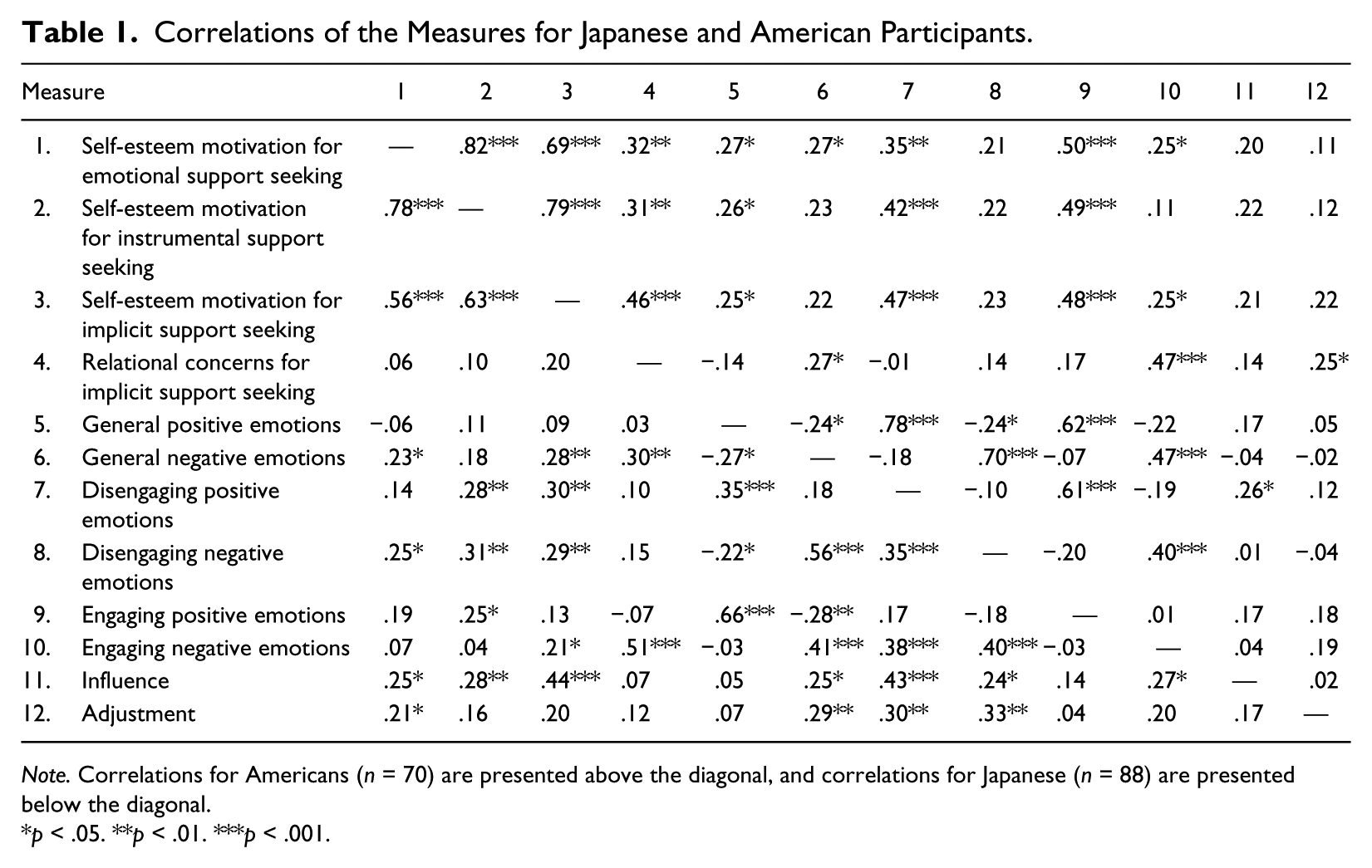
Note. Correlations for Americans (n = 70) are presented above the diagonal, and correlations for Japanese (n = 88) are presented below the diagonal.
p < .05. **p < .01. ***p < .001.
We then examined whether influence and adjustment mediate cultural differences in motivation for support seeking through structural equation modeling. Testing emotional and instrumental support separately yielded similar results, so we combined these two types of support into a measure of explicit support for our main analysis. A model based on our predictions (Figure 3) yielded an adequate fit, df = 1, χ2 = 2.41, p = .12, comparative fit index (CFI) = 0.990, root mean square error of approximation (RMSEA) = 0.096. Culture (0 = Japan, 1 = United States) significantly predicted influence (b = .45, SE = .11, z = 4.08, p < .001) and adjustment (b = −.79, SE = .09, z = −8.66, p < .001). Influence significantly predicted the motivation for self-esteem in seeking explicit support (b = .35, SE = .13, z = 2.73, p = .006), although the direct path between culture and the motivation for self-esteem (b = .63, SE = .22, z = 2.83, p = .005) was also significant. In addition, adjustment significantly predicted the motivation related to relational concerns in seeking implicit support (b = .45, SE = .20, z = 2.23, p = .03), although the direct path between culture and the motivation related to relational concerns (b = −1.18, SE = .29, z = −4.06, p < .001) was also significant. 9
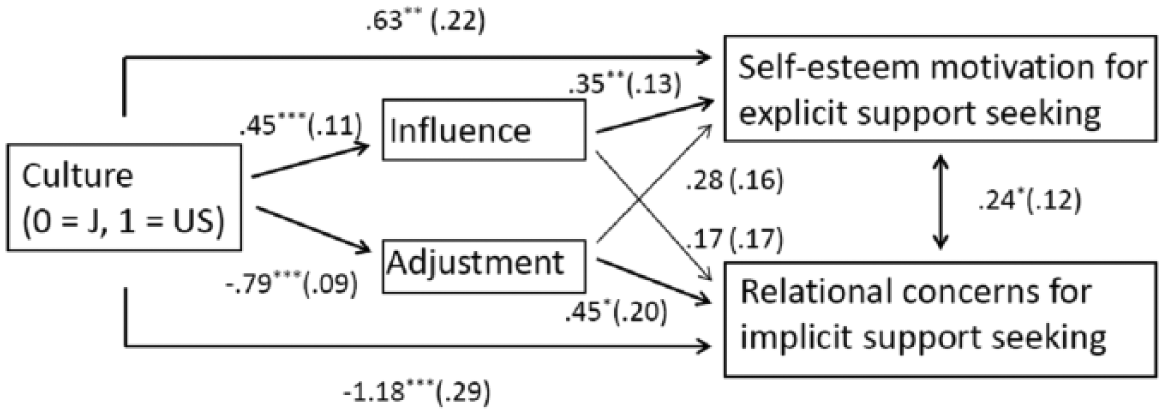
The relationship between culture and motivation in support seeking, mediated by influence and adjustment.
We also examined whether influence and adjustment mediate cultural differences in expected experiences of disengaging positive emotions and engaging negative emotions. A model led by our prediction (Figure 4) yielded an adequate fit, df = 1, χ2 = 1.59, p = .21, CFI = 0.995, RMSEA = 0.061. Influence significantly predicted disengaging positive emotions in receiving support (b = .46, SE = .10, z = 4.55, p < .001), although the direct path between culture and disengaging positive emotion (b = .66, SE = .18, z = 4.55, p < .001) was also significant. In addition, adjustment significantly predicted engaging negative emotions in receiving support (b = .30, SE = .13, z = 2.36, p = .02) while it also unexpectedly significantly predicted disengaging positive emotions (b = .30, SE = .13, z = 2.43, p = .02). Moreover, the direct path between culture and engaging negative emotion was nonsignificant, b = −.16, SE = .18, z = −0.93, p = .35.
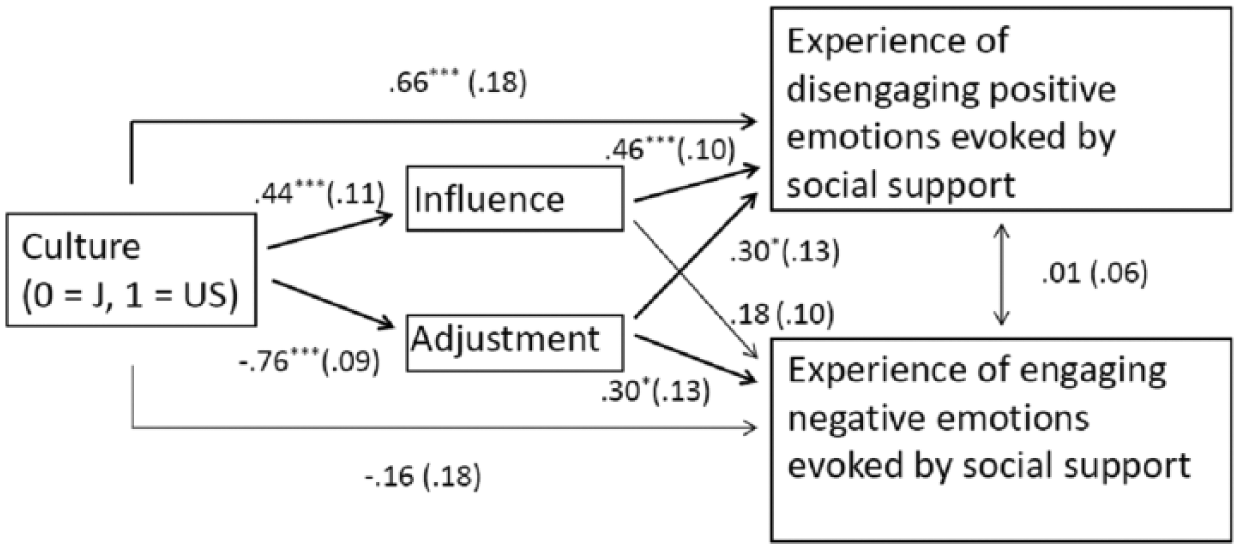
The relationship between culture and emotions evoked by social support, mediated by influence and adjustment.
Discussion
We found that European Americans emphasized maintaining self-esteem when deciding to seek explicit social support whereas Japanese emphasized relational concerns when deciding to seek implicit social support. Moreover, European Americans reported more self-esteem and pride when receiving social support than did Japanese whereas Japanese reported more shame and guilt in receiving social support than did European Americans. Furthermore, we demonstrated that influence goals, which were higher in European Americans than in Japanese, mediated cultural differences in self-esteem motivation for seeking explicit social support, whereas adjustment goals, which were higher in Japanese than in European Americans, mediated cultural differences in relational concerns in seeking implicit social support. In addition, influence and adjustment goals mediated the cultural differences in emotional experiences of receiving support.
One benefit of the present study is that it suggests that there are cultural differences in the underlying mechanisms of seeking explicit and implicit social support. We demonstrated that culture interacted with self-esteem motivations for seeking explicit social support and relational concern motivations for seeking implicit social support. These mechanisms have been suggested as potential mediators in previous research but were never directly tested. Additionally, the present study, to our knowledge, offers the first evidence that influence and adjustment goals are linked to psychological factors leading individuals to seek appropriate and beneficial types of social support. The current findings suggest that motivation for bolstering self-esteem by seeking and receiving explicit emotional support and instrumental advice are more encouraged in a cultural environment where control and efficacy are emphasized (manifested as influence goals). By contrast, relational concerns leading individuals to seek implicit social support are more encouraged in a cultural environment where the values of connectedness and accommodation are emphasized (manifested as adjustment goals). These findings contribute to the literature on the psychological factors that influence culturally divergent ways of seeking social support.
In seeking implicit social support, Japanese rated both relational concerns and self-esteem as more important than European Americans did. This suggests that the motivation for self-esteem is salient even among Japanese, reflecting the importance of maintaining self-esteem in our social lives (e.g., Leary, Tambor, Terdal, & Downs, 1995). At the same time, this result also suggests that ways to bolster self-esteem vary depending on culturally normative perceptions of voluntary interpersonal responsibilities (e.g., Miller & Bersoff, 1998; Miller, Bersoff, & Harwood, 1990) and how frequently individuals engage in self-disclosure (e.g., Schug, Yuki, & Maddux, 2010). Moreover, implicit social support may increase the recipient’s feelings of closeness to the provider, which may be related to increased self-esteem, particularly among Japanese. Indeed, a recent article (Chen, Kim, Sherman, & Hashimoto, 2015) reported that high relationship quality is more strongly associated with an indirect form of support provision, such as being attentive of close others’ need, among Japanese than Americans. Future research should examine additional mechanisms underlying implicit and explicit support seeking and provision, such as one’s feelings for the support provider and one’s evaluation of the relationship with the support provider.
As explicit social support is more appropriate and psychologically and physiologically effective for European Americans than for Asians and Asian Americans (Taylor et al., 2007), we expected that explicit social support would increase positive feelings (particularly, self-esteem and pride) for European Americans and increase negative feelings (particularly, guilt and shame) for Japanese. However, the results showed that, regardless of the types of support, European Americans reported more self-esteem and pride than did Japanese, and Japanese reported more guilt and shame than did European Americans. Although the types of support moderated an interaction between culture and valence (see Note 8), the four-way interaction was not significant. Because the emotional responses measured in the study were anticipated reactions to a hypothetical situation, the results might reflect only weak effects of the types of social support in the expected emotional experience of receiving support. Investigating emotional responses to actual social support situations may lead to a clearer understanding of the emotional consequences of culturally appropriate (or inappropriate) methods of social support.
The present study has several limitations. First, it used a cross-sectional design. The possibility cannot be ruled out that self-esteem motivations and relational concern motivations lead people to engage in goals of influence and adjustment. Although the model with self-esteem motivations and relational concern motivations as mediators fits the data poorly (see Note 9), future research with a longitudinal design will be needed to determine the nature of the association between goals of influence and adjustment and motivations for seeking social support.
Second, by adopting the items used by Chen et al. (2012), which examined an association between concern for a recipient’s self-esteem and support provision, we measured self-esteem motivations for seeking social support. However, the items used in the current study might have differing connotations reflecting how effective and successful explicit social support is perceived to be based on past experiences. Additional work with revised items to measure self-esteem motivations will be needed to confirm cultural differences related to self-esteem motivations and social support seeking.
Third, although no cultural differences existed in the extent to which participants perceived the events described as stressful and negative, the characteristics of the stressors differed across cultures. Japanese mentioned more stressful events related to friendship whereas European Americans mentioned more stressful events related to academic issues. We adopted the approach to recall the stressors to assess participants’ salient responses to concrete stress situations. Indeed, the situational differences did not influence cultural differences in motives for seeking social support and the emotional consequences (see Note 7). However, in future research, it will be important to generalize the current findings to a common type of stressful event across cultures.
Fourth, the present research did not examine the extent to which cultural differences in motivational aspects of seeking social support and the resulting emotional consequences would be associated with differences in communal norms regarding taking care of mutual needs versus exchange norms that involve expectations of immediate repayment in return for providing a benefit (Clark & Mills, 1979). Recently, Miller, Akiyama, and Kapadia (2017) showed that, although Japanese and Americans are more likely than Indians to endorse exchange norms in receiving help, Japanese, who are more motivated to maintain harmony and restore balance in relationships, are more likely to be concerned with compensating for the costs that the helper paid to provide benefits. In contrast, Americans are more likely to focus on conveying appreciation (e.g., expressing gratitude) to the helper, which leads the receiver to view herself or himself positively. On the contrary, Indians, who are more likely than Japanese and Americans to endorse communal norms, are more likely to feel obligations to in-group members. The findings of Miller et al. suggest that the cultural differences in motivational aspects of seeking social support and the emotional consequences found in the present research might involve exchange norms. It also suggests that the findings of the present research may not generalize to all Asian cultures. Compared with Japanese, cultural groups endorsing communal norms (e.g., Indians) would less likely have relational concerns about receiving help and, accordingly, would be less motivated to seek implicit social support and would feel less guilt and shame from the experience of receiving social support (see also Campos & Kim, 2017).
Finally, the present study did not assess how the potential costs of receiving social support would be perceived or examine cultural differences in the perceived cost. Miller et al. (2017) found that Japanese reported more relational concerns in the case of high-cost compared with low-cost help whereas cost did not influence Americans’ estimation of relational concerns. Given this research, the findings of the present research might partially result from the fact that, compared with European Americans, Japanese might recall stressors which include a high cost to the support provider. Comparing stressful events solved via high-cost versus low-cost help and examining the impact of cost in the cultural differences in motivational aspects of seeking social support and emotional consequences will be crucial in future work.
Despite these limitations, the present research contributes to our understanding of culturally appropriate forms of support and the emotional consequences of receiving support, reflecting differences in the relative emphasis of influence versus adjustment goals. This evidence for culturally divergent mechanisms that underlie seeking explicit and implicit social support has implications for the types of counseling services and interventions used to cope with stress effectively and enhance well-being in different cultures. The present study also poses interesting new directions for future research. Additional insight provided by further investigations using various behavioral and physiological measures would be beneficial in achieving a better understanding of the psychological factors that underlie seeking social support in divergent cultural contexts.
Footnotes
Declaration of Conflicting Interests
The author(s) declared no potential conflicts of interest with respect to the research, authorship, and/or publication of this article.
Funding
The author(s) disclosed receipt of the following financial support for the research, authorship, and/or publication of this article: The research was supported by the Uehiro Foundation on Ethics and Education.