




Abstract
Despite much research being conducted around identity and acculturation, immigrant groups are often collectively considered according to ethnicity with broad policy recommendations applied to them. The role of generational status is frequently ignored. This article reveals findings from an in-depth interview and questionnaire-based assessment of parenting quality and parent–child relationships, child psychological adjustment, and contextual factors in 90 second-generation Indian, Pakistani, and White British mothers with 5- to 7-year-old children living in minority dense urban areas of the United Kingdom. The analysis aimed to understand second-generation parenting in more depth and to explore similarities and differences between the three British-born groups. Standardized interviews and questionnaires were used to quantitatively measure parenting and child adjustment across a number of constructs. The study found positive levels of child adjustment across all groups. Similarities were found between family types for some aspects of parenting quality. Identified differences were generally reflected between the Pakistani and White mothers, with the Indian mothers lying between the two, including child supervision and discipline, levels of religiousness, and ethnic identity (all higher in the Pakistani group). The current findings relating to second-generation mothers and their children did not support the negative assumptions which are often associated with ethnic minority families. The findings also increase understanding of effective parenting processes across different ethnic groups.
Introduction
As time passes, immigrant groups change. New generations emerge and evolve in different ways. Children who are born and raised in the host country adapt and develop in varied trajectories compared with the original generation. Parenting styles may also change over time with adaptation to the new setting and in relation to parenting styles of other groups. Despite much work being conducted in this realm around identity and acculturation, immigrant groups are often still grouped together according to ethnicity based categorisations, and broad policy recommendations are holistically applied to them. This is problematic given that second-generation families do not go through the process of migration and all of its associated aspects (Dorsett, Rienzo, & Weale, 2015).
In an attempt to understand second-generation parenting in more depth, this article reveals findings from a detailed assessment of (a) parenting quality and parent–child relationships, (b) child psychological adjustment, and (c) religiosity and ethnic identity in second-generation Indian, Pakistani, and native White British (hereafter referred to as Indian, Pakistani, and White) mothers with 5- to 7-year-old children living in minority dense urban areas of the United Kingdom.
Parenting Practices and Generational Status
The vast body of literature on parenting shows positive child adjustment is associated with the quality of parent–child relationships including the use of warmth, sensitivity, and appropriate discipline and control, as well as parental psychological well-being (see Bornstein, 2002; Collins, Maccoby, Steinberg, Hetherington, & Bornstein, 2000; Golombok, 2015; Pinquart & Kauser, 2017). However, when thinking about the intergenerational transmission of parenting practices and cultural values in immigrant groups, Trommsdorff (2009) argues that this is a complex phenomenon which involves the consideration of biological, sociological, and psychological processes. In second-generation families, parenting strategies and socialization styles can be adopted not only from both parents’ traditional culture but also from the culture in which they live following migration, thus adding a further layer of complexity to this process of transmission.
British South Asians first arrived in large numbers in the 1950s and 1960s, and subsequently now have a large number of British-born members. Two major periods of migration existed for Pakistanis: the 1960s, when mainly male migrants arrived and the 1970s-1980s, when their families followed. By 2001, 55% of the Pakistani population was British-born. In the most recent census figures, Indian was the second largest ethnic group (after White) with 1.4 million people (2.5%) followed by Pakistani (2.0%) in England and Wales (“Ethnicity and National Identity,” 2012).
Research from Dorsett et al. (2015) uses the U.K. household longitudinal survey to investigate how mental health and life satisfaction varies within and across groups based on generational status. The analysis distinguishes between first generation migrants, second-generation migrants, and “natives” (those born in the United Kingdom and with both parents also born in the United Kingdom). Indian and Pakistani groups were among those studied. The researchers found that recent migrants had better mental health and higher life satisfaction on average than White natives and other migrant generations, demonstrating that research carried out on immigrant families cannot always be generalized to the experiences of British-born ethnic minority families.
Cross-cultural research on parental ethnotheories (Greenfield, Keller, Fulungi, & Maynard, 2003) can be helpful in providing a framework for thinking about differences in parenting practices across cultures. The term ethnotheories refers to the set of ideas, beliefs, and child care and socialization practices specifying how to raise a competent child in the context of culturally relevant development goals (Super & Harkness, 1997; Triandis & Suh, 2002). These parental ethnotheories are shared by members of cultural communities and are essentially parenting goals with the developmental domains of independence or interdependence at their core. Greenfield et al. (2003) empirically argued that non-Western cultures (such as those from India and Pakistan) follow the cultural ideal of interdependence. Interdependent, collectivist-oriented ethnotheories emphasize responsibility, correct demeanor, politeness, respect for elders, and family loyalty as cultural developmental domains as well as conformity and obedience. In contrast, Western cultures (such as English culture) possess more independent-oriented ethnotheories, which emphasize self-maximization, assertiveness, self-esteem, curiosity and creativity, autonomy, and self-direction. These developmental domains are capable of existing across different educational and socioeconomic backgrounds.
Parenting and Identity in Second-Generation Families: Exploring Religion and Ethnicity
Numerous studies have been carried out exploring particular contextual factors in Pakistani and Indian family life, including kinship and extended family, respect and family hierarchy, and language (Barn, Ladino & Rogers, 2006; Shaw & Lee, 2003). However, generational dimensions have been ignored in this research. Of interest to this article are those studies focusing on religion and ethnic identity.
Acculturation studies provide much insight into learning particularly about ethnic identification and have shown that while family values and religion remain important for the South Asian diasporic community, second-generation individuals born or educated in the host country find interaction with White British peers important (Ghuman, 2003). Robinson (2009), in a study of South Asian adolescents (13-18 years), found Indian adolescents were more likely to use integration strategies, while many Pakistanis partook in separation strategies. Lau (2000) and Berthoud (2000) both described South Asian families in Britain as existing on a spectrum from traditional hierarchal family to “Western” contemporary nuclear family. They argue that Indians and particularly Pakistanis continue to hold traditional more collectivist (interdependent) values and are thus closer to one end of the spectrum. They also argue that Pakistani families tend to move at a slower pace of change than other ethnic groups, with high marriage rates, large family sizes, and lower economic activity among female Pakistanis (Berthoud, 2000; Imtiaz, 2002). These studies all increase understanding about acculturation and ethnic identification in South Asians. However, none focus specifically on British-born third-generation samples or on pre-adolescent children.
Another aspect of interdependent cultures is closeness to traditional values and religious beliefs. Few studies have been conducted on parenting and religion in Indian and Pakistani families, and little is known about the positive or detrimental influences of religion in the household (Mahoney, Pargament, Tarakeshwar & Swank, 2001). However, research has indicated that religious identification can go hand-in-hand with cultural and ethnic identification, particularly in second-generation families (Christine, 2007). Islamic values and traditions have been found to be especially important to the Pakistani diaspora (Shaw & Lee, 2003). Recent research in British South Asian families describes how Islam offers parents with networks and resources for the socialization of young people, including the community, extended family, and the mosque. Also “Islamic upbringing” (Franceschelli & O’Brien, 2014) of children allows parents control of their children’s behavior, the passing on of values such as morality as well as the chance to influence their future life chances, for example, through educational support. Güngör, Fleischmann, Phalet, and Maliepaard (2013) stated Islamic religious parenting involves implicit learning as parents provide examples which children imitate (e.g., praying, fasting) and it also involves more directed socialization efforts (e.g., storytelling, dressing modestly, etc.). Other research on religion and the family has found that religiosity in parents is linked to protective factors, which have positive influences on the family structure (Shor, 1998). In an increasingly anti-Islamic setting, the role of religion and its intersection with race and ethnicity in early socialization is important (Iqbal, 2014). Studies have also shown associations between religious practices and positive outcomes in adolescents arguing that religion acts as a source of coping in stressful times and during illness (Faro, McKee, Garcia, & Jones, 2017).
Rutter & Tienda (2005) showed that South Asians in Britain tend to use religion as a form of identification, and that many report that their faith identity holds a greater importance in their lives than other forms of identity. Pakistani Muslims have been found to display more outward signs of religious and cultural practice, with children more likely to engage in religio-cultural activity such as prayer and Quran classes (Barn, Ladino & Rogers, 2006). Studies have also found that religion is more important for Pakistani Muslim young people than Indian Hindu young people, with participants describing religion as a significant component of their identity (Robinson, 2009). Speigler, Güngör& Leyendecker (2016) took generational status into account in their study of Turkish immigrant parents of young children in Germany. They found religious parenting in second-generation immigrants did not influence children’s identification with host culture, but it promoted their identification with their Turkish home culture. They argued for the close association in second-generation Muslim families between religious parenting and cultural socialization and that Islam did not pose a barrier to integration in this group. This research shows how ethnic identity and religion can be closely associated in some groups.
The above literature describes some of the aspects, particularly around religion and identity to be considered when examining parenting in second-generation families. We next turn to the present study which explores the types of parenting practices second-generation Indian and Pakistani families partake in and tries to understand whether parents from traditionally interdependent cultures move toward more independent practices in parenting as time from migration increases. First, we visit the study hypotheses.
Study Hypothesis
Method
Participants
Ninety British-born mothers with children aged 5 to 7 years (26 British Indian, 31 British Pakistani, 33 White British) living in highly diverse urban neighborhoods were interviewed in depth (Iqbal, 2012). Mothers were recruited mainly through state primary schools in London, located in areas with high concentrations of Indian and Pakistani ethnic populations as well as sizable White British populations. London was selected as it hosts the largest population of ethnic minority populations in the country, with these particular groups living in close proximity and engaging in routine interaction (Simpson, 2013). The children came from a range of schools in mainly three areas in London. The researcher contacted head teachers and asked for permission to approach parents at school, in order to invite them to participate in the study. This age group (5-7 years) was chosen as the children were still very much under parental supervision, yet were old enough to discuss their family networks and complete an observational task about mother–child interaction with their parent (which formed part of the larger research project; see Iqbal, 2012). Data collection took place over 18 months and snowballing helped greatly in obtaining participants.
Strict criteria were used to select and match the sample using data from the most recent census at the time of data collection. Details on the educational stratification of Indian, Pakistani, and White families living in London were used to develop a grid which included the corresponding numbers of participants based on a sample size of 30 participants per family needed for each educational category. Modified versions of the U.K. National Qualification Framework (NQF) and the Qualification and Credit Framework (QCF) were used to develop these education categories, and Educational Level of parents was used as a proxy indicator of social class. Participants were selected based on education level to create a representative sample based on the actual population of ethnic groups in London. The education level of the parent with the highest qualifications was used for matching purposes. The selection criteria were as follows: The child was between the ages of 5 and 7 years old and was British born, the child attended primary school, and the child’s mother was British born. All of the Pakistani’s interviewed were Muslim and the majority of Indian mothers were Hindu. All mothers were married to, or in a committed relationship with the child’s father. Strict inclusion criteria were maintained to ensure that the samples were as similar as possible in terms of family structure. The sample size in the study is small for quantitative purposes. However, the study was part of a larger mixed methods project in which each participant was interviewed in great depth.
If we look at the sample characteristics (see Table 1), there were similar proportions of boys and girls in each ethnic group and the child’s age did not differ between groups. In total, twenty-seven 5-year-olds, thirty-one 6-year-olds, and thirty-two 7-year-olds participated in the study. Aside from small differences in Mother’s Working Status, assessed according to a set of options ranging from 1 (not currently working) to 3 (working full-time) which showed that a higher proportion of Pakistani mothers were not currently working and a higher proportion of White mothers were working part-time, there was close matching between groups for demographic factors.
Sociodemographic Information by Family Type.
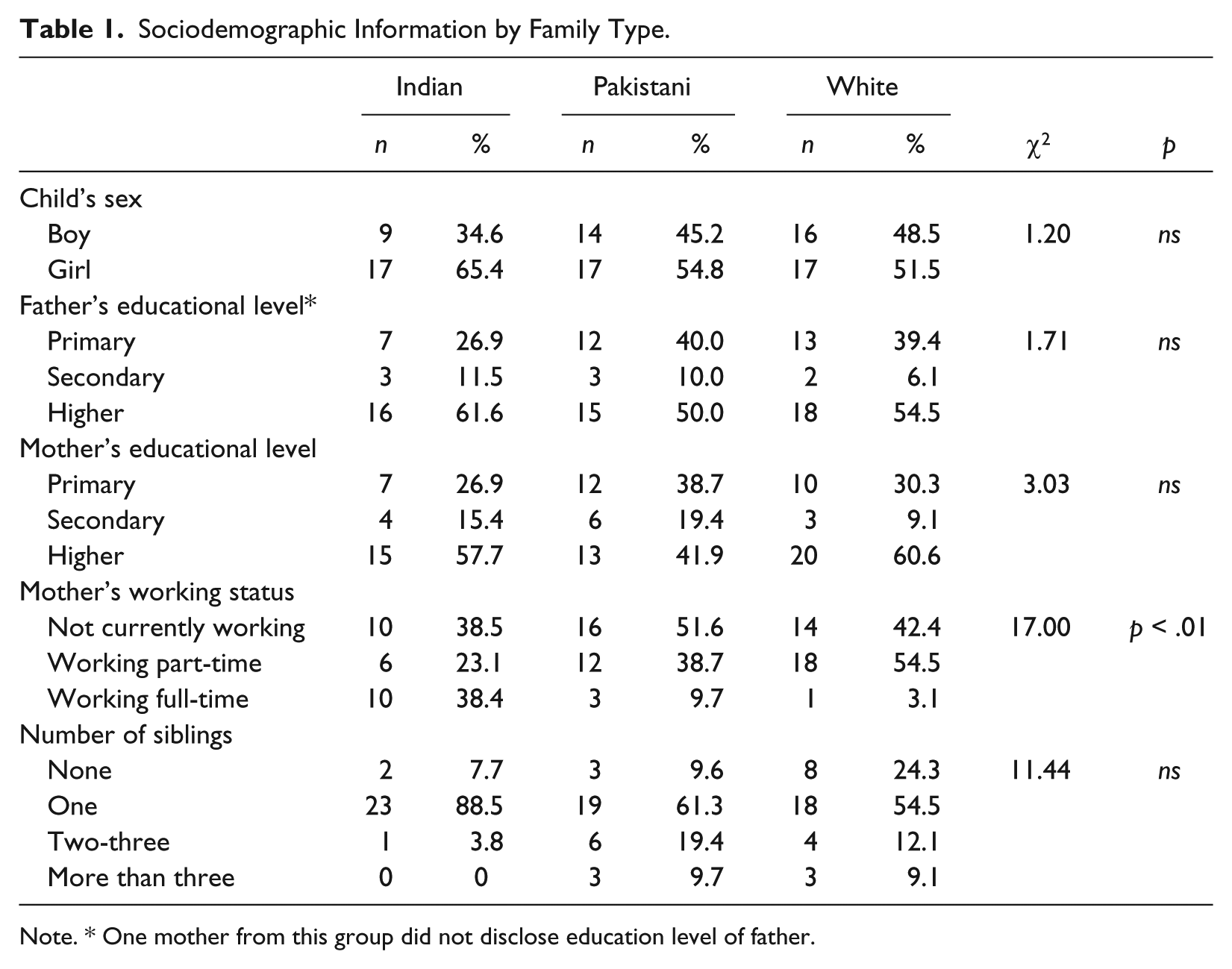
Note. * One mother from this group did not disclose education level of father.
Procedures
Mothers were interviewed at home with each visit lasting approximately 2 to 2.5 hours. Written and informed consent to participate in the investigation was obtained from each parent and verbal assent was obtained from the child. Ethical approval was granted by the University of Cambridge Psychology Research Ethics Committee. A trained researcher conducted in-depth interviews with mothers, questionnaires, a child test, and observational measures (Iqbal, 2012). Only data from a selection of the quantitative portion of the interview as well as questionnaires are presented here. This set of interview and questionnaires has been used extensively and across different family types to assess parenting and child well-being (Golombok et al., 2011).
The researcher administered the questionnaires and conducted the interviews which were recorded using a digital device. Before data collection began, the researcher received training on conducting the family interview. This interview asks a series of detailed questions about different aspects of the child and parenting practices, including warmth, discipline, and supervision, and requires ratings to be given for these different aspects using an accompanying interview coding manual (Quinton & Rutter, 1988). The researcher kept the manual with them during data collection and coded each interview during or immediately after the interview. Following the interview, the mothers were administered a questionnaire booklet which took approximately 15 minutes to complete. Participants were given a box of chocolates as thanks for participating. To provide interrater reliability ratings for the interview, 24 randomly selected interviews (eight from each family type) were coded by a second researcher (with extensive experience in the interview technique) who was blind to family type.
Different approaches for countering construct bias and validity were used. Prior to the study, during the research pilot, representatives from each group were interviewed and asked to reflect on their understanding of each section of the interview as well as the wording of questions. Those which were unclear were adjusted accordingly. This allowed for the relevance and shared meaning between groups being interviewed. Construct and item bias were reduced through the judgmental approach, which relies on cultural expertise on the groups being studied. The ethnic matching of the principal researcher (who was of British South Asian origin) to British Indian and British Pakistani groups helped achieve this. It also facilitated in the interpretation of the validity of the information obtained from the British Indian and British Pakistani groups.
However, there was also a chance that experimenter expectancies could influence the outcome of the study. To combat this, the interviewer was mindful of taking an unbiased stance throughout. Following each interview, they took extensive reflexive fieldnotes to help in the process of interpretation and coding of the interview. The calculation of interrater reliabilities also helped to ensure this. Details of the measures used and the intraclass correlation coefficients between raters for the interview variable are provided below.
Measures
Parenting practices and parent–child relationships
Questionnaire
The short form of the Parenting Stress Index (PSI/SF; Abidin, 1990) was completed by each parent to assess stress associated with parenting. For this instrument, higher scores represent greater difficulties. In addition, it has been shown to have good reliability and to discriminate well between clinical and nonclinical groups and has been adapted for use across a range of cultures (see Anderson, 2008).
Interview with parents
An adaptation of a semi-structured interview designed to assess quality of parenting was used. The interview was a combination of an investigator-based interview on quality of parenting (Quinton & Rutter, 1988) as well as the one used to assess quality of marriage (Quinton, Rutter, & Rowlands, 1976). This parenting interview which has been used extensively in other studies of parenting (see Golombok et al., 2011) has been validated against observational ratings in the home of mother–child relationships as well as child specific measures and has shown a high level of concordance between global ratings of the quality of parenting by interviewers and observers (concurrent validity; r = .63; Iqbal, 2012; Quinton & Rutter, 1988). Furthermore, the marital relations section of the interview has been shown to demonstrate predictive validity for marital breakdown (Quinton, Rutter & Rowlands, 1976). It applies a standardized approach to coding responses to questions (i.e., the interviews were rated by the trained researcher) rather than using self-report data of mothers as well as a flexible style of questioning. Extensive details were taken of the child’s behavior and the mother’s response to it particularly relating to interactions around warmth and control. The interview allows the researcher to rate variables according to a detailed standardized coding scheme described in an accompanying interview manual.
The interview is made up of a number of sections, for example, parental description of the child, a section on developmental behavior and emotional problems, one on the child’s relationship with their mother, and a section on supervision and discipline. Within each of these sections, there are a series of questions. For example, in “relationship with mother,” different questions are asked to try and assess the global maternal warmth code. Questions included the following: How do you get along with your child? Is she or he easy to be affectionate with? In what ways does she or he show affection toward you? Do you enjoy each other’s company? Are there things you do together in your spare time? How much time have you spent in the last week doing these kinds of things? Through this questioning, a detailed picture emerged on the different dimensions of parenting. There is limited space in this article to outline the full series of questions used; however, please see Iqbal (2012) for a full copy of the interview.
The fact that mothers may present themselves in a socially desirable manner during the interview was anticipated. The characteristics of the interview helped account for this. It involved detailed and lengthy questioning and the assessment of nonverbal behaviors, including facial expressions and body language.
The following variables were coded from the interview: (a) expressed warmth from 0 (none) to 5 (high). Tone of voice, facial expression, and gestures when speaking about the child, spontaneous expressions of warmth, sympathy, and concern about the child’s difficulties (if any) and interest in the child as a person were all taken into account; (b) sensitive responding from 0 (none) to 4 (very), measured the mother’s ability to read the child’s fears and anxieties and respond appropriately to them through discussion and dialogue; (c) mother–child interaction/quality of interaction from 0 (very low) to 4 (very high) measured how much time the mother and child spent in each other’s company and enjoyed spending time together. The ratings were also based on the extent of affection the child and mother showed to one another and the extent to which the mother took responsibility for the child; (d) expressed criticism from 0 (no criticism) to 3 (considerable criticism). Expressed criticism assessed the degree to which the mother was critical of the child, throughout the interview; (e) boundaries from 0 (not allowed out) to 4 (no specified territory) assessed the mother’s rules for their child with regard to playing outdoors; (f) chaperonage from 0 (allowed to play with others in own home) to 6 (allowed to play with unknown children, territory undefined), assessed the mother’s rules for the child concerning playing with other children, known or unknown); (g) overt discipline (expressed), rated from 0 (none) to 4 (aggressive), measured the extent to which the mother lost her temper and was likely to raise her voice in a disciplinary situation; (h) frequency of battle from 0 (never) to 4 (all the time), assessed the frequency over the past 3 months that confrontations occurred between the mother and child; and (j) level of battle from 0 (no confrontations) to 3 (major battles), assessed the type of confrontation between mother and child. The interrater reliabilities (intraclass correlation coefficients) were as follows: expressed warmth (.68), sensitive responding (.52), mother–child interaction/quality of interaction (.68), criticism (.56), overt discipline (.86), chaperonage (.68), outside boundaries (.73), frequency of battle (.78), and level of battle (.82).
Child adjustment
The Strengths and Difficulties Questionnaire (SDQ)
The SDQ was completed by mothers at home (R. Goodman, 2001) and used to assess the presence of child psychological problems. The SDQ produces an overall score of child adjustment: total difficulties as well as five subscale scores: Conduct Problems, Emotional Symptoms, Hyperactivity, Peer Problems, and Prosocial Behavior with higher scores indicating higher difficulties in all scales except prosocial scale (higher is fewer difficulties). The SDQ has been shown to have good internal consistency, test–retest and interrater reliability, and concurrent and discriminative validity (R. Goodman, 2001). Moreover, it has been used widely in numerous ethnic groups including those being investigated in the present study (see A. Goodman, Patel, & Leon, 2010). The number of children obtaining a parent-rated total SDQ score above cutoff for psychiatric disorder was also calculated.
Contextual factors: Religion and ethnic identity
Religion
As part of the adapted interview, there were a number of questions relating to religious beliefs which investigated how mothers described religion to be part of their own and children’s lives. The following variables were coded: (a) religious beliefs and (b) religious practices both from 0 (none) to 4 (extremely high), which assessed beliefs and practices based on mothers’ responses (separately) when asked how strong these were; (c) child’s religiosity: from 0 (none) to 3 (active discussion and participation), assessed the extent to which mothers discussed religion with their child and incorporated religious rituals and practices into child’s life; and (d) child’s knowledge of religion rated on a 4-point scale from 0 (none) to 3 (high), assessed mothers’ description of how informed their child was about religion. The intraclass correlation coefficients for religiosity and child’s knowledge of religion were found to be .62 and .75, respectively.
Ethnic identity
The Multigroup Ethnic Identity Measure (MEIM)
The revised shorter version of the Multigroup Ethnic Identity Measure–Revised (MEIM-R; Phinney & Ong, 2007) was completed by mothers. This six-item questionnaire has been shown to be a valid, reliable measure for assessing ethnic identity by distinguishing between two related yet separate components of ethnic identity (i.e., exploration and commitment). The MEIM-R provided scores for Total Ethnic Identity which assessed the mother’s overall ethnic identity, and comprised two subscales: Commitment and Exploration. Commitment was an affective component that examined the tendencies of mothers to feel psychologically attached to their ethnic group, and Exploration, was a developmental and cognitive component that examined the tendencies of mothers to spend time understanding more about the ethnic group of which they were a member. The measure uses a 5-point Likert-type scale from 1 (strongly agree) to 5 (strongly disagree), and produces a mean score between 1 and 5 which represents Total Ethnic Identity, with higher scores indicating higher levels of identification with ethnic identity. A mean score of 1 or 2 would be considered as a low level of ethnic identity. A mean score of 3 would be considered a moderate level of ethnic identity, while a mean score of 4 or 5 would be considered a high level of ethnic identity.
Results
Analysis Plan
The analysis aimed to determine whether groups differed on the following constructs in line with the hypotheses of the study:
Hypothesis 1: Parenting quality and parent–child relationships
Parenting stress: Scores for total parenting stress from the PSI were calculated.
Maternal warmth/closeness: This construct was created using variables derived from the interviews with mothers (expressed warmth, sensitive responding, mother–child interaction, and expressed criticism). The adjusted correlations between each variable and the overall construct varied from .41 to .64 and the α-coefficient for the construct was .80 (internal consistency).
Maternal supervision: This construct was developed using the variables: outside boundaries and chaperonage. The between-item correlation was .61 and the α-coefficient for the construct was .75.
Maternal discipline: The following variables were used in creating this construct: overt discipline, frequency of battle, and level of battle. The adjusted correlations between each variable and the overall construct varied from .27 to .36 and the α-coefficient for the construct was .58.
Hypothesis 2: Child adjustment
Scores for Total Difficulties as well as each of the subscale scores were calculated from the SDQ.
To test for Hypothesis 2, constructs of parenting quality and parent–child relationships, particularly those of maternal discipline and maternal supervision were also important.
Hypothesis 3: Religion and ethnic identity
Religion: To condense the religion variables into a more robust measure, a single Religion variable was created using principal components analysis (PCA). In the case of religion, quantitative variables from the interview with the mother (religiosity, religious beliefs, religious practices, and child’s knowledge of religion), were combined to form a single Religion variable.
Ethnic identity: The MEIM-R provided scores for Total Ethnic Identity which assessed the mother’s overall ethnic identity, and comprised two subscales: Commitment and Exploration.
Statistical Analysis
Across the data, when outcome variables were multivariate, MANOVAs were conducted. Post hoc tests were carried out to examine whether differences existed between family types as follows: (a) British Indian mothers versus White British mothers (I vs. B), (b) British Pakistani mothers versus White British mothers (P vs. W), and (c) British Indian versus British Pakistani mothers (I vs. P). When the MANOVA was statistically significant, one-way ANOVAs were carried out for each variable included in the MANOVA, to fully explore the dataset. A decision was taken not to enter any contextual factors into the analyses as covariates when assessing group differences due to the close matching between groups during the sampling process (see “Method” section and Table 1).
At this juncture, it is important to make a key point about the nature of the correlations and internal consistency measures which can help to contextualize the analytical findings below. The interview used a multi-dimensional approach to measuring parenting constructs. Each construct from the interview, that is, maternal warmth, maternal supervision, and maternal discipline, comprised of multiple variables which measured different aspects of the same construct (e.g., maternal warmth is comprised of the variables expressed warmth, sensitive responding, mother–child interaction, and expressed criticism). It is thus possible that, high scores on one type of variable (criticism) could result in lower scores in the underlying construct (maternal warmth) and vice versa. This helps to explain why low correlations exist between some variables and why particular constructs such as maternal warmth and maternal discipline have a lower internal consistency. Despite the lower consistency and correlations, the approach allowed for different types of interchangeable behavior in the same parenting measure to be considered in a holistic manner. Keeping this in mind, we next turn to the result section of the paper.
Descriptive Results
Parenting quality and parent child relationships
These results relate to Hypothesis 1 on similarities and differences in parenting quality and parent–child relationships across the three groups:
Maternal stress: As shown in Table 2, total parenting stress was calculated and variables were entered into a one-way ANOVA. No significant difference between groups was found for total stress.
Warmth and closeness: The maternal warmth/closeness construct was derived from the interviews with mothers (expressed warmth, sensitive responding, mother–child interaction, and expressed criticism). The variables were entered into a MANOVA, and Wilks’s λ was not significant (see Table 2).
Supervision: Variables from the mother’s interview (outside boundaries and chaperonage) formed the supervision construct. When these variables were entered into a MANOVA, Wilks’s λ was significant, F(4, 172) = 3.44, p < .01, indicating an overall group difference, as shown in Table 2. Univariate ANOVAs showed a group difference for both outside boundaries, F(2, 87) = 4.94, p < .01, and Chaperonage, F(2, 87) = 5.94, p < .01. Games–Howell post hoc tests revealed that Pakistani mothers showed tighter supervision rules with regard to their children playing outdoors compared with White mothers (P vs. W, p < .01). There was also a significant group difference for chaperonage, with Pakistani mothers again reporting tighter rules in relation to their children playing with other children (either known or unknown) compared with White mothers (P vs. W, p < .01).
Discipline: A MANOVA was conducted for the discipline variables from the mother’s interview (overt discipline, frequency of battle, and level of battle). Wilks’s λ was significant, F(6, 170) = 2.17, p < .05, indicating an overall group difference (see Table 2). One-way ANOVAs showed a group difference for overt discipline, F(2, 87) = 6.07 p < .01. A Gabriel’s post hoc test was conducted on this variable, and revealed that Indian mothers showed higher levels of overt discipline when compared with White mothers (I vs. W, p < .01). Pakistani mothers also showed higher levels of overt discipline compared with White mothers (P vs. W, p < .05). No difference was found in levels of overt discipline between Indian and Pakistani mothers. Moreover, no differences were found between groups for frequency of battle or level of battle.
Means, SD, F, and p Values for Comparisons of Parenting Quality and Parent–Child Relationship by Ethnic Group.
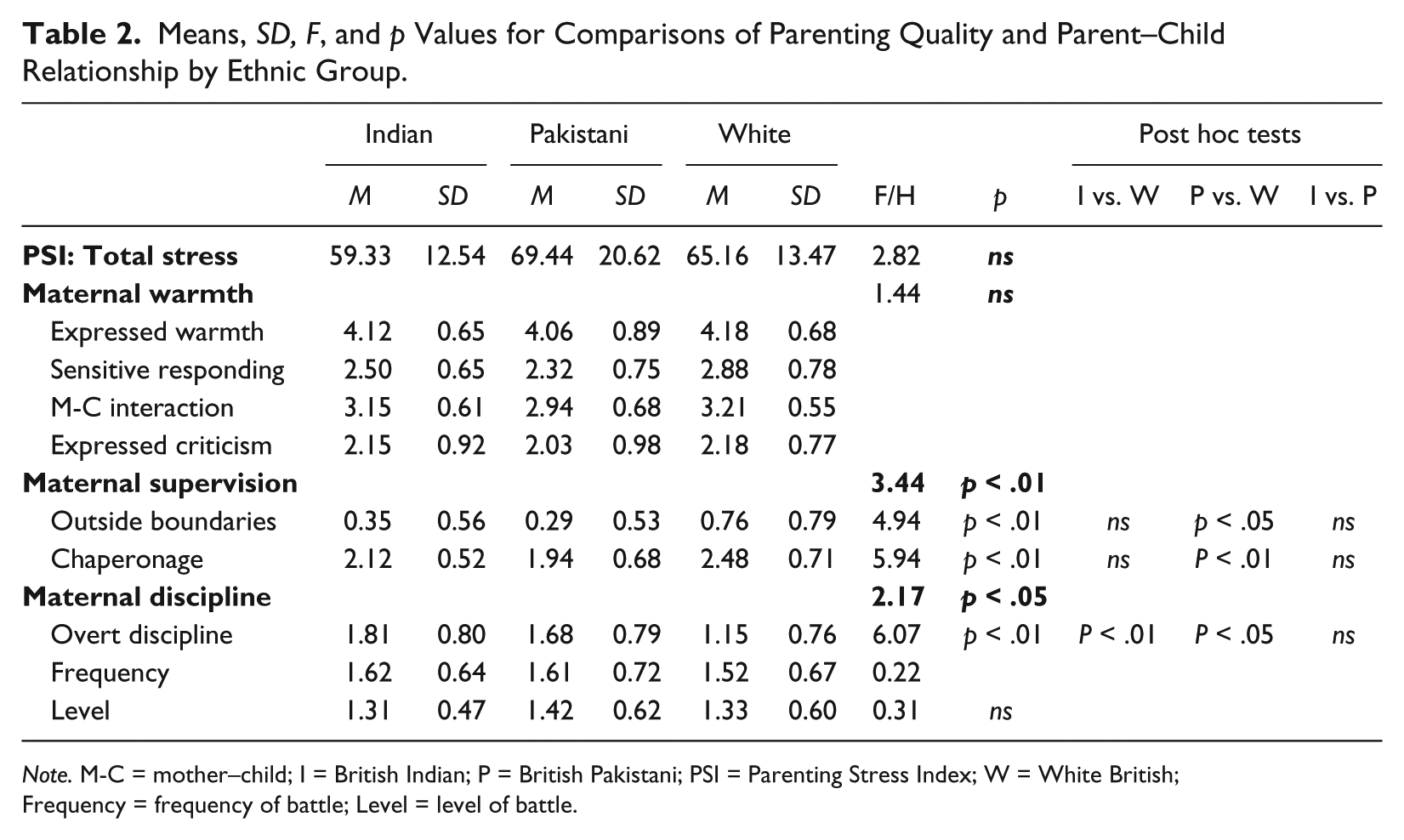
Note. M-C = mother–child; I = British Indian; P = British Pakistani; PSI = Parenting Stress Index; W = White British; Frequency = frequency of battle; Level = level of battle.
Child adjustment
These results relate to Hypothesis 2 on child outcomes in the three groups:
A univariate ANOVA was conducted for the total difficulties score of the SDQ. As shown in Table 3, no difference was found between groups for total difficulties. A MANOVA was then conducted for the SDQ subscale scores and titled Child Adjustment. The adjusted correlations between each subscale and the overall construct varied from −.05 to .47 and the α-coefficient for the construct was .33. Wilks’s λ was not significant (see Table 3). The analyses of the SDQ data indicate that overall, the children in the different family types were well adjusted lying within the normal range and similar to the U.K. population for 5- to 7-year-old children (Green, McGinty, Meltzer, Ford, & Goodman, 2004). Recent studies (A. Goodman et al., 2010) have shown no difference between Pakistani and White children for overall mental health. Indian children were shown to have overall better mental health than White children.
Means, SD, F, and p Values for Comparisons of Child Adjustment Between Ethnic Groups.
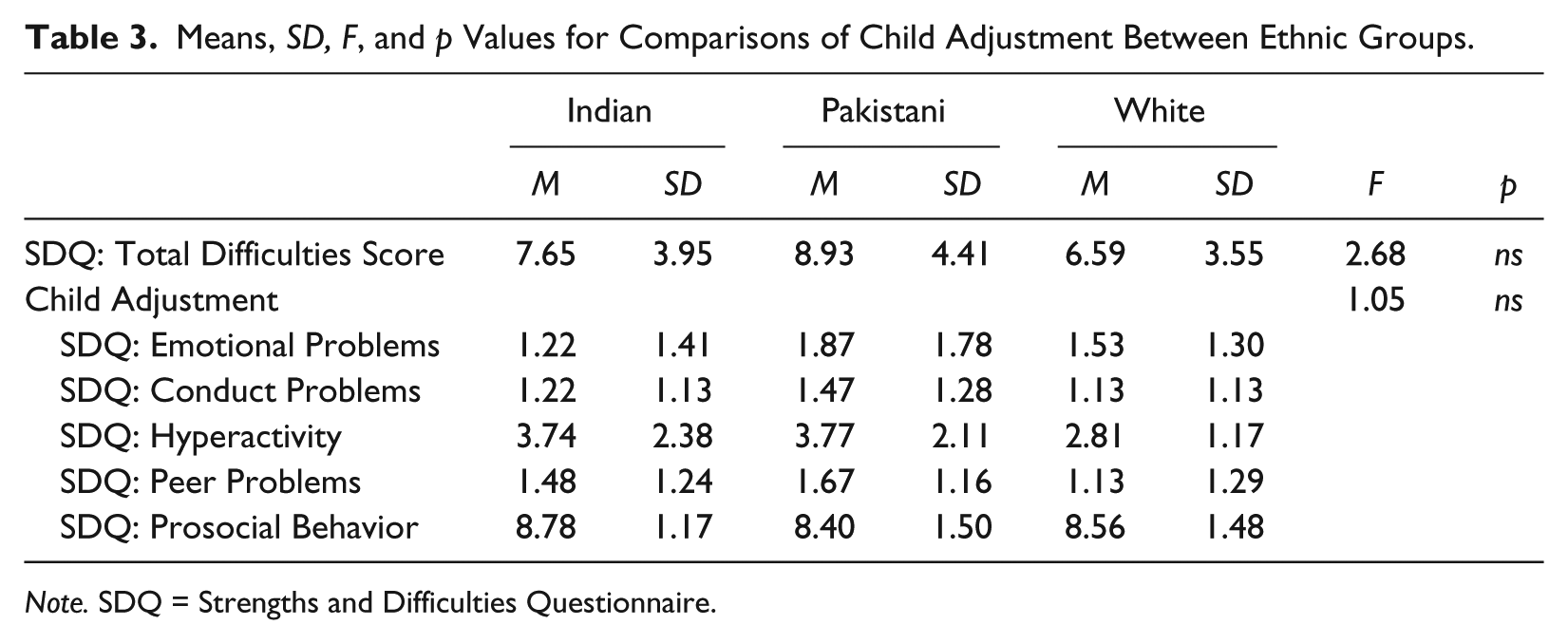
Note. SDQ = Strengths and Difficulties Questionnaire.
Religion and ethnic identity
These results relate to Hypothesis 3 on similarities and differences in religion and ethnic identity in the three groups.
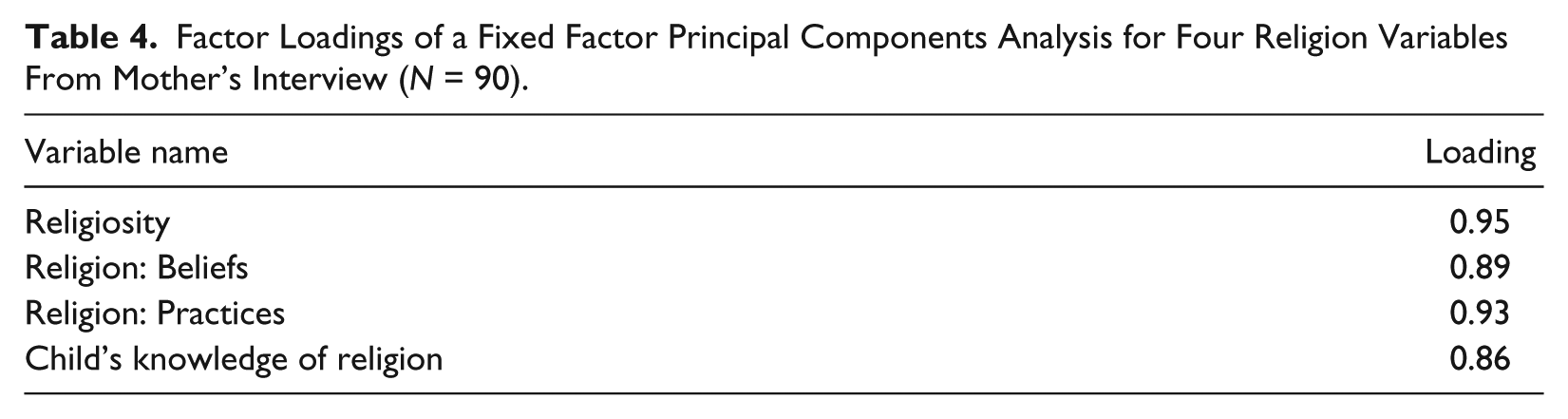
Religion: The variables relating to religion derived from the mother’s interview were religiosity, religious beliefs, religious practices and child’s knowledge of religion. The four items showed strong interitem correlations ranging from .65 to .85 and the α-coefficient for the construct was .93. PCA was used with the religion variables to produce a religion scale. All variables loaded on one factor with loadings of more than .8 and the factor explained 82.1% of the variance (see Table 4). A composite score was created from this factor, with higher scores indicating stronger religious beliefs and practices. This score was labeled religion.
Factor Loadings of a Fixed Factor Principal Components Analysis for Four Religion Variables From Mother’s Interview (N = 90).
A one-way ANOVA of the religion variable revealed a significant group difference, F(2, 87) = 32.48, p <.001. A Games–Howell post hoc test showed that Pakistani mothers held significantly stronger religious beliefs and practices when compared with both Indian (I vs. P p < .001) and White mothers (P vs. W, p < .001; see Table 5).
ii. Ethnic identity and socialization: Scores from the two subscales of the MEIM-R (Exploration and Commitment) were combined to form an ethnic identity construct. The between-item correlation coefficient was .53 and the α-coefficient for the construct was .69. When these variables were entered into a MANOVA, Wilks’s λ was not significant (see Table 5).
Means, SD, F, and p Values for Comparisons of Religion and Ethnic Identity Between Groups.

Parenting, Ethnic Identity, and Child Adjustment
The parenting measures (Expressed Warmth, Frequency of Battle, and Total Stress) and the identity factor (MEIM-R: Total Ethnic Identity) each correlated with child adjustment (SDQ: Total Difficulties). In line with wider literature on parental influences on child adjustment, these reflected fewer emotional and behavior problems in children whose mothers demonstrated greater expressed warmth (r = −.34, p < .01), fewer battles (r = .22, p < .05), and lower parenting stress (r = .55, p < .001). The significant correlation found between ethnic identity and SDQ reflected higher emotional and behavioral problems in children whose mothers demonstrated stronger exploration of and commitment to ethnic identity (r = .34, p < .01).
Hierarchical regression analyses on these variables were carried out to explore the relationship between parenting, ethnic identity, and child adjustment using a multilevel statistical model. This was an important step for testing Hypothesis 2 of the study which aimed to explore the relationship between parent–child relationships and child outcomes in the three groups. Past literature and earlier analyses of the data served to guide the order in which variables were entered into the regression. 1 The regression analysis assessed whether the parenting measures of Expressed Warmth, Frequency of Battle, and Total Stress and the ethnic identity measure of Total Ethnic Identity as measured by the MEIM-R explained unique variance in child adjustment as measured by the SDQ. The cases-to-independent variables (IVs) ratio was 21:1 (85 cases and 4 IVs), which is a satisfactory ratio for conducting regression analyses.
At Step 1 of the regression, mothers’ Total Stress score on the PSI/SF was entered, which accounted for 31% of the variance, adjusted R2 = .30, F(1, 83) = 36.60, p < .001. The inclusion of Ethnic Identity into the equation at Step 2 resulted in an additional 5% of the variance being explained (ΔR2 = .05). The IVs Expressed Warmth and Frequency of Battle were not included in the stepwise regression as they did not significantly strengthen the model and were not found to be significant predictors of child adjustment as measured by the SDQ. Therefore, the final model contained only two IVs, Total Stress and Ethnic Identity, which accounted for an overall variance of 35%, adjusted R2 = .34, F(6, 77) = 22.20, p < .001 (see Table 6). Multivariate outliers were not identified (max Cook’s distance = 0.28), indicating each case had a similar influence on the regression coefficients. The result of the regression indicated that Parenting Total Stress, reported by mothers as well as the strength of their Ethnic Identity were most closely associated with child adjustment. Higher levels of maternal stress, and greater exploration and commitment to ethnic identity, were associated with greater difficulties in the child.
Summary of Hierarchal Regression on Children’s SDQ Scores.
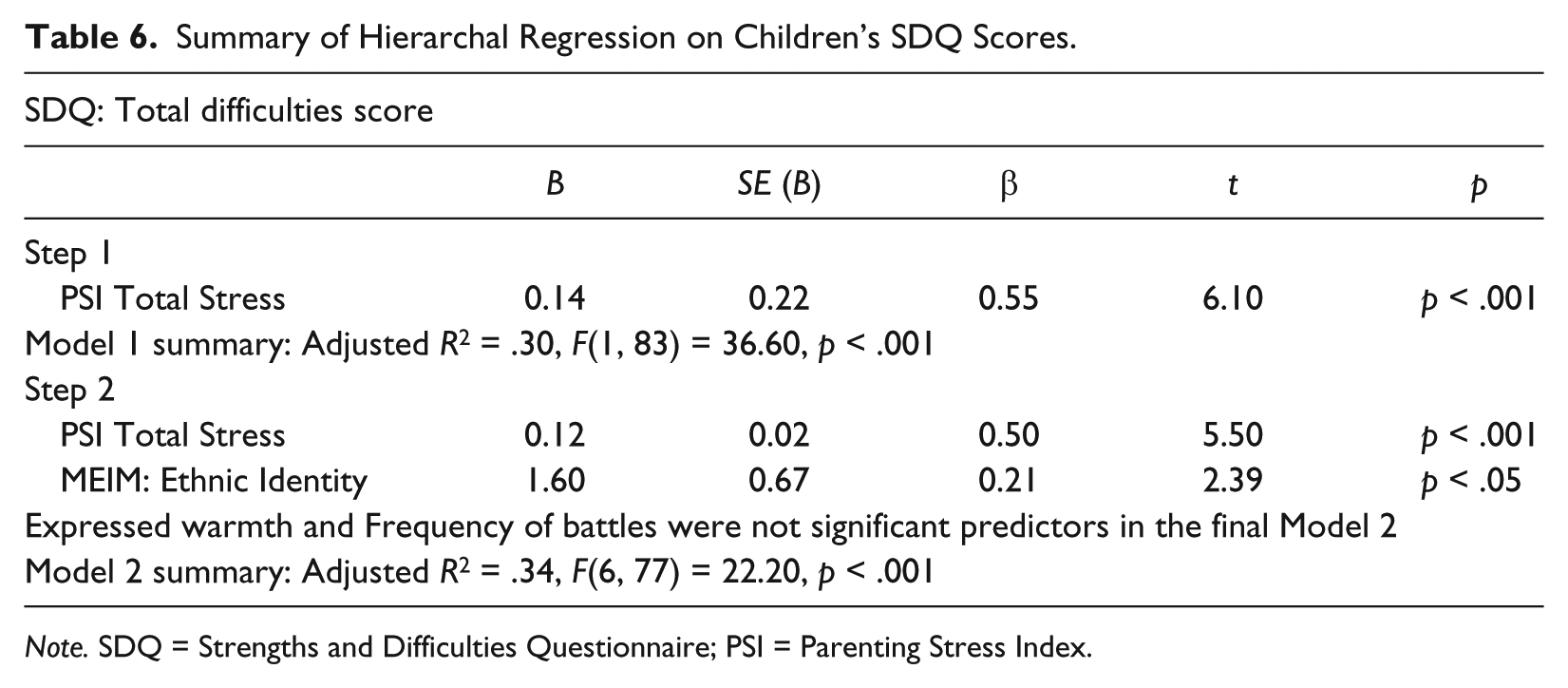
Note. SDQ = Strengths and Difficulties Questionnaire; PSI = Parenting Stress Index.
Discussion
This study set out to conduct an in-depth investigation in parenting quality, parent–child relationships, and children’s psychological adjustment in British-born Indian, Pakistani, and White British families with young children living in ethnically diverse regions of the United Kingdom.
In comparing parenting and child adjustment in British-born Indian, Pakistani, and White families, an overall pattern seemed to emerge, with differences mainly occurring between Pakistani and White mothers and somewhat resembling a continuum due to different parenting practices varying between the three communities to different extents. In this continuum, White families would exist at one end, Pakistani families at the other, and Indian families between the two. In some aspects of family life, Indian mothers were more comparable with White mothers, while in other aspects, they behaved similarly to Pakistani mothers. This supports Lau (2000) and Berthoud (2000) but also suggested different dimensions exist within parenting practices and family life. How do the study hypotheses hold up in relation to these findings? We explore below.
Hypothesis 1: Parenting Quality and Parent–Child Relationships
The hypotheses that similarities in parenting quality would exist between ethnic groups was supported overall by similar levels of warmth, control, and mother–child interaction between Indian, Pakistani, and White families. In terms of discipline, Indian and Pakistani mothers were more likely to use higher levels of overt discipline (raising voice and losing temper) with their children compared with White mothers. However, the magnitude of this difference was small (within one scale point between groups). Furthermore, Pakistani, Indian, and White mothers reported similar levels of conflict with their children. In relation to child well-being, contrary to past research, which has suggested that children from ethnic minority groups may be more likely to display problematic behavior compared with ethnic majority groups (discussed by Phoenix & Husain, 2007), third-generation Indian and Pakistani children in the study showed positive psychological adjustment. Similar levels of adjustment were found in the White children in the study and the mean SDQ score for total difficulties for each family type lay within the normal range. Thus, it seems that this study found that the children were doing well irrespective of their ethnicity.
The findings of positive child adjustment, taken together with the findings on parenting and mother–child relationships, demonstrate (as literature suggests) that positive parenting is associated with positive outcomes for children. The high levels of maternal warmth and mother–child interaction and low levels of maternal criticism in each family type, as measured by the interview, support this. Moreover, the regression between parenting and child adjustment reveals that, in each ethnic group, total parenting stress was a greater predictor of child socioemotional adjustment than other aspects of parenting, with ethnic identity a lesser predictor.
The hypothesis relating to differences between ethnic groups in the nature of parent–child relationships, particularly in relation to supervision and discipline, was also upheld. Differences were found between groups in supervision, child-centeredness, and overt discipline. These were most often found between the Pakistani and White families, with the Indian families lying between the two.
The higher levels of supervision found in Pakistani mothers (still within normal range) compared with Indian and White mothers indicate higher levels of protectiveness in this family type. Why should Pakistani mothers be more protective? Past research has reported that groups of individuals experiencing higher discrimination, such as Muslims at present in the United Kingdom, are more likely to use separation strategies (Robinson, 2009; Sam & Berry, 2010). It may be argued that higher maternal supervision in Pakistani mothers represents a form of separation strategy in parenting practices among mothers from this group. However, it could also relate to what Iqbal, Neal, and Vincent (2016) found in their study of children’s friendships in diverse neighborhood, that some parents (including Muslim ones) felt anxiety around their child attending the homes of “unknown” others. This was age related and the authors argue that it was a strategy of parental management and negotiation around preserving a sense of security around their children rather than a separation strategy.
Past research has also discussed the importance of upholding family honor, particularly in more collectivist-based Pakistani families (Becher & Husain, 2002; Bose, 2000; Lau, 2000). It is conceivable that protectiveness is a parenting mechanism by which mothers uphold the izzat (moral upstanding) and behavior of their young children to maintain family honor. This could relate to different ethnotheories around parenting in the family types. Given the more interdependent nature of Pakistani culture, and the young age of the children in the study, this could thus help to explain the higher supervision of children and possible associations with correct demeanor in Pakistani families.
Higher levels of overt discipline were found in Pakistani and Indian mothers compared with White mothers. High levels of discipline have been reported in past cross-cultural literature on parenting styles, and it has been suggested that in more interdependent cultures, a more authoritarian style of parenting results in better outcomes for children, as children have been socialized to expect such discipline and do not interpret it negatively (Arnett, 1995; Rutter & Tienda, 2005). It is conceivable that this could explain the higher levels of overt discipline in Indian and Pakistani families, and that children from these groups understand that overt discipline does not indicate a lack of affection. The difference in emphasis on parental discipline may also be related to different parental and cultural values around obedience. The classic study of Asian Americans by Chao (1994) found that greater authoritarian parenting is associated with a cultural importance placed on child “training” which emphasizes hard work and discipline rather than high levels of sensitivity. Pinquart and Kauser (2017) through their meta-analysis study of parenting styles across cultures also found that differences in understanding on the normativeness on particular parenting practices in different cultures moderated the socialization function of these practices with different meanings being assigned to similar practices cross-culturally. Studies have also shown that more authoritarian parenting is associated with better child outcomes in conduct and educational achievement in some ethnic groups (Chao & Tseng, 2002; Darling, 1999). Could similar parental ethnotheories also exist in Indian and Pakistani families? Past studies have shown the importance parents from both groups (particularly Indians) place on educational attainment and hard work in children (Barn, Ladino & Rogers, 2006; Lau, 2000). Therefore, this could be a possibility.
Hypothesis 2: Child Adjustment
Despite the presence of these differences in parenting between groups (i.e., higher levels of supervision, child-centeredness, and overt discipline in Indian and Pakistani families), no differences were found in levels of children’s psychological adjustment (which were high) between groups. How should we interpret this? If we think about the idea of cultural pathways (Greenfield et al., 2003; discussed earlier), we could suggest that development in British Indian, Pakistani, and White children was taking place within particular cultural contexts and developmental pathways, causing them to experience different parenting styles yet still attain positive adjustment (Triandis & Suh, 2002). The two developmental pathways (i.e., independence and interdependence) are thought to be part of larger sociocultural systems (i.e., individualistic and collectivistic systems). As discussed earlier, Indian and Pakistani families represent more collectivistic cultures, while White families represent a more individualistic culture. Given the available data, the suggestion of developmental pathways in third-generation children could be possible.
Hypothesis 3: Religion and Ethnic Identity
Religion was hypothesized to play a strong part in the parenting and family life of second-generation Pakistani families compared with Indian and White families. Religious beliefs varied between and within groups, with some mothers more religious than others. The current findings concur with past research, which has highlighted the centrality of religion to the Pakistani group and its lesser importance to the Indian group in Britain (Abbas, 2005; Modood, Beishon, & Virdee, 1994; Robinson, 2009; Shaw & Lee, 2003; Stopes-Roe & Cochrane, 1990). The literature has also shown that Muslims in Britain often express outward displays of religion through dress and behavior (Barn, Ladino & Rogers, 2006).
The relationship between parenting, ethnic identity, and child outcomes was also explored, and showed that total parenting stress and strength of ethnic identity were most closely associated with child outcomes. Mothers with higher levels of parenting stress, as well as stronger ethnic identification, were more likely to report having children who experienced greater difficulties. It is not clear why this relationship between high ethnic identity, increased parenting stress, and child outcomes was found. Past studies have shown that parenting stress is associated with child behavior and thus the relationship between the two in the present study was not surprising. However, the increased level of child difficulties in families where mothers reported high levels of ethnic identity was unexpected. In terms of cultural pathways and parental ethnotheories, we could suggest that differences may exist between ethnic groups in the perception of what correct child behavior is, and that mothers with higher ethnic commitment have higher expectations of correct child behavior. However, this aspect of the findings remains unclear.
It has been argued that when culture takes on different components, such as when individuals grow up in two or more cultures, then the chances of parenting practices changing across generations are high (Greenfield et al., 2003). Second-generation families thus seem to represent a group in transition.
This study has placed a spotlight on second-generation South Asian families to understand how different types of parenting practices occur in different groups. While it is small scale, it is detailed and helps us to understand the patterns and practices important for broadening understanding about minority groups. It has also tried to use cross-cultural theoretical insights to attempt to unpick what some of these differences might mean.
Strengths and Limitations
One of the strengths of the present study was that it attempted to reduce bias and inequivalence in a number of ways. The carefully matched sample of participants had the smallest possible cultural distance (i.e., the minimal difference between the cultures being studied) to enhance validity of the study and minimize differences due to extraneous variables. For example, the fact that all mothers were British-born was one way in which closeness in sample characteristics and cultural distance was seen. Moreover, as discussed earlier during the pilot study, representatives from each group were asked to describe what they understood the study was about and what they understood each question to mean. The pilot ensured that the researchers’ understanding of ethnic identity and parenting was in line with that of the participants. Although the study examines the perspectives of mothers, the child’s relationship with siblings and grandparents and with their father was absent.
The recruitment of participants from ethnic minority groups is often difficult, particularly those from lower socioeconomic status who are classed as a “hard to reach group” (Nazroo, 2006). Furthermore, ensuring the families were all British-born was difficult. While every attempt was made to ensure both parents were British-born, a small number of fathers from the Indian and Pakistani families were not born in Britain but had immigrated to the United Kingdom during their formative years. In light of these difficulties of recruitment, the size of the sample was satisfactory, although smaller than originally planned, mainly due to time constraints. It was also a reflection of the challenges of recruiting a hard to reach sample. Future studies would benefit from larger sample sizes. Finally, the analysis is based on cross sectional, single-time-point data. This limits the comparability of findings across age groups, and means that definite conclusions cannot be made about developmental trends.
The interview uses standardized measures and relies on the trained interviewer to code and rate measures according to responses and through observing cues during the interview with the use of a detailed coding manual. Despite measures in the interview designed to counter the possibility of the mother responding in a socially desirable manner as well as the possibility of the interviewer coding in a bias way (countered by a second researcher coding interviews to ensure reliability), it is still possible for these aspects to influence final measures. The use of questionnaire measures alongside the interview ones also helped to counter the effects of these.
The present study took place in London, which has the highest level of ethnic populations and is thus different from other parts of Britain (Simpson, 2013). Moreover, neighborhood has been shown to influence well-being and family functioning (Dorsett et al., 2015). Therefore, the results cannot be generalized to families in the United Kingdom as a whole. Nevertheless, the study still provides details about the family lives of three important ethnic groups in Britain, examining second-generation families in depth.
Conclusion
The study shows that it is important for policy makers and the media to differentiate between generations when working with ethnic groups. While the media often reports widespread polarization in educational and community institutions, family life, voluntary bodies, and places of work and social and cultural networks, and of communities leading parallel lives, how true is this for second-generation families as well as British Muslims? The present research highlights that second-generation families have been found to be very different to the immigrant generation before them and to show similarity in parenting practices with other British-born ethnic group members. It also showed the importance of religion often over cultural traditions in British Pakistani families. Future strategy needs to integrate generational difference in migrant groups into policy around diversity and understand it as an important consideration to differences in behavior. Studying more about intergroup differences will help increase understanding and dispel some of the stereotypes prevailing. If multiculturalism is to exist as a framework where people can live with equal opportunities, more of such research is needed.
Footnotes
Acknowledgements
The authors would like to acknowledge all the families who took part in the study.
Declaration of Conflicting Interests
The author(s) declared no potential conflicts of interest with respect to the research, authorship, and/or publication of this article.
Funding
The author(s) disclosed receipt of the following financial support for the research, authorship, and/or publication of this article: We would like to acknowledge The Laura Ashley Foundation for their funding support.