




Abstract
What, if any, are the common cultural characteristics that distinguish European societies and groups when viewed against a backdrop of global cultural variation? We sought to identify any shared features of European cultures through secondary multilevel analyses of two large datasets that together provided measures of cultural values, beliefs, and models of selfhood from samples in all inhabited continents. Although heterogeneous in many respects—including the value dimension of autonomy versus embeddedness—European samples shared two distinctive features: a decontextualized representation of personhood and a cultural model of selfhood emphasizing difference from others. Compared with samples from other regions, European samples on average also emphasized egalitarianism and harmony values, commitment to others in their models of selfhood, and an immutable concept of personhood, but not uniformly so. We interpret these findings in relation to a Durkheimian model of individualism.
Europe has long been recognized among the world’s continents, but attempts to identify core features of “European culture” have evoked philosophical and empirical debates. Europe has been variously portrayed as the “cradle of individualism” (e.g., Lukes, 1971), a “middle ground” between North American individualism and East Asian collectivism (Kitayama, Park, Sevincer, Karasawa & Uskul, 2009), or a “small-scale model of the world” in terms of cultural variability (Hofstede, 1993, p. 10). Evidently, contemporary Europe harbors many distinct cultural groups and orientations (House et al., 2004; Ronen & Shenkar, 2013), but such diversity is not the main focus of our current contribution. Here, analyzing data from two large multinational surveys, we sought to identify which cultural characteristics, if any, might be relatively similar among contemporary European societies—despite their diversity in other respects—characteristics that might be understood as defining a “pan-European culture” when viewed against a wider backdrop of global cultural variation.
Existing Characterizations of European Culture(s)
Social scientific portrayals of European culture have been rather contradictory. Some have viewed Europe as the “cradle of individualism.” Individualistic thinkers have made salient contributions to European heritage over many centuries, especially since the enlightenment (e.g., Durkheim, 1898/1969; Mill, 1859; Smith, 1759/1976; see Lukes, 1971; Marková et al., 1998). Notably, Durkheim foresaw Europe’s increasing development toward “the cult of the individual.” Disagreeing with those who blamed individualism for social or moral fragmentation, he proposed that individualism could function like a religion—a novel form of “collective consciousness” comprising ideals, beliefs, and practices reflecting the value of the individual as a moral absolute, that would bind individuals together within a society, rather than dividing them. He viewed the growth of individualism as a cultural adaptation to processes of urbanization and secularization occurring within the Europe of his time. These processes—and their concomitants of trade, innovation, and labor mobility—are now characteristic of modernization globally (Inglehart & Baker, 2000), but European history has framed them, and it remains plausible that their lengthier and continuing salience leaves a distinctive footprint on contemporary European societies that contrasts with how modernization has occurred in the predominantly postcolonial societies characteristic of other parts of the world (Deutsch & Welzel, 2016).
Against portrayals of Europe as the “cradle of individualism,” others have suggested that contemporary European cultures may form a “middle ground” between North American individualism and East Asian collectivism. Kitayama, Park, Sevincer, Karasawa, and Uskul (2009) compared scores on a series of experimental tasks, designed to reflect cultural tendencies toward independence or interdependence, among students in Japan, the United States, the United Kingdom, and Germany. They found that European participants on average showed intermediate responses between those obtained in Japan, seen to represent interdependent (i.e., collectivistic) cultures, and in the United States, seen to represent independent (i.e., individualistic) cultures. However, much broader sampling of both European and non-European cultures would be needed for confidence in such a characterization. European cultures are not homogeneous in cultural values (Hofstede, 1980), norms (Gelfand et al., 2011), or emotional expressiveness (Matsumoto et al., 2008). Moreover, cultures vary globally on numerous dimensions, irreducible to simple contrasts between West and East or independence and interdependence (Hofstede, 1980; Schwartz, 2006; Vignoles et al., 2016). Rather than forming a “middle ground” between West and East, European cultures could be individualistic in some respects and collectivistic in others, they could be best distinguished by features other than individualism–collectivism, or there could be no longer any cultural characteristics that reliably differentiate European cultures from those in other world regions.
Large-scale empirical studies have mostly emphasized the diversity, rather than convergence, of European national cultures. In his survey of IBM employees, Hofstede (1993) found nearly as much variability within Europe as there was global variation on four dimensions of cultural variation. This led him to conclude that Europe’s cultures might form a “small-scale model of the world” in terms of cultural variability (p. 10). Analyzing data from 61 nations, the Global Leadership and Organizational Behavior Effectiveness (GLOBE) researchers (House et al., 2004) concluded that Nordic, Germanic, Latin, and Eastern European cultural clusters were distinctive to Europe, while an Anglo cluster was represented both within and outside Europe. Summarizing the results of these and eight other surveys, Ronen and Shenkar (2013) endorsed the same five clusters within Europe.
One limitation of these studies is that analyses were based on nation-level means, aggregated from individual-level data. Multilevel analyses comparing within-nation and between-nation variability in personality and values typically show that less than 20% of variance is attributable to national differences (Fischer & Schwartz, 2011). For example, across representative samples of many nations included in the European Social Survey, values are found to vary primarily between individuals, to a lesser extent between nations, and still less between regions within nations (Magun, Rudnev, & Schmidt, 2016; Minkov & Hofstede, 2014; Van Herk & Poortinga, 2012). To identify possible distinctive features of European cultures, one should preferably use a multilevel analysis to isolate genuinely culture-level variation in the constructs of interest from aggregated individual-level variation.
Furthermore, the cluster analytic methods used in some previous studies involve ambiguities regarding the clustering method to be used, the number of clusters to extract, and the naming of the obtained clusters, as well as a risk of circularity in deciding the geographical boundaries of regions that are thought to map onto the clusters. Although suitable for the descriptive goals of those studies, adopting such an approach here could lead to biased conclusions for, or against, a pan-European culture, because the researchers’ preconceptions might inadvertently influence statistical or interpretative decisions. Hence, we sought to establish a priori criteria for deciding what would count as evidence for a distinctive European cultural emphasis. We explain these criteria shortly, but first we introduce the cultural dimensions that formed the focus of our analyses.
Dimensions of Cultural Variation
Culture is multifaceted, and whether one can identify shared features of European cultures may depend on which dimensions one considers. Here, we examined cultural variability in three domains of psychological functioning that are commonly seen as especially important foci for cross-cultural examination: values, beliefs, and models of selfhood (see Brewer & Chen, 2007). As we describe below, certain dimensions within each of these domains can be viewed as facets of the broader contrast between individualism and collectivism (Triandis, 1995), but each domain also yields further dimensions that are theoretically and empirically distinct from individualism–collectivism.
Cultural Value Priorities
Researchers often use measures of values to characterize cross-cultural differences, as well as individual differences in cultural orientation (Hofstede, 1980; Schwartz, 1992, 2006). Based on a multinational study of value priorities, Schwartz (1992) concluded that individual differences in values are organized in a circumplex structure, defined by bipolar axes of openness to change versus conservation (contrasting self-direction and stimulation with tradition, conformity, and security) and self-enhancement versus self-transcendence (contrasting power and achievement with benevolence and universalism). This structure has now been found in more than 75 nations (Schwartz, 2011) and with different measures (Lindeman & Verkasalo, 2005; Schwartz, 2007).
A broadly similar—but not identical—circumplex structure captures cross-cultural differences in values (Schwartz, 2006). The individual-level distinction between openness and conservation values is closely mirrored by a culture-level dimension labeled autonomy versus embeddedness (Schwartz, 2006; see also Fischer, 2012; Fischer, Vauclair, Fontaine, & Schwartz, 2010). Although the items used to define these dimensions are not identical, both dimensions broadly contrast value priorities of self-direction and stimulation—thought to be typical of individualistic cultures—with those of tradition, security, and conformity—thought to be typical of collectivistic cultures (Welzel, 2010). In several studies, scores on this dimension converged closely with Hofstede’s (1980) individualism index and with the GLOBE project’s scores for in-group collectivism (Gheorghiu, Vignoles, & Smith, 2009; Vignoles et al., 2016).
Meanwhile, the distinction between self-enhancement and self-transcendence values is partially recaptured by two separate, but correlated, culture-level dimensions—mastery versus harmony and hierarchy versus egalitarianism, which are conceptually and empirically distinct from individualism–collectivism (see Schwartz, 2006, 2011).
Cultural Beliefs About Personhood
Beyond value priorities, researchers have sought to characterize cultures in terms of prevailing beliefs about the world (Bond et al., 2004). Here, we focused on personhood beliefs, which refer to people’s understandings or implicit theories of what it is to be a person (see Bastian & Haslam, 2006; Church et al., 2005; Dweck, 2000; Owe et al., 2013).
Based on evidence that members of individualistic cultures tend to adopt “de-contextualized” conceptions of personhood compared with members of collectivistic cultures (e.g., Miller, 1984; Triandis, 1995), Owe et al. (2013) devised a measure of contextualism beliefs—defined as beliefs in the importance of context for understanding people—which formed a single factor at individual and national levels of analysis. National scores correlated with archival indices of national individualism–collectivism and predicted nation-level variance in corruption, in-group favoritism, and differential social trust after accounting for effects of autonomy–embeddedness values. Thus, autonomy–embeddedness values and contextualism beliefs are seemingly distinct facets of the broader construct of individualism–collectivism.
Whereas contextualism beliefs focus on the individual in relation to others, immutability beliefs focus on the individual in relation to time, opposing a belief that human beings are stable and immutable entities who cannot change even when they try, with a belief that persons are malleable and able to change over time (Dweck, 2000). In previous cross-cultural comparisons, Mexican, Philippine, and Japanese participants endorsed immutability beliefs more, Korean and Belgian participants endorsed immutability beliefs less, and Hong Kong participants showed an inconsistent pattern, compared with participants from English-speaking nations (Chiu, Dweck, Tong, & Fu, 1997; Church et al., 2005; Kashima et al., 2005; Norenzayan, Choi, & Nisbett, 2002). Thus, cultural differences in immutability beliefs do not seem to map neatly onto differences in individualism–collectivism (see also Becker et al., 2018; Minkov et al., 2018).
Cultural Models of Selfhood
A third focus of cross-cultural research has been on self-construals (Markus & Kitayama, 1991), self-representations (Brewer & Chen, 2007), or cultural models of selfhood (Vignoles et al., 2016). Until recently, research in this area has focused mainly on bicultural comparisons, usually between North Americans and East Asians, and typically contrasting independent with interdependent self-construals (e.g., Singelis, 1994). However, the most widely used measures of self-construal have lacked adequate reliability and validity, failing to account for response style and validated across an insufficiently diverse range of cultural contexts.
Recently, Vignoles et al. (2016) explored the structure of self-construals in two large multinational studies. Controlling for a response-style method factor, they found seven distinct factors on both individual and cultural levels of analysis. These seven dimensions could not be reduced to a second-order contrast between independence and interdependence at either level, showing the importance of separating them empirically and conceptually. At the cultural level, four dimensions were positively associated with individualism (vs. collectivism): difference (vs. similarity), self-direction (vs. receptiveness to influence), self-expression (vs. harmony), and self-containment (vs. connectedness to others). A fifth dimension, self-interest (vs. commitment to others), was higher in collectivist than in individualist cultures. 1 Two further dimensions, consistency (vs. variability) and self-reliance (vs. dependence on others) were unrelated to individualism–collectivism.
Criteria for Inferring Pan-European Cultural Characteristics
How might we infer the existence (or otherwise) of a distinctively European cultural emphasis on one or more of these dimensions of cultural variation? Rather than derive cultural regions bottom-up from the data as in previous studies (cf. Ronen & Shenkar, 2013), we sought to avoid circularity by first categorizing—without the aid of psychological data—which of the world’s societies should be considered “European.” We could then characterize the distributions of cultural values, beliefs, and models of selfhood among samples from European societies against a backdrop of variability among samples from all other parts of the world.
Drawing the Boundaries of Europe
Although there is little ambiguity regarding its Northern, Western, and Southern boundaries, the position of Europe’s Eastern boundary with Asia is contested, with some nations categorized ambiguously or considered “transcontinental.” By convention, the Eastern boundary of Europe has been defined by the Ural Mountains and by the Bosphorus, but this definition leaves ambiguous the status of nations that lie east of the Bosphorus and West of the Urals, namely, Armenia, Azerbaijan, Cyprus, and Georgia. Meanwhile, Turkey lies both east and west of the Bosphorus, and Russia lies both east and west of the Urals. (Historically, Russia was considered unambiguously European, but the eastward expansion of its territory increasingly included Asian lands). For the current research, we compared the results of parallel analyses using either a narrow definition of Europe, treating ambiguous and transcontinental cultural samples as non-European, or a broad definition of Europe, treating these samples as European.
Identifying Distinctive Cultural Emphases
By comparing European with non-European cultural samples, we emphatically are not suggesting that “non-European cultures” form a coherent cultural entity. Nor are we advocating European “exceptionalism”—the idea that European samples will have a profile that is somehow more distinctive than, or not overlapping with, the cultural profiles of other world regions. On the contrary, one should expect that samples from various world regions will be at least as distinctive as European samples, but in different ways, and that there will also be much overlap across regions. Our goal is simply to establish in what ways—if any—European cultures are distinctively positioned, when viewed against a wider backdrop of global cultural diversity. We consider the non-European samples in each study to provide a measure of this backdrop, against which we could examine the positioning of European samples on each cultural dimension of interest. When viewed in this global perspective, we used two criteria to evaluate the evidence for distinctive shared features of European cultural samples.
A first—perhaps most obvious—criterion was whether the average values, beliefs, or models of selfhood among European samples differed significantly on one or more dimensions from the average values, beliefs, or models of selfhood among samples from other parts of the world. In other words, do European cultural samples tend toward one pole or the other of each cultural dimension, compared with the range of global variability? Note, however, that this criterion does not capture the possibility that European cultures might be distinctively average—occupying a “middle ground” (Kitayama et al., 2009)—on one or more cultural dimensions. In that case, contrasting cultural tendencies among non-European samples from different parts of the world (e.g., North America, sub-Saharan Africa) might “cancel out,” so that the average positioning of European samples would appear nondistinctive by comparison. Nor does this criterion consider the extent to which a given cultural emphasis is shared across samples from different parts of Europe.
Hence, a second—arguably stronger—criterion focuses on similarity among European cultures: Europe could be said to have a distinctive cultural emphasis if there is significantly less variability on a given dimension among European samples than among non-European samples (cf. Hofstede, 1993). This second criterion would entail that there is some coherence—at least more than would be expected by chance—among diverse European cultures on a given cultural dimension. Conversely, if European samples were no more similar to each other than were samples from other parts of the world, this would signify that there is no coherent shared cultural emphasis. In that case, thinking of Europe as a cultural region would arguably make no more sense than thinking of “non-Europe” as a cultural region.
The Current Research
We conducted secondary analyses of data from two major international surveys. We selected these datasets because they provided the broadest bases for global comparisons of theoretically specified measures of values, beliefs, and models of selfhood for which multilevel data were publicly available. For Study 1, we analyzed data from Waves 5 and 6 of the World Values Survey (WVS). These surveys included no measures of personhood beliefs or models of selfhood but, unlike earlier WVS waves, they included a brief measure of values based on Schwartz’s (1992) model among large, representative samples from a total of 78 nations. For Study 2, we analyzed data from the second study into motivated identity construction across cultures conducted by the Culture and Identity Research Network (CIRN; Vignoles & Brown, 2016). Whereas the first CIRN study involved adolescent participants from just 19 nations, the second study was completed by opportunity samples of nonstudent adult members of 55 cultural groups spanning 33 nations across all inhabited continents. Although not providing representative samples, this survey included a fuller range of cultural orientation measures than the WVS, including values (Schwartz, 2007), personhood beliefs (Bastian & Haslam, 2006; Owe et al., 2013), and cultural models of selfhood (Vignoles et al., 2016). Neither of these datasets was designed for comparing Europeans and non-Europeans, but their breadth of sampling provides a much firmer basis for estimations of variability than prior studies in which regional contrasts have been postulated through comparing just a few nations. Analyses for both studies were conducted in parallel, but they are presented in sequence for clarity of exposition.
Based on the reasoning outlined above, we formulated two sets of generic hypotheses, which guided our exploration of the WVS and CIRN datasets in search of distinctive shared features of European cultures:
In Study 1, we tested H1a and H2a. In Study 2, we tested all aspects of H1 and H2. As indicated above, we considered that H2 would provide a stronger test than H1 for the presence of distinctive shared features of European cultures. Nonetheless, we interpreted results for both hypotheses in conjunction.
Study 1
Study 1 was a secondary analysis of responses to measures of values in Wave 5 (2005-2009) and Wave 6 (2010-2014) of the WVS (www.worldvaluessurvey.org).
Method
Participants and procedure
Data were downloaded from the WVS website. For those nations sampled in both waves, the more recent Wave 6 data were included in our analyses. Hence, the main sample consisted of 123,644 participants (60,449 males, 63,194 females, 166 unspecified; M age = 41.19, SD = 16.48) from 78 nations spanning all inhabited continents. 2 We weighted participants using the 1,000-equilibrated weights provided in the database, which compensate for minor deviations from representativeness in each sample, as well as rescaling each sample to a size of 1,000 so that all nations were weighted equally (Diez Medrano, 2016).
Of the included nations, 20 were unambiguously European and 52 were unambiguously non-European (see the appendix). Among the latter were 17 Asian, 13 Arab, nine African, 11 North and South American, and two Australasian nations. However, the positioning of Armenia, Azerbaijan, Cyprus, Georgia, and Turkey is contested. Furthermore, the WVS data from Russia were drawn from both European and Asian regions. We therefore conducted parallel sets of analyses using both narrow and broad definitions of Europe, to ensure that results were not affected disproportionately by how these samples were classified.
Measure
A brief measure of personal values was included among the WVS items. Ten items, using a similar format to the Portrait Values Questionnaire (Schwartz, 2007), represented the 10 value types originally postulated by Schwartz (1992). 3 Although it is preferable to assess values with more than one item per value type, similar patterns of correlations with criterion measures have been shown for 10-, 20-, and 40-item versions of the Portrait Values Questionnaire (Sandy, Gosling, Schwartz, & Koelkebeck, 2017).
We tested a multilevel measurement model using Mplus Version 6 (Muthén & Muthén, 2010), including a separate method factor modeling acquiescence at both levels of analysis, which loaded onto every indicator at a fixed value of 1 and was allowed to correlate with the substantive factors (Welkenhuysen-Gybels, Billiet, & Cambré, 2003). Because our analyses used population weights, we used maximum likelihood estimation with robust standard errors (MLR) in Mplus, which yields a Satorra–Bentler chi-square (henceforth,
The resulting model showed acceptable fit:
Plan of analysis
To test H1a and H2a, we conducted multigroup multilevel modeling in Mplus Version 6 (Muthén & Muthén, 2010), comparing the latent means and variances of the two dimensions of cultural values between European and non-European samples. Although the data included a relatively large number of cultural samples, these were still a relatively small N in statistical terms; hence, to simplify our main analyses while retaining the benefits of latent variables for reliability and statistical power, we saved factor loadings from the previously reported multilevel measurement model and fixed the loadings in our multigroup models to these values. To test for latent mean differences between European and non-European samples (H1a), we treated the means for non-European samples as a baseline (fixed at zero) and tested the significance of the latent means for European samples. To test for homogeneity of variances (H2a), we used two approaches: (a) We examined 95% confidence intervals of the variance estimates for the culture-level factors for European and non-European samples, to see whether the estimated variance for each group of samples fell within the confidence interval of the estimated variance for the other group; (b) we tested whether constraining the variances of each culture-level factor to be equal across European samples and across non-European samples would result in a significant loss of model fit. All analyses were run twice—once with Armenian, Azeri, Cypriot, Georgian, Russian, and Turkish samples considered as non-European (i.e., narrow definition of Europe) and once with these samples considered as European (i.e., broad definition of Europe). 5
Results and Discussion
As shown in Table 1, both sets of analyses revealed a similar pattern of results. When focusing on autonomy versus embeddedness values (often associated with individualism–collectivism), we found no support for a distinctive European cultural profile. Against H1a, autonomy–embeddedness values among European samples, on average, did not differ significantly from their mean level among samples from all other parts of the world (despite a marginal trend toward higher autonomy when Europe was defined narrowly). But nor did European samples share a distinctively moderate position on this dimension (cf. Kitayama et al., 2009). Against H2a, we found significantly more variation in autonomy–embeddedness among European samples than among samples from other parts of the world put together. Even when Europe was defined narrowly, the estimated variance among European samples (.031) fell outside the 95% confidence interval for non-European samples (.005, .028), whereas the estimated variance for non-European samples (.016) fell on the margin of the 95% confidence interval for European samples (.016, .046); constraining these estimates to equality provided a significant loss of fit, Δ
Latent Means and Variances for Cultural Values in European and Rest of World (RoW) Samples, Study 1.

Note. Latent means for RoW were set to zero as the reference category. RoW = rest of world; CI = confidence interval.
In contrast, when focusing on mastery–hierarchy versus harmony–egalitarianism values, we did find evidence of a distinctive European profile, with support for both H1a and H2a. In both analyses, European samples on average prioritized harmony–egalitarianism values over mastery–hierarchy values significantly more than the average among samples from other parts of the world (H1a). Moreover, European samples showed significantly more homogeneous positions on this dimension, compared with samples from other parts of the world: As shown in Table 1, even when Europe was defined broadly, the estimated variance among European samples (.018) fell outside the 95% confidence interval for non-European samples [0.025, 0.050], whereas the estimated variance for non-European samples (.037) fell outside the 95% confidence interval for European samples [0.007, 0.028]; constraining these estimates to equality provided a significant loss of fit, Δ
Study 2
Based on nationally representative samples from 78 nations, Study 1 provided evidence for a somewhat distinctive shared emphasis on harmony and egalitarianism (vs. mastery and hierarchy) values among European cultures, when viewed against the backdrop of global cultural variation. However, the study included only a very brief measure of values, which may not have adequately captured the meanings of the value priorities identified by Schwartz (1992, 2006) The brevity of the measure might also have contributed to our inability to distinguish two culture-level value dimensions, mastery versus harmony and hierarchy versus egalitarianism (Schwartz, 2006). Nor did the WVS include measures of personhood beliefs or models of selfhood suitable for our analyses.
Hence, for Study 2, we analyzed data collected for the CIRN project (Vignoles & Brown, 2016, Study 2). Previous analyses of these data examined the nature and structure of personhood beliefs (Owe et al., 2013) and models of selfhood (Vignoles et al., 2016), as well as the role of personhood beliefs in moderating how individuals achieve self-continuity in different cultures (Becker et al., 2018). Vignoles et al. (2016) examined the distribution of models of selfhood across six global regions, two of which were partly European, but no previous analysis of these data has tested for the possibility of pan-European cultural characteristics.
Method
Participants and procedure
The survey was completed by 7,299 adults (3,082 males, 4,157 females, 60 unspecified; M age = 35.27 years, SD = 13.39), who were predominantly nonstudent members of 55 cultural groups spanning 33 nations. In many nations, more than one cultural group was sampled. The conventional assumption that nations can be equated with cultures is increasingly challenged; hence, cultural groups were targeted based on locally salient demographics such as religion, social class, urban-versus-rural location, and ethnicity, thereby providing a more adequate representation of global cultural diversity. Further details of samples and procedures are published elsewhere (Owe et al., 2013; Vignoles et al., 2016).
Of the 55 cultural groups sampled, 18 were drawn from unambiguously European locations, whereas 32 were drawn from unambiguously non-European locations (see the appendix). The latter comprised 11 samples from North and South America, nine from Asia, seven from Africa, four from Arab nations, and one from New Zealand. However, five groups came from nations or regions whose status as part of Europe is contested (Turkey, Georgia, Russian Caucasus). As in Study 1, we conducted parallel sets of analyses, invoking a narrow definition of Europe (treating Turkey, Georgia, and the Russian Caucasus as non-European) and a broad definition of Europe (treating Turkey, Georgia, and the Russian Caucasus as European), to ensure that results were not affected disproportionately by how these samples were classified.
Measures and plan of analysis
Cultural orientation measures were included in a larger questionnaire (Vignoles & Brown, 2016). Multilevel measurement models were tested using Mplus Version 6 (Muthén & Muthén, 2010). All models included a separate method factor modeling acquiescence at each level of analysis, which loaded onto every item at a fixed value of 1 and was allowed to correlate with the substantive factors (Welkenhuysen-Gybels et al., 2003). Because Study 2 focused on cultural groups rather than nations, and samples were not designed to be representative, we did not use sampling weights. We adjusted for age and gender differences in sample composition by including these variables as predictors of the individual-level factors in all models. In other respects, we followed a similar plan of analysis to Study 1, saving the loadings as well as age and gender effects from the measurement models and fixing the corresponding parameters in our multigroup models to these values.
Values
Participants completed the 21-item Portrait Values Questionnaire (Schwartz, 2007). Participants read descriptions of 21 target individuals, gender matched to the participant, described as endorsing particular value priorities (e.g., “Thinking up new ideas and being creative is important to her. She likes to do things in her own original way”). Participants rated how similar each target was to themselves, from 1 (very much like me) to 6 (not at all like me).
Our initial measurement model for values was based on Schwartz (1992, 2007) for the individual-level structure and Schwartz (2006) for the culture-level structure. At the individual level, we modeled the two axes underlying Schwartz’s circumplex model: openness versus conservation and self-enhancement versus self-transcendence. Because hedonism occupies an ambiguous position between openness and self-enhancement (Schwartz, 2007), we allowed the two hedonism items to cross-load on both factors. The circumplex structure permits items to cross-load on adjacent factors; based on a large modification index, we allowed one tradition item to cross-load on self-transcendence. At the cultural level, we initially assigned items as described by Schwartz (2006) to three dimensions: autonomy versus embeddedness, hierarchy versus egalitarianism, and mastery versus harmony. However, preliminary multigroup analyses showed that the latter two dimensions were not distinguishable among narrowly defined European samples. Hence, we opted again for a two-dimensional structure at both levels of analysis (see Fischer, 2012, for a similar approach using this instrument).
Fit indices for this model showed a mixed pattern: χ2(403) = 5,505.807, CFI = .866, RMSEA = .042, SRMRwithin = .050, SRMRbetween = .146. Although CFI was below the conventional cutoff of .90, we judged this acceptable given the complexity of the model and because RMSEA showed no problems (see Kenny & McCoach, 2003). Although the SRMRbetween was above the conventional cutoff of .10, this might be due to a relatively small N at the culture level. Thus, to avoid overfitting the data, we made no further modifications to the measurement model for values. 6
Personhood beliefs
Contextualism (Owe et al., 2013) and immutability beliefs (Bastian & Haslam, 2006) were each measured using six balanced items (e.g., “To understand a person well, it is essential to know about his or her family” [contextualism]; “Everyone, no matter who they are, can significantly change their basic characteristics” [immutability, reversed]). Items were intermingled and rated from 1 (completely disagree) to 6 (completely agree). A multilevel measurement model, with substantive factors of contextualism and immutability measured by the same items at both levels of analysis, showed mostly acceptable fit indices: χ2(118) = 1,111.329, CFI = .941, RMSEA = .035, SRMRwithin = .027, SRMRbetween = .107. 7
Models of selfhood
Seven dimensions of self-construal were measured with 22 items, selected from this dataset by Vignoles et al. (2016). Example items are “You like being different from other people” (difference) and “You value good relations with the people close to you more than your personal achievements” (commitment to others). Participants rated how well each item described them personally from 1 (not at all) to 9 (exactly). As previously reported by Vignoles et al., a measurement model with seven substantive factors, identified by the same items at both levels of analysis, showed acceptable fit: χ2(409) = 2,375.33, CFI = .923, RMSEA = .026, SRMRwithin = .031, SRMRbetween = .096. However, preliminary multigroup analyses revealed a negative culture-level variance among European samples in the dimension of self-containment versus connectedness to others, and including this dimension impeded model convergence in our tests of H2c. We therefore decided to remove this dimension from our analyses and focus on the remaining six dimensions in Vignoles and colleagues’ model, measured with 20 items. 8
Results
Results are summarized in Table 2.
Latent Means and Variances for Cultural Values, Beliefs, and Models of Selfhood in European and Rest of World (RoW) Samples, Study 2.

Note. Latent means for RoW were set to zero as the reference category. RoW = rest of world; CI = confidence interval; nc = nonconvergence.
Cultural value priorities
Mean differences, but not variances, were consistent with the pattern observed in Study 1. Regarding mean differences, European cultures, whether defined broadly or narrowly, showed greater emphasis on harmony and egalitarianism (vs. mastery and hierarchy values), compared with the average profile of samples from other parts of the world (H1a); the variance among European samples on this dimension was smaller than that among non-European samples, but not significantly so (H2a). Consistent with the marginal trend observed in Study 1, narrowly defined European cultures also averaged significantly higher on autonomy (vs. embeddedness) values, although we did not replicate the finding of greater variance among European than among non-European samples on this dimension.
Cultural beliefs
Personhood beliefs revealed much stronger evidence for European distinctiveness. In both analyses, European samples showed a distinctively decontextualized representation of personhood (H1b: p < .01), and European samples were significantly more similar to each other on this dimension than were samples from other parts of the world (H2b: p < .001). European samples also scored relatively high on immutability beliefs (H1b: p < .05), although the homogeneity test was significant only when Europe was narrowly defined (H2b: p < .05).
Cultural models of selfhood
Among the six dimensions analyzed, difference (vs. similarity) showed the strongest evidence for European distinctiveness. European samples averaged significantly higher when narrowly defined (H1c: p = .004) and marginally so when broadly defined (H1c: p = .054); in both analyses, there was considerably less variance among European samples than among samples from other parts of the world (H2c: p < .001).
Results for self-expression (vs. harmony) showed a similar, but weaker, pattern. European samples scored significantly higher when Europe was narrowly defined (H1c: p = .012), and they were somewhat more homogeneous using both definitions: In both analyses, the variance among European samples was not contained within the confidence interval for the variance among non-European samples—although constraining these variances to be equal resulted in only a marginal loss of fit (H2c: p < .10).
In both analyses, European samples averaged significantly higher on commitment to others (vs. self-interest; H1c: p < .001), although the variance among European samples was no smaller than that among non-European samples (H2c). In contrast, European samples showed somewhat lower variance than non-European samples in self-reliance versus dependence on others, as indexed by confidence intervals (one model comparison was marginally significant at p = .050; the other one did not converge), but no significant difference in the mean—suggesting that European samples were somewhat distinctively close to the middle on this dimension. Finally, we found no evidence for European distinctiveness on the remaining dimensions, self-direction (vs. receptiveness to influence) and consistency (vs. variability).
Discussion
Although Study 2 was based on opportunity samples of diverse cultural groups, rather than nationally representative samples, the results for cultural value priorities were largely consistent with those observed in Study 1. Crucially, however, Study 2 provided information about cultural beliefs and models of selfhood that were not measured in the WVS. Figures 1 and 2 illustrate some of the most important findings of Study 2, showing the positions of European, ambiguous and non-European samples on selected dimensions of cultural values, beliefs, and models of selfhood. Based on this wider range of cultural dimensions, European samples in Study 2 were characterized especially by two distinctive cultural emphases—a decontextualized concept of the person and a model of selfhood, in which the uniqueness and difference of the individual is valued and emphasized (see Figure 1). Notably, these features were not accompanied by a focus on self-interest or a desire to get ahead—instead, European samples on average scored highly—although not uniformly—on commitment to others (vs. self-interest) and harmony-egalitarianism (vs. mastery-hierarchy) values (see Figure 2).
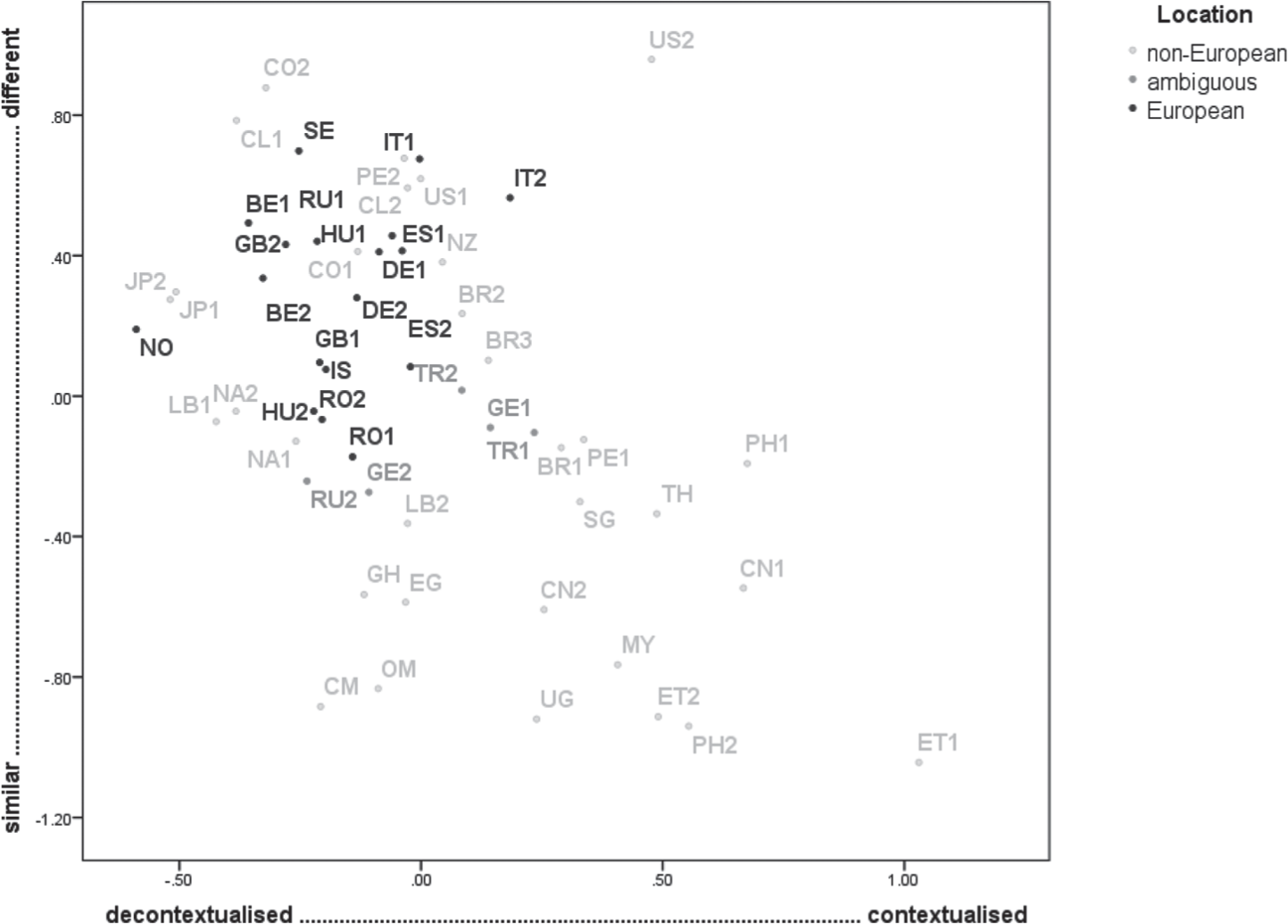
Scatterplot showing culture-level factor scores saved from Study 2 measurement models for difference versus similarity (cultural models of selfhood) and contextualism (cultural beliefs about personhood).

Scatterplot showing culture-level factor scores saved from Study 2 measurement models for self-interest versus commitment to others (cultural models of selfhood) and mastery + hierarchy versus harmony + egalitarianism (cultural values).
General Discussion
Our goal was to identify core features (if any) of a pan-European culture—features that would be shared to some extent by different cultural groups in Europe, as well as differentiating these groups to some extent from those in other world regions. Two unique datasets together provided unparalleled representative sampling from almost 40% of the world’s nations (Study 1) and unparalleled coverage of cultural values, beliefs, and models of selfhood (Study 2). Analyses of these two datasets provided largely consistent and complementary insights.
First, the value dimension of autonomy versus embeddedness—often seen as a core facet of cultural individualism–collectivism—is not helpful for distinguishing European from non-European cultures. Especially when the boundaries of Europe are conceived more broadly, European cultures average toward the middle of the global range on this cultural dimension. However, this is not to say that European cultures consistently occupy a “middle ground” between extremes of individualism and collectivism that are found elsewhere in the world (cf. Kitayama et al., 2009)—in fact, in Study 1, we found more heterogeneity within Europe than outside Europe in autonomy versus embeddedness values. Nor did we find any evidence of a distinctive European emphasis in two of the six examined dimensions of selfhood: self-direction (vs. receptiveness to influence) and consistency (vs. variability).
Two cultural dimensions measured in Study 2 showed the most distinctive European profile: As shown in Figure 1, European samples tended somewhat homogeneously to endorse a decontextualized concept of the person and a cultural model of selfhood emphasizing difference from others. Also, as shown in Figure 2, European samples tended on average—but less homogeneously—to prioritize egalitarianism and harmony over mastery and hierarchy values in both studies, and to emphasize commitment to others over self-interest in their models of selfhood in Study 2. Notably, as both figures reveal, we are not suggesting that any of these features is unique to European cultures, nor that they are absent from cultures in other parts of the world. Yet, our findings clearly indicate that these features are characteristic of European cultures, when viewed against a global backdrop.
The combination of features that we identified does not fit neatly into prevailing conceptions of individualism–collectivism in cross-cultural psychology, although they resonate somewhat with Triandis’s (1995) portrayal of horizontal but not vertical individualism. We believe that these features fit more closely with Durkheim’s (1898/1969) vision of individualism as a basis for social solidarity—a cultural system founded on valuing the individual as a moral absolute, so that individuals are judged in their own terms rather than by their social position (i.e., decontextualized), and are encouraged to express their differences, but none of this implies selfishness, competitiveness, or social withdrawal (see also Welzel, 2010).
These findings show clearly the value of adopting a multifaceted and multidimensional model of cultural variation, adding weight to critiques of the still common practice of reducing “culture” empirically to monolithic contrasts between individualist and collectivist, independent and interdependent, or East and West (Vignoles et al., 2016). Avoiding such oversimplifications, our findings provide a more precise and nuanced characterization of what is—as well as what is not—distinctive about European cultures when viewed in global perspective. Thus, we could identify certain distinctive shared features of European cultures, while recognizing substantial diversity across European cultures in other dimensions of cultural variation.
A potential limitation arises from ambiguities in defining the Eastern boundary of Europe, which we addressed by running parallel sets of analyses. Despite some differences, our main conclusions held for both definitions of Europe. By defining Europe geographically, we avoided potential circularities that may arise from the more common practice of defining cultural regions in terms of previously identified or expected cultural similarities (such that Australasian samples are classed as “Western” and South American samples as “non-Western”).
Admittedly, neither study provided a comprehensive sample of the world’s cultures. Potentially, studies involving different samples of European and non-European cultural groups might yield different results. Moreover, analyses of personhood beliefs and models of selfhood were possible in Study 2 only, and so they need replicating. Yet, both studies included samples from diverse regions of Europe and a balanced range of samples from all other inhabited continents. Thus, we believe that the WVS and CIRN datasets provide the best information currently available that we could have used to answer our research question.
In conclusion, we believe that our findings point to the existence of a pan-European cultural emphasis, comprising a decontextualized concept of personhood and a model of selfhood that emphasize difference and uniqueness, accompanied by tendencies toward commitment to others and harmony–egalitarian value priorities. Especially at an historical moment when European cultures seem increasingly fragmented and intolerant of diversity, it may be encouraging to know not only that there are certain cultural characteristics that European cultural groups have in common, coexisting with their variability on other dimensions, but also that the cultural characteristics in question are those that arguably may be most essential for fostering tolerance of diversity. A Durkheimian collective consciousness, focused on the value of every individual, regardless of background or origins, may not always be apparent in the prevailing cultural climate of contemporary Europe, but these two studies suggest that the cultural ingredients needed for such a collective consciousness are present.
Footnotes
Appendix
List of Samples.

| Study | European samples | Ambiguous samples | Non-European samples |
|---|---|---|---|
| Study 1 (WVS) | Andorra, Bulgaria, Belarus, Estonia, Finland, France, Germany, Great Britain, Hungary, Italy, Moldova, Netherlands, Norway, Poland, Romania, Serbia and Montenegro, Slovenia, Spain, Sweden, Switzerland, Ukraine | Azerbaijan, Armenia, Cyprus, Georgia, Russia, Turkey | Algeria, Argentina, Australia, Bahrain, Brazil, Burkina Faso, Canada, Chile, China, Colombia, Ecuador, Egypt, Ethiopia, Ghana, Hong Kong, India, Indonesia, Iran, Iraq, Japan, Jordan, Kazakhstan, Kuwait, Kyrgyzstan, Lebanon, Libya, Malaysia, Mali, Mexico, Morocco, New Zealand, Nigeria, Pakistan, Palestine, Peru, Philippines, Qatar, Rwanda, Singapore, South Africa, South Korea, Taiwan, Thailand, Trinidad and Tobago, Tunisia, United States, Uruguay, Uzbekistan, Viet Nam, Yemen, Zambia, Zimbabwe |
| Study 2 (CIRN) | Belgium low SES (BE1), Belgium high SES (BE2), Germany East (DE1), Germany West (DE2), Hungary majority (HU1), Hungary Roma (HU2), Iceland (IS), Italy rural (IT1), Italy urban (IT2), Norway (NO), Romania rural (RO1), Romania urban (RO2), Russia Moscow Russians (RU1), Spain rural (ES1), Spain urban (ES2), Sweden (SE), UK rural (GB1), UK urban (GB2) | Georgia Orthodox (GE1), Georgia Baptists (GE2), Russia Caucasus (RU2), Turkey majority (TR1), Turkey Alevi (TR2) | Brazil Central (BR1), Brazil North East (BR2), Brazil South (BR3), Cameroon Bafut (CM), Chile majority (CL1), Chile Mapuche (CL2), China East (CN1), China West (CN2), Colombia rural (CO1), Colombia urban (CO2), Egypt (EG), Ethiopia highlanders (ET1), Ethiopia urban (ET2), Ghana (GH), Japan mainland (JP1), Japan Hokkaido JP2), Lebanon East Beirut (LB1), Lebanon West Beirut (LB2), Malaysia (MY), Namibia Damara/Nama (NA1), Namibia Owambo (NA2), New Zealand Pākehā (NZ), Oman (OM), Peru rural (PE1), Peru urban (PE2), Philippines Christian (PH1), Philippines Muslim (PH2), Singapore (SG), Thailand (TH), Uganda Baganda (UG), US Colorado (US1), U.S. Miami Hispanics (US2) |
Declaration of Conflicting Interests
The author(s) declared no potential conflicts of interest with respect to the research, authorship, and/or publication of this article.
Funding
The author(s) disclosed receipt of the following financial support for the research, authorship, and/or publication of this article: The CIRN project (Study 2 in this paper) was supported by a grant from the Economic and Social Research Council (ESRC, United Kingdom) to Vivian Vignoles and Rupert Brown (reference: RES-062-23-1300).