




Abstract
European identity is currently facing important challenges. From the beginning, European identity has been related to the national identities of Member States with different economic strengths. The recent economic recession made these disparities salient across countries. In this research conducted in two countries with relative low status in the European Union (EU), we explored whether the perceived disparities in wealth between the countries of the EU—perceived economic inequality—predicted disidentification with Europe. We also examined the mediators of this relationship. Study 1, conducted in Spain, revealed that perceived economic inequality positively predicted disidentification with Europe; importantly, this effect remained when controlling for individuals’ subjective socioeconomic status and the perceived status of the country. The experience of fear of economic inequality in the EU mediated this relationship. The results of Study 1 were replicated comparing a Spanish sample (Study 2a) and a Greek sample (Study 2b). These studies delved deeper into the specific appraisals of fear that mediate the relationship between economic inequality and disidentification with Europe. Four categories of fear appraisals obtained in a preliminary qualitative study were measured as potential mediators: losing national sovereignty, worsening of living conditions, being negatively stereotyped, and Europe losing fundamental values. The relationship between economic inequality in the EU and disidentification with Europe was mediated by fear of losing national sovereignty and fear of Europe losing fundamental values.
The European Union (EU), founded with the Maastricht treaty in 1992, aimed to create a common identity for the citizens of member states, to bring about economic and political integration, and to guarantee harmony and cohesion among European countries (Commission of the European Communities, 1985; European Monetary Institute, 1996). However, many recent events have cast doubts on this project. On June 23, 2016, British citizens decided to abandon the EU. In Greece, the GREXIT has also been actively discussed in recent years, and right-wing parties from the Netherlands, Italy, and France have included the possibility of leaving the EU in their political agendas. These recent political events suggest that European identity is currently facing important challenges. In the present research, we examined whether the tendency to disidentify with Europe is related to Spanish and Greek citizens’ perceptions of economic inequality (EI) among the countries of the EU.
The recent economic recession has made it salient that the EU is composed of countries with different positions and economic power (Chryssochoou, 2013). There is a considerable body of research suggesting that inequality between social groups hampers individuals’ identification with a superordinate identity (Dovidio, Gaertner, & Saguy, 2007). Past research has supported this idea in the context of the EU (Chryssochoou, 2000a, 2000b); however, the effects of inequality on identification with a common identity have mainly been explored in terms of status. For instance, perceiving that one’s country has lower status in the EU than other countries has been associated with unfavorable attitudes toward the Euro, a symbol of the EU (Luna-Arocas, Guzmán, Quintanilla, & Farhangmehr, 2001; Meier-Pesti & Kirchler, 2003).
In the present research, we extended previous research and examined whether perceived EI between EU countries predicts disidentification with Europe in Spain and Greece—two countries that recently experienced economic crises that affected their relative status in the EU (Muro & Vidal, 2017). However, instead of focusing on the effects of being a citizen of a country with relatively lower status, we explored whether there is a positive relationship between perceived EI in the EU and disidentification with Europe.
EI has been conceptualized as the degree of wealth disparities between people within a society (Kerbo, 2011; Willis, Rodriguez-Bailon, Lopez-Rodriguez, & Garcia Sanchez, 2016). Wilkinson and Pickett (2010) suggested that EI has pernicious effects for the entire society, irrespective of the socioeconomic position of individuals in it. Indeed, the literature has shown that EI between people is associated with multiple indicators of reduced social cohesion. For example, EI is negatively related to perceived fairness, trust, and solidarity, and positively related to dishonest behavior (Neville, 2012; Oishi, Kesebir, & Diener, 2011; Uslaner & Brown, 2005). In the European context, Paskov and Dewilde (2012) showed that people are less willing to contribute to the welfare of others in countries with greater EI.
We argued that perceived EI also predicts a different sign of reduced social cohesion: disidentification with the society or the group in which inequality exists. Given that our research question was situated at an intergroup level, our unit of analysis shifted from EI between individuals to EI between European countries. We defined perceived EI in Europe as the perceived gap between the wealth of the poorest and the richest countries of the EU and explored whether it predicted disidentification with the superordinate European identity. Moreover, we explored various processes—emotions and appraisals related to threat perception—that may act as mediators in this relationship.
Perceived Threat and Disidentification
According to social identity theory (SIT; Tajfel & Turner, 1986) and self-categorization theory (SCT; Turner, Hogg, Oakes, Reicher, & Wetherell, 1987), individuals construe their self-concept through their membership in a variety of social groups and categories. They, therefore, have multiple social identities simultaneously. Some of them are linked to individuals’ membership in smaller groups, whereas others derive from their identification with more inclusive superordinate categories (Gaertner, Dovidio, Bachman, & Rust, 1993).
Building on the principles of SIT and SCT, the common in-group identity theory argues that identification with a superordinate category is an effective strategy to seek social harmony, given that it reduces conflict and intergroup bias, and increases positive affect and cooperation among the different subgroups (Gaertner & Dovidio, 2000; Gonzalez & Brown, 2003). The beneficial effects of a common identity are greater when subgroup identities are preserved and valued; otherwise, the common identity can become threatening, undermining subgroup members’ need to perceive their subgroup identity as distinctive, well recognized, and respected (Branscombe, Ellemers, Spears, & Doojse, 1999; Hornsey & Hogg, 2000). A superordinate identity may become threatening especially for low status and minority subgroup members, who may fear that the superordinate identity will be dominated by high power subgroups (Hornsey & Hogg, 2000).
Sindic and Reicher (2009) further examined the content of identity threat, suggesting that people may refuse a common identity when they perceive that the values, traits, and norms of their in-group are incompatible with those of the out-group or when the out-group makes them feel powerless. These two conditions, named incompatibility and powerlessness, were found to predict Scottish citizens’ feelings of undermined identity and, consequently, their opposition to remaining in the United Kingdom.
Other authors have highlighted that identity threat can also be induced by the experience of stigma and discrimination (Major & O’Brien, 2005). Specifically, the members of devalued social groups who feel stigmatized within a superordinate group may resist identifying with it. A longitudinal study conducted in Finland with immigrants from the former Soviet Union confirmed this idea: Among the minority group members, feelings of being discriminated against led individuals to disidentify with the national identity (Jasinskaja-Lahti, Liebkind, & Solheim, 2009).
In the context of the EU, the threat to national identity has been acknowledged to be an important obstacle for the European integration project (McLaren, 2002). Moreover, given that national identity is a more basic level of identification and a stronger point of reference for individuals’ self-concepts, European identity is more vulnerable than other identities (Abrams & Vasiljevic, 2014; David & Bar-Tal, 2009). For example, European citizens’ fears related to degradation of their national culture trigger skeptical attitudes toward the EU (Garry & Tilley, 2009; McLaren, 2004). Moreover, feelings of threat to national sovereignty are associated with perceived incompatibility between European and national identity (Cinnirella, 1997).
All the above suggest that, under some conditions, citizens from the different Member States of the EU may perceive different types of threat that make them being skeptical about their membership in the EU. We claim that the higher EI is in the EU, the greater the threat people perceive and the more they distance themselves from the superordinate European identity. We also explored the specific content of threat that carries more weight in two countries with relative lower status in the EU. For this purpose, we measured feelings and appraisals of fear—an emotion that has traditionally been associated to the presence of threat (Frijda, Kuipers, & ter Schure, 1989; Tamir & Ford, 2009)—as potential mediators in the relationship between EI in the EU and disidentification with Europe.
The Mediating Role of Fear
Low-status group members respond to their disadvantage with different emotions such as anger, fear, and sadness (H. J. Smith, Cronin, & Kessler, 2008; H. J. Smith & Kessler, 2004). Appraisal and intergroup emotion theorists agree on the need to study negative emotions separately due to the different action tendencies that follow the experience of each of them (Frijda et al., 1989; Mackie, Devos, & Smith, 2000).
For instance, although negative emotions such as anger, sadness, and fear might share a common evaluation of a situation as threatening (Kamans, Otten, & Gordijn, 2011; H. J. Smith et al., 2008), anger is accompanied by an appraisal of the group as strong and motivates an active confrontation of the threat (Mackie et al., 2000). Conversely, fear triggers “flight” action tendencies to avoid the threatening situation, and sadness leads to passivity (Frijda et al., 1989; C. A. Smith & Lazarus, 1993). Indeed, anger has been found to trigger collective action to challenge inequality (Van Zomeren, Leach, & Spears, 2012); in the organizational context, studies have also shown that emotional reactions of sadness due to unequal payment predicted passive behavior such as neglect, whereas fear predicted individuals’ avoidance tendencies—their decision to abandon the organization (Osborne, Smith, & Huo, 2012; H. J. Smith et al., 2008).
The aforementioned findings focused on individuals’ emotional reaction to their disadvantage. However, it has been recently suggested that negative feelings do not only derive from being in a low status or disadvantaged position but also from the perceived disparity in wealth or status (Barford, 2017; Nielsen, 2016). Thus, perceived EI in Europe might be related to a variety of negative emotions among Spanish and Greek citizens. Taken together, the previous literature on appraisals and intergroup emotions theories suggests that only feelings and appraisals of fear could predict an actively fleeing tendency such as disidentification with Europe.
The Present Research
The main aim of the current study was to explore the relationship between perceived EI in the EU and disidentification with Europe, accounting for the perceived status of the country and individual socioeconomic status. The research was conducted in Spain and Greece, two countries with relatively lower status in the EU (Muro & Vidal, 2017). Although we expected the relationship between EI in the EU and disidentification to be comparable with that of countries with relatively higher status (see Wilkinson & Pickett, 2010), we considered that the mediating processes might differ. The Spanish and Greek samples gave us the opportunity to explore and compare the factors that may act as mediators in the particular socioeconomic and cultural contexts of Southern European countries, with relatively lower status.
We were mainly interested in measuring disidentification instead of identification with Europe. It has been suggested that disidentification refers to an active process of psychological distancing from a group with which there has been some identification in the past. By contrast, identification is a neutral process that refers to the lack of connection or separation with a meaningless group (Becker & Tausch, 2013; Jasinskaja-Lahti et al., 2009; Zou, Morris, & Benet-Martínez, 2008). Previous research has mainly focused on identification with Europe (see Cinnirella, 1997; Mols, Jetten, & Haslam, 2009). However, to our knowledge, no studies so far have explored the disidentification processes.
We expected perceived EI in the EU to positively predict disidentification with Europe over and above perceived status of the country or individuals’ socioeconomic status. Furthermore, we expected Spanish and Greek citizens’ feelings and appraisals of threat to mediate this relationship. We tested these hypotheses in a set of three studies. We included an emotional measure of threat related to EI in the EU in all our studies.
More concretely, in Study 1, conducted in Spain, we hypothesized that EI in the EU would predict disidentification with Europe through feelings of fear. In a second pilot study, we addressed the specific content of threat, and qualitatively explored the different types of appraisals of fear related to EI in Europe. Finally, in Studies 2a (in Spain) and 2b (in Greece), we explored the appraisals of fear that better explain the relationship between EI and disidentification. In addition, we tested the cross-cultural robustness of these processes and examined the possible differences between these countries.
Study 1
In Study 1, we explored the relationship between perceived EI in the EU and disidentification with Europe and tested the mediating role of fear, anger, sadness, and guilt. 1
Method
Participants and procedure
The sample was composed of 177 Spanish residents (87 women, 25 men, and 65 participants of undisclosed sex) aged between 19 and 65 years (M = 34.2 years, SD = 11.38 years) who voluntarily answered the survey. Participants were recruited using snowballing methods. After reading the instructions, participants provided informed consent and completed the questionnaire individually using Qualtrics software.
Measures
The questionnaire was composed of the following measures.
Perceived EI
The following two items were used to assess perceived EI among countries in the EU: “To what extent do you think that the distribution of the resources among the 28 countries of the EU is unequal?” and “How much difference is there between the wealth of the richest and the wealth of the poorest countries of the EU?” Answers were given on a Likert-type scale (1 = not at all, 7 = extremely/extreme; r = .592, p < .001).
Perceived status of Spain within the EU
The following two items assessed participants’ perceptions of the status of Spain within the EU: “To what extent do you think that Spain is a prestigious country in the EU?” and “To what extent is Spain economically successful compared with the other countries of the EU?” (1 = not at all, 7 = very much; r = .632, p < .001).
Emotions toward EI
Participants were asked about their emotions toward inequality within the EU. We measured the following emotional reactions: anger (angry, outraged, and frustrated, α = .860), fear (afraid, worried, and alarmed, α = .856), sadness (sad, afflicted, and disappointed, α = .830), and guilt (guilty, responsible, and remorseful, α = .915). Answers were given on scales ranging from 1 = not at all to 7 = very much.
Disidentification with Europe
Disidentification with Europe was measured with the Disidentification scale (Becker & Tausch, 2013), composed of 11 items (e.g., “I feel detached from the group of Europeans”; 1 = strongly disagree to 7 = strongly agree; α = .915).
Identification with Spain
The subscale of centrality of the In-Group Identification Scale developed by Leach et al. (2008) was used to measure identification with the national identity (e.g., “Being Spanish is an important part of how I see myself”; 1 = strongly disagree; 7 = strongly agree; α = .769).
Subjective socioeconomic status (S-SES)
Participants’ S-SES was assessed with the Subjective SES scale (Adler, Epel, Castellazzo, & Ickovics, 2000).
Demographic information
Finally, participants provided sociodemographic information (i.e., level of education, age, gender, nationality, and place of residence).
Results
Means, standard deviations, and Pearson’s correlations between the key variables are presented in Table 1.
Means, SDs, and Correlations (Study 1).
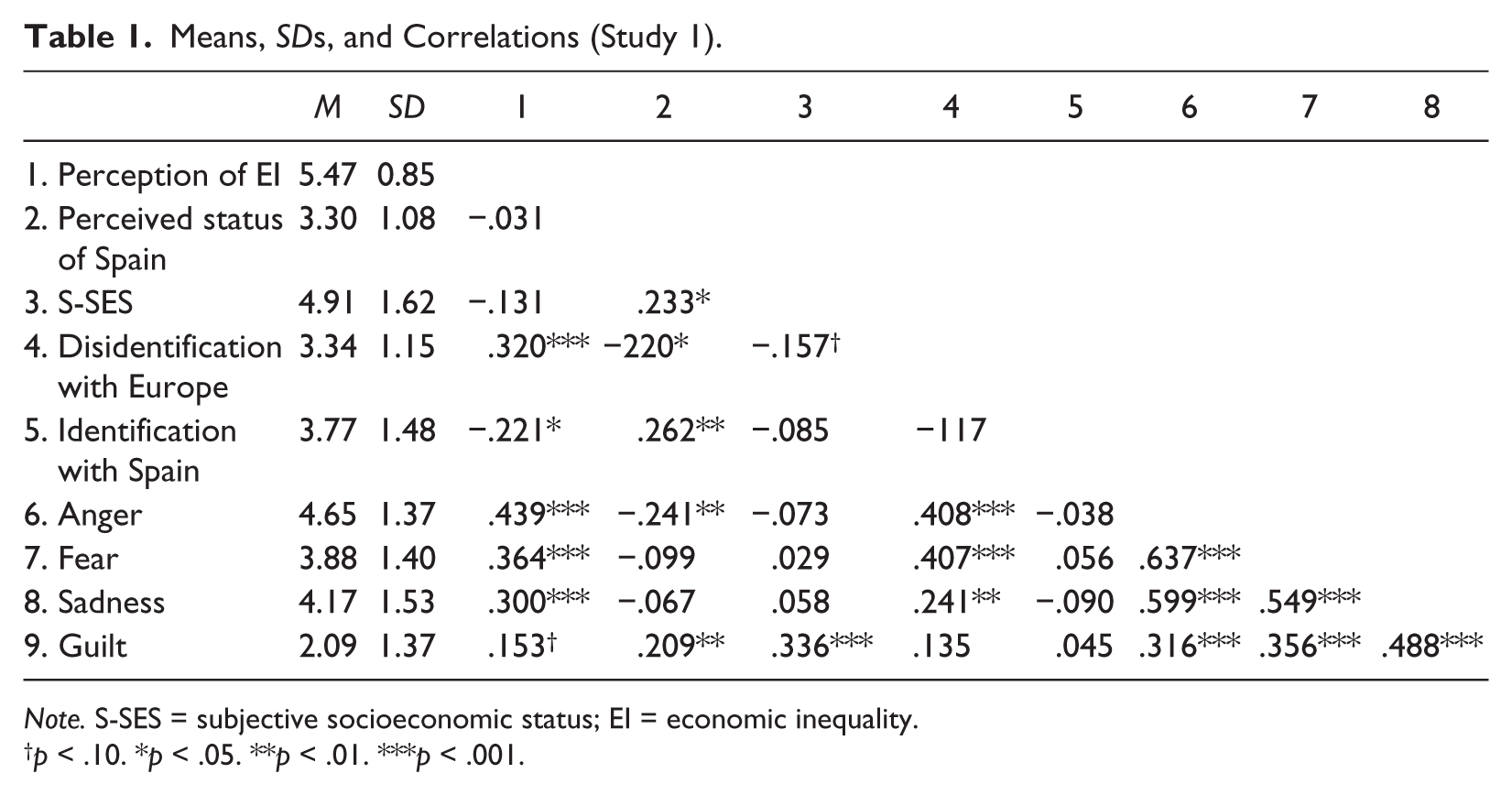
Note. S-SES = subjective socioeconomic status; EI = economic inequality.
p < .10. *p < .05. **p < .01. ***p < .001.
Perceived EI as a predictor of disidentification with Europe
We first conducted a hierarchical multiple regression analysis using disidentification with Europe as the criterion variable. Perceived status of Spain, participants’ S-SES, participants’ sex (0 = men, 1 = women), and age were introduced as covariates in Step 1, whereas perceived EI was included in Step 2. Model 1 was significant, F(4, 102) = 3.75, p = .007; both sex (β = .198, p = .041) and age (β = −.200, p = .033) predicted disidentification with Europe. Perceived status of Spain (β = −.117, p = .238) and participants SES (β = −.111, p = .248) were not found to predict disidentification with Europe. More importantly for our prediction, Model 2 was significant as well, F(5, 101) = 4.48, p = .001. Perceived EI explained an additional 5.4% of the variance of disidentification with Europe, F(1, 101) = 6.60, p = .012. As expected, perceived EI positively predicted disidentification (β = .236, p = .012) when controlling for the perceived status of Spain within the EU, participants’ S-SES, age, and sex (see Table 2).
Hierarchical Regression Analysis to Predict Disidentification With Europe (Study 1).
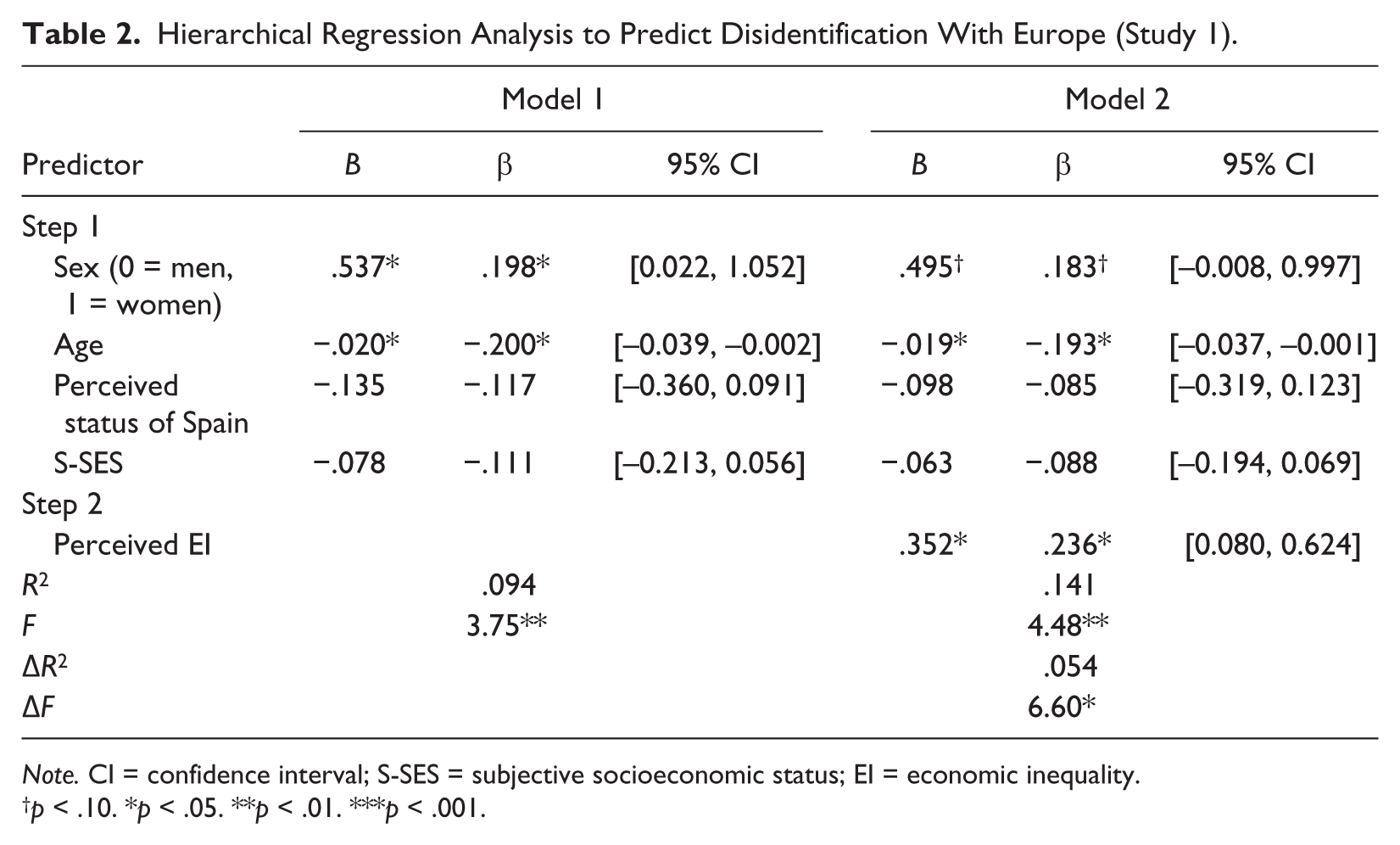
Note. CI = confidence interval; S-SES = subjective socioeconomic status; EI = economic inequality.
p < .10. *p < .05. **p < .01. ***p < .001.
Multiple mediation analysis
To examine the possible mediating role of the different emotional reactions to EI in the relationship between perceived EI and disidentification with Europe, we conducted a multiple mediation analysis (Preacher & Hayes, 2008). This analysis was performed with the Process macro for SPSS (Model 4) using bias-corrected bootstrapping for 10,000 resamples and 95% confidence interval (Hayes, 2013). Perceived status of Spain and participants’ S-SES were included as covariates. When mediators (i.e., anger, fear, sadness, and guilt) were simultaneously added to the model, the only significant indirect effect was that of fear, IEfear = 0.08 (0.06), [0.0022, 0.2626] (see Figure 1). Anger, sadness, or guilt did not mediate the relationship between perceived EI and disidentification with Europe; IEanger = 0.12 (0.08), [−0.0292, 0.2987]; IEsadness = −0.05 (0.05), [−0.0081, 0.1705]; IEguilt = −0.04 (0.04), [−0.0081, 0.1705].
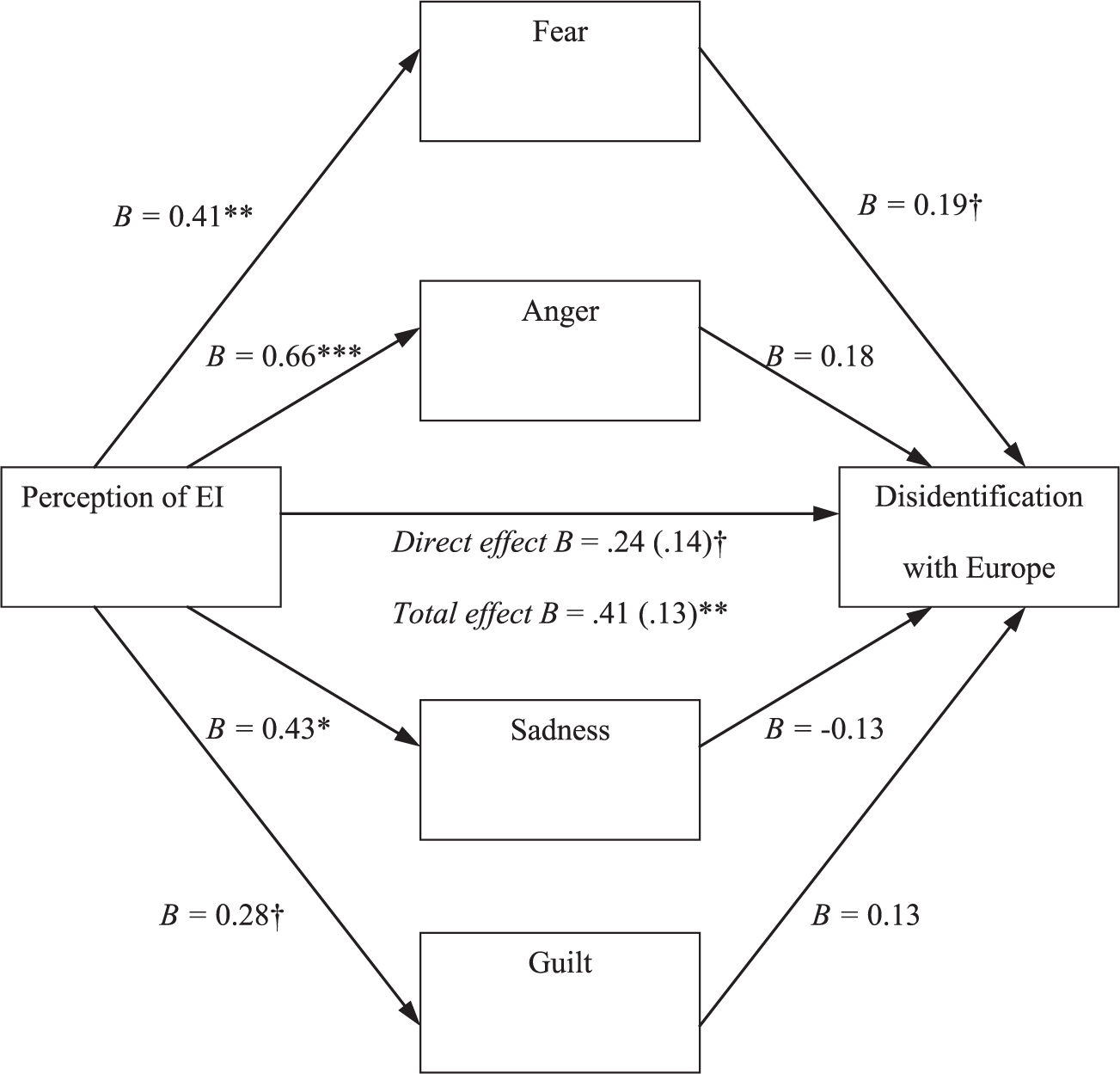
Multiple mediation analysis: Emotions toward EI as mediators between perception of EI and disidentification with Europe.
Discussion
The results of Study 1 provided evidence supporting our hypothesis that perceived EI in EU would positively predict Spanish citizens’ disidentification with Europe over and above the perceived status of the country and individuals’ S-SES. Moreover, these results revealed that the greater the gap that people perceive among EU countries, the more anger, fear, and sadness they experience. These negative emotional reactions suggest that EI is perceived as threatening (Kamans et al., 2011; H. J. Smith et al., 2008).
However, as expected, only fear reactions mediated the relationship between perceived EI and disidentification with Europe. This is consistent with appraisal theories supporting that this emotion is associated with people’s tendencies to distance themselves from threats (Frijda et al., 1989). These results provide initial support for our hypothesis that threat perceptions mediate the relationship between perceived EI and disidentification with Europe. Yet, the operationalization and measurement of threat in this study was somewhat vague, given that it did not provide any information about the specific content of threat that is hidden behind fear reactions. Studies 2a and 2b measured different specific appraisals of fear related to EI in the EU and explored those that mediated the relationship between perceived EI and disidentification with Europe.
Studies 2a and 2b
Studies 2a and 2b were conducted in Spain and Greece, respectively, to test our hypotheses in two different countries of the EU that have been affected by the recent economic recession. In these studies, we additionally measured identification with Europe to explore how this variable is related to disidentification and to the other variables of our interest.
Method
Participants and procedure
Two hundred fifty Spanish citizens (161 women, 77 men, and 12 participants of undisclosed sex) aged between 18 and 78 years (M = 33.9 years, SD = 15.12 years) voluntarily participated in Study 2a. Participants were recruited using an incidental sampling method in public spaces of a Spanish city.
Participants of Study 2b were 205 Greek citizens (134 women, 43 men, and 28 participants of undisclosed sex) aged between 18 and 77 years (M = 40.93 years, SD = 13.16 years). 2 They were recruited through snowball sampling and voluntarily completed the online survey using Qualtrics software.
Pilot study
A preliminary study was first conducted to qualitatively explore the specific appraisals of fear that are related to perceived EI in the EU and may potentially lead to disidentification with Europe. Forty-nine Spanish citizens (25 women, 22 men, and two participants of undisclosed sex) aged between 18 and 62 years (M = 29.7 years, SD = 9.3 years) were recruited through incidental sampling in public libraries of a Spanish city. Participation was voluntary and consisted of answering an open-ended single question: “Why do Spanish people feel fear when thinking about EI among EU countries?” Participants were encouraged to mention at least three different reasons.
A total of 159 answers were collected. First, two of the researchers independently analyzed the content of participants’ responses. Responses identified as sharing a common theme were combined to form a broad response category of appraisals of fear (for a similar procedure, see Czopp & Monteith, 2003). In a second session, the two independent schemes developed by the two researchers were compared and any discrepancies were resolved through discussion. A total of four categories of fear appraisals emerged: (a) worsening of living conditions, (b) losing national sovereignty, (c) being negatively stereotyped, and (d) Europe losing fundamental values. Definitions of the categories and examples of the responses are provided in Supplementary Material S2. Next, two independent coders blind to the aim of the research read the definitions of the different categories and assigned each of the participants’ responses to one of the different categories (kappa = .56, p < .001).
Measures
We included the same measures in both studies in the order they are reported below. Measures were presented in Spanish and Greek for Studies 2a and 2b, respectively. Translations from English into Spanish or Greek (when the original scale was in English) and translations from Spanish into Greek (for items originally created in Spanish) were performed by bilingual researchers.
Identification with European and national identity
A single item measured participants’ identification with Europe: “I identify with Europe” (Postmes, Haslam, & Jans, 2013). The same item was adapted and used to measure national identification: “I identify with Spain/Greece” (1 = not at all, 7 = strongly).
Perceived EI
We used the same two items included in Study 1 (rSpain = .417, p < .001; rGreece = .600, p < .001).
Perceived status of the country within the EU
The same two items used in Study 1 measured participants’ perception of the status of Spain/Greece in the EU (rSpain = .556, p < .001; rGreece = .479, p < .001).
Appraisals of fear toward EI
This measure was developed drawing on participants’ most representative answers for each category in the pilot study. All items followed the structure, “I am afraid that . . .” Fear of losing national sovereignty was measured with the following items: “ . . . Spain/Greece may depend on the decision of other countries in the EU,” “ . . . Spain/Greece may lose its autonomy as a country,” and “ . . . Spain/Greece may lose its capacity to freely decide about internal issues” (αSpain = .753, αGreece = .880). Fear of worsening of living conditions was measured with the items “ . . . the working conditions may get worse in Spain/Greece,” “ . . . Spain/Greece may lose its welfare state,” and “ . . . cuts in public services, educational and health system may increase” (αSpain = .787, αGreece = .810). Fear of being negatively stereotyped was assessed by items “ . . . Spanish/Greek people may be perceived as less competent than other European citizens,” “ . . . Spanish/Greek people may be perceived as inferior to other citizens of the EU,” and “ . . . Spanish/Greek people may be negatively valued compared with other citizens of the EU” (αSpain = .829, αGreece = .866). Finally, the category of fear of Europe losing fundamental values was composed of the following items: “ . . . fundamental rights and liberties may not be respected in the EU,” “the EU may not promote equality of opportunities,” and “xenophobia and discrimination may increase in the EU” (αSpain = .794, αGreece = .727). Answers were given on a 7-point scale (1 = not at all, 7 = very much).
Disidentification with Europe
Disidentification was assessed with the same scale included in Study 1 (αSpain = .943, αGreece = .943; Becker & Tausch, 2013).
S-SES
Similarly to Study 1, participants answered the S-SES scale (Adler et al., 2000).
Demographic information
Participants completed the same demographic questions as in Study 1. They additionally reported their political orientations and their family income.
Results
Means, standard deviations, and Pearson’s correlations are presented in Table 3 for the Spanish and the Greek samples separately.
Means, SDs, and Correlations Studies 2a and 2b.

Note. See lower triangular matrix for Spanish sample (Study 2a) and upper triangular matrix for Greek sample (Study 2b). EI = economic inequality; S-SES = subjective socioeconomic status.
p < .10. *p < .05. **p < .01. ***p < .001.
Given that one of the aims of Studies 2a and 2b was to explore possible differences between the two countries, data from Spain and Greece were pooled (455 participants in total). Culture (Spanish vs. Greek) was introduced in the subsequent analyses to explore its main and interaction effects with perceived EI.
Comparison between the Spanish sample (Study 2a) and the Greek sample (Study 2b)
Two ANOVAs were first conducted with culture as the independent variable. Perceived EI and disidentification with Europe were introduced as dependent variables in each ANOVA. 3 Results revealed that Greek participants perceived greater EI and reported greater disidentification with Europe than Spanish participants, FEI(1, 434) = 25.70, p < .001, η2 = .056; Fdisidentification(1, 424) = 10.91, p = .001, η2 = .025 (see Table 3 for means and SDs).
Next, we conducted a MANOVA with the four appraisals of fear as dependent variables and culture as the independent variable. Results revealed a significant multivariate effect of culture, F(4, 425) = 8.55, p < .001, η2 = .074. Compared with Spanish participants, Greek participants reported greater fear of Europe losing fundamental values, F(1, 428) = 27.71, p < .001, η2 = .061; fear of losing national sovereignty, F(1, 428) = 23.85, p < .001, η2 = .053; and fear of worsening of living conditions, F(1, 428) = 8.49, p = .004, η2 = .019. 4 The univariate effect of culture on fear of being negatively stereotyped was not significant, F(1, 428) = 1.86, p = .174, η2 = .004.
Perceived EI as a predictor of disidentification with Europe
Next, we performed a multiple hierarchical regression analysis on disidentification with Europe. Continuous predictors were first standardized within each study. As in Study 1, perceived status of the country, participants’ S-SES, sex (0 = men, 1 = women), and age were introduced in Step 1. The culture variable (0 = Spanish, 1 = Greece) was additionally introduced in Step 1. Perceived EI was included in Step 2, and the perceived EI × Culture interaction was introduced in Step 3 (see Table 4).
Hierarchical Regression Analysis to Predict Disidentification With Europe (Pooled Data Studies 2a and 2b).
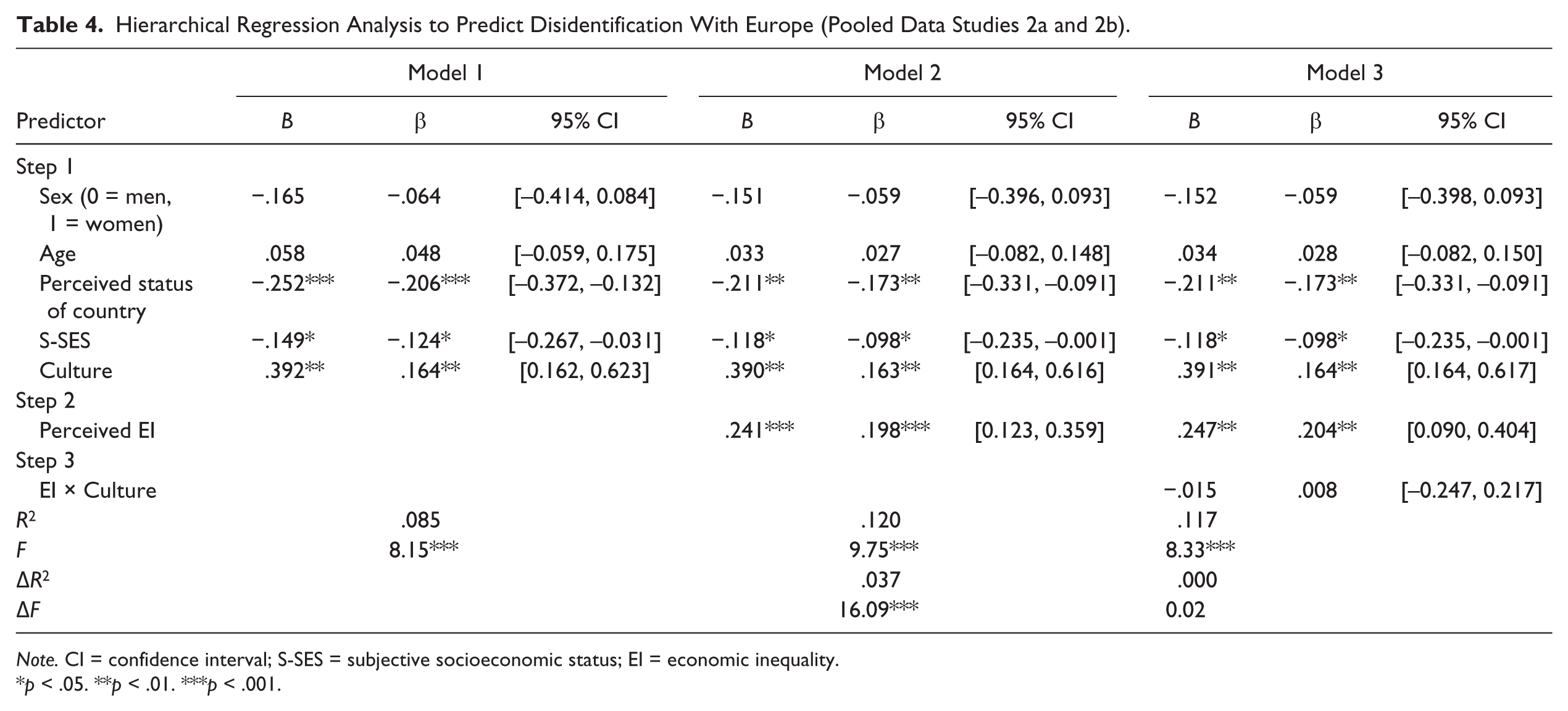
Note. CI = confidence interval; S-SES = subjective socioeconomic status; EI = economic inequality.
p < .05. **p < .01. ***p < .001.
Model 1 was significant, F(5, 381) = 8.15, p < .001. Disidentification with Europe was negatively predicted by the perceived status of the country (β = −.206, p < .001) and S-SES (β = −.124, p = .014). Culture also predicted disidentification with Europe (β = .164, p = .001). As expected, Model 2 was also significant, F(6, 380) = 9.75, p < .001. The explained variance increased by 3.7% after introducing perceived EI, F(1, 380) = 16.09, p < .001. Perceived EI predicted disidentification (β = .198, p < .001) over and above the effects of the perceived status of the country in the EU and participants’ S-SES. The perceived EI × Culture interaction was not significant (β = –.008, p = .901).
Multiple mediation analysis
A multiple mediation analysis (Preacher & Hayes, 2008) was performed to test the specific appraisals of fear that better mediated the relationship between perceived EI and disidentification. The variables S-SES, perceived status of the country, and culture were introduced as covariates.
Results revealed an indirect effect of perceived EI on disidentification with Europe through fear of losing national sovereignty, IE = 0.07 (0.02), [0.0326, 0.1250], and fear of Europe losing fundamental values, IE = 0.10 (0.03), [0.0506, 0.1749], with 95% confidence intervals (see Figure 2). A comparison of the two indirect effects (see Preacher & Hayes, 2008) revealed that indirect effects did not differ in magnitude, B = −0.03 (0.03), [−0.0438, 0.1151]. The indirect effect of perceived EI on disidentification through fear of worsening of living conditions was also significant but in the opposite direction, IE = −0.05 (0.02), [−0.1126, −0.0186]. No mediation occurred through fear of being negatively stereotyped, IE ~ 0.00 (0.01), [−0.0159, 0.0173]. 5

Multiple mediation analysis: Appraisals of fear as mediators between perception of EI and disidentification with Europe (pooled data of Studies 2a and 2b).
Discussion
The results of Studies 2a and 2b replicated the findings of Study 1 and provided additional support for our main hypothesis: Perceived EI predicted disidentification with Europe even when controlling for perceived status of the country and participants’ socioeconomic status. They also revealed that fear of losing national sovereignty and fear of Europe losing fundamental values mediated the relationship between perceived EI and disidentification with Europe; this held true in two different countries of the EU.
These results support the idea that values and rights are an important aspect of collective identities, in general, and of the European identity, in particular (David & Bar-Tal, 2009; Oshri, Sheafer, & Shenhav, 2016). Moreover, our results are in line with those of previous studies that have shown that identification with a superordinate identity is hindered by fear of loss of national sovereignty and power (Cinnirella, 1997; Sindic & Reicher, 2009).
Surprisingly, the indirect effect of perceived EI on disidentification through worsening of living conditions operated in the opposite direction to that of the direct effect. That is, an increased fear of worsening of living conditions predicted lower levels of disidentification. It may happen that European citizens from countries with lower status and weaker economies perceive that leaving the EU could be even more detrimental to their standard of living.
A comparison between the two countries showed that Greek participants scored higher than Spanish ones on almost all variables of interest. In other words, participants in Greece perceived greater EI, greater threat, and disidentified more with Europe. Status differences between the two countries could be a possible explanation for these differences. Indeed, additional analyses showed that the perceived status of the country mediated these effects. Specifically, Greek participants, compared with Spanish ones, perceived that their country had a lower status in the EU. As a result, they perceived greater EI, they disidentified more with Europe, and they reported greater fear of losing national sovereignty, fear of Europe losing fundamental values, fear of being negatively stereotyped, and fear of worsening of living conditions (see Supplementary Material S2).
Following authors who suggested that disidentification is different from nonidentification (Becker & Tausch, 2013; Zou et al., 2008), we also measured identification with Europe apart from disidentification in Studies 2a and 2b. Our results showed that these constructs were highly correlated (see also Supplementary Material S2). However, we considered that it was more relevant for the aim of the present research to explore disidentification, which is likely to be particularly informative when trying to understand the willingness to abandon the EU.
General Discussion
Disidentification with Europe seems to be an issue that urgently requires our understanding. However, little is known yet about the reasons why some Europeans distance themselves from the European identity. The present research provided evidence that perceived EI among the countries of the EU undermines European identity. Across three studies conducted in two different cultural settings, we demonstrated that EI predicts feelings and appraisals of fear among Spanish and Greek European citizens and leads them to disidentify with Europe.
Previous studies have suggested that perceiving that one’s country has lower status than other European countries leads to more negative attitudes toward the EU (Meier-Pesti & Kirchler, 2003). In line with these findings, Studies 2a and 2b showed that perceived status of the country negatively predicted disidentification with Europe. However, our findings also went beyond those of previous research in two ways. First, to the best of our knowledge, this is the first study that has directly measured disidentification rather than attitudes toward Europe. Second, our results demonstrated that perceived EI independently predicts disidentification with Europe over and above the perceived status of the country and participants’ socioeconomic status.
This result adds to the literature about the pernicious effects of EI on social cohesion (Neville, 2012; Oishi et al., 2011). According to the common in-group identity theory, identification with a broader common identity promotes social harmony and cohesion among the members of the different subgroups that compose it (Gaertner & Dovidio, 2000). Disidentification with the superordinate European identity could be considered as a manifestation of a lack of social cohesion within the European family, which may potentially lead to negative and conflictive attitudes and behaviors (Reese & Lauenstein, 2014).
Furthermore, our results illustrate some of the psychological mechanisms that play an important role in this disidentification process. Study 1 revealed that the relationship between EI and disidentification with Europe is mediated by feelings of fear—and not by sadness, anger, or guilt. This finding confirms the assumptions of the appraisal and intergroup emotions theories that fear is associated with avoidance tendencies (Frijda et al., 1989; Osborne et al., 2012). Studies 2a and 2b enhanced our understanding of the specific appraisals of fear that mediate this relationship. Although EI was positively correlated with all the different appraisals of fear measured in these studies—worsening of living conditions, being negatively stereotyped, losing national sovereignty, and Europe losing fundamental values—only the latter two positively predicted disidentification with Europe. This is in line with the findings of previous studies on identity threat that suggest that concerns related to the relative power of a subgroup within a common group predict subgroup members’ separatist tendencies from the superordinate entity (Hornsey & Hogg, 2000; Sindic & Reicher, 2009). Our findings are also consistent with those obtained in other European countries. For instance, Cinnirella (1997) showed that threat to national sovereignty was a reason for perceived incompatibility between the European and the national identity in Britain.
Other scholars have shown that values are a crucial feature of collective identities (David & Bar-Tal, 2009). In particular, fundamental values and rights have been defined as the cornerstone of the European identity and European citizens are socialized to respect them (Oshri et al., 2016). Our research provides cross-cultural evidence that loss of these values makes European identity less appealing.
Contrary to previous research highlighting that concerns related to stigma and stereotypes predict disidentification with the superordinate identity (Jasinskaja-Lahti et al., 2009; Major & O’Brien, 2005), fear of being negatively stereotyped did not mediate the relationship between perceived EI and disidentification with Europe. A possible explanation could be that the possibility of being negatively stereotyped does not affect the everyday lives of Spanish and Greek citizens within their national contexts but may gain relevance in a context of interaction between the members of the different subgroups. For instance, this type of fear may mediate the relationship between EI in the EU and disidentification with Europe for Spanish and Greek citizens who live in other European countries.
Importantly, the direct and indirect effects of EI on disidentification with Europe did not differ between the two countries. This is not surprising given that Spain and Greece were both affected by the recent economic recession and share a common Mediterranean culture. Future studies could test whether our predictions hold true in countries that were also affected by the economic crisis but have a different cultural background (e.g., northern countries such as Ireland).
Following Wilkinson and Pickett’s (2010) argument, it could be expected that perceived EI positively predicts disdentification with Europe also in countries with higher relative status and stronger economies (e.g., Germany). Future studies could test this prediction and explore the specific appraisals that may act as mediators in those cultural and socioeconomic contexts.
It is worth noting that participants’ ratings of disidentification with Europe were moderate across all studies, which means that European identity is still an existing and established identity. One of the challenges that Europe currently faces is probably to implement policies that promote equality and provide a meaningful and secure superordinate identity for all the countries of the European family, that is, the wealthier and the less wealthy alike. Although this is only speculative, we suggest that respect of fundamental values and national sovereignty is likely to warrant a strong European identity. In fact, fundamental values and rights may confer meaning to the European culture and entitativity to the European identity (i.e., having a real existence; Castano, Yzerbyt, & Bourguignon, 2003); moreover, perceptions that the national sovereignty is not in jeopardy may increase feelings of compatibility between the national and the European identity.
The main limitation of our study is that the correlational nature of our designs does not allow us to claim a causal relationship between variables. Nevertheless, intergroup emotions theory and the theory of appraisals and action tendencies related to specific emotions give us some good reasons to infer this causality (Frijda et al., 1989; Mackie et al., 2000; H. J. Smith & Kessler, 2004). Future studies could manipulate EI in the EU to provide such causal evidence.
Another limitation concerns our samples. First, the use of snowballing and incidental sampling methods caused some inevitable imbalances in our samples (e.g., a majority of women). Thus, generalizations should be made with caution. Second, the samples of Studies 2a and 2b had some differences in sociodemographic variables such as age, sex, S-SES, and ideology—due to different recruitment methods or real differences of the populations—that raise issues of comparability. Importantly, controlling for these variables did not alter our direct and indirect effects.
In conclusion, our research revealed that EI in the EU undermines the European identity by increasing feelings of threat among European citizens from two countries in Southern Europe affected by the economic crisis. Moreover, this research highlights the importance that these European citizens give to respect of national sovereignty and fundamental values. The absence of these elements ultimately leads to disidentification with Europe.
Supplementary Material
supplementary material, Final_Supplements_EIandEuropeanIdentity – Two Countries in Crisis: Economic Inequality in the EU and Disidentification With Europe in Spain and Greece
supplementary material, Final_Supplements_EIandEuropeanIdentity for Two Countries in Crisis: Economic Inequality in the EU and Disidentification With Europe in Spain and Greece by Katerina Petkanopoulou, Ángel Sánchez-Rodríguez, Guillermo B. Willis, Xenia Chryssochoou, and Rosa Rodríguez-Bailón in Journal of Cross-Cultural Psychology
Footnotes
Declaration of Conflicting Interests
The author(s) declared no potential conflicts of interest with respect to the research, authorship, and/or publication of this article.
Funding
The author(s) disclosed receipt of the following financial support for the research, authorship, and/or publication of this article: This research has been conducted within the project Ref. PSI2016-78839-P funded by the Spanish Ministry of Economy and Competitiveness and the grant “IKY Scholarship Programs-Strengthening Post Doctoral Research” cofinanced by the European Social Fund—ESF and the Greek government.
Supplemental Material
Supplementary material for this article is available online.
Notes
References
Supplementary Material
Please find the following supplemental material available below.
For Open Access articles published under a Creative Commons License, all supplemental material carries the same license as the article it is associated with.
For non-Open Access articles published, all supplemental material carries a non-exclusive license, and permission requests for re-use of supplemental material or any part of supplemental material shall be sent directly to the copyright owner as specified in the copyright notice associated with the article.
