



Abstract
Most research on workplace incivility has been conducted in the United States, where the cultural logic of dignity prescribes that individuals’ worthiness be determined in reference to self-set standards. This inductive study explores the construal of workplace incivility in a contrasting cultural logic of honor, where an individual’s worth is largely dependent on the esteem of others. In particular, it seeks to understand how the logic of honor may influence which behaviors are labeled as incivility and which criteria are used to appraise uncivil behaviors in the Turkish context. In the first phase of the study, we asked 53 Turkish employees for examples of workplace incivility behaviors and generated 32 incivility episodes. In the second and third phases, using data from 35 business students and 106 Turkish employees, we analyzed these episodes using multidimensional scaling technique. The results suggested that workplace incivility may have both universal and culturally salient manifestations, and that Turkish respondents appraised uncivil behaviors along three dimensions: honor threatening versus ordinary, excluding versus intruding, inoffensive versus offensive. We further observed that Turkish participants differentiated the power of the instigator (supervisor vs. coworker) as well as the omission of versus commission of behaviors. We discuss the results with a focus on understanding how the honor logic may manifest itself in professional relationships.
Scholarly interest in workplace incivility has been consistently increasing as evidenced by the recent literature reviews (e.g., Cortina, Kabat-Farr, Magley, & Nelson, 2017; Schilpzand, De Pater, & Erez, 2016). Defined as “low-intensity deviant behavior with ambiguous intent to harm the target, in violation of workplace norms for mutual respect” (Andersson & Pearson, 1999, p. 457), uncivil behaviors typically include sarcasm, condescension, interruption, subtly disparaging remarks as well as nonverbal displays of disrespect such as ignoring (Cortina, Kabat-Farr, Leskinen, Huerta, & Magley, 2013; Cortina, Magley, Williams, & Langhout, 2001; Lim, Cortina, & Magley, 2008). Yet, despite being a low-key stressor, workplace incivility has been found to cause more psychological and physical harm than other major but time-limited stressors (e.g., Lim et al., 2008; Pearson, Andersson, & Wegner, 2001; Porath & Erez, 2007).
These adverse consequences of incivility are predicted more accurately when targets’ appraisal is taken into account (e.g., Cortina & Magley, 2009). Appraisal refers to a multistage cognitive-emotional evaluation process of a stressful event in an attempt to determine its potential harm to one’s well-being (Smith & Lazarus, 1993). Although the role of target characteristics (e.g., personality), status of the instigator, and the characteristics of the uncivil incident (e.g., frequency, duration, variety) have been studied in the appraisal of incivility (Beattie & Griffin, 2014; Bunk & Magley, 2013; Cortina & Magley, 2009), less attention has been given to contextual factors. One increasingly relevant operationalization of context for organizational psychology involves societal culture (Gelfand, Leslie, & Fehr, 2008). However, Schilpzand and her colleagues’ (2016) review reveals that the vast majority of the incivility research has emerged from the United States, followed by Australia. Only a handful of studies are from China, Korea, the Philippines, and Singapore, and several of them have not incorporated the cultural context into their research questions or design (e.g., Y. Chen et al., 2013; Scott, Restubog, & Zagenczyk, 2013). This seems problematic as cross-cultural research points to important differences in both the meaning and enactment of general and workplace aggression (e.g., X. Li & Lim, 2017; Severance et al., 2013). Given its ambiguous nature, workplace incivility is likely to be even more susceptible to cultural variation.
A useful approach to investigate this possibility is the honor, face, and dignity framework, which proposes that cultures differ in terms of how an individual’s worthiness is ascertained, specifically, the extent to which it is inherent to the individual or whether it is socially conferred (Leung & Cohen, 2011). In dignity cultures, such as the United States (the northern states in particular, see Nisbett & Cohen, 1996) or Western Europe, the self is construed to be autonomous and independent, and a person’s worthiness is not based on the opinions of others, but on internal (i.e., self-generated) evaluations. This is in stark contrast to honor cultures, such as Middle Eastern or Latin American societies, or face cultures of East Asia, where one’s worth is very much dependent on the respect garnered from others. Yet, beyond this commonality, members of face and honor cultures react considerably differently to threats to their worthiness (Leung & Cohen, 2011; Severance et al., 2013). However, organizational research to date has not been very discerning of the nuances among cultures that were originally bundled as collectivist (e.g., Hofstede, 2001), and the literature that has formed the basis of subsequent research is largely reflective of the face-based collectivism of East Asia (e.g., Markus & Kitayama, 1991).
In this study, we employed an inductive approach to explore the construct of workplace incivility in the Turkish context, which is an honor-based collectivist culture (Cross et al., 2014; Uskul, Cross, Sunbay, Gercek-Swing, & Ataca, 2012). To this end, we conducted an incivility episode/behavior generation, a multidimensional scaling (MDS), and an attribute rating study with three distinct samples. In what follows, we first elaborate on the honor, face, and dignity framework. Next, we report the findings of the three interrelated studies. We discuss what seem to be universal versus culturally salient manifestations of workplace incivility and how the honor logic may manifest itself in organizational contexts, a topic hitherto underexplored.
The Cultural Logics of Honor, Face, and Dignity: Implications for Incivility
Cultural logics create a pattern of shared scripts, behaviors, and practices around a central theme, thereby providing coherence for the people living in a specific culture (Leung & Cohen, 2011). The cultural logics of honor, face, and dignity have important implications with respect to the establishment of one’s social standing, public image, and trustworthiness (Y.-H. Kim, Cohen, & Au, 2010). In particular, these logics vary in the respective importance of internal (i.e., self-generated) versus external (i.e., other-generated) evaluations in determining one’s worth. Dignity cultures are contexts where the worth of an individual is less contingent on others’ evaluations or approval. In such typically individualistic cultures, one’s behaviors are determined by a concern for autonomy and agency. This desire to maintain sovereignty may require disregarding others’ evaluations in an assessment of self-worth (Y.-H. Kim et al., 2010). Instead, the worth of an individual is defined by reference to self-set standards or achievement of self-set goals. As such, in dignity cultures, self-worth is an intrinsic value that cannot be taken away by other people. This mind-set is argued to be apparent in the English rhyme of “stick and stones may break my bones, but names will never hurt me.” Even if vexing, disrespectful behaviors are less likely to damage one’s fundamental sense of self, nor are they likely to affect one’s perceptions of social standing (Aslani, Ramirez-Marin, Semnani-Azad, Brett, & Tinsley, 2013; Severance et al., 2013).
Contrast the above rhyme with a popular Turkish saying, “a sword wound heals, but a wound inflicted by the tongue never heals.” The saying warns people to watch their words, as they may never be forgiven or forgotten if truly hurtful. Implying the importance of others’ assessments as well as the possible repercussions to undue assertions made by others, this saying nicely summarizes the gist of an honor mind-set. Honor refers to the value of a person in his [sic] own eyes but also in the eyes of his society. It is his estimation of his own worth, his claim to pride, but it is also the acknowledgement of that claim, his excellence recognized by his society, his right to pride. (Pitt-Rivers, 1966, p. 21)
Being honorable is evident in being trustworthy and keeping one’s word, but also in a reputation for toughness in protecting self and family, and not being taken advantage by others (Nisbett & Cohen, 1996).
Face cultures are similar to honor cultures in that the opinions and sentiments of others, in particular, their assessments as to whether the individual is fulfilling social role obligations, are crucial in determining a person’s social worth (Heine, 2001; Ho, 1976). However, due to the different settings from which they historically emerged, face and honor cultures diverge in their reaction to threats to their worthiness. Face cultures are characterized by stable hierarchies that are essentially cooperative (Leung & Cohen, 2011). Status-related roles and boundaries are carefully observed, and direct conflicts are avoided to preserve interpersonal harmony (Gelfand et al., 2001; Y.-H. Kim et al., 2010; Leung & Cohen, 2011). In contrast, honor mind-sets are argued to be a psychological heritage of more lawless, unstable, and competitive environments, which afford or necessitate stronger norms for both positive reciprocity (returning gifts or hospitality) and negative reciprocity (retaliation for insults or harm; for the origins of honor, face, and dignity cultures, please refer to Aslani et al., 2013; Leung & Cohen, 2011).
Albeit scarce, the cross-cultural research on workplace incivility has largely focused on the issue of prevalence, either in the form of instigation (e.g., Liu, Chi, Friedman, & Tsai, 2009), or reciprocation (e.g., T. Y. Kim & Shapiro, 2008). These studies have explored whether in collectivist cultures, where there is a strong emphasis on interpersonal harmony, workplace incivility would be observed to a lesser extent. However, the proposition that incivility would occur less in collectivist cultures reflects the face logic of humility and self-control to fit in the hierarchical structures typical of such societies (Aslani et al., 2013; Y.-H. Kim et al., 2010). In face cultures, when conflict does arise, intervention by superiors is preferred because direct punishment by the target is regarded as disruptive to the established hierarchy (Leung & Cohen, 2011). Furthermore, for face-based collectivists, protecting others’ face is also of the utmost importance and individuals may overlook uncivil behaviors or refrain from expressing their true feelings (Gelfand et al., 2001; Severance et al., 2013). In contrast, for honor-based collectivists, being an honorable person is possible only if other people accept an individual’s honor claims (e.g., Rodriguez Mosquera, Manstead, & Fischer, 2002). This brings with it a certain vigilance regarding others’ displays of disrespect (Aslani et al., 2013). Indeed, as put succinctly by Stewart (1994), honor is experienced as “a right to respect.” Hence, honor cultures are quick to view conflicts as challenges to status and reputation, and aggressive and emotional confrontation is more normative in honor than in dignity or face cultures (Aslani et al., 2016; Aslani et al., 2013; Uskul et al., 2014).
Yet, this should not suggest that honor cultures are abounding with incivility. Although research has focused on the link between insult and retaliatory aggression (e.g., Nisbett & Cohen, 1996), an important characteristic of honor cultures is the coexistence of politeness and violence norms (Cohen, Vandello, Puente, & Rantilla, 1999; Shafa, Harinck, Ellemers, & Beersma, 2015). One reason for these seemingly contradictory norms to coexist is that, in honor cultures, people are aware of the prospect of violence escalation if they offend others, and politeness is a means of preventing long spirals of revenge (Cohen et al., 1999; Harinck, Shafa, Ellemers, & Beersma, 2013). For instance, Cohen and his colleagues (1999) showed that although honor-oriented U.S. Southerners did not show anger to an annoying confederate at the beginning, after a certain threshold, they gave a more severe reaction than dignity-oriented U.S. Northerners. In a similar vein, Harinck et al. (2013) found that honor-oriented individuals were cooperative in conflict situations, even more so than dignity-oriented individuals as long as they were not insulted.
Overview of Research
The purpose of this study is to uncover the conceptualization of workplace incivility in an honor culture, namely Turkey. Though the above discussion raises the prevalence of incivility in different contexts, the frequency assessment is contingent on what is labeled as incivility. Yet, cross-cultural research has typically used incivility scales developed in the United States and taken a leap of faith in terms of construct validity (Leung & van de Vijver, 2008). To avoid this possible bias, in the first phase, we asked Turkish employees to list uncivil behaviors they experienced or observed in their workplaces. Based on the literature, we expected to observe the more direct and overt incivility behaviors (e.g., raising one’s voice, making insulting remarks) as part and parcel of the norms that legitimize the maintenance of an image of toughness and the retaliation of even ambiguous cues of disrespect. However, because Turkey is an honor-based collectivist culture, which is also mindful of conflict escalations, incivility may take more indirect and subtle forms (e.g., ignoring, not listening) that might pose less risk in social relations. In addition, given their concern for social approval and respect, we speculated that honor-oriented individuals may be quicker to take offense from such ambiguous behaviors and label them as incivility. Therefore, we pose the following research question:
In the second and third phases of the study, using 32 incivility episodes generated from the first phase, we conducted an MDS and an attribute rating study. MDS is a data-reduction technique that produces a geometric map, which illustrates the underlying structure of a complex psychological phenomenon (Pinkley, Gelfand, & Duan, 2005). Through this map, the dimensions along which respondents distinguish or interpret a set of stimuli (e.g., various uncivil behaviors) can be extracted. In the mainstream literature, uncivil behaviors are classified as low-intensity deviant behaviors; yet, if these same behaviors are perceived to be honor threatening for Turkish employees, this will have implications for outcomes as alluded to above. Therefore, we explored the emergence of culturally salient dimensions such as the degree of honor threat or damage to social standing in the appraisal of uncivil behaviors (e.g., Severance et al., 2013):
Method
The study consisted of three phases (Gelfand et al., 2001; Robinson & Bennett, 1995).
Phase 1: Generation of Workplace Incivility Behaviors
A convenience sample of 53 Turkish employees from organizations in different industries (hospitality, manufacturing, pharmaceuticals, telecommunications, consultancy, education, fast-moving consumer goods [FMCG], and finance) were reached through personal and professional networks and voluntarily participated in the study. A little over half (52.8%) were male, the mean age was 32.96 (SD = 5.77), and 92.5% were university graduates. Their average number of years of full-time work experience was 5.42 (SD = 5.35) and they held different jobs such as technicians (16%), office workers (15.4%), supervisors or managers (38.4%), or white-collar professionals (30.2%).
Respondents were told that “employees encounter several negative/mistreatment behaviors in their work lives, which may be minor and possibly unintentional similar to interrupting while speaking, or severe and intentional, similar to a physical assault” and were asked to list up to 10 examples of minor and possibly unintentional negative behaviors that they experienced or observed in their workplaces. They supplied a total of 250 behaviors. Two Turkish doctoral students independently screened these behaviors to remove those that did not reflect the three defining characteristics of workplace incivility, namely, low-intensity deviant interpersonal behaviors with ambiguous intent, which violate norms of mutual respect. The students compared their independent lists at regular intervals to clarify and agree upon the operationalization of this working definition. As a result, the following item selection rules were generated. First, counterproductive task-related behaviors that were not interpersonal in nature (e.g., taking too many breaks, being inattentive during training programs, being late to work) were dropped. Similarly, distributive or procedural justice related items, such as unequal pay for equal work or promotion not being merit-based were excluded. A handful of items captured what may be considered ineffective or capricious supervision; yet, they were entirely task-focused (e.g., supervisor assigning trivial, unpleasant, or impossible tasks) and were dropped. Finally, a set of items that referred to problematic personalities (e.g., selfishness, being narcissistic) was also excluded from further analysis. Although not necessarily involving face-to-face interaction, behaviors that violated norms of respect regarding the use of shared spaces (e.g., speaking loudly on the phone, spraying perfume without checking with others in the room) were kept.
The second criterion of whether the behavior had ambiguous intent resulted in the elimination of political behaviors (e.g., ingratiation toward supervisors, ratting on coworkers) as well as contract violations (e.g., creating problems during pregnancy leave, forced overtime). From the remaining 187 behaviors, the doctoral students further dropped behaviors that were idiosyncratic (e.g., arguing about football teams, slamming the phone), ambiguous in meaning (e.g., lack of rational thinking), or too generic (e.g., lack of respect). The final qualitative screening criterion was whether the behavior violated respect norms in Turkish context. The students then summarized similar items to single behavioral categories. For instance, spraying perfume without asking others in the shared office, speaking loudly on the phone or with other people, or littering the shared work environment were combined to create a single category of “disrupting the shared work space.” To enhance reliability, two subject matter experts (one Turkish and one American professor of organizational psychology) independently assessed the item selection and categorization decisions (Mays & Pope, 1995) and served as “judges” to resolve disagreements between raters.
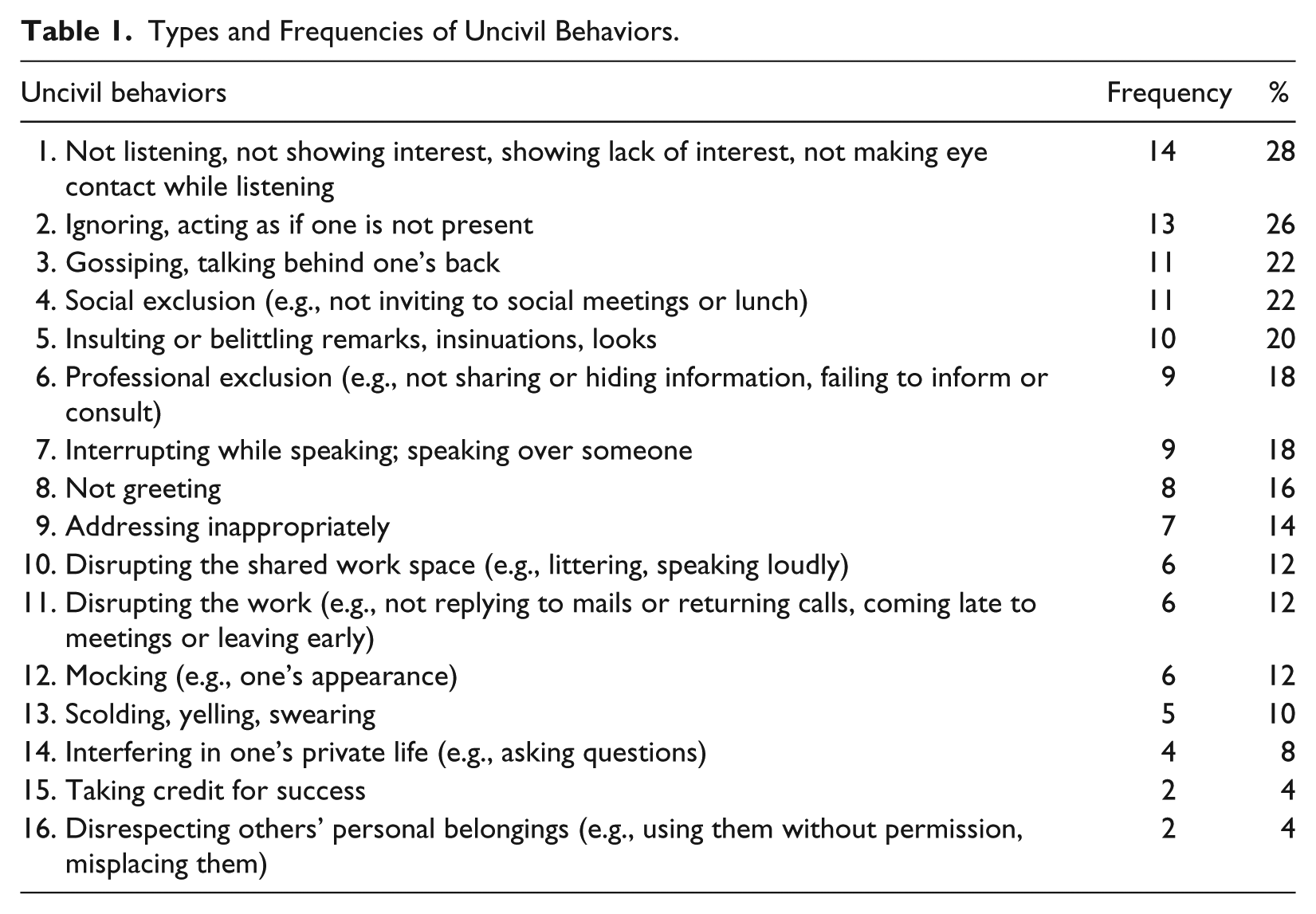
Table 1 shows the final categorization of uncivil behaviors generated from the Turkish sample. 1 The frequencies and the percentages represent the number of participants who mentioned such a behavior at least once. In the Turkish context, the most commonly listed behaviors were more inconspicuous or indirect (e.g., ignoring, not greeting); yet, there was also evidence for uncivil behaviors that were direct or overt (e.g., insulting, scolding).
Types and Frequencies of Uncivil Behaviors.
In the mainstream literature, researchers most commonly assess workplace incivility using the seven- or 12-item Workplace Incivility Scale (WIS; Cortina et al., 2013; Cortina, Magley et al., 2001); developed in the United States. The WIS items, which constitute a single dimension, include behaviors such as insult, inattention to one’s opinions, demeaning remarks, unprofessional terms of address, exclusion from professional camaraderie, expression of doubt about one’s professional judgment, unwanted discussions of personal matters, interrupting, anger outbursts, and hostile looks. Providing a more detailed assessment of workplace incivility is Martin and Hine’s (2005) Uncivil Workplace Behavior Questionnaire (UWBQ), developed in Australia. The UWBQ contains 17 items that map onto a four-factor structure, namely, hostility (e.g., use of a raised voice), privacy invasion (e.g., interference with one’s desk or personal items), exclusionary behavior (e.g., failing to consult or inform an employee), and gossiping.
Comparing the behaviors generated by the Turkish sample with the UWBQ or the WIS, considerable overlap was evident and supported the cross-cultural generalizability of the construct of workplace incivility. Nonetheless, there were noteworthy differences. While the exclusionary behavior subscale of the UWBQ focuses on professional exclusion, the behaviors by the Turkish sample reflected both professional and social exclusion (e.g., not inviting to a social event). In fact, social exclusion and omission of social courtesies such as not greeting were rather salient for Turkish employees. Similarly, although the UWBQ’s privacy invasion subscale captures the abuse of the shared office space solely by reference to personal belongings or workspace privacy, in the Turkish context, the shared nature of the office space was emphasized, and behaviors like talking loudly were mentioned. A final category generated by the Turkish sample, but not evident in the extant scales, was taking credit for success. Although such behaviors may be seen as obviously competitive, hence unambiguous in intent, we reckoned that they may be disguised as or confused with enthusiasm or team spirit and kept them for further analysis.
Of note, Turkish employees reported uncivil behaviors not only from coworkers but also from supervisors such as the supervisor scolding the employee in front of other employees or not listening to the presentation of a subordinate. While instigator status has been found to be an important variable in determining the negativity of incivility appraisals (e.g., Cortina & Magley, 2009), Schilpzand et al. (2016) have suggested that employees in high power distance cultures may be less likely to consider being ignored by their supervisor to be an act of uncivil conduct than employees in low power distance cultures. This argument is based on the notion that in high power distance cultures, such as Turkey, it is normative for authority figures to deviate from the norms of mutual respect or fairness without provoking negative reactions from their subordinates (A. Li & Cropanzano, 2009). However, in the Turkish context, the notion of respect is not limited to deferential esteem by subordinates toward superiors, but also refers to mutual consideration, appreciation, and kind regard (Aycan, 2006). In honor cultures, it is an injunctive norm that those in higher status protect and bestow warmth and generosity toward subordinates (Aslani et al., 2013). Our results suggest that a failure to do so is perceived as incivility by subordinates.
Phase 2: MDS Procedure
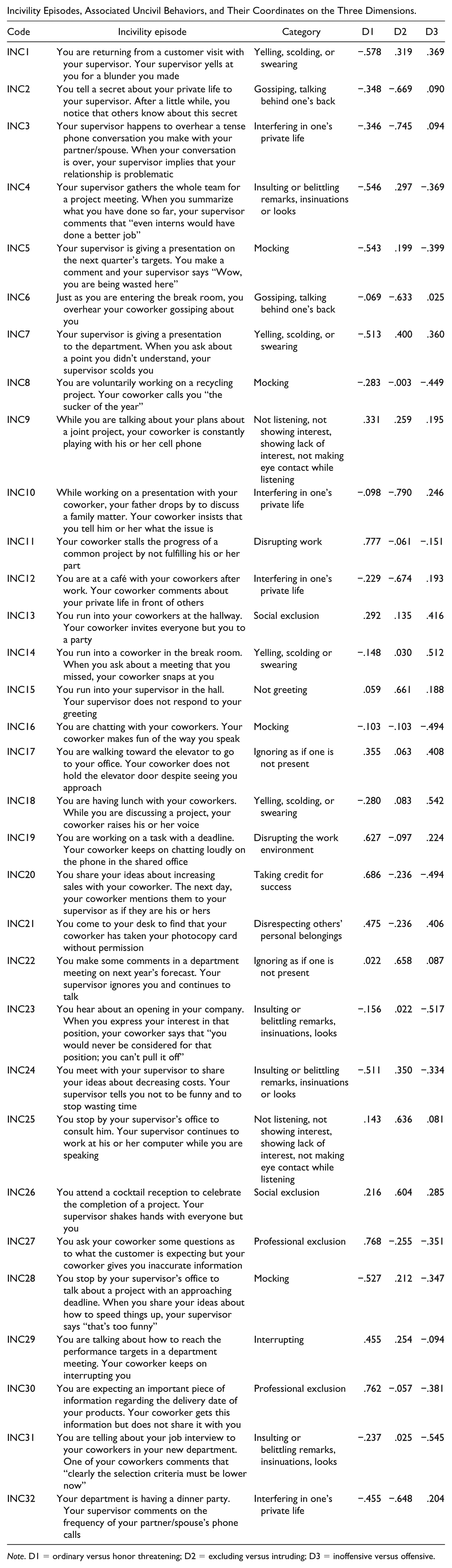
Using the behavioral categories in Table 1, we wrote 32 incivility episodes for the second phase of the study. In Phase 1, a few examples had information on what the literature has identified as moderators, such as the power relationship between the instigator and the target as well as the visibility of the incident (Hershcovis, 2011). Therefore, we created incivility episodes that varied in terms of the behavior, the presence of others (whether the incivility happened in public or in private), and the hierarchical status of the instigator (supervisor vs. coworker). For instance, “Your supervisor is giving a presentation to the department. When you ask about a point you didn’t understand, your supervisor scolds you” reflects an episode of incivility instigated by a supervisor in public (please refer to the Appendix A for the full set of episodes). 2
Thirty-five undergraduate business students enrolled in a private university in Istanbul, Turkey took part in this study in return for course credit. Of the participants, 57.1% were male, and the average age was 22.12 (SD = 1.52). We printed the 32 episodes on separate index cards, gave each participant a pack of cards with instructions to sort the cards into as many mutually exclusive piles as they thought necessary (Giguere, 2006; Rosenberg & Kim, 1975), and to jot down titles (that described how the cards were similar) for each pile. Tullis and Wood (2004) have shown that 20 to 30 participants suffice to obtain reasonable structures in card sorting studies.
We used MDS to identify the dimensions representative of people’s construal of workplace incivility (Ferguson, Kerrin, & Patterson, 1997). MDS enables the transformation of the psychological or cognitive “distances” among uncivil behaviors into Euclidean distances. We converted the data into a matrix of proximity, which indicates distance among stimuli (Whaley & Longoria, 2009). To calculate the measure of distance between two uncivil behaviors, we pooled the similarity information across 35 participants. For instance, if eight of our 35 participants categorized Episodes 1 and 2 together, we estimated the similarity as 8/35 = 0.23. We constructed a 32 × 32 matrix based on the co-occurrence of episodes. Using the SPSS PROXSCAL algorithm, we conducted separate analyses to obtain one- to six-dimension solutions and calculated the stress indices for each. We collected the additional data in Phase 3 to interpret these dimensions (Kruskal & Wish, 1978).
Phase 3: Attribute Ratings for Labeling of Dimensions
One hundred six Turkish employees from a variety of industries, including textiles, pharmaceuticals, consulting, education, chemicals, health care, and finance participated in the study. Females constituted 54.72 % of the sample, and the average age was 32.92 (SD = 8.23). All respondents had at least a bachelor’s degree and held various managerial or specialist positions. The average work experience was 9.98 years (SD = 7.82). These data were collected in two waves, with the first wave collected through personal networks with no material incentive to participate (N = 64), whereas the second wave of data was collected through business school students in return for course credit (N = 42). The analyses conducted separately for the first and the combined sample revealed no notable difference that affected the interpretation of the dimensions.
The task involved the rating of the 32 incivility episodes along 23 attributes related to the appraisal of incivility. Consistent with studies on mistreatment and aggression (e.g., Robinson & Bennett, 1995; Severance et al., 2013), participants rated each episode in terms of its severity or degree of threat (i.e., distressing, hurtful, annoying, provocative, and typical in the workplace), intentionality (unintentional and due to external factors), and directness (i.e., covert, overt, insidious). Given the cultural perspective adopted in the study, we further explored whether respondents perceived a nuance across the episodes in terms of the threat to one’s reputation, social standing, or relationships (i.e., damaging to one’s honor, damaging to one’s reputation, dishonorable, immoral, and embarrassing). We also perused the grouping titles offered by the respondents in Phase 2 for additional insight. The respondents had generated an average of 5.82 groups and a total of 196 grouping titles. Of these, 46% comprised a literal description of the behavior (e.g., interruption) and were not informative regarding the underlying criteria used by the participants. The rest largely aligned with the literature-driven attributes of severity (e.g., inconsiderate), intentionality (e.g., malicious), damage to relationships (e.g., ostracizing), and damage to social standing (e.g., causing feeling of unworthiness). Yet, there were two attributes that were not captured, which we added to the final list: whether the episode was competitive and intrusive to one’s private life. Using a 1 to 7 Likert-type scale (1 = not at all, 7 = very much), the participants rated each episode along these 23 attributes. Considering the cognitive load of rating (32 episodes × 23 attributes resulting in 736 ratings), participants were randomly assigned to rate either the first or the last 16 incivility episodes, presented in random order.
Results
We used two criteria, specifically the stress value that is a badness-of-fit index, and interpretability to determine the number of dimensions that best represent the MDS space (Kruskal & Wish, 1978; Severance et al., 2013). Figure 1 shows Kruskal’s Stress Formula 1 against the number of dimensions. Stress values above .15 are generally considered unacceptable (Borgatti, 1997; Kruskal & Wish, 1978). The one-dimensional solution had a stress index of .41. For the two-, three-, four-, five-, and six-dimensional solutions, the stress indices dropped to .21, .13, 08, .07, and .06, respectively, with the elbow test suggesting that stress values decreased substantially until it reached the three-dimensional solution. In addition, we compared the two-, three-, and four-dimensional solutions in terms of clarity and interpretability. We conducted multiple regression analyses to assess how well each of the attribute ratings was predicted by its location in the multidimensional space. In this analysis, the attributes that have significant beta weights on a particular dimension are used to interpret that specific dimension (Kruskal & Wish, 1978; Pinkley et al., 2005). When the attributes have high loadings on more than one dimension with a difference less than .10 between loadings, they are not used in the labeling process. This analysis, conducted with the two-, three-, and the four-dimensional solutions suggested that the three-dimensional solution outweighed the alternatives in terms of interpretability. (Please refer to Appendix B for the graphical representation of the three-dimensional configuration and Appendix A for the uncivil behaviors associated with the shorthand labels in the graph.) Table 2 presents the multiple correlations for each of the attributes for the incivility episodes.

Stress values (badness-of-fit indices) for one to six dimensions.
Multiple Correlations, F Ratios, and Standardized Beta Values (Regression Weights) of Attributes on Dimensions of Workplace Incivility.
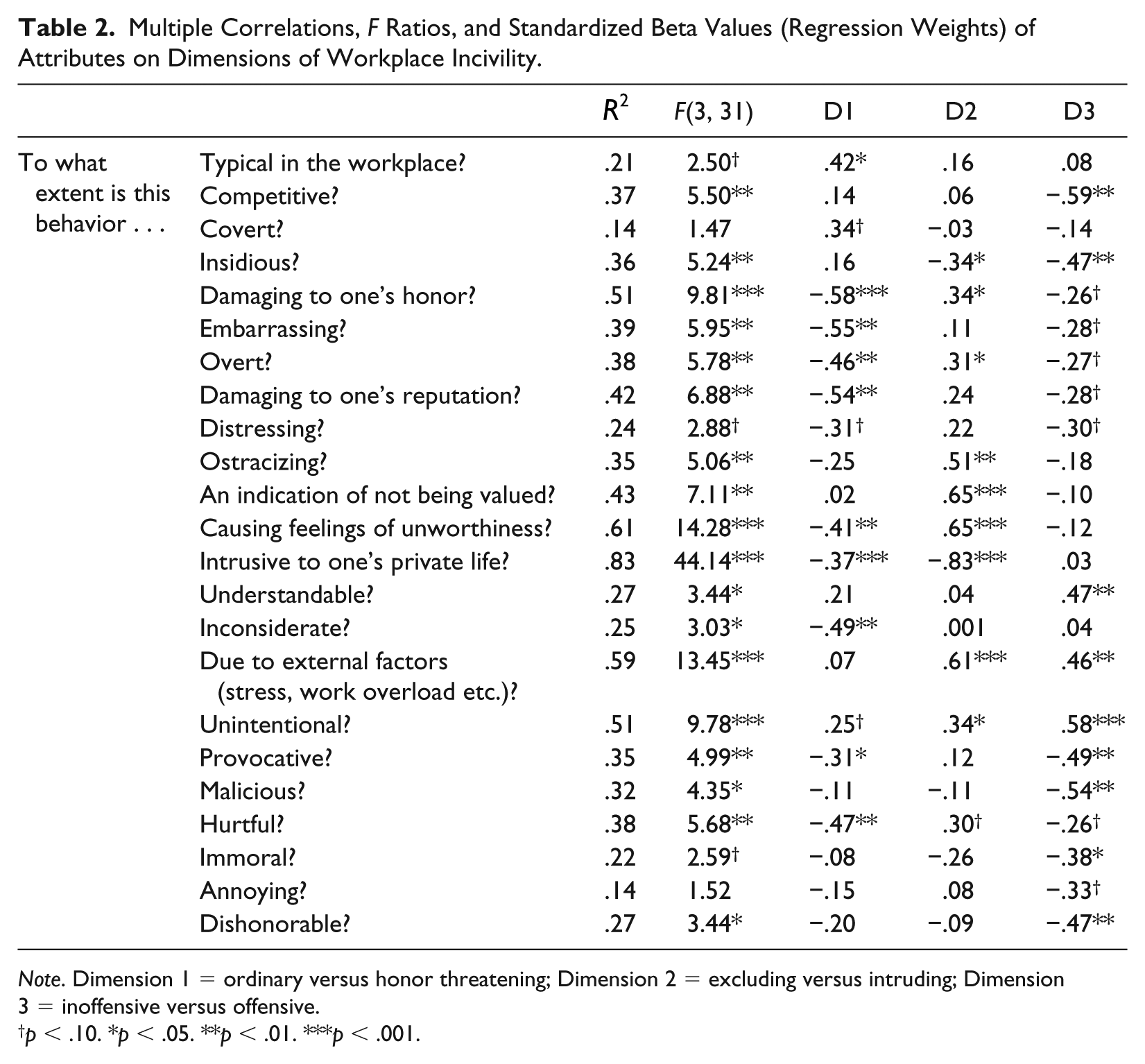
Note. Dimension 1 = ordinary versus honor threatening; Dimension 2 = excluding versus intruding; Dimension 3 = inoffensive versus offensive.
p < .10. *p < .05. **p < .01. ***p < .001.
As seen in Table 2, of the 23 attributes, 18 had significant beta weights. Each dimension was labeled in terms of the attributes that loaded most heavily on that specific dimension. Thus, Dimension 1 was labeled as ordinary versus honor threatening. The high end of this dimension comprised of episodes such as a coworker not giving the information the employee needs, a coworker taking credit for the employee’s ideas, a coworker impeding the employee’s work, and a coworker giving inaccurate information. Attributes that helped define this end of the dimension included “typical in the workplace” (β = .42, p < .05) and “covert” (β = .34, p < .10). Examples of incivility episodes in the low end of this dimension included the supervisor raising his or her voice to employee, the supervisor’s public humiliation, the supervisor’s public scolding, and the supervisor’s belittling the employee. The attributes that explained the low end of this dimension were “damaging to one’s honor” (β = −.58, p < .001), “embarrassing” (β = −.55, p < .01), “damaging to one’s reputation” (β = −.54, p < .01), “overt” (β = −.46, p < .01), inconsiderate (β = −.49, p < .01), and “hurtful” (β = −.47, p < .01).
Dimension 2 was termed as excluding versus intruding. The episodes that fell into the high end of this dimension involved uncivil behaviors, such as the supervisor not greeting the employee, the supervisor ignoring comments by the employee, and the supervisor playing with his or her computer while the employee is speaking. The attributes that loaded on the high end of this dimension were “causing feeling of unworthiness” (β = .65 p <.001), “not being valued” (β = .65, p < .001), “due to external factors (stress, work overload etc.)” (β = .61, p < .001), and “ostracizing” (β = .51, p < .01). Episodes at the opposite end of this dimension revolved around interfering with one’s private life, such as the supervisor or a coworker making inappropriate comments either publicly or privately, or gossiping, and the attribute that loaded highly significantly on this dimension was “intrusive to one’s private life” (β = −.83, p < .001).
Dimension 3 was labeled as inoffensive versus offensive. The episodes on the high end of this dimension included behaviors such as a coworker raising his voice to the employee, a coworker snapping at the employee, a coworker not holding the elevator for the employee, and a coworker inviting everyone but the employee to a social event. Attributes associated with the high end of this dimension consisted of “unintentional” (β = .58, p < .001) and “understandable” (β = .47, p < .01). The episodes on the low end of this dimension included coworker humiliating the employee in public, a coworker making condescending remarks about the employee, and a coworker mocking the employee’s speaking style. Attributes associated with the low end of this dimension were “competitive” (β = −.59, p < .01), “insidious” (β = −.47, p < .01), “malicious” (β = −.54, p < .01), “provocative” (β = −.49, p < .01), and “dishonorable” (β = −.47, p < .01).
Discussion
Research on incivility has grown tremendously, not only in the number of publications, but also in terms of theoretical and methodological sophistication (Cortina et al., 2017; Schilpzand et al., 2016). Nonetheless, one major shortcoming of this literature is the scarcity of evidence regarding cross-cultural generalizability. Moreover, the cross-cultural evidence is overwhelmingly representative of face-based collectivism. Yet, one of the most fruitful advances in cultural psychology in recent years has been the delineation of various species of collectivism as proposed by the honor, face, and dignity framework (Leung & Cohen, 2011). That these advances had not informed the study of incivility, and that honor-based collectivists were virtually absent in this literature formed the motivation of this research.
Given the study was one of the first of its kind, we started from scratch by soliciting workplace incivility behaviors from a sample of Turkish employees. Our findings suggest that there are many potentially universal manifestations of workplace incivility such as mocking, belittling, ignoring, scolding, gossiping, and disrupting the work processes or the work environment. Yet, there appear to be culturally salient manifestations as well. In the Turkish sample, exclusion from social activities and omission of greetings were frequently mentioned incivilities. That such an emphasis is not apparent in the WIS, the most established U.S. scale, is not surprising in view of the research on American workways. Workways refer to workplace beliefs, mental models, and practices about what is true, good, and efficient in the work domain (Sanchez-Burks & Lee, 2007). Drawing on individualism and collectivism (Triandis, 1995) as well as low versus high context cultures (Hall, 1976), American workways are described as being comparatively low in relational focus and high in task focus (Sanchez-Burks, 2005).
In contrast, East Asian, Mediterranean, and Middle Eastern workways are characterized by a greater emphasis on relational or affective components (e.g., Morris, Podolny, & Ariel, 2000; Sanchez-Burks & Lee, 2007). Our results indicate that behaviors undermining these components were regarded as uncivil. In fact, Turkish employees in Phase 1 generated nuanced examples of social exclusion (e.g., putting one’s handbag to the next seat to prevent the person from taking it), ignoring (e.g., not holding the elevator door), and not listening (e.g., playing with one’s cell phone). It seems that Turkish employees are rather alert regarding subtle or ambiguous displays of disrespect. This finding supports Aslani et al.’s (2013) argument that members of honor cultures may easily perceive insult out of ambiguous cues in a conflict situation.
American workways are also characterized by a separation of professional and personal domains of life. This divide is viewed essential to the maintenance of “professionalism” at the workplace (Sanchez-Burks, 2005). Indeed, the original, seven-item WIS had an item regarding unwanted discussions of personal life, which was not included in the 12-item revised version as it did not explain sufficient variance. Our results suggest that such behaviors may be more relevant in collectivist contexts where personal sharing in work relationships is more typical than observed in individualist contexts. It is appropriate (even expected) to inquire about the private life of a colleague, for example. If one becomes rude while doing so, this would be a form of incivility disguised behind behaviors that are normative in collectivist work contexts.
In this study, in addition to the content of incivility, we explored the cognitive frames Turkish respondents use to evaluate uncivil behaviors. The cultural psychology literature has established that in honor cultures, attacks on one’s social standing, or integrity, are fundamentally damaging to one’s sense of worthiness, or honor (e.g., Cross et al., 2014; Uskul et al., 2015). In particular, insults take on a special importance (Aslani et al., 2013; Leung & Cohen, 2011) and play a major role in the escalation of conflicts (Cohen, Nisbett, Bowdle, & Schwarz, 1996). Validating the findings of social psychology experiments in the context of professional relationships, our study revealed that supervisors’ humiliating or scolding behaviors, whether in public or in private, were perceived as honor threatening. Contrarily, humiliating behaviors from coworkers even when public were more likely to be appraised as competitive and malicious than honor threatening. Scolding by a coworker was even appraised as unintentional or understandable. It was also remarkable that insulting behaviors from supervisors threatened the target’s honor, while comparable behaviors from coworkers reflected how dishonorable the coworker was.
These findings may be interpreted in the context of the group-value model (Lind & Tyler, 1988) that posits that people have a strong desire to be members of social groups (e.g., family, work group) because group membership provides self-validation and emotional or material resources (Tyler, 1989). As such, people are sensitive to cues that provide information about their relative standing within the group. The treatment of a high-status group member constitutes an important signal in this respect (Tyler, 1989). When targeted with disrespect by a supervisor, employees are more likely to think that they are less worthy members of the group. Hence, compared with a coworker, insults by a supervisor are more likely to damage to one’s honor. Indeed, the differential appraisal of uncivil behaviors as a function of status was also evident in exclusionary behaviors. Whereas supervisors’ exclusion or ignoring behaviors were described as causing feelings of unworthiness, coworkers’ social exclusion was perceived as being unintentional or understandable, and coworkers’ professional exclusion was considered typical.
Of note, our study pointed to a nuance between uncivil behaviors that are acts of commission (like insults) versus omission (like exclusion) in terms of constituting threats to one’s honor. In particular, while supervisor acts of commission were perceived to be damaging to one’s honor and reputation, supervisor acts of omission were perceived to be damaging to one’s feelings of being worthy or valuable. This finding resonates with the recent review by Ferris, Chen, and Lim (2017), who used the expressions of “omissions of positive attention” versus “commission of negative attention” to differentiate ostracism from other forms of incivility, like insults (p. 330). The authors argued that individuals with an approach temperament may be most sensitive to the presence or absence of positive stimuli and be more affected by ostracism. In contrast, individuals with an avoidance temperament might be more sensitive to the presence of negative attention. Shafa and his colleagues (2015) have shown that in settings that pose a possible threat to one’s social standing, an honor mind-set is associated with a prevention focus. Specifically, they showed that both cooperative and aggressive responses in conflict situations were driven by a concern to prevent a loss of honor. Considering the workplace is a context where one’s social standing is highly salient and important (e.g., Djurdjevic et al., 2017), it is plausible that honor-oriented individuals have a heightened prevention focus and are particularly vigilant toward acts of negative commission in hierarchical relations.
Finally, our study also contributes to the mainstream literature on appraisal of workplace incivility in a number of ways. First, it highlights the importance of the cultural context in the appraisal process. When targeted with incivility, members of honor cultures may be particularly concerned with whether the incident affects their social standing negatively, which suggests that there are culturally salient appraisal criteria. Second, it corroborates Cortina and Magley’s (2009) finding that high-status instigators lead to more negative appraisals of incivility. Third, it extends this finding by showing that instigator status may interact with the type of incivility behavior. For instance, instigator status seems less relevant when evaluating uncivil behaviors such as interference in one’s private life; however, it seems more consequential when subject to behaviors like scolding or mocking. Thus, appraisal of workplace incivility may be a complicated process, particularly when cultural contingencies are also taken into account.
Limitations and Future Directions
The present study sought to provide an in-depth understanding of incivility in a particular honor culture; yet, this depth comes at the expense of generalizability. As such, it would be difficult to argue that the findings would generalize even to other honor cultures such as Iran, Pakistan, or Spain. It is essential that further replications and extensions are conducted across a wider range of samples as well as with multiple methodologies. Nonetheless, we would strongly recommend the initial stages of the research to involve a qualitative phase by which the meaning of incivility is established in the cultural contexts of interest. Our results suggest that while incivility is defined similarly across cultures, its operational definition may show cultural differences (Leung & van de Vijver, 2008). This case of nonequivalent operational definition risks metric invariance (nonequivalent slopes) and threatens the meaningfulness of correlational analyses in cross-cultural studies (F. F. Chen, 2008). For multicountry studies, we advocate the active involvement of all local researchers in the development of scales that are “decentered,” whereby items are not written to reflect a single culture and are applicable both in meaning and choice of expression to many cultures (van de Vijver & Leung, 1997). Future cross-cultural studies should also make a concerted effort to match organizational characteristics (e.g., industry, size, human resource practices) as much as possible to be able to attribute the observed differences to societal culture rather than other contextual factors (Gelfand, Raver, & Ehrhart, 2002).
Future research should also investigate the consequences of workplace incivility in honor cultures. So far, the implications of dignity versus honor cultures have been studied mostly by reference to one-shot relationships among strangers or vignette studies and negotiation exercises with student samples (see Miner & Smittick, 2016, for an exception). In contrast, the workplace is characterized by ongoing relationships between actors with power or status differentials. For instance, our findings indicate that supervisor insults or scolding are honor threatening; yet, it is unclear whether aggressive retaliation is viable in these contexts. Thus, future research on honor restoration strategies beyond confrontation seems necessary for a more complete understanding of the logic of honor.
To conclude, our findings reveal that rudeness is not experienced similarly across cultures. With cross-cultural work interactions becoming more prevalent, a failure to understand culturally construed definitions and interpretations of workplace incivility is likely to be costly for individuals as well as their organizations (X. Li & Lim, 2017). We hope that our study inspires more research on building culturally sensitive and sensible work environments.
Footnotes
Appendix A
Incivility Episodes, Associated Uncivil Behaviors, and Their Coordinates on the Three Dimensions.
| Code | Incivility episode | Category | D1 | D2 | D3 |
|---|---|---|---|---|---|
| INC1 | You are returning from a customer visit with your supervisor. Your supervisor yells at you for a blunder you made | Yelling, scolding, or swearing | −.578 | .319 | .369 |
| INC2 | You tell a secret about your private life to your supervisor. After a little while, you notice that others know about this secret | Gossiping, talking behind one’s back | −.348 | −.669 | .090 |
| INC3 | Your supervisor happens to overhear a tense phone conversation you make with your partner/spouse. When your conversation is over, your supervisor implies that your relationship is problematic | Interfering in one’s private life | −.346 | −.745 | .094 |
| INC4 | Your supervisor gathers the whole team for a project meeting. When you summarize what you have done so far, your supervisor comments that “even interns would have done a better job” | Insulting or belittling remarks, insinuations or looks | −.546 | .297 | −.369 |
| INC5 | Your supervisor is giving a presentation on the next quarter’s targets. You make a comment and your supervisor says “Wow, you are being wasted here” | Mocking | −.543 | .199 | −.399 |
| INC6 | Just as you are entering the break room, you overhear your coworker gossiping about you | Gossiping, talking behind one’s back | −.069 | −.633 | .025 |
| INC7 | Your supervisor is giving a presentation to the department. When you ask about a point you didn’t understand, your supervisor scolds you | Yelling, scolding, or swearing | −.513 | .400 | .360 |
| INC8 | You are voluntarily working on a recycling project. Your coworker calls you “the sucker of the year” | Mocking | −.283 | −.003 | −.449 |
| INC9 | While you are talking about your plans about a joint project, your coworker is constantly playing with his or her cell phone | Not listening, not showing interest, showing lack of interest, not making eye contact while listening | .331 | .259 | .195 |
| INC10 | While working on a presentation with your coworker, your father drops by to discuss a family matter. Your coworker insists that you tell him or her what the issue is | Interfering in one’s private life | −.098 | −.790 | .246 |
| INC11 | Your coworker stalls the progress of a common project by not fulfilling his or her part | Disrupting work | .777 | −.061 | −.151 |
| INC12 | You are at a café with your coworkers after work. Your coworker comments about your private life in front of others | Interfering in one’s private life | −.229 | −.674 | .193 |
| INC13 | You run into your coworkers at the hallway. Your coworker invites everyone but you to a party | Social exclusion | .292 | .135 | .416 |
| INC14 | You run into a coworker in the break room. When you ask about a meeting that you missed, your coworker snaps at you | Yelling, scolding or swearing | −.148 | .030 | .512 |
| INC15 | You run into your supervisor in the hall. Your supervisor does not respond to your greeting | Not greeting | .059 | .661 | .188 |
| INC16 | You are chatting with your coworkers. Your coworker makes fun of the way you speak | Mocking | −.103 | −.103 | −.494 |
| INC17 | You are walking toward the elevator to go to your office. Your coworker does not hold the elevator door despite seeing you approach | Ignoring as if one is not present | .355 | .063 | .408 |
| INC18 | You are having lunch with your coworkers. While you are discussing a project, your coworker raises his or her voice | Yelling, scolding, or swearing | −.280 | .083 | .542 |
| INC19 | You are working on a task with a deadline. Your coworker keeps on chatting loudly on the phone in the shared office | Disrupting the work environment | .627 | −.097 | .224 |
| INC20 | You share your ideas about increasing sales with your coworker. The next day, your coworker mentions them to your supervisor as if they are his or hers | Taking credit for success | .686 | −.236 | −.494 |
| INC21 | You come to your desk to find that your coworker has taken your photocopy card without permission | Disrespecting others’ personal belongings | .475 | −.236 | .406 |
| INC22 | You make some comments in a department meeting on next year’s forecast. Your supervisor ignores you and continues to talk | Ignoring as if one is not present | .022 | .658 | .087 |
| INC23 | You hear about an opening in your company. When you express your interest in that position, your coworker says that “you would never be considered for that position; you can’t pull it off” | Insulting or belittling remarks, insinuations, looks | −.156 | .022 | −.517 |
| INC24 | You meet with your supervisor to share your ideas about decreasing costs. Your supervisor tells you not to be funny and to stop wasting time | Insulting or belittling remarks, insinuations or looks | −.511 | .350 | −.334 |
| INC25 | You stop by your supervisor’s office to consult him. Your supervisor continues to work at his or her computer while you are speaking | Not listening, not showing interest, showing lack of interest, not making eye contact while listening | .143 | .636 | .081 |
| INC26 | You attend a cocktail reception to celebrate the completion of a project. Your supervisor shakes hands with everyone but you | Social exclusion | .216 | .604 | .285 |
| INC27 | You ask your coworker some questions as to what the customer is expecting but your coworker gives you inaccurate information | Professional exclusion | .768 | −.255 | −.351 |
| INC28 | You stop by your supervisor’s office to talk about a project with an approaching deadline. When you share your ideas about how to speed things up, your supervisor says “that’s too funny” | Mocking | −.527 | .212 | −.347 |
| INC29 | You are talking about how to reach the performance targets in a department meeting. Your coworker keeps on interrupting you | Interrupting | .455 | .254 | −.094 |
| INC30 | You are expecting an important piece of information regarding the delivery date of your products. Your coworker gets this information but does not share it with you | Professional exclusion | .762 | −.057 | −.381 |
| INC31 | You are telling about your job interview to your coworkers in your new department. One of your coworkers comments that “clearly the selection criteria must be lower now” | Insulting or belittling remarks, insinuations, looks | −.237 | .025 | −.545 |
| INC32 | Your department is having a dinner party. Your supervisor comments on the frequency of your partner/spouse’s phone calls | Interfering in one’s private life | −.455 | −.648 | .204 |
Note. D1 = ordinary versus honor threatening; D2 = excluding versus intruding; D3 = inoffensive versus offensive.
Appendix B
Acknowledgements
We are immensely grateful to Lilia M. Cortina for her contributions to the Phase 1 of the study. Many thanks are extended to Theresa M. Glomb, Ayse K. Uskul, and Afsar Yegin for their constructive feedback on an earlier version of the manuscript and to Cihangir Gümüştaş for his assistance in data collection and coding in Phase 1.
Authors’ Note
An earlier version of the study was presented at the 13th European Academy of Management Conference, Istanbul, Turkey and at the 75th Academy of Management Meeting, Vancouver, British Columbia, Canada.
Declaration of Conflicting Interests
The author(s) declared no potential conflicts of interest with respect to the research, authorship, and/or publication of this article.
Funding
The author(s) disclosed receipt of the following financial support for the research, authorship, and/or publication of this article: K. Duygu Erdaş completed this research during her doctoral studies which were supported by a PhD scholarship from TUBITAK (The Scientific and Technological Research Council of Turkey).