



Abstract
Through codified rule-use, humans can accurately solve many problems. Yet, mechanized strategies can also be costly. After adopting a solution strategy, humans often become blind to alternatives, even when those alternatives are more efficient. Termed cognitive set, this failure to switch from a familiar strategy to a better alternative has been considered universally human. Yet, our understanding of this phenomenon is derived almost exclusively from Western subjects. In this study, we used the nonverbal Learned Strategy–Direct Strategy (LS-DS) touchscreen task in which subjects are presented with an opportunity to use either a learned strategy or a more efficient, but novel, shortcut. We found that the remote, seminomadic Himba of northern Namibia exhibited enhanced shortcut-use on the LS-DS task, challenging the claim that cognitive set affects humans universally. In addition, we found that altering subjects’ conceptualization of the shortcut as a viable option significantly enhanced its subsequent use in Western but not Himba participants. We discuss how other aspects of cultural variation, namely, environmental uncertainty and educational background, might contribute to the observed cross-cultural differences in flexible strategy-use.
Flexible problem solving is a critical element of navigating dynamic environments. As such, its role in cognition has been extensively studied. Broadly defined, cognitive flexibility is the ability to incorporate both known solutions and innovated or acquired novel solutions in a contextually appropriate manner (modified from Buttelmann & Karbach, 2017; Lehner, Burkart, & Schaik, 2011). Flexible responses must integrate external environmental cues with internal inputs such as past experience, and in the case that a previous strategy is no longer the most appropriate, flexible behavior requires inhibiting that previous response to switch to a more efficient strategy. With this understanding, it seems inadequate to assume that cognitive flexibility is a uniform construct, invariant to cultural or contextual diversity (see Ionescu, 2017). Indeed, multiple processes likely contribute to individuals’ cognitive flexibility, which in all probability changes to accommodate contextual demands.
Tasks used to measure cognitive flexibility vary considerably in design and how they characterize flexible versus inflexible responses. By far, the most prominent forced-switch tasks such as Discrimination Reversals and Card Sorting tasks (e.g., the Wisconsin Card Sorting Task and Dimensional Change Card Sorting task) first allow a subject to learn one solution method and then require them, by altering the reward contingencies, to abandon and replace it with another (Berg, 1948; Zelazo, 2006). Inflexibility is then calculated as the degree of persistence (i.e., the number of erroneous trials) before the new, correct solution strategy is adopted (Berg, 1948; Harlow, 1949; Rumbaugh, 1971). Card sorting task performance, often equated with switching ability (Doebel & Zelazo, 2015; Frye, Zelazo, & Palfai, 1995), improves substantially throughout development (Deak, 2000; Zelazo, 2006); however, Diamond and Kirkham (2005) demonstrated that even adults exhibit response time deficits when switching between rules.
Similarly, cued-switch tasks assess subjects’ ability to shift between known strategies by comparing trials that require subjects to either repeat their previous strategy (stay trials) or switch to another strategy (switch trials) within their repertoire (Stoet & Snyder, 2008; Zelazo, 2008). Indeed, on cued-switch tasks, both children and adults exhibit pronounced deficits in response time and/or accuracy on switch compared with stay trials (Diamond & Kirkham, 2005; Ionescu, 2012; Lemaire, Luwel, & Brun, 2017; Luwel, Schillemans, Onghena, & Verschaffel, 2009; Stoet & Snyder, 2008). Termed “switch costs,” these deficits are thought to be associated with disengaging from one strategy and initiating another (Meiran, 1996; Rogers & Monsell, 1995; Stoet & Snyder, 2007); however, they are not exhibited by some nonhuman primates (Macaca mulatta; Stoet & Snyder, 2003, 2008), suggesting that they may be a byproduct of human rule-encoding (however, see Caselli & Chelazzi, 2011).
In contrast to forced-switch tasks, optional-switch tasks do not require subjects to switch strategies. They are designed so that subjects can (and often do) continue to use the learned strategy (LS), and it continues to be rewarded, albeit at a less efficient rate than if subjects employ an alternative strategy. In 1942, Abraham Luchins asked a group of university students, faculty, and staff to solve a set of simple math problems (Luchins, 1942). The task began with several problems solvable only by using a four-step rule, which participants quickly mastered. However, after these “learned rule” problems, Luchins added a twist. In addition to the familiar strategy, Problems 7 and 8 could also be solved by a more efficient, one-step method—a shortcut. Remarkably, when the time came, not a single subject used the shortcut. Instead, they continued to use the learned rule despite its relative inefficiency. This type of cognitive inflexibility—the inability to implement an alternative strategy once a learned rule has been adopted—is termed “cognitive set.” Optional-switch tasks, or cognitive set tasks, measure flexibility as the extent to which a familiar strategy blocks the optional use of more efficient alternatives.
Thousands of subjects have been tested on Luchins’s water jar task under various manipulations, and a consistent majority persist in using the learned rule, leading to the conclusion that, within human problem solving, cognitive set is universal (Aftanas & Koppenaal, 1962; Luchins, 1942; Luchins & Luchins, 1950; McKelvie, 1984). Yet, despite attempts to account for subjects’ age (Cunningham, 1965; Luchins, 1942, pp. 18, 19; Pope, Meguerditchian, Hopkins, & Fagot, 2015), education level (Luchins, 1942, pp. 18, 20), and occupation (Luchins, 1942, pp. 7, 20), only Western (American, British, and Canadian) subjects’ susceptibility to cognitive set has been tested, leaving potential cross-cultural differences entirely unexplored.
This is problematic given that our understanding of many “universal” cognitive processes is derived predominantly from testing Western, Educated, Industrialized, Rich, Democratic (WEIRD) people (Clegg & Legare, 2016; Henrich, Heine, & Norenzayan, 2010; Legare & Nielsen, 2015). Indeed, the few studies that do include non-WEIRD populations find that WEIRD data are at the extremes of more globally diverse samples. This is not surprising considering Westerners’ highly unusual lifestyles compared with the lifestyles of most other humans and of all humans in our recent evolutionary past (see Henrich et al., 2010, for review).
The influence of culture on cognition is understandably complex; even the concept of culture is complex (Hardin, Robitschek, Flores, Navarro, & Ashton, 2014). Factors such as language, social structure, means of subsistence, education, and environmental instability are all likely to influence humans’ performance on cognitive tasks. For example, differences in linguistic encoding affect subjects’ abilities to remember and discriminate between stimuli (Lucy & Gaskins, 2003), especially when discrimination requires differentiating between items which fall along a continuum such as color (Davidoff, Davies, & Roberson, 1999; Davidoff & Fagot, 2010; Roberson, Davidoff, Davies, & Shapiro, 2005) or quantity (Frank, Everett, Fedorenko, & Gibson, 2008). Yet, others have found that cultural background but not language affects categorical processing (Chiu, 1972; Ji, Zhang, & Nisbett, 2004; Nisbett, Choi, Peng, & Norenzayan, 2001). There is also evidence that linguistic encoding affects the ability to switch between concepts (Kalia, Daneri, & Wilbourn, 2017). Indeed, social structures and norms or “culturally-specific mentalities” (Norenzayan & Nisbett, 2000, p. 132) are thought to affect causal interpretations of events and even problem-solving approaches (Norenzayan, Smith, Kim, & Nisbett, 2002). Furthermore, many non-WEIRD populations face environmental uncertainties or risks that can affect cognition (Ellis, Bianchi, Griskevicius, & Frankenhuis, 2018); for example, adults with more unpredictable childhoods performed better at a shifting task than those with more stable childhoods (Mittal, Griskevicius, Simpson, Sung, & Young, 2015).
Current Study
To study cross-cultural differences in cognitive set, the current study used a nonverbal, nonarithmetic optional-switch cognitive flexibility task, which was originally devised by Pope et al. (2015) as a means of comparing baboons’ and humans’ susceptibilities to cognitive set. The Learned Strategy–Direct Strategy (LS-DS) task begins with several levels of training wherein subjects learn to utilize a three-step (Square1, Square2, Triangle) sequence, which constitutes the LS (see Figure 1a). Once subjects consistently utilize the LS, experimental trials are presented in which subjects can use the LS (see Figure 1b) or they can use a direct strategy (DS or the shortcut) by skipping Square1 and Square2 and immediately selecting the Triangle (see Figure 1c). Indeed, the study found that every one of the 15 baboon subjects immediately switched to the DS when it became available and used it in 99.98% of trials. However, reminiscent of Luchins’s findings, only four of the 53 (i.e., 7.55%) adult human subjects used the DS in more than 5% of trials. That is to say, adult humans but not baboons were affected by cognitive set on the LS-DS task.

The LS-DS task.
In light of these findings, we considered that differences in problem conceptualization might have driven the observed differences in susceptibility to cognitive set between baboons and humans. Namely, human subjects might have responded according to how they thought they should, based on their previous experience with rule-based problem solving. Undoubtedly, rules-of-thumb and equations offer a tremendous advantage when solving many similar problems; for this reason, repetitive rule-use is a staple of Western education. Yet the real-world applications of this approach could easily lead to cognitive inflexibility (Luchins, 1942, pp. 13, 21; Star & Seifert, 2006), especially when a problem allows for multiple solution strategies. Alternative solutions are not found because they are not sought. Indeed, on Luchins’s task, some subjects were inspired to use the shortcut after receiving the prompt “Don’t be blind” (Luchins, 1942). However, Luchins noted that this was also interpreted as Don’t be blind to the obvious rule. Although the LS-DS task does not explicitly instruct subjects how to respond (they learn through trial and error), it is possible that previous human subjects (Pope et al., 2015) did not regard the DS as a viable option based on their history with repetitive rule-use and/or single-solution problems. In the current study, we hypothesized that cross-cultural differences in how problems are understood or approached influence susceptibility to cognitive set.
Our first aim was to challenge the universality of cognitive set by testing a population that exhibits several key differences from Westerners. Traditionally living Himba have maintained their seminomadic, pastoralist lifestyles within the harsh desert of northern Namibia for roughly 400 years. Most do not partake in (or have access to) formal education and many have not or have rarely visited the nearest town, Opuwo (~8,000 inhabitants). Traditional Himba live in small, hierarchical, interdependent villages. They have been shown to respond differently than Westerners on some cognitive assessments, particularly those involving perceptual biases (Davidoff, Fonteneau, & Fagot, 2008; de Fockert, Davidoff, Fagot, Parron, & Goldstein, 2007). Opportunely, there is a subset of Himba who now live in and around Opuwo. Like Westerners, these “urban” Himba exhibit global perceptual biases and less selective attention than traditional Himba (Caparos, Ahmed, et al., 2012; Caparos, Linnell, Bremner, de Fockert, & Davidoff, 2012; de Fockert, Caparos, Linnell, & Davidoff, 2011; Linnell, Caparos, de Fockert, & Davidoff, 2013). Urban Himba frequent the town and regularly engage in the market economy by buying food or selling jewelry to tourists. Urban Himba have better access to schools than more traditionally living Himba; however, the majority of children, even in the villages surrounding Opuwo, do not attend school. Thus, by comparing Himba and Westerners, we wanted to examine the broader influences of language, social structure, environmental instability, and education on susceptibility to cognitive set, and by testing both Urban and Traditional Himba, we aimed to assess the potential for more specific impacts of market economy engagement, resource availability, familiarity with technology, and perceptual biases.
Second, we aimed to explore how the conceptualization of a problem space might influence susceptibility to cognitive set. Thus, we prompted both Himba and Western participants midway through testing, saying, “Don’t be afraid to try new things.” We reasoned that releasing subjects from potentially constraining presuppositions would enhance shortcut-use on the LS-DS task. Furthermore, any relative differences in the prompt’s influence on shortcut-use among Westerners, Traditional Himba, and Urban Himba might be indicative of the extent to which they were initially constrained by preexisting conceptualizations.
Method
Subjects
Data were collected from 54 Western (42 females and 12 males), 54 Urban Himba (34 females and 20 males), and 75 traditional Himba subjects (34 females and 41 males). All subjects were above 18 years of age. Exact ages were not recorded as Himba do not keep track of their age; however, subjects were predominantly in their 20s and 30s. All methods were approved by the Georgia State University Institutional Review Board prior to testing. Western subjects were recruited from the pool of undergraduate students at Georgia State University by posting the study on the SONA Experiment Management System, tested on the Georgia State University campus, and received one course credit in exchange for their participation. Himba subjects were recruited and tested in their villages by a hired research assistant after initial permissions were received from the village leader(s). Testing took place inside a tent or in a shaded area. Himba subjects were classified as “Urban” if they lived within 20 km of Opuwo, the primary city in the Kunene region, and “Traditional” if they lived further than 100 km from Opuwo. We only tested subjects who fell into these two categories. The number of times each subject had been to a city (almost exclusively Opuwo) was recorded for all Himba subjects. Urban subjects received 20 Namibian Dollars and Traditional subjects received 1 kg maize meal and 1 kg sugar each.
LS-DS Task
The LS-DS task was programmed with OpenSesame software (Mathot, Schreij, & Theeuwes, 2012) and administered via a Lenovo Ideapad FLEX 4 (14″) 2-in-1 touchscreen laptop. All subjects received basic instructions on touching the fixation cross to begin each trial and which feedback screens/sounds indicated correct versus incorrect responses. As part of the instructions, all subjects were told that they would need to touch the shapes to figure out the correct answer. However, in the Himba’s language (Otjihimba), there is no direct translation for “shapes.” Thus, Himba subjects were shown an illustration of a square and a triangle at that point during the instructions. 1
A complete description of the LS-DS task can be found in Pope et al. (2015). The task consists of three training levels and 96 experimental trials. In Training 1, a demonstration shows two white squares, which flash red in sequence (250 ms each); the subject must reproduce the demonstration by selecting the two squares in the correct order. In Training 2, the demonstration shows four white squares, two of which flash red in sequence (200 ms each), and the subject reproduces the demonstration by selecting the two correct squares (the ones that flashed red) in the correct order. Training 3 is identical to Training 2; however, after the subject has correctly selected Square1 and Square2 (which are demonstrated for 150 ms each), they must then select a blue triangle which appears in one of the remaining locations. Subjects do not progress to the next training level until they achieve 80% accuracy, measured after each 8-trial block. After training, BASE and PROBE experimental trials are presented (Figure 1). In PROBE trials, the Triangle appears alongside the Square1, Square2 demonstration and remains visible on the response screen. Importantly, to be correct, subjects can either continue to use the Square1, Square2, Triangle sequence (i.e., the LS) or they can simply ignore the demonstration and select the Triangle (i.e., the DS or shortcut). BASE trials appear identical to Training 3; however, if subjects select the Triangle’s hidden location, they are marked as having used the DS, thereby providing a measure of accidental DS-use within each subject. In summary, subjects initially learn via the training to reproduce a two-square demonstration and then touch the Triangle. Cognitive flexibility on the LS-DS task is measured by subjects’ propensity to forego this learned method to use a more direct strategy when the Triangle is already present.
For the current study, after the first 48 PRE trials, the task was paused and the experimenter issued the “Don’t be afraid to try new things” prompt. Subjects then completed an additional 48 POST trials. PRE and POST trial lists consisted of one BASE and one PROBE trial for each of the possible 24 configurations; trial order was randomized.
Shortcut Analysis
The percentage of accurate trials in which subjects used the DS was calculated for both BASE and PROBE trials. Each subject’s BASE DS-use was subtracted from PROBE DS-use to yield a measure of DS-use that accounted for within-subject accidental DS-use. In accordance with our previous studies, subjects were classified as DSers if they used the DS in greater than 5% of trials; however, we also included progressively more stringent DSer qualification criteria (greater than 25%, greater than 50%, and greater than 75%) to better assess consistency of DS-use between groups. Whenever the data violated the assumptions for parametric statistical analyses, we used nonparametric analyses and reported group medians rather than means.
Switch Cost Analysis
The switch costs associated with using the DS were also analyzed. Recall that during BASE trials, subjects typically only use the LS. Thus, for DSers who were switching between the DS and the LS for PROBE and BASE trials, respectively, we expected to see switch costs. Because some subjects did not ever use the DS and thus did not switch, we analyzed only those who had used the DS in more than 50% of PRE (N = 40) and POST (N = 50) trials. We isolated the time between the end of the Square1, Square2 demonstration and subjects’ first response (RT1) for BASE trials in which subjects repeated (BASE stay) or switched (BASE switch) their strategy and for PROBE trials in which subjects repeated (PROBE stay) or switched (PROBE switch) their strategy. All trials that were precluded by an incorrect trial and those in which the first response was incorrect were excluded. For each subject, response time outliers (more than 1.5× the interquartile range of the first and third quartile) were excluded. We applied a natural log transform to normalize the response time data.
Results
Cross-Cultural Differences in Cognitive Set
In accordance with our previous studies, subjects were classified as DSers if they used the DS in more than 5% of trials. A Pearson’s chi-square analysis revealed that, in PRE trials, a significantly smaller proportion of Westerners were classified as DSers (5.6%; N = 3) than either Urban (42.6%; N =23) or Traditional (34.7%; N = 26) Himba participants, χ2(2, N = 183) = 20.65, p < .001, the proportions of which did not significantly differ from each other (Figure 2).
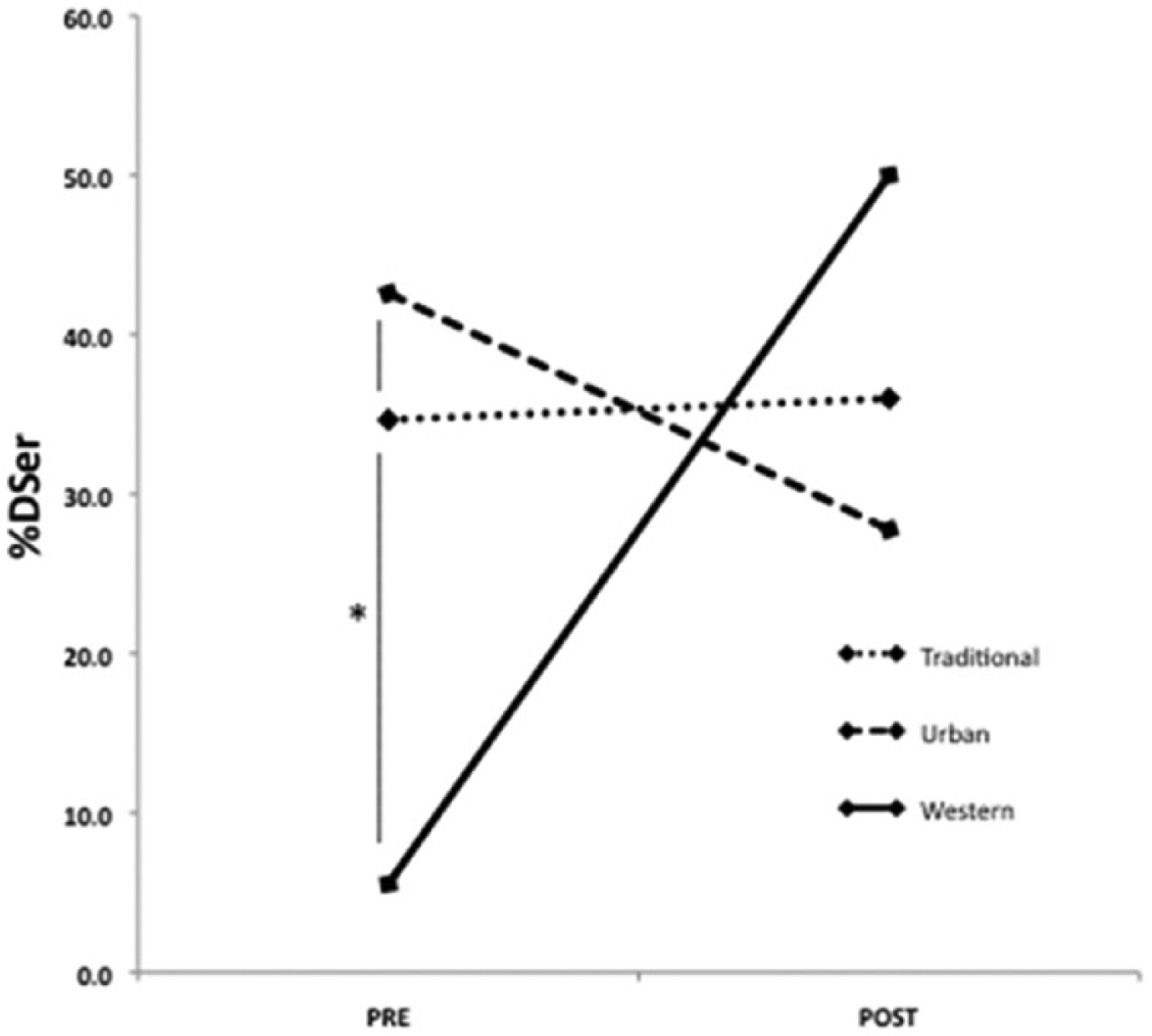
The percentage of DSers within each group before (PRE) and after (POST) receiving the prompt.
Conceptual Influences on Cognitive Set
In POST trials, after subjects were told “Don’t be afraid to try new things,” a Pearson’s chi-square analysis revealed that the proportion of DSers significantly increased for Westerners (50.0%; N = 27), significantly decreased for Urban Himba (27.8%; N = 15), and did not change for Traditional Himba (36.0%; N = 27), χ2(2, N = 183) = 38.989, p <.001. In other words, the prompt effectively increased only Westerners’ DS-use (Figure 2).
Immediacy and Consistency of DS-Use
Significantly more Traditional (25.3%) and Urban (27.8%) Himba used the DS the very first time it was available (i.e., in PRE trials) compared with Westerners (3.7%), χ2(2, N = 183) = 12.48, p = .002. However, following the prompt (i.e., in POST trials), Westerners (24.1%) used the first available shortcut as much as Urban (20.4%) or Traditional (33.3%) Himba, χ2(2, N = 183) = 2.976, p = .226. We next investigated whether any subjects used the DS in every single trial. In PRE trials, 3.7% of Westerners, 3.7% of Urban, and 9.7% of Traditional Himba used the DS every single time it was available, and in POST trials, those numbers increased slightly to 5.6% of Westerners, 5.6% of Urban, and 18.7% of Traditional Himba. Notably, of the three Westerners classified as DSers in PRE trials, two of them used the DS in every trial that it was available and the third used it in 95.3% of trials, illustrating a stark contrast between them and their LSer counterparts.
Next, we explored the consistency of DS-use across groups by applying progressively more stringent DSer classification requirements: DS was used in greater than 25%, greater than 50%, and greater than 75% of trials. As with the 5% classification criterion, there were significantly fewer Western DSers than Traditional or Urban Himba DSers when the criterion was set to greater than 25%, χ2(2, N = 183) = 14.57, p = .001, and greater than 50% of PRE, χ2(2, N = 183) = 13.07, p = .001, trials. When the criterion was set to greater than 75% of trials, there were significantly more Traditional Himba DSers than Western DSers, but Urban Himba did not significantly differ from either group, χ2(2, N = 183) = 9.099, p = .011. In POST trials, DSer proportions did not differ significantly between groups for any of the DSer classification criteria (Table 1).
Percentage of Each Group Which Used the DS in Greater Than 5%, 25%, 50%, and 75% of Trials.
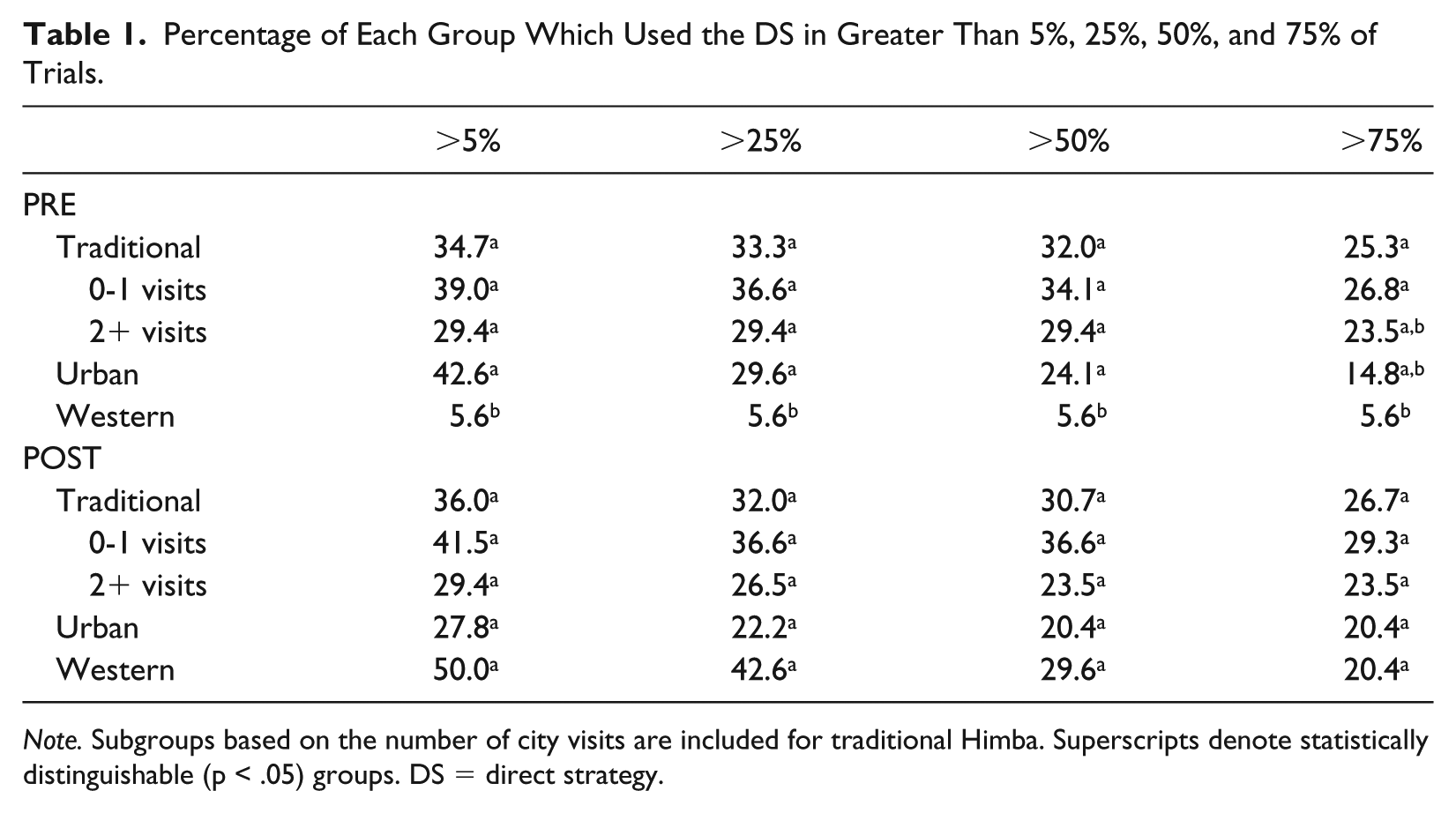
Note. Subgroups based on the number of city visits are included for traditional Himba. Superscripts denote statistically distinguishable (p < .05) groups. DS = direct strategy.
Influence of Urban Exposure
To explore how urban exposure might have affected LS-DS performance, we regrouped the Traditional Himba into those who had visited the city either one or fewer (N = 41; M = 0.24; SD = 0.43) or two or more times (N = 34; 16 participants reported “many” instead of an exact number, but for the other 18 Traditional Himba subjects, M = 3.06; SD = 1.70). In PRE trials, for the more than 5% DSer classification criterion, a Pearson’s chi-square analysis again revealed that the proportion of DSers within the Western group was significantly less than within Himba populations, χ2(3, N = 183) = 21.49, p <.001; Western = 5.6%, Urban = 42.6%, Traditional 0-1 = 39.0%, and Traditional 2+ = 29.4%. There was no difference in the proportion of DSers between Himba based on location (Urban vs. Traditional) or the number of urban exposures (Table 1). This finding was preserved for the more than 25% and more than 50% DSer classification criteria. However, for the more than 75% DSer classification criterion, only Traditional Himba who had been to the city 0 or 1 times were statistically distinct, χ2(3, N = 183) = 9.25, p = .026, from Westerners; both Traditional Himba who had been to the city 2+ times and Urban Himba displayed intermediate DS-use (i.e., the proportions of DSers within these groups did not differ significantly from either of the other groups or each other). Like before, in POST trials, DSer proportions did not differ significantly between groups for any of the DSer classification criteria.
Effects of Shortcut-Use on Performance
To explore the impact of strategy on accuracy, PROBE trial accuracies were compared using Mann–Whitney U tests for each group. For PRE trials, Urban and Traditional DSers (Urban Himba: Mdn = 95.83%; Traditional Himba: Mdn = 95.83%) had significantly higher PROBE accuracy scores than LSers (Urban Himba: Mdn = 70.83%; Traditional Himba: Mdn = 70.83%; Urban: U = 459, p < .001; Traditional: U = 1,074, p < .001). No difference was observed between Western DSers (Mdn = 95.83%) and LSers (Mdn = 95.83%); however, recall that only three Westerners were classified as DSers in PRE trials. For POST trials, DSers from each group (Westerners: Mdn = 97.92%; Urban Himba: Mdn = 100.00%; Traditional Himba: Mdn = 95.83%) had higher PROBE accuracies than LSers (Westerners: Mdn = 91.67%; Urban Himba: Mdn = 79.17%; Traditional Himba: Mdn = 79.17%; Western: U = 499, p < .001; Urban: U = 453, p < .001; Traditional: U = 1,100, p < .001).
To explore the impact of strategy on efficiency, we compared subjects’ average trial times for DS and LS responses for each group. For PRE and POST trial blocks, mixed model analyses of variance (ANOVAs) revealed no interaction between group (Westerners, Urban Himba, Traditional Himba) and strategy (LS vs. DS) on total trial time. However, significant main effects of strategy on total trial time were observed. In both PRE, F(2, 47) = 644.15, p <.001, and POST, F(2, 47) = 644.15, p <.001, trial blocks, DS trial times were significantly faster than LS trial times, validating the enhanced efficiency of the DS compared with the LS (Table 2).
Trial Times for DS and LS Strategies for Each Group.

Note. DS = direct strategy; LS = learned strategy.
Finally, we assessed LSers’ RT1s for BASE and PROBE trials. For PRE trials, BASE RT1s (M = 1,132.57 ms, SD = 531.33) were significantly faster than PROBE RT1s (M = 1,226.7 ms, SD = 596.24), t(142) = −9.51, p <.001. This was also found for POST trials (BASE M = 1,118.08 ms, SD = 454.40; PROBE M = 1,159.59 ms, SD = 503.60), t(132) = −2.80, p =.006, suggesting that the premature presence of the Triangle in PROBE trials may have been distracting.
Switch Costs
A mixed model ANOVA showed that group (Western, Urban, Traditional) did not significantly interact with either trial condition (BASE/PROBE) or trial type (stay/switch) for either PRE, F(2, 37) = 1.34, p = .273, or POST, F(2, 46) = .811, p = .451, trials’ RT1s. However, for PRE DSers, a significant, F(1, 37) = 5.49, p =.025, interaction between condition (BASE vs. PROBE) and trial type (stay vs. switch) was observed. PROBE stay RT1s (M = 1,126.33 ms; SD = 488.73) were faster than PROBE switch RT1s (M = 1,285.25 ms; SD = 680.53), t(39) = 3.16, p = .003, which were significantly faster than BASE switch RT1s (M = 1,488.53 ms; SD = 599.45), t(39) = −3.19, p = .003, and BASE stay RT1s (M = 1,576.31 ms; SD = 916.20), t(39) = −3.19, p = .003, RT1s. However, BASE switch and BASE stay RT1s did not significantly differ from each other, t(39) = −887, p = .381).
In addition, for POST trials, a significant, F(1, 46) = 6.21, p = .016, interaction between condition (BASE vs. PROBE) and trial type (stay vs. switch) was observed. PROBE stay RT1s (M = 828.15 ms; SD = 458.71) were faster than PROBE switch RT1s (M = 891.08 ms; SD = 431.40), t(48) = 4.05, p < .001, which were significantly faster than BASE stay RT1s (M = 1,181.60 ms; SD = 522.39), t(48) = −6.07, p < .001, and BASE switch RT1s (M = 1,190.42 ms; SD = 503.31), t(48) = −6.86, p < .001, RT1s. However, BASE switch and BASE stay RT1s did not significantly differ from each other, t(39) = .919, p = .362. Thus, although DS RT1s were faster than LS RT1s, DSers experienced switch costs during their LS-to-DS strategy switch (Figure 3).
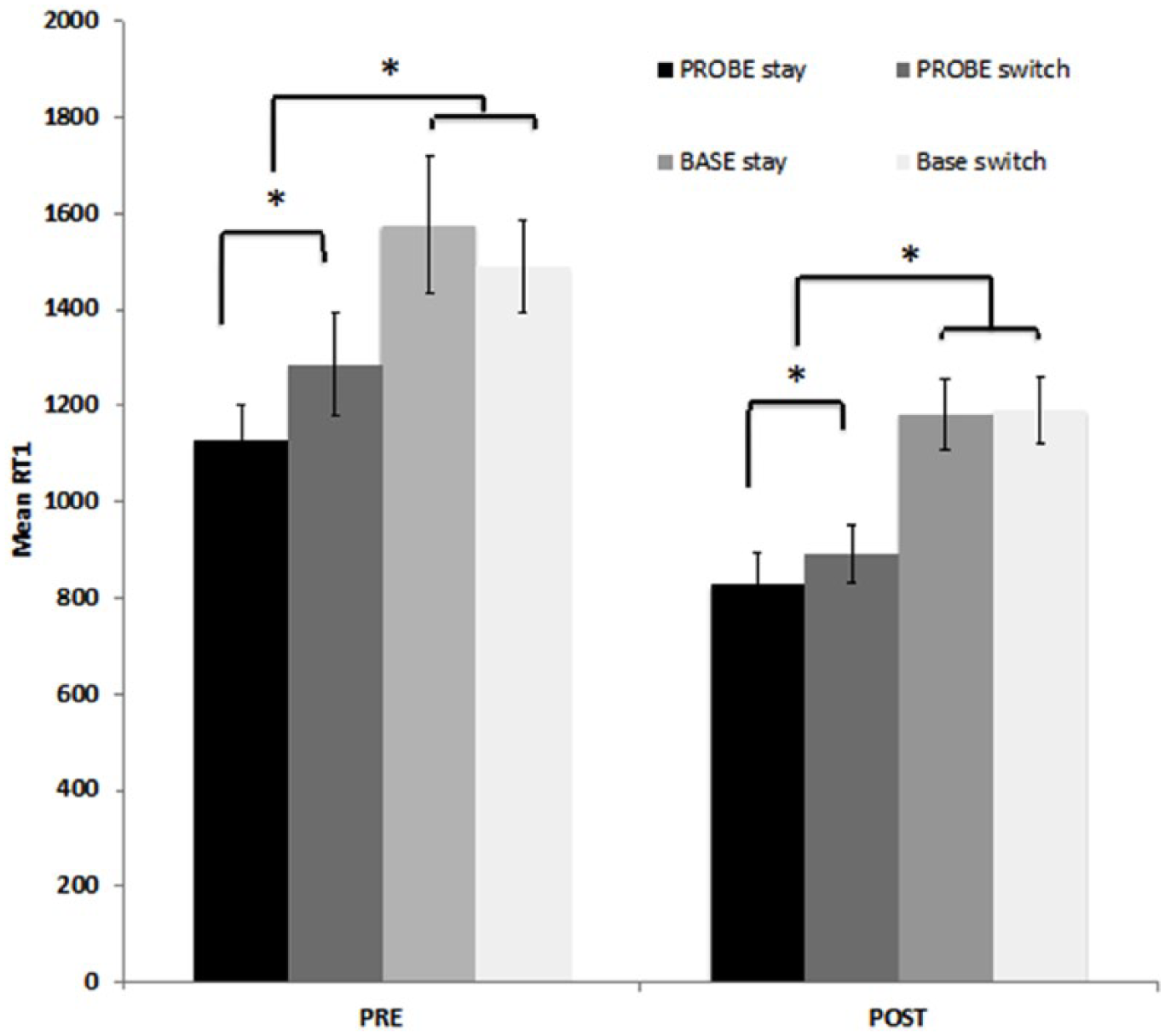
Mean BASE and PROBE same and switch trials’ RT1s for subjects who used the DS in greater than 50% of trials.
Effect of Training
As noted previously, Western participants were more likely to successfully complete the training than Himba, who often took much longer to reach criterion. A Kruskal–Wallis analysis of variance confirmed that Westerners differed from Urban and Traditional Himba (which did not differ from each other) in the total number of training trials needed before graduating to the experiment, H(2) = 63.48, p < .001; M (SD): Western = 39.0 trials (33.44), Urban = 73.2 trials (40.12), Traditional = 86.2 trials (44.98). To assess whether increased training affected strategy-use, we used logistic regressions to analyze the effects of group (Western, Urban, Traditional) and number of training trials on DSer classification. As noted before, group significantly corresponded to DSer classification, correctly predicting 71.6% of cases. However, there were no significant effects of Training level on DSer classification. 2
Discussion
The ability to break away from a learned rule and use a shortcut was enhanced in Urban and Traditional Himba compared with Westerners, providing the first evidence that cultural factors affect susceptibility to cognitive set in humans. In addition, efforts to promote shortcut-use, by issuing the “Don’t be afraid to try new things” prompt, successfully increased the proportion of DSers in Western but not Himba participants. However, we found no effects of group on switch costs for either PRE or POST trial blocks. These findings support the hypothesis that cognitive set can be influenced by participants’ conceptualization of the problem and that this is mediated by cultural influences.
As mentioned previously, Western and Himba participants’ cultural environments differ in many ways, including social structure, physical and visual environment, language, subsistence style, access to technology, and educational opportunities. Although this study describes a stark contrast between Western and Himba participants’ susceptibility to cognitive set, the factors underlying this difference remain speculative. We now discuss how certain aspects of cultural variation might affect shortcut-use, with an emphasis on future directions.
First, we consider how differences in social structure might influence problem solving. The social structure hypothesis, proposed by Nisbett et al. (2001), posited that interdependent people (such as the Himba) utilize holistic problem-solving approaches more than independent people (such as Westerners), who were said to use more analytic approaches. In other words, societies that rely on one another are more attentive to relationships between stimuli rather than their individual properties. Under this hypothesis, we might have expected the Himba to use the LS (i.e., the sequence in its entirety) more often than Westerners. Yet, we found the opposite; Himba participants were significantly better able to use the shortcut (i.e., one part of the sequence) than the Westerners. Although societal impacts on problem-solving strategies are certainly plausible, the current findings do not support the social structure hypothesis.
Next, we consider differences in environmental visual clutter between groups. Under the visual clutter hypothesis (Miyamoto, Nisbett, & Masuda, 2006), exposure to an urban environment can shift local perceptual biases to more global perceptual biases (Caparos, Ahmed, et al., 2012), which is said to favor holistic response strategies (Nisbett & Miyamoto, 2005). Although we found that the two groups who have been previously shown to exhibit more Western perceptual biases, Urban Himba and Traditional Himba who had been to the city two or more times (Caparos, Ahmed, et al., 2012), did exhibit intermediate DS-use, this was only significant when the criterion was set to more than 75% of trials. We posit that this may indicate a potential association between urban exposure and the consistency with which subjects evoked the shortcut, but not their propensity to break cognitive set in the first place. 3 Thus, a substantive impact of visual clutter or perceptual bias on shortcut-use is also not supported.
Another consideration is the potential impact of language on shortcut-use. Language is vital to rule-based problem solving (Stoet & Snyder, 2008), and without a word for “shapes” the Himba may have been less equipped to verbally encode the LS, resulting in relatively weaker constraints on strategy selection compared with Westerners (Jacques, 2001). This could also explain the comparatively lower number of Himba participants who passed the training levels. We suggest that weaker verbal encoding would be a more viable explanation if all of the Himba subjects were less susceptible to cognitive set, given that all of the Himba were monolingual in Otjiherero. Furthermore, it is evident that the Himba were able to discern between the square and triangle, given that Himba who used the shortcut consistently (greater than 25% of PROBE trials) used it an average of 84.6% of the time it was available. In addition, our finding that Himba and Westerners were equally affected by switch costs suggests that the rule is similarly encoded in both populations. That said, future attempts should be made to use shapes or stimuli that are either equally familiar or unfamiliar to both groups.
On a larger scale, human response style may also be affected by environmental stress and uncertainty. Ionescu (2017) proposed a variability–stability–flexibility framework for describing response-style differences throughout development and skill learning. First, during an initial variability stage, solution efforts consist of trial and error or random attempts. Next, once a viable solution is found, the stability stage reflects the consistent use (and perhaps overuse) of that strategy. Finally, after the skill is mastered, other alternative solutions are strategically explored in the flexibility stage. Under this framework, flexibility is achieved at the pinnacle of a learning progression; however, the pervasiveness of cognitive set suggests that this stage is not always reached. We posit that the relative duration and benefit of each of the variability–stability–flexibility stages, in all likelihood, differ across cultures. Indeed, it was the prompt that seems to have allowed Westerners to make the transition into a flexible response state. Certain environments might favor more stable problem-solving strategies, which are familiar and potentially more efficient than the time it would take to explore alternatives. It is conceivable that Westerners’ initial use of the more stable LS approach may have been promoted by their relatively predictable environment. Similarly, unpredictable or risky environments may require more flexible approaches to problem solving, as one solution’s efficacy could change suddenly (Ellis et al., 2018; Mittal et al., 2015). Both Urban and Traditional Himba often face resource scarcity. Although speculative, we plan to further explore the impacts of environmental risk on cognitive flexibility, especially within optional-switch paradigms.
Our final consideration is on the putative impact of educational background on cognitive set. Luchins (1942) discussed the potentially set-inducing instructional methods typical of Western education in his initial description of cognitive set: “Methods are needed which will teach the child to stand on his own feet, to face the world freely and act through intelligent thinking rather than by blind force of habit” (p. 93). We posit that the blind repetition characteristic of Western education deters subjects from interpreting the DS as a viable solution. They may never even consider that the problem could have multiple solutions, until explicitly told “Don’t be afraid to try new things” which clearly states the possibility of multiple solutions. In support of this, following the prompt, 24.1% of Westerners (compared with 3.7% before) used the shortcut the very first time it was available. In addition, we noted that Urban Himba’s shortcut-use significantly decreased following the prompt; however, considering that in PRE trials Urban Himba showed the largest degree of shortcut-use, this could be interpreted as adherence to the prompt’s suggestion to try new things. We argue that because the prompt did not elicit enhanced shortcut-use in either Urban or Traditional Himba, they may have already been operating without a single-solution assumption. Instruction has been found to induce set in other paradigms (Chrysikou & Weisberg, 2005), and this susceptibility conceivably varies across cultures (Berl & Hewlett, 2015; Clegg & Legare, 2016; Legare & Nielsen, 2015). However, a caveat to this interpretation is necessary: Although the vast majority of Himba do not partake in formal education, a very small portion of both Urban and Traditional Himba attend or have briefly attended small schools. We estimate that very few (<10%) of our subjects had been exposed to schooling and posit that any potential influence would have served to suppress DS-use, not enhance it. Nevertheless, future studies directly aimed at addressing the impact of educational background and literacy on cognitive flexibility, especially in a remote culture, are necessary.
Exploring alternatives can be advantageous when a more efficient reward is discovered, but it can also be risky by consuming time and resources especially when the outcome is unknown (Brosnan & Hopper, 2014; Hommel & Colzato, 2017). A balance between flexible and persistent response styles is likely beneficial, making Westerners’ proclivity for rule-based problem solving a worrying prospect. This is the first study to explore cross-cultural differences in cognitive set. Many psychological pursuits have made conclusions based on Western participants’ responses, and as the spread of Western culture begins to reach even remote cultures such as the Himba (Caparos, Ahmed, et al., 2012), a process that may eventually render this type of research impossible, we argue that strengthening our understanding of cross-cultural cognition is invaluable.
Footnotes
Acknowledgements
We are grateful for the extensive contributions toward data collection provided by our research assistant in Namibia, Aparacio (Chinho) Lopes, and project members Nadia de KoekKoek, Quintin Caldwell, and Arianne Ribeiro. We thank the Namibian people for their generous hospitality. We would also like to thank Jules Davidoff, Serge Caparos, and Helen Spray for their invaluable logistical input.
Declaration of Conflicting Interests
The author(s) declared no potential conflicts of interest with respect to the research, authorship, and/or publication of this article.
Funding
The author(s) disclosed receipt of the following financial support for the research, authorship, and/or publication of this article: S. Pope received funding in support of this project from the National Geographic Society’s Young Explorer Grant, the Chateaubriand Fellowship, the Kenneth W. and Georganne F. Honeycutt Fellowship, and Georgia State University’s Dissertation Research grant, Suttles Fellowship Award, and Second Century Initiative Primate Social Cognition, Evolution, and Behavior fellowship. Aidditional support for this project was received by D. Washburn from National Institutes of Health grant HD-60563.