



Abstract
Adopting an Interactional Sociolinguistic approach, this article focuses on one Māori male manager working in an ethnicised Māori workplace and examines the way he adapts his interaction patterns in meetings where he takes on different roles. The role of chair requires being much more active than when simply attending as a member of the team, while the additional responsibility of “acting CEO” adds extra interactional obligations and expectations. Team norms are important, these being constrained by the cultural context, and the analysis demonstrates how the focus participant’s adaptation of his interaction patterns reflects Māori norms and the values underlying these.
Keywords
Throughout a typical work day, white-collar workers will generally find themselves engaged in different types of interactions with a variety of people. Interactions may range from brief social exchanges with colleagues to longer one-to-one meetings, larger team meetings, or meetings with people from outside their organizations. In each context, there are different norms and expectations for interaction, such as returning the greeting of a colleague, or being polite and respectful to clients. Norms are taken for granted, but become salient when they are violated or when they differ. Consistently ignoring colleagues when they greet you or failing to be polite to clients will have wider repercussions in terms of interpersonal relationships which will in turn impact on work goals. Norms are influenced by a range of factors (Hymes, 1974). This includes how well the interactants know each other, status differences, and the purpose or overall goal of the interaction, as well as cultural expectations regarding what is regarded as polite and appropriate in different contexts (Spencer-Oatey & Xing, 2003).
Norms can vary between cultures, and what appear to be the same norms in different cultures can reflect different underlying values. In this article, the norms for interaction in executive team meetings in an organization in New Zealand are explored. The norms of the predominant culture in New Zealand are Pākehā (New Zealand European) norms; however, the data examined in this article come from an ethnicised Māori workplace and so the predominant norms in this workplace are Māori. 1 An ethnicised Māori workplace is one where Māori norms and practices are evident in the way the organization operates and the way people interact (Schnurr, Marra, & Holmes, 2007).
Respect for hierarchy and whānau (family)/group orientation are core components of what Holmes (2018) identifies as the Māori culture order. Holmes (2018, p. 34) defines the “culture order,” as the norms and expectations to which everyone in society orients and which constrain the ways in which individuals construct their ethnic or cultural identity. This article explores the influence of respect for hierarchy and whānau/group orientation on the way one Māori male manager interacts in executive team meetings. This involves examining meetings where he takes on different roles, allowing for exploration of whether and how he adapts his interaction patterns to the different norms appropriate to different contexts and how this may reflect his orientation to Māori values.
The approach taken to explore these issues draws on Interactional Sociolinguistics and analyses data from the Wellington Language in the Workplace Project (LWP) (http://www.vuw.ac.nz/lwp). First, the project and basic methodology is outlined, and then the approach to analysis is described. Māori cultural values are then explored and a brief survey of research on Māori interaction patterns is provided, before I illustrate how Caleb 2 interacts in team meetings and how this reflects his core values, the different roles he takes on, and the cultural norms associated with these different roles.
Data and Data Collection
The data examined in this article are drawn from the database of interactions collected by the Wellington Language in the Workplace Project (LWP). The LWP has been a key contributor in the field of sociolinguistic workplace discourse research since the mid-1990s and a main aim of the LWP is to “identify and analyse features of effective interpersonal communication in a variety of workplaces” (Holmes, 2000, p. 2) through the qualitative analysis of authentic interactional data.
The approach taken by the LWP requires the collection of naturally occurring workplace interaction and the team developed an innovative participatory methodology to do this. Wherever recording takes place, the relationship with workplace participants is a crucial aspect of LWP practices: negotiating and collaborating with workplaces, researching with participants rather than conducting research on them (Cameron, Frazer, Harvey, Rampton, & Richardson, 1992). Briefing sessions are conducted before recording begins, and typically debriefing interviews, workshops, and feedback occur after the recording process is over (see Holmes & Stubbe, 2015, Chapter 2; Marra, 2008).
From a practical point of view, data collection typically involves recruiting volunteers from within each workplace to audio record their everyday workplace interactions after initial observation by a research assistant is undertaken to gain contextual understanding of the environment. Where possible, team meetings of each team that the volunteers belong to are also recorded. These meetings are videoed in addition to the normal audio recording.
The LWP now has approximately two million words of transcribed data from over 30 New Zealand workplaces. The analyses of this database over the years have allowed the identification of patterns of interaction for different groups. In this article, data from one Māori workplace (Kiwi Consultations) are examined. These data provide examples of the focus participant, Caleb, interacting in three team meetings. The meetings range in length from 50 min to 1 hr and 20 min and each meeting is attended by at least five people, with the first two meetings having the same seven participants (see Table 1). Each member of the management team has specialized and separate skills relating to their areas of expertise.
Meeting Participants.

Caleb takes on different roles in each meeting. In the first, he is present as a member of the organization’s executive management team and the meeting is chaired by the company’s CEO (Chief Executive Officer), Daniel. In the second team meeting, Caleb is the chair, while in the third he both chairs and is acting CEO while Daniel is away. These data allow a case study of how one individual alters his interaction patterns and exploration of the possible influence of Māori norms on the way he does this. 3
An Interactional Sociolinguistic Approach to Analysis
The approach to analyzing workplace discourse used by the LWP has its roots in Interactional Sociolinguistics (Gumperz, 1999), an approach which analyses discourse in its wider sociocultural context and draws on the analysts’ knowledge of the community and its norms in interpreting what is going on in an interaction. Interactional Sociolinguistics aims to “capture and explicate the complexity of communication as a cultural phenomenon” (Gordon & Kraut, 2018, p. 4) through the analysis of naturally occurring conversation.
Interactional Sociolinguistics is combined with a social constructionist framework where interaction and identity construction are viewed as dynamic processes, negotiated between participants in an interaction as they enact and reinforce their workplace identities (Bucholtz & Hall, 2005). Language is an essential aspect of how these processes are accomplished (Burr, 2015; Lazzaro-Salazar, 2018). The goal in this approach is therefore to explore how social meaning is discursively conveyed and inferred in authentic everyday interactions, examining both what people say and how they say it.
Considerations of the content, linguistic forms, and discourse features of the talk are important, therefore, and it is also indispensable to consider who initiates and engages in both transactional and social talk. The content and functions of small talk and humor, for instance, can tell us a great deal about the norms for a group as well as the identities that interactants want to claim. Detailed analysis of pronoun use, discourse markers (e.g., oh, okay, well), pragmatic markers (e.g., eh, you know), and paralinguistic behavior, as well as other relevant discourse features, adds another layer to our understanding of the norms in different groups. Ethnographic observations and interview data inform the analyses.
The LWP team has consistently adopted this approach and has found that it provides valuable insights into understanding speakers’ language use which, as argued in this article, reflects speakers’ perceptions of the norms of interaction for each context in which they interact. Sociolinguists who follow a social constructionist approach have described how societal norms constrain appropriate language use in different contexts and they have also demonstrated how norms are negotiated in interaction (see Bell, 2016, p. 393).
Norms of interaction in any situation are influenced by a range of contextual factors (Mortensen, 2014; Spencer-Oatey, 2000). In the workplace, these factors include the relative status of participants and the purpose or goal of an interaction. The relative importance of such factors is influenced by the norms of the group or team, the specific workplace, and the wider society, as well as potentially being constrained by minority group norms (see Figure 1; see Holmes, Marra, & Vine, 2011, pp. 13-20, for detailed discussion of this model). In the discussion below, the influence of norms at the different levels are considered, with the main focus being on cultural norms and, in particular, Māori norms.
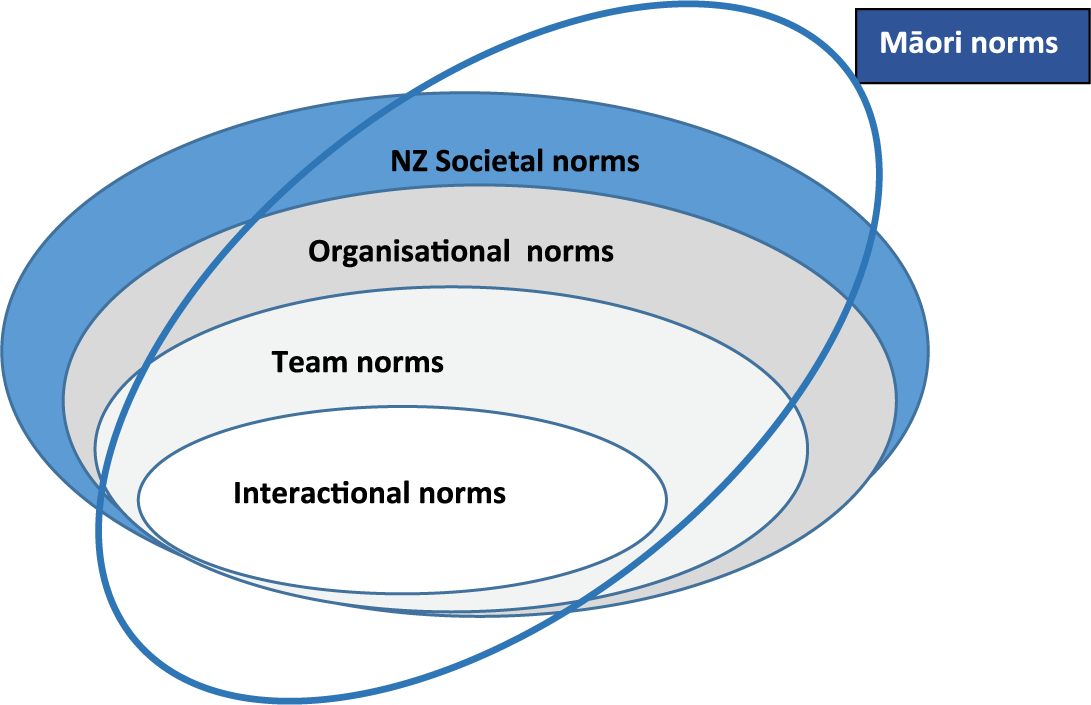
A Model of Intercultural Interaction Norms.
Cultural Values in New Zealand
Holmes (2018) introduces the concept of “culture order” to help understand the norms in society which constrain how people “construct their ethnic or cultural identity,” as a parallel to the concept of “gender order” (Connell, 1987; Matthews, 1984). The concept of the culture order acknowledges inequalities and “taken-for-granted societal norms or ideologies which influence behaviour, including linguistic behaviour” (Holmes, 2018, p. 33).
The predominant culture in New Zealand is Pākehā and one distinctive feature of this culture is the New Zealand egalitarian ideology (Bönisch-Brednich, 2008). Many Pākehā New Zealanders are not comfortable with the explicit enactment of power or status and prefer instead for power differences to be minimized and an emphasis on equality between colleagues (Jackson & Parry, 2011; Kennedy, 2007). When in a subordinate position, calling your boss by their first name and initiating small talk with them is normal in many Pākehā workplaces. It is also accepted and even expected that lower level staff contribute in meetings when they have knowledge in an area, without necessarily waiting for someone more senior to ask them for input.
The egalitarian ethic is an aspect of Pākehā culture which contrasts in a number of ways with Māori culture. For Māori, hierarchy differences are accepted and leaders are explicitly respected. It is not deemed appropriate for followers to treat leaders as they treat equals, and less senior members of a group often do not have speaking rights in a formal meeting unless these are assigned to them by someone with more authority (Salmond, 2004; Tauroa & Tauroa, 2009, p. 73). Age is an important consideration when understanding hierarchy and authority in Māori culture, with older people “accorded more respect” (Mead, 2016, p. 48) and birth order within a family is also important (Mead, 2016, p. 40; Metge, 1995, p. 89).
Traditionally, Māori taking on a leadership role needed “the right ‘birth credentials’” (Katene, 2017, p. 264), although nowadays some leaders, for example, political leaders, do not come from families that have chiefly ancestors. Māori leaders must have certain attributes, however. One important attribute is mana (prestige, spiritual power) which gives them “the authority to control and direct activities over which they have jurisdiction” (Katene, 2017, p. 275; see also Mead, 1992, pp. 2-3). However, although they have this right, Māori leaders are expected to be humble and so will often use interactional strategies which reduce status differences. They therefore may use language in a similar way to Pākehā leaders, but for different reasons.
Another aspect of the cultures which contrast is a focus on individualism, Pākehā, rather than collectivism, Māori (Holmes, 2018; O’Sullivan & Mills, 2009). Individualist cultures view the individual as the most important unit and there is an emphasis on individual initiative and achievement. This may again mean that less senior members of a team will contribute to discussions without explicit invitation as they exert their rights to express their point of view and foreground their expertise. O’Sullivan and Mills (2009) comment that a crucial role of the chair in a meeting often cited in textbooks used to teach New Zealand (and other) tertiary students about workplace meetings is “the encouragement of ideas from everyone attending” (p. 29). As they note, this aligns “with individualism and low power distance, which are features of the dominant cultures of Western societies” (O’Sullivan and Mills, 2009, p. 29). For collectivist cultures, this advice may contravene the accepted norms.
There was a suppression of Māori culture and ways of doing things in New Zealand for many years, although Mead (2016) notes that from the 1960s on “there has been a steady movement towards a greater acceptance of aspects of Māori culture” (p. 11). Many Māori had lost knowledge of tikanga Māori (Māori ways of doing things) and collectivist cultural norms, but there has been a huge revival, rediscovery, re-education, and redevelopment within Māoridom (Mead, 2016). 4 Collectivist cultural norms are evident in the ethnicised Māori workplaces which the LWP has worked with (Holmes et al., 2011; Schnurr et al., 2007), where tikanga Māori play a significant and explicit role in the day-to-day operations of the organizations (see Holmes, Vine, & Marra, 2009).
Underlying tikanga, are values that are important for Māori. In exploring the values of Māori, Mikaere (2007) notes the diversity of tikanga between iwi (tribes) and hapū (subtribes), but also notes “that at the core of that diversity there are a set of common values underpinning the way in which we practise our tikanga” (p. 24). 5 The common values include aroha (love), manaakitanga (hospitality), utu (reciprocation or balance), whanaungatanga (close connection between people), and whakapapa (genealogy).
Whanaungatanga can have a significant influence on the way meetings in Māori contexts are conducted. The focus becomes relationships, with a recognition of the fragility of these and the need for nurturing (Mead, 2016, p. 31). The focus is also on the group (Henare, 1988; Mead, 2016), with an emphasis on belonging (Hofstede, 2001; Metge, 1995) and being “a good group member” (O’Sullivan & Mills, 2009). And as O’Sullivan and Mills (2009) note, “the whanaungatanga generated can . . . place constraints on when and how individuals contribute their personal views or ideas” (p. 30). In a workplace context, this means that the obligation created for less senior individuals is not to put forward their personal views, as the “collective group . . . expects the support and help of its individuals” (Mead, 2016, p. 31).
When considering the relevance of Māori values such as whanaungatanga for how Māori people lead, the expectation is that these values will be at the heart of leadership practice. In discussing Māori leadership, Winiata (2017, p. viii) cites the Anglican Bishop Manuhuia Bennett, who in turn cites his kaumātua (elders), saying that the attributions of rangatiratanga (chiefs) are that they must be articulate, they must be generous, and they must be able to bring people together.
This focus on the importance of people when leading has been referred to as Humanistic Management (Pirson, 2017). This contrasts with traditional approaches to leadership and management in Western contexts where profits and business goals are usually considered central.
Exploring Evidence of Cultural Values in the Language of Meetings
There has not been a great deal of linguistic research on Māori patterns of interaction. Much of what is known about Māori expectations and norms for interaction comes from general descriptions and discussions of tikanga from outside linguistics (e.g., Mead, 2016; Metge, 1995; Salmond, 2004). Sociolinguistic research on Māori workplace interaction has mainly been conducted by researchers connected with the LWP (e.g., Holmes, 2018; Holmes et al., 2011; Kell, Marra, Holmes, & Vine, 2007). In exploring the instantiation of the culture order in New Zealand workplace interaction, for example, Holmes (2018) highlights four areas where norms may differ for Pākehā and Māori because of the differing core ideological components. These are meeting openings, the way criticism is expressed, the enactment of professional identity, and norms for speaking. In terms of the first of these aspects, Holmes notes that meetings in many New Zealand workplaces begin in a low key way, often with a statement from the chair such as “let’s start” (see also Holmes et al., 2011). Māori custom on the contrary requires a formal welcome and introduction at meetings. Larger workplace meetings tend to be more formal than one-to-one interactions in New Zealand organizations (Vine, 2016), with the norm in Māori workplaces to generally mark this with a formal opening.
Another aspect Holmes examines is the way criticism is expressed. In Māori contexts, negative feedback tends to be expressed indirectly or aimed at the group rather than the individual (Holmes, 2018). This type of indirect strategy is seen as evidence of Māori values which require paying a great deal of attention to maintaining positive relationships and taking explicit care of colleagues.
Holmes (2018) also examines the way status is claimed and enacted, including expert status versus constructing a modest and humble professional identity. Although hierarchy is acknowledged and accepted in Māori culture, Māori leaders are expected to be humble and to avoid self-promotion. They must manage the leadership role, balancing the need for authority with humility (see also Holmes et al., 2011). They must also balance the need to achieve workplace (transactional) goals, while always keeping in mind interpersonal (relational) goals.
The fourth aspect Holmes (2018) discusses is speaking norms in meetings, focusing on the way it is acceptable for low level murmuring while someone else has the floor in a Māori context, while the Pākehā norm is to be quiet while someone else talks (Metge & Kinloch, 1978). Illustrating this point, Kell et al. (2007) compared speaking norms in a Pākehā and a Māori team meeting in the same New Zealand government workplace. They found that the Māori meeting was characterized by much more overlapping talk, explicit verbal feedback, and collaborative interaction than the Pākehā meeting.
The four areas that Holmes (2018) highlights provide a useful starting point for investigating norms and the importance of contextual variation. In the discussion below, each of the three meetings is examined to see how Caleb interacts when he takes on different roles, and how this instantiates cultural norms and cultural values. This includes consideration of some of the factors highlighted by Holmes (2018), but also looks beyond this. The role Caleb plays in meeting openings and closings is considered in each case, when and how much he speaks and what type of content he contributes (transactional or relational). Consideration is also given to the importance of formality for Caleb. Given these factors, the discussion below focuses both on salient ways that Caleb indexes his Māori identity and values, as well as less obvious features which enable him to do this in different contexts (Marra & Angouri, 2011).
Māori Expectations and Norms in Different Contexts
Introducing Kiwi Consultations
As noted above, Caleb works in a New Zealand government organization and the company he works for is one that can be described as an ethnicised Māori workplace. Kiwi Consultation’s goals and purpose are to support and further Māori interests and all the people who work in this organization have a strong commitment to promoting Māori goals. Importantly, they also behave in ways that accord with Māori norms and values.
The company’s CEO, Daniel, has had a large impact on the culture of the workplace since joining and taking on the CEO role. He has deliberately tried to be more informal than the previous CEO and to create what he feels is a more nurturing atmosphere. This superficially appears to be consistent with Pākehā norms, but underlying this is his strong commitment to Māori values, such as whanaungatanga, manaakitanga, utu, and aroha.
Introducing Caleb
Caleb has worked at Kiwi Consultations for 7 years and holds a senior management position within the company. Caleb identifies as Māori, and the importance of this aspect of his identity is already signaled given the role and workplace in which he has chosen to work. He is Māori, working for Māori. In this section, I consider how he enacts Māori norms and values when he interacts. Identity is not a static attribute but is something that is enacted and negotiated through interaction (Bucholtz & Hall, 2005). Caleb provides a fascinating case study because he takes on different roles in different meetings.
Interacting as a Team Member
Caleb is present in the first meeting as a member of the senior management team in a meeting chaired by the CEO, Daniel. The opening is brief and informal, with Daniel saying “right” and then “welcome back Hari” as he gets the meeting underway. The closing is similar, with Daniel simply saying “alright okay folks thank you very much.” Daniel decides when the meeting should start and when it will end and completes the transitions in an informal way. This informal approach to opening and closing the meeting is a norm that Daniel has introduced to this team.
Caleb does not talk much in this meeting. He is not the most senior person present and often, as the CEO and another senior member of the team discuss issues, no one else joins in. This is consistent with Māori norms regarding speaking rights and seniority (Tauroa & Tauroa, 2009). Caleb does contribute when asked for his weekly update about his particular area of responsibility and expertise, and at one other point he provides Daniel with the name of someone who is knowledgeable about an issue that is being discussed. He does not however give his personal opinion or views on any topic but supports the goals of the group (Mead, 2016, p. 31).
Caleb also joins in with the humor at times, as illustrated in Example 1. At this point in the meeting, the team has been discussing a report that has been sent out to interested parties for comment, but there has been very little feedback. Hinerau will write a report back to the board about this and Daniel advises her about what they need.
Example 1
Daniel winds up the discussion of an issue, summarizing what is needed in a report Hinerau needs to write for the company board
I think we just have a one page report to them
okay
these were the comments we got back
the changes were modest
[laughs]: we got one phone call:
comments appear in this box [laughs]
[laughs]
on this line
[laughter]
The humor here is collaborative, as Hari and Caleb elaborate on Daniel’s humorous quip that the “modest” comments came from “one phone call.” Humor is a frequent feature of these meetings, often instigated by the CEO Daniel. The recurrent use of humor is one way Daniel creates connections with his team, and the team members respond by laughing and often elaborating and developing the humor. Frequent use of humor is a norm in both Pākehā and Māori workplaces, often being used for relational purposes (Holmes et al., 2011), although also enabling speakers to achieve transactional goals (Vine, 2019).
To summarize, Caleb generally contributes in this meeting only when he is directly asked for input relating to his areas of expertise, or where he adds to humor in a collaborative way. This is in line with Māori patterns of interaction, where his role in this context is to provide input when requested and to support the development of whanaungatanga (O’Sullivan & Mills, 2009). It is interesting that the one work-related comment he makes that is not elicited entails providing the name of someone who might help with an issue, so he endorses someone else’s expertise and knowledge in an area. This is consistent with Māori values and norms where individuals do not endorse themselves, rather others provide recognition of status (Holmes, Marra, & Lazzaro-Salazar, 2017; Mead, 2016, p. 48).
Interacting as Chair of a Team Meeting
Daniel began the first meeting by simply saying “right” and then welcoming back a member of the team who had been away. When Caleb takes on the role of chair, he starts the meeting with a karakia (prayer). In this series of management meetings at Kiwi Consultations there is not typically a karakia or formal opening, although this is a feature of meeting openings in larger staff meetings at this company and in other Māori workplaces where the LWP has gathered data (see, e.g., Holmes et al., 2011). In this particular meeting, however, Caleb does include a more formal opening, although the karakia here is unusual because it is the only karakia in our wider LWP database which is mainly in English (see Example 2).
Example 2
Beginning of the meeting after several minutes of pre-meeting talk
way you go Caleb
oh okay kia ora anō tātou katoa [hello again everyone]
first of all it’s good to have a a welcome
for a new staff member
and um I’m certain that you’ll look after her here Hari
but also too in your um whakatau [welcome] to her
and I also acknowledge it to er passing of [name]’s father
and um so it was good that that was acknowledged
so welcome here today
and I hope everything’s going well f- with you too Albert
and the whānau [family]
so um kia kaha e hoa [stay strong my friend]
okay moving into it we’ve got two agenda items so far
Caleb’s use of a formal opening here can be understood as a response to several contextual factors relevant to this meeting. First, Caleb shows support to Albert who has arrived in the meeting room a little late, explaining that he was held up by a family phone call related to his father having health problems. Caleb’s opening supports Albert, and in using mainly English, and Māori phrases that Albert knows 6 , Caleb makes sure that Albert understands the support he is being offered (see Holmes et al., 2011, p. 75). Second, there have also been a few other events over the week that Caleb wants to formally mark—the arrival of a new staff member and the death of a staff member’s father (recognizing the death of a family member is an important component of karakia). Here Caleb overtly indexes his Māori identity through the formal Māori element, as well as implicitly through the values that it demonstrates as he pays attention to Albert’s personal needs and to acknowledging significant events relating to other members of the organization. In addition, Caleb is also acknowledging and marking the different role that he has in this meeting as chair and the responsibilities he sees as being part of this role.
It is also interesting to note in Example 2 that Caleb starts the meeting after Daniel gives him the go-ahead. He does not decide himself that it is time to begin, but waits for Daniel’s prompt, and when this comes he immediately begins.
The closing of this meeting is shown in Example 3.
Example 3
meeting closing
nothing else?
thank you very much
who’s chairing next week? +
you get to pick them Caleb
oh do you I thought it was just a +
oh because it’s your first week of ( ) do you want to chair Hari?
Caleb closes the meeting in an informal manner, as Daniel tends to, and in a way that conforms with the norm for the group. After checking that there are no other issues, he thanks everyone, using the same phrase Daniel used in the first meeting “thank you very much.” He then checks who will chair next week, although Daniel then points out that Caleb gets to choose. This is the first executive team meeting Caleb has chaired, and he does not realize that as chair he chooses the next chair. It is interesting that when he does allocate this role it is to a more junior member of the team, and even at this point he asks Hari a question “do you want to chair Hari?,” suggesting that Hari has a choice and can say “no.”
Daniel has only recently introduced a system of having a revolving chair to the meetings so the group norm for this is still being established. Daniel quickly steps in to direct Caleb here and make clear how he wants the allocation of the chair to work.
Caleb speaks much more in this second meeting than he did when Daniel was chairing, although the bulk of his turns in this case are related to his management of the meeting and his role as chair. At one point, for example, he is careful to document and check the conclusions that have resulted from the discussion of an issue, which has mainly involved Daniel and Frank. Before he closes the meeting Caleb also sums up decisions that have been made in the meeting, which results in more discussion of one issue as Hari asks for clarification on when something needs to happen.
As with the first meeting, Caleb joins in with the humor, but does not instigate it during the meeting proper. Pre-meeting talk is a place where he does initiate humor, both with the LWP Research Assistants as they finish setting up the recording equipment and with team members as they arrive. Caleb’s failure to instigate humor and social talk during the meeting, along with his formal opening, suggests that Caleb views the meeting proper as a more formal event. He understands the importance of humor and social talk in creating connections between people, as evidenced by the fact he joins in when others are engaging in this type of talk, but does not seem to see his role here to instigate this type of talk himself.
To summarize, Caleb contributes much more talk in this meeting, although his contributions are generally related to his role as chair. He uses a more formal opening than Daniel does as chair, but closes the meeting in a similar informal way, reflecting the norm that Daniel has established within the group. Caleb leaves the instigation of humor and social talk to Daniel, a role that Daniel clearly takes on whenever he is present, and one which is part of his leadership style. This is in line with Māori patterns of interaction, where Caleb’s role in this context is to provide support to the leader, in this case by taking on the tasks of the chair.
Interacting as Chair and Acting CEO
When Caleb opens the third meeting, as chair and acting CEO, he does not open the meeting with a karakia but adopts the informal and brief type of opening that the CEO Daniel favors in these meetings. He is stepping into Daniel’s shoes and begins the meeting in the way that has become the norm for the team, as illustrated in Example 4.
Example 4
Beginning of management team meeting. Frank and Caleb have been discussing some issues related to an agenda item as others arrive, but Maureen now asks if they should start and Caleb responds.
shall we start?
oh yeah we’ll make a start eh
yeah
[brief exchange between Caleb and Frank about the issue they were discussing]
okay well first of all is there anything else
to add the agenda at this stage?
no? kei te pai [good] ++
so um we’re just heading straight to the monthly report
Daniel prodded Caleb to start in the previous meeting, while here Maureen, the CEO’s personal assistant, does this. Caleb acknowledges this, saying “we’ll make a start eh.” He then briefly adds one more comment to the discussion he was having with Frank prior to Maureen’s question before addressing everyone “okay well” and asking for any additional agenda items, thereby getting the meeting underway. Maureen does not have the same status as Daniel, so while Caleb acknowledges her direction, he finishes his discussion before beginning the meeting.
In Example 5, Caleb finishes the meeting by thanking everyone. As with the opening of the meeting, the closing is brief and mirrors the way Daniel ends meetings. Caleb then realizes he needs to assign a chair for the next meeting, and as with the second meeting he does not seem to want to nominate anyone himself. Darcy suggests that Hari, who is absent this week, can do it. Caleb takes this suggestion up.
Example 5
end of management team meeting
oh okay alright okay well thank you
Al nothing else?
okay kia ora [thank you] thank you guys
here who wants the chair next week? ++
Maureen do you chair these meetings?
nah
nah Hari will be here so if you want to nominate him ( )
yeah we’ll shal- shall we make Hari eh yeah
[discussion of who will be away next week
and whether they should therefore have a meeting]
Again then, the meeting ends with the chair thanking everyone, although Caleb does this more informally on this occasion, saying “kia ora thank you guys.” Instead of nominating the next chair though, he then asks who wants to chair next, so still seems uncomfortable with allocating this role. The person who is nominated is again Hari, one of the junior members of the team. The discussion actually extends beyond this for approximately another 4 min as several people realize as they pack up that they will not be able to make the next week’s meeting because of other work commitments. Caleb tries to clarify several times whether enough people will be available to have a meeting. At the end of this discussion Caleb again thanks everyone, saying “okay thanks guys.”
During this meeting, Caleb also adopts a couple of strategies which other senior Māori leaders in our LWP database use, including Daniel. For instance, he checks information with another team members, signaling their expertise and knowledge on issues and endorsing their status. In one case, for example, Caleb had clarified what he thinks Daniel is wanting regarding an agenda item, but refers to Frank to check that he has explained the issue correctly, saying “well that’s my understanding, is that right Frank?” He acknowledges Frank’s expertise and experience in relation to the issue. Again, this is compatible with the Māori norm where others provide recognition of status, rather than people endorsing themselves (Holmes et al., 2017; Mead, 2016 p. 48; Metge, 1995, p. 160).
Caleb endorses others therefore, but there are also occasions where others endorse Caleb. Albert, for example, explicitly refers to Caleb’s role as acting CEO in this meeting twice. The first occurrence is provided in Example 6.
Example 6
Caleb has just asked if there is anything else anyone wants to talk about before they move on to the next agenda item
I want to talk about the annual report
if I //would you like to put on the\
/yep +\\ no it wasn’t on the agenda
but we’ll we’ll have it +
[laughter] //[laughter]\
/[laughs]: oh thank you for being so kind to me
mister acting C E O I appreciate your leniency:\\
okay there you go Albert
alright um the annual report is at er the printers
being designed and put together
They have just finished discussing an issue and Caleb has checked if there are any other issues they should discuss before moving to the next item on the agenda. Albert brings up the annual report, which is not on the agenda. Caleb jokes that although it was not on the agenda, Albert can still talk about it. His tone when he says this is quite light and after a brief pause everyone laughs. In these meetings, the agenda is only ever a basic guide and people frequently bring up additional items. Albert takes the humor further and in the process draws attention to Caleb’s role in this meeting as CEO. The others, including Caleb, laugh throughout Albert’s overly polite thanks to Caleb for letting him talk about the report. Although Albert is teasing Caleb, he is also acknowledging his role, and the teasing here creates a sense of solidarity and belonging (Boxer & Cortés-Conde, 1997).
Caleb does initiate humor during the meeting proper in the third meeting, and he joins in with the humor more than in the previous two meetings. There is also one instance in this meeting where he initiates social talk while discussing what the team members have coming up in the next week (Example 7).
Example 7
[to Darcy]: so you’re out it’s Angie’s what is it?
//it’s her admission to the bar:\
/it’s her admission to the bar tomorrow yeah\\
who’s admitting her? is it Hari?
Darcy has said that he will not be in the office the next day, and Caleb asks him about where he will be. Caleb extends the social talk here beyond what would be necessary in terms of noting Darcy’s absence the following day. This demonstrates an interest in other people and attention to relational goals and to whanaungatanga (Mead, 2016), and to concerns beyond the immediate transactional goals of the meeting.
The role Caleb takes on in the third meeting is a temporary and unfamiliar leadership role. This is an interesting situation for him because it is a regular meeting that he normally attends as one of the management group. He is not used to taking on the role of CEO, and nor are the other team members accustomed to him being in this role. He references Daniel and what Daniel wants at several points, marking his own position as “acting” CEO clear. He is humble in taking up the position while Daniel is away, and seems to orient to the temporary nature of this role.
As acting CEO, Caleb does take a more active role in relational aspects of the meetings, initiating humor and social talk, taking on some of the role that Daniel enacts as CEO when he is present. Examples 4 and 5 also illustrate the way others support Caleb in his unfamiliar role. Maureen is the CEO’s Personal Assistant and she prods him gently to begin the meeting in Example 4. In Example 5, Darcy helps him out with a suggestion for whom to nominate as the chair for the next meeting, which he takes up. At the end of the meeting, Caleb repeatedly questions whether they will have a meeting the following week, and Frank, Albert, and Maureen all step in to assure him that they do not need one.
Frank is also more active in the discussions in this meeting than when Daniel is present, both in terms of transactional and relational aspects. He, for instance, clarifies for Darcy what is needed from his team for a report and when Albert asks about deadlines for this report, Frank checks with Albert what date would be realistic for this. He also instigates more humor in this meeting than in the previous meetings. Frank’s behavior supports Caleb, who in the case of the report had been a little unsure about the details. Frank is at a similar level as Caleb, being an experienced senior manager who has been with the organization for several years. He is also older then Caleb (an important consideration for Māori in relation to status). His explicit support for Caleb is thus both helpful and consistent with Māori values.
The members of the team, therefore, share out some of the tasks that Daniel normally undertakes and the others provide support to Caleb, and assist with achieving the goals of the group, rather than expecting Caleb to take on Daniel’s role all by himself. Like Caleb, they adapt their behavior to the change. There has been a shift and the norms also shift and need to be negotiated because something important is different. The commitment to Māori values is evident in the way the other members of the team support Caleb in his unfamiliar and temporary role.
To summarize, Caleb’s contributions in this meeting are similar to those he made when taking on the role of chair, although slightly expanded to accommodate his status as acting CEO. The other members of the team also adapt to Daniel’s absence and take on more active roles. They support Caleb in this new temporary role, as well as supporting the interests of the group.
Conclusion
An individual’s role in a meeting can constrain how they are expected to interact and in this article the way one Māori manager orients to his changing roles has been considered in some detail. I have analyzed Caleb’s interaction in three different meetings while taking on different roles, and there are demonstrable differences between how he interacts in each situation. The way he interacts and his responsiveness to contextual factors and differing norms of interaction are influenced by core Māori values such as whanaungatanga, manaakitanga, utu, and aroha. In the first meeting, his contributions are minimal, as is appropriate given his presence at this meeting as a member of the team, without another role. In the second meeting, his contributions relate to his role as chair. As acting CEO and chair in the third meeting, he takes a more active role than in the previous two meetings, but this is a temporary and unfamiliar role, and the other members of the team step in to support him and the goals of the group.
Daniel is the CEO of the company in which Caleb works and Daniel’s influence is obvious even when he is not present. The way the members of the team interact in his absence is clearly shaped by his interactional style. There is a great deal of humor, for example, showing that this has become a norm for this group. Caleb reinforces the group norm for humor as acting CEO, joining in with this more than when he has another role in the meeting. He also initiates social talk in this context and his attention to interpersonal aspects of the interaction is evident in his discourse. Caleb enacts a more traditional and formal professional Māori identity than the CEO, but this meeting shows him adapting his interaction patterns and the way he does this illustrates his commitment to Māori values such as whanaungatanga.
Caleb indexes core Māori values and his Māori identity is an ever-present influence and constraint on how he interacts. In working in an ethnicised Māori organization, Caleb is able to enact his Māori identity within a context where tikanga Māori (Māori ways of doing things) play a significant and explicit role. The predominant norms of New Zealand society are Pākehā, but they are not the predominant norms of this workplace. There may be overlap in norms for Pākehā and Māori (and each group may influence the other), but at the basis of similarities are different core values. Respect for hierarchy and a group orientation are core components of the Māori culture order in this context, rather than Pākehā values which orient to egalitarianism and individualism (Holmes, 2018).
It is through interaction that linguistic norms are established and reinforced and the examination of authentic interactional data allows exploration of what this can look like. In different situations, we can observe how participants in an interaction orient to contextual factors which influence how they interact. Participants must respond to these influences to interact effectively, taking account of factors such as their differing roles, as well as the changing roles of others. Norms that develop in different contexts reflect people’s values and the patterns that emerge from analysis of authentic interaction highlight how important it is to consider the influence of norms, values, and contextual factors on the way people interact at work.
Footnotes
Acknowledgements
I would like to thank Janet Holmes and the anonymous reviewers for useful comments on earlier drafts of this article. A huge thank you also to Caleb and the team who are the focus of the analysis in this article, kia ora.
Transcription Conventions
kia ora Māori words in italics
[laughs] Paralinguistic features, replaced words, and Māori translations
[laughs]: mm: Colons show scope of a feature
+ Pause of up to one second
// \ / \\ Simultaneous speech
ke- Incomplete word
() Unclear word or phrase
Declaration of Conflicting Interests
The author(s) declared no potential conflicts of interest with respect to the research, authorship, and/or publication of this article.
Funding
The author(s) disclosed receipt of the following financial support for the research, authorship, and/or publication of this article: The data in this study was collected with the financial support of a Marsden grant administered by the Royal Society of New Zealand.
