




Abstract
Roma children are often segregated within the Serbian education system: They are disproportionally placed in special schools or put in ethnically homogeneous classrooms. Even in nonsegregated environments, they face everyday discrimination—an 80% dropout rate from elementary school testifies to that. Being a stigmatized minority might contribute to negative social identity, manifested in reversed in-group–out-group preferences. In this cross-sectional study, we investigated (a) if Roma children exhibit implicit/explicit preference for the majority group, and compared their preferences with those of majority children; (b) if these preferences differ in two age groups (second/third and seventh-grade elementary school); and (c) if they relate to academic self-efficacy. A total of 89 children completed the implicit associations test (IAT) test, three measures of explicit ethnic preference (semantic differential, feeling thermometer, and social distance), and a measure of academic self-efficacy. While Serbian children showed consistent explicit and implicit in-group preference, in Roma, we found out-group preferences on both sets of measures. Age-wise, the older group of Roma showed less explicit out-group preferences only in social distance, but not in other measures; the older children showed higher implicit out-group preference (Roma), and slightly lower implicit in-group preference (Serbs), in comparison with the younger. Finally, implicit, but not explicit, out-group preference predicted lower academic self-efficacy in Roma. Our findings demonstrate that out-group preference in Roma children is a robust phenomenon, and that implicit preference is stronger with age. This implies that schooling alone will not reduce negative social identity and that the minority children need to be strategically empowered.
Keywords
Ethnic Roma is one of the most, if not the most stigmatized minority group in many European countries (Kende, Handarics, & Lášticová, 2017). In the Republic of Serbia, Roma people constitute the largest ethnic minority with an estimated 600,000 unregistered and 150,000 registered members (Radovanović & Knežević, 2014). They are almost completely excluded from the general social environment, as numerous statistical reports indicate. In Serbia, the majority of Roma people (60.5%) live in very poor conditions (Bodewig & Sethi, 2005), 1 with significantly lower access to social and health services, and other state institutions. Poor living conditions are, at least in part, responsible for their shorter than average life expectancy and higher nontraumatic mortality rate (Bogdanović et al., 2007).
The average employment rate among Roma is 17% in comparison with 60% for the general population, whereas their political voice is almost nonexistent. In terms of education, 50% of Roma children who enter elementary school drop out a few years later; every fifth Roma child finishes obligatory primary school and only one in a 100 enters college (Franceško, Mihić, & Kajon, 2005). Some Roma children are enrolled in special education schools, not because of a mental and/or developmental problem, but because the ability assessment does not account for the language barrier or the socio-cultural context children are brought up in (Miladinović, 2008). The number of Roma children aged between 7 years and 15 years who attend or have been attending special schools exceeds 5%, as opposed to 1% of the general population (Brüggemann, 2012; UNICEF, 2015). This was true in spite of the fact that one of the goals of the Serbian Law on Preschool Education introduced in 2010 was to decrease disproportional enrolment of Roma children in special schools and to support them in overcoming the language barrier (Macura-Milovanović, 2013). The figures also imply notable gender inequality: reports from European countries show that Roma girls have less access to the educational system, leaving school earlier than boys and usually having poorer performance (European Commission, 2008).
In comparison to other minorities, social distance and negative attitudes toward the Roma population are very pronounced (Franceško et al., 2005). Even though data concerning the level of social exclusion of Roma exists, not a lot of it comes from the Roma perspective. The way they perceive their position, their attitudes toward other ethnic groups and their well-being, is severely underresearched (especially in relation to Roma children). In a rare research of this type, Cvjetković, Janković, and Bjegović-Mikanović (2017) have shown that, compared to non-Roma, Roma people are generally less happy and less satisfied with life. In addition, those without an education or with only primary education were less likely to report life satisfaction and optimism. Having in mind this evidence gap, in this research, we explored how school-aged Roma children perceive the position of their ethnic group in comparison with the Serbian majority, and whether that perceived position is related to their self-efficacy in an academic setting.
In understanding how deprivileged social status affects the attitudes of and relating to minority members, social identity theory (Tajfel & Turner, 1986) proposes that perceptions of and attitudes toward in-group and out-group members originate from the desire to belong to groups that are comparatively higher in status. Identifying with the members whose group status is perceived as superior enhances self-esteem (Tajfel & Turner, 1979). This process rests on the universal motivation for a positive social distinctiveness. A large body of research has shown that socially dominant, high-status groups (usually but not exclusively, the numerical majority) develop an in-group preference (i.e., favoritism), which is a pattern of consistent favoring of members of one’s own group over members of the out-group. This preference stems from an awareness of the contrast in social dominance of different groups within a certain society or community (Dunham, Baron, & Banaji, 2006). However, when considering the meaning of “high” and “low” social status, we refer to the degree of status difference, that is, how pronounced the differences between groups are in a certain social context (Newheiser, Dunham, Merrill, Hoosain, & Olson, 2014) as opposed to something that is given or easily distinguishable per se. The favorable and positive distinctiveness of one’s own group in relevant comparisons with other groups is considered a sign of a positive self-evaluation and in-group evaluation, that is, a positive social identity (Mummendey, Kessler, Klink, & Mielke, 1999).
On the contrary, minority members (people of a different ethnicity, race, socio-economic status etc., all relative to the majority), can display preferences and positive attitudes toward the out-group (majority) rather than their in-group, to whom attitudes are neutral or even negative (Dasgupta, 2004). This phenomenon, labeled out-group favoritism, often accompanied by the internalization of stereotypes of the in-group, is considered a sign of a negative social identity (Tajfel & Turner, 1979). However, despite being detected frequently, negative identity is not typical for all minorities. In fact, there are minorities with a strong in-group preference (Newman, Liss, & Sherman, 1983). To fully understand why the pattern of out-group favoring occurs in some, but not in other minorities, we must further elaborate on the issue of their identity formation.
Children are sensitive to knowledge about the relative social status of the group they and those around them belong to, within the local and cultural context of society. Research suggests that children around the age of 4 years engage in social comparisons, demonstrating the capability of self–other evaluations (Chafel, 1986). When it comes to perceiving ethnicity, the fact that its features are sometimes more visible (e.g., skin color) makes children more prone to noticing them and thus, pairing evaluative attributes with different social and ethnic groups (Tomašić, 2011). Ethnic identification is one of the precursors of identity formation, and it is based on the conception of belongingness to a group that consistently uses a certain ethnic label. As Clark and Clark (1939) described it, this process is indicative of a particularized self-consciousness, being intimately tied to the way people understand themselves and make sense of the world around them.
Minority status means that a child is growing up in a very different niche from a child belonging to the population majority. In the example of Roma, identity formation is influenced by negative stereotypes toward their in-group held by Serbian people. More importantly, it is the environmental conditions (poverty, health-related behaviors, and access to state institutions), which, along with the cognitive limitations of younger children, make the difference between Roma and Serbian children more clear-cut. Awareness and perception make it possible to distinguish and compare similarities and differences between individuals as members of different social groups. As Festinger’s (1954) social comparison theory postulated, there exists an innate drive in people to evaluate themselves, their opinions and abilities, relative to other social groups. For children, acknowledging group status has a major impact on the perceived similarity to other group members, their desire to be members of a group, and finally, their in-group preference (Nesdale & Flesser, 2001).
The emergence of an out-group preference was first observed in Clark and Clark’s (1947) doll experiment, which showed that children between 4 years and 5 years of age strongly preferred the dominant group doll (both Black and White children). Although the doll experiment initiated a fruitful line of research regarding ethnic and racial preferences in children, specifically in-group and out-group biases, the way it translates to negative identity in minorities is still not fully understood. We believe that much of what is known is to be complemented with the concrete sociocultural and historical contexts of the minority in question. Specifically, historical and statistical facts about the Roma community can provide a framework for understanding their social identity and its particularities. In the present research, we aim to explore its precursors: group preference and how it relates to self-efficacy, an aspect of the self-concept.
In this article, we investigate in-group and out-group preferences in children not only on the explicit level, but also on an implicit level. Explicit attitudes are conscious attitudes which people are able to manifest/elaborate, which makes them appropriate for self-report measurement. On the contrary, implicit attitudes are automatic, and thus not available for introspection (Greenwald & Banaji, 1995). Differences in relative social status may affect both children’s explicit and implicit cognition (Newheiser et al., 2014).
The empirical evidence regarding the developmental course of the two types of ethnic attitudes is not univocal. Although there are numerous cross-sectional studies on different populations suggesting that implicit preferences emerge early and show a certain stability over the course of a lifetime in both high- and low-status groups (Dunham et al., 2006), longitudinal studies questioning these findings reveal that, despite comparable internal consistency, implicit measures tend to vary more over time than corresponding explicit measures (Gawronski, Morrison, Phills, & Galdi, 2017). As for explicit ethnic attitudes, research indicates that between early and late childhood, explicit in-group favoritism of children from high-status groups rises slightly at an early age, peaking around 6 years to 7 years of age, and then decreasing between 8 years and 10 years of age (Raabe & Beelmann, as cited in Newheiser et al., 2014). This has been documented across cultures (Hailey & Olson, 2013).
However, children from low-status (minority) groups experience a decrease in explicit out-group favoritism at about the same age, that is, in-group bias grows or no bias is found. This is likely to indicate that as children grow older, awareness of social norms, as well as cultural and general knowledge increases (“it is desirable to be egalitarian”), so explicit measures become less sensitive to status (Hailey & Olson, 2013; Newheiser et al., 2014; Nicović & Ležaja, 2016).
However, the interplay between implicit and explicit attitudes can be complicated: For example, a person can consciously adopt an egalitarian belief system, while still negatively evaluating minority members on the implicit level (Ashburn-Nardo, Knowles, & Monteith, 2003). For example, in one field study that employed both sets of measures, contact Roma children in an inclusive educational environment led to more positive explicit attitudes toward this group, but made no difference at the implicit level (Žeželj, Jakšić, & Jošić, 2015).
Finally, establishing a social identity is in its course and outcome closely connected to mental health, well-being, and health-preserving behaviors (Haslam, Jetten, Postmes, & Haslam, 2009). For instance, negative social identity is shown to correlate with lower self-esteem (Mummendey et al., 1999). In this study, we were interested in academic self-efficacy (an aspect of self-efficacy) that represents individuals’ knowledge and perceptions about themselves in achievement situations (Byrne, 1984). How does it relate to in-group and out-group preferences in pupils? There is evidence that a stronger sense of a social identity leads to higher self-efficacy and predicted greater behavioral intention (Guan & So, 2016). Through collating data on Roma people in Serbia (more precisely, their education), we aimed to gain an understanding of whether or not the potential presence of out-group preference can relate to beliefs about one’s own achievement in school, which is also an under-researched area.
In brief, the present research investigates explicit and implicit attitudes of and about Roma children in two age groups. In addition, it relates the out-group/in-group preference to a psychological correlate relevant to school performance. Exploring these kinds of questions, we believe, could yield insights into the experiences of Roma children in the educational system, and provide concrete, practical steps for the empowerment of Roma people.
Goals and Hypotheses
The main goals of this research were as follows:
To compare explicit and implicit preferences to one’s own ethnic group between two age groups in Roma and non-Roma children.
To relate these preferences to academic self-efficacy in both age and ethnic groups separately. We wanted to measure correlations as well as the predictive power of explicit and implicit attitudes.
Following the previous discussion, we hypothesized that the following:
On both attitude measures and in both age groups, we expected Serbian children to show an in-group bias and that Roma children would show an out-group bias. Research has convincingly demonstrated that the majority in society holds an in-group bias, whereas it is absent or reversed in the minority group (Newheiser et al., 2014; Nicović & Ležaja, 2016). Having said that, we expected that Roma children, as members of an ethnic and national minority in Serbia, would show a preference and more positive attitudes toward Serbian children (the out-group) than their own group, that is, the lack of a positive or a negative attitude toward the Roma in-group would be registered along with a positive out-group attitude (Mummendey et al., 1999).
We expected that the implicit attitudes would, when comparing age groups, differ less than explicit attitudes. There is empirical support for the stability of implicit cognition that persists even through adulthood, whereas explicit in-group preference is expected to diminish with age. Our design allowed us to compare two age groups by both sets of measures.
Theory and research behind the concept of self-efficacy suggest that the beliefs of one’s own academic capabilities to learn or perform are influenced by the self-concept and the broader social and school context. A negative social identity may harm one’s self-concept and subsequently lead to a lower self-efficacy (Guan & So, 2016; Schunk & Pajares, 2001).
Method
The sample consisted of 89 children (28 Roma, 31.5%; 46 male, 51.7%) divided into two age groups according to school class: second grade (30 children, two Roma, M = 8), third grade (11 children, all Roma, M = 9) categorized into a single, younger group; and seventh grade (48 children, 15 Roma, M = 13). In the Roma subsample (25.0% girls), the average age was 10.86 years (SD = 2.10). In the Serbian subsample (54.1% girls), the average age was similar (M = 10.79, SD = 2.55).
Participants were recruited from the elementary school “Zaga Malivuk,” which has a higher number of enrolled Roma pupils than average Serbian elementary schools (28.7%). The two ethnic groups were determined by the participants’ self-categorization. Children were instructed to answer a yes/no question (Do you consider yourself a member of the Roma community?) that preceded the research. Children who said that their ethnicity is mixed, that is, that the question could not be answered in a straightforward manner, were excluded from the analyses. To confirm the self-reported ethnic membership, we cross-referenced it with the teacher’s selection of Roma and Serbian children that participated in this research.
Variables
Our design was 2 (age: second vs. seventh grade) × 2 (ethnicity: Roma vs. Serbian) between-subjects, with relative implicit and explicit group preferences as dependent variables. In addition, relative group preferences served as predictors of academic self-efficacy. The materials, syntax, and databases are available at https://osf.io/s2u4x/
Instruments
Child IAT
We employed a version of the implicit associations test (IAT) adapted for children. The main idea of utilizing IAT is the measurement of the automatic association of two target concepts with evaluative attributes, using response time (Greenwald, McGhee, & Schwartz, 1998). Rather than being asked to evaluate the target concepts directly, respondents are asked to categorize them into two categories; the critical tasks being the ones in which the targets and evaluative attributes share the same key—congruent or noncongruent (Žeželj, Lazarević, & Pavlović, 2010). The specific test was borrowed from previous research (Ćirović, Jošić, & Žeželj, 2011; Žeželj et al., 2015), which investigated ethnic preference in Roma and non-Roma children. It was presented to the participants as a video game, in which the progress depends on the accuracy of their categorization. Target concepts were Roma/non-Roma (Other; photos of children) and target attributes were good/bad (words). Child IAT consists of seven categorization blocks, where the first two are practice blocks for participants to get familiar with the keys and the spatial representation of targets; they are simple categorization tasks in which children categorize photographs of Roma and non-Roma children (first block) and verbal stimuli of positive or negative valence. The third block is also a practice trial for the combined targets (i.e., press the left key when good or Roma is shown), whereas the fourth block is critical in terms of implicit evaluation. The fifth block is another simple categorization task, with the reversed positioning of “good” and “bad,” and twice the number of trials relative to the second block. This was done to avoid the effect of sequencing (as suggested in Schnabel, Asendorpf, & Greenwald, 2007). Blocks 6 and 7 corresponded to blocks 3 and 4, with the opposite pairing of the target and attribute categories. More details about the procedure can be found in the original articles. We calculated a D measure of implicit preference (DIAT) using an algorithm that excludes all participants whose response time was shorter than 300 ms or longer than 10,000 ms, as well as those who had an error rate higher than 75% (Greenwald, Nosek, & Banaji, 2003). A positive DIAT score represented a relative preference for Roma versus Serbian.
Semantic differential scale
This instrument consists of six five-point items anchored with contrasted attributes. It was taken from Ćirović et al. (2011) and represent a subscale containing eight bipolar attributes describing Serbs and Roma separately. The authors labeled the scale perceived attractiveness. To shorten the scale, we omitted two items with the lowest factor loadings (.37 = safe/dangerous and .34 = known/unknown). The participant’s task was to read the questions (e.g., How close/distant are Roma to you?, How pleasant/unpleasant are Serbs?) and assess their agreement on a 5-point scale anchored with −2 to +2. We transferred the scale into the 1-5 format for further analyses. It showed satisfactory internal reliability (α= .83,) which allowed us to calculate an average score with higher values indicating higher perceived attractiveness of the group.
Feeling thermometer
It measures the feeling of warmth toward a certain group. It is a lightly modified instrument taken from Nicović and Ležaja (2016), an adapted version of Wilcox, Sigelman, and Cook (1989). We have reduced the number of items from four to two leaving only those relevant to our research question (the other two included questions about parents). The remaining questions are How much do you like people who are Serbian? and How much do you like people who are Roma? Low scores indicated disliking and vice versa. The five degrees of warmth were represented by smiley faces, to facilitate children’s understanding of the task.
Social distance scale
We used the Bogardus scale adapted for children, as in Franceško et al. (2005), and shortened it to include the most discriminative relations, in accordance with recent research (Maričić, Kamenov, & Horvat, 2012; Nicović & Ležaja, 2016). It consists of three descriptions of relations with a graduated level of closeness for both Serbian and Roma children (a total of six items for each participant). The participant’s task was to answer simply with yes or no, having read the description of a certain relation, that is, to judge its personal acceptability. These items stated the following: Imagine a girl or a boy who is Serbian (Roma). Would you accept that (a) he or she sits with you in class, (b) he or she is invited to your birthday, and (c) you go to his or her house when invited? A third description was added on the basis of a high factor loading from the research on social distance toward Roma conducted by Maričić et al. (2012). The reliability of these scales was satisfactory (α= .65, α= .76). As the answers were coded (yes = 1 and no = 2), the maximum possible score is 6, reflecting the highest social distance and the minimum score is 3, reflecting the absence of social distance.
Academic self-efficacy scale
The adapted academic self-efficacy scale was taken from Lončarić (2014). The instrument has six five-point items. Similar to others, we eliminated two items according to factor loadings from the original research (Muris, 2001) that Lončarić (2014) has adapted for children. Participants had the task of reading every statement and circling the number next to the one they agree with (e.g., I can easily concentrate on learning, even when I’m surrounded by other interesting things, I am successful in almost all my school subjects, My school grades meet the expectations of my parents). The scale ranged from 1 = I do not agree at all to 5 = I totally agree. The internal reliability (α = .84) allowed us to average all the answers so that a higher score represented higher self-efficacy.
Procedure
The research was conducted at the elementary school “Zaga Malivuk” in Belgrade, which has 553 pupils (out of which 159 are Roma). The official approval was given by the school’s psychologist and principal after a detailed research proposal was delivered. The school policy is to obtain a broad parental consent at the beginning of each school year. The consent form covers the participation of children in different types of psychological research that is conducted at “Zaga Malivuk.” We asked the teachers to assist us in sampling both ethnic groups. They invited the children to volunteer after we had explained to them what the research was about and why we were doing it. All the children were informed that they could withdraw from participation at any moment.
The research was conducted in the school library, which had 10 computers available for us to use. Upon greeting them, the researchers told the children they would “play an interesting game of seven levels where the main goal is to be as fast and accurate as possible” (Child IAT). After the completion, they were asked to fill out paper-and-pencil explicit-measure questionnaires 2 while seated at separate tables, as far from each other as possible. The children who had trouble following the instructions or understanding the items (mostly in the younger group) received special attention and assistance. It was ensured that all participants understood the questionnaires, which they were supposed to fill out. After completion, participants were debriefed and thanked.
Results
Before we proceed to test our main hypothesis for which we need relative preferences, we will briefly present the differences between the majority and the minority group in absolute explicit scores (i.e., explicit attitudes toward Roma), the existence of implicit preferences and academic self-efficacy. Based on the exclusion criteria for the IAT we reported previously, we omitted the results of two participants. Our results show that, not surprisingly, Roma children perceived their in-group more attractive than Serbian children perceived Roma, F(1, 79) = 9.81, p = .003, η² = 0.12; MRoma = 3.53, MSerbs = 2.85. They also liked Roma more than Serbs liked Roma, F(1, 84) = 4.60, p = .035, η² = 0.05; MRoma = 3.44, MSerbs = 2.80, and expressed marginally less social distance toward Roma in comparison with Serbs’ distance toward Roma, F(1, 87) = 3.49, p = .065, η² = 0.04; MRoma = 1.34, MSerbs = 1.50. As for the implicit preferences, the nature of the measure allowed us to conclude if relative preferences exist at all; same sample t tests have shown than Roma children’s out-group preference actually did not differ from zero, t(26) = −0.64, p = .52, d = –.25, whereas Serbian in-group preference did, t(56) = −5.02, p < .001, d = −1.34. Finally, Serbian children reported higher academic self-efficacy in comparison with Roma, F(1, 80) = 4.61, p = .035, η² = 0.06; MRoma = 3.53, MSerbs = 3.89.
In the rest of the analysis, we report difference scores, for two main reasons: first, it is easier to follow the results and relate them to theoretical assumptions if DVs are calculated as relative preference; second, there is empirical evidence that the compatibility of implicit and explicit measures influences the strength of their relationship, that is, implicit measures have higher correlations with relative (difference) explicit measures (e.g., Hofmann, Gawronski, Gschwender, Le, & Schmitt, 2005).
The descriptives for all the measured variables broken by ethnic groups are presented in Table 1.
Descriptives for Explicit/Implicit Group Preference Measures and Academic Self-Efficacy.

Note. All scores except academic self-efficacy are difference scores, meaning the scores of the Serbian subsample were subtracted from the scores of the Roma subsample. As such, negative scores indicate a preference toward the Serbian, non-Roma group for DIAT, semantic differential and feeling thermometer. Social distance is also a difference score but because of the scores of the original scale, higher scores indicate a higher social distance. There were 10 missing values for across all measures of the Roma subsample (see Table 1), and 18 missing values for the Serbian subsample overall.
In Table 2, the correlations between measures with respect to ethnic groups are shown.
Correlations Between the Measures in Both Ethnic Subsamples.
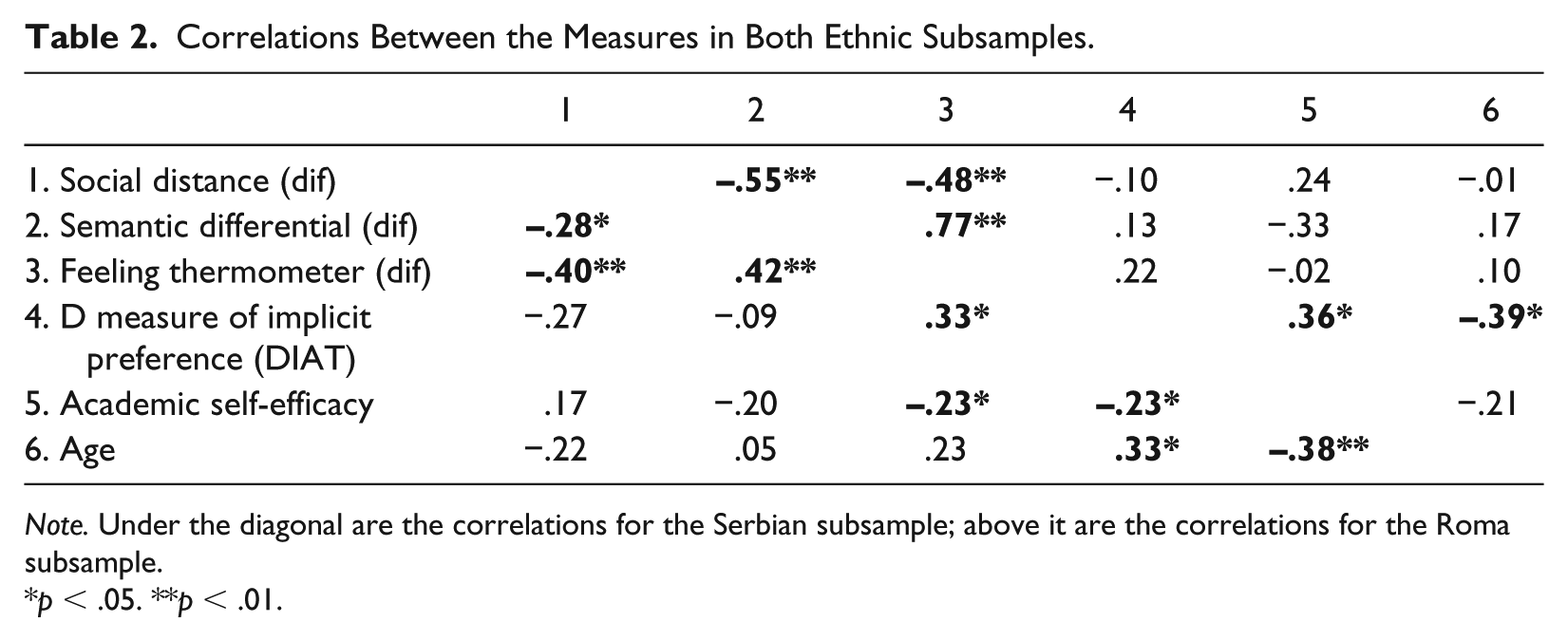
Note. Under the diagonal are the correlations for the Serbian subsample; above it are the correlations for the Roma subsample.
p < .05. **p < .01.
The Roma subsample data show that all relative explicit group preferences correlated strongly and in an expected manner: fewer stereotypes were related to more warmth and less social distance. In this subsample, the measure of relative implicit group preference also correlated with the explicit ones, as well as with academic self-efficacy, suggesting that a higher implicit out-group preference relates to a lower academic self-efficacy. Because of the potential relevance of such a connection, we explored it further and reported it later in the article. Age was moderately negatively correlated with academic self-efficacy, that is, in older children, academic self-efficacy was somewhat lower. Age was also moderately positively correlated with the DIAT, which suggests that in younger children implicit out-group preference was higher than in older children.
In the Serbian subsample, all relative explicit group preferences were correlated in an expected manner. However, we did not register correlations between the measure of implicit preference (DIAT) and measures of explicit preferences as we did in the Roma subsample. The DIAT correlated with academic self-efficacy score in the opposite direction in comparison with Roma subsample, indicating that implicit in-group preference is related to higher academic self-efficacy.
Age and Ethnic Group Differences in Relative Implicit Group Preference
The DIAT score was calculated as a relative preference for Roma in comparison with Serbs, thus a negative sign suggests an implicit preference toward the Serbian group.
We conducted a 2 × 2 ANOVA (age: second and seventh grade; ethnicity: Roma and Serbian) to explore the relationship of age and ethnicity with implicit attitudes. The main effect of age was not significant, F(1, 80) = 0.83, p = .37, whereas the main effect of ethnicity was significant, F(1, 80) = 4.39, p = .04, η² = 0.06, meaning that both ethnic groups preferred Serbs, but Serbs preferred their in-group more than Roma. These data are not in line with the second hypothesis but confirms that the minority group implicitly prefers the out-group (majority). This is graphically presented in Figure 1.

Mean D measure of implicit preference (DIAT) scores by ethnicity and age.
These effects were qualified by strong interaction, F(1, 80) = 10.87, p < .001, η² = 0.12. To disentangle it, we conducted a simple effect analysis, which breaks the interaction effect into component parts and then tests the separate parts for significance. In our case, we used MANOVA to separately test (a) the differences between the age groups for Roma and non-Roma and (b) the differences between the ethnicities for younger and older children. It showed that the effect of age was significant within both ethnic groups, Roma: F(1, 80) = 6.54, p = .01, Serbs: F(1, 80) = 4.37, p = .04, but in the opposite direction: while the in-group preference of Serbian children was lower in the older group, the out-group preference of Roma children was higher in the older group. The effect of ethnicity was significant in the younger group, F(1, 80) = 14.27, p < .001, but not in the older group, F(1, 80) = .74, p = .39.
Age and Ethnic Group Differences in Explicit Group Preferences
We ran three two-way ANOVAs to test the effects of age and ethnicity in all explicit relative group preferences (difference scores).
The main effects of ethnicity were found on all three explicit measures: social distance, F(1, 87) = 7.70, p = .007, η² = .084, MRoma = .20, MSerbs = .45; perceived attractiveness, F(1, 78) = 7.41, p = .008, η² = .09, MRoma = –.74, MSerbs = −1.45; and feelings of warmth, F(1, 84) = 4.09, p = .047, η² = .05, MRoma = −1.22, MSerbs = −1.79. This means that while the Serbian children demonstrated constant in-group preference, the Roma children demonstrated constant out-group preference, albeit with a smaller effect size. The results are graphically presented in Figures 2 to 4.

Mean difference of perceived attractiveness of Roma relative to non-Roma in two age and ethnic groups.
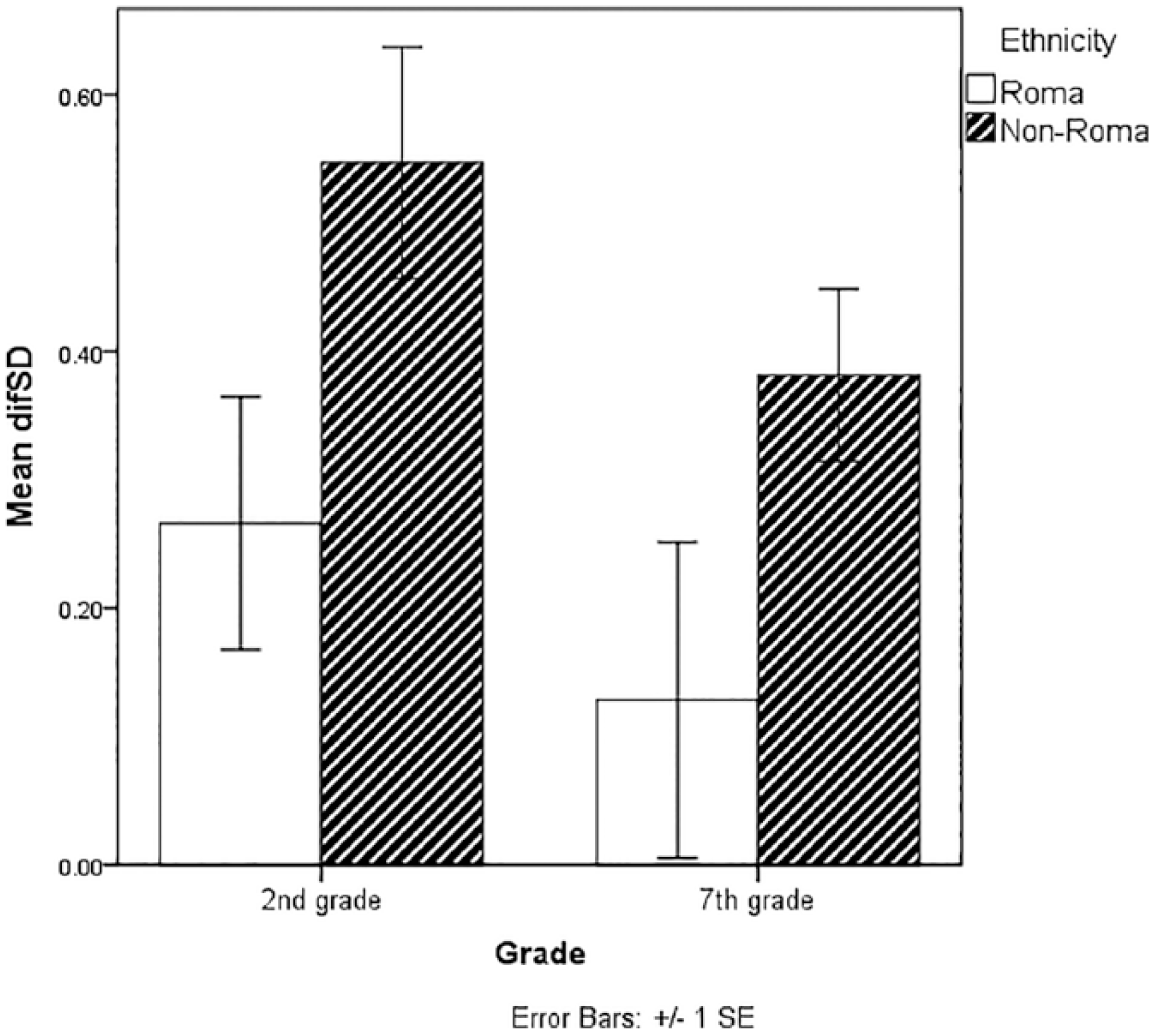
Mean difference of social distance toward Roma relative to non-Roma in two age and ethnic groups.
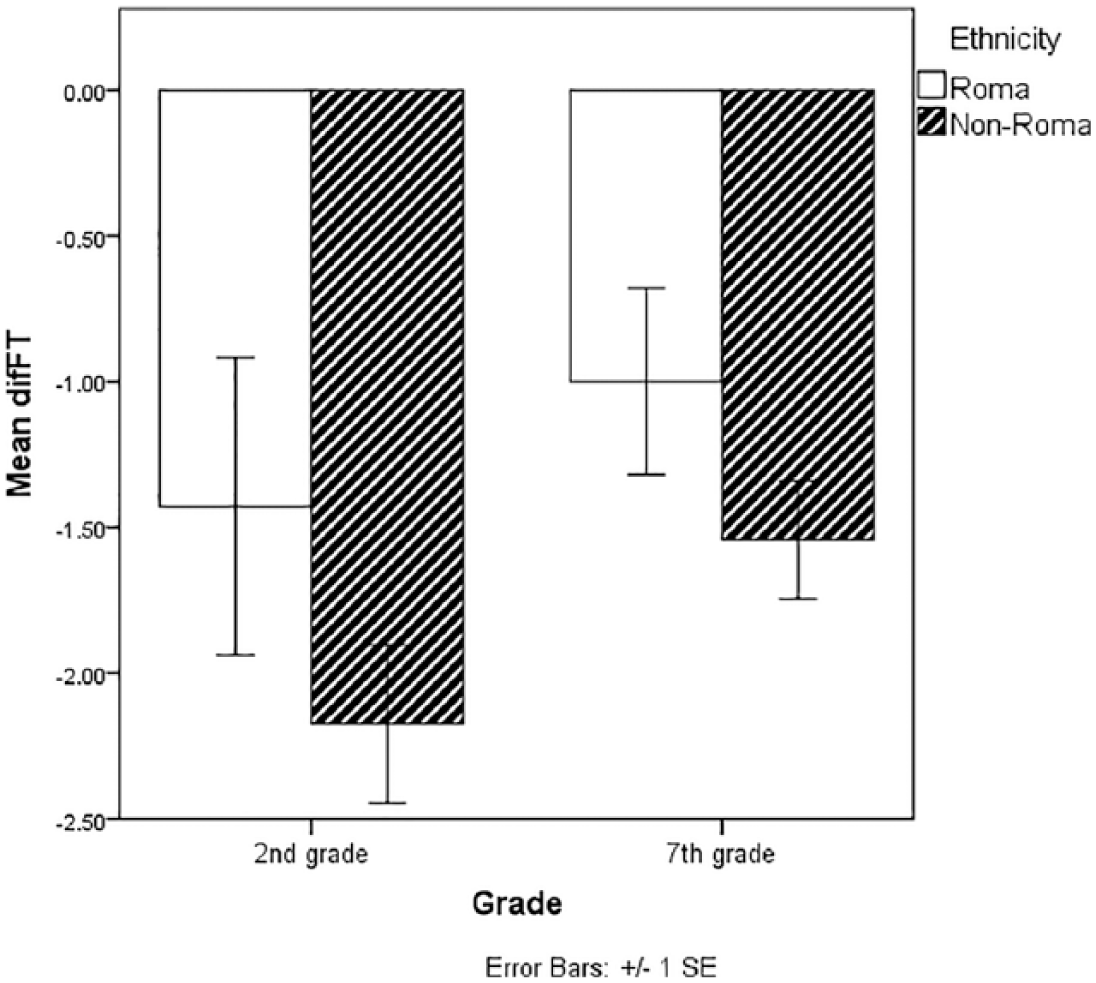
Mean difference of feeling thermometer toward Roma relative to non-Roma in two age and ethnic groups.
The main effect of age was found only for social distance, which was decreased in the older group, F(1, 59) = 4.46, p = .038, η² = .06, but not in perceived attractiveness, F(1, 78) = 0.68, p = .412, and feelings of warmth, F (1, 84) = 2.76, p = .1. There were no interaction effects.
Out-Group Preference and Academic Self-Efficacy
To explore the predictive power of relative out-group preference for academic self-efficacy, we conducted a multiple regression with the DIAT and three relative explicit preferences as predictors, separately for the two ethnic groups. To achieve more interpretable results, we separately calculated relative preference scores so that they reflect the out-group preference for both samples. Results are shown in Tables 3 and 4.
Predicting Academic Self-Efficacy by Implicit and Explicit Out-Group Preference in the Roma Subsample.

Note. Criterion: Academic self-efficacy; *p < .05.
Predicting Academic Self-Efficacy by Implicit and Explicit Out-Group Preference in the Serbian Subsample.
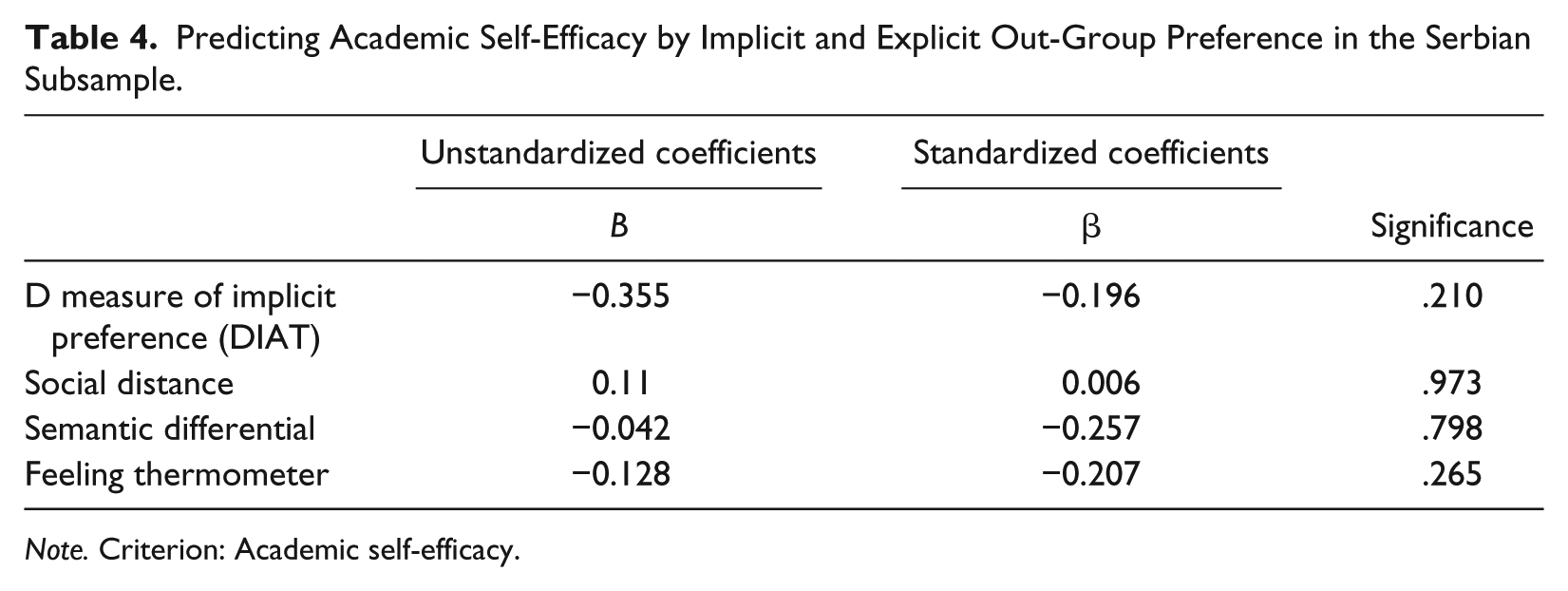
Note. Criterion: Academic self-efficacy.
In the Roma group, the DIAT score was a marginally significant predictor of academic self-efficacy (the implicit out-group preference was negatively related to self-efficacy), whereas explicit out-group preferences were not. In the Serbian group, neither implicit nor explicit relative preferences were predictive of academic self-efficacy.
Discussion
The present study aimed to investigate (a) implicit and explicit in-group preferences in Roma and non-Roma children, (b) differences in group preference in younger and older elementary school children, and (c) how these preferences relate to perceived academic self-efficacy.
Results have shown that Serbian children demonstrate a clear in-group preference (i.e., the favoring of members of one’s own group over the members of the out-group), whereas Roma children demonstrated an out-group preference. In other words, both groups preferred the majority group across all measures, fully supporting our first hypothesis. In absolute terms, Serbian children also showed social distance toward Roma, rating their attractiveness as a group as low. Research in intergroup relations (e.g., Dasgupta, 2004) points out that negative attitudes held by majority members are likely to have a harmful impact on the lives of disadvantaged group members. In fact, the manner in which Roma children perceive their in-group relative to Serbian children is indicative of a negative social identity.
The analysis of explicit measures in the two age groups yielded the expected difference only regarding social distance, which was less pronounced in the older children. Contrary to the initial hypothesis, we did register differences between age groups on implicit attitudes: in the younger group, Roma children showed no preference, whereas Serbian children showed an in-group preference. In the older group, Roma children showed an out-group preference, whereas older Serbian children still had an in-group preference, but present to a lesser degree.
Although older groups of both Serbian and Roma children explicitly expressed less in-group/out-group favoritism, their implicit preferences seem to follow a different path. The pattern of differences across age groups could be a consequence of implicit learning of the relative status of own and other groups for Roma children. For Serbian children, it could be influenced by the learning of social norms, which prohibit overt in-group preferences. For Roma children, enrolling in elementary school, that is, experiencing a dramatic change in the social environment, can amplify the comparison process. This interpretation relies more on social exposure than on the robustness of early acquisition of implicit intergroup attitudes, found in numerous past efforts in the field. Although Serbian children’s implicit in-group preference was somewhat lower in the older group, this difference was not dramatic, remaining consistent with the evidence that developmental and individual variability in in-group preference is usually smaller in advantaged groups (Nosek, Banaji, & Greenwald, 2002). Having in mind that our sample was limited and culturally specific, future studies to disentangle this issue are warranted.
Finally, we assumed that both implicit and explicit out-group favoritism in the minority group may negatively influence the feeling of competence and ambition in achievement situations (Hymel, Comfort, Schonert-Reichl, & McDougall, 1996). In Roma children, implicit out-group preference was a marginally significant negative predictor of academic self-efficacy, whereas explicit out-group preferences were not. Given the effect was small, it needs to be replicated to prove its robustness. In the Serbian subsample, none of the predictors were significant. This could be due to the fact that having an in-group preference as a majority member represents a standard (Tajfel & Turner, 1979), a norm, so it will not be diverse enough to influence academic self-efficacy.
In addition, we observed lower academic self-efficacy in older children. This decline is documented in other cultural settings as well, be it during the elementary school or in the transition from elementary to middle school (Eccles, Wigfield, Harold, & Blumenfeld, 1993; Wigfield & Eccles, 1994). In our study, the choice of age groups might have contributed to this result: we compared second/third graders who have just entered the school system to seventh graders who are about to finish elementary school. The academic feedback that the former receive is almost uniformly positive, while it gets more diverse with age. These mechanisms are underresearched in Serbian school settings and should be explored in the future.
Drawing on the findings from the current study, the future research could measure more indicators of negative identity in Roma (above the out-group preference), as well as the strategies for overcoming it. In addition, its relation to different measures of academic success, but also to other indicators of mental and physical health, should be explored further. Finally, as our research was correlational and cross-sectional, and thus did not demonstrate actual developmental changes, a longitudinal analysis could provide stronger evidence on the course of ethnic preferences in Roma and Serbian children. Notably, the issue of variability/stability of implicit preferences warrants further investigation.
Limitations
Notwithstanding the contributions of the present study, several limitations could provide directions for future research. The first such limitation is the sample size, in particular, the size of the Roma subsample. Although we chose the school with higher than average enrolment of Roma, not all of them were present at the time of research, and a number of second graders did not have sufficient reading and writing skills for the completion of questionnaires and Child IAT. In addition, our sample was an opportunity sample, with imperfect gender balance. More importantly, even though “Serbian” refers to the ethnic group and “Serbian citizens” should be used in reference to the national group, it is possible that to some Roma children they overlapped, so that they did not perceive the Serbian group as an out-group, as they themselves are the citizens of Serbia. Finally, our study was cross-sectional, which did not allow us to comment on the developmental course of implicit and explicit attitudes.
We observed a specific responding style of the Roma children, which indicated their efforts to answer in a socially desirable manner: When researchers approached them to clarify a question or to check progress, Roma children established frequent eye contact, asking for instructions, confirmation, or encouragement. Even though socially desirable responding is common among children (Crandall, Crandall, & Katkovsky, 1965), it was considerably more pronounced in the Roma group (see also Elijaš & Laklija, 2014).
Conclusion
This study is unique in that it gives voice to a population, which is underrepresented in social psychological research. Although there is substantial evidence of anti-Roma prejudice in Europe and Eastern Europe in particular, studies with Roma participants are still scarce. This is especially true for Roma children, the most vulnerable subpopulation in this minority group. We provide robust evidence of their preference for the majority over their in-group on both implicit and explicit measures. At the same time, Serbian children express a pattern typical for majorities—stable preference for their own group. We also found a weak, albeit indicative relation between implicit out-group preference and lower academic self-efficacy, which should be explored further. The explicit out-group preference in Roma was relatively stable across age groups (with the exception of social distance), whereas implicit out-group preference was more pronounced in older children. Taken together, the results are an important signal for educators that partaking in organized education alone will not decrease negative identity in minority children. Having in mind that previous research indicated that having a strong ethnic identity can be a resource that facilitates better adjustment to the school setting (Rivas-Drake et al., 2014; Spiegler et al., 2018), the Roma self-view needs to be actively challenged if we aim to empower them socially and academically.
Footnotes
Declaration of Conflicting Interests
The author(s) declared no potential conflicts of interest with respect to the research, authorship, and/or publication of this article.
Funding
The author(s) received no financial support for the research, authorship, and/or publication of this article.
