




Abstract
Dual language learners (DLLs) make up 32% of all children in the United States. Past research showed that proficiency in a heritage language (HL) was associated with better psychological adjustment in school-aged children and adolescents, but the associations of HL and English (EL) proficiency with preschool-aged DLLs’ socioemotional adjustment remain understudied. This study included a sample of low-income Mexican and Chinese immigrant families with preschool-aged DLLs (N = 90). Children’s HL and EL proficiencies were assessed using language tests. Parents rated their own cultural orientations, parenting styles, and children’s socioemotional adjustment. Children’s expressed anger/frustration and sadness were observed from an emotion-evoking task. Path analyses were conducted to test (a) the unique relations of children’s HL and EL proficiency and parents’ American and heritage cultural orientations to parenting styles, and (b) the relations of parenting styles to children’s adjustment. Results showed that children’s expressive HL proficiency and parents’ American and heritage cultural orientations were positively associated with authoritative parenting, which in turn was associated with children’s lower externalizing problems and higher prosocial behaviors. Children’s expressive EL was negatively associated with parents’ use of authoritarian parenting, and both expressive and receptive HL were negatively associated with children’s expressed sadness. These results indicate that children’s HL development and parents’ host and heritage cultural orientations are associated with socioemotional benefits for young DLLs growing up in low-income immigrant families.
Keywords
Dual language learners (DLLs), or children aged 8 years and younger with at least one parent speaking a language other than English at home, make up 32% of all children in the United States, with Spanish- and Chinese-speaking DLLs being the two largest groups (Park, O’Toole, & Katsiaficas, 2017). Preschool-aged DLLs in the United States are more likely than monolingual English speakers to come from economically disadvantaged families (Park et al., 2017), and low socioeconomic status (SES) confers increased risk for academic and adjustment problems (Mistry, Biesanz, Chien, Howes, & Benner, 2008). Past research conducted with school-aged children and adolescents found that immigrant youth’s higher proficiency in heritage language (HL) was associated with closer relationships with parents (Oh & Fuligni, 2010) and higher social competence (Chen, Hua, et al., 2014) and self-regulation (Chen, Zhou, Uchikoshi, & Bunge, 2014). Little is known, however, about the links between DLLs’ language proficiency and socioemotional adjustment in early childhood and the role of family processes in these relations.
Links Between Parenting Styles and Child Adjustment in Immigrant Families
A recent meta-analysis found that authoritative parenting (high warmth and high control) is associated with youth’s better adjustment (e.g., fewer behavioral problems) across cultures and ethnic groups (i.e., White, Hispanic, Asian, and African American), whereas the opposite relations were found for authoritarian parenting (Pinquart & Kauser, 2017). Thus, despite cultural variations in socialization goals and practices, children whose parents are warm, firm, and supportive of their autonomy tend to exhibit better outcomes than their peers. Mexican American (MA) and Chinese American (CA) families are two of the largest and fastest-growing ethnic minority groups in the United States (Pew Research Center, 2017). Authoritarian parenting shares some similarities with Latino and Asian cultural values, such as the emphases on familism (e.g., family is central, obligations to the family; Sabogal, Marín, Otero-Sabogal, Marín, & Perez-Stable, 1987) and respeto (i.e., respect for authority) in Latino families (Gonzalez-Ramos, Zayas, & Cohen, 1998), and parental firm control and filial piety in Asian families (Wu et al., 2002). Indeed, Latino and Asian parents endorsed higher authoritarian and lower authoritative parenting compared with European Americans (Gonzalez-Ramos et al., 1998; Su & Hynie, 2011).
Links Between Cultural Orientations and Parenting Styles in Immigrant Families
Cultural orientations (e.g., American and heritage orientations) and SES are important factors associated with heterogeneity in parenting among immigrant families (e.g., Calzada, Barajas-Gonzalez, Huang, & Brotman, 2017; Chen et al., 2014). Acculturation is theorized as a bidimensional (in host and heritage cultures) and multidomain process that includes behaviors (e.g., language proficiency/use), values, and identification (Schwartz, Unger, Zamboanga, & Szapocznik, 2010). Immigrants’ proficiency in or use of heritage and host languages is viewed as a crucial dimension of cultural orientation and has been associated with their parenting beliefs and practices (e.g., Calzada et al., 2017; Chen, Hua, et al., 2014). The social setting of immigrant parents, such as their social ties to other parents who endorse cultural parenting practices and socialization goals (Roche et al., 2014), may also influence their engagement in warm/supportive or hostile/punitive parenting (Yu, Cheah, & Calvin, 2016).
Researchers have theorized that as immigrants assimilate to the host culture’s values and practices, such as those supportive of youth autonomy, their parenting styles may shift to reflect this socialization goal (Roche et al., 2014). This hypothesis has received empirical support: compared with enculturated Latino immigrant mothers (i.e., those who ascribe to traditional Latino values and practices), acculturated Latino mothers valued independence over respeto (Gonzalez-Ramos et al., 1998) and used less hostile parenting (Parke et al., 2004). Acculturation in Chinese immigrant parents has similarly been linked to higher authoritative and lower authoritarian parenting with preschoolers and adolescents, whereas the opposite relations were found for parents’ Chinese orientation (Kim, Shen, Huang, Wang, & Orozco-Lapray, 2014; Su & Hynie, 2011; Yu et al., 2016). To our knowledge, no researchers have included Latino and Asian immigrant parents of matched SES in the same study, which allows researchers to examine the unique relation of cultural group to parenting. The present study tested the links between cultural orientations and parenting styles in two cultural groups: low-income MA and CA families with preschool-aged children.
DLLs’ Language Proficiency and Adjustment in Early Childhood: The Role of Parenting
Expressive language is the ability to communicate with others via the production of words and nonverbal language (see Holzman, 1998 for a review). Receptive language is the ability to understand the words and nonverbal language presented by others (Holzman, 1998). Higher expressive and receptive abilities enable the child to effectively understand and respond to the demands and comments of others. Early impairments in these areas are associated with a wide range of attentional, emotional, and behavioral problems (Yew & O’Kearney, 2013), such as lower ability to regulate anger (Roben, Cole, & Armstrong, 2013). The two language domains have been found to develop at different rates in early childhood, with receptive ability developing before expressive ability (Hirsh-Pasek, & Golinkoff, 1996), and are differentially related to children’s social contexts and adjustment outcomes. Expressive and receptive skills are thus regularly studied as distinct constructs in the language development literature. For example, expressive vocabulary delays in monolingual 2-year-old children were related to later peer problems, such as not being liked and being bullied at 4 years of age (Bretherton et al., 2014). Higher receptive ability was found to be a better predictor of shy preschool children’s joint play with peers than expressive ability, likely because understanding peers’ requests in play holds more importance to participation in play than verbal output during the preschool period (Jahng, 2018).
For DLLs in particular, receptive and expressive proficiencies in HL and host culture language often follow different developmental trajectories because of significant variations in their language input and output between school and home environments (Ribot, Hoff, & Burridge, 2018). Spanish-EL bilinguals in the United States, for example, showed stronger receptive than expressive skills in Spanish, but equivalent skills in EL (Hoff, 2018). The differences in abilities across domains may be due to preferences that parents have for which language to use with their children at home and which language children prefer to use in response (e.g., Spanish-EL preschoolers are more likely to switch to EL when their parents speak to them in Spanish than vice versa; Hoff, 2018). Language use (output) was indeed found to be a stronger predictor of growth in expressive than receptive vocabulary among DLLs (Ribot et al., 2018). Language researchers thus recommend measuring DLLs’ receptive and expressive proficiencies in both languages separately to capture their developmental progress (Hoff, 2018).
DLL children’s choice of EL or HL use in expressive and receptive domains may also have different implications for their social interactions. Parent–child interactions are viewed as a proximal context by which language shapes developmental outcomes (Bronfenbrenner, 2001; Vygotsky, 1978), and thus parenting may mediate the relationship between children’s language ability and socioemotional adjustment. Among monolingual children, receptive ability, and not expressive ability, has been linked to mother’s positive parenting (Barnett, Gustafsson, Deng, Mills-Koonce, & Cox, 2012), possibly because greater receptive ability allows for better comprehension of parents’ comments and directions, which elicits parents’ praise, encouragement, and positive attention. Given the bidirectional nature of parent–child relationships (see Pettit & Arsiwalla, 2008, for a review), expressive and receptive skills in EL and HL may differentially elicit parenting behaviors. Because of the limited EL proficiency among many Latino and Asian immigrants (Pew Research Center, 2017), Latino and Asian children’s HL proficiency may promote parent–child communication and bonding, which in turn confers socioemotional benefits. Studies of older children (late childhood and adolescence) in immigrant families have supported this hypothesis (Liu, Benner, Lau, & Kim, 2009; Oh & Fuligni, 2010). On the contrary, speaking a particular language may also elicit the cultural practices associated with that language. Children with higher EL proficiency, for example, may endorse parenting values/practices typical of American culture (e.g., parental warmth, democratic participation, autonomy support), which may elicit parents’ greater use of authoritative parenting (Chen et al., 2014). Indeed, CA school-aged children’s (6-9 years old) EL proficiency was associated with higher authoritative parenting, which in turn was linked to children’s higher social competence and lower behavioral problems (Chen et al., 2014).
The current literature is limited in its examination of (a) how DLLs’ development in both EL and HL is associated with their socioemotional adjustment during early childhood, a critical period for language and socioemotional development (see Halle et al., 2014, for a review), and (b) how parenting may mediate the relationship between children’s EL and HL ability and their adjustment outcomes. Previous studies have found some evidence that higher EL proficiency is associated with better socioemotional adjustment in Latino and Asian DLLs during preschool to early elementary school period (e.g., Chen, Hua, et al., 2014; Collins, Toppelberg, Suárez-Orozco, O’Connor, & Nieto-Castañon, 2011 Dawson & Williams, 2008; Ren, Wyver, Xu, & Demuth, 2016). However, the findings on the links between HL proficiency and adjustment are inconsistent. Although some studies found HL proficiency to be positively associated with socioemotional adjustment in Spanish-EL DLLs (e.g., Collins et al., 2011; Dawson & Williams, 2008), another study found HL proficiency to be associated with higher internalizing behaviors in Mandarin-EL DLLs (e.g., Ren et al., 2016). Ren et al. (2016) argued that this relation may be due to the children’s social context—children who speak more Mandarin may be rejected by their peers or may experience more authoritarian parenting practices. In addition to the inconsistent findings, previous studies have several methodological limitations, including the reliance on subjective (e.g., parent report) rather than objective language measures, failure to consider both the main and interactive effects of HL and EL proficiency on socioemotional outcomes, or the lack of examining parenting as a mechanism (Halle et al., 2014).
The Present Study
Using a sample of preschool-aged DLLs from low-income MA and CA families, the present study tested the concurrent relations of children’s HL and EL proficiency to parenting styles and children’s socioemotional adjustment. We also examined the relations of parents’ American and heritage cultural orientations to their parenting and children’s adjustment. Previous research has also shown that parent–child gaps in language proficiency/cultural orientations might convey risk for maladjustment by impeding parent–child communication and increasing conflict. Parent–child dyads with greater gaps in Chinese proficiency scored lower on authoritative parenting, which in turn was associated with children’s increased externalizing problems (Chen et al., 2014). Thus, we also tested whether parents’ cultural orientations moderated the links between children’s language proficiency and parenting or child adjustment.
Figure 1 presents a conceptual model of the hypothesized relations. Similar to Barnett and colleague’s (2012) examination of parenting, language development, and social competence among monolingual toddlers, we tested the path models separately by language domains. The first aim was to examine the concurrent associations of children’s EL and HL proficiency with parents’ cultural orientations to parenting styles (i.e., authoritative and authoritarian; Figure 1, Paths A). Based on previous research (e.g., Barnett et al., 2012; Calzada et al., 2017; Chen et al., 2014), we hypothesized the following:

The hypothesized conceptual model regarding the associations among children’s language proficiency and parent’s cultural orientation, parenting styles, and psychological adjustment.
The second aim was to examine the direct relations of children’s EL and HL proficiency and parents’ cultural orientations to children’s adjustment as well as the indirect relations via parenting. Based on the research on bilingual and socioemotional adjustment of young DLLs (Halle et al., 2014), we hypothesized the following:
An additional aim was to test whether parents’ cultural orientations moderate the links between child language and adjustment. Based on the research on parent–child language/cultural orientation gap and child maladjustment (Chen et al., 2014), we hypothesized the following:
We examined family SES factors and parents’ length of time living in the United States and children’s age, gender, and generation status as covariates because they have been tied to language proficiency, cultural orientations, parenting, and socioemotional outcomes in previous studies (Chen et al., 2014; Halle et al., 2014; Ren et al., 2016). Due to sample size constraint, we did not test whether cultural group (MA vs. CA) moderates the relations among constructs, although we controlled for cultural group in testing the hypothesized models.
This study has two methodological strengths. First, language tests were used to assess children’s EL and HL proficiency rather than relying on parent report. Second, socioemotional adjustment was assessed via parents’ report and behavioral observations of children’s emotion expressiveness. Longitudinal studies have shown unregulated negative expressiveness of anger and sadness to predict maladjustment (Diaz et al., 2017; Hernández et al., 2015), supporting the use of emotion expressiveness as a valid predictor of later socioemotional adjustment.
Method
Participants
The sample consisted of 90 preschoolers (46 MA and 44 CA, age range = 38-70 months, M = 54.5, SD = 7.04) and their parents. Eighteen percent of the children were born outside of the United States (i.e., first-generation), 77% were born in the United States and had at least one foreign-born parent (i.e., second-generation), and 5% were born in the United States and had both U.S.-born parents (i.e., third-generation or above). The parents were mostly foreign-born (46% born in China, 43% born in Mexico, 9% born in the United States, and 2% born elsewhere; age range = 21-46 years, M = 34.6, SD = 6.38). The parents had lived in the United States for an average of 9.2 years (range = 0-28 years, SD = 6.2). Parental education was on average 11 years (i.e., high school; range = 0-18 years, SD = 3.77). Of the parents, 70% were married, 22% were not married and living with a partner, 5% were divorced/separated, and 3% were never married or married but not living with the partner. Annual per capita income was calculated by dividing the total income for the past year by the number of individuals in the household (M = US$5,167, range = US$1,000-$24,167, SD = US$3,655).
Procedures
Bilingual (Spanish-EL or Chinese-EL) research assistants (RAs) visited 15 Head Start centers with high concentrations of MA or CA children for recruitment. The project was described as a research study on language and emotional development of children in MA and CA families. Interested parents filled out a contact form; 229 contact forms were collected. To be eligible for the study, the child must (a) be between 36 and 71 months of age, (b) be enrolled at a Head Start program for at least 3 days per week, (c) understand and speak some EL and Spanish, Cantonese, or Mandarin, and (d) have both parents self-identify as ethnically Mexican or Chinese. Children diagnosed with a speech or language disorder or who were receiving speech and language services were excluded from the study. After a brief phone screen, one child was invited to participate from each family. A total of 194 children (MA = 88, CA = 106) were screened and 90 (MA = 46, CA = 44) were found eligible and completed the assessment. Of those excluded, 26.9% received speech/language services, 32.6% did not meet all four eligibility criteria, and 40.5% were eligible at screening but dropped out of the study before assessment.
Eligible children participated in a 2.5-hr assessment with their primary caretaker (98% mothers). Participants completed the assessment at our university laboratory (with compensation for transportation; 68%) or at their homes (32%). The assessment consisted of a parent questionnaire, child language and emotion tasks, and parent–child interaction tasks. Children’s HL and EL tests (order counterbalanced) were administered by different RAs to minimize code switching. Most of the parents (90%) and children (82%) completed the majority of tasks in HL (their preferred language). The expressive vocabulary test preceded the receptive test to reduce practice effects. Children were given a small prize and parents were paid for their participation.
Measures
Family demographics and migration history
Parents completed an adapted version of the Family Demographics and Migration History Questionnaire (Roosa et al., 2008), which has been previously used with MA and CA immigrant families (Chen et al., 2014; Roosa et al., 2008). The questionnaire included questions on child’s age and parent’s age, country of birth, length of stay in the United States, education, marital status, and family income and household size.
Children’s EL and HL proficiency
Children were individually administered tests of expressive and receptive vocabulary in both EL and HL. EL receptive vocabulary was tested by the Peabody Picture Vocabulary Test–Third Edition (PPVT-III; Dunn & Dunn, 1997), which asked the child to select one picture from an array of four that best matched the word spoken by the RA. The reported split-half reliability of this test ranged from .86 to .97. For the CA sample, the Chinese PPVT–Revised (Lu & Liu, 1998) tested Chinese receptive vocabulary. The reported split-half reliability standardized on native Chinese-speaking children was .95. For the MA sample, the Spanish version, Test de Vocabulario Imágenes-Peabody (TVIP; Dunn, Padilla, Lugo, & Dunn, 1986), tested Spanish receptive vocabulary. The reported split-half reliability for TVIP was .94 for 4-year-olds and .93 for 5-year-olds.
The picture vocabulary subtest of the Woodcock Language Proficiency Battery–Revised (WLPB-R; Woodcock, 1991) tested for EL expressive vocabulary by asking the child to name pictures with increasing difficulty. The reported internal consistency reliability standardized on native EL-speaking samples is .81 (Woodcock, 1991). Chinese expressive vocabulary was assessed using pictures from the WLPB-R because no standardized measures for Chinese-speaking DLLs currently exist. This strategy has been previously used in a study of Chinese-speaking DLLs from kindergarten to second grade (Uchikoshi, 2013). The Spanish version, Vocabulario Sobre Dibujos, tested for Spanish expressive vocabulary; the reported internal consistency reliability is .73 for 4-year-olds (Woodcock & Munoz-Sandoval, 1996).
Parents’ cultural orientations
Parents self-reported on American and heritage cultural orientations using the Cultural and Social Acculturation Scale (CSAS; Chen & Lee, 1996). The CSAS assesses for engagement in both heritage and host cultures across domains, including language proficiency, media use, and interpersonal relationships. Items on the CSAS were rated on scales ranging from 1 = extremely poor/never to 5 = very good/often. Eight items assessed for language proficiency (e.g., “How well do you speak in English/Spanish/Chinese?”). Ten items assessed for media use (e.g., “How often do you watch English/Spanish/Chinese movies?”), and six items assessed for social relationships (e.g., “How often do you invite Caucasian American/Latino/Chinese friends to your house?”). Previous research has supported the multidomain and bidimensional structure of the CSAS (Chen, Hua, et al., 2014). The means of the items were used as the two cultural orientation scores. The alpha reliabilities for American and heritage orientations were .87 and .73 in the MA sample and .81 and .82 in the CA sample.
Parenting styles
Parents completed the Parenting Styles and Dimensions Questionnaire–Short Form (PSDQ-SF; Robinson, Mandleco, Olsen, & Hart, 2001). The authoritative subscale included warmth and support, reasoning/induction, and autonomy granting. The authoritarian subscale included physical coercion, verbal hostility, and punitive parenting. Parents rated how often she or he exhibits the behavior from 1 (never) to 5 (always). The Chinese version of the PSDQ has shown satisfactory reliabilities and evidence of measurement equivalence across Chinese and American samples (Chen et al., 2014). The Spanish version also showed satisfactory reliabilities in previous studies of MA parents (e.g., Calzada et al., 2017). The alphas in our sample were .83 (MA) and .92 (CA) for authoritative parenting (17 items) and .65 (MA) and .74 (CA) for authoritarian parenting (13 items). Two composite scores were computed.
Children’s socioemotional adjustment
Parents completed the Strengths and Difficulties Questionnaire (SDQ; Goodman, 2001), which assessed for children’s peer problems (five items), emotional symptoms (five items), externalizing problems (10 items), and prosocial behaviors (five items). Parents rated each item from 0 (not true) to 2 (certainly true). The Chinese and Spanish versions had satisfactory alpha reliabilities in previous studies (Bao et al., 2016; Rodríguez-Hernández et al., 2012). Studies have also found that the SDQ has strong measurement invariance longitudinally and is a valid predictor of psychiatric issues (DeVries, Gebhardt, & Voß, 2017; Theunissen, de Wolff, & Reijneveld, 2019). The peer problem (α = .30) and emotional symptoms scales (α = .54) were dropped from further analyses due to low reliability. Alphas were .67 for externalizing problems and .71 for prosocial behaviors.
Children’s emotion expressiveness
Children’s expressed anger/frustration and sadness were assessed using the “Not Sharing” task from the Preschool Laboratory Temperament Assessment Battery (Goldsmith, Reilly, Lemery, Longley, & Prescott, 1993). This task has been used in previous studies to elicit anger and sadness in preschool- and school-aged children (6- to 10-year old; Clifford, Lemery-Chalfant, & Goldsmith, 2015; Spinrad et al., 2009). An RA begins the task by sharing candy equally with the child, but becomes increasingly unfair as she or he takes more candies while giving the child only one. The RA then takes all the candies, including those given to the child, and the task ends when the interviewer apologizes to the child for sharing unfairly and then allows the child to keep two candies. Using the manual developed by Spinrad et al. (2009), two coders rated children’s anger and sadness on a 4-point scale (1 = no emotion, 2 = mild, vague, or very brief expression of the emotion, 3 = moderate intensity of the facial expression or more prolonged mild facial expression of the emotion, 4 = intense or prolonged expression of the emotion) in 10-s epochs. Verbalizations and bodily movements were considered in the codes. The scores were averaged across epochs. The interrater reliabilities, computed as the intraclass correlations, were .91 for both anger/frustration and sadness.
Results
Pearson’s correlations (for child age, family income, parental education, and length of stay in the United States) and independent-samples t-tests and one-way ANOVAs (for culture and child gender and generation status) were computed to examine the relations between the theorized covariates and study variables (i.e., children’s language proficiency, parents’ language proficiency, parenting, and adjustment outcomes). Because some families were assessed in their homes rather than the laboratory, we conducted a t-test to determine any group differences based on the assessment location. Path analyses were conducted to test the study hypotheses.
Correlations Between the Theorized Covariates and Study Variables
Table 1 presents the correlations and descriptive statistics for all study variables. Parents’ years in the United States was positively correlated with parents’ American orientation and children’s receptive EL, prosocial behaviors, anger, and sadness. Child age was positively correlated with expressive and receptive EL and receptive HL. Family income was positively correlated with parents’ American and heritage orientations, children’s EL, and prosocial behaviors and negatively correlated with externalizing problems. Parental education was negatively correlated with externalizing problems. No mean differences were found for child gender, or between lab and home assessments. Third-generation children scored higher on receptive EL than those of first-generation, F(2) = 4.55, p = .013, and were more likely to have parents with higher American orientations, F(2) = 7.22, p = .001. MA families scored higher than CA families on parents’ American orientation, authoritative parenting, and children’s prosocial behaviors and sadness, ts(88) ranged from 2.08 to 2.66, ps < .05. Cultural group, child age, child generation status, family income, parents’ years in the United States, and parental education were included as covariates.
Correlation Matrix for Study Variables With Means and Standard Deviations for the Full Sample and by Cultural Groups.
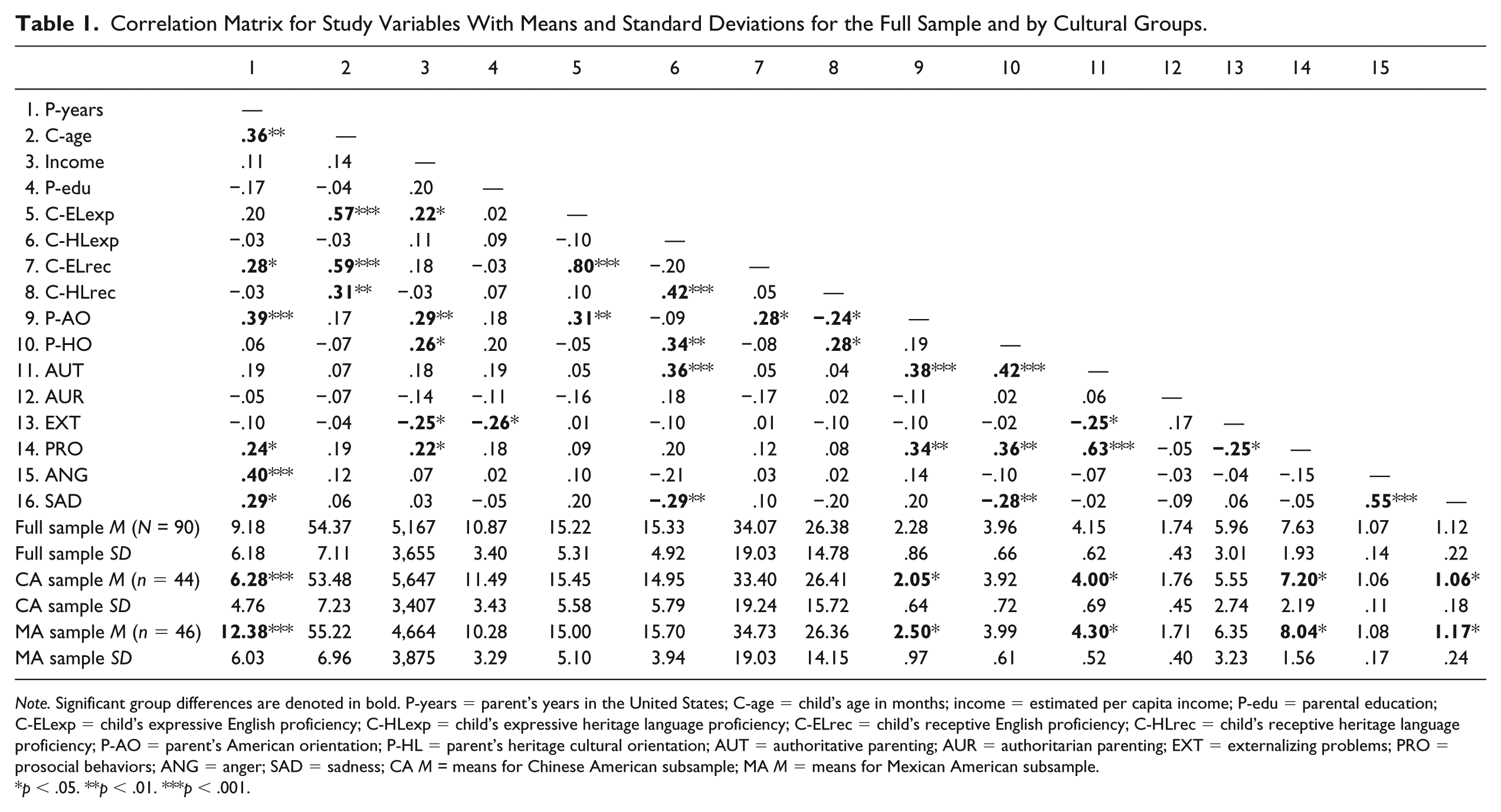
Note. Significant group differences are denoted in bold. P-years = parent’s years in the United States; C-age = child’s age in months; income = estimated per capita income; P-edu = parental education; C-ELexp = child’s expressive English proficiency; C-HLexp = child’s expressive heritage language proficiency; C-ELrec = child’s receptive English proficiency; C-HLrec = child’s receptive heritage language proficiency; P-AO = parent’s American orientation; P-HL = parent’s heritage cultural orientation; AUT = authoritative parenting; AUR = authoritarian parenting; EXT = externalizing problems; PRO = prosocial behaviors; ANG = anger; SAD = sadness; CA M = means for Chinese American subsample; MA M = means for Mexican American subsample.
p < .05. **p < .01. ***p < .001.
Path Analysis Testing the Hypothesized Models
Two path analysis models were estimated using Mplus 7.4 (Muthén & Muthén, 1998-2015). As shown in Figure 1, each model has six language/cultural orientation variables: children’s EL and HL, parents’ American and heritage orientations, and parent–child gaps in language proficiency/cultural orientation. To best assess both types and directions of differences in parent–child gaps in language/cultural orientation, gaps were tested using two interaction terms (Child EL × Parent American Orientation, Child HL × Parent Heritage Orientation; see Birman, 2006, for a review). Authoritative and authoritarian parenting, parent-reported child adjustment (i.e., externalizing problems and prosocial behaviors), and observed emotionality variables (i.e., anger and sadness) were tested in both models. The effects of covariates (i.e., cultural group, child age and generation status, family income, and parents’ years in the United States and education) on parenting and adjustment variables were controlled in both models. Expressive and receptive skills are viewed as distinct domains of language development (e.g., Hoff, 2018). Past research showed that DLLs’ expressive and receptive skills related differently to their language use at home (Hoff, 2018) and may have different links to parent–child relationships and children’s socioemotional adjustment. In our sample, although children’s expressive and receptive proficiency was correlated with each other (rs = .80 and .42, ps < .001, EL and HL, respectively), they were differentially correlated with other variables (Table 1). Separate models were thus tested using children’s expressive (Figure 2a) and receptive proficiencies (Figure 2b). Missing data were handled using the full information maximum likelihood estimation option. Based on recommended best practices, the model chi-square statistic and additional fit indices and their cutoffs (Hu & Bentler, 1999) were used as the criteria for a good fit between the data and hypothesized model: comparative fit index (CFI) ≥.95, root mean square error of approximation (RMSEA) ≤.06, and standardized root mean square residual (SRMR) ≤.08. Table 2 presents all estimated path coefficients and the overall model fit indexes. To estimate the power for detecting significant path coefficients, we conducted a power analysis using G*Power 3.1 (Faul, Erdfelder, Buchner, & Lang, 2009). Prior studies using similar path analysis models to test simultaneous relations of children’s and parents’ language/cultural orientations to parenting styles reported effect sizes in the small-to-medium range (e.g., R2 = .06-.17; Chen, Hua, et al., 2014). With a sample size of 90, the present study had adequate power (.98) to detect medium effects but inadequate power (.66) to detect small effects.
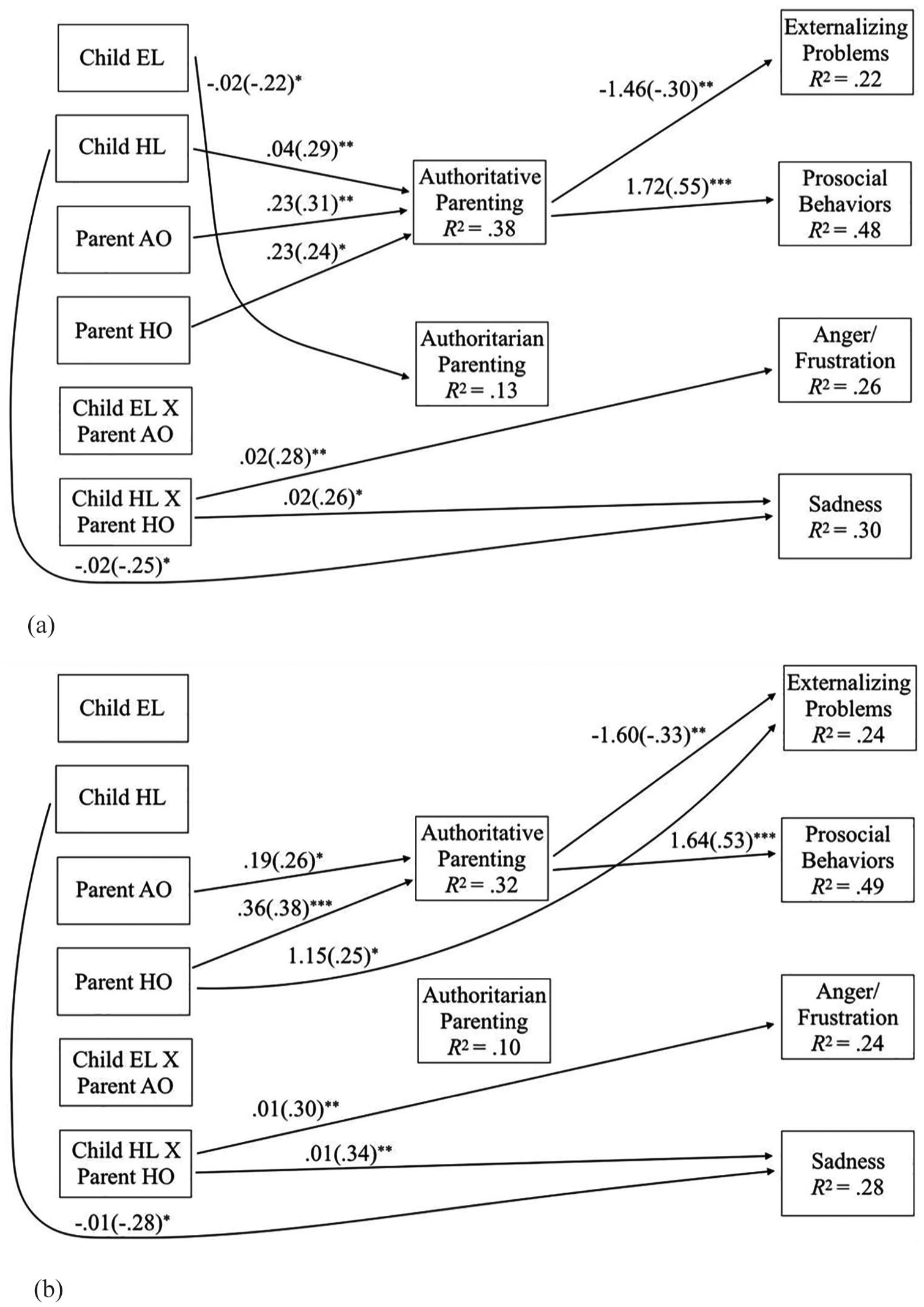
The models estimating paths from children’s language proficiency, parent’s cultural orientations, and parent–child language/orientation gaps to parenting, then to children’s adjustment outcomes, controlling for the covariates: (a) path model using children’s expressive language proficiency and (b) path model using children’s receptive language proficiency.
Coefficients for Direct and Indirect Effects for the Models Using Child’s Expressive and Receptive Language Proficiency.

Note. Standard error presented in parentheses. Unstandard. = unstandardized coefficients; Standard. = standardized coefficients; C-EL = child’s English proficiency; C-HL = child’s heritage language proficiency; P-AO = parent’s American orientation; P-HL = parent’s heritage cultural orientation; P-HO = parent’s heritage cultural orientation; AUT = authoritative parenting; AUR = authoritarian parenting; EXT = externalizing problems; PRO = prosocial behaviors; ANG = anger; SAD = sadness; RMSEA = root mean square error of approximation; SRMR = standardized root mean square residual; CFI = comparative fit index. Significant values are denoted in bold.
p < .05. **p < .01. ***p < .001.
The expressive proficiency model
The model fit the data well (Figure 2a). Several significant direct paths from covariates to main study variables were found. The MA children expressed more sadness than the CA group (β = −0.18, p < .05). Older children were more likely to display more prosocial behaviors (β = 0.04, p < .05). Parents’ years in the United States was positively associated with children’s expressed anger and sadness (βs = 0.01, ps < .05).
We estimated three sets of direct paths: (a) from the language/cultural orientation variables to parenting styles (Figure 1, Paths A), (b) from parenting to child adjustment (Figure 1, Paths B), and (c) from the language/cultural orientation variables to adjustment (Figure 1, Path C). Controlling for covariates, children’s expressive HL and parents’ American and heritage orientations were positively associated with authoritative parenting. Expressive EL was negatively associated with authoritarian parenting. Authoritative parenting was negatively associated with externalizing problems and positively associated with prosocial behaviors, whereas authoritarian parenting was not associated with the adjustment outcomes. Finally, expressive HL was negatively linked to sadness. The significant interaction effects of Child HL × Parent Heritage Orientation on anger and sadness were probed using the Aiken and West method (1991). For anger, at mean or low (1 SD below the mean) levels of parents’ heritage orientation, children’s higher expressive HL was associated with lower anger (unstandardized slopes = −1.99 and −2.81, p < .05), but was unrelated to anger at high (1 SD or more above the mean) levels of parents’ heritage orientation. Similarly, for sadness, at mean or low levels of parents’ heritage orientation, children’s higher expressive HL was associated with lower sadness (unstandardized slopes = −2.54 and −2.87, respectively, ps < .05), but was unrelated to sadness at the high level of parents’ heritage orientation. Mediation analyses found six significant indirect effects (Table 2). Authoritative parenting mediated the links between expressive HL and externalizing and prosocial behaviors, parents’ American orientation and externalizing and prosocial behaviors, and parents’ heritage orientation and prosocial behaviors.
The receptive proficiency model
This model also fit the data well (Figure 2b). Parents’ years in the United States was positively associated with anger and sadness (βs = 0.01, ps < .05). Parents’ American and heritage orientations were positively associated with authoritative parenting. Authoritative parenting was negatively associated with externalizing problems and positively associated with their prosocial behaviors. Receptive HL was negatively associated with sadness. Parents’ heritage orientation was positively associated with externalizing problems. Two interaction effects were significant. First, at mean or low levels of parents’ heritage orientation, higher receptive HL was associated with lower sadness (unstandardized slopes = −2.26 and −2.69, respectively, ps < .05), but was unrelated to sadness at the high level of parents’ heritage orientation. For anger, at low levels of parents’ heritage orientation, higher receptive HL was associated with lower anger (unstandardized slope = −2.49, p < .05); at high levels of parents’ heritage orientation, receptive HL was associated with higher anger (unstandardized slope = 2.10, p < .05). Authoritative parenting mediated the links between parents’ American and heritage orientations and externalizing or prosocial behaviors.
Discussion
The study examined the unique associations of preschool-aged DLLs’ EL and HL proficiencies to parenting styles and socioemotional adjustment in low-income MA and CA families. We found that children’s expressive HL and parents’ American and heritage orientations were associated with higher authoritative parenting. In turn, authoritative parenting was associated with children’s lower externalizing problems and higher prosocial behaviors. Children’s expressive EL was negatively related to authoritarian parenting, and both expressive and receptive HL were negatively related to expressed sadness. Our findings are in line with the growing body of literature suggesting that HL maintenance, along with parents’ American and heritage orientation, is protective for the socioemotional development of youth of immigrant families (Collins et al., 2011; Liu et al., 2009; Oh & Fuligni, 2010). It is important to note that post hoc analyses showed that the EL and HL proficiency of the children in our sample did not differ in either expressive or receptive domains (ps < .97). Thus, the children in our sample were simultaneously developing two languages at this early age.
The link between parents’ heritage orientations and authoritative parenting was somewhat inconsistent with previous findings among Latino families (Calzada et al., 2017; Roche et al., 2014). Our findings, however, were in line with Chen et al.’s (2014) study of CA families with school-aged children, in which they found a positive link between parents’ HL proficiency and authoritative parenting. As they and others have theorized, parenting may be influenced by multiple individual, family, and contextual factors, such as the child’s behaviors and family relationships (e.g., Su & Hynie, 2011). The effects of children’s language output on the quality of parent–child relationships may thus vary based on familial characteristics. Unlike Calzada et al.’s (2017) study, which only accounted for parents’ language proficiency, our analyses examined both children’s language and parent’s cultural orientations simultaneously. It is possible that parents’ ability to support their child’s HL development in the context of their sharing a common language jointly increases parenting efficacy and promotes the use of supportive parenting practices (Schofield, Conger, Robins, Coltrane, & Parke, 2017). This notion is supported by our finding that children’s HL and parents’ American and heritage orientations had similarly sized effects on authoritative parenting, demonstrating the simultaneous influence of both parents’ and children’s characteristics on parenting. We notably found that children’s expressive, but not receptive, HL was related to higher authoritative parenting. This finding is contrary to that found in monolingual children, among whom receptive ability alone has been linked to mother’s positive parenting (Barnett et al., 2012). These findings indicate that DLLs’ language use/output might have a greater impact on the parent–child relationship than their language comprehension/input. In bicultural immigrant families, it may be the sharing of cultural norms/values between parents and children (signaled via language output), rather than a mere ability to understand their parents’ comments and demands, that is crucial for positive parenting.
The findings on the links between authoritative parenting and parent-reported child adjustment were in line with previous research (Pinquart & Kauser, 2017): higher authoritative parenting was related to lower externalizing problems and higher prosocial behaviors. Notably, authoritative parenting appeared to have a stronger relation to prosocial behaviors than externalizing behaviors. It is possible that other parenting behaviors such as parental anger expression or child characteristics such as difficult temperament have greater impact on children’s externalizing problems. Furthermore, parenting styles were only correlated with parent-reported child adjustment and unrelated to observed child adjustment. The lack of relations between parenting and observed child adjustment may indicate that the impact of parenting styles on children’s actual behavioral and emotional manifestations can take time to occur. Our results of indirect effects provided support for authoritative parenting as a protective mediating factor in the link between language and adjustment (i.e., child’s HL proficiency → authoritative parenting → better adjustment; for example, Calzada et al., 2017).
We did not expect to find parents’ heritage orientation to have a direct relation to their higher endorsement of children’s externalizing problems. It is possible that parents who are more oriented toward their heritage culture may have higher behavioral expectations of their young children and are more likely to perceive their children as less regulated, which is in line with the traditional values of maintaining family harmony and respecting elders in both Chinese and Mexican cultures (Gonzalez-Ramos et al., 1998; Wu et al., 2002). Future research should assess children’s adjustment from other reporters/methods (e.g., teacher report, observation) to clarify the processes underlying this relationship.
We also tested whether parents’ cultural orientations interacted with children’s language proficiency in relation to children’s adjustment. Although we found some evidence for interactions, the pattern of interactions was somewhat different from previous studies using older child samples. The parent–child language/cultural orientation gap hypothesis theorizes that the relation between children’s HL proficiency and adjustment would be stronger when parents are higher on heritage orientation (e.g., Chen et al., 2014). We found, however, that the positive relation between child’s HL and adjustment was stronger when parents were lower on heritage orientation. DLLs’ HL appeared to serve as a protective factor for children’s adjustment in the preschool period, especially among families whose parents were less engaged in their heritage culture. DLLs’ higher HL proficiency may enable them to access other cultural resources (e.g., social support from other family members who are fluent in HL) that promote socioemotional well-being in this developmental period. The positive relation between children’s HL receptive proficiency and expressed anger at high levels of parents’ heritage was unexpected. It is possible that when parents and children are matched in their orientation, children express emotions more openly (especially in Mexican culture, which values open expression of emotion; Soto, Levenson, & Ebling, 2005). Due to sample size constraint, we were unable to examine these links separately in MA and CA groups, which is an important future research direction.
Regarding the covariates, MA families scored higher than CA families on parents’ American orientation, authoritative parenting, and children’s prosocial behaviors and sadness. Differences in neighborhood characteristics of the recruitment sites may have contributed to these findings. The CA families in this study were mainly recruited from Chinatown areas, which tend to be more culturally isolated than the suburban locations from which the MA families were recruited. Previous research has linked higher acculturation with increased authoritative parenting (e.g., Parke et al., 2004). The pattern of higher American orientation and higher authoritative parenting among MA parents supports the theory that acculturating to American culture increases social ties to parents who endorse American socialization goals (Roche et al., 2014). Future research should match neighborhood characteristics by cultural groups during sampling and/or include neighborhood characteristics in data analyses. Our finding of a cultural group difference in children’s sadness was in line with previously reported cultural differences in emotion expression between Mexican and Chinese adults (Soto et al., 2005) and suggested that that these cultural group differences may be observed in preschool-aged children.
This study had several limitations. First, the cross-sectional data did not allow us to test the directionality of the links between children’s language and parenting. Although children’s language may shape parenting, the quality of parenting or parent–child relationship may also shape children’s language development (Pungello, Iruka, Dotterer, Mills-Koonce, & Reznick, 2009). Our findings support this theory by demonstrating that children’s language and parents’ cultural orientations simultaneously, and to somewhat similar extents, influence parenting, but do not allow for conclusions of this complex and potentially nonlinear developmental process. Future research should utilize longitudinal data to disentangle the direction of relations. Second, parenting styles were only assessed by parents’ self-report, which is susceptible to biased perceptions and memories. Future research should try to incorporate objective measures of parenting. Third, the “Not Sharing” task (Goldsmith et al., 1993) is a behavioral task that observes children’s expressions of anger and sadness. As previous researchers have noted (Locke, Davidson, Kalin, & Goldsmith, 2009), emotion dysregulation (and subsequent outcomes) may be gleaned from the intensity at which an emotion is expressed or the incongruence of an emotion to the situation. Future research should consider both levels of intensity and situation congruency when assessing children’s emotions and related outcomes. Fourth, the small sample size does not allow us to test for measurement invariance by languages or cultural group, nor does it allow us to test for moderation effects by cultural group. Fifth, the study only considered children’s language proficiency and parents’ cultural orientations (in behavioral domains) as dimensions of “culture.” Future studies should consider how other sociocultural processes (e.g., the sociohistorical context of migration, ethnic socialization, stereotype, and discrimination) shape parenting and children’s adjustment in immigrant families.
In summary, our findings suggest that promoting children’s HL development and heritage orientation maintenance in immigrant parents can be simultaneously beneficial for young DLLs’ socioemotional adjustment, and these relations may be mediated by authoritative parenting. Because use/output is crucial for expressive language development, early childhood education programs are encouraged to build on the HL of immigrant children and to ensure opportunities for language use in the classroom setting. Educators should encourage HL use, ask questions in HL, and provide HL-oriented activities for children while educating parents about the socioemotional benefits of their HL and encouraging parents to use their HL with their child at home via shared reading, storytelling, parent–child play, and other family activities.
Supplemental Material
RR3_DLLMACAPreschool_Figure3_JCCP_Supplementary – Supplemental material for Language Proficiency, Parenting Styles, and Socioemotional Adjustment of Young Dual Language Learners
Supplemental material, RR3_DLLMACAPreschool_Figure3_JCCP_Supplementary for Language Proficiency, Parenting Styles, and Socioemotional Adjustment of Young Dual Language Learners by Sara Chung, Qing Zhou, Catherine Anicama, Carol Rivera and Yuuko Uchikoshi in Journal of Cross-Cultural Psychology
Footnotes
Declaration of Conflicting Interests
The author(s) declared no potential conflicts of interest with respect to the research, authorship, and/or publication of this article.
Funding
The author(s) disclosed receipt of the following financial support for the research, authorship, and/or publication of this article: This work has been funded by the University of California Berkeley Institute for the Study of Societal Issues Seed Grant.

Supplemental Material
Supplemental material for this article is available online.
References
Supplementary Material
Please find the following supplemental material available below.
For Open Access articles published under a Creative Commons License, all supplemental material carries the same license as the article it is associated with.
For non-Open Access articles published, all supplemental material carries a non-exclusive license, and permission requests for re-use of supplemental material or any part of supplemental material shall be sent directly to the copyright owner as specified in the copyright notice associated with the article.
