




Abstract
Content analyses of U.S. English-language news coverage of immigration indicate that these stories are laden with negative, threatening messages and have an almost exclusive focus on Latino immigrants. However, little is known regarding how non-immigrant Latinos process and interpret these messages. The current survey of adult non-immigrant Latinos living in the United States addresses this question by applying insights from the rejection-identification model and research on vicarious shame. Based on this research, experiencing group shame in response to immigration news should drive Latinos to distance themselves from this identity, leading to greater affiliation with American identity (to maintain a positive self-concept) and stronger support for restrictive immigration policies (to mitigate the potential threats). Alternatively, experiencing anger in response to this coverage should result in less distancing from the shared Latino identity (i.e., greater affiliation), prompting decreased association with American identity and less support for restrictive immigration policies. Results from the mediation model tested here found support for predictions stemming from both vicarious shame and rejection-identification assumptions, indicating that they represent distinct pathways to views on immigration attitudes and identity management. Furthermore, in line with social identity theory, Mexican Americans (vs. non-Mexican Latinos) were more likely to distance from the immigration message and perceive immigration coverage to depict negative beliefs others hold about their ethnic group (owing to the disproportionate emphasis on Mexicans in this coverage). Results are discussed in terms of the implications for group standing as well as the importance of legitimacy of media messages in this context.
Although objectivity and accuracy were once the ideals in U.S. news reporting, there is little disputing the fact that contemporary news is a product of market-driven forces (Fuller, 1996; Hamilton, 2011). This economic motivation is not without consequence, as it dictates which topics are presented to audience segments and how they are framed (e.g., Branton & Dunaway, 2008, 2009), ultimately defining issues, events, and policies for media consumers (e.g., Iyengar, Peters, & Kinder, 1982). When it comes to the manner in which immigration is represented in the news, this market-based orientation is particularly consequential, as it relies on conflict-laden and sensationalized narratives that situate immigrants in roles as antagonists (Abrajano & Singh, 2009; Branton & Dunaway, 2009). Indeed, analyses of U.S. news coverage of immigration reveal that these stories nearly exclusively frame immigration and immigrants in a threatening manner (e.g., a cultural, economic, or criminal threat), with a disproportionate and inaccurate focus on Latino immigrants (Chavez, Whiteford, & Hoewe, 2010; J. Dixon & Williams, 2015; Haynes, Merolla, & Ramakrishnan, 2016).
Empirical evidence indicates that exposure to news coverage of immigration promotes unsympathetic policy preferences, attitudes, and behaviors, among non-Latino predominately White audiences (Atwell Seate & Mastro, 2016, 2017; Fujioka, 2011; Tukachinsky, Mastro, & King, 2011; Valentino, Brader, & Jardina, 2013). Certainly, investigations of this kind are essential; however, Whites are not the only audience exposed to these news reports. Latinos, who currently comprise approximately 18% of the U.S. population (U.S. Census Report, 2017) and account for over half of the population growth during the last 17 years in the United States (Flores, 2017), also are confronted with this coverage when attending to the news. Yet, the implications of exposure to these stories on Latino audiences have received minimal attention.
To this end, this study applies insights from the rejection-identification model (Branscombe, Schmitt, & Harvey, 1999) and research on vicarious shame (e.g., Schmader & Lickel, 2006a, 2006b) to examine this complex issue. Of particular interest is not only the distinct affective and cognitive outcomes among Latinos exposed to this coverage but also the degree to which differential outcomes exist among Latinos from dissimilar national origins. Given that immigration coverage seems to have a myopic focus on Latino immigration, with a concentration on Mexican immigration specifically (Chavez et al., 2010), this study aims to disentangle the extent to which non-immigrant Mexican Americans respond differently than non-immigrant Latinos from other backgrounds to immigration news coverage.
News Coverage of Immigration
Research documenting coverage of immigration in English-language, U.S. news reveals that this subject generally receives low levels of attention but with steep increases in coverage occurring when driven by events such as elections or legislative initiatives (Akdenizli, Dionne, Kaplan, Rosenstiel, & Suro, 2008), with more consistent, heavier coverage existing in states sharing a border with Mexico (Branton & Dunaway, 2009). In this content, undocumented immigrants are characterized as unlawful and dangerous, inundating the U.S. population and endangering the American people (Conway, Elizabeth Grabe, & Grieves, 2007; Santa Ana, 2013). Indeed, across content analyses of immigration news, crime and criminality have been found to be the focus of between 29% and 51% of stories (Chavez et al., 2010; Kim, Carvalho, Davis, & Mullins, 2011). Furthermore, in analyses of crime news, 99% of the undocumented immigrants depicted as suspects in these stories are identified as Latino (J. Dixon & Williams, 2015). This belies real-world evidence which indicates that undocumented immigrants are neither exclusively Latino (Lopez & Radford, 2017) nor any more likely—and possibly less likely—than U.S. citizens to commit crimes (Martinez, Stowell, & Lee, 2010).
When not depicted as a danger to the safety and well-being of U.S. citizens, undocumented immigrants are described as a threat to citizens’ livelihoods, as well as their customs, culture, and way of life in the United States (Conway et al., 2007; Rodgers & Thorson, 2000). In reality, immigrants comprise approximately 13.4% of the U.S. population, with the vast majority (76%) in the country legally (Lopez & Radford, 2017). Among U.S. immigrants, 27% are from Mexico, with immigration from India exceeding immigration from Mexico. Yet in the news, immigrants and the issue of immigration are framed nearly exclusively in terms of Latinos, and Mexicans in particular (Chavez et al., 2010; Santa Ana, 2013). Indeed, Santa Ana (2013) notes that due to the failure of news coverage to provide any formal markers of distinction when talking about the heterogeneous Latino population living in the United States (e.g., country of origin, immigration history, citizenship status), the American public is left with the misunderstanding that all Latinos are “unauthorized Mexican immigrants” (p. 6).
Alongside the broader themes or frames associated with news coverage of immigration, the individual sources presented in this content (e.g., politicians, activists) are also meaningful. What content analyses indicate is that the typical representatives featured in this news coverage (i.e., those in newscasts who are not the news anchor or host of the show) do not often reflect the individuals who are at the center of this debate (i.e., the immigrants). Instead, research reveals that most sources featured in immigration television news are White politicians (68%) with no personal connections to the issue of immigration (Kim, 2013). This not only suggests that immigration coverage is a racialized issue centered on Latinos, but also that the individuals entrusted to communicate about immigration are typically members of the dominant social group (i.e., White).
Taken together, content analytic research demonstrates that news coverage of immigration conveys a stable and consistent message: Latinos are Mexican, Mexicans are undocumented, and undocumented immigrants are criminals (Chavez et al., 2010; J. Dixon & Williams, 2015; Kim et al., 2011; Santa Ana, 2013). We know from existing experimental evidence that exposure to such news stories provokes unsympathetic responses to immigrants, increases support for restrictive immigration policies, and encourages information sharing consistent with these positions among non-Latino audience members (Atwell Seate & Mastro, 2016, 2017; Fujioka, 2011; Lahav & Courtemanche, 2012). Although it is not inconceivable that some Latinos might process and respond to these messages in a manner consistent with non-Latino audiences, it seems more plausible that when confronted with coverage of this nature, Latino audiences would instead experience threat and/or distress based on the misperceptions about and mischaracterizations of their group and respond accordingly. In other words, given the overwhelmingly negative and inaccurate nature of this coverage, coupled with the practice of singling-out and homogenizing Latinos within this content, it seems unlikely that Latino audiences, on average, would be affected in a manner comparable to non-Latinos. However, empirical evidence is needed to shed light on this question.
Unfortunately, based on existing research, it is difficult to draw conclusions regarding how Latino audiences might respond to immigration news. In fact, existing scholarship points to two sets of processes and effects that may emerge depending on interpretations of the perceived threat. Research in the domain of vicarious shame suggests that exposure to this coverage would manifest in feelings of shame, group-distancing motivations, and identity repair (Schmader & Lickel, 2006a, 2006b). On the other hand, the rejection-identification model would predict an anger response, alongside increased affiliation with the marginalized ingroup and hostility toward the dominant group (Branscombe et al., 1999).
Vicarious Shame
Members of underserved, marginalized, and/or stigmatized groups are often acutely aware of how members of dominant outgroups perceive them and are mindful of behaviors that might confirm negative stereotypes held about them or their group (Schmader & Lickel, 2006b). Such stereotypic actions, when performed by fellow ingroup members, can threaten one’s personal and group identity, prompting a sense of shame and self-consciousness that damages feelings of self-worth and produces a desire to withdraw or distance oneself from the action/offender. Although most research on shame conceptualizes this emotion as an individual-level construct, research on vicarious shame suggests that this emotion can be felt as function of group membership (e.g., Johns, Schmader, & Lickel, 2005; Schmader & Lickel, 2006a).
At the individual level, shame is experienced when a negative event or action is attributed to an internal flaw in one’s character or identity. In other words, individual-level shame emerges when a behavior/occurrence confirms something negative about them as a person (e.g., “this wouldn’t have happened if I was different/better/smarter”). This is acutely relevant when such confirmation occurs in a public setting, exposing the negative flaw not only to themselves but also to others (Schmader & Lickel, 2006b). Similarly, members of groups experience vicarious shame when fellow in-group members engage in very negative behaviors that are relevant to aspects of the group identity, [which] both the self and others might perceive . . . as an indication of a flaw in the character of the entire group. (Johns et al., 2005, p. 332)
Put differently, vicarious shame is elicited when the actions of ingroup members (including those in mediated contexts) are perceived to damage the group’s image or to reinforce stereotypes others hold about the group (Iyer, Schmader, & Lickel, 2007; Lickel, Schmader, Curtis, Scarnier, & Ames, 2005; Schmader & Lickel, 2006a, 2006b). This is particularly likely to occur when the ingroup is marginalized or underserved, such as racial/ethnic minority groups in the United States.
As with other group-based affective reactions to threat, vicarious shame has been shown to predict distinct behavioral responses among ingroup members. Consistent with inwardly directed emotions such as fear and disgust, experiencing group-based shame manifests in the desire to distance one’s self from the offending party (Lickel et al., 2005). However, in contrast to other group-based emotions, vicarious shame has been found to predict motivations to distance one’s self from the ingroup as a whole, not just from the individual responsible for the shame-inducing event (Schmader & Lickel, 2006b). For example, Schmader and Lickel (2006b) found that vicarious shame uniquely (in comparison to other emotional responses) predicted Mexican Americans’ desire to distance themselves from their ethnic identity to reestablish a positive group esteem. Although previous research in the domain of social identity theory has established that individuals will engage in a variety of strategies to maintain and promote positive group identity (Hogg & Abrams, 1988; Jackson, Sullivan, Harnish, & Hodge, 1996; Kessler & Hollbach, 2005), vicarious shame can be seen, in this context, to be the affective mechanism driving these actions.
Consistent with findings from traditional social identity and intergroup research (Smith & Mackie, 2016), identification with one’s ingroup is a factor in experiencing vicarious shame. For example, results from Schmader and Lickel (2006b) and Schmader, Block, and Lickel (2015) reveal that in both real-world and mediated stereotype-confirming contexts, Mexican Americans report greater feelings of shame if their racial/ethnic group is an important part of their self-concept. At the same time, research on vicarious shame additionally emphasizes the importance of shared identity relevance in this context (e.g., Lickel et al., 2005). Shared identity is defined as “the degree to which a social association is perceived to reflect a deep and immutable aspect of identity that is common to two or more people and is often used by social perceivers to make causal inferences about their behavior” (Lickel et al., 2005, p. 147). Research finds that the relevance of a person’s actions to a shared group identity is a key determining factor in experiencing vicarious shame. As Lickel and colleagues (2005, p. 148) articulate, the degree to which the person’s behavior is seen as relevant to a group identity or reputation shared in common with the perpetrator should relate to an appraisal that the event is a threat to one’s own self-image, which in turn should be associated with the degree of shame.
Vicarious Shame and Immigration News
When considered in the context of exposure to immigration news, this research raises two important considerations. First, given that Latinos in the United States are often perceived (or stereotyped) as violent criminals (Cottrell & Neuberg, 2005; Johnston & Glasford, 2014), exposure to coverage depicting immigrants in this way would be expected to predict feelings of shame among non-immigrant Latinos because those actions are relevant to preconceptions that non-Latinos have about Latinos’ shared group identity. Second, due to misspecifications in immigration news coverage and broader immigration discourse, U.S. immigration is largely considered not only a Latino issue but, more specifically, a Mexican issue (Chavez et al., 2010; Santa Ana, 2013). Consequently, for Mexican Americans, exposure to this group-threatening coverage should be associated with greater levels of shared identity relevance and distancing motivations due to sharing both an ethnic group and the county of origin with the prototypical immigrants found in news coverage.
At the same time, both Mexican and non-Mexican Latino Americans may shift social identities to associate themselves with the larger and more powerful ingroup in this context: their American national identity (Hogg & Abrams, 1988). In other words, because group boundaries in this case are permeable (i.e., both ethnic and national identities are readily available to non-immigrant Latinos) and due to the innate desire to maintain a positive social identity, Latino citizens may engage in disaffiliation from their ethnic identity and increase affiliation with their national identity. Support for this contention can be found in work examining intragroup competition among Latinos, which reveals that perceived competition with co-ethnic members (e.g., threats to jobs, health care, education) predicts support for more restrictive immigration policies and belief that immigration is bad for America (Carey, Matsubayashi, Branton, and Martinez-Ebers, 2013). As Carey et al. (2013) explain, under conditions that generate intragroup competition, Latinos will “make their proximate identities (e.g., national origin, nativity) more salient than their pan-ethnic identity, thus causing them to perceive other co-ethnic members as an out-group” (p. 313). Thus, given that non-immigrant Latinos have a proximal social identity that, in the context of immigration news coverage, is more advantageous, distancing from their shared ethnic identity might also be coupled with a shift toward their American identity.
Although vicarious shame largely situates the consequences of exposure to this coverage on a cognitive and affective level, it stands to reason that these processes could also result in behavioral effects. As noted earlier, shame—like other inwardly directly emotions (e.g., fear and guilt)—is typically associated with avoidant or withdrawal action tendencies (Cottrell & Neuberg, 2005). Thus, given the current context, experiencing shame would provoke not only distancing motivations and identity shifts but also avoidant behaviors such as support for more stringent immigration policies. In other words, because immigration news presents immigrants in an image-threatening manner, non-immigrant Latinos exposed to this coverage might be more supportive of policies that have the potential to limit or diminish this threat.
Rejection-Identification Model
Emerging from efforts to reconcile conflicting findings regarding the effects of prejudice on disadvantaged groups, the rejection-identification model (e.g., Branscombe et al., 1999; Schmitt & Branscombe, 2002) suggests that a different set of processes and outcomes would occur in this context. From this perspective, when disadvantaged groups identify persistent prejudice against their group by a dominant group and are confronted with stereotype-confirming ingroup behaviors/events, increased identification with the ingroup and hostility toward the outgroup would be expected, stemming from efforts to safeguard their group’s collective well-being (e.g., Branscombe et al., 1999; Outten, Schmitt, Garcia, & Branscombe, 2009).
Although research on group identity and well-being indicates that the discrimination experienced by stigmatized groups would harm self-esteem, this outcome has only rarely emerged (Crocker & Major, 1989). Proponents of the rejection-identification model reason that two important factors are central to understanding why: the pervasiveness of the prejudice and the likelihood of encountering such prejudice again (Branscombe et al., 1999). Members of non-White racial/ethnic groups in the United States are more likely (than Whites) to experience pervasive and stable prejudice throughout their lives (Outten et al., 2009; Schmitt & Branscombe, 2002). Consequently, members of disadvantaged groups (particularly those who are more readily able to recognize these prejudicial behaviors) report greater levels of identification with their stigmatized group. This increased affiliation is argued to stem from a recognition that acceptance by the dominant group is unlikely (Branscombe et al., 1999). Therefore, to maintain a positive social identity, the best alternative is to endow greater importance to identification with the stigmatized group. Put differently, “if one cannot gain acceptance in the group with much of society’s power and prestige, the most adaptive response might be to increase one’s investment in one’s own group, or to ‘love the one you’re with’” (Branscombe et al., 1999, p. 137).
Not only does responding to prejudice manifest in increased group identification, but it also produces increased hostility toward the offending outgroup. Consistent with the logic of social identity theory, the rejection-identification model posits that in the face of group threatening messages or behaviors (i.e., rejection), group membership becomes salient as does the perceived difference between the ingroup and the outgroup (Branscombe et al., 1999; Wiley, 2013). As a consequence of this psychological, group-based process, individuals from disadvantaged groups report greater hostility toward the offending, dominant group, to maintain self-concept (Branscombe et al., 1999; Outten et al., 2009; Schmitt & Branscombe, 2002; Wiley, 2013).
The affective manifestation of this type of hostility or outgroup derogation has been identified as anger among intergroup emotion scholars (Cottrell & Neuberg, 2005; Iyer & Leach, 2009). Because anger is an appetitive emotion marked by impulsivity, it prompts actions against (e.g., attacking or defending against) the offending party (Johnston & Glasford, 2014; Smith & Mackie, 2016). For example, van Zomeren, Spears, Fischer, and Leach (2004) found that, when group identity was made salient (i.e., group-level appraisal), individuals faced with a threat experienced increased anger and a greater intention to engage in collective action against the offending group than those whose group identity was not salient (i.e., individual-level appraisal). Similarly, T. L. Dixon, Tropp, Durrheim, and Tredoux (2010) note that members of historically disadvantaged groups will engage in collective action to challenge the status quo (e.g., engage in or support policy-level changes) when they experience: (a) a sense of injustice regarding their status, (b) increased salience of group boundaries and identities, and (c) collective anger.
Altogether then, this body of work suggests that in the context of pervasive discrimination, affiliation with the victimized group provides a sense of belonging which serves to protect well-being (Armenta & Hunt, 2009), particularly when shifting or concealing group membership is not an option. Moreover, feelings of anger that result from perceptions of prejudice and discrimination promote rejection of the negative evaluations espoused by the dominant group and hostility toward that group, helping to maintain a positive sense of self.
Support for the rejection-identification model has been found in contexts of perceived stable prejudice and/or discrimination against Blacks (Branscombe et al., 1999), the elderly (Garstka, Schmitt, Branscombe, & Hummert, 2004), women (Schmitt, Branscombe, Kobrynowicz, & Owen, 2002), international students (Schmitt, Spears, & Branscombe, 2003), and Latino adults (Armenta & Hunt, 2009). Most relevant to this study is Wiley’s (2013) research examining how Latino immigrants cope with threats from both White Americans and U.S. Latinos. In line with the model’s assumptions, Latino immigrants who faced rejection from Americans exhibited increased disidentification with the United States, whereas Latino immigrants who experienced group-based rejection from other Latinos exhibited decreased ethnic identification and increased American identification. In other words, the source of the threat is key, as it functions to drive individuals away from that group and toward a more supportive ingroup. As Wiley (2013, p. 382) articulates, “group-based rejection from Americans was tied to stronger disidentification with the United States. Immigrants who perceived that Americans would never accept them because they were too Latino actively avoided seeing themselves as American.” It should be noted that although the term “American” is not inherently laden with any racial/ethnic component, research indicates that for both racial/ethnic minorities and Whites in the United States, being labeled “American” is interchangeable with being labeled White (Devos & Banaji, 2005). Consequently, feeling group-based rejections from Americans is functionally equivalent to experiencing group-based rejection from Whites.
Rejection-Identification Model and Immigration News
The ability of media exposure to prompt processes and effects consistent with the rejection-identification model has received scant attention (c.f., Abrajano & Singh, 2009). Given the patterns in coverage of immigration in news media, such as its negative/threatening portrayal of immigration, undue focus on Latinos, and the featured sources being almost exclusively White, it seems highly probable that these messages would be perceived to reflect stable prejudice against Latino immigrants from Whites. Accordingly, among Latino audiences, exposure should encourage identification and affiliation with the ingroup as well as produce anger toward the dominant outgroup, possibly leading to dissatisfaction with one’s American identity and more sympathetic immigration policy positions.
This Study and Hypotheses
Broadly speaking, research based on vicarious shame (Schmader & Lickel, 2006a, 2006b) and the rejection-identification model (Branscombe et al., 1999) converge in asserting that (a) negative emotional responses are likely to emerge when Latino audiences consume news coverage of immigration; (b) connection with the group will exacerbate this relationship; (c) distancing/affiliation with the group will depend on the specific emotional outcome and the particular group-based characteristics of the audience member; resulting in (e) policy preferences and national-level identification in line with the particular emotional and group-level responses. However, where these frameworks differ is in terms of the distinct emotional outcome that would be expected, which serves as the key trigger for what follows.
Stated formally we would expect that audience members’ Latino group membership will predict shared identity relevance with immigrants depicted in news coverage, such that Mexican Americans will report higher shared identity relevance than other U.S. Latino ethnic groups (Hypothesis 1). However, shared identity relevance, from a vicarious shame perspective, will positively predict shame (Hypothesis 2a), which in turn will positively predict distancing from the Latino group (Hypothesis 3a). Whereas from a rejection-identification approach, shared identity relevance with the immigrants portrayed in news coverage will positively predict anger (Hypothesis 2b), which in turn will negatively predict distancing from the Latino ingroup (Hypothesis 3b). Finally, distancing motivations will then positively predict both support for restrictive immigration policies (Hypothesis 4) and affiliation with national/American identity (Hypothesis 5). In other words, as distancing motivations increase (as expected with shame responses) so too will restrictive policy preferences and American identification, whereas when distancing motivations decrease (as expected with anger responses), preferences for restrictive immigration policies and American identification will decrease.
In sum, the proposed mediation model tests predictions based on the rejection-identification model and vicarious shame research to determine if one takes precedence or if both operate in tandem in the current context. Figure 1 contains the path model testing these predictions.

Mediation model testing the relationship between Mexican identificaiton, shared identify relavance, shame, anger, distancing motivations, American identity, and support for restrictive immigration policies.
Method
Participants and Procedures
Latino participants (N = 179) were recruited from Amazon Mechanical Turk in February 2018. They took part on a voluntary and anonymous basis and all participants were financially compensated for their participation. Only participants who had prior completion rates of 90% and lived in the United States were allowed to participate in the study. Due to the nature of the study, only non-immigrant Latinos were included in the analysis (N = 145). Following the exclusion of immigrant Latinos, participants who failed to correctly answer all six attention check items correctly (n = 6) were excluded from the final analysis, leaving a final sample of N = 139.
The mean completion time for the study was 14 min (SD = 5.86). The mean sample age was 34.86 (SD = 10.19). Among the 139 participants included in the final analysis, 50.4% (n = 70) identified as male and 48.9% (n = 68) identified as female, and 0.7% (n = 1) identified as other. Approximately 49.6% (n = 69) identified as a Democrat, 26.6% (n = 37) as Independent, 16.5% (n = 23) as Republican, and 7.2% (n = 10) as other. Finally, about 51.8% of the final sample identified as Mexican (n = 72), 18.7% as Puerto Rican (n = 26), 9.4% as Cuban (n = 13), 9.4% as Spanish (n = 13), and 10.8% identified as being from other origins (e.g., Dominican, Salvadorian, Guatemalan; n = 13). 48.2% identified being second-generation Americans (n = 67), followed by 32.5% of participants identified as third generation (n = 45), 9.4% as fourth generation (n = 13), and 10.1% as fifth generation (n = 14).
Measures
Participants were instructed to think about immigration news in the United States when completing the following sets of measures, including coverage they have come across on television, online, in the newspaper, or on the radio. There were six constructs of interests: the Latino origin of the participant (i.e., Mexican or non-Mexican Latino), shared identity relevance, emotional responses to immigration coverage, distancing motivations, support for restrictive immigration policies, and American identity (see supplemental appendix of full set of measures).
Shared identity relevance (α = .945, M = 5.07, SD = 1.44)
To assess the degree to which participants believed that immigration coverage reflected negative aspects of their group, four items related to shared identity relevance were measured (modified from Lickel et al., 2005; Schmader et al., 2015; Schmader & Lickel, 2006b), including items such as “Immigration coverage depicts negative beliefs or preconceptions about my ethnic group.” Responses were scored on a 7-point scale from (1) “Strongly disagree” to (7) “Strongly agree,” with higher scores indicating stronger feelings of shared identity relevance.
Emotional responses to immigration coverage
Participants were asked to estimate, “how you think the typical Latino feels after watching immigration coverage on TV,” from (1) “Not at all” to (7) “Very much,” across eight distinct emotions. As with previous research (Lickel et al., 2005), a composite measure was created for shame (α = .910, M = 3.70, SD = 1.70) by averaging responses to feeling: ashamed, embarrassed, disgraced, and humiliated. A separate composite measure was created for anger (α = .904, M = 4.46, SD = 1.60) by averaging responses to feeling: upset, angry, furious, and frustrated. Higher scores indicate stronger feelings of shame and anger.
Distancing motivations (α = .828, M = 4.05, SD = 1.43)
Five items modified from existing research (Lickel et al., 2005; Schmader et al., 2015; Schmader & Lickel, 2006a) were used to assess whether watching immigration news prompted the desire to dissociate with one’s Latino identity (e.g., “When I see immigration coverage that depicts Latinos negatively, I don’t want to be associated with the people in the coverage”). Responses were scored on a 7-point scale from (1) “Strongly disagree” to (7) “Strongly agree,” with higher scores indicating stronger distancing motivation.
Policy support (α = .822, M = 3.76, SD = 1.60)
Three items were used to assess support for restrictive immigration policy (e.g., “How much would you support a government policy that would increase government spending to secure our borders”). Responses were scored on a 7-point scale (1) “Strongly oppose” to (7) “Strongly favor” with higher scores indicating stronger support for restrictive immigration policies.
American identity (α = .925, M = 5.07, SD = 1.45)
Four items, adapted from existing research (Masuoka & Junn, 2013; Schwartz et al., 2012), assessed national/American identification (e.g., “I would feel good if I were described as a typical American”). Responses were scored on a 7-point scale from (1) “Strongly disagree” to (7) “Strongly agree,” with higher scores indicating stronger levels of identification.
Data Analysis Procedure
A path analysis was conducted to test the proposed hypotheses using a maximum likelihood estimator. The significance of indirect effect was tested using 10,000 bootstrap resamples and a 95% bias-corrected confidence interval. Given the nature of the hypotheses, a dummy coded variable was created comparing Mexicans (1) to non-Mexican Latinos (0) and served as the exogenous variable (X) and the composite measures created for shared identity (M1), shame (M2), anger (M3), and distancing motivations (M4) were specified as the mediator variables. American identity and immigration policy support were specified as the final endogenous variables.
Results
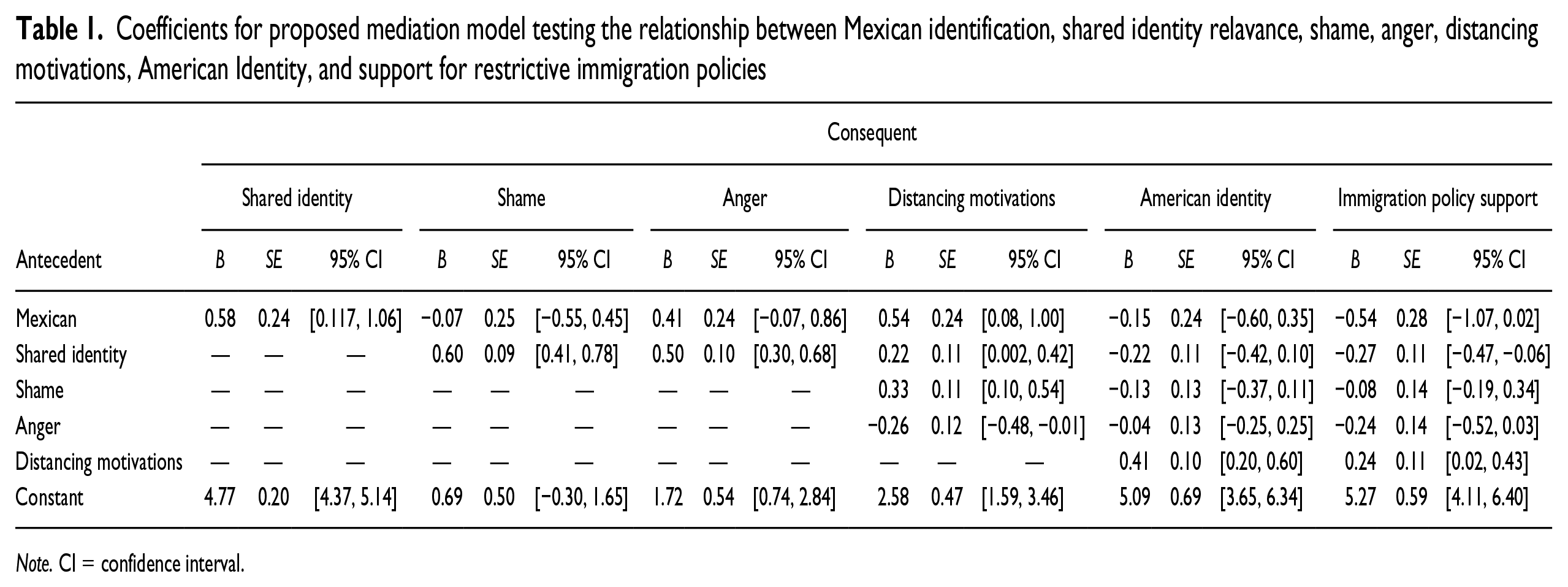
The proposed mediation model (see Figure 1) accounted for a significant amount of variance in the outcome measure American identity (R2 = .17, SE = 0.08, p = .035) and immigration policy support (R2 = .22, SE = 0.08, p = .003). Prior to an examination of the full model, a t-test was conducted to determine if in fact non-Mexican Latino Americans (M = 4.76, SD = 1.60) and Mexican Americans (M = 5.35, SD = 1.22) differed in their reported shared identity relevance of this coverage. The t-test revealed a significant difference between the two groups in the expected direction, t(137) = 2.42, p < .05. An examination of the 95% bias-corrected confidence intervals of the proposed mediation model (see Table 1 for model coefficients) indicated significant direct effects of being Mexican on shared identity relevance such that Mexicans were more likely than non-Mexican Latinos to believe that immigration coverage depicts negative beliefs others might have about their ethnic group (B = 0.58, SE = 0.24, 95% confidence interval [CI] = [.12, 1.06]), offering support for Hypothesis 1.
Coefficients for proposed mediation model testing the relationship between Mexican identification, shared identity relavance, shame, anger, distancing motivations, American Identity, and support for restrictive immigration policies
Note. CI = confidence interval.
In turn, shared identity relevance positively predicted feelings of shame as posited in Hypothesis 2a (B = 0.60, SE = 0.09, 95% CI = [0.41, 0.78]) and anger as postulated in Hypothesis 2b (B = 0.50, SE = 0.10, 95% CI = [0.30, 0.68]). There was also a significant indirect effect of being Mexican on both shame (B = 0.35, SE = 0.15, 95% CI = [0.09, 0.66]) and anger (B = 0.29, SE = 0.13, 95% CI = [0.07, 0.58]). Together, these data indicate that Mexican Americans are more likely than non-Mexican Latino Americans to perceive a shared group identity with the immigrants depicted in the news and to additionally experience a stronger affective response to this coverage.
The Effects of Shame and Anger on Distancing Motivations
Consistent with Hypothesis 3a, shame was positively associated with distancing from the Latino immigrants depicted in immigration media coverage (B = 0.33, SE = 0.11, 95% CI = [0.10, 0.54]). In line with Hypothesis 3b, anger was negatively associated with distancing from the Latino ingroup (B = −0.26, SE = 0.12, 95% CI = [−0.48, −0.01]). Furthermore, there were significant indirect effects of being Mexican on distancing motivations, through shared identity and shame (B = 0.12, SE = 0.06, 95% CI = [0.03, 0.30]), and through anger (B = −0.09, SE = 0.06, 95% CI = [−0.26, −0.01]). A pairwise comparison of the indirect effects indicated that they were significantly different from one another (B = 0.21, SE = 0.12, 95% CI = [0.04, 0.53]). In addition, there was a positive direct effect of being Mexican on distancing motivations (B = 0.54, SE = 0.24, 95% CI = [0.08, 0.95]).
Taken together these findings indicate that Mexican Americans (vs. non-Mexican Latinos) not only experience greater desire to distance themselves from the messages about immigration in the news, but that experiencing this distancing motivation for Mexicans was largely influenced by the different emotional reactions elicited from viewing immigration news. Whereas shame can function to drive Mexican Americans further way from their shared ethnic identity with Latino immigrants depicted in the news, experiencing anger in response to negative group depictions has the potential to manifest in feelings of greater affiliation.
Support for Immigration Policies
Consistent with Hypothesis 4, analyses revealed a positive direct effect of distancing motivations on support for restrictive immigration policies (B = 0.24, SE = 0.11, 95% CI = [0.02, 0.43]), indicating that distancing manifests in greater endorsement of anti-immigrant legislation. Furthermore, the examination revealed a significant indirect effect of being Mexican on policy support through shared identity, shame, and distancing motivations (B = 0.05, SE = 0.03, 95% CI = [0.01, 0.14]), as well as through shared identity, anger, and distancing motivations (B = −0.03, SE = 0.02, 95% CI = [−0.11, −0.003]) in the expected directions. A pairwise comparison revealed these indirect effects were significantly different from one another (B = 0.08, SE = 0.05, 95% CI = [0.02, 0.24]). These findings suggest that for Mexican Americans exposure to this coverage does not directly manifest in support for anti-immigrant policies nor does experiencing anger and shame in response to negative immigration coverage directly predict such positions. Rather, a desire (or lack of desire) to distance oneself from immigrant Latinos depicted in the news prompts support for or opposition to these policies depending on the affective reaction (i.e., shame and anger, respectively) to such coverage.
American Identity
Consistent with Hypothesis 5, analyses revealed a positive direct effect of distancing motivations on American identity (B = 0.41, SE = 0.10, 95% CI = [0.20, 0.60]), indicating that distancing prompts greater affiliation with one’s national identity. More specifically, there was a significant indirect effect of being Mexican on American identity through shared identity relevance and both shame (B = 0.03, SE = 0.02, 95% CI = [0.004, 0.09]) and anger (B = −0.02, SE = 0.02, 95% CI = [−0.07, −0.001]). A pairwise comparison also indicating a significant difference between these effects (B = 0.05, SE = 0.05, 95% CI = [0.01, 0.14]). In line with findings regarding immigration policy preferences, Mexican Americans were not directly more likely to endorse an alternate, and more favorable, social identity when compared to non-Mexican Latinos in response to negative group depictions. Instead, the desire to move away from their shared ethnic identity with immigrant Latinos coupled with their emotional reaction to this coverage either prompts (i.e., shame) or inhibits (i.e., anger) this affiliation.
Discussion
The issue of immigration is one of the most divisive and controversial topics on the political agenda today. In 2018, numerous legislative and executive-branch efforts to impose travel bans, restrict immigration, build a wall along the southern U.S. border, and deport children brought to the United States unlawfully have led to widespread consternation from both ends of the political spectrum (e.g., Cowen, 2018). Not only does immigration news reflect the contentious nature of this debate, but it also defines the issue for audiences (e.g., Iyengar et al., 1982). As Abrajano and Singh (2009) articulate, If immigration is framed in a way that only focuses on Latinos (and not immigrants in general), it may cause individuals to think about . . . immigration reform in terms of . . . attitudes and opinions towards Latinos; this would shift the emphasis away from evaluating the policy proposal itself and transfer it to their opinions on Latinos. Thus, depending on how the news organization frames the immigration issue, then the standards by which an individual judges this particular issue may also change. (p. 4)
Accordingly, because immigration news in the United States is laden with negative, threatening messages and places an almost exclusive focus on Latino immigrants, it leaves little uncertainty regarding how the issue of immigration will be interpreted. Indeed, the effects of this coverage on majority (particularly White) audiences have been well documented, demonstrating that exposure can (a) lead to beliefs that immigrants are threatening (Esses, Medianu, & Lawson, 2013), (b) encourage unfavorable attitudes toward immigration and immigrants (Fujioka, 2011), (c) prompt feelings of contempt and anxiety toward immigrants (Atwell Seate & Mastro, 2016, 2017; Esses et al., 2013), and (d) produce support for restrictive immigration policies (Atwell Seate & Mastro, 2016, 2017; Fujioka, 2011; Haynes et al., 2016; Lahav & Courtemanche, 2012). However, this research is limited in its ability to speak to the experiences of the 57.5 million Latinos (U.S. Census Report, 2017) living in the United States who are also part of the potential audiences for this coverage.
This study addresses this complex question by applying insights from scholarship on vicarious shame and the rejection-identification model. Based on research in the domain of vicarious shame (e.g., Schmader & Lickel, 2006b), experiencing group shame in response to immigration news would drive Latinos to distance themselves from their shared group identity. In turn, this distancing would lead to both greater affiliation with American identity (to maintain a positive self-concept) and stronger support for restrictive immigration policies (to mitigate the potential threats). Alternatively, based on the logic of the rejection-identification model (e.g., Schmitt & Branscombe, 2002), anger would be the likely response to exposure to this coverage, manifesting in less distancing (i.e., greater affiliation) from the shared ethnic identity with immigrant Latinos. This lack of distancing would then predict less affiliation with American identity and less support for restrictive immigration policies. Moreover, from the overarching social identity perspective (e.g., Tajfel & Turner, 2004), based on the disproportionate emphasis on Mexicans in immigration coverage, Mexican Americans would respond differently to this coverage than non-Mexican Latinos and would be more likely to perceive this coverage to be tied to their ethnic group.
The results found here support predictions based on both the vicarious shame and rejection-identification approaches, further indicating that they are distinct. The mediation model revealed that Mexican Americans reported greater levels of shared identity relevance than non-Mexican Latinos. Thus, although immigration from Mexico has been declining over recent years (Passel & Cohn, 2016), Mexican Americans understand (either explicitly or implicitly) immigration in much the same way as non-Latino Americans—that is, as a Mexican issue (Santa Ana, 2013). Furthermore, when reflecting on how immigration coverage typically portrays Latino immigrants, Mexican Americans evaluate such coverage as perpetuating negative preconceptions about their ethnic group whereas non-Mexican Latinos are less likely to do so.
Because of this evaluation, Mexican Americans appear to be more likely to experience distancing desires. However, in examining the mediating affective response to this coverage, a more complicated relationship was revealed such that these distancing desires were largely influenced by the particular emotional reactions elicited from consuming immigration news. Although shame positively predicted distancing motivations (i.e., driving Mexican Americans further from their shared ethnic identity with Latino immigrants), anger in response to this coverage brought Mexican Americans closer to this shared identity (i.e., producing affiliation with the group). In addition, the influence of these processes on support for restrictive immigration policies and national/American identification were also supported, indicating that for Mexican Americans exposure to this coverage might not directly manifest in support for anti-immigrant policies nor a direct shift toward their national identity; rather, it is the desire (or lack of desire) to distance oneself from immigrant Latinos depicted in media coverage of immigration, coupled with either shame or anger, that has the potential to prompt these outcomes. Again, this is in line with the predictions put forth by vicarious shame scholars and proponents of the rejection-identification model. Thus, given that these data provide support for both sets of hypotheses, a looming concern remains: it is still unclear what prompts feelings of anger or shame in response to this coverage. One potential explanation might lie within the perceived legitimacy of this coverage.
Based on the content analytic work reviewed previously, this study conceptualized immigration news coverage as biased in its treatment of Latinos because (a) English-language immigration coverage in the United States presents immigration as a racialized issue and, more specifically, a Latino issue, and (b) such coverage highlights prevalent negative stereotypes about Latinos. Consequently, Latinos exposed to such coverage were thought to evaluate this content as a form of prejudicial rejection from the dominant group. In other words, because immigration news often characterizes Latinos as criminals or other types of threats and because this news often comes from White news sources, it was assumed that Latinos who view or listen to this coverage would interpret these messages as a form of racially biased communication. These assumptions are not necessarily wrong; in fact, they are supported by this study and other studies on media effects focused on Latinos (Schmader et al., 2015; Tukachinsky, Mastro, & Yarchi, 2015). However, simply recognizing that the coverage is prejudicial does not mean that it is not also legitimate. As Branscombe et al. (1999) note, [the] effects of attributions to prejudice depend not just on the externality of the attribution but also on what the attribution means for the devalued group member. An attribution to prejudice that is seen by targets as legitimate implies that they and their group membership are deserving of negative treatment. (p. 136)
In other words, the legitimacy of a prejudicial behavior or communication is critical in determining how a disadvantaged group member responds to it.
The rejection-identification model is premised on the notion that such prejudicial behaviors are perceived as illegitimate, and the blame is placed on the offending outgroup; without this perception, the predictions of the model do not apply. Put differently, the disadvantaged group member will increase affiliation with their ingroup and hostility toward the outgroup only if the prejudice is perceived as illegitimate. Given the current study, this presents a potential explanation as to why some individuals experience anger in response to this coverage instead of shame: They perceive immigration coverage as an illegitimate, prejudicial message against their group.
Research on prejudicial attributions (Major, Quinton, & McCoy, 2002), system justification theories (Jost, Banaji, & Nosek, 2004), and perceived legitimacy (Major & Schmader, 2001) support this contention regarding shame as well. Bringing together the logic of the system justification perspective (see Jost et al., 2004, for review) and perceptions of the legitimacy of socially negative outcomes, Major and Schmader (2001) argue that, at times, members of disadvantaged groups perceive the status quo as legitimate, are motivated to maintain the current system, and are less likely to perceive negative outcomes as discrimination, but rather as internal flaws of either themselves or their group. This internal attribution of blame complements our conceptualization of vicarious shame as an inwardly directed, group-based emotion experienced when a fellow ingroup member engages in an event or action that exemplifies an internal flaw of the group. That is to say, it is theoretically reasonable to suggest that the cognitive evaluation of prejudicial behavior as legitimate is coupled with experiencing vicarious shame. Thus, within this study, the differential affective responses of shame and anger can potentially be explained by the degree to which non-immigrant Latinos, and Mexican Americans in particular, believe that immigration coverage depicting Latinos is a legitimate depiction of their group.
Because this study can neither speak to possible differences in perceived legitimacy nor address factors such as subjective group vitality (Ehala, 2010), which might also shed light on these relationships, it will be important for future research to interrogate these relationships, focusing particular attention on evaluative judgments about immigration news content and whether or not non-immigrant Latinos feel that this coverage is a fair and valid representation of Latinos. In addition, the cross-sectional nature of these data makes it difficult to examine differences among Latinos’ sources for immigration news, as well as the frequency with which it is consumed. Accordingly, further research should attempt to either experimentally test whether the use of distinct frames in news coverage prompts differential responses or longitudinally assess whether increases in consuming to this coverage manifest in the identity shifts predicted by vicarious shame and the rejection-identification model.
This study was focused on elucidating the media experiences of non-immigrant Latinos who consume immigration news coverage. To that end, support for our predictions based on the rejection-identification model and vicarious shame were found. Our data indicate that non-immigrant Latinos, and Mexican Americans in particular, who consume news coverage of immigration might experience undue and damaging effects pertaining to their ethnic identity. For this reason, race and ethnicity research endeavoring to explore the deleterious consequences of exposure to media content should not focus their attention exclusively on dominant audiences; as our findings suggest, racial/ethnic minorities can experience unique, personal, and equally harmful outcomes.
Supplemental Material
Appendix – Supplemental material for Does Watching This Make Me Feel Ashamed or Angry? An Examination of Latino Americans’ Responses to Immigration Coverage
Supplemental material, Appendix for Does Watching This Make Me Feel Ashamed or Angry? An Examination of Latino Americans’ Responses to Immigration Coverage by Andrea Figueroa-Caballero and Dana Mastro in Journal of Cross-Cultural Psychology
Footnotes
Declaration of Conflicting Interests
The author(s) declared no potential conflicts of interest with respect to the research, authorship, and/or publication of this article.
Funding
The author(s) received no financial support for the research, authorship, and/or publication of this article.

Supplemental Material
Supplemental material for this article is available online.
References
Supplementary Material
Please find the following supplemental material available below.
For Open Access articles published under a Creative Commons License, all supplemental material carries the same license as the article it is associated with.
For non-Open Access articles published, all supplemental material carries a non-exclusive license, and permission requests for re-use of supplemental material or any part of supplemental material shall be sent directly to the copyright owner as specified in the copyright notice associated with the article.
