



Abstract
Cultural norms for the experience, expression, and regulation of emotion vary widely between individualistic and collectivistic cultures. Collectivistic cultures value conformity, social harmony, and social status hierarchies, which demand sensitivity and focus to broader social contexts, such that attention is directed to contextual emotion information to effectively function within constrained social roles and suppress incongruent personal emotions. By contrast, individualistic cultures valuing autonomy and personal aspirations are more likely to attend to central emotion information and to reappraise emotions to avoid negative emotional experience. Here we examined how culture affects perceptual strategies employed during emotion regulation, particularly during cognitive reappraisal and emotional suppression. Eye movements were measured while healthy young adult participants viewed negative International Affective Picture System (IAPS) images and regulated emotions by using either strategies of reappraisal (19 Asian American, 21 Caucasian American) or suppression (21 Asian American, 23 Caucasian American). After image viewing, participants rated how negative they felt as a measure of subjective emotional experience. Consistent with prior studies, reappraisers made lower negative valence ratings after regulating emotions than suppressers across both Asian American and Caucasian American groups. Although no cultural variation was observed in subjective emotional experience during emotion regulation, we found evidence of cultural variation in perceptual strategies used during emotion regulation. During middle and late time periods of emotional suppression, Asian American participants made significantly fewer fixations to emotionally salient areas than Caucasian American participants. These results indicate cultural variation in perceptual differences underlying emotional suppression, but not cognitive reappraisal.
Introduction
Culture influences the processes of emotion across multiple levels of analysis. Culture shapes the mental representations consistent with the historical social knowledge of the cultural group (Morling & Lamoreaux, 2008). Culture provides intersubjective norms that are shared across members of the cultural group (Chiu, Gelfand, Yamagishi, Shteynberg, & Wan, 2010). People of a given culture endorse values that are personally accepted and implemented in society (Markus & Kitayama, 1991; Triandis, 1989). Finally, culture interacts with genetics to influence the sensitivity of individuals toward their social and physical environment (Boyd & Richerson, 1985).
Societal norms for the experience, expression, and regulation of emotion vary between cultures (Kitayama & Markus, 1994; Mesquita & Frijda, 1992). Collectivistic cultures value conformity, social harmony, and social status hierarchies (Markus & Kitayama, 1991); direct attention toward contextual scene information (Chua, Boland, & Nisbett, 2005); display expressive suppression (Butler, Lee, & Gross, 2007); and value feelings of calm (Tsai, 2007). By contrast, individualistic cultures value autonomy and the pursuit of happiness (Markus & Kitayama, 1991), attend to central scene information (Chua et al., 2005), openly express emotions (Butler et al., 2007), and prefer feelings of excitement and joy (Tsai, 2007).
These emotional differences between cultures are facilitated by differences in the organization of social environments (Mesquita, De Leersnyder, & Albert, 2014) and likely reflect the dual influence of evolutionary inheritance and cultural niche construction on the psychological and biological processes underlying emotional behavior (Chiao & Blizinsky, 2010; Sasaki, LeClair, West, & Kim, 2016). For example, cultural variation in top-down strategies to regulate emotions reflects cultural norms that are adaptive for different environmental conditions (Fincher, Thornhill, Murray, & Schaller, 2008) such as the appropriate displays of emotion in social relationships and contexts (Butler et al., 2007; Ford & Mauss, 2015; Matsumoto, Yoo, Nakagawa, & 37 Members of the Multinational Study of Cultural Display Rules, 2008), including different kinds of verbal (Wierzbicka, 1999) and nonverbal gestures (Elfenbein & Ambady, 2002). People recognize emotions expressed by members of their own group to a better extent relative to those of other group members (Elfenbein & Ambady, 2002), likely due to the familiar social context surrounding the expressing of emotion (Marsh, Elfenbein, & Ambady, 2003).
Cultural display rules affect how people regulate emotions. Emotion regulation is a process by which people regulate negative feelings (Gross, 1998). Cognitive reappraisal is an emotion regulation strategy that relies on rethinking one’s negative feelings. Expressive suppression is another emotion regulation strategy that includes the conscious suppression of expressions of negative emotion. Cultures differ in the extent to which people endorse cognitive reappraisal or expressive suppression as an emotion regulation strategy (Matsumoto et al., 2008). Consistent with collectivistic cultural values, East Asians and Asian Americans are more likely to value regulating emotions, instead of expressing emotions and to endorse expressive suppression as an optimal regulation strategy, relative to Europeans and European Americans (Mauss, Butler, Roberts, & Chu, 2010). Nations higher in interdependence or collectivism report greater levels of emotional suppression (Matsumoto et al., 2008). Cultural values also predict motivation to regulate one’s emotions (Ford & Mauss, 2015). Endorsement of Asian cultural values predicts use of expressive suppression as an emotion regulation strategy to a greater extent relative to cultural group membership (Mauss et al., 2010). Cultural factors interact with genetic sensitivity to guide the regulation of emotion. Koreans who were more genetically sensitive to the social environment are more likely to use expressive suppression during emotion regulation, relative to Americans (Kim & Sasaki, 2012; Kim et al., 2011). Consistent with dual inheritance theory, these findings suggest that shared biological inheritance within a nation may reinforce the selection of a normative emotion regulation strategy within the culture.
Cultural norms also affect how people perceive scenes in the environment. When perceiving a neutral scene in the environment, North Americans look more rapidly at the focal areas of a scene, whereas East Asians (i.e., Chinese, Japanese) look more frequently at the contextual background of a scene (Cheon, Wang, Chiao, & Tang, 2018; Chua et al., 2005; Masuda et al., 2008). When perceiving an emotional scene in the environment, people attend to emotional cues in the social environment differently, depending on how emotions are regulated. While regulating emotions, people look away from the emotional areas of the social environment, particularly during suppression of emotion (Bebko, Franconeri, Ochsner, & Chiao, 2011). Nevertheless, emotion regulation success is predicted by looking toward emotional areas of the social environment, likely due to enhancement of perceived emotional information during cognitive reappraisal (Bebko, Franconeri, Ochsner, Chiao, 2014; Urry, 2010). When reappraising emotions, attending to select features of emotional areas in the social environment provides the perceptual input necessary for cognitive change to occur. Attentional deployment precedes cognitive selection, selecting perceptual aspects of the situation whose particular meaning associated with a given situation may undergo modification. These findings suggest that in addition to cultural background, cognitive strategies for regulating emotions also affect how people perceive the environment around them, possibly due to the role of perceptual strategies underlying emotion regulation in facilitation and maintenance of cultural norms.
The goal of the current study was to examine for the first time the influence of culture on perceptual strategies of emotion regulation. While much is known about how people regulate emotions, less well understood is how culture and emotion regulation strategies (i.e., suppression vs. reappraisal) may interact to jointly guide patterns of perception and attention for emotional visual stimuli. Given the stronger context-sensitive processing styles of Asian populations, as well as greater tendencies to look away from focally emotional content during suppression of emotions (Bebko et al., 2011), we predicted that Asian Americans will direct more attention toward contextual information during suppression relative to Caucasian Americans. We also predicted that Caucasian Americans will direct more attention toward central emotional information during reappraisal relative to Asian Americans, given increased perceptual tendencies to attend to focally salient features of stimuli (rather than contextual features) compared with Asian populations.
Method
Participants
Eighty-four healthy young adults (40 Asian Americans/44 Caucasian Americans; age in years: M = 19.67, SD = 2.08) with normal or corrected-to-normal vision participated in this study for course credit or monetary compensation. Within each of the two cultural subgroups, participants were randomly assigned to either a cognitive reappraisal (n = 40; 19 Asian Americans/21 Caucasian Americans) or expressive suppression (n = 44; 21 Asian Americans/23 Caucasian Americans) group. 1
Procedure
Our task was adapted from a standard emotion regulation paradigm (i.e., see Ochsner et al., 2004) (Figure 1). Before each trial, participants viewed an instructional cue (2 s) to either “Attend” to or “Regulate” emotions elicited while viewing an IAPS image (10 s). Eye movements were recorded during image viewing. Next, participants rated how negative they felt on a scale from 1 (weakly negative) to 7 (strongly negative) as an indicator of subjective emotional experience. At the end of the trial, participants viewed the instruction to “Relax” (4 s).

Example emotion regulation task trial (from Bebko, Franconeri, Ochsner, & Chiao, 2011).
The experiment consisted of 40 total trials, with 10 trials in each of four blocks that varied by instruction (attend or regulate) and image valence (negative or neutral) such that there were four conditions of interest: (a) attend to negative images, (b) attend to neutral images, (c) regulate to negative images, and (d) regulate to neutral images. We counterbalanced the block order between participants and randomized the order of image presentation within each block.
Stimuli and Emotional Area-of-Interest (eAOI) Definition
We selected 20 digital IAPS color images (1024 × 768 pixels) (Lang, Bradley, & Cuthbert, 2005) to be unpleasant (M = 3.04, SD = 0.60), dominating (M = 4.60, SD = 0.52), and arousing (M = 5.15, SD = 0.59) based on standardized IAPS ratings. To prevent habituation to the negative images, we also selected 20 neutral images (valence: M = 6.02, SD = .56; dominance: M = 4.52, SD = .48; arousal: M = 5.41, SD = .48) (see Bebko et al., 2011, for full description of IAPS images). We defined negative eAOIs as the top 50% most emotionally negative spatial regions within the most frequently fixated locations of the negative images. The emotionally negative spatial regions were identified via one set of participants’ self-report, while the frequently fixated regions were identified via another participants’ eye movements over the images. The final eAOIs were validated as being emotional areas of interest by a third set of participants (see Bebko et al., 2011, for full description of the norming procedure and eAOIs).
Emotion Regulation Training
Similar to prior emotion regulation studies, an experimenter provided emotion regulation training in both written and verbal formats (see Gross, 1998; Ochsner et al., 2004). All participants were instructed to naturally respond to the images during “attend” trials, which served as a baseline for comparison with the “regulate” trials. Participants in the suppress group were instructed to inhibit facial expressions of emotion during “regulate” trials so that someone else would not be able to identify their feelings by seeing their face, while participants in the reappraise group were instructed to reinterpret the visual content of the images during “regulate” trials so as to decrease negative feelings.
The training session consisted of 10 negative and 10 neutral IAPS images unique to the training session. During the training session, participants practiced using their assigned emotion regulation strategy and rating how negative they felt after viewing each image. Once done with the training session, the experimenter verbally confirmed the participants’ ability to use his or her assigned emotion regulation strategy and understanding of the emotion rating scale. In addition, the experimenter instructed participants to use the assigned emotion regulation strategy to the best of their ability and to accurately report negative feelings regardless of how successful they felt using the assigned emotion regulation strategy.
Eye-Tracking Apparatus
An SR Research Eyelink 1000 (Ontario, Canada) eye tracker recorded participants’ eye movements throughout the experiment. We performed a 9-point calibration on each participant prior to starting the experiment and drift correction before each trial during the experiment. Participants viewed images presented by Experiment Builder software (SR Research, Ontario, Canada) on a 19″ LCD monitor located 60 cm from the eyes. During the experiment, a stimulus generation computer transmitted event codes to a PC controlling the eye tracker (see Bebko et al., 2011). Fixation for each trial was defined as attending to a 1024 × 768 pixels digital image from the IAPS for 10 s.
Data Analysis 2
Emotional experience ratings
Consistent with earlier study, a behavioral measure of emotion regulation success was calculated. Emotion regulation success was defined as the self-reported baseline “attend” ratings subtracted from the “regulate” ratings (regulate – attend) of negative emotional experience (Bebko et al., 2014). We conducted a 2 (Group: reappraise, suppress) × 2 (Culture: Asian American, Caucasian American) × 2 (Task: attend, regulate) repeated measures analysis of variance (ANOVA) to examine differences in emotional experience ratings. Significant interactions were followed up by conducting one-tailed t tests.
Fixations in eAOIs
Similar to our prior study (Bebko et al., 2011), we analyzed the average percentage of fixations made to eAOIs across three discrete times during the 10 s of image viewing: early (1-3 s), middle (4-6 s), and late (7-10 s) due to neural response variability over time during emotion regulation (Goldin, McRae, Ramel, & Gross, 2008). We conducted a 2 (Group: reappraise, suppress) × 2 (Culture: Asian American, Caucasian American) × 2 (Task: attend, regulate) × 3 (Time: early, middle, late) repeated measures ANOVA. When appropriate, we conducted follow-up one-tailed t tests to examine significant interactions.
Results
Emotional Experience Ratings
There was a significant Task × Group interaction, F(1, 80) = 61.56, p < .001, η2 = 0.43, such that reappraisers (M = 3.34, SD = 1.10) rated feeling significantly less negative during regulate trials relative to suppressers (M = 4.29, SD = 1.30), t(80) = 3.84, p < .001. There was a significant main effect of task, F(1, 80) = 24.49, p < .001, η2 = .23, such that participants rated feeling more negative during attend trials (M = 4.67, SD = 1.12) relative to regulate trials (M = 3.84, SD = 1.29). There were no significant cultural interactions or main effects.
Fixations in eAOIs
There was a significant Time × Culture × Group interaction, F(2, 160) = 3.29, p < .05, η2 = 0.04, such that Asian Americans in the suppress group (Middle: M = 53.91, SD = 11.61; Late: M = 50.81, SD = 12.37) made a significantly smaller percentage of fixations to negative eAOIs during the middle, t(42) = 2.21, p < .05, one-tailed t test, and late, t(42) = 2.06, p < .05, one-tailed t test, time bins relative to Caucasian Americans in the suppress group (Middle: M = 60.35, SD = 10.98; Late: M = 56.92, SD = 11.14) (Figure 2). There was a significant Time × Group interaction, F(2, 160) = 12.43, p < .001, η2 = 0.14, such that participants in the suppress group (Middle: M = 57.28, SD = 11.62; Late: M = 54.00, SD = 12.01) made a significantly smaller percentage of fixations to negative eAOIs during the middle, t(82) = 2.55, p < .05, and late, t(85) = 3.51, p < .001, time bins relative to participants in the reappraise group (Middle: M = 62.38, SD = 8.50; Late: M = 61.29, SD = 7.55). There was a significant main effect of time, F(2, 160) = 124.34, p < .001, η2 = 0.61, such that a significantly greater percentage of fixations were made to eAOIs in the early (M = 68.22, SD = 8.81) time bin relative to both the middle (M = 59.71, SD = 10.51) and late (M = 57.47, SD = 10.72) time bins, Early versus Middle: t(82) = 6.14, p < .001; Early versus Late: t(82) = 7.80, p < .001. There was also a significant main effect of group, F(1, 80) = 1.23, p < .05, η2 = 0.08, such that reappraisers (M = 64.34, SD = 7.09) made a greater percentage of fixation to eAOIs relative to suppressors (M = 59.37, SD = 10.17). All other interactions and main effects were not significant, all ps > .05.
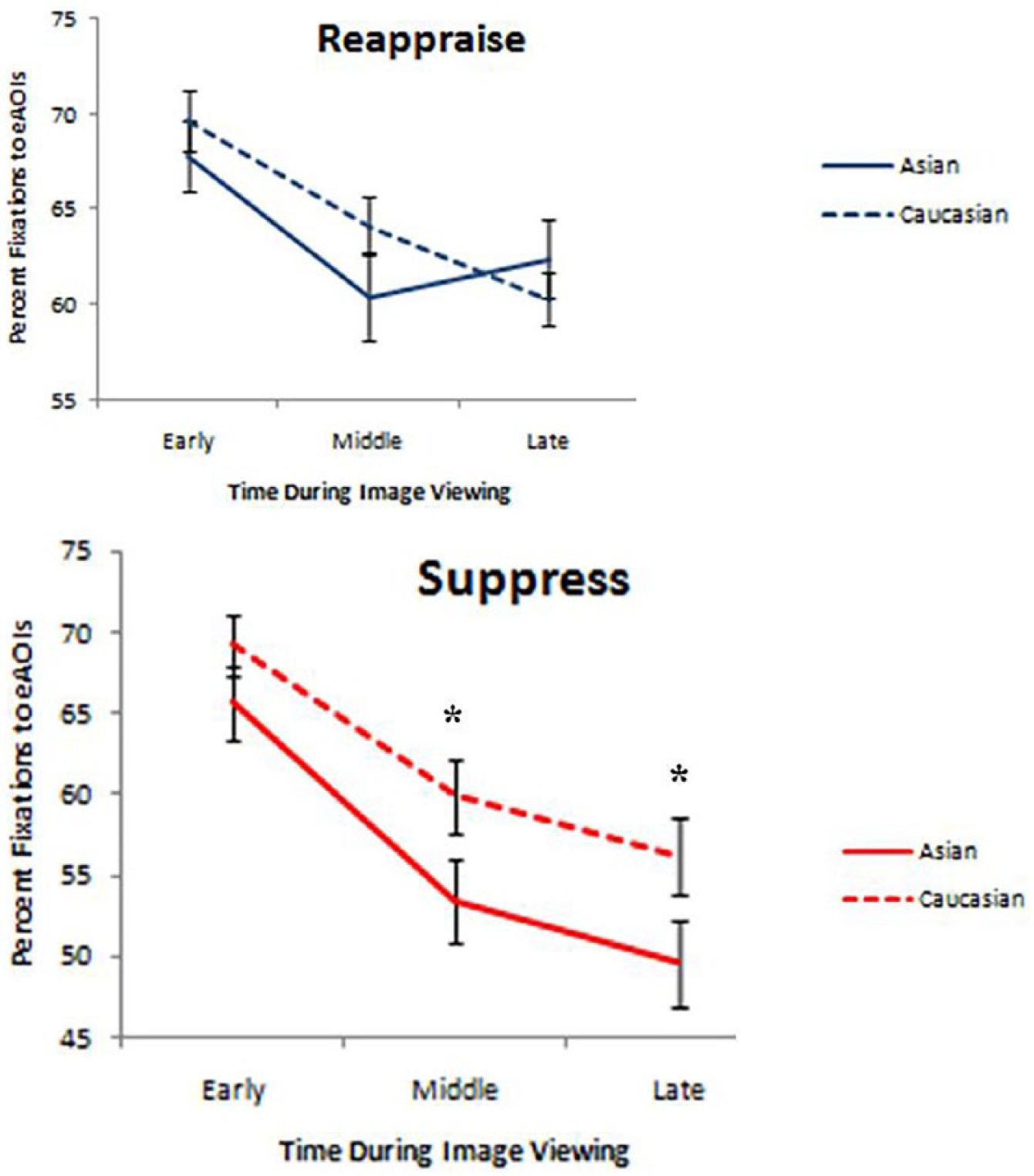
Asian Americans in the suppress group made significantly fewer fixations to negative emotional areas of interest during the middle and late viewing times relative to Caucasian Americans in the reappraise group.
Discussion
Here we studied for the first time the influence of culture on perceptual strategies during emotion regulation. Cultures vary in the use of cognitive processes for the regulation of emotion (Ford & Mauss, 2015). East Asian cultures rely on the strategy of expressive suppression to regulate emotions, while European American cultures regulate emotions with the strategy of cognitive reappraisal. While prior research has demonstrated that both cultural background and emotional suppression strategy independently contribute to the deployment of visual attention to contextual features of emotional scenes (Masuda et al., 2008), the shared influence of these cultural and emotion-regulatory processes on visual attention toward emotional scenes has received limited investigation. Consistent with our hypotheses, during emotional suppression, Asian Americans looked away from emotional areas of a scene to a greater extent relative to Caucasian Americans. These findings are consistent with earlier behavioral studies in culture and holistic processing showing that relative to Caucasian Americans, East Asians may attend more to the background or contextual areas of a scene. Yet, no cultural variations were observed in visual attention to emotional scenes during reappraisal, suggesting that cultural variations on holistic and context-sensitive visual processing may be mitigated during reappraisal, which requires attending to emotionally focal areas of scenes. Cultural variation in eye movements during expressive suppression in Asian Americans, but not Caucasian Americans, demonstrates behavioral consistency and reinforcement of top-down processes such as cultural display rules (Matsumoto et al., 2008). Cultural differences in eye movements during emotion regulation at the early stage of perceptual processing likely reflect the reinforcement of cultural display rules, or the societal norm to regulate the perception of emotional expressivity within the culture. The cultural difference in eye movements during emotion regulation occurs during the middle and late stages of viewing and thus may reflect a controlled component of perceptual processing during emotion regulation.
In the current study, the emotional areas of a scene are not necessarily spatially focal (e.g., positioned in the center of the scene); however, due to the emotional content of the area within the scene, the area becomes more focally important (e.g., positioned in the scene with emotional content). Both groups demonstrate greater success at emotion regulation during cognitive reappraisal compared with emotional suppression, and no perceptual differences during cognitive reappraisal. Our results demonstrate the importance of perceiving the external and contextual environment when suppressing emotion for Asian Americans, but not when reappraising emotion likely due to the internal aspect of generating cognition or thoughts that change the semantics or meaning of a feeling (e.g., a woman is crying because she feels joy, rather than sadness). This may be due to cultural congruency between task demands associated with emotional suppression.
Cultural influences on perceptual strategies of emotion regulation were observed during the middle (4-6 s) and late (7-10 s) time periods. This temporally sensitive effect is not unexpected given that attention is likely to initially be automatically deployed at the eAOIs given that these are the most salient parts of the scene. Yet, the influence of culture and emotion regulation style may then subsequently adjust attention away from these emotionally salient areas to the broader context of the scene. For instance, while Japanese and Westerners may initially attend to focal areas of a scene, Japanese (who rely on more holistic processing styles) are more likely to attend to contextual information in the scene after this initial inspection of the focal area (Masuda et al., 2008). Similarly, those employing strategies of emotional suppression may also look away from emotionally arousing areas of scenes as a means of downregulating unwanted or aversive emotions (Bebko et al., 2011).
The goal of the present study was to examine the interplay of culture and emotional regulation strategies during perceptual navigation of emotional scenes. Prior research has demonstrated cultural differences in perceptual strategies underlying scene recognition. East Asians look more frequently at the background of a scene, relative to Americans who look more directly at the focal area of a scene (Chua et al., 2005; Goh, Tan, & Park, 2009). Greater attentional deployment toward the contextual or background of a visual scene likely serves as an antecedent for enhanced memory for context and background observed for East Asians relative to Americans (Gutchess & Indeck, 2009; Masuda & Nisbett, 2001). While the importance of perceptual strategies during scene recognition has been previously demonstrated, less well understood is the effect of culture and emotion regulation on scene recognition. Numerous behavioral paradigms show that culture affects different aspects of scene encoding and recognition across temporal distance. The current study examines effects of culture on regulation of emotion during scene recognition within a brief period of static encoding of information from the visual scene, spanning only a few seconds, akin to working or short-term memory. When regulating emotion in a naturalistic setting, emotional suppression may occur while scene information changes in a slow (e.g., sitting in a chair) or rapid (e.g., running outdoors) manner. Given that the primary influence of culture on emotion regulation is during suppression, it may be possible that further perceptual differences may be observed when changing the length of encoding, such as regulating emotions while encoding scene information into long-term memory.
The current work complements recent empirical findings that demonstrate cultural differences in emotion regulation. Due to cultural display rules, East Asians and Asian Americans are more likely to utilize suppression of emotion, whereas European Americans prefer cognitive reappraisal, or rethinking one’s feelings, as an effective emotion regulation strategy (Butler et al., 2007; Matsumoto et al., 2008). Here we show that during emotional suppression, Asian Americans are more likely to look away from the emotional areas of a scene compared with Caucasian Americans. These findings are consistent with a cultural psychophysiological study demonstrating a reduction in parietal late positive potential (LPP) activation during the suppression of emotion in Asian Americans, but not Caucasian Americans (Murata, Moser, & Kitayama, 2013). The LPP is an electrophysiological waveform that peaks approximately 300 to 400 ms after the onset of a stimulus originating from the parietal lobe (Moser, Hajcak, Bukay, & Simons, 2006). The LPP is typically associated with late stages of emotional processing and emotion regulation, sensitive to affective dimensions of arousal. Taken together, this evidence of cultural variation in emotion regulation likely reflects psychological and neural mechanisms of “down-regulation” or “dampening” (Miyamoto & Ma, 2011) of emotion that may serve to facilitate the maintenance of collectivistic and individualistic values, respectively (Mauss et al., 2010; Murata et al., 2013).
A process model of emotion regulation suggests that the attentional act of looking away predicts reduction in degree of LPP activation during emotional suppression for Asian Americans. The current findings indicate that the perceptual strategy to look away during emotion suppression is either a reflexive or controlled perceptual response that enhances cognitive and behavioral maintenance of societal norms in collectivistic cultures. Collectivistic cultures emphasize the importance of social relations, such as attending to social harmony and connectedness with close others (Markus & Kitayama, 1991; Oyserman, Coon, & Kemmelmeier, 2002). Cultural display rules of collectivism provide a top-down strategy that allows for the conscious control of attention within an emotional scene that is appropriate to the cultural context (Matsumoto et al., 2008). Cultural practices that are consistent with cultural display rules provide a bottom-up strategy for unconscious learning of an effective strategy for emotion regulation that occurs in a culturally appropriate manner. Our findings suggest that when navigating the social environment, looking away from social signals within the environment with emotional content may predict conscious and unconscious endorsement of collectivistic values, and degree of cultural competence in social relationships within a collectivistic cultural context for Asian Americans.
In summary, cultural differences in the use of strategies for emotion regulation are observed during the early, middle, and late processing stage of attentional deployment. These results suggest that culture consists of a top-down strategy of variation in eye movements to regulate the experience of emotion. When culturally appropriate emotion regulation is performed routinely, culture acts as a bottom-up strategy for learning of reflexive regulation of emotion.
Basic and Clinical Research Applications
The present study has several applications for basic and clinical research. Here we introduce a novel perceptual paradigm for studying cultural differences in attentional deployment during emotion regulation in healthy young adults. This study paradigm allows for the examination of cultural differences in frequency and intensity of attention within predefined emotional areas of a set of standardized visual scenes based on naturalistic or free-viewing gaze patterns (Bebko et al., 2011). While the current study includes only healthy young adults, this paradigm may be utilized or adapted for examination of emotion regulation in younger and older adults across cultures.
Cultural variation in psychopathology may be explained as functional dysregulation of attention and emotion regulation. Clinical disorders have been previously characterized as functional dysregulation of emotion and their neurobiological bases (Bebko et al., 2014; Keener & Phillips, 2007; Shin & Liberzon, 2010). While prior research has identified neurobiological markers of functional dysregulation in psychopathology, less well understood is the role of attention in facilitation or inhibition of attention in emotional dysregulation. Attentional biases toward negative information have been shown to be characteristic of functional dysregulation of emotion (MacLeod, Matthews, & Tata, 1986). Clinical studies that assess the role of attention and emotion regulation in psychopathology may illuminate novel mechanisms and treatments for clinical disorder.
Limitations and Future Directions
There are a number of limitations in the current study. Here we demonstrate a cultural group difference in perceptual strategy underlying emotion regulation. More recently, cultural differences in emotion regulation have been related to cultural values (Mauss et al., 2010; Tamir et al., 2016) and genes, such as the oxytocin receptor polymorphism (OXTR) (Kim & Sasaki, 2012). It is possible that the current findings are due in part to group differences in endorsement of cultural values as well as genetic sensitivity to social information. Cultural difference in attentional deployment during emotion regulation was observed, but not in subjective ratings of emotional experience. One possible explanation for this finding is the interplay of cultural and genetic factors in shaping subjective emotional experience during emotion regulation (Kim & Sasaki, 2012). In a gene-culture study of emotion regulation, Americans who carry two copies of the G allele report less emotional suppression relative to those who carry two copies of the A allele, whereas Koreans who carry two copies of the G allele report more emotional suppression relative to those who carry two copies of the A allele (Kim et al., 2011). These earlier findings suggest culture and genes interactively influence subjective emotional experience during emotion regulation, particularly for emotional suppression. Future studies may examine the independent and interactive roles of cultural values and genetics on perceptual strategies of emotion regulation.
Another limitation of the current study is the absence of parallel measurement of physiological or neurobiological mechanisms during emotion regulation. The current findings suggest a physiological difference during emotion regulation, as indexed by eye movements. Yet, the neurophysiological trajectory of emotion regulation from eye movements to reduction in activation of neurobiological mechanisms of arousal, such as cardiovascular response (Roberts, Levenson, & Gross, 2008), skin conductance response (Soto, Lee, & Roberts, 2016), LPP (Murata et al., 2013), or anterior insula (Giuliani, Drabant, Bhatnagar, & Gross, 2011), remains unknown. Future research that integrates measurement of perceptual strategies with neurophysiological indices of emotion regulation may provide greater understanding of the biological basis of emotion regulation across cultures.
Relatedly, the current study examines effects of culture during regulation of emotion from complex visual scenes, but not from other kinds of socially relevant sources, such as facial expressions of emotion (Stanley, Zhang, Fung, & Isaacowitz, 2013) or self-reflection (Tsai & Lau, 2013). It is plausible that cultural differences in perceptual mechanisms of emotion regulation may result in differential attentional patterns when perceiving emotion expressed from the face or reflecting on the self, rather than when viewing a complex visual scene. Future studies of cultural influences on emotion regulation in social processes may benefit from methodological variation in paradigms on regulation of emotional and social processing (e.g., larger sample size, type of experimental stimuli). Finally, the consequences of cultural differences in perceptual strategies of emotion regulation remain relatively unknown. For European Americans, emotional suppression is associated with costs to memory (Richards & Gross, 2000), affect and social relationships (Gross & John, 2003), but not necessarily for East Asians (Soto et al., 2011). Hence, it is possible that cultural differences in strategy-specific mechanisms of emotion regulation lead to cultural differences in motivation and cognition for (Miyamoto, Ma, & Petermann, 2014) as well as consequences of emotion regulation (De Leersnyder, Boiger, & Mesquita, 2013; Soto et al., 2011).
Conclusion
Our study demonstrates cultural differences in perceptual strategies underlying emotion regulation. We found that Asian Americans were more likely to look away from emotional areas of a scene when suppressing emotion relative to Caucasian Americans. This cultural difference indicates variation in a strategy-specific perceptual mechanism associated with eye movements during emotion regulation, which is not related to emotion regulation success. Our findings provide a foundation for future research examining the role of culture on perceptual mechanisms of emotion regulation and its consequences.
Footnotes
Declaration of Conflicting Interests
The author(s) declared no potential conflicts of interest with respect to the research, authorship, and/or publication of this article.
Funding
The author(s) received no financial support for the research, authorship, and/or publication of this article.
