




Abstract
Resilience capacity has been found to be associated with individuals’ flexibility and adaptability when dealing with adversity-related stress. Previous research suggested that resilience capacity may play an important role in moderating the relationships between exposure to traumatic events and severity of post-traumatic stress disorder (PTSD) symptoms and cultural factors may be associated with that process. However, adequate research of the mechanisms on how culture may relate to the relationship between resilience and PTSD is still lacking. The present study attempted to explore potential mediators associated with the relationship between culture and resilience capacity among trauma survivors and focused on the potential mediating associations of cultural variables (independent/interdependent self-construal, dialectical thinking, and familism). Levels of culture-related variables among three cultural regions (America, Hong Kong, and Mainland China) were assessed and analyzed. The results of a bootstrapping analysis indicated that independent self-construal and dialectical thinking each significantly mediated the relationship between culture and resilience capacity. Cultural and clinical implications of these findings and suggestions for future research were explored.
Trauma, Resilience Capacity, and Culture
Exposure to potentially traumatic events is not uncommon, yet the majority of individuals experiencing such events exhibit post-traumatic resilience. By way of example, a meta-analysis of predictors of post-traumatic stress disorder (PTSD) demonstrated that “roughly 50%-60% of the U.S. population is exposed to traumatic stress but only 5%-10%” develop PTSD (Ozer et al., 2003, p. 54). The result of an epidemiological study 8 years after the Wenchuan earthquake in China indicated that approximately 1.9% of adolescents in the generally affected area and 2.7% in the severely affected disaster area suffered from PTSD (Du et al., 2018). Exposure to trauma and individuals’ responses to their experiences of traumatic events are both important to their recovery. This has been supported by previous research that resilience capacity plays an important role in moderating the relationships between exposure to traumatic events and severity of PTSD symptoms. In addition, individual coping strategies for PTSD are predictive of the development of PTSD. The two most important factors that may contribute to the occurrence of PTSD are preexisting disorders (e.g., depression, substance use disorders, or other psychiatric disorders) and individual vulnerabilities (Breslau, 2009). These two factors are both related to individual coping strategies influenced by resilience capacity (Zhang et al., 2014).
Resilience capacity has been described as a stable pattern of psychological adjustment following traumatic events and characterized as adaptability (Bonanno, 2012) and is typically assessed in cross-sectional studies by the Resilience Scale at a given point in time (Campbell-Sills & Stein, 2007; Connor & Davidson, 2003; Connor et al., 2003). Historically, most research has focused on psychopathology—such as PTSD—following traumatic event exposure, but cross-cultural examination on resilience capacity and PTSD has been comparatively limited during the past 20 years (American Psychiatric Association, 2013). As American and Chinese cultures originate from very different philosophies that drive human action/behavior, culture-related thinking may be associated with not only interpretations influencing the development of PTSD and the perception of PTSD symptoms but also the selection and implementation of coping strategies (Lei et al., 2012; Wagnild, 2009). American and Chinese cultures represent Western culture and Eastern-Asian culture, respectively. European (Caucasian American) is a typical representative of American culture, whereas traditional Han Chinese culture (Mainland China) is a typical representative of Chinese culture (Zheng & Gray, 2015). The culture of Hong Kong has demonstrated characteristics of both Western cultures and Eastern-Asian cultures because of its changes in history and political features (Ng & Lai, 2011). The majority group in Hong Kong have been influenced by both Chinese and Western culture (Chen & Bond, 2010; Chen, Benet-Martínez, Wu, Lam, & Bond, 2013).
Previously, the results of a three-culture (American culture, Chinese culture, and the culture in Hong Kong) analysis on resilience capacity and trauma have indicated that culture significantly moderates the relationship between levels of resilience capacity and severity of PTSD symptoms (Zheng et al., 2019). Specifically, resilience capacity has been found to be a significant predictor of severity of PTSD symptoms in the American sample and in the Mainland China sample, but not in the Hong Kong sample. That may imply that mechanisms of trauma-related resilience capacity may be different among different cultures. However, no adequate study has focused on the potential influence of specific cultural variables on interpreting mechanisms of trauma-related resilience capacity. American culture, Chinese culture, and the biculture of Hong Kong may reflect differential tendencies toward dialectic thinking, self-construal, and familism.
Three Relevant Variables of Cultural Differences
The theory relating to unpackaging culture may help clarify cultural differences by examining specific underlying “context variables” (Matsumoto & Yoo, 2006). A number of cultural variables containing contextual information may elucidate West–East cultural differences in psychological well-being. In particular, independent-interdependent self-construals, dialectical thinking, and familism may represent the important cultural norms governing the experience and expression of emotion and have received much attention in the literature. Each will be considered in turn below.
Self-construal refers to the grounds of self-definition. Markus and Kitayama (1991) proposed that Westerners hold an independent view of the self that stresses the separateness, internal attributes, and uniqueness of individuals (an independent self-construal) and that Easterners hold an interdependent image of self, emphasizing connectedness, social context, and relationships (an interdependent self-construal). Strongly influenced by culture, self-construals play a major role in regulating various processes of psychological adjustment (Markus and Kitayama, 1991). This cultural difference in self-construal has also been found relevant among traumatized individuals. Individuals high in independent self-construal consistently provide more specific autobiographical memories of traumatic experiences than those high in interdependent self-construal through enhancing the dominant self-focus (Jobson, 2009). Greater specific autobiographical memories of traumatic experiences reflect higher levels of self-focus, because higher levels of self-focus may elicit greater levels of rumination and more self-related automatic thoughts. Because self-focus is a part of the reflection of self-construal, this finding implies that culture differences may affect individual trauma–related resilience capacity through self-construal.
Second, strongly influenced by Taoism, Chinese culture is a dialecticism-oriented culture. According to Taoism, all things operate through the interaction of yin and yang, including the self. Yin is the negative, passive, and feminine, whereas yang is the positive, active, and masculine. Neither can exist without the other, and neither is inferior to the other (Peng et al., 2006). The Taoist notion of nonduality refers to the belief that “matter is spirit” and that “spirit is matter,” which indicates mutual dependence of two opposites. Therefore, naive dialecticism in Eastern culture, characterized as Chinese holistic thinking, is quite different from Western thinking which tends to be, relatively speaking, more dualistic in nature. The cognitive tendency toward attempts to reconcile two opposing perspectives or acceptance of contradiction could be defined broadly as dialectical thinking (Peng & Nisbett, 1999). The dialectical self is regarded as normative and adaptive in dialectical cultures (Spencer-Rodgers et al., 2004). Dialectical thinking is rooted in Chinese philosophical and religious traditions, including Confucianism and Buddhism (Peng et al., 2006). Because of the differences in the tendency of dialectical thinking between Western and Eastern populations, cultural differences between Western and Eastern samples in self-esteem, self-appraisals, and psychological adjustment have been reported in a number of studies. Compared with Western populations, East-Asian populations show higher levels of tolerance of contradictory beliefs and tend to be more ambivalent and moderate, because tendency toward reconciliation of two opposing options may increase indecisiveness (Hamamura et al., 2008). Because contradiction, ambivalence, and uncertainty are regarded as preferable and normative in dialectical cultures than in nondialectical cultures, Chinese individuals more readily tolerate inconsistencies in their cognitions and emotions than do Americans (Peng & Nisbett, 1999). This may explain why Chinese reporting greater psychological distress showed the same level of psychological well-being, relative to Westerners. In addition, as changes and contradictions both involve uncertainty and ambiguity, individuals with a higher capacity for dialectical thinking are more likely to perceive the environment as ever-changing and the meaning of events as framed by the specific situation in which it is embedded. Specifically, individuals having a higher capacity for dialectical thinking tend to display greater flexibility in coping across different stressful events and vice versa (Cheng, 2009). These findings imply that dialectical thinking may affect adversity-related resilience capacity and coping strategies (e.g., thoughts or actions used to deal with a threatening situation) of PTSD in different cultural contexts. However, how dialectical thinking is associated with adversity-related resilience capacity in both Western and Eastern cultures has not yet been investigated empirically.
Finally, besides self-construal and dialectical thinking, familism, as one of the Chinese cultural norms, has been termed as “collective-egocentricism”: Interests and gains are conceived at the level of the familial group to which one belongs rather than at the individual level (Bardis, 1959; Chan & Lee, 1995). Findings have suggested that family support, as one form of important social support, contributes more to the life satisfaction of Chinese adults than do other forms of social support, for example, friend support or professional services. Chinese older adults who have been more satisfied with emotional support from family members have shown a stronger tendency toward familism than those who have been less satisfied (Yeung & Fung, 2007). Familism has been found associated with help-seeking behavior that is a part of coping with traumatic experiences. Although levels of familism are associated with resilient outcomes following trauma and sustain long-term change of traumatized individuals in both Western and Eastern cultures, familism has been found as a particularly important protective factor to enhance resilience in the face of adverse circumstance in some collective Eastern cultures (Gallo et al., 2009). However, how exactly familism is associated with adversity-related resilience capacity in both Western and Eastern cultures has not been investigated.
In summary, these three variables are closely related to each other, although they have been developed separately (Spencer-Rodgers & Peng, 2018). First, different cultural norms (e.g., familism) reflect different tendencies toward independent versus interdependent self-construals. A greater tendency toward familism is associated with greater interdependent self-construals. Second, a greater tendency toward dialectical thinking is associated with greater interdependent self-construals. Finally, a greater tendency toward dialectical thinking is associated with a greater tendency toward familism. Independent-interdependent self-construals, the cultural dimension of dialectical thinking, and familism potentially mediate the relationship between resilience capacity and severity of PTSD symptoms among traumatized individuals. However, these potential mediating relationships among the aforementioned variables have not been studied.
Hypotheses
Previous research has focused on distress and psychopathology resulting from trauma. Comparatively, limited research has focused on how resilience capacity, in terms of protective factors, may predict the development of adaptive outcomes among trauma survivors in the cultural context. The role of resilience capacity in promoting adaptive outcomes of psychological trauma may be associated with cultural variables. The present study aimed to explore whether cultural variables play an important role in interpreting the function of resilience capacity in traumatized individuals among three cultures: Eastern culture (Mainland Chinese), biculture (Hong Kong), and Western culture (non-Asian American). Therefore, two hypotheses were tested:
Method
Participants
Data collection was completed in three research sites in the United States, Hong Kong, and the Mainland China. During the first phase of the study (the screening phase), a total of 1,912 participants were recruited in the three research sites (edited out for blind review). A total of 764 qualifying participants were identified from the initial participants and were invited to complete a battery of questionnaires. During the second phase (the investigative phase), a total of 558 qualifying participants (79.2% women) from the three research sites (Mainland China 199, Hong Kong 104, America 255) completed the battery of questionnaires to fulfill research credit requirements for their courses. The participants were all older than 18 years of age (432 women, 126 men; Mage=20.29, age range: 18–39 years). The American sample included primarily Caucasian American participants born in America, specifically 94.08% Caucasian, 2.35% Hispanic or Latino, 0.07% Asian/other Pacific Islander, and 3.5% mixed/other. The Mainland China sample included China-born 100% Han Chinese participants. The Hong Kong sample included 100% Han Chinese born in Hong Kong. To qualify for the study, all participants had to report experiencing at least one PTSD DSM-5 Criterion A potentially traumatic event—although 74.1% of participants reported experiencing at least two potentially traumatic events in their lifetime.
Measures
The Life Events Checklist for DSM-5 (LEC-5)
The LEC-5 is a checklist used to screen for events that meet PTSD criteria for DSM-5 Criterion A (American Psychiatric Association, 2013). Also, the LEC-5 assesses exposure to 16 events known to potentially result in PTSD or distress and includes one additional item assessing any other extraordinarily stressful event not captured in the first 16 items (Weathers et al., 2013). Participants were asked to report if the event or events happened to them personally, they witnessed it, learned about it, part of their job, were not sure, or it did not apply. Categories of traumatic life events were assessed by the LEC-5: natural disasters, sexual assault, car accident, loss of the loved one, and so on. The total number of traumatic life events in each category was assessed for each individual category (“happened to me”). Frequency of exposure to trauma was assessed for each participant who experienced a potentially traumatic event (i.e., they endorsed that the event “happened to me”). The LEC has good temporal stability and convergent validity as a screening measure for trauma exposure among adult samples (Gray et al., 2004). A total of 558 qualifying participants were selected from the initial participants using the LEC-5. The detailed screening process is described below.
The PTSD Checklist for DSM-5 (PCL-5)
The PCL-5 was used to assess severity of post-traumatic stress. Those qualifying participants who reported to have experienced a potentially traumatic event during the screening phase of the study were invited to complete the PCL-5. The PCL-5 is a 20-item self-report measure that assesses the 20 DSM-5 symptoms of PTSD (American Psychiatric Association, 2013). For each question, the participants were asked to indicate how much they have been bothered by each symptom on a 5-point Likert-type scale from 0 (not at all) to 4 (extremely) in regard to their most significant life event stressor. The PCL-5 has exhibited high internal consistency (α = .94) and good test–retest reliability (r = .82). In addition, the PCL-5 has good validity and been comparable to other PTSD measures (Blevins et al., 2015). A total score of ≥33 is considered clinically significant for PTSD in Caucasian (Weathers, Litz, Keane, Palmieri, Marx, & Schnurr, 2013) and accurately converges with diagnostic status among Asians with 72% sensitivity and 92% specificity (Ghazali & Chen, 2018). In the present study, internal consistencies for the interdependent SCS were adequate for American (α = .71), Hong Kong (α = .68), and Mainland China (α = .76) samples; for the independent SCS were adequate for American (α = .70), Hong Kong (α = .68), and Mainland China (α = .62) samples.
The Revised Connor-Davidson Resilience Scale (CD-RISC-R)
The CD-RISC-R was used to assess resilience capacity of participants (Campbell-Sills & Stein, 2007). This 10-item scale was rated based on how the subject has felt over the past month with each item rated on a 5-point scale (0 = not true at all, 1 = rarely true, 2 = sometimes true, 3 = often true, and 4 = true nearly all of the time). The total score ranges from 0 to 40, with higher scores reflecting greater resilience capacity. Example items include “Able to adapt to change,” “Tend to bounce back after illness or hardship,” and “Can stay focused under pressure.” The scale has demonstrated good structure and concurrent validity for French, American, and Chinese trauma survivors (e.g., Scali et al., 2012; Wang et al., 2010). In the present study, internal consistencies for the CD-RISC-R were excellent for American (α = .86), Hong Kong (α = .86), and Mainland China (α = .81) samples.
The Self-Construal Scale (SCS)
The SCS comprising independent and interdependent self-construals as separate dimensions was used to measure the “constellation of thoughts, feelings, and actions” (Singelis, 1994, p. 584). The SCS consists of 12 independent items (e.g., “I enjoy being unique and different from others in many respects”) and 12 interdependent items (e.g., “It is important for me to maintain harmony within my group”). The 24 items are rated on a 7-point Likert-type scale (1 = strongly disagree, 7 = strongly agree) without any reverse-keyed items. The SCS demonstrates a good reliability and stable construct validity in cross-cultural samples including Chinese participants (Francais, 2005; Singelis, 1994). In the present study, internal consistencies for the SCS were adequate for American (α = .71), Hong Kong (α = .68), and Mainland China (α = .76) samples; for the SCS were adequate for American (α = .70), Hong Kong (α = .68), and Mainland China (α = .62) samples.
The Dialectical Self Scale (DSS)
The DSS was used to assess levels of dialectical thinking among three cultures. This measure consists of 32 items rated on a 7-point Likert-type scale (1 = strongly disagree, 7 = strongly agree; Spencer-Rodgers et al., 2010). The DSS has been shown to possess adequate validity and reliability in both Chinese and American samples (Hamamura et al., 2008). The DSS has a three-factor structure and the subscales include contradiction (i.e., “There are always two sides to everything, depending on how you look at it”), cognitive change (i.e., “I find that my values and beliefs will change depending on who I am with”), and behavioral change (i.e., “The way I behave usually has more to do with immediate circumstances than with my personal preferences”). The scale was designed to be a “global” measure of dialecticism, and all three subscales are related to self-perception. Cronbach’s alphas have been examined among Chinese (.74) and non-Asian Americans (.78). With respect to test–retest reliability, over a 4-week interval, alphas have ranged from .70 to .91. In the present study, internal consistencies for the DSS were adequate for American (α = .60), Hong Kong (α = .77), and Mainland China (α = .64) samples.
The Attitudinal Familism Scale (AFS)
The AFS was used to assess levels of familistic attitude among three cultures (Heller, 1970). The AFS was designed to reflect five aspects of familism: The feeling on the part of all members that they belong preeminently to the family group and that all other persons are outsiders; complete integration of individual activities for the achievement of family objectives; the assumption that land, money, and other material goods are family property, involving the obligation to support individual members and give them assistance when they are in need; concern for the perpetuation of the family as evidenced by helping an adult child in beginning and continuing an economic activity in line with the family expectations, and in setting up a new household; mutual aid, consisting of friendly exchange relationships between parents and their married children, and married children and their married siblings. This measure consists of 15 items rated on a 9-point Likert-type scale (1 = strongly disagree, 9 = strongly agree; Heller, 1970, 1976) This scale has been used among multiple samples of different cultures including Asians and demonstrated adequate reliability in previous studies and solid cross-cultural construct validity (Parveen & Morrison, 2009). In the present study, internal consistencies for the AFS were good for American (α = .81), Hong Kong (α = .82), and adequate for Mainland China (α = .73) samples.
Procedures
The Institutional Review Boards (IRBs) of all three research sites in America, Hong Kong, and Mainland China approved the present study. The first phase of the study (the screening phase) identified individuals who have experienced a potentially traumatic event by use of the LEC-5 and the PCL-5. All students who enrolled in psychology courses in the three research sites had the option of completing a 1-hr online survey study for an hour of course credit or extra credit during the Academic Year. Thus, the LEC-5 was part of the online survey study administered by researchers at the three research sites. The data collection was completed anonymously online at a time and place of their choosing via personal computers. Before completing the online survey measures, students were asked to sign an IRB-approved consent form and informed of their right to refuse or withdraw their participation at any time. As a safeguard, however, participants were provided with the phone numbers of their campus student counseling centers in three research sites and were instructed to call the centers if they feel upset as a result of completing the study. Counseling care was provided to students free of charge.
All the participants who indicated that they experienced a qualifying potentially traumatic event (a total score of the PCL-5 ≥33 is considered clinically significant for PTSD) were invited by email to participate in the second phase (the investigative phase) of the study without their identities or specific screening responses becoming known to investigators. Participants who expressed an interest in participating in the second phase were given detailed information about the study including benefits and risks and their right to refuse or withdraw their participation at any time. In the second phase, the qualifying participants were asked to complete the following questionnaires online: a demographics survey, the CD-RISC-R, the SCS, the DSS, and the AFS.
All the measures were translated from English versions into Chinese versions through a two-stage process of translation and back translation. One bilingual translator translated all the measures from English into Chinese. Then, a different bilingual translator translated the measures written in Chinese translated by the first translator from Chinese into English. Two translators compared the original and the back-translated English versions of all the measures, checked possible inaccuracy of translation of some items, and adjusted them to ensure accuracy and clarity of translation. The participants in Hong Kong were provided with both Chinese and English versions of measures and asked to decide which language version of measures they preferred to use. All the participants in Hong Kong chose English versions of measures. The participants from Mainland China were provided with the Chinese version of the survey. The participants in America were provided with English versions of the survey.
Statistical Analyses
Three statistical approaches were used to examine two hypotheses of this study. First, one-way analysis of variance (ANOVA) was used to examine difference in levels of independent-interdependent self-construal, the cultural dimension of dialectical thinking, and familism among three different cultures for Hypothesis 1. Pairwise comparisons were examined using Tukey post hoc tests. Second, simple regression analysis was used to examine the relationship between culture and resilience capacity controlling for other predictors (i.e., gender, age, education, income). Finally, bootstrapping using a parallel mediation model was used to examine the potentially mediating effects of dialectical thinking, self-construal, and familistic attitudes as intervening variables in the association of culture and resilience capacity controlling for other predictors (i.e., gender, age, education, income). The hypothesized path model was analyzed using Hayes’s (2018) PROCESS macro with bias-corrected confidence intervals (CIs) for estimates of indirect effect.
Results
Comparisons of Cultural Variables
The results of a one-way ANOVA analysis indicated the significant difference in independent self-construal, F(2, 555) = 16.30, p < .001; dialectical thinking, F(2, 555) = 59.16, p < .001; and tendency toward familistic attitude, F(2, 555) = 42.49, p < .001, among three cultures (American culture, Chinese culture, the Hong Kong culture). Specifically, the results of a Tukey post hoc test indicated that level of independent self-construal was found higher in the Mainland China participants than the Hong Kong participants (p = .02, d = .36) but lower than in American participants (p < .001, d = .30). In addition, level of dialectical thinking was found higher in both the Mainland China participants (p < .001, d = .86) and the Hong Kong participants (p < .001, d = .77) than in the American participants. Level of dialectical thinking was found higher in the Mainland participants than in the Hong Kong participants (p = .03, d = .26). Level of attitudinal familism was found higher in both the Mainland China participants (p < .001, d = .71) and the Hong Kong participants (p < .001, d = .85) than in the American participants, but no significant difference was found between the Mainland China and the Hong Kong participants. However, no significant difference in interdependent self-construal was found among three cultures. Table 1 shows descriptive statistics.
Mean and Standard Deviation of the SCS, the DSS, and the AFS Scores among the Cultures of the Three Regions (America, Hong Kong, and Mainland China).

Note. SCS = Self-Construal Scale (Singelis, 1994); ID-SCS = Interdependent Self-Construal Scale; ISCS = Independent Self-Construal Scale; DSS = Dialectical Self Scale; AFS = Attitudinal Familism Scale (Heller, 1970); CD-RISC-R = Revised Connor-Davidson Resilience Scale (Campbell-Sills & Stein, 2007).
Mediation Analyses for Culture and Resilience Capacity
Regression of resilience capacity onto either the Hong Kong sample versus the American sample (β = −.17, p < .001, pr = −.16) or the Mainland China sample versus the American sample (β = −.18, p < .001, pr = −.17) without controlling for mediating variables (total effect) was significant through a simple regression (p < .001).
Following the guidelines for statistical mediation analysis with a multicategorical independent variable (Hayes & Preacher, 2014), bootstrapping techniques with bootstrap sample size B = 5,000 were used to formally test indirect effects of culture on resilience capacity through self-construals, dialectical thinking, and familism. The diagram of mediation model is depicted in Figure 1. The results of the PROCESS model are shown in Table 2. Regression of mediating variables onto cultural groups (“a” paths) indicated greater levels of familism and dialectical thinking in respondents from both Hong Kong and Mainland China relative to American participants (all p < .001). Participants from Hong Kong and Mainland China also demonstrated lower levels of independent self-construal than American participants (all p ≤ .001), controlling for other variables in the model. Data, however, failed to provide support for differences in interdependent self-construals across cultural groups (all p ≥ .323).

A mediation model in path diagram.
Coefficients, Confidence Intervals, and Effect Sizes for Direct and Indirect Effects of Culture on Resilience Capacity. a
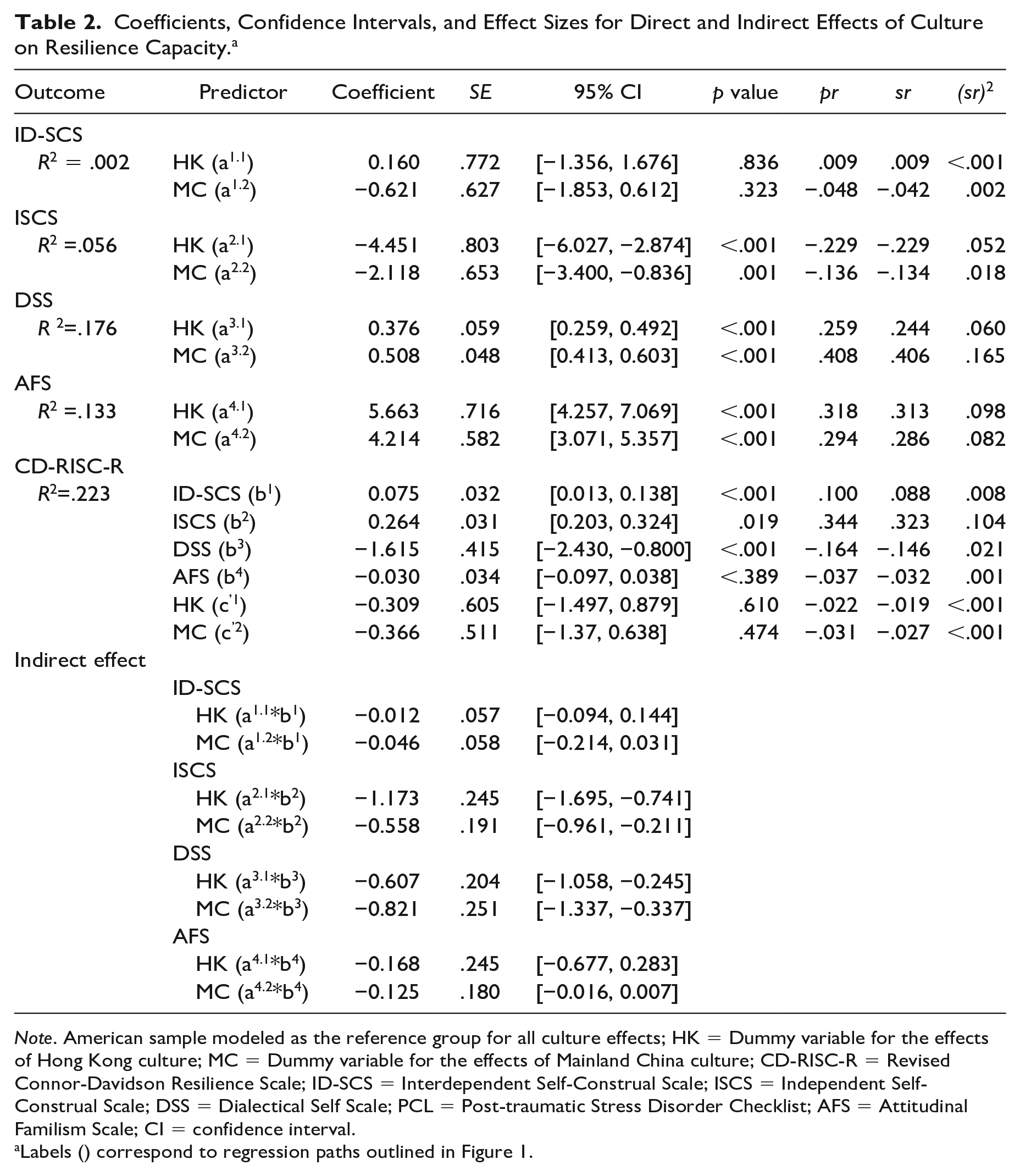
Note. American sample modeled as the reference group for all culture effects; HK = Dummy variable for the effects of Hong Kong culture; MC = Dummy variable for the effects of Mainland China culture; CD-RISC-R = Revised Connor-Davidson Resilience Scale; ID-SCS = Interdependent Self-Construal Scale; ISCS = Independent Self-Construal Scale; DSS = Dialectical Self Scale; PCL = Post-traumatic Stress Disorder Checklist; AFS = Attitudinal Familism Scale; CI = confidence interval.
Labels () correspond to regression paths outlined in Figure 1.
Regression of resilience capacity onto mediating variables (“b” paths) indicated positive associations of interdependent (p < .001) and independent (p = .019) self-construals with resilience capacity. Increases in dialectical thinking also demonstrated a unique relation with reductions in reported resilience capacity (p < .001). Data failed to support a unique association of familism with resilience capacity controlling for other variables in the model (p < .389). Cultural groups also failed to demonstrate unique associations with resilience capacity (“c’” paths) when accounting for mediating variables and relevant covariates (all p ≥ .474).
Bias-corrected, bootstrapped CIs identified reliable indirect effects for the differences in resilience across Hong Kong and American samples through independent self-construals (a2.1*b2: 95% CI = [−1.70, −.74]). A similar indirect effect was observed for differences in resilience across Mainland China and American respondents (a2.2*b2: 95% CI = [−.96, −.21]). Data also offered support for indirect effects of cultural on resilience capacity through dialectical thinking for Hong Kong (a3.1*b2: 95% CI = [−1.06, −.25]) and Mainland China (a3.1*b2: 95% CI = [−1.34, −.34]) groups. Bootstrapped CIs failed to provide support indirect effects of interdependent self-construals or familism for either cultural group.
Discussion
Cultural Differences in Dialectical Thinking, Self-Construal, and Familism
The Mainland China participants have been found to show the highest level of dialectical thinking, whereas those participants in America have been found to show the lowest level of dialectical thinking. This finding demonstrates an example of the East–West difference in way of thinking and attitudes toward reasoning (Hamamura et al., 2008). The finding of a previous study suggests that Chinese participants are more likely to use scale midpoints rather than extremes, whereas U.S. participants are more likely to use the extremes (Chen et al., 1995). The present finding provides more evidence supporting this point.
In addition, higher levels of tendency toward familistic attitude and interdependent self-construal have been found in the participants of both Hong Kong and Mainland China than that in the American participants, consistent with the findings of previous studies. Compared with Americans or Canadians, Chinese participants are more likely to fulfill expectations of or receive support from their family members (Scharlach et al., 2006) and show higher level of self-family connectedness and interdependent self-construal (Li et al., 2006). Considered as one of the important values for sustainable human development, the interconnectedness with “other” including family members has its historical roots in ancient Chinese philosophy and has been embraced in the Hong Kong bilingual educational system (Chan et al., 2009). Because the family is considered an extension of the self, the relationships between family members are demonstrated at least partially through level of interdependent relationships between related individuals. According to the present study, the value of placing the family above all human relations has been found to be prominent among individuals in Hong Kong and Mainland China, although Western cultures have influenced contemporary Chinese culture through international interactions and globalism.
The findings of another study suggest that the Hong Kong participants do not significantly differ from their U.S. counterpart regarding coping flexibility in reaction to traumatic events (Burton et al., 2012). This may imply that the Hong Kong trauma survivors may be similar to their Western counterparts when it comes to coping with traumatic experiences.
Mediating Effect of Independent Self-Construal and Dialectical Thinking
In the present study, independent self-construal was found to significantly mediate the relationship between culture and resilience capacity, but no mediating effect of interdependent self-construal was found. Resilience capacity contains stable elements of individuals’ traits, personality, or behavioral orientation. Independent self-construal is an individual-centered concept that is defined as “bounded, unitary, stable” self, whereas interdependent self-construal is a relationship-centered concept that is defined as “flexible, variable” self and emphasizes one’s connectedness with others (Singelis, 1994). Independent self-construal may play a more important role than interdependent self-construal does when it comes to how resilience capacity affects the effectiveness of individuals’ coping with trauma. Most trauma survivors may need to manage coping with all kinds of situations in the aftermath of trauma alone although they may receive some support from their interdependent social relationships with others. However, both external support for those trauma survivors and internal strength generated from their resilience capacity are reflected through how those trauma survivors individually respond to various situations of daily life after they have experienced traumatic events. Findings from previous studies indicate that independent self-construal is more likely associated with personality- or trait-related variables affecting individual, such as stress (Hong & Woody, 2007; Levinson et al., 2011), whereas interdependent self-construal is more likely associated with context- or relationship-related variables affecting group or community, such as attitude or social norms (Park & Levine, 1999).
Dialectical thinking was found to significantly mediate the relationship between culture and resilience capacity in the present study. This finding not only supports the finding of cultural differences in dialectical thinking and resilience capacity but also provides more evidence on potential causal relationships between culture, dialectical thinking, and resilience capacity. Three possible mechanisms may explain the mediating effect of dialectical thinking on culture and resilience capacity. First of all, dialectical thinking may change resilience capacity through the factors related to cognition, emotion, and motivations. Findings from a previous study indicate that cultural differences in dialectical beliefs about motivational and cognitive utility of negative emotions mediate the relationships between culture and hedonic emotion regulation (Miyamoto, Ma, & Petermann, 2014). Speculatively, dialectical thinking involves cognitive process in information-analyzing, judgment-constructing, and decision-making through considering both sides of one issue. Dialectical thinking also involves the tendency toward regulating negative emotion and attaining the goal of reconciliation. Second, dialectical thinking may possibly affect resilience capacity through modification of self-concept and beliefs. Dialectical beliefs about behavior have been found to mediate the ethnicity difference in consistency of self-enhancement across contexts (English & Chen, 2007). Trauma survivors who are able to consciously or unconsciously take advantage of the elements of their culture to gain insight and understanding through their personally traumatic events are more likely to experience self-perception of efficacy and optimism (Zimmermann & Forstmeier, 2020). In the present study, trauma survivors indicated different levels of dialectical thinking that may be associated with variations in self-perception of efficacy and optimism. The variations of self-perception with different levels of dialectical thinking may facilitate constructing a more resilient self-concept (Hemenover, 2003). Third, dialectical thinking may be interpreted and operated by individuals changing in a variety of cultures. Generally speaking, dialecticism has been found to lead to greater self-ambivalence and dialectical self-esteem and an ability to tolerate and accept contradiction without experiencing an aversive sense of psychological conflict (Spencer-Rodgers et al., 2004). The relationship between dialectical thinking and resilience capacity has been found to differ among cultures. By way of example, Engelbrecht and Jobson (2015) have found that self-ambivalence does differentiate between Caucasian British trauma survivors with and without PTSD but does not differentiate between Asian British trauma survivors with and without PTSD (Engelbrecht and Jobson, 2015). The present study may imply that dialectical thinking may affect trauma survivors’ behavior in decision-making and coping strategies in Chinese differently from Americans.
This study is not without limitations. First of all, childhood and adulthood traumatic exposure may affect resilience capacity in different ways. In the future, the relationships between resilience capacity, trauma, and culture should be investigated within the same category of traumatic events (i.e., sexual assault, or transportation accident) because these relationships may differ for any particular trauma type. In addition, the investigation within the same category traumatic events would also help to determine whether women and men would differ with respect to the relative influence of these cultural variables and coping mechanisms (Tolin & Foa, 2006). Second, the present cross-sectional study does not permit knowledge of temporal order/influence of all variables and precludes firm causal statements from being made. Longitudinal studies will be needed to further investigate possible causal relationships between cultural variables, resilience capacity, and severity of PTSD symptoms. Finally, all participants from the three research sites were recruited from collegiate settings. The majority of the participants are college students who are around 20 years old. Their responses may not generalize to all individuals in the three research sites.
Future Directions and Implications
With an increasing number of domestic and international conflicts and terroristic incidents, the prevalence of trauma-related psychological problems may continue to rise. Globalization may provide more opportunities for clinicians and mental health professionals from different regions or countries to communicate and share resources of assessment and intervention for PTSD. However, the training of clinicians and mental health professionals may require adaptations specific to their home culture. Therefore, clinicians and mental health professionals may be motivated to balance the homogeneity of standardizing diagnostic criteria and treatment plans for trauma-related emotional difficulties with needs and reactions of trauma survivors from diverse backgrounds. Becoming aware of the function of culture in post-traumatic adaptation will facilitate culturally tailored and appropriate care.
Footnotes
Declaration of Conflicting Interests
The author(s) declared no potential conflicts of interest with respect to the research, authorship, and/or publication of this article.
Funding
The author(s) received no financial support for the research, authorship, and/or publication of this article.
