



Abstract
Traditional social cognitive model of prosocial development suggests important links between both sociocognitive and socioemotive traits and prosocial behaviors. The present study examined the relations among perspective taking, empathic concern, prosocial moral reasoning, and public, emotional, compliant, and anonymous prosocial behaviors in Filipino and Turkish young adults to test the generalizability of this traditional model. Participants were 257 college students recruited from state universities in Ankara, Turkey (57 women, 83 men; Mage = 19.26 years, SD = 0.63) and Manila, the Philippines (75 women, 42 men; Mage = 18.41 years, SD = 1.44). Results showed that the relations among perspective taking, empathic concern, prosocial moral reasoning, and four types of self-reported prosocial behaviors were robust across two countries and gender. Perspective taking was positively related to empathic concern, which, in turn, was positively related to emotional and compliant prosocial behaviors. Perspective taking was also positively related to prosocial moral reasoning, which, in turn, was positively related to anonymous and negatively related to public prosocial behaviors. Overall, the findings provide support for the generalizability of traditional model of prosocial development and extend our understanding of prosocial behaviors to two non-Western, collectivist-oriented societies.
Keywords
Prosocial behaviors, or actions intended to benefit others (e.g., helping, sharing, comforting; Eisenberg et al., 2006), are valued in all societies because such actions are critical to foster community cohesion, cooperation, and harmony. Traditional social cognitive model of prosocial development suggests that perspective taking, empathic concern, and prosocial moral reasoning are some of the main socioemotive and sociocognitive traits that foster prosocial behaviors (Eisenberg et al., 2006; Hoffman, 2000). Perspective taking is defined as the ability to understand the internal and external situations of others, and empathic concern is defined as feeling sorrow or being concerned for others (Davis, 1983; Eisenberg et al., 2006; Hoffman, 2000). Prosocial moral reasoning refers to decision making when individuals face a moral dilemma as to whether or not to help others in need (Eisenberg, 1986). This model supported by a robust body of empirical research suggests important links between sociocognitive and socioemotive traits and prosocial behaviors (Carlo, 2014).
However, very little of this work has been done outside of ‘Western, educated, industrialized, rich, democratic’ societies (Henrich et al., 2010). Although cross-cultural scholars emphasize the importance of testing the generalizability of theories or models developed in any one culture to other cultures (Brislin, 1976; Triandis & Brislin, 1984), the generalizability of the traditional social cognitive model of prosocial development to non-Western and collectivist-oriented contexts is very limited. Additionally, previous research typically utilizes unitary measures of prosocial behaviors; nonetheless, prosocial behaviors are multidimensional, and research suggests potential differences in their underlying motivations and correlates (Carlo & Randall, 2002). Further, gender roles sometimes interact in important ways with predictors of prosocial outcomes (Eisenberg et al., 2006). And though gender roles and expectations vary widely across societies, studies looking at the role of gender in prosocial outcomes are lacking in non-Western, collectivist-oriented contexts. To address these gaps, we examined the relations among perspective taking, empathic concern, prosocial moral reasoning, and four types of self-reported prosocial behaviors (public, emotional, compliant, and anonymous) among Filipino and Turkish young adults. We also examined whether these relations vary by country and gender. Although cross-cultural studies have reported similarities between these two countries as having collectivist-orientation (Hofstede et al., 2010; Çukur et al., 2004), there are important purported differences in other cultural dimensions (i.e., power distance, masculinity/femininity, uncertainty avoidance; Hofstede et al., 2010) and family contexts (i.e., interdependent-relational vs. relational-autonomous; Kağıtçıbaşı, 2005).
Multidimensionality of Prosocial Behaviors
In this study, we examined four types of self-reported prosocial behaviors, namely public, anonymous, emotional, and compliant, to more precisely understand distinct sociocognitive and socioemotive mechanisms that might operate. Public prosocial behaviors refer to engaging in helping behaviors in front of an audience to gain their approval. Individuals who engage in anonymous prosocial behaviors do so without the knowledge of others. Emotional prosocial behaviors are exhibited in emotionally evocative situations to reduce the distress and suffering in others. Compliant prosocial behaviors, on the other hand, are helping or assisting at the request of another (Carlo & Randall, 2002). Given the distinct characteristics of each type of prosocial behavior, these prosocial behaviors are differentially linked to socioemotive and sociocognitive traits (Carlo & Randall, 2002).
Perspective Taking, Empathic Concern, and Prosocial Moral Reasoning
Theorists (Eisenberg et al., 2006; Hoffman, 2000) highlight the role of sociocognitive and socioemotive traits in prosocial behaviors, and suggest that perspective taking and empathic concern work together to foster prosocial behaviors. Perspective taking facilitates empathic concern because it allows one to better understand the needs and situations of others (Davis, 1983; Eisenberg, 1986; Hoffman, 2000). Batson’s empathy-altruism hypothesis, for example, posits that empathic traits can motivate individuals to engage in prosocial actions to relieve another individual’s distress (Batson, 1998). Greater perspective taking also predicts more cognitively sophisticated forms of prosocial moral reasoning (such as empathic, internalized principles); in turn, prosocial moral reasoning positively predicts prosocial behaviors (Eisenberg, 1986). In sum, perspective taking leads to empathic concern, which, in turn, leads to more sophisticated prosocial moral reasoning and subsequently to prosocial behaviors (Eisenberg et al., 2006).
In general, previous research has supported these conceptual links and shown that perspective taking is positively related to empathic concern and prosocial moral reasoning (Carlo, 2014; Eisenberg et al., 2006). These traits, in turn, are positively associated with higher levels of prosocial moral reasoning and more prosocial behaviors in U.S. youth (Carlo et al., 2012, 2018; Davis & Carlo, 2018). However, studies of these links in non-Western, collectivist-oriented societies are rare. In one study, Brazilian youth’s perspective taking predicted sympathy and that sympathy was linked to prosocial behaviors through prosocial moral reasoning (Eisenberg et al., 2001). Similar findings were reported in a longitudinal study of youth from Spain (Carlo et al., 2010). In addition, a meta-analysis, including 14 Western and non-Western cultures, showed positive associations between sympathy and prosocial behaviors (Miller et al., 2001). Building on previous research, we examined the associations as suggested in the traditional model of prosocial development focusing on four types of prosocial behaviors among young adults from two distinct cultures, in the Philippines and Turkey.
Philippines and Turkey
Filipino and Turkish societies have several similarities, such as tendencies toward collectivism, the centrality of the family to individuals and society, and emphasis on group harmony and loyalty (Grimm et al., 1999; Hofstede et al., 2010; Oyserman et al., 2002). Scholars have suggested that collectivist-oriented societies tend to encourage cooperative and prosocial behaviors to maintain group harmony and benefit their community (Knight & Carlo, 2012; Triandis, 1995). Despite an emphasis on community and collectivity, it has been suggested that individual differences may arise—especially in the degree to which individuals have been socialized into their society’s norms and expectations (Nadler et al., 1979). The tendency of some scholars to collectively describe the Philippines, Turkey and other societies as other- and possibly prosocially-oriented, glosses over the individual differences that may be present in the tendency toward these acts. Supporting scholars’ assertions as to how the Individualism-Collectivism (I-C) distinction is too broad to depict cultural patterns (Hofstede et al., 2010; Kağıtçıbaşı, 1997), Turkish and Filipino societies also diverge substantially in many important ways.
Although both the Philippines and Turkey tend toward collectivism and score relatively low on individualism in large cross-cultural investigations (e.g., Hofstede et al., 2010), other studies suggest that Turkey is closer to the middle of the I-C dimension (e.g., Göregenli, 1997). Hofstede (2015)’s publicly available Value Survey data reveal some important differences between Turkey and the Philippines in cultural dimensions of power distance, masculinity, and uncertainty avoidance. That is, for power distance, there are more hierarchical orientation and respect for authority in the Philippines (scoring 94 out of 100) than Turkey (scoring 66 out of 100). Because higher power distance creates a respect-based relationship between individuals, high power distance can make individuals to be more sensitive and cautious about both their own and others’ needs and behaviors. For masculinity-femininity, the Philippines (64) also scores higher with being on the masculine side of the scale, indicating that Filipino society is motivated by competition, achievement, and success. In contrast, Turkey (45) scores lower with being on the Feminine side of the scale, indicating that softer aspects of culture such as harmony, sympathy, and caring for others are valued and encouraged. For uncertainty avoidance, Turkey (85) scores higher, indicating that society deals with more wariness of ambiguous or unknown situations via avoidance than the Philippines (44). On the other hand, Filipino society has a low preference for uncertainty and a more relaxed attitude toward deviance from the norm. Probably having relaxed attitudes toward uncertainty or unknown situations can make individuals be more likely to focus on others’ needs rather than focusing on self and worrying about individuals’ own needs. In sum, these unique aspects of cultures may promote prosocial behaviors at varying levels.
According to Kağıtçıbaşı’s family model (2005), the Philippines can be considered as an interdependent-relational context, whereas Turkey can be considered as a relational-autonomous context. Children in interdependent-relational contexts are assigned greater responsibilities and socialized to help around the household (e.g., cleaning, taking care of young siblings) at an early age; thus, these early responsibilities made them nurturant, sensitive to other individuals’ needs, and to be prosocial (Whiting & Whiting, 1975). These two cultural contexts differentially influence children’s prosocial behaviors (Whiting & Whiting, 1975).
Gender
Socialization theorists have noted that traditional women stereotypic behaviors (e.g., nurturance, caretaking), in contrast to men stereotypic behaviors, promote prosocial behaviors (Eisenberg et al., 2001). Adolescent girls report more prosocial behaviors than boys across different types of prosocial behaviors and situations (Eisenberg et al., 2006). Despite these reported gender differences, we know little regarding how predictors might operate differently between men and women in non-Western cultures where traditional gender roles and expectations might be different from Western cultures.
Gender roles and expectations vary widely across cultures. For instance, Filipino women are expected to hold traditional gender roles, such as being the primary caregiver of the child, being more subservient to parents, and being less assertive in her ways (Andres & Ilada-Andres, 1987). Filipino girls are generally socialized to help in the home (Whiting & Edwards, 1988; Whiting & Whiting, 1975). However, according to Global Gender Gap Report (World Economic Forum, 2020), the Philippines has been rapidly progressing to close the gender gap as being ranked 16th country out of 153 in gender equality index. Despite gender roles in Turkey have been developing into non-traditional ways, gender gap is still high, and Turkey ranked 130th country out of 153 in gender equality index (World Economic Forum, 2020). Further, gender roles and attitudes toward women in Turkey were found to significantly interact with sex, place where people live (e.g., conservative areas), and their cultural orientation toward vertical collectivism (i.e., hierarchy and inequality in society) (Bugay et al., 2019). In conclusion, differences in gender roles and expectation between the Philippines and Turkey may promote prosocial behaviors differentially and needs to be taken into consideration.
The Current Study
The goal of this present study was to explore the relations among perspective taking, empathic concern, prosocial moral reasoning, and four types of prosocial behaviors in Filipino and Turkish young adults and to test if there were any country and gender differences in these aforementioned variables. Based on theories (Eisenberg, 1986; Hoffman, 2000) suggesting the interplay among sociocognitive (e.g., prosocial moral reasoning, perspective taking) and socioemotive (e.g., empathic concern) traits in fostering prosocial behaviors, we hypothesized (see Figure 1) that: (a) perspective taking would be positively related to empathic concern and prosocial moral reasoning, (b) empathic concern would be positively related to prosocial moral reasoning, and (c) perspective taking, empathic concern, and prosocial moral reasoning would be positively related to most forms of prosocial behaviors except selfishly motivated actions (public prosocial behaviors). Perhaps more importantly, there would be some mediation effects. We expected indirect relations such that perspective taking would be positively linked to empathic concern, which, in turn, would be positively linked to prosocial moral reasoning. These relations, in turn, were expected to be positively linked to emotional, compliant, and anonymous prosocial behaviors but negatively linked to public prosocial behaviors. Given the lack of prior direct research, however, we explored whether the aforementioned relations might vary across gender and young adults from Turkey and the Philippines. Due to the exploratory nature of our study, we did not have specific a priori hypotheses regarding whether the models would differ across gender and country.
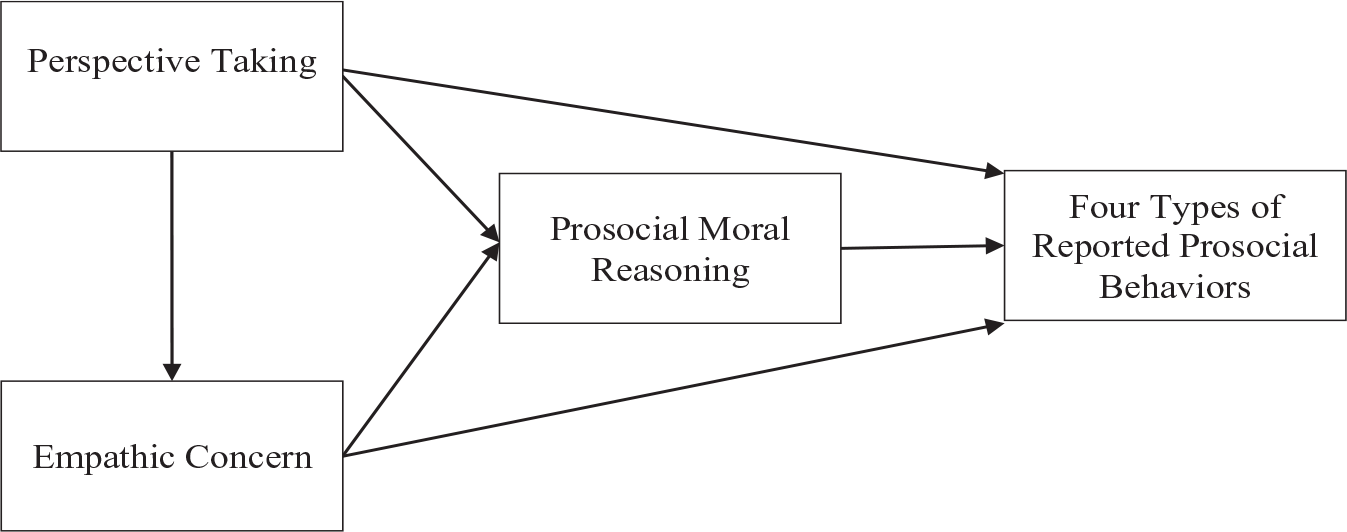
The hypothesized model: The relations among perspective taking, empathic concern, prosocial moral reasoning, and self-reported prosocial behaviors.
Method
Participants
A total of 257 college students participated in this study. Participants were recruited from state universities in Ankara, Turkey (57 women, 83 men; Mage = 19.26 years, SD = 0.63, ranges = 18–22 years) and in Quezon City, the Philippines (75 women, 42 men; Mage = 18.41 years, SD = 1.44, ranges = 17–22 years). Because mothers’ level of education was reported on a different scale in the Philippines (1 = elementary school and 7 = professional degree) and Turkey (1 = never go to school and 7 = 4-year college and/or more), we re-coded the data to make them consistent across countries (1 = never go to school, 7 = 4-year college and/or more). The mean of mothers’ education was 6.57 (SD = 0.83, range from elementary school to 4-year college and/or more) in the Philippines. The mean of mothers’ education was 4.40 (SD = 1.88, ranging from never going to school to 4-year college and/or more) in Turkey. Participants from the Philippines mostly resided with their parents (48%) or lived in apartments (23%) and dormitories (20%) and respondents from Turkey mostly resided with their parents (62%) or lived in apartments (29%) and dormitories (8%). Both Filipino and Turkish samples fairly represent middle-class families in their own cultural context. Quezon City, with a population of over 2 million, is one of the 17 cities and municipalities comprising the larger Metro Manila area, which is the capital of the country with a population of over 24 million. Quezon City is a bustling city with many commercial establishments, several universities, and houses the country’s main government. Ankara is the national capital city of Turkey, with a population of over 5 million. It is the second-largest metropolitan city with several universities.
Measures
Paper-and-pencil questionnaires were administered in English for the Philippines sample and in Turkish language for the Turkish sample. Turkish versions of all measures were translated and back-translated by four developmental psychology professors who were fluent in both Turkish language and English. Any discrepancies in translations were resolved through discussions.
Prosocial behaviors
The Prosocial Tendencies Measure (PTM) is a self-report measurement developed by Carlo and Randall (2002) to assess an individual’s tendency to display prosocial behaviors in different contexts and for different reasons on a 5-point scale (1 = This does not describe me at all, 5 = This describes me greatly). In the present study, (a) public (3 items, e.g., “I can help others best when people are watching me.”; Cronbach’s alphas were .77 and .62 for the Philippines and Turkey, respectively); (b) emotional (4 items, e.g., “I tend to help others particularly when they are emotionally distressed.”; Cronbach’s alphas were .76 and .68, respectively); (c) compliant (2 items, e.g., “When people ask me to help them, I do not hesitate.”; Cronbach’s alphas were .85 and .68, respectively); and (d) anonymous (5 items, e.g., “I prefer to donate money anonymously.”; Cronbach’s alphas were .70 and .80, respectively) prosocial behaviors were used. Dire and altruistic prosocial behaviors subscales were excluded from the analyses due to low-reliability coefficients. The PTM has been previously used in a Turkish sample and shows good validity and reliability (see Kumru et al., 2004; Tuncel, 2010).
Empathic concern and perspective taking
The Interpersonal Reactivity Index (IRI) is a self-report measurement developed by Davis (1983) to assess individuals’ tendency to show perspective taking and empathic concern traits on a 5-point scale (1 = Does not describe me at all, 5 = Describes me very well). The IRI includes 14 items and taps into two subscales: empathic concern (4 items, e.g., “I often have tender, concerned feelings for people less fortunate than me”; Cronbach’s alphas were .71 and .61 for the Philippines and Turkey respectively) and perspective taking (5 items, e.g., “When I am upset at someone, I usually try to ‘put myself in their shoes’ for a while”; Cronbach’s alphas were .80 and .78, respectively). Three reverse-scored items from empathic concern and two reverse-scored items from perspective taking subscale were excluded from analysis due to low inter-item correlations both in the Philippines and Turkey sample. The IRI has been used in Turkish sample before and showed good validity and reliability, and except for the first adaptation study, showed alpha values similar to those in the present Turkish sample (see Güvenç et al., 2010; Kumru et al., 2004). Further, the IRI was also used in English in a cultural comparison study across 63 countries, including Turkey and the Philippines, and showed “near equivalence” in factor loadings, variances, intercepts, and residuals across regions (for details, see Chopik et al., 2017).
Prosocial moral reasoning
The Objective Measure of Prosocial Moral Reasoning (PROM) is a self-report measurement developed by Carlo et al. (1992) to assess individuals’ five types of prosocial moral reasoning to decide whether to engage in prosocial behavior or not. In the present study, three vignettes (The Blood, The Accident, and The Flood Story) were used. The names of the vignette characters were replaced with common Turkish names (e.g., Ahmet, for male character and Zeynep for female character) in the respective version of the PROM, whereas original English names were used in the Filipino version. There were two versions of each vignette for each gender as well. A sample vignette is included below: “One day, in a town near a big river, there was a big rainstorm and the river started to overflow. The water from the river got into the streets and houses and everywhere. Because of the flooding, there was no way for food to be brought into the town from far away. Lisa/Mike had some food and lived close to the town. But if Lisa/Mike took food to the town’s people, then she/he would not have enough food for herself/himself and she/he may not be able to get any more food for a long time. If Lisa/Mike had no food she/he would not die, but she/he would get sick.”
After reading each vignette, participants are asked to decide whether or not the character should help needy others (“What should Lisa/Mike do?”) and directed to choose an answer (a) “Lisa/Mike should take the food,” (b) “Not sure,” (c) “Lisa/Mike should stay home.” After choosing what the character should do, participants are asked to rate the importance of each reasoning items when making a moral decision. These reasoning items taps into five subscales and indicate five types of moral reasoning: hedonistic (i.e., reasoning to consider one’s own needs; e.g., “It depends if Lisa/Mike thinks she/he will get some help from the town’s people in the future”), needs-oriented (i.e., reasoning to consider other’s need; e.g., “It depends on whether the people in the flooded town would get sick or not”), approval-oriented (i.e., reasoning to receive other’s approval; e.g., “It depends on whether Lisa’s/Mike’s parents and friends would approve or disapprove of what she/he does), stereotypic (i.e., reasoning to follow societal norms or expected behaviors’ e.g., “It depends on whether Lisa/Mike thinks it would be mean not to help”), and internalized (i.e., reasoning according to already held moral beliefs and principles; e.g., “It depends on whether Lisa/Mike would feel bad if the people in the town got sick”).
In the Turkish sample, participants rated the importance of 5 reasoning items on a 5-point scale (1 = Not at all, 5 = Greatly) under each vignette. In the Filipino sample, participants rated the importance of 8 reasoning items on a 7-point scale (1 = Not at all, 7 = Greatly) under each vignette. First, Turkish and Filipino versions of the PROM were compared, and the same 5 reasoning items were selected to use in the current analysis. Second, a 5-point scale was converted to a 7-point scale by multiplying each value by 1.5 and subtracting .5 (IBM Support, 2018).
As outlined by Carlo et al (1992), we used the standard weighted scoring procedure to calculate the composite score of the PROM. First, we calculated the frequency of moral reasoning by summing raw scores. Second, we summed all frequency scores to calculate a total frequency score. Third, we computed proportional scores by dividing each frequency scores by the total frequency score. Fourth, we summed the proportional score of hedonistic and approval-oriented multiplied by 1, stereotypic and needs-oriented multiplied by 2, and internalized multiplied by 3 to calculate the composite score of the PROM (see Carlo et al., 1992 for scoring details). The weighted PROM composite score indicates an overall measure of the relative preference for higher levels of prosocial moral reasoning over the lower levels of reasoning. In the present study, the Cronbach’s alphas were .78 for the Filipino sample and .73 for the Turkish sample. The PROM has been used in the Filipino and Turkish samples before and showed good validity and reliability (see Kumru et al., 2002, 2012).
Procedure
IRB approval was obtained from the university’s institutional review board in the U.S., but IRB approval procedures were not formally established at the universities when the study was conducted in Turkey and the Philippines. Instead, as a common procedure, we received approval from administrators in local universities and approval from instructors to administer the surveys in their classes. Each of the samples was recruited from several introductory undergraduate classes. Respondents participated voluntarily and signed the informed consent form prior to the administration of the survey packet. Parental consents were obtained from the parents of participants who were younger than 18 years of age. Students who were unable to complete the questionnaires during designated class time returned them to their instructors during the following class day. The administration lasted approximately 45 to 75 min.
Results
First, we conducted a series of preliminary analyses to assess the distribution of the main study variables, identify covariates, and missing data patterns. Second, we conducted path analyses to examine the associations among Filipino and Turkish young adults’ self-reported perspective taking, empathic concern, prosocial moral reasoning, and four types of prosocial behaviors. Third, we conducted multigroup analyses to test whether the hypothesized model varied by gender and country. Finally, we conducted follow up analyses to test the indirect effects via empathic concern and prosocial moral reasoning on the associations of interest.
Preliminary Analysis
The study variables were normally distributed. The percent of missing data ranged from .4% (one case) to 2.7% (seven cases) across the main study variables. Bivariate correlations among main study variables, means, and standard deviations are presented in Table 1 for the Filipino and Turkish samples (see Table 1). As expected, there were several significant correlations among variables. Perspective taking was positively correlated with empathic concern, prosocial moral reasoning, emotional and compliant prosocial behaviors. And, it was negatively correlated with public prosocial behavior. Empathic concern was positively correlated with emotional and compliant prosocial behaviors. Prosocial moral reasoning was positively correlated with compliant and anonymous prosocial behaviors, but it was negatively correlated with public prosocial behaviors. Emotional, compliant, and anonymous prosocial behaviors were positively correlated with each other. There were no other significant correlations.
Descriptive Statistics and Correlations among Study Variables in Filipino and Turkish Sample.
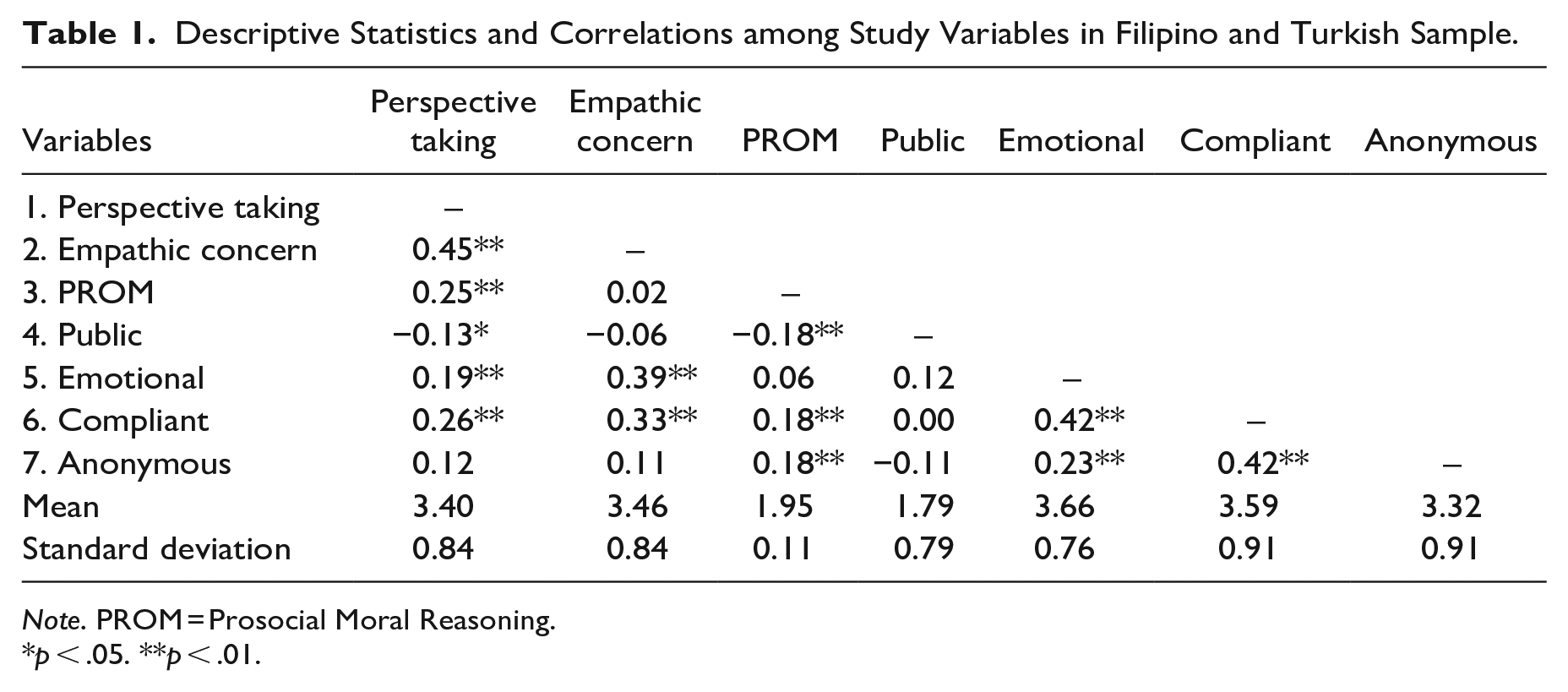
Note. PROM = Prosocial Moral Reasoning.
p < .05. **p < .01.
Path Analyses
Path analyses were conducted in Mplus Version 8 by using full information maximum likelihood estimation with robust standard error (MLR) to handle missing data (Enders, 2010; Muthén & Muthén, 1998–2017). Ten cases were excluded from analyses due to complete missing data across the main study variables. Multiple model fit indices were applied to assess the goodness of model fit, including the root mean square error of approximation (RMSEA) is equal to or below 0.06, 90% confidence interval for RMSEA, comparative fit index (CFI) and Tucker-Lewis index (TLI) are greater than 0.90, and standardized root mean residual (SRMR) is equal to or below 0.08 (Byrne, 2012; Hu & Bentler, 1999).
Four direct paths were tested from perspective taking to prosocial behaviors, from empathic concern to prosocial behaviors, and from prosocial moral reasoning to prosocial behaviors. A direct path was tested from perspective taking to empathic concern, and another direct path was tested from perspective taking and empathic concern to prosocial moral reasoning (see Figure 1 for the hypothesized model). Additionally, residual error variance of each prosocial behavior was allowed to correlate but not depicted in the figures for parsimony reason. Mothers’ level of education as a proxy of socioeconomic status was included as a statistical control on prosocial behaviors.
Multigroup Analyses
To explore whether the associations of interest vary between Filipino and Turkish young adults, multigroup analyses by country were tested. Gender and mothers’ level of education as a proxy of socioeconomic status were statistical controls. Satorra–Bentler Scaled (S–B χ2; Satorra & Bentler, 2010) chi-square difference tests were conducted to calculate whether there was a significant difference between constrained and unconstrained models (Muthén & Muthén, 1998–2017). Results revealed that unconstrained model (N = 247, χ2 (8) = 13.98, p = .08, Scaling correction factor for MLR = 0.965, RMSEA (90% CI) = 0.08, (0.00, 0.14), CFI = 0.97, TLI = 0.77, SRMR = 0.04) was not significantly different than the constrained model (N = 247, χ2 (31) = 32.71, p = .38, Scaling correction factor for MLR = 1.038, RMSEA (90% CI) = 0.02, (0.00, 0.07), CFI = 0.99, TLI = 0.98, SRMR = 0.08) based on chi-square difference test (S-B Δ χ2 = 19.24, Δdf = 23, p = .69). Results suggest that the hypothesized model did not vary between Filipino and Turkish young adults. Therefore, the results were presented for the entire sample.
We also conducted a second multigroup analysis by gender to explore whether associations of interest vary between men and women. Country and mothers’ level of education were statistical controls. Results revealed that unconstrained model (N = 247, χ2 (8) = 20.96, p = .01, Scaling correction factor for MLR = 0.989, RMSEA (90% CI) = 0.11, (0.06, 0.18), CFI = 0.94, TLI = 0.54, SRMR = 0.05) was not significantly different than the constrained model (N = 247, χ2 (31) = 54.11, p = .01, Scaling correction factor for MLR = 1.030, RMSEA (90% CI) = 0.08, (0.04, 0.11), CFI = 0.90, TLI = 0.79, SRMR = 0.11) based on chi-square difference test (S-B Δ χ2 = 33.52, Δ df = 23, p = .07). Results suggest that the hypothesized model did not vary between men and women. Therefore, the results were presented for both genders the entire sample.
Final Model
The final hypothesized model was tested by controlling for gender, country, and mothers’ level of education (see Figure 2). Control variables were not depicted in the figure for parsimony reason. The final model fit the data well: N = 247, χ2 (4) = 3.09, p = .54, Scaling correction factor for MLR = 1.023, RMSEA (90% CI) = 0.00, (0.00, 0.09), CFI = 1.00, TLI = 1.04, SRMR = 0.01. Results showed that perspective taking was positively linked to empathic concern and prosocial moral reasoning (see Table 2). Empathic concern was positively linked to self-reported emotional and compliant prosocial behaviors. Prosocial moral reasoning was positively linked to compliant and anonymous prosocial behaviors, and it was negatively linked to public prosocial behaviors.
Direct and Indirect Effects of Perspective Taking, Empathic Concern, and Prosocial Moral Reasoning on Prosocial Behaviors.
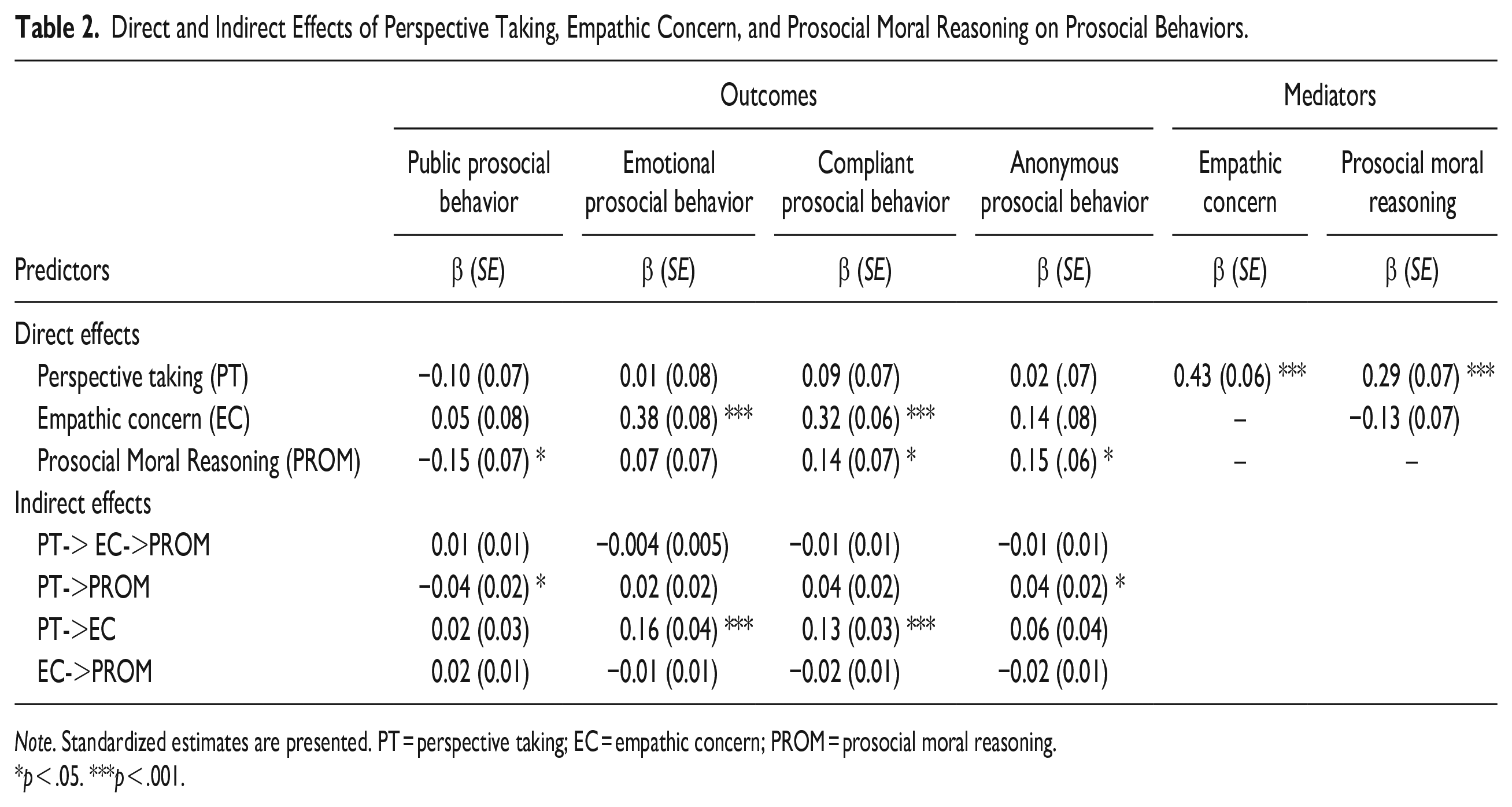
Note. Standardized estimates are presented. PT = perspective taking; EC = empathic concern; PROM = prosocial moral reasoning.
p < .05. ***p < .001.
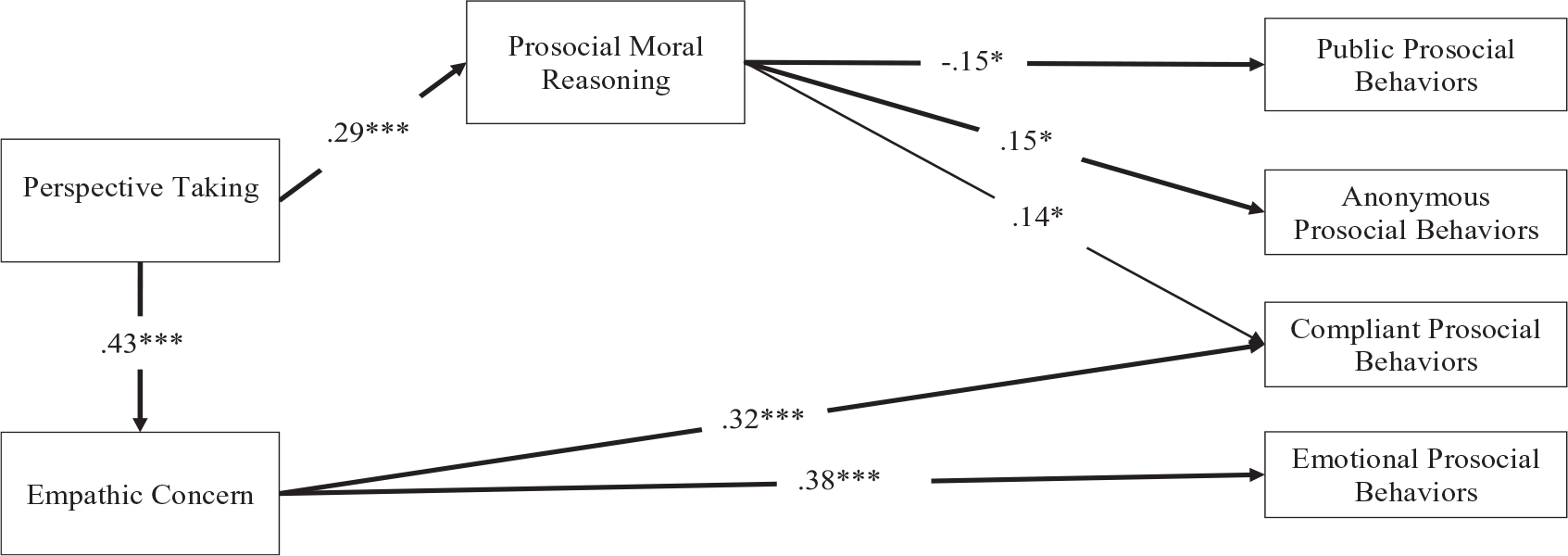
The relations among perspective taking, empathic concern, prosocial moral reasoning, and self-reported prosocial behaviors in Filipino and Turkish young adults.
Indirect Effects
A follow-up bias-corrected residual bootstrap analyses was conducted to test indirect links (Bollen & Stine, 1990) (see Table 2). Perspective taking was significantly linked to emotional prosocial behaviors via empathic concern (β = 0.16; SE = 0.04; 95% CI [0.09, 0.24]; p < .001) and perspective taking was significantly linked to compliant prosocial behaviors via empathic concern (β = 0.13; SE = 0.03; 95% CI [0.08, 0.21]; p < .001). Perspective taking was significantly linked to public prosocial behaviors via prosocial moral reasoning (β = −0.04; SE = 0.02; 95% CI [−0.09, −0.005]; p = .04) and perspective taking was significantly linked to anonymous prosocial behaviors via prosocial moral reasoning (β = 0.04; SE = 0.02; 95% CI [0.01, 0.09]; p = .04).
Discussion
The purpose of this study was to examine the relations among perspective taking, empathic concern, prosocial moral reasoning, and four types of self-reported prosocial behaviors in Filipino and Turkish young adults. We found cross-cultural evidence that perspective taking was positively related to empathic concern, which, in turn, was positively associated with self-reported emotional and compliant prosocial behaviors. Perspective taking was also positively related to prosocial moral reasoning, which, in turn, was positively related to anonymous and negatively related to public prosocial behaviors. Additionally, prosocial moral reasoning was positively linked to compliant prosocial behaviors. The patterns of association were robust across country and gender. Overall, these findings provide partial support for the generalizability of traditional social cognitive model of prosocial development and extend our understanding of prosocial behavior to young adults from non-Western, collectivist-oriented societies.
Higher levels of perspective taking were related to higher levels of empathic concern, which, in turn, was associated with more emotional and compliant prosocial behaviors. When individuals understand others’ internal and external situations, they are more likely to be sympathetic to others’ needs and responsive to others’ help requests, especially in emotionally evocative situations and when someone in need asks for assistance. As theorists have noted, perspective taking facilitates empathic concerns because empathic concern involves cognitive skills necessary to understand other individuals’ needs and feel sorrow for others, which in turn, fosters prosocial behaviors (Davis, 1983; Eisenberg, 1986; Hoffman, 2000).
Perspective taking and empathic concern might be particularly relevant in facilitating emotional and compliant forms of prosocial behaviors in Filipino and Turkish young adults. Emotional and compliant prosocial behaviors are commonly observed in the family context (Knight & Carlo, 2012). In collectivist-oriented cultures, parents socialize their children to take responsibilities (e.g., taking care of younger siblings) and do household chores (Whiting & Edwards, 1988; Whiting & Whiting, 1975). Probably Filipino and Turkish young adults help their parents around the household, comply with their parents by doing what they are asked to do. Further, Kağıtçıbaşı’s family model (1982) emphasizes emotional interdependence in both relational and autonomous-relational family contexts. Filipino and Turkish young adults are socialized to be emotionally interdependent on family members, such as seeking emotional support from family members (Alampay, 2014; Kağıtçıbaşı, 1982). Probably these socialization practices encourage Filipino and Turkish young adults to help needy others in emotionally evocative situations. Moreover, helping people when they ask and in emotionally evocative contexts might be helpful to build and to maintain group and family harmony.
Consistent with conceptualization (Eisenberg, 1986) and previous findings in U.S. Latinx youth (e.g., Carlo et al., 2018), perspective taking in this study was also directly related to higher levels of prosocial moral reasoning, which, in turn, was related to fewer public prosocial behaviors among Filipino and Turkish young adults. Public prosocial behaviors are usually selfishly motivated actions, and individuals often expect to gain other’s approval or social acknowledgment in return (Carlo & Randall, 2002). Because gaining others’ approval is an extrinsic motivation, public prosocial behaviors are undermined by individuals who report strong moral principles or higher levels of prosocial moral reasoning (Carlo, 2014).
Although prosocial moral reasoning was negatively related to public prosocial behaviors, there might be other mechanisms that could promote public prosocial behaviors in collectivist-oriented cultures. Some scholars have noted that placing more importance on mutual reciprocity, group harmony, and cooperation (Markus & Kitayama, 1991; Triandis, 1989) can promote helping people publicly with selfish motivations (e.g., gaining societal benefits). Furthermore, cross-cultural evidence suggesting differences in reciprocity between individualist- and collectivist-oriented cultures showed that individuals from individualist-oriented cultures tend to rely on immediate reciprocation norms and feel less obligated after reciprocation. However, individuals from collectivist-oriented cultures tend to have more enduring feelings of obligation toward the helper (Goyal & Miller, 2018; Miller et al., 2014). These enduring feelings of indebtedness could motivate individuals to engage in public prosocial behaviors. Research is needed to directly examine this possibility in future studies.
As noted, higher levels of perspective taking were also related to higher levels of prosocial moral reasoning, which, in turn, was related to more anonymous and compliant prosocial behaviors. Cultural scholars have noted that face-saving and humility are highly valued in collectivist-oriented cultures (Triandis et al., 1988). Individuals from collectivist-oriented cultures might be intentionally socialized to engage in anonymous prosocial behaviors to be humble and to protect the dignity of the recipients. Thus, the links between both perspective taking and prosocial moral reasoning and anonymous prosocial behaviors could partly result from understanding the social consequences of helping and adherence to the principles of humility and dignity of assisting distressed victims. Similar findings for compliant prosocial behaviors are also congruent with the importance placed in interdependent and communal societies to assists others (especially family members) when requested. Thus, Filipino and Turkish young adults who reported greater perspective taking and higher care-oriented moral reasoning tendencies were more likely to comply when help is needed.
Contrary to the hypothesis, there was no significant relation between empathic concern and prosocial moral reasoning. Individuals from collectivist-oriented cultures, like Turkey and the Philippines, tend to score higher on empathic concern than individuals from individualist-oriented cultures (Chopik et al., 2017). Additionally, individuals from Western, individualist-oriented cultures tend to rely on autonomous, care and justice-based moral principles (i.e., the ethics of autonomy) in their moral reasoning, whereas individuals from non-Western, collectivist-oriented cultures tend to rely on a broader range of moral principles such as an ethic of community and divinity (Henrich et al., 2010; Jensen, 2015a, 2015b). The ethic of community and divinity in collectivist-oriented societies intersect with concerns for others and other-oriented tendencies (e.g., empathic concern, perspective taking; Jensen, 2015b). And, these concerns and tendencies foster prosocial moral behaviors. Probably these differences between cultural contexts may account for the nonsignificant relation between empathic concern and prosocial moral reasoning in Turkish and Filipino young adults. These unexpected results suggest an inconsistency with traditional model of prosocial development and highlight the importance of testing the generalizability of prior theories and the need to conceptualize culture-specific models (Brislin, 1976; Triandis & Brislin, 1984). Given the differences in moral reasoning across cultures (Jensen, 2015a, 2015b), these findings provoke the need for future research to examine such associations with culture-related variables, particularly with individualism/collectivism-orientation.
Study Limitations
There were several study limitations. First, participants were college students and drawn from one college in each country. Thus, findings cannot be generalizable to broader young adult population and other college students in the Philippines and Turkey. Second, the Philippines and Turkey were broadly defined as collectivist-oriented societies. Our findings should be interpreted cautiously due to the wide variations in collectivism-orientation. For instance, attending college is more closely align with the independent-oriented cultural values rather than interdependent-oriented cultural values. Thus, a broader sample should be drawn to better understand the wide diversity of I-C orientation in the Philippines and Turkey. Third, we did not include a culture related variable into our hypothesized model other than the country of the participants. Future research is needed to examine these associations with culture-related variables (e.g., I-C orientation, masculinity/femininity, family orientation) or directly compare these two cultures with individualist-oriented, Western cultures. Further, although our samples coming from predominantly Catholic Christian and Muslim oriented countries, the Philippines and Turkey, respectively, we did not assess the roles of religion and religiosity in prosocial behaviors. Future research is needed to take these variables into consideration. Fourth, the present study was a cross-sectional design. Therefore, neither causality nor the directions of relations cannot be determined based on the current findings. Future prospective longitudinal studies will be helpful to determine the directions of relations. Fifth, the questionnaires (e.g., PROM, PTM) utilized in this study were developed in individualist-oriented cultures with Western samples though prior research has demonstrated evidence for the validity of the questionnaires (see Güvenç et al., 2010; Kumru et al., 2012 for Turkish sample; see Kumru et al., 2002 for the Philippines sample) and the current Cronbach’s alphas may suggest adequate reliability. Although statisticians point out that alphas for short scales might be somewhat low because alpha coefficients are influenced by the number of items (Cortina, 1993), relatively lower alphas for the Turkish sample (compared to the Filipino sample) may suggest the need for further validation of the instruments in future studies. Furthermore, studies of the equivalence properties of the measures are needed across the culture groups, gender, and age groups (He & van de Vijver, 2012; Milfont & Fisher, 2010). And sixth, we administered a self-report measure of prosocial behaviors and we do not know whether participants’ opinions coincide with their actual behavior. Although prior evidence has shown significant correlations between PTM and behavioral task measures (Rodrigues et al., 2017; Ngai & Xie, 2018), future research will be needed using multi-method (e.g., observation) and multi-report (e.g., parent report, peer report) instruments.
Conclusion
Despite these limitations, our findings yield support for traditional social cognitive model of prosocial development (Eisenberg et al., 2006; Hoffman, 2000) in two non-Western, collectivist-oriented societies. These findings suggest that greater perspective taking is associated with greater empathic concern and prosocial moral reasoning, and together, they are significantly related to prosocial behaviors. Moreover, the study extends our understanding of the links among perspective taking, empathic concern, prosocial moral reasoning to four distinct forms of prosocial behaviors. These differentiated patterns of relations demonstrate further support for the need to develop more nuanced conceptual models that account for understanding the development and correlates of specific types of prosocial behaviors. The findings can be used to inform prevention and intervention efforts that focus on sociocognitive and socioemotive traits to foster prosocial behaviors across cultures.
Footnotes
Authors’ Note
Zehra Gülseven and Gustavo Carlo are now affiliated with School of Education, University of California, Irvine.
Declaration of Conflicting Interests
The author(s) declared no potential conflicts of interest with respect to the research, authorship, and/or publication of this article.
Funding
The author(s) received no financial support for the research, authorship, and/or publication of this article.
