



Abstract
As acculturation research has become more interdisciplinary and dynamic over the last 20 years, it is necessary to explore its emerging trends. We collected 10,039 research articles on acculturation research from 2000 to 2020 from the Web of Science (WoS) database and utilized the CiteSpace tool to visualize emerging trends. During the data analysis, we extracted noun phrases from the abstracts of the retrieved articles to identify clusters, and the log-likelihood ratio (LLR) algorithm was used to generate cluster labels in the co-citation network. Based on the size of the clusters, the five largest clusters were chosen and analyzed: “Asian cultural value,” “Suicide attempt,” “Unhealthy behavior,” “Host country identification,” and “Emerging adulthood”. These findings may help researchers and scholars gain useful insight and explore topics related to the research trends in acculturation.
Acculturation, which involves the process of changes that result from contact between individuals from different cultures (Gibson, 2001), has become a well-recognized and important area of study (Schwartz et al., 2010). Over the last 20 years, there has been a wide-ranging theoretical discussion on acculturation, including its concepts, dimensions, and measurements (e.g., Lara et al., 2005; Schwartz et al., 2010). Meanwhile, some empirical studies have concentrated on topics such as acculturation measurement (e.g., Schwartz et al., 2015; Tibbert et al., 2015), psychological adaptation (e.g., Berry, 2005; Sam & Berry, 2010), and immigrants’ psychological health (e.g., Abraído-Lanza et al., 2005; Berry & Hou, 2016).
As the increasing international migration of the 21st century has generated enormous social and cultural implications in host countries, research on acculturation has become more interdisciplinary and dynamic. With the overwhelming amount of literature on acculturation, some researchers have initiated reviews from various perspectives, such as constructs and measures of acculturation (e.g., Rudmin, 2009; Smith & Khawaja, 2011) and the relationship between acculturation and health (e.g., Lara et al., 2005). However, most reveal emerging trends in acculturation research through speculative arguments or critical reviews. Bibliometric analysis, which is based on library and information science, has the advantage of providing a representative and informative perspective of the data quantitatively (Broadus, 1987). Therefore, this study attempts to use the bibliometric approach to visualize the emerging trends of acculturation research from the year 2000 to the year 2020 through CiteSpace, a scientific literature analysis tool that helps map knowledge domains and analyze emerging trends in a research field and can offer theoretical implications for researchers and scholars in acculturation research.
Method
Data Collection
The data for this research were collected from the Web of Science (WoS) Social Sciences Citation Index (SSCI). First, as the acculturation research has become more interdisciplinary and dynamic in the 21st century, we searched “acculturation” in the “Topic” field with a timespan from 2000 to 2020 in the “Web of Science Core Collection—SSCI” database and found 11,248 articles. Second, these database results were refined by “Languages—English” and “Document Types—Article,” and 10,039 articles were obtained. Third, the search results were saved as plain text files, including information on the author, title, source, abstract, and cited references of the articles. The data for this research were updated until April 28, 2021.
Data Analysis
CiteSpace is software that can detect and visualize the emerging trends in a field of research by finding clusters in the co-citation reference network that can be established using the author, title, source, abstract, and cited references of the retrieved articles (Chen, 2006). To identify the clusters, CiteSpace can extract noun phrases from the titles, keyword lists, or abstracts of articles. As the abstracts of articles contain more information, we chose to extract noun phrases from abstracts to identify clusters. The log-likelihood ratio (LLR) algorithm was then selected to generate the cluster labels, which has the advantage of assessing the goodness of fit of two competing clusters based on the ratio of their likelihoods and thus gives the best result in terms of uniqueness and coverage when generating cluster labels (Chen, 2014). When a cluster contains numerous nodes (referring to cited references) with strong citation bursts (referring to a surge of citations), the cluster captures an emerging trend (Chen, 2014). In addition, the silhouette value of a cluster measures the quality of a clustering configuration, which is a measure of how similar an object is to its own cluster (cohesion), compared to other clusters (separation), and ranges from −1 to 1. A value of 1 represents perfect separation from other clusters (Chen et al., 2010).
In utilizing the CiteSpace tool, we first visualized a co-citation reference network with the aforementioned 10,039 retrieved papers. Second, we adopted the LLR algorithm to identify clusters in the network with the abstracts of those 10,039 papers. Finally, we analyzed the emerging trends based on the five largest clusters.
Results and Discussion
Through data analysis, 22 clusters with labels were generated in the co-citation reference network. Based on the size of the clusters, the 10 largest clusters are presented in Figure 1 as a timeline view where the clusters are arranged along with horizontal timelines; the size, silhouette value, label, and main terms of the 10 largest clusters and the mean publication year of the cited references in the clusters are shown in Table 1, from which the emerging trends in acculturation research can be inferred. In the timeline view, the nodes in the clusters represent cited references, and the lines represent the connections between cited references. The values of the silhouettes of each cluster are found to be above 0.7 (see Table 1), which suggests that there is a satisfactory partition of these clusters in the network. Thus, we chose the five largest clusters to analyze the emerging trends and labeled them “Asian cultural value,” “Suicide attempt,” “Unhealthy behavior,” “Host country identification,” and “Emerging adulthood.”
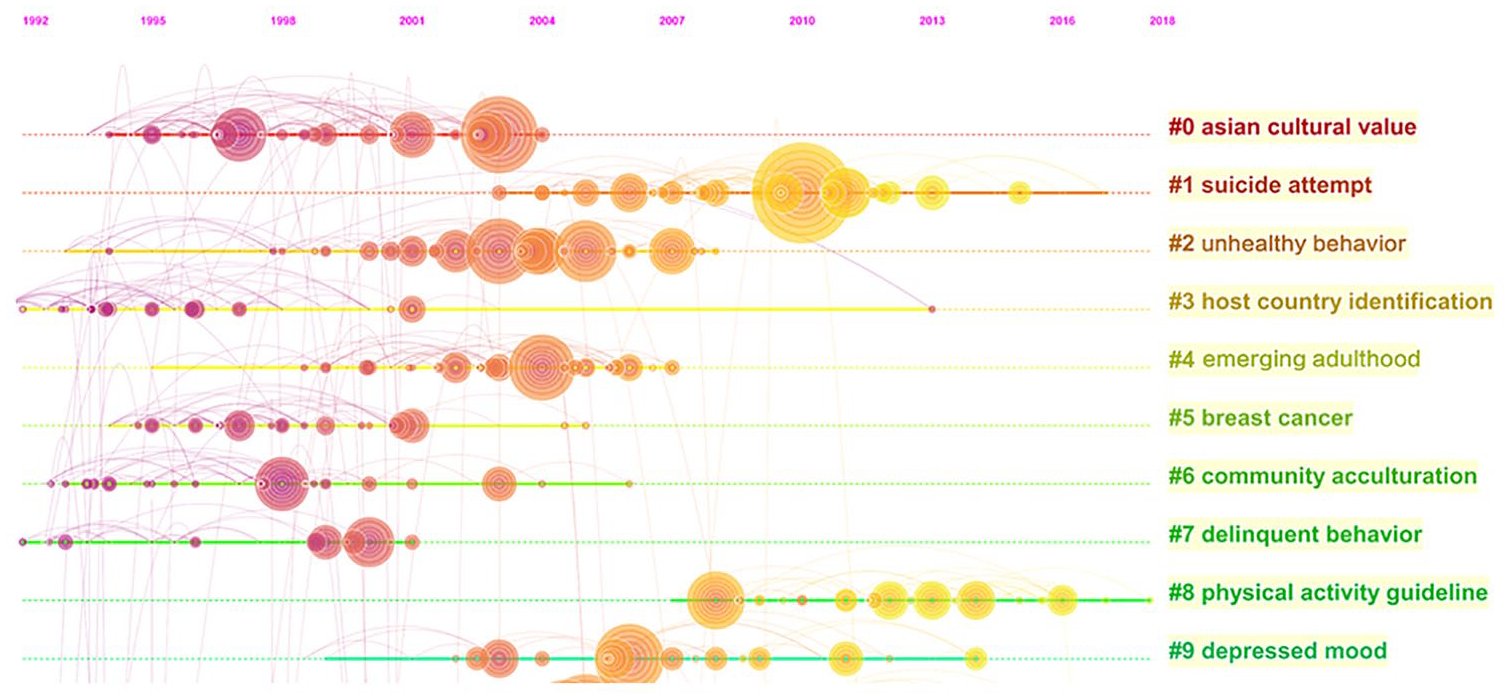
Timeline view of the 10 largest clusters in the co-citation network.
Summary of the 10 Largest Clusters in the Co-Citation Network.
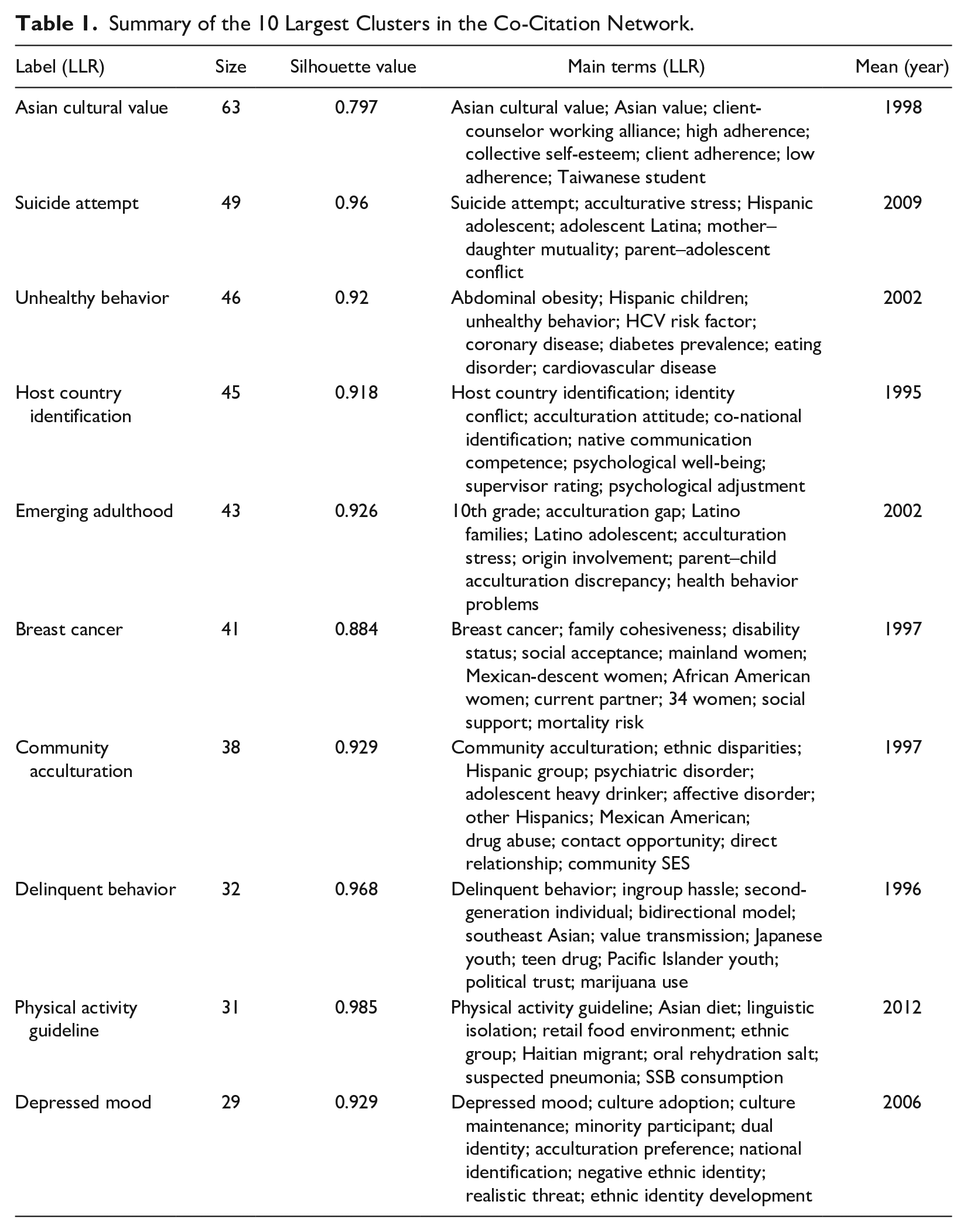
The first largest cluster, labeled “Asian cultural value,” consists of 63 publication member articles with an average publication year of 2009 (see Table 1) and a citation burst between 1993 and 2004 (see Figure 1). This cluster contains the following terms: (a) Asian cultural value, (b) Asian value, (c) client-counselor working alliance, (d) high adherence, (e) collective self-esteem, (f) client adherence, (g) low adherence, and( h) Taiwanese student. Based on the terms above, Asian cultural value research covers topics including, for example, the relationship between adherence to Asian cultural values and counseling or help-seeking during acculturation (Kim et al., 2001), measurement of cultural value acculturation among Asian immigrants (Zhang & Moradi, 2013), and the relationship between value and behavior in the Asian cultural orientation (Miller, 2007).
The second-largest cluster, labeled “Suicide attempt,” consists of 49 publication member articles with an average publication year of 2009 (see Table 1) and a citation burst between 2003 and 2017 (see Figure 1). This cluster contains the following terms: (a) suicide attempt, (b) acculturative stress, (c) Hispanic adolescents, (d) adolescent Latina, (e) mother–daughter mutuality, and (f) parent–adolescent conflict. These terms reflect research regarding suicide attempts or ideation in adolescent Latinas, owing to the fact that adolescent Latinas have much higher suicide attempt rates than non-Hispanic peers (Price & Khubchandani, 2017). Among these studies, most explored the factors affecting adolescent Latinas’ suicide attempts, including health risk behaviors (Price & Khubchandani, 2017), parent–adolescent conflicts (Kuhlberg et al., 2010), and psychological experiences (Zayas et al., 2005). Others focus on issues of suicide attempts by Asian Americans (Bersani & Morabito, 2020) and immigrants in Sweden (Hollander et al., 2020).
“Unhealthy behavior” is the third-largest cluster; it consists of 46 publication member articles with an average publication year of 2002 (see Table 1) and a citation burst between 1993 and 2008 (see Figure 1). This cluster contains the following terms: (a) abdominal obesity, (b) Hispanic children, (c) unhealthy behavior, (d) HCV risk factor, (e) coronary disease, (f) diabetes prevalence, (g) eating disorder, and (h) cardiovascular disease. This collection of terms shows that many researchers focus on the effect of acculturation on unhealthy behaviors such as obesity, alcohol use, and smoking as well as health problems such as HCV, HIV, and cardiovascular disease in ethnic minorities in the United States (Abraído-Lanza et al., 2005; Lara et al., 2005; Unger et al., 2004). For example, Lara et al. (2005) proposed that the health of Latinos in the United States was closely influenced by acculturation. Similarly, Unger et al. (2004) examined the relationship between acculturation to the US and obesity-related behaviors among Asian American and Hispanic adolescents in the US and found that acculturation to the US was a risk factor for obesity-related behaviors among these two groups.
“Host country identification” is the fourth-largest cluster; it consists of 45 publication member articles with an average publication year of 1995 (see Table 1) and a citation burst between 1992 and 2013 (see Figure 1). This cluster contains the following terms: (a) host country identification, (b) identity conflict, (c) acculturation attitude, (d) co-national identification, (e) native communication competence, (f) psychological well-being, (g) supervisor rating, and (h) psychological adjustment. Among them, host country identification has received considerable attention in acculturation research. The term refers to the development of a new identity in the country of settlement (Brisset et al., 2010). In regard to host country identification, researchers have primarily examined its psychological consequences (Verkuyten & Martinovic, 2012) and antecedents, including acculturation attitude (Nesdale, 2002) and communication competence (Lee & Chen, 2000).
“Emerging adulthood” is the fifth-largest cluster; it consists of 43 publication member articles with an average publication year of 2002 (see Table 1) and a citation burst between 1995 and 2007 (see Figure 1). This cluster contains the following terms: (a) 10th grade, (b) acculturation gap, (c) Latino families, (d) Latino adolescents, (e) acculturation stress, (f) origin involvement, (g) parent–child acculturation discrepancy, and (h) health behavior problems. The label “emerging adulthood” represents emerging adults in immigrant families, who are likely to acculturate at a faster pace or to a greater extent than their parents, thus generating a parent–adolescent acculturation gap as well as conflict and leading to health behavior problems in youth. A multitude of studies have examined the impact of the acculturation gap and conflicts on family relationships (Birman, 2006), behavioral problems (Goforth et al., 2015), and adolescents’ psychological health (Bahrassa et al., 2013) in immigrant families.
Conclusion
This study provides vivid analyses of clusters of literature to help researchers and scholars effectively understand the emerging trends in acculturation research. The identification and discussion of emerging trends may help them develop valuable knowledge of the dynamics of acculturation research in the last 20 years as well as the future direction of acculturation research.
Footnotes
Declaration of Conflicting Interests
The author(s) declared no potential conflicts of interest with respect to the research, authorship, and/or publication of this article.
Funding
The author(s) disclosed receipt of the following financial support for the research, authorship, and/or publication of this article: This research was supported by “the National Social Science Fund of China” (Grant Number: 17BYY098).
