




Abstract
Self-determination theory (SDT) posits universality without cross-cultural uniformity of the three basic psychological needs (autonomy, competence, and relatedness) which have been associated with desirable job outcomes. Yet these promising directions in theory and research have not been extended to Indigenous samples and different occupational types. This is unfortunate as Indigenous peoples globally remain the most disadvantaged on all socio-economic indicators, including employment. This study adopted a strengths-based approach to investigating associations between SDT’s need satisfaction and job outcomes in Australian Indigenous and non-Indigenous professionals and non-professionals. Participants included 1,146 Indigenous (48.8%) and non-Indigenous Australians (39.1% men), aged 18 to 81 years (Mage = 43.54). Structural equation modeling (SEM) revealed that autonomy and competence need satisfaction were associated with multiple positive work outcomes and less job ambiguity, whereas satisfaction of the need for relatedness was associated with increased job satisfaction and greater resilience in the workplace. Moderation by Indigenous status and occupation type revealed few differences in the direction and strength of the associations between need satisfaction and job outcomes. However, non-professionals reported significantly lower satisfaction of all three needs, and Indigenous participants reported significantly lower levels of autonomy need satisfaction. As need satisfaction was shown to be equally beneficial for all workers regardless of culture or occupation type, these findings highlight the need for employers to invest more in cultivating the need satisfaction of their Indigenous and non-professional staff. Overall, the results extend upon previous research by demonstrating that SDT is generalizable to an Australian Indigenous population and that workplace need satisfaction is important for Indigenous and non-professional employee outcomes.
Historically, there have been a number of barriers preventing Indigenous populations from participating fully in the workforce, resulting in a large gap in the employment rates and wellbeing outcomes between Indigenous and non-Indigenous people across the globe (Craven et al., 2016; Kirmayer & Brass, 2016). However, evidence indicates there is an increasing number of Indigenous people who, despite adversity, are excelling in their workplaces and engaging in professional and non-professional employment across multiple sectors (Craven et al., 2016; Lahn, 2018; Langton, 2013; The Lowitja Institute, 2019). Despite this increase in Indigenous success, there is limited research examining what characterizes positive workplaces for Indigenous people or the factors that contribute to their professional achievements (Craven et al., 2013). Using the lens of self-determination theory (SDT; Ryan & Deci, 2017), and strengths-based approaches to conducting Indigenous research (Craven et al., 2016), a focus of this cross-cultural research was to gain a greater understanding of the factors that facilitate Indigenous people’s work engagement and professional commitment. A second focus of this research was to examine any potential group differences in the associations between need satisfaction and work outcomes based on Indigenous status (Indigenous vs. non-Indigenous) and job type (professional vs. non-professional).
Self-Determination Theory Within Organizational Settings
One of the more prominent motivational theories applied to workplace practices and job outcomes is SDT (Rigby & Ryan, 2018; Ryan & Deci, 2017). SDT posits that all individuals have three basic psychological needs that are essential for thriving and well-being, and that these needs are universal, applying across different work domains and cultures (Ryan & Deci, 2000). These three basic psychological needs are: The need for autonomy, the need for competence, and the need for relatedness (Ryan & Deci, 2000). The need for autonomy refers to having a sense of ownership and volition in one’s behavior (Deci & Ryan, 2000). The need for competence is defined as an individual’s need to feel effective when interacting with their environment, and to experience opportunties for mastery and growth (Van Den Broeck et al., 2016). The need for relatedness represents an individual’s inherent need to experience a sense of belonging and human connection (Deci & Ryan, 2000).
In the context of employment, SDT proposes that work environments that promote the satisfaction of the three basic psychological needs will enhance employees’ intrinsic motivation which will in turn increase their engagement and improve their productivity (Gagné et al., 2018). Organizations and supervisors that create work climates optimal to the satisfaction of these needs are referred to as “need-supportive” (Slemp et al., 2018), and are expected to foster intrinsic motivation and desirable job outcomes. In contrast, work environments that stifle or “thwart” the fulfilment of psychological needs, lead employees to experience disengagement on the job, and less commitment to the organization even when well compensated financially (Rigby & Ryan, 2018). The importance of satisfying these three needs in order to produce optimal motivation, productivity, and wellness in the workplace has been well supported by research over the last two decades (see Deci et al., 2017; Van Den Broeck et al., 2021).
SDT’s claim that the three basic psychological needs are universal, or relevant across cultures and contexts (Deci & Ryan, 2000), has also been supported in several studies which have shown positive associations between need satisfaction and desirable employment outcomes in both collective and individualistic cultures (e.g., Chen et al., 2015). Importantly, the universality of the basic psychological needs does not require each need to be equally valued, or similalrly satisfied in identical ways across cultures and contexts. Rather, SDT takes an etic perspective claiming a “universality without uniformity” view, as different cultures are seen as affording different pathways and obstacles to the satisfaction of the three basic needs (Reeve et al., 2018; Soenens et al., 2015). Hence, SDT proposes that satisfaction of the three basic needs can be applied to people of all cultures; however, the expression and subjective importance of the individual needs may vary. Further, whereas it is known that the three needs strongly co-vary and are highly intercorrelated at domain and general levels (Ryan & Deci, 2017), it is unclear whether they collectively predict outcomes across cultural groups in the same way, or independently predict outcomes in distinctive ways for different cultural groups.
Despite cross-cultural evidence supporting SDT’s universality without uniformity claim, SDT research in the workplace has not been extended to Indigenous samples to provide further evidence for the salience of SDT’s needs across cultures. The importance of conducting SDT research with Indigenous populations cannot be emphasized enough, as Indigenous people remain the most disadvantaged people globally based on key socio-economic indicators, including participating in and gaining the psychological and socio-economic benefits of employment (Kirmayer & Brass, 2016). For example, a greater focus on the psychological needs of Indigenous Australians within the workplace to inform intervention strategies may be warranted considering the unemployment rate for Indigenous Australian people of working age is almost three times higher than that of the non-Indigenous population and there is a dire need to close this gap (Commonwealth of Australia, 2018). Similar disparities are evident between Indigenous and non-Indigenous cultures globally (Kirmayer & Brass, 2016), thus highlighting the pressing need to conduct more cross-cultural research into what factors may facilitate Indigenous success in the workplace and contribute to closing the gap.
SDT ‘s framework may also be especially applicable in an Indigenous context because of the importance of autonomy and self-governance in Indigenous culture and the value Indigenous peoples place on freely choosing and self-determining their own economic, political, social, and cultural aspirations (Craven et al., 2016). This is important as historically, interventions designed to enhance Indigenous wellbeing have often been thrust upon them with little consideration of Indigenous worldviews and their corresponding life goals (Craven et al., 2016). Hence autonomy may be a salient need for Indigenous Australians, although this remains to be tested. Further, engaging in meaningful work may be especially valuable in building Indigenous workers’ sense of competence when so many Indigenous people are excluded from the workforce (Haar & Roche, 2010) and therefore prevented from reaping the psychological and socio-economic benefits ensuing from enjoying productive and fulfilling employment. However, the salience of the psychological need for competence remains unexamined for Indigenous employees and given gaps in employment outcomes, could be lower compared to non-Indigenous employees. The salience of relatedness in the workplace is also less clear for Indigenous workers. Due to the importance of kinship and the strong collective value system held by Indigenous groups (Durmush et al., 2021; McFarlane & Kennedy, 2006), relatedness may be a significant predictor of Indigenous workers’ wellbeing. Supporting this notion, one study has shown that high levels of relatedness, in the workplace and home, enhanced Indigenous peoples’ career and life satisfaction, and reduced work stress and anxiety (Haar & Roche, 2010). However, the research of Haar and Roche appears to be the only study that has drawn upon SDT with an Indigenous sample. Further, Haar and Roche’s study focused on social and emotional outcomes, whereas the current study focused on job-related outcomes and experiences.
In addition to SDT’s universality without cross-cultural uniformity, context is also important to examine when investigating the universality of SDT. Research involving SDT has mainly focused on workers in professional roles (e.g., managers), however, SDT’s universality assumption suggests that the positive benefits of basic need satisfaction at work should extend to all workers regardless of job type (Van Den Broeck et al., 2016). While there has been some evidence to support need satisfaction at work also benefits workers in non-professional roles (Liu et al., 2020), research is yet to directly contrast the associations between need satisfaction and job outcomes in both professional and non-professional employees. One could expect higher need satisfaction in those occupying professional roles as past research has shown that those in non-professional jobs are given less autonomy and fewer opportunities to challenge their current skill set (Marmot, 2006). However, whether the strength and pattern of associations between need satisfaction and job outcomes differs according to employment type is yet to be explored empirically in non-Indigenous populations, nor in relation to cross-cultural research with Indigenous samples.
Prior Empirical Evidence for Need Supportive Work Climates on Job Outcomes
Over the years, a large body of research has shown support for SDT in demonstrating that employees’ basic psychological need satisfaction at work predicts an array of improved employee outcomes (see Ryan & Deci, 2019; Van Den Broeck et al., 2016). While there are numerous job outcomes worthy of study, we have chosen to focus on outcomes that feature prominently in the SDT literature, as well as those that are most closely associated with employment success in both professional and non-professional work settings, to ensure that the current findings are comparable to prior research. These outcomes include: job commitment (Gillet et al., 2015), role ambiguity/clarity (Albrecht, 2015), and job satisfaction (Hussain et al., 2015). Further, we extend on existing SDT research by examining the associations between need satisfaction at work and workplace resilience, as having high resilience in the workplace is considered a fundamental attribute in building a successful career (King et al., 2016). Despite this, there has been no research directly investigating the relations between need satisfaction and resilience within the workplace, and no research to date examining any of the abovementioned outcomes in an Indigenous sample. We briefly describe the existing SDT research involving each of these job outcomes below.
Job satisfaction and organizational commitment
Considering the time and resources put into hiring and training of employees, employee retention is an important goal for any organization (Richer et al., 2002). The SDT framework has been utilized in various studies to show how need-supportive workplaces increase job satisfaction, employee retention, and organizational commitment. For example, Richer et al. (2002) found that perceived need satisfaction at work led to greater autonomous motivation and job satisfaction, which in turn, increased employees’ intentions to remain in their organization. Similarly, Gillet et al. (2015) found that workers’ need satisfaction positively predicted increases in affective commitment to the organization that also increased employees’ intentions to remain with their current employer. Meta-analytic evidence has also shown that all three psychological needs posited by SDT are associated with increases in job satisfaction, affective commitment, and job retention (Van Den Broeck et al., 2016). As affective commitment and intention to stay with the current organization have been positively associated with career progression in non-Indigenous samples (e.g., Weng et al., 2010), the influence of need satisfaction on job commitment is important to study in Indigenous employees, as it could be an important facilitating factor in their career growth and success.
Resilience at work
Resilience, the ability to be flexible, adapt to new situations, and bounce back from adversity is a vital skill to have in any modern workplace (King et al., 2016). It is well established that some employees are able to deal with workplace stress better than others, and those that cope well are said to have high resilience (Winwood et al., 2013). However, the factors essential for building resilience in the workplace are poorly understood (Winwood et al., 2013). Although limited, some existing indirect evidence suggests that need-supportive work climates may foster greater resilience among employees. For instance, a daily diary study conducted by van Hooff and Geurts (2015) found that need satisfaction at work attenuated the adverse mental health effects of a high-pressure work environment. Further, Aldrup et al. (2017) found that on days that stress was high, teachers reported less exhaustion and greater enthusiasm for their work if their perceived need satisfaction was also high.
Surprisingly, despite the high levels of stress consistently reported in workplaces globally (Milenkovic, 2019), organizational research is yet to directly examine the impact of need satisfaction at work on levels of workplace resilience. However, research in Palestine has shown that need satisfaction in general life can result in greater resilience in early adolescents who were exposed to extreme stress through trauma and violence (Abualkibash & Lera, 2017). Further, satisfaction of the three basic psychological needs outside of work was significantly associated with greater resilience among Iranian teachers working in high stress environments (Naemi, 2018). Taken together, these studies suggest that need satisfaction in the workplace may be positively associated with greater resilience among employees, although this hypothesis is yet to be tested.
Role ambiguity
Role ambiguity is defined as “a lack of clarity concerning employees’ roles, responsibility and/or procedures to achieve what [is] expected of them” (Zhou et al., 2016, p. 3382). Role ambiguity has been linked to increased work-related stress (Vanishree, 2014), reduced job satisfaction (Kawai & Mohr, 2015), greater burnout and exhaustion (Crawford et al., 2010), and higher employee turnover (Jaramillo et al., 2006). Considering the negative consequences associated with role ambiguity, several researchers have applied SDT to the study of role ambiguity to investigate whether need satisfaction in the workplace can attenuate these negative outcomes. For example, Gillet et al. (2016) investigated whether role ambiguity moderated the association between autonomous and controlled work motivation on job anxiety and job satisfaction. Results showed that autonomous motivation was strongly associated with increased job satisfaction when role ambiguity was low, but not when role ambiguity was high. Further, Gillet et al. (2015) examined psychological need satisfaction as a mediator of the positive association between role conflict and employee turnover, whereby collectively, the three psychological needs fully mediated the association between role conflict and affective organizational commitment. Other research has shown that the satisfaction of the three basic psychological needs in the workplace can also directly influence perceived role ambiguity. For example, Albrecht (2015) found that increases in need satisfaction at work was associated with moderate decreases in role ambiguity across a range of occupations. Therefore, workplaces that create a need supportive environment may reduce role ambiguity and in turn reduce the well-documented consequences associated with it (e.g., burnout, stress).
The Present Study
There has been limited research investigating Indigenous populations’ experiences in the workplace, and none that we are aware of that has specifically explored the associations between the satisfaction of the three basic psychological needs at work and job outcomes. Further, much of the SDT research in workplaces has been carried out with managers and professional staff with few examining the role of need satisfaction in job outcomes for those employed in lower skilled and/or non-professional roles. Finally, there has been no research to date examining the salience of SDT’s basic needs in Indigenous employees, and whether the associations between psychological need satisfaction and job outcomes differ as a function of either Indigenous status or occupation type.
Aims
We aimed to test and extend SDT’s etic “universality without uniformity” tenet to an Indigenous and non-Indigenous Australian sample, and different occupational types by:
(1) Determining whether previous empirical findings relating to the benefits of the three psychological needs in the workplace identified by SDT can be replicated in, and extended to, a sample of Indigenous and non-Indigenous Australian employees, and those occupying non-professional roles;
(2) Examining if the pattern and magnitude of the associations between psychological need satisfaction and job outcomes, and levels of need satisfaction, varied as a function of occupational type (professional or non-professional roles) to test the generalizability of SDT for those employed in non-professional roles; and,
(3) Examining whether the pattern and magnitude of the associations examined between the three psychological needs and job outcomes, and levels of need satisfaction, differed by Indigenous status to determine if the principles of SDT are generalizable to an Indigenous Australian sample which is a currently understudied population that merits attention.
Hypotheses and Research Questions
To address the aims of this research, we posed a number of hypotheses and research questions. Research questions were posed when extant research evidence was not adequate to formulate a hypothesis based on previous research findings.
Hypothesis 1
Based on SDT’s core theoretical principles and previous research suggesting that higher satisfaction of the three basic needs in the workplace can produce better job outcomes for workers irrespective of cultural background and job type, we predicted that regardless of age and income, higher levels of basic psychological need satisfaction would be associated with higher job commitment, more job satisfaction, greater workplace resilience, and lower role ambiguity.
Hypothesis 2
Professionals compared to non-professionals, will score significantly higher on levels of satisfaction of the three basic psychological needs as prior research has demonstrated that individuals in non-professional roles are often given little autonomy, opportunity to socialize with coworkers, or to enhance their skill-set (e.g., Marmot, 2006).
Finally, due to the lack of prior research examining the moderating effects of occupational type on associations between need satisfaction and job outcomes, and the extent of similarities and differences in levels of need satisfaction between Indigenous and non-Indigenous employees, two research questions were posed.
Research question 1 (RQ1)
Are there similarities and differences in need satisfaction between Indigenous and non-Indigenous employees and their associations with job outcomes?
Research question 2 (RQ2)
Does occupational type moderate the associations between need satisfaction and job outcomes?
Method
Participants
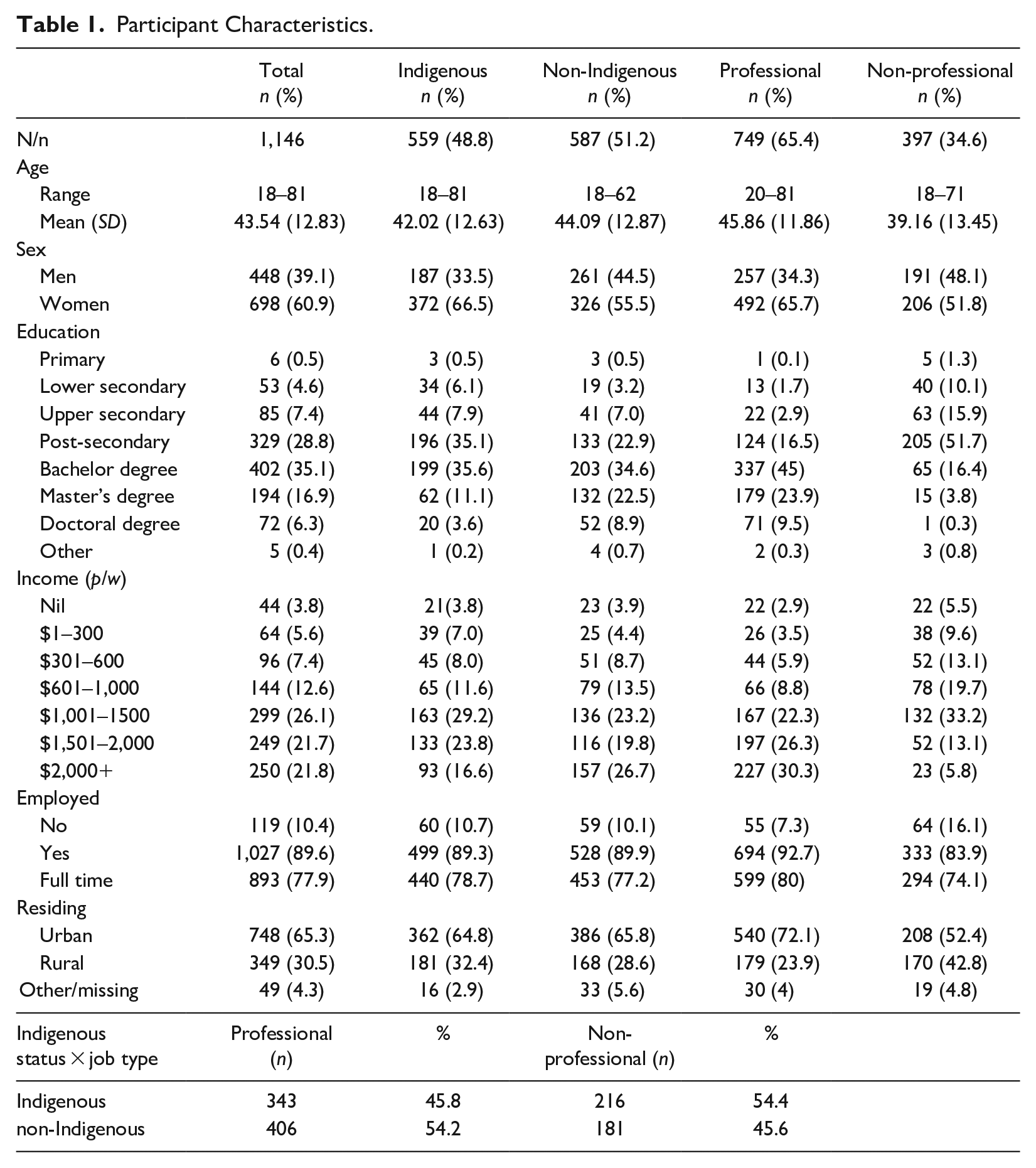
Participant characteristics can be found in Table 1. Participants were 1,146 men and women (60.9%) Indigenous and non-Indigenous (51.2%) adult Australians aged 18 to 81 years. Approximately two thirds of the sample resided in urban areas of Australia, with more than half having attained a bachelor’s degree or higher qualification. The majority of participants were employed and the length of time in their current job ranged from 1 month to 54 years. Reported household weekly income ranged from $0 to $2,000 or more, with the average weekly income bracket being $1,000 to $1,249. Almost two thirds of the sample were employed in professional or managerial roles as defined by the Australian and New Zealand Standard Classification of Occupations (ANZSCO; Australian Bureau of Statistics [ABS], 2013) while the remaining third worked in one of the other six major employment categories (i.e., technicians/trades; community/personal service; clerical/administrative; sales; machinery operators and drivers; and laborers). Although ANZSCO categorizes managers and professionals into distinct groups, the current study merged them, as both require similar skill level and corresponding qualification and/or experience.
Participant Characteristics.
Measures
Demographic questions
Participants indicated their age, sex, Indigenous status, whether they currently resided in Australia, the state and postcode of their current residence, the highest level of education they and their parents had attained, their families’ financial situation growing up, and current income. They were also asked about their mother and father’s main occupation, whether they were currently employed and length of current employment, their employment type (e.g., permanent ongoing, fixed contract), status (e.g., full-time, part-time, casual), and employment category and sub-category as defined by ANZSCO (ABS, 2013).
Psychological need satisfaction at work
Psychological need satisfaction at work was measured using the Basic Psychological Need Satisfaction and Frustration Scale—Work Domain (BPNSS-W; Chen et al., 2015). The original 24-item, 6-factor scale, measures the satisfaction and frustration of the three basic psychological needs: Autonomy (e.g., “I have felt a sense of choice and freedom in the things I am undertaking at work”), Relatedness (e.g., “At work, I feel close and connected with other people who are important to me”), and Competence (e.g., “I feel confident that I can do things well in my job”). Only the three satisfaction subscales were used in the current study. Participants rated their responses to each of the items on a scale of 1 (strongly disagree) to 6 (strongly agree), with higher scores reflecting greater need satisfaction. In the current study, the Cronbach’s alpha value for Autonomy (total α = .85, Indigenous α = .84, non-Indigenous α = .87, professionals α = .84, non-professionals α = .87), Relatedness (total α = .91, Indigenous α = .91, non-Indigenous α = .91, professionals α = .91, non-professionals α = .91), and Competence (total α = .91, Indigenous α = .91, non-Indigenous α = .90, professionals α = .89, non-professionals α = .92) were high.
Work commitment
Commitment to work was measured using the Morin et al.’s (2009) Workplace Affective Commitment Scale (WACS). The WACS consists of nine positively worded statements measuring three factors: Commitment to profession (three-items; e.g., “I would be happy to practice this profession all my life”), commitment to work in general (three-items; e.g., “Work is a priority in my life”), and commitment to career progression (three-items; e.g., “It is important for me to move up the ranks or obtain promotions”). The responses are measured on a 6-point Likert scale from 1 (strongly disagree) to 6 (strongly agree). Cronbach’s alpha was satisfactory for each of the three subscales (profession: total α = .80, Indigenous α = .79, non-Indigenous α = .80, professionals α = .78, non-professionals α = .81; work in general: total α = .71, Indigenous α = .72, non-Indigenous α = .70, professionals α = .69, non-professionals α = .74; and career progression: total α = .80, Indigenous α = .79, non-Indigenous α = .80, professionals α = .78, non-professionals α = .81) and the total measure (α = .81).
Resilience at work
Workplace resilience was measured using an adapted version of the Buoyancy Scale developed by Martin and Marsh (2008) which is referred to hereafter as the Resilience at Work Scale (RAWS). This scale included six items designed to capture everyday resilience at work (e.g., “I’m good at bouncing back from disappointments in my work”). Responses to each item were rated from 1 (strongly disagree) to 6 (strongly agree), thus higher scores indicated greater resilience at work. Past research has shown the scale to have good internal consistency (α = .80; Martin & Marsh, 2008) which is consistent with the good internal consistency of the measure in the current study (total α = .88, Indigenous α = .88, non-Indigenous α = .88, professionals α = 88, non-professionals α = .89).
Role ambiguity
Role ambiguity at work was measured using the 5-item Role Clarity subscale of the Haynes et al. (1999) Measure of Work Characteristics. Items (e.g., “I have clear planned goals and objectives for my job”) were scored on a 6-point scale from 1 (strongly agree) to 6 (strongly disagree) meaning that higher scores reflected greater role ambiguity. Prior research has shown this subscale to have good convergent and construct validity, and high internal consistency (α > .82; Dubreuil et al., 2009; Haynes et al., 1999). The Cronbach’s alpha value was also satisfactory in the current study (total α = .84, Indigenous α = .86, non-Indigenous α = .82, professionals α = .84, non-professionals α = .84).
Job satisfaction
The General Workplace subscale of the Professional Self-Description Questionnaire (PSDQ, Cowin et al., 2008) was used in the current study as a subjective measure of participants’ general job satisfaction. The subscale comprises five items (e.g., “I get a lot of enjoyment out of my work” and “I like my workplace”) measured on a 6-point scale from 1 (strongly agree) to 6 (strongly disagree). A single score was calculated for each participant by averaging scores across the five-items with higher scores indicating more job satisfaction. Previous research has shown the subscale to have good internal consistency (Cowin et al., 2008) and the Cronbach’s alpha values in the current study’s samples were high (total α = .91, Indigenous α = .90, non-Indigenous α = .92, professionals α = .90, non-professionals α = .91).
Procedure
After obtaining university ethical approval for the study, all participants were recruited through workplaces, newspapers, social media platforms, Indigenous organizations and networks, and word of mouth. As Indigenous Australians make up only 3.3% of the total population (ABS, 2018) purposeful sampling was undertaken with recruitment efforts predominantly focused on Indigenous media (e.g., Koori Mail), Indigenous specific organizations (e.g., Reconciliation Australia), and government and nongovernment organizations with a large number of Indigenous employees. Although we specifically targeted organizations employing a high percentage of Indigenous workers, non-Indigenous employees still made up the vast majority of total employees, thus, the non-Indigenous sample was simultaneously recruited through these same organizations. Organizations that agreed to be involved were emailed the study information and the link to the online Qualtrics survey to provide to their subscribers/employees. Participants indicated their agreement to participate by clicking on “I agree to participate” and then completed the measures used in the current study as well as additional items for a broader study that also included items related to wellbeing, family and community relationships, and passion and self-concept, which are beyond the scope of the current work outcomes focused research.
After first completing the block of demographic questions, question blocks, and the items within them, were randomized to avoid order effects. Respondents that were unemployed at the time of survey completion were instructed to answer the work-related items based on the most recent job they held. All responses were anonymous, and all information provided was treated in accordance with guidelines outlined in the National Statement on Ethical Conduct in Human Research 2007 (National Health and Medical Research Council et al., 2018).
Statistical Analyses
Data screening
Data were initially screened for normality and missingness using SPSS v25 (IBM Corp, 2017). Results of the missing data analysis revealed that the amount of missing data on all variables was low (0.3%–1.6%) and Little’s Missing Completely At Random (MCAR; Little, 1988) tests for each measure were not significant (ps ≥ .315) indicating the data were MCAR. Due to the very low percentage of missingness, missing values were replaced using the Expectation Maximization algorithm (Schultz et al., 2006). This method is considered superior to other single imputation methods as it uses an iterative process based on the means, correlations, and covariances of available cases to more accurately predict the missing values without the replacement values changing the variance of the covariance matrix (Tabachnick & Fidell, 2013). Based on the ±2 criteria suggested by Gravetter and Wallnau (2014), there was no evidence of skewness at the item level, although slight kurtosis was evident in some of the variables. Prior to the main analyses, bivariate correlations were carried out to ascertain the associations between all variables under study. Independent t-tests were also performed to determine if there were any significant differences between Indigenous and non-Indigenous, and professional and non-professional participants on each of the variables of interest.
Primary analyses
The main analyses were conducted in four phases. First, the measurement model of each scale was evaluated through confirmatory factor analysis in Mplus version 8 (Muthén & Muthén, 2015) to confirm the relations between the latent constructs and their corresponding indicators. Following common practice for evaluation of model fit, we used the Root Mean Square Error of Approximation (RMSEA), the Tucker Lewis Index (TLI), the Comparative Fit Index (CFI), and the Standardized Root Mean Square Residual (SRMR). For the RMSEA, generally values below 0.05 represent an excellent fit and values up to 0.07 to 0.08 indicate an acceptable fit (see Chen, 2008). For the TLI and CFI, values greater than 0.95 are indicative of excellent fit, and values greater than 0.90 are indicative of good/acceptable model fit (Schumacker & Lomax, 1996). The SRMR ranges from 0 to 1 and values lower than 0.05 are indicative of good model fit (Diamantopoulos & Siguaw, 2000), although values as high as 0.08 are deemed acceptable (Hu & Bentler, 1999). As the data screening process produced evidence of nonnormality (kurtosis) for some variables, all analyses were performed using the MLR estimator that has been shown to be more robust when dealing with nonnormality (Maydeu-Olivares, 2017).
Second, due to the importance of ensuring that measures are suitable for making cross-cultural comparisons (Geisinger & McCormick, 2013), we conducted sequential multi-group confirmatory factor analysis in Mplus (Muthén & Muthén, 2015) to test the equivalence of the measures used across sex and Indigenous and non-Indigenous participants. We tested three levels of measurement equivalence by introducing additional equality constraints at each level. Initially, configural invariance was assessed by estimating the factor model simultaneously across the groups of interest allowing all parameters to vary. Next, to gauge whether the constructs were interpreted in the same way between groups we tested metric invariance (also referred to as weak invariance) by placing equality constraints between groups on the factor loadings. Finally, to justify making group comparisons on mean construct levels we tested each measure for scalar invariance (referred to as strong invariance) by restricting the item intercepts to be equivalent across groups. As recommended by Cheung and Rensvold (2002) a measure was considered invariant when the difference in CFI values (△CFI) between the increasingly restricted models did not exceed.01.
The third phase of the analyses used structural equation modeling (SEM) to test the associations between need satisfaction at work (i.e., autonomy, relatedness, and competence) and the job outcomes which included: length of current employment, job ambiguity, resilience at work, job satisfaction, and commitment to one’s profession, to work life, and to career progression. Importantly, we controlled for income level and age in all analyses. The same fit statistics as those described in the CFA section above were used to evaluate the model fit. In the final phase of the analyses, we conducted moderating SEM on the relations presented in Figure 1 to determine if there were any significant interactions based on Indigenous status and occupational type (professional vs. non-professional). The interactions between latent and observed independent variables were created in Mplus using the “XWITH” command and therefore the covariances were fixed at zero. Finally, due to the multiple statistical tests carried out, we used the Benjamini-Hochberg procedure (Benjamini & Hochberg, 1995) to control for Type 1 error. Using a paper wide false discovery rate of.10, this corresponded to an adjusted p-value of .022 for all analyses.
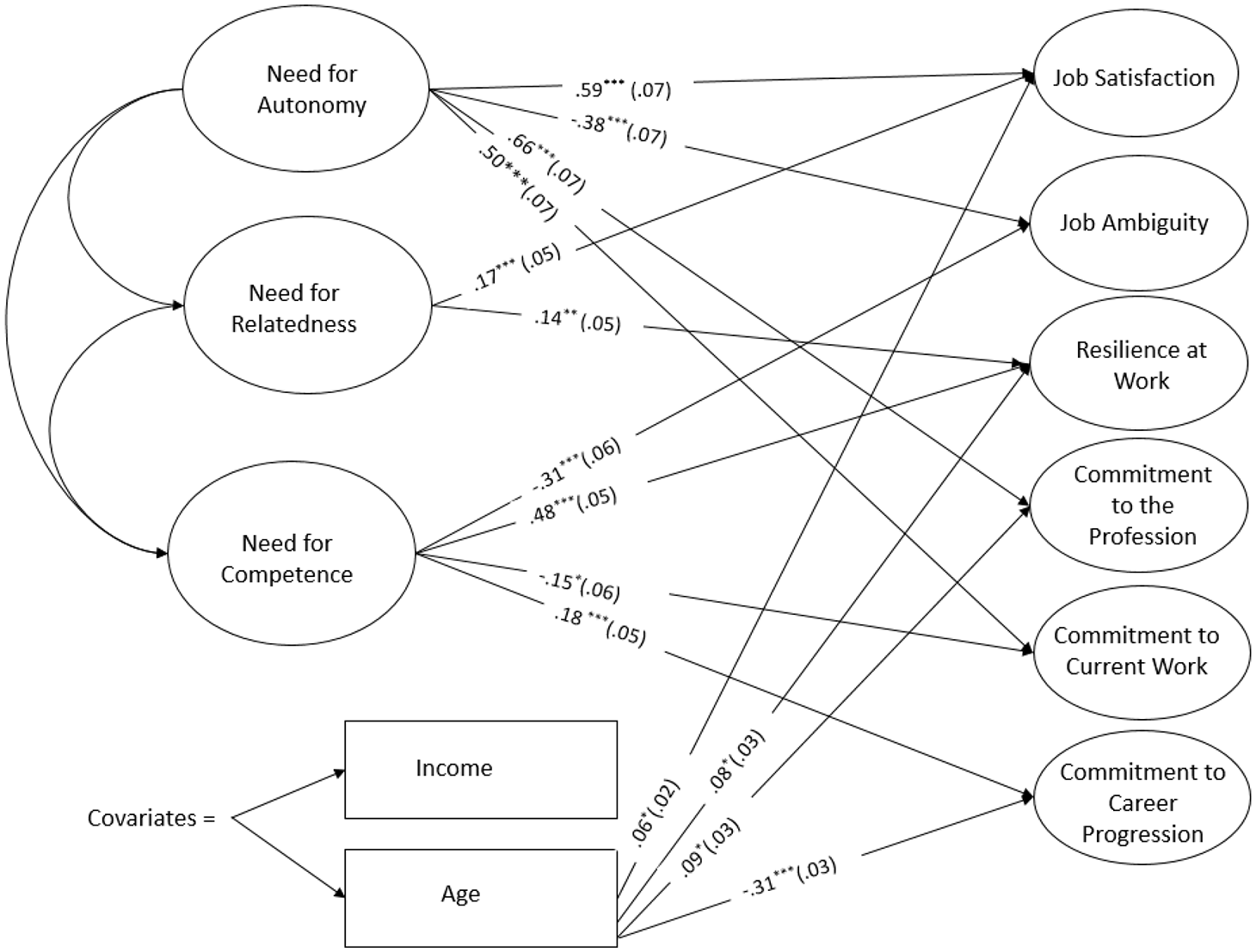
Standardized beta paths showing significant associations between psychological need satisfaction at work and job outcomes.
Results
Preliminary Results
Descriptive statistics for each of the measures are presented in Table 2. As shown, these values were computed for the total sample and then stratified by Indigenous status and occupation type. Correlations between the key variables utilized in the current research are shown in Table 3. All correlations were in the predicted direction and ranged from negligible/small (e.g., r = .03) to large (e.g., r = .78), with the majority being significant at the .01 level. Excluding role ambiguity, all subscales were positively correlated and as anticipated, showed negative associations with role ambiguity. Consistent with previous work (Deci et al., 2017), the three basic psychological needs were moderately to highly correlated (relatedness and competence = .61, autonomy and competence = .67, relatedness and autonomy = .78). As such, we obtained the variance inflation factor (VIF) and tolerance values for each predictor to determine whether multicollinearity would pose a problem in the multivariate analysis. Results indicated that the VIFs were well within acceptable levels (<10; Hair et al., 1995) ranging from 1.03 to 2.51. Tolerance values were also within an acceptable range (>0.20; Menard, 1995) with values of 0.40 to 0.97, thus suggesting that it was appropriate to proceed with the multivariate analyses.
Mean Scores and Standard Deviations of Key Study Variables for the Total Sample and Stratified by Indigenous Status and Occupation Type.

Note. Commit to work = commitment to work; Commit to profess = commitment to current profession; Commit to progress = commitment to career progression; Time in job = number of months employed in current job.
Pearson Bivariate Correlation Coefficients Between the Key Variables Examined.
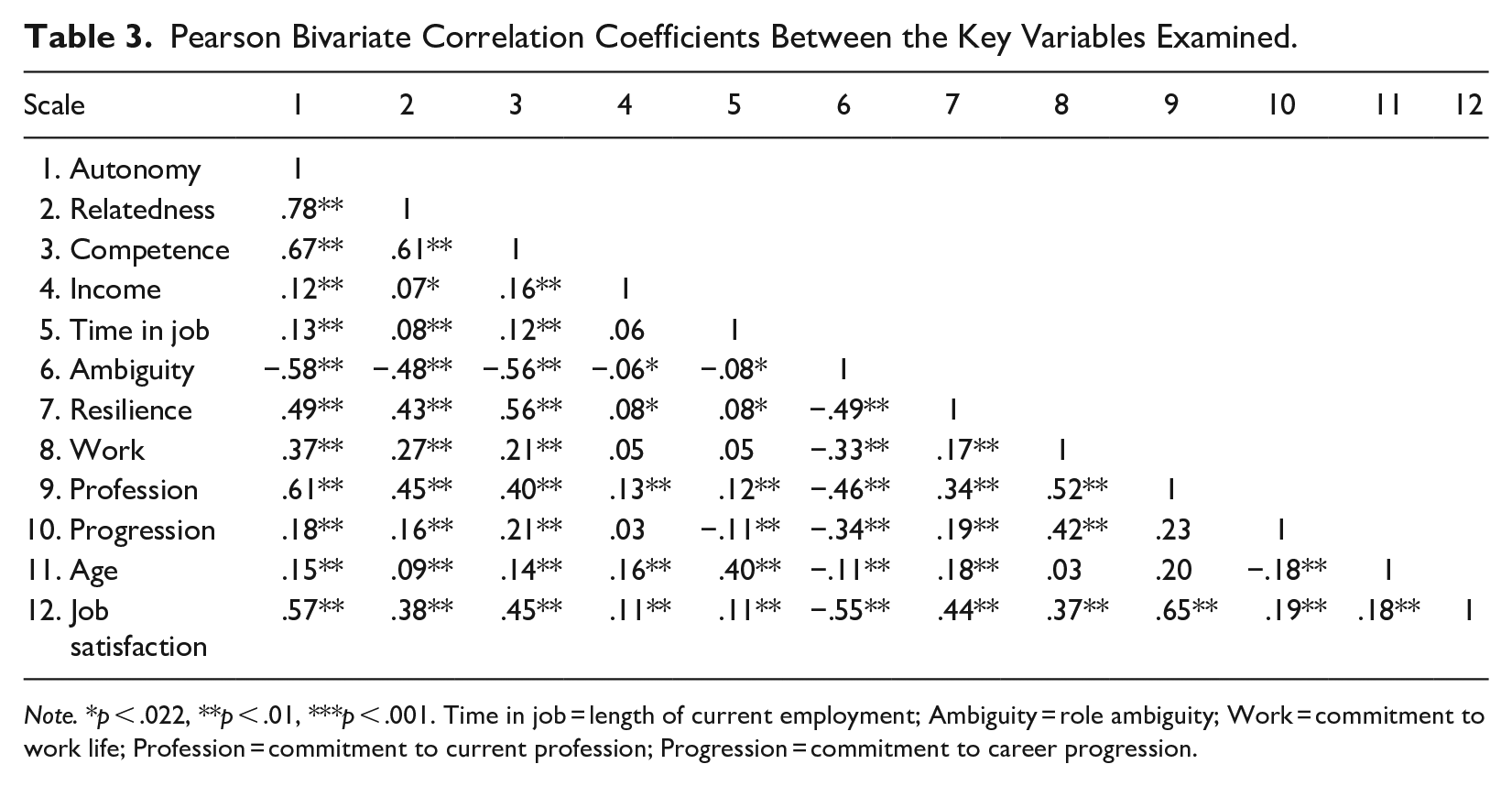
Note. *p < .022, **p < .01, ***p < .001. Time in job = length of current employment; Ambiguity = role ambiguity; Work = commitment to work life; Profession = commitment to current profession; Progression = commitment to career progression.
Comparison of mean differences between professionals and non-professionals revealed that professionals reported significantly greater need satisfaction of competence (t[1144] = 5.02, p < .001, d = 0.77), autonomy (t[1144] = 5.45, p < .001, d = 0.83), and relatedness (t[1144] = 3.38, p < .001, d = 0.83) in the workplace, and a significantly higher income (t[1144] = 10.18, p < .001, d = 2.45) than non-professionals. Work outcomes also differed significantly between groups with professionals reporting significantly less role ambiguity (t[1144] = −2.94, p = .003, d = 0.85), and a greater commitment to work in general (t[1144] = 2.78, p = .006, d = 3.07) and their profession (t[1144] = 6.65, p < .001, d = 1.07) than non-professionals. There were no significant differences found for length of current employment, workplace resilience, or commitment to career progression (p’s > .022).
Comparison of mean differences between Indigenous and non-Indigenous participants showed that non-Indigenous participants reported significantly higher levels of autonomy compared to Indigenous participants (t[1144] = −2.45, p = .014, d = 0.84) but that levels of relatedness and competence need satisfaction in the workplace were similar across groups (p’s > .022). In terms of the outcome variables, non-Indigenous participants reported a significantly higher level of commitment to their current profession (t[1144] = −2.77, p = .006, d = 1.08), whereas Indigenous participants reported significantly greater commitment to progressing their careers than non-Indigenous participants (t[1144] = 3.99, p < .001, d = 2.95).
Measurement Models and Factor Invariance
The CFA model results for all measures are displayed in Table 4. All CFA models converged well and overall model fit was deemed adequate across all measures. All CFIs were 0.96 or higher, all TLIs were 0.93 or above, all SMSRs were below 0.044, and all RMSEAs were 0.064 or lower. Furthermore, an examination of factor loadings across each measure showed that the indicators were satisfactorily related to their purported factors with standardized factor loadings ranging from 0.42 to 0.89. Table 4 also displays the results of the measure invariance analyses. As shown, all four measures were fully invariant (i.e., configural, metric, and scalar invariance achieved) across men and women, and Indigenous and non-Indigenous subgroups.
Results of Confirmatory Factor Analyses and Invariance Testing for all Measures.

Note. χ2 = chi square statistic; df = degrees of freedom; TLI = Tucker-Lewis Index; CFI = Comparative Fit Index; RMSEA = root mean square of approximation; SMSR = standardized root mean square residual; PNSS-W = Basic Psychological Need Satisfaction Scale—Work; WACS = Workplace Affective Commitment Scale; RAWS = Resilience at Work Scale; PDSQ-Gen = general workplace subscale (measuring job satisfaction) of the Professional Self-Description Questionnaire; ✓ = full measurement invariance achieved.
Structural Equation Models (SEMs)
SEM was used to examine the associations between need satisfaction at work and job outcomes (see Figure 1). Autonomy, relatedness, and competence need satisfaction were entered simultaneously as predictors along with income and age as covariates to determine the unique contribution of each on the seven job outcomes examined: (1) Length of current employment, (2) Role ambiguity, (3) Resilience at work, (4) Job Satisfaction; and commitment to (5) Current profession, (6) Work in general, and (7) Career progression. The initial SEM showed that none of the paths leading from the key predictors to length of current employment was significant and thus the model was trimmed to remove this outcome. The results of the final SEM model are presented in Table 5, and the significant paths are shown visually in Figure 1. The model provided an adequate fit to the data (x2 = 1,799.38, df = 616, CFI = 0.93, TLI = 0.92, RMSEA = 0.041, and SMSR = 0.059) and revealed that 14 of the 30 paths estimated were significant.
Path Model Results for the Associations Between Basic Psychological Need Satisfaction and Job Outcomes Controlling for Income and Age.

Note. Significant paths bolded to aid interpretation. Ambiguity = role ambiguity; Work = commitment to work life; Profession = commitment to current profession; Progression = commitment to career progression; β = standardized beta coefficient.
After controlling for age, income, and the other two needs, autonomy need satisfaction was independently associated with less job ambiguity, greater job satisfaction, and an increased commitment to both current profession and work in general with effect sizes being moderate to large (β’s = −.38 to .66). Competence need satisfaction was uniquely associated with less job ambiguity and greater resilience in the workplace with moderate effect sizes (β’s = −.31 and .48, respectively), and an increased commitment to career progression but a decrease in commitment to working life, although these effects were small (β’s = .18 and −.15, respectively). Relatedness need satisfaction was independently and positively associated with workplace resilience and job satisfaction with small effect sizes (β’s = .14 and .17, respectively). In terms of the covariates, income was not uniquely associated with any of the job outcomes when controlling for the other predictors, although age was independently associated with workplace resilience, job satisfaction, and commitment to one’s profession; however, these effect sizes were very small (β’s = .06–.09). There was also a moderate effect of age predicting a decrease in commitment to career progression (β = −.31).
Moderation Analyses
When controlling for all other predictors and covariates, there were very small but significant main effects of occupational type on: Commitment to current profession (β = −.10, SE = 0.03, p = .002, d = 0.14), job satisfaction (β = −.09, SE = 0.03, p = .001, d = 0.19), and workplace resilience (β = −.07, SE = 0.03, p = .011, d = 0.14) with professionals scoring higher than non-professionals on all outcomes. There were no significant interactions on the associations between the three basic psychological needs and work outcomes when controlling for age and income.
Consistent with the mean differences reported above, there was a significant main effect of Indigenous status on career progression after controlling for the covariates and all other predictors, with being Indigenous associated with an increased commitment to career progression (β = −0.14, SE = 0.034, p < .001, d = 0.23). Indigenous status also moderated the association between competence need satisfaction and commitment to one’s current profession (β = −.15, SE = 0.06, p = .030, d = 0.24). As plotted in Figure 2, competence need satisfaction had no effect on Indigenous participants’ commitment to their current profession but was associated with a significantly lower commitment in non-Indigenous participants. There were no other significant interactions.

Visual representation of the significant interaction using Indigenous status as a moderator of the association between the need for competence on commitment to current profession.
Discussion
This research is the first cross-cultural study to compare the role of basic psychological need satisfaction in the workplace in predicting work outcomes for Indigenous workers. Further, research examining the effect of basic psychological need satisfaction at work on job outcomes for non-professional employees is scarce. The current study sought to address these gaps by examining the associations between SDT’s three basic psychological needs of employees and work outcomes, and determine whether these associations differed in magnitude based on Indigenous status or occupational type whilst controlling for both age and income. Specifically, we tested two hypotheses and answered two RQs which are discussed in detail below.
Hypothesis 1: Need Satisfaction at Work Will Be Associated With Desirable Job Outcomes Irrespective of Age and Income
Our data have provided general support for Hypothesis 1 by showing positive associations between the three basic psychological needs and a range of desirable job outcomes across the total sample whilst controlling for age and income. It is also important to note, that the pattern of the associations found varied depending on the work outcome examined as not all needs were associated with all outcomes. These specific findings are discussed in greater detail below in the context of each of the outcomes examined.
Basic psychological need satisfaction and job satisfaction
Consistent with previous research (e.g., Richer et al., 2002), the current results showed that autonomy and relatedness need satisfaction were uniquely and positively associated with employee job satisfaction. However, despite moderately sized zero-order correlations we found no unique association between competence need satisfaction and job satisfaction once we controlled for the other psychological needs and both covariates. This latter finding is inconsistent with previous meta-analytic evidence that showed that all three needs were significantly associated with increased in job satisfaction (Van Den Broeck et al., 2016). This inconsistency may be due to several factors such as the larger sample size, the different measures used, and the lack of covariates (age and income) included in the meta-analyses. As the current results found age to have a small positive association with job satisfaction and there was a significant interaction between age and competence found in the previous meta-analysis (Van Den Broeck et al., 2016), future research should consider including age as a covariate to aid in the comparison of findings across studies. Interestingly, income was not related to job satisfaction after accounting for age and the basic psychological needs suggesting that intrinsic motivators such as feeling a connection to coworkers (relatedness) and having a sense of ownership and choice on how one works (autonomy) is more important for job satisfaction than extrinsic motivators such as income.
Basic psychological need satisfaction and work-related commitment
A particularly interesting finding that has not been previously noted was that each psychological need appears to be differentially associated with each type of commitment examined in the current study (work in general, profession, and career progression). For example, in line with prior research, we found that satisfaction of the need for autonomy was associated with an increased employee commitment to their profession and current work (Gillet et al., 2015; Richer et al., 2002), however, it was not associated with commitment to career progression. Further, competence need satisfaction was associated with an increased commitment to career progression but less commitment to the current workplace which has also been noted previously (Van Den Broeck et al., 2016). This finding suggests that there could be a surprising side effect of competence need satisfaction in the workplace. Perhaps when an individual has gained a heightened sense of competence, and given the innate need for ongoing learning (Spreitzer & Porath, 2014), they may wish to pursue promotion and new career challenges in another organization, and thus, become less committed to their current work role. The significant but varying associations between autonomy and competence need satisfaction on commitment have important practical implications for employers wanting to provide their employees with the relevant support to satisfy their basic psychological needs while at the same time increasing their commitment to the organization. To do so, employers need to ensure that employees are given a sense of autonomy, but also that highly competent employees are not only recognized, but are also given the opportunity to progress their careers within their current organization to maximize their commitment to their existing employer.
Interestingly, although significantly correlated with the commitment outcomes, relatedness need satisfaction was not independently associated with any form of commitment after accounting for the covariates and other psychological needs. Again, this finding is inconsistent with previous meta-analytic evidence which found relatedness to be a significant independent predictor of organizational commitment and turnover intentions (Van Den Broeck et al., 2016). The current result is consistent however, with some prior work that has suggested that the need for relatedness may be less important for predicting some outcomes than either autonomy or competence, both of which share strong associations with relatedness in workplace settings, thus diminishing its independent effects (Ryan & Deci, 2017). It could also be that if employees are having their need for relatedness met through family and friends outside of the work context, it plays less of a role than autonomy and competence when deciding on whether to remain with their current organization.
Finally, income was not significantly associated with any of the commitment outcomes, suggesting that satisfying ones’ psychological needs is more important than financial reward in determining levels of work-related commitment. Unsurprisingly, age was significantly negatively associated with career progression, and significantly positively associated with commitment to one’s current profession. This would simply reflect the fact that as most people near the end of their working life they are less interested in pursuing a new profession or planning on further career progression.
Basic psychological need satisfaction and role ambiguity
While all three needs were negatively and significantly associated with role ambiguity at the zero-order level, only autonomy and competence produced significant independent associations. This finding may indicate that providing employees with more choice and involvement in work-related decision making, along with increasing their competence in job related tasks, provides employees with greater clarity around what is expected or required of them at work. Similar findings have been reported elsewhere across a range of occupations (e.g., Albrecht, 2015). The reason why relatedness did not independently predict decreases in role ambiguity is not clear and may be due to the methodological reasons given above. But theoretically, it may simply reflect the fact that knowing how to do your job well and what is expected of you, relies more on your experience and skill set (competence), and how much choice and control you have over your work (autonomy) than your social relationships in the workplace.
While it has been shown in this study and previously (Albrecht, 2015) that need supportive work environments can effectively reduce role ambiguity, it is important to acknowledge that the direction of the associations could not be ascertained in the current study and that there are several other plausible models that could have been tested. For example, role ambiguity has previously been tested as a moderator of the associations between autonomy and job satisfaction (Gillet et al., 2016; Jong, 2016), and need satisfaction has been shown to mediate the associations between various work stressors and organizational commitment (Gillet et al., 2015).
Further, it was pointed out during the review process that role ambiguity may also serve as a predictor of work outcomes and that the three psychological needs may mediate these associations. Although true mediation cannot be accurately tested with the current cross-sectional data (Kraemer et al., 2008; Maxwell & Cole, 2007; Maxwell et al., 2011), we ran the model suggested by the reviewers and the results partially support the plausibility of this alternate model. Specifically, autonomy need satisfaction was found to mediate the association between role ambiguity and commitment to one’s profession, work life, and job satisfaction, and competence need satisfaction was a unique mediator of the association between role ambiguity and commitment to work life and workplace resilience. Relatedness need satisfaction did not uniquely mediate any of the associations between role ambiguity and job outcomes. Collectively, these results indicate that not only are competence and autonomy need satisfaction directly and independently associated with decreased levels of role ambiguity, but also the findings suggest that role ambiguity in the workplace is what SDT considers a need thwarting variable (Slemp et al., 2015), in that it predicts decreased levels of competence and autonomy need satisfaction, which in turn, predicts poorer job outcomes. Interested readers can view the findings in greater detail in the Supplementary Material attached to this paper, although importantly, the models will need to be replicated using longitudinal data before any firm conclusions can be drawn.
Basic psychological need satisfaction and workplace resilience
Of the three needs examined, only relatedness need satisfaction demonstrated significant independent associations with resilience in the workplace. As this was the first study to directly examine the associations between basic psychological need satisfaction at work and workplace resilience, there is no previous research in which to compare the reliability of this finding. However, prior research has found that positive interpersonal relationships significantly reduced work-related stress in an Indigenous Māori population (Haar & Roche, 2010). Speculatively, it may be that relatedness is particularly important for building workplace resilience because employees that have strong interpersonal relationships with their colleagues are able to draw on them for emotional and social support when facing workplace challenges. Indirect evidence for the importance of need satisfaction on increasing resilience has been shown previously, with studies showing that greater need satisfaction at work attenuated the effects of a high stress work climate on employee well-being (Aldrup et al., 2017; van Hooff & Geurts, 2015), and need satisfaction outside of the workplace can increase the resilience of adolescents and teachers exposed to high stress environments in war ravaged countries (Abualkibash & Lera, 2017; Naemi, 2018).
As is little known about the factors that build workplace resilience (Winwood et al., 2013), the current findings add to the literature by showing a direct association between relatedness need satisfaction at work and increased workplace resilience independent of income. Considering the significant barriers (e.g., racism/discrimination) that Indigenous people face in both securing and maintaining meaningful careers (Craven et al., 2016; Haar & Roche, 2010), fostering quality interpersonal relationships between Indigenous employees and other staff members may be an effective way of increasing Indigenous workers flexibility and ability to deal with adversity encountered within the workplace. In turn, increasing workplace resilience may reduce the high employment turnover rates found within the Indigenous workforce (Hunter & Gray, 2018).
Summary
Collectively, the findings relating to Hypothesis 1 provide us with two important insights: (1) The patterns of association found are largely consistent with SDT’s universality principle (Deci & Ryan, 2000), showing that higher levels of psychological need satisfaction at work are generally associated with positive job outcomes; and (2) the satisfaction of each need is often uniquely associated with certain, but not necessarily, all outcomes. This second point highlights the importance of examining each of the needs independently rather than aggregating or averaging them to form a single measure which is common within the existing literature (Van Den Broeck et al., 2016).
Hypothesis 2. Professionals Are Higher Than Non-professionals on Need Satisfaction
In support of Hypothesis 2, the analyses showed that professionals reported significantly greater satisfaction of the need for competence, autonomy, and relatedness in the workplace, when compared to non-professionals. Unsurprisingly, professional workers also reported a significantly higher income than non-professionals. Although one may conclude from this that income is a key contributor to positive work outcomes, our analyses of the covariates does not support this as income was not uniquely associated with any of the job outcomes when controlling for the other predictors. More likely, these results may reflect the nature of the work carried out by employees in managerial and professional roles, who are typically given greater autonomy in the workplace as well as more opportunities to demonstrate their competence and their ability to relate to others than are non-professionals (Marmot, 2006).
Further, professionals also reported significantly higher levels of commitment to work in general and their profession, while experiencing less role ambiguity. As the current findings demonstrated that need satisfaction is beneficial for job outcomes for all employees irrespective of income and job type, these results highlight the need for organizations to invest more in cultivating the need satisfaction of their non-professional staff. Moreover, as one of the most well supported aspects of SDT is that greater need satisfaction increases employee motivation at work (Deci et al., 2017), ensuring that all staff feel that they have the ability, skills, and resources to complete work based tasks, and have a sense of agency and volition to make meaningful decisions about workplace practices, along with opportunities for staff to build high quality relationships, may not only increase workplace commitment, resilience, and job satisfaction but also the overall productivity of the organization.
RQ1. Similarities and Differences Between Indigenous and Non-Indigenous Employees
A key aim of this research was to examine the universality of SDT through a cross-cultural examination of the similarities and differences between Indigenous and non-Indigenous employees in terms of levels of need satisfaction and job outcomes which are discussed in turn below.
Need satisfaction
Mean scores indicated that the levels of relatedness and competence need satisfaction in the workplace were very similar for Indigenous and non-Indigenous workers. Conversely, non-Indigenous participants reported significantly higher levels of autonomy need satisfaction compared to Indigenous participants. The relatively lower sense of autonomy in the workplace among Indigenous employees is concerning, regardless of whether it is based on differential treatment or perceptual biases. The lower ratings of autonomy may reflect more controlling treatment by managers or leaders of Indigenous employees regardless of whether they occupy professional or non-professional roles. Alternatively, due to past marginalization, exclusion, and a failure by educational systems and institutions to understand Indigenous Australians’ educational needs (Dillon et al., 2020), Indigenous employees may have a heightened sensitivity to control imposed upon them by others. Finally, it is also possible that within our Indigenous sample, lower educational attainment has limited employment opportunities, leading many to settle for non-professional jobs that they do not feel well suited for, and within which they experience little autonomy.
A greater understanding of these differences in levels of autonomy need satisfaction may provide some insight into the reasons why the turnover rates are much higher for Indigenous employees, particularly those occupying professional roles, when compared to non-Indigenous professionals (Hunter & Gray, 2018). The reasons for this have remained unclear and further research is needed to understand what workplace practices would facilitate Indigenous peoples’ sense of autonomy and ongoing engagement with work (Lahn, 2018). These findings also highlight the importance of considering Indigenous worldviews and life goals in the workplace by promoting autonomy for Indigenous employees and providing opportunities for them to engage in meaningful tasks to achieve their career goals (Craven et al., 2016).
Job outcomes
The only differences found on job outcomes were that non-Indigenous employees reported a significantly higher level of commitment to their current profession, but a lower commitment to progressing their careers than Indigenous employees. Perhaps Indigenous employees’ lower level of commitment to their current profession, whilst at the same time holding a higher commitment to progressing their careers, is due to Indigenous Australians holding high aspirations for career progression to facilitate better socioeconomic outcomes for themselves, their families, and their communities, and thus more actively seek to progress their careers. Further research is warranted to investigate this issue which may be particularly well suited to qualitative investigation.
Moderation by Indigenous Status
The moderation analyses by Indigenous status indicated that there were very few differences in both the magnitude and direction of the associations tested. The only significant interaction found was that Indigenous status moderated the association between competence satisfaction and level of commitment to one’s current profession. Specifically, different levels of competence satisfaction had little effect on Indigenous employees’ level of commitment, whereas higher competence was associated with significant decreases in commitment in the non-Indigenous sample. These results may reflect Indigenous employees’ overrepresentation in community service occupations (social work, education, health, etc.; Hunter & Gray, 2018) and thus their level of commitment to their profession is not contingent on being challenged or feeling competent in the workplace but instead relies more strongly on the belief that their jobs are meaningful, and they are making a difference in their communities. Further, it is possible that having had to overcome many barriers to establish a profession and obtain secure employment in the first place, Indigenous workers may be more reluctant to change professions even though they are not having their needs for competence satisfied. In contrast, non-Indigenous people face fewer challenges in establishing a profession, and are more likely than Indigenous people to be employed in the business sector in upper managerial roles (Australian Institute of Health and Welfare, 2019), which may lack the sense of meaning that can facilitate commitment in those employed in service roles. Thus, as their sense of mastery and competence increases, individuals may feel less challenged in their roles and seek out new career opportunities. Both of these possibilities require further investigation.
RQ2. Occupational Type as Moderator of the Associations between Need Satisfaction and Job Outcomes
Again supporting the universal benefits of need satisfaction in the workplace, there were no significant differences in the magnitude or direction of the associations between satisfaction of the three basic psychological needs and job outcomes based on occupational type. The lack of significant interactions suggests, that despite non-professionals experiencing lower levels of need satisfaction in the workplace, they provide equivalent benefits to both professional and non-professional staff. Thus, as argued above, it is important that organizations invest equally in the need satisfaction of employees in non-professional roles to maximize their organizational commitment, workplace resilience, and job satisfaction whilst reducing ambiguity around what is expected of them. Overall, the lack of moderation also suggests that the rewards of work are not financial but about finding psychological fulfillment and meaning in one’s work, which consistent with SDT, was associated with better job outcomes in the current study irrespective of income level.
Summary
Our empirical findings showed that all three psychological needs identified by SDT are equally salient in the workplace for both Indigenous and non-Indigenous Australian employees, and for employees in professional and non-professional roles. Specifically, the strength and direction of the association between each of the three SDT psychological needs on job outcomes were almost identical across sub-groups. These findings are consistent with the universality of these SDT factors as drivers of positive job outcomes across culture and occupational type.
Strengths and Limitations
This study has several strengths and makes a valuable contribution to the dearth of research on the Indigenous workforce. First, while psychological need satisfaction in the workplace has been extensively studied in the general population, this is first to include an Indigenous sample. Second, much of the research on employment for Indigenous people has primarily focused on problems (i.e., barriers to employment), whereas the current study guided by SDT within the framework of positive psychology (Craven et al., 2016), focused on how positive workplace experiences are linked to desirable employment outcomes while reducing negative ones. Third, this is the only study to use SDT to directly compare the similarities and differences between Indigenous and non-Indigenous employees, and professional and non-professional workers, on the associations between basic need satisfaction and job outcomes. Fourth, this is also the first study to directly examine the associations between basic psychological need satisfaction at work and workplace resilience. Finally, the invariance of all measures used was established across subgroups prior to making group comparisons thus increasing the validity of the findings.
With the strengths noted, it is important to address some of this study’s limitations in order to guide future research. First, the current study was limited to the use of self-report quantitative data. Instead, interviews could be also be conducted with Indigenous and non-Indigenous employees and their employers to yield a rich complementary source of data. Second, the disparity in unemployment rates between Indigenous and non-Indigenous populations globally is greatest in remote communities (Commonwealth of Australia, 2018; Dhir, 2015; Morris et al., 2005). However, the current findings are based primarily on reports by participants residing in urban and rural settings, therefore, future research should include participants from remote Indigenous communities to better gauge the generalizability of the current results.
Third, the current study used a proxy measure of job satisfaction drawn from the PSDQ (Cowin et al., 2008), which although demonstrating acceptable invariance and reliability across subgroups, was not explicitly designed to measure job satisfaction specifically. Future research should consider reexamining the current model using a well-validated measure of job satisfaction. Finally, this research was cross-sectional, and while it yielded some new and important findings along with avenues for future research, causality between the variables tested in the current study cannot be determined from the analyses or design used. As such, alternative models such as mediation analysis requiring at least three time points with a temporal lag between each measurement occasion (Kraemer et al., 2008), could not be adequately tested. Now that the preliminary patterns of association have been established in the current research, it is important that future research reassesses them longitudinally to better identify both the temporal and possibly bidirectional associations between them along with potential mediating and moderating factors.
Conclusion
This research extends the existing literature by demonstrating that the quality of work experiences, as tapped by SDT’s basic need satisfaction, predicts better work adjustment for both Indigenous and non-Indigenous individuals, and those occupying both professional and non-professional roles. The finding of differential predictive patterns for each of the three psychological needs has important implications. Practically, it is relevant to employers who endeavor to provide their employees with the best need support to achieve a specific outcome. In terms of theory, examining in more detail the different outcomes stemming from the satisfaction of each of the three psychological needs can tell us more about their functional effects, and how each may be relevant in promoting a content and productive workforce.
The study also demonstrates the usefulness of employing a strengths-based positive psychology approach to Indigenous populations as advocated by Craven et al. (2016). As a cross-cultural study, our findings also provide a rare insight into Indigenous employees’ experiences at work, demonstrating the salience and importance of psychological need satisfaction for Indigenous as well as non-Indigenous employees. Hence, the study adds additional validity to the international SDT research literature, which claims that basic psychological need satisfaction is universal and matters to all groups regardless of culture or occupational role. At the same time, our results also reflect the broader social structure within Australia and other western nations, whereby professional, and non-Indigenous employees reported higher scores on the most desired work outcomes.
Importantly, our results are both novel and encouraging by showing that basic psychological need satisfaction at work can universally and simultaneously be associated with multiple desirable work outcomes, while reducing those that are less desirable, in all subgroups examined in the current study. Thus, specifically targeting need satisfaction in the workplace for all employees, regardless of their Indigenous or occupational status, may assist in reducing systemic disparities between these subgroups. The current results also indicated that organizations that invest more in satisfying the basic psychological needs of all their staff may derive greater commitment and productivity from their workers, particularly so for employees in non-professional roles who are currently not having their basic psychological needs met to the same degree as their professional counterparts. For Indigenous employees in particular, our results imply there is a need to better support autonomy satisfaction in the workplace, which is lower relative to their non-Indigenous colleagues.
Supplemental Material
sj-doc-1-jcc-10.1177_00220221211060441 – Supplemental material for A Cross-Cultural Investigation of Basic Psychological Need Satisfaction at Work in an Indigenous and Non-Indigenous Australian Sample Across Occupation Types
Supplemental material, sj-doc-1-jcc-10.1177_00220221211060441 for A Cross-Cultural Investigation of Basic Psychological Need Satisfaction at Work in an Indigenous and Non-Indigenous Australian Sample Across Occupation Types by Natasha R. Magson, Rhonda G. Craven, Richard M. Ryan, Anthony Dillon, Janet Mooney, Fabri Blacklock, Alexander S. Yeung, Munirah S. Kadir and Alicia Franklin in Journal of Cross-Cultural Psychology
Footnotes
Declaration of Conflicting Interests
The author(s) declared no potential conflicts of interest with respect to the research, authorship, and/or publication of this article.
Funding
The author(s) disclosed receipt of the following financial support for the research, authorship, and/or publication of this article: This research was funded by the Australian Research Council’s Indigenous Discovery Scheme (IN1501000060).

Supplemental Material
Supplemental material for this article is available online.
References
Supplementary Material
Please find the following supplemental material available below.
For Open Access articles published under a Creative Commons License, all supplemental material carries the same license as the article it is associated with.
For non-Open Access articles published, all supplemental material carries a non-exclusive license, and permission requests for re-use of supplemental material or any part of supplemental material shall be sent directly to the copyright owner as specified in the copyright notice associated with the article.
