




Abstract
Changes in socioeconomic conditions can affect how people understand themselves. The present analyses tested hypotheses on individuals’ self-construal and insecure attachment variation and co-variation during a period of severe and prolonged economic downturn in Greece, a typically more collectivist culture. Adult attachment and self-construal were surveyed in 15 independent samples of young adults collected consecutively between 2004 and 2016. Significantly lower independence, but not higher interdependence, was observed in recent crisis-stricken years of higher unemployment compared to earlier (pre-crisis) years. Participants also reported higher insecure attachment, particularly higher anxious attachment in recent years. However, it were temporal changes in avoidance that were associated with a greater decline in independent self-construal during the time period studied. Avoidance also preceded temporal variability in independent self-construal during this period. The results highlight links between socioeconomic conditions and individual-level variation in cultural understandings of the self and insecure attachment, and point to socio-cognitive processes that may explain interrelationships between two constructs that partly lie at different levels of understanding the self.
Economic crises come and go, and their passage can have a profound impact on people’s lives (Davalos & French, 2011), including on how people understand themselves (Park et al., 2014, 2017). It has long been recognized that economic factors can lead to value and identity transformation (e.g., Inglehart & Baker, 2000), yet, the social and psychological effects that economic crises can have on people’s understanding of the self have been much less researched. Based on data collected between 2004 and 2016, this paper analyzes and discusses individual-level variation (shifts) in young people’s independent and interdependent understanding of self and insecure attachment during a period of severe and prolonged economic crisis in a more collectivistic culture, Greece (Hofstede, 2001).
Socio-Economic Correlates of Self-construal
Individualism and collectivism at the cultural level and independent and interdependent self-construal at the individual level (Triandis, 1995) constitute fundamental psychological resources that can explain the ways people understand themselves in relation to their social context (Markus & Kitayama, 1991). The independent self-construal places an emphasis on individuals’ needs and agency and considers one’s feelings, thoughts, and actions as separate from others, whereas the interdependent self-construal involves persons’ feelings, thoughts, and actions as a result of understanding the self as connected to others, particularly others from the in-group.
Cultural ecologies, social, and economic factors in particular, can shape independent and interdependent views of the self (Grossman & Varnum, 2015). For example, higher social class promotes independence, whereas lower social class is associated with higher interdependence and more intensified social relations in the US (Stephens et al., 2012). Such within-culture differences in socioeconomic standing are also reflected in cross-cultural differences in wealth and self-construal associations: people in wealthier nations construe themselves, on average, as more independent, while people in poorer countries understand themselves as more interdependent (Hofstede, 2001; Inglehart & Baker, 2000). Equally, upward or downward changes in socioeconomic conditions are followed by changes in self-construal (Greenfield, 2009). Yet, the impact economic downturns can have on changes in social values and self-construal has been much less researched.
Studies examining the impact of the 2008 to 2010 recession (Park et al., 2014) and longer-term financial fluctuations in the U.S. (Bianchi, 2016) agree in their observations that economic downturns can lead to a reversal of long-term trends toward greater individualism (see Santos et al., 2017). During the recent Great Recession in the United States (2008–2010), high school seniors expressed more collectivistic orientations (concern for others and the environment) and fewer materialistic values compared to adolescents of the same age group just before the recession (Park et al., 2014). A number of studies found further evidence of lower individualism during economic downturns. During periods of higher unemployment, Americans placed less emphasis on standing out from the crowd and adopted fewer individualistic values. American parents were more likely to choose unique names for their offspring during good economic times and more likely to choose common names during bad economic times (Bianchi, 2016). These findings have led to the conclusion that collectivism is higher and individualism is lower during times of economic hardship (e.g., Park et al., 2014).
A major limitation, however, is that all of the admittedly contained evidence on economic hardship and cultural identity comes from a limited number of countries with generally higher individualistic values (Hamamura, 2020). Ecological factors may differentially impact the development of cultural values and norms as a result of societal stressors, particularly those that construct relational identities. For example, in a recent analysis (Oishi & Komiya, 2017), natural disaster risk predicted higher in-group collectivism only in wealthy (and more individualized) nations, suggesting that social relations and increasing in-group connections may develop differently in individualistic and in collectivistic cultures as a result of harsher ecological factors.
Another key limitation of existing research is that it has drawn inferences about the relationships between economic fluctuation and self-construal on the basis of indirect indices of constructions of the self, thus implicitly promoting understanding of independence- interdependence as one dimension of cultural values change (e.g., Bianchi, 2016). However, independence and interdependence are distinct constructs with discrete social correlates and individual-level outcomes (Singelis, 1994; Vignoles et al., 2016). A further illustration of this point, a cross-temporal analysis of individualism and collectivism in Japan and the United States since 1950, observed an increase in indicators of individualism in both cultures but did not observe a similar drop in collectivism, which remained stable, especially in Japan (Hamamura, 2012). Therefore, the extent to which different processes associated with economic downturns may influence independent and/or interdependent constructions of the self at the individual level is open to empirical investigation. Overall, there is a lack of data on how personal or more collective aspects of the self (Brewer & Gardner, 1996) may shift due to socio-economic changes, particularly aspects related to social and personal resources.
With respect to the likely psychological processes that may explain the differential impact economic crises can have on shifts in independent and interdependent understandings of the self, two such have been identified. One is socio-cognitive, involving more automatic processes (Bardi & Goodwin, 2011): a change in independent or interdependent cultural primes as a result of changes in socio-economic conditions may trigger lowering independent mindsets and individualistic values. For example, signs of standing out from the rest are abundant in times of economic growth and can lead to an increase independence, but can diminish in times of economic malaise, leading to a reduction in independent mind sets and behaviors (Greenfield, 2009). Another process relates to uncertainty regulation and the role of social connectedness in reducing uncertainty. In times of economic malaise and greater uncertainty, people turn to their social and personal relationship resources, especially within the in-group (Hogg, 2007). Thus, economic crises can lead to increased uncertainty, and this can enhance interdependent orientation by increasing connectedness and identification with others (e.g., Bianchi, 2016, studies 5 and 6). Nevertheless, as seen in the case of the effects of national disaster risk in different societies (Oishi & Komiya, 2017), this positive relationship may be confined within individualistic cultures, where the prevailing norms of interpersonal helping behavior and support run differently compared to collectivistic cultures.
Economic Crises, Self-construal, and Insecure Attachment
The ways in which uncertainty and relating propensity can lead to shifts in independent and interdependent orientations during times of economic hardship may not apply to everyone in the same way. Individual differences in adult attachment organization have been associated with both threat regulation (Ein-Dor et al., 2010; Marris, 1996) and relating propensity (Mikulincer & Shaver, 2007) and thus may influence responses to economic downturns. Attachment orientations, a seminal concept in social and personality psychology, are also associated with independent and interdependent self-construal. Yet, very little is known about the temporal co-variation of the two constructs, that partly lie at different levels of the classic tri-partite understanding of the self (i.e., Sedikides et al., 2011) during times of economic crisis.
Attachment organization, an evolutionary developed behavioral system that characterizes mammalian species (Bowlby, 1969/1982), at distal level has the adaptive goal to increase the prospect of survival whereas proximally, constitutes primarily, a system of fear, and uncertainty regulation: it is activated by exposure to an impending threat and activation of the attachment system motivates an individual to search for affinity and support from those who are important to them. One condition under which deactivation of the system occurs, is when the person receives the support she requires and acquires a feeling of safety. Developing a sense of security allows to deal effectively with threat and to promote social and emotional connection and well-being throughout life (Mikulincer & Shaver, 2020).
Persons with differing insecure attachment orientations (avoidant, anxious) have different reactions to threat and therefore a different response to uncertainty regulation. Attachment anxiety has been consistently associated with heightened appraisals of threat and increased rumination, higher depression, anxiety, and intrusive post traumatic symptoms (Mikulincer et al., 2000). Attachment avoidance on the other hand, is linked to distancing from and suppression of distress (Berant et al., 2001). Accordingly, research has linked anxious but not avoidant attachment orientations with life events and socio-economic presses (Mickelson et al., 1997). Mickelson et al. (1997) reasoned that the relative cognitive consistency associated with avoidant attachment may be a protective factor for persons with higher avoidance in times of social and economic stresses.
Yet, anxious and avoidant insecure attachment orientations are also directly associated with independent and interdependent self-construal. Attachment orientations are part of a system to sustain security that links different levels of the self: self-esteem, relationships, and cultural world views (Hart et al., 2005). Anxious and avoidant orientations involve mental (working) models of self and others and the relationship between self and significant others that result from experiences in interactions with significant others (Pietromonaco & Barrett, 2000). Anxious attachment involves highly positive models of others and a focus on others, whereas avoidant working models involve perceptions of distance of the self from significant others and a focus on the self (Mikulincer, 1998). Existing research suggests that the attachment self-other schemas are associated with independent and interdependent understandings of the self. People from East Asian cultures characterized by higher collectivism, typically report higher anxious-preoccupied attachment orientation (Schmitt et al., 2004). Avoidant attachment on the other hand, is cognitively more fitted to individualistic than to collectivistic cultures (Friedman et al., 2010) and part of that “fit” is likely due to cognitive-schematic coincidence between avoidance (Janoff-Bulman, 1989; Mikulincer et al., 2009) and an independent self-construal.
According to the attachment-culture fit hypothesis (Friedman et al., 2010), attachment anxiety is typically associated with more functional psychological and relational outcomes in a collectivistic culture (see also Kafetsios & Kateri, 2020) whereas attachment avoidance leads to more functional relational outcomes in an individualistic society. In a recent theoretical analysis, Strand (2020) identifies the strong interrelationship between insecure attachment and self-construal, and makes a strong case for insecure attachment strategies being antecedent to cultural constructions of the self. He suggests that a preponderance of anxious attachment secondary strategies can lead to a higher proportion of interdependent understanding of the self at cultural level whereas a preponderance of avoidant strategies can lead to a higher proportion of individualist cultural orientations. The present research presents a unique opportunity to test such expectations about attachment-self-construal relationships and likely shifts in those relationships due to changing socio-economic conditions.
The Present Research
In the present research young persons’ independent and interdependent self-construal and insecure (anxious and avoidant) attachment were consecutively measured over a 12-year period (2004–2016), a big part of this period being occupied by a severe and prolonged economic downturn in Greece. Since 2009 Greece has entered into an unprecedented and prolonged debt and economic crisis (Andriopoulou et al., 2018). Due to austerity and budgetary cuts in the period between 2008 and 2016, the gross domestic product of Greece shrank by 26.5% (Matsaganis, 2017) and wages decreased on average by 20% (Filippidis et al., 2017). Meanwhile, recorded unemployment rates raised from 9.4% in 2009 to 17.9% in 2011, a staggering 26.5% in 2014 and 23.5% in 2016 with long term unemployment around 20%; unemployment rates before the crisis were, for example, 10.5% in 2004 and 8.5% in 2007 (European Commission, 2016). 1
The data were collected at a large public university in Southern Greece. The use of University student samples provides several advantages for the purposes of the present analysis. Firstly, it provides a way to test the effect changes in the economic conditions in the recent years can have on psychological dimensions (period effects), while cohort effects are minimized due to the limited time span (Yang & Land, 2008). Also, basic demographic variables are kept constant across comparisons. Importantly, rises and falls in economic conditions have shown to particularly affect younger age cohorts (Inglehart & Baker, 2000; Stewart & Healy, 1989).
Since individual observations were nested within each year of data collection, multilevel random coefficient modeling was used to analyze the data. Multilevel modeling allows to model variation in individual-level data while also being able to include group-level variables in the regression analyses (Yang & Land, 2008). In the present analyses data were temporarily ordered with independent and interdependent self-construal and anxious and avoidant attachment orientations examined at individual level and year of data collection was at level 2.
Hypotheses
On the basis of the preceding rationales, the following hypotheses were possible:
Hypothesis 1. Based on existing research (Bianchi, 2016; Park et al., 2014) it was expected that in relation to earlier years, in the more recent, crisis-stricken years in Greece there will be lower independent and higher interdependent self-construal.
Hypothesis 2. On the basis of attachment theory (Mikulincer et al., 2007) and evidence relating to insecure attachment and socio-economic stresses (Mickelson et al., 1997), it was expected that in relation to earlier years, in the more recent crisis-stricken years in Greece, higher anxious attachment orientation will be reported, but not higher avoidant attachment orientation.
Hypothesis 3. Overall, at a meta-analytic level, it was expected that avoidant attachment will be associated with higher independent self-construal and lower interdependent self-construal whereas anxious attachment will be associated with higher interdependent self-construal and lower independent self-construal.
In relation to the last hypothesis, temporal-bound relationships between anxious and avoidant attachment and independent and interdependent self-construal as a result of the economic crisis years were explored. I tested whether likely temporal changes in insecure attachment as a result of the socioeconomic crisis will precede changes in cultural understandings of the self as expected (Strand, 2020) and not the vice versa. Given limited available evidence, no specific hypotheses as to the direction of the change were formulated (i.e., stronger or weaker relationships between avoidance and independence and anxious attachment and interdependence as a result of changes in the socio-economic circumstances).
Method
Participants
The dataset comprised 15 separate samples that totaled 1,627 observations collected consecutively between 2004 and 2016 (see Table 1). Of those, 1,572 had full records of all variables of interest and were used in the analyses.
Descriptive Statistics of Study Samples.
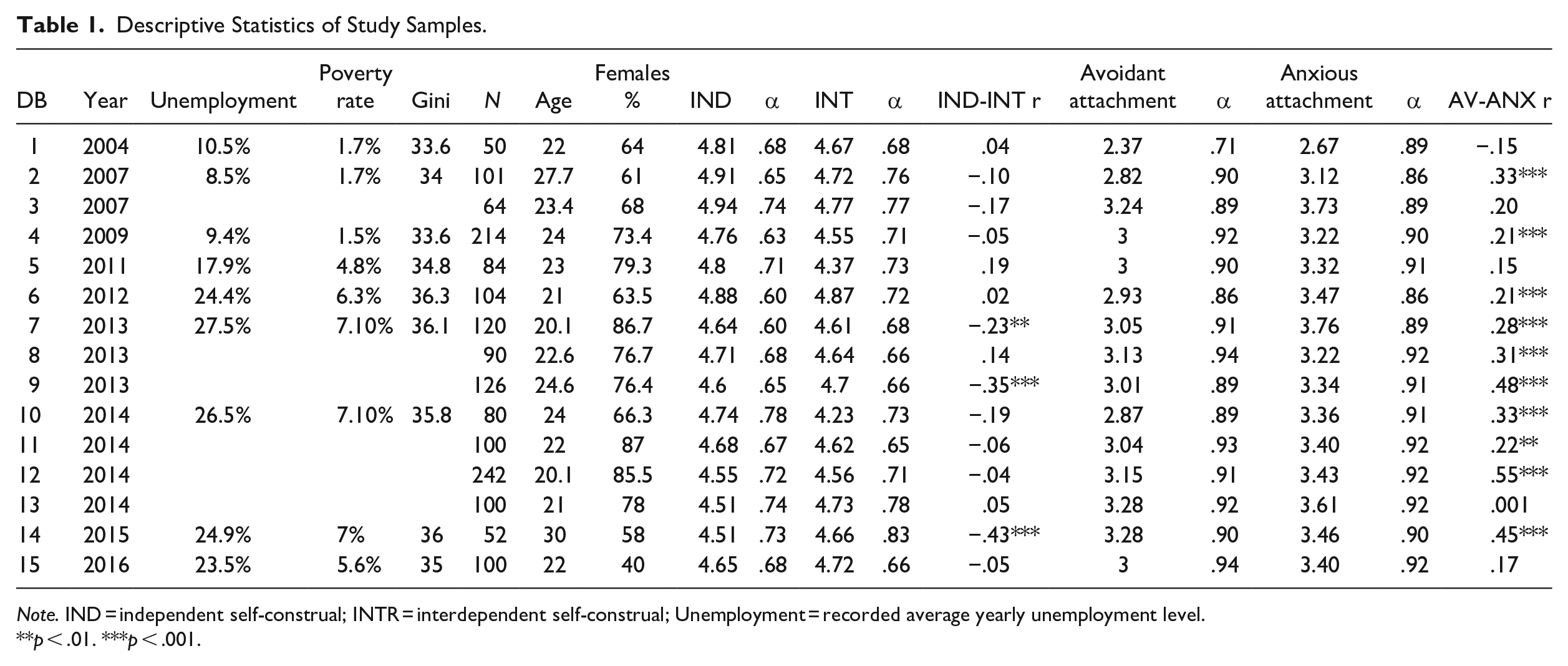
Note. IND = independent self-construal; INTR = interdependent self-construal; Unemployment = recorded average yearly unemployment level.
p < .01. ***p < .001.
Measures
In all these samples the same two scales for adult attachment (ECR-R; Fraley et al., 2000) and self-construal (SCS; Singelis, 1994) were included. The basic descriptive statistics for each sample are presented in Table 1. Data are available at https://osf.io/x2dne/settings/#createVolsAnchor.
Adult Attachment Orientations
Chronic attachment orientation was measured with the Greek version (Tsagarakis et al., 2007) of the Experiences in Close Relationships Questionnaire revised version (ECR-R, Fraley et al., 2000) a 36-item scale typically assessing anxiety and avoidance attachment dimensions in adulthood (using a 7-point scale, 1 = strongly disagree, 7 = strongly agree). The instrument comprises two subscales, 18 items each, that assess attachment anxiety and avoidance. Sample items are “I’m afraid that I will lose my partner’s love” (anxious attachment subscale) and “I prefer not to show a partner how I feel deep down” (avoidance subscale). According to this model, security corresponds to low scores on the avoidance and anxiety dimensions.
Self-construal
Chronic self-construal was measured with the Greek version of the Self-Construal Scale (SCS; Kafetsios & Hess, 2013). The SCS is a 24-item scale designed to measure the strength of individuals’ interdependent and independent self-construals. The independent self-construal subscale refers to an emphasis on feeling separate and unique, whereas the interdependent self-construal subscale refers to an emphasis on feelings of connectedness and relations to others. In an initial testing session, participants responded to each item using a 7-point scale (1 = strongly disagree, 7 = strongly agree). Cronbach alphas and means for the two scales are presented in Table 1.
Results
A repeated cross-sectional survey design was adopted (Yang & Land, 2006). The data were conceptualized as a two-level hierarchically nested data structure with individual measurements nested within each of the 15 samples. The data were chronologically ordered (from the earlier to the most recent years). The statistical program HLM 7.03 (Raudenbush et al., 2013) was used for the data analyses. Random coefficient was preferred over fixed effects modeling following recommendations for its appropriateness for middle sized data sets (Yang & Land, 2008).
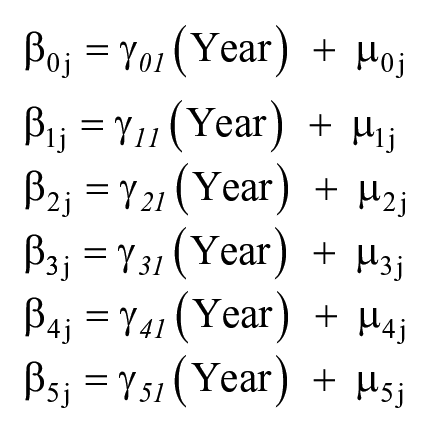
To test hypothesis 1 (that lower independence and higher interdependence will be reported during the recent crisis-stricken years) and the research question, a model was computed (see formula (1)) that had independent or interdependent self-construal as respective outcomes at individual level predicted by year of data collection at group level (year at level two) controlling for attachment avoidance and anxious attachment, the other self-construal dimension (independent or interdependent) from that as an outcome, gender, and age at individual level. Attachment and self-construal dimensions were controlled given a high covariation between the two attachment dimensions (Fraley et al., 2000) and anticipated relationships between the two attachment dimensions and independent and interdependent self-construal (Kafetsios & Kateri, 2020; Strand, 2020). Gender and age were also included as controls in all models given known relationships with self-construal (Cross & Madson, 1997; Yeung et al., 2008). Year was grand mean centered and individual-level variables were group mean centered except from gender which was effect coded and entered uncentered. 2 The model was thus as follows and results from those analyses are presented in Table 2. 3
Multilevel Models on Relationships Between Insecure Attachment and Self-construal as a Function of Year of Data Collection.

Note. Coefficients in bold are described in the results section. Gender coded-1 = males, 1 = females. Indep. = independent self-construal; Interd. = interdependent self-construal.
[1] Level 1:

Level 2:
Regarding the first hypothesis, results found a variation in independent self-construal as a function of temporal (yearly) change, but no significant such variation in interdependent self-construal. Specifically, as observed in Table 2, recent years observed lower independent self-construal (γ10 = −.056, t = −4.977, p < .001). This is graphically depicted in Figure 1. The same relationship was also evidenced in models with no individual-level controls (γ10 = −.032, t = −4.185, p < .001).

Yearly variation in Independent self-construal between 2004 and 2016.
To test Hypothesis 2 (that higher anxious but not avoidant attachment will be reported in during the crisis-stricken years), a model outlined in formula (2) was tested that had avoidance or anxiety as respective outcome variables at individual level predicted by year of data collection at group level (controlling for independent and interdependent self-construal and anxiety or avoidance respectively and also gender and age at individual-level). Year was grand mean centered and all individual-level variables were group mean centered apart from gender which was effect-coded and hence entered uncentered. The results from those analyses are presented in Table 3.
Multilevel Models on Relationships Between Self-construal and Insecure Attachment as a Function of Year of Data Collection.
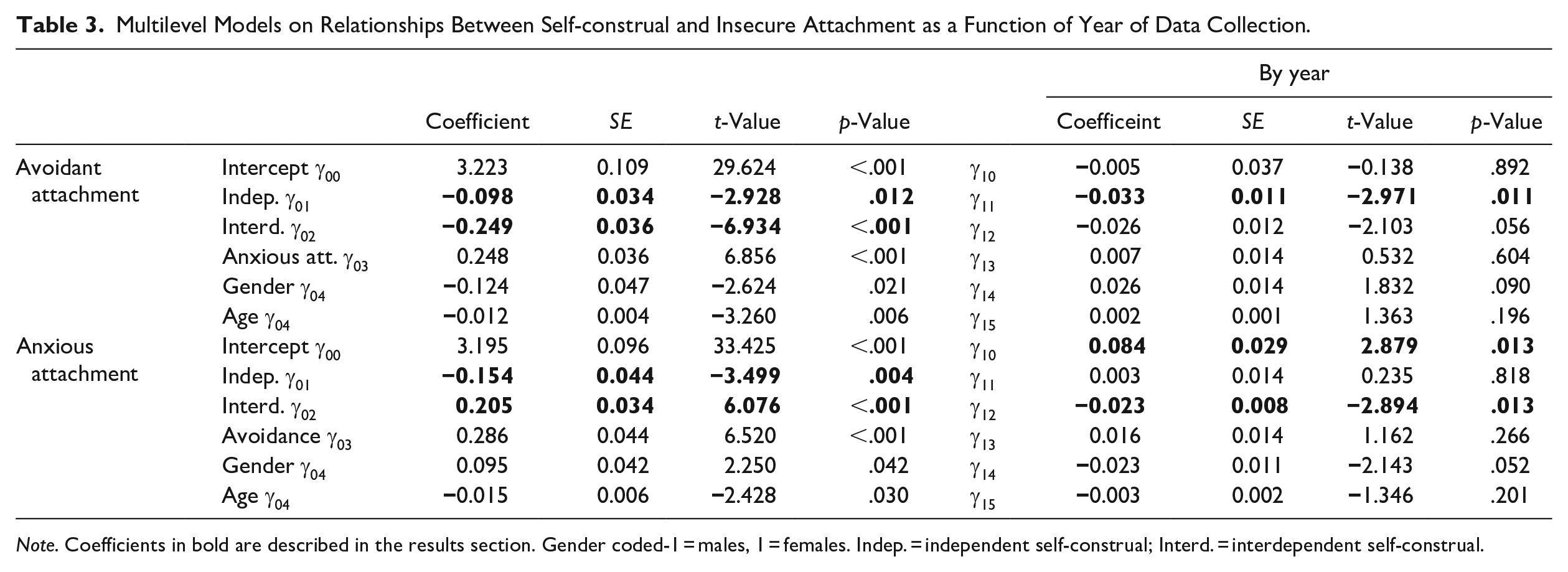
Note. Coefficients in bold are described in the results section. Gender coded-1 = males, 1 = females. Indep. = independent self-construal; Interd. = interdependent self-construal.
[2] Level 1:

Level 2:

Results depicted that in the recent, crisis-stricken years, participants reported, on average, higher anxious (γ10 = .084, t = 2.879, p < .05) but not higher avoidant attachment (γ10 = −.005, t = −0.138, p = .892). Anxious and avoidant attachment orientations were negatively related as expected, yet, Year of data collection did not moderate any of the relationships between anxious and avoidant attachment and models that included only the expected predictor (Year at level two) and each of the anxious and avoidance attachment at individual level, did not return meaningfully different results than the ones presented above. Females reported lower avoidant attachment than males (γ04 = −.124, t = −2.624, p < .05) and this relationship tended to increase during the recent years.
Hypothesis 3 (meta-analytic type relationships between insecure attachment and self-construal) was tested by examining overall (level 1) relationships between anxious and avoidant attachment and independent and interdependent self-construal (see formula (1) and Table 2). A meta-analytic approach is justified given that data were collected at different times from different samples under different conditions (e.g., in some studies additional scales were included). Meta-analysis redirects attention toward effect sizes and away from individual studies’ p-values, which have very limited comparative value (Goh et al., 2016) and MLM models is one way such meta-analyses can be conducted (see Hox & de Leeuw, 2003). As expected, anxious attachment was overall positively associated with interdependent self-construal (γ02 = .111, t = 7.148, p < .001) and negatively associated with independent self-construal (γ02 = −.071, t = −3.64, p < .001). Avoidance was overall negatively associated with independent self-construal (γ01 = −.052, t = −2.559, p < .05) which was not expected, yet in partial agreement with expectations, avoidance was also negatively correlated with interdependent self-construal (γ01 = −.146, t = −5.130, p < .001).
Regarding the research questions, significant associations between avoidant attachment and independence and anxious attachment and interdependence were moderated by Year of data collection (Table 2). Namely, the negative association between avoidance and independent self-construal was further intensified in the recent, crisis-stricken years (γ11 = −.021, t = −3.082, p < .01). This interaction was graphically probed in HLM 7.03 using the upper and lower quartiles in Year and a full range of the avoidant attachment variable. As depicted in Figure 2, in the more recent, crisis stricken years (Year higher quartile, calculated 3.197 corresponding roughly to the year 2015), higher avoidant attachment was associated with lower independence (predicted value = 3.699) compared to lower avoidant attachment (predicted value = 4.870). In the earlier pro-crisis years (Year lower quartile, calculated −5.173 roughly corresponding to the year 2007) higher avoidant attachment was associated with a flat drop in independent self-construal (predicted value = 4.516) compared to lower avoidant attachment (predicted value = 4.787).

Avoidant attachment by year interaction predicting independent self-construal.
Conversely, the positive association between anxiety and interdependent self-construal was weakened in the economic crisis years (γ11 = -.018, t = -5.459, p < .001). This interaction was also graphically probed using the upper (3.197) and lower (-5.173) quartiles in Year and a full range of the level 1 anxious attachment values. As depicted in Figure 3, in the earlier, pro-crisis, years (Year lower quartile calculated -5.173) higher anxious attachment was associated with higher interdependence (predicted value = 5.081) compared to lower anxious attachment (predicted value = 3.963). In the more recent, crisis stricken years (Year higher quartile, calculated 3.197), higher anxious attachment was associated with higher interdependence (predicted value = 4.760) compared to lower anxious attachment (predicted value = 4.480) however in a much lower rate than in the earlier, pro-crisis years. All of the analyses reported above were repeated including an avoidance by anxious attachment interaction term, that is considered to represent the fearful attachment orientation (Hart et al., 2005), yet the results did not differ meaningfully from those found without entering this interaction term.
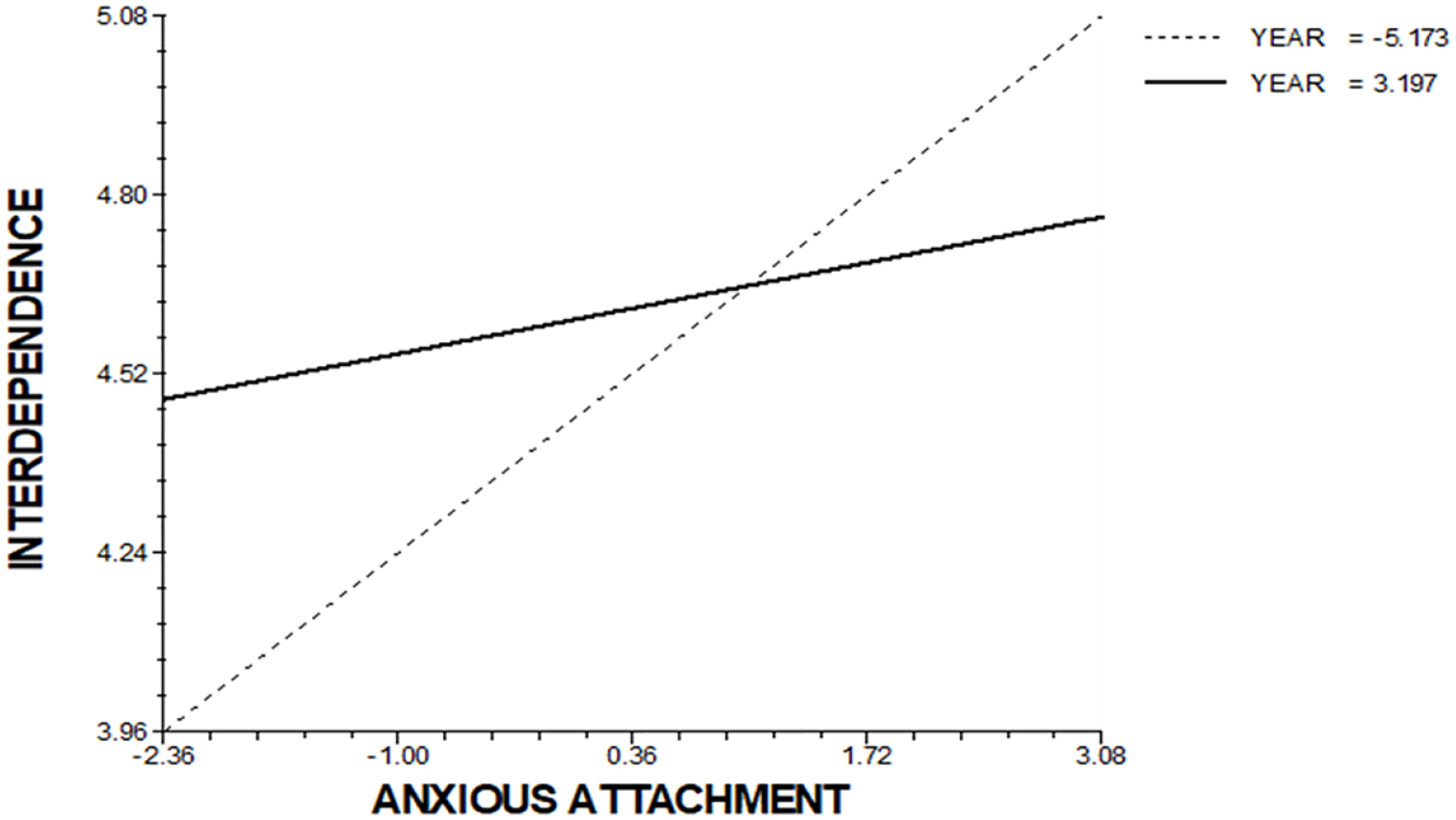
Anxious attachment by year interaction predicting interdependent self-construal.
Granger-Type Causality Test
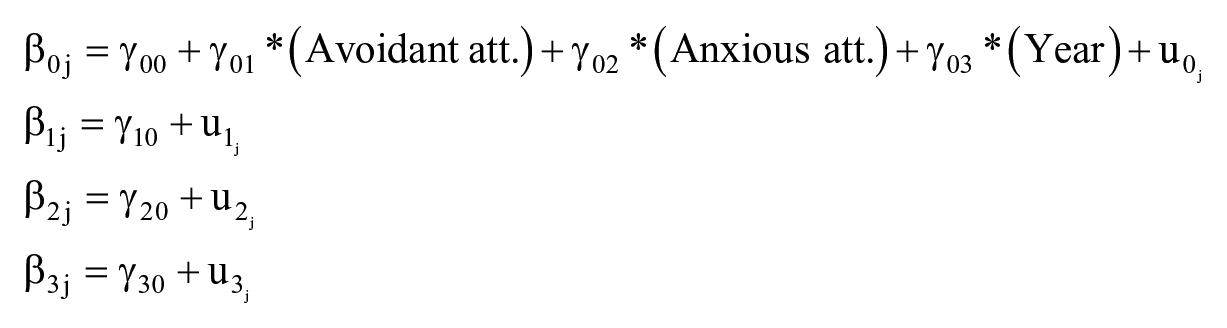
Given temporal variation found in the avoidance—independence and anxious attachment-interdependence relationships, a Granger-type causality test (Granger, 1969) was performed to assess likely temporal precedence of avoidant attachment over independent self-construal, that is, to test whether, a year by year change of avoidant and anxious attachment predicts shifts in independent and interdependent self-construal, or, conversely, whether it is the yearly change in independent and interdependent self-construal that drives changes in avoidant and anxious attachment. To do that, two lagged models were tested where yearly (Level 2) predictors were regressed on the following measured temporal point/year (Level 1) outcomes using models (3) and (4) below. These analyses were run in two steps, with the second step including year of data collection to explore crisis-related effects. Given the lagged form of analyses, data for level 2 predictors derive from Databases 1 to 14.
[3] Level 1

Level 2
[4] Level 1

Level 2
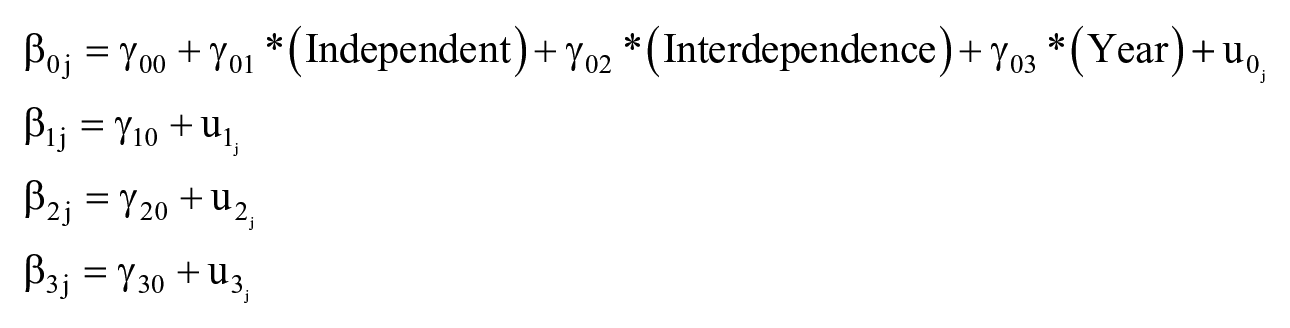
Results depicted in Table 4a found avoidance temporally preceded reported changes in independent self-construal. Specifically, higher avoidance in the temporarily preceding year of data collection was associated with lower independence in the following year/time points (γ02 = -.274, t = -2.681, p < .05). Entering year of data collection in step 2 rendered this association non-significant. Independent self-construal was not found to temporally precede variation (shifts) in avoidance across the years under examination (see Table 5a). Further supporting assertions for the likely causal role attachment orientations may have on self-construal were findings (depicted in Table 4b) that temporarily antecedent year-average avoidance predicted higher year-average interdependent self-construal in subsequent yearly time points (γ02 = .842, t = 4.468, p < .01) whereas higher temporarily preceding average anxious attachment was associated with lower interdependence in subsequent yearly time point (γ02 = -.699, t = -4.644, p < .01) in the examined period (2004-2016). The likely interactions between avoidance and interdependence were further highlighted by relationships between average temporally antecedent interdependence and higher avoidance in the following yearly time point was observed (Table 5a).
Multilevel models predicting independent and interdependent SC from the temporally preceding year Avoidant and Anxious attachment (step 1) and Year of data collection (step 2).

Note. Coefficients in bold are described in the results section. For presentation purposes, results from Level 1 variable relationships with the outcome are omitted from Step 1. Gender coded-1 = males, 1 = females. Indep. = independent self-construal; Interd. = interdependent self-construal.
^p < .10. *p ≤ .05. **p < .01. ***p < .001. ^p < .06.
Multilevel Models Predicting Avoidant and Anxious Attachment From the Temporally Preceding Year Independent and Interdependent SC (step 1) and Year of Data Collection (step 2).

Note. Coefficients in bold are described in the results section. Gender coded-1 = males, 1 = females. For presentation purposes, results from Level 1 variable relationships with the outcome are omitted from Step 1.
*p ≤ .05. ***p < .001. ^p < .06.
Discussion
Socioeconomic conditions constitute one important predictor of prevalent trends toward higher individualism and cultural differences in levels of individualism internationally (Santos et al., 2017). In a way of natural experiment (e.g., Oishi et al., 2018), the present research documented significant fluctuations (shifts) in young people’s self and attachment orientations during a period of significant economic downturn in Greece. There was also evidence of temporal shifts in attachment and self-construal relations, likely due to conditions related to the economic crisis.
In line with expectations, participants understood themselves as less independent and higher in anxious attachment in recent years of higher unemployment and economic uncertainty than in earlier (pre-crisis) years. These findings are important not only because they provide a unique insight into how deteriorating economic conditions can affect cultural and personal identity changes at the individual level (e.g., Park et al., 2014), but also because the pseudo-longitudinal nature of the study points to likely processes that may underlie these changes, in a society (Greece) that is considered more collectivistic than those typically studied.
The findings regarding a shift toward lower independent self-construal were in accord with expectations and observations regarding significant declines in levels of independent self-construal during periods of economic crisis in the United States (Bianchi, 2016; Park et al., 2013) and broader changes in socioeconomic structure and individualism (Grossman & Varnum, 2015). Findings are also consistent with broader cross-national analyses of the impact of the 2008 global financial crisis on European youth, which also evidenced a decline in growth and self-expression values and an increase of values that revolve around security and self-protection (Sortheix et al., 2019). The observed downturn in independent self-construal may have resulted from a shift in related mind-sets. Economic crises provide ample environmental cues that prime people toward lower independence (Greenfield, 2009), and this may influence cultural self-schemas. This idea is consistent with a socially situated cognition perspective on understanding of the self (Oyserman, 2016). Other motivational or social comparison-related processes that could be responsible for the observed changes (see Bardi & Goodwin, 2011; Sánchez-Rodríguez et al., 2019) cannot be ruled out and could be the subject of future research. Contrary to hypotheses, an increase in interdependent self-construal during the economic crisis years (Greenfield, 2009) was not demonstrated (in fact, in the time-lagged models, there was even a trend toward decreasing interdependence observed over the time period studied, when prior avoidant and anxious attachment were controlled for). This is a non-finding that deserves further investigation given prior research pointing to obstacles in the enactment of social approach in collectivistic cultures (Kafetsios & Nezlek, 2012; Kim et al., 2008; Oishi & Komiya, 2017).
The present study provides important new information to the existing literature with regard to how other aspects and levels of the self (Sedikides et al., 2011) may influence self-construal, in particular young persons’ insecure attachment. Due to its close link to threat and uncertainty regulation and social relating tendencies, insecure attachment was considered more proximally related to socioeconomic presses in comparison to sociocultural self-concept. Anxious attachment self-perceptions increased during the crisis years, consistent with expectations deriving from attachment theory (Mikulincer et al., 2000). Increased threat appraisal may make these individuals more vulnerable to socioeconomic stress (Marris, 1996; Mickelson et al., 1997), a finding also supported by recent evidence that in the first wave of the Sars-Cov-2 epidemic, anxious attachment was associated with higher risk perception, but avoidant attachment was associated with lower risk perception (Tagini et al., 2021). In turn, as expected, avoidant attachment did not significantly increase in younger persons’ self-perceptions during the crisis years, also suggesting that avoidant persons may have a way of coping with threat responses.
Self-construal and insecure attachment orientations were overall interrelated, as expected (Strand, 2020), and this relationship was a function of temporal shifts in socioeconomic conditions. Consistent with Hypothesis 3, anxious attachment orientation was associated with higher interdependent self-construal and lower independent self-construal. Avoidant attachment was however, not associated with higher independent self-construal as expected by H3, yet, avoidance was associated with lower interdependent self-construal, partially confirming H3. Importantly, it were relationships between avoidance and independent self-construal and anxious attachment and interdependent self-construal that shifted during the crisis years. Higher avoidance was associated with lower independent self-construal whereas higher anxious attachment was associated with a weaker link to interdependent self-perceptions compared with the pre-crisis years.
These patterns of changes were further tested in an exploratory analysis that mimicked a Granger causality test. Namely, the temporal shifts (lowering) in independent self-construal were predicted by the previous time-point/year higher avoidant attachment, and not the other way round (i.e., preceding year independence did not predict subsequent year/time point avoidance). An indirectly related finding that needs to be explored further is that temporally preceding avoidance predicted subsequent year higher interdependence whereas higher anxious attachment was associated with lower interdependence in subsequent years of the respective time period. Overall, these results provide a solid empirical basis for recent theorizing on insecure attachment as an antecedent to central cultural mandates of independence or interdependence, as proposed by Strand (2020). The present study findings are also consistent with recent cross-cultural evidence that, compared to independent/interdependent cultural orientations, attachment orientations can be a stronger predictor of responses to threat, epidemic (COVID-19) threat in particular (Kafetsios, 2021). From a practical perspective, the results signify it is the secure persons who develop a stronger interdependent and more independent understandings of the self during the crisis years, two strategies that can have a positive impact on social and personal outcomes.
The results also have theoretical information added-value on the connection between insecure attachment orientations and self-construal. In particular, the fact that it were specifically the anxiety-interdependence and the avoidance-independence relationships that lowered during the economic crisis point to a socio-cognitive path of confluence (Janoff-Bulman, 1989; Mikulincer et al., 2009) between working models of self and other in insecure attachment (Pietromonaco & Barrett, 2000) and cultural self-construal. The diminishing strength of the relationship between anxious attachment and interdependent self-construal in the crisis years suggests that presses to focus and act on the self as distinct from others (a way of thinking which is a-typical in interdependent contexts) may have rendered young persons’ anxiety working models as less other-oriented. Equally, lower independence mind-sets during the crisis years could account for the weaker relationship found between avoidance and independent self-construal.
Finally, an interesting by-product of this study was findings for gender relationships with self-construal temporal changes. As might be expected (Cross & Madson, 1997), women reported lower overall independent self-construal overall than men, and this relationship tended to increase during the crisis years. There was also evidence that men’s and women’s attachment orientations shifted during the more recent, crisis stricken years.
Limitations
The results of this study should be evaluated keeping a number of limitations in mind. First, although a repeated cross-sectional survey design provides meaningful information about longitudinal changes, it cannot reliably substitute for an actual longitudinal research; the present study cannot rule out the possibility that the results are due to cohort effects, although this is less likely given the limited study period. Second, the data in this study are self-reported, and various factors may influence how people interospect on their own psychological processes. Third, the results generally involve a younger generation. In general, younger generations place more value on autonomy and self-expression more than older generations, and how socioeconomic deterioration may affect changes in self-concept among older adults is a question that warrants further investigation.
Conclusion
Research in social psychology has identified economic fluctuations as the sources of changes in cultural values and understanding of the self. Although most of this work has been insightful, it has focused on the consequences of economic downturns at the cultural level and in one particular culture, the United States. The present research provides an important extension of existing research by documenting important links between socioeconomic processes and individual-level variation in cultural understandings of the self, insecure attachment, and their interrelationship in a society (Greece) that is considered more collectivist.
Supplemental Material
sj-doc-1-jcc-10.1177_00220221211060458 – Supplemental material for Self-construal and Insecure Attachment Variation and Co-variation During a Period of Economic Crisis
Supplemental material, sj-doc-1-jcc-10.1177_00220221211060458 for Self-construal and Insecure Attachment Variation and Co-variation During a Period of Economic Crisis by Konstantinos Kafetsios in Journal of Cross-Cultural Psychology
Footnotes
Declaration of Conflicting Interests
The author(s) declared no potential conflicts of interest with respect to the research, authorship, and/or publication of this article.
Funding
The author(s) received no financial support for the research, authorship, and/or publication of this article.

Supplemental Material
Supplemental material for this article is available online.
Notes
References
Supplementary Material
Please find the following supplemental material available below.
For Open Access articles published under a Creative Commons License, all supplemental material carries the same license as the article it is associated with.
For non-Open Access articles published, all supplemental material carries a non-exclusive license, and permission requests for re-use of supplemental material or any part of supplemental material shall be sent directly to the copyright owner as specified in the copyright notice associated with the article.
