



Abstract
This study examines what it means to be bicultural to Hmong American emerging adults living in central California. Twenty-four participants (Mage = 21.92 years) constructed a cultural identity map that portrayed what it means to them to be “Hmong American,” described both their cultural identity map content and their process of constructing it, and completed the Multigroup Ethnic Identity Measure (MEIM). Grounded theory analysis of cultural identity maps and accompanying conversations reveals the pervasiveness of bifurcated biculturalism, or the experience of having split selves. For participants in this study, perceived cultural incompatibility between Hmong and American cultures rendered it necessary to possess two (and sometimes more) distinct cultural identities, and required—for some, almost constant—frame-switching to manage these identities. This article offers an in-depth portrait of three illustrative cases, which represent diversity in terms of gender, social class, and MEIM score. Altogether, findings contribute to scientific understanding of the complex and contradictory nature of biculturalism for Hmong American emerging adults, and speak to the link between ethnic stereotypes and bicultural identity development. Methodologically, this study highlights the utility of identity mapping to examine psychological experiences of biculturalism and other aspects of identity about which people may have hidden, complex, and potentially contradictory stances.
Keywords
The advantages of biculturalism, or incorporating multiple cultures into one’s sense of self, have been well documented in recent decades (e.g., Chen & Padilla, 2019; Schwartz & Unger, 2010). Conclusions about the adaptiveness of biculturalism, however, are overwhelmingly drawn from quantitative studies (Safa & Umaña-Taylor, 2021) that foreground researcher’s definitions of and expectations about the phenomenon. This reflects trends in psychology more generally, wherein qualitative methods are commonly framed as precursors or adjuncts to addressing quantitative questions (Lamarre & Chamberlain, 2022; Syed & McLean, 2022). When qualitative psychological research is published, its typically formulaic nature (e.g., via consensus coding, near exclusive reliance on interviews and focus groups, and constructing exclusively descriptive [vs. theorized or interpretive] accounts) reflects the enduring positivist legacy in our discipline and constrains knowledge production (Brinkmann, 2015; Clarke & Braun, 2019; Lamarre & Chamberlain, 2022).
To galvanize innovation and insight about complex psychological phenomena—such as the nature and experience of biculturalism (Meca et al., 2019)—dynamic, flexible, and creative approaches to data collection and analysis are needed. That is, we need methods that allow us to make new connections, address contradictions, and see complex realities that may be omitted when relying exclusively on self-report measures and interviews. This study uses the entirely inductive arts-based methodological tool of cultural identity mapping to examine the meaning of biculturalism among a seldom studied cultural group in the United States: Hmong Americans. In so doing, this study aims both to offer methodological contributions to the study of cultural identity development and to contribute to scientific understanding of Hmong American emerging adults’ cultural identities.
Managing Multiple Cultural Identities
Cultural identity is presently defined as one’s experience of cultural in-group membership—which encompasses the adoption of cultural beliefs, behaviors, values, and/or ideologies (McKenzie et al., 2023). Much of what is known about cultural identity development among immigrant-origin youth comes from quantitative, survey-based studies that examine the existence and the adaptiveness of biculturalism. For three decades, Berry’s (1992, 1997) acculturation model, which proposes four possible strategies of acculturation depending on the extent to which one identifies with their (ethnic) heritage culture and (national) host culture, has guided research examining the adoption of multiple cultural identities. This has inspired the development of acculturation scales for specific ethnic and pan-ethnic groups (e.g., Chung et al., 2004; Cuéllar et al., 1995). Research widely suggests that biculturalism or integration (in which one strongly identifies with both heritage culture and host culture) is the ideal way of psychologically adapting to intercultural contact. This line of work argues that bicultural individuals are more physically and mentally healthy, better at perspective-taking, more flexible, and more creative (Safa & Umaña-Taylor, 2021; Tadmor et al., 2012).
The early 2000s ushered in the explicit examination of not only how much individuals identify with multiple cultures, but also how individuals internally negotiate the multiple cultures with which they identify. The widely used Bicultural Identity Integration Scale (Benet-Martínez & Haritatos, 2005; Huynh et al., 2018), which assesses the extent to which cultural identities are blended (vs. compartmentalized) and experienced as harmonious (vs. conflictual), largely guided these efforts. This line of work has propelled important insights about cultural identity among bicultural youth—especially regarding the health-promoting effects of possessing blended cultural identities and experiencing cultural identities as harmonious (Nguyen & Ferguson, 2020; Safa & Umaña-Taylor, 2021; Yampolsky et al., 2015).
Although the work highlighted in the previous two paragraphs has yielded important insights, the dominance of scale-based assessments of young people’s experiences of biculturalism speaks to the pervasiveness of etic approaches—which impose an overlay of the researchers’ perspectives, rather than prioritizing participants’ subjective realities (Rogoff, 2003)—in our field. In part because of this etic and quantitative tendency in cross-cultural psychology, less is known about how young people perceive their own management of multiple cultural identities, and about the processes that lie beneath these commonly used cultural identity categories (Meca et al., 2019; Ward, 2008).
Although rarer in acculturation studies, recent qualitative emically oriented research has revealed how young people manage multiple cultural identities (e.g., Ferguson et al., 2020; Lee et al., 2022; McKenzie et al., 2022, 2023; Nguyen & Ferguson, 2020). Thus far, such work has especially drawn attention to cultural frame-switching, a process wherein individuals alternate between cultural identities depending on circumstance (Ferguson et al., 2020; LaFromboise et al., 1993; Lee et al., 2022; McKenzie, 2019) and the complementary process of cultural variability, in which individuals play up and play down their cultural identities (Nguyen & Ferguson, 2020). Quantitative, etic-based research on the adaptiveness of cultural frame-switching and cultural variability is mixed, with some work highlighting their adaptiveness (e.g., by enabling positive relationships with more than one culture; LaFromboise et al., 1993; Nguyen & Ferguson, 2020) and other work highlighting their risks (e.g., via associations with cultural identity conflict and poorer psychological adaptation; Ward et al., 2019).
Creative qualitative methods that do not rely exclusively on language (i.e., interviews, focus groups) and numerical representations of psychological phenomenon (i.e., surveys) are well positioned to address these inconsistencies and speak to the multidimensional nature of young people’s experiences of biculturalism more generally. To date, qualitative studies investigating how multicultural youth manage multiple cultural identities overwhelmingly rely on interview and focus group data—data collection techniques that, while valuable, can limit scientific understanding of complex internal processes. Although largely invisible in psychology, arts-based methods—which include, but are not limited to, the construction of visual images 1 —represent an exciting avenue insofar as they open doors to obtaining knowledge and conveying emotions that may otherwise remain covert (Chamberlain et al., 2018). This is perhaps especially important for members of cultural groups that tend to de-emphasize emotion, and for younger people who may not yet have the language to identify and describe potentially contradictory psychological states.
Arts-based approaches, for instance, have been integral in theorizing and studying people’s experiences of living “in-between” two distinct cultures (Anzaldúa, 2012; Keating, 2022). Such work suggests that this “in-betweenness” can give way to the emergence of a third consciousness that holds space for paradoxes or conflicts—thereby representing a potentially psychologically adaptive alternative to blending or integrating heritage and host cultures (Benet-Martínez & Haritatos, 2005; Huynh et al., 2018). That is, although the tensions inherent in living at the borderlands of opposing cultural realities can be painful, it can also carry the potential for liberation and empowerment (Anzaldúa, 2012, 2015). While meanings ascribed to living “in-between” has to some extent been explored among Chicanx and Latinx American youth (e.g., Bernal, 2001; Covarrubias & Valle, 2023; Garcia & Delgado Bernal, 2021), little is known about how Hmong American youth—a population that remains largely invisible in cultural and developmental psychology literature—make sense of inhabiting multiple cultural realities.
Hmong American Youth Experiences of Biculturalism
Hmong are a stateless ethnic group with geographic ties to South and Southeast Asia. Following their persecution in southern China in the 1800s, many Hmong moved to mountainous regions of Laos, Thailand, Burma, and Northern Vietnam (Chiang et al., 2015). During the 1960s and 1970s, and in the shadows of the Vietnam War, the U.S. CIA conducted a “Secret War” in Laos in which an estimated 30,000 Hmong boys and men were recruited to fight against the Communist Pathet Lao Viet Cong (North Vietnamese). Estimates suggest that by 1971, over half of all Hmong males over the age of 15 had been killed in combat (Faderman & Xiong, 1998).
When the Hmong military were forced by Viet Cong troops to retreat from Laos, the Hmong were “targets of genocide” from the victorious communist governments of Laos and Vietnam for their partnership with the United States (Chiang et al., 2015). This persecution resulted in thousands of deaths and a massive fleeing to Thailand—mostly by foot—for refuge. Those who survived the grueling journey lived in refugee camps in northern Thailand for years before being allowed to move to the United States and elsewhere from the late 1970s through the mid-1990s (Tsai, 2000). Today, central California is home to the largest Hmong diaspora outside of East and Southeast Asia (Salazar, 2022). Recent scholarship has tied Hmong Americans’ relatively high rates of poverty and lack of representation in higher education to their reason for relocation (i.e., out of necessity as political refugees, vs. choicefully for “a better life”), the incongruent lifestyle in Laos and the United States, the fact that U.S. resettlement agencies largely resettled Hmong in poor communities, and the enduring Model Minority Myth (Budiman, 2021; Chiang et al., 2015).
When Hmong are focused on in psychological literature, they are typically folded in alongside other Southeast Asian or Asian groups (e.g., Chan et al., 2020; Nguyen & Ferguson, 2020; Thompson et al., 2016). While there are some shared experiences across Asian ethnicities, the characterized cultures are hugely variable—hailing from diverse regions, and possessing diverse migration histories, languages, and religions. Perhaps because of this tremendous diversity, only a quarter of Asian Americans actually identify with this pan-ethnic label; indeed, Asian adults often see more cultural differences than commonalities across their group (Ruiz et al., 2023). Although we have for over a decade seen pushes to disaggregate “Asian American” data in various spheres—from popular discourse (Zhou, 2021) to scholarly spaces (e.g., Bhakta, 2022; Hasnain et al., 2020) to the government (Aina, 2012), this call and practice is less often seen in psychology. It is, however, a pressing need because the psychological experiences and cultural identities of Asian Americans are anything but uniform. Collapsing multiple Asian ethnicities into a single pan-ethnic category serves to flatten their experience and mask their realities—which matters in our science and in our classrooms.
Quantitative, survey-based assessments of cultural orientation have revealed that, for overseas-born (i.e., first generation) and U.S.-born (i.e., second generation) alike, Hmong American young adults in the midwestern United States were more oriented to American culture than to Hmong culture (Tsai, 2000), thereby driving a cultural gap between generations (as older Hmong adults were deemed more culturally traditional). Vang’s (2014) work has also pointed to similar acculturation levels among first- and second-generation Hmong adults in midwestern United States, suggesting parallel rates of acculturation regardless of generation status. Yet, some research has revealed differences in models of cultural orientation by place of birth. Among first-generation Hmong young adults, “being Hmong” and “being American” were negatively correlated constructs (i.e., the more “Hmong” they felt, the less “American” they felt); no such correlation existed among second-generation Hmong young adults (Tsai, 2000).
Qualitative research has to some extent unpacked meanings of “being Hmong” among Hmong American young adults. Tsai (2000) found that first- and second-generation Hmong youth in the midwestern United States alike consider customs, traditional behaviors, and group (particularly migration) history as core to “Hmongness.” Recent research in the western United States has identified the precise customs, traditional behaviors, and traditional beliefs that are deemed core to Hmong cultural identity: the centering of family, community, and age-based hierarchy; gender role expectations; religiosity (particularly Shamanism and Animism); and individual-level traits of deference and obedience (Chiang et al., 2015; McKenzie et al., 2022; Schaefer, 2008; Tatman, 2004). Yet, research suggests that the current generation of Hmong American young adults in the western United States commonly center autonomous American values and work to reshape Hmong values that are deemed problematic, such as strict gender roles, emotional stoicism, and submission of the individual in favor of the collective (McKenzie, 2022; McKenzie et al., 2022).
Other qualitative work with Hmong youth suggests the complexity of cultural identity for this cultural group, wherein youth are simultaneously prideful of their Hmong identity—particularly of cultural practices such as language and dress (e.g., McKenzie et al., 2022; Nguyen, 2013; Tsai, 2000)—and disconnected from and critical of “Hmongness” and Hmong culture (McKenzie, 2022; Tsai, 2000). Some work also suggests that Hmong youth feel connected to other Asian identities (e.g., Korean, Thai [McKenzie, 2022]) and nonethnic identities (e.g., hip hop [Nguyen & Ferguson, 2019, 2020])—perhaps in part because barriers may impede alignment with their heritage Hmong identity. Thus far, however, little is known about what those barriers might be, and why members of this cultural group may be particularly prone to identify with tertiary cultures.
In sum, Hmong Americans possess a unique migration history and appear “at risk” of assimilating to American culture—a risk given that, as previously noted, research suggests that identifying with and integrating ethnic and national identities uniquely promotes psychological and physical health. Yet, little is known about the cultural identity development of Hmong Americans, due in part to the tendency to aggregate data (e.g., lump this group alongside other Asian Americans or Southeast Asian Americans). Creative, arts-based qualitative methods are uniquely positioned to understand the proclivity toward assimilation and the complexity of cultural identity development for this cultural group.
Current Study
This study utilizes qualitative and quantitative data collection techniques to examine the cultural identities of Hmong American emerging adults living in central California. The present focus is primarily on cultural identity mapping, an arts-based tool that simultaneously unlocks and centers young people’s unique experiences of biculturalism. Owing to its psychoanalytic roots (Furth, 2002), this method encourages the externalization of emotions that talking alone may not accomplish. Whereas cultural identity research tends to separately assess identification with heritage and host identities (McKenzie et al., 2023; Tsai, 2000), cultural identity mapping facilitates reflection about and assessment of both identities in tandem, therefore inviting reflection on one’s whole (as opposed to partial) identity.
With regard to age, the focus is on emerging adults given that this is a period of intensified identity and cultural identity exploration (Arnett, 2000; Jensen et al., 2011; Phinney, 1990). With regard to location, the focus is on central California, a natural laboratory of sorts for studying Hmong youth given its status as the largest Hmong diaspora outside of East and Southeast Asia (Budiman, 2021).
Method
Participants and Researchers
This study was part of a larger project examining the psychological experiences of biculturalism among culturally diverse emerging adults in central California. Data collection took place over the course of 5 months, after obtaining approval from the California State University, Fresno Institutional Review Board.
Although Hmong youth represent roughly 5% of the California State University, Fresno student population, a recent report revealed that Hmong students at California State University, Fresno experience distinct academic challenges due in part to their cultural values and belief systems (Takahashi & Nottbohm, 2019). The same report highlighted problematic gaps in scholarly and institutional understanding of Hmong Americans’ unique experiences (Takahashi & Nottbohm, 2019), which impede targeted and culturally attuned support for this student population. For these reasons, the current study focused on a target sample composed primarily of current and former California State University, Fresno undergraduate and graduate students.
Participants were recruited via the circulation of study information and a flyer that invited prospective participants to contribute to science by sharing [their] experience growing up bicultural. The flyer was distributed by faculty members in multiple departments at the authors’ home institution, posted in the university library and in other campus buildings, and shared on a social media page geared toward prospective, current, and former university students. Given that participation in this study was predicated on participants’ self-identification as “bicultural,” participants will be referred to as “bicultural,” even if—as we shall see—they rarely neatly fit into the “integrated bicultural” label (per Berry, 1992, 1997).
A total of 24 Hmong American emerging adults (Mage = 21.92 years, SDage = 2.50, 21 females) living in central California took part in this study. Of these 24 participants, 21 either were pursuing or had obtained an undergraduate degree at the time of data collection and three were pursuing or had obtained a graduate degree at the time of data collection. Twenty-two participants were born in the United States (i.e., second generation); two participants were born in Southeast Asia and came to the United States as very young children (i.e., 1.5 generation). All but one participant had both parents born in Southeast Asia.
All interviews were led by the first author, a White European American woman who has studied cultural identity development of Southeast Asian youth for over a decade. To balance the challenges of the first author’s status as a cultural outsider (Rogoff, 2003), collaborators and co-authors are culturally diverse and include a Hmong American cultural insider. All data collection materials (i.e., recruitment flyer, study protocol, interview questions) were reviewed and modified upon consultation with the first author’s research assistant, a Hmong American emerging adult.
Data Collection
To obtain a layered understanding of participants’ cultural identities, this study combined multiple methodologies: (a) cultural identity maps in which participants depicted what it means to them to be Hmong American; (b) the Multigroup Ethnic Identity Measure (MEIM; Phinney, 1992), a 12-item survey that assesses the strength of participants’ identification with their ethnic group on a 4-point scale, with one subscale assessing ethnic identity exploration and another assessing ethnic identity commitment; and (c) a semi-structured interview in which participants responded to a variety of more pointed questions about—among other things their background, views of biculturalism, and home and school contexts in relation to biculturalism. Because data analyzed for this study were primarily cultural identity maps and participants’ descriptions of their maps, the following paragraphs will describe this portion of data collection in detail.
After participants’ questions were addressed and written consent was obtained, participants chose a pseudonym (a fictitious name by which they would be known for the purposes of this study to protect their identities). Participants were then asked to begin the conversation by constructing a cultural identity map, or a spontaneous drawing that conveys their cultural identity from their perspective. The prompt was as follows: I’d like to begin by asking you to draw what it means to you to be Hmong American, using this blank piece of paper, colored pencils, and a pen. You can depict this in any way you’d like—as long as it represents your experience as a Hmong American.
The interviewer stepped out of the room while the participant constructed their cultural identity map and completed the MEIM (which took between 10 and 20 min). Upon the interviewer’s return, the participant described the contents of their cultural identity map in detail. This conversation was semi-structured in nature, with the interviewer seeking to understand both identity map content (i.e., what the participant drew) and their process of constructing the map (i.e., how and why the participant drew what they drew). The conversation broadly included the following three sections:
Beginning: The participant was asked to guide the conversation, with the interviewer saying, “Tell me where you would like to begin in describing your identity map.” If they deferred to the interviewer, they were asked, “Could you tell me where you started in constructing your map, and why?”
Middle: The interviewer let the participant direct the description of and conversation surrounding their map. The interviewer regularly probed participants, seeking maximal clarification and depth. (The “Findings” section offers examples of the kinds of follow-up questions that the interviewer asked to seek clarification and depth.)
End: Once the map was thoroughly described, the participant was asked, “Pulling yourself up from the specifics of your map, and thinking now about your map in a broader way, what do you see? What seems to be the overarching story here?”
All conversations were audio-recorded, and participants received compensation in the form of a US$20 Visa Gift Card.
This identity mapping exercise builds upon methodologies used to document Muslim American identity in the U.S. context (Sirin & Fine, 2007) and Jamaican or “Jamerican” identity in the context of remote acculturation (Ferguson, 2018). The key difference is that the present prompt was even more open-ended to ensure that map construction was entirely inductive. That is, rather than eliciting a view of the self that is inherently multiple by asking participants to draw their selves (as was the case for Muslim American youth) or to map “the many sides of themselves” (as was the case for Jamaican youth who were remotely acculturated to U.S. culture), the present prompt did not prime participants to conceptualize or represent their heritage and host cultures as distinct. As such, this exercise invited participants to conceptualize and convey their cultural identities as intertwined—and indeed, many Mexican American youth who constructed cultural identity maps framed their ethnic and national identities as such (McKenzie et al., 2023).
Data Analysis
After audio-recorded conversations were transcribed, participants’ cultural identity maps (i.e., identity map content) and their descriptions of and discussions surrounding those maps (i.e., identity map process) were analyzed using grounded theory (Charmaz, 2006), an analytic technique that examines how meaning is constructed. The overarching focus was on how participants made meaning of biculturalism. As such, each stage of analysis employed constant comparison to interpret and explain the underlying meaning of participant drawings of and discourse about the nature of biculturalism.
At the stage of initial coding, all authors individually reviewed cultural identity maps and engaged in iterative individual readings of participant discourse in which they described their identity maps. At this stage of data analysis, we coded at the micro-level—focusing on cultural identity content. In addition to directly coding (i.e., brief analytic labels of smaller chunks of data, such as sentences and individual components of identity maps) and memoing (i.e., notes that document the researcher’s thinking about these data), each analyst simultaneously maintained a separate reflexive record dedicated to considering how their positionality may have influenced analytic interpretations. Following collective discussions of individual coding lists, memos, and reflexive stances, a complete list of 42 initial codes across analysts was compiled. When compiling the list of initial codes depicted in Figure 1, we strove to construct a list that was simultaneously comprehensive (i.e., by conveying all analysts’ observations) and parsimonious (i.e., by collapsing conceptually similar codes were framed in slightly different ways across analysts). Parsimony was achieved, for instance, by jointly labeling “culture clash,” “cultural tensions,” “two different worlds,” and “identity crisis” as “internal conflict.”
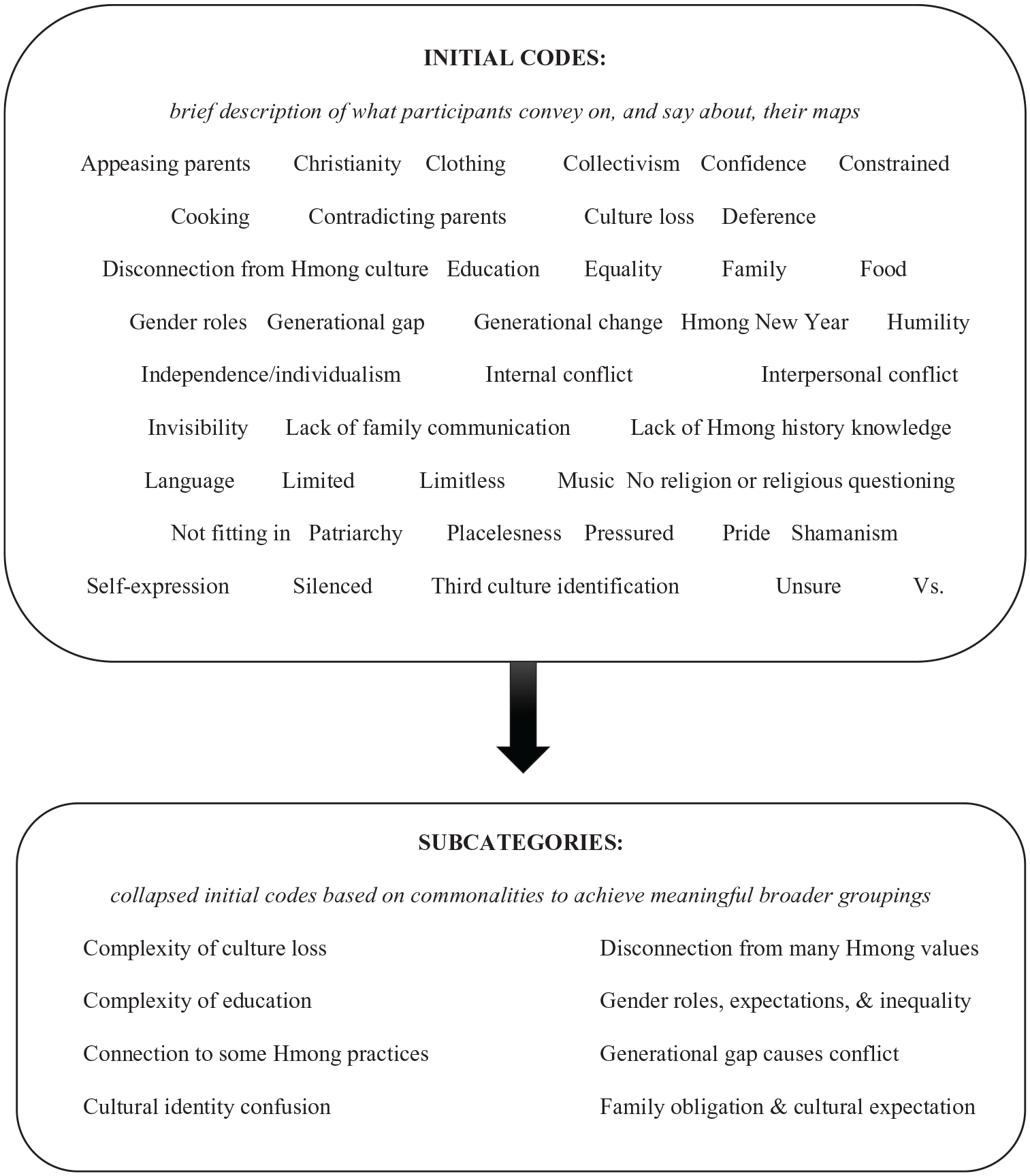
Initial and Focused Coding.
Beginning with initial coding and extending throughout data analysis, the research team discussed reflexive accounts on a weekly basis, paying particular attention to how our position as cultural insiders (in the case of Hmong- and Asian-identified analysts) and cultural outsiders (in the case of Latina and European American-identified analysts) informed coding and memoing. These conversations revealed that at the stage of initial coding, for instance, Latin American analysts often emphasized codes pertaining to language and family dynamics (also central components of biculturalism for Latin Americans [McKenzie et al., 2023]) and Asian analysts often emphasized codes pertaining to cultural expectations and culture clashes (experiences with which they could directly relate and observe in their community). The European American analyst, who holds a doctorate in psychology, emphasized codes pertaining to psychological experiences such as internal conflict and feelings of invisibility. The intentional diversity of this analytic team afforded rich discussions and a rounded portrait of participants’ experiences of biculturalism.
During the next stage of focused coding, we jointly examined the codes that had been identified during initial coding, with the aim of synthesizing across and explaining these codes. This synthesis was informed by a review of literature documenting Hmong American cultural identity development (detailed in the introduction). As a result of this probing of codes and literature review, eight analytic subcategories were developed to capture linkages between codes (see Figure 1). At this stage, for instance, cooking, deference, family, gender roles, humility, limited, patriarchy, and pressured were collapsed into a single subcategory and labeled “Gender roles, expectations, and inequality.” It is important to note, however, that some central codes recurred across multiple subcategories. For instance, reflecting the centrality of family in participants’ experiences of biculturalism, this code was featured in multiple subcategories: “Connection to some Hmong practices,” “Disconnection from many Hmong values,” “Gender roles, expectations, and inequality,” “Generational gap causes conflict,” and “Family obligation and cultural expectation.” Each of the five named subcategories, therefore, captures something distinct about the nature of family in participant experiences of biculturalism.
During axial coding, subcategories were further processed with the aim of reassembling the data by focusing on how cultural identity content (described in the preceding two paragraphs) was conveyed on individual identity maps. This data analytic stage, therefore, focused on process—or how Hmong American identities were conveyed on the maps themselves. At this stage, it became clear that participants overwhelmingly depicted their experience of biculturalism in one (or more) of three overlapping ways: (a) literally dividing their map in half, with one side devoted to their Hmong identity and the other side devoted to their American identity; (b) drawing themselves at the center of the map and split into two distinct selves; and (c) filling the paper with a variety of cultural contradictions, and portraying themselves as confused, caught in the middle, or altogether absent.
The final stage of theoretical coding entailed a tandem focus on cultural identity content and processes identified in earlier stages of analysis, seeking to establish the broadest explanatory theory offered by the data. The emergent theory that reflected the overwhelming majority of participants’ cultural identity maps was bifurcated biculturalism in which the self is perceived as stuck—either wedged between incompatible Hmong American cultural scripts, and/or caught amid a tidal wave of repressive Hmong values.
Findings will first be briefly described for the overall sample. Then, three illustrative cases will be explored in greater depth. These cases were chosen because, in addition to clearly conveying the experience of bifurcated biculturalism, they represent diversity in gender, social class, and MEIM score (Phinney, 1992).
To provide a sense of this diversity, and to contextualize individual experiences of bifurcated biculturalism, each case begins with a brief description of both the participant (including age, education and work status, MEIM scores) and their family background (including migration history, parent education and occupation). Beyond demonstrating the diversity of cases included in the present paper, participant MEIM scores are reported with the aims of: (a) offering a numeric sense of how participants manage multiple cultural identities, and (b) conveying the limitations of this quantitative measure in capturing different processes of managing multiple cultural identifications—illustrated by the fact that experiences of bifurcated biculturalism cut across participants with relatively higher and lower MEIM scores.
Findings
The overall MEIM score across the sample was 2.99 (identity exploration: 2.90, identity commitment: 3.07), on a 1 to 4 Likert-type scale, indicating a moderate identification with Hmong culture across the entire sample. The grounded theory of bifurcated biculturalism aids in making sense of participants’ moderate ethnic identification. To bring this grounded theory to life, an in-depth portrait of the maps and perspectives of three participants (each identified by their chosen pseudonym) follows.
J
J is a 21-year-old woman pursuing an undergraduate degree and working part-time as a student assistant. Her MEIM score was 3.25 (identity exploration: 3.20, identity commitment: 3.29). J was born in a central California city, where she grew up with both parents and three younger siblings. At the time of the interview, she lived alone in a dorm room on campus.
Both of J’s parents are Hmong and moved to the United States just after the end of the Vietnam War. Her father came from a wealthy clan in Laos and relocated to Thailand as a young child, and then to the United States in the late 1970s. J’s mother was born in a refugee camp in Thailand and migrated to the United States as a young girl. Her parents were married when J’s mother was 16 years old. J’s father holds a master’s degree and is an academic counselor; J’s mother holds a bachelor’s degree and is an elementary school teacher.
J’s divided identity map conveys her experience of being caught between two distinct cultures (see Figure 2). Before discussing the content of her identity map, J offered insight into her process of constructing the map. She explained (here and throughout, I = interviewer, P = participant): P: I wanted to portray how I feel . . . so I figured splitting the paper might help. I: I saw that you did that before I was even gone, you had folded the paper over. Why did you do that? P: I did that because I wanted to show a split in the paper. . . I wanted to define the two separate parts of me and my experience as a Hmong American. I wanted one side to be Hmong, and the other side to be American. [Deep sigh] Because I guess, my whole thing going on is that I feel like sometimes I come from two totally different worlds.
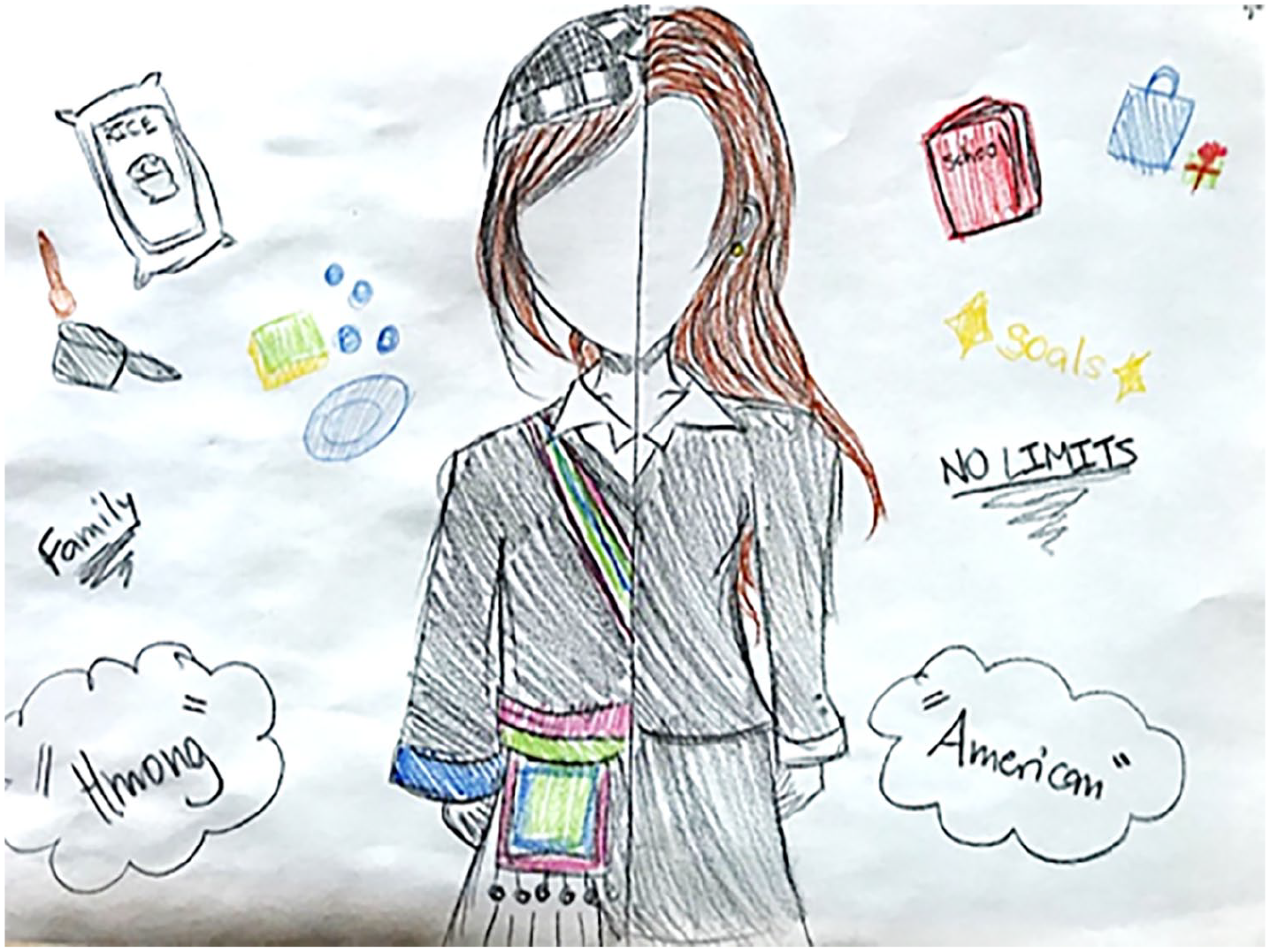
J’s Cultural Identity Map.
As the above exchange reveals, J’s instinctive paper-splitting is not inconsequential—rather, it reveals her psychological experience of inhabiting “two totally different worlds.” Throughout the rest of our conversation, J elaborated on how each “world” uniquely shapes her identity, and her—often challenging—experience of jumping back and forth between those worlds.
The left side of J’s identity map conveys her wearing Hmong clothing, with a traditional Hmong hat and hair conservatively pulled back. Although J typically wears Hmong attire during the week-long Hmong New Year celebration to appease her mother, J had recently decided that she would not do so that year, in part because she preferred to spend the hundreds of dollars that her mother planned to drain on Hmong clothes on textbooks. For J (and others, as we shall see), Hmong clothes served as both material and metaphorical representations of Hmong culture and their orientation toward it. For J, the conservative and confining nature of Hmong clothing represents both gendered cultural scripts that she finds restrictive and the perceived impossibility of synthesizing her Hmong American identities. This side of her map also elaborates other gendered expectations that she should cook, clean, and be laser-focused on family.
The right side of J’s map represents her American self. The business attire illustrates her focus on education and career, and her loose hair conveys the flexibility of women’s appearance in American culture. This side of the map further highlights her confident pursuit of personal goals, the perceived limitlessness for her and other women in American culture, and her ability to make use of personal financial capital (which she deems less feasible for “traditional Hmong girls”). Asked if J’s facelessness on the map was symbolic, she explained, It kind of was. I wanted to symbolize—OK, it’s going to sound a little weird. It’s almost like, since I’m always jumping back and forth between these two worlds, I feel like sometimes my identity is a little bit warped. So I left it blank because, in a way, I actually have to switch on and off masks between each world, so it’s never the same face.
The perceived incompatibility of J’s Hmong American worlds, and her inability to bring her authentic self into Hmong settings, renders J a constant shape-shifter. Although she questions, and indeed is agitated by, many Hmong values—particularly those revolving around gender—J works hard to understand Hmong customs and regularly participates in Hmong events. At such events, J “tries to be a typical Hmong girl that [my family] would like me to be.” Yet, conflict often arises with her mother and grandmother after such events because “sometimes the American me will jump out and say stuff that they don’t really like or want to hear.”
The decades-long tension that has characterized J’s relationship with her mother and grandmother centers on the incompatibility between “American her” (i.e., loud, outspoken, independent, and outward-focused) and traits expected of Hmong women and girls (i.e., docile, deferential, and with a relatively small world focused on family and the home). J expressed frustration with the constant reminders she received from family that her confidence and tendency to speak her mind rendered her “not a good Hmong girl.” Yet, these same traits, J pointed out, are considered virtuous in mainstream American society. “To sell yourself,” J explained, “in some ways you HAVE to do that.” The incompatibility between American and Hmong value systems forced J to engage in constant cultural frame-switching.
Asked what she sees when she looks at her map most broadly, J paused, then said, This is me, but this person—it’s always a conflict back-and-forth for this person. It’s a conflict between cultures, a tug-of-war. It’s like, I can’t really please you guys, but I want to do things on my own, so I don’t really care in the end for your opinions. But then I hear my mom’s and grandma’s voices, they’re always saying, “You have to care.” . . . On this page, it’s always a war of conflicts for this individual. . . I don’t even know what to call it—purgatory, maybe? Or like a loophole that I find myself in all the time. Where it’s like, “OK, yea, I can do this.” But then something else happened so now have to reel back, go back to the drawing board and figure out how I’m going to solve this. . .
J’s distancing of herself from “this person,” “this individual” (herself, as represented on her cultural identity map) suggests that disassociation may be a strategy employed to deal with bifurcated biculturalism. Asked if she thinks the war will be lifelong, she responded, “I don’t know, that’s a good question. I want it to end in this lifetime, but right now it’s not even close.”
Takashi
Takashi is a 25-year-old male pursuing a bachelor’s degree and working three jobs. His MEIM score was 2.67 (identity exploration: 2.40, identity commitment: 2.86).
Takashi was born, and continues to live, in a central California city with both parents and his five siblings. Both of his parents are Hmong and were born in Laos, and both moved to the United States after having spent several years in their early childhood living in a refugee camp in Thailand. His parents both received high school diplomas in the United States. While Takashi and his siblings were young, his mother stayed home and his father worked as a wood-cutter. More recently, his parents both work in a nearby factory for a combined total of 120 hours a week.
Like J, Takashi featured traditional Hmong clothing on his identity map (see Figure 3). Takashi’s uncertainty about Hmong culture was illustrated in part by the fact that he had to Google “Hmong clothing” to appropriately represent Hmong clothing and accompanying patterns on his identity map. Also like J, Takashi expressed that he only wears Hmong clothes to please his parents (“if I have to, if my parents want pictures”). In fact, Takashi predicted that his own Hmong clothing would be in a suitcase in 10 years’ time.
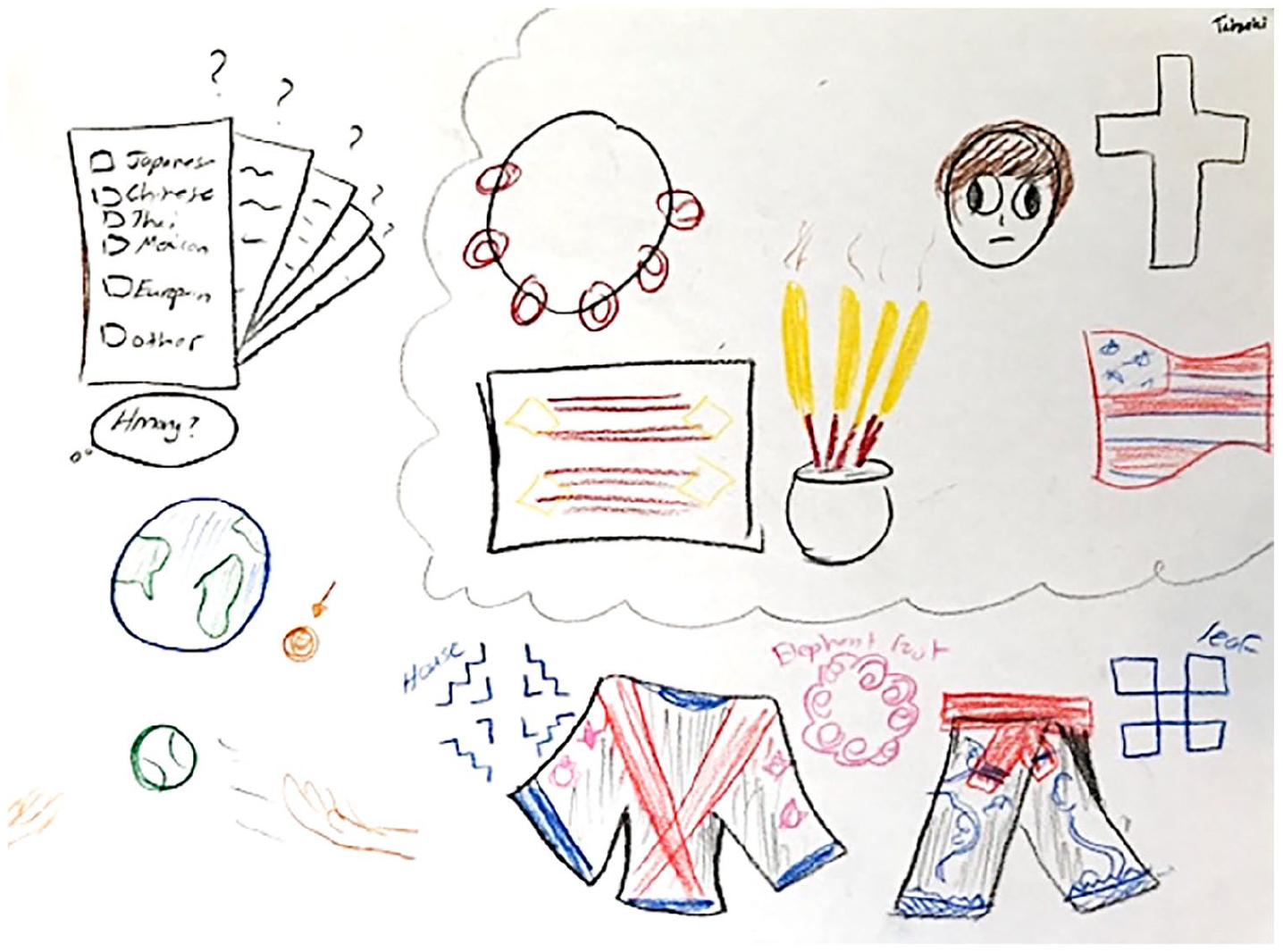
Takashi’s Cultural Identity Map.
Takashi’s map also highlights other traditional Hmong practices, including Pov Pob (ball-tossing as a form of courtship) and Shamanistic rituals (symbolized by incense, a musical instrument, and papers dedicated to the guardian spirit of the house, though Takashi expressed that he did not know their purpose). Asked if he participates in these rituals, Takashi responded, P: I just do it for my family, if that makes sense. I just do it for my family. I don’t really see—I don’t really understand it . . . culturally, I’m like a kid. If we need to do it, we’ll do it. I: Your parents don’t tell you why you need to do it, or—? P: They try to, but . . . I think they’re waiting for me to ask them. I: And you haven’t asked them? P: No (laughs), no. I’ve never really thought about it. Because, well, I’m agnostic so I don’t really believe in this kind of stuff. If my parents believe in it, I’ll support them. But I don’t believe it myself.
This exchange clarifies that, as with wearing Hmong clothing, Takashi’s participation in Shamanistic rituals is solely to appease his parents. For him, these practices were devoid of meaning.
The left side of Takashi’s map conveys the perceived invisibility of Hmong people—a topic that he elaborated on throughout our 2-hr conversation. He depicts this, first, via a stack of surveys and applications that offer a host of ethnic identifications, but no “Hmong” option. Although the experience of having to constantly force himself into the “Other” box anytime he is asked to report his race or ethnicity may seem superficial, it has contributed to gradual erasure of cultural identification over time. Beneath this stack of surveys, Takashi depicted Hmong invisibility in another way: by drawing planet Earth, and a small brown blob just to the right—“another planet or another place” for Hmong people. This illustration reveals Takashi’s experience of being “a true alien—because Earth doesn’t have a land for Hmong people.” Together, these depictions reveal Takashi’s cultural experience of “not being known and seen”—a reality that he dislikes, but tries not to think about because he deems it unalterable (“I was born into this world and it was already like this”).
The right-hand corner of Takashi’s map depicts his internal experience of biculturalism—that of feeling him stuck between two cultural spheres. He drew himself cross-eyed in between Hmong American cultures, because “I don’t know where I stand.” For Takashi, the Hmong sphere centers on Shamanism (which his family practices) and the American sphere centers Christianity and education—neither which neatly cohere with Hmong “spiritual stuff.” Takashi explained that he had been drawn to Christianity for a time because he preferred the atmosphere of church (singing, music, group talks) to lengthy, smokey incense-laden Shamanistic rituals.
The American flag, Takashi explained, represents “the American dream—going to school and getting a good job. [It’s about] focusing more on that stuff . . . and living life instead of thinking about religion.” Takashi’s drive to achieve the American dream inspires his pursuit of a Bachelor’s degree, which he hoped would help him “go farther in life” than his father. Although his parents supported his academic pursuits, Takashi experienced significant conflict between the academic gaze and his Shamanistic home culture, for education has trained him to develop a questioning attitude—including toward Shamanism and Hmongness.
For Takashi, his Hmong self and his American self constitute distinct spheres because he has learned that he cannot “bring what [he] learns from American culture into the Hmong culture.” Takashi said, “I can’t just tell my parents, ‘Hey, let’s stop doing this Hmong thing and practice American, OK?’ I can’t do that. My parents would say, ‘It’s not Hmong!’”
Asked how it feels to gaze cross-eyed toward each cultural sphere, Takashi explained, P: It feels like I don’t belong in either space, even in the middle. Like, where’s my sense of belonging, where’s my cultural identity? I’m stuck cross-eyed because I can’t bring myself to turn to one side. . . I: And does that feel bad? P: It feels neutral. Does that count? It doesn’t feel bad, but it also doesn’t feel good. It just feels normal. It feels, I don’t know, like I want to belong somewhere.
For Takashi, being in the middle meant that he was perpetually disconnected from both Hmong culture and American culture, even if he engages in some practices from each culture.
Although Takashi felt “very distant” from Hmong culture, even as it permeated his home via smells and sounds, he felt very connected to another Asian culture: Japanese. His identification with Japanese culture is illustrated in the style of his identity map (which invokes anime and manga comics), the description of his map (“I feel like I’m Japanese”), and his choice of pseudonym. Of his decade-long affinity for Japanese culture, Takashi shared, Growing up, I was more invested in Japanese culture than I was in Hmong culture because a lot of the things interested me more. The food, the anime and shows, the music, even the land—the cherry blossom trees, the scenery. Whereas in Laos and Thailand, it’s more like straw houses and rundown houses, stuff like that.
For Takashi, Japanese culture was a more alluring Asian culture than his own, owing both to Japan’s economic development and pop cultural contributions.
Before the interview began, Takashi shared that he had decided to participate in this research study because he wished to learn more about his Hmong identity. Asked if he had accomplished this goal at the end of the interview, Takashi explained that he had learned a great deal about his cultural identity, but not in the way he had anticipated. “I learned,” he said, “that I’m drifting away from Hmong culture and falling more into Japanese and American culture.”
Cactus
Cactus is a 23-year-old female pursuing a bachelor’s degree and working full-time as a bank teller. Her MEIM score was 2.08 (identity exploration: 1.80, identity commitment: 2.29).
Cactus was born in a central California city, and is one of nine children. At the time of our conversation, Cactus lived with her mother, stepfather, older brother, and (occasionally) her young son. Both of Cactus’s parents are Hmong and both were born in Laos, then spent several years in refugee camps in Thailand before relocating elsewhere. Cactus’s father came to the United States with his family in the early 1980s, and her mother first moved to France with her family in 1975 and then came alone to the United States in 1989. Her mother and father, both whom obtained high school diplomas in the United States, had a number of jobs while Cactus was growing up. Most recently, her mother assists with food preparation at a restaurant and her father works at a casino.
Before describing the content of her identity map (see Figure 4), Cactus reflected on how challenging the exercise was, as it pushed her to see that she holds a far more negative view of Hmong culture than she had realized. Cactus shared, P: It was very hard because I never knew how negative I was towards my culture. You grow up and you’re like, OK, I guess this is normal. Then later on as you grow up and think back to it like, “What does it mean when people actually ask you that?” JM: You mean when people actually ask you what it means to be Hmong American? P: Yea. A lot of negative stuff [came up, there’s] just so many cons about it. You know? Like, there’s nothing great about being Hmong American. JM: Did that surprise you? P: It did, cuz I’ve always felt like I have a very strong sense of pride in being Hmong American. But then, drawing it, writing the words down, it’s like, WOAH, actually. . . “I hate this, I hate this, I hate that.” It’s just like, oh gosh . . . there’s a clash I feel, culturally.
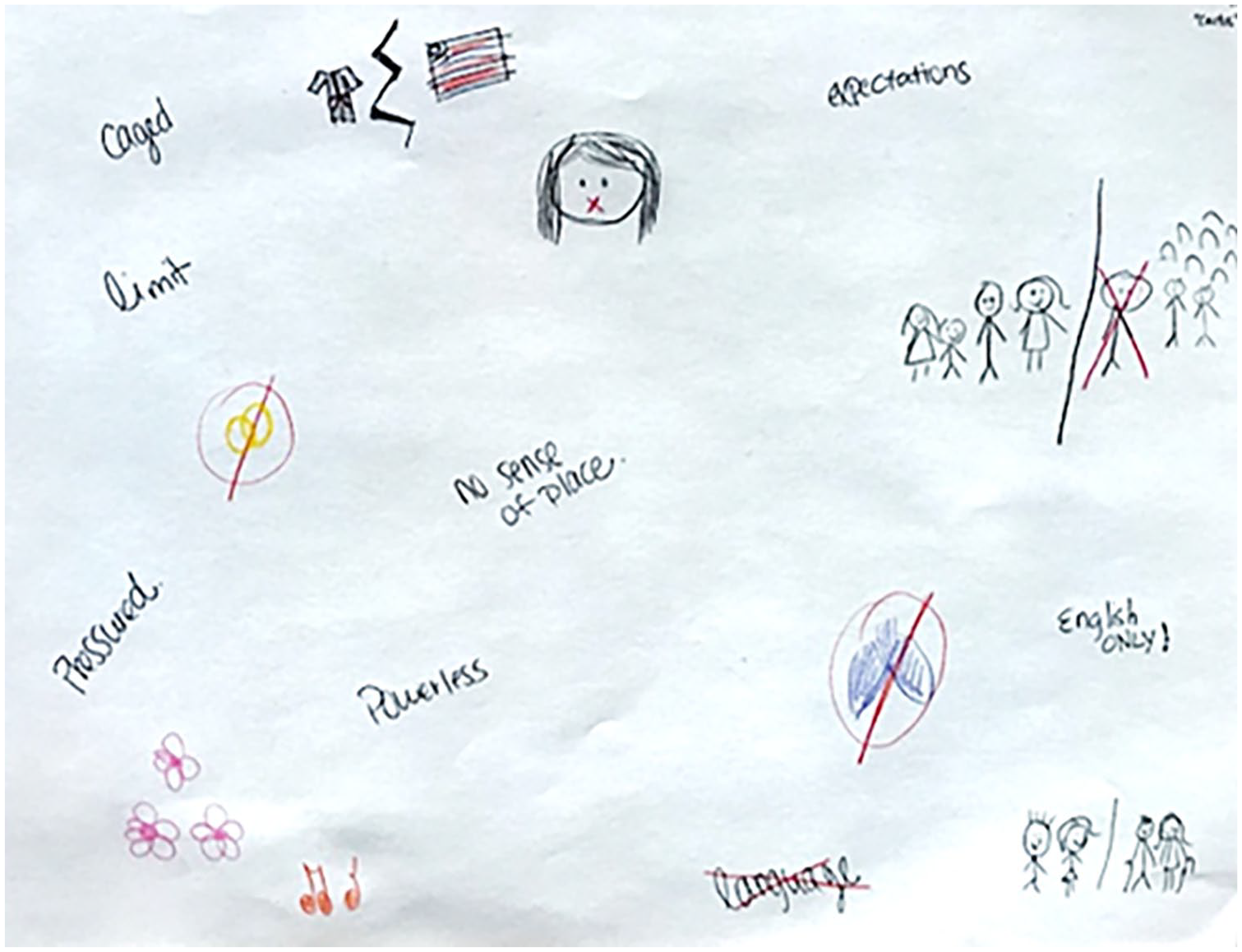
Cactus’s Cultural Identity Map.
Clarifying the nature of that clash, Cactus focused on the open-mindedness and freedom of expression encouraged in American society and the closed-mindedness she perceived in Hmong culture. Like Takashi and J, Cactus reflected on her inability to bring her American-leaning values into her Hmong home environment: “[Hmong] people are like, ‘Don’t do that, it doesn’t look good.’ In the U.S. they’re like, ‘Express yourself, freedom of speech, all of this stuff.’ And when you do that at home it’s, ‘Oh, you know, you’re bad.’”
Cactus’s entire identity map speaks to the nature of this and other culture clashes and contradictions, beginning with the first thing she drew on the map, toward the top center: her face with a crossed-out mouth, which represents her inability to speak up as a Hmong girl. Several other words scattered across her identity map (“caged,” “limit,” “powerless,” “pressured,” and “expectations”) speak to the gendered expectations that she feels have defined and confined her life thus far. Cactus explained that, growing up, she was unable to fulfill the American motto of “being whoever she wants to be” because she was relegated to cooking, cleaning, and babysitting. Now an adult, she circumvents these restrictive gender roles by “just not showing up” to Hmong events in which she will be expected to cook and clean.
Like J, Cactus also highlighted generational disconnects within the Hmong community, with the older generation holding steadfast to traditional Hmong customs and beliefs, and the younger generation of Hmong youth (herself included) leaning more toward American culture. Finding common ground with elders is hard, because, “They’re straight-up from the jungle . . . and we’re straight-up from the hospital. It’s two different things.”
Cactus’s entire map is flooded with challenges inherent in the bicultural experience and the perceived impossibility of synthesizing cultural identities. Even the “happy area” in the lower left corner of her map is not entirely happy. The flowers represent Hmong clothing—a part of Hmong culture she enjoys because it makes her “feel beautiful—like I’m another person, [an] obedient girl, [a] good daughter.” When I pointed out that it sounded as though she did not quite wish to be those things, she replied, “Yea, I don’t want to be that. I’m the bad daughter. But [the clothes are] a good disguise.” For Cactus, then, wearing Hmong clothes offers fleeting adherence to gendered cultural scripts that she generally questions. Yet, elsewhere on her map, Cactus’s crossing out of the Hmong hat symbolizes what she perceives to be the inevitable “death of Hmong culture.” The “happy area” further includes Hmong music, which she enjoys because it connects her to Hmong language. Yet elsewhere on her map, Cactus’s crossing out of “language” represents her observation that Hmong language is being lost among the next generation of Hmong youth, including her own son to whom she primarily speaks in English.
Cactus considers herself “Americanized” because she values freedom of speech (which, she says, Hmong elders label “talking back”) and the pursuit of higher education (which, she says, threatens Hmong men). As a young woman who had a child out of wedlock, Cactus appreciates the wider array of accepted life scripts in American culture and loathes the constant lectures she has received from members of the Hmong community. In her words, “The problem with being Hmong American is that I’m American.” For Cactus, to be “American” is to be without limits, while to be “Hmong”—and particularly a Hmong woman—is to be limited.
Asked to consider the overarching narrative conveyed in her map, Cactus said, The big story? I feel very, very divided. [Being Hmong American] is like contradictions on top of each other. It’s like fire and water, that’s all I can think of. You can’t—I don’t know how that’s gonna work out, you know?
Although she believed it impossible for fire and water to coexist, Cactus predicted that things would “get better” as each generation edges closer toward exclusive alignment with American (rather than Hmong) values.
Discussion
As these cases and the overarching grounded theory reveal, Hmong Americans in this study—across gender, social class, and MEIM score—experienced bifurcated biculturalism. Methodologically, this study highlights the utility of cultural identity mapping as a tool that expands beyond boundaries erected when relying exclusively on language, thereby addressing people’s complex, hidden, and potentially contradictory stances. As such, this method is promising for many other areas of psychology. These and other points are expanded upon in the sections that follow.
Barriers to Biculturalism
The method used presently enabled us to dig beneath the mantra in our field about the adaptiveness of biculturalism (see Chen & Padilla, 2019; Safa & Umaña-Taylor, 2021; Schwartz & Unger, 2010). Although participants in this study self-identified as “bicultural,” the perceived incongruence of heritage and national cultures represents a significant barrier to the establishment of a cohesive cultural identity and helps make sense of Hmong American young adults’ tendency to be more oriented toward American than to Hmong culture (McKenzie et al., 2022; Tsai, 2000). While some recent research points to Hmong American emerging adults’ situational integration of ethnic and national cultures (McKenzie et al., 2022), this study draws attention to challenges in holistic cultural integration that we see among other immigrant-origin youth in the United States (e.g., McKenzie et al., 2023).
Participants used strong language to convey the incompatibility of Hmong American cultures and their resultant cultural identity confusion (e.g., Cactus: “like fire and water,” J: “like being in purgatory”). For female participants, cultural incompatibilities revolved primarily around gender roles and gendered scripts; for Takashi and other males in this study, cultural incompatibilities were primarily religious in nature. Male and female participants alike highlighted incongruent idealized personality traits (e.g., confident vs. humble, assertive vs. deferential) and orientations to self (e.g., individualistic vs. collectivistic). The cultural incongruence was most obvious when comparing expectations of them in academic and home environments—where distinct ideals about how they should think, what they should believe, and how they should behave forced cultural identity compartmentalization (Yampolsky et al., 2015) and cultural frame-switching (LaFromboise et al., 1993)—described eloquently by J, who “switch[es] on and off masks” as she moves “between each world.” It may well be that if cultural frame-switching is done out of necessity (i.e., forced rather than choiceful), it is less adaptive than scholarship often suggests (LaFromboise et al., 1993). This, in turn, may help us understand why Hmong American youth experience cultural challenges in the academic sphere (Takahashi & Nottbohm, 2019): Participating in the academy requires that they “turn off” their Hmongness, while being at home and in other Hmong spaces requires that they “turn off” their Americanness.
This study also helps address the complexity highlighted in previous research, of Hmong American youth simultaneously being prideful of and disconnected from Hmong culture (McKenzie, 2022; McKenzie et al., 2022; Nguyen, 2013; Tsai, 2000). Participants were both prideful about (some) Hmong practices and disdainful of many Hmong values. The focus on practices aligns with research that suggests that practices (e.g., dress, language, food, religion) are important loci of cultural identity (Jensen et al., 2011; Nguyen & Brown, 2010). Yet, even practices that were core to their identification with Hmong culture (e.g., religion, clothing—a symbolic marker of Hmongness) were fraught and, at times, devoid of meaning. Consider, for instance, J and Takashi wearing Hmong clothing just to appease their parents, and Cactus, for whom wearing Hmong clothing offered a portal for connection to and achieving belongingness in Hmong culture, from which she otherwise feels distant.
Cultural identity maps revealed that participants were ambivalent about their ethnic identities. As revealed in the “Findings” section, participants felt both close to Hmong culture (i.e., in their households, with constant reminders from family) and distant from it (in values and embodied identities). Although the origins of this ambivalence may be partially shared—including acculturative stress as a result of acculturation dissonance between themselves and their older relatives (McKenzie et al., 2023)—how this ambivalence and accompanying cultural frustrations was managed varied by participant. J challenged gendered scripts, especially when enforced by Hmong women in positions of power (i.e., her mother, grandmother), and disassociated from her own internal conflict. Cactus avoided Hmong events in which she would be expected to adhere to gendered cultural scripts. As with other Hmong American emerging adults (McKenzie, 2022; Nguyen & Ferguson, 2019, 2022), Takashi cultivated a third cultural identity—Japanese—which offered an onramp for him to maintain alignment with Asianness while “drifting away from” his Hmongness.
Among Takashi and Cactus alike, we further see evidence of internalized stereotypes and oppression (Pyke & Dang, 2003). Contextualizing his affinity for Japanese culture, Takashi compared the idyllic Japanese scenery to the “straw houses and rundown houses” of Laos and Thailand. Cactus further interpreted her intergenerational challenges in light of Hmong elders being “straight-up from the jungle.” In both examples, Hmong are portrayed as uncivilized, impoverished jungle-dwellers—ethnic stereotypes that may have become integrated into their psyche and erected notable barriers to the development of a bicultural identity. We propose that the internalization of ethnic stereotypes serves to distance Hmong American youth from their ethnic heritage culture and promotes assimilation to mainstream American culture. The romanticization of (wealthy) Asian cultures further encourages remote acculturation (Ferguson, 2018) to Asian cultures that possess substantial social capital both in the U.S. and in the global context (e.g., Japan).
Cultural Identity Mapping as a Tool to Express and Process
Methodologically, this study reveals that cultural identity mapping is a powerful tool for facilitating expression and sense-making. Using drawing as a starting point to provoke reflection on potentially covert cultural realities enabled us to explore meanings attached to “being Hmong” and “being American,” thereby heeding Tsai’s (2000) call to understand Hmong American youth’s tendency toward assimilation. Cultural identity mapping therefore assists researchers in accessing participants’ internal experiences and perspectives in a way that more prevalent self-report measures do not. As the present findings reveal, even participants with relatively high Multigroup Ethnic Identity Measure scores commonly held exceptionally complex feelings about their ethnic identity—a complexity that would remain obscured if relying exclusively on survey data.
In spite of the inherent complexity of culture and cultural identity, these terms are regularly reduced—from school and census surveys to educational and employment applications—to labels that young people must proclaim. Throughout the course of their development, young people also regularly receive implicit messages about which cultures are worthy of proclaiming (recall the characteristic constrained set of ethnic/racial cultural identifiers on Takashi’s map), and the realities of young people’s cultural group membership often remain unexplored—even in much of contemporary cross-cultural research. Cultural identity mapping facilitates movement against this current by inviting participants and researchers to pierce through cultural labels to see what is on the other side. By committing symbolic representations of internal cultural realities to a page, participants simultaneously reflect upon and direct their own stories. Cultural identity mapping mobilizes the visual not to replace—but to provoke—the linguistic, offering an authentic starting point from which the participant and researcher can jointly explore the meaning of cultural identification—often revealing meanings that surprise even the story-teller (i.e., the participant). In this way, cultural identity mapping adds to the arsenal of qualitative techniques that put participants in charge of telling their story (i.e., life stories, McAdams, 2001; photovoice, Wang & Burris, 1997).
In recent years, critiques have increasingly been launched at cross-cultural studies for their typically extractive tendency (e.g., Broesch et al., 2020; Gaudry, 2011). When taking part in cross-cultural psychological studies, participants are accustomed to responding to a battery of surveys, rife with boxes to tick and identities to proclaim. Starting instead with a blank piece of paper and the invitation to ponder a single question returns agency to the participant—simultaneously upsetting traditional power dynamics between researchers and the researched and ensuring that findings reflect on-the-ground experiences and struggles—both key in countering the extractive tendency of cross-cultural research (Broesch et al., 2020; Gaudry, 2011). Identity mapping is also ripe for application to other areas of psychological research—perhaps especially when addressing aspects of identity about which individuals may have hidden, complex, and potentially contradictory stances (e.g., sexuality, sexual and gender identity, disability).
Because cultural identity mapping helps individuals consider aspects of themselves that may have previously been opaque, this method also holds therapeutic and pedagogical value. Consider, for instance, Cactus’s (not uncommon) reflection of her cultural identity map, in which she shared that this exercise inspired the realization that she harbors a great deal of negative feelings toward her ethnic culture and experiences a “culture clash”—a realization that was surprising because she had always felt very proud of being Hmong American. By fostering this deeper reflective gaze, the very process of mapping one’s cultural identity may assist young people’s cultural identity development. As such, this method is potentially applicable for therapists (e.g., art therapy; Malchiodi, 2003) and for educators (both by helping educators understand the cultural identities of their students, and by helping students reflect upon and understand their own cultural identities; e.g., Gay, 2018; Will & Najarro, 2022). Educators and therapists may find this method especially useful for adolescents in middle and high school—a developmental period when questions of identity and cultural identity take center stage (Umaña-Taylor et al., 2014).
Limitations and Future Directions
As with any study, the present findings must be understood alongside several limitations. First, the methods used in this study leant itself to exploring the psychological experience of a single participant group: here, second- and 1.5-generation Hmong American emerging adults with relatively high levels of education living in central California. As such, findings are not expected to generalize to other populations. Future research would do well to utilize similar arts-based methods to understand psychological experiences of biculturalism among Hmong American youth living in other Hmong-rich settings (e.g., Minneapolis-St. Paul, MN) and in settings with less dense Hmong populations. Future research would also do well to determine whether bifurcated biculturalism resonates among Hmong American youth with less exposure to formal schooling, and among first-generation Hmong American youth. This method is also ripe for longitudinal adoption—examining whether, for instance, the presently identified cultural identity dissonance may give way to a third consciousness in which space is held for cultural paradox (Anzaldúa, 2012) as Hmong American emerging adults move into established adulthood.
Second, the fact that participants were interviewed by a White female academic may have impacted results. Although she has conducted research with Asian youth for over a decade, the fact that her ethnic heritage did not align with those of her participants could have influenced what participants shared. The interviewer worked to minimize this social distance in multiple ways—most notably, by: (a) constructing a comfortable and informal study environment and describing her previous work with Asian youth prior to the interview; (b) emphasizing to participants prior to their participation that they occupy the role of educator during the conversation; and (c) working closely with Hmong research assistants and collaborators from study design through data analysis. Still, the present findings may have differed if the interviewer and participants shared an ethnic heritage.
Future research should explore the tendency toward bifurcated biculturalism revealed in this study. Hmong Americans are, of course, not the only cultural group for whom contradictions exist between ethnic and national cultures. For example, Mexican cultural values to some extent overlap with Hmong values, at least historically (e.g., strict gender roles and centering the family, which contradicts American values of gender equality and centering the self). Yet, cultural identity mapping research with identical recruitment procedures and conversational prompts suggest that Mexican American emerging adults tend toward blended (vs. bifurcated) biculturalism (McKenzie et al., 2023). Why is that so? Does it have to do with Hmong status as refugees (i.e., the fact that they and/or their parents arrived out of necessity following a traumatic war, vs. volitionally, with the aim of improving their lives)? Does it have to do with their felt experience of invisibility—both in the community (even one with a relatively dense Hmong population) and in the academy (via lack of focus on Hmong Americans, and tendency to collapse this group alongside other “Asians?”). Relatedly, what exactly is the role of ethnic stereotypes, and how does their internalization uniquely contribute to the cultural identity development of Hmong American youth? How might ethnic/cultural groups on campus support—and potentially hinder—Hmong youth ethnic identity exploration and commitment? 2 Future research would do well to explore the reasons behind the bifurcated biculturalism identified in this study, for understanding this might help facilitate the development of a more integrated form of biculturalism.
Importantly, fruitful future directions also entail utilizing the present findings at the institutional level. For emerging adults in this study, educational environments were felt to tacitly promote bifurcated biculturalism by requiring the activation of one’s American self and the silencing of one’s Hmong self. Elsewhere in the interview, however, some participants also highlighted educational experiences that promoted their cultural identity development—particularly coursework that centered the experiences of Asian Americans and the presence of Asian instructors and role models. Educational institutions, then, should consider their role in facilitating the bicultural identity development of underrepresented Hmong and Southeast Asian American youth. This may include, but is not limited to, offering courses that center the experiences of Southeast Asian Americans (SEAA), the establishment and maintenance of SEAA student organizations, and when possible, hiring SEAA faculty and staff. In addition to aligning with suggestions offered by participants in this study, these suggestions overlap with research that highlights the importance of cultural validation in supporting SEAA students (Maramba & Palmer, 2014). That is, places of learning (universities, secondary, and primary schools) must go beyond supporting students’ academic success to supporting their healthy cultural identity development.
Conclusion
This study highlights the complexity of negotiating multiple cultures among Hmong American emerging adults in central California. Although all participants self-identified as bicultural and to some extent endorsed both Hmong and American cultures, findings reveal the perceived incompatibility of these cultures. As a result, participants kept their Hmong American selves separate (i.e., bifurcated biculturalism) and managed their distinct identities by engaging in—for some, almost constant—cultural frame-switching. These findings, therefore, assist interpretation of Hmong American young adults’ orientation toward American (vs. Hmong) culture (McKenzie et al., 2022; Tsai, 2000). Methodologically, this study highlights the utility of identity mapping to examine psychological experiences of biculturalism and other aspects of identity about which individuals may have hidden, complex, and potentially contradictory stances.
Footnotes
Acknowledgements
Our deepest gratitude goes to those who took part in this study. We also offer sincere thanks to the anonymous reviewers and editor, whose thoughtful feedback significantly strengthened this manuscript.
Declaration of Conflicting Interests
The author(s) declared no potential conflicts of interest with respect to the research, authorship, and/or publication of this article.
Funding
The author(s) disclosed receipt of the following financial support for the research, authorship, and/or publication of this article: The authors are grateful to the Department of Child and Family Science at California State University, Fresno, whose financial support made this research possible.
