




Abstract
Prolonged orthodontic treatment is associated with adverse effects, yet safely and efficiently accelerating orthodontic tooth movement (OTM) remains a clinical challenge. Microneedles (MNs) have emerged as a promising minimally invasive platform for localized drug delivery, offering advantages in patient compliance, controlled release, and reduced systemic side effects. In this study, we developed a detachable, hierarchical-release MN patch integrating mesoporous silica nanoparticles (MSNs) within a supramolecular CMC-MPP⊂CB[8] hydrogel for the sustained, localized delivery of receptor activator of nuclear factor kappa-B ligand (RANKL) to accelerate OTM. The resulting MSN@CMC-MPP⊂CB[8] MN patches exhibited excellent biocompatibility and sufficient mechanical strength for gingival penetration. In vitro, MSN encapsulation significantly attenuated the initial burst release, providing sustained RANKL delivery while preserving its bioactivity to induce robust osteoclastogenesis in RAW 264.7 cells. In a rat OTM model, RANKL-loaded MSN MN patches accelerated tooth movement and enhanced alveolar bone remodeling comparably to direct RANKL injection. Crucially, the MN delivery demonstrated significantly less root resorption than direct RANKL injection, indicating better safety through localized and controlled delivery. This minimally invasive MN platform, enabling sustained biomolecule release, represents a significant advancement for safely enhancing orthodontic treatment efficiency.
This is a visual representation of the abstract.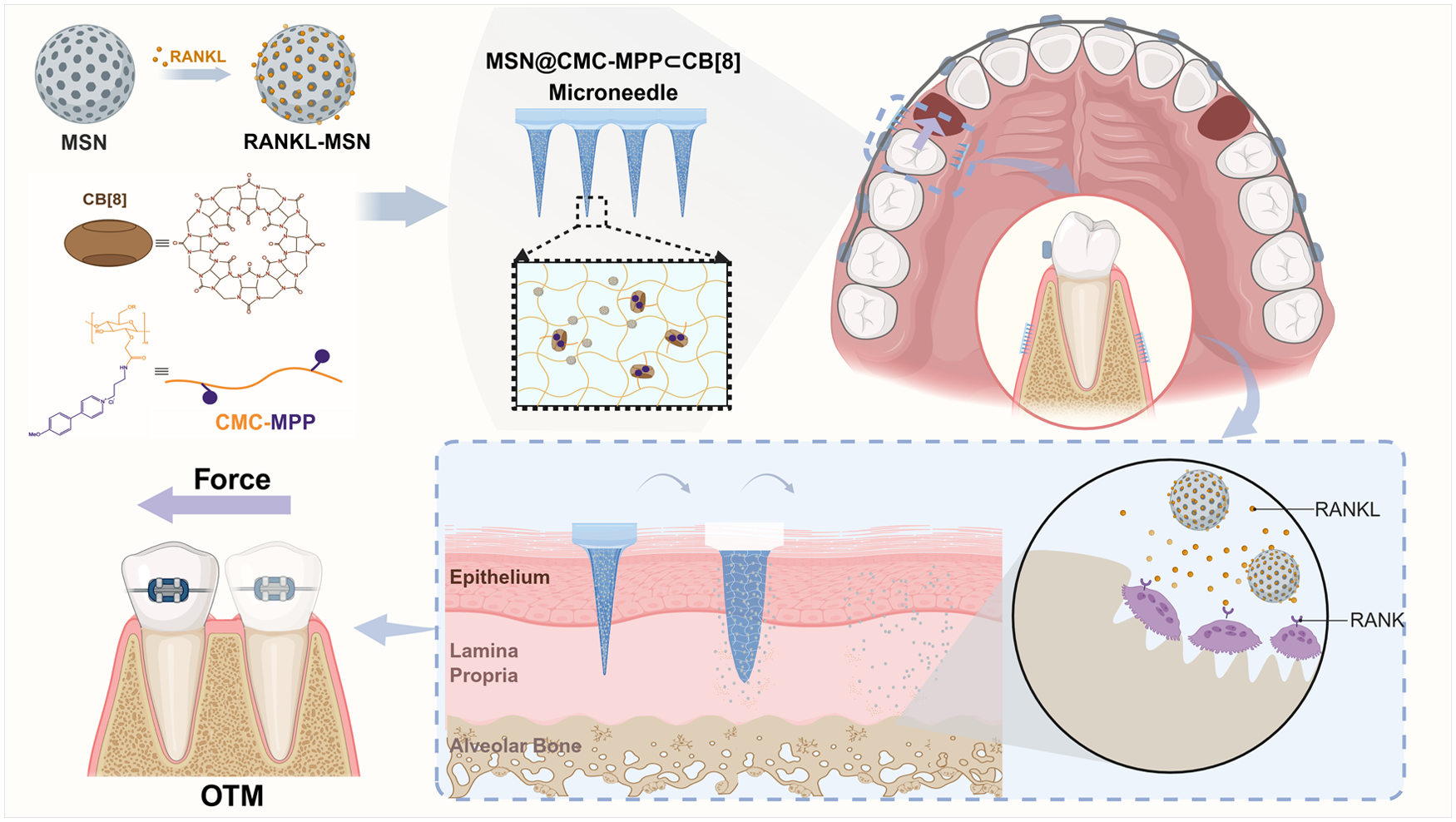
Keywords
Get full access to this article
View all access options for this article.
References
Supplementary Material
Please find the following supplemental material available below.
For Open Access articles published under a Creative Commons License, all supplemental material carries the same license as the article it is associated with.
For non-Open Access articles published, all supplemental material carries a non-exclusive license, and permission requests for re-use of supplemental material or any part of supplemental material shall be sent directly to the copyright owner as specified in the copyright notice associated with the article.
